Archive for the ‘IDF’ category

Israel Targets Palestinian Gun Makers

March 10, 2017

Israel Targets Palestinian Gun Makers, Investigative Project on Terrorism, Yaakov Lappin, March 10, 2017

At first glance, the bridal gown shop in the Palestinian city of Nablus appeared innocuous. But behind the scenes, Israeli intelligence says, the store served as a front for a major West Bank gun parts distribution center.

“Components for weapons were continuously being sold out of there,” a senior Israel Defense Forces (IDF) source told The Investigative Project on Terrorism.

The store turned out to be part of a wide network of weapons dealers who had imported their lethal goods by ordering them on the internet, the IDF stated this week.

Nine suspects, including the store owner, are in custody, and additional members of the weapons trafficking ring remain at large. “They came from all walks of life and from varied layers of Palestinian society,” the source stated.

Since mid-2016, the IDF has been engaged in an intensive, large-scale campaign to seize as many firearms circulating in the West Bank as possible to prevent them from falling into the hands of terrorists.

A growing number of such firearms have been used in deadly attacks, such as the Sarona Market shooting in Tel Aviv last June in which two Palestinian gunmen murdered four people in a restaurant. The gunmen used locally produced automatic rifles, dubbed ‘Carlos’ due to their resemblance to the Carl Gustav Swedish sub-machine gun.

While the latest wave of arrests focused on traders who used the internet to import gun parts, most of those on the IDF’s target list manufacture and assemble guns in local workshops. Seven such workshops have been shut down since the start of 2017, and 84 guns have been seized by Israeli security forces, according to figures made available by the IDF.

“The terrorist threat picture has changed. In the past, the main threat was posed by organized, institutional organizations,” the senior security source said. “For the most part, these were hierarchical terror cells, with a clear division of labor. There was someone responsible for financing, someone else had the designated job of transporting the suicide bomber or gunman, etc. This threat still exists. Hamas is trying to organize such cells all of the time. But the main challenge these days comes from terrorists that we do not have prior knowledge about.”

Lone attackers, or small, localized cells with no organizational affiliation or background of security offenses, are far harder for intelligence services to detect, and these are just the type of terrorists who are likely to use firearms available in their surroundings. These types of attackers, some of whom have suicidal tendencies or personal crises, according to the source, often will attempt simple attacks, using whatever is at their disposal. This can take the form of knife or vehicle attacks, or picking up locally available weapons.

Guns in the West Bank can be purchased by Palestinians for many reasons; whether for personal protection, to defend families and clans, to fire at wedding celebrations, or to reinforce one’s sense of ego.

As long as the guns are cheap and affordable, the source warned, “anyone can get [them]. Many of the shootings cells we captured in the West Bank were armed with these types of weapons.”

A year ago, a locally produced Carlo rifle cost around 2,300 shekels in the West Bank, meaning that Palestinians could purchase it with a single month’s salary, or take the money from family members, before moving ahead with an attack.

“The Sarona Market gunmen had no outside financial support, but still managed to get their hands on their firearms. The suits they wore [to disguise their identities] cost more than their guns,” the source said.

“This is why we are in the midst of an intensive campaign targeting the manufacturing and trade of weapons and gun parts. Even if I can’t get rid of the illegal weapons phenomenon, I can make them less accessible, and much harder to traffic in them.”

The increased Israeli pressure makes it more difficult to obtain guns, and increases the odds of catching people before they can attack. They have to leave their village or neighborhood and move around with the firearms where they can be caught and intercepted by the IDF. “People will fear more getting caught and moving around with these firearms,” the source said.

The Palestinian Authority would also like to see these guns taken off the streets, the source said, since it encourages lawlessness and anarchy in some areas that pose challenges to its rule.

Nablus, Balata Camp (next to Nablus), and Hebron are gun manufacturing focal points, according to IDF assessments. In addition, areas like Ramallah, Kalandia, and Palestinian neighborhoods on the outskirts of Jerusalem have workshops that take air or toy guns and convert them into real firearms using stolen components.

Thefts from IDF soldiers and Israeli civilians, as well as trade with Israeli weapons traffickers who do not care where the guns end up provide other sources of terrorist arms.

Efforts by security forces to stem the tide were beginning to pay dividends, the source said. Today, a Carlo gun costs more than 6,000 shekels, as numbers dwindle.

“With time, we are seeing improvements,” he said. “We are seizing more than we did in the past, and our intelligence techniques have improved, so that we can capture guns not only in homes, but also in the manufacturing locations, and when they are moved around. This is a campaign. No single incident will stamp out the problem. So long as the profit from this trade is big enough compared to the fear of arrest or facing raids, many Palestinians will continue to be active in it. ”

Ultimately, he said, “over time, we will seek to decrease the number of guns and keep raising the price. This will result in less terrorists getting their hands on them, and resorting to less lethal attack forms, such as knife attacks. Our soldiers’ alertness [to knife attacks] means such attacks produce less casualties – meaning that our effort will boost security.”

Trump Admin, Congress Seek to Slash U.N. Funding in Wake of New Anti-Israel Action

March 3, 2017

Trump Admin, Congress Seek to Slash U.N. Funding in Wake of New Anti-Israel Action, Washington Free Beacon, March 2, 2017

“In a region where the use of civilians, including children, as human shields is routine, singling out Israel for condemnation is, in a word, ridiculous,” the White House official said. “If the United Nations’ Watchlist on Children and Armed Conflict has nothing better to do with the United States taxpayer dollars that fund it than engage in a vendetta against our ally Israel, perhaps we should rethink that support.”

***************************************

The White House and Congress are considering slashing U.S. funding to the United Nations in light of its most recent effort to declare the Jewish state’s fighting forces a chief violator of children’s rights, according to multiple conversations with U.S. officials.

The U.N. is working to add the Israeli Defense Forces, or IDF, to a list of entities such as terror groups that are responsible for inhumane acts against children.

The move would be just the latest anti-Israel salvo by the U.N., which caused controversy late last year when, with the backing of the Obama administration, it moved to condemn Israel for building homes for Jewish people in Jerusalem.

The latest action against Israel would add the IDF to the Watchlist on Children and Armed Conflicts, which would designate the Jewish state’s fighting forces as one of the worst offenders of children’s human rights in the world. Other groups and entities on the list include terrorist entities and forces that kill children en masse.

The move has prompted outrage in the White House and on Capitol Hill, where multiple U.S. officials told the Washington Free Beacon that they will no longer stand by as the U.N. singles out Israel for criticism. The effort to counter what they described as the U.N.’s anti-Israel bias is likely to include cutting a large portion of U.S. funding to the organization.

One senior White House official familiar with the Trump administration’s thinking on the matter told the Free Beacon that the president and his senior-most advisers are sick of seeing Israel treated as a pariah by the U.N.

“The Israeli Defense Forces are among the most humane, professional armed forces on the planet,” said the official, who was not authorized to speak on record. “Israel has been aggressively refining its protocols to minimize civilian casualties—so much so that after the 2014 conflict in Gaza the United States sent a delegation to study their best practices.”

The White House official signaled that the Trump administration would pursue a vastly different approach to the U.N. than its predecessor.

The Obama administration came under criticism from the pro-Israel community on numerous occasions for failing to defend Israel adequately in the face of international criticism. This culminated in a flurry of anger late last year when the Obama administration, in one of its final official acts, permitted the U.N. to officially chastise Israel in a break with decades of U.S. policy.

“In a region where the use of civilians, including children, as human shields is routine, singling out Israel for condemnation is, in a word, ridiculous,” the White House official said. “If the United Nations’ Watchlist on Children and Armed Conflict has nothing better to do with the United States taxpayer dollars that fund it than engage in a vendetta against our ally Israel, perhaps we should rethink that support.”

Rep. Peter Roskam (R., Ill.), a vocal defender of Israel, expressed disappointment in the U.N.’s latest action. He told the Free Beacon that Congress is prepared to reduce U.S. financial support for the U.N., which comprises a significant share of the organization’s operational budget.

“The United States Congress is already taking a serious look at United Nations funding levels in light of a number of recent actions unfairly targeting Israel,” Roskam said. “Classifying the IDF, one of the most professional and responsible military forces in the world, alongside terrorist groups like ISIS and Boko Haram is an absurdity.”

“If the U.N. goes through with this,” Roskam said, “the calls for reduced funding will grow even louder.”

Other sources who spoke to the Free Beacon about the matter said that the effort to single out the IDF is part of a broader strategy by anti-Israel organizations to mainstream hatred of the Jewish state in Turtle Bay.

“It’s a scam,” said one senior congressional adviser who is working with multiple offices on Capitol Hill to reform the U.N. “The U.N. wants excuses for its anti-Israel diplomacy, so it facilitates anti-Israel NGOs. Then those NGOs circle back and call on the U.N. to take anti-Israel actions, which provides the excuse that the U.N. wanted. It’s time for Congress to put a stop to this stupid game.”

​The next war: Hizballah tunnels, pocket drones

February 27, 2017

The next war: Hizballah tunnels, pocket drones, DEBKAfile, February 27, 2017

(Until January 20th, Israel had to deal with the anti-Israel Obama administration. Had Israel killed Hamas rather than allowing it to live and recover, U.S. policy toward Israel would have been even worse. Remember the complaints about Israel’s “disproportionate” response to Hamas rockets? With a pro-Israel president in Washingon, it seems reasonable to hope that the “no-winners, no-losers doctrine” military doctrine will quickly atrophy and die. — DM)

threatshamashizballah480eng

After years of denial, the IDF is now ready to admit that Hizballah has built two kinds of tunnel running from Lebanon under the border into Israel. One type is meant as a pathway for Hizballah Radwan Force commandos to infiltrate northern Israel and seize Galilee villages, in an area up to the Mediterranean town of Nahariya. The other type will be crammed with hundreds of kilos of explosives for remote detonation.

For Israel, this no-winners, no-losers doctrine has saved the radical Palestinian Hamas from ever having to hoist a white flag. It caused the IDF’s two successful anti-terror Gaza wars of Dec.2008-Jan. 2009 and July-Aug. 2006 to be stopped halfway through. The troops were left to cool their heels until the government decided how to proceed. In both conflicts, the troops were ordered to stop fighting in mid-operation and pull back behind the border. Although the second operation managed to halt Hamas’ long rocket barrage from the Gaza Strip and allow Israelis living within range normal lives, Hamas was left in belligerent mode.

***************************

Leaks from the State Comptroller’s report, due out Tuesday, Feb. 28, have sparked a storm of recriminations among the politicians and generals who led the IDF’s 2014 operation, which ended nearly a decade of constant Palestinian rocket fire on southern Israel. The argument centers on how the security cabinet headed by Prime Minister Binyamin Netanyahu and the military, led then by defense minister Moshe Yaa’lon and former Chief of Staff Lt. Gen. Benny Gantz, prepared for and grappled with the threat of terror tunnels. A cabinet member, the hawkish education minister, Naftali Bennett, accuses them of falling down on the job.  They charge him with going after political capital.

DEBKAfile’s military sources take exception to the furious focus on a past war – the post mortem  of any conflict will always pick at faults – when the new menaces staring Israel in the face should be at the forefront of the national discourse.

Some of the most striking examples are noted here:

1. President Bashar Assad has just informed Iran that he is willing to place Syrian territory at the disposal of the Revolutionary Guards and Hizballah for shooting missiles into Israel.

Israel’s policy of non-intervention in Syria’s six-year civil war has therefore become a boomerang. Hizballah has been allowed to relocate a second strategic missile arsenal to the Qalamoun Mountains in Syria, after procuring advanced weapons systems from Iran, and gaining combat skills on the Syrian battlefield. The Shiite terrorist group has learned out to fight alongside a regular big-power military force, such as the Russian army.

It is therefore not surprising to hear Hizballah leader Hassan Nasrallah bragging confidently about his ability to vanquish Israel.

So what is Israel doing to counter this peril? Not much. From time to time, the IDF mounts an air strike against a weapons arsenal or missile depot in Syria. That has as much effect on the military threat building up in Syria as the tit-for-tat air strikes against Hamas in the Gaza Strip.

How was Hizballah allowed to attain a capability for shooting thousands of rockets a day at Israeli cities from two countries? Why were the air strikes staged over Syria not directed against Hizballah’s rocket depots in Lebanon?

Many words have been poured out over the Hamas tunnels from the Gaza Strip., but what about Hizballah’s tunnels from Lebanon? After years of denial, the IDF is now ready to admit that Hizballah has built two kinds of tunnel running from Lebanon under the border into Israel. One type is meant as a pathway for Hizballah Radwan Force commandos to infiltrate northern Israel and seize Galilee villages, in an area up to the Mediterranean town of Nahariya. The other type will be crammed with hundreds of kilos of explosives for remote detonation.

How are Israel’s army strategists addressing this threat?

One answer came a few days ago from Maj. Gen Yoel Strick, commander of the home command, who is about to step into his new appointment as OC Northern Command.

He recently disclosed a plan to evacuate entire locations which are potentially on the front line of a conflict with Hizballah. He is aware of the shock effect on the country, which abides by the national ethos of never retreating before an enemy. But he also argues that the only way the IDF can effectively fight Hizballah invaders and eject them from Israeli soil is to keep civilians out of the way of the battle.

4. On Thursday, Feb. 23, an Israel Air Force fighter knocked down a miniature unmanned flying object over the Mediterranean coast of the Gaza Strip. It is already obvious that drones of one type or another, including the cheap and easily available quadcopter pocket drone, will serve the enemy in any future war, in large numbers.

When scores of pocket drones loaded with explosives are lofted, some may be shot down by Israeli warplanes and air defense systems, but some will escape and drop on target, because they are too small to be detected by the radar of air defense systems like Iron Dome and blown out of the sky.

Nevertheless, Israel can address these dangers, provided its generals embrace a major change of strategy, or doctrine. It is incumbent on the IDF to discard the doctrine which holds that modern wars can never end in a straight victory or defeat. This preconception has ruled the thinking of Israeli generals in the 11 years since the 2006 Lebanon war, although it is alien to the Middle East conflict environment.

Take, for example, the Syrian civil war. The Russian, Syrian, Iranian and Hizballah’s armies have clearly won that war and preserved a victorious Assad in power.

In Yemen, too, the Saudi army and its Gulf allies are fighting to win the war against the Houthi rebels but falling short of victory, notwithstanding their superior Western armaments.

In 2014, the Islamic State beat the Iraqi army and captured vast swathes of Iraq and Syria. The jihadists are still holding onto most of this territory – even against US-backed military efforts three years later. They will do so until they are vanquished on the battlefield.

For Israel, this no-winners, no-losers doctrine has saved the radical Palestinian Hamas from ever having to hoist a white flag. It caused the IDF’s two successful anti-terror Gaza wars of Dec.2008-Jan. 2009 and July-Aug. 2006 to be stopped halfway through. The troops were left to cool their heels until the government decided how to proceed. In both conflicts, the troops were ordered to stop fighting in mid-operation and pull back behind the border. Although the second operation managed to halt Hamas’ long rocket barrage from the Gaza Strip and allow Israelis living within range normal lives, Hamas was left in belligerent mode.

Because of this doctrine, Hizballah, like Hamas, feels free to build up its arsenal ready for the next war. Iran’s Lebanese proxy watches the IDF withholding action for containing its buildup. Certain that Israeli generals won’t be fighting for victory, Hizballah and Hamas have always felt they were in no danger of being wiped out.

Hamas, therefore, chose the tactic of inflicting maximum damage and casualties on Israel, without fear of major reprisals. Hence, in the early 2000s, the Palestinian terrorists ruling Gaza began shooting primitive Qassam rockets at Israeli civilian locations, moving on over the years to more advanced missiles, followed by terror tunnels and are now building an air force of exploding pocket drones.

If State Comptroller Joseph Shapiro had addressed those present and future threats when he exposed the mishandling of the tunnels of 2014, his report would have served an important security and national purpose. But since he confined himself to determining who said what to whom – and why – his report is just a platform for political bickering.

Hamas headquarters uncovered north of Jerusalem

January 16, 2017

Hamas headquarters uncovered north of Jerusalem, Israel National News,Uzi Baruch, January 16, 2017

hamasguysIllustration Flash90

Thirteen Hamas terrorists, including a member of the Palestinian Authority’s Legislative Council, were arrested overnight in a joint operation by the IDF and Shin Bet internal security agency.

The operation comes on the heels of the discovery of a regional headquarters of the Hamas terror group in the Ramallah district, north of Jerusalem.

The base is believed to have served as the center of operations for dozens of Hamas terrorists in Samaria, and may be part of a broader effort by Hamas to expand its influence in the Ramallah area. Payments to jailed terrorists and their families, outreach efforts to local Palestinian Authority residents, public demonstrations, and the operation of a Hamas student group were all managed from the headquarters.

During the raid of the facility overnight, IDF soldiers and Shin Bet agents confiscated cash, vehicles, and propaganda material used by Hamas for recruitment purposes.

“The discovery of this [terror] infrastructure reveals Hamas’ continuing strategic intentions to operate and establish bases in the area, as part of an effort to weaken the [Palestinian] Authority; all while attempting to commit serious acts of terror,” a Shin Bet spokesperson said.

“The Shin Bet security agency and the IDF will continue to operate with determination to disrupt these [terror] infrastructures in advance [of possible attacks].”

Eyewitness: Rammed Soldiers Hesitated to Shoot Fearing Court Martial (Graphic)

January 8, 2017

Eyewitness: Rammed Soldiers Hesitated to Shoot Fearing Court Martial (Graphic), The Jewish PressDavid Israel, January 8, 2016

truck-attackPhoto Credit: Screenshot

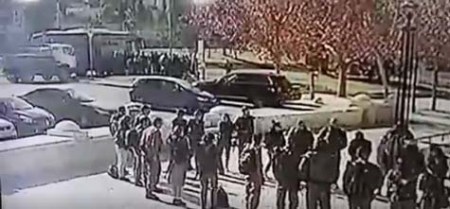
The tour guide who accompanied the IDF cadets on their visit to Armon Hanatziv in Jerusalem Sunday afternoon told Army Radio that they hesitated to shoot at that truck as it was speeding in their direction. He attributed their fateful pause to last week’s manslaughter conviction of Sgt. Elor Azaria by a military panel of judges for his shooting of a subdued terrorist in hebron.

Stopping just short of placing the blame for the four dead soldiers on the court, the tour guide said he was the only one shooting his handgun at the terrorist truck driver, and only after he had emptied his magazine did some cadets start shooting.

The tour guide spoke to Army Radio from the back of an ambulance, and sounded highly agitated. He said every IDF soldier has been keeping abreast of the Azaria trial and Thursday’s verdict affected them directly. “All they’re being told recently is – watch it,” he reiterated.

Moshe Aharon, a bus driver who was present at the scene of the attack told Army Radio: “A group of soldiers with their duffle bags were standing there, I just let them off the bus – when a truck came ramming into a group of the soldiers and ran over them. The soldiers shot at him and he ran over them a second time. He got to my bus, then switched to reverse and ran over them again.”

Four soldiers died and one was critically wounded in Sunday’s attack. A dozen more soldiers were wounded.

According to Channel 10 News, Arab passers by who witnessed the fatal attack stood and applauded.

The IDF’s New Social Contract

January 6, 2017

The IDF’s New Social Contract, Front Page MagazineCaroline Glick, January 6, 2016

flickr_-_israel_defense_forces_-_karakal_winter_training_1

Azaria is the first victim of a General Staff that has decided to cease serving as the people’s army and serve instead as B’Tselem’s army. The call now spreading through the Knesset for Azaria to receive a presidential pardon, while certainly reasonable and desirable, will likely fail to bring about his freedom. For a pardon request to reach President Reuven Rivlin’s desk, it first needs to be stamped by Eisenkot.

A pardon for Azaria would go some way toward repairing the damage the General Staff has done to its relationship with the public. But from Eisenkot’s behavior this week, it is apparent that he feels no need and has no interest in repairing that damage.

******************************

Sgt. Elor Azaria, who was convicted of manslaughter Wednesday for shooting a terrorist in Hebron last March, is a symptom of what may be the most dangerous threat to Israeli society today.

Azaria, a combat medic from the Kfir Brigade, arrived at the scene of an attack where two terrorists had just stabbed his comrades. One of the terrorists was killed, the other was wounded and lying on the ground, his knife less than a meter away from him.

A cameraman from the foreign-funded, Israeli- registered anti-Israel pressure group B’Tselem filmed Azaria removing his helmet and shooting the wounded terrorist. According to the military judges, the film was the centerpiece of the case against him.

The day of the incident, the General Staff reacted to the B’Tselem film with utter hysteria. Led by Chief of General Staff Lt.-Gen. Gadi Eisenkot and then-defense minister Moshe Ya’alon, Israel’s generals competed to see who could condemn Azaria most harshly.

For the public, though, the issue wasn’t so cut and dry. Certainly Azaria didn’t act like a model soldier. It was clear, for instance, that he acted without proper authority and that his action was not permitted under the rules of engagement then in effect in Hebron.

But unlike the IDF’s senior leadership, the public believed that the fact that it was B’Tselem that produced the film meant that it had to be viewed with a grain of salt.

The name “B’Tselem” was seared into the public’s consciousness as an organization hostile to Israel and dedicated to causing it harm with the publication of the UN’s Goldstone Commission Report in 2009. Among the Israeli-registered groups that provided materials to the biased UN commission charged with finding Israel guilty of war crimes during the course of Operation Cast Lead against Hamas in late 2008 and early 2009, B’Tselem made the greatest contribution.

The Goldstone Report cited B’Tselem as the source for its slanderous “findings” 56 times.

After the UN published the Goldstone Report, Michael Posner, the US assistant secretary of state for human rights, visited Israel and met with Jessica Montell, B’Tselem’s executive director at the time.

The US Embassy’s official report of their meeting was published by WikiLeaks.

During their meeting, Montell told Posner that her group’s goal in providing the Goldstone Commission with materials was to force the government to pay a heavy price for its decision to fight Hamas, by criminalizing Israel in the court of world opinion.

As B’Tselem saw it, Israel needed to come to the point where it would consider whether it could “afford another operation like this.”

Montell explained that from B’Tselem’s perspective the root of the problem with Israel is the Israeli public. The public is the source of Israel’s bad behavior, according to B’Tselem, because it “had zero tolerance for IDF killed.” As far as the public is concerned, she said, harm to Palestinian civilians is preferable to harm to IDF soldiers.

Since, in B’Tselem’s view, the public’s commitment to the lives of its soldiers meant that it would not constitute a “moral check on war,” and check the bellicosity of IDF commanders, it fell to B’Tselem to make the IDF brass and the government care more about world opinion than they care about what the public thinks.

The public’s condemnation of B’Tselem after its role in compiling the Goldstone Commission’s libelous accusations against the IDF was made public made no impression whatsoever on the group.

Following Operation Protective Edge in 2014, B’Tselem’s materials were cited 67 times by the report of the biased UN commission put together to slander Israel.

In 2007, B’Tselem launched its “Camera Program.”

The camera initiative involved providing video cameras to B’Tselem employees and volunteers in Judea and Samaria in order to document the actions of Israeli security forces and civilians in the areas.

In many cases, the videos B’Tselem produced distorted reality for the purpose of criminalizing both groups.

For instance, in 2011, B’Tselem gave a film to Ynet’s Elior Cohen that purported to show Israeli police brutally arresting a young Palestinian boy and preventing his mother from coming to the police station with him.

But as CAMERA showed at the time, B’Tselem’s portrayal of events was fanciful at best. In all likelihood, the event was staged by the B’Tselem photographer.

At the outset of the film the boy is unseen as he throws rocks at a police van. The boy is first seen as he runs toward the B’Tselem camerawoman. For her part, the camerawoman screams at the police and identifies herself as from B’Tselem.

The police are shown asking the boy’s mother repeatedly to join them in the car. As she stands poised to enter the vehicle, a Palestinian man is shown telling her in Arabic not to go.

In July 2016, B’Tselem released a film taken in Hebron during an attempted stabbing attack by a female Palestinian terrorist against Israel police at a security checkpoint outside the Cave of the Patriarchs.

The police reported that the terrorist tried to stab a policewoman who was checking her in an inspection room. Another policewoman shot and killed her.

B’Tselem claimed that its film proved that the female terrorist was shot for no reason. But the fact is that it does no such thing. As NGO Monitor noted, the B’Tselem film neither contradicts nor proves the police’s version of events.

Over the years, the public’s growing awareness of B’Tselem’s unwavering hostility went hand in hand with its growing distress over what was perceived as the IDF’s willingness to sacrifice the safety of troops to prevent it from receiving bad press.

For instance, in 2012, a film went viral on social media that showed a platoon of combat engineers fleeing from a mob of Palestinians attacking with rocks, Molotov cocktails and slingshots.

When questioned by reporters, the soldiers said that they had repeatedly asked their battalion commander for permission to use force to disperse the crowd and they were repeatedly denied permission.

Retreat was their only option.

In 2015, another film went viral showing a group of Palestinian women hitting and screaming at a soldier trying to arrest one of them for throwing rocks at his platoon. He did nothing as he absorbed the blows. And no harm came to the women who assaulted him.

Along with the films, came stories that soldiers on leave told their friends and family about the IDF’s rules of engagement. The tales were always the same. The rules of engagement are so restrictive that all initiative is placed in the hands of the enemy. Not only can terrorists attack at will. They can flee afterward and expect that no harm will come to them, because what is most important, the soldiers explain, is to ensure that IDF maintains its reputation as the most moral army in the world.

This was the context in which Azaria killed the wounded terrorist.

Although the headlines relate to Azaria, and his family members have become familiar faces on the news, the fact is the reason the Azaria affair was the biggest story of the year is that it really has very little to do with him.

There are three forces driving the story.

First of course, there is B’Tselem.

B’Tselem’s produced the film to advance its goal of obliging Israel’s national leadership, including the IDF brass, to care more about “world opinion” than about the opinion of Israeli citizens.

Second then, is the pubic that cares more about the lives of IDF soldiers than about what the world thinks of it.

Finally, there is the IDF General Staff that is being forced to pick which side it stands with.

Since Israel was established nearly 70 years ago, the relationship between the IDF and the public has been based on an often unstated social contract.

From the public’s side, Israel’s citizens agree to serve in the IDF and risk their lives in its service.

Moreover, they agree to allow their children to serve in the military and to be placed in harm’s way.

From the IDF’s side, the commanders agree to view the lives of their soldiers as sacrosanct, and certainly as more precious than the lives of the enemy and the enemies’ society.

The third side is the General Staff. In the years leading up to the Azaria affair the generals were already showing disturbing signs of forgetting their contract with the public.

The films of fleeing soldiers and the rules of engagement weren’t the only signs of our military leadership’s estrangement.

There were also the promotions given to radical lawyers to serve in key positions in the Military Advocate-General’s unit, and the red carpet treatment given to radical leftist groups like B’Tselem that were dedicated to criminalizing soldiers and commanders.

Since the shooting in Hebron, the General Staff’s treatment of the public has become even more disdainful.

Ya’alon and Eisenkot and his generals have repeatedly offended the public with comparisons of “IDF values” with alleged processes of barbarization, Nazification and ISIS-ization of the public by the likes of Azaria and his supporters.

If there was a specific moment where the military brass abandoned its compact with society once and for all, it came on Tuesday, the day before the military court convicted Azaria of manslaughter. In a speech that day, Eisenkot insisted that IDF soldiers are not “our children.” They are grownups and they are required to obey the orders they receive.

By making this statement the day before the verdict in a case that pitted society against the General Staff, which sided with B’Tselem, Eisenkot told us that the General Staff no longer feels itself obligated by a sacred compact with the people of Israel.

Azaria is the first victim of a General Staff that has decided to cease serving as the people’s army and serve instead as B’Tselem’s army. The call now spreading through the Knesset for Azaria to receive a presidential pardon, while certainly reasonable and desirable, will likely fail to bring about his freedom. For a pardon request to reach President Reuven Rivlin’s desk, it first needs to be stamped by Eisenkot.

A pardon for Azaria would go some way toward repairing the damage the General Staff has done to its relationship with the public. But from Eisenkot’s behavior this week, it is apparent that he feels no need and has no interest in repairing that damage.

As a result, it is likely that Azaria will spend years behind bars for killing the enemy.

Moreover, if nothing forces Eisenkot and his generals to their senses, Azaria will neither be the last nor the greatest victim of their betrayal of the public’s trust.

Palestinian Father Tries to Get Son Killed

July 31, 2016

Palestinian Father Tries to Get Son Killed, Power LineJohn Hinderaker, July 31, 2016

In this video of a weekly demonstration near Modiin Illit, shot yesterday, you see a Palestinian father urging his young son toward a group of IDF soldiers, yelling at them to shoot him, as explained here. What greater honor for a four-year-old boy than to be on the evening news as a “martyr”? The soldiers don’t take the bait; I interpret their reaction as one of disbelief. One of them shakes hands with the boy. The father yells at his son to throw rocks at the soldiers, but he can’t throw hard enough to do any damage.

https://www.youtube.com/watch?v=OIN6xAoHQak

Syrian-Russian Provocations Could Spark Golan Clash

July 28, 2016

Syrian-Russian Provocations Could Spark Golan Clash, DEBKAfile, July 28, 2016

EinZivan2

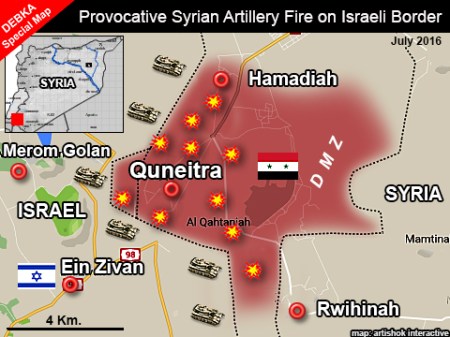
For four days since July 25, the Syrian army has been continuously firing artillery batteries – moved close to Israel’s defense lines on the Golan border – in a manner that comes dangerously close to provoking an Israeli response. This carefully orchestrated Syrian campaign goes on around the clock.

It is the first time in the six years of the Syrian war that Bashar Assad has ventured to come near to provoking Israel. But now he appears to be emboldened by his Russian ally.

The IDF is holding its fire for the moment. But Israeli military and government leaders know that the time is near for the IDF to be forced to hit back, especially since it is becoming evident that the Syrian army’s steps ae backed by Russia.

DEBKAfile’s military sources provide details of the Syrian steps:

  • The Syrian army’s 90th and 121nd battalions have been firing their artillery batteries non-stop across a 10km band along the Golan border from Hamadia, north of Quneitra, up to a point facing the Israeli village of Eyn Zivan. (See attacked map).
    This means that the Syrian army has seized the center of buffer zone between Israel and Syria and made it a firing zone.
  • This artillery fire fans out across a radius that comes a few meters short of the Israeli border and the IDF troops stationed there. It then recedes to a distance of 500 to 600 meters and sweeps across the outposts and bases of the Syrian rebel forces believed to be in touch with Israel or in receipt of Israeli medical aid.
  • The new Syrian attack appears to hold a message for Jerusalem: For six years, you supported the rebels against the Assad regime in southern Syria. That’s now over. If you continue, you will come face to face with Syrian fire.
  • Damascus is also cautioning those rebels:  For years, you fought us with Israel at your backs. But no longer. Watch us bring you under direct artillery fire, while the IDF sits on its hands.
  • On July 26, Russian media published an article revealing that Russia had delivered to the Syrian Air Force, advanced SU-24M2 front-line bombers, which is designed for attack on frontlines of battle. Israeli officials were unpleasantly taken aback by the news. Up until now, the Russians and Syrians refrained from deploying air strength in South Syria near the Israeli border. Now the Syrian air force has the means to do so.
  • DEBKAfile military sources report that the SU-24M2, following recent upgrades and modifications in Russian factories, is now capable of dropping smart bombs – ballistic bombs with a guidance system on their tails that enable them to hit targets with precision.This guidance system does not rely on US GPS satellites but rather the equivalent Russian GLONASS system which is linked to a network of 21 Russian satellites and partially encrypted for military usages.
    In addition, the SU-24M2 is equipped with a system that projects the information the pilot needs (flight details and battle details) on the plane’s windshield (head-up display) and on the pilot’s visor.
  • The Russians delivered to the Syrians two of these sophisticated airplanes this week, out of 10 that they will supply soon.

The IDF has concluded that it is only a matter of time before these planes appear in Southern Syria and so generate a new and highly combustible situation on Israel’s northern and northeastern borders.

The Russians are colluding with Damascus to inform Israel that it will no longer be allowed by either to continue backing the rebel forces in southern Syria or sustain the buffer zone which they man.

Israel may pay dear if Prime Minister Binyamin Netanyahu, Defense Minister Avigdor Lieberman, and Chief of Staff Lt. Gen. Gadi Eisenkot decide to continue to abstain from hitting back at the Syrian fire which is aimed every few hours at the vicinity of IDF posts or the impending arrival of Russian bombers. The price in store would be the weakening of the IDF’s hold on the Golan border.

IDF bulldozers with tanks enter Golan DMZ

July 13, 2016

IDF bulldozers with tanks enter Golan DMZ, DEBKAfile, July 13, 2016

GolanIsrael_Zone

Israeli military bulldozers backed by tanks have crossed into the demilitarized zone dividing the Israeli and Syrian Golan borders. They are building a line of fortifications and anti-tank trenches 300-500 meters inside the DMZ.

This is the first time in the six-year Syrian war that the IDF has openly operated on the Syrian side of the border. The force has not so far run into opposition- or indeed any word of protest – or even mention – by Assad regime officials in Damascus.

The sole reference to Israeli military movements in the DMZ has come from a small Syrian rebel group which described them.

DEBKAfile’s military sources report that the IDF operation was still going forward Wednesday, July 12, on a patch of terrain facing the Israeli Golan village of Ein Zivan, on the one hand, and the Syrian town of Quneitra, on the other.

The enclave splitting the Golan between Syria and Israel is defined in the 1974 armistice agreements as a demilitarized zone under the military control of the UN Disengagement Observer Force (UNDOF) and Syrian civilian administration. It is bounded by two strips of land around 10km deep where each side is permitted to maintain diluted military strength. No ground-to-air missiles may be deployed inside a 25km radius from the DMZ.

It was agreed that Syrian nationals forced by the October 1973 war and its aftermath to leave their homes would be able to return. Ruined Quneitra was later handed back to Syria against a commitment by its government to repopulate the town and ban terrorist activity and infiltrations of Israel from the Golan sector.

Both commitments were given orally to the US government.

However, the Syrian war as it unfolded in the last two years turned the deal on its head. The UN observers abandoned their posts, leaving behind a void that was partly filled by Syrian troops and a motley assortment of rebel groups.

But the DMZ was left mostly unoccupied as both Israel and Syria tried to preserve at least the semblance of the deal intact. However, Assad’s allies Iran and Hizballah have repeatedly attempted to plant a forward military and terrorist presence opposite Israel’s Golan defense lines – with avowed hostile intent.

The silence from Damascus on Israel’s military steps on the Golan may be no more than a respite as the Syrian ruler waits for Tehran’s endorsement of joint Syrian-Iranian-Hizballah counteraction.

Our sources add that IDF military steps on the ground were accompanied by unusual Israeli Air Force movements over Syria and Lebanon, and elevated preparedness on the 10th anniversary this week of the Lebanon war fought between Hizballah and Israel.

It was noted that Hizballah refrained from celebrating the occasion and omitted its customary boasts of a “great victory” – thereby intensifying the sense in Israeli military circles that Iran’s Lebanese proxy may be cooking up a surprise operation.

A Palestinian 9-bomb ambush for IDF

May 11, 2016

A Palestinian 9-bomb ambush for IDF, DEBKAfile, May 11, 2016

The bomb trap which seriously injured an Israeli officer at the Hizmeh checkpoint north of Jerusalem Tuesday night  was primed for a multiple  terror attack. The trap consisted of four iron pipe bomb stuffed with explosives, screws and sharp nails. Another explosive devices, some of which were attached   to a gas canister, failed to explode because of a technical malfunction and so averted a major disaster.

The most likely scenario according to our sources was for the terrorists to spring the bomb trap in two wave: the first four to blow up against the IDF patrol  and the rest to hit the responders to the first explosion, including rescue teams, and   intelligence and senior officers.

The initial conclusion gained by DEBKA counterterrorism from the data available is as follows:

1. This was no lone wolf event. It was a complex operation carried out by a competent team experienced in the building and placement of rigged explosive. Part of the team head nearby ready to set off the second wave of pipe bombs.

The plot was hatched in total secrecy. Neither Israeli intelligence nor the police caught any sign of the planned attack. Had there been any suspicion  a bomb squad would have inspected the route taken by the IDF patrol in advance.

2. Although the Israeli military sealed off Judea and Samaria for three days starting Tuesday night the eve of Remembrance  Day for the Fallen men and women of IDF – like “other sensitive dates” of the year, Palestinian terrorist were nonetheless able to reach their target.   It was only by sheer luck that a major disaster was averted. But one young officer paid the price.

Our source reports that this is the first time Palestinian terrorists are known to set up a complicated bomb trap of this kind. It must been assumed that some Palestinian organization received instructions in this skill from Hizballah who practiced it with devastating effect in Lebanon in the late nineties.