Cartoon of the Day
By A.F. Branco Thursday, March 19, 2015 at 5:15pm

(Note the placement of the flags. – LS)
Cartoon of the Day
By A.F. Branco Thursday, March 19, 2015 at 5:15pm
(Note the placement of the flags. – LS)
From Tel Aviv to Turtle Bay
BY JOHN HUDSON, COLUM LYNCH MARCH 18, 2015 Via Foreign Policy

(Sorry, I beg to differ. Obama is not a Chamberlain. He’s worse. He’s vengeful and will utilize whatever means at his disposal to get his way. Israel is about to get a big taste of what we’ve been getting all along here in the US. Not only that, I predict he will incite the minorities in Israel and try to portray the Israelis as racist and not the type of democracy the world should tolerate. – LS)
The White House hoped a new Israeli prime minister would resume peace talks with the Palestinians. With Netanyahu holding on, the administration is weighing a turn to the U.N. to help force a deal.
After years of blocking U.N. efforts to pressure Israelis and Palestinians into accepting a lasting two-state solution, the United States is edging closer toward supporting a U.N. Security Council resolution that would call for the resumption of political talks to conclude a final peace settlement, according to Western diplomats.
The move follows Israeli Prime Minister Benjamin Netanyahu’s decisive re-election Tuesday after the incumbent publicly abandoned his commitment to negotiate a Palestinian state — the basis of more than 20 years of U.S. diplomatic efforts — and promised to continue the construction of settlements on occupied territory. The development also reflects deepening pessimism over the prospect of U.S.-brokered negotiations delivering peace between Israelis and Palestinians.
Shortly before this week’s election, the United States informed its diplomatic partners that it would hold off any moves in the U.N. Security Council designed to put Israel on the spot at the United Nations in the event that Netanyahu’s challenger, Isaac Herzog, won the election. But U.S. officials signaled a willingness to consider a U.N. resolution in the event that Netanyahu was re-elected and formed a coalition government opposed to peace talks. The United States has not yet circulated a draft, but diplomats say Washington has set some red lines and is unwilling to agree to set a fixed deadline for political talks to conclude.
“The more the new government veers to the right the more likely you will see something in New York,” said a Western diplomat.
Netanyahu’s government will likely be made up of right-wing and Orthodox parties adamantly opposed to making concessions to Palestinians. According to a statement from Netanyahu’s office, the Israeli leader has already consulted with party leaders he plans to add to his coalition, including Naftali Bennett of the pro-settlement Jewish Home party, Avigdor Lieberman of the far-right nationalist Yisrael Beitenu party, and leaders of the ultra-Orthodox Shas and United Torah Judaism parties.
On Wednesday, State Department spokeswoman Jen Psaki did not rule out the possibility of the United States supporting a U.N. resolution on Israel-Palestine.
“We’re currently evaluating our approach. We’re not going to prejudge what we would do if there was a U.N. action,” she told reporters.
For decades, Democratic and Republican administrations have resisted a role for the U.N. Security Council in dealing with the Middle East crisis. They have argued consistently that an enduring peace can only be achieved through direct negotiations between the parties. Israeli leaders have also strongly opposed giving the world body a greater role in bringing about a deal.
However, the prospect of direct negotiations appeared to evaporate with Netanyahu’s pre-election declaration that he would never allow the creation of a Palestinian state. The comment completely reversed the Israeli leader’s previous support for an independent Palestine as part of a permanent peace deal between the two sides.
The deliberations over the future of the U.S. diplomatic efforts are playing out just weeks before the Palestinians are scheduled to join the International Criminal Court, a move that is certain to heighten diplomatic tensions between Israel and the Palestinians. On Wednesday, the Palestine Liberation Organization’s top diplomat in the United States told Foreign Policy the Palestinians would move forward with plans to use the ICC to try to hold Israel accountable for alleged war crimes during last summer’s war in Gaza. (Israel says it worked hard to avoid civilian casualties, of which there were many, and blames Hamas militants for taking shelter in populated areas.)
“The fact that we have a government in Israel publicly opposing a two-state solution just reinforces our position that this conflict must be handled by the international community,” Maen Rashid Areikat said.
Ilan Goldenberg, a former member of the Obama administration’s Mideast peace team, told FP that Washington might be inclined to support a Security Council resolution backing a two-state solution as an alternative to the Palestinian effort to hold Israel accountable at the ICC.
“If it was done, it could protect Israel from a worse outcome,” he said.
Under this scenario, the United States would seek guarantees from the international community to hold off on ICC activity in exchange for a Security Council resolution outlining international standards for a final peace agreement between the Israelis and Palestinians.
“The Israelis will probably resist and say this is a bad idea, but they could also be convinced that this is better than the alternative,” said Goldenberg.
The window for this type of U.N. initiative is small. U.S. officials are unlikely to act during the contentious Iran negotiations, which are set to end in late June, Goldenberg said. But the administration will not want to wait until the 2016 presidential race kicks into high gear, as any Democratic nominee would likely advise the White House against upsetting the party’s influential pro-Israel supporters.
“Don’t expect anything to move until the summer,” said Goldenberg.
European and Arab governments, including France and the Palestinians, will likely want to move more quickly at the United Nations.
The Palestinians had been pressing the U.N. Security Council for months last year to adopt a resolution demanding that Israel end its occupation of Palestinian lands within three years. But the United States vetoed the Palestinian initiative. U.S. Ambassador to the U.N. Samantha Power called it “unbalanced” because it failed to take into consideration Israel’s security concerns.
But France, which is seeking a broader diplomatic role in the Middle East, had also been pushing for a separate resolution, which calls for the resumption of political talks between Israelis and Palestinians in order to conclude a comprehensive peace settlement. In December, U.S. Secretary of State John Kerry warned Paris and other European governments that the United States would block the resolution if it were put to a vote before the Israeli election.
But one European diplomat said that there was “a broad understanding” at the time “that this was something that could be revisited post-election.” So far, U.S. talks with European allies have taken place in Washington and other capitals. There have been no substantive talks in New York among Security Council members.
France, however, recently renewed its appeal to the United States to consider taking up the issue before the council, according to diplomats familiar with the matter.
The United States, according to the diplomats, gave no firm commitment. But the administration indicated that it was willing to consider action in the council once a coalition government is put into place.
“I think they probably just want to see how it pans out,” said one U.N.-based diplomat. “But certainly the message we got back in December was that they might be able to show more flexibility after the election.”
Security Council diplomats say there remain significant differences between the U.S. approach and that of France. “There are discrepancies between the U.S. and European positions but I think they will bridge them soon,” said an Arab diplomat. “The key elements are the same: a framework for a peaceful solution that leads to the establishment of a Palestinian state … plus guarantees for Israel’s long-term security.” The United States is unlikely to hit Israel or the Palestinians with punitive measures if they fail to comply.
During a recent meeting of U.S. and European officials in Washington, a senior State Department official said the United States was considering a draft resolution at the Security Council but that no decision had been made.
Of course, two other options lie before the Obama administration with regard to the Israel-Palestine issue: continuing to reflexively back Israel at the United Nations, and simply enduring the widespread criticism of the international community, or raising the pressure on Jerusalem by abstaining from a U.N. resolution condemning Israeli settlements.
In 2011, the United States vetoed a resolution demanding that Israel’s settlement activity cease immediately — even though it was in line with U.S. policy. The measure was sponsored by nearly two-thirds of the U.N.’s membership and received a 14-1 vote on the Security Council.
“If there was a settlement resolution, would the U.S. abstain? I could see that as a possibility,” said Goldenberg.
In the wake of Israel’s election, U.N. and Israeli officials exchanged sharp words after U.N. spokesman Farhan Haq called on the new Israeli government to halt “illegal settlement-building in the Occupied Palestinian Territory.”
In response to the statement, Ron Prosor, Israel’s ambassador to the U.N., snapped back: “If the U.N. is so concerned about the future of the Palestinian people, it should be asking … why Hamas uses the Palestinian people as human shields.”
What Is the Islamic State Trying to Accomplish? National Review on line, Andrew C. McCarthy, February 7, 2015
(As soon as Obama defeats climate change, he may begin to focus on other less important problems. — DM)
 (Image: ISIS video)
The Islamic State and al-Qaeda are our problem.
*********************
The Islamic State’s barbaric murder of Lieutenant Mouath al-Kasaebeh, the Jordanian air-force pilot the jihadists captured late last year, has naturally given rise to questions about the group’s objectives. Charles Krauthammer argues (here and here) that the Islamic State is trying to draw Jordan into a land war in Syria. It is no doubt correct that the terrorist group would like to destabilize Jordan — indeed, it is destabilizing Jordan. Its immediate aim, however, is more modest and attainable. The Islamic State wants to break up President Obama’s much trumpeted Islamic-American coalition.
As the administration proudly announced back in September, Jordan joined the U.S. coalition, along with the United Arab Emirates, Saudi Arabia, Bahrain, and Qatar. The only potential value of the coalition is symbolic: It has enabled the president to claim that Muslim countries were lining up with us against the Islamic State. Militarily, the coalition is of little use. These countries cannot defeat the Islamic State.
Moreover, even the symbolism is insignificant. Symbolism, after all, cuts both ways. As I pointed out when the administration breathlessly announced the coalition, our five Islamic partners have only been willing to conduct (extremely limited) aerial operations against the Islamic State. They would not attack al-Qaeda targets — i.e., the strongholds of al-Nusra (the local al-Qaeda franchise) and “Khorasan” (an al-Qaeda advisory council that operates within al-Nusra in Syria).
Obviously, if the relevance of the five Islamic countries’ willingness to fight the Islamic State is the implication that the Islamic State is not really Islamic, then their unwillingness to fight al-Qaeda equally implies their assessment that al-Qaeda is representative of Islam. The latter implication no doubt explains why the Saudis, Qatar, and the UAE have given so much funding over the years to al-Qaeda . . . the terror network from which the Islamic State originates and with which the Islamic State shares its sharia-supremacist ideology.
I’ll give the Saudis this: They don’t burn their prisoners alive in a cage. As previously recounted here, though, they routinely behead their prisoners. In fact, here’s another report from the British press just three weeks ago:
Authorities in Saudi Arabia have publicly beheaded a woman in Islam’s holy city of Mecca. . . . Laila Bint Abdul Muttalib Basim, a Burmese woman who resided in Saudi Arabia, was executed by sword on Monday after being dragged through the street and held down by four police officers.
She was convicted of the sexual abuse and murder of her seven-year-old step-daughter.
A video showed how it took three blows to complete the execution, while the woman screamed “I did not kill. I did not kill.” It has now been removed by YouTube as part of its policy on “shocking and disgusting content”.
There are two ways to behead people according to Mohammed al-Saeedi, a human rights activist: “One way is to inject the prisoner with painkillers to numb the pain and the other is without the painkiller. . . . This woman was beheaded without painkillers — they wanted to make the pain more powerful for her.”
The Saudi Ministry of the Interior said in a statement that it believed the sentence was warranted due to the severity of the crime.
The beheading is part of an alarming trend, which has seen the kingdom execute seven people in the first two weeks of this year. In 2014 the number of executions rose to 87, from 78 in 2013.
Would that the president of the United States were more worried about the security of the United States than about how people in such repulsive countries perceive the United States.
In any event, the Islamic State is simply trying to blow up the coalition, which would be a useful propaganda victory. And the strategy is working. It appears at this point that only Jordan is participating in the airstrikes. While all eyes were on Jordan this week for a reaction to Lieutenant al-Kasaebeh’s immolation, the administration has quietly conceded that the UAEsuspended its participation in bombing missions when the pilot was captured in December.
The explanation for this is obvious: The Islamic countries in the coalition know they can’t stop the Islamic State unless the United States joins the fight in earnest, and they know this president is not serious. The White House says the coalition has carried out a total of about 1,000 airstrikes in the last five months. In Desert Storm, we did 1,100 a day.
Seven strikes a day is not going to accomplish anything, especially with no troops on the ground, and thus no search-and-rescue capability in the event planes go down, as Lieutenant al-Kasaebeh’s did. With no prospect of winning, and with a high potential of losing pilots and agitating the rambunctious Islamists in their own populations, why would these countries continue to participate?
The Islamic State knows there is intense opposition to King Abdullah’s decision to join in the coalition. While the Islamic State’s sadistic method of killing the pilot has the king and his supporters talking tough about retaliation, millions of Jordanians are Islamist in orientation and thousands have crossed into Syria and Iraq to fight for the Islamic State and al-Qaeda. There will continue to be pressure on Jordan to withdraw. Without a real American commitment to the fight, this pressure will get harder for Abdullah to resist.
Jordan has no intention of getting into a land war the king knows he cannot win without U.S. forces leading the way. But the Islamic State does not need to lure Jordan into a land war in order to destabilize the country — it is already doing plenty of that by intensifying the Syrian refugee crisis, sending Jordanians back home from Syria as trained jihadists, and trying to assassinate Abdullah.
I will close by repeating the larger point I’ve argued several times before. We know from experience that when jihadists have safe havens, they attack the United States. They now have more safe havens than they’ve ever had before — not just because of what the Islamic State has accomplished in what used to be Syria and Iraq (the map of the Middle East needs updating) but because of what al-Qaeda has done there and in North Africa, what the Taliban and al-Qaeda are doing in Afghanistan, and so on.
If we understand, as we by now should, what these safe havens portend, then we must grasp that the Islamic State, al-Qaeda, and the global jihad constitute a threat to American national security. That they also (and more immediately) threaten Arab Islamic countries is true, but it is not close to being our top concern. Ensuring our security is a concern that could not be responsibly delegated to other countries even if they had formidable armed forces — which the “coalition” countries do not.
The Islamic State and al-Qaeda are our problem.
Obama: Christianity No Different From the Islamic State, Front Page Magazine,
(Some Christians did awful things during the crusades and inquisition, particularly during the Spanish inquisition. Assume arguendo that they did evil things comparable to those of the Islamic State, its cohorts and other Islamists, as commanded by the Koran. In recent centuries, Christians in general managed to get over it. Islam, however, remains stuck in a former millennium of barbarism and seems to be regressing. So what’s Obama’s point, assuming that he has one? — DM)

As the world reacts with shock and horror at the increasingly savage deeds of the Islamic State (IS)—in this case, the recent immolation of a captive—U.S. President Obama’s response has been one of nonjudgmental relativism.
Speaking at the National Prayer Breakfast on February 5, Obama counseled Americans to get off their “high horse” and remember that Christians have been equally guilty of such atrocities:
Unless we get on our high horse and think this [beheadings, sex-slavery, crucifixion, roasting humans] is unique to some other place, remember that during the Crusades and the Inquisition, people committed terrible deeds in the name of Christ.
There is so much to be said here. First, the obvious: the wide gulf between violence and hate “justified in the name of Christ” and violence and hate “justified in the name of Muhammad” is that Christ never justified it, while Muhammad continuously did.
This is not just a theoretic point; it is the very reason that Muslims are still committing savage atrocities. Every evil act IS commits—whether beheading, crucifying, raping, enslaving, or immolating humans—has precedents in the deeds of Muhammad, that most “perfect” and “moral” man, per Koran 33:21 and 68:4 (see “The Islamic State and Islam” for parallels).
Does Obama know something about Christ—who eschewed violence and told people to love and forgive their enemies—that we don’t? Perhaps he’s clinging to that solitary verse that academics like Philip Jenkins habitually highlight, that Christ—who “spoke to the multitudes in parables and without a parable spoke not” once said, “I come not to bring peace but a sword.” (Matt. 10:34, 13:34).
Jesus was not commanding violence against non-Christians but rather predicting that Christians will be persecuted, including by family members (as, for example, when a Muslim family slaughters their child for “apostatizing” to Christianity as happens frequently).
Conversely, in its fatwa justifying the burning of the Jordanian captive, the Islamic State cites Muhammad putting out the eyes of some with “heated irons” (he also cut their hands and feet off). The fatwa also cites Khalid bin al-Walid—the heroic “Sword of Allah”—who burned apostates to death, including one man whose head he set on fire to cook his dinner on.
Nor is the Islamic State alone in burning people. Recently a “mob accused of burning alive a Christian couple in an industrial kiln in Pakistan allegedly wrapped a pregnant mother in cotton so she would catch fire more easily.”
As for the Islamic “authorities,” Al Azhar—the Islamic world’s oldest and most prestigious university which cohosted Obama’s 2009 “New Beginning” speech—still assigns books that justify every barbarity IS commits, includingburning people alive. Moreover, Al Azhar—a religious institution concerned with what is and is not Islamic—has called for the cutting off of the hands and feet of IS members, thereby legitimizing such acts according to Islamic law.
On the other hand, does Obama know of some secret document in the halls of the Vatican that calls for amputating, beheading or immolating enemies of Christ to support his religious relativism?
As for the much maligned Crusades, Obama naturally follows the mainstream academic narrative that anachronistically portrays the crusaders as greedy, white, Christian imperialists who decided to conquer peace-loving Muslims in the Middle East.
Again, familiarity with the true sources and causes behind the Crusades shows that they were a response to the very same atrocities being committed by the Islamic State today. Consider the words of Pope Urban II, spoken almost a millennium ago, and note how well they perfectly mirror IS behavior:
From the confines of Jerusalem and the city of Constantinople a horrible tale has gone forth and very frequently has been brought to our ears, namely, that a race from the kingdom of the Persians [i.e., Muslim Turks] … has invaded the lands of those Christians and has depopulated them by the sword, pillage and fire; it has led away a part of the captives into its own country [as slaves], and a part it has destroyed by cruel tortures; it has either entirely destroyed the churches of God or appropriated them for the rites of its own religion …. What shall I say of the abominable rape of the women? To speak of it is worse than to be silent…. On whom therefore is the labor of avenging these wrongs and of recovering this territory incumbent, if not upon you? You, upon whom above other nations God has conferred remarkable glory in arms, great courage, bodily activity, and strength…
If the crusaders left their own lands and families to come to the aid of persecuted Christians and to liberate Jerusalem, here is Obama portraying them as no better than the Islamic State—which isn’t surprising considering that, far from helping persecuted Christians, Obama’s policies have significantly worsened their plight.
According to primary historical texts—not the modern day fantasies peddled by the likes of Karen Armstrong, an ex-nun with an axe to grind—Muslim persecution of Christians was indeed a primary impetus for the Crusades.
As for the Inquisition, this too took place in the context of Christendom’s struggle with Islam. (Isn’t it curious that the European nation most associated with the Inquisition, Spain, was also the only nation to be conquered and occupied by Islam for centuries?) After the Christian reconquest of Spain, Muslims, seen as untrustworthy, were ordered either to convert to Christianity or go back to Africa whence they came. Countless Muslims feigned conversion by practicing taqiyya and living as moles, always trying to subvert Spain back to Islam. Hence the extreme measures of the Inquisition—which, either way, find no support in the teachings of Christ.
Conversely, after one of his jihads, Muhammad had a man tortured to death in order to reveal his tribe’s hidden treasure and “married” the same man’s wife hours later. Unsurprisingly, the woman, Safiya, later confessed that “Of all men, I hated the prophet the most—for he killed my husband, my brother, and my father,” before “marrying” her.
In short, Obama’s claim that there will always be people willing to “hijack religion for their own murderous ends” is patently false when applied to the Islamic State and like organizations and individuals.
Muhammad himself called for the murder of his enemies; he permitted Muslims to feign friendship to his enemies in order to assassinate them; he incited his followers to conquer and plunder non-believers, promising them a sexual paradise if they were martyred; he kept sex slaves and practiced pedophilia with his “child-bride,” Aisha.
He, the prophet of Islam, did everything the Islamic State is doing.
If Muslims are supposed to follow the sunna, or example, of Muhammad, and if Muhammad engaged in and justified every barbarity being committed by the Islamic State and other Muslims—how, exactly, are they “hijacking” Islam?
Such is the simple logic Obama fails to grasp. Or else he does grasp it—but hopes most Americans don’t.
The Glamor of Evil, Mark Stein on line, February 5, 2015

President Obama’s response was to go to the National Prayer Breakfast and condescendingly advise us – as if it’s some dazzlingly original observation rather than the lamest faculty-lounge relativist bromide – to “remember that during the Crusades and the Inquisition, people committed terrible deeds in the name of Christ“.
[C]ivilization is a fragile and unnatural state of affairs. Droning on about the Crusades and Jim Crow, Obama offers the foreign policy of Oscar Wilde’s cynic: He knows the price of everything and the value of nothing. And so, as the world burns, he, uh, redoubles his, uh, vigilance, uh uh uh… Whatever. That and $16.4 million will buy you coffee and some trauma counseling in Kiev.
****************
On Tuesday the Islamic State released a 22-minute video showing Flight Lieutenant Muath al-Kasasbeh of the Royal Jordanian Air Force being doused in petrol and burned to death. It is an horrific way to die, and Flt Lt al-Kasasbeh showed uncommon bravery, standing stiff and dignified as the flames consumed him. And then he toppled, and the ISIS cameras rolled on, until what was left was charred and shapeless and unrecognizable as human.
King Abdullah’s response to this barbaric act was to execute two ISIS prisoners the following morning, including the evil woman who was part of the cell that blew up the lobby of my favorite hotel in Amman, the Grand Hyatt.
President Obama’s response was to go to the National Prayer Breakfast and condescendingly advise us – as if it’s some dazzlingly original observation rather than the lamest faculty-lounge relativist bromide – to “remember that during the Crusades and the Inquisition, people committed terrible deeds in the name of Christ“.
Gee, thanks. If you’re watching on ISIS premium cable, I’m sure that’s a great consolation when they’re reaching for the scimitar and readying you for your close-up. Oh, and, even by the standards of his usual rote cookie-cutter shoulder-to-shoulder shtick that follows every ISIS beheading of western captives, the President could barely conceal his boredom at having to discuss the immolation of Flt Lt al-Kasasbeh:
Aaand it, I think, will redouble [pause] the vigilance aaand determination on the part of our global coalition to, uh, make sure that they are degraded and ultimately defeated. Ummmm. [Adopting a whimsical look] It also just indicates the degree to which whatever ideology they’re operating off of, it’s bankrupt. [Suppressing a smirk, pivoting to a much more important subject.] We’re here to talk about how to make people healthier and make their lives better.
The lack of passion – the bloodlessness – of Obama’s reaction to atrocity is always striking. He can’t even be bothered pretending that he means it.
I am not a great fan of the Hashemites, and there is great peril for Jordan in getting sucked deeper into a spiral that could quickly consume one of the weakest polities in the region and turn the least-worst Sunni monarchy into merely the latest Obama-era failed-state – after Iraq, Syria, Libya, Yemen, etc. The UAE took advantage of Flt Lt al-Kasasbeh’s capture to cease participation in sorties entirely, and, given the general halfheartedness of Obama’s “coalition”, King Abdullah could have been forgiven for also deciding to head for the exit.
Yet he understood the necessity of action. Obama, by contrast, declares action, and then does nothing. His war against ISIS was supposed to be one in which the US would not put “boots on the ground”, but instead leave that to our allies. The allies have the boots, but they could use some weapons, too. Obama has failed to supply the Kurds or anybody else with what they need to defeat our enemies. It’s becoming what they call a pattern of behavior. Elliott Abrams draws attention to this passage in a New York Times story about Ukraine:
The Russians have sent modern T-80 tanks, whose armor cannot be penetrated by Ukraine’s aging and largely inoperative antitank weapons, along with Grad rockets and other heavy weapons. Russian forces have also used electronic jamming equipment to interfere with the Ukrainians’ communications….
Ukraine has requested arms and equipment, including ammunition, sniper rifles, mortars, grenade launchers, antitank missiles, armored personnel carriers, mobile field hospitals, counterbattery radars and reconnaissance drones.
Hmm. So how much of that shopping list have we responded to? Obama won’t write Ukraine a blank check, but he will write them a blanket check:
The $16.4 million in aid that Mr. Kerry will announce in Kiev is intended to help people trapped by the fighting in Donetsk and Luhansk. The aid will be used to buy basic items like blankets and clothing, along with counseling for traumatized civilians.
Could be worse. He might have thrown in another James Taylor singalong. Then they really would need trauma counselors.
With at least another two years of civilizational retreat to go, we’re gonna need a lot more security blankets, which is good news for whichever Chinese factory makes them.
~As Kyle Smith points out, the video of Flt Lt al-Kasasbeh’s death is an extremely sophisticated and professional production. US news media have declined to run it, because it’s too disturbing, as opposed to, say, Brian Williams’ ripping yarns of derring-do about being shot out of the sky by an RPG. There are really two parallel media structures now: Consumers of Brian Williams-delivered “news” aren’t even aware of the metastasizing of evil. Meanwhile, out there on Twitter and Facebook it’s the hottest recruiting tool on the planet. You’ll recall Hannah Arendt’s tired and misleading coinage “the banality of evil”, derived from her observation of Adolf Eichmann at his trial in Jerusalem. As I wrote last August:
Hitler felt obliged to be somewhat coy about just how final the final solution was. As Eichmann testified at his trial, when typing up the minutes of the Wannsee conference, “How shall I put it? Certain over-plain talk and jargon expressions had to be rendered into office language by me.” Even the Nazis were reluctant to spell it out.
The Germans didn’t have social media, but they had newsreels, and Hitler knew enough not to make genocide available to Pathé or “The March of Time”. He had considerations both domestic and foreign. Pre-Wannsee, in Poland and elsewhere, German troops had been ordered to shoot Jewish prisoners in cold blood, and their commanders reported back to Berlin that too many soldiers had found it sickening and demoralizing. So the purpose of “the final solution” was to make mass murder painless, at least for the perpetrators – more bureaucratic, removed, bloodless.
As for foreign considerations, Germany expected to be treated as a civilized power by its enemies, and that would not have been possible had they been boasting about genocide.
Seventy years on, the Islamic State has slipped free of even these minimal constraints. They advertize their barbarism to the world, because what’s the downside? Let’s say the guys who burned Flt Lt al-Kasasbeh are one day captured by Americans. They can look forward to a decade or two of a soft, pampering sojourn in the US justice system, represented by an A-list dream-team that’ll string things along until the administration figures it’ll cut its losses and ship them to Qatar in exchange for some worthless deserter.
As for the upside, “the banality of evil” may have its appeal for lower-middle-class Teuton bureaucrats, but the glamor of evil is a far more potent and universal brand. The Islamic State has come up with the ultimate social-media campaign: evil goes viral! At some level German conscripts needed to believe they were honorable soldiers in an honorable cause, no different from the British or Americans. But ISIS volunteers are signing up explicitly for the war crimes. The Islamic State burned Flt Lt al-Kasasbeh alive not only to kill him but to inspire the thousands of ISIS fanbois around the globe, like Moussa Coulibaly, the guy who stabbed three French policemen outside a Jewish school in Nice this week.
For many of its beneficiaries, modern western life is bland, undemanding and vaguely unsatisfying. Some seek a greater cause, and turn to climate change or LGBTQWERTY rights. But others want something with a little more red meat to it. Jihad is primal in a way that the stodgy multiculti relativist mush peddled by Obama isn’t. And what the Islamic State is offering is Jihad 2.0, cranking up the blood-lust and rape and sex slavery and head-chopping and depravity in ways that make Osama-era al-Qaeda look like a bunch of pantywaists.
Success breeds success. The success of evil breeds darker evil. And the glamorization of evil breeds ever more of those “recent Muslim converts” and “lone wolves” and “self-radicalized extremists” in the news. That’s a Big Idea – a bigger idea, indeed, than Communism or Nazism. Islam, as we know, means “submission”. But Xtreme-Sports Hyper-Islam, blood-soaked and baying, is also wonderfully liberating, offering the chance for dull-witted, repressed young men to slip free of even the most basic societal restraints. And, when the charms of the open road in Headchoppistan wear thin, your British and Canadian and Australian and European welfare checks will still be waiting for you on the doormat back home.
By contrast, civilization is a fragile and unnatural state of affairs. Droning on about the Crusades and Jim Crow, Obama offers the foreign policy of Oscar Wilde’s cynic: He knows the price of everything and the value of nothing. And so, as the world burns, he, uh, redoubles his, uh, vigilance, uh uh uh… Whatever. That and $16.4 million will buy you coffee and some trauma counseling in Kiev.
ISIS Purifies Islam Through Fire, Front Page Magazine,
(The “non-Islamic” Islamic State is not the only Islamic entity that “purifies” by fire. That’s how many “honor killings” are done. When The Islamic Republic of Iran uses nukes against its enemies, it will “purify” them wholesale.– DM)
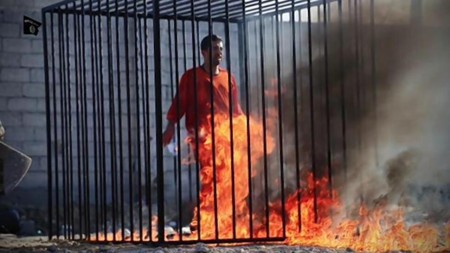
Fire is symbolic of the destruction of evil. Symbolically people who are burned alive are human sacrifices that are expiating evil from the community. Tainted victims are purified through fire.
Filming and disseminating the ritual killing strikes fear into the hearts of enemies and attracts new recruits. Similar to an arsonist that is fascinated with fire, disaffected young people will be attracted to this ritual burning. Like moths to a flame.
*****************
On Tuesday February 3, 2015 the Islamic State released a video showing Jordanian pilot, Lt. Muath al-Kaseasbeh, 26 being burned alive while locked in a metal cage. The 22 minute video includes footage of Jordan’s King Abdullah II declaring his support for the anti-ISIS coalition. It shows Lt. Al-Kaseasbeh, who was captured by the Islamic State in December after his aircraft crashed over Syria, being interrogated, paraded in front of heavily armed men, walking towards the cage, and then standing inside the cage wearing an orange jumpsuit that is doused in flammable liquid. The executioner uses a torch to light a trail of gasoline that leads to his feet. Lt. Al-Kasasbeh is engulfed in flames and remains alive for over 1 minute and half and collapses to the floor. Militants pour broken masonry and other debris over the cage which is then flattened with a bulldozer with the body still inside. Despite the surprise and shock of seeing a young man burned alive, this is not a new tactic. In fact it is a common method of ritual murder in Iraq and other countries particularly in honor killings and the murder of Christians. The significant difference is that the Islamic State media films the execution using sophisticated editing and highly choreographed techniques turning the killing into a scripted reality show.
Hundreds of women in the Muslim world have been murdered by fire in honor killings. The murders were often disguised as suicides or accidents. In the first six months of 2007, in Iraqi Kurdistan, 255 women were killed, three-quarters of them by burning. An earlier report cited 366 cases of women who were the victims of so called fire accidents in Dohuk in 2006, up from 289 the year before. In Irbil, there were 576 burn cases since 2003, resulting in 358 deaths. In 2006 in Sulaimaniyah, Iraq there were 400 cases of women burned. In Tunisia in May 2014 a father burned his 13 year old daughter to death for walking home with a boy. In October 2013 a 15 year old Yemeni girl was burned to death by her father for communicating with her fiancé. In March 2009, a sixteen year old Muslim girl suspected of having a relationship with a boy was burned to death by four male neighbors in her village in Ghaziabad, North India. They came to the girl’s house and demanded to know why the young man frequently visited her, and then the men beat her, doused her with kerosene and set her on fire. There are numerous more examples of women burned alive. This form of punishment is not just reserved for women. In April 2011 three men were set on fire in Iraq for being gay. A video of that incident is easily accessible online. In June 2008, the Taliban burned three truck drivers of the Turi tribe alive for supplying the Pakistan Armed Forces. There have been numerous reports of Christians burned alive by Islamist jihadists. In November 2014 a Christian couple in Pakistan Sajjad Maseeh, 27, and his wife Shama Bibi, 24, were burned alive in a brick furnace after it was rumored that they had burned verses from the Quran.”Bibi, a mother of four who was four months pregnant, was wearing an outfit that initially didn’t burn…… The mob removed her from over the kiln and wrapped her up in cotton to make sure the garments would be set alight.” These incidents are rarely reported by the mainstream media and were difficult for most people to comprehend as real until ISIS started filming documentaries of their ritual murders.
Fire is symbolic of the destruction of evil. Symbolically people who are burned alive are human sacrifices that are expiating evil from the community. Tainted victims are purified through fire. Fire is considered a powerful transformer of the negative to the positive. Because of such properties, fire is commonly found in purification rites throughout the world. In other cultures polluted persons may be required to walk around, jump over, or jump through fire. Historically, burning a person to death was reserved for the most threating evil, such as heresy or witchcraft and considered an extreme form of purification. In the context of honor killing the use of fire is not only symbolic but practical. Practical in Iraq because most of the homes do not have electricity so every house has a large supply of oil which makes it easier to conceal honor killings under the guise of suicide or kitchen accidents. In the context of the murder of Lt. Muath al-Kaseasbeh fire is an Islamic purification ritual that serves vengeance and restores honor and purity to the community of believers.
Islamist jihadists from different movements, countries, sects, and factions all emphasize the need to cleanse Islam of its impurities. Al Qaeda’s ideological belief is the purification of Islam through violent struggle. Bin Laden and Al-Zawahiri have continually called on supporters to purify Muslim holy lands of infidels, un-Islamic beliefs, and practices. The Islamic State cleanses Islam of its impurities while protecting its territory in the same manner as Mexican cartels, using brutal tactics that are justified as vengeance.
The title of the video, Healing the Believers’ Chests, is a quote from the Quran: “Fight them, and Allah will punish them by your hands, cover them with shame, help you over them, heal the breasts of Believers.” (Qur’an 9:14). It was reported to mean ‘giving them pleasure’ – interpreted as a reference to achieving revenge. That is one interpretation, however healing is symbolic of purification, the title Healing the Believers’ Chests can be understood as cleansing the community of the contamination of impurity. Lt. Muath al-Kaseasbeh’s alleged crimes symbolically unleashed an epidemic of contagious evil. The function of the burning ritual is a communal act of expiation, expelling the contagious evil of an infidel enemy through fire. Having ISIS fighters participate and watch makes it a communal sacrificial ritual. Ritualizing the violence justifies it and makes it sacred. Once the transgressor is ritually killed the impurity is removed, the evil has been expelled, taboo has been ameliorated and justice is served. The body is immediately buried under the earth, another purifying element, restoring honor and purity.
Filming and disseminating the ritual killing strikes fear into the hearts of enemies and attracts new recruits. Similar to an arsonist that is fascinated with fire, disaffected young people will be attracted to this ritual burning. Like moths to a flame.
White House Struggles To Distinguish Between The Islamic State and Taliban Prisoner Swaps, Jonathan Turley’s Blog, Jonathan Turley, January 30, 2015
(President Humpty Dumpty:
‘When I use a word,’ Humpty Dumpty said, in rather a scornful tone, ‘it means just what I choose it to mean — neither more nor less.’
‘The question is,’ said Alice, ‘whether you can make words mean so many different things.’
‘The question is,’ said Humpty Dumpty, ‘which is to be master — that’s all.’
Hence, Islam is the religion of peace and terrorists aren’t terrorists. Will all of the king’s horses and all of the king’s men be able to put him back together again?– DM)
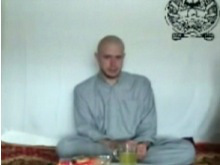

The White House again seems to be struggling with barriers of both language and logic as many raise comparisons between the controversial Bergdahl swap and the effort this week of Jordan to swap a terrorist for one of its downed pilots with Islamic State. During a week where one of the five Taliban leaders released by the Administration has been found trying to communicate with the Taliban, the Jordanian swap has reignited the criticism of the swap for Army Sgt. Bowe Bergdahl, which violated federal law and released Taliban leaders with long and bloody records. The White House seems to be trying to argue that the Taliban are not terrorists in direct contradiction to its prior position that they are indeed terrorists. It shows the fluidity of these terms and how the government uses or withdraws designations as terrorists to suit its purposes. The familiarities between Islamic State (IS) and the Taliban appear to be something in the eye of beholder or, to quote a certain former president, “It depends on what the meaning of the word ‘is’ is.”
As a refresher, the Taliban has long been viewed as terrorists, even when they were in power. They have destroyed religious sites, art, and in one of the most infamous acts in modern history, blew up the giant ancient Buddhas at Bamiyan.The United Nations and human rights groups have documented a long list of civilian massacres and bombings carried out by the Taliban. One report described “15 massacres” between 1996 and 2001. The UN estimates that the Taliban were responsible for 76% of civilian casualties in Afghanistan in 2009, 75% in 2010 and 80% in 2011. The Human Rights Watch estimates that “at least 669 Afghan civilians were killed in at least 350 armed attacks, most of which appear to have been intentionally launched at non-combatants.” This includes the widespread use of suicide belts. The Taliban has always had a close alliance with al Qaeda.
That record was put into sharp relief with the swap for Bergdahl with ties to terrorism including one who was the head of the Taliban army, one who had direct ties to al-Qaeda training operations, and another who was implicated by the United Nations for killing thousands of Shiite Muslims. While we have always said that we do not negotiate with terrorists, we not only negotiated for Bergdahl but gave them what they wanted.
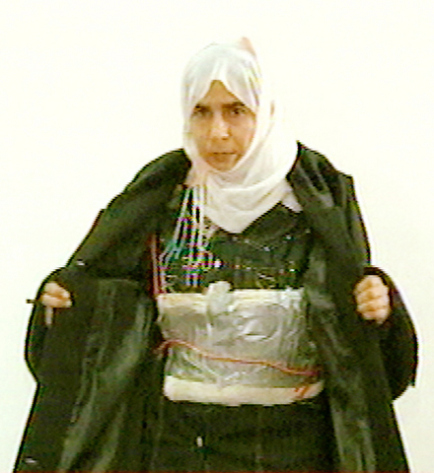
The Jordanian swap raised the same obvious concerns. Many have objected, for good reason, to the idea of releasing Sajida al-Rishawi, who participated with her husband in a terrorist attack on a wedding party at the luxury Radisson hotel in the Jordanian capital of Amman on Nov. 9, 2005. al-Rishawi hoped to be welcomed to paradise by walking into a wedding of 300 people enjoying a family gathering with children and murdering them in cold blood. Her husband’s bomb went off but not her bomb. It goes without saying that she is a hero to the murderous Islamic State for her effort to kill men, women, and children at a wedding.
The swap appears in part the result of pressure from Japan to secure the release of one of its citizens. In my view, such a propose swap was disgraceful. al-Rishawi is as bad as it gets as a terrorist. To yield to terrorists who engage in weekly demonstrations of beheading unarmed captives is morally wrong and practically suicidal. Just as the West is funding this terrorist organization through millions of ransom payments, the exchange of a terrorist only fuels their effort to capture and torture more Western captives.
This brings us back to the White House. When asked about the proposed swap with Islamic State, the White House was aghast. White House spokesman Eric Schultz stated “Our policy is that we don’t pay ransom, that we don’t give concessions to terrorist organizations. This is a longstanding policy that predates this administration and it’s also one that we communicated to our friends and allies across the world.”
The media understandably sought guidance on why the swap with Bergdahl was the right thing to do (despite the flagrant violation of federal law) while the swap for the pilot was not. The White House acknowledged that the Taliban are still on a terrorist list but then tried to rehabilitate the organization into something else. The White House is now referring to the Taliban as an “armed insurgency.” It notes that the Taliban are not listed by the State Department as a terrorist organization. However, they are listed as one of the “specially designated global terrorist” groups by the Department of the Treasury. Indeed, they have been on that list since 2002. Worse yet, the statement from the White House came in the same week that the Taliban claimed responsibility for killing three U.S. contractors.
John Earnest tried to thread the needle by explaining “They do carry out tactics that are akin to terrorism, they do pursue terror attacks in an effort to try to advance their agenda.” He seems to struggle to explain what is terrorist attacks and what are attacks “akin to terrorism.” Most people view suicide belts and civilian massacres to be a bit more than “akin to terrorism.”
Earnest also note that, while the Taliban has links to al Qaeda, they “have principally been focused on Afghanistan.” However, “Al Qaeda is a terrorist organization that has aspirations that extend beyond just the border between Afghanistan and Pakistan.” That is diametrically opposed to the position of the Administration in claiming sweeping powers to strike targets around the world against any forces linked to al Qaeda and many who have few such links. Indeed, while referencing to the authorization to attack al Qaeda, the Administration attacked Islamic State, which was actively fighting with al Qaeda.
The spin of the White Hosue also ignores the role of the Taliban-aligned Haqqani network in holding Bergdahl, a well-known terrorist group.
There are obviously arguments to make for the Bergdahl swap (though I find little compelling in the arguments that justify the violation of federal law by the White House). However, the argument must acknowledge that we negotiated with a group of hostage taking terrorists and we need to address the implications of that fact. Alternatively, if the White House now believes that the Taliban is no longer a terrorist organization, it needs to take it off its listing of such groups (a listing that subjects people to criminal charges for material support or assistance with the group). It cannot have it both ways and call it a terrorist group unless such a label is inconvenient.
Swapping Prisoners with Terrorists, National Review Online, Andrew C. McCarthy, January 29, 2015
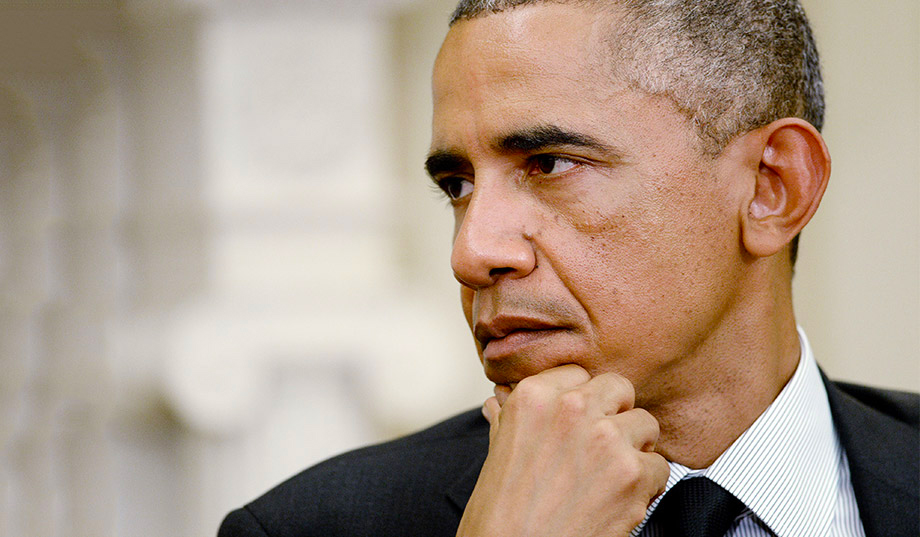
Obama’s disastrous policy dates back to his earliest days in office.
Suddenly, there is outrage in the land over President Obama’s policy of negotiating prisoner swaps with terrorist organizations, a national-security catastrophe that, as night follows day, is resulting in more abductions by terrorist organizations.
Well, yes, of course. But what took so long? Sorry if I sometimes sound like I work the “I Told You So” beat at the counter-jihad press. But as recounted in these pages, immediately upon assuming power in 2009, Obama started negotiating exchanges of terrorists — lopsided exchanges that sell out American national security for a net-zero return.
Critics now point to the indefensible swap Obama negotiated with our Taliban enemies in 2012 as if it were the start of the problem. In reality, the springing of five top Taliban commanders in exchange for the Haqqani terror network’s release of U.S. soldier Bowe Bergdahl was fully consistent with what was by then established Obama policy. There was nothing new in our president’s provision of material support to terrorists even as those terrorists continued to conduct offensive terrorist operations against our troops.
Clearly, the Bergdahl–Taliban swap was a disaster. As I’ve previously noted, it would be a profound dereliction of duty for a commander-in-chief to replenish enemy forces in this manner even if the captive we received in exchange had been an American war hero. To the contrary, Obama replenished our enemies in exchange for a likely deserter who may have voluntarily provided intelligence to the enemy and whose treachery cost the lives of American soldiers who tried to find and rescue him.
Even the conservative media are now suggesting it was the Bergdahl–Taliban swap that marked Obama’s reckless departure from longstanding American policy against negotiation with terrorists, and in particular against exchanging captured terrorists for hostages. This policy reversal has indeed incentivized jihadists to capture more Westerners, and prompted state sponsors of jihadists, such as Qatar, to propose more prisoner swaps. Moreover, the Obama strategy has deprived the U.S. of any moral authority or leadership influence to dissuade other countries, such as Jordan, from releasing anti-American jihadists in similar prisoner exchanges.
But the disaster did not begin with the Bergdahl–Taliban swap.
As I detailed in a column soon after Obama took office — specifically, on June 24, 2009 (“Negotiating with Terrorists: The Obama administration ignores a longstanding — and life-saving — policy”):
Even as the mullahs [i.e., the rulers of Iran’s Shiite regime] are terrorizing the Iranian people, the Obama administration is negotiating with an Iranian-backed terrorist organization and abandoning the American proscription against exchanging terrorist prisoners for hostages kidnapped by terrorists. Worse still, Obama has already released a terrorist responsible for the brutal murders of five American soldiers in exchange for the remains of two deceased British hostages.
To summarize: The Iranian government implanted a network of Shia jihadist cells in Iraq in order to spearhead the terror campaign against American troops. The point was to duplicate the Hezbollah model by which Iran controls other territory beyond its borders. In fact, the network of cells, known as Asaib al-Haq (League of the Righteous), was organized by Hezbollah veteran Ali Musa Daqduq.
The network was run day-to-day by two brothers, Qais and Layith Qazali. Both brothers and Daqduq were captured by U.S. forces in Basrah after they orchestrated the assassination-style murders of five American soldiers abducted in Karbala on January 20, 2007.
A few months later, in May 2007, the terror network kidnapped five British civilians. As American troops put their lives on the line to protect Iraq, the terrorist network told Iraq’s Iran-friendly prime minister, Nouri al-Maliki, that they would release the Brits in exchange for Daqduq and the Qazali brothers. The Bush administration refused the offer.
But soon after entering office in 2009, President Obama decided to change course and entertain the offer. The new administration rationalized that the trade could serve the purpose of Iraqi political reconciliation — which is to say: Obama, in the midst of pleading for negotiations with the “Death to America” regime in Tehran, prioritized the forging of political ties between Iraq and an Iran-backed terror network over justice for the murderers of American soldiers.
Conveniently, Iran’s influence over Maliki ensured that Iraq would play ball: Maliki’s government would serve as the cut-out, enabling Obama to pretend that (a) he was negotiating with Iraq, not terrorists; and (b) he was releasing terrorists for the sake of Iraqi peace, not as a ransom for hostages.
Layith Qazali was released in July. This failed to satisfy the terror network, which continued to demand the release of Daqduq and Qais Qazali. The terrorists did, however, turn over two of the British hostages — or rather, their remains.
I know you’ll be shock-shocked to hear this, but while Obama’s minions were practicing their so-very-smart diplomacy, the jihadists were killing most of their hostages. At least three of the Brits were murdered. Yet even that did not cause Obama to reconsider his position.
In late 2009, the administration released Qais Qazali in a trade for the last living British hostage, Peter Moore. As The Long War Journal’s Bill Roggio reported at the time, an enraged U.S. military official aware of the details of the swap presciently observed: “We let a very dangerous man go, a man whose hands are stained with U.S. and Iraqi blood. We are going to pay for this in the future.”
Meanwhile, as I related in July 2009, Obama released the “Irbil Five” — five commanders from the Iranian Revolutionary Guard’s Quds force. Like Daqduq, the Quds force was coordinating Iran’s terror cells in Iraq. At the time, General Ray Odierno, then the top U.S. military commander in Iraq, publicly stated that Iran was continuing to support, fund, and train the terrorists attacking American and allied forces.
As Michael Ledeen pointed out, the release of the five Iranian terrorist commanders – three years before Obama’s release of the five Taliban commanders – was the price the mullahs had demanded to free Roxana Saberi, a freelance journalist the mullahs had been holding. The Obama administration, naturally, claimed that it was not negotiating with terrorists but with sovereign governments (just as it claimed only to be negotiating with Qatar as it cut the Bergdahl deal with the Taliban and the Haqqanis). Besides, said the administration, the president’s hands were tied by the status-of-forces agreement, which purportedly required turning prisoners over to the Iraqi government (for certain return to Iran) — even prisoners responsible for killing hundreds of Americans, even prisoners sure to persevere in the ongoing, global, anti-American jihad.
And then there was Daqduq. His comparative notoriety, coupled with a smattering of negative publicity over the other terrorist negotiations and swaps, caused a delay in his release. But in July 2011, with the Beltway distracted by the debt-ceiling controversy, the Obama administration tried to pull off Daqduq’s stealth transfer to Iraq.
As I noted at the time, however, the Associated Press got wind of the terrorist’s imminent release, and its short report ignited fury on Capitol Hill. Several senators fired off a letter, outraged that the United States would surrender “the highest ranking Hezbollah operative currently in our custody” — a man who would surely return to the jihad “to harm and kill more American servicemen and women” when Iraq inevitably turned him over to Iran, as it had done with other released terrorists.
The administration retreated . . . but only for the moment. Realizing it would be explosive to spring Daqduq during his reelection campaign, Obama waited until the Christmas recess after the election. The president then had the terrorist quietly handed over to Iraq, which, after acquitting Daqduq at a farce of a “trial,” duly released him to Hezbollah in Lebanon.
There is a reason why the Arab press was reporting that the Obama State Department was entertaining discussions with Egyptian authorities about freeing the Blind Sheikh — Omar Abdel Rahman, the convicted terrorist serving a life sentence for running the jihadist cell that bombed the World Trade Center and plotted other attacks against New York City landmarks. There is a reason why, when he assumed power in 2011, Muslim Brotherhood–leader-turned-Egyptian-president Mohamed Morsi proclaimed that his top priorities included pressuring the United States to return the Blind Sheikh to Egypt.
Long before the Bergdahl–Taliban swap, it was well known that the Obama administration was open for business — if the business meant releasing terrorists.
Exclusive: Freed Al Qaeda Agent Was Part of Proposed Swap for Jailed Americans, Daily Beast, January 25, 2015
(Please see also Analysis: Former al Qaeda operative freed, sent home to Qatar, a January 20th article from Long War Journal which also raises questions about the release of Al-Marri and notes the grand reception given him as a hero upon arrival in Qatar. Among other points, it states:
According to The Guardian (UK), al Marri’s nephew revealed that upon arrival in Doha, his uncle “was greeted by representatives from the Qatari interior and foreign ministries” and is now in “high spirits.” He thanked Qatari officials for exerting “tremendous efforts” for his uncle’s release.
— DM)
 The Daily Beast
An American couple’s freedom may have come at a steep price: the release of a convicted terrorist from Supermax prison.
Before he was released from a U.S. maximum-security prison last week, a confessed al Qaeda sleeper agent was offered up in a potential prisoner swap that would have freed two Americans held abroad.
The Daily Beast has learned that the proposal was floated in July 2014 to the then-U.S. ambassador in Qatar by an individual acting on behalf of that country’s attorney general. According to two individuals with direct knowledge of the case, the proposition was made shortly after the Obama administration traded five Taliban fighters for Army Sgt. Bowe Bergdahl. Those fighters were also sent to Qatar, where they’re to remain under government watch until later this year. U.S. officials have said they’re at risk of plotting further attacks against the United States.
The proposed swap involving the al Qaeda agent, Ali Saleh Al-Marri, raises troubling questions about whether the Bergdahl trade opened a kind of Pandora’s box, signaling to foreign governments that they can pressure the United States to make concessions on terrorism by trading American prisoners abroad for dangerous extremists held in the United States.
“I believe we must examine the administration’s decision in the case of Al-Marri and determine if his release is connected to negotiations of any kind,” Rep. Duncan Hunter, a frequent critic of the Obama administration’s hostage negotiations, wrote Thursday in a letter to Rep. Mac Thornberry (R-TX), the House Armed Services Committee chairman, obtained by The Daily Beast.
Governments’ hostage negotiations policies are once again taking center stage after ISIS released a photograph Saturday showing the apparent beheading of Haruna Yukawa, one of two Japanese men the group is holding. Unexpectedly, ISIS has now dropped an earlier demand of $200 million ransom and says it will free the remaining hostage, journalist Kenji Goto, in exchange for the release of Sajida Mubarak al-Rishawi, a failed suicide bomber who’s imprisoned in Jordan for her role in an attack on three hotels in Amman in 2005, which killed 60 people.
ISIS has made other demands for freeing prisoners, including a Pakistani woman held in the United Sates, Aafia Siddiqui, known in counterterrorism circles as “Lady Al Qaeda,” who was convicted in 2010 of attempting to kill Americans in Afghanistan. Siddiqui has been used as a bargaining chip in other negotiations, as well. In 2012, Pakistani officials offered to try and win the release of Bergdahl if the United States would free Siddiqui. The Obama administration quickly rejected the idea because releasing her would be seen as offering concessions to terrorist groups and put a potentially dangerous woman back on the streets, according to current and former administration officials.In his letter, Hunter accused the administration of failing to pursue other avenues for freeing Americans abroad and relying on prisoner releases or exchanges, “which are often counter to U.S. security interests, for leverage in negotiations.” The congressman also alluded to other potential swaps, saying it’s his understanding that “other foreign nationals” who are still in U.S. custody “have also been named as potential figures of interest in other cases, with Qatar at the forefront.”
 Tara Todras-Whitehill/The New York Times, via Redux
Qatar has emerged as a go-between in various hostage negotiations. It agreed to take custody of the five Taliban fighters for a period of one year after Bergdahl’s release. And sources close to efforts to free other Americans held abroad said that Qatar facilitated a ransom payment to help free journalist Peter Theo Curtis, who was held for two years by al Qaeda’s branch in Syria.
Hunter helped spur the administration to review its hostage negotiation policy, which is widely seen by experts and family members of Americans held abroad as dysfunctional.
The proposal to trade Al-Marri came from an individual described by one source as a “government contractor” and close friend of Qatar’s attorney general, Ali Bin Mohsen Bin Fetais Al Marri, who is said to be a relative of the confessed terrorist. The emissary met with the then-U.S. ambassador to Qatar, Susan Ziadeh, and raised the idea of trading Al-Marri for Matthew and Grace Huang, an American couple who’d been living in Qatar and were convicted in the still-unexplained death of their adopted daughter, in what was widely criticized by human-rights groups and legal experts as an unfair show trial.
“Qatari government officials told the Huang team that they floated the idea of a prisoner swap to the U.S. ambassador,” Richard Grenell, a former U.S. diplomat who worked on the Huang case, told The Daily Beast. That account was corroborated by a second source.
A State Department spokesman said that “no such proposal was ever on the table,” and noted that Al-Marri was eventually released from prison and sent home to Qatar as scheduled “and not as the result of any U.S.-Qatari agreement.” Asked for further clarification on whether the swap was raised as described and what the U.S. reaction was, the spokesman declined to comment further. The Qatari embassy in Washington didn’t respond to inquiries from The Daily Beast.
A second administration official pushed back on the idea that Al-Marri’s release was a quid pro quo for freeing the Huangs, who were eventually allowed to leave Qatar in December after their conviction was overturned.
“Al-Marri’s release happened as a matter of course, as a result of his court-imposed sentence being completed,” the administration official said. Al-Marri was given a “good conduct release” from the “supermax” facility in Florence, Colorado, on Jan. 16, after serving 87 percent of his 100-month sentence, said a spokesperson for the Bureau of Prisons. He’d accumulated credit for good behavior while in prison and time already served in jail while awaiting trial, which is why he didn’t serve the remainder of his time.
Administration officials characterized Al-Marri’s release as routine. But Al-Marri was no ordinary prisoner. At one time, he was the only so-called enemy combatant being held on U.S. soil, a status that treated him more like solider in a war than an ordinary criminal. Al-Marri’s release—timely or otherwise—has led to criticism that the Obama administration is repatriating a dangerous man who could help plan more attacks. An individual with knowledge of Al-Marri’s release said President Obama played no role in the process.
Al-Marri was first detained by U.S. authorities in December 2001 at his home in Peoria, Illinois, having arrived in the U.S. on a student visa. Authorities suspected that Al-Marri, who has dual citizenship in Qatar and Saudi Arabia, had ties to al Qaeda. But his future dramatically changed when was declared an enemy combatant in June 2003 and then transferred into military custody.
It turns out that Al-Marri may have been more valuable as a source of intelligence about other terrorist plots than for anything he knew about the 9/11 attacks. Much of the information that U.S. officials have on his plans came from the brutal interrogation of Khalid Sheikh Mohammed, the 9/11 mastermind, which included waterboarding. “Over three quarters of the intelligence reports that the FBI cited in a paper assessing the activities of [Al-Marri] and explaining the reach of al Qaeda’s network in the U.S. were sourced to” Mohammed, the CIA stated in its written response to a blistering report by the Senate Intelligence Committee on the so-called torture program. “Prior to [Mohammed’s] information, CIA and the FBI were aware of Al-Marri’s links to al Qaeda but lacked the detail to more fully understand al Qaeda’s plans for him.”
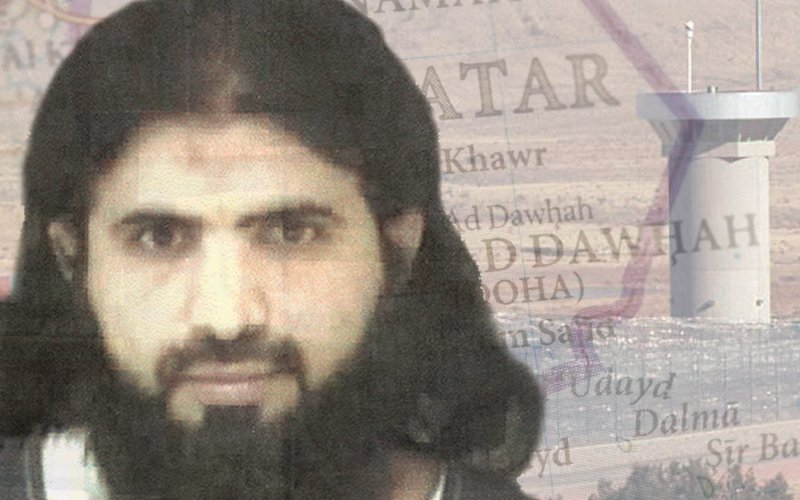
 Ali Saleh Kahlah al-Marri, former graduate student at Bradley University, Peoria, Illinois, is photographed in this booking photo at Peoria County Sheriff’s Office in Illinois on May 20, 2003. (Peoria County Sheriff’s Office/Reuters)
That may explain why U.S. officials were reluctant to give Al-Marri a criminal trial, where he could have questioned the credibility of the evidence Mohammed provided while being tortured and exposed the details of the CIA’s interrogation program.
Al-Marri was held in a naval brig for more than five years, and his lawyers have claimed he was subjected to harsh and intimidating treatment. Al-Marri’s case took yet another odd turn when, early in the Obama administration, he was transferred back into federal court and pleaded guilty to conspiracy to aid al Qaeda.
Back in Qatar, where Al-Marri has been reunited with his family, he’s being given a hero’s welcome. Members of the public have been invited to a celebration in Al-Marri’s honor held just down the street from a football stadium that will host the 2022 World Cup, said David Weinberg, a senior fellow at the Foundation for Defense of Democracies.
“Several prominent Qatari personalities welcomed Al-Marri home with open arms. That trend has continued, with a longtime board member of Al Jazeeradeclaring on her personal Twitter page that ‘We congratulate the family of Ali bin Kahlah Al-Marri on his return,’” Weinberg told The Daily Beast.
Al-Marri may have other powerful friends in Qatar, in addition to the attorney general. Weinberg noted that in U.S. court documents, Al-Marri is said to have spent nearly a decade working as a “key person” in the audit department of Qatar Islamic Bank, and then as a senior auditor for the government of Qatar. Sending a known moneyman to a country widely seen as a major financial hub for terrorist groups, instead of to Saudi Arabia, where he also has citizenship, “was a big missed opportunity for U.S. policy,” Weinberg said.




 anneinpt
 artaxes
 danmillerinpanama
 davidking1530
 Peter Hofman
 Joseph Wouk
 Peter
Peter Louisiana Steve
 WarSclerotic
Recent Comments