Terrorist Nation, Truth Revolt via You Tube, Bill Whittle, January 9, 2014
(A brief history of “Palestine” and its friends.– DM)
IDF pulls units from locations bordering Gaza, ignoring rising Egyptian military and al Qaeda activity, DEBKAfile, January 4, 2015
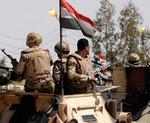 Egyptian troops battling terrorists in Sinai
Israelis living in a string of villages and towns bordering on the Gaza Strip protested in vain against Defense Minister Moshe Ya’alon’s decision to withdraw the military presence keeping them safe, especially since the summer war on Gaza.
Four significant security events in the last 48 hours on both sides of the border added to their concerns:
Their government, at its weekly cabinet meeting in Jerusalem Sunday, Jan. 4, set up a committee to expedite the transfer of the bulk of IDF facilities from the center of the country to the south.
At the same time, Israelis living in the south within range of the Hamas-ruled Gaza Strip saw the soldiers heading out and were advised to put their trust in local paramilitary “preparedness squads” taking over from the army. The local population believes that they are not up to the job of safeguarding them from more terrorist aggression – by missile, tunnel or intrusion.
Also Sunday, Egypt began expanding the security buffer zone along the 14km of the Gaza-Sinai-Israel border, doubling its breadth from one half to a whole kilometer. The mostly Palestinian inhabitants of this zone were evacuated.
Saturday, Jan. 3, Egyptian troops raided three towns in northern Sinai: Rafah (which is part located in the Gaza Strip), El Arish and Sheikh Zuweid, killing 7 militants of Ansar Beit al-Maqdis, which last month pledged allegiance to the Islamic State of Iraq and the Levant, and jihad against Egypt and Israel.
A few hours later, an Egyptian army explosives expert was killed and several soldiers injured when a large bomb planted on a road in Sheikh Zuweid blew up when they tried to dismantle it.
Saturday night, the IDF commander of the Gaza Division, Brig. Gen. Itay Virov tried to calm dwellers across from the Gaza Strip, who were up in arms about the withdrawal of their military safety net. He addressed members of Kibbutz Nahal Oz with a rare burst of frankness. He spoke of military policy, but his words no doubt reflected the strategic thinking of Prime Minister Binyamin Netanyahu, Defense Minister Ya’alon, the outgoing Chief of Staff, Lt. Gen. Benny Gantz, and his successor next month Maj. Gen. Gadi Eisenkott.
The general may be commended for laying the truth about official policy on the table. However, instead of calming his audience, he bared evaluations that may give the rest of the country sleepless nights as well.
Here are the high points of his Nahal Oz lecture:
Like all policies, even those well thought out, this one too carries a price tag.
The general spoke of Hamas in terms of an independent entity whose operations and impact are confined to the Gaza Strip. He refrained from mentioning that, as recently as December, both of Hamas’ branches, the military and the political, jumped aboard the Iran-led Iraqi-Syrian-Hizballah alliance. This Palestinian group is now subject to Tehran’s policy decisions and directives. This omission from Israel’s policy calculations could be dangerous. Clearly, an undefeated Hamas remains a lasting menace.
Tehran’s decisions regarding Hamas may have an overarching effect, possibly touching on the moves directed by President Barack Obama. (See our Jan. 1 article on Obama’s New Year gift to Israel and the Middle East.).
Israel’s policy of relying on the Egyptian army to contain Al Qaeda’s Sinai network also comes at a price.
For now, Israel has quietly consented to large-scale Egyptian military strength entering Sinai: One and a half divisions, including fighter squadrons and tank battalions, have taken up positions, nullifying the key demilitarization clause of their 1979 peace treaty.
And that’s just for starters.
A Sad State of Affairs: The Kerry Record, World Affairs Journal, Joshua Muravchik, November/December, 2014
(Kerry likely agrees with Obama as to his quite foreign foreign policies and, equally likely, we are stuck with both at least until Obama leaves the White House.

The most bothersome current aspects of Obama-Kerry foreign policies are the extent to which they trust Iran and how they deal with it and the P5+1 negotiating group. — DM)

Although Kerry’s anti-American ideology has moderated to some degree from his fiery days as an antiwar leader, he has misrepresented but never repudiated his past. Especially consistent has been his inclination to see the best in America’s enemies, from Madame Binh to Comandante Ortega to Bashar Assad. Israelis were shocked this summer that Kerry came up with a plan molded by Turkey and Qatar to fit the interests of Hamas at their own expense. Had they known him and his record better, they might not have been.
***************
The Gaza war of July and August 2014 occasioned the sharpest frictions in memory between the United States and Israel, highlighted by a cease-fire proposal offered by Secretary of State John Kerry that Israel’s security cabinet rejected unanimously. Kerry’s plan envisioned a seven-day cease-fire, during which the parties would negotiate “arrangements” to meet each of Hamas’s demands about the free flow of people and goods into Gaza and the payment of salaries of Hamas’s tens of thousands of employees. As for Israel’s demands about destruction of tunnels and rockets and the demilitarization of Gaza, these were not mentioned at all, except in the add-on phrase that the talks would also “address all security issues.”
The document cited the important role to be played by “the United Nations, the Arab League, the European Union, the United States, Turkey, [and] Qatar.” Conspicuous by their absence from this list were Israel, Egypt, and the Palestinian Authority. These three had also not been invited to the Paris meetings where Kerry worked on his ideas with leaders of the countries and bodies mentioned.
Barak Ravid, diplomatic correspondent for the liberal Israeli newspaper Haaretz, wrote that the proposal “might as well have been penned by Khaled Meshal [head of Hamas]. It was everything Hamas could have hoped for.” The centrist Times of Israel’s characteristically circumspect editor, David Horovitz, branded Kerry’s initiative “a betrayal.” And left-leaning author Ari Shavit commented that “Kerry ruined everything. [He] put wind in the sails of Hamas’ political leader Khaled Meshal, allowed the Hamas extremists to overcome the Hamas moderates, and gave renewed life to the weakened regional alliance of the Muslim Brotherhood.”
Turkey and Qatar are the mainstays of that alliance and were chosen by Kerry as his principal interlocutors because they are Hamas’s main backers. This brought protests from the Palestinian Authority, led by President Mahmoud Abbas’s movement, Fatah, the secularist rival to Hamas. That group declared that “whoever wants Qatar and Turkey to represent them can emigrate and go live there. Our only legitimate representative is the PLO.”
The shock of Palestinian and Israeli leaders would have been less, however, if they had been more familiar with the record of John Kerry. Spurning America’s friends in pursuit of deals with their nemeses was perfectly in character for the secretary of state. The hallmark of his career has been to denigrate America itself, while supporting the claims of its enemies.
That career began in 1969, when, months after returning from a tour of duty in Vietnam, Kerry sought and received a military discharge so that he might run for Congress. His campaign as a peace candidate sputtered, but his authenticity as a Vietnam vet established him as a presence in the burgeoning antiwar movement. In May 1970, he traveled to Paris for an unpublicized meeting with Viet Cong representatives, and, perhaps at their suggestion, he joined up upon his return with Vietnam Veterans Against the War. VVAW was headed by Al Hubbard, a former Black Panther. Kerry was instantly given a top role, twinning with Hubbard as the public face of the organization.
At a VVAW protest in Washington, DC, in April 1971, Kerry joined other veterans in throwing away their military medals in front of news cameras. The entire demonstration was punctuated by Kerry’s appearance before the Senate Foreign Relations Committee, where he offered dramatic testimony about American atrocities in Vietnam based on accounts heard at a VVAW inquest a few months earlier. He spoke of veterans who said:
They had personally raped, cut off ears, cut off heads, taped wires from portable telephones to human genitals and turned up the power, cut off limbs, blown up bodies, randomly shot at civilians, razed villages . . . poisoned food stocks, and generally ravaged the countryside.
These acts, Kerry emphasized, “were not isolated incidents but crimes committed on a day-to-day basis with the full awareness of officers at all levels of command.”
When, at the behest of aghast senators, the Naval Criminal Investigative Service conducted a formal inquiry into the stories presented at the VVAW inquest, it reported that many of the VVAW witnesses cited by Kerry refused to cooperate, although promised immunity. Others were clearly crackpots, and several swore, and provided witness corroboration, that they had not participated at the inquest at all and had no idea who had appeared in their names. The entire exercise had been inspired and largely engineered by Mark Lane, whose book on the same subject earlier that year had been panned by New York Times columnist James Reston Jr. as “a hodgepodge of hearsay,” while that paper’s book reviewer, Neil Sheehan, who had reported from Vietnam and would soon break the Pentagon Papers, revealed that some of Lane’s “witnesses” had not served in Vietnam. (The political scientist Guenter Lewy documents these events in his 1978 book America in Vietnam.)
In August 1971, four months after his Senate appearance, Kerry made another trip to Paris, to meet with Madame Nguyen Thi Binh, foreign minister of the Viet Cong, this time in full view, for his first exercise in international diplomacy. He returned touting the “peace plan” of the Viet Cong, explaining: “If the United States were to set a date for withdrawal, the prisoners of war would be returned.” Although he frequently accused American leaders of lying, he took the Communist leaders’ statements at face value, asserting that their peace plan “negates very clearly the argument of the president [Nixon] that we have to maintain a presence in Vietnam to use as a negotiating [chip] for the return of those prisoners.”
Kerry’s dismissal of the statements of US leaders as lies and his credulity toward those of the Vietnamese Communists reflected a broader difference in attitude toward the two sides to the conflict. Ho Chi Minh, who had spent long years as a henchman of Stalin’s, serving the Comintern in several countries, was in Kerry’s admiring eyes “the George Washington of Vietnam” who aimed only “to install the same provisions into the government of Vietnam” that appeared in the American Constitution. America, in contrast, had itself strayed so far from those principles that it needed a “revolution” to restore them.
Kerry’s colleagues in VVAW undoubtedly shared this sentiment, and in November 1971, at a conference of its leadership in Kansas, the group considered just how far down the path of revolution it was willing to go. It debated, although ultimately rejected, a proposal to commence a campaign of terrorist violence and assassination of pro-war US senators. When he ran for president in 2004, Kerry denied he had been present at this conclave, but when FBI files secured by the Los Angeles Times under the Freedom of Information Act placed him there, he retracted that denial in favor of the statement that he had “no personal recollection” of it.
Is this plausible? Gerald Nicosia, author of a highly sympathetic history of the antiwar movement, reported, in May 2004, that “several people at the Kansas City meeting recently said to me or to mutual friends that they had been told by the Kerry campaign not to speak about those events without permission.” Why the urgency to cover up? And how would the campaign know who was there, that is, whose silence to seek, if Kerry had no recollection of the meeting? One of Nicosia’s interviewees, John Musgrave, said “he was asked by Kerry’s veterans coordinator to ‘refresh his memory’ after he told the press Kerry was in Kansas City. Not only is Musgrave outraged that ‘they were trying to make me look like a liar,’ but he also says ‘there’s no way Kerry could have forgotten that meeting—there was too much going on.’”
This puts it mildly: the event was memorably raucous, with debates over the proposals for violence and for napalming the national Christmas tree, furious factional fighting, the discovery of eavesdropping bugs in the building leading to a quick move to another location, and above all an angry showdown between Kerry and Hubbard over revelations that the latter had never been in Vietnam. This particular contretemps was punctuated by Hubbard’s dramatically pulling down his pants to show scars he claimed he sustained in Vietnam. The mayhem culminated in Kerry’s announcing his resignation from the group’s executive. And Kerry had “no personal recollection” of being there?
Although Kerry appeared as a speaker for VVAW for about a year following this resignation, he then faded from national view for a decade, climbing the ladder of local and state politics in Massachusetts before winning election to the US Senate in 1984. The Senate, he later said, “was the right place for me in terms of . . . my passions. The issue of war and peace was on the table again.” What put it on the table were the anti-communist policies of President Ronald Reagan, which Kerry deeply opposed. A year earlier, Reagan had ordered the invasion of Grenada, which Kerry scorned as “a bully’s show of force [that] only served to heighten world tensions and further strain brittle US-Soviet and North-South relations.”
In contrast, Kerry ran on a platform of the Nuclear Freeze, a popular movement opposing US plans to counterbalance a large Soviet nuclear buildup over the previous decade. Kerry made sure to score one hundred percent on a test of candidates’ positions presented by a group called Freeze Voter ’84, and he proposed to cut the defense budget by nearly twenty percent, including “cancellation of twenty-seven weapons systems” and “reductions in eighteen other[s],” according to the Boston Globe. He cited his own work with VVAW as a counterpoint: “We were criticized when we stood up on Vietnam. . . . But we’ve been borne out. We were correct. Sometimes you just have to stand and hold your ground.”
In the Senate, he secured a coveted seat on the Foreign Affairs Committee and turned his attention to the fraught issue of policy toward Central America, a small region that had assumed inordinate geopolitical importance by becoming one of the front lines in the Cold War. A Marxist-Leninist party, the Sandinista National Liberation Front, had seized power in Nicaragua and was aiding likeminded movements in El Salvador and other nearby states while the Reagan administration supported anti-Communist guerrillas inside Nicaragua, the so-called “Contras.”
Kerry lent his name to Medical Aid for El Salvador, which gave non-lethal aid to the Communist side in that civil war. On February 16, 1982, an Associated Press story quoted actor Ed Asner, leader of a Hollywood group that raised much of the funding for this project, as explaining that “medical supplies are to be purchased in Mexico and shipped clandestinely to the Democratic Revolutionary Front in El Salvador.” However, the issue of US aid to El Salvador’s anti-Communist government became overshadowed by debate about aid to the Nicaraguan “Contras.”
As the Senate neared a decisive vote, Kerry and Senator Tom Harkin undertook a dramatic maneuver to try to head off approval of the Reagan administration’s request for Contra funding. They flew to Managua, the Nicaraguan capital, for their own summit meeting with the country’s strongman, “Comandante” Daniel Ortega. The results resembled those of his 1971 meeting with Madame Binh. Ortega handed Kerry a “peace plan” according to which the US would first end all aid to the Contras, and the Sandinistas would then initiate a cease-fire and restore civil liberties. Kerry justified undercutting the US government in this way by faulting Reagan’s failure “to create a climate of trust” with the Sandinistas. He, in contrast, offered them trust in abundance, calling Ortega’s plan “a wonderful opening.” He took to the Senate floor to say, “Here, in writing, is a guarantee of the security interest of the United States.”
A year later, in 1986, in another Senate debate on Contra aid, Kerry voiced one of the odder claims about his Vietnam experience. Warning against the slippery slope of military involvement and against the duplicity of our own government, Kerry delivered a floor speech containing this assertion:
I remember Christmas of 1968, sitting on a gunboat in Cambodia. I remember what it was like to be shot at by Vietnamese and Khmer Rouge and Cambodians, and have the president of the United States telling the American people that I was not there; the troops were not in Cambodia. I have that memory which is seared—seared—in me.
The “seared” part was a nice touch, especially in view of the fact that the whole thing had not happened (although Kerry had been repeating the story since as early as 1979). In the course of Kerry’s 2004 presidential campaign, the Swift Boat Veterans for Truth, former crewmen on the type of vessel on which Kerry served who were angered by his antiwar activities, attacked this claim among other aspects of Kerry’s military history. In this case, however, unlike in response to some points raised by Kerry’s detractors, no shipmate of Kerry’s could be found to corroborate his version. Soon, his spokesmen began to hedge. One aide explained that Kerry’s boat had been “between” Vietnam and Cambodia. But the two countries are contiguous: there is no “between,” so another spokesman backed down further, explaining that Kerry had merely been “near” Cambodia.
Then, Douglas Brinkley, who authored a laudatory history of Kerry’s military service, issued another explanation, apparently at the behest of the campaign. On Christmas 1968, the moment of Kerry’s “seared” memory, he was fifty miles from Cambodia, said Brinkley, but his boat “went into Cambodia waters three or four times in January and February 1969.” Oddly, however, Brinkley’s book, which covered those two months in painstaking detail at a length of nearly one hundred pages, even to the extent of locating the sites of battles, made no mention of Kerry’s having crossed into Cambodia. And the campaign soon pulled the rug from under Brinkley by issuing a new claim, namely, that Kerry’s boat had “on one occasion crossed into Cambodia.” Three of Kerry’s shipmates, two of whom were supporting his campaign, categorically denied even this minimized claim.
In that, they are supported by no less a source than Kerry himself, in the form of a journal he kept while on duty. Substantial passages of it are reproduced in Brinkley’s book, and one of them reads:
The banks of the [Rach Giang Thanh River] whistled by as we churned out mile after mile at full speed. On my left were occasional open fields that allowed us a clear view into Cambodia. At some points, the border was only fifty yards away and it then would meander out to several hundred or even as much as a thousand yards away, always making one wonder what lay on the other side.
He was never to learn the answer because this diary entry was from his final mission.
Kerry was of course right to link Central America to Southeast Asia. They were both nodes in the Cold War, the epic struggle that defined international politics for forty years, including the first two decades of Kerry’s political engagement, from the time he returned from Vietnam in 1969 until the Berlin Wall came down in 1989. Whatever the rights and wrongs of America’s entry into Vietnam, or its actions in Central America or elsewhere, Kerry perverted the basic issue of the Cold War, always viewing America’s actions as bellicose and malign, while casting those of the Communists, like “George Washington” Ho Chi Minh, in the most favorable light.
To many, the Cold War’s benign denouement—the fall of the Wall and the USSR’s disappearance into the ash bin of history—vindicated Reagan’s approach, but Kerry appears to have entertained no second thoughts despite these outcomes. When it came to addressing post–Cold War issues, he remained reflexively averse to the exercise of American power. Kerry had lamented as “not proportional” Reagan’s 1986 bombing of Libyan dictator Muammar el-Qaddafi’s residence in response to a Libyan terror attack on US servicemen in Germany. The Middle East was also the scene of the first military showdown after the Cold War, when Saddam Hussein’s Iraq swallowed whole the neighboring state of Kuwait, in 1990. At the time, Kerry opposed the Bush administration’s request for authorization of military action, saying that those “of the Vietnam generation . . . come to this debate with a measure of distrust [and] a resolve . . . not [to be] misled again.” He concluded his Senate speech by reading a passage from an antiwar novel by the American Communist Dalton Trumbo.
With the Cold War’s end, and America’s demonstration of will and strength in driving Hussein’s forces from Kuwait, the defining issue of the 1990s became the wars of Yugoslavia’s dissolution. Here, the prime issue was whether or not to lift an international arms embargo that rendered Bosnia’s Muslims naked before their predators, the well-armed Serbs. As public opinion reacted to news accounts of the grisly results of this imbalance, the Senate voted to lift the embargo, over the objections of Kerry, who helped to lead the opposition.
With the terrorist attacks of September 11, 2001, the American public was awakened from its post–Cold War indifference toward foreign affairs. A fierce patriotism burst forth, and with it a determination to take down those who had attacked us. Thus, preparing for a 2004 presidential bid, Kerry moved to reconfigure his image. The antiwar veteran was suddenly replaced by the military hero, and the Democratic nominating convention was replete with uniforms and military gestures, highlighted by Kerry’s sharp salute to the assemblage while uttering the words, “reporting for duty.” Already, his rejected service medals had miraculously reappeared mounted and framed on his Senate office wall. Asked how that was possible, as he had been photographed throwing them away, Kerry explained that the medals he tossed were not his own but actually belonged to another veteran.
The dramatic reincarnation did not quite come off, as Kerry was dogged by Vietnam veterans, led by fellow Swift Boat crewmen, still furious at how he had blackened their names. And the awkwardness of his transformation was symbolized by his much-ridiculed explanation of his stance on funding the 2003 US invasion of Iraq: “I actually did vote for the $87 billion before I voted against it.”
In his later years in the Senate, Kerry made the issue of Syria his own. He took several trips to Damascus where, according to a June 2011 account in the Wall Street Journal, he “established something approaching a friendship with [Syrian dictator Bashar] Assad.” When Barack Obama came to office, he made Kerry his point man in efforts to improve US-Syrian relations. Kerry put his endorsement on diplomatic proposals he received in Damascus, including an offer by Assad to engineer a Palestinian unity government embracing Fatah and Hamas. The benefits to the US, not to mention Israel, of such unity were not self-evident, but in any event, talks between the two Palestinian factions were already under way, mediated by Egypt, which was closer to Fatah. Why it would be advantageous to switch the sponsorship to Syria, the ally of Hamas, was hard to grasp. Nonetheless, Kerry saw in Assad’s proposal the prospect of “a major step forward in terms of how you reignite discussions for the two-state solution . . . . Syria indicated to me a willingness to be helpful in that respect.” In all, as the Journal put it, “Kerry . . . became . . . Assad’s champion in the US, urging lawmakers and policymakers to embrace the Syrian leader as a partner in stabilizing the Mideast.”
In sum, although Kerry’s anti-American ideology has moderated to some degree from his fiery days as an antiwar leader, he has misrepresented but never repudiated his past. Especially consistent has been his inclination to see the best in America’s enemies, from Madame Binh to Comandante Ortega to Bashar Assad. Israelis were shocked this summer that Kerry came up with a plan molded by Turkey and Qatar to fit the interests of Hamas at their own expense. Had they known him and his record better, they might not have been.
Egypt-Qatar rapprochement rattles Hamas, Al-Monitor, Adnan Abu Amer, December 30, 2014
(These guys could form several pretty adequate stand-up comedy teams.
— DM)
 An Egyptian woman gestures during a demonstration against what protesters call Qatar’s backing of ousted Egyptian President Mohammed Morsi’s government, outside the Qatari Embassy in Cairo, Nov. 30, 2013. (photo by REUTERS)
At a time when Hamas is mending its relationship with Iran, Egypt and Qatar are also in the process of rapprochement after more than a year of tension. Resumed ties between them will likely have an impact on Hamas, but questions remain as to whether the Palestinian Islamist movement stands to gain or lose from this important regional development.
Hamas waited several days to announce its final position on the return of positive relations between Doha and Cairo on Dec. 20, when President Abdel Fattah al-Sisi met the envoy of Qatar’s emir in Cairo, Sheikh Mohammed bin Abdulrahman bin Jassim Al-Thani, the minister’s assistant for International Cooperation Affairs.
On Dec. 28, senior Hamas leader Mahmoud al-Zahar welcomed the Egyptian-Qatari convergence and denied Qatar was pressuring the Hamas leadership to leave Doha. He also denied reports that Qatar was planning to suspend its support for Hamas over the warming of ties with Egypt, reiterating that Hamas supports the unity of Arab countries to serve the Palestinian cause.
Yousef Rizqa, the former minister of information and political adviser to former Gaza Prime Minister Ismail Haniyeh, said in an interview with Al-Monitor, “The Egyptian-Qatari rapprochement serves the interest of the Palestinian national project, and Hamas has no concerns about its relations with Doha being harmed after the Doha-Cairo rapprochement because the movement is not a party to the internal Arab conflict, and it is accepted by the Arab capitals.”
However, an anonymous Egyptian official said in Dec. 26 press statement that Doha informed Hamas leaders that it would temporarily suspend its support for the movement in a bid to pressure Hamas to change its policies against Cairo.
Husam Badran, spokesman for Hamas and a resident of Doha, told Al-Monitor, “There is no suspension of the Qatari financial support for the movement, since their relationship is ongoing.” But Palestinian Minister of Labor Maamoun Abu Shahla revealed Dec. 28 that Qatar had postponed the financial grant supposed to be sent to Gaza’s state workers.
Rizqa neither confirmed nor denied this report, but he told Al-Monitor that Qatar has not cut its support and relationship with Hamas over the rapprochement with Egypt, saying, “The Hamas-Doha relationship is stable and Qatar’s support for the movement is sustained and has never ceased. Moreover, Qatar’s position on Hamas is strategic.”
It is worth noting that Hamas’ fear of Qatar halting its financial support for the movement at Egypt’s request coincides with its renewed attempt to improve ties with Iran, as well as political head Khaled Meshaal’s recent visit to Turkey. Hamas may be reaching out to possible alternatives for regional support should Doha downgrade its ties with the movement in a “secret” deal with Cairo.
The Palestinian Authority did not express a position on the Egyptian-Qatari rapprochement, but on Dec. 25 Ambassador Hazem Abu Shanab, a member of the Revolutionary Council of Fatah, ruled out the consideration that the Egyptian-Qatari convergence would contribute to the improvement of relations between Hamas and Cairo, because this depends on how Cairo decides to deal with the Muslim Brotherhood and its affiliates, such as Hamas.
This prompted the Egyptian official to reveal Dec. 26, also on condition of anonymity, that Hamas demanded Doha mediate with Cairo to calm the atmosphere with Hamas, as the movement expressed its goodwill toward overcoming the tension with Cairo.
A senior Hamas official told Al-Monitor on condition of anonymity that Hamas is analyzing the extent of Doha’s ability to influence Cairo on reconciling with the movement. Should the rupture between Hamas and Egypt continue irrespective of the Doha-Cairo rapprochement, this would be interpreted by Hamas as being made a scapegoat.
A former member of the Qatari Shura Council, asking not to be named, revealed to Al-Monitor, “There have been contacts made between the Hamas leadership, represented by Meshaal, and Emir Tamim bin Hamad al-Thani, among other Qatari officials. They discussed the rapprochement with Egypt. Meshaal told the emir that he fully supports any Qatari effort to unify Arab positions.”
The Qatari official told Al-Monitor by phone from Doha, “Meshaal received a formal Qatari pledge not to attack the Hamas leadership or tighten the noose around its neck in Doha in exchange for rapprochement with Cairo. This is because Qatar never establishes relations based on bargaining between one party or another, and our relationship with Hamas will continue to exist.”
Interestingly, coinciding with the rapprochement, Egyptian media outlets reported that Cairo threatened to cut ties with Hamas on Dec. 26 unless 13 accused members of the movement were extradited to Egypt. The 13 were accused of involvement in armed operations in Egypt, and allegedly, Egyptian authorities have insisted that extradition proceedings must conclude before they consider improving relations with Hamas.
On Dec. 28, Zahar denied Egyptian media reports that Hamas interfered in Egypt’s domestic affairs.
A senior Hamas official in Gaza who spoke to Al-Monitor on condition of anonymity also denied the reports, saying, “Egypt made no formal request to extradite any Hamas member, and these accusations were featured across all media outlets, which only creates more tensions,” he said.
Ahmed Yousef, a senior Hamas official, told Al-Monitor that he hopes “the breakthrough in the Doha-Cairo relations will positively affect Hamas’ relations with Egypt and that Qatar would do its best to alleviate the tension between Gaza and Cairo,” adding, “The Hamas and Cairo dossier is likely to be opened after the meeting of Emir Tamim with Sisi.” He denied the existence of contacts between the movement and Egypt following the Doha-Cairo rapprochement.
The timing of the Egyptian-Qatari warming may have come as a surprise to Hamas, which took nearly a week to announce that it welcomes the move, making sure that it would not come at its expense. The atmosphere prevailing within Hamas is still ambiguous over whether the Qatari position toward the movement will be affected, despite promises made by Doha to the contrary. Hamas knows that the pressure exerted on Qatar may be stronger than its ability to resist.
Turkey: America’s unacknowledged problem, Israel Hayom, Prof. Efraim Inbar, December 31, 2014
(The foreign policy of the Obama administration is difficult to understand. What might be the reasoning behind its apparently continuing support for Islamic Turkey, a bitter foe of Israel? What are the administration’s interests in the Middle East?– DM)
It is not clear why Washington puts up with such Turkish behavior. The Obama administration seems to be unable to call a spade a spade. It refuses to acknowledge that Turkey is a Trojan horse in NATO, and that Ankara undermines American interests in the Middle East and elsewhere.
***************
Turkey is a NATO ally, and U.S. President Barack Obama has called Turkish President Recep Tayyip Erdogan his best friend. But Erdogan-led Turkey does not behave as an ally or a friend of the U.S. This is not a new development.
Erdogan and his Islamist party, the Justice and Development Party (AKP), have ruled Turkey since 2002. Erdogan’s Turkey has gradually distanced itself from the West, adopting domestic and foreign policies fueled by Ottoman and Islamist impulses.
Turkey has been on the road to an authoritarian regime for several years. Infringements on human rights have gradually increased. In truth, Turkey has never had a political system with checks and balances able to constrain attempts to consolidate power around one politician. In recent years, Erdogan has weakened further the few constitutional constraints against “Putinization” of the Turkish political system.
The longer Erdogan rules, the more power-hungry he seems. His authoritarian personality becomes clearer every day. The press is hardly free. Erdogan arrests even Islamist journalists who are critical of his policies. His party has infiltrated the judicial system and the police. Foci of power, such as the bureaucracy, the banking system, industrial associations and trade unions, have been mostly co-opted by the AKP. Opposition political parties are largely discredited. The military, once active in politics as the defender of the Kemalist secular tradition, has been successfully sidelined.
From a realpolitik perspective, the domestic political developments, deplorable as they may be in Turkey, could be ignored by the democratic West as long as Ankara continues to be a useful ally. Unfortunately, Turkey no longer qualifies as a trusted ally.
The most recent examples of nefarious Turkish behavior are its support of Islamic State and Hamas. Turkey is playing a double game on the issue of Islamic State. It pretends to cooperate with the U.S. policy in the attempt to contain radical Islam, but actually Turkey supports the radical group. It allows passage of volunteers through Turkish territory to join Islamic State in Iraq. The group gets logistical support via Turkey, and sends its wounded militants for treatment in Turkey. Turkish military forces stood idly by the besieged city of Kobani, just across the Turkish border, while the Islamists killed Kurdish fighters. Finally, Turkey denies the American air force access to Turkish bases, forcing the U.S. to use faraway bases when attacking Islamic State targets.
Turkey is also openly supporting another radical Islamist organization, Hamas. Despite the fact that the West regards Hamas a terrorist organization, Ankara regularly hosts Hamas representatives to meet the highest Turkish dignitaries. Hamas, an offshoot of the Muslim Brotherhood, has a rabid anti-American position. Moreover, Salah al-Aruri, a senior Hamas operative, operates out of Istanbul. Recently, the Turkish branch of Hamas was involved in a series of attempts to carry out terrorist attacks against Israel, and in orchestrating a coup against the current leadership of the Palestinian Authority.
Such behavior should not surprise policy makers in Washington. In 2003, Ankara denied the request from Washington to open its territory so that the U.S. military could attack Saddam Hussein’s forces from two separate fronts.
AKP-ruled Ankara also defied American preferences on Syria, a country allied with radical Iran and on the American list of states supporting terrorism. In January 2004, Bashar Assad became the first Syrian president ever to visit Turkey. In April 2009, the two states conducted their first ever joint military exercise. No other NATO member had such close relations with the authoritarian regime in Damascus, which has been closely allied with Iran for several decades.
Turkey further deviated from the Western consensus in 2008 by hosting Sudanese President Omar Hassan al-Bashir twice. Bashir, who was charged with war crimes and genocide in Darfur, presided over an Islamist regime.
Turkey even welcomed the president of the Islamic Republic of Iran, Mahmoud Ahmadinejad, for a visit in August 2008. No Western country has issued such an invitation to the Iranian leader. Additionally, Erdogan congratulated Ahmadinejad immediately after his re-election in June 2009. When it comes to Iran’s nuclear threat, Ankara, unlike its NATO allies, has refused to adopt the U.S. stance on harsher sanctions, fearing in part the economic consequences of such steps. In June 2010, Turkey voted at the U.N. Security Council against a U.S.-sponsored resolution meant to impose a new round of sanctions on Iran.
Turkey also has consistently defied advice from Washington to tone down its anti-Israel statements and mend relations with an important American ally. All American efforts in this direction have failed.
There is also a clear divergence between the U.S. and Turkey on important global issues such as Russia and China. For example, U.S. wanted to send ships into the Black Sea via the Bosporus Strait during the Georgia war in August 2008. Turkey flatly denied several such requests on the pretext that the military vessels were too large. Moreover, Turkey proposed the creation of a regional security framework involving Turkey, Russia, Georgia, Armenia and Azerbaijan that left out a NATO role. More blatantly, Turkey has failed to participate in the Western economic sanctions imposed on Russia during the recent Ukraine crisis.
Dissonance exists also with regards to China. While the U.S. fears the rise of China, Turkey sees this country as a potential economic partner and not a problem. It held military exercises with China. Ankara even considered purchasing anti-aircraft systems from Beijing, an incredibly brazen position for a NATO member.
It is not clear why Washington puts up with such Turkish behavior. The Obama administration seems to be unable to call a spade a spade. It refuses to acknowledge that Turkey is a Trojan horse in NATO, and that Ankara undermines American interests in the Middle East and elsewhere.
Mahmoud Abbas: Failing the Palestinians and Peace, Front Page Magazine,

[T]he increased authoritarianism of Abu Mazen is reflected in a recent survey by the Palestinian Center for Policy and Survey Research. It indicates that 66% of Palestinians are afraid to criticise Abu Mazen and the PA, and 80% consider the PA institutions to be corrupt and infected with nepotism.
***************
Mahmoud Abbas, (aka Abu Mazen) has been a failure as the Palestinian “Rais.” He failed to lead the Palestinian Authority (PA) toward peace with Israel, and he mismanaged the alleged goal to achieve statehood for the Palestinians. Instead of facing the tough issues and making compromises required in negotiating peace and statehood with the Israelis, Abbas chose an alliance with the Gaza controlled terrorist group Hamas. Following Abbas’ pact with Hamas last April, Israel broke off peace negotiations with the Palestinians, just days before the talks brokered by Secretary of State John Kerry were scheduled to expire.
Abbas isn’t only confusing Israelis, Americans, and is his Europeans patrons, he is perplexing his own Palestinian consituents. Following last summer’s Gaza War between Hamas and Israel, Abbas threatened to join the International Criminal Court (ICC) and saught to indict Israel on war crimes. PA Foreign Minister Riad al-Maliki met with the Chief Prosecutor of the ICC last August to explore ways of joining the court by PA President Abbas signing the Rome Statute. When, however, the U.S. Congress threatened to cut off all funding to Palestine if Abbas filed war crimes charges against Israel, Abbas backed off. At the same time though, Israel’s Prime Minister threatened to counter-sue, alleging that the rockets fired by Hamas terrorists into Israeli civilian areas constituted “double war” crimes.
The Israeli Law Center called Shurat-HaDin, led by Nitsana Darshan-Leitner submitted a complaint against Mahmoud Abbas in the ICC for “war crimes.” The complaint claims that Abbas may be tried for his responsibility in the missile attacks targeting Israeli cities, executed by the Palestine Liberation Organization (PLO), which Abbas heads. It charges that Fatah, also led by Abbas, was responsible for several missile attacks on Israeli cities. Darshn-Leitner pointed out that Fatah leader Abbas may be tried by the ICC. Abbas is a citizen of Jordan and Jordan is a member-state of the ICC. The ICC has jurisdiction over crimes committed by a citizen of a member state. Darshan-Leitner added, the organization “will not allow Fatah to carry out rocket attacks on Israeli population centers, while hypocritically advocating Palestinian membership in the ICC. Abbas falsely believes that alleged crimes against Arabs are the only ones that should be prosecuted.”
A week ago, Abbas threatened again. This time he fingered the security co-ordination with Israel following the death of Ziad Abu Ein, 55, PA Minister without Portfolio. He promptly backtracked. On November 29, 2014, Abbas declared that if the United Nations Security Council rejects the Palestinian statehood resolution, he will seek membership in the ICC. He said, “We will seek Palestinian membership in international organizations, including the International Criminal Court in the Hague. We will also reassess our ties with Israel, including ending the security cooperation between us.”
Abbas’ latest gambit is a UN Security Council (UNSC) resolution that would force Israel to withdraw from Judea and Samaria (West Bank) within two-years. According to press reports, U.S. Secretary of State John Kerry requested to postpone the Palestinian initiative at the UNSC until after the Israeli elections, (March 17, 2015) but the Palestinians refused. PA Foreign Minister Riad al-Maliki intimated to reporters that there was disagreement between the Americans and Palestinians on how the elections in Israel would or wouldn’t advance the PA UNSC resolution. Kerry believed that a UNSC vote before the elections would impact adversely on the winners. In other words, a vote before the elections would strengthen Netanyahu and the Right in Israel. Maliki argued that a vote before January, 2015 would be rather positive.
At a closed meeting last week with 28 EU ambassadors, John Kerry revealed that he was asked by former Israeli president Shimon Peres and Tzipi Livni to prevent the Palestinian initiative at the UNSC because it will help “Netanyahu and Bennett (Jewish Home Party chairman) in the upcoming elections.” Maliki posited that Kerry himself has not abided by his pledge not to intervene in the Israeli elections.
Also last week in London, Secretary of State Kerry met with Saeb Erekat, the chief Palestinian negotiator, and according to a PA senior official, Kerry posed a number of U.S. principles that should be included in the Palestinian UNSC resolution. Kerry supposedly refused the two year time period demand by the PA for Israeli withdrawal. The resolution as Kerry suggested should include recognition of Israel as a Jewish state, as well as U.S. opposition to declare Jerusalem as a joint capital for Palestine and Israel. Erekat rejected the U.S. proposals. Kerry declared afterward that the U.S. does not accept the Jordanian (presenting the Palestinian resolution) and French resolutions. He warned that if the Palestinians insist on presenting the resolutions, the U.S. would use its veto power. Erekat rejected Kerry’s ideas, and insisted that the resolutions would be submitted. As of December 25, 2014, Abbas rejected an Arab League request to delay the submission of the Palestinian statehood until January when five new members who support the Palestinian cause will join the Security Council.
Abbas’ gambits notwithstanding, the increased authoritarianism of Abu Mazen is reflected in a recent survey by the Palestinian Center for Policy and Survey Research. It indicates that 66% of Palestinians are afraid to criticise Abu Mazen and the PA, and 80% consider the PA institutions to be corrupt and infected with nepotism. Last summer, according to the survey, support for Abbas (Abu Mazen) declined to 35% from 50%. “There is no doubt about the fact that outlawing freedoms and rights, especially of professional unions, is a factor in Abbas’ decline in popularity,” said Dr. Khalil Shikaki, one of the survey takers.
PA security agents inspect what is written in the social media, and threaten those who criticize Abbas. Abu Mazen critics point out that after a decade in power he is controlling all systems of government to such an extent as to minimize all resistance. Perceived political rivals such as Mohammad Dahlan, who once served as Abu Mazen’s assistant, and Salam Fayyad, the former Prime Minister of the PA, are vilified by Abbas. Following the Palestinian Unity government formation, headed by Rami Hamdallah last May, elections were to follow. But, once again, internal squabbling prevented it, and added to it was Abbas’ fear of a Hamas victory.
Abu Mazen’s strategy for the establishment of a Palestinian state has reached a cul-de-sac. None of his gambits proved successful. His rivalry with Hamas is bitter and ongoing, despite the alliance he forged at the expense of negotiations with Israel. And, like his predecessor Yasser Arafat, he balks at the idea of ‘ending the conflict’ with Israel. He knows full well that this might be a death sentence for him, targeting him for assassination. It is for this reason that Abbas and the PA are unlikely to forgo the “right of return” of Palestinian refugees to Israel. Israel for its part, cannot accept such a demographic suicide. This is why Abbas would rather avoid negotiations with Israel and bypass it by going to the UNSC. It is also the ostensible reason why peace with Israel cannot be achieved, and as a result, the Palestinian people continue to suffer political and economic deprivation. Abbas has not been the solution to the Palestinian problems; rather, he has been responsible for failing them.
Original posted by Dan Miller
Meshaal on point of relocating Hamas’ political headquarters from Doha to Tehran, DEBKAfile, December 27, 2014
 Hamas’ Khaled Meshaal heads for new exile
Hamas’ political leader Khaled Meshaak, forced to quit his old headquarters in Damascus after abandoning his longtime host Bashar Assad and finding sanctuary in Doha – is again being hounded from pillar to post.
A deal struck this week between Egypt and Qatar could result in the Hamas leader settling in the Iranian capital. This would afford Tehran a foothold in the Gaza Strip, its second Mediterranean outpost after Lebanon on the Israeli border.
The Egyptian-Qatar deal, revealed here by DEBKAfile’s Middle East sources, covers the future of the Muslim Brotherhood, the nemesis of Egyptian President Abdel-Fatteh El-Sisis, and its offspring, the Palestinian Hamas, which rules the Gaza Strip. Their memorandum of understanding was concluded Wednesday, Dec. 24, in Cairo by a delegation of Qatari intelligence chiefs and the new Egyptian director of intelligence Gen. Khaled Fawzi. They spent most of the day hammering out its six points, which are listed here:
1. Qatar withdraws its support from all Brotherhood operations against Egypt and Saudi Arabia;
2. This point applies equally to any Hamas activity that may be interpreted as inimical to Egypt;
3. Qatar’s assistance to Hamas will be limited to “civilian” projects (such as repairing war damage in Gaza), which too will be subject to President El-Sisi’s approval;
4. Given the close cooperation maintained at present between the Egyptian president and Israeli Prime Minister Binyamin Netanyahu on affairs relating to Gaza, Israel will implicitly have the right to disqualify certain Palestinian projects in the enclave;
5. Qatar is to shut down the anti-Egyptian propaganda channel run by its Al Jazeera television station;
6. The emirate is not required to sever all its ties with the Muslim Brotherhood and Hamas, just to keep them under control as its “strategic reserve.”
It is extremely hard to conceive of these two radical Islamist organizations bowing to the restrictions placed on their operations under the Egyptian-Qatari deal.
Brotherhood leaders have exited Doha and made arrangements to establish residence and a new center of operations in London, U.K. Khaled Meshaal, after he was denied permission by Turkish President Tayyip Erdogan to set up shop in Istanbul, is on the point of a decision to relocate his offices in Tehran. Iran would thus gain a proxy foothold in the Gaza Strip, its second outpost on the Mediterranean after the first was provided by Hizballah in Lebanon. If Meshaal decided to settle in Tehran, Iran would acquire a handy springboard for action against Egypt and southern Israel.
Israel, the Obsession, American Thinker, Richard Baehr, December 22, 2014
[T]here is no clear path back to sanity, nor is there a clear path to the end of the obsession with Israel.
*****************
It has been a pretty typical week on the hate Israel front. A European Union Court has decided that Hamas is not a terrorist organization, and their previous designation as such had not been justified by real evidence that Europeans had developed, as opposed, say, to information supplied by the United States or Israel. An international court in Geneva is hearing evidence of Israeli human rights violations. The United Nations Security Council has been considering a resolution developed by the Palestinian Authority, as well as one by the French that would effectively lay out the terms for Israel’s capitulation over the next few years. Israel’s peace camp has been working with U.S. Secretary of State John Kerry, encouraging a delay in consideration of the Security Council resolutions, since any action before the upcoming Israeli parliamentary elections could benefit the right-wing parties in Israel. In other words, there is not even an attempt to hide anymore that the United States is putting its foot down for one particular side in the Israeli election. Various European countries are endorsing Palestinian statehood on the terms demanded by the Palestinian Authority. Academic groups, unions, and churches in Europe and the United States are endorsing the boycott, divestment, and sanctions (BDS) movement. Certain European communities are now “Israeli-frei” – free of Israeli goods (or at least those they can identify and care to avoid). The U.N. Human Rights Council and the General Assembly, as well as specific agencies whose only task is to bash Israel, are set to get back to work, creating more resolutions and condemnations of the Jewish state.
As Joshua Muravchik makes clear in his outstanding new book, Making David Into Goliath, this obsession with Israel by most nations of the world and the United Nations – or as they are collectively known, “the international community” – as well as by “the global left,” could not have been imagined a half-century back, prior to the Six-Day War. At that time, Israel was championed by Socialist political parties, and viewed sympathetically as a beleaguered democracy fighting for its existence against a collection of larger anti-Western Arab tyrannies. There was residual sympathy for Jewish survivors of the Holocaust, many of whom had moved to Israel. There was no movement for Palestinian nationhood, though certainly violent actions by Arabs aimed at Israel and Jews in the region had been going on for decades.
Muravchik’s book attempts to explain what has happened during this period and why. A lot changed after the 1967 war, when, instead of little Israel facing off with 21 Arab nations, the conflict was recast with Israel as the big dog, oppressing the Palestinians and occupying their land. Since the left tends to root for the underdog, Israel no longer fit the bill. The description of the conflict in the post-1967 telling is of course neither factual nor historical, since there had never been a unique nation of Palestinian Arabs, denied their nationhood – say, the way the Tibetans or the Kurds have been for sixty years, or forever. The Palestinians became refugees because their leaders refused to accept half a loaf – a state on half of the mandate territory in 1947 – and instead chose to go to war to deny the Zionists their state. The Arabs of Palestine, even with the support of armies from their Arab neighbor states, lost the war.
When you start a war and lose, there are consequences.
Since 1967, the Palestinians and their allies have been trying to reverse not just the war of 1967, but the 1948 war as well. Refugees from the 1948 war (and there are not many of them left) are still in refugee camps, unlike any other refugees from any other conflicts then or in the years since, and the descendants of the original refugee population, now from three generations, demands a “right of return” to homes in Israel where they never lived and in fact to a country where they have never been.
The 1948 war produced a population exchange – a larger number of Jews were driven out of Egypt, Tunisia, Morocco, Algeria, Yemen, Iraq, Libya, and other countries than Arabs who left their homes in what became Israel. Most of the Jewish refugees moved to Israel, where in relatively short order they were out of any temporary refugee camps and absorbed as regular citizens of the state. That the Arabs have sacrificed generations of their own people to maintain their inflexible hatred of Israel is all one needs to know about why there has been no resolution of the conflict despite serious efforts over the years to accomplish this.
Muravchik, who was once a leftist himself, spends a fair amount of time in the book documenting the impact of Edward Said , who with his disciples has mentored the current U.S. president, Barack Obama. Said, despite his faked personal history, has had enormous impact introducing moral relativism to studies of the regions, declaring that the West cannot understand “the Orient” and has no right to judge the regimes, the religions, the people. What the West calls a terrorist group is instead viewed as a resistance fighting for freedom. The combination of mosque and state is what those in the region know and prefer, not Western parliamentary systems. Israel is not a beacon with much to offer those in the region, but an imperialist creation and a predator. Muravchik outlines how in Israel itself, a part of the population is at war with Zionism and is in fact in league with Israel’s external enemies, assisting viperish non-governmental organizations (often funded by European nations) and bigoted journalists. An increasing number of left-wing Jews in the United States behave as if Israel is an embarrassment, claiming that Israel’s behavior is “not in its name” and calling for an end to the “racist, apartheid“ state.
At one time, the United Nations consisted primarily of democracies who had fought the Axis powers. With the decolonization of Africa and Asia after the war, dozens of new nations, since dubbed “the Third World,” became the dominant block at the U.N., particularly in the General Assembly and other international organizations. These new nations included many Arab and Islamic countries, and their power in numbers shifted these organizations into full-blown assault forces directed at Israel. Three quarters of all U.N. General Assembly resolutions that are directed at a single country are rebukes of Israel. It is fairly obvious that the international community considers Israel the worst country in the world (or at least the closest thing to a piñata for the purposes of diplomatic assault) and has ignored the human rights disasters at play in Sudan, Somalia, Nigeria, Iran, North Korea, Pakistan, Bangladesh, Libya, Saudi Arabia, and dozens of other easy targets, since there is no real interest in fairness, and Israel is always held to a different standard.
The Palestinians and their allies have also scored with the terror weapon and the oil weapon. One nation after another demonstrated that cowardice was the preferred policy for dealing with Palestinian terror groups, rather than risking confrontation with them, and many nations thought they could buy peace and security by becoming harsh critics of Israel and allies of the Palestinians. In countries with large populations of Arab or Muslim immigrants, taking on Israel politically, and ignoring violence directed against Israel or threats against Jews, was seen as a safety valve to prevent terrorism and violence directed against such countries’ own citizens. After the 1973 Yom Kippur War, OPEC, dominated by Arab oil producers, began a more systematic effort to use the threat of cutting off oil deliveries to force changes in policy by oil-importing nations, particularly in Europe.
Muravchik is an honest historian of the conflict, and he documents how Israel contributed to changing the narrative of the conflict. Some of Israel’s leaders were poor spokespersons for the country. The invasion of Lebanon in 1982, followed by the attacks carried out by Christian Phalangists in Sabra and Shatila to avenge the assassination of their leader by Palestinians, with Israeli forces seemingly looking the other way, were particularly damaging. Many Israelis, not all on the hard left, have opposed the settlement enterprise in Judea and Samaria. Muravchik makes clear, however, much as Caroline Glick has done in her book The Israel Solution, that to a large extent it is irrelevant what Israel has offered in any peace process to achieve a deal. In essence, the country has entered a bidding war against itself.
Muravchik has laid out why Israel is now in the dock, facing more critics on more fronts all the time. But what is most depressing is that there is no clear path back to sanity, nor is there a clear path to the end of the obsession with Israel. In fact, the momentum is all with those ganging up on the Jewish state. In the United States, Barack Obama is a president more comfortable with the thinking of the international community than any prior president since Israeli statehood in 1948, and he seems anxious to end America’s isolation on this issue (since it alone has stood in Israel’s corner for several decades) and move American policy so we are more in line with Sweden or Spain with regard to the conflict.
Muravchik calls for vigilance (Obama will be around only another two years and one month), but with America’s rapidly shifting demography, and the takeover of so many parts of the culture by the left – most of the media, the arts, the universities, Hollywood, many churches and synagogues – the struggle for those who stand with Israel will be uphill.
EU Gives Hamas Green Light to Attack Israel, Gatestone Institute, Khaled Abu Toameh, December 22, 2014
Although the EU court has said that its controversial decision was “technical” and was not a reassessment of Hamas’s classification as a terrorist group, leaders of the Islamist movement believe that the move will eventually earn them legitimacy in the international arena.
The EU court’s decision represents a “severe blow to the Palestinian Authority and Egypt,” according to Palestinian political analyst Raed Abu Dayer.
Any victory for Hamas, albeit a small and symbolic one, is a victory for the Islamic State, Al-Qaeda, Islamic Jihad, the Muslim Brotherhood and other fundamentalist groups, and causes tremendous damage to those Muslims who are opposed to radical Islam.
Hours before the EU court’s decision was made public, Hamas leader Mahmoud Zahar announced that his movement would never recognize Israel, and that Hamas seeks to overthrow the Palestinian Authority and seize control of the West Bank.
The EU court’s decision also coincided with a rapprochement between Hamas and Iran. Now, the Iranians and other countries, such as Turkey and Qatar, are likely to interpret the EU court’s decision as a green light to resume financial and military aid, including rockets and missiles, to Hamas — not only to Gaza but to the West Bank as well — to support those Palestinians whose aim it is to eliminate Israel.
Less than 48 hours after a top European Union court ruled that Hamas should be removed from the bloc’s list of terrorist groups, supporters of the Palestinian Islamist movement responded by firing a rocket at Israel. The attack, which did not cause any casualties or damage, did not come as a surprise.
Buoyed by the EU court’s ruling, Hamas leaders and spokesmen see it as a “political and legal achievement” and a “big victory” for the “armed struggle” against Israel.
Musa Abu Marzouk, a top Hamas leader, issued a statement thanking the EU court for its decision. He hailed the decision to remove his movement from the terrorist list as a “victory for all those who support the Palestinian right to resistance.”
When Hamas leaders talk about “resistance,” they are referring to terrorist attacks, such as the launching of rockets and suicide bombings against Israel. In other words, Hamas has interpreted the court’s decision as a green light to carry out fresh attacks as part of its ambition to destroy Israel.
The rocket that was fired from the Gaza Strip at Israel only days after the court decision is not likely to be the last.
Although the EU court has said that its controversial decision was “technical” and was not a reassessment of Hamas’s classification as a terrorist group, leaders of the Islamist movement believe that the move will eventually earn them legitimacy in the international arena.
Ironically, the EU court’s decision coincided with Hamas celebrations marking the 27thanniversary of its founding. Once again, Hamas used the celebrations to remind everyone that its real goal is to destroy Israel. And, of course, Hamas used the event to display its arsenal of weapons that include various types of rockets and missiles, as well as drones.
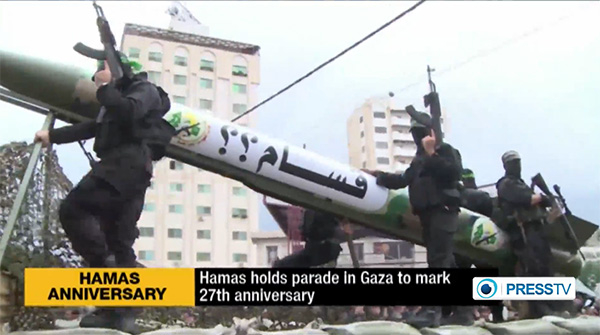 Thousands of armed Hamas troops showed off their military hardware at a Dec. 14, 2014 parade in Gaza, marking the organization’s 27th anniversary. (Image source: PressTV video screenshot)
Hours before the EU court decision was made public, Hamas leader Mahmoud Zahar announced that his movement would never recognize Israel. Zahar also made it clear that Hamas seeks to overthrow the Palestinian Authority [PA] regime and seize control over the West Bank.
The EU court’s decision also coincided with increased efforts to achieve rapprochement between Hamas and Iran. Recently, a senior Hamas leadership delegation visited Tehran as part of efforts to mend fences between the two sides. The main purpose of the visit was to persuade the Iranians to resume military and financial aid to Hamas. The visit, according to senior Hamas officials, appears to have been “successful.”
“There are many signs that our relations are back on the right track,” explained Hamas’s Musa Abu Marzouk. “Hamas and Iran have repaired their relations, which were strong before the Syrian crisis.” Relations between Hamas and Iran deteriorated due to the Islamist movement’s refusal to support the regime of Syrian President Bashar Assad.
Now the Iranians are likely to interpret the EU court decision to remove Hamas from the list of terrorist groups as a green light to resume financial and military aid to the movement.
Iran’s leaders recently announced that they intend to dispatch weapons not only to the Gaza Strip, but to the West Bank as well, as part of Tehran’s effort to support those Palestinians who are fighting to eliminate Israel.
Moreover, the EU court’s move will also embolden other countries that provide Hamas with political and financial aid, first and foremost Qatar and Turkey. Oil-rich Gulf countries such as Kuwait, Bahrain, Oman and Saudi Arabia will now face pressure from many Arabs and Muslims to join Qatar, Turkey and Iran in extending their support to Hamas.
The biggest losers, meanwhile, are Palestinian Authority President Mahmoud Abbas and Egypt’s President Abdel Fattah el-Sisi. Over the past few months, the two men have been doing their utmost to undermine Hamas and end its rule over the Gaza Strip.
Abbas has been fighting Hamas by blocking financial and humanitarian aid and arresting its supporters in the West Bank, while Sisi continues to tighten the blockade on the Gaza Strip and destroy dozens of smuggling tunnels along the border with Egypt.
The EU court’s decision represents a “severe blow to the Palestinian Authority and Egypt,” noted Palestinian political analyst Raed Abu Dayer. “As far is Abbas is concerned, the decision grants Hamas political legitimacy and challenges his claim to be the sole legitimate leader [of the Palestinians]. With regards to Egypt, the European court decision calls into question rulings by Egyptian courts that Hamas is a terrorist organization.”
Even if the EU court decision is reversed in the future, there’s no doubt that it has already caused tremendous damage, especially to those Muslims who are opposed to radical Islam.
Any victory for Hamas, albeit a small and symbolic one, is a victory for the Islamic State, Al-Qaeda, Islamic Jihad, the Muslim Brotherhood and other fundamentalist groups around the world.
The decision has left many Arabs and Muslims with the impression that Hamas, after all, is not a terrorist organization, especially if non-Muslims in Europe say so through one of their top courts. Even worse, the decision poses a real and immediate threat to Israel, as evident from the latest rocket attack.
If the Europeans have reached the conclusion that Hamas is not a terrorist organization, then why don’t their governments openly invite tens of thousands of Hamas members and supporters to move to London, Paris and Rome? And they should not forget to ask the Hamas members to bring along with them their arsenal of weapons.




 anneinpt
 artaxes
 danmillerinpanama
 davidking1530
 Peter Hofman
 Joseph Wouk
 Peter
Peter Louisiana Steve
 WarSclerotic
Recent Comments