Archive for the ‘Hamas’ category

Israel’s Revenge Is That “We Are Still Here”

June 7, 2015

Israel’s Revenge Is That “We Are Still Here” The Legal Insurrection, June 7, 2015

My wife and I are back, after an intense two weeks in Israel.

From the Lebanese to Gaza borders, from the Mediterranean Sea to Judea and Samaria, from the cool evenings of Jerusalem to the heat of the Negev Desert, from an apartment in the Jewish Quarter of the Old City of Jerusalem to Bedouin villages in the north and south, from university campuses to military bases, from faculty to students, from Jews to Muslims … I can’t say we saw it all, but we saw a lot.

I’ve documented most of our big events in daily posts, with the exception of our emotional meetings with the families of Edward Joffe and Leon Kanner, students killed in the 1969 Supersol supermarket bombing by Rasmea Odeh; that post is coming, but I still have new photos, documents and information I have to work through.

Here are my 5 Big Takeaways from the trip:

1. Our Revenge Is That “We Are Still Here”

Near the start of our trip, we visited Moshav Avivim straddling the Lebanese border, where we met Shimon Biton, a survivor of the 1970 bazooka attack on a school bus by the Popular Front for the Liberation of Palestine.

Biton, who was six and one-half years old, lost his father in the attack, and himself was shot point blank range by the terrorists when they realized he survived the bazooka attack.  Ten days before we met Biton, he was reunited for the first time in 45 years with the nurse who helped save him.  (Featured Image)

When we asked whether he ever wanted revenge, Biton told us that the revenge was that “we are still here and building for another 70 families.”

Moshav-Aviviv-Shimon-Biton-e1432683043370[Shimon Biton, Moshav Avivim, Israel]

When we related that story to numerous people we met along the rest of the trip, heads vigorously shook up and down.  It struck a chord, since almost every Israeli has a relative or friend impacted by terror.

Despite several decades of terrorism, particularly intense during the Second Intifada, and a world campaign against it, the People of Israel are still there.

The will to resist is underestimated.  Israel has a longer-term view, and a history.  It will not give in to boycotts, or Obama, or outside pressure that puts its security at risk.

2. “I don’t like Bibi, BUT….”

For whatever the reason, most of the people with whom we interacted self-identified as center-left or left.

There was no shortage of criticism of Israeli Prime Minister Benjamin Netanyahu: He’s egotistical, he doesn’t keep his tough promises, he is only interested in his own political survival, he’s a liar, his pre-election comment about Arab voting was shameful, and so on.

Yet with only a couple of exceptions, the negative comments always were followed with a big BUT.
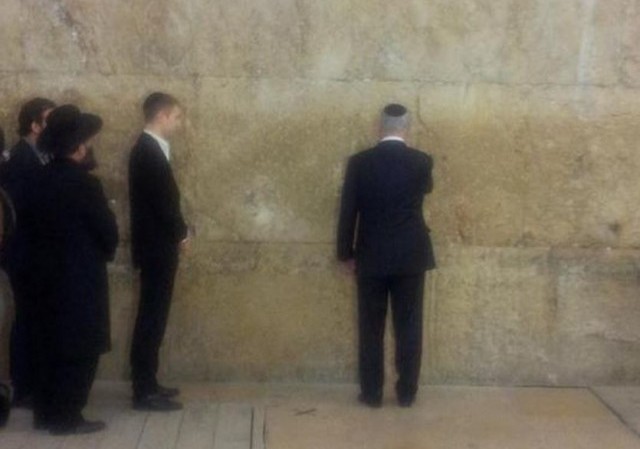
Benjamin-Netanyahu-at-Western-Wall-post-election-2015-e1426681806959[Israeli Prime Minister Benjamin Netanyahu at Western Wall after 2015 election victory.]

But he is the only Israeli politician who has the stature to handle the world pressure; but I don’t envy the position he is in with so many forces against us; but [opposition leader Yitzhak “Bougie” Herzog] Bougie is weak and no one will fear him; and so on.

These opinions pretty much were reflected in polling and the election results — Many people may not like Netanyahu, but he is the only Israeli politician capable of standing up for Israel in a hostile world.

3. I don’t like Obama, no BUTs about it

Polling in Israel shows Obama is hugely unpopular.  Our anecdotal interactions with Israelis confirmed that polling.

I  can’t recall anyone, from left to right, who had anything nice to say about Obama.  The most consistent theme was that Obama is naive and weak, and that naivitee and weakness had resulted in disaster in the Arab world as it encouraged the most aggressive Islamist elements.

They see Syria falling apart with al-Qaeda or ISIS groups likely to control large parts of the country; or if not, then Iran in control. There are no good outcomes for Israel’s Golan Heights border. Along the Lebanese border there is Hezbollah, and in Gaza Hamas and increasingly even more radical Salafist-ISIS groups.

Against this background of being surrounded by a sea of increasing threats resulting from Obama administration policy, not a single person thought the Iran nuclear deal made any sense, or trusted the Obama administration on it.

In other words, Israelis live in the real world, not the world of Obama’s delusional hope.  And they don’t appreciate Obama taking risks with their lives.

4. Are we really that popular in the United States?

The anti-Israel Boycott, Divestment and Sanctions movement was a frequent topic of conversation, almost always brought up by us as part of describing the type of coverage at Legal Insurrection.  This coincided with what I consider an irrational panic the past two weeks in the Israeli press and political discourse about BDS (more on that in a later post.)

I tried to explain that there is a complete disconnect between the BDS movement in the U.S. and the vast majority of Americans.  Gallup and Pew polling shows Israel at or near historical highs in terms of Israel’s favorability both abolutely and relative to favorability of Palestinians.  The gap between those who pick Israel over Palestinians when the question forces a choice, also is historically high.

Virtually every Israeli we met was shocked that Israel is actually so popular in the United States.  Even Israelis who have extensive American contacts and visit the U.S.

That’s not all so surprising.  Both the U.S. and Israeli media focus on the negative, though for different reasons.  The U.S. media long has had in implicit anti-Israel bias, compounded by the rise of left-leaning new media, while the Israeli media competes for readers with a “sky is falling” outlook.

(added) Israel’s enormous popularity among Americans is a strategic asset.  That strategic asset needs to be used more effectively to minimize the damage from the narrow but influential slices of the American population — radical faculty, some students, and mainstream journalists — who have explicit or implicit anti-Israel biases. The American people as a whole are the “Israeli Lobby.”

5. The Next War is Only a Matter of Time

While we were in Jerusalem, Israel underwent a national defense drill, including sirens warningof incoming rockets.

Our tour along the Gaza border, particularly near Sderot, also reflected preparation for the next round of rocket fire through reinforcing key civilian infrastructures, such as schools.
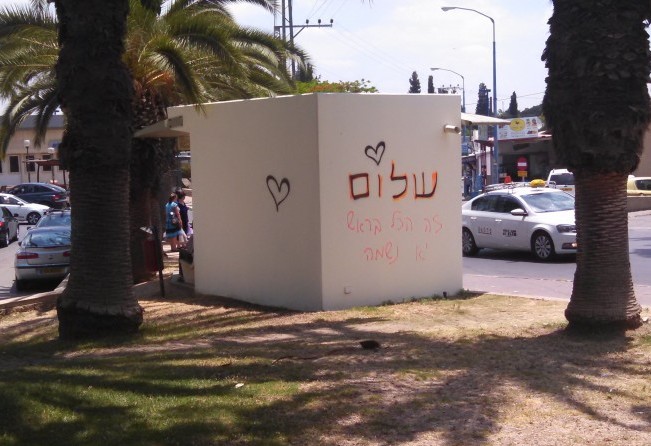
Sderot-Israel-bomb-shelter-street-e1433110130989[Sderot, Israel, street bomb shelter with “Shalom” grafitti]

There was a pervasive feeling that the calm cannot last.  And sure enough, while we were there and just after we left, rockets were fired from Gaza to Israel by Salafists suffering from a Hamas crackdown, and groups competing with Hamas for control.

That’s the logic of the region in which Israel lives: Radical groups retaliate against each other by firing rockets at … Israel.

The next war is coming.  Every Israeli knows it. It’s only a matter of time.

*  *  *  *  *

Those are my big takeaways.  I hope you enjoyed the coverage.

We will be back in Israel, hopefully next year.
Who Is Blocking Palestinian Elections?

June 4, 2015

Who Is Blocking Palestinian Elections? The Gatestone InstituteKhaled Abu Toameh, June 4, 2015

  • Fatah is afraid that Hamas’s chances of winning the elections, especially in the West Bank, are very high. Hamas is not willing to relinquish control over the Gaza Strip, certainly not to Abbas and the Palestinian Authority, who were expelled from there in 2007.
  • Each party cares only about its own interests, while at the same time lying to the world that it is all Israel’s fault. Hamas continues to invest enormous resources in digging new tunnels, in preparation for a new war with Israel.
  • All this is being done with the help of anti-Israel governments around the world, and groups such as the Boycott, Divestment and Sanctions (BDS) movement, whose only goal is to delegitimize Israel and demonize Jews rather than to help the Palestinians.

One year after Palestinian Authority (PA) President Mahmoud Abbas announced the establishment of the Palestinian Fatah-Hamas “national consensus” government, the two rival parties remain as far apart as ever.

The “national consensus” government, headed by Prime Minister Rami Hamdallah, was formed after a series of “understandings” between Fatah and Hamas on the basis of previous “reconciliation” agreements between the two sides.

A year later, it has become obvious that the “national consensus” government has failed to achieve its main objectives: the reconstruction of the Gaza Strip; ending the conflict between Hamas and Fatah, and preparing for new presidential and parliamentary elections.

Fatah and Hamas can only blame each other for the failure of the latest attempt to end their dispute and do something good for their people. There is no way this time that they could lay the blame on Israel.

The two parties had a chance to cooperate on the reconstruction of the Gaza Strip in the aftermath of last year’s military confrontation between Israel and Hamas. The international community even offered to assist in the mission, but Fatah and Hamas chose to continue fighting each other at the expense of Palestinians in the Gaza Strip. Until today, the two rival Palestinian parties have not been able to reach agreement on a mechanism for the transfer of funds from international donors to the Gaza Strip.

Fatah claims that Hamas wants to steal the money, while Hamas is already accusing Fatah and the Palestinian Authority government of working to lay their hands on the funds.

Fatah and Hamas agreed back then that the Hamdallah government would remain in office for only six months — the period needed to prepare for long overdue presidential and legislative elections in the West Bank and Gaza Strip. But the “interim” government has just completed its first year in power, while the chances of holding new elections under the current circumstances are non-existent.

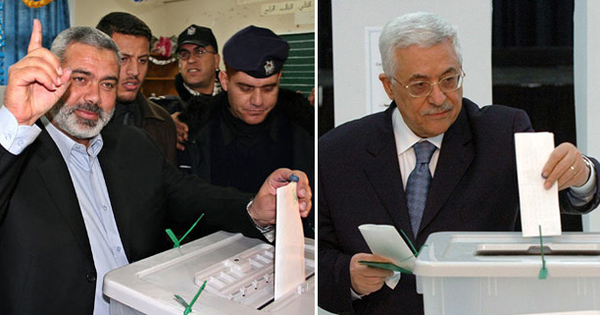
1096One man, one vote, one time? Hamas leader Ismail Haniyeh (left) and Fatah leader Mahmoud Abbas (also president of the Palestinian Authority) are pictured voting in the last election for the Palestinian Legislative Council, which took place in 2006.

Again, the two sides do not seem to be interested at all in sending Palestinians to the ballot boxes. Each side has many good reasons to avoid holding new elections in the West Bank and Gaza Strip.

First, Fatah and Hamas do not trust each other, and each side is convinced that the other would try to steal the vote. How can there be free and democratic elections while Hamas and Fatah continue to arrest and torture each other’s supporters in the Gaza Strip and West Bank?

Second, Fatah is afraid that Hamas’s chances of winning the elections, especially in the West Bank, are very high. That is because many Palestinians still do not trust Abbas and Fatah, whom they accuse of maintaining close security ties with Israel. Moreover, many Palestinians remain disillusioned with Fatah because of its failure to combat financial and administrative corruption and pave the way for the emergence of new leaders.

There is no way that Hamas and Fatah can cast the blame on Israel regarding the issue of elections. If they were really interested in holding new elections, they could do so with the help of the international community, as was the case with previous votes in 2005 and 2006. Israel even helped the Palestinian hold those elections.

When several Hamas candidates from east Jerusalem ran in the January 2006 parliamentary election, Israel did nothing to stop them. Israel even opened its post offices in the city to allow Arab voters from the city (who hold Israeli-issued ID cards) to vote in the election.

Charges made by some Palestinians and anti-Israel groups around the world, to the effect that Israel is responsible for “foiling” efforts to achieve Palestinian unity, are baseless. Although the Israeli government initially opposed the Fatah-Hamas “reconciliation” deal that was reached in 2014, it has not stopped the Palestinian prime minister and some of his cabinet members from visiting the Gaza Strip to pursue the implementation of the accord. In fact, Prime Minister Hamdallah has since visited the Gaza Strip twice, after receiving permission from Israel to go through the Erez border crossing.

Recently, ten Palestinian ministers were forced to leave the Gaza Strip, after Hamas placed them under house arrest in their hotel and banned them from meeting with locals. The ministers entered the Gaza Strip through the Erez border crossing. They came to the Gaza Strip to help solve the problem of thousands of Hamas government employees who have not received salaries for more than a year, and to discuss issues related to the reconstruction of the Gaza Strip.

So while Israel facilitated the visits by Hamdallah and his ministers to the Gaza Strip, it was Hamas that expelled them and prevented them from carrying out their duties. Had Israel expelled the ministers from the Gaza Strip or stopped them from entering the area, the country would have been condemned by the international community for “blocking” efforts to achieve Palestinian unity and rebuild the Gaza Strip.

Today, it has become unavoidably clear that Fatah and Hamas, and not Israel, are responsible for the ongoing plight of the Palestinians in the Gaza Strip. The two parties are unlikely to resolve their differences in the near future, further exacerbating the misery of their people. Each party cares only about its own interests, while at the same time lying to the world that it is all Israel’s fault. Hamas is not willing to relinquish control over the Gaza Strip, certainly not to Abbas and the Palestinian Authority, who were expelled from there in 2007. As for Abbas, he does not seem to be interested in regaining control over a problematic area such as the Gaza Strip, where most of the population lives under the poverty line and in refugee camps.

Yet instead of being honest with their people and admitting their failure to improve their people’s living conditions, Hamas and Fatah continue to wage smear campaigns against each other and, at the same time, also against Israel.

The campaigns that Hamas and Fatah are waging against Israel, particularly in the international community, are designed to divert attention from their failure to provide their people with basic services or any kind of hope.

While ignoring the plight of the Palestinians in the Gaza Strip, the Palestinian Authority leaders were prepared to invest huge efforts and resources in trying to have Israel suspended from the International Federation of Association Football (FIFA). It is as if the Palestinians had solved all their major problems and all that they needed to do now was to stop Israeli soccer players from playing in international matches.

Hamas, for its part, continues to invest enormous resources in digging new tunnels, in preparation for another war with Israel. The money that is being invested in the tunnels and the purchase and smuggling of weapons could benefit many families who lost their homes during the last war. But Hamas, like the Palestinian Authority, does not care about the misery of the Palestinians in the Gaza Strip. They want to fight Israel to the last Palestinian. And this is all being done with the help of anti-Israel governments around the world, and groups such the Boycott, Divestment and Sanctions (BDS) movement, whose only goal is to delegitimize Israel and demonize Jews rather than to help the Palestinians.

Egypt Says NY Times Promoting Muslim Brotherhood Agitprop

June 3, 2015

Egypt Says NY Times Promoting Muslim Brotherhood Agitprop, The Clarion ProjectRyan Mauro, June 3, 2015

(Obama has spread and relied upon much the same meme as the NY Times and Washington Post. — DM)

New-York-Times-Building-IP_1The New York Times building in New York City

If the New York Times values objective reporting, then it must mention the Brotherhood’s calls to violence in its coverage as well as the many other instances of violence that the group has been involved in.

*********************

The Egyptian ambassador to the U.S. has written a public letter toThe New York Times protesting “its unquestioning adoption of Moslem Brotherhood’s propaganda” and false characterization of the Islamist group as non-violent.

Ambassador Mohamed Tawfik’s letter was written around the same time that the Egyptian embassy released three videos of calls to violence made on Muslim Brotherhood television networks based in Turkey.

The networks’ coverage promoted explicit calls for killing Egyptian police officers and attacking foreign companies and embassies. A threat was also made to carry out regional attacks against the interests of countries who support the Egyptian government.

Egypt is infuriated at the Times as well as the Washington Post for repeatedly asserting that the Brotherhood is non-violent. In response to the Times suggestion that the Egyptian government’s prosecution of the Brotherhood is pushing it towards terrorism, the Egyptian ambassador writes:

This statement demonstrates, at best, a complete misunderstanding of the roots of radicalism. At worst, it amounts to a justification for violent extremism. Today, terrorists in Egypt are part of a network of extremists who are bound by a singular distorted ideology, and by a shared goal of taking our region back hundreds of years. They are inspired by the radical teachings of the former Moslem Brotherhood leader Sayyid Kutb [Qutb]. Terrorists in Egypt share the same evil goals as terrorists in Iraq, Syria and Libya.

Indeed, Ambassador Tawfik is correct that the New York Times separates Islamists from terrorists and extremists. The Times editorial condemns “relentless and sweeping crackdown on Islamists, under the baseless contention that they are inherently dangerous.”

The New York Times described sentencing to death of former President Morsi and 100 other Brotherhood members as “deplorable.” It describes the Brotherhood as having renounced violence in the 1970s.

However, Morsi and the defendants were sentenced for his involvement in prison breaks in 2011 that freed 20,000 inmates, including Morsi himself. The Egyptian government says the attacks were well-orchestrated and involved participation by the Muslim Brotherhood, Hamas and Hezbollah.

Tawfik chastises the Times for failing to mention that the prison break was a violent operation that resulted in the deaths of prison guards and inmates and freed members of Hamas and Hezbollah.

The Egyptian ambassador also excoriated the Washington Post in February for “toeing the Muslim Brotherhood line” and advised it to be more balance in order to “save whatever is left of your credibility in the Arab world.”

Egyptian President El-Sisi came into power after the popularly-supported military intervention in July 2013 overthrew the Muslim Brotherhood government. The move had the support of a broad spectrum of Egyptian society with public endorsements from secular-democratic activists, the Grand Sheikh of Al-Azhar University and the leader of the Coptic Orthodox Church.

The overthrow came after Morsi (whose election itself was marred bycharges of voter fraud) seized far-sweeping powers for himself, essentially negating any semblance of a democratic government.

El-Sisi is often characterized as an anti-democratic strongman; a depiction that his government is now challenging.

He argues that these strongman tactics are necessary because a democratic transition cannot be completed without stability, economic development and a confrontation with Islamism (also known as Political Islam). He asks the West to understand that there is a “civilizational gap between us and you” and it will take time to modernize.

A study commissioned by the Egyptian government criticized its heavy-handedness but concluded that banning Islamist parties is required for the country’s stability and democratic development. It recommended a program to separate politics and religion.

The Egyptian government sees the Islamic State (ISIS) as a natural outgrowth of the Muslim Brotherhood. Its website warns that the Muslim Brotherhood has a network of fronts in America that are disguised as civil society organizations.

El-Sisi called for a reformation in Islamic interpretation in January 2014 and made a dramatic call on the Islamic religious establishment to address problematic teachings this January that received widespread media coverage. He has explicitly said that Egypt should be “a civil state, not an Islamic one” and defined the ideology of the enemy as Political Islam in an interview on FOX News Channel.

El-Sisi is also confronting Islamist terrorism internationally, in addition to its fight against Islamic State in the Sinai Peninsula. His government is an enemy of Hamas and is as minimally anti-Israel as can be expected of an Arab leader.

Egypt has conducted airstrikes on ISIS in Libya and is materially supporting the Libyan government in its civil war against Islamist forces. Egypt and Libya are complaining about a lack of American backing. A new Egyptian-backed offensive is said to be in the works.

El-Sisi is assembling an Arab rapid-reaction force of 40-50,000 troops that can quickly be deployed to fight Islamic State and other terrorists. Egypt is also taking part in the Arab military intervention against the Iranian-backed Houthi rebels in Yemen.

El-Sisi also made a historic visit to a Coptic Christian church during mass on Christmas Eve. He challenged the Egyptian honor culture when he apologized to a woman who was raped in Tahrir Square.

Major American media outlets have fallen for the falsehood that the Muslim Brotherhood is non-violent. It is true that the Egyptian government is often criticized for its human rights record, but coverage of those accusations should not automatically exempt the Brotherhood and other Islamists from blame.

If the New York Times values objective reporting, then it must mention the Brotherhood’s calls to violence in its coverage as well as the many other instances of violence that the group has been involved in.

A Preview of ‘Palestine’

May 12, 2015

A Preview of ‘Palestine’, Front Page Magazine, May 12, 2015

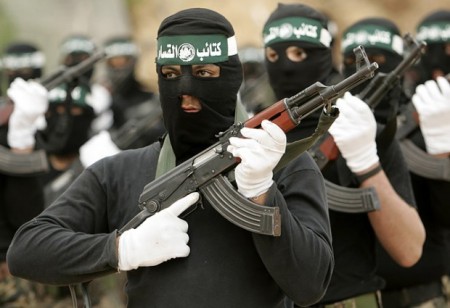
Hamas-450x308

[W]hy is the Obama administration placing mammoth pressure on Israel to cede vital strategic territory and why is it besotted with the idea of dismembering Israel by tearing away parts of its ancestral heartland? The answer lies in a flawed foreign policy that rewards tyrannical regimes while back-stabbing allies; a foreign policy that favors Iranian Fatwas over concrete empirical evidence of malfeasance.

******************

Anyone wishing to get a glimpse of what a future “Palestinian” state might look like, need look no further than recent actions taken and official statements made by both the Palestinian Authority and its rival Hamas this past month. While these two governing entities detest each other (perhaps even more so than the infidel Yahuds), it is difficult to discern why, since both of these governing bodies spew forth nearly identical xenophobic rhetoric and act with typical autocratic ruthlessness to stifle any whiff of internal dissent. In essence, they both act in a manner that is not dissimilar to the 20 or so chauvinistic, anti-democratic Muslim pseudo-states of the Middle East.

Most Israelis harbor deep reservations about the creation of an “independent Palestinian state” for a multitude of reasons. Chief among them is the fear that a Palestinian state would devolve into an entity similar to that found in Gaza and that’s a best case scenario. There are far worse, more frightening scenarios. But while Gaza is contained in the southwest corner of Israel and can, relatively speaking, be monitored and controlled, the same cannot be said about the West Bank with its long, torturous border along the imaginary Green Line (the 1949 armistice lines). Moreover, in contrast to the Gaza periphery, much of Israel’s population and industry faces the West Bank, which juts out like a bone into Israel’s throat.

But even if the Palestinian Authority, headed by its aging, autocratic leader Mahmoud Abbas, succeeds in rebuffing a Hamas takeover – an unlikely prospect – the Palestinian Authority’s leadership has proven to be just as extreme, xenophobic and malevolent as its rivals in Gaza. Palestinian Authority TV and media outlets as well as PA-backed NGOs, routinely spew forth ancient anti-Semitic canards involving ritualistic Passover blood libels and conspiracy theories involving Jewish attempts at world domination.

On April 5, in an official PA television interview, Fatah spokesperson, Osama Al-Qawasmi, invoked the notorious early 20th century Czarist forgery known as the Protocols of the Elders of Zion to back up his spurious claims against Israel. For the sake of perspective, both Hitler’sMein Kampf and the Hamas Charter incorporate the Protocols to buttress repugnant supremacist views and reinforce ancient calumnies.

Al-Qawasmi comments, largely ignored by the West, represent views that are commonplace within the Palestinian Authority. In fact, most high-level officials within the PA subscribe to Hitleresque positions and this comes as no surprise given that the father of the modern “Palestinian” movement and the man who gave birth to Palestinian nationalism, Haj Amin al Husseini, was a Nazi collaborator and a dear friend of the Fuhrer.  In January 2013, “President” Abbas, whose own ventures into Holocaust denial are well known, showered the Hitler-supporting Husseini with acclaim.

The Palestinian Authority has also been known to perpetuate ancient ritualistic Passover blood libels. In July 2014 Mahmoud Abbas’ official PA daily, Al-Hayat Al-Jadida, featured an op-ed which claimed that Jews use the “blood of [Palestinian] children” as a key ingredient in Matzah or unleavened bread used by Jews during the Passover holiday. Shortly thereafter, in a variation of that insidious theme, Palestinian Authority TV claimed that Israel was injecting poison into the Palestinian water supply.

In 2013, a Western funded Palestinian propaganda outfit called MIFTAH (which publishes in both English and Arabic) published an article in Arabic criticizing President Obama for speaking of Passover in a favorable light. The author then went on to invoke the ancient blood libel stating,

Does Obama in fact know the relationship, for example, between “Passover” and “Christian blood”..?! Or “Passover” and “Jewish blood rituals?!’ Much of the chatter and gossip about historical Jewish blood rituals in Europe are real and not fake as they claim; the Jews used the blood of Christians in the Jewish Passover.

Palestinians routinely spew forth revolting babble and nonsensical conspiracy theories in Arabic but are substantially more reserved when addressing Western audiences who would find such utterances disquieting to say the least.

MIFTAH was founded by the Palestinian Authority’s spokeswoman and PLO Central Committee Member Hanan Ashrawi. Incredibly, when confronted with the outrage, Ashrawi, a seasoned politician who makes frequent guest appearances on Western news programs, refused to acknowledge any wrongdoing and actually attacked the blogger who exposed the incident claiming that she was the victim of a “smear campaign.” She also risibly noted that she was committed to “open dialogue” and in any event, a “disclaimer” in the publication absolved her and her organization of any culpability.

To a vile terror apologist like Ashrawi, blood libels are part of her concept of “open dialogue.” Only after drawing the ire of her Western donors did Ashrawi express contrition and posted an apologylaced with the requisite dose of crocodile tears. That served to placate MIFTAH’s gullible Western enablers.

But while Palestinians are free to spew forth the vilest canards against Israel and Jews, any whiff of criticism or dissention directed against any Palestinian body, Hamas or the Palestinian Authority, is ruthlessly dealt with. In April, a Palestinian civil servant was arrested for expressing views on Facebook critical of Yassir Arafat. More precisely, he failed to subscribe to the view that Arafat was a “martyr.” He was charged with “attacking and harming the martyr, eternal leader and symbol of the Palestinian people Abu Ammar,” Arafat’s nom de guerre. His niece was expelled from Birzeit University near Ramallah for expressing similar views and all other Palestinian universities have been instructed to deny her admission.

In Hamas-controlled Gaza, in a rare show of defiance, a group of between 150 to 200 Palestinians demonstrated against the governing authorities. The demonstrators were beaten with sticks and some were herded off in jeeps by thug-like Hamas enforcers.

These two incidents are demonstrative of the complete absence of freedom of speech and freedom of assembly in areas governed by Palestinians. Conversely, Palestinians are completely free to let loose with the vilest canards as long as the objects of derision, defamation and ridicule are Jews.

A Palestinians state, whether governed by Hamas or the “moderate” Palestinian Authority, will almost certainly resemble the 20 or so Arab pseudo-states currently in existence.  It will be dysfunctional, autocratic, xenophobic and unable to survive without massive financial assistance. That will be the nature of the state that lives alongside Israel’s long and tortuous border with the West Bank. That will be the state that will have full view of all commercial airlines that come and go from Ben Gurion International Airport. And that will be the state that juts into Israel’s narrow 9-mile wide waistline overlooking Israel’s heavily populated coastline.

Considering these facts, why is the Obama administration placing mammoth pressure on Israel to cede vital strategic territory and why is it besotted with the idea of dismembering Israel by tearing away parts of its ancestral heartland? The answer lies in a flawed foreign policy that rewards tyrannical regimes while back-stabbing allies; a foreign policy that favors Iranian Fatwas over concrete empirical evidence of malfeasance.

Prime Minister Netanyahu has just formed a governing coalition with a razor thin majority. Yet his coalition partners, cognizant of the dangers they face, both on the battlefield and in the political arena, appear to be solidly behind their Prime Minister. One can only hope that the Prime Minister will stand fast in the face of massive pressure he is sure to encounter from an extremely hostile Obama administration. Good luck Mr. Prime Minister, you’re going to need every bit of it for the next 18 months.

Cartoonists are Controversial and Murderers are Moderate

May 5, 2015

Cartoonists are Controversial and Murderers are Moderate, Front Page Magazine, Daniel Greenfield, May 5, 2015

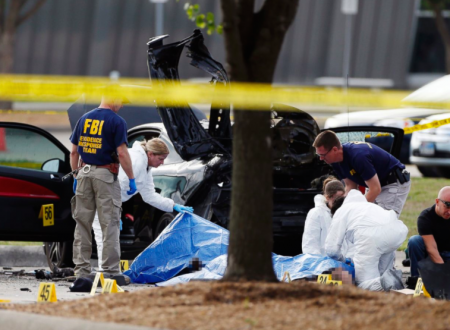
garland1-450x330

[I]f you believe the media, cartoonists are more controversial than killers. A former Muslim sketching a cartoon of Mohammed is bigoted, but justifying attacks on Jews is moderate. Plotting to overthrow the United States and replace it with an Islamic theocracy is right up the alley of your local civil rights group, but a cartoon contest threatens the nation and all of creation by bringing down the wrath of men who spent their time at moderate and Muslim organizations which only occasionally support terrorism.

****************

Controversial, intolerant and provocative. Mainstream media outlets broke out these three words to describe the “Draw the Prophet” contest, the American Freedom Defense Initiative and Pamela Geller.

While the police were still checking cars for explosives and attendees waited to be released, CNN called AFDI, rather than the terrorists who attacked a cartoon contest, “intolerant.” Time dubbed the group “controversial.” The Washington Post called the contest, “provocative.”

Many media outlets relied on the expert opinion of the Southern Poverty Law Center, a multi-million dollar mail order scam disguised as a civil rights group, which had listed AFDI as a hate group. Also listed as hate groups were a number of single author blogs, including mine, a brand of gun oil and a bar sign.

The bar sign, which hangs outside a bar seven miles outside Pittsburgh, appears to be made out of metal and plastic. It is reportedly unaware that it is a hate group and has made no plans to take over America.

The SPLC’s inability to conduct even the most elementary fact checking did not stop news networks from inviting its talking head on to suggest that AFDI got “the response that they — in a sense — they are seeking.” Neither CNN nor MSNBC were impolitic enough to mention that no AFDI supporter had used its materials to plan a killing spree, while at least one of SPLC’s supporters had done just that.

But being “controversial” and “provocative” has nothing to do with who is doing the shooting. It’s a media signal that the target shouldn’t be sympathized with. The Family Research Council, which was shot up by a killer using the SPLC’s hate map, is invariably dubbed “intolerant.” The SPLC, which targeted it, is however a “respected civil rights group” which provides maps to respected civil rights gunmen.

A contest in which Bosch Fawstin, an ex-Muslim, drew a cartoon of a genocidal warlord is “controversial” and “provocative,” while the MSA, which has invited Sheikh Khalid Yasin, who has inspired a number of terrorists, including apparently one of the Mohammed contest attackers, is a legitimate organization that is only criticized by controversial, intolerant and provocative Islamophobes.

Khalid Yasin has held such controversial and provocative views as claiming that the US created AIDS, that gays should be stoned to death and that women should be beaten. But the mosques and MSAs that he has appeared at have not been described as controversial, intolerant and provocative for inviting him.

Elton Simpson, the first gunman, attended the Islamic Community Center of Phoenix. The mosque was listed as being controlled by the Muslim Brotherhood’s North American Islamic Trust front group.

The Muslim Brotherhood holds such controversial and provocative views as “waging Jihad” against American infidels, “raising a Jihadi generation that pursues death” and “destroying the Western civilization from within.” Despite these extremely provocative and intolerant views, the Muslim Brotherhood is usually described by the media as a “moderate” group.

The Brotherhood’s American arm believes in launching a “Grand Jihad” to Islamize America. Its final phase calls for “Seizing power to establish their Islamic Nation” in the United State.

Some might say this is a slightly more controversial activity than drawing cartoons of a dead warlord.

The Islamic Community Center of Phoenix featured an appearance by Lauren Booth, a convert to Islam employed by Iran, who has been photographed with the leader of Hamas, and holds such controversial and provocative views, as the Boston Marathon bombing being faked and attacks on Jews being justified as “a frustrated backlash.

Some might say Booth’s views are controversial, provocative and intolerant. And that the gunman’s mosque was intolerant for inviting her. But don’t expect the media to call out terrorist intolerance.

Booth came as part of a fundraising effort for the Muslim Legal Fund of America, which funded the defense for Islamic Jihad boss Sami al-Arian and aided some of the terrorists involved in the provocative and controversial Fort Dix terror plot to “kill as many soldiers as possible.”

If the two Mohammed cartoon gunmen had survived, the Muslim Legal Fund of America might be having Lauren Booth spout Jewish conspiracies to fundraise on their behalf.

But if you believe the media, cartoonists are more controversial than killers. A former Muslim sketching a cartoon of Mohammed is bigoted, but justifying attacks on Jews is moderate. Plotting to overthrow the United States and replace it with an Islamic theocracy is right up the alley of your local civil rights group, but a cartoon contest threatens the nation and all of creation by bringing down the wrath of men who spent their time at moderate and Muslim organizations which only occasionally support terrorism.

Cartoons can be provocative, but the only people inspired to kill over them, are killers. No one took a shot at Gary “Punching Up” Trudeau, despite decades of mocking conservatives. None of the assorted arts projects that involve defiling and mocking the sacred symbols of Christianity and Judaism resulted in gunmen in body armor trying to storm a cartoon competition. And yet it keeps happening with Islam.

Satire exposes sociopaths and sociopathic ideologies. And it’s the very attack on the “controversial” and “provocative” contest that shows why exposing them is so important.

Elton Simpson had already been on the radar of the FBI. He should have been in jail, but Judge Mary H. Murguia, a Clinton appointee who has been bandied about as a possible Obama Supreme Court nominee, chose to believe a claim by his public defender that when he was taped talking about Jihad, it might have meant “an internal struggle to maintain faith,” instead of killing non-Muslims.

Simpson had said that Allah loves those who fight non-Muslims, that Jihadists go to paradise and stated, “I’m tellin’ you man. We gonna make it to the battlefield… it’s time to roll.”

But that was just too ambiguous for Judge Murguia, who wrote, “It is true that the Defendant had expressed sympathy and admiration for individuals who “fight” non-Muslims as well as his belief in the establishment of Shariah law, all over the world including in Somalia. What precisely was meant by “fighting” whenever he discussed it, however, was not clear.”

“Neither was what the Defendant meant when he stated he wanted to get to the ‘battlefield’ in Somalia,” she added.

If nothing else, events like these help clarify the question of just what “fighting” non-Muslims involves, and whether it’s an internal struggle to maintain faith or an external struggle waged with assault rifles.

Satire helps expose the idiocy and absurdity of our betters, whether it’s Gary Trudeau or Judge Murguia. Every act of Islamic terror discredits them and their dishonest worldview even further. And they know it.

We cannot fight Islamic terrorism until we deal with it and we cannot deal with it as long as we are burdened by a political establishment that frantically censors any mention of its existence or its agenda.

The two gunmen did not attack the cartoon event simply because they were offended, but because they believed that their religion gave them a mandate to impose Islamic law on Americans. Until we deal with this supremacist reality, any effort to fight Islamic terrorists will be futile and will ultimately fail.

The Mohammed cartoons are so vital because they expose the theocracy at the heart of Islamic terrorism. When Muslim terrorists attack cartoonists, they’re not fighting our foreign policy; they are killing and dying to impose the foreign policy of the Muslim Brotherhood and its numerous daughter groups, such as Al Qaeda, Hamas and ISIS, on us.

The controversial and provocative cartoonists go into battle with pencils in their hands. The terrorists come with body armor and assault rifles. This clash is what real political dissent looks like.

The cartoonists believe in the controversial, intolerant and provocative idea that America should not be a theocracy. But the only people who should be provoked by that provocative idea are the Jihadists who want to impose a theocracy on America and the useful idiots lying and denying on their behalf.

How Iran Saved Obama’s “Blame America” Foreign Policy

April 29, 2015

How Iran Saved Obama’s “Blame America” Foreign Policy, Front Page Magazine, April 28, 2015

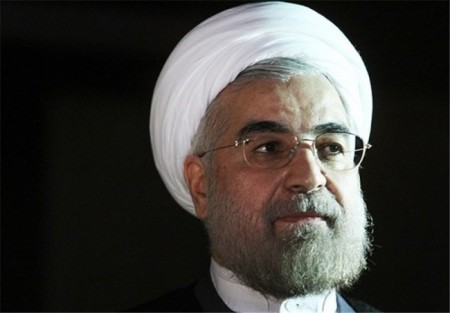
rouh-450x313

Obama’s public rejection of every ally, from Israel to Egypt to Saudi Arabia, has finally created the Post-American Middle East that his “Blame America” doctrine sought. The Post-American Middle East is a hive of terrorist groups and a region of nuclear arms races where murderous despots with vast armies dream of resurrecting the Ottoman Empire, the Persian Empire and the Abbasid Caliphate.

*********************

Obama’s Middle East policy was doomed to fail because it was based on the myth that everything wrong with the region was America’s fault.

Senator Obama had argued that Iraq would fix itself once we pulled out. Without America, the Iraqis would create a “political solution”. Instead the Shiites used the withdrawal to take over the government and Al Qaeda rebounded to dominate the Sunnis. After years of denying what was going on, he was forced back into Iraq after genocide and beheadings filled every television screen.

From the White House, he deployed the “Iraq Solution” across the Middle East by withdrawing support from American allies and backing terrorist groups like the Muslim Brotherhood. The chaos tore apart the region and turned over entire cities and countries to terrorists.

Egypt went through multiple coups. Street violence in Tunisia wrecked the country and supplied thousands of fighters to ISIS. His regime change war in Libya led to terrorist takeovers of its capital. Al Qaeda nearly took over Mali. Houthi Jihadists backed by Iran took over Yemen’s capital. The Saudis are bombing Yemen. The Egyptians are bombing Libya. The French are still fighting in Mali.

Iran and Al Qaeda have divided up Iraq, Syria and Yemen between themselves.

Withdrawing American power and influence didn’t work because we were never the problem. American soldiers weren’t causing the Sunnis and Shiites to fight each other. They were the only thing preventing it. American power and influence across the Middle East wasn’t holding back freedom and human rights, it was the only thing keeping a modicum of freedom alive in places like Egypt and Tunisia that quickly fell to Islamist rule in the Arab Spring, resulting in street violence, torture, terrorism and military coups.

The left had been fundamentally wrong about the cause of the problems in the Middle East. Obama trashed the region by following its wrongheaded doctrines.

Once the “Blame America” foreign policy has been implemented and the region went to hell, he had no idea what to do next. Intervening in Libya made sense according to the “Blame America” doctrine because Gaddafi had recently cut a deal with the United States and was obstructing the Jihadists who were implementing the local version of the Arab Spring in coordination with the Muslim Brotherhood.

But intervening in Syria didn’t. Assad wasn’t an American ally. Therefore the “Blame America” doctrine said that he should be left alone. But he was obstructing the Arab Spring. Overthrowing him would let the Muslim Brotherhood claim another country, but would alienate Iran and spoil any reconciliation.

Unable to make a final decision, Obama veered back and forth between Iran and the Muslim Brotherhood. Some days he seemed on the verge of bombing Syria and other days he was against even providing the promised weapons to the Sunni rebels. Even his supporters accused him of having no plan.

Syria’s real red line was the one that it had drawn through his foreign policy. Instead of making the Middle East better, his withdrawals had made it worse. And the beneficiaries of his foreign policy, especially the Muslim Brotherhood, were clamoring for more American military intervention.

Even Iraq’s Shiite government, backed by Iran, wanted American intervention.

Obama’s foreign policy had created a new set of untrustworthy client states which had to be kept alive by American intervention. The great joke of his foreign policy was that his new terrorist states acted just like the old dictators they were supposed to replace. They wanted American weapons and soldiers. Their own people hated them and hated America by extension. The climax of the Arab Spring came with crowds in Tahrir Square denouncing Obama and the Muslim Brotherhood for acting as his client state.

The “Blame America” foreign policy had led to even more blame of America. The new “democratic” Islamist governments that he helped bring to power to appease the Arab Street and atone for the sins of supporting the old secular-ish dictators backfired by making the Arab Street hate us more than ever.

Iran saved Obama’s foreign policy. Just as he was stumbling around Syria and weeping at being stuck back in Iraq, the agents of the Iran Lobby suggested that the whole mess could be put back together again. Iran and the US would fight on the same side against ISIS in Syria and Iraq. And this cooperation could be used to hammer out a nuclear accord that would retroactively justify Obama’s Nobel Prize.

The only problem was that everyone else in the region was completely against the idea.

The Iran Lobby threw Obama’s failed foreign policy a lifeline and he grabbed it. The bombing of Syria was off. Assad turned over some WMDs, but went on using others. The US began acting as the air force for Iran’s Shiite militias in Iraq while the Kurds and the Sunni Sheikhs of the Awakening were shut out.

When the Houthis took over Yemen, Obama shrugged. When the Saudis began bombing Yemen, they didn’t tell him because they were afraid the news would leak to Iran. And the administration covertly began pressuring them to stop, confirming that it now took its marching orders from Tehran, not Riyadh.

Obama ignored the vocal opposition, particularly from Israel’s Netanyahu, because the Iran deal was the only thing holding his foreign policy together. It made it seem as if he knew what he was doing. Take away the Iran deal and there was no longer a strategy, just a series of incoherent panicked responses.

That is why he continues to cling to the Iran deal. Without it, the Emperor’s foreign policy is naked.

The Iran deal salvaged the “Blame America” foreign policy by reorienting it away from the Muslim Brotherhood to deal with our great enemy in the region. By acceding to Iran’s nuclear program, Obama could finally fix everything by atoning for America’s biggest foreign policy sin in the region.

Despite his Muslim family background, Obama never understood the Middle East. Instead he looked at the region through a left-wing lens and saw only America’s crimes.

The Sunnis and Shiites, the Arabs, Kurds, Persians and Turkmen, weren’t fighting because of America. They were fighting over differences in religion, ethnicity and clan. The left has always thought that the way to fix the Middle East was to withdraw American influence. Instead doing that destabilized the region and created a power vacuum that Russia and Iran have been more than happy to fill.

Obama’s final foreign policy act was to fall directly into Iran and Al Qaeda’s trap.

Iran and the various Al Qaeda groups had effectively split parts of the region among themselves. By embracing Iran, Obama alienated the Sunni Middle East and shoved entire populations into Al Qaeda’s waiting embrace. He completed the polarizing process that he began with the Arab Spring by selling out the moderates to the extremists and waiting for everyone in the region to love America again.

But the Muslim Brotherhood lost out to its edgier Al Qaeda children. Egypt and the Saudis are scrambling to hold together some sort of Sunni center without the United States and against its wishes. Obama’s alignment with Iran, his rejection of Egypt’s new government and his failure to back the Saudis in Yemen has sent the message that the only legitimate alternative to Al Qaeda is Iran.

That’s not an alternative that most Sunnis can accept. Many would rather stand with Al Qaeda than Iran.

Obama’s public rejection of every ally, from Israel to Egypt to Saudi Arabia, has finally created the Post-American Middle East that his “Blame America” doctrine sought. The Post-American Middle East is a hive of terrorist groups and a region of nuclear arms races where murderous despots with vast armies dream of resurrecting the Ottoman Empire, the Persian Empire and the Abbasid Caliphate.

While genocide goes on, sex slaves are raped under the rule of a Caliph and black flags are unfurled and nuclear weapons are developed to fulfill apocalyptic Islamic prophecies, Obama smiles for the camera and waits for his second Nobel Prize.

It had been America’s fault all along. Now that Iran and Al Qaeda are in charge, everything will be okay.

Hizballah copycats Hamas’ terror tunnels for Lebanese-Galilee border. No IDF solutions yet

April 21, 2015

Hizballah copycats Hamas’ terror tunnels for Lebanese-Galilee border. No IDF solutions yet, DEBKAfile, April 20, 2015

Gaza-Terror-Tunnels_4.15A Hamas terror tunnel – a model for Hizballah

Anxiety about the new terror tunnels they sense Hamas is excavating under their feet is no longer confined to Israelis living in proximity to the Gaza Strip, or the soldiers serving there. Israel’s northern borderland dwellers, who can see Hizballah’s yellow flags in from their balconies, have the same concerns. Their reports of mysterious underground explosions are confirmed by thousands of Israeli troops conducting field exercises in the neighborhood. The soldiers attest to heavy earthmoving equipment, explosions, burrowing, and shaking ground on the Lebanese side of the border, giving the area the appearance of a huge subterranean building site.

The Lebanese Shiite Hizballah group, Iran’s Lebanese surrogate, has clearly taken a leaf out of its Palestinian ally, Hamas’ book, for a fully mobilized terror tunnel project against northern Israel. Its manpower, including engineering units, is working under the guidance of Iranian Revolutionary Guards officers to sink a large network of tunnels leading under the border into Galilee. They are working efficiently and at top speed with the aid of modern Western-made earthmoving equipment and foreign professionals paid top dollar to manage the project.

Israel seems to be curiously passive in the face of its enemy’s ambitious enterprise. Only last week, the Defense Ministry’s Political Coordinator Amos Gilad denied any knowledge of terrorist tunnels reaching Israel from Lebanon.

However, Brig. Gen. Moni Katz, commander of the IDF’s Division 91, which is responsible for security of the Galilee region, told a different story: “To me it is obvious that the other side is busy digging tunnels. I don’t need intelligence to tell me this. Intuition is enough. There is no denying that this is what they are up to. Can I say they have completed a tunnel?” The general went on to reply: “I must assume they have. I can’t prove it or say for sure a tunnel has crossed into our territory. But my basic premise is that this is so and it is up to us to make plans to fit this case.”

Putting those plans into practice – which would necessitate destroying the tunnels either before they were built or at their entry-points – faces four major difficulties:

1. Close surveillance and first-class intelligence are required to keep track of hostile tunnel projects starting from the planning stage, the recruitment of manpower, the acquisition of engineering technology and equipment and registering the quantity of earth displaced and removed from the underground burrow.

2.  The digging process, which sound sensors should have no difficulty in detecting, is a relatively short and irregular process which can just as easily be camouflaged by surface activities.

3.  Locating a finished tunnel at the stage when it is still unused and relatively quiet calls for pinning down a number of variables, such as the type of soil, the depth, length, breadth and lining material used in building the tunnel, humidity, weather conditions on the surface as well as its environment, whether urban or rural.

4.  Locating such a tunnel – even when it is already in operational use by an enemy – poses another set of difficulties. In combat conditions, electronic listening devices would be drowned out by the fire and explosions of battle and, in the confusion of war, enemy troops would be hard to intercept as they moved in and out the tunnels.

A glance at the map shows that the danger of tunnel warfare should also be taken into account on Israel’s eastern front – where it would just as hard to detect as in the north and the southwest: The Arab populations inhabiting the West Bank and the Israeli side of the border – only hundreds of meters apart – are similar enough to keep counter-terrorism authorities on a high level of alert for the construction of tunnel links between the two territories.

Perhaps a succession of military chiefs should be held accountable for letting the tunnel terror peril develop to its current proportions. But it must also be said that no silver bullet has so far been invented to counter this primitive vehicle of terror, including the methods tried till now, such as buried microphones, optical fibers sensitive to seismic tremors, deep trenches along the border and an assortment of off-beat inventions.

In the view of our military analysts, any solutions would have to vary from sector to sector, adapted to the military and topographical features in each case and an intelligence assessment of the level of risk involved in counteraction. This effort would have to be directed by an interdepartmental, interagency administration directly answerable to the prime minister or defense minister.

Report: Hamas Using Heavy Machinery to Re-Dig Terror Tunnels

April 15, 2015

Report: Hamas Using Heavy Machinery to Re-Dig Terror Tunnels, Israel National News, Tova Dvorin, April 15, 2015

(From whom are they getting the heavy machinery, how is it being transported and from where to where? — DM)

Less than one year after Operation Protective Edge in Gaza fizzled out, Hamas is already building new terror tunnels under Israel.

But while the evidence that terror activity has resumed has been lingering for months, sources now say that the terror group has taken the digging to the next level.

Hamas has switched from manual slave labor to machinery to dig terror tunnels under Israel, Palestinian Arab sources revealed to Walla! News Wednesday.

The group is using a Bagger 288, a German-produced mining machine known as a bucket-wheel excavator.

A damning letter emerged from Gaza in August 2014 from a Palestinian Arab who was forced to dig terror tunnels after he accepted a cryptic joboffer from Hamas; the group plucked him from his home in a truck and forced him down into a tunnel. At least 160 Palestinian Arab children have also died digging terror tunnels, the same report revealed.

Unlike workers working by hand, however, the Bagger can dig far faster and burrow into smaller spaces, the sources revealed.

In addition, bulldozers can clearly be seen from the Israeli side of the border doing at least part of the digging and cleanup; Hamas is using a mixture of cement (when available) and wooden boards for the construction.

Senior security sources confirmed the report, adding that Hamas’s true aim is to dig the tunnels at high speed and that they are focusing on producing short-range rockets and mortars – which are more difficult for the Iron Dome Missile Defense System to shoot down.

After terrorists claim 13 lives in Sinai, El-Sisi reshuffles top army, navy, intelligence and Suez Canal chiefs

April 13, 2015

After terrorists claim 13 lives in Sinai, El-Sisi reshuffles top army, navy, intelligence and Suez Canal chiefs, DEBKAfile, April 13,2015

police_station_in_the_city_of_al-Arish12.4.15Devastated Egyptian police station in El Arish

DEBKAfile’s military sources report that northern Sinai, due to the increasing frequency and scale of terrorist attacks, is beginning to resemble Baghdad, which on that same Sunday was struck by four ISIS car bombs and other devices, which killed at least 12 people and injured dozens.

*********************

President Abdel-Fatteh El-Sisi was spurred Sunday, April 12, to make a clean sweep of his top military intelligence, navy and Second Field Army command (responsible for Sinai and the Suez Canal) by another two deadly attacks in northern Sinai by Ansar Bayt al-Maqdis, the lslamic State’s local branch. They claimed 13 deaths, seven of them Egyptian troops, including two officers, and injured more than 50.

The Sinai terrorists have played havoc with Sinai security since pledging loyalty to and gained support from the Islamic State of Iraq and the Levant. The Egyptian military, even after being substantially reinforced and imposing a state of emergency, has been unable to stem the deadly spiral and paid for it with a heavy toll of casualties.

In the first attack Sunday, six soldiers, including two officers, were killed when a roadside bomb struck their armored vehicle traveling south of el-Arish, the capital of North Sinai. Twelve hours later, a suicide car bomber detonated his vehicle at the entrance of a large police station in el-Arish, killing seven people, including five policemen, and injuring at least 40, many of them civilians.

In a third smaller attack, militants clashed with soldiers at a mobile checkpoint in Rafah, south of el-Arish, wounding one police officer and two soldiers.

Saturday, April 11, Ansar Bayt al-Maqdas, using the methods of its new parent, released a video clip depicting an Egyptian soldier being shot dead and the decapitation of an Egyptian civilian. Both victims were snatched during an attack on April 2, which left 15 soldiers dead, on an Egyptian army position in the El Arish vicinity.

DEBKAfile’s military sources report that northern Sinai, due to the increasing frequency and scale of terrorist attacks, is beginning to resemble Baghdad, which on that same Sunday was struck by four ISIS car bombs and other devices, which killed at least 12 people and injured dozens.

Before the thunder of the blasts died down in Sinai, the Egyptian president announced a major reshuffle of his military, security and intelligence ranks.

The most senior officer to be sacked was military intelligence chief, Maj. Gen. Salah El-Badry. He was replaced by Gen. Mohamed al-Shahat, a former commander of the Second Field Army, which is the current backbone of the army force fighting the Islamists terrorists in northern Sinai.

Gen. Nasser al-Assi is the new commander of the Second Army. Our military sources report that al-Assi spent some months in northern Sinai on a personal assignment on behalf of the president and returned to Cairo with new recommendations for combating the terrorists.

In another key change, Rear Admiral Osama El-Gendy was replaced as commander of the Egyptian Navy by Rear Admiral Osama Mounir.

The navy’s role is increasingly prominent since Egyptian warships were deployed in the last two weeks off the coast of Yemen to secure the strategically vital Bab el-Mandab Strait — the gateway to the Suez Canal – against Iranian-backed Houthi rebel control. Their guns have been trained on the Yemeni port of Aden in a running barrage to prevent the rebels and their allies, the mutinous Yemeni army’s  212nd Brigade, from overrunning the town.

The Navy’s role in the Yemen war makes a change of commanders in mid-combat highly unusual. However, it had become just as urgent at this stage to shift Rear Adm El-Gendy from the Navy to the top post in the Suez Canal Authority, to take charge of one of the most important seaways in the world, which had became a highway from the rampant smuggling of the arms and fighters nourishing ISIS terrorist outposts in Sinai.

DEBKAfile reports that ships from Libya and Jordan carry the contraband by sea and unload it at secret dropping-off points on the Sinai Peninsula’s western Mediterranean and the eastern Gulf of Aqaba coasts. Some of the goods are conveyed from Libya via the Suez Canal via the towns of Suez, Ismailia and Port Said, whence smuggling rings based on the banks of the waterway collect them by boat.

Tunnels between the Gaza Strip and Sinai are also an important smuggling route for supplying terrorist groups. The Egyptian military reshuffle was accompanied by an amendment to the penal code by presidential decree which raised the penalty for building or using cross-border tunnels to life in jail. The penalty also applies to people with knowledge of tunnels who fail to report them to the authorities. The Egyptian government was authorized to seize buildings at the top of tunnels and equipment for digging them.

Khamenei Smashes Terms of Nuclear Agreement

April 12, 2015

Khamenei Smashes Terms of Nuclear Agreement, Clarion ProjectRyan Mauro, April 12, 2015

(Obama demands, don’t mention Iran’s mumblings about his once in a lifetime deal. Partisan wrangling must stop!– DM)

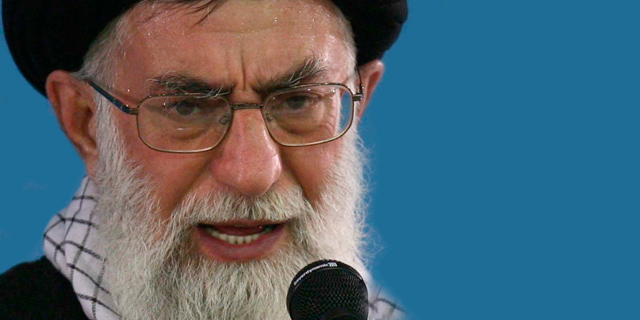
Iran-Ayatollah-Khamenei-HP_3Iranian Supreme Leader Ayatollah Kamenei (Photo: © Reuters)

Khamenei’s accusations make Saudi Arabia a legitimate target under any understanding of jihad. He even went so far as to say the Saudis’ actions are equivalent to Israel’s so-called “genocide” in Gaza. This implies that a violent jihad against Saudi Arabia is as justifiable as one against Israel.

Iran believes that these end times prophesies correlate to the death of Saudi King Abdullah, the Houthis’ overthrow of the Yemeni government, the civil war in Syria, Saudi military action and the fierce fighting in Iraq. The regime sees the confluence of all these crises as beyond the realm of coincidence and signaling the imminent arrival of the “Hidden Imam” which will herald military victory for Iran.

Before the “Hidden Imam” can arrive, two other condition must be fulfilled: instability in Saudi Arabia and the march of a prophetic figure titled “Yamani” who will lead Shiite forces from Yemen into Mecca. The Houthis recently pledged to invade Saudi territory, capture Mecca and overthrow the royal family in Riyadh. They were likely referring to this prophecy.

“We’re not going to respond to every public statement made by Iranian officials or negotiate in public,” said State Department spokesman Jeff Rathke during a daily press briefing.

********************

Iranian Supreme Leader Ayatollah Khamenei ended his eerie silence since the nuclear framework agreement was announced with a fiery speech accompanied with “Death to America” chants. Khamenei essentially smashed the viability of the nuclear framework to pieces, signalled a major escalations in the war in Yemen and essentially endorsed a violent jihad against the Saudi royal family.

Wishful thinkers can’t dismiss the speech as theater for a domestic audience. Khamenei tweeted highlights in English to make sure the world, especially Americans, saw them. The threats and demands are so unequivocal that failing to follow through would sacrifice his entire credibility and prestige.

The Iranian Supreme Leader is unsatisfied with the nuclear framework agreement even though it generously permits Iran to retain the ability to produce nuclear weapons while getting major sanctions relief.

First, he said that the fact sheet published by the U.S. contains lies and does not reflect what Iran agreed to. The statement obliges the regime to seek significant revisions shortly after it gave President Obama the go ahead to make a high-profile victory lap.

Khamenei’s demands are inescapably incompatible with America’s requirements for a deal.

First, Iran is demanding that all sanctions be lifted on the first day that a final deal is signed. The framework only agrees to lift sanctions in phases and only those related to nuclear activity, not terrorism or human rights. Doing so would unfreeze the assets of individuals and entities involved in terrorism around the world, sparking a massive growth in Iran’s terrorist apparatus and proxy warfare.

The inherently flawed hope by the West that “moderate” President Rouhani and other Iranian figures can reign in Khamenei can be immediately ruled out, since Rouhani said the same exact thing.

Iran-Khamenei-Nuke-Tweets

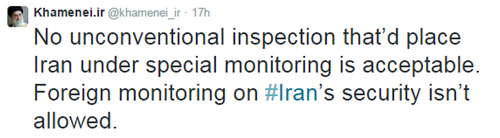
Second, Iran is insisting that there will be no “unconventional,” “special” or “foreign” inspections or monitoring. In other words, Iran will not be subject to exceptionally intrusive inspections. Khamenei’s tweets do not specify Iran’s standards, but it is clear that Iran does not intend to give the IAEA unlimited access.

Iran-Khamenei-Rejects-Inspections-Tweets

This is almost definitely a reference to military sites, to which Iran consistently says it has the option of denying access. Iran wants the ability to deny access to any location by declaring it a military institution.

This is how Iran denies access to the critical Parchin site, where damning evidence may exist to prove that Iran conducted major nuclear weapons research until at least 2003. An Iranian opposition group identified an alleged nuclear site in February that is within a military compound. It is claimed that the facility is used for uranium enrichment and the production of advanced centrifuges.

Notice the language of the tweets, which was reported to be equally non-compromising in Farsi. There is no wiggle room. Khamenei would have left some ambiguity if he was willing to budge. If you believe this is just talk, then you must believe that Khamenei made the calculated decision to cause an easily avoidable self-inflicted wound for no reason.

Another flurry of tweets related to the war in Yemen, where Iran is backing the Shiite Houthi rebels who have overthrown the government.

A U.S.-supported coalition of Sunni countries intervened militarily to support President Hadi and stop Iran from threatening the strategic Bab al-Mandeb Strait. This alliance includes Saudi Arabia, Egypt, Bahrain, Qatar, Kuwait, the United Arab Emirates, Jordan, Morocco, Turkey, Pakistan and Sudan. The last two are especially significant because of their close ties to Iran. Separately, Al-Qaeda is gaining ground in Yemen and the Islamic State (ISIS) is rising up as a competitor.

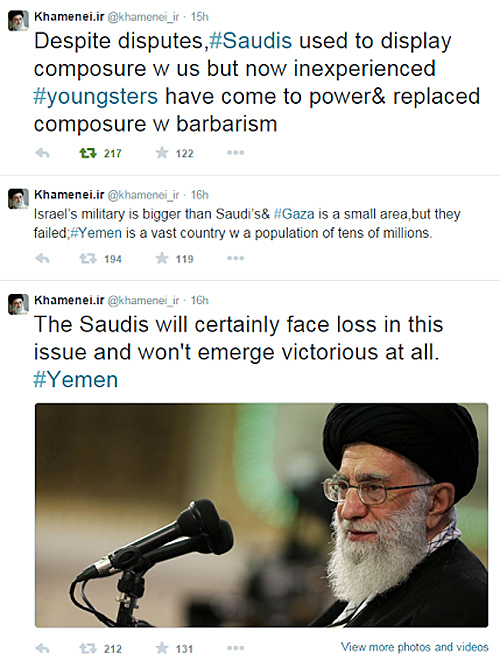
Interestingly, the tweets only threatened Saudi Arabia and did not mention any of these other participants by name. Khamenei stopped just short of a formal declaration of jihad, instead laying out the justification for it.

Iran-Khamenei-Yemen-1-Tweets
Iran-Khamenei-Yemen-2-Tweets

Khamenei’s accusations make Saudi Arabia a legitimate target under any understanding of jihad. He even went so far as to say the Saudis’ actions are equivalent to Israel’s so-called “genocide” in Gaza. This implies that a violent jihad against Saudi Arabia is as justifiable as one against Israel.

Don’t be comforted by Khamenei’s mentioning of prosecuting Saudi leaders in international courts. This is not meant to substitute jihad. Khamenei is making a point about how blatant the Saudi crimes are. He’s not even saying that this is Iran’s chosen course of action.

This comes as Iran dispatches two ships to the front in Yemen, including a destroyer to “safeguard naval routes” — meaning it will challenge the challenge the Saudi-Egyptian naval blockade.

Iran sent a flotilla to Bahrain in 2011 after Saudi and Emirati forces intervened to stomp out a revolution against the Sunni monarchy. The regime blinked at the last moment when the Arabs made it clear they would use force to stop it. However, the Yemen conflict has significant differences that Khamenei’s tweets help explain.

Khamenei is signaling that unprecedented hostilities with Saudi Arabia will now commence. The previous Saudi leaders, he says, could be dealt with. The new Saudi King and his circle must be handled more toughly.

However, Iran orchestrated massive terrorist attacks on Saudi interests even under the previous “composed” leaders, a campaign that put the U.S. economy and homeland at risk.

For example, in 2011, the U.S. prevented an Iranian Revolutionary Guards’ plot to assassinate the Saudi ambassador in Washington, D.C. by blowing up a restaurant, which inevitably would have taken the lives of American citizens as well. The scheme involved hiring a Mexican drug cartel to perpetrate the attack, along with bombings of the Israeli embassy in D.C. and the Israeli and Saudi embassies in Argentina.

In 2012, Iran launched a cyber attack on the Saudi Aramco oil company in response to the country’s policies in Bahrain and Syria. Aramco said the hackers tried to take down the country’s oil and gas production (which failed), but they did erase the data on 30,000 computers, three-fourths of the corporate computers.

Khamenei says that the new Saudi leadership is committing far worse crimes, so we should expect a far worse response.

We must also remember the prophecies cited by the Iranian regime.  Iran believes that these end times prophesies correlate to the death of Saudi King Abdullah, the Houthis’ overthrow of the Yemeni government, the civil war in Syria, Saudi military action and the fierce fighting in Iraq. The regime sees the confluence of all these crises as beyond the realm of coincidence and signaling the imminent arrival of the “Hidden Imam” which will herald military victory for Iran.

Before the “Hidden Imam” can arrive, two other condition must be fulfilled: instability in Saudi Arabia and the march of a prophetic figure titled “Yamani” who will lead Shiite forces from Yemen into Mecca. The Houthis recently pledged to invade Saudi territory, capture Mecca and overthrow the royal family in Riyadh. They were likely referring to this prophecy.

Khamenei’s speech wasn’t the typical bluster we are used to hearing from Islamist radicals and dictators. The timing, language and high-profile nature makes it very significant.

Even though the U.S. State Dept. responded by saying that sanctions against Iran would be removed gradually based on verification that Iran had kept its commitments, its response lacked conviction:

“We’re not going to respond to every public statement made by Iranian officials or negotiate in public,” said State Department spokesman Jeff Rathke during a daily press briefing.