Archive for the ‘Golan’ category

That Kissinger Promise and Obama’s Fulfillment

May 30, 2016

That Kissinger Promise and Obama’s Fulfillment, The Jewish PressVic Rosenthal, May 30, 2016

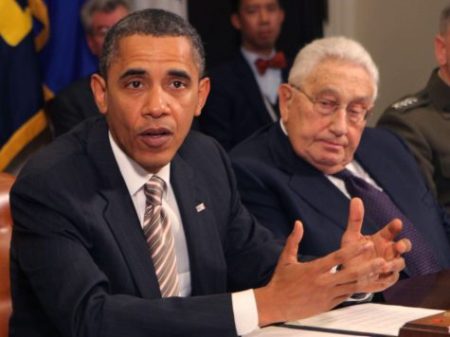
Obama-Kissinger-e1464550543436Pres. Obama seated with Henry Kissinger

{Originally posted to the author’s website, Abu Yehuda}

Old realpolitiker Henry Kissinger was in the news recently when he sat down with Donald Trump, to give him the benefit of his experience. It brought to mind Kissinger’s numerous attempts to get Israel out of the territories it conquered in 1967, before, during and – especially – after the Yom Kippur War.

Kissinger went to Iraq in December of 1975 to try to wean the regime away from the Soviet Union and improve relations with the US. In a discussion with Sa’dun Hammadi, the Iraqi Foreign Minister, Kissinger suggested that American support for Israel was a result of Jewish political and financial power, promised that the US would work to force Israel back to pre-1967 boundaries, and indicated that while the US would not support the elimination of Israel, he believed that its existence was only temporary. Here is an excerpt (the whole thing is worth reading):

I think, when we look at history, that when Israel was created in 1948, I don’t think anyone understood it. It originated in American domestic politics. It was far away and little understood. So it was not an American design to get a bastion of imperialism in the area. It was much less complicated. And I would say that until 1973, the Jewish community had enormous influence. It is only in the last two years, as a result of the policy we are pursuing, that it has changed.

We don’t need Israel for influence in the Arab world. On the contrary, Israel does us more harm than good in the Arab world. You yourself said your objection to us is Israel. Except maybe that we are capitalists. We can’t negotiate about the existence of Israel, but we can reduce its size to historical proportions. I don’t agree that Israel is a permanent threat. How can a nation of three million be a permanent threat? They have a technical advantage now. But it is inconceivable that peoples with wealth and skill and the tradition of the Arabs won’t develop the capacity that is needed. So I think in ten to fifteen years, Israel will be like Lebanon—struggling for existence, with no influence in the Arab world.  [my emphasis] …

Kissinger also promised that aid to Israel, which he presented as a result of Jewish political influence, would be significantly reduced. He indicated that legal changes in the US – he must have been referring to the creation of the Federal Electoral Commission in 1974 to regulate campaign contributions – would attenuate Jewish power and therefore American support for Israel. Naturally, he didn’t foresee the Israel-Egypt peace agreement, which permanently established a high level of military aid to both countries.

He further promised that the US would support a PLO-run Palestinian state if the PLO would accept UNSC resolution 242 and recognize Israel. This of course is what (supposedly) happened in the Oslo accords.

Kissinger insisted that “No one is in favor of Israel’s destruction—I won’t mislead you—nor am I.” But his hint that a smaller Israel might not survive is clear. Surely he understood that a pre-1967-sized Israel (within what Eban called “Auschwitz lines”) would have no chance of surviving, simply because of the strategic geography of the area.

Kissinger was wrong about the Arabs developing the capability to challenge Israel, but their place has been taken by soon-to-be-nuclear Iran and its proxies, who are significantly more dangerous than the Arab states ever were.

US policy, however, has kept more or less the same shape, except that the hypocrisy of insisting that the US supports the existence of Israel but in a pre-1967 size is even more glaring. The substitution of the PLO for the Arab states as the desired recipient of the land to be taken from Israel has barely made a ripple either in America or among the Arabs, suggesting that the policy is more about Israel giving up land than about the Arabs getting it.

The original motivation for Kissinger’s promises was supposedly the desire of the US to replace the Soviet Union as the patron of the Arab states. After the collapse of the USSR and the end of the Cold War in 1991, however, there was no change in policy. Although the Oslo Accords were initiated by left-wing Israelis, the US eagerly embraced them, and the so-called ‘peace process’ became a permanent stick to beat Israel with.

President Obama is especially adept at emphasizing support for Israel’s existence while at the same time demanding that Israel make concessions that would make her continued existence impossible. Apparently agreeing with Kissinger about Jewish power, Obama has worked to reduce the pro-Israel influence of American Jews in numerous ways, such as by providing access to the White House for groups like J Street and the Israel Policy Forum, while marginalizing traditional Zionist organizations like ZOA.

Kissinger’s almost anti-Semitic claim that US support for Israel is bought with Jewish money was probably untrue in 1975 and is even less so today, when a large proportion of American Jews, including wealthy ones, have chosen their liberal or progressive politics over Zionism. The coming struggle over the introduction of a pro-Palestinian plank into the Democratic platform is an indication that the party and with it, many of its Jewish supporters, is moving toward Obama’s position.

The Obama Administration’s program to extricate itself from the Middle East by empowering Iran as the new regional power has given a new impetus to the policy of shrinking Israel. Iran sees Israel as a major obstacle to its hegemony, for both geopolitical and religious/ideological reasons, and is committed to eliminating the Jewish state. Obama found it necessary to restrain Israel from bombing Iran’s nuclear facilities at least once (in 2012), and seems to be prepared to sacrifice Israel in order to achieve his goal of establishing Iranian regional dominance.

Some would go even further and say that Obama’s primary ideological goal is to eliminate Israel and the Iranian gambit is a means to this end, but that is highly speculative! Or maybe it’s a matter of two birds with one stone.

Henry Kissinger didn’t do us any favors, but I think the anti-Israel thread in American policy would have been strong enough without him, running from Truman’s Secretary of State George C. Marshall all the way to Obama’s stable of anti-Zionists like Rob Malley and Ben Rhodes.

Today Israel is long gone from the Sinai, more recently from Gaza, and probably only thanks to the disintegration of Syria, still holding the Golan Heights. I would like to believe that PM Netanyahu was correct when he said that Israel will never leave the Golan. Regarding Judea, Samaria and Jerusalem, I expect that we are about to begin a very difficult time, as the Obama Administration is likely to mount a campaign in its last days to fulfill Kissinger’s promise to the Arabs at long last.
Top Senate Democrat chides Netanyahu over ‘untimely’ Golan remarks

April 22, 2016

Top Senate Democrat chides Netanyahu over ‘untimely’ Golan remarks, Jerusalem Post, April 22, 2016

(So Netanyahu should remain silent when Obama and Putin propose to give Golan to Israel’s long time enemy, Syria? — DM)

Sen. Ben Cardin, the top Democrat on the Senate Foreign Affairs Committee, counseled Israel to focus more on peace with the Palestinians.

Sen. Ben Cardin, the top Democrat on the Senate Foreign Affairs Committee, said declaring Israeli ownership of the Golan Heights was not “timely” while Syria was mired in civil war.

He counseled Israel to focus more on peace with the Palestinians.

“Syria is in a state of war, the whole area is in flux,” Cardin, D-Md., said Thursday when he was asked about Prime Minister Benjamin Netanyahu’s declaration this week that “the Golan Heights will forever remain in Israel’s hands.”

“I don’t think it’s timely to figure out what’s happening in the north when there is an active war in Syria,” Cardin said of Netanyahu.

“Ultimately you’re going to need to have some type of recognition factor and you don’t have a government you can negotiate with and talk with in Syria,” said Cardin, who was meeting foreign policy reporters during a break from Senate votes.

The Obama administration this week reiterated longstanding US policy that the strategic plateau captured by Israel in the 1967 Six-Day War was not part of Israel, and that its fate should be determined through negotiations.

“I would love to see a peace process and deal with the West Bank and Gaza,” he said. “And that to me is the most important chapter for Israel right now, is to advance the peace process toward a two-state solution for the Palestinians and Israelis. That to me is the most urgent need.”

Cardin is close to pro-Israel groups and has made clear in the past that he believes it is wrong to place the burden on Israel to renew talks, saying that the Palestinians must end incitement and return to talks with Israel suspended in 2014.

He was one of just four Senate Democrats who voted last year against the Iran nuclear deal, which Netanyahu vehemently opposed, and the senator was in the region just weeks ago, and met with Netanyahu.

Cardin also said he favors renewing the Iran Sanctions Act, due to expire this year, although Obama administration officials fear its renewal would rankle Iran and undercut the sanctions relief for nuclear rollback deal.

Cardin said there was broad agreement in Congress that the act needs renewing in order to keep in place sanctions that would be revived if Iran violates the deal. Obama administration officials say the president has the discretion to kick in sanctions should he need to.

The senator said he also hopes to pass new sanctions against Iran for testing ballistic missiles, a violation of UN Security Council resolutions. Current Republican proposals to renew the Iran Sanctions Act or to sanction Iran for its missile testing seem aimed at undercutting the Iran deal, Cardin said, a path he opposes even though he voted against the deal.

Is Obama plotting yet again to harm embattled Israel?

April 19, 2016

Is Obama plotting yet again to harm embattled Israel? American ThinkerVictor Sharpe, April 19, 2016

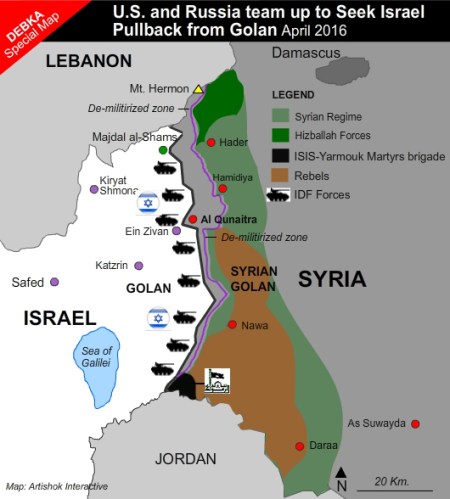
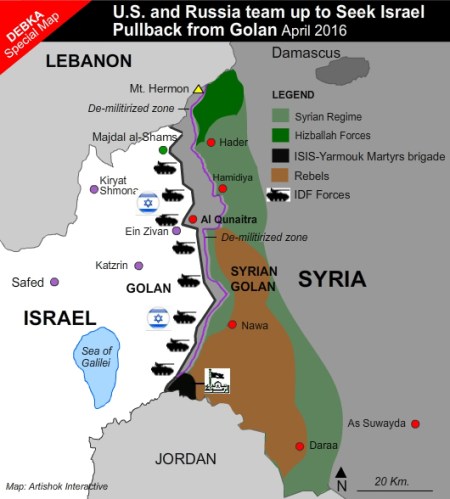
According to a report dated April 16, 2016 in the sometimes reliable Debka Special Report,Israel’s top political leaders and military commanders were stunned and shocked last weekend when they found out that US President Barack Obama and Russian President Vladimir Putin have agreed to support the return of the Golan to Syria.”

If this is true, Barack Hussein Obama is plotting yet again a way to torment the Jewish state with yet another vile edict, one which clearly has nothing to do with enlightened statecraft but much more to do with evil witchcraft.

The occupant in the Oval Office cannot salivate enough at the prospect of harming Israel’s security and survivability. No doubt he is fulfilling a malevolent pact he has made with a cabal of Islamists and extreme leftists; both of which ideologies have satanic hatred for Israel.

With this threat hanging over the strategic territory known as the Golan Heights, it is time once again to learn its history and Biblical significance.  Even as modern day Syria is convulsed in a murderous and bloody civil war with untold thousands dead and maimed; even as its tyrant, Bashir al-Assad, fights for his political and physical life; even with all this, he nevertheless spews forth his hatred of Israel and his call to take away the Golan Heights from the Jewish state.

But so do those “rebels” who are fighting him and thus remind us of the famous aphorism: “better the devil you know,” or better still, “a plague on all your houses.”

Those of us who have stood on the Golan’s 1,700 foot steep escarpment, are struck by its immense strategic value overlooking Israel’s fertile Hula Valley and the beautiful harp-shaped lake below, called in Hebrew, Kinneret (better known as the Sea of Galilee.)

But during Syria’s occupation of the territory, no agriculture of any significance took place and no restoration of its terrain was ever undertaken. Instead, the Golan was a giant Syrian army artillery encampment whose sole purpose was to deliberately rain down upon Israeli farmers, fishermen and villagers an endless barrage of shells.

So what is the history of the Golan Heights and what is its overwhelming biblical significance to the reconstituted Jewish state? Perhaps we should return primarily to the biblical books of Joshua and Numbers.

Before the Tribes of Israel would cross the River Jordan and enter the Promised Land, the first among them had already taken possession of territory east of the River Jordan. These were the half tribes of Manasseh, Gad, and Reuben who liberated the Bashan and Gilead from the Amorites.

Biblical Bashan incorporates today’s Golan Heights. Gilead is the fertile land, which lies in what is the north eastern area of today’s Kingdom of Jordan:

“ … a little balm, and a little honey, spices and myrrh, nuts and almonds” (Gen 43:11.)

 It was Canaan, west of the Jordan, (including today’s so-called West Bank) which would pose the formidable challenge to Joshua bin Nun, the general leading the Israelite tribes.

So it was that Moses, the Lawgiver, spoke to the children of Gad and Reuben thus:
“Shall your brethren go to war, and shall you sit here?” (Numbers 32:6) The leaders of the two tribes replied that they would indeed send their warriors west into Canaan and fight alongside their brethren while their families would remain behind.

“We will build sheepfolds here for our cattle and cities for our little ones. But we ourselves will go ready armed before the children of Israel until we have brought them unto their place: and our little ones shall dwell in fenced cities because of the inhabitants of the land. We will not return unto our houses until the children of Israel have inherited every man his inheritance.” (Numbers 32: 16-18)

The story of reconstituted Israel and its people is mirrored in the biblical story of those ancient ancestors. The young men and women of modern Israel have gone again and again from their homes; be they villages, towns or cities, to the borders and established communities there in times of danger and peril, just like those young men did from the biblical tribes of Gad and Reuben.

The Jewish pioneers of today in Judea and Samaria — the biblical and ancestral heartland known today as the “West Bank” — are no different.

But the world has chosen to demonize them as ‘‘obstacles to peace” and an impediment to the creation of a fraudulent Arab state to be called Palestine; a state that has never existed in all of recorded history; and certainly not as a sovereign independent Arab state.

The pioneers are now called “settlers” and their homes and farms derisively called “settlements.” It matters not to the infernal chorus that sings the international siren song of hate and ignorance that these pioneers are returned to their ancestral homesteads and seek to take up their ploughshares to sow, to plant and re-possess their homeland.

But the purpose of this article is also to learn about the biblical and post biblical history of the Jewish descendants of Gad, Reuben and Manasseh. Such facts, of course, will not persuade the likes of Barack Hussein Obama as he plots and schemes.
 The Bashan region, now known as the Golan Heights, is a part of the biblical territory promised to the Patriarch Abraham and the people of Israel for an everlasting covenant — the Covenant of the Parts — recounted in Genesis 15. The city of Bashan was a refuge city (Deut, 4:43).

During the biblical period of the Jewish Kings, a battle high on the Golan took place between King Ahab and the army of Aram. A Jewish victory occurred at the present site of Kibbutz Afik, which lies a few miles east of Lake Kinneret, the Sea of Galilee.

After the end of the Babylonian Exile, and during the Second Temple Period, Jews returned to their homes on the Golan. Subsequently the returnees were attacked by gentiles and Judah Maccabee brought his forces up to the Heights to defend them.

At the conclusion of the Hasmonean Period, King Alexander Yannai finally re-conquered the Golan and Jews returned yet again. They rebuilt communities in central Golan, including the major cities of Banias and Susita, which formed part of the defense of the Golan.

Their residents fought heroically against the Roman legions during the Great Revolt of 135 AD, known also as the Second Uprising. It was led by the charismatic Shimon Bar Kokhba, known as the “Son of a Star” and a Jewish folk hero. Some 10,000 residents of Gamla alone perished fighting against Rome.

Second century Jewish coins were found on the Golan after its liberation during the last days of the June, 1967 Six Day War. These ancient coins were inscribed with the words, “For the Redemption of Holy Jerusalem.”

In the succeeding period of the Talmudic Period, Jewish communities flourished and expanded. Archaeologists have found the remains of 34 synagogues on the Golan. Jewish life on the Golan largely ended after the defeat of the Byzantine army by Arabs from Arabia carrying the new banner of Islam and the region descended into a long period of neglect.

But Jewish life returned yet again in the latter years of the 19th century when members of the Bnei Yehuda society from Safed purchased land on the Golan. In 1891, Baron Rothschild purchased around 18,000 acres in what is present day Ramat Magshimim.

The Jewish pioneers of the First Aliyah (immigration) began to farm land they had purchased in the Horan region until the Turkish Ottoman occupiers evicted them in 1898. Their land was then seized, and in 1923 the entire Golan was given away by Britain to the French Mandate over Syria and Lebanon.

Zionist leaders had earlier demanded the Golan be included within the new Jewish National Home because of its immense historical roots in biblical and post-biblical Jewish history. But Jewish liberation of the ancestral land was not possible until Israel was forced to fight for its very survival during the Six Day War.

The Golan is only 60 miles from Haifa; and the slopes of Mount Hermon, the highest point in the region, are the present eyes and ears of Israel. The Golan Heights were officially annexed to Israel in 1980. But it was the left wing Israeli Prime Minister, Yitzhak Rabin, who first offered to give the Heights away in 1994.

Since then, Israelis have winced at the wrenching offers made by subsequent left leaning Israeli governments and politicians who declared publicly their desire to give the entire Heights to the Syrians in return for a delusional peace. The overwhelming majority of Israelis are adamantly opposed to any such suggestion.

The Baker-Hamilton Iraq Study Group suggested that a way out for the United States from its Iraqi imbroglio would be for Israel to give the Golan Heights away to Syria. This, it was believed by the ISG, would bring Syria into responsible nationhood and wean her away from support of the “insurgents” attacking Iraqi and U.S assets. Of course this was before the successes of the “Surge” instituted by General Petraus made such a suggestion moot.

President Obama mistakenly renewed diplomatic relations with Syria as a way, he believed, of distancing the Arab dictatorship from its alliance with Iran. This was yet another delusional act by the current U.S. President whose foreign policy is in tatters.

But Obama’s carrot to the Syrian dictator, should it ever be resurrected, inevitably will be the Golan Heights. Again and again, he chooses to appease Arab and Muslim tyrants and it is becoming more and more apparent that indeed he is preparing to apply brutal pressure against Israel to force it to give away yet more of its biblical patrimony.

 But what would such pressure on Israel to withdraw from the Golan Heights mean? Bringing down the Israeli radar stations on the Hermon Massif to the valley floor below would seriously degrade any warning of future hostile Syrian attacks.

It would further hamper Israel’s ability to prevent attacks upon it by Syrian forces and by Hezb’allah, now armed to the teeth by the Iranian mullahs and with an estimated 150,000 missiles aimed at Israel and hidden among Lebanese civilians.

To put any trust in an Arab nation, especially the Iranian-backed Syrian regime, is truly mind boggling. Besides which, the so-called rebels fighting the Syrian regime have already stated that their ambition is also to take the Golan from Israel at the same time that they plan on making Syria yet another Islamic Republic and a future part of an Islamic Caliphate.

And consider this. The British colonial power gave away the Golan to France’s Syrian colony in 1923. Syria attacked Israel in 1967 and lost the Golan. Syria had occupied it for 44 years. Israel’s liberation of the Golan has lasted nearly 50 years. Ask yourself then, who has possessed the Golan the longest?

Any thought of being brutally forced by Obama and Putin to abandon biblical Bashan (the Golan) with its immense strategic value to such Islamist foes as exist in Syria would be a betrayal of a loyal ally of the United States and of those first Jewish ancestors on the Golan who long ago “built sheepfolds for their cattle and cities for their little ones.”


IDF’s drill secures Netanyahu-Putin summit

April 18, 2016

IDF’s drill secures Netanyahu-Putin summit, DEBKAfile, April 18, 2016

1 (3)

The IDF launched an unannounced military-air exercise in northen Israel Monday April 18. It will also be held in the Jordan valley, strategically located south of the Golan Heights and the Sea of Galilee. Despite the official explanation that the drills are part of the IDF’s training schedule for 2016, it is difficult not to see it as a follow-up to the Cabinet meeting on the Golan the previous day, including Prime Minister Benyamin Netanyahu’s declaration that “Israel will never withdraw from the Golan.”

Just as the Cabinet meeting was an “emergency” one, the exercise is not part of standard training, as an IDF statement claimed, but rather part of the overall picture of the war in Syria on the other side of the northeastern border.

The drill is mainly intended to prevent a possible attack by ISIS, Syrian, Iranian or Hizballah forces aimed at torpedoing Netanyahu’s discussions in Moscow with Russian President Vladimir Putin on Thursday, April 21.

DEBKAfile’s military sources report that the IDF exercise shows only half of the military picture in the area.
On the other side of the border, in the triangular pocket where the Israeli, Syrian and Jordanian borders meet, heavy fighting has been underway for several days between Syrian rebels and forces of the Yarmouk Martyrs Brigades and the al-Muthanna organization, which have both sworn allegiance to ISIS. The battles are taking place across from Israel’s Hamat Gader, south of the Sea of Galilee, which is the reason why the exercise is also being held in the Jordan Valley.

On the other side of the border, in the triangular pocket where the Israeli, Syrian and Jordanian borders meet, heavy fighting has been underway for several days between Syrian rebels and forces of the Yarmouk Martyrs Brigades and the al-Muthanna organization, which have both sworn allegiance to ISIS. The battles are taking place across from Israel’s Hamat Gader, south of the Sea of Galilee, which is the reason why the exercise is also being held in the Jordan Valley.

On the other side of the border, in the triangular pocket where the Israeli, Syrian and Jordanian borders meet, heavy fighting has been underway for several days between Syrian rebels and forces of the Yarmouk Martyrs Brigades and the al-Muthanna organization, which have both sworn allegiance to ISIS. The battles are taking place across from Israel’s Hamat Gader, south of the Sea of Galilee, which is the reason why the exercise is also being held in the Jordan Valley.

On Sunday, the leader and commander of Al-Muthanna was killed during the fighting. The goal of the rebel attack is to capture the Syrian villages in the territory held by ISIS, which threatens the Galilee and the Golan communities of Tel Katzir, Shaar Hagolan and Masada. Sources in Kuwait reported last week that Jordanian special forces and Israeli drones marked in the colors of the Jordanian air force are participating in the battles. The developments on the ground indicate that the goal of the attacking forces is to uproot ISIS from the Israeli and Jordanian border areas.

DEBKAfile’s sources provided the following exclusive details on April 17:   

The Israeli cabinet holds its weekly session Sunday April 17, on the Golan. Prime Minister Benyamin Netanyahu will visit Moscow on Thursday, April 21 to meet with Russian President Vladimir Putin and to launch the most important battle of his political career, and one of Israel’s most decisive contests of the last 10 years: the battle over the future of the Golan Heights.

DEBKAfile’s intelligence sources and its sources in Moscow report exclusively that Israel’s top political leaders and military commanders were stunned and shocked last weekend when they found out that US President Barack Obama and Russian President Vladimir Putin have agreed to support the return of the Golan to Syria. The two presidents gave their top diplomats, Secretary of State John Kerry and Foreign Minister Sergei Lavrov, the green light to include such a clause in a proposal being drafted at the Geneva conference on ending the Syrian civil war.

Israeli prime minister Benjamin Netanyahu seen during a security and defense tour in the Golan Heights, near the Northern Israeli border with Syria. April 11, 2016. Photo by Kobi Gideon/GPO *** Local Caption *** ??? ?????? ?????? ?????? ????? ?????? ?????. ????? ?????? ?????? ????? ?? ????? ??????? ???? ????? ?????? ?????? ?????

Israeli prime minister Benjamin Netanyahu seen during a security and defense tour in the Golan Heights, near the Northern Israeli border with Syria. April 11, 2016. Photo by Kobi Gideon/GPO

Israel captured the Golan from the Syrian army 49 years ago, during the Six-Day War in 1967 after the Syrian army invaded Israel.

In 1981, during the tenure of then Prime Minister Menachem Begin, Israel passed a law defining the Golan as a territory under Israeli sovereignty. However, it did not state that the area belongs to Israel.

While Israel was preparing for a diplomatic battle over the future of Jerusalem, Judea and Samaria, Obama and Putin decided to deal a diplomatic blow to Israel and Netanyahu’s government on an unexpected issue, the Golan.

It is part of an endeavor by the two powers to use their diplomatic and military cooperation regarding Syria to impose agreements on neighboring countries, such as Israel, Turkey, Saudi Arabia and Jordan.

For example, Washington and Moscow are trying to impose an agreement regarding the granting of independence to Syrian Kurds, despite Ankara’s adamant opposition. The two presidents are also pressuring Riyadh and Amman to accept the continuation of Syrian President Bashar Assad’s rule, at least for the immediate future.

DEBKAfile’s sources report that just like the other diplomatic or military steps initiated by Obama and Putin in Syria, such as those for Assad’s eventual removal from power, the two powers see a resolution of the Golan issue as a gradual process that may take a long time, perhaps even years. But as far as they are concerned, Israel will have to withdraw from the Golan at the end of that process.

It should be noted that Prime Minister Netanyahu is not traveling to Washington to discuss the Golan issue with Obama. The frequent trips by the prime minister, senior officials and top IDF brass to Moscow in recent months show where the winds are blowing in the Middle East.

However, Moscow is not Washington, and Israel has no lobby in the Russian capital defending its interests.

It should be made very clear that the frequent trips by senior Israeli officials to Moscow have not created an Israeli policy that can influence Putin or other senior members of the Russian leadership. Putin has made occasional concessions to Israel on matters of minimal strategic importance, but on diplomatic and military steps regarding Syria and Iran he has shown little consideration of Jerusalem’s stance.

It should also be noted that there has been no basis for the enthusiasm over the Russian intervention in Syria shown by Netanyahu, Israeli ministers and senior IDF officers.

All of the calls by a number of Russia experts, mainly those of ll of the calls by a number of Russia experts, mainly those of DEBKAfile, for extreme caution in ties with Putin have fallen on deaf ears among the political leadership in Jerusalem and the IDF command in Tel Aviv.

Amid these developments, three regional actors are very pleased by Washington and Moscow’s agreement to demand Israeli withdrawal from the Golan: Syrian President Assad, the Iranian leadership in Tehran and Hizballah leader Hassan Nasrallah.

Now, they do not need to risk a military confrontation with Israel over the Golan because Obama and Putin have essentially agreed to do the dirty work for them.

Syrian official answers Netanyahu: We will use all available means to recapture the Golan

April 17, 2016

Syrian official answers Netanyahu: We will use all available means to recapture the Golan, Jerusalem PostMaayan Groisman, April 17, 2016

(Please see also, Netanyahu to battle Obama, Putin over the Golan. — DM)

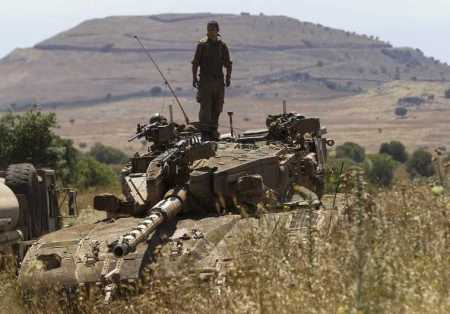
ShowImage (24)An IDF soldier stands atop a tank near Alonei Habashan on the Golan Heights, close to the ceasefire line between Israel and Syria. (photo credit:REUTERS)

In a first reaction to Prime Minister Benjamin Netanyahu’s declaration that “Israel will never leave the Golan Heights,” Syrian Foreign Minister Faisal al-Miqdad said Sunday that Syria is prepared to use every possible means to recapture the area, including military means.

“The Syrian Golan is an occupied Arab land according to the UN Security Council’s resolutions, and the presence of the United Nations Disengagement Observer Forces proves this,” Miqad said in an interview with the Lebanon-based TV channel al-Mayadeen.

“We have never renounced the resistance and we are ready to recapture the Golan in all possible ways, including military ways. Israel wants to provoke us, but we will never surrender,” Miqdad added.

Regarding Syria’s cooperation with Russia, he stated that “the daily communication between the Syrian leadership and the Russian leadership continues. We believe that the Russian policy leans on the international law and on UN Security Council resolutions.

“Neither Russian President Vladimir Putin nor any other president in the world would have accepted the indecent Israeli logic regarding the Golan,” Miqdad argued.

At the opening of a special cabinet meeting held for the first time ever on the Golan Heights on Sunday, PM Netanyahu declared: “The time has come after 40 years for the international community to finally recognize that the Golan Heights will remain forever under Israeli sovereignty.”

Netanyahu to battle Obama, Putin over the Golan

April 17, 2016

Netanyahu to battle Obama, Putin over the Golan, DEBKAfile, April 16, 2016

1 (2)

The Israeli cabinet holds its weekly session Sunday April 17, on the Golan. Prime Minister Benyamin Netanyahu will visit Moscow on Thursday, April 21 to meet with Russian President Vladimir Putin and to launch the most important battle of his political career, and one of Israel’s most decisive contests of the last 10 years: the battle over the future of the Golan Heights.

DEBKAfile’s intelligence sources and its sources in Moscow report exclusively that Israel’s top political leaders and military commanders were stunned and shocked last weekend when they found out that US President Barack Obama and Russian President Vladimir Putin have agreed to support the return of the Golan to Syria. The two presidents gave their top diplomats, Secretary of State John Kerry and Foreign Minister Sergei Lavrov, the green light to include such a clause in a proposal being drafted at the Geneva conference on ending the Syrian civil war.

Israel captured the Golan from the Syrian army 49 years ago, during the Six-Day War in 1967 after the Syrian army invaded Israel.

In 1981, during the tenure of then Prime Minister Menachem Begin, Israel passed a law defining the Golan as a territory under Israeli sovereignty. However, it did not state that the area belongs to Israel.

While Israel was preparing for a diplomatic battle over the future of Jerusalem, Judea and Samaria, Obama and Putin decided to deal a diplomatic blow to Israel and Netanyahu’s government on an unexpected issue, the Golan.

It is part of an endeavor by the two powers to use their diplomatic and military cooperation regarding Syria to impose agreements on neighboring countries, such as Israel, Turkey, Saudi Arabia and Jordan.

For example, Washington and Moscow are trying to impose an agreement regarding the granting of independence to Syrian Kurds, despite Ankara’s adamant opposition. The two presidents are also pressuring Riyadh and Amman to accept the continuation of Syrian President Bashar Assad’s rule, at least for the immediate future.

DEBKAfile’s sources report that just like the other diplomatic or military steps initiated by Obama and Putin in Syria, such as those for Assad’s eventual removal from power, the two powers see a resolution of the Golan issue as a gradual process that may take a long time, perhaps even years. But as far as they are concerned, Israel will have to withdraw from the Golan at the end of that process.

It should be noted that Prime Minister Netanyahu is not traveling to Washington to discuss the Golan issue with Obama. The frequent trips by the prime minister, senior officials and top IDF brass to Moscow in recent months show where the winds are blowing in the Middle East.

However, Moscow is not Washington, and Israel has no lobby in the Russian capital defending its interests.

It should be made very clear that the frequent trips by senior Israeli officials to Moscow have not created an Israeli policy that can influence Putin or other senior members of the Russian leadership. Putin has made occasional concessions to Israel on matters of minimal strategic importance, but on diplomatic and military steps regarding Syria and Iran he has shown little consideration of Jerusalem’s stance.

It should also be noted that there has been no basis for the enthusiasm over the Russian intervention in Syria shown by Netanyahu, Israeli ministers and senior IDF officers.

All of the calls by a number of Russia experts, mainly those of DEBKAfile, for extreme caution in ties with Putin have fallen on deaf ears among the political leadership in Jerusalem and the IDF command in Tel Aviv.
Amid these developments, three regional actors are very pleased by Washington and Moscow’s agreement to demand Israeli withdrawal from the Golan: Syrian President Assad, the Iranian leadership in Tehran and Hizballah leader Hassan Nasrallah.

Amid these developments, three regional actors are very pleased by Washington and Moscow’s agreement to demand Israeli withdrawal from the Golan: Syrian President Assad, the Iranian leadership in Tehran and Hizballah leader Hassan Nasrallah.

Now, they do not need to risk a military confrontation with Israel over the Golan because Obama and Putin have essentially agreed to do the dirty work for them.

Iran uses Syrian truce to deploy hundreds of Palestinian terrorists on Golan border

February 27, 2016

Iran uses Syrian truce to deploy hundreds of Palestinian terrorists on Golan border, DEBKAfile, February 27, 2016

Al-Sabirin-logo

Under cover of the Syrian ceasefire that went into effect Saturday, Feb. 27, and the Russian air umbrella, Iran’s Revolutionary Guards Corps finally managed to secretly install hundreds of armed Palestinian terrorists on the Syrian-Israeli border face-to-face with the IDF’s Golan positions.

This is reported exclusively by DEBKAfile’s military and intelligence sources.

These Palestinians belong to Al-Sabirin, a new terrorist organization the Iranian Guards and Hizballah are building in the refugee camps of Lebanon and the Gaza Strip. Their agents clandestinely recruited the new terrorists from among young Palestinians who fled the Yarmouk refugee camp outside Damascus and sought refuge in Lebanon. Hizballah organized their return to Syria through south Lebanon – but not before training and arming them for penetration deep inside Israel to carry out mass-casualty assaults on IDF positions, highways and civilians.

So Iran and Hizballah have finally been able to achieve one of the most cherished goals of their integration in the Syria civil war, namely, to bring a loyal terrorist force right up to Israel’s border.

Israel’s military planners went to extreme lengths to prevent this happening. Last December, Samir Quntar, after being assigned by Tehran and Hizballah to establish a Palestinian-Druze terror network on the Golan, was assassinated in Damascus.

Twelve months before that, on Jan. 18, an Israeli air strike hit an Iranian-Syrian military party surveying the Golan in search of jumping-off locations for Hizballah terror squads to strike across the border against Israeli targets. The two senior officers in the party, Iranian General Allah-Dadi and Hizballah’s Jihad Mughniyeh, were killed.

The hubbub in the run-up to the Syrian truce, coupled with Russia’s protective military presence, finally gave the Islamic Republic and its Lebanese proxy the chance to outfox Israeli intelligence and secretly bring forward a terrorist force to striking range against Israel

This discovery was one of the causes of Prime Minister Binyamin Netanyahu’s urgent phone call to President Vladimir Putin Wednesday, Feb. 24, two days before the ceasefire went into effect. He reminded the Russian leader of the understandings they had reached regarding the deployment of pro-Iranian terrorists on the Syrian-Israeli border. He also sent emissaries to Moscow to intercede with Russian officials.

Putin’s answers to Israel’s demarches were vague and evasive, on the lines of a promise to look into their complaints.

He also tried to fob Netanyahu off by inviting President Reuven Rivlin for a state visit to Russia. Putin promised to use that occasion for a solemn Russian pledge of commitment to upholding Israel’s security in a tone that would leave Tehran in no doubt of Moscow support for the Jewish state.
The Rivlin visit has been scheduled for March 16.

But it is clear that the prime minister and defense minister Moshe Ya’alon were too slow to pick up on the new terrorist menace Iran had parked on Israel’s border. Now their hands are tied, say DEBKAfile’s sources. An IDF operation to evict the pro-Iranian Palestinian Al-Sabirin network from the Syrian Golan, before it digs in, would lay Israel open to the charge of jeopardizing, or even sabotaging, the inherently fragile Syrian ceasefire initiated jointly by the US and Russia.

Russia air strikes seal Jebel Druze against attack and refugees

February 21, 2016

Russia air strikes seal Jebel Druze against attack and refugees, DEBKAfile, February 22, 2016

2717545 10/10/2015 Russian Su-25 attack aircraft take off from the Khmeimim airbase in Syria. Dmitriy Vinogradov/RIA Novosti

2717545 10/10/2015 Russian Su-25 attack aircraft take off from the Khmeimim airbase in Syria. Dmitriy Vinogradov/RIA Novosti

While Syrian war reporting focused over the weekend on the battles around Aleppo and along the Turkish border in the north, Russia since Saturday, Feb. 20 has ramped up its air bombardment of southern cities and towns, especially Daraa and Nawa. Thousands of fleeing rebels with their families and other civilians have meanwhile been turned away from the locked Jordanian border and are heading towards the Golan opposite the Israeli border.

The heaviest Russian air strikes seen hitherto in Syria have two strategic goals.

1. To retake the key southern town of Daraa from rebel hands and restore it to Syrian President Bashar Assad’s full control.

2. To crush rebel resistance in the South and force them to accept surrender, collapse or escape in the direction of the Jordanian or Israeli borders.

The intense Russian sorties are opening the door to Syrian, Iranian and Hizballah forces to move into the South and reach the Israeli borders. Prime Minister Binyamin Netanyahu sent Dr. Dore Gold to Moscow last week as his special emissary to explain how this affected Israel’s security. But he was unable to persuade the Russians to scale down their attacks in this sensitive border region.

Those attacks have a third goal, which is to encircle the Jebel Druze region with a “shield of fire” as protection for this ethnic minority of 750,000, most which inhabit mountain villages.

This unusual operation, the first of its kind in the Syrian war, has three objectives:

A. To shield the Druzes villages against ISIS attack from the east, namely Deir az-Zour.

B. To shut the door against fleeing rebels seeking sanctuary in the Druze enclave.

C. To show other Syrian minorities, especially the Kurds in the north, the great advantage of allying themselves with Moscow. Word of Russian protection of the Druzes has undoubtedly spread to Syria’s other minorities.

As for the rebels and refugees, Jordanian troops moved into the border crossings evacuated by Syrian rebels and closed the last crossing at Ramtha.

The exodus from southern Syria is now heading towards the Golan on Israel’s doorstep.

Israel has imposed a media blackout on this development. However, DEBKAfile’s sources warn that it will soon be impossible to keep it dark. Within a few days, many thousands of Syrian refugees will be massing at Israel’s Ein Zivan gate opposite Quneitra. Like Turkey and Jordan, Israel will have to supply large numbers of distressed Syrian refugees with tents, food, water and medicines.

Special Israeli emissary to Moscow over Russian Syria air strikes near border

February 17, 2016

Special Israeli emissary to Moscow over Russian Syria air strikes near border, DEBKAfile, February 17, 2016

Israel_near_border_16.2.16

In view of the crisis building up on the southern Syrian-Israeli border, Prime Minister Binyamin Netanyahu decided immediately on his return home from Berlin early Wednesday, Feb. 17, to send a special  emissary to Moscow to ask for clarifications. Tuesday, Intensified Russian air strikes came to within 6 km of the Israeli border, sparking a growing exodus of Syrian refugees heading towards the Qoneitra border crossing to Israel.

DEBKAfile’s sources reveal that the envoy is Dr. Dore Gold, director-general of the Foreign Ministry and one of the prime minister’s few trusted confidantes.

It was still not clear whom Gold will meet in the Russian capital, but it is assumed that it will be one of Moscow’s senior decision-makers in the loop on its military operation in Syria.

The fact that Netanyahu decided to dispatch a top diplomat rather than a senior military or intelligence officer is a sign that the prime minister is not of one mind with the IDF’s intelligence assessments of the situation on the ground.

Netanyahu’s concerns grew after after the Russian air force on Tuesday widened its massive bombing of southern Syria from the city of Daraa to the Golan town of Quneitra, in order to help the Syria army’s 7th armored division push the rebels east, so they will not attempt to cross the border and seek shelter in Israel.

DEBKAfile’s military sources report that that 12 of the 15 targets bombed by the Russian air force across from the Israeli border were new rebel positions that had not been attacked before, even by the Syrian army. Military sources monitoring the war said Tuesday night that there is no doubt that the Russians are in the process of wiping out the rebel positions along the Israeli border by means of an offensive comparable to their operations in the northern Aleppo sector.

Our sources report that Israel’s concerns grew when, as the Russians bombing raids neared the Israeli border, Syrian officials threatened Jordan with serious consequences if Amman gave the Saudi air force a base for attacking eastern or southern Syria.

The threats began Tuesday, after Jordanian forces took over the Syrian-Jordanian border crossings formerly held by Syrian rebels, as a measure to stem the volume of Syrian refugees in search of sanctuary in the Hashemite Kingdom. But this step was interpreted by the Syrians and their Russian ally as clearing the way for Saudi intervention in the Syrian conflict using Jordan as a jumping-off base.

Meanwhile, Western military sources reported a sub substantial presence Tuesday of both Russian and Israeli warplanes in the skies over and around southern Syria.

In new Syrian exodus, some 50,000 refugees head to Jordanian, Israeli borders

February 10, 2016

In new Syrian exodus, some 50,000 refugees head to Jordanian, Israeli borders, DEBKAfile, February 10, 2016

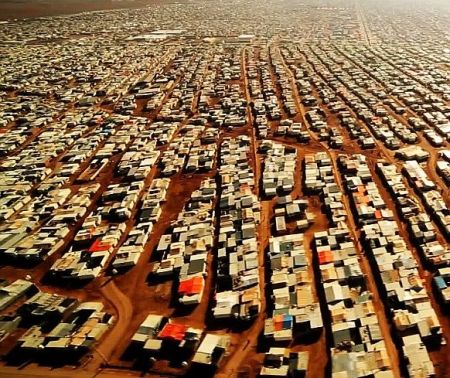
An aerial view shows the Zaatari refugee camp near the Jordanian city of Mafraq, some 8 kilometers from the Jordanian-Syrian border. 03/02/2016. BBC News

An aerial view shows the Zaatari refugee camp near the Jordanian city of Mafraq, some 8 kilometers from the Jordanian-Syrian border. 03/02/2016. BBC News

Syria’s refugee crisis in the north is now repeating itself in the south, with tens of thousands of destitute women, children and elderly people fleeing their homes – not this time from beleaguered Aleppo to the Turkish border, but from the southern region of Daraa towards the Jordanian and Israeli borders.

Unlike the broad coverage of the refugee crisis on the Syrian-Turkish border, the refugee exodus from the south has received scant media attention – even from Israeli correspondents.

With the intensification of attacks in southern Syria, about 50,000 refugees are now streaming toward Jordan and another 20,000 making tracks from Israel’s Golan border at Quneitra.

DEBKAfile’s military sources report that, since the weather has cleared and Russian air strikes resumed against the rebels holding the northern part of Daraa, tens of thousands of civilians are on the move from the South. About 15,000 to 20,000 have reached the Jordanian border, and more than 30,000 are believed heading that way; while another 20,000 refugees may be making for the Golan town of Quneitra on the Israeli border.

Jordan has taken in 650,000 Syrian refugees in previous exoduses from the five-year old war.

A desperate SOS appeared on social media Wednesday, Feb. 10, in which the rebel-controlled Daraa Provincial Council warned that tens of thousands of civilians were in flight from Russian air strikes and the barrel bombs dropped by the Syrian warplanes and helicopters.

There was no way to bring water, food or medicines to the fleeing refugees.

Military sources monitoring the situation report that the exodus was first touched off by the fall of Alaman, 3 km north of Daraa in the last few days to Syrian and Hizballah forces. They next cut off parts of Highway 5 from Daraa to Damascus. The rebels were left with only one remaining escape route, the road to the Jordanian border, but that too is under heavy fire, forcing the refugees to go round through rough country.

As in Aleppo, the Darnah district is held by hundreds of assorted rebel militias, ranging from the US-backed Free Syrian Army to groups which have sworn allegiance to ISIS. According to our intelligence sources, it is often hard to determine which groups are taking orders from whom.

Jordan has followed the Turkish policy towards the tens of thousands of refugees massing on its border  A single crossing is operating at Ramtha, but refugees are not allowed to pass through.

The Israeli government has not yet issued any statements of policy with regard to the Syrian refugees heading for the Golan.