Archive for the ‘Germany’ category

Pegida: The New German Revolution

January 15, 2015

Pegida: The New German Revolution, The Gatestone InstitutePeter Martino, January 15, 2015

Pegida’s worries about the Islamization of Germany concern the seeming intolerance and religious fanaticism that have grown hand in hand with the arrival of Muslim populations unwilling to adapt to Western values.

But by decrying Pegida’s views as “xenophobic,” “narrow minded” and even “inhuman,” Germany’s ruling establishment shows how deeply out of touch it is with the worries of a large segment of the population.

***************

Pegida’s worries about the Islamization of Germany concern the seeming intolerance and religious fanaticism that have grown hand-in-hand with the arrival of the Muslim populations unwilling to adapt to Western values.

The terror attacks in France Had “nothing to do with Islam.” — German Interior Minister Thomas de Maizière.

By decrying Pegida’s views as “xenophobic,” narrow minded” and even “inhuman,” Germany’s ruling establishment shows how deeply out of touch it is with the worries of a large segment of the population.

Perhaps the people in the East just want to avoid the situation that the Western part of the country is in. Having gone through decades of Communist dictatorship, perhaps they are less inclined to trust that their political leaders have the people’s best interests in mind with their policies.

Every Monday evening since last October, thousands of citizens have marched through the city of Dresden as well as other German cities to protest the Islamization of their country. They belong to an organization, established only three months ago, called Pegida, the German abbreviation for “Patriotic Europeans Against the Islamization of the West.”

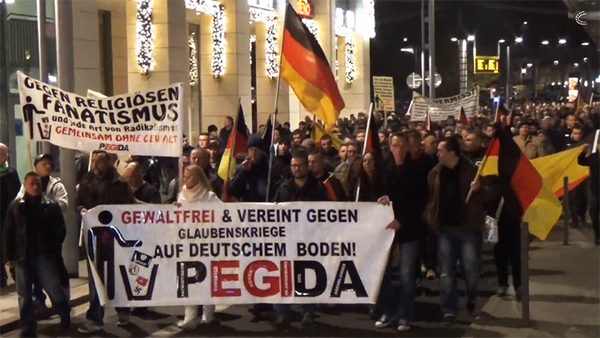
834 (1)PEGIDA on a Monday “evening walk” in Dresden, November 10, 2014. (Image source: Filmproduktionen video screenshot)

Pegida is a democratic grassroots organization, without origins in the far-left, far-right or links to any political parties, domestic or foreign. The French Front National [FN] of Marine Le Pen even made it clear that it wants nothing to do with “spontaneous initiatives” such as Pegida. According to the FN, “something like Pegida cannot be a substitute for a party.”

In the Netherlands, Geert Wilders of the Freedom Party [PVV] is more positive. He sees Pegida as a sign of the growing discontent of ordinary people with the political elite now governing them. “A revolution is on its way,” he says. Ironically, Wilders’s PVV, currently by far the largest party in the Dutch polls, is itself more of a spontaneous movement, driven by the energy and charisma of one single man with a mission to liberate his country from Islamic extremism, rather than an established and structured political party.

That Pegida is a spontaneous and diffuse organization of citizens expressing their discontent, seems to be worrying the German political establishment. German Chancellor Angela Merkel knows how powerful these movements can become. In 1989, when thousands of people shouting, “Wir sind das Volk” [“We are the people”] took to the streets in cities such as Dresden, the Communist regime in East Germany was toppled.

Apart from slogans such as: “Against Religious Fanaticism,” and: “For the Future of our Children,” the anti-Islamization protesters of Pegida are using exactly the same slogan — “Wir sind das Volk” — of the anti-Communist demonstrators a quarter of a century ago, as they march against the open-door policies of the German government.

The use of the 1989 liberation slogan has infuriated Merkel, who reproaches Pegida for using it. In her New Year’s speech, Merkel attacked the Pegida demonstrators. “Their hearts are cold, full of prejudice and hatred,” she said, while defending her government’s policies of welcoming asylum seekers and immigrants. She pointed out that Germany had taken in more than 200,000 asylum seekers in 2014, making it the country that is accepting the largest number of refugees in the world.

Merkel has been backed by church leaders, who are slamming Pegida and calling for solidarity with migrants. The Confederation of German Employers has been blaming Pegida for damaging Germany’s international reputation. Meanwhile, so-called anti-fascist demonstrators, shouting “Wir sind die Mauer. Das Volk muss weg!” [“We are the Wall. Down with the people!”], last week blocked a Pegida march in Berlin.

On January 10, fearing that the recent Islamic terror attacks in France might lead to even more public support for Pegida, Dresden Mayor Helma Orosz, a member of Chancellor Merkel’s Christian-Democratic CDU Party, co-sponsored in her town a so-called “Lovestorm” event. The aim was to conquer the “xenophobia” of Pegida through “open mindedness and humanity.” Interior Minister Thomas de Maizière, another leading CDU politician, claimed that the terror attacks in France had “nothing to do with Islam” and warned against “political pyromaniacs” such as Pegida who suggest otherwise.

Pegida’s worries about the Islamization of Germany concern the seeming intolerance and religious fanaticism that have grown hand in hand with the arrival of Muslim populations unwilling to adapt to Western values.

But by decrying Pegida’s views as “xenophobic,” “narrow minded” and even “inhuman,” Germany’s ruling establishment shows how deeply out of touch it is with the worries of a large segment of the population.

A recent poll, dating from before the terror attacks in France, found that one in three Germans support the Pegida anti-Islamization marches. Further, a new study by the Bertelsmann Foundation found that German attitudes toward Islam are hardening, with 61% saying in 2014 that Islam is “not suited to the Western world” — up from 52% in 2012. Also, up to 57% of the Germans see Islam as a threat, 40% feel that they are becoming foreigners in their own country because of the Muslim presence, and 24% want to ban Muslim immigration.

Looking at the numbers of demonstrators that join the Pegida demonstrations every Monday in various German cities, Pegida is clearly an overwhelmingly East German phenomenon. Indeed, in the provinces formerly belonging to the Communist German Democratic Republic [GDR], many thousands of people are drawn to the demonstrations, while in the West the numbers are far lower. Political analysts admit to being puzzled by this, given that the number of immigrants, including Muslims, is far lower in the East than in the West. Some blame the higher unemployment figures in the East; the “backwardness,” the lack of “civil society,” the lack of “liberal open mindedness,” and that “people in the East feel that they are losers.”

There might, however, be two other explanations that make more sense. Perhaps the people in the East just want to avoid the situation that the Western part of the country is in, as a result of the large Islamic presence. While the West might already be lost as a result of Islamization, the East is still capable of avoiding the West’s fate. Moreover, having gone through decades of Communist dictatorship, perhaps the Easterners are less inclined to trust that their political leaders have the people’s best interests in mind with their policies.

Perhaps they feel that, rather than trust that Frau Merkel knows what is best for the German people — as she welcomes in record numbers these new Islamic immigrants — the German people need to show her clearly that they think she is wrong.

Germans Rise Up Against Islamization

December 13, 2014

Germans Rise Up Against Islamization, Gatestone InstituteSoeren Kern, December 13, 2014

There is a mounting public backlash over what many perceive as the government’s indifference to the growing influence of Islam in German society. This backlash represents a potentially significant turning point.

Despite efforts by German politicians and the media to portray PEGIDA as neo-Nazi, the group has taken great pains to distance itself from Germany’s extreme right. The group says that it is “apolitical” and that its main objective is to preserve what is left of Germany’s Judeo-Christian culture and values.

“Many people in Germany have legitimate concerns about the spread of radical Islamic ideology, which promotes violence against non-Muslims, robs women and girls of their natural rights, and seeks to require the application of Sharia law…. Because the rule of law, tolerance and freedom of religion are fundamental Western values, the PEGIDA movement must leave no doubt that it is precisely these values that it seeks to defend.” — Bernd Lucke, leader, Alternative for Germany Party and professor of macroeconomics, Hamburg University.

In a classic case of shooting the messenger rather than heeding the message, German politicians have dismissed PEGIDA protesters as ignorant and racist.

*******************

Thousands of German citizens have been taking to the streets to protest the growing “Islamization” of their country.

The protests are part of a burgeoning grassroots movement made up of ordinary citizens who are calling for an end to runaway immigration and the spread of Islamic Sharia law in Germany.

The guardians of German multiculturalism are fighting back: they are seeking to delegitimize the protesters by branding them as “neo-Nazis” and by claiming that the Islamization of Germany is a myth contrived by misinformed citizens.

But there is a mounting public backlash over what many perceive as the government’s indifference to the growing influence of Islam in German society. This backlash represents a potentially significant turning point—one that implies that the days of unrestrained German multiculturalism may be coming to an end.

The latest protest took place in the eastern German city of Dresden on December 8, when more than 10,000 people defied freezing temperatures to express their displeasure with Germany’s lenient asylum policies.

Germany—which is facing an unprecedented influx of asylum seekers, including many from Muslim countries—is now the second most popular destination in the world for migrants, after the United States.

The Dresden protest was organized by a new citizens initiative, “Patriotic Europeans against the Islamization of the West,” better known by its German abbreviation, PEGIDA, short for “Patriotische Europäer gegen die Islamisierung des Abendlandes.”

PEGIDA, which has been organizing so-called “evening walks” (Abendspaziergang) through downtown Dresden every Monday evening since October, has seen the number of protesters increase exponentially from week to week.

834PEGIDA on a Monday “evening walk” in Dresden, November 10, 2014. (Image source: Filmproduktionen video screenshot)

Similar anti-Islamization protests have been held in the western German cities of Hannover, Kassel and Düsseldorf, where 400 people showed up on December 8 for demonstration organized by a PEGIDA offshoot, named DÜGIDA.

These protests are similar to, but separate from, other mass demonstrations organized in Cologne and other German cities by a group called Hooligans against Salafists, or HoGeSa.

PEGIDA was launched by Lutz Bachmann, a 41-year-old Dresden native with no background in politics, after government officials in the eastern German state of Saxony announced that they would be opening more than a dozen new shelters to house some 2,000 refugees.

Bachmann says that he is not opposed to legitimate asylum seekers, but that he is against so-called economic refugees who are taking advantage of Germany’s generous asylum laws in order to benefit from the country’s cradle-to-grave social welfare system. According to Bachmann, most of the asylum seekers in Saxony are males who have left their families behind in war-torn Muslim countries.

Despite efforts by German politicians and the media to portray PEGIDA as neo-Nazi, the group has taken great pains to distance itself from Germany’s extreme right. PEGIDA’s motto is “We are the people!” (Wir sind das Volk!), the same slogan used by East Germans to bring down the Berlin Wall in 1989. The group says that it is “apolitical” and that its main objective is to preserve what is left of Germany’s Judeo-Christian culture and values.

Ahead of the march on December 8, PEGIDA posted the following call to action:

“Dear friends, dear fellow citizens, dear patriots! Monday is PEGIDA Day and today too we want to show that we are peaceful. Bring your friends and neighbors and let us show the counter-demonstrators that we are not xenophobic.”

Placards displayed by protesters in Dresden included slogans such as “Against Religious Fanaticism,” “United against a Holy War on German Soil,” “Homeland Security Rather than Islamization,” and “For the Future of our Children.” There was no visible sign of neo-Nazi propaganda at the event.

On December 10, PEGIDA published a “Position Paper” outlining what the group is “for” and “against” in 19 bullet points. These include:

  • “1. PEGIDA is FOR the acceptance of asylum seekers from war zones, or those who are subject to political and religious persecution. This is a human duty!”
  • “2. PEGIDA is FOR amending the Basic Law of the Federal Republic of Germany to include a list of the right and the responsibility for immigrants to integrate.”
  • “9. PEGIDA is FOR a zero-tolerance policy vis-à-vis asylum seekers and migrants who commit crimes in Germany.”
  • “13. PEGIDA is FOR maintaining and protecting our Judeo-Christian Western culture.”
  • “16. PEGIDA is AGAINST the establishment of parallel societies/parallel legal systems in our midst, such as Sharia Law, Sharia Police, and Sharia Courts, etc.”
  • “18. PEGIDA is AGAINST religious radicalism, regardless of whether it is religiously or politically motivated.”
  • “19. PEGIDA is AGAINST hate preachers, regardless of religious affiliation.”

In a classic case of shooting the messenger rather than heeding the message, German politicians have dismissed PEGIDA protesters as ignorant and racist.

German Interior Minister Thomas de Maizière characterized PEGIDA as “shameless,” adding: “We have no danger of Islamization, certainly not in Saxony or Dresden with 2.2% immigrant population.”

In an interview with the German newsmagazine Der Spiegel, Justice Minister Heiko Maas said:

“There are limits to the political battle of ideas. All political parties should clearly distance themselves from these protests. We cannot be silent if a xenophobic atmosphere is being built on the backs of people who have lost everything and come to us for help: We have to be clear that the demonstrators are not the majority.”

A politician with the ruling Christian Democratic Union [CDU], Wolfgang Bosbach, warned that the protests represented the “anchoring of radical views in the heart of society.”

But Bachmann says the protests will continue until there are changes to Germany’s asylum policies. “We do not want to launch a political party or start a revolution,” he said. “But we need to talk openly about the asylum issue.”

Meanwhile, the Christian Social Union [CSU], the Bavarian partner of Chancellor Angela Merkel’s CDU, has watered down a demand that migrants settling in Germany on a permanent basis should speak German at home.

The “politically incorrect” proposal appeared in a draft policy paper on December 7. Following an outcry, the proposal was quickly amended to read that migrants who want to live in Germany permanently should be “motivated,” rather than “obliged,” to speak German “in daily life,” rather than “in public and within the family.”

In October, it emerged that so many asylum seekers were converging on Bavaria that they needed to be housed in tents normally used for the annual Oktoberfest.

In September, the governor of Bavaria and leader of the CSU party, Horst Seehofer, called for the return of border controls with Austria to stem the tide of refugees seeking asylum in Germany.

The Schengen Agreement, which entered into effect in 1995, abolished internal borders within the European Union, enabling passport-free movement between most countries within the bloc.

Although international law holds that migrants are supposed to claim asylum in the first country they reach, many are taking advantage of Europe’s open borders to claim asylum in Germany after first passing through Italy and Austria.

Seehofer also lashed out at Italian authorities, who he said are not doing enough to stop the flow of migrants entering the EU through Italy, after crossing the Mediterranean Sea from Africa. In aninterview, he said:

“Italy is in clear violation of the Schengen accords. If this does not stop, Germany has seriously to consider stopping this violation via border controls. We must set quotas for refugees in Europe. And we have to deal with the fact that refugees need to be shared out among EU members fairly.”

Bavarian officials estimate that at least 33,000 asylum seekers have arrived in the state during 2014, twice the number of arrivals registered in 2013.

In an effort to stem the flow of asylum seekers, the CSU has demanded that the central government begin cracking down on so-called welfare tourism. The CSU is concerned that the problem of runaway immigration is prompting traditional supporters of the party to defect to the Alternative for Germany (AfD), an upstart political party formed in 2013.

The AfD—which wants Germany to leave the euro single currency and promotes a tough line on immigration—received 4.7% of the vote in the September 2013 federal election, narrowly failing to reach the 5% threshold needed for representation in Germany’s national parliament.

Since then, support for the AfD has surged. The party has extended its gains in regional elections, and also won nine seats in European Parliament elections in May 2014. A pollpublished in September 2014 found that one in ten German voters now support the AfD.

Germany’s political establishment has worked hard to discredit the AfD. But if the party continues to siphon voters away from the mainstream parties, the AfD will be in a position to influence the debate over the future of German multiculturalism.

The AfD has already come out in support of the PEGIDA protests in Dresden. AfD spokesman Konrad Adam said the party has a “fundamental sympathy for the PEGIDA movement.”

AfD leader Bernd Lucke, a professor of macroeconomics at Hamburg University, summed it up this way:

“Many people in Germany have legitimate concerns about the spread of radical Islamic ideology, which promotes violence against non-Muslims, robs women and girls of their natural rights, and seeks to require the application of Sharia law. That citizens are expressing these concerns in nonviolent demonstrations is good and right. It is a sign that these people do not feel that their concerns are being taken seriously by politicians. It is an incentive for all politicians to act more decisively at a time when political Islam is challenging and calling into question our rule of law.

“That PEGIDA protesters have advertised their goals in an exclusively peaceful manner is to be welcomed. Because the rule of law, tolerance and freedom of religion are fundamental Western values, the PEGIDA movement must leave no doubt that it is precisely these values that it seeks to defend.”

Germany’s Islamic State problem

October 13, 2014

Germany’s Islamic State problem, Long War Journal, Benjamin Weinthal, October 13, 2014

(Might German antisemitism be a factor? “[T]he ugly truth that many in Europe don’t want to confront is that much of the anti-Jewish animus originates with European people of Muslim background.” — DM)

German officials are tangled up in knots over Islamic State. While they recognize the threat, there has been little appetite over the years to clamp down on jihadist networks in the country. In short, Berlin’s lax policies toward terrorist groups have contributed to its Islamic State crisis.

An estimated 150 radical Islamists have returned from the Middle East war theater to Germany.

****************

There is a growing sense among leading German politicians that the Federal Republic’s preoccupation with the NSA surveillance scandal should not overshadow the pressing need to confront the Islamic State.

“German worry over Islamist attack eclipses spy scandal,” Bloomberg News headlined its Oct. 8 report on the issue. A new reality appears to be sinking in. Roderich Kiesewetter, a Bundestag deputy from Chancellor Angela Merkel’s Christian Democratic Union and a former army colonel, was quoted as saying, “In the German public, there is more of an awareness that our intelligence services need information to confront these terror threats.”

Some German politicians from powerful opposition parties, the Greens and the Left Party, have called for US airstrikes on Islamic State positions near the besieged city of Kobane in northern Syria. This call has come despite the Greens’ and the Left Party’s traditional anti-Americanism and hardline anti-intervention policies.

According to German authorities, an estimated 450 German Muslims have gone to fight against the Syrian regime. Most of the 450 sought membership with Islamic State. Roughly 40 women and a 13-year-old boy are among those who have departed for Syria. Die Welt provides a helpful systematic breakdown of “German Jihadists in Syria.”

A spokeswoman for Germany’s intelligence agency told this writer that the government cannot track individuals traveling to Turkey because the country does not require visas. European jihadists frequently use southern Turkey as an entry point into Syria.

Germany’s interior ministry is struggling to modernize its counterterrorism policies. On Oct. 2, Interior Minister Thomas de Maiziere acknowledged, “The situation has changed over the last few months.” Germany outlawed Islamic State activities in September. In the same month, a Frankfurt court started the trial of 20-year-old Kreshnik Berisha for membership in the Islamic State; it is the first terrorism trial of an Islamic State member in Germany. Berisha, who was born in Germany to Kosovan parents, was arrested in December 2013.

De Maiziere stressed the need for more sophisticated surveillance mechanisms to track Islamist combatants. He cited revocation of passports and identity cards as ways to combat terrorism.

German officials are tangled up in knots over Islamic State. While they recognize the threat, there has been little appetite over the years to clamp down on jihadist networks in the country. In short, Berlin’s lax policies toward terrorist groups have contributed to its Islamic State crisis.

It is worth recalling that Hezbollah’s so-called political wing is legal in the country. According to Germany’s national domestic intelligence report covering 2013, and published in June 2014, Hezbollah has 950 active members in the Federal Republic. There are also roughly 6,300 radical Islamists in Germany who are supporters of the Sunni branch of Salafism, Interior Minister de Maiziere said last week. Many of these Salafists are connected to the ideologies of al Qaeda, Shabaab, or the Islamic State.

Germany’s latest domestic intelligence report described the growth of Salafists as the most “dynamic Islamic movement” in Germany.

An estimated 150 radical Islamists have returned from the Middle East war theater to Germany. In recent days, the battle for the northern Syrian town of Kobane, where Islamic State fighters are carrying out an assault on Kurdish civilians and fighters, has had repercussions in Germany. On Oct. 7, pro-Islamic State Muslims fought Kurds in the city of Hamburg, resulting in 14 people being injured and 22 arrests. The police used water cannons to disperse the street battle [see video from Online Focus].

In an eye-popping report last week, Germany’s ARD television station stated that over the years authorities allowed — and even encouraged — the travel of German Islamists to foreign countries. The policy appeared to be a kind of “export of terror” designed to reduce the risk domestically. “Persons who are dangerous and could launch attacks are brought outside of the country,” a government official said.

“Germany is on the way to be world champion in terrorism export,” one commentator wrote in Die Welt newspaper in 2010. The author was not referencing the green light from German authorities for jihadists to leave for the Afghanistan and Pakistan war theaters, but rather the sheer number of radical German Muslims departing for conflict zones. The ARD report helps to explain why so many radical German Islamists have enjoyed unrestricted movement.

The chief destination for German jihadists now is to fight in Syria, Die Welt reported last week. German intelligence agencies also believe that jihadists who were based in terror camps in Afghanistan and Pakistan are now in Syria or on their way there. Pakistani jihadist networks — ranging from al Qaeda to the Taliban to the Islamic Movement of Uzbekistan — have attracted German Muslims to Pakistan and Afghanistan. The large number of Germans gave rise to so-called “German colonies” in the region.

According to German security information obtained by Die Welt, the German-Moroccans Yassin and Mounir Chouka and their wives, Nele Ch. and Luisa S., as well as Seynabou S. from Hamburg, along with children, relocated from Pakistan to Syria. It is unclear if the terrorists made it to Syria. Some of the group’s children were born in terror camps in Pakistan. While in Pakistan, the Choukas joined the Islamic Movement of Uzbekistan. Now, they have declared allegiance to Islamic State.

The Choukas, who are originally from the western German city of Bonn, motivated Arid Uka, a 24-year-old radical Islamist and Kosovo native who worked at Frankfurt’s airport, to murder two American airmen and wound two others in March 2011. Uka was sentenced to life in prison but Germany’s liberal judicial system may release him after 18 years of prison time.

Another German jihadist, former rapper Denis Cuspert a.k.a. singer Deso Dogg, is said to be in Syria and has been linked to both the Islamic State and al Qaeda’s Al Nusrah Front. Germany plans to submit his name for inclusion in the UN’s sanctions list, Der Spiegel reported on Oct. 5.

While issuing rhetorical support for strikes on Islamic State, the Merkel administration decided not to join US president Barack Obama’s airstrike coalition in Iraq and Syria to knock out Islamic State fighters and sites. Merkel did, however, send military arms to the Kurds and military personnel to train the Kurdish fighters.

It is unclear why President Obama chose not to twist Germany’s arm to join his anti-Islamic State airstrike coalition. Commentators in Germany believe the Merkel administration could do much more to stem Islamic State violence. In a late September commentary in Germany’s mass circulation paper Bild, the headline screamed, “All Talk, no action!”

