Archive for the ‘Gaza’ category

Iran/Hizballah noose tightens around Israel

September 1, 2017

Iran/Hizballah noose tightens around Israel, DEBKAfile, September 1, 2017

Seen from the strategic-military angle, Israel can be said to have regressed 11 years to 2006, when two foes were poised menacingly on its northern and southern borders. Israel was then compelled to fight a war against Hizballah in Lebanon. This time, the conflict could potentially flare up simultaneously on three fronts – Lebanon, Gaza and Syria.

********************************

Nikki Haley, the US Ambassador to the UN, challenged the international community to hold Iran to account on Thursday, Aug. 31, after the Islamic Republic showed its “true colors” by restoring its ties with the Palestinian extremist Hamas. In her statement, she described as “stunning” the Hamas leader’s boast that Tehran is again the biggest provider of money and arms. The breach between them followed the terrorist group’s refusal to side with Bashar Assad in the Syrian civil war.

“Iran must decide whether it wants to be a member of the community of nations that can be expected to take its international obligations seriously, or whether it wants to be the leader of a jihadist terrorist movement. It cannot be both,” Haley said in her statement.

Islamic Iran has long made that decision, as the ambassador knows very well from the intelligence reports she sees. But her brave words were meant as a wakeup call for the rapid advances made by Iran and Hizballah during August to impose their will on the Middle East, often with great stealth.

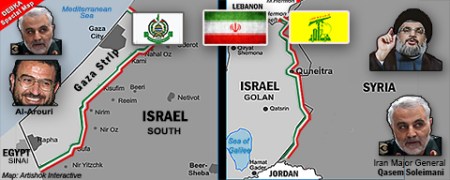
Haley will have learned about the Aug. 2 meeting in Beirut between Hamas’s military chief Salah al-Arouri and Iranian officials, following which Hizballah’s Hassan Nasrallah confirmed that the Palestinian rulers of the Gaza Strip were worthy of restored military and financial aid.

That deal was clinched at the highest level in Tehran, after Arouri and a delegation from Gaza were received by top Iranian officials, including Revolutionary Guards General Qassem Soleimani. He is not only commander of Iran’s Middle East warfronts, but also head of Al Qods, which runs Iran’s intelligence, subversion and terror networks.

These events and their ramifications were itemized in the latest issue of DEBKA Weekly, out Friday, Sept. 1.

It was Soleimani who assigned Hamas and its military arm with its next tasks. Since both parties are dedicated to violent tactics (terror) to achieve their ends, one of which is the destruction of the State of Israel, all that remains to be seen is the precise form the Iranian-backed Hamas-Hizballah partnership will take – and where. Those practicalities were aired at the secret sessions between Hamas and Al Qods in Tehran

Present at some of those sessions were also Soleimani’s secret agents and heads of the terrorist networks he runs across the Middle East and in the Gulf emirates.

The inauguration ceremony for Hassan Rouhani’s second term as Iran’s president on Aug. 5 provided a convenient cover for these get-togethers.

Nikki Haley’s warning to the international community was prompted by these dangerous events. Although her words were powerful, telling and timely, it is hard to see any sign of their being followed up by other parts of the Trump administration.

With the southern front against Israel in the bag, Iran and Hizballah this week put together its northern front, just two or three kilometers from Israel’s Golan border with Syria. This could not have happened without the Trump administration submitting to Russia’s demand to revise their de-escalation zone project for the Syrian Golan, so that Iranian and Hizballah forces are no longer required to distance themselves 40-50km from the zone, but only 8km.

Iran and Hizballah in Syria have in consequence been quietly shortening their distance from the Israeli border. But this week, they made a major leap forward, when the Russian monitors brought a group of Iranian and Hizballah officers all the way to Quneitra. There, they were given a base under Russian protection within sight of the Israeli Golan.

Tehran and its pawn therefore used the month of August to climb into position for drawing a noose around Israel and tightening it at will.

Prime Minister Binyamin Netanyahu this week boasted that his tenure was marked by relative calm. Israel, he said, had successfully avoided getting embroiled in any major war.

That is correct. However, his policy of preserving the calm and maintaining a purely defensive stance has carried a price. That price was totted up on Sept. 1. By then, Iran and Iran had been able to move unopposed into position on Israel’s borders with Syria and Lebanon in the north and had crept up to the Gaza border in the south.

Seen from the strategic-military angle, Israel can be said to have regressed 11 years to 2006, when two foes were poised menacingly on its northern and southern borders. Israel was then compelled to fight a war against Hizballah in Lebanon. This time, the conflict could potentially flare up simultaneously on three fronts – Lebanon, Gaza and Syria.

The IDF set for long period of unrest, also attack from Gaza

July 22, 2017

The IDF set for long period of unrest, also attack from Gaza, DEBKAfile, July 22, 2017

(Please see also, This is a war for sovereign control of Temple Mt. — DM)

The IDF spokesman said Saturday that the armed forces are getting set for the current Palestinian unrest to continue for some weeks – if not more – and a possible terrorist attack from the Gaza Strip. In a briefing to reporters following the terrorist murder of three members of a Halamish family, the spokesman said: Religious elements new to us have raised their heads.” He did not elaborate on this. “We are making a great effort, operationally and by covert means, to curtail the escalating of the violence. But we face a surge of negativity with religious extremist overtones that spreads from one day to the next and could generate more terrorism.”

The spokesman revealed that the terrorist hiked the 2.5km from his village to Halamish Friday night, carrying a bag containing a Koran, a bottle of water and a knife. It took him 15 minutes to stab to death a grandfather and son and daughter and injure a grandmother, before a soldier on leave who heard the screaming from a nearby apartment shot him through a window.

Palestinians: Mohammad Dahlan, the New Mayor of the Gaza Strip?

July 3, 2017

Palestinians: Mohammad Dahlan, the New Mayor of the Gaza Strip? Gatestone InstituteKhaled Abu Toameh, July 3, 2017

(Please see also, What Hamas Wants. — DM)

This new reality could buy quiet in the short term. In the long term, however, Hamas is likely to emerge as stronger and more prepared for the next war with Israel.

***********************************

Dahlan will be functioning under the watchful eye of Hamas, which will remain the real de facto and unchallenged ruler of the Gaza Strip. Hamas is willing to allow Dahlan to return to the Palestinian political scene through the Gaza Strip window. But he will be on a very short leash.

Dahlan’s presence in the Gaza Strip will not deter Hamas from continuing with its preparations for another war with Israel.

Dahlan will find himself playing the role of fundraiser for the Palestinians in the Gaza Strip while Hamas hides behind his formidable political shoulders.

Mohammed Dahlan is an aspiring Palestinian with huge political ambitions. Specifically, he hopes to succeed Mahmoud Abbas as president of the Palestinian Authority (PA). Knowing this, Abbas expelled him from the ruling Fatah faction in 2011. Since then, Dahlan has been living in the United Arab Emirates.

Hamas, the Islamist movement that has controlled the Gaza Strip for the past decade, used to consider Dahlan one of its fiercest enemies.

As commander of the notorious Preventive Security Service (PSS) in the Gaza Strip in the 1990s, Dahlan was personally responsible for the PA’s security crackdown on Hamas. On his instructions, hundreds of Hamas activists were routinely targeted and detained.

The enmity was mutual; Dahlan too considered Hamas a major threat to him and the PA regime in the Gaza Strip.

Dahlan’s contempt for Hamas knew no limits. On his orders, Hamas founder and spiritual leader Ahmed Yassin was placed under house arrest.

Two other senior Hamas officials, Mahmoud Zahar and Abdel Aziz Rantisi, were repeatedly detained and tortured by Dahlan’s agents. At one point, Dahlan ordered his interrogators to shave the two men’s beards as a way of humiliating them.

During and after its violent takeover of the Gaza Strip in 2007, Hamas targeted Dahlan’s PSS and loyalists. Some were killed or incarcerated, while many others were forced to flee the Gaza Strip to Egypt and the West Bank. For many years, Dahlan was at the top of Hamas’s most wanted fugitives. No longer.

Erstwhile enemies, Dahlan and Hamas today have a common foe: Mahmoud Abbas. They seem about to join forces to repay him for the humiliation they have suffered at his hands.

Dahlan has long sought revenge for Abbas’s decision to expel him from Fatah and prosecute him on charges of murder and embezzlement. Dahlan will never forgive Abbas for dispatching security officers to raid his Ramallah residence and confiscate documents and other equipment. On that day, Dahlan slunk out of Ramallah.

Dahlan found refuge in the United Arab Emirates, a wealthy Gulf country whose rulers seem very fond of him. He receives millions of dollars from his Gulf hosts. Until today, Abbas regards Dahlan, who was once an intimate associate, as his main enemy.

Exile has been good for Dahlan. Thanks to the United Arab Emirates and Egypt, Dahlan has amassed enough power and money to become a major player in the Palestinian arena.

In the past few years, he has succeeded in building bases of power in the West Bank and Gaza Strip, largely with the cash that he has been providing to his loyalists and others.

More importantly, Dahlan has succeeded in building a personal relationship with Egyptian President Abdel Fattah el-Sisi, who also seems rather partial to him. While this relationship has alienated Abbas, Hamas sees it as an opportunity to rid itself of its increased isolation in the Gaza Strip.

Hamas’s predicament has been exacerbated by the continued Egyptian blockade on the Gaza Strip, specifically the closure of the Rafah border crossing, and a series of punitive measures taken by Abbas in recent weeks.

These measures, which are being described by Hamas as a “declaration of war” on the Gaza Strip, include refusing to pay for electricity that Israel supplies to the Gaza Strip, halting the shipment of medicine from the West Bank, denying permits to patients to leave the Gaza Strip for medical treatment, and cutting off salaries to thousands of PA and Hamas civil servants and former security prisoners (who had served time in Israeli prisons).

Dahlan is desperate to make a comeback to the Palestinian political scene. He is fed up with exile, far from his friends in the West Bank and Gaza Strip. He is also aware that the 82-year-old Abbas may be nearing his end, especially in light of rumors concerning his failing health.

Mohammed Dahlan addresses a political rally on January 7, 2007 in Gaza City. (Photo by Abid Katib/Getty Images)

Dahlan also sees Hamas’s desperation now that its main patron, Qatar, is facing massive pressure from Saudi Arabia and other Arab countries to cease funding the Islamist movement and its mother group, Muslim Brotherhood.

Hamas wants to hold on to power in the Gaza Strip at any cost, even if that means swallowing the poison pill of aligning itself with someone like Dahlan.

Hamas has no intention of changing its ideology or engaging in any peace process with Israel. It will not recognize Israel’s right to exist or abandon the “armed struggle” to liberate all of Palestine, “from the Mediterranean Sea to the Jordan River.” The name of the game, as far as Hamas is considered, is survival.

Hamas fears that the continued Egyptian blockade and Abbas’s draconian measures may undermine its rule over the Gaza Strip.

Even worse, Hamas fears that the pressure and sanctions could trigger a Palestinian “intifada” in the Gaza Strip. Hamas knows full well that the electricity crisis and lack of medicine is destined to explode in its face.

Hamas believes it has now found a way out of the crisis.

Ironically, yesterday’s number one enemy, Dahlan, could prove to be the savior — the very Dahlan who imprisoned and tortured and killed many Hamas members and leaders. The same Dahlan who, as a security commander in the Gaza Strip, was responsible for security coordination with the “Zionist enemy.” The Dahlan who is one of the main byproducts and symbols of the Oslo Accords, which Hamas continues to reject to this day.

Last month, Hamas leaders traveled to Cairo for talks with Egyptian intelligence officials and representatives of Dahlan, on ways of ending the “humanitarian crisis” in the Gaza Strip. It was the first meeting of its kind between Dahlan’s men and Hamas leaders.

Mahmoud Zahar, a senior Hamas official, disclosed that the two sides reached “understandings” over a number of issues, including the reopening of the Rafah crossing between Egypt and Gaza, and allowing entry of medicine and fuel for the power plants in the Gaza Strip.

Hamas also reached an agreement with the Egyptians to build a security buffer zone along the border between the Gaza Strip and Egypt, to stop the smuggling of weapons and the infiltration of terrorists. This week, Hamas bulldozers were already seen breaking ground along the border.

The unexpected rapprochement between Dahlan and Hamas has already resulted in the return of some of Dahlan’s loyalists to the Gaza Strip. Now, everyone is waiting to see if and when Dahlan himself will be permitted to return to his home in the Gaza Strip.

Sources in the Gaza Strip believe that the countdown for Dahlan’s return has begun. The sources also believe that he may be entrusted with serving as “prime minister” of a new government, while Hamas remains in charge of overall security in the Gaza Strip.

In fact, Hamas already has its own “administrative committee” that functions as a government.

Dahlan’s role will be to help break the blockade on the Gaza Strip, attract Arab and Western funds, and improve living conditions and the economy.

Dahlan, in short, may be on his way to become Mayor of the Gaza Strip.

Already this week, there were signs that Dahlan may have already succeeded in convincing Hamas that he is indeed the long-awaited savior: Egyptians began dispatching trucks loaded with fuel to the Gaza Strip to help solve the electricity crisis. Moreover, the Egyptian authorities have expressed readiness to reopen the Rafah terminal.

The “understandings” reached between Dahlan and Hamas may help alleviate the suffering of the Palestinians in the Gaza Strip and pave the way for improving the economy. However, the biggest winner will be Hamas, which is not being required to make any meaningful concessions other than allowing Dahlan and his loyalists back into the Gaza Strip.

Dahlan will be functioning under the watchful eye of Hamas, which will remain the real de facto and unchallenged ruler of the Gaza Strip. Hamas is willing to allow Dahlan to return to the Palestinian political scene through the Gaza Strip window. But he will be on a very short leash.

Dahlan’s presence in the Gaza Strip will not deter Hamas from continuing with its preparations for another war with Israel.

Hamas is not going to stop digging tunnels along the border with Israel for fear of Dahlan. He will likely enjoy extensive civilian powers, but security matters will remain in the hands of Hamas and its military wing, Ezaddin al-Qassam.

Dahlan will find himself playing the role of fundraiser for the Palestinians in the Gaza Strip while Hamas hides behind his formidable political shoulders.

This new reality could buy quiet in the short term. In the long term, however, Hamas is likely to emerge as stronger and more prepared for the next war with Israel.

For Dahlan and Hamas, it’s win-win. No wonder, then, that Abbas and his friends in the West Bank are angry and anxious.

The unholy alliance between Dahlan and Hamas, in their view, is nothing less than an attempt to establish a separate Palestinian state in the Gaza Strip.

The international audience might wish to take note: it is now official — the division between the West Bank and Gaza Strip marks the end of the so-called two-state solution. On the Palestinian street, it appears that the Palestinians are closer than ever to achieving two separate entities of their own — one that is run by Abbas’s Palestinian Authority and another controlled by Hamas and Dahlan.

Khaled Abu Toameh, an award-winning journalist and television presence, is based in Jerusalem.
Hamas’ Catch-22

June 29, 2017

Hamas’ Catch-22, Israel Hayom, Prof. Eyal Zisser, June 29, 2017

The dilemma facing Israel, and perhaps Egypt as well, is whether to tighten the noose around Hamas’ neck or, conversely, turn on the power and ease the pressure in an effort to sidestep entanglement in Abbas’ own grudge match with Hamas. Abbas, for his part, is trying to kill three birds with one stone: Hamas, Dahlan, and Israel — trying to embarrass the latter by making it the focus of international criticism. Water and electricity are one thing; visas abroad for Haniyeh and his cohort another thing altogether.

**********************

The voices rising from Gaza are not of war and certainly not of triumph, but of distress. It has been 10 years since its people took Gaza by force, and Hamas is not only looking at a dead end, but a Catch-22. Even as Qatar, its primary benefactor, is under a diplomatic barrage from its neighbors; the cries of despair are still emanating from Gaza, where residents are paying the price for Hamas’ isolation in the Arab world.

These are no longer the days of Muslim Brotherhood rule in Egypt, when Turkey and Qatar did as they pleased across the Arab world, and when Hamas leaders freely globe-trotted from capital to capital. Now, Hamas leader Ismail Haniyeh is caged in; forced to wait until his Egyptian guard feels like letting him out.

Cairo has its own grudge against Hamas. It wants to see action first and foremost, such as the buffer zone being built along Gaza’s border with Egypt, intended to prevent terrorists from Islamic State’s Sinai branch from finding shelter inside Gaza under Hamas’ blind eye.

Thus, bereft of outside support and facing boiling distress at home, the Strip is convulsing from one crisis to the next. With so many people struggling to keep their heads barely above water (in the dark no less), Hamas is now even willing to consider waiving a white flag and handing over the keys to Mohammed Dahlan — Palestinian Authority President Mahmoud Abbas’ detested political rival — who could very well be the only one capable of turning things around in Gaza.

Hamas hopes that Dahlan will suffice with the symbolic and powerless position of prime minister. But Dahlan is not a child, and with backing from Egyptian President Abdel-Fattah el-Sissi — and perhaps with a wink and a nod from Israel, as well — he can pull the rug out from under Hamas.

The dilemma facing Israel, and perhaps Egypt as well, is whether to tighten the noose around Hamas’ neck or, conversely, turn on the power and ease the pressure in an effort to sidestep entanglement in Abbas’ own grudge match with Hamas. Abbas, for his part, is trying to kill three birds with one stone: Hamas, Dahlan, and Israel — trying to embarrass the latter by making it the focus of international criticism. Water and electricity are one thing; visas abroad for Haniyeh and his cohort another thing altogether.

Articles In Gulf Press: The Escalation In Gaza – A Result Of Qatar, Iran, Turkey Toying With Lives Of Innocent Palestinians

June 28, 2017

Articles In Gulf Press: The Escalation In Gaza – A Result Of Qatar, Iran, Turkey Toying With Lives Of Innocent Palestinians, MEMRI, June 28, 2017

Following the June 27, 2017 Israeli airstrikes in Gaza in response to the firing of a rocket from Gaza into Israel, articles in the Gulf press attacked Hamas and the countries that support it: Qatar, Iran and Turkey. The articles – published against the backdrop of the inter-Gulf tension and the Boycott imposed on Qatar, chiefly by Saudi Arabia, the UAE, Bahrain and Egypt – blamed Hamas of the firing of the rocket into Israel, and claimed that it was escalating the situation in Gaza on purpose in order to serve the interests of its three patron countries. These countries, said the articles, place innocent Palestinians in danger in order to divert global attention away from the Gulf crisis. 

The following are excerpts from two articles on this topic:   

‘Al-Ittihad’ Editorial: Qatar, Iran, Turkey Use Gaza As Bargaining Chip, Toying With The Lives Of Its Innocent People

Muhammad Al-Hamadi, editor of the UAE daily Al-Ittihad, wrote: “On June 27, without any warning, the Arabs woke up to discover that Gaza had been bombarded. Why? What has happened that we don’t know about? What did the Gazan Palestinians do to find themselves under Israeli fire? Has a third intifada broken out? Has the battle for the liberation of Jerusalem begun?

“In practice, none [of the above] happened. All [that happened was] that those who trade in the Palestinian problem, who are themselves in trouble, remembered an old bargaining chip that they have long been using successfully, [and decided] to use it in the dire circumstances that have befallen their friend Qatar, which serves as their open bank [account]. They thought that [using this bargaining chip] would be a good way to divert the Arabs’ attention away from Qatar and focus it [instead] on Gaza and its residents who are being bombarded with missiles by the Israeli enemy.

“This conduct of Qatar and its allies, in Palestine and elsewhere, is despicable. How disgraceful it is that some are willing to toy with the lives of innocents and with the future of small children in Gaza in order to achieve political aims. For a long time now, some [elements] – chiefly Iran, Qatar and Turkey – have been toying with the Palestinian cause and they were successful, but the cost was high: hundreds and even thousands of innocent Palestinians who have been martyred or wounded and crippled. What was the [Palestinian’s] reward? The reward was a donation drive among Arab and Muslim countries that raised millions. [But only] a handful of riyals and dinars was handed out to the disaster-stricken Palestinians. It is always the case that the [Gazan] people get crumbs, while the rest goes to the loyal partner, Hamas.

“We have said from the beginning of the boycott of Qatar that the game is over, but Qatar apparently isn’t listening. Continuing this transparently [wicked] behavior will no longer avail [it], because the peoples are no longer fooled. If in the past they trusted the propaganda of the ideologically recruited Al-Jazeera channel, which serves certain goals, today the peoples no longer watch Al-Jazeera and are no longer influenced by it and by other Arab or foreign channels. Information has become very accessible, and [cyber]space has opened up in [this] era of new media. Nobody has a monopoly on the facts, and it is no longer possible to deceive the peoples. That is what the Palestinian people discovered on July 27. It discovered that there are those who want to exploit it and drag it into a new confrontation with the Israeli enemy, while those who plan [the confrontation] stay in five-star hotels in Doha and Istanbul and in other capitals that shelter the leaders of the Muslim Brotherhood and of terror.

“Our friends in Gaza informed us that the [Gaza] Strip was not bombarded and that only two Israeli missiles were fired in response to the rocket fired from Gaza into Israel. Everyone knows that Qatar is the one that is ‘bombarded’ and boycotted. Who gains from the firing of the rocket and from the situation in which Gaza is bombarded?”[i]

Saudi Columnist: Qatar, Iran Sponsor Hamas, Which Uses Gazans As Human Shields

Hani Al-Zahiri wrote in the Saudi ‘Okaz daily: “It has been centuries since our region has seen a political gamble as terrible as the Iranian and Qatari regimes’ [current] gamble with the lives and the cause of the Palestinians. These two [regimes] adopted the Muslim Brotherhood’s Hamas organization, and supported it by every means when it staged an uprising against the legal Palestinian leadership [the PA] and took over Gaza, and then turned the innocent residents [of Gaza] into a human shield for the Hamas leadership.

“The state of the Gaza Strip in the face of the Israeli bombardments, which usually come in direct response to Hamas actions, reminds us of  [a situation in which] a man kidnaps a girl and then provokes [the soldiers in] a military base to open fire on him and uses the girl as a human shield. The kidnapper in this case is Hamas and the girl is Gaza and its helpless people. The portly Hamas leaders meet in Doha and Tehran, laugh around tables laden with delicacies and order their young [fighters] to open the gates of Hell to the Palestinians by [shooting] firecrackers – which they call ‘rockets’ – at Israeli [army] posts, so that Gaza will be bombarded and women, children and the elderly will die. Then Hamas [officials] will come out, condemn this on satellite channels, and demand support and funds to rescue the Palestinian people, before going back to their feast, safe and sound. In the meantime the entire world will watch the suffering of an unarmed people that has no means to defend itself.

“Everything that has happened to the Palestinians since Hamas took over them indicates that their second enemy, after Israel, is Qatar and Iran, which are using a tinderbox named Hamas to burn them in order to achieve purely political aims… The question now is why, on the day before yesterday [June 26], Qatar and its allies prompted Hamas to fire on Israeli positions, thus inviting Israel to respond by bombarding Gaza. The answer is clearly that this was a despicable attempt and a new political gamble by the Qatari regime, aimed at easing the noose of the Gulf boycott [of Qatar, a boycott] which prompted calls to sue [this regime] in the international [court] for the black [crime] of supporting terror. Today [Qatar] desperately needs to divert the world’s attention in another direction, even at the expense of the life and blood of a defenseless people… The Qataris and Iranians will exploit the event to utter phrases of pretended sympathy for the Palestinians, but only the people in Gaza know that they are the victims of this pair of plotters [Qatar and Iran].”[ii]

______________________

[i] Al-Ittihad (UAE), June 28, 2017.

[ii] ‘Okaz (Saudi Arabia), June 28, 2017.

Illuminating Gaza

June 18, 2017

Illuminating Gaza, The Jewish PressVic Rosenthal, June 18, 2017

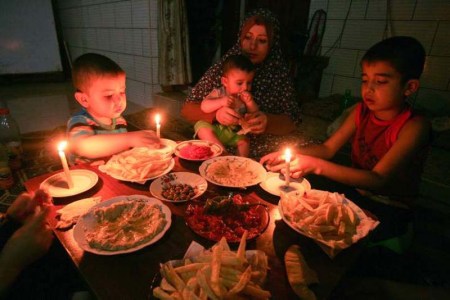
An Arab family eats a Ramadan dinner by candlelight in the Rafah refugee camp, in the southern Gaza Strip, during a power outage on June 12, 2017.

I’m calling it the Watts for Weapons program. I’m sure they’ll go along with it. Only someone who prefers killing Jews to keeping his own people alive could possibly turn it down.

***************************

{Originally posted to the author’s website, Abu Yehuda}

Gaza’s electricity shortage has recently become critical. Gaza gets its power from Israel and Egypt, and has a small power station of its own. But due to a decision of the Palestinian Authority to further reduce the amount it pays Israel  for electricity, the 3-4 hours a day during which Gaza is illuminated will be reduced by another 45 minutes or so – unless money is found somewhere.

Hamas is threatening that there will be an “explosion” unless something is done. It is a big problem for the population, because food is not being refrigerated, sewage is not being processed, water is not being pumped, and hospitals are unable to operate. And the weather is getting hotter.

Israel presently supplies Hamas with about 125 megawatt-hours (MWh) per day, and Egypt provides a smaller amount. Gaza’s own power station is presently not operating due to lack of fuel. It’s estimated that a 24-hour supply of electricity would require 400-500 MWh per day.

Negotiations are under way (Wednesday) for Western and Arab countries to pick up some of the slack. After all, think of the children. And nobody wants an “explosion.”

But there is a solution that nobody seems to have proposed yet. Let’s begin by asking a question: why doesn’t Hamas have money for electricity? After all, it levies heavy taxes on goods coming into the strip (both legally via the crossings from Israel and illegally via tunnels from Egypt) and on almost every other form of economic activity. It got money from Qatar until recently, and has now started receiving aid from Iran again. International donors pledged large sums for reconstruction after the 2014 war, although there was very little rebuilding done. Where did the money go?

The answer is simple: some of it enriched Hamas insiders, but most of it was used to dig tunnels, to manufacture rockets and for other weapons and military infrastructure. Hamas officials were ready to see their children (well, the children of other Gaza residents) hungry and wading in sewage if it advanced their project to destroy Israel.

In effect money was converted into weapons. And that provides a way to solve the problem: we can convert it back.

For example, what if Israel agreed to provide Hamas with 2 MWh for every stockpiled Qassam rocket turned over to us? They have thousands of these, which could keep the lights on for weeks. Not to mention longer-range rockets, which would be worth more. And tunnels – I’m sure we would be happy to give them a whole day’s worth of electricity for the precise location of a terror tunnel. Just give us the coordinates and we’ll do the rest! Anti-tank and anti-aircraft weapons are valuable, too. A nice shoulder-fired SAM is probably worth 10 MWh. Even rifles and mortar shells could help keep the juice flowing.

You get the idea. From Israel’s point of view, it would be far cheaper than the tamir rockets used by Iron Dome to shoot down the Qassams ($50k -$100k each!), and the amount of effort needed to find the tunnels. Hamas would get its electricity – and we would get some peace and quiet for a change.

I’m calling it the Watts for Weapons program. I’m sure they’ll go along with it. Only someone who prefers killing Jews to keeping his own people alive could possibly turn it down.

Will Trump make a peace breakthrough in 2018?

June 15, 2017

Will Trump make a peace breakthrough in 2018? DEBKAfile, June 15, 2017

(Lots of speculation about future events, but an interesting piece nevertheless. — DM)

US President Donald Trump’s goal of generating a rapid improvement of Israel’s ties with the Arab world, including the Palestinians in 2018, is not just up to Prime Minister Binyamin Netanyahu and Palestinian Authority Chairman Mahmoud Abbas, but depends largely on how the Trump administration handles the continuing conflict between Qatar and its powerful Arab opponents, Egypt, Saudi Arabia and the UAE.

Up until the end of this week, Trump had turned down the efforts of Secretary of State Rex Tillerson and Secretary of Defense James Mattis to resolve the Gulf conflict by diplomacy. Instead of heeding them, the president took the advice of the Saudi defense minister, Prince Mohammed bin Salman, and Saudi Foreign Minister Adel Al-Jubeir, who visited Washington this week. Tillerson and Mattis tried to arrange a conference between Saudi Arabia and Qatar so as to gradually ease the tensions, but Trump torpedoed the initiative by adopting Riyadh’s tough line.

A complex situation has arisen in the last few days regarding the US diplomacy for bringing Israel and the Palestinians aboard a peace process. The signs of movement on this score fluctuate between crises and some progress:

1. The Gaza electricity row falls under the first heading. Some circles contend that the crisis is artificial, since the Palestinian enclave is receiving as much power now as before. What is different is the new, intensified pressure by Egypt on the one hand and the Palestinian Authority on the other in the hope of toppling Hamas rule in the Gaza Strip or squeezing its leaders into toeing their lines. Neither Egyptian President Abel Fatteh El-Sisi nor the Palestinian Authority chairman has made headway. Hamas stubbornly refuses Cairo’s demand to sever ties with Qatar, while launching a counteroffensive to draw Israel into the dispute by making an empty threat of an “explosion.”

Israel responded with a counter-threat on Thursday, June 15: a proposal to transfer one hour’s worth of power from West Bank Palestinian towns to boost the supply to Gaza.

This maneuver kept the entire electricity issue in the court from it was tossed, Ramallah.

2. A shower of Israeli concessions is landing on the Palestinians judging by almost daily reports. Some are true and others false. But in sum, they are designed to impress President Trump with the Netanyahu government’s good will towards his peace initiative and readiness to take steps in its support. In fact, the prime minister is preparing the ground for the forthcoming arrival of Jason Greenblatt, Trump’s envoy on the Israel-Palestinian issue.

3. US Secretary of State Tillerson this week informed the Senate that the Palestinian Authority had agreed to  halt its payments to the families of Palestinian terrorists who were killed while carrying out attacks against Israelis. Palestinian officials no doubt let this be understood to demonstrate their willingness to go along with Trump’s peace initiative, without, however, have any real intention of following through.

4. Media reports and the findings of Arab research institutes add up to the following predictions on the fate of the negotiations generated by the Trump administration between Israel and the Arab world:

A. Some time during 2018, a showcase summit will be staged for Trump, Netanyahu and leading Arab rulers like Saudi King Salman, Egyptian President El-Sisi and the UAE’s Crown Prince Mohammed bin Zayed al-Nahyan.

They will publish a joint declaration signaling the phased normalization of relations with Israel by such preliminary steps as the exchange of economic and business delegations, the opening of trade offices and of Arab skies to Israeli commecial flights. None of these researchers is clear about the Palestinian role in this event.

B. Meanwhile, Israel will make concessions towards improving the lives of ordinary Palestinians, such as removing checkpoints, issuing building permits for Palestinian towns and more jobs in Israel.

C. Israel and the Palestinian Authority will expand their security cooperation. The Palestinians will be persuaded to cease their incitement against the Jewish State and stop payouts to the families of convicted Palestinian terrorists and other security offenders.

D. Direct Israeli-Palestinian negotiations will ensue, without preconditions on either side, and expand. with Arab governments sitting in.

E. At the end of a period of some years, this process will mature into a discussion of the core issues of the dispute, Palestinian statehood, future borders, settlements, Jerusalem and refugees.

In other words, the year 2018 will see the building of normal relations between Israel and Arab countries to be followed at a later date by the Israeli-Palestinian peace process. President Trump has clearly seized on relations with Riyadh, Cairo and Abu Dhabi as a lever for pushing Israel and the Palestinians into peace talks.

The idea is simple. Israel’s improved ties with the Arab world will resonate positively on Israeli-Palestinian relations. That appears to be Trump’s formula for peace. But there is a catch. It depends heavily on the US President maintaining good relations with the Arab world in the long term.

Military crisis in Qatar may spark Gaza outbreak

June 13, 2017

Military crisis in Qatar may spark Gaza outbreak, DEBKAfile, June 13, 2017

A military crisis centering on Qatar would be a catalyst for an outbreak of violence from the Gaza Strip. And indeed, after the failed Sanwar mission to Cairo and the reduction of electric power to the Gaza Strip, Hamas spokesmen warned that an “explosion” was imminent.

*********************

The electricity cutback in the Gaza Strip, engineered by Palestinian leader Mahmoud Abbas to flex muscle against Hamas rule, was just one piece on the checkerboard created by the crackdown Egypt, Saudi Arabia Bahrain and the United Arab Emirates have imposed on Qatar for supporting terrorist groups like the Palestinian extremist Hamas. Therefore, Hamas leader Yahya Sanwar had little to expect from his mission to Cairo last weekend to persuade the El-Sisi government to ease its restrictions on the Gaza Strip.

He arrived at the head of a large mission, in which the group’s military arm, Ezz e-Din El-Qassam was heavily represented. Their appeals to Maj.-Gen Khaled Fawzy, director of Egyptian General Intelligence, met with a list of tough conditions. When the Palestinian delegation balked, Cairo acted to tighten its blockade on the Palestinian enclave.

The Hamas rulers of the Gaza Strip found themselves in the same boat as their old friend, Qatar, in the week that their internal rival, Mahmoud Abba, docked payment for the electricity Israeli supplies the Gaza Strip. The power supply was cut by 40 percent.

From 2015, the emir of Qatar remained the only Arab ruler backing the Palestinian extremist Hamas with occasional cash donations to Gaza City and permission for its top officials to set up shop in Doha.

This flow of aid was abruptly cut off by the land, sea and air blockade Saudi Arabia, the UAE, Bahrain and Egypt clamped down on Qatar last week over its support for terrorist groups and ties with Tehran. Sheikh Tamim bin-Hamad Al-Khalifa defied the ultimatum they presented him, and so Qatar’s banks and international assets have been losing dollars, its currency has plummeted and there is no money to spare for the Gaza Strip.

Qatar and Hamas are being pushed into the same corner.

The small Gulf island, which is the world’s largest supplier of natural gas, was been told by the four leading Arab governments to expel Muslim Brotherhood and Hamas officials from its soil, after years of providing them with hospitality plus pensions generous enough for them to live a life of ease and plenty, while also running their terrorist networks across the region and beyond.

Qatar was also told to discontinue its propaganda campaigns against Egypt, Saudi Arabia and the UAE, and shut down its main platform, the Al Jazeera TV channel; and hundreds of Egyptian and Saudi dissidents granted political asylum deported forthwith.

With nowhere else to go, these dissidents could potentially head for sanctuary in the Gaza Strip, making it a “little Qatar,” which is why Cairo further tightened the Palestinian enclave’s isolation by blocking all routes of access.

The Hamas delegation was likewise confronted in Cairo with tough demands by the Egyptian intelligence chief:

1. To turn in the Muslim Brotherhood fugitives they were sheltering in the Gaza Strip.

2.  Not just to sever cooperation between the Hamas military arm and the Islamic State networks in the Sinai Peninsula, but to surrender to Egypt all the intelligence they possessed about the jihadists and their activities.

3.  To discontinue weapons smuggling operations through Sinai.

After balking at the Egyptian demands, Yahya Sanwar was forced to leave Cairo empty-handed with regard to eased restrictions and humanitarian aid – only to find on his return home that the Egyptians had raised their biggest gun against the Gaza Strip: They had cut off power.

A humanitarian catastrophe now hangs over the two million inhabitants of the tiny Mediterranean enclave. Hospitals are cutting back operations, refrigerators are switched off, clean water supplies are dwindling because desalination plants are without power, raw sewage is dumped into the sea and sanitary conditions deteriorating.

Cairo asked the Palestinian Authority in Ramallah and the Israeli government not to relent, but to keep the pressure on the Hamas regime high. Ramallah must continue to hold back payment to cover Israel’s electricity bills, which suits Mahmoud Abbas’ campaign for bringing Hamas to heel.

But for Israel, there is a dilemma. Nonetheless, the Netanyahu government is extremely wary of breaking away from the anti-terror line taken by Arab governments, because this could put paid to the delicate ties established with them – especially in the military domain – through long and laborious effort.

In Jerusalem, it is therefore ardently hoped that the Qatar crisis is quickly resolved and Hamas and Cairo can reach terms exponentially for easing the humanitarian crisis in the Gaza Strip.

For the time being, there is no sign of this happening. On the contrary, there are indications of the crisis moving onto a military plane. Sources in the Middle East are not ruling out possible military action by Saudi Arabia, Egypt and the UAE against Qatar.

Read more about this looming potential in the coming DEBKA Weekly issue (for subscribers) out next Friday, June 16. 

A military crisis centering on Qatar would be a catalyst for an outbreak of violence from the Gaza Strip. And indeed, after the failed Sanwar mission to Cairo and the reduction of electric power to the Gaza Strip, Hamas spokesmen warned that an “explosion” was imminent.

Palestinian Islamic Jihad, Iran’s ‘Preferred Proxy,’ Arming in Gaza

June 5, 2017

Palestinian Islamic Jihad, Iran’s ‘Preferred Proxy,’ Arming in Gaza, Investigative Project on Terrorism, Yaakov Lappin, June 5, 2017

Iran provides PIJ with both “military and financial support,” ITIC noted in its report.

“PIJ is the preferred organization for Iran, due to the problematic nature of the relationship between Iran and Hamas,” ITIC Director Col. (ret.) Reuven Erlich, told the Investigative Project on Terrorism.

Although Iran continues to fund Hamas’s military wing, relations between Shi’ite Tehran and the Sunni Islamist rulers of Gaza have been unstable since 2012, when the two found themselves on opposite sides of the sectarian war raging in Syria.

PIJ has around 5,000 members in its armed wing, the Quds Brigades. The organization has its own Gazan rocket production industry, and PIJ possesses the second largest arsenal of projectiles in Gaza, thanks to Iranian manufacturing knowledge. The organization has been working on improvements to its rocket launch systems. It also digs combat tunnels.

***************************************

Palestinian Islamic Jihad (PIJ), the second largest terrorist army in Gaza, recently issued a video threat about its willingness to end the three-year truce in place with Israel.

“If the Israeli enemy continues its normal game and plays with the lives of the Palestinian people, we will break the cease-fire,” PIJ leader Ramadan Shallah says in the video, according to an Algemeiner report.

The footage is laced with images of gunmen in camouflage, rising out of the ground, moving through tunnels, and watching areas of southern Israel near the Gaza border. It is interspersed with scenes from a rocket factory, and a close up shot appears of a senior Israel Defense Forces (IDF) officer, who is placed in crosshairs, before a bullet is loaded into a rifle.

“Don’t try to test the resistance,” says the video’s last message.

PIJ remains Iran’s favored proxy in the Strip as relations between Tehran and Hamas continue to fluctuate.

The Gaza-based Al-Ansar charity, a Palestinian branch of the Iranian Martyrs Foundation, announced May 21 that it would provide financial grants to “families of martyrs” whose relatives were killed between 2002 and 2014.

A parallel Iranian funding channel is in place for families of “martyrs” killed in the 2014 conflict with Israel.

The Al-Ansar charity is “affiliated with PIJ,” according to a report released by the Tel Aviv-based Meir Amit Intelligence and Terrorism Information Center (ITIC).

Iran provides PIJ with both “military and financial support,” ITIC noted in its report.

“PIJ is the preferred organization for Iran, due to the problematic nature of the relationship between Iran and Hamas,” ITIC Director Col. (ret.) Reuven Erlich, told the Investigative Project on Terrorism.

Although Iran continues to fund Hamas’s military wing, relations between Shi’ite Tehran and the Sunni Islamist rulers of Gaza have been unstable since 2012, when the two found themselves on opposite sides of the sectarian war raging in Syria.

Thus, Iran does not currently fund Hamas’s non-violent operations, including the salaries for tens of thousands of Hamas government employees.

In recent days, a Hamas senior official even took the trouble to flatly deny Arabic media reports that Iran had resumed full-scale funding for his regime, describing the claims as “fake news.”

PIJ, which plays no governmental role, has no such issues with Iran, and it continues to enjoy a high level of Iranian financial support.

A snapshot of that support can be seen in the estimated $8.7 million that was transferred from the Iranian Martyrs Foundation to Gaza over the last three years. Not all the money went to families of those killed in conflict with Israel. “We can assume that some of that money also went towards financing groups like PIJ,” Erlich said.

The Al-Ansar charity is used by the Iranian Martyrs Foundation “as a pipeline to funnel funds into the Gaza Strip, in indirect support of terrorism. The money also serves to increase Iran’s influence among the Palestinian people, and sends a message to the Sunni Arab world, that it is Iran which is supporting the Palestinians in their struggle against Israel,” the ITIC report said.

The Al-Ansar charity is fed with cash by a branch of the Iranian Martyrs Foundation in Lebanon. A second branch of the foundation in Lebanon supports Hizballah.

In 2007, the U.S. Department of Treasury designated the Iranian Martyrs Foundation and its branches in Lebanon as sponsors of terrorism. Israel banned the Al-Ansar charity in 2003, but it reestablished itself in Gaza after the Israeli withdrawal in 2005.

The reelection of Iranian President Hassan Rouhani to a second term is unlikely to dent Iranian funding for terror groups like PIJ, as Supreme Leader Khamanei, who is committed to arming and financing jihadists intent on fighting Israel, continues to exercise control over foreign affairs and military policies.

PIJ has around 5,000 members in its armed wing, the Quds Brigades. The organization has its own Gazan rocket production industry, and PIJ possesses the second largest arsenal of projectiles in Gaza, thanks to Iranian manufacturing knowledge. The organization has been working on improvements to its rocket launch systems. It also digs combat tunnels.

PIJ is a quarter of the size of Hamas’s 20,000 armed operatives, but that did not stop it from having numerous past run-ins and power struggles with Hamas.

Since the end of the 2014 conflict with Israel, however, Hamas has improved its ability to coordinate and control the other armed factions operating in its territory.

It remains unclear whether the latest PIJ threat to violate the ceasefire represents a warning of a possible split with Hamas’s leadership.

“What matters most is the ideological distinction between the PIJ and Hamas,” said Ely Karmon, a senior research scholar at the International Institute for Counter-Terrorism in Herzliya.

“While Hamas, [which is] the Palestinian Muslim Brotherhood, has a strategic cooperation with Iran, PIJ has a religious affinity with the Khomeinist doctrine and regime, since their [former] leaders Fathi Shaqaqi and ‘Abd al-‘Aziz ‘Odah, from the inception of their group, acknowledged the importance of the Iranian revolution and its influence,” Karmon told the IPT.

“Sheikh Ahmed Yassin, the Hamas leader,  wrote nothing on religious matters (and did not write about any other issues either),” Karmon noted. “Shaqaqi wrote 5 books in which he praised the Iranian revolution.”

“In this sense, the PIJ is the real proxy of Iran, and not Hamas,” he added.

PIJ leaders integrated themselves into the Iranian-Hizballah camp when Israel expelled them to Lebanon in 1988, Karmon noted. Then, PIJ leader Fathi Shaqaqi was assassinated in Malta in 1995, representing a dramatic blow to the organization.

It took his successor, Ramadan Abdullah Shallah, who is still the current leader, five years following Shaqaqi’s assassination to build up the group’s infrastructure, with the aid of “major Iranian financial and military support,” Karmon said.

“Ironically, Shallah, who spent five years at Durham University [in Britain] writing a thesis on Islamic banking in Jordan, was called to lead the PIJ from the U.S., where he taught at the University of South Florida,” Karmon added.

When Hamas released a document that represented an update to its policies last month, feigning a softer stance and a willingness to accept a Palestinian state on the 1967 borders, PIJ’s response was unequivocal.

“As partners with our Hamas brothers in the struggle for liberation, we feel concerned over the document,” said Islamic Jihad’s deputy leader, Ziad Al-Nakhala.

“We are opposed to Hamas’s acceptance of a state within the 1967 borders and we think this is a concession which damages our aims,” Al-Nakhala said, in comments posted on PIJ’s website.

Accepting a state on the 1967 borders would “lead to deadlock and can only produce half-solutions,” Al-Nakhala added.

Ultimately, the dispute between PIJ and Hamas is one over tactics, not strategy. In light of its acute isolation, Hamas is seeking to rebrand itself somewhat, without any intention of giving up its long-term goal of destroying Israel.

PIJ, enjoying firm Iranian backing, and lacking all of Hamas’s dilemmas of sovereignty, rejects the very idea of a rebranding. It insists on openly advertising its jihadist, Iranian-influenced ideology. Hoisted on Iran’s shoulders, PIJ prepares for the next round of fighting with Israel.

Yaakov Lappin is a military and strategic affairs correspondent. He also conducts research and analysis for defense think tanks, and is the Israel correspondent for IHS Jane’s Defense Weekly. His book, The Virtual Caliphate, explores the online jihadist presence.

UNRWA recycles image of Syrian girl, now claims she is Gazan victim of Israel in fundraising campaign

June 3, 2017

UNRWA recycles image of Syrian girl, now claims she is Gazan victim of Israel in fundraising campaign, Jihad Watch, June 2, 2017

(The UN Rocket Warehousing Agency strikes again. Please see also, Gaza on the Brink. — DM)

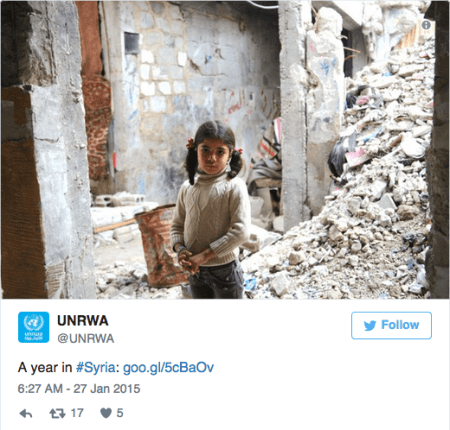
Notice also that not only do they cynically reuse the photo, but they make up a whole tear-jerking story about little “Aya,” victim of Israeli oppression. Three years ago they used the identical picture as a girl standing in bombed-out Damascus.

Two primary lessons:

  1. The UNRWA is a viciously corrupt and dishonest organization, bent on enabling the jihad against Israel and willing to lie brazenly in the process.
  2. There is so little actual oppression of the “Palestinians” that images from elsewhere have to be used to demonize the Israelis.

Nikki Haley, Trump’s ambassador to the United Nations, said that the U.S. would fight against the demonization of Israel at the UN. Why is the UN receiving even a penny of U.S. funding at this point?

“UNRWA fakes Gaza girl campaign with image of bombed-out Damascus,” UN Watch, June 2, 2017 (thanks to The Religion of Peace):

GENEVA, June 2, 2017 – UN Watch today demanded that UNRWA chief Pierre Krahenbuhl apologize for using fake images of a girl in a bombed-out Syria building in a major global campaign to raise money for the organization by pretending the girl is a Gaza victim of Israeli actions.

UNRWA is now running the above photo on Facebook and Twitter ads. It is also now UNRWA’s cover image.

Imagine being cut off from the world – for your whole life. That’s reality for children like Aya. The blockade of Gaza began when she was a baby, the occupation in the West Bank before her parents were born. Now she is eleven, and the blockade goes on.

Aya’s childhood memories are of conflict and hardship, walls she cannot escape, and the fear that the only home she knows, however tiny, could be gone when she returns from school.

This Ramadan, please help support children like Aya who have known nothing but conflict and hardship. Donate here: http://buff.ly/2qgsP0Y#forPalestinerefugees

Yet neither the girl nor the bombed-out building are in Gaza; it’s an old photo from Syria, dating apparently to 2014.

Here is UNRWA tweeting the original image in a January 2015 story on Syria:

The photo also appeared on other UNRWA Syria pages, here, here, and here, an UNRWA report in which the caption reads:

A young girl stands in the rubble of Qabr Essit, near Damascus. In 2014, UNRWA was able begin rebuilding facilities within the neighbourhood, including a school and community centre © 2014 UNRWA Photo by Taghrid Mohammad