Archive for the ‘Gaza’ category

Watch: Children on Hamas TV Say they Want to ‘Blow Up the Jews’

September 17, 2015

Watch: Children on Hamas TV Say they Want to ‘Blow Up the Jews,’ Elad Benari, September 17, 2015

Hamas is continuing to use its media to educate young children to carry out “jihad” against Jews.

The Middle East Media Research Institute (MEMRI) has exposed a clip from a children’s show on the Hamas-owned Al-Aqsa TV channel which shows young children, dressed in military fatigues, asked what they want to be when they grow up.

One of the children said that he wanted to be an engineer, “so that I can blow up the Jews.” Another recited a poem, “I shall liberate [Jerusalem] from the Jews by means of the Al-Qassam Brigades.”


https://www.youtube.com/watch?v=1UXlSeDHGh0


MEMRI has in the past published several clips which show Arab youths vowing to fight “the occupation”.

A clip released by MEMRI earlier this year showed footage from a youth camp organized by Hamas’s so-called “military wing”, in which young cadets learn how to use weapons and simulate the kidnapping of an Israeli soldier.

A previous clip shows a televised graduation ceremony for a similar Hamas youth camp in Gaza. At the ceremony, suicide terror attacks against the “Zionist enemy” were glorified by Hamas officials.

Hamas has also in the past released a cartoon honoring its “military wing”.


The Fiction of Political Islam

September 2, 2015

The Fiction of Political Islam, The Gatestone InstituteBassam Tawil, September 2, 2015

  • To this day, the Obama administration mourns the fall of Egypt’s Islamist President Morsi, and turns a cold shoulder to forward-looking President el-Sisi, who is (sometimes) trying to take Egypt into the 21st century and extricate Egypt from its economic and societal crisis.
  • Muslim Brotherhood terrorism against the Egyptian regime is a perfect example of how this “political movement” is in reality a terrorist movement whose objective is the violent overthrow of Egypt’s government. The White House, fully aware of the facts, continues hosting senior Muslim Brotherhood officials and shows them respect during consultations about the American Islamic community and U.S. policy in the Middle East.
  • Events in Sinai prove there is no such thing as “political Islam.” There is a radical Islamist leadership that represents itself to the gullible West as “moderate,” preaches violence from mosques, cloaks itself in ideological-religious tradition, and employs Islamist terrorists to attack civilians and Egyptian government targets.
  • It is hard not to conclude, looking at President Obama’s record (ignoring protesters of 2009 in Iran; “I’ve got a pen, and I’ve got a phone”; the dictatorial way the Iran deal is bypassing the democratic process) that in his heart-of-hearts, he is far more committed to supporting extremist Islamist regimes — whether the mullahs of Iran or the Muslim Brotherhood — than to supporting democracy, individual freedoms or human rights.
  • The Europeans are more aware of the situation but woke up too late. As hundreds of thousands of migrants from Muslim lands continue to pour over Europe’s open borders, there is little doubt that radical Islam is poised to take over the West. Islamic communities and terrorist cells continue to mushroom throughout the cities of Europe.
  • The world is beginning to understand that the catastrophes of the Middle East have nothing to do with the resolution of the Palestinian issue but are caused by the innate homicidal tendencies of the Arab rulers and the regional Islamist terrorist organizations.

Hamas is in trouble. Its relations with Egypt are going from bad to worse, and the influx of money, primarily from Qatar, Saudi Arabia and the mosques in the Western world — where charity (zakat) was collected to finance anti-Israel terrorism — has dwindled to almost nothing. So has the flow of arms and explosives from Iran, Libya, Sudan and Lebanon. The resulted is the weakening of Hamas rule in the Gaza Strip, making it ever more difficult for Hamas to continue its ongoing subversion of the Palestinian Authority (PA) in the West Bank and its non-stop attempts to overthrow President Mahmoud Abbas to take over the West Bank and establish there the sort of Islamic emirate it established in the Gaza Strip.

Hamas’s military buildup was halted when the President Mohamed Morsi’s radical Muslim Brotherhood regime in Egypt was toppled and General Abdel Fattah el-Sisi was elected President. Morsi, it will be recalled, strangely received support from President Obama until he was ousted. The Obama administration supported him despite Morsi enabling for the flow of money and arms to Hamas in Gaza to continue unhampered through the tunnels in the Sinai Peninsula. The weapons were used not only to attack Israel, but also to sabotage peace talks between Israel and the Palestinians and, indirectly, to attack the Palestinian Authority.

The Islamist terrorism festivities ended when President el-Sisi clamped down on the Islamists in Egypt, destroyed the tunnels and sealed Egypt’s border with Gaza. Since el-Sisi has been president of Egypt, Muslim Brotherhood rule has ended and the tunnels have been destroyed. It is hard to fathom why, to this day, the Obama administration mourns the fall of the Islamist Morsi administration and turns a cold shoulder to forward-looking el-Sisi, who is (sometimes) trying to take Egypt into the 21st century and extricate Egypt from its economic and societal crisis.

Since el-Sisi has been in power, money and arms no longer flow through the tunnels into the Gaza Strip; instead they began to flow in the opposite direction, from the Gaza Strip into Egypt’s Sinai Peninsula. Since the Muslim Brotherhood and its affiliated terrorist organizations, Hamas among them, have not accepted defeat, there has been an increase in terrorist attacks targeting the Egyptian regime both inside the country proper and in the Sinai Peninsula. The terrorist campaign receives ongoing support from the Izz al-Din al-Qassam Brigades, Hamas’ military-terrorist wing, and the ISIS-affiliated Ansar Bayt al-Maqdis. Both continuously attack the Egyptian police and army in the Sinai Peninsula, murder Egyptian officials and target Egyptian institutions.

The endless terrorist campaign in Egypt has proven yet again that the claim of a political Islam, separate from the terrorist organizations, is simply a lie. Muslim Brotherhood terrorism against the Egyptian regime is a perfect example of how the “political movement” tries to represent itself as dealing only with the da’wah [proselytizing], while in reality it is a terrorist movement whose objective is the violent overthrow of el-Sisi’s administration. The White House, fully aware of the facts, continues hosting senior Muslim Brotherhood officials and shows them respect during consultations about the American Islamic community and U.S. policy in the Middle East.

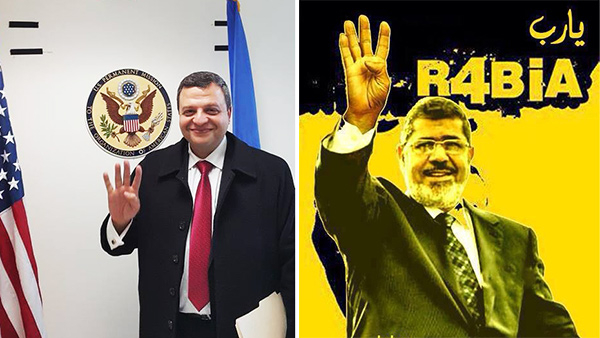
919 (1)While being hosted by the State Department on a visit to Washington in January 2015, Muslim Brotherhood judge Waleed Sharaby (left) flashed the organization’s four-finger “Rabia” sign. At right, ousted Egyptian President Mohamed Morsi (from the Muslim Brotherhood) displays the Rabia sign.

The events in the Sinai Peninsula prove there is no such thing as “political Islam.” There is a radical Islamist leadership that represents itself to the gullible West as “moderate,” preaches violence from the mosques, cloaks itself in ideological-religious tradition, and employs a hard core of Islamist terrorists to carry out attacks on civilians and Egyptian administration targets.

In the meantime, the real victims are the Egyptians. The Muslim Brotherhood’s terrorism has paralyzed Egypt’s tourist industry, as foreigners fear to visit Egypt’s antiquities. And now there are terrorist threats to the New Suez Canal, a project initiated and carried out under the leadership of General Sisi to turn both banks of the two canals into an international logistics, commercial and industrial area.

The Islamists’ plans are clear. First, they want to leverage violence, murder and countless Egyptian army casualties into establishing an autonomous terrorist enclave in the Sinai Peninsula. Then they will try to overthrow the Egyptian government and reinstate an Islamist Muslim Brotherhood regime headed by Morsi. That is exactly what their offshoot, Hamas, did in the Gaza Strip when it liquidated Palestinian Authority officials and established an Islamic emirate. The writing on the wall is still illegible as far as the U.S. government is concerned. Or else the Obama administration is still in the thrall of extremist Islam and its Muslim Brotherhood leaders. The two main ones are Turkey’s Recep Tayyip Erdogan, who has just called new elections so that he can try again to acquire enough seats in parliament to amend Turkey’s constitution to award himself a one-man Sultanate, an absolute dictatorship-for-life to go along with his new palace. The other is Mohamed Morsi, whom Obama apparently is still backing.

It is hard not to conclude, looking at the U.S. president’s record (ignoring the protesters of 2009 in Iran; “I’ve got a pen, and I’ve got a phone” and the dictatorial way the Iran deal has been short-circuited to bypass the democratic process) that in his heart-of-hearts, he is far more committed to supporting extremist Islamist regimes — whether the mullahs of Iran or the Muslim Brotherhood — than to supporting democracy, individual freedoms or human rights.

The Europeans are more aware of the situation but unfortunately woke up too late. As hundreds of thousands of migrants from Muslim lands continue to pour over Europe’s open borders, there is little doubt that radical Islam is poised to take over the West. Islamic communities and terrorist cells continue to mushroom and gather strength throughout the cities of Europe.

From the beginning of the wave of attacks in Egypt, senior Egyptian security officials threatened Hamas. Egypt warned Hamas to stop training, arming and sending its terrorists to collaborate with ISIS operatives in attacks against the Egyptian army. Hamas steadfastly denies any involvement, even as it continues collaborating with ISIS against Egypt.

As far as Hamas is concerned, destroying the Egyptian army is essential, because its continued actions along the Rafah border and in Sheikh Zuweid in the northern Sinai Peninsula prevent Hamas from acquiring money and stockpiling weapons to fight Israel, which weakens its subversion against Mahmoud Abbas and its plans to take over the West Bank.

Despite profuse denials, at the end of August 2015, four operatives from Hamas’s military-terrorist wing, the Izz al-Din al-Qassam Brigades, were taken off a bus by armed Egyptians on the way from Rafah through the Sinai Peninsula to Cairo. Hamas immediately accused Israeli intelligence of responsibility and warned the Egyptian authorities that “the abduction of its operatives will not go unpunished.”

In response, Dina Ramez, a co-host on Egypt’s official TV station, called Hamas out on its lies and denials of its terrorist activities in the Sinai Peninsula against the Egyptian regime. She asked Hamas, “If you are not involved in terrorism, what were your senior Izz al-Din al-Qassam Brigades operatives doing in Sinai?” and called them “cockroaches.”

Sources in Hamas called her a “whore,” and called Egypt a loser country defeated by Israel, using a peace treaty to sell Palestine to the enemy. Was that really the way to thank Egypt for everything it has done for the Palestinians, sacrificing its army and soldiers for us? It is a sad situation for the Palestinians and for our leadership.

What have we Palestinians gained from Hamas’s military actions against Egypt? What have we gained from our solidarity with Islamist organizations fighting against Assad in Syria, or joining organizations such as the “Palestinian Liberation Army” fighting for Assad? Why are we killing each other in the Ain al-Hilweh refugee camp? Why do we refuse everything the Israelis offer us?

Anyone who remembers history remembers the ungrateful path trodden by the Palestinians against the Kingdom of Jordan, when our leaders, headed by Arafat, tried in 1970 to overthrow King Hussein, despite the refuge Jordan offered us during the catastrophes of the Nakba in 1948 and the Naksa in 1967. Then we did the same thing in Lebanon, to where we fled from Jordan. The PLO relocated its headquarters to Beirut, and went on to turn Lebanon into a terrorist country and the lives of the Lebanese into a nightmare. If the Israelis had not invaded Lebanon in 1982, and forced the PLO to relocate to Tunisia (where its behavior was also criminal), the Palestinians definitely would have destroyed Lebanon.

The Middle East is in chaos, and Palestinian factionalism and ingratitude continue to inflame the dissolution of the Arab states and the internal Palestinian division between Hamas in Gaza and the Palestinian Authority in the West Bank.

The world is beginning to understand that the catastrophes of the Middle East have nothing to do with the resolution of the Palestinian issue, but are caused by the innate homicidal tendencies of the Arab rulers and the regional Islamist terrorist organizations.

The only person left who believes the Israeli-Palestinian nonsense is President Barack Obama, even though he is witness to the murders, rapes, beheadings and the millions of refugees, next to which the Palestinian issue is an old, irrelevant and very tired joke.

Egypt and the Hamas “Cockroaches”

August 26, 2015

Egypt and the Hamas “Cockroaches,” The Gatestone InstituteKhaled Abu Toameh, August 26, 2015

  • “What were your four [Hamas] men doing in Sinai? Haven’t you denied in the past the presence of any Hamas men in Sinai? So where did these men pop up from?” — Dina Ramez, Egyptian journalist.
  • The incident also proves that Hamas does not hesitate to take advantage of Cairo’s humanitarian gestures to smuggle its men out of the Gaza Strip. Obviously, the four Hamas men were not on their way to receive medical treatment. That they are members of Hamas’s armed wing, Ezaddin al-Qassam, speaks for itself.
  • The Egyptians are particularly fed up with reports about Hamas’s increased involvement in their internal affairs and links to terror groups in Sinai.
  • This practice by Hamas is something that the Egyptian authorities have come to understand, which is why they are refusing to reopen the Rafah border crossing between Gaza and Egypt. The question now is whether the international community will understand Hamas’s true intentions and plans — namely to prepare for another war against Israel.

Egypt’s President Abdel Fatah Sisi has once again proven that he and his country will not tolerate any threats from Hamas or other Palestinians.

The crisis that erupted between Sisi’s regime and Hamas after the removal from power of Muslim Brotherhood President Mohamed Morsi two years ago, reached it peak in the past few days with the kidnapping of four Hamas operatives in Sinai.

The four men were snatched from a bus shortly after crossing from the Gaza Strip into Egyptian territory on August 19. Reports said that unidentified gunmen stopped the bus and kidnapped the four Hamas men, who are wanted by Egypt for their involvement in terrorism.

1222A bus carrying Palestinians drives through the Rafah crossing, from the Gaza Strip to Egyptian Sinai, on August 23, 2015. (Image source: Aqsatv video screenshot)

Although initial reports suggested that the kidnappers belonged to a salafi-jihadi group based in Sinai, some Hamas officials have accused Egyptian security forces of being behind the abduction. The Hamas officials even issued veiled threats against Sisi and the Egyptian authorities, and said that they held them fully responsible for the safety of the Hamas men.

A statement issued by Hamas warned the Egyptian authorities against harming the four men. “These men were the victims of deception and their only fault is that they are from the Gaza Strip,” the statement said. “This incident shows that the criminals are not afraid to target our people.”

Hamas leader Musa Abu Marzouk said that his movement holds the Egyptian authorities fully responsible for any harm caused to the abductees. He said that the kidnapping raises many questions and its circumstances remain unclear.

Hamas claims that salafi-jihadi groups in Sinai have informed its representatives that they did not kidnap the four men. According to Hamas officials, the abduction took place near the border with the Gaza Strip — an area where the Egyptian army maintains a large presence.

Sources in the Gaza Strip, however, have confirmed that the four men belong to Hamas’s armed wing, Ezaddin al-Qassam. The sources said that the men were apparently on their way to Iran for military training. The sources pointed out that the four had received permission from the Egyptian authorities to leave the Gaza Strip through the Rafah border crossing. The visas, however, are supposedly for civilians, not for Hamas operatives.

Hamas’s threats against Egypt have, meanwhile, enraged the Egyptian authorities as well as some top journalists in Cairo.

Egyptian authorities responded by refusing to give permission to Hamas leader Ismail Haniyeh and some leaders of his movement to travel to Qatar and Lebanon through the Rafah border crossing. The Hamas leaders were hoping to hold talks with some of their colleagues in those two countries about the possibility of reaching a long-term truce with Israel.

The Egyptians’ refusal to allow the Hamas leaders to leave the Gaza Strip has further strained relations between the two sides. Hamas representatives in the Gaza Strip were quoted as accusing the Egyptian authorities of “conspiring” against the movement and all Palestinians.

In Cairo, Egyptian security officials denied any link to the kidnapping of the four Hamas men. However, the denials have fallen on deaf ears and no one in Hamas seems to believe the Egyptian authorities. Even worse, Hamas representatives continued over the past few days to issue warnings and threats against Egypt.

As in the past, each time tensions rise between Hamas and Egypt, the Egyptians unleash some of their senior journalists against the Islamist movement. Since President Morsi’s removal from power, the Egyptians have displayed zero tolerance when it comes to Hamas. They are particularly fed up with reports about Hamas’s increased involvement in their internal affairs and links to terror groups in Sinai.

During the last war between Israel and Hamas, several Egyptian journalists and public figures openly expressed hope that the Israelis would destroy the movement for once and for all. Other journalists in Cairo, who are openly affiliated with the Sisi regime, have even urged their government to launch attacks against Hamas bases in the Gaza Strip.

This week, and in wake of the renewed tensions between Hamas and Egypt, Egyptian journalists resumed their rhetorical attacks against the movement. The question that most of these journalists asked was: What are Hamas members doing on Egyptian soil in the first place? The journalists accused Hamas of exploiting Egypt’s humanitarian gestures to smuggle its men out of the Gaza Strip.

One of these journalists, Dina Ramez, who is known as a staunch supporter of President Sisi, launched a scathing attack on Hamas, calling its members and leaders “cockroaches.”

Referring to the Hamas threats against Egypt, Ramez said: “Has anyone ever heard of cockroaches or ants that could threaten lions? These cockroaches belong to Hamas, which is threatening Egypt following the abduction of four of its men. I want to ask the Hamas cockroaches a simple question: What were your four men doing in Sinai? Haven’t you denied in the past the presence of any Hamas men in Sinai? So where did these men pop up from? I dare you to approach the border with Egypt. We have confidence in our army and our response will be painful. It will be a strong and deterring response against any cockroach that dares to come close to our border or threaten Egypt.”

Regardless of the identity of the kidnappers, the incident shows that Sisi and the Egyptian authorities continue to view Hamas as a threat to Egypt’s national security. The incident also proves that Hamas does not hesitate to take advantage of Cairo’s humanitarian gestures to smuggle its men out of the Gaza Strip. Obviously, the four Hamas men were not on their way to receive medical treatment or pursue their studies in Egypt or any other country.

That they are members of Ezaddin al-Qassam speaks for itself. Instead of dispatching its fighters to Iran and Turkey, Hamas should have allowed medical patients and university students to leave the Gaza Strip. But Hamas does not care about the well-being of the Palestinians in the Gaza Strip. Rather, it cares about sending its men to Iran and Turkey to receive military and security training.

This practice by Hamas is something that the Egyptian authorities have come to understand, which is why they are refusing to reopen the Rafah border crossing between Gaza and Egypt. The question now is whether the international community will understand Hamas’s true intentions and plans — namely to prepare for another war against Israel.

Captured Hamas Operative Details Group’s Terrorist Plans

August 11, 2015

Captured Hamas Operative Details Group’s Terrorist Plans, Investigative Project on Terrorism, August 11, 2015

A Hamas operative provided a treasure trove of intelligence during Israeli interrogation concerning the terrorist group’s rebuilding efforts and future terrorist plans, Israel’s intelligence agency Shin Bet disclosed on Tuesday.

The terrorist, Ibrahim Adal Shahada Sha’ar, 21, described about Hamas’ tunnel reconstruction efforts, planned terrorist attacks against Israel, military strategy, and coordination with Iran, the Jerusalem Post reported.

He admitted working on rebuilding underground tunnels and described how some would be used in future attacks against Israel. Sha’ar disclosed the location of digging sites, tunnel entrances and underground routes, and reportedly said that a road built along the border with Israel is intended partly for terrorist attacks involving vehicles charging into Israeli territory.

He admitted that he stored several 50 kg explosive charges in his home and said that fighters kept explosives and other material in their own homes since Hamas commanders worried that the organization’s weapons depots would be targeted by Israel.

Israeli authorities arrested Sha’ar last month at the Erez Crossing after he attempted to enter Israel for “personal or humanitarian reasons.” Officers were aware of Sha’ar’s terrorist background and immediately detained him.

During last summer’s war between Israel and Hamas, Sha’ar participated in specific battlefield operations, including field logistics, transferring terrorists and weapons, and even admitted to setting up an anti-tank improvised explosion device (IED).

Sha’ar provided details of Iranian-Hamas military cooperation, including how Iran transfers funds and supplies weapons and electronics to the terrorist group. Those supplies include devices intended to jam radio frequencies to bring down Israeli drones deployed over Gaza. Furthermore, Sha’ar described how Iran trained Hamas terrorists to use hang gliders for attacks against Israel – a tactic revealed by previous Israeli interrogations of captured terrorists.

Critics of the recent Iran nuclear agreement argue that newly released funds to the Islamic Republic will bolster their regional hegemonic ambitions and global terrorist activities, including transferring more money and weaponry to its terrorist proxies.

According to Israeli intelligence, the Sha’ar detailed plans using tunnels to conduct cross-border attacks against Israeli targets, akin to Hamas’ attempts during last summer’s war. The Hamas operative confirmed that the terrorist group is diverting civilian reconstruction material for the purposes of rebuilding its terrorist infrastructure and underground tunnel network.

Sha’ar was indicted July 31 in the Beersheba District Court for being a member and engaging in activities with a banned organization, attempted murder, and forbidden military training.

Palestinian Summer Camps Preach Jihad and Train Youth to Become Terrorists

July 30, 2015

Palestinian Summer Camps Preach Jihad and Train Youth to Become Terrorists, Investigative Project on Terrorism, July 30, 2015

(In Gaza and at the Al-Aqsa Mosque in Jerusalem: raising a new generation of Palestinian children yearning to be free kill Jews for Allah, virgins, their parents and Palestine.  — DM)

Hamas hopes to provide 25,000 children and teenagers with military training to seed future terrorist operations against Israel. Similar to the Al-Aqsa camp, the Hamas camp heavily emphasizes religious indoctrination and radical jihadist brainwashing, according to a news report translated by MEMRI.

******************

Palestinian summer camps in Jerusalem and Gaza are actively indoctrinating young children with radical jihadist ideology and preparing them for martyrdom (suicide) operations, the Middle East Media Research Institute (MEMRI) reports.

In an Islamic summer camp at Al-Aqsa Mosque in Jerusalem, little children are subjected to a radical sheikh’s lecture on the virtues of martyrdom.


“The martyr is absolved with the first drop of his blood…the martyr also gets to vouch for seventy family members (on Judgment Day)… the martyr gets two virgins of Paradise, but the murabit [someone guarding Islam against the infidel] gets 70 – 35 times more than the martyr,” preached radical cleric Khaled Al-Maghrabi.

The children generally appear like most children their age – fidgeting, looking around, some playing with toys, seemingly disinterested in the lecture. Al-Magrabi still appears determined to impart jihadist indoctrination into the next generation of Palestinians at a very early age.

A Palestinian bystander even confronts Al-Maghrabi and tells him his message isn’t appropriate for children.

“Listen, sheik, they do not understand what you are saying. They are children…you are talking to them about ribat, martyrdom, and the virgins of Paradise. Shame on you. You can teach these lessons to (adults) like us, not to them,” said the Palestinian man.

Unfortunately, Palestinians standing up against radicalization is all too rare of an occurrence. Al-Maghrabi carried on after the distraction, leading the children in chanting, “We shall sacrifice our souls and our blood for you, Al-Aqsa!” the children chant.

In a second video illustrating Palestinian indoctrination of its young people with hate, viewers are taken inside a Hamas summer camp called “Vanguard of Liberation.” Hamas hopes to provide 25,000 children and teenagers with military training to seed future terrorist operations against Israel. Similar to the Al-Aqsa camp, the Hamas camp heavily emphasizes religious indoctrination and radical jihadist brainwashing, according to a news report translated by MEMRI.

“The goal of the camps is to instil the spirit of Jihad and of fighting in these cubs, these youth, so that they will become the next generation of liberation,” says a masked Hamas operative and camp counselor.


“Liberation” in this context means taking over all of Israel since Hamas is openly dedicated to the destruction of the Jewish state in any form.

The video features the youth running through military style courses, weapons training, and even shows a junior version of a Hamas naval commando unit dedicated to infiltrating Israel and conducting terrorist attacks.

ISIS infiltrates Egyptian special forces, joins with Hamas to occupy N. Sinai, liquidate Sisi

July 23, 2015

ISIS infiltrates Egyptian special forces, joins with Hamas to occupy N. Sinai, liquidate Sisi, DEBKAfile, July 23, 2015

islamic-State-Corvette-AttackThe ISIS Kornet missile attack on Egyptian Navy vessel

Islamic State affiliates in Sinai and Libya have banded together with the Palestinian Hamas rulers of the Gaza Strip for the shared goals of capturing northern Sinai from the Egyptian army and staging an assassination coup against President Abdel-Fatteh El-Sisi, DEBKAfile’s exclusive military and intelligence sources report.

They are in the throes of four steps for promoting their objectives:

1.  Monday, June 29, a rogue group of Egyptian Special Forces accessed the heavily-guarded upscale Cairo district of Heliopolis to plant a bomb car, which they remotely detonated as the convoy of their target, Egypt’s general prosecutor Hisham Barakat, went by. He was killed on the spot. The assassins were members of the Egyptian elite force which had defected to the Islamic State of Iraq and the Levant.

Three weeks later, on July 16, notwithstanding reinforced security in Heliopolis, ISIS killers reached inside the neighborhood once again and planted a roadside bomb. It was detonated as an Interior Ministry special forces security patrol moved past.

Because of the tight official blackout on the event, there are no reliable accounts on casualties. The authorities in Cairo reported that one Egyptian soldier was injured, but this is no doubt only part of the picture.

The following day, July 17, a violent clash erupted In the Talibiya neighborhood of Giza near the pyramids between Egyptian Special Forces and Muslim Brotherhood’s underground cells. Five MB adherents were reported killed, but again no word on military losses.

2. On July 1, ISIS forces launched their most ambitious offensive to date against Egyptian military and police facilities in northern Sinai. Still ongoing three weeks later, the losses the Egyptian military have sustained to date are estimated at 120 dead and hundreds injured. Though fighting fiercely, Egyptian troops have not been able to repel the continuous Islamist assault or contain its advance through the northeastern section of the peninsula.

Tuesday, July 21, Hamas terrorists arrived at ISIS positions in northern Sinai for a joint assault on the base of the Multinational Observer Force at El Gorah, not far from the embattled town of Sheik Zuwaid. It was the first major attack on the US-led force that was installed in Sinai to monitor the 1979 Egyptian-Israeli peace accord – and is still going on..

Here, too, the MFO command and Cairo have combined to impose a blackout on the situation in the camp and the extent of casualties..

3. On July 17, the Islamic state of Sinai sank an Egyptian coast guard vessel with a sophisticated guided Kornet anti-tank missile. The ship was patrolling the Mediterranean shore of Rafah to prevent the smuggling of arms and fighters from Egypt proper and Libya into northern Sinai. This was a landmark incident in that it was the first time ISIS is known to have sunk an adversary’s vessel at sea.

Cairo reported at first that a fire broke out on the ship and there were no casualties.

4.  On July 22, an audio message began making the rounds in Cairo and other Egyptian cities claiming to be the voice of Hisham al-Ashmawy, an Egyptian Special Forces officer who defected to ISIS. He said the country had been “overpowered by the new pharaoh” and called on all Egyptians “to come together to confront the enemy.” The message concluded with the words: “Do not fear them, but fear Allah if you are true believers.”

Western and Middle East counter-terror experts have concluded that it was Hisham al-Ashmawy who orchestrated the assassination of the general prosecutor last month. They tag him as the leader of the group of Egyptian officers and men who defected to ISIS. Egypt’s elite military units would appear therefore to be heavily penetrated by the Islamic State.

For Egyptian rulers this is a recurring menace. Thirty-years ago in October 1981, President Anwar Sadat was assassinated by a senior Egyptian intelligence officer who had secretly joined the radical Egyptian Islamic Jihad, one of Al Qaeda’s two parent groups, and went AWOL a short time earlier.

US-Israeli-Egyptian mobile sensor-fence projects to block further ISIS Mid East expansion

July 10, 2015

US-Israeli-Egyptian mobile sensor-fence projects to block further ISIS Mid East expansion, DEBKAfile, July 10, 2015

mobile_surveillance_sensor_towers7.15A US mobile surveillance sensor tower

US counter-terror experts are overseeing a lightning operation for setting up mobile sensor towers and electronic fences in Tunisia, Egypt, Jordan and Israel in a desperate bid to seal their borders off against the fast-moving impetus of the Islamic State of Iraq and the Levant – ISIS, or at least slow it down. This reign of terror is spreading out from Iraq and Syria and creeping into southern Jordan, the Israeli Negev, and Egyptian Sinai, then on to Libya and over to Tunisia and Algeria, covering a distance of 4,000 km.

When President Abdel-Fatteh El-Sisi saw his army had not repelled the ISIS Sinai affiliate’s offensive in North Sinai as it went into its second week – controlling only the main highway from El Arish to Cairo via Bardawil Lake – he turned to Washington with an urgent request to ship over mobile surveillance sensor towers and American crews to operate them. His plan is to string them across the Sinai Peninsula and along Egypt’s borders with Libya and Sudan in a last-chance bid to block the constant influx of reinforcements and weapons to ISIS fighters reaching Sinai from Libya, through the Egyptian borde,r and from Iraq, through southern Jordan and the Israeli Negev.

The State Department acceded to the Egyptian request and has submitted the application worth $100 million for congressional approval.

The application states: “This procurement is intended for Egyptian Border Guard Forces, which currently lack any remote detection capability along unpatrolled areas of Egypt’s borders.” Libya, Sudan and Sinai are specified. The application goes on to explain: “The system would provide an early warning capability to allow for faster response times to mitigate threats to the border guards and the civilian population.”

DEBKAfile’s counter-terror and intelligence sources disclose that Egypt already has one set of American mobile sensor towers. They were installed on the 193 km long banks of the Suez Canal more than a year ago and have kept ISIS terrorists from reaching those banks and firing missiles at passing ships to block the waterway, like the RPG attack of Sept. 5, 2013.

The sensor towers have proved effective so long as the various terrorist groups, such as ISIS, were deterred from directly attacking American facilities by tactical considerations of their own, such as a preference for those systems rather than a large-scale army forces to police the Suez zone, which would physically impede the convoys carrying men and arms from Libya into Egypt.

The drivers of these convoys stop over at Suez and Port Suez to rest up before carrying on with the long drive to their destinations in Sinai. Scattering the mobile sensor towers in areas unpatrolled by Egyptian troops would expose the American operators to ISIS attacks and abductions. So while solving one problem, they may well generate another. In any case they won’t make the ISIS threat go away.

Whereas Egypt asked for mobile sensors, Tunisia is to have a new, permanent fence with electronic warning stations along its route. Our counter-terror experts point out that, however effective this system is, it can’t promise Tunisia hermetic protection against terrorist encroachment.

ISIS has at least two ways of getting around the fence barrier:

1. Landing by sea. The gunman who massacred 39 tourists on the Soussa beach on June 26 landed from the Mediterranean by speedboat.

2. Circumventing the fence through the meeting point of the Tunisian-Libyan-Algerian borders. That point will not be enclosed. Tunisia may be reached through western Algeria where the border is wide open.

The second electronic fence the United States is providing will run down 30 km of the border between Israel and Jordan from Timna to Eilat. It is a joint project, which has become necessary to curb ISIS movements from southern Jordan through the Israeli Negev and onto Egyptian Sinai and the Gaza Strip.

The Iran Delusion: A Primer for the Perplexed

July 8, 2015

The Iran Delusion: A Primer for the Perplexed, World AffairsMichael J. Totten, Summer 2015

Totten_Iran

US foreign policy in the Middle East is focused on two things right now: containing ISIS and preventing Iran from acquiring nuclear weapons. These are both worthy goals, but if sanctions are lifted on Iran as part of a nuclear deal, whether or not it gets the bomb, Tehran will certainly have more money and resources to funnel to Hezbollah, the Assad regime, Iraq’s Shia militias, the Houthis in Yemen, and—perhaps—to Saudi Arabia’s disaffected Shia minority. The region will become even less stable than it already is. ISIS and al-Qaeda will likely grow stronger than they already are.

**************************

The chattering class has spent months bickering about whether or not the United States should sign on to a nuclear deal with Iran, and everyone from the French and the Israelis to the Saudis has weighed in with “no” votes. Hardly anyone aside from the Saudis, however, seems to recognize that the Iranian government’s ultimate goal is regional hegemony and that its nuclear weapons program is simply a means to that end.

What do these shatter zones have in common? The Iranian government backs militias and terrorist armies in all of them. As Kaplan writes, “The instability Iran will cause will not come from its implosion, but from a strong, internally coherent nation that explodes outward from a natural geographic platform to shatter the region around it.”

That’s why Iran is a problem for American foreign policy makers in the first place; and that’s why trading sanctions relief for an international weapons inspection regime will have no effect on any of it whatsoever.

Iran has been a regional power since the time of the Persian Empire, and its Islamic leaders have played an entirely pernicious role in the Middle East since they seized power from Mohammad Shah Reza Pahlavi in 1979, stormed the US Embassy in Tehran, and held 66 American diplomats hostage for 444 days.

In 1982, they went international. When the Israelis invaded Lebanon to dislodge Yasir Arafat’s Palestine Liberation Army, Iranian Revolutionary Guard Corps commanders forged a network of terrorist and guerrilla cells among their coreligionists in Lebanon’s Shia population.

Hezbollah, the poisoned fruit of these efforts, initially had no name. It was a hidden force that struck from the shadows. It left a hell of a mark, though, for an organization of anonymous nobodies when it blew up the American Embassy in Beirut and hit French and American peacekeeping troops—who were there at the invitation of the Lebanese government—with suicide truck bombers in 1983 that killed 368 people.

When Hezbollah’s leaders finally sent out a birth announcement in their 1985 Open Letter, they weren’t the least bit shy about telling the world who they worked for. “We are,” they wrote, “the Party of God (Hizb Allah), the vanguard of which was made victorious by God in Iran . . . We obey the orders of one leader, wise and just, that of our tutor and faqih [jurist] who fulfills all the necessary conditions: Ruhollah Musawi Khomeini. God save him!”

The Israelis fought a grinding counterinsurgency against Hezbollah for 18 years in southern Lebanon before withdrawing in 2000, and they fought a devastating war in 2006 along the border that killed thousands and produced more than a million refugees in both countries. Hezbollah was better armed and equipped than the Lebanese government even then, but today its missiles can reach Tel Aviv, Jerusalem, and even the Dimona nuclear power plant all the way down in the southern part of the country. 

Until September 11, 2001, no terrorist organization in the world had killed more Americans than Hezbollah. Hamas in Gaza isn’t even qualified as a batboy in the league Hezbollah plays in.

Hezbollah is more than just an anti-Western and anti-Jewish terrorist organization. It is also a ruthless sectarian Shia militia that imposes its will at gunpoint on Lebanon’s Sunnis, Christians, and Druze. It has toppled elected governments, invaded and occupied parts of Beirut, and, according to a United Nations indictment, assassinated former Lebanese Prime Minister Rafik Hariri.

Hezbollah is, for all intents and purposes, the foreign legion of Iran’s Revolutionary Guard Corps. The parts of the country it occupies—the northern Bekaa Valley, the Israeli border region, and the suburbs south of Beirut—constitute a de facto Iranian-controlled state-within-a-state inside Lebanon. 

After the United States demolished Saddam Hussein’s Sunni-dominated regime in 2003, Iran’s rulers duplicated their Lebanon strategy in Iraq by sponsoring a smorgasbord of sectarian Shia militias and death squads that waged war against the Iraqi government, the American military, Sunni civilians, and politically moderate Shias. 

Unlike Lebanon—which is more or less evenly divided between Christians, Sunnis, and Shias—Iraq has an outright Shia majority that feels a gravitational pull toward their fellow Shias in Iran and a revulsion for the Sunni minority that backed Hussein’s brutal totalitarianism and today tolerates the even more deranged occupation by the Islamic State, also known as ISIS. 

The central government, then, is firmly aligned with Tehran. Iran’s clients don’t run a Hezbollah-style state-within-a-state in Iraq. They don’t have to. Now that Hussein is out of the way, Iraq’s Shias can dominate Baghdad with the weight of sheer demographics alone. But Iran isn’t content with merely having strong diplomatic relations with its neighbor. It still sponsors sectarian Shia militias in the center and south of the country that outperform the American-trained national army. They may one day even supplant Iraq’s national army as the Iranian Revolutionary Guard Corps has more or less supplanted the Iranian national army. Iraq’s Shia militias are already the most powerful armed force outside the Kurdish autonomous region and ISIS-held territory.

When ISIS took complete control of the city of Ramadi, the capital of Anbar Province, in May of 2015, the Iraqi soldiers tasked with protecting it dropped their weapons and ran as they had earlier in Mosul, Tikrit, and Fallujah. So Iraq’s central government tasked its Iranian-backed Shia militias with taking it back. 

On the one hand, we can hardly fault Baghdad for sending in whatever competent fighting force is available when it needs to liberate a city from a psychopathic terrorist army, but the only reason ISIS gained a foothold among Iraq’s Sunnis in the first place is because the Baghdad government spent years acting like the sectarian dictatorship that it is, by treating the Sunni minority like second-class citizens, and by trumping up bogus charges against Sunni officials in the capital. When ISIS promised to protect Iraq’s Sunnis from the Iranian-backed Shia rulers in Baghdad, the narrative seemed almost plausible. So ISIS, after being vomited out of Anbar Province in 2007, was allowed to come back.

Most of Iraq’s Sunnis fear and loathe ISIS. They previously fought ISIS under its former name, al-Qaeda in Iraq. But they fear and loathe the central government and its Shiite militias even more. They’d rather be oppressed by “their own” than by “the other” if they had to choose. But they have to choose because Iran has made Iraq its second national project after Lebanon.

It doesn’t have to be this way. At least some of the tribal Sunni militias would gladly fight ISIS as they did in the past with American backing. If they did, residents of Ramadi, Fallujah, and Mosul would view them as liberators and protectors rather than potential oppressors, but Tehran and Baghdad will have none of it.

“All attempts to send arms and ammunition must be through the central government,” Adnan al-Assadi, a member of Parliament, told CNN back in May. “That is why we refused the American proposal to arm the tribes in Anbar. We want to make sure that the weapons would not end up in the wrong hands, especially ISIS.”

That may appear reasonable on the surface, but ISIS can seize weapons from Shia militias just as easily as it can seize weapons from Sunni militias. The real reason for the government’s reluctance ought to be obvious: Iraq’s Shias do not want to arm Iraq’s Sunnis. They’d rather have ISIS controlling huge swaths of the country than a genuinely popular Sunni movement with staying power that’s implacably hostile to the Iranian-backed project in Mesopotamia.

The catastrophe in Iraq is bad enough, but the Iranian handiwork in Syria is looking even more apocalyptic nowadays. ISIS wouldn’t even exist, of course, if it weren’t for the predatory regime of Bashar al-Assad, and the close alliance that has existed between Damascus and Tehran since the 1979 revolution that brought the ayatollahs to power.

Syria’s government is dominated by the Alawites, who make up just 15 percent of the population. Their religion is a heterodox blend of Christianity, Gnosticism, and Shia Islam. They aren’t Shias. They aren’t even Muslims. Their Arab Socialist Baath Party is and has always been as secular as the Communist Party was in the Soviet Union (and it was in fact a client of the Soviet Union). A marriage between an aggressively secular Alawite regime and Iran’s clerical Islamic Republic was hardly inevitable, but it’s certainly logical. The two nations had a common enemy wedged between them in Saddam Hussein’s Iraq, and both have been threatened by the region’s Sunni Arab majority since their inception. 

Hezbollah is their first child, and the three of them together make up the core of what analyst Lee Smith calls the Resistance Bloc in his book, The Strong Horse. The Party of God, as it calls itself, wouldn’t exist without Iranian money and weapons, nor would it exist without Damascus as the logistics hub that connects them. And it would have expired decades ago if Syria hadn’t conquered and effectively annexed Lebanon at the end of the Lebanese civil war in 1990.

Every armed faction in Lebanon, including Hezbollah, signed on to the Syrian-brokered Taif Agreement, which required the disarmament of every militia in the country. But the Assads governed Lebanon with the same crooked and cynical dishonesty they perfected at home, and as the occupying power they not only allowed Hezbollah to hold onto its arsenal, but also allowed Hezbollah to import rockets and even missiles from Iran.

“For Syria,” historian William Harris wrote in The New Face of Lebanon, “Hezbollah could persist as both a check on the Lebanese regime and as a means to bother Israel when convenient.”

The Party of God is now a powerful force unto itself, but it rightly views the potential downfall of the Assad regime as the beginning of its own end. The fact that Assad might be replaced by the anti-Shia genocidaires of ISIS compelled its fighters to invade Syria without an exit strategy—with the help of Iranian commanders, of course—to either prop up their co-patron or die.

Rather than going all-in, the Iranians could have cut their losses in Syria and pressured Assad into leaving the country. ISIS would be hiding under rocks right now had that happened. Hardly any Sunnis in Syria would tolerate such a deranged revolution if they had no one to revolt against. But the Resistance Bloc will only back down if it’s forced to back down. If ISIS devours Syria and Iraq as a result, then so be it.

And while the Resistance Bloc is fighting for its survival in the Levant, it’s expanding into the Arabian Peninsula.

The Shia-dominated Houthi movement took control of Yemen’s capital, Sanaa, earlier this year following the revolution that toppled former President Ali Abdullah Saleh, and its fighters are well on their way to taking the port city of Aden, in the Sunni part of the country.

The Houthis, of course, are backed by Iran.

They’re no more likely to conquer every inch of that country than Iran’s other regional proxies are to conquer every inch of anywhere else. Shias make up slightly less than half of Yemen’s population, and their natural “territory” is restricted to the northwestern region in and around the capital. Taking and holding it all is likely impossible. No government—Sunni, Shia, or otherwise—has managed to control all of Yemen for long. 

And the Saudis are doing their damnedest to make sure it stays that way. Their fighter jets have been pounding Houthi positions throughout the country since March.

Saudi Arabia is more alarmed at Iranian expansion in the region than anyone else, and for good reason. It’s the only Arab country with a substantial Shia minority that hasn’t yet been hit by Iranian-backed revolution, upheaval, or sectarian strife, although events in Yemen could quickly change that.

In the city and province of Najran, in the southwestern corner just over the Yemeni border, Shias are the largest religious group, and they’re linked by sect, tribe, and custom to the Houthis.

Not only is the border there porous and poorly defined, but that part of Saudi Arabia once belonged to Yemen. The Saudis conquered and annexed it in 1934. Najran is almost identical architecturally to the Yemeni capital, and you can walk from Najran to Yemen is a little over an hour. 

Will the Houthis be content to let Najran remain in Saudi hands now that they have Iranian guns, money, power, and wind at their back? Maybe. But the Saudis won’t bet their sovereignty on a maybe.

Roughly 15 percent of Saudi Arabia’s citizens are Shias. They’re not a large minority, but Syria’s Alawites are no larger and they’ve been ruling the entire country since 1971. And Shias make up the absolute majority in the Eastern Province, the country’s largest, where most of the oil is concentrated. 

Support among Yemen’s Sunnis for al-Qaeda in the Arabian Peninsula—the most dangerous branch of al-Qaeda on earth—is rising for purely sectarian reasons just as it has in Syria and Iraq. Iran can’t intervene anywhere in the region right now without provoking a psychotic backlash that’s as dangerous to Tehran and its interests as it is to America’s.

If Iranian adventurism spreads to Saudi Arabia, watch out. Everywhere in the entire Middle East where Sunnis and Shias live adjacent to one another will have turned into a shatter zone.

The entire world’s oil patch will have turned into a shatter zone.

US foreign policy in the Middle East is focused on two things right now: containing ISIS and preventing Iran from acquiring nuclear weapons. These are both worthy goals, but if sanctions are lifted on Iran as part of a nuclear deal, whether or not it gets the bomb, Tehran will certainly have more money and resources to funnel to Hezbollah, the Assad regime, Iraq’s Shia militias, the Houthis in Yemen, and—perhaps—to Saudi Arabia’s disaffected Shia minority. The region will become even less stable than it already is. ISIS and al-Qaeda will likely grow stronger than they already are.

We’re kidding ourselves if we think that won’t affect us. It’s not just about the oil, although until every car in the world is powered by green energy we can’t pretend the global economy won’t crash if gasoline becomes scarce. We also have security concerns in the region. What happens in the Middle East hasn’t stayed in the Middle East now for decades. 

The head-choppers of ISIS are problematic for obvious reasons. Their leader, Abu Bakr al-Baghdadi, said, “I’ll see you in New York,” to American military personnel when they (foolishly) released him from Iraq’s Camp Bucca prison in 2004. But the Iranian-led Resistance Bloc has behaved just as atrociously since 1979 and will continue to do so with or without nuclear weapons.

US involvement in Syria and Iraq is minimal now, but even the little we are doing makes little sense. We’re against ISIS in both countries, which is entirely fine and appropriate, but in Iraq we’re using air power to cover advances by Shia militias and therefore furthering Iranian interests, and in Syria we’re working against Iranian interests by undermining Assad and Hezbollah. Meanwhile, the nuclear deal Washington is negotiating with Tehran places a grand total of zero requirements on Iran’s rulers to roll back in their necklace of shatter zones.

We don’t have to choose between ISIS and Iran’s revolutionary regime. They’re both murderous Islamist powers with global ambitions, and they’re both implacably hostile to us and our interests. Resisting both simultaneously wouldn’t make our foreign policy even a whit more complicated. It would, however, make our foreign policy much more coherent.
Israel merges IDF elite units to form the new Commando Brigade tailored to combat ISIS

July 7, 2015

Israel merges IDF elite units to form the new Commando Brigade tailored to combat ISIS, DEBKAfile, July 7, 2015

Israeli_Special_ForcesIsrael Special Operations Forces

The new Commando Brigade is designed for quiet, bold, covert and effective action against terrorist groups posing a threat from the Sinai Desert to Egyptian sovereignty and Israel’s southern border. Such action would be coordinated closely between Israeli and Egyptian military and intelligence arms.

*******************

While US president Barack Obama coined his approach to the struggle against the Islamic State with the words: “Ideologies are not defeated by guns. They’re defeated with better ideas.” – Israel and its military leaders are taking no chances against a declared enemy.

Last Friday, July 3, the Islamic State of Iraq and the Levant’s Sinai branch fired three Grad missiles across the border into the Israeli Eshkol district, while it was in mid-offensive against the Egyptian army in North Sinai. Large parts of southern Israel next door had already been declared closed military areas in consequence of that offensive.

ISIS and its affiliates, while currently preoccupied with snatching up territory from countries neighboring Israel, make no secret of their intention, confirmed by military intelligence, to reach Israel’s northern, eastern and southern borders before long.

Monday, July 6, IDF Chief of Staff Lt. Gen. Gady Eisenkott unveiled Israel’s answer to the coming challenge. It is a unique, multi-purpose commando ground force, especially tailored to fight ISIS and provide the “boots on the ground” which the US-led coalition has kept back from the Islamists’ constantly expanding warfront.

It will be trained and armed for extraordinary missions outside routine military tasks.

The revelation was something of a wake-up call for the general Israeli population. The new force’s short term tasks are to guard southern and northern Israel against hostile rocket fire and attempts by Islamist groups riding captured armored carriers to storm the border. This happened once before on Aug. 6, 2012, when Ansar Beit Al-Maqdis Islamists (who later joined ISIS) broke through the Egyptian-Israeli Kerem Shalom border crossing from Sinai. Their APCs had driven almost up to a military base before they were wiped out by Israeli warplanes.

The new Commando Brigade is designed for quiet, bold, covert and effective action against terrorist groups posing a threat from the Sinai Desert to Egyptian sovereignty and Israel’s southern border. Such action would be coordinated closely between Israeli and Egyptian military and intelligence arms.

Similar operations would also be staged if necessary from Israel’s northern border – against Hizballah or any threat from Syria.

The new outfit brings together the different skills and the high, focused fire power rendered by the four elite units’ assorted weaponry. In this sense, these units, all highly adept in different aspects of covert and stealth operations deep behind enemy lines, complement one another. This amalgam that may be loosely likened to a unique combination of US Delta, Seals, Rangers, and airborne commandoes all rolled in one.

The elite units merged into the new commando brigade are:

1. Meglan, which specializes in destroying enemy systems with the accent on armored units. Its members are equipped with intelligence technology for gathering data and its transmission in real time.

2.  Duvdevan‘s tasks are to liquidate targeted terrorists and round up suspects. Its members operate under cover by blending into a hostile population in disguise. They are trained for single combat in the heart of enemy terrain.

3. Egoz commandos employ guerilla tactics borrowed from the books of terrorist organizations.

4. Rimon commandos also blend into a hostile population disguised as locals for the purpose of spotting and foiling terrorist operations in difficult and complex areas.

The commander of the new combined brigade is Col. David Zinni who defers to the 98th (Esh) Division.

Gen. Eisenkott has brought the four elite units together from the Paratroops, Golani and Givati brigades, among which they were formerly distributed. His action capped the reassessment of the IDF’s war doctrine which he found essential for dealing with the new volatile and constantly moving enemy.

The four elite units in combination offer a synergetic combination. They will train together in air, sea and tactics for missions to meet unorthodox intelligence demands. They will also be set apart from the conventional military by their special weapons, secret high-tech equipment, and separate guidelines and logistics.

The swiftness of ISIS’s climb to highest ranks of Israel’s foes caused Gen. Eisenkott to override the most recent innovation of his predecessor, Lt. Gen. Benny Gantz: the Depth Command. The Commando Brigade has made the Depth Command redundant.

When Palestinians Die in Jail

July 6, 2015

When Palestinians Die in Jail, The Gatestone InstituteKhaled Abu Toameh, July 6, 2015

  • Like the mainstream media in the West, the UN chooses to look the other way when Palestinians torture or kill fellow Palestinians.
  • The Palestinian Authority and Hamas claim that the three men committed suicide.
  • When three detainees die in less than a week, this should sound an alarm. But pro-Palestinian groups and human rights activists do not care about the human rights of Palestinians if Israel cannot be held responsible. Their obsession with Israel has made them blind to the plight of Palestinians living under the Palestinian Authority.

Three Palestinian men were found dead in their jail cells in the West Bank and Gaza Strip this past week.

But their stories did not attract the attention of the international media or human rights organizations in the U.S. and Europe. Nor was their case brought to the attention of the United Nations or the International Criminal Court (ICC).

By contrast, the case of 17-year-old Mohamed Kasba, who was shot dead north of Jerusalem by an Israeli army officer as he attacked the officer’s car with stones, received widespread coverage in the Western media.

The UN even rushed to condemn the killing of Kasba, and called for an “immediate end” to violence and for everyone to keep calm. “This reaffirms the need for a political process aiming to establish two states living beside each other safely and peacefully,” said UN Special Coordinator for the Middle East Peace Process, Nickolay Maldenov.

The UN official, needless to say, made no reference to the deaths that occurred in the Palestinian Authority (PA) and Hamas jails. He did not even see a need to express concern over the deaths or call for an investigation. Like the mainstream media in the West, the UN chooses to look the other way when Palestinians torture or kill fellow Palestinians.

The reason the case of the three detainees will not interest anyone in the international community is because the men did not die in an Israeli jail. Instead, the three men died while being held in Palestinian-controlled jails.

Had the three men died in Israeli detention, their names would have most likely appeared on the front pages of most leading Western newspapers. The families of the three men would have also been busy talking to Western journalists about Israeli “atrocities” and “human rights violations.”

But no respected Western journalist is going to visit any of the families of the three detainees: they did not die in an Israeli jail.

The same week that the three Palestinian men were found dead in jail, the UN Human Rights Council decided to adopt a resolution condemning Israel over the UN report into last year’s Operation Protective Edge in the Gaza Strip. Again, the UN Human Rights Council chose to ignore human rights violations by Hamas and the Palestinian Authority, who deny detainees basic rights and proper medical treatment.

Two of them died in PA security installations in Bethlehem, while the third was found dead in a Hamas-controlled jail in the Gaza Strip.

The two detainees who were found dead in their jail cells in Bethlehem are Shadi Mohamed Obeidallah and Hazem Yassin Udwan. The man who died in the Gaza Strip jail was identified as Khaled Hammad al-Balbisi.

The Palestinian Authority and Hamas claim that the three men committed suicide.

In the case of Obeidallah, the Palestinian Authority police said he hanged himself with a piece of cloth inside the jail restrooms. He was taken into custody on suspicion of committing a murder three years ago.

The second man, Udwan, died a few days later in another Bethlehem police facility. According to police officials, he too committed suicide.

The detainee in the Gaza Strip, al-Balbisi, was being held by Hamas authorities for allegedly assaulting his wife.

But al-Balbisi, 43, apparently did not commit suicide. He was very ill when he was arrested by the Hamas security forces, and did not receive proper medical care while in detention.

The Palestinian Center for Human Rights (PCHR), a Gaza-based non-profit group dedicated to protecting human rights, promoting the rule of law and upholding democratic principles in the Palestinian territories, called for an investigation into the circumstances surrounding the deaths of the detainees.

“PCHR stresses that the Palestinian Authority is responsible for the lives of prisoners and detainees under its control and is thus responsible for treating them with dignity, including offering them medical care,” the group said in a statement.

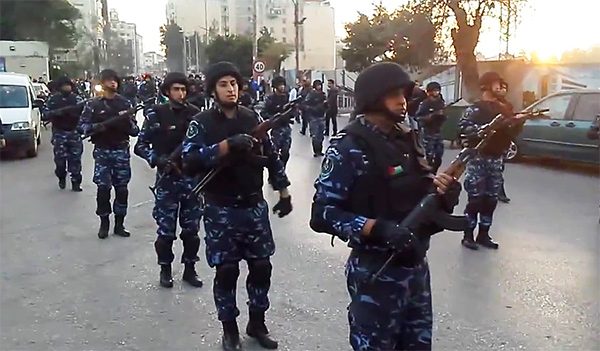
1143The Palestinian Authority police on parade, January 2015.

When three detainees die in less than a week in Palestinian detention, this should sound an alarm bell, especially among so-called pro-Palestinian groups and human rights activists in different parts of the world.

But these folks, like the UN and mainstream media, do not care about the human rights of the Palestinians if Israel cannot be held responsible. Their obsession with Israel has made them blind to the plight of Palestinians living under the Palestinian Authority and Hamas, as well as to the horrific crimes committed every day by Muslim terrorists in the Middle East and elsewhere.

The story of the three men who died in Palestinian jails is yet another example of the double standards that the international community and media employ when it comes to the Israeli-Palestinian conflict