Archive for the ‘Foreign policy’ category

What If There’s No Iran Deal?

March 30, 2015

What If There’s No Iran Deal? Commentary Magazine, March 30, 2015

(If there is no deal, Iran will still have won. U.S. sanctions, difficult to enforce in the best of times, will continue, and be ignored by other nations eager for more trade with Iran. Iran will continue to do as it pleases. The situation will be worse than had no P5+1 deal been sought. — DM)

[T]he grand realignment Obama has been seeking with Iran can’t and won’t be undone. That’s happening whether a deal is signed or not. And while Obama will have spent much of his own political capital, the president’s wasted time will pale in comparison to the smoldering ruins of American influence he leaves behind.

*********************

Each week seems to bring a new damning portrait of President Obama’s foreign policy from a different major news outlet. They say essentially the same thing but, like fingerprints, aren’t exactly the same. And Politico’s piece on Thursday by Michael Crowley stood out for providing a quote from the Obama administration that may rise above even the infamous “leading from behind” slogan the White House has rued since the words were spoken. What it lacks in bumper-sticker brevity it more than makes up for in stunning honesty.

Here’s how the Politico article closes, with a quote from an administration official:

“The truth is, you can dwell on Yemen, or you can recognize that we’re one agreement away from a game-changing, legacy-setting nuclear accord on Iran that tackles what every one agrees is the biggest threat to the region,” the official said.

The Obama administration’s official perspective on the Middle East currently engulfed in brutal sectarian conflict, civil war, and the collapse of state authority is: Let it burn. Nothing matters but a piece of paper affirming a partnership with the region’s key source of instability and terror in the name of a presidential legacy.

But there’s another question that’s easy to miss in the frenetic, desperate attempt to reach a deal with Iran: What if there’s no deal?

Obviously the president wants a deal, and he’s willing to do just about anything for it. The Obama administration long ago abandoned the idea that a bad deal is worse than no deal, and only recently began hinting at this shift in public. Officials have no interest in even talking about Yemen while they’re negotiating the Iran deal. It’s a singleminded pursuit; obsessive, irrational, ideologically extreme. But it’s possible the pursuit will fail: witness today’s New York Times story demonstrating that the Iranians are still playing hardball. (Why wouldn’t they? Their demands keep getting met.)

Surely it’s appalling for the administration to be so dismissive of the failure of a state, such as Yemen, in which we’ve invested our counterterrorism efforts. But it also shifts the power structure in the region. Take this piece in the Wall Street Journal: “Uncertain of Obama, Arab States Gear Up for War.” In it, David Schenker and Gilad Wenig explain that “The willingness of Arab states to finally sacrifice blood and treasure to defend the region from terrorism and Iranian encroachment is a positive development. But it also represents a growing desperation in the shadow of Washington’s shrinking security role in the Middle East.”

They also note the Arab League’s record isn’t exactly a monument to competent organization, so it’s not a great stand-in for an American government looking to unburden itself as a security guarantor for nervous Sunni allies. And it adds yet another note of instability.

Yemen’s only the latest example of the realignment, of course. The death toll in Syria’s civil war long ago hit triple digits, and it’s still raging. Bashar al-Assad, thanks to his patron Iran and Tehran’s complacent hopeful partner in Washington, appears to have turned a corner and is headed to eventual, bloody victory.

The Saudis are toying with joining the nuclear arms race furthered by the Obama administration’s paving the Iranian road to a bomb. In Iraq, as Michael Weiss and Michael Pregent report, our decision to serve as Iran’s air force against ISIS has grotesque consequences, including that our military is now “providing air cover for ethnic cleansing.” Iran’s proxies, such as those in Lebanon and on Israel’s borders, will only be further emboldened.

And the lengths the administration has gone to elbow Israel out of the way–fromleaking Israel’s nuclear secrets to intervening in its elections to try to oust those critical of Obama’s nuclear diplomacy–only cement the impression that to this president, there is room for every erstwhile ally under the bus, if that’s what it takes to get right with Iran. The view from France, meanwhile, “is of a Washington that seems to lack empathy and trust for its long-time friends and partners — more interested in making nice with Iran than looking out for its old allies.”

The ramifications to domestic politics are becoming clear as well. The point of Obama portraying foreign-government critics as Republicans abroad is that he sees everything in binary, hyperpartisan fashion. The latest dispatch from the Wall Street Journal on the issue includes this sentence:

In recent days, officials have tried to neutralize skeptical Democrats by arguing that opposing President Barack Obama would empower the new Republican majority, according to people familiar with the discussions.

Taking a tough line on Iranian nukes is bad, according to Obama, because it could help Republicans. It’s a rather amazing bit of myopia and partisan mania from the president.

And yet all this damage Obama is doing is for an Iran deal that might, in the end, not happen. And what if that’s the case? We can’t stitch Yemen, Syria, and Iraq back together. The failure of the negotiations won’t make the Saudis or the Israelis or the French trust Obama any more.

Obama’s clout on the Hill will plummet. And his legacy will be in ruins. After all, though he has been on pace to sign a bad Iran deal, it would at least buy him time for his devotees to spin the deal before its worst consequences happen (which would be after Obama leaves office, as designed). In other words, signing a bad deal for Obama allows him to say that at least from a narrow antiwar standpoint, all the costs we and our allies have incurred were for a purpose.

Of course, the grand realignment Obama has been seeking with Iran can’t and won’t be undone. That’s happening whether a deal is signed or not. And while Obama will have spent much of his own political capital, the president’s wasted time will pale in comparison to the smoldering ruins of American influence he leaves behind.

Iran, North Korea, nukes and Obama

March 30, 2015

Iran, North Korea, nukes and Obama, Dan Miller’s Blog, March 30, 2015

(The views expressed in this article are mine and do not necessarily reflect those of Warsclerotic or its other editors. — DM)

North Korea has ample nukes and wants money. Iran wants (and may already have) nukes, has money and will have more as sanctions are ended. The two rogue nations have long had a symbiotic relationship and it has not diminished. Yet “our” P5+1 negotiators, under the leadership of Obama’s minions, ignore that inconvenient problem as well as Iran’s missile development, “possible” nuclear weaponization and increasing regional hegemony.

I wrote about the Iran – North Korea connection back in 2013 in articles titled China, Iran and North Korea — a radioactive stew,  Iran, North Korea and Nuke Negotiations and elsewhere. As I noted in the radioactive stew article,

The main thing that puzzles me is why we continue to focus on Iran’s uranium enrichment. Is Iran (again) playing us for suckers? North Korea is fully capable of enriching uranium for Iran (or for anyone else) and would doubtless be happy to enrich as much as may be desired in exchange for the hard currency freely available to Iran if it were only to cease its own enrichment. North Korea needs the money and is not likely very particular about its sources. Just as our sanctions have not impacted Iran’s enrichment capabilities significantly, neither have they impacted those of North Korea. Perhaps we may awaken before it’s too late and notice Iran playing its Korean hole card in our high-stakes poker game.

We have not awakened and the problem has worsened since 2013.

Soure: American in North Korea

Soure: American in North Korea

In 2014, I summarized several earlier articles in one titled The Iran scam continues. There, I pointed out that the English language version of the interim P5+1 deal and the White House summary generally ignore “undisclosed” — but known — Iranian sites for missile and warhead development and the work done there– despite warnings from the International Atomic Energy Agency. I also noted the Iran – North Korea nexus. Again, the situation has become worse since then. As the magic date of March  31, 2015 arrives, Iran is still demanding – and likely will get — more and more concessions.

“The Iranians are again outplaying the Americans,” said one source in Europe familiar with the negotiations. “They know they’ll have to give up certain things eventually. So they’re digging in their heels on issues that mean everything and preparing to give ground on relatively minor issues—but not yet, and not until they see how much more the Americans are willing to give.” [Emphasis added.]

. . . .

“Iran has successfully dragged the administration toward their positions to attain massive concessions, and, sensing that kind of weakness, they are seeking to press their advantage to gain further ground on critical points,” according to the source, who added that on the sanctions relief front, Iran is seeking a rollback “without dismantling anything.” [Emphasis added.]

a1  Obama and Kahameni -building a toaster

What might Iran be willing to give up in order to get additional important concessions? How about stuff that North Korea will be pleased to do in exchange for a share of the extra funds Iran will have as sanctions are eliminated?

Occasionally but not often, news media raise the Iran – North Korea connection. For example, a March 29th article at the Washington Post by Ali Alfoneh and Reuel Marc Gerecht is titled What else is Iran hiding? Another article at the Daily Beast by Gordon G. Chang is titled Does Iran Have Secret Nukes in North Korea?

As noted in the Washington Post article,

The unfinished North Korean-designed reactor that was destroyed by Israeli planes on Sept. 6, 2007, at Deir al-Zour in Syria was in all likelihood an Iranian project, perhaps one meant to serve as a backup site for Iran’s own nuclear plants. We draw this conclusion because of the timing and the close connection between the two regimes: Deir al-Zour was started around the time Iran’s nuclear facilities were disclosed by an Iranian opposition group in 2002, and the relationship between Shiite-ruled Syria and Shiite Iran has been exceptionally tight since Bashar al-Assad came to power in 2000. We also know — because Ali Akbar Hashemi Rafsanjani, the former Iranian president and majordomo of the political clergy, proudly tells us in his multivolume autobiography — that sensitive Iranian-North Korean military cooperation began in 1989. Rafsanjani’s commentary leaves little doubt that the Iranian-North Korean nexus revolved around two items: ballistic missiles and nuclear-weapons technology. [Emphasis added.]

. . . .

The Iranian-North Korean contacts intensify in 1992, the year that Rafsanjani, with Rouhani at his side, launches a policy of commercial engagement with the Europeans. On Jan. 30, Rafsanjani receives intelligence minister Ali Fallahian and Mostafa Pourmohammadi, the ministry’s director of foreign espionage, to discuss “procurement channels for sensitive commodities.” On Feb. 8, Rafsanjani writes, “The North Koreans want oil, but have nothing to give in return but the special commodity. We, too, are inclined to solve their problem.” Rafsanjani orders defense minister Akbar Torkan to organize a task force to analyze the risks and benefits of receiving the “special commodity.” This task force recommends that the president accept the “risk of procuring the commodities in question.” Rafsanjani adds that “I discussed [this] with the Leader [Ayatollah Ali Khamenei] in more general terms and it was decided to take action based on the [task force’s] review.” [Emphasis added.]

It’s most unlikely that the “special commodity” and the technical know-how surrounding it have anything to do with ballistic missiles; Rafsanjani expresses anxiety that the “special commodity” could be intercepted by the United States, but doesn’t share this worry about missile procurement. In a March 9, 1992, journal entry, the cleric gloats about the U.S. Navy having tracked a North Korean ship bound for Syria but not two ships destined for Iran. Two days later, when the “special commodity” is unloaded, he writes: “The Americans were really embarrassed.” [Emphasis added.]

. . . .

Odds are good that North Korea helped to jump-start Iran’s nuclear-weapons program. If so, how long did this nefarious partnership continue?

Rouhani was Rafsanjani’s alter ego. He’s undoubtedly the right man to answer all of the PMD questions that the IAEA keeps asking and the Obama administration keeps avoiding. [Emphasis added.]

As noted at the Daily Beast article,

In October 2012, Iran began stationing personnel at a military base in North Korea, in a mountainous area close to the Chinese border. The Iranians, from the Ministry of Defense and associated firms, reportedly are working on both missiles and nuclear weapons. Ahmed Vahidi, Tehran’s minister of defense at the time, denied sending people to the North, but the unconfirmed dispatches make sense in light of the two states announcing a technical cooperation pact the preceding month.

. . . .

[N]o inspections of Iranian sites will solve a fundamental issue: As can be seen from the North Korean base housing Tehran’s weapons specialists, Iran is only one part of a nuclear weapons effort spanning the Asian continent. North Korea, now the world’s proliferation superstar, is a participant. China, once the mastermind, may still be a co-conspirator. Inspections inside the borders of Iran, therefore, will not give the international community the assurance it needs.

The cross-border nuclear trade is substantial enough to be called a “program.” Larry Niksch of the Center for Strategic and International Studies in Washington, D.C., estimates that the North’s proceeds from this trade with Iran are “between $1.5 billion and $2.0 billion annually.” A portion of this amount is related to missiles and miscellaneous items, the rest derived from building Tehran’s nuclear capabilities. [Emphasis added.]

Iran has bought a lot with its money. Mohsen Fakhrizadeh, thought to be Tehran’s chief nuclear scientist, was almost certainly in North Korea at Punggye-ri in February 2013 to witness Pyongyang’s third atomic test. Reports put Iranian technicians on hand at the site for the first two detonations as well.

The North Koreans have also sold Iran material for bomb cores, perhaps even weapons-grade uranium. The Telegraph reported that in 2002 a barrel of North Korean uranium cracked open and contaminated the tarmac of the new Tehran airport.

. . . .

Even if Iran today were to agree to adhere to the Additional Protocol, it could still continue developing its bomb in North Korea, conducting research there or buying North Korean technology and plans. And as North Korean centrifuges spin in both known and hidden locations, the Kim regime will have a bigger stock of uranium to sell to the Iranians for their warheads. With the removal of sanctions, as the P5+1 is contemplating, Iran will have the cash to accelerate the building of its nuclear arsenal.

So while the international community inspects Iranian facilities pursuant to a framework deal, the Iranians could be busy assembling the components for a bomb elsewhere. In other words, they will be one day away from a bomb—the flight time from Pyongyang to Tehran—not one year as American and other policymakers hope. [Emphasis added.]

Why does the Obama administration persistently avoid raising the Iran – North Korea nexus? Perhaps doing so would scuttle the “negotiations” and thereby Obama’s dreams about His legacy. Perhaps Obama is keen for Iran to have, and be in a position to use, nukes to enhance its hegemony over the Middle East and to displace Israel as well as regional Arab allies in the Gulf states. Since Israel is unwilling to commit suicide in present circumstances by agreeing to a two state solution with Palestinians — intent upon and capable of causing her destruction — that may well be His only way to bring to fruition His desire for Middle east “peace” through submission and “social justice.”

to follow the Constitution.  It's to old and too slow.

to transform the Middle East with social justice

Conclusions

The Iran – North Korea nexus, regardless of its importance, was not considered (or was considered but deemed too intractable to approach) when the framework for the P5+1 negotiations was decided and it will not be considered now. That’s bad and dangerous. If a deal with Iran evolves from the current mess, Obama will gloat about His legacy and the Mad Mullahs will gloat about having put one over on the weak and declining free world. That’s frustrating but otherwise of little consequence.

Because of the Iran – North Korea nexus, Iran would need little time to repair any damage Israel and/or her Arab allies might do to Iran’s existing or future nuclear infrastructure. What can and should be done? I wish I knew. Perhaps Iran’s borders could be sealed adequately to keep North Korean stuff out, but that would require an expensive long term commitment. Perhaps others will think of something better. I hope so.

Why ‘Operation: Decisive Storm’ is Iran’s worst nightmare

March 29, 2015

Why ‘Operation: Decisive Storm’ is Iran’s worst nightmare, Al ArabiyaMajid Rafizadeh, March 28, 2015

(Al Arabiya is Saudi owned. — DM)

[B]y the U.S. being so concentrated on a nuclear deal and President Obama being so focused on leaving behind a historic legacy regarding a nuclear deal with Iran, the unintended consequences of such an inefficient foreign policy are being ignored and overshadowed. Although the U.S. has military bases in the region, it has evidently chosen to ignore Iran’s military expansion.

********************

Often, scholars and politicians have made the argument that regional powers in the Middle East are opposed to a nuclear deal between Iran and the six world powers due to the nuclear technicalities of the deal or restoring relationships between Tehran and the U.S. Nevertheless, this premise fails to shed light on the underlying concerns, nuances and intricacies of such a nuclear deal as well as Iran’s multi-front role in the region.

The underlying regional concerns are not primarily linked to the potential reaching of a final nuclear deal with the Islamic Republic or easing of ties between the West and Tehran. At the end of the day, regional powers would welcome and be satisfied with a nuclear deal that can ratchet down regional tension, eliminate the possibility of the Islamic Republic to become a nuclear state, and prevent a nuclear arms race.

But what is most worrying is the expanding empire of the Islamic Republic across the Arab world from Beirut to Baghdad, and from Sanaa to Damascus, as the nuclear talks reach the final stages and as no political will exists among the world powers to cease Iran’s military expansion.

Establishing another proxy in Yemen

Iran’s Quds forces have long being linked to the Houthis. The Islamic Republic continues to fund and provide military support to the Houthis (by smuggling weapons such as AK-47s, surface-to-air missiles as well as rocket-propelled grenades) in order to establish another proxy in the Arab world.

Iran’s long-term strategic and geopolitical objectives in Yemen are clear. The Islamic Republic’s attempt to have a robust foothold near the border of Saudi Arabia, as well as in the Gulf Peninsula, will tip the balance of power in favor of Tehran.

By empowering the Houthis, Tehran would ensure that Saudi Arabia is experiencing grave national security concerns, the possibility of conflict spill-over, and internal instability. In addition, by influencing Yemeni politics through the Houthis, Iranian leaders can pressure Saudi Arabia to accept Iran’s political, strategic and economic dominance in Iraq, Syria, and Lebanon as well.

The latest advancement of the Houthis supported the interests of the Islamic Republic until recently. There was a need for robust action against Iran’s hegemonic ambitions. Nevertheless, the West was resistant to act.

From geopolitical, strategic and humanitarian perspective, the robust military action, Operation Decisive Storm, is a calculated and intelligent move to send a strong signal to the Islamic Republic that its interference in another Arab state will not be overlooked. In other words, Arab states do not have to wait for the West to act against Iran’s covert activities and support for Shiite loyalist-militias in the region.

The tightening grip over another Arab capital

As the nuclear talks between Britain, China, France, Russia and the United States – the five permanent members of the Security Council – plus Germany (P5+1) and the Islamic Republic appear to show progress towards a final agreement to curb Iran’s nuclear ambitions, the world powers (specifically the United States) have chosen to turn a blind eye on Iran’s military expansion in the Arab states, and particularly in Yemen.

Iran’s long term strategic and geopolitical agenda should not be overlooked. Iranian leaders’ hegemonic ambition is to consolidate and strengthen its grip on the Arab states, and to have control over Arab capitals from Beirut to Baghdad and from Sanaa to Damascus.

The Islamic Republic’s ambitions to expand its empire during the nuclear talks and regional insecurities are carried out through several platforms. Central figures, such as Quds Force commander General Qassem Soleimani, hardliners such as Ali Reza Zakani, Tehran’s representative in the Iranian parliament and a close figure to the Iranian supreme Leader Ayatollah Ali Khamenei, and the Supreme Leader himself, play a crucial role in fulfilling Iran’s regional hegemonic ambitions.

Iranian leaders are not even concerned about repercussions from boasting about their grip over Arab capitals. Zakani recently bragged about having control over Arab capitals, “Three Arab capitals have today ended up in the hands of Iran and belong to the Islamic Iranian revolution”. He added that Sanaa will soon be under the grip on the Islamic Republic as well. According to him, most of Yemen’s territories will soon be under the power of the Shiite group, the Houthis, supported by the Islamic Republic.

The second platform that the Islamic Republic utilizes is sponsoring, financing, equipping, training and advising loyalist and heterodox Shiite groups across the region. The number of these militia groups is on the rise and they operate as a pawn to serve the geopolitical, strategic, economic, ideological and national interests of the ruling clerics.

America’s lack of political willingness to act

As the Islamic Republic creates such Shiite groups across the region to “protect” Arab capitals, Tehran centralizes its power across the region. In addition, after the creation of new Shiite groups, the elimination of these proxies will not be a simple task, for they will be ingrained in the socio-political and socio-economic fabric of the society.

In addition, these loyalist militia groups are game changers in the region, tipping the balance of power further in favor of the Islamic Republic and its regional hegemonic ambitions.

The expansion of Iran’s military and loyalist-militia groups in the region transcends Tehran’s political ambitions. The ideological tenet of this expansion and of Tehran’s overall growing regional empire (under the banner of Popular Mobilization Forces: an umbrella institution of Shiite armed groups) are crucial facets to analyze.

More fundamentally, as the final nuclear deal approaches, and as Tehran witnesses the weakness of Washington and other powers when deciding to overlook Iran’s militaristic and imperialistic activities in the region, Tehran has become more emboldened and vocal when it comes to its military expansion.

Iranian leaders boast about their role in Arab states projecting Tehran as a savior for the Arab world. As Zakani stated, according to Iran’s Rasa new agency “had Hajj Qassem Soleimani not intervened in Iraq, Baghdad would have fallen, and the same applies to Syria; without the will of Iran, Syria would have fallen”.

Nevertheless, by the U.S. being so concentrated on a nuclear deal and President Obama being so focused on leaving behind a historic legacy regarding a nuclear deal with Iran, the unintended consequences of such an inefficient foreign policy are being ignored and overshadowed. Although the U.S. has military bases in the region, it has evidently chosen to ignore Iran’s military expansion.

The concerns of regional countries about the nuclear deal is not solely linked to the nuclear technicalities of the deal or Iran-West rapprochement, but are primarily related to Iran’s growing empire as well as the consequences of such a nuclear deal leading Tehran to apply more assertive and expansionist foreign policy in the region.

Regional robust actions such as Operation Decisive Storm are sometimes required in order to set limits to Iran’s hegemonic, imperialistic objectives, and interference in other Arab states’ affairs, as well as in order to prevent the destabilizing effects emanating from the growing militia rebels sponsored by the Islamic Republic.

US surrender on breakout time to a bomb leads to breakthrough on a nuclear deal

March 29, 2015

US surrender on breakout time to a bomb leads to breakthrough on a nuclear deal, DEBKAfile, March 29, 2015

Kerry-0bama_IranObama and Kerry hash over nuclear deal with Iran

President Barack Obama and John Kerry promised that the nuclear deal to be signed with Iran in Switzerland this week will give the world powers a year’s warning after the Islamic Republic’s breakout up to an operational weapon. DEBKAfile’s intelligence sources disclose that, to clinch the framework deal in Lausanne, even this concession, which imperils Israel, the Gulf and the Middle East at large, was not enough. In a further surrender, the president authorized the US delegation to fall back again on the space granted the world powers for reacting to breakthrough, dropping it from a year to six or seven months:

Our nuclear experts explain why even that grim arithmetic does not do full justice to the advantages Iran has gained for its push to a nuke:

1.  Because Iran is permitted to continue running up to 6,500 elderly IR-1 centrifuges for enriching uranium to a low 3.5 percent grade, even if it is permitted to keep only 500 kilos of its stock of 7.5-8 –tons, Tehran would still be able to build a bomb in 7-8 months, i.e. a lot faster than Obama and Kerry have promised.
2.  But if Tehran activates secret facilities undetected by US intelligence, it can produce a larger quantity of enriched uranium and so shrink the time between breakout and bomb to three, at most, four months, totally insufficient for the world powers to detect, step in and abort the bomb’s manufacture, in view of the following considerations:

— To obtain proof that Iran is cheating on its accord with the world powers, “environmental” samples would have to be obtained and tested in laboratories outside Iran. Results would be available only after two months, further slashing the time line for stopping Iran building a weapon. But that is not all.
— If Iran is shown by the first round of tests to be in violation of the accord and enriching uranium to a higher grade than 3.5, a second batch of “environmental” samples must be collected to analyze the exact quantities of uranium illicitly enriched and grade of purity.

There goes another month of valuable time for action, cutting it down to 10-12 weeks.

3. And, finally, the US President, Secretary of State and International Atomic Energy leaders have affirmed Iran’s faithful compliance with the first interim nuclear accord – known as the Joint Plan of Action – JPOA – that was signed in Geneva November 2013.

That information is equally false.

It is a fact which is known to intelligence agencies that Iran never complied with its commitment to reduce its UF6 stocks below 7.5 tons and convert added amounts to harmless oxides. Indeed, they estimate that Iran has enlarged its approved amount of stock to 8.5 tons or more, by means of the “creep-out” strategyit has repeatedly pursued in the past to conceal its nefarious nuclear activities.

3.  A final concession which Iran has managed to wring out of the six world powers led by Washington allows Tehran to keep an extra 9,000 IR-1 centrifuges Tehran idle – though not dismantled – and permission to continue research and development on high-speed IR-8 or IR-5 centrifuges.

This mans thatn the Islamic Republic will not only keep its nuclear infrastructure under the accord the six powers plan to sign, but add improvements along with the freedom to shorten at will the critical time lapse between breakout and bomb.

The tons of spoken and printed verbiage poured out on the Iranian nuclear issue and ongoing diplomacy year after year have exposed, rather than disguised, President Obama’s willingness to sign a nuclear deal with Iran – however bad and whatever the price.

The inescapable conclusion is that the US president has come around to accepting the reality of a nuclear-armed Iran. As seen from Washington, America never stopped India, Pakistan and North Korea from becoming nuclear powers, and has therefore decided it can live with a fourth – Iran.

Iranian Defector: ‘U.S. Negotiating Team Mainly There to Speak on Iran’s Behalf’

March 29, 2015

Iranian Defector: ‘U.S. Negotiating Team Mainly There to Speak on Iran’s Behalf’, Weekly StandardDaniel Halper, March 28, 2015

(If the report is accurate, it explains quite a lot about the direction in which the “negotiations” have been going. — DM)

An Iranian journalist writing about the nuclear negotiations between the United States and Iran has defected. In an interview Amir Hossein Motaghi, has some harsh words for his native Iran. He also has a damning indictment of America’s role in the nuclear negotiations.

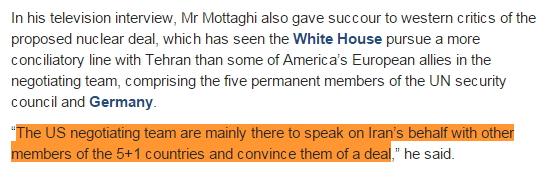
“The U.S. negotiating team are mainly there to speak on Iran’s behalf with other members of the 5+1 countries and convince them of a deal,” Motaghi told a TV station after just defecting from the Iranian delegation while abroad for the nuclear talks. The P 5 + 1 is made up of United States, United Kingdom, Russia, China, France, plus Germany.

CBNkmdFVIAADMpl
CBNk6T0WsAAEI1T

Abbas Calls on Arab States to Attack Hamas

March 28, 2015

Abbas Calls on Arab States to Attack Hamas, Israel National News,  Ari Yashar, March 28, 2015

(Unlikely, but what would Obama say? — DM)

574415Mahmoud Abbas Reuters

Abbas urges ‘same policy’ of Yemen airstrikes to be used by Arab League in ‘Palestine,’ after his adviser calls for ‘iron’ blow to Hamas.

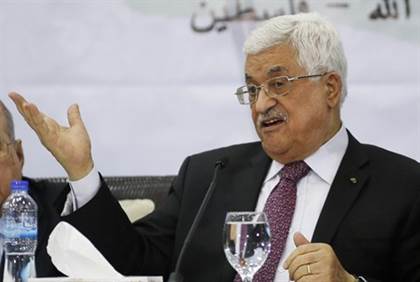
Palestinian Authority (PA) Chairman Mahmoud Abbas used the platform of the Arab League summit in Sharm el-Shekh, Egypt, this Saturday to attack his “unity partner” Hamas, making a subtle call for the Arab states to take military action against the Gaza-based Muslim Brotherhood offshoot.

Speaking at the 26th summit in the southern Sinai peninsula, Abbas made reference to the campaign of airstrikes launched last Thursday by Saudi Arabia and other Arab countries against Iran-backed Shi’ite Houthi rebelsin Yemen – the Houthis have overthrown the government while rapidly expanding their control.

“I hope that the Arab countries will take the same policy they employed in Yemen for all Arab countries suffering from internal conflict – like Palestine, Syria, Libya and Iraq,” Abbas said according to Yedioth Aharonot, in an open jab at Hamas in Gaza.

Making Abbas’s comments calling for military intervention in “Palestine” all the more pointed is the fact that just two days earlier, Abbas’s adviser on Religious and Islamic Affairs Mahmoud Al-Habbash, who also serves as PA Supreme Sharia (Islamic law) Judge, made similar remarks.

Al-Habbash urged the Arab countries to take action and strike Hamas with an “iron fist,” in an open call for military intervention.

Hamas and the PA signed a unity deal last April, which has done little to damper the enmity raging between the rivals ever since Hamas violently seized control of Gaza in 2007 – the most obvious example of the how the deal has not changed tensions was when Hamas tried to stage a coup against the PA in Judea and Samaria last year.

Responding to Al-Habbash, Hamas said the comment is “a dangerous and not nationalist call.”

Abbas’s call for Arab intervention comes after Arab foreign ministers meeting in Egypt last Thursday declared the establishment of a joint Arab military force, reportedly meant to rapidly respond to security threats to Arab nations.

Arab League secretary-general Nabil al-Arabi was assigned with coordinating the details with the chiefs of staff of the various Arab armies within one month, so as to work out the logistics of establishing the new force.

NBC’s Engel: Officials Say Allies: Simply Don’t Trust” U.S. Under Obama Admin – The Five

March 28, 2015

NBC’s Engel: Officials Say Allies: Simply Don’t Trust” U.S. Under Obama Admin – The Five, Fox News via You Tube, March 27, 2015

(In other breaking news, today is Saturday, unexpectedly. Please see also, Iranian general in Sanaa to organize Yemen rebel counter-offensive for Saudi-led attacks.  — DM)


Column One: Managing Obama’s war against Israel

March 27, 2015

Column One: Managing Obama’s war against Israel, Jerusalem Post, Caroline Glick, March 26, 2015

ShowImageUS President Barack Obama meets with Prime Minister Benjamin Netanyahu at the White House, October 1, 2014. (photo credit:REUTERS)

As Max Boot explained Wednesday in The Wall Street Journal, the administration’s animosity toward Israel is a function of Obama’s twin strategic aims, both evident since he entered office: realigning US policy in the Middle East toward Iran and away from its traditional allies Israel and the Sunni Arab states, and ending the US’s strategic alliance with Israel.

Obama has reached a point in his presidency where he is prepared to give full expression to his plan to end the US’s strategic alliance with Israel.

He thinks that doing so is both an end to itself and a means of succeeding in his bid to achieve a rapprochement with Iran.

*********************

On Wednesday the Jerusalem Municipality announced it is shelving plans to build 1,500 apartments in the Har Homa neighborhood. Officials gave no explanation for its sudden move. But none was needed.

Obviously the construction of apartments for Jews in Jerusalem was blocked in the hopes of appeasing US President Barack Obama.

But is there any reason to believe he can be appeased? Today the White House is issuing condemnations of Israel faster than the UN.

To determine how to handle what is happening, we need to understand the nature of what is happening.

First we need to understand that the administration’s hostility has little to do with Israel’s actions.

As Max Boot explained Wednesday in The Wall Street Journal, the administration’s animosity toward Israel is a function of Obama’s twin strategic aims, both evident since he entered office: realigning US policy in the Middle East toward Iran and away from its traditional allies Israel and the Sunni Arab states, and ending the US’s strategic alliance with Israel.

Over the past six years we have seen how Obama has consistently, but gradually, taken steps to advance these two goals. Toward Iran, he has demonstrated an unflappable determination to accommodate the terrorism supporting, nuclear proliferating, human rights repressing and empire building mullahs.

Beginning last November, as the deadline for nuclear talks between the US and its partners and Tehran approached, Obama’s attempts to accommodate Tehran escalated steeply.

Obama has thrown caution to the winds in a last-ditch effort to convince Iranian dictator Ali Khamenei to sign a deal with him. Last month the administration published a top secret report on Israel’s nuclear installations. Last week, Obama’s director of national intelligence James Clapper published an annual terrorism threat assessment that failed to mention either Iran or Hezbollah as threats.

And this week, the administration accused Israel of spying on its talks with Iran in order to tell members of Congress the details of the nuclear deal that Obama and his advisers have been trying to hide from them.

In the regional context, the administration has had nothing to say in the face of Iran’s takeover of the Bab el-Mandeb Strait and the Gulf of Aden this week. With its Houthi-proxy now in charge of the strategic waterway, and with its own control over the Straits of Hormuz, Iran is poised to exercise naval control over the two choke points of access to Arab oil.

The administration is assisting Iranian Shi’ite proxies in their battle to defeat Islamic State forces in the Iraqi city of Tikrit. It has said nothing about the Shi’ite massacres of Sunnis that come under their control.

Parallel to its endless patience for Tehran, the Obama administration has been treating Israel with bristling and ever-escalating hostility. This hostility has been manifested among other things through strategic leaks of highly classified information, implementing an arms embargo on weapons exports to Israel in time of war, ending a 40-year agreement to provide Israel with fuel in times of emergency, blaming Israel for the absence of peace, expressing tolerance and understanding for Palestinian terrorism, providing indirect support for Europe’s economic war against Israel, and providing indirect support for the BDS movement by constantly accusing Israel of ill intentions and dishonesty.

Then there is the UN. Since he first entered office, Obama has been threatening to withhold support for Israel at the UN. To date, the administration has vetoed one anti-Israel resolution at the UN Security Council and convinced the Palestinians not to submit another one for a vote.

In the months that preceded these actions, the administration exploited Israel’s vulnerability to extort massive concessions to the Palestinians.

Obama forced Benjamin Netanyahu to announce his support for Palestinian statehood in September 2009. He used the UN threat to coerce Netanyahu to agree to negotiations based on the 1949 armistice lines, to deny Jews their property rights in Jerusalem, Judea and Samaria, and to release scores of terrorist murderers from prison.

Following the nationalist camp’s victory in last week’s election, Obama brought to a head the crisis in relations he instigated. He has done so for two reasons.

First, next week is the deadline for signing a nuclear agreement with Iran. Obama views Netanyahu as the prospective deal’s most articulate and effective opponent.

As Obama sees it, Netanyahu threatens his nuclear diplomacy with Iran because he has a unique ability to communicate his concerns about the deal to US lawmakers and the American people, and mobilize them to join him in opposing Obama’s actions. The letters sent by 47 senators to the Iranian regime explaining the constitutional limitations on presidential power to conclude treaties without Senate approval, like the letter to Obama from 367 House members expressing grave and urgent concerns about the substance of the deal he seeks to conclude, are evidence of Netanyahu’s success.

The second reason Obama has gone to war against Israel is because he views the results of last week’s election as an opportunity to market his anti-Israel and pro-Iranian positions to the American public.

If Netanyahu can convince Americans to oppose Obama on Iran, Obama believes that by accusing Netanyahu of destroying chances for peace and calling him a racist, Obama will be able to win sufficient public support for his anti-Israel policies to intimidate pro-Israel Democratic lawmakers into accepting his pro-Iranian policies.

To this end, Obama has announced that the threat that he will abandon Israel at the UN has now become a certainty. There is no peace process, Obama says, because Netanyahu had the temerity to point out that there is no way for Israel to risk the transformation of Judea and Samaria into a new terror base. As a consequence, he has all but made it official that he is abandoning the peace process and joining the anti-Israel bandwagon at the UN.

Given Obama’s decision to abandon support for a negotiated peace between Israel and the Palestinians, modes of appeasement aimed at showing Israel’s good faith, such as Jewish building freezes, are no longer relevant. Scrapping plans to build apartments in Jewish neighborhoods like Har Homa will make no difference.

Obama has reached a point in his presidency where he is prepared to give full expression to his plan to end the US’s strategic alliance with Israel.

He thinks that doing so is both an end to itself and a means of succeeding in his bid to achieve a rapprochement with Iran.

Given this dismal reality, Israel needs to develop ways to minimize the damage Obama can cause.

Israel needs to oppose Obama’s policies while preserving its relations with its US supporters, including its Democratic supporters. Doing so will ensure that it is in a position to renew its alliance with the US immediately after Obama leaves office.

With regards to Iran, such a policy requires Israel to act with the US’s spurned Arab allies to check Iran’s expansionism and nuclear progress. It also requires Israel to galvanize strong opposition to Obama’s goal of replacing Israel with Iran as America’s chief ally in the Middle East and enabling it to develop nuclear weapons.

As for the Palestinians, Israel needs to view Obama’s abandonment of the peace process as an opportunity to improve our diplomatic position by resetting our relations with the Palestinians. Since 1993, Israel has been entrapped by the chimerical promise of a “two-state solution.”

By late 2000, the majority of Israelis had recognized that there is no way to achieve the two-state solution. There is no way to make peace with the PLO. But due to successive governments’ aversion to risking a crisis in relations with Washington, no one dared abandon the failed two-state strategy.

Now, with Obama himself declaring the peace process dead and replacing it with a policy of pure hostility toward Israel, Israel has nothing to gain from upholding a policy that blames it for the absence of peace.

No matter how loudly Netanyahu declares his allegiance to the establishment of a Palestinian state in Israel’s heartland, Obama will keep castigating him and Israel as the destroyer of peace.

The prevailing, 23-year-old view among our leadership posits that if we abandon the two-state model, we will lose American support, particularly liberal American support. But the truth is more complicated.

Inspired by the White House and the Israeli Left, pro-Israel Democrats now have difficulty believing Netanyahu’s statements of support for the establishment of a Palestinians state. But those who truly uphold liberal values of human rights can be convinced of the rightness of Israel’s conviction that peace is currently impossible and as a consequence, the two-state model must be put on the back burner.

We can maintain support among Republicans and Democrats alike if we present an alternative policy that makes sense in the absence of an option for the two-state model.

Such a policy is the Israeli sovereignty model. If the government adopts a policy of applying Israeli sovereignty over Judea and Samaria in whole – as I recommend in my book The Israeli Solution: A One- State Plan for Peace in the Middle East, or in part, in Area C, as Economy Minister Naftali Bennett recommends, our leaders will be able to defend their actions before the American people, including pro-Israel Democrats.

Israel must base its policy of sovereignty on two principles. First, this is a liberal policy that will ensure the civil rights of Palestinians and Israelis alike, and improve the Palestinians’ standard of living.

Second, such a policy is not necessarily a longterm or permanent “solution,” but it is a stable equilibrium for now.

Just as Israel’s decision to apply its laws to united Jerusalem and the Golan Heights in the past didn’t prevent it from conducting negotiations regarding the possible transfer of control over the areas to the Palestinians and Syrians, respectively, so an administrative decision to apply Israeli law to all or parts of Judea and Samaria will not block the path for negotiations with the Palestinians when regional and internal Palestinian conditions render them practicable.

The sovereignty policy is both liberal and strategically viable. If the government adopts it, the move will rebuild Israel’s credibility and preserve Israel’s standing on both sides of the aisle in Washington.

Never before has Israel had to deal with such an openly hostile US administration. Indeed, until 2009, the very notion that a day would come when an American president would prefer an alliance with Khamenei’s Iran to its traditional alliances with Israel and the Sunni Arab states was never even considered. But here we are.

Our current situation is unpleasant. But it isn’t the end of the world. We aren’t helpless. If we act wisely, we can stem Iran’s nuclear and regional advance. If we act boldly, we can preserve our alliance with the US while adopting a policy toward the Palestinians that for the first time in decades will advance our interests and our liberal values on the world stage.

US continues to insist airstrikes support Iraqi forces, not Shiite militias

March 26, 2015

US continues to insist airstrikes support Iraqi forces, not Shiite militias, Long War Journal, Bill Roggio, March 26, 2015

(Perhaps it’s just Obama’s unrequited love for Iran and his need to get any nuke deal that Iran will give him. — DM)

US government officials and top military commanders are so eager to destroy the Islamic State that they are crawling into bed with the flip side of the jihadist coin: the fanatical Shiite militias backed by Iran that are terrorist organizations and ultimate destabilizers of Iraq in their own right.

*****************

Combined Joint Task Force-Operation Inherent Resolve (CJTF-OIR), the US-led Coalition that is launching airstrikes against the Islamic State in Iraq and Syria, announced that it conducted 17 strikes against Islamic State fighters entrenched in Tikrit. US commanders continue to insist that they are supporting Iraqi security forces, and not the Iranian-backed Shiite militias who make up more than two-thirds of the fighting force in the Tikrit offensive.

The 17 airstrikes targeted “an ISIL [Islamic State] building, two ISIL bridges, three ISIL checkpoints, two ISIL staging areas, two ISIL berms, an ISIL roadblock and an ISIL controlled command and control facility,” according to a press release. The US military continues to refer to Islamic State as ISIL, the outdated acronym for the Islamic State of Iraq and the Levant (Syria).

The airstrikes launched “in support of Iraqi Security Forces in Tikrit commenced last night after a request from the Government of Iraq,” CJTF-OIR stated. The 17 targets hit in the last 24 hours were “approved by the Iraqi Ministry of Defense.”

US military officials have previously said that support for the Tikrit offensive was being withheld because of the massive presence of the Iranian-backed militias and Iranian military units and advisers.

Despite this previous acknowledgment, Lieutenant General James Terry, the commander of CJTF-OIR, skips over the presence of Shiite militias in the Tikrit operation [emphasis mine] in the latest statement.

“The ongoing Iraqi and Coalition air strikes are setting the conditions for offensive action to be conducted by Iraqi forces currently surrounding Tikrit,” said Lt. Gen. James Terry. “Iraqi Security Forcessupported by the Coalition will continue to gain territory from Daesh [a vaguely pejorative Arabic acronym for the Islamic State].” [Emphasis in original — DM]

Pretending that US airpower isn’t supporting the Iranian-backed Shiite militias obviously doesn’t make it so.

US military officials’ denials that they are serving as the air force for Iranian-backed Shiite militias that are responsible for killing hundreds of American soldiers before US forces withdrew from Iraq in December 2011 becomes even more perplexing once you understand that many of the top leaders of these militias have been designated by the US as terrorists. And one of these militias (Hezbollah Brigades) is listed as a Foreign Terrorist Organization. [See LWJ report, US begins airstrikes against Islamic State in Tikrit, supports Shiite militias.]

US government officials and top military commanders are so eager to destroy the Islamic State that they are crawling into bed with the flip side of the jihadist coin: the fanatical Shiite militias backed by Iran that are terrorist organizations and ultimate destabilizers of Iraq in their own right.

Saudi Arabia puppet of US, Israel: Houthi leader

March 26, 2015

Saudi Arabia puppet of US, Israel: Houthi leader, Press TV (Iranian), March 26, 2015

(The positions of Obama’s friends in Iran. How soon will he bow, apologize and make more concessions to Iran to atone for his sins? — DM)

bbc72135-d3b0-4924-91b3-4c85d14cbc21Tribal gunmen loyal to the Houthis Ansarullah shout slogans against Saudi Arabia during a gathering in the capital Sana’a on March 26, 2015.

The leader of Yemen’s Houthi fighters has heaped scorn on Saudi Arabia for conducing unjust and heinous attacks on Yemeni people, saying the Arab kingdom is serving as a puppet for the United States and the Israeli regime.

Abdul-Malik al-Houthi made the remarks in a televised address on Thursday in reaction to Saudi Arabia’s “unjustified” deadly attacks targeting Yemeni people in the capital, Sana’a.

Saudi Arabia is a puppet at the disposal of superpowers, the Houthi leader said, adding that Riyadh is putting in action the US-Israeli conspiracy in Yemen.

He noted that the US-Israeli plot in Yemen aims to break up the chaotic country and deprive people of security and freedom.

Al-Houthi said the Saudi invasion of Yemen came after their agents, including al-Qaeda terrorists and the ISIL Takfiri terrorists, failed to execute their plots in Yemen.

He said the “criminal” attacks uncovered the “tyrannical” nature of the Saudi regime.

Al-Houthi warned that Saudi Arabia would face consequences should it push ahead with its aggression against Yemen, saying, “We will confront the criminal forces and their tools in the country.”

“You think you can kill Yemeni people, but this is because of your stupidity,” he said. “This unjustified aggression shows the hostility and arrogance of this regime. The attacks are reflecting the inhumanity of the aggressor.”

Al-Houthi said the “aggressors” should keep in mind that the Yemeni people are “committed to defending their country and revolution” by relying on God.

On Thursday, Saudi warplanes carried out fresh airstrikes against Yemen, hitting the northern cities of Sa’ada and Ta’izz in the south.

Airstrikes also targeted arms depots in the Malaheez region in Sa’ada near the border with Saudi Arabia.

Saudi warplanes started bombing the positions of the Ansarullah fighters and launched attacks against the Sana’a International Airport and the Dulaimi airbase early on Thursday.

Despite Riyadh’s claims that it is attacking Ansarullah positions, Saudi warplanes have flattened a number of homes near the Sana’a airport. Based on early reports, the Saudi airstrikes on Yemen have so far claimed the lives of 18 civilians with more deaths feared, Yemeni sources said.

The Saudi invasion of Yemen has drawn condemnation from many countries such as Iran, Russia, Iraq and Syria, as well as the Lebanese resistance movement, Hezbollah.

The blatant invasion of Yemen’s sovereignty by the Saudi government comes against a backdrop of total silence on the part of international bodies, especially the United Nations. The world body has so far failed to show any reaction whatsoever to the violation of the sovereignty of one of its members by Riyadh.