Archive for the ‘Egypt’ category

Israeli-Saudi Ties Warming; Hizballah and Iran Livid

August 8, 2016

Israeli-Saudi Ties Warming; Hizballah and Iran Livid, PJ MediaP. David Hornik, August 7, 2016

netImage Courtesy of Shutterstock

As Khamenei tweeted on Monday: “Revelation of Saudi government’s relations with Zionist regime was stab in the back of Islamic Ummah.”

************************

The Israeli society that I encountered embraces a culture of peace, has accomplishments it wants to (protect), wants coexistence, and wants peace.

Those words weren’t spoken by an enthused congressman after a trip to Israel. They were spoken to BBC Arabic by Abd al-Mujid al-Hakim, director of the Middle East Center for Strategic and Legal Policy in Jedda, Saudi Arabia, and a member of a Saudi delegation that recently visited Israel.

The delegation, which included academics and businessmen, was led by Dr. Anwar Eshki, a retired Saudi general and former top adviser to the Saudi government. About a year earlier Eshki had shaken hands and shared a stage in Washington with Israeli Foreign Ministry director-general Dore Gold—seen as a major breakthrough at the time. But a public visit to Israel of this kind, which could only have been carried out with the approval of the highest level of the Saudi government, is a historical first and still has a taste of the surreal to it.

During the visit Eshki met again with Gold; with Maj.-Gen. Yoav Mordechai, responsible for Israeli administration of the territories; with Palestinian officials in Ramallah; and with opposition Members of Knesset.

One of those opposition MKs, Issawi Frej of the far-left, mostly Jewish Meretz Party, said:

The Saudis want to open up to Israel. It’s a strategic move for them. They want to continue what former Egyptian president Anwar Sadat started (with the 1979 Israeli-Egyptian peace treaty). They want to get closer with Israel, and we could feel it clearly.

What’s going on?

Israeli commentator Yossi Melman, while noting that the visit marks a new plateau in the increasingly overt Israeli-Saudi ties, points out:

[O]n a covert level, according to foreign reports, the ties being cultivated are even more fascinating. Intelligence Online reported that Israel is selling intelligence equipment, as well as control and command centers, to the Saudi security forces. Previously, it had been reported in the foreign media that the heads of the Mossad, the organization responsible for Israel’s covert ties, met with their Saudi counterparts. Media outlets affiliated with Hezbollah even reported that officers from the two countries’ armies had met.

What’s going on, in other words, is that Israel and Saudi Arabia have common enemies in the region, and with American power withdrawing, Israel’s power constantly growing, ISIS threatening, and the Obama administration having paved a path to nuclear weapons for Iran, the Saudis—like Egypt, Jordan, and other Sunni states—are casting their troubled gaze toward Jerusalem.

Or as Melman puts it:

Israel and the Saudis share a fear for Iran’s nuclear program and Tehran’s efforts to increase its influence in the region. They also both have an interest in weakening the standing of Hezbollah, “the forward headquarters” of Iran on Lebanon’s Mediterranean coast. Prime Minister Benjamin Netanyahu speaks often of Israel’s ties with the “Sunni Bloc,” and hints that the Saudis are included in this group.

It appears that he need hint no more.

Last week’s Saudi visit to Jerusalem—a dramatic, even stunning confirmation of Israel’s cooperation with that bloc—did not go unnoticed, of course, by the rival Shiite bloc. And they’re not happy about it.

Hizballah chief Hassan Nasrallah accused the Saudis of “normalizing for free, without receiving anything in return…. It seems the future of Palestine and the fate of its children have become a trivial matter for some Arab states recently.”

The Saudi visit, he said, “couldn’t have taken place without the agreement of the Saudi government. We know how things work there. In Saudi Arabia a person will be lashed for so much as tweeting.”

But if Nasrallah is not pleased with this development, his boss—Iranian supreme leader Ayatollah Khamenei—is even less thrilled.

As Khamenei tweeted on Monday: “Revelation of Saudi government’s relations with Zionist regime was stab in the back of Islamic Ummah.”

None of this means that the Sunni Arab part of the Ummah is ready to warmly embrace Israel. While in Israel last week, Dr. Eshki—like Egyptian and Jordanian officials before him—said that real “normalization” would have to await a resolution of the Palestinian issue. It’s code for: “We’re not really ready to accept a Jewish state in our midst.”

Still, considering that Israel and Sunni Arab states used to fight wars every few years, a reality of nonbelligerency and pragmatic ties is a major improvement for Israel. Whoever is the next U.S. president might want to cooperate with the Israeli-Sunni alliance against Iran instead of giving the mullahs a “sunset clause” leading to nuclear night.
Polemic on the Demonstrations by Copts in the USA

August 7, 2016

Polemic on the Demonstrations by Copts in the USA, Gates of Vienna, August 6, 2016

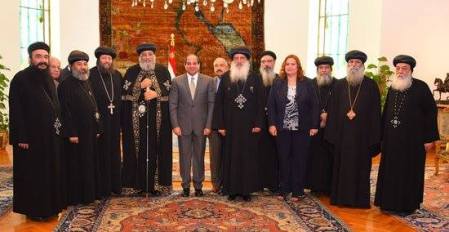
copts-sisi

Should the Islamic revolution of the Arab Spring be victorious in Egypt, this state would sink into Islamic chaos like Libya, Iraq and Syria. Christians would be the big losers and would soon flee or be murdered. That is why the Coptic Church must maintain a good relationship with the Egyptian state, which can be so much easier with a president who is so critical of his own religion. It could even happen that a model may arise in Egypt of how Muslims and Christians can better coexist. Even if we of the West do not care to hear it, the Islamic states will never produce a democracy.

***********************

The following article from the German-language Copts Without Borders blog discusses the delicate problem posed by the demonstrations against Egypt organized by Coptic groups in exile. The author’s main point is that they, the Copts who stayed behind, must live as dhimmis under Islamic rule; there is no other choice. Copts in the diaspora are asked to consider the strategic ramifications of their protests, since the current Egyptian president has done more to help the Copts than any other president or dictator in recent times.

JLH, who translated the article, includes this note:

As our runaway government greases the skids for ever more Muslim immigrants to enter the country, and turns a blind eye to the pleas of Christian individuals and institutions being plowed into the ground in the Middle East, I was struck by the continuing outreach of the “dictator” Al-Sisi to the most endangered of his citizens. And by the tightrope the Copts feel they must walk in an attempt to survive in what was and should still be our highly valued ally.

The translated article:

Polemic on the Demonstrations by Copts in the USA

Egyptian citizens, whatever their religious affiliation, “all have the same rights and duties under the constitution.” And the Egyptian Christians have “displayed prudence and a spirit for the homeland” in the way in which they have reacted to sufferings and provocations in past years. They have remained sensibly united against the attacks of those who “want to use religion to sow discord and spread extremist ideas.”

These are the significant thoughts expressed by Egyptian President Abdel Fatah al-Sisi during his meeting with Coptic Orthodox Patriarch Tawadros II, as he received him in the presidential palace, together with a delegation of several bishops from the synods of the church.

Al-Sisi emphasized the value of brotherliness between Christians and Muslims in Egypt by his positive evaluation of initiatives undertaken in the context of the Egyptian Family House. This so-named House of the Egyptian Family is an inter-religious organ for making connections that had arisen several years ago as an instrument for prevention and mitigation of sectarian contrasts.

However, the public demonstrations by several groups of the Coptic diaspora still trigger polemics, for instance those in recent days in Washington in front of the White House that protested against acts of violence against Christians in Egypt. Speakers for the Coptic Orthodox patriarchate did not wish to comment officially on these demonstrations. But recently there have been warnings from the patriarchate of their possible manipulation, as well as the warning against mobilizing public campaigns abroad which could be seen as “attempts at intervention” by foreign organizations and groups in Egypt’s domestic affairs.

The Egyptian writer Michael Fahmy spoke out sharply against such demonstrations organized by members of the Coptic Egyptian diaspora. He labeled them “stupid or treasonous” actions instigated by small groups. He also emphasized that only the Egyptian state can protect the Copts from acts of violence; that these groups are capable of protecting neither the militant Coptic-Orthodox diaspora nor the Copts now sitting in the Egyptian parliament.

Comment From Copts Without Borders

It may seem odd that the official Coptic Church is speaking against demonstrations abroad for Christians in Egypt. But the fact remains that only the Egyptian state — which is an Islamic one — can protect the Coptic Church and its faithful after a fashion, even though, after a period of relative calm, Islamic attacks on Copts in Egypt have increased. But the Copts’ overall situation has improved recently.

The Church must protect its members and make these statements officially. This induces a precarious situation. On the one hand, Christians abroad should not be indifferent to this imposed dhimmi status in Islamic countries, as in Egypt. On the other hand, these protests abroad put pressure on the recently moderate Islamic President Al-Sisi, who had the courage to criticize his own religion.

The churches in Islamic countries that are under increasing pressure in Iraq and Syria, where an extensive exodus of Christian life occurred and is still occurring, should be grateful for the involvement of the still-too-few Christians abroad. Because it is not to be taken for granted. In contrast to Iraq and Syria, where Christians have lost everything and the priests there rightly speak out against the Islamic reign of violence in these countries, the military in Egypt has succeeded in halting the “Arab Spring,” which pummeled especially the Christians and Yazidis. Despite the discrimination, the Copts there are relatively secure and protected. If the Arab Spring had swept across Egypt, there would be no more Copts in Egypt, as there are none in Iraq.

Such demonstrations would only be helpful in the event of the complete collapse of Islam in the Turkish-Arabic-North African area. But that is nowhere in sight. On the contrary, we are undergoing a worldwide radicalization of Islam. As a blog, we thank the demonstrators in the USA and elsewhere in the diaspora for their commitment and ask them not to slacken. But we also ask the Copts in the diaspora to have some consideration for the Copts who must live in Egypt. They could make posters repeating President Al-Sisi’s criticism delivered to the religious leaders in Al-Azhar University when he visited there on taking office. That would even be useful.

This dilemma could more easily be resolved if the Coptic groups abroad would exclusively oppose Islamic acts of violence in Egypt, which is also the Egyptian president’s point of attack. Al-Sisi has proceeded strenuously against the Muslim Brotherhood, and that has also provided relief for the Copts. Yet this, or other radical groups still practice violence against Copts. Europe too, is learning painfully how difficult it is to root out nests of Islamic radicals.

Throwing the baby out with the bath would mean losing everything in Egypt, as the Christians suffered and are still suffering in Syria and Iraq. This has unfortunately proven to be true. The Christian exodus from Iraq and Syria is taking place unnoticed where the Copts are demonstrating, in the USA, in Europe and in western churches. If this were not the case, there would have been, for decades now, much stronger support for fellow Christians and against the persecution of Christians. They have shown that their solidarity with their co-religionists is less than half-hearted. Nonetheless, we thank all those people in church and country who have continued to help to raise the awareness of the great tragedy of contemporary Christian persecution. This task has received too little support from the general population and the Church.

Should the Islamic revolution of the Arab Spring be victorious in Egypt, this state would sink into Islamic chaos like Libya, Iraq and Syria. Christians would be the big losers and would soon flee or be murdered. That is why the Coptic Church must maintain a good relationship with the Egyptian state, which can be so much easier with a president who is so critical of his own religion. It could even happen that a model may arise in Egypt of how Muslims and Christians can better coexist. Even if we of the West do not care to hear it, the Islamic states will never produce a democracy.

The path out of servitude for Christians in Islamic lands is stony and difficult and must be accompanied by tactical measures on the part of the affected churches. Some may find fault, but, under the present circumstances, it is the only practical survival strategy under dhimmi subjection.

We must trust in Jesus Christ, who has not yet abandoned the Coptic Church. We beseech Him to protect Christians in Iraq and Syria, strengthen them in number and in faith. Let us not falter in prayer for persecuted Christians and other persecuted minorities.

Egypt blocks U.N. Security Council condemnation of Turkey violence

July 16, 2016

Egypt blocks U.N. Security Council condemnation of Turkey violence, Reuters, July 16, 2016

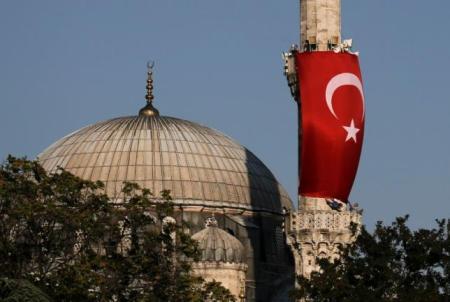
A Turkish flag is seen next to the dome of Hagia Sophia mosque in Istanbul, Turkey, July 16, 2016. REUTERS/Alkis Konstantinidis

A Turkish flag is seen next to the dome of Hagia Sophia mosque in Istanbul, Turkey, July 16, 2016. REUTERS/Alkis Konstantinidis

The United Nations Security Council failed on Saturday to condemn the violence and unrest in Turkey after Egypt objected to a statement that called on all parties to “respect the democratically elected government of Turkey,” diplomats said.

The U.S.-drafted statement also expressed grave concern over the situation in Turkey, urged the parties to show restraint, avoid any violence or bloodshed, and called for an urgent end to the crisis and return to rule of law.

Statements by the 15-member Security council have to be agreed by consensus.

Diplomats, speaking on condition of anonymity, said Egypt argued that the U.N. Security Council was not in a position to determine whether a government had been democratically elected.

Egypt’s mission to the United Nations did not immediately respond to a request for comment.

Turkish forces loyal to President Tayyip Erdogan largely crushed an attempted military coup on Saturday after crowds answered his call to take to the streets in support of the government and dozens of rebels abandoned their tanks.

Egyptian President Abdel Fattah al-Sisi is a former general who overthrew elected President Mohamed Mursi, of the Islamist Muslim Brotherhood, in 2013 after mass protests against Mursi. Turkey provided support for the Muslim Brotherhood in Egypt.

The covert dimension of Israeli-Egyptian ties

July 10, 2016

The covert dimension of Israeli-Egyptian ties, DEBKAfile, July 10, 2016

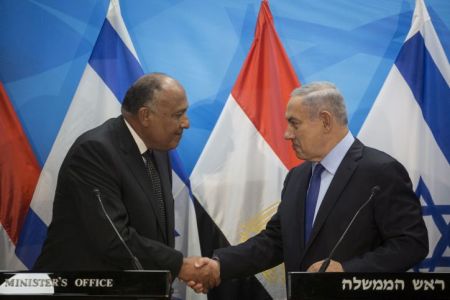
Prime Minister Benjamin Netanyahu meets with Egypt's Foreign Minister Sameh Shoukry at the Prime Minister's office in Jerusalem, on July 10, 2016, during a visit to Israel for the first time in nearly a decade. Foreign Minister Shoukry came to meet Netanyahu to support the peace process between Israel and the Palestinians. Photo by Hadas Parush/Flash90 *** Local Caption *** ????? ???? ?? ???? ???? ????? ????? ????? ???? ????? ??????? ??? ?????? ?????? ??????

Prime Minister Benjamin Netanyahu meets with Egypt’s Foreign Minister Sameh Shoukry at the Prime Minister’s office in Jerusalem, on July 10, 2016, during a visit to Israel for the first time in nearly a decade. Foreign Minister Shoukry came to meet Netanyahu to support the peace process between Israel and the Palestinians. Photo by Hadas Parush/Flash90

The Egyptian Foreign Minister Sameh Shoukry’s visit to Israel Sunday, July 10 and the two conversations he held with Prime Minister Binyamin Netanyahu that day underscored the intensified ties between the two governments and their leaders, President Abdel-Fatteh El-Sisi and the prime minister. The Palestinian issue rated a mention in passing, mostly as useful camouflage to disguise the real business under discussion. This, DEBKAfile’s intelligence sources reveal, revolved around a fresh update on the Syrian war and most of all on the sudden reversal of Syria’s Bashar Assad’s fortunes from wanted war criminal, whose head the US and its president Barack Obama demanded, to the master of a regime and army which is suddenly in the highest demand – even by Obama – as the only reliable military force capable of pursuing the war on jihadi terror, especially ISIS.

This astonishing reversal came to the fore in the last week of June. While putting the final touches on his reconciliation pact with Israel after six years of discord, Turkish President Tayyip Erdogan sent his intelligence chiefs on a clandestine mission to meet Assad’s aides and test the ground for burying the hatchet with him too.

This move was not taken into account by Netanyahu. Erdogan acted on the quiet, while in the midst of yet another maneuver, this one advanced talks for mending relations with the Egyptian president with the help of Algerian mediators who are flitting between Ankara and Cairo, DEBKAfile’s sources report.

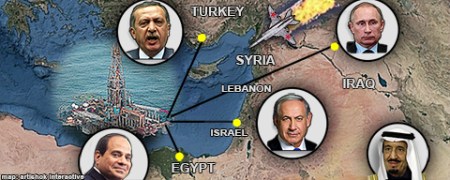
While taking briefings from his foreign minister on the talks in Jerusalem, El-Sisi tried to assess whether Erdogan’s feelers to Assad would ripen into a deal between them   If so, the Turkish leader was perfectly capable of jumping aboard the Iranian-Syrian-Hizballah lineup on the Shiite side of the Middle East map and ditching the moves led by Saudi Arabia, Egypt and the UAE for a counter-alignment of Sunni nations.

The answer to this question will determine whether Iran’s position in Syria is strengthened or weakened.

Egypt and Israel share a strong common interest in this answer.

mistral_class_helicopter_carrier_Egypt_26.8.15

Meanwhile the balance of military strength in the region underwent a radical change with the delivery to the Egyptian Navy of its first helicopter carrier, an advanced Mistral-class vessel made in France and paid for by Saudi Arabia to the tune of half a billion dollars.

The second carrier is due later this year.

These acquisitions substantially upgrade Egypt’s military capabilities as the only power operating in the region in possession of helicopter carriers except Russia.

The highly versatile French amphibious assault ship, equipped with state-of the-art radar navigation and missile defense systems, can carry 16 helicopters plus a battalion of 40 Leclerc tanks and 450 soldiers. This makes the Egyptian navy the primary sea and air arm for defending the shores of the Sinai Peninsula, Suez Canal, the Gulf of Suez, the Red Sea and the approaches to the Gulf of Aqaba – not just against Islamist terrorists but also Iranian expansion.

Since the Saudi, Egyptian and Emirate governments are in close military and intelligence sync for combating the two threats, the Egyptian foreign minister had plenty of urgent business to discuss with Netanyahu.

Humor? | Let’s give all immigrants and Muslim “terror” groups what they want and need.

June 28, 2016

Let’s give all immigrants and Muslim “terror” groups what they want and need. Dan Miller’s Blog, June 28, 2016

(I marked the post as “Humor?” but it comes very close to reflecting Obama’s world view. The opinions implicit in this article are mine and do not necessarily reflect those of Warsclerotic or its other editors. — DM)

This is a guest post by Loretta Lynchmob, Supreme Attorney of Imam Obama’s Loving America. Her younger sister is among the singers in the following inspirational video, as is Hillary Clinton. Here are her, er, inspiring words.

I also participated in this dazzling performance on my way to support an abortion clinic:

Unfortunately, I did not have enough time to sing What the World Needs Now is Love before or after making my remarks following the White supremacist hate-group’s attack in Orlando, Florida during which almost two hundred innocent  homosexuals and lesbians were killed or wounded. That sad incident, of course, had nothing — absolutely nothing — to do with the wonderful Religion of Peace and Tolerance. Rather than listen to the haters who claim that it was on account of our their beautiful Islam, we must give all Muslims at home and abroad love, not hate.

This brings me to the major point of this article: Since everyone — including Muslim “terror” groups — wants the same loving sort of life that all good Americans want, we must give them what they want and need to end their totally justified “depredations.” To do so is Imam Obama’s Loving American way and we cannot do otherwise; that would not be who we are and would put us on the wrong side of hisherstory.

What do immigrants and the so-called terror groups want and what can we give them?

“Terror” groups, like the immigrants fleeing the poverty and repression they suffer in much of Latin America, want to have the same prosperity and freedom that we have in Imam Obama’s already-great America; America was never greater than under the heel of Obama. The Latin American immigrants want it here, the “terror groups” want it in the countries we wrongfully took from them to give to radical firebrands such as President al-Sisi in Egypt and Prime Minister Netanyahu in Occupied Palestine. They will have the prosperity and freedom they want and deserve only when we give them love, not hate. Trump offers hate, we offer love. Surely, ours is not only the better way, it is the only way.

Aside from our abiding, non-judgmental love, what can we give them? They are poor so we need to give them money and the stuff that money can buy. Based on our outpourings of love, they will not use the money to purchase automatic weapons and other types of assault rifles to use against innocents or even against us. Obama’s wonderful peace deal with Iran is a case in point: due to His wisdom in returning to Iran economic power and money of which she had been unjustly deprived, Iran has joined the world community as a peaceful power, opposed to “terrorism,” and will never have nuclear bombs. Only those in America who cling hatefully to their guns and their religion of hate see the world differently and use weapons of war on innocents.

We can, and must, also help them to learn more about democracy. We encouraged democracy when the Egyptian masses overthrew “their” dictator Mubarak and replaced him with their own peace-loving, tolerant President Morsi. That’s the way true democracy works. Then, sadly, a few thousand Egyptian enemies of the brave and peace-loving Muslim Brotherhood conducted a coup, led by an Egyptian general, and replaced President Morsi with a fascist dictator named al-Sisi. The people of Egypt have not forgotten about how democracy should work, and given a chance will again rebel against fascist al-Sisi and depose him in favor of another brave, peace-loving Muslim Brotherhood advocate. We must do everything we can to help them in their loving quest for true freedom and true democracy.

Much of Occupied Palestine is rich; that’s where the Jews live and parade with their filthy feet in what they call “Temple Mount.”

What do the Jews give their Palestinian brothers — who want only their love and sustenance? When they provide water, they poison it. They often cut off electricity to Gaza, with no better excuse than that their poverty-stricken supplicants there can’t pay for it! Is money all that matters? Is gross human suffering of no consequence?

We can, and must, do everything possible to send the Jews festering in Occupied Palestine back to wherever they came from. It’s only just and fair! The blessed United Nations is one hundred percent with us on this; too long have we vetoed Security Council resolutions even modestly adverse to “Israel.” Were we to sponsor a decree by the UN Security Council to rid Occupied Palestine of its Jews, it would pass without veto. If we believe in love — not the hate spewed by “Israel” — that’s precisely what we must do.

Hillary Clinton is indisputably the best-qualified person to take up Obama’s great work when He, sadly, must leave office next January. There is much left to be done, and only She can and will do it. Even the proprietor of this vile right-wing hate blog has said so. Trump, on the other hand, would destroy everything that Obama has done and thereby destroy America as we know and love her. A vote for Hillary is a vote for honesty, candor and, most important, love. A vote for he-of-the-orange hair is a vote for dishonesty, lies and hate.

****************

Editor’s comments

Ms. Lynchmob does a good job of articulating the differences between Trump and the Obama-Clinton cabal and their visions for America as seen by the left. How many in Obama’s America see things as she does?


Israeli-Turkish accord: core of new lineup vs Iran

June 28, 2016

Israeli-Turkish accord: core of new lineup vs Iran, DEBKAfile, June 27, 2016

(Please see also, Israel and Turkey restore relations – peace in our time? — DM)

Turkey_Israel480

The reconciliation agreement announced Monday, June 27 for restoring full normalization between Israel and Turkey after six years of animosity will restart intelligence and security cooperation between the two countries and entail joint military exercises, and investments in energy and defense.

DEBKAfile’s security experts evaluate the deal as offering a valuable and timely increment for Israeli’s national interests on eight scores:

1. It fits neatly into the current joint Saudi-Egyptian bid for Israel to bolster their emerging alliance with Turkey that is designed for drawing a Sunni line against Iran’s expansionist moves in the Horn of Africa, the Red Sea, the Straits of Aqaba and in uncomfortable proximity to the Mediterranean shores of Israel and Egypt.

2. It is designed as the forerunner of a series of interlocking deals. DEBKAfile can disclose that the next bilateral accord expected to be concluded is a reconciliation agreement between Turkey and Egypt for Presidents Recep Tayyip Erdogan and Abdel-Fatteh El-Sisi to bury the hatchet. In at least one respect, this ont will be modeled on the Turkish deal with Israel: Turkey is committed not to let Hamas act against Israel from its soil and, by the same token, not to permit Hamas’s parent and El-Sisi’s archenemy, the Muslim Brotherhood, operate from Turkey.

3. In this regard, Egypt and Turkey will maintain intelligence cooperation.

4. The bilateral intelligence mechanisms to be set up between Turkey and Israel and Turkey and Egypt will pool their input on Iran.

5.  This key aspect of the renewed cooperation between Ankara and Jerusalem lends it a military-intelligence dimension rather than that of a diplomatic protocol. This dimension finds expression in the decision to devolve its implementation not on the holders of political office but the heads of the military-intelligence services of the two countries.

IDF Chief of Staff Lt. Gen. Gady Eisenkot, to whom the head of military intelligence defers, will in fact be in charge of these exchanges, as well as the joint military exercises which are in the active planning stage.

Realizing he had been passed over for this important facet of cooperation with Turkey, Israel’s new defense minister Avigdor Lieberman announced he was opposed to the deal. This was treated as no more than a token protest that will not impede it.

6.  Jordan has been slated as another member of the new alliance. King Abdullah is currently in the process of quietly dismantling the Muslim Brotherhood networks in his kingdom. Many of is members belong to the Palestinian Hamas.

7.  Under the agreement, Israel and Turkey will begin formal talks to build a gas pipeline between the two countries, through which Israel might sell its natural gas, with Turkish assistance, to Europe.

DEBKAfile rates this provision as fundamental to the entire process and of cardinal importance to both their interests. Israel is in need of a major client to boost the development of its offshore gas fields, whereas Turkey wants to be that client and, at the same time, Russia is after a piece of the energy bonanza and most of all a contract to build the pipeline to Europe.

Up until recently, Israel put up a keep out sign for Moscow, mainly under pressure from Washington. But in recent months the conversations between Binyamin Netanyahu and Vladimir Putin have progressed into an inclusive strategic dialogue on Middle East issues, especially on Syria. This opened the door to a Russian role being broached in the export of Israeli gas.

8. This role took another step forward Monday. On the table now is Israeli-Turkish-Russian military and intelligence collaboration for securing the Israeli offshore gas in the Mediterranean – a prospect that brought the Turkish president to finally apologize for his air force downing a Russian Su-24M bomber over the Syrian-Turkish border on Nov. 24, 2015.

For the sake of these promising relations, Turkey was ready to offer compensation in the case of the dead pilot, just as Israel agreed to pay compensation for the nine Turks killed in a clash with Israeli troops during an illicit attempt too breach Israel’s blockade of the Gaza Strip.

Israeli-Turkish-Russian cooperation and goodwill for their mutual benefit on the gas issue may also generate joint efforts in other spheres too.

ISIS Attacks Northern Sinai, 15 Egyptian Police Dead

June 5, 2016

ISIS Attacks Northern Sinai, 15 Egyptian Police Dead, The Jewish PressHana Levi Julian, June 5, 2016

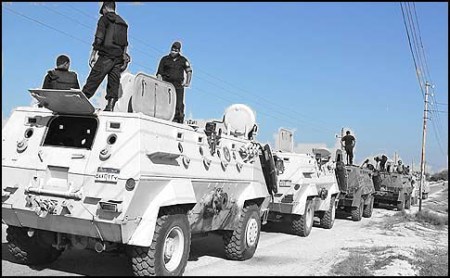
Egyptian security forces stand by their Armoured Personell Carriers ahead of a military operation in the northern Sinai peninsula on August 08, 2012. Egypt, which launched air raids against Islamist militants in Sinai for the first time in decades, faces a tough enemy that has used the peninsula's rugged terrain to evade capture in the past. The military said it deployed Apache helicopter gunships in the strikes that killed 20 "terrorists" in the Sinai village of Tumah, in retaliation for a weekend ambush that cost the lives of 16 soldiers. AFP PHOTO/STRINGERSTRINGER/AFP/GettyImagesEgyptian security forces stand by their Armored Personnel Carriers ahead of a military operation in the northern Sinai peninsula.

Da’esh (ISIS) operatives from the local Sinai Province terrorist group carried out a massive attack Friday in the northern Sinai Peninsula.

At least 15 Egyptian police officers were killed in one of the terror attacks on a checkpoint in El Arish.

Terrorists attacked the checkpoint using a car bomb and followed up with mortar fire against government troops at the site, according to a translation of the Al-Masry Al-Youm newspaper report, cited by Egypt Independent.

The Sinai Province group officially claimed responsibility for the attack a few hours later.

Also on Friday the Masa’ed Sheikh Zuwayed power line in northern Sinai came under attack by terrorists. The attack led to power blackouts in Sheikh Zuwayed and in Rafah, located on Egypt’s border with Gaza.

Such incidents are common, according to the Electricity Ministry, which said security forces provide protection for technicians tasked with repairing the lines. The forces are also tasked with hunting for the terrorists responsible for the attacks that cause the blackouts.

Egypt and Israel have been quietly working together to fight against the attempt by Da’esh to increase its forces in the area.

The Islamist terror group has also forged a bond with Gaza’s ruling Hamas terrorist organization, further complicating the already complex security situation along Israel’s southern border.

Since the Iranian-backed Palestinian Islamic Jihad and Iranian proxy Hezbollah terror group both also have operatives moving in and out of Sinai and Gaza, one wonders how long it will take before Da’esh and Iran sit down to discuss an alliance, with the Muslim Brotherhood (which gave birth to Hamas) as the broker.

US mull hitting ISIS for EgyptAir bombing

May 22, 2016

US mull hitting ISIS for EgyptAir bombing, DEBKAfile, May 22, 2016

Triangle480_Koteret

A special team set up by ISIS in its Syrian capital Raqqa planned the downing of EgyptAir Flight 804 from Paris to Cairo, which took the lives of 66 passengers and crew, DEBKAfile’s intelligence and counterterrorism sources say in an exclusive report.

The information that an ISIS team ploting terrorist attacks has been operating in Raqqa for several weeks was known to American intelligence and counterterrorism services even before the downing of the Egyptian airliner, and warnings containing the information were sent to several Western European capitals, including Paris.

The warnings said ISIS is prepare a series of large-scale attacks in main European cities and airports with the start of the summer travel season.

That is the main reason why both Paris and Cairo said the plane was downed by an act of terror on May 19 as soon as it became clear that the airliner had crashed into the Mediterranean 288 kilometers north of Alexandria, even before the debris was found.

Our sources report that the US has decided to maintain its original plan, prepared  before the downing of Flight 804, to impose a siege on Raqqa in an attempt to prevent terror cells from leaving the city and carrying out attacks.

On Saturday, May 21, US Army Gen. Joseph Votel, the commander of American forces in the Middle East, made a secret visit to Syria, the first of its kind by a senior US officer since the Syrian civil war began in 2011. Votel, who recently assumed command, visited Kurdish YPG militia forces and the US special forces troops at Rmelan airbase located 288 kilometers northeast of Raqqa. The American force is equipped with AH-64 Apache attack helicopters capable of attacking Raqqa within a relatively short period of time.

The purpose of Gen. Votel’s visit was to look into the viability of a US-Kurdish strike in retaliation for the downing of the Egyptian plane. It should be assumed that US President Barack Obama will need to make a decision on the operation in the coming hours.

Over the weekend, ISIS, which is aware of the American plans, enabled citizens to leave Raqqa if they wished to do so. ISIS does not want to have to worry about the civilian population if there is a US-Kurdish attack or siege.

In the meantime, Washington and Cairo are stalling for time while considering their options.

That is the reason why US and Egyptian officials, and even Egyptian President Abdel Fattah al-Sisi, continued to claim on May 22 that more time is needed to determine the cause of the crash.

It was also the reason why, soon after the air disaster, it was claimed that there was no distress call or any other message regarding a problem with the plane.

But two days after the crash, on May 21, following the recovery of debris and parts of the bodies of the passengers, there were suddenly reports that they signals from the plane of smoke in two places in the aircraft.

Investigators say it is still not clear what caused the smoke, whether a fire or fires broke out on the plane, or whether the fire eventually caused the crash, but al the signs point to an internal explosion.

DEBKAfile sources report that both Paris and Cairo believe that the crash was caused by a new type of small time bomb, or several of them, that were smuggled into the plane and planted by Charles de Gaulle airport workers loyal to ISIS.

The sources point out that ISIS explosives experts specialize in building very small devices that can be smuggled onto planes. A device within a Coca-Cola can downed a Russian Airbus A321 over the Sinai Peninsula on October 31, killing all 224 passengers and crew.

Our sources also report that investigators of the latest crash believe that just as ISIS blew up the Russian plane in retaliation for Moscow’s intervention in Syria, the downing of the Egyptian plane is linked to the entry by Egyptian special forces into Libya during the last few weeks to take action against ISIS forces.

DEBKAfile’s military sources report that an Egyptian special force is operating with a  US elite units against ISIS targets in eastern Libya near the port city of Tobruk.

Sisi and Mideast Peace

May 21, 2016

Sisi and Mideast Peace, American ThinkerC. Hart, May 21, 2016

Egyptian President Abdel Fatah al-Sisi’s speech on Tuesday, May 18, set ripples through Israel’s political establishment. Speaking in the southern city of Assiut, Sisi signaled to the Arab world, the Palestinians, and Israel that it is time for an historic breakthrough in peace negotiations.

Responding immediately to Sisi’s comments, Israeli Prime Minister Benjamin Netanyahu stated that he is open to working with Egypt and Arab states towards advancing the peace process, not only with the Palestinians but with the peoples of the Middle East region.

Netanyahu’s comments come on the heels of a visit to Israel by French Foreign Minister Jean-Mark Ayrault. The two men met but disagreed on how to advance peace.

France insists on hosting an international parley to force Israel and the Palestinians to come to the peace table. Israel is against the French initiative.

Netanyahu would like to go beyond the Israeli-Palestinian conflict and work directly with moderate Arab states on a comprehensive peace deal. Sisi could be instrumental in building an Arab coalition for peace which would dismiss or weaken the divisive French initiative, releasing Israel from conceding to European demands.

Former Israeli ambassador to Egypt, Zvi Mazel, is currently working as a Research Fellow at the Jerusalem Center for Public Affairs (JCPA). He is a Middle East expert who has represented Israel’s Ministry of Foreign Affairs as former Ambassador to Sweden and Romania, as well. This writer asked Mazel if Sisi’s comments were spontaneous or were released at this time for political reasons because he wants to strengthen Egypt’s position in the region by helping Israel.

“I don’t think there is a big design… I think that Sisi understands what is going on in the Middle East and he is identifying according to his view — a kind of possibility of advancing the peace process.”

Egypt, Saudi Arabia, the Gulf countries, and Israel have common enemies: Iran and Islamic State. Already there have been discreet diplomatic and business ties between Israel and these nations

According to Mazel, Sisi is also emerging as a strong respected leader among Egyptians despite the Western media’s portrayal of him as a dictator similar to former Egyptian President Hosni Mubarak.

“Sisi sees himself as a president quite stable among his people. I know that this is not the way they think in the Western media — New York Times and company. They see him as a kind of military dictator; absolutely not! He’s a good man. He’s not Mubarak. He’s Sisi.”

Mazel explains that Egypt is on the way to economic sustainable development. This is what Sisi has been focused on over the past two years and he is seeing success. Unemployment has gone down, despite the fact that almost 90 million people live in Egypt and the country is poor.

“He has started something quite positive, and Sisi thinks that the time has come for Egypt to be in the international arena.”

What that means, according to Mazel, is that Egypt’s current role is still minor. Sisi is asking Israelis and Palestinians to go forward, yet he, himself, does not have a plan. But, in the future, Egypt could emerge as a larger player in the region.

Mazel is pragmatic about the short-term. “It’s a positive step for Egypt, but it is not going to change the world.”

Current peace advances that are being prepared for release are not a positive development for Israel: (a) the French Initiative; (b) a document showing the obstacles to Israeli-Palestinian peace efforts soon to be reported by the Quartet; (c) the 2002 Arab Peace Initiative that, despite being outdated, is still considered a serious option by the Arab world.

In the coming days, the Arab League plans to meet and discuss the Israeli-Palestinian conflict. Mazel thinks that Sisi’s statement was good timing for that meeting, but otherwise, was not connected to a bigger scheme.

However, on Wednesday, May 18, American Secretary of State John Kerry arrived in Egypt one day after Sisi gave his emotional speech. Some analysts believe that the U.S. is behind Sisi’s bold words, in an effort to circumvent the French from becoming a new power broker in the Middle East.

The question is whether Sisi’s encouragement will lead to Israel courting the Arab nations and the Arab nations courting Israel, while by-passing the Palestinians. Mazel thinks that kind of change is slow in coming, because the Arabs continue to entrench themselves in old positions that favor Palestinian demands.

Refusing to sit down and negotiate with Israel, the Palestinians have insisted on preconditions which the Arab League has accepted. They demand that Israel agree on the right of return for so-called Palestinian “refugees” to Israeli land; that Israel withdraw to the 1967 borders; and, that Israel stop building in West Bank settlements (Judea and Samaria). Palestinian President Mahmoud Abbas also expects Israel to release hundreds of Palestinian prisoners, who have blood on their hands, serving time in Israeli jails because of terrorist attacks against the Israeli population.

So far, these unresolved issues have kept Abbas away from face-to-face negotiations with Netanyahu. However, his real diplomatic scheme is to get the international community to affirm the Palestinian position and force Israel to concede to Palestinian demands. Right now, Abbas sees the best venue to accomplish his goal as a French-sponsored future peace conference, followed by a stinging UN anti-Israel resolution.

Meanwhile, the future pressure on Israel will be to immediately stop settlement construction in order to get the peace process going. Mazel declares, “Absolutely not… we have to go on! Half a million people live there. And, they are the shield of Israel. We continue to build until there is peace.”

Mazel has a real problem with the demands of the Arab League, as well. “The Arab Peace Initiative is more or less the same as the Palestinian attitude. The ‘right of return’ is still there. It should be taken completely out. Most importantly, the Palestinians and the Arabs should recognize a Jewish State in Israel.”

Mazel is also not sure that Netanyahu’s insistence on widening his government, to provide greater stability, is a wise idea. Reportedly, Yisrael Beytenu Chairman Avigdor Liberman will soon become Israel’s new Defense Minister as Netanyahu brings several more ministers into his coalition. Mazel thinks this will not provide a wider diplomatic envelope; nor, will it help change European or Arab attitudes towards Israel; nor will it end the Boycott-Divestment-Sanctions (BDS) movement against Israel.

Then there is U.S. President Barack Obama’s failed Middle East policy, which includes his lackluster support of American allies in the region. Mazel says this policy cannot continue.

“It cannot be like that, because America is the most important power in the world… And, whoever will win the presidency, whether it will be Mrs. Clinton or Trump, both of them are in a certain way connected to the Middle East.”

Mazel believes that with 22 countries and more than 300 million people living in the region, the next U.S. president will be more engaged in leading the nations into greater stability.

In the meantime, currently 80% of the Egyptian people support Egyptian President Sisi. His nation has already made peace with Israel (along with Jordan). Helping Israel to extend an olive branch to other Arab countries will encourage Egypt to take up an important leadership role in a region that continues to be embroiled in major upheaval and violence.


EgyptAir flight blown up by ISIS time bomb

May 19, 2016

EgyptAir flight blown up by ISIS time Bomb, DEBKAfile,  May 19, 2016

EgyptAir804_480

EgyptAir flight MS804, which took off at 11:09 p.m. on Thursday May 19 from Charles de Gaulle airport in Paris, was supposed to land at 3:55 a.m. in Cairo. However, it dropped off the radar screens of Greek and Egyptian flight controllers at 2:45 a.m. and crashed into the Mediterranean about 10 miles inside Egypt’s territorial waters.

The Airbus A320-232 had 66 people aboard including seven crew members, three security guards, 30 Egyptian citizens, 17 French nationals as well as citizens of Iraq, Saudi Arabia and other countries. The plane, which was built in 2003, was flown by two pilots who each had thousands of hours of cockpit experience. Reports by Egypt’s airport authority said the cargo did not contain dangerous materials or anything else out of the ordinary.

Egyptian Prime Minister Sherif Ismail said terrorism could not be ruled out, emphasizing that there were no distress calls made from the cockpit and that there were no reports showing deviation from the flight path or altitude before the plane disappeared. The spokesman of the Egyptian military, Brig. Gen. Mohammed Samir, confirmed in a posting on the military’s Facebook page that the pilots did not send out a distress signal.

Following the disappearance, French President Francois Hollande convened an emergency meeting Thursday morning at the Elysee Palace.

Reports on social media said that witnesses in Greece saw a large ball of fire in the sky, which may strengthen the assumption that flight MS804 carried a time bomb that was set to explode when the plane was in Egyptian airspace.

DEBKAfile’s counterterrorism sources say that if the plane was downed by an act of terror, it would be the latest major blow by ISIS to international civilian aviation, Egyptian tourism, and the security, counterterror and intelligence services of France and Egypt.

  • It is the second time in less than a year that ISIS has succeeded in using a time bomb to down a passenger plane linked to Egypt. The first one was a Russian Airbus A321 that took off from Sharm al-Sheikh and blew up over the Sinai Peninsula on October 31. All 224 passengers and crew were killed.
  • One of the main questions in the investigation of the latest air disaster will be whether the explosive device was planted in Cairo or Paris. If it did happen in Paris, it would raise the question of whether an ISIS cell penetrated the ground crews at Charles de Gaulle airport. If confirmed, it would be a serious escalation by ISIS following the terrorist organization’s November 2015 attacks in Paris in which 130 people were killed and hundreds were wounded.
  • A sign of an escalation was that it was the second terrorist attack within three months on a civilian aviation target in a Western European capital, following the bombing of Brussels international airport in March in which 31 people were killed and about 200 were wounded.
  • But if the investigation finds that the bomb was planted on the plane in Cairo before it departed for Paris, it would mark a serious and dangerous escalation of the infiltration and operational abilities of ISIS in the Egyptian capital, and a major threat to the stability of the regime of President Abel Fattah al-Sisi.