Archive for the ‘Egypt’ category

Islamic “peace,” Imam Obama and multiculturalism

January 13, 2015

Islamic “peace,” Imam Obama and multiculturalism, Dan Miller’s Blog, January 13, 2015

(The views expressed here are mine, and do not necessarily reflect those of Warsclerotic or of its other editors. — DM)

Multiculturalism fosters and perpetuates myths that Islam is the religion of peace, not death; that it is benign like other world religions and improves Western civilization. In Obama’s world, such fantasies are reality. They are principal bases of His foreign policies.

turbanbomb1

Islam

I argued here and here that adherents to Islam, not to “radical” or “extremist” Islam, but to Islam, are the perpetrators and supporters of the Islamic slaughter of those with whose ideologies and actions they disagree. They demand submission and will tolerate nothing less.

In His January 4, 2009 address in Cairo, Obama proclaimed:

America and Islam are not exclusive, and need not be in competition. Instead, they overlap, and share common principles – principles of justice and progress; tolerance and the dignity of all human beings. [Emphasis added.]

. . . .

[P]artnership between America and Islam must be based on what Islam is, not what it isn’t. And I consider it part of my responsibility as President of the United States to fight against negative stereotypes of Islam wherever they appear. [Emphasis added.[

He continues to “fight against negative stereotypes of Islam wherever they appear,” but who elected Him to do that? Despite massive evidence contrary to Obama’s perceptions of Islam as benign and slandered, He continues to base His perceptions and policies on what Islam is not, not on what it is. Bridget Gabriel, who also lived in Islamic countries, would disagree with many of Obama’s theses:

Here is Ms. Gabriel’s response to a Muslim-American citizen:

As goes Europe so goes the Obama Nation?

The Organization of Islamic Cooperation is the largest Islamic body in the world.

The OIC is comprised of the 57 Muslim-majority nations and the Palestinian Authority. They are the largest bloc at the UN, and when they meet on the head-of-state level, they literally speak for the Muslim world. [Emphasis added.]

Contemporaneously with the attack on Charlie Hedbo and a kosher supermarket in France, it sought

more implementation of the OIC-sponsored UN Human Rights Council Resolution 16/18 and the follow-up Rabat Plan of Action that would criminalize the very type of speech that Charlie Hebdo engaged in.

Such laws — similar to Sharia’s prohibition of “insulting” Islam — would criminalize our once free speech. Western nations, presumably, would jail rather than execute those who “insult” Islam. Although brute governmental force might largely displace Islamic slaughter of those who “insult” Islam, it would be more pervasive and hence probably more effective. It would also contravene what’s left of the First Amendment to the United States Constitution.

Muslim leaders from around the Obama Nation recently assembled in Texas to stand with the murdering, antisemitic pedophile worshiped by billions of Muslims “Prophet”

in Honor and Respect conference, a weekend forum that is being billed as a “movement to defend Prophet Muhammad, his person, and his message,” according to event information.

. . . .

Organizers of the event place the blame for Islam’s bad reputation on the media and so-called American Islamophobes who have “invested at least $160 million dollars to attack our Prophet and Islam,” according to the conference web page.

. . . .

“This is not an event. It is the beginning of a movement,” organizers write on their website, which blames Americans for giving Islam a bad name. “A movement to defend Prophet Muhammad, his person, and his message.”

All these accusations were invented by Islamophobes in America,” the group claims. “As we celebrate the Prophet in our now annual, nationwide event: Stand with the Prophet, we recommit ourselves to rectify his image, peace be upon him.” [Emphasis added.]

Hirsi Ali, an apostate from Islam and an indomitable (other than by her own eventual murder) voice for freedom, was recently interviewed by several media. Here are videos of three of her interviews:


The thrust of her remarks is that Islamic ideology, including reverence for all of the vile things that Mohamed did and encouraged, is the root of the problem. However, the Western tendency to absolve all other Mohamed worshipers of blame for the acts of their coreligionists — which they often support — is prevalent in multicultural societies. Similarly, it is the position of our “leaders” and “betters” that attacks such as those on Charlie Hedbo have nothing to do with Islam, or even “radical” Islam.


“We” are, therefore, not at war with Islam or “radical” Islam but with those who would “corrupt” it by committing acts of “senseless” terror. That’s comparable to saying that, in the 1940s, we were not at war with Nazism, but with those who corrupted the beautiful Nazi ideology.

Multiculturalism

While denigrating the Western culture of life, multiculturalism and its advocates promote ignorance and fallacies about the Islamic culture of death. Those who accept the fallacy that Islam is a benign religion thereby join a “cult” of cultural suicide which takes advantage of the ignorance, or worse, of many within Western cultures.

obama_chamberlain_charlie_hebdo_1-11-15-1

According to Victor Davis Hanson, in an article titled Multicultural Suicide,

For the multiculturalist, the sins of the non-West are mostly ignored or attributed to Western influence, while those of the West are peculiar to Western civilization. In terms of the challenge of radical Islam, multiculturalism manifests itself in the abstract with the notion that Islamists are simply the fundamentalist counterparts to any other religion. Islamic extremists are no different from Christian extremists, as the isolated examples of David Koresh or the Rev. Jim Jones are cited ad nauseam as the morally and numerically equivalent bookends to thousands of radical Islamic terrorist acts that plague the world each month. We are not to assess other religions by any absolute standard, given that such judgmentalism would inevitably be prejudiced by endemic Western privilege. There is nothing in the Sermon on the Mount that differs much from what is found in the Koran. And on and on and on. [Emphasis added.]

In the concrete, multiculturalism seeks to use language and politics to mask reality. The slaughter at Ford Hood becomes “workplace violence,” not a case of a radical Islamist, Major Nidal Hasan, screaming “Allahu Akbar” as he butchered the innocent. After the Paris violence, the administration envisions a “Summit on Countering Violent Extremism,” apparently in reaction to Buddhists who are filming beheadings, skinheads storming Paris media offices, and lone-wolf anti-abortionists who slaughtered the innocent in Australia, Canada, and France. [Emphasis added.]

. . . .

If the Western establishment were truly moral, it would reject multiculturalism as a deductive, anti-empirical, and illiberal creed. It would demand that critics abroad first put their own house in order before blaming others for their own failures, and remind Western elites that their multicultural fantasies are cheap nostrums designed to deal with their own neuroses. [Emphasis added.]

Finally, it would also not welcome in newcomers who seek to destroy the very institutions that make the West so unlike the homelands they have voted with their feet to utterly abandon. [Emphasis added.]

Unfortunately, Islamists now resident in the United States or in other Western nations did not vote “with their feet to utterly abandon” the hellholes they left; they brought them with them and seek to impose their ideology wherever they go.

No Islamic nation is multicultural. None (with the possible exception of Egypt under President Sisi) welcome those who oppose their Islamic values or otherwise seek to change their ways. Were a Saudi citizen or visiting foreigner to blame the Islamic principles in which Saudi Arabia is grounded for the ills of the Middle East or the evils of Islam, his stay there, if not his life, would be abbreviated, promptly.

Islam is the principal enemy, but the multiculturalists who inflict it upon Western civilization aid and abet it. They attempt to dull our senses of right and wrong by sanitizing and promoting Islam as good.

Perhaps, and I hope that, the very substantial attention paid by the media to the recent Islamic slaughters in France will do as few other such incidents have done: bring about the rejection of Islam, multiculturalism and their advocates.

Kerry I am Charlie

IDF pulls units from locations bordering Gaza, ignoring rising Egyptian military and al Qaeda activity

January 4, 2015

IDF pulls units from locations bordering Gaza, ignoring rising Egyptian military and al Qaeda activity, DEBKAfile, January 4, 2015

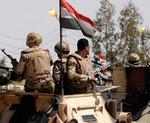
Egyptian_troops_SinaiEgyptian troops battling terrorists in Sinai

Israelis living in a string of villages and towns bordering on the Gaza Strip protested in vain against Defense Minister Moshe Ya’alon’s decision to withdraw the military presence keeping them safe, especially since the summer war on Gaza.

Four significant security events in the last 48 hours on both sides of the border added to their concerns:

Their government, at its weekly cabinet meeting in Jerusalem Sunday, Jan. 4, set up a committee to expedite the transfer of the bulk of IDF facilities from the center of the country to the south.

At the same time, Israelis living in the south within range of the Hamas-ruled Gaza Strip saw the soldiers heading out and were advised to put their trust in local paramilitary “preparedness squads” taking over from the army. The local population believes that they are not up to the job of safeguarding them from more terrorist aggression – by missile, tunnel or intrusion.

Also Sunday, Egypt began expanding the security buffer zone along the 14km of the Gaza-Sinai-Israel border, doubling its breadth from one half to a whole kilometer. The mostly Palestinian inhabitants of this zone were evacuated.

Saturday, Jan. 3, Egyptian troops raided three towns in northern Sinai: Rafah (which is part located in the Gaza Strip), El Arish and Sheikh Zuweid, killing 7 militants of Ansar Beit al-Maqdis, which last month pledged allegiance to the Islamic State of Iraq and the Levant, and jihad against Egypt and Israel.

A few hours later, an Egyptian army explosives expert was killed and several soldiers injured when a large bomb planted on a road in Sheikh Zuweid blew up when they tried to dismantle it.

Saturday night, the IDF commander of the Gaza Division, Brig. Gen. Itay Virov tried to calm dwellers across from the Gaza Strip, who were up in arms about the withdrawal of their military safety net. He addressed members of Kibbutz Nahal Oz with a rare burst of frankness. He spoke of military policy, but his words no doubt reflected the strategic thinking of Prime Minister Binyamin Netanyahu, Defense Minister Ya’alon, the outgoing Chief of Staff, Lt. Gen. Benny Gantz, and his successor next month Maj. Gen. Gadi Eisenkott.

The general may be commended for laying the truth about official policy on the table. However, instead of calming his audience, he bared evaluations that may give the rest of the country sleepless nights as well.

Here are the high points of his Nahal Oz lecture:

  • Israel can’t deter Gazan Palestinians from making war, because they have no other options. So deterrence in this case is an empty value.
  • Israel deliberately avoided going all the way to remove Hamas from power in Gaza in the summer war because salafist jihadists and al Qaeda would have moved in to replace them. It was deemed better to rely on Egypt to grapple with the terrorist threat, including al Qaeda, rather than the IDF.
  • Brig. Virov termed the last Gaza operation a campaign based on the doctrine of prevention rather than a war of aggression.
  • The political wing of Hamas looks after the population and wants peace and quiet, whereas the military wing lost no time in restoring the tunnels Israel blew up, conducting scores of test launches of rockets, and training hard for the next round of combat with Israel.
  • Israel therefore has no option but to prepare for a replay of Defense Edge with operations 2, 3 or even 4. Hamas must be degraded militarily each time – but not so far as to be rendered incapable of buttressing the Hamas regime.
  • The conclusion drawn from Gen. Virov’s lecture was that the Netanyahu government has provided Hamas-Gaza with a political and military guarantee of safety.

Like all policies, even those well thought out, this one too carries a price tag.

The general spoke of Hamas in terms of an independent entity whose operations and impact are confined to the Gaza Strip. He refrained from mentioning that, as recently as December, both of Hamas’ branches, the military and the political, jumped aboard the Iran-led Iraqi-Syrian-Hizballah alliance. This Palestinian group is now subject to Tehran’s policy decisions and directives. This omission from Israel’s policy calculations could be dangerous. Clearly, an undefeated Hamas remains a lasting menace.

Tehran’s decisions regarding Hamas may have an overarching effect, possibly touching on the moves directed by President Barack Obama. (See our Jan. 1 article on Obama’s New Year gift to Israel and the Middle East.).

Israel’s policy of relying on the Egyptian army to contain Al Qaeda’s Sinai network also comes at a price.

For now, Israel has quietly consented to large-scale Egyptian military strength entering Sinai: One and a half divisions, including fighter squadrons and tank battalions, have taken up positions, nullifying the key demilitarization clause of their 1979 peace treaty.

And that’s just for starters.

Egypt’s Sisi: Islamic “Thinking” Is “Antagonizing the Entire World”

January 2, 2015

Egypt’s Sisi: Islamic “Thinking” Is “Antagonizing the Entire World” Raymond Ibraham, January 1, 2015

Speaking before Al-Azhar and the Awqaf Ministry on New Year’s Day, 2015, in connection to Prophet Muhammad’s upcoming birthday, Egyptian President Abdel Fattah al-Sisi, a vocal supporter for a renewed vision of Islam, made what must be his most forceful and impassioned plea to date on the subject.

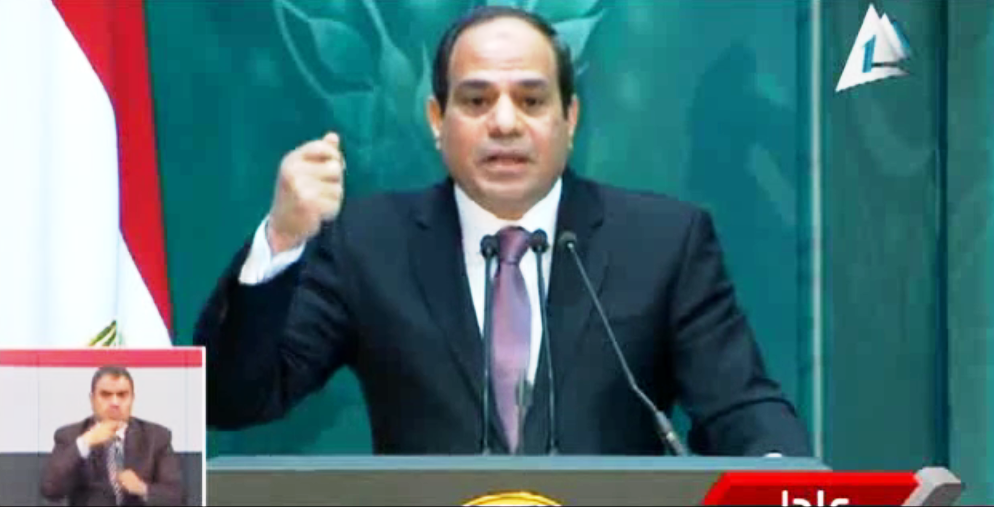
Sisi Jan 1 15Sisi during his New Year’s Day speech before Al Azhar

Among other things, Sisi said that the “corpus of [Islamic] texts and ideas that we have sacralized over the years” are  “antagonizing the entire world”; that it is not “possible that 1.6 billion people [reference to the world’s Muslims] should want to kill the rest of the world’s inhabitants—that is 7 billion—so that they themselves may live”; and that Egypt (or the Islamic world in its entirety) “is being torn, it is being destroyed, it is being lost—and it is being lost by our own hands.”

The relevant excerpt from Sisi’s speech follows (translation by Michele Antaki):

I am referring here to the religious clerics.   We have to think hard about what we are facing—and I have, in fact, addressed this topic a couple of times before.  It’s inconceivable that the thinking that we hold most sacred should cause the entire umma[Islamic world] to be a source of anxiety, danger, killing and destruction for the rest of the world.  Impossible!

That thinking—I am not saying “religion” but “thinking”—that corpus of texts and ideas that we have sacralized over the years, to the point that departing from them has become almost impossible, is antagonizing the entire world.  It’s antagonizing the entire world!

Is it possible that 1.6 billion people [Muslims] should want to kill the rest of the world’s inhabitants—that is 7 billion—so that they themselves may live? Impossible!

I am saying these words here at Al Azhar, before this assembly of scholars and ulema—Allah Almighty be witness to your truth on Judgment Day concerning that which I’m talking about now.

All this that I am telling you, you cannot feel it if you remain trapped within this mindset. You need to step outside of yourselves to be able to observe it and reflect on it it from a more enlightened perspective.

I say and repeat again that we are in need of a religious revolution. You, imams, are responsible before Allah. The entire world, I say it again, the entire world is waiting for your next move… because this umma is being torn, it is being destroyed, it is being lost—and it is being lost by our own hands.

Note: It is unclear if in the last instance of umma Sisi is referring to Egypt (“the nation”) or if he is using it in the pan-Islamic sense as he did initially to refer to the entire Islamic world.

A Sad State of Affairs: The Kerry Record

January 2, 2015

A Sad State of Affairs: The Kerry Record, World Affairs JournalJoshua Muravchik, November/December, 2014

(Kerry likely agrees with Obama as to his quite foreign foreign policies and, equally likely, we are stuck with both at least until Obama leaves the White House.

Kerry I'm an idiot

The most bothersome current aspects of Obama-Kerry foreign policies are the extent to which they trust Iran and how they deal with it and the P5+1 negotiating group. — DM)

John_Kerry_and_Benjamin_Netanyahu_July_2014 (1)

Although Kerry’s anti-American ideology has moderated to some degree from his fiery days as an antiwar leader, he has misrepresented but never repudiated his past. Especially consistent has been his inclination to see the best in America’s enemies, from Madame Binh to Comandante Ortega to Bashar Assad. Israelis were shocked this summer that Kerry came up with a plan molded by Turkey and Qatar to fit the interests of Hamas at their own expense. Had they known him and his record better, they might not have been.

***************

The Gaza war of July and August 2014 occasioned the sharpest frictions in memory between the United States and Israel, highlighted by a cease-fire proposal offered by Secretary of State John Kerry that Israel’s security cabinet rejected unanimously. Kerry’s plan envisioned a seven-day cease-fire, during which the parties would negotiate “arrangements” to meet each of Hamas’s demands about the free flow of people and goods into Gaza and the payment of salaries of Hamas’s tens of thousands of employees. As for Israel’s demands about destruction of tunnels and rockets and the demilitarization of Gaza, these were not mentioned at all, except in the add-on phrase that the talks would also “address all security issues.”

The document cited the important role to be played by “the United Nations, the Arab League, the European Union, the United States, Turkey, [and] Qatar.” Conspicuous by their absence from this list were Israel, Egypt, and the Palestinian Authority. These three had also not been invited to the Paris meetings where Kerry worked on his ideas with leaders of the countries and bodies mentioned.

Barak Ravid, diplomatic correspondent for the liberal Israeli newspaper Haaretz, wrote that the proposal “might as well have been penned by Khaled Meshal [head of Hamas]. It was everything Hamas could have hoped for.” The centrist Times of Israel’s characteristically circumspect editor, David Horovitz, branded Kerry’s initiative “a betrayal.” And left-leaning author Ari Shavit commented that “Kerry ruined everything. [He] put wind in the sails of Hamas’ political leader Khaled Meshal, allowed the Hamas extremists to overcome the Hamas moderates, and gave renewed life to the weakened regional alliance of the Muslim Brotherhood.”

Turkey and Qatar are the mainstays of that alliance and were chosen by Kerry as his principal interlocutors because they are Hamas’s main backers. This brought protests from the Palestinian Authority, led by President Mahmoud Abbas’s movement, Fatah, the secularist rival to Hamas. That group declared that “whoever wants Qatar and Turkey to represent them can emigrate and go live there. Our only legitimate representative is the PLO.”

The shock of Palestinian and Israeli leaders would have been less, however, if they had been more familiar with the record of John Kerry. Spurning America’s friends in pursuit of deals with their nemeses was perfectly in character for the secretary of state. The hallmark of his career has been to denigrate America itself, while supporting the claims of its enemies.

That career began in 1969, when, months after returning from a tour of duty in Vietnam, Kerry sought and received a military discharge so that he might run for Congress. His campaign as a peace candidate sputtered, but his authenticity as a Vietnam vet established him as a presence in the burgeoning antiwar movement. In May 1970, he traveled to Paris for an unpublicized meeting with Viet Cong representatives, and, perhaps at their suggestion, he joined up upon his return with Vietnam Veterans Against the War. VVAW was headed by Al Hubbard, a former Black Panther. Kerry was instantly given a top role, twinning with Hubbard as the public face of the organization.

At a VVAW protest in Washington, DC, in April 1971, Kerry joined other veterans in throwing away their military medals in front of news cameras. The entire demonstration was punctuated by Kerry’s appearance before the Senate Foreign Relations Committee, where he offered dramatic testimony about American atrocities in Vietnam based on accounts heard at a VVAW inquest a few months earlier. He spoke of veterans who said:

They had personally raped, cut off ears, cut off heads, taped wires from portable telephones to human genitals and turned up the power, cut off limbs, blown up bodies, randomly shot at civilians, razed villages . . . poisoned food stocks, and generally ravaged the countryside.

These acts, Kerry emphasized, “were not isolated incidents but crimes committed on a day-to-day basis with the full awareness of officers at all levels of command.”

When, at the behest of aghast senators, the Naval Criminal Investigative Service conducted a formal inquiry into the stories presented at the VVAW inquest, it reported that many of the VVAW witnesses cited by Kerry refused to cooperate, although promised immunity. Others were clearly crackpots, and several swore, and provided witness corroboration, that they had not participated at the inquest at all and had no idea who had appeared in their names. The entire exercise had been inspired and largely engineered by Mark Lane, whose book on the same subject earlier that year had been panned by New York Times columnist James Reston Jr. as “a hodgepodge of hearsay,” while that paper’s book reviewer, Neil Sheehan, who had reported from Vietnam and would soon break the Pentagon Papers, revealed that some of Lane’s “witnesses” had not served in Vietnam. (The political scientist Guenter Lewy documents these events in his 1978 book America in Vietnam.)

In August 1971, four months after his Senate appearance, Kerry made another trip to Paris, to meet with Madame Nguyen Thi Binh, foreign minister of the Viet Cong, this time in full view, for his first exercise in international diplomacy. He returned touting the “peace plan” of the Viet Cong, explaining: “If the United States were to set a date for withdrawal, the prisoners of war would be returned.” Although he frequently accused American leaders of lying, he took the Communist leaders’ statements at face value, asserting that their peace plan “negates very clearly the argument of the president [Nixon] that we have to maintain a presence in Vietnam to use as a negotiating [chip] for the return of those prisoners.”

Kerry’s dismissal of the statements of US leaders as lies and his credulity toward those of the Vietnamese Communists reflected a broader difference in attitude toward the two sides to the conflict. Ho Chi Minh, who had spent long years as a henchman of Stalin’s, serving the Comintern in several countries, was in Kerry’s admiring eyes “the George Washington of Vietnam” who aimed only “to install the same provisions into the government of Vietnam” that appeared in the American Constitution. America, in contrast, had itself strayed so far from those principles that it needed a “revolution” to restore them.

Kerry’s colleagues in VVAW undoubtedly shared this sentiment, and in November 1971, at a conference of its leadership in Kansas, the group considered just how far down the path of revolution it was willing to go. It debated, although ultimately rejected, a proposal to commence a campaign of terrorist violence and assassination of pro-war US senators. When he ran for president in 2004, Kerry denied he had been present at this conclave, but when FBI files secured by the Los Angeles Times under the Freedom of Information Act placed him there, he retracted that denial in favor of the statement that he had “no personal recollection” of it.

Is this plausible? Gerald Nicosia, author of a highly sympathetic history of the antiwar movement, reported, in May 2004, that “several people at the Kansas City meeting recently said to me or to mutual friends that they had been told by the Kerry campaign not to speak about those events without permission.” Why the urgency to cover up? And how would the campaign know who was there, that is, whose silence to seek, if Kerry had no recollection of the meeting? One of Nicosia’s interviewees, John Musgrave, said “he was asked by Kerry’s veterans coordinator to ‘refresh his memory’ after he told the press Kerry was in Kansas City. Not only is Musgrave outraged that ‘they were trying to make me look like a liar,’ but he also says ‘there’s no way Kerry could have forgotten that meeting—there was too much going on.’”

This puts it mildly: the event was memorably raucous, with debates over the proposals for violence and for napalming the national Christmas tree, furious factional fighting, the discovery of eavesdropping bugs in the building leading to a quick move to another location, and above all an angry showdown between Kerry and Hubbard over revelations that the latter had never been in Vietnam. This particular contretemps was punctuated by Hubbard’s dramatically pulling down his pants to show scars he claimed he sustained in Vietnam. The mayhem culminated in Kerry’s announcing his resignation from the group’s executive. And Kerry had “no personal recollection” of being there?

Although Kerry appeared as a speaker for VVAW for about a year following this resignation, he then faded from national view for a decade, climbing the ladder of local and state politics in Massachusetts before winning election to the US Senate in 1984. The Senate, he later said, “was the right place for me in terms of . . . my passions. The issue of war and peace was on the table again.” What put it on the table were the anti-communist policies of President Ronald Reagan, which Kerry deeply opposed. A year earlier, Reagan had ordered the invasion of Grenada, which Kerry scorned as “a bully’s show of force [that] only served to heighten world tensions and further strain brittle US-Soviet and North-South relations.”

In contrast, Kerry ran on a platform of the Nuclear Freeze, a popular movement opposing US plans to counterbalance a large Soviet nuclear buildup over the previous decade. Kerry made sure to score one hundred percent on a test of candidates’ positions presented by a group called Freeze Voter ’84, and he proposed to cut the defense budget by nearly twenty percent, including “cancellation of twenty-seven weapons systems” and “reductions in eighteen other[s],” according to the Boston Globe. He cited his own work with VVAW as a counterpoint: “We were criticized when we stood up on Vietnam. . . . But we’ve been borne out. We were correct. Sometimes you just have to stand and hold your ground.”

In the Senate, he secured a coveted seat on the Foreign Affairs Committee and turned his attention to the fraught issue of policy toward Central America, a small region that had assumed inordinate geopolitical importance by becoming one of the front lines in the Cold War. A Marxist-Leninist party, the Sandinista National Liberation Front, had seized power in Nicaragua and was aiding likeminded movements in El Salvador and other nearby states while the Reagan administration supported anti-Communist guerrillas inside Nicaragua, the so-called “Contras.”

Kerry lent his name to Medical Aid for El Salvador, which gave non-lethal aid to the Communist side in that civil war. On February 16, 1982, an Associated Press story quoted actor Ed Asner, leader of a Hollywood group that raised much of the funding for this project, as explaining that “medical supplies are to be purchased in Mexico and shipped clandestinely to the Democratic Revolutionary Front in El Salvador.” However, the issue of US aid to El Salvador’s anti-Communist government became overshadowed by debate about aid to the Nicaraguan “Contras.”

As the Senate neared a decisive vote, Kerry and Senator Tom Harkin undertook a dramatic maneuver to try to head off approval of the Reagan administration’s request for Contra funding. They flew to Managua, the Nicaraguan capital, for their own summit meeting with the country’s strongman, “Comandante” Daniel Ortega. The results resembled those of his 1971 meeting with Madame Binh. Ortega handed Kerry a “peace plan” according to which the US would first end all aid to the Contras, and the Sandinistas would then initiate a cease-fire and restore civil liberties. Kerry justified undercutting the US government in this way by faulting Reagan’s failure “to create a climate of trust” with the Sandinistas. He, in contrast, offered them trust in abundance, calling Ortega’s plan “a wonderful opening.” He took to the Senate floor to say, “Here, in writing, is a guarantee of the security interest of the United States.”

A year later, in 1986, in another Senate debate on Contra aid, Kerry voiced one of the odder claims about his Vietnam experience. Warning against the slippery slope of military involvement and against the duplicity of our own government, Kerry delivered a floor speech containing this assertion:

I remember Christmas of 1968, sitting on a gunboat in Cambodia. I remember what it was like to be shot at by Vietnamese and Khmer Rouge and Cambodians, and have the president of the United States telling the American people that I was not there; the troops were not in Cambodia. I have that memory which is seared—seared—in me.

The “seared” part was a nice touch, especially in view of the fact that the whole thing had not happened (although Kerry had been repeating the story since as early as 1979). In the course of Kerry’s 2004 presidential campaign, the Swift Boat Veterans for Truth, former crewmen on the type of vessel on which Kerry served who were angered by his antiwar activities, attacked this claim among other aspects of Kerry’s military history. In this case, however, unlike in response to some points raised by Kerry’s detractors, no shipmate of Kerry’s could be found to corroborate his version. Soon, his spokesmen began to hedge. One aide explained that Kerry’s boat had been “between” Vietnam and Cambodia. But the two countries are contiguous: there is no “between,” so another spokesman backed down further, explaining that Kerry had merely been “near” Cambodia.

Then, Douglas Brinkley, who authored a laudatory history of Kerry’s military service, issued another explanation, apparently at the behest of the campaign. On Christmas 1968, the moment of Kerry’s “seared” memory, he was fifty miles from Cambodia, said Brinkley, but his boat “went into Cambodia waters three or four times in January and February 1969.” Oddly, however, Brinkley’s book, which covered those two months in painstaking detail at a length of nearly one hundred pages, even to the extent of locating the sites of battles, made no mention of Kerry’s having crossed into Cambodia. And the campaign soon pulled the rug from under Brinkley by issuing a new claim, namely, that Kerry’s boat had “on one occasion crossed into Cambodia.” Three of Kerry’s shipmates, two of whom were supporting his campaign, categorically denied even this minimized claim.

In that, they are supported by no less a source than Kerry himself, in the form of a journal he kept while on duty. Substantial passages of it are reproduced in Brinkley’s book, and one of them reads:

The banks of the [Rach Giang Thanh River] whistled by as we churned out mile after mile at full speed. On my left were occasional open fields that allowed us a clear view into Cambodia. At some points, the border was only fifty yards away and it then would meander out to several hundred or even as much as a thousand yards away, always making one wonder what lay on the other side.

He was never to learn the answer because this diary entry was from his final mission.

Kerry was of course right to link Central America to Southeast Asia. They were both nodes in the Cold War, the epic struggle that defined international politics for forty years, including the first two decades of Kerry’s political engagement, from the time he returned from Vietnam in 1969 until the Berlin Wall came down in 1989. Whatever the rights and wrongs of America’s entry into Vietnam, or its actions in Central America or elsewhere, Kerry perverted the basic issue of the Cold War, always viewing America’s actions as bellicose and malign, while casting those of the Communists, like “George Washington” Ho Chi Minh, in the most favorable light.

To many, the Cold War’s benign denouement—the fall of the Wall and the USSR’s disappearance into the ash bin of history—vindicated Reagan’s approach, but Kerry appears to have entertained no second thoughts despite these outcomes. When it came to addressing post–Cold War issues, he remained reflexively averse to the exercise of American power. Kerry had lamented as “not proportional” Reagan’s 1986 bombing of Libyan dictator Muammar el-Qaddafi’s residence in response to a Libyan terror attack on US servicemen in Germany. The Middle East was also the scene of the first military showdown after the Cold War, when Saddam Hussein’s Iraq swallowed whole the neighboring state of Kuwait, in 1990. At the time, Kerry opposed the Bush administration’s request for authorization of military action, saying that those “of the Vietnam generation . . . come to this debate with a measure of distrust [and] a resolve . . . not [to be] misled again.” He concluded his Senate speech by reading a passage from an antiwar novel by the American Communist Dalton Trumbo.

With the Cold War’s end, and America’s demonstration of will and strength in driving Hussein’s forces from Kuwait, the defining issue of the 1990s became the wars of Yugoslavia’s dissolution. Here, the prime issue was whether or not to lift an international arms embargo that rendered Bosnia’s Muslims naked before their predators, the well-armed Serbs. As public opinion reacted to news accounts of the grisly results of this imbalance, the Senate voted to lift the embargo, over the objections of Kerry, who helped to lead the opposition.

With the terrorist attacks of September 11, 2001, the American public was awakened from its post–Cold War indifference toward foreign affairs. A fierce patriotism burst forth, and with it a determination to take down those who had attacked us. Thus, preparing for a 2004 presidential bid, Kerry moved to reconfigure his image. The antiwar veteran was suddenly replaced by the military hero, and the Democratic nominating convention was replete with uniforms and military gestures, highlighted by Kerry’s sharp salute to the assemblage while uttering the words, “reporting for duty.” Already, his rejected service medals had miraculously reappeared mounted and framed on his Senate office wall. Asked how that was possible, as he had been photographed throwing them away, Kerry explained that the medals he tossed were not his own but actually belonged to another veteran.

The dramatic reincarnation did not quite come off, as Kerry was dogged by Vietnam veterans, led by fellow Swift Boat crewmen, still furious at how he had blackened their names. And the awkwardness of his transformation was symbolized by his much-ridiculed explanation of his stance on funding the 2003 US invasion of Iraq: “I actually did vote for the $87 billion before I voted against it.”

In his later years in the Senate, Kerry made the issue of Syria his own. He took several trips to Damascus where, according to a June 2011 account in the Wall Street Journal, he “established something approaching a friendship with [Syrian dictator Bashar] Assad.” When Barack Obama came to office, he made Kerry his point man in efforts to improve US-Syrian relations. Kerry put his endorsement on diplomatic proposals he received in Damascus, including an offer by Assad to engineer a Palestinian unity government embracing Fatah and Hamas. The benefits to the US, not to mention Israel, of such unity were not self-evident, but in any event, talks between the two Palestinian factions were already under way, mediated by Egypt, which was closer to Fatah. Why it would be advantageous to switch the sponsorship to Syria, the ally of Hamas, was hard to grasp. Nonetheless, Kerry saw in Assad’s proposal the prospect of “a major step forward in terms of how you reignite discussions for the two-state solution . . . . Syria indicated to me a willingness to be helpful in that respect.” In all, as the Journal put it, “Kerry . . . became . . . Assad’s champion in the US, urging lawmakers and policymakers to embrace the Syrian leader as a partner in stabilizing the Mideast.”

In sum, although Kerry’s anti-American ideology has moderated to some degree from his fiery days as an antiwar leader, he has misrepresented but never repudiated his past. Especially consistent has been his inclination to see the best in America’s enemies, from Madame Binh to Comandante Ortega to Bashar Assad. Israelis were shocked this summer that Kerry came up with a plan molded by Turkey and Qatar to fit the interests of Hamas at their own expense. Had they known him and his record better, they might not have been.

Egypt-Qatar rapprochement rattles Hamas

December 31, 2014

Egypt-Qatar rapprochement rattles Hamas, Al-MonitorAdnan Abu Amer, December 30, 2014

(These guys could form several pretty adequate stand-up comedy teams.

— DM)

Egyptian woman gestures during a protest against what they say is Qatar's backing of ousted Egyptian president Mohamed Mursi's government, outside the Qatari Embassy in CairoAn Egyptian woman gestures during a demonstration against what protesters call Qatar’s backing of ousted Egyptian President Mohammed Morsi’s government, outside the Qatari Embassy in Cairo, Nov. 30, 2013. (photo by REUTERS)

At a time when Hamas is mending its relationship with Iran, Egypt and Qatar are also in the process of rapprochement after more than a year of tension. Resumed ties between them will likely have an impact on Hamas, but questions remain as to whether the Palestinian Islamist movement stands to gain or lose from this important regional development.

Hamas waited several days to announce its final position on the return of positive relations between Doha and Cairo on Dec. 20, when President Abdel Fattah al-Sisi met the envoy of Qatar’s emir in Cairo, Sheikh Mohammed bin Abdulrahman bin Jassim Al-Thani, the minister’s assistant for International Cooperation Affairs.

On Dec. 28, senior Hamas leader Mahmoud al-Zahar welcomed the Egyptian-Qatari convergence and denied Qatar was pressuring the Hamas leadership to leave Doha. He also denied reports that Qatar was planning to suspend its support for Hamas over the warming of ties with Egypt, reiterating that Hamas supports the unity of Arab countries to serve the Palestinian cause.

Yousef Rizqa, the former minister of information and political adviser to former Gaza Prime Minister Ismail Haniyeh, said in an interview with Al-Monitor, “The Egyptian-Qatari rapprochement serves the interest of the Palestinian national project, and Hamas has no concerns about its relations with Doha being harmed after the Doha-Cairo rapprochement because the movement is not a party to the internal Arab conflict, and it is accepted by the Arab capitals.”

However, an anonymous Egyptian official said in Dec. 26 press statement that Doha informed Hamas leaders that it would temporarily suspend its support for the movement in a bid to pressure Hamas to change its policies against Cairo.

Husam Badran, spokesman for Hamas and a resident of Doha, told Al-Monitor, “There is no suspension of the Qatari financial support for the movement, since their relationship is ongoing.” But Palestinian Minister of Labor Maamoun Abu Shahla revealed Dec. 28 that Qatar had postponed the financial grant supposed to be sent to Gaza’s state workers.

Rizqa neither confirmed nor denied this report, but he told Al-Monitor that Qatar has not cut its support and relationship with Hamas over the rapprochement with Egypt, saying, “The Hamas-Doha relationship is stable and Qatar’s support for the movement is sustained and has never ceased. Moreover, Qatar’s position on Hamas is strategic.”

It is worth noting that Hamas’ fear of Qatar halting its financial support for the movement at Egypt’s request coincides with its renewed attempt to improve ties with Iran, as well as political head Khaled Meshaal’s recent visit to Turkey. Hamas may be reaching out to possible alternatives for regional support should Doha downgrade its ties with the movement in a “secret” deal with Cairo.

The Palestinian Authority did not express a position on the Egyptian-Qatari rapprochement, but on Dec. 25 Ambassador Hazem Abu Shanab, a member of the Revolutionary Council of Fatah, ruled out the consideration that the Egyptian-Qatari convergence would contribute to the improvement of relations between Hamas and Cairo, because this depends on how Cairo decides to deal with the Muslim Brotherhood and its affiliates, such as Hamas.

This prompted the Egyptian official to reveal Dec. 26, also on condition of anonymity, that Hamas demanded Doha mediate with Cairo to calm the atmosphere with Hamas, as the movement expressed its goodwill toward overcoming the tension with Cairo.

A senior Hamas official told Al-Monitor on condition of anonymity that Hamas is analyzing the extent of Doha’s ability to influence Cairo on reconciling with the movement. Should the rupture between Hamas and Egypt continue irrespective of the Doha-Cairo rapprochement, this would be interpreted by Hamas as being made a scapegoat.

A former member of the Qatari Shura Council, asking not to be named, revealed to Al-Monitor, “There have been contacts made between the Hamas leadership, represented by Meshaal, and Emir Tamim bin Hamad al-Thani, among other Qatari officials. They discussed the rapprochement with Egypt. Meshaal told the emir that he fully supports any Qatari effort to unify Arab positions.”

The Qatari official told Al-Monitor by phone from Doha, “Meshaal received a formal Qatari pledge not to attack the Hamas leadership or tighten the noose around its neck in Doha in exchange for rapprochement with Cairo. This is because Qatar never establishes relations based on bargaining between one party or another, and our relationship with Hamas will continue to exist.”

Interestingly, coinciding with the rapprochement, Egyptian media outlets reported that Cairo threatened to cut ties with Hamas on Dec. 26 unless 13 accused members of the movement were extradited to Egypt. The 13 were accused of involvement in armed operations in Egypt, and allegedly, Egyptian authorities have insisted that extradition proceedings must conclude before they consider improving relations with Hamas.

On Dec. 28, Zahar denied Egyptian media reports that Hamas interfered in Egypt’s domestic affairs.

A senior Hamas official in Gaza who spoke to Al-Monitor on condition of anonymity also denied the reports, saying, “Egypt made no formal request to extradite any Hamas member, and these accusations were featured across all media outlets, which only creates more tensions,” he said.

Ahmed Yousef, a senior Hamas official, told Al-Monitor that he hopes “the breakthrough in the Doha-Cairo relations will positively affect Hamas’ relations with Egypt and that Qatar would do its best to alleviate the tension between Gaza and Cairo,” adding, “The Hamas and Cairo dossier is likely to be opened after the meeting of Emir Tamim with Sisi.” He denied the existence of contacts between the movement and Egypt following the Doha-Cairo rapprochement.

The timing of the Egyptian-Qatari warming may have come as a surprise to Hamas, which took nearly a week to announce that it welcomes the move, making sure that it would not come at its expense. The atmosphere prevailing within Hamas is still ambiguous over whether the Qatari position toward the movement will be affected, despite promises made by Doha to the contrary. Hamas knows that the pressure exerted on Qatar may be stronger than its ability to resist.


Erdogan’s Egyptian Nightmare

December 30, 2014

Erdogan’s Egyptian Nightmare, The Gatestone InstituteBurak Bekdil, December 30,2014

Erdogan was happy. At least until a few days ago….

Erdogan probably did not know the Emir of Qatar’s next move on the Middle Eastern chessboard.

Turkey aspires to be a regional leader with no, little or problematic dialogue with about a dozen countries in its region.

Back in 2011, everything ostensibly was coming up roses between Turkey and Egypt. In a speech that year, then-Turkish President Abdullah Gul mentioned “…an axis of democracy of the two biggest nations in our region [Turkey and Egypt], from the north to the south, from the Black Sea down to the Nile Valley…”

In September 2011, then-Prime Minister [now President] Recep Tayyip Erdogan found an emotional hero’s welcome at Cairo’s Tahrir Square. Tens of thousands of Egyptians had flocked to the Cairo airport to welcome him. Streets were decorated with posters of Erdogan.

In early 2012, a survey by TESEV, a Turkish think-tank, found that Turkey was the most popular country for the residents of seven Arab countries, including Egypt.

But against that glittering backdrop, this author wrote in June 2011: “For Ankara, Cairo can be the new Damascus until another capital becomes the new Cairo. At that time, Syrian President Bashar al-Assad, Erdogan’s one-time best regional ally, had already become his worst regional nemesis.

The Turkish-Egyptian love affair would, in fact, be quite short-lived.

In August 2013, about a month after General Abdel Fattah el-Sisi in Egypt toppled the Muslim Brotherhood rule of President Mohammed Morsi, Erdogan appeared on TV, reading — in an unusually soft voice — a letter by the Muslim Brotherhood’s Mohamed al-Beltagy. The letter was written to Beltagy’s daughter Asmaa, a 17-year-old girl, who had been killed in Cairo when security forces stormed two protest camps occupied by supporters of the deposed president. Poor Asmaa had been shot in the chest and back.

“I believe you have been loyal to your commitment to God, and He has been to you,” her father wrote in the letter. “Otherwise, He would not have called you to His presence before me.” Erdogan’s tears were visible.

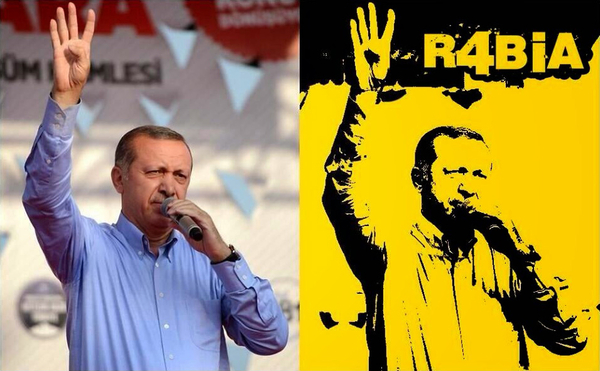
Later, Asmaa became another symbol for Turkish Islamists; Erdogan cheered party fans with the four-finger “Rabia” sign, in reference to his solidarity with the Muslim Brotherhood, and as a sign of his endearment for the unfortunate girl. Even on the playing field, a few footballers made the same sign after scoring.

859In this image, widely circulated in social media, Turkey’s then-Prime Minister [now President] Recep Tayyip Erdogan flashes the Egyptian Muslim Brotherhood’s four-fingered “Rabia” sign.

After the coup in Egypt, when el-Sisi ran for president and won the elections, Turkey’s Erdogan declared them “null and void.” And not just that. Erdogan also said that he did not view el-Sisi as “president of Egypt.” At another time, he said, “Turkey would not recognize the coup regime in Egypt.” Last July, he called el-Sisi “an illegitimate tyrant” and a “coup-maker.”

Meanwhile, neither was Erdogan a “rock star” in Cairo nor was Turkey “the most popular country.” Egyptian non-governmental organizations [NGOs] called on Egyptians and Arabs to boycott Turkish goods and soap operas. Egypt’s intellectuals, writers and businessmen were recommending a break in Egypt’s relations with Turkey because “they were disappointed.” Egypt unilaterally cancelled both visa-free travel for Turkish citizens and a transit agreement for Turkish trucks.

In the anti-el-Sisi campaign, Turkey was not alone. Its only regional ally, Qatar, fully supported Turkey against Egypt’s elected “coup leader.” Erdogan was happy. At least until a few days ago….

In Ankara, Erdogan was all smiles when he offered a red-carpet ceremony to the visiting Qatari Emir Sheikh Tamim bin Hamad al-Thani. Happy to have his best ally as a guest, Erdogan probably did not know the Emir’s next move on the Middle Eastern chessboard.

A few days after al-Thani’s merry visit to Ankara, Qatar announced its determination to thaw ties with Egypt, ending its alliance with Turkey over “Egypt’s illegitimate tyrant.”

“The security of Egypt is important for the security of Qatar … the two countries are linked by deep and fraternal ties,” ran a statement from the office of al-Thani on Dec. 21. It was a real cold shower on Ankara — and Erdogan. The statement had come one day after el-Sisi met in Cairo with a Qatari envoy, suggesting a possible thaw in relations. After the meeting, el-Sisi’s office issued a statement saying, “Egypt looks forward to a new era that ends past disagreements.” Apparently, the Egyptian-Qatari reconciliation had been brokered by Saudi Arabia and, once again, Turkey was the odd one out.

In its immediate vicinity, Turkey does not have diplomatic relations with three countries — Armenia, Cyprus and Syria — and has deeply problematic diplomatic relations with two countries: Israel and Egypt. This situation is not sustainable.

Even Deputy Prime Minister Bulent Arinc has said that Turkey should repair its relations with Egypt. But this is not an easy task. In the unlikely event of a reconciliation, Erdogan’s previous big words on el-Sisi the coup-maker will make him look like a leader shaking hands with an “illegitimate tyrant.”

On Dec. 24, Turkey’s foreign ministry spokesman said that bilateral ties with Egypt could “normalize if the country properly returns to democracy, if the Egyptian people’s free will is reflected in politics and social life.” Meaning, no normalization. The spokesman would not comment on Qatar’s policy change on Egypt.

Turkey aspires to be a regional leader with no, little or problematic dialogue with about a dozen countries in its region. Erdogan’s top advisors have found a nice euphemism for this situation: “precious loneliness.” In reality, it is rather a blend of miscalculation and over self-confidence.

Meshaal on point of relocating Hamas’ political headquarters from Doha to Tehran

December 27, 2014

Original posted by Dan Miller

Meshaal on point of relocating Hamas’ political headquarters from Doha to Tehran, DEBKAfile, December 27, 2014

Khaled_Mashaal_12.14Hamas’ Khaled Meshaal heads for new exile

Hamas’ political leader Khaled Meshaak, forced to quit his old headquarters in Damascus after abandoning his longtime host Bashar Assad and finding sanctuary in Doha – is again being hounded from pillar to post.

A deal struck this week between Egypt and Qatar could result in the Hamas leader settling in the Iranian capital. This would afford Tehran a foothold in the Gaza Strip, its second Mediterranean outpost after Lebanon on the Israeli border.

The Egyptian-Qatar deal, revealed here by DEBKAfile’s Middle East sources, covers the future of the Muslim Brotherhood, the nemesis of Egyptian President Abdel-Fatteh El-Sisis, and its offspring, the Palestinian Hamas, which rules the Gaza Strip. Their memorandum of understanding was concluded Wednesday, Dec. 24, in Cairo by a delegation of Qatari intelligence chiefs and the new Egyptian director of intelligence Gen. Khaled Fawzi. They spent most of the day hammering out its six points, which are listed here:

1.  Qatar withdraws its support from all Brotherhood operations against Egypt and Saudi Arabia;

2.  This point applies equally to any Hamas activity that may be interpreted as inimical to Egypt;

3.  Qatar’s assistance to Hamas will be limited to “civilian” projects (such as repairing war damage in Gaza), which too will be subject to President El-Sisi’s approval;

4. Given the close cooperation maintained at present between the Egyptian president and Israeli Prime Minister Binyamin Netanyahu on affairs relating to Gaza, Israel will implicitly have the right to disqualify certain Palestinian projects in the enclave;

5.  Qatar is to shut down the anti-Egyptian propaganda channel run by its Al Jazeera television station;

6.  The emirate is not required to sever all its ties with the Muslim Brotherhood and Hamas, just to keep them under control as its “strategic reserve.”

It is extremely hard to conceive of these two radical Islamist organizations bowing to the restrictions placed on their operations under the Egyptian-Qatari deal.

Brotherhood leaders have exited Doha and made arrangements to establish residence and a new center of operations in London, U.K.  Khaled Meshaal, after he was denied permission by Turkish President Tayyip Erdogan to set up shop in Istanbul, is on the point of a decision to relocate his offices in Tehran. Iran would thus gain a proxy foothold in the Gaza Strip, its second outpost on the Mediterranean after the first was provided by Hizballah in Lebanon. If Meshaal decided to settle in Tehran, Iran would acquire a handy springboard for action against Egypt and southern Israel.

EU Gives Hamas Green Light to Attack Israel

December 22, 2014

EU Gives Hamas Green Light to Attack Israel, Gatestone InstituteKhaled Abu Toameh, December 22, 2014

Although the EU court has said that its controversial decision was “technical” and was not a reassessment of Hamas’s classification as a terrorist group, leaders of the Islamist movement believe that the move will eventually earn them legitimacy in the international arena.

The EU court’s decision represents a “severe blow to the Palestinian Authority and Egypt,” according to Palestinian political analyst Raed Abu Dayer.

Any victory for Hamas, albeit a small and symbolic one, is a victory for the Islamic State, Al-Qaeda, Islamic Jihad, the Muslim Brotherhood and other fundamentalist groups, and causes tremendous damage to those Muslims who are opposed to radical Islam.

Hours before the EU court’s decision was made public, Hamas leader Mahmoud Zahar announced that his movement would never recognize Israel, and that Hamas seeks to overthrow the Palestinian Authority and seize control of the West Bank.

The EU court’s decision also coincided with a rapprochement between Hamas and Iran. Now, the Iranians and other countries, such as Turkey and Qatar, are likely to interpret the EU court’s decision as a green light to resume financial and military aid, including rockets and missiles, to Hamas — not only to Gaza but to the West Bank as well — to support those Palestinians whose aim it is to eliminate Israel.

Less than 48 hours after a top European Union court ruled that Hamas should be removed from the bloc’s list of terrorist groups, supporters of the Palestinian Islamist movement responded by firing a rocket at Israel. The attack, which did not cause any casualties or damage, did not come as a surprise.

Buoyed by the EU court’s ruling, Hamas leaders and spokesmen see it as a “political and legal achievement” and a “big victory” for the “armed struggle” against Israel.

Musa Abu Marzouk, a top Hamas leader, issued a statement thanking the EU court for its decision. He hailed the decision to remove his movement from the terrorist list as a “victory for all those who support the Palestinian right to resistance.”

When Hamas leaders talk about “resistance,” they are referring to terrorist attacks, such as the launching of rockets and suicide bombings against Israel. In other words, Hamas has interpreted the court’s decision as a green light to carry out fresh attacks as part of its ambition to destroy Israel.

The rocket that was fired from the Gaza Strip at Israel only days after the court decision is not likely to be the last.

Although the EU court has said that its controversial decision was “technical” and was not a reassessment of Hamas’s classification as a terrorist group, leaders of the Islamist movement believe that the move will eventually earn them legitimacy in the international arena.

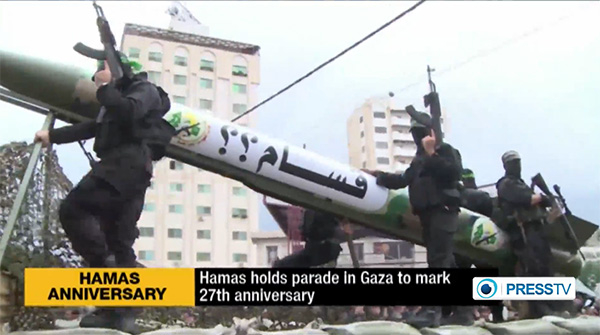
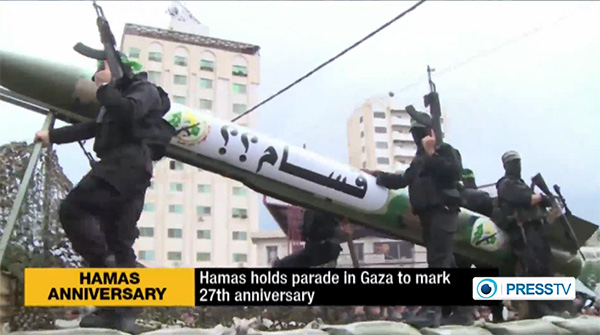
Ironically, the EU court’s decision coincided with Hamas celebrations marking the 27thanniversary of its founding. Once again, Hamas used the celebrations to remind everyone that its real goal is to destroy Israel. And, of course, Hamas used the event to display its arsenal of weapons that include various types of rockets and missiles, as well as drones.

845 (1)Thousands of armed Hamas troops showed off their military hardware at a Dec. 14, 2014 parade in Gaza, marking the organization’s 27th anniversary. (Image source: PressTV video screenshot)

Hours before the EU court decision was made public, Hamas leader Mahmoud Zahar announced that his movement would never recognize Israel. Zahar also made it clear that Hamas seeks to overthrow the Palestinian Authority [PA] regime and seize control over the West Bank.

The EU court’s decision also coincided with increased efforts to achieve rapprochement between Hamas and Iran. Recently, a senior Hamas leadership delegation visited Tehran as part of efforts to mend fences between the two sides. The main purpose of the visit was to persuade the Iranians to resume military and financial aid to Hamas. The visit, according to senior Hamas officials, appears to have been “successful.”

“There are many signs that our relations are back on the right track,” explained Hamas’s Musa Abu Marzouk. “Hamas and Iran have repaired their relations, which were strong before the Syrian crisis.” Relations between Hamas and Iran deteriorated due to the Islamist movement’s refusal to support the regime of Syrian President Bashar Assad.

Now the Iranians are likely to interpret the EU court decision to remove Hamas from the list of terrorist groups as a green light to resume financial and military aid to the movement.

Iran’s leaders recently announced that they intend to dispatch weapons not only to the Gaza Strip, but to the West Bank as well, as part of Tehran’s effort to support those Palestinians who are fighting to eliminate Israel.

Moreover, the EU court’s move will also embolden other countries that provide Hamas with political and financial aid, first and foremost Qatar and Turkey. Oil-rich Gulf countries such as Kuwait, Bahrain, Oman and Saudi Arabia will now face pressure from many Arabs and Muslims to join Qatar, Turkey and Iran in extending their support to Hamas.

The biggest losers, meanwhile, are Palestinian Authority President Mahmoud Abbas and Egypt’s President Abdel Fattah el-Sisi. Over the past few months, the two men have been doing their utmost to undermine Hamas and end its rule over the Gaza Strip.

Abbas has been fighting Hamas by blocking financial and humanitarian aid and arresting its supporters in the West Bank, while Sisi continues to tighten the blockade on the Gaza Strip and destroy dozens of smuggling tunnels along the border with Egypt.

The EU court’s decision represents a “severe blow to the Palestinian Authority and Egypt,” noted Palestinian political analyst Raed Abu Dayer. “As far is Abbas is concerned, the decision grants Hamas political legitimacy and challenges his claim to be the sole legitimate leader [of the Palestinians]. With regards to Egypt, the European court decision calls into question rulings by Egyptian courts that Hamas is a terrorist organization.”

Even if the EU court decision is reversed in the future, there’s no doubt that it has already caused tremendous damage, especially to those Muslims who are opposed to radical Islam.

Any victory for Hamas, albeit a small and symbolic one, is a victory for the Islamic State, Al-Qaeda, Islamic Jihad, the Muslim Brotherhood and other fundamentalist groups around the world.

The decision has left many Arabs and Muslims with the impression that Hamas, after all, is not a terrorist organization, especially if non-Muslims in Europe say so through one of their top courts. Even worse, the decision poses a real and immediate threat to Israel, as evident from the latest rocket attack.

If the Europeans have reached the conclusion that Hamas is not a terrorist organization, then why don’t their governments openly invite tens of thousands of Hamas members and supporters to move to London, Paris and Rome? And they should not forget to ask the Hamas members to bring along with them their arsenal of weapons.

How Western Media Enable Islamic Terrorism

December 19, 2014

How Western Media Enable Islamic Terrorism, Front Page Magazine, December 19, 2014

(Please see also Sharyl Attkisson’s Stonewalled for explanations of what happens in the legitimate “news” media and why. — DM)

la-epa-egypt-unrest2-jpg-20130819-450x300

If the West is experiencing a rise in the sort of terror attacks that are endemic to the Islamic world—church attacks, sex-slavery and beheadings—it was only natural that the same mainstream media that habitually conceals such atrocities, especially against Christians and other minorities under Islam, would also conceal the reality of jihadi aspirations on Western soil.

As The Commentator reports:

[T]he level of the [media] grovelling after the tragic and deadly saga in Sydney Australia over the last 24 hours has been astounding.

At the time of writing, the lead story on the BBC website is of course about that very tragedy, in which an Islamist fanatic took a random group hostage in a cafe, ultimately killing two of them.

He did this in the name of Islam. But you wouldn’t get that impression if you started to read the BBC’s lead story, which astoundingly managed to avoid mentioning the words Islam, Islamic, Islamist, Muslim, or any derivations thereof for a full 16 paragraphs. The New York Times, which led by calling the terrorist, Man Haron Monis an “armed man”, waited until paragraph 11.

In the Guardian’s main story – whose lead paragraph simply referred to a “gunman” — you had to wait until paragraph 24.

If you’d have blinked, you’d have missed it.

….

In the wider media, reports about Muslim fears of a “backlash” have been all but ubiquitous.

If these are the lengths that Western mainstream media go to dissemble about the Islamic-inspired slaughter of Western peoples, it should now be clear why the ubiquitous Muslim persecution of those unfashionable Christian minorities is also practically unknown by those who follow Western mainstream media.

As with the Sydney attack, media headlines say it all. The 2011 New Year’s Eve Coptic church attack that left 28 dead appeared under vague headlines: “Clashes grow as Egyptians remain angry after attack,”was the New York Times’ headline; and “Christians clash with police in Egypt after attack on churchgoers kills 21” was the Washington Post’s—as if frustrated and harried Christians lashing out against their oppressors is the “big news,” not the unprovoked atrocity itself; as if their angry reaction “evens” everything up.

Similarly, the Los Angeles Times partially told the story of an Egyptian off-duty police officer who, after identifying Copts by their crosses on a train, opened fire on them, killing one, while screaming “Allahu Akbar”—but to exonerate the persecution, as caught by the report’s headline: “Eyewitness claims train attacker did not target Copts, state media say.”

A February 2012 NPR report titled “In Egypt, Christian-Muslim Tension is on the Rise,” while meant to familiarize readers with the situation of Egypt’s Christians, prompts more questions than answers them: “In Egypt, growing tensions between Muslims and Christians have led to sporadic violence [initiated by whom?]. Many Egyptians blame the interreligious strife on hooligans [who?] taking advantage of absent or weak security forces. Others believe it’s because of a deep-seated mistrust between Muslims and the minority Christian community [what are the sources of this “mistrust”?].”

The photo accompanying the story is of angry Christians holding a cross aloft—not Muslims destroying crosses, which is what prompted the former to this display of Christian solidarity.

Blurring the line between victim and oppressor—recall the fear of “anti-Muslim backlashes” whenever a Muslim terrorizes “infidels” in the West—also applies to the media’s reporting on Muslim persecution of Christians.

A February 2012 BBC report on a church attack in Nigeria that left three Christians dead, including a toddler, objectively states the bare bone facts in one sentence.  Then it jumps to apparently the really big news: that “the bombing sparked a riot by Christian youths, with reports that at least two Muslims were killed in the violence. The two men were dragged off their bikes after being stopped at a roadblock set up by the rioters, police said. A row of Muslim-owned shops was also burned…”

The report goes on and on, with an entire section about “very angry” Christians till one confuses victims with persecutors, forgetting what the Christians are “very angry” about in the first place: nonstop terror attacks on their churches and the slaughter of their women and children.

A New York Times report that appeared on December 25, 2011—the day after Boko Haram bombed several churches during Christmas Eve services, leaving some 40 dead—said that such church bombings threaten “to exploit the already frayed relations between Nigeria’s nearly evenly split populations of Christians and Muslims…”  Such an assertion suggests that both Christians and Muslims are equally motivated by religious hostility—even as one seeks in vain for Christian terror organizations that bomb mosques in Nigeria to screams of “Christ is Great!”

Indeed, Boko Haram has torched 185 churches—to say nothing of the countless Christians beheaded—in just the last few months alone.

Continuing to grasp for straws, the same NYT report suggests that the Nigerian government’s “heavy-handed” response to Boko Haram is responsible for its terror, and even manages to invoke another mainstream media favorite: the poverty-causes-terrorism myth.

Whether Muslim mayhem is taking place in the Islamic or Western worlds, the mainstream media shows remarkable consistency in employing an arsenal of semantic games, key phrases, convenient omissions, and moral relativism to portray such violence as a product of anything and everything—political and historical grievances, “Islamophobia,” individual insanity, poverty and ignorance, territorial disputes—not Islam.

As such, Western mainstream media keep Western majorities in the dark about the Islamic threat, here and abroad.  Thus the “MSM” protects and enables the Islamic agenda—irrespective of whether its distortions are a product of intent, political correctness, or sheer stupidity.

The Countdown to the Next Gaza Conflict Has Begun

December 19, 2014

The Countdown to the Next Gaza Conflict Has Begun, Gatestone InstituteYaakov Lappin, December 19, 2014

(Please see also Hamas reconstructing terror tunnels using Israeli materials. — DM)

Hamas could, with a fair amount of ease, cause Israel to end its security blockade by accepting the terms of the international Quartet. These include recognizing the state of Israel, renouncing violence and abiding by past agreements.

Of course, those would contravene Hamas’s ideology of Islamist jihad and move it away from its current trajectory of organized violence and religious hatred, the foundations upon which it was established in the 1980s by the Muslim Brotherhood.

For now, it seems, Hamas will try, as it has been doing for months, to orchestrate terrorism in the West Bank, on the opposite side of Israel, while upholding its truce in Gaza.

The Israel Defense Forces, too, has spent recent months preparing to respond if there is a fresh round of hostilities.

More than three months have passed since the end of the fifty-day conflict between Hamas in Gaza and Israel this past summer, yet all of the catalysts that helped spark that war remain in place and are pushing the sides into their next clash.

845Thousands of armed Hamas troops showed off their military hardware at a Dec. 14, 2014 parade in Gaza, marking the organization’s 27th anniversary. (Image source: PressTV video screenshot)

One of the reasons Hamas launched a war in July this year was to try to end its strategic isolation, which became severe after the downfall of the Muslim Brotherhood in next-door Egypt. Hamas also sought to improve its crumbling economic situation as the ruler of the Gaza Strip; its dire situation was illustrated by Hamas’s inability to pay 40,000 of its Gazan employees their monthly salaries.

Hamas could, with a fair amount of ease, cause Israel to end its security blockade by accepting the terms of the international Quartet. These would include recognizing the state of Israel, renouncing violence and abiding by previous diplomatic agreements. Of course, those would contravene Hamas’s ideology of Islamist jihad and move it away from its current trajectory of organized violence and religious hatred, the foundations upon which it was established in the 1980s by Palestinian members of the Muslim Brotherhood.

Today, however, the same problems that plagued Hamas prior to the summer war have become worse. Gaza is hemmed in to the south by a hostile Egypt under the rule of President Abdel Fattah El-Sisi. Egypt is systematically cutting off the smuggling tunnels that linked Sinai to the Gaza Strip. This means that Hamas is no longer easily able to smuggle either weapons or goods it can tax before they enter Gaza’s market.

Israel’s naval security blockade, designed to prevent the smuggling of arms or materiel that can be used to build weapons, remains in place, as does Israel’s tight security control of its border crossings with the Gaza Strip. Israel has in recent months begun permitting the entry of construction materials to encourage Gaza’s reconstruction efforts, and assisted in the export of Gazan agricultural goods to places such as the West Bank.

Most critically, however, Hamas’s hopes for $5.4 billion of international aid money, pledged by donor states for Gaza’s post-war recovery, remain unrealized. The money has barely begun to trickle in, due to an ongoing crisis with the Fatah-run Palestinian Authority [PA] in Ramallah.

Under the terms set by the international community, the money must enter Gaza through a joint PA-Hamas mechanism. Due to ongoing Fatah-Hamas divisions, such a mechanism appears far from being built.

The latest illustration of these intra-Palestinian tensions can be found in the coordinated, multiple bomb attacks in November on the homes of Fatah officials in Gaza — attacks carried out by Hamas’s military wing.

Meanwhile, the approximately 100,000 Gazans whose homes were destroyed by the fighting in the summer remain without a fixed roof over their heads in the winter, creating another source of pressure on Hamas.

These factors have led Hamas’s military wing to warn publicly that a new explosion of violence against Israel is imminent. “We are saying to all sides — if the siege on Gaza and the obstacles for reconstruction remain, there will be a new explosion,” stated Abu Obeida, the spokesman of Hamas’s military wing, the Ezzedine al-Qassam Brigades.

The warning was answered this week by Israel’s Defense Minister, Moshe Ya’alon, who said, “We now base the quiet in the Gaza Strip on deterrence. At this stage they are deterred, but we must be ready at any given time for the possibility that we will have to again act with full force.”

While it would not be in Hamas’s interests to spark a new destructive conflict so soon after a bruising one, if faced with the possibility that its regime in Gaza might collapse, it may decide to do so.

Hamas has, since the moment that hostilities ended in August, resumed rocket production in Gazan plants, albeit at a slower rate than before the conflict. Hamas has also most likely restarted work to dig more tunnels from Gaza into Israel, which are designed to inject guerrilla squads into Israel to commit terrorist kidnappings and murders.

The Israel Defense Forces, too, has spent recent months preparing to respond if there is a fresh round of hostilities. It assesses that Israeli deterrence has been fully replenished; it is also reluctantly prepared should the volatile situation in Gaza push deterrence aside.

For now, it seems, Hamas in Gaza will try, as it has been doing in recent months, to orchestrate terrorism in the West Bank, on the opposite side of Israel, while upholding its truce in Gaza. If Hamas’s standoff with Fatah continues, however, and the host of factors that pushed Hamas into the last war do not change, the countdown to the next war may be shorter than many think.