Archive for the ‘Clinton’ category

Is Biden’s Israel visit opening shot for White House bid?

March 7, 2016

Is Biden’s Israel visit opening shot for White House bid? DEBKAfile, March 7, 2016

Clinton_BidenKotere480t

US Vice President Joe Biden will start his five-day Middle East tour in Israel Tuesday, March 8, by presenting the multibillion financial and defense aid package promised by the Obama administration to redress the imbalance in Israeli security generated by the nuclear deal with Iran. DEBKAfile’s sources report that Prime Minister’s Binyamin Netanyahu was also quietly tipped from Biden’s close circle that he may decide to use the handover of this package as the opening shot of his run for the Democratic presidential nomination, despite past repudiations.

Our sources in Jerusalem reveal that Israeli officials in charge of staging the Biden visit were directed to handle the visitor to all intents and purposes as a candidate running for election to the White House on Nov. 4.

His presentation of an impressive US assistance program is meant to convey President Barack Obama’s desire to straighten out his rocky relations with Netanyahu before his departure, while also portraying his vice president to American Jews as a successor who will continue to look after Israel’s security interests.

The two governments have been negotiating for months on the size of US military assistance committed by Washington for preserving Israel’s qualitative military and security edge in the next decade, in the course of which Iran and the Islamic Republic’ will substantially upgrade the military capabilities of its armed forces and radical Revolutionary Guards Corps.

In recent talks between US Defense Secretary Ashton Carter and Israel’s Defense Minister Moshe Ya’alon, Israel put in a bid for $50 billion to be spread over 10 years, so raising the US military aid package for Israel from $3.5 bn to $5 bn a year. The Americans said this sum required further negotiation.

According to sources close to the prime minister, the vice president will be bringing the administration’s compromise proposal of between $40 billion and $50 billion, to be spread out over 13-15 years. He will also throw in to the deal US weaponry and items of cutting-edge military technology withheld hitherto from the IDF.

That list was agreed last week when Gen. Joseph Dunford, the Chairman of the US Chiefs of Staff sat down in Tel Aviv with IDF chief of staff Lt. Gen. Gady Eisenkot and his top officers.

As for Biden’s intentions, it should be noted that, although in February, he denied intending to contest the presidential nomination, he surprised political observers when, on Feb. 19, he sharply criticized the campaigns run by Democratic hopefuls Hillary Clinton and Senator Bernie Sanders. He accused them of “doom and gloom” and not doing enough to combat the idea that the country is in decline.

Talking to a Democratic Party audience in California on Feb. 28, Biden congratulated Clinton on her successes in the primaries.

Political observers who are familiar with the vice president’s thought patterns say those comments were well calculated. They expect him to continue to stay in the wings of the campaign and watch Hillary get tied in knots over events in her past, not least the affair of the private emails she sent as Secretary of State. He expects her to be forced by the baggage she carries to give up her run for the presidency. Biden will then step in as the shining savior of the Democratic Party.  He and many of his backers are sure that he is the only Democrat capable of stopping Donald Trump’s inexorable run for the presidency.

At the annual Gridiron Club anniversary dinner Saturday night, March 5, Joe Biden was reported to have quoted a reputed comment by Winston Churchill, “When eagles are silent, the parrots begin to jabber,” he said, adding: “Our kids are watching. The world is watching. The American people are better than this.”

These remarks indicate that Biden is guided by a strong sense of mission.

Off Topic | Deserve Hillary? Then vote for her

March 3, 2016

Deserve Hillary? Then vote for her, Dan Miller’s Blog, March 3, 2016

(The views expressed in this post are mine and do not necessarily reflect those of Warsclerotic or its other editors. — DM)

Democrats have done a bang up job for their people for the last fifty years. Want more of the same? Vote for Hillary.


https://www.youtube.com/watch?v=BFXwg7U_-DU


How about Mit Romney? Surely, he must be right. After all, the proud godfather of ObamaCare did so well in 2012. His part of the video starts at 23:00.


https://www.youtube.com/watch?v=JfTtyBStFHQ


So, all of you RINOs who prefer Hillary to Trump, have at it. Heck, with the RINOs and the Dems in charge, the country will stay in the very best of hands.


UN: ISIS expanding in Libya

November 17, 2015

UN: ISIS expanding in Libya, Front Page Magazine, Daniel Greenfield, November 17, 2015

Libya

According to Obama, ISIS has been contained. But the UN tells a different story. Not about Iraq, but Obama’s own war of choice in Libya.

Islamic State militants have consolidated control over central Libya, carrying out summary executions, beheadings and amputations, the United Nations said on Monday in a further illustration of the North African state’s descent into anarchy.

All sides in Libya’s multiple armed conflicts are committing breaches of international law that may amount to war crimes, including abductions, torture and the killing of civilians, according to a U.N. report.

Obama and Hilllary’s regime change plan for Libya really worked out. It worked so well that neither of them wants to talk about it.

Islamic State (IS) has gained control over swathes of territory, “committing gross abuses including public summary executions of individuals based on their religion or political allegiance”, the joint report by the U.N. High Commissioner for Human Rights and the U.N. Support Mission in Libya said.

It’s like the time that Hillary said, “We came, we saw, he died.” Except ISIS does that sort of thing for real.

But if you listen to the White House terrorsplain all this. ISIS attacked Paris because it’s weak. Obama is unable to defeat ISIS because he’s so strong. Black is white. Up is down. Lies are truth.

Madam Hillary is on the right side of herstory

October 25, 2015

Madam Hillary is on the right side of herstory, Dan Miller’s Blog, October 25, 2015

(The views expressed in this article are mine, and do not necessarily reflect those of Warsclerotic or its other editors.– DM)


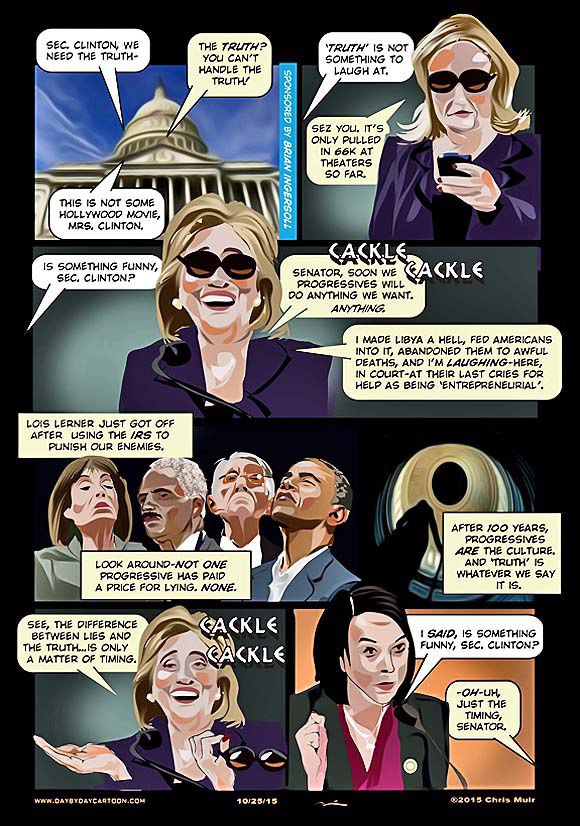
Lies are good and truth is bad because truth would damage Madam Hillary’s and even Imam Obama’s sterling images. Both, bravely and proudly, try to feed us what is “good.” Their people love it, so what difference does it make? 

1025151 (1)

According to John Hinderaker at Power Line, Madam Hillary

lies…it’s not exactly a news flash. On the contrary, based on the liberal media’s reaction to her Benghazi testimony, her willingness to lie, brazenly, is a positive virtue.

There’s always an excuse for having “misspoke.” It need not be a credible excuse, because an incredible excuse works just fine. Anyway, whatever happened was in the past and therefore doesn’t matter now:

What has Imam Obama lied about? Plenty. Here’s an incomplete list: Islam, the nuke “deal” with Iran, Libya, His strength and Putin’s weakness in the Middle East, Israel, Immigration, Crime, Obamacare, race relations and on and on and on. As with Madam Hillary’s spewings, the “legitimate media” generally love it.

Madam Hillary blamed the video repeatedly

According to an article titled “I didn’t blame the video,” Madam Hillary did just that while also managing to lie about substantially more than that.

Hillary simply adores arguing and lawyering.

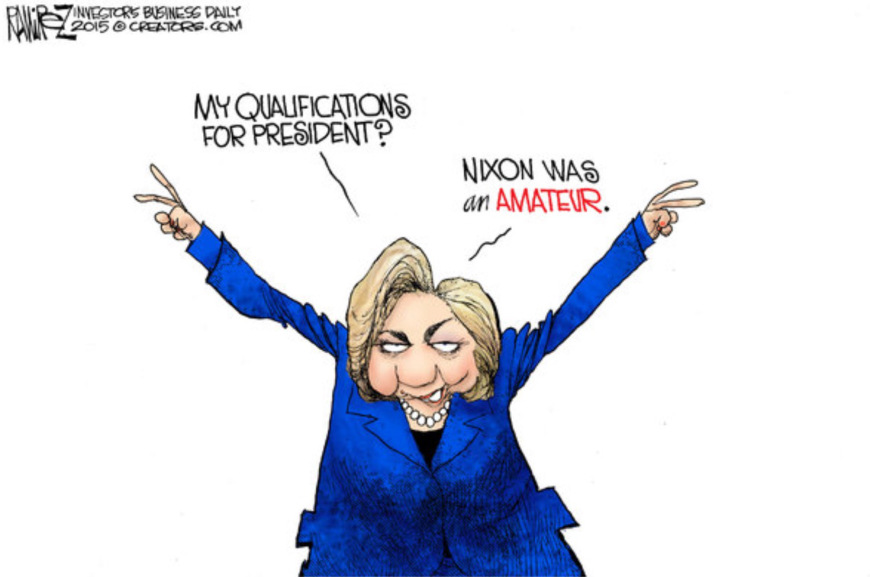
She lives for it and has at least since she was fired from the House Judiciary Committee during its investigation of the Watergate scandal that eventually brought down President Richard M. Nixon in 1974. Hillary’s then-supervisor, lifelong Democrat Jerry Zeifman, said he canned the 27-year-old attorney “because she was a liar … an unethical, dishonest lawyer. She conspired to violate the Constitution, the rules of the House, the rules of the committee and the rules of confidentiality.” [Emphasis added.]

No lie is too big or too small for Hillary, whether it’s a concocted tale of being under enemy fire at an airport in Bosnia, the existence of a “vast right-wing conspiracy” to undermine her husband’s presidency, that she was named after Mt. Everest climber Sir Edmund Hillary even though he rocketed to fame by accomplishing the feat when she was a six-year-old, or that the Clintons were “dead broke” when they exited the White House.

Meanwhile, at the Thursday hearing, Rep. Jim Jordan (R-Ohio) demolished Clinton’s apparently fresh assertion at the hearing that she didn’t actually claim an obscure anti-Islam movie trailer posted on YouTube prompted the terrorist assault in Benghazi on the eleventh anniversary of the 9/11 attacks. She now takes a more nuanced, twisted-like-a-pretzel position in which maybe some non-terrorist Muslims were suddenly stirred to violence in Libya by the video, but really at the same time it was a terrorist attack, something she testified Thursday has been her position the whole time. She talked about the video publicly not to point fingers but as a warning, she testified, to those who might attack U.S. interests in the region. In other words, like a good defense lawyer, Hillary was trying to confuse the issues and muddy the waters. [Emphasis added.]

. . . .

While she was informing the American public that the anti-Islam video was what caused the attack, at the same time she emailed her daughter Chelsea and the governments of Libya and Egypt to pin the blame on Muslim militants, Jordan explained. Around the same time the White House, in the closing weeks of a heated presidential election campaign, was pushing the line that what transpired in Benghazi was a spontaneous demonstration turned violent, but terrorism was not a factor.

“We know that the attack in Libya had nothing to do with the film,” Clinton wrote Egypt’s prime minister the night of the attack. “It was a planned attack, not a protest.” But in public Clinton continued to blame the “offensive” video. The U.S. government acquired $80,000 worth of commercial airtime in Pakistan to apologize for the YouTube clip. [Emphasis added]

Jordan pointed out that there was no video-inspired protest over in Benghazi on Sept. 11, 2012, but there was one in Cairo, Egypt. The same day State Department spokeswoman Victoria Nuland said “Benghazi has been attacked by militants. In Cairo, police have removed demonstrators.”

You want to talk about Madam Hillary’s lies? She didn’t lie, of course, but let’s change the subject to something more important. Right now.

hillary-Nixon-copy


Conclusions

“Her people” not only don’t care, they are delighted with Madam Hillary’s numerous lies. Again, “what difference does it make?” Plenty.

Please think about Madam Hillary’s and Imam Obama’s impunity — and readiness —  to lie, violate laws and do pretty much whatever they please. We have become a nation without law enforcement where we need it most and very much where enforcement of Obama’s executive decrees harms us greatly (climate change and immigration for example). Do we want a nation the governance of which is increasingly based on, and perpetuated through, lies to “We the people?” Do we want Madam Hillary or another Obama clone as the next Commander in Chief?

Here’s what “Commander in Chief” Obama has done with his our military:

Do you approve of those and the other things He has done to our military? Want more of the same? Or even worse? If not, what can we do about it? Supporting Donald Trump may or may not be what we should do, but I think the songs in the video are superb. Back in September, I wrote an article titled To bring America back we need to break some stuff. We still do, and if someone other than Trump is ready, willing and able he (or, of course, she) should also be considered, very seriously.;

Nuclear Fiascoes: From Diplomatic Failure With North Korea To Debacle With Iran

September 1, 2015

Nuclear Fiascoes: From Diplomatic Failure With North Korea To Debacle With Iran, Forbes, Claudia Rosett, August 31, 2015

(An excellent comparison of the machinations that led to the nuke “deal” with North Korea and those now leading to the “deal” with the Islamic Republic of Iran. — DM)

[B]oth Clinton and Bush purchased the transient gains of North Korean nuclear deals at the cost of bolstering a North Korean regime that has become vastly more dangerous. . . . Kim Jong Un bestrides a growing arsenal of weapons of mass murder, including chemical and biological, as well as nuclear, plus a growing cyber warfare capability. This is the legacy not least of North Korea’s skill at exploiting the feckless nuclear deals offered by U.S. presidents whose real achievements on this front were to hand off a monstrous and rising threat to the next administration.

Now comes the Iran nuclear deal, which President Obama has described as a perhaps once-in-a-lifetime “historic chance to pursue a safer and more secure world.” And from Israel’s Prime Minister Netanyahu, leader of America’s closest ally and Iran’s prime target in the Middle East, comes the warning that this deal is a “stunning historic mistake,” configured not to block Iran’s path to the bomb, but to pave the way.

Like the North Korea Agreed Framework, the Iran nuclear deal pivots narrowly on nuclear issues, as if ballistic missiles, terrorism, arms smuggling, gross violations of human rights, blatant declarations of destructive intent and the malign character of the regime itself were irrelevant to the promised “exclusively peaceful” nuclear program.

[I]f this Iran deal goes through, is that we are about to see the mistakes made with North Korea amplified on a scale that augurs not security in the 21st century, but a soaring risk of nuclear war.

************************

With Congress due to vote by Sept. 17 on the Iran nuclear deal, there’s a warning worth revisiting. It goes like this: The president is pushing a historic nuclear agreement, saying it will stop a terror-sponsoring tyranny from getting nuclear weapons. And up pipes the democratically elected leader of one of America’s closest allies, to say this nuclear deal is mortal folly. He warns that it is filled with concessions more likely to sustain and embolden the nuclear-weapons-seeking despotism than to disarm it.

This critic has more incentive than most to weigh the full implications of the deal, because his country is most immediately in harm’s way — though it has not been included in the nuclear talks. He notes that the nuclear negotiators have sidelined such glaring issues as human rights, and warns that Washington is naive, and the U.S. is allowing itself to be manipulated by a ruthless dictatorship.

No, the critic I’m referring to is not Israel’s Prime Minister Benjamin Netanyahu, though he has warned of precisely such dangers in the Iran nuclear deal. I am citing the warnings voiced 21 years ago by the then-President of South Korea, Kim Young Sam, as the Clinton administration bargained its way toward the 1994 nuclear deal with North Korea known as the Agreed Framework.

As it turned out, Kim Young Sam’s misgivings were right on target. The 1994 Agreed Framework did not stop North Korea’s pursuit of the bomb. Instead, it became a pit stop on North Korea’s road to the nuclear arsenal it is amassing today.

For all the differences between North Korea and Iran, there are parallels enough to suggest that the failed 1994 nuclear bargain with North Korea is an excellent guide to the future trajectory with Iran, if the U.S. goes ahead with the nuclear deal — the Joint Comprehensive Plan of Action — announced by the U.S., France, Britain, Germany, Russia, China and Iran on July 14 in Vienna.

Recall that in 1994, faced with the threat of North Korea producing plutonium for nuclear weapons, the U.S. sought a diplomatic solution. Taking a cue from an exploratory trip to Pyongyang by former President Jimmy Carter, the Clinton administration wooed North Korea with an offer of lightwater nuclear reactors to be used exclusively for the peaceful production of electricity. All Pyongyang had to do was give up its nuclear bomb program.

As this agreement was taking shape, South Korea’s Kim Young Sam laid out his concerns in an hourlong interview with the New York Times. In the resulting article, dated Oct. 8, 1994, the Times reported: “After weeks of watching in silent frustration as the United States tries to negotiate a halt to North Korea’s nuclear program, President Kim Young Sam of South Korea lashed out at the Clinton administration today in an interview for what he characterized as a lack of knowledge and an overeagerness to compromise.”

The Times article described Kim’s concerns that “compromises might prolong the life of the North Korean government and would send the wrong signal to its leaders.” Kim was quoted as denouncing the deal then in the making as a “half-baked compromise” which would lead to “more danger and peril.”

President Clinton rolled right past that warning. On Oct. 21, 1994, less than two weeks after Kim’s concerns hit the headlines, the U.S. signed the Agreed Framework with North Korea. Clinton praised the deal as “good for the United States, good for our allies, and good for the safety of the entire world.” Promising that the Agreed Framework would reduce the threat of nuclear proliferation, Clinton further lauded the deal as “a crucial step for drawing North Korea into the global community.”

South Koreans and their leaders, in the main, disagreed. But with South Korea dependent on the U.S. superpower for defense against North Korea, Kim Young Sam had little choice but to follow Clinton’s lead. Seoul damned the deal with faint praise. The Associated Press reported: “South Korean Foreign Minister Han Sung-joo said that even though the deal fell short of expectations, it met South Korea’s minimum policy goals.”

History now shows that the chief policy goals served by the Agreed Framework were those of Pyongyang, which racked up a highly successful exercise in nuclear extortion, and carried on, first secretly, then overtly, with its nuclear weapons program. As South Korea’s president had predicted, the Agreed Framework helped fortify Pyongyang’s totalitarian regime, rather than transforming it.

Some of the negotiators involved in that 1994 deal have since argued that while the North Korean agreement eventually collapsed, it did at least delay Pyongyang’s progress toward nuclear weapons. What they tend to omit from that select slice of history is that the Agreed Framework helped rescue a North Korean regime which in 1994 was on the ropes. Just three years earlier, North Korea’s chief patron of decades past, the Soviet Union, had collapsed. The longtime Soviet subsidies to Pyongyang had vanished. China did not yet have the wealth to easily step in. And just three months before the nuclear deal was struck, North Korea’s founding tyrant, Kim Il Sung, died. His son and heir, Kim Jong Il, faced the challenge of consolidating power during a period of famine at home and American superpower ascendancy abroad.

But in the game of nuclear chicken, it was America that blinked. In exchange for North Korea’s promise to freeze and eventually dismantle its nuclear weapons program, the U.S. agreed to lead a $4.6 billion consortium to build two lightwater reactors for North Korea, and provide shipments of free heavy fuel oil for heating and electricity production while the new reactors were being built. This was augmented by U.S. security guarantees, easing of sanctions and promises to move toward normalizing diplomatic relations, with generous food aid thrown in.

By the late 1990s, just a few years into the deal, North Korea had become the largest recipient of U.S. aid in East Asia. That did not curb Kim Jong Il’s hostile ways. The Pyongyang regime put the interests of its military and its weapons programs before the needs of its starving population. In 1998, North Korea launched a long-range missile over Japan, a test for which it was hard to discern any purpose other than developing a vehicle to carry nuclear weapons. By that time, as a number of former Clinton administration officials have since confirmed, the U.S. was seeing signs that North Korea was cheating on the nuclear deal by pursuing a secret program for uranium enrichment.

Instead of confronting North Korea, Clinton during his last two years in office tried to double down on his crumbling nuclear deal by pursuing a missile deal with Pyongyang. In 2000, that led to an exchange of high-ranking officials, in which the Clinton administration dignified North Korea with the unprecedented move of welcoming one of its top-ranking military officials, Vice Marshal Jo Myong Rok, to a 45-minute sitdown with Clinton at the White House. Clinton then dispatched Secretary of State Madeleine Albright, together with the administration’s special advisor for North Korea policy, Wendy Sherman, to Pyongyang (yes, the same Wendy Sherman recently employed by Obama as chief negotiator of the Iran nuclear deal). Sherman and Albright brought North Korea’s Kim Jong Il a basketball signed by star player Michael Jordan; Kim entertained them with a stadium flip-card depiction of a long-range missile launch. There was no missile deal.

North Korea continued raking in U.S. largesse until late 2002, when the Bush administration finally confronted Pyongyang over its nuclear cheating. North Korea then walked away from the 1994 deal (on which it had by then been cheating for years), withdrew from the Non-Proliferation Treaty (on which it had also been cheating) and began reprocessing plutonium from the spent fuel rods which despite the 1994 deal had never been removed from its Yongbyon nuclear complex. President Bush then made his own stab at nuclear diplomacy, via the Six-Party Talks. North Korea punctuated that process in Oct. 2006 with its first nuclear test. In 2007, the Bush administration led the way to a Six-Party denuclearization deal with North Korea, bull-dozing ahead even after it became clear that North Korea had been helping Syria build a secret copy of North Korea’s plutonium-producing Yongbyon reactor (destroyed in Sept. 2007 by an Israeli air strike). Once again, North Korea took the concessions, cheated on the deal and in late 2008 walked away.

Since Obama took office, North Korea has carried out its second and third nuclear tests, in 2009 and 2013; restarted its plutonium-producing reactor at Yongbyon; and in 2010 unveiled a uranium enrichment plant, which appears to have since at least doubled in size. Having equipped itself with both uranium and plutonium pathways to the bomb, North Korea is now making nuclear weapons, and developing increasingly sophisticated missiles — including long-range — to deliver them.

In sum, both Clinton and Bush purchased the transient gains of North Korean nuclear deals at the cost of bolstering a North Korean regime that has become vastly more dangerous. When Kim Jong Il died in late 2011, North Korea’s regime managed a second transition of power, to third-generation Kim family tyrant Kim Jong Un — who was described last year by the commander of U.S. Forces in Korea, General Curtis Scaparrotti, as “overconfident and unpredictable.” Kim Jong Un bestrides a growing arsenal of weapons of mass murder, including chemical and biological, as well as nuclear, plus a growing cyber warfare capability. This is the legacy not least of North Korea’s skill at exploiting the feckless nuclear deals offered by U.S. presidents whose real achievements on this front were to hand off a monstrous and rising threat to the next administration.

Now comes the Iran nuclear deal, which President Obama has described as a perhaps once-in-a-lifetime “historic chance to pursue a safer and more secure world.” And from Israel’s Prime Minister Netanyahu, leader of America’s closest ally and Iran’s prime target in the Middle East, comes the warning that this deal is a “stunning historic mistake,” configured not to block Iran’s path to the bomb, but to pave the way.

There are surely dissertations to be written on the intricate differences between the North Korea Agreed Framework and the Iran nuclear deal now before Congress. But important and alarming similarities abound.

Like the North Korea deal, the Iran deal dignifies a despotic, murderous regime, and provides its worst elements with relief from economic distress, via a flood of rejuvenating resources. In North Korea’s case, the main help arrived in the form of aid. In oil-rich Iran’s case, it comes in the far more lucrative form of sanctions relief, including access to an estimated $55 billion or more (by some estimates, two or three times that amount) in currently frozen funds held abroad.

Like the North Korea Agreed Framework, the Iran nuclear deal pivots narrowly on nuclear issues, as if ballistic missiles, terrorism, arms smuggling, gross violations of human rights, blatant declarations of destructive intent and the malign character of the regime itself were irrelevant to the promised “exclusively peaceful” nuclear program.

Like the North Korea deal, the Iran deal comes loaded with incentives for the U.S. administration to protect its own diplomatic claims of success by ignoring signs of cheating. Monitoring of nuclear facilities is shunted to the secretive International Atomic Energy Agency, which has no power of enforcement, and will have to haggle with Iran for access to suspect sites.

Like Clinton with North Korea, Obama chose to frame the Iran deal not as a treaty, but as an executive agreement, performing an end-run around vigorous dissent within Congress by submitting the deal pronto for approval by the United Nations Security Council. In the North Korean case, the Security Council gave its unanimous blessing in the form of a presidential statement. In the Iran case, the Obama administration drafted a resolution which the Security Council unanimously approved. Having hustled the deal directly to the U.N., despite legislation meant to ensure Congress a voice, Obama administration officials are now pressuring Congress to defer to the U.N.

To be sure, there are two highly significant differences between the 1994 North Korea deal and the 2015 Iran deal. Iran, with its oil wealth, location in the heart of the Middle East, messianic Islamic theocracy and global terror networks, is even more dangerous to the world than North Korea. And, bad as the North Korea deal was, the Iran deal is much worse. Along with its secret side agreements and its promises to lift the arms embargo on Iran in five years and the missile embargo in eight, this deal lets Iran preserve its large illicitly built nuclear infrastructure and carry on enriching uranium, subject to constraints that will be problematic to enforce, and are themselves limited by sunset clauses that even North Korea never managed to obtain at the bargaining table.

When Israel’s Netanyahu spoke this past March to a joint meeting of Congress, warning that the Iran nuclear deal would lead to “a much more dangerous Iran, a Middle East littered with nuclear bombs and a countdown to a potential nuclear nightmare,” Obama dismissed that speech as “nothing new.” That’s true, in the sense that we have heard similar warnings before. What’s new, if this Iran deal goes through, is that we are about to see the mistakes made with North Korea amplified on a scale that augurs not security in the 21st century, but a soaring risk of nuclear war.
Hillary Clinton is the X-factor for the Iranian nuclear deal’s congressional survival

July 13, 2015

Hillary Clinton is the X-factor for the Iranian nuclear deal’s congressional survival, DEBKAfile, July 13, 2015

Clinton_7.15Hillary Clinton faces tough decision

“A parade of concessions to Iran,” was Israeli Prime Minister Binyamin Netanyahu’s comment on the nuclear accord expected to be announced and fully revealed later on Monday July 13 in Vienna. He underscored his point by playing back President Bill Clinton’s words upon signing the nuclear deal with North Korea 21 years ago: “North Korea will freeze and then dismantle its nuclear program,” Clinton announced then. “South Korea and our other allies will be better protected. The entire world will be safer as we slow the spread of nuclear weapons.”

Despite Bill Clinton’s pledge of carefully monitoring, Pyongyang broke through to a nuclear bomb in October 2006, twelve years later. By comparison; a ten-year limit on the period during which Iran is allowed to develop a bomb is believed to be incorporated in the Vienna accord. Its full text of100 pages plus is still to be fully disclosed.

By playing back the Clinton clip, Netanyahu aimed to place high on Washington’s agenda, the leverage in the hands of his wife, Hillary Clinton, in determining whether the deal survives the US Congress, which will have 60 days to review it.

Hillary is currently rated by the polls with a 62 percent lead in her run for the Democratic nomination in the 2016 presidential election. She tops the lists of alll declared Democratic and Republic contenders combined.

In the first week of July, she is quoted as supporting Obama’s relentless drive for a deal when she said: “I so hope that we are able to get a deal in the next week that puts a lid on Iran’s nuclear weapons program because that’s going to be a singular step in the right direction.”

Before that, she echoed Obama’s words that “no deal is better than a bad deal.”

Now that the accord is in its last stage, she has held back from judging whether it is good or bad – only in private conversations with wealthy Jewish contributors to her campaign, she has promised to be “a better friend to Israel than President Barack Obama.”

But once the final accord is in the bag – expected in the coming hours – Clinton will have to come out in the open, because she holds the key to a Senate majority for blocking it. The 54 Republican senators are committed to voting against it: Senate Majority leader Mitch McConnell told Fox News Sunday: “I think it’s going to be a very hard sell, if it’s completed, in Congress. We already know it’s going to leave Iran as a threshold nuclear state. It appears as if the administration’s approach to this was to reach whatever agreement the Iranians are willing to enter into,” he said.

But the 44 Democratic senators are wobbling between being loyal to the president and their profound misgivings about the deal with Iran. It would take 13 Democrats to cross the floor and join the Republicans to achieve the necessary majority for annulling the promised presidential veto of a negative vote.

A Clinton declaration against the deal could swing those 13 senators against the accord – so painfully crafted in 13 months of agonizing bargaining led by Secretary of State John Kerry – and leave Obama in the position of a lame duck president.

Iran’s leaders, after reading the map in Washington, took the precaution of submitting to the Majlis a motion that would require a parliamentary review every few months of the US performance in complying with the accord with the power to annul it if this performance was judged unsatisfactory.

This pits the Iranian parliament against the US Senate and, by implication, puts Hillary Clinton in the driving seat in Washington versus Ayatollah Ali Khamenei in Tehran.

Whatever she decides now – whether for or against the Iranian deal – will have consequences for her campaign for president. That campaign has almost a year and a half to run before the November 2016 election. If she backs the deal and lets the Democratic senators refrain from voting against it, she will be held accountable – not only by Jewish campaign donors, but, up to a point, the American voter too. Israeli and Saudi intelligence will certainly use a microscope to discover the tiniest particles of evidence of Iran’s non-compliance. They will be thrown in her face.

Republican rivals will certainly fuel their campaigns with allegations of the total surrender to Iran by Obama and Kerry – with consequences for the prospects of Obama’s former secretary of state, Hillary Clinton.
Backing Obama would therefore cast a shadow over her presidential hopes, whereas taking the lead of a   Democratic senatorial mutiny against it may well undo the deal before the year is out.  Either way, Clinton faces one of her toughest decisions since she decided to run as the first American woman president.

Documents: Feds Knew Benghazi Attack Planned in Advance

May 19, 2015

Documents: Feds Knew Benghazi Attack Planned in Advance, Washington Free Beacon, May 18, 2015

(Please see also, Arab military chiefs approve Egyptian-led intervention in Libya — DM)


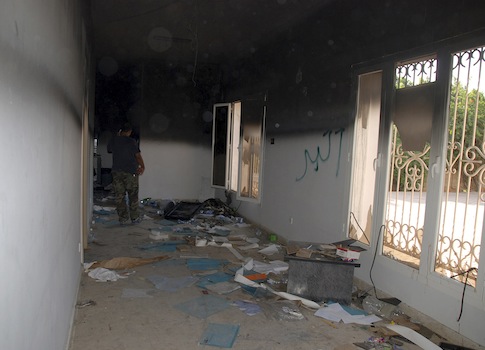
Gutted U.S. consulate in Libya / AP

Documents obtained by Judicial Watch from their May 2014 Freedom of Information Act (FOIA) lawsuits filed against the State Department and the Department of Defense revealed that the Obama administration knew about the attacks on the U.S. Consulate in Benghazi at least 10 days before the attack.

The documents also revealed that the DOD immediately reported the attacks on the consulate.

The documents included an August 2012 analysis predicting the failure of President Obama’s policy of a regime change in Syria as well as a warning about the rise of the Islamic State. The documents also included a confirmation that United States was aware of an arms shipment from Benghazi to Syria.

One of the documents from the DOD’s Defense Intelligence Agency dated September 12, 2012, the day after the attacks in Benghazi, lays out the details of the attack on the consulate and assesses that it was carefully planned by the terrorist group “Brigades of the Captive Omar Abdul Rahman.”

The group is known to have connections to the Muslim Brotherhood as well as  to al Qaeda. Rahman is serving a life sentence in prison for his role in the 1993 bombing of the World Trade Center.

The group’s goal was to “kill as many Americans as possible,” according to the documents, which were sent to Secretary of State Hillary Clinton, Defense Secretary Leon Panetta, the Joint Chiefs of Staff, and the National Security Council.

An October 2012 DOD document contained the first official document that the Obama administration knew of the shipment of weapons from the Benghazi to rebel forces in Syria.

Weapons from the former Libya military stockpiles were shipped from the port of Benghazi, Libya to the Port of Banias and the Port of Borj Islam, Syria. The weapons shipped during late-August 2012 were Sniper rifles, RPG’s, and 125 mm and 155 mm howitzers missiles.

During the immediate aftermath of, and following the uncertainty caused by, the downfall of the (Qaddafi) regime in October 2011 and up until early September of 2012, weapons from the former Libya military stockpiles located in Benghazi, Libya were shipped from the port of Benghazi, Libya to the ports of Banias and the Port of Borj Islam, Syria. The Syrian ports were chosen due to the small amount of cargo traffic transiting these two ports. The ships used to transport the weapons were medium-sized and able to hold 10 or less shipping containers of cargo.

The heavily redacted document did not reveal which weapons were sent to Syria

The DIA consistently warned of the deterioration of the situation in Iraq and warned that it creates an ideal situation for Al Qaeda to return to Mosul and Ramadi, according to an August 2012 report. During this time the U.S. was monitoring weapons flows from Libya to Syria. The agency warned of dire consequences but blocked out what most of what those consequences were.

The State Department produced a single document from a separate lawsuit that Judicial Watch had filed against the department. The document was created by Hillary Clinton’s office the morning after the attacks on the consulate in Benghazi and was sent throughout the State Department.

Neither the State Department nor Hillary Clinton have turned over any documents in regards to Benghazi or her personal email account that was used during her as well as other top aides during her time as Secretary of State.

Judicial Watch has filed multiple FOIA requests and has waited over two years for the documents that they have received.

“These documents show that the Benghazi cover-up has continued for years and is only unraveling through our independent lawsuits,” said Tom Fitton, president of Judicial Watch. “The Benghazi scandal just got a whole lot worse for Barack Obama and Hillary Clinton.”

Hillary Clinton’s Anti-Israel History

April 13, 2015

Hillary Clinton’s Anti-Israel History
Via The Lid blogsite


(Ladies and Gentlemen, please allow me to introduce the next president of the United States and leader of the not-so-free world…Hillary Rodham Clinton! Let the inauguration begin! So sit back kiddies, grab a bag of popcorn and stay tuned for the upcoming clown show. – LS)

An article appearing in the Jewish Daily Forward announced the formation of “Jewish Americans Ready For Hillary!” A truth those progressive Jews for Hillary ignore, with the possible exception of the time from her first campaign New York’s Senate seat in 2000 to her resignation from the Senate to become Secretary of State in January 2009, except for the time she needed New York’s Jewish voting bloc, Hillary Clinton has never been pro-Israel.

On their website, “Jewish Americans Ready For Hillary!” claim, “Throughout her career, Hillary Clinton has fought for the issues that matter most to Jewish Americans.”

Of one issue that “matters most to Jewish Americans,” Hillary Clinton is most certainly not a supporter that is the health and security of the Jewish State of Israel.

Even before her marriage to Bill, Hillary Clinton was opposing Israel and promoting the forces of terrorism. In his book American Evita on page 49, Christopher Anderson writes.
At a time when elements of the American Left embraced the Palestinian cause and condemned Israel, Hillary was telling friends that she was “sympathetic” to the terrorist organization and admired its flamboyant leader, Yasser Arafat. When Arafat made his famous appearance before the UN General Assembly in November 1974 wearing his revolutionary uniform and his holster on his hip, Bill “was outraged like everybody else,” said a Yale Law School classmate. But not Hillary, who tried to convince Bill that Arafat was a “freedom fighter” trying to free his people from their Israeli “oppressors.”
On page 50 the author relates an experience that Hillary and and her future husband had during a trip to Arkansas in 1973.
It was during this trip to his home state that Bill took Hillary to meet a politically well-connected friend. When they drove up to the house, Bill and Hillary noticed that a menorah-the seven branched Hebrew candelabrum (not to be confused with the more common and subtler mezuzah)-has been affixed to the front door.

“My daddy was half Jewish,” explained Bill’s friend. “One day when he came to visit , my daddy placed the menorah on my door because he wanted me to be proud that we were part Jewish. And I wasn’t about to say no to my daddy.”

To his astonishment, as soon as Hillary saw the menorah, she refused to get out of the car. “Bill walked up to me and said that she was hot and tired, but later he explained the real reason.” According to the friend and another eyewitness, Bill said, “I’m sorry, but Hillary’s really tight with the people in the PLO in New York. They’re friends of hers, and she just doesn’t feel right about the menorah.”
Hillary’s attitude did not change when she became first lady. In May 1998 Ms Clinton became the first member of any presidential administration ever to call for a Palestinian State. She told a youth conference on Middle East peace in Switzerland, that she supports the eventual creation of an independent Palestinian state. Her spokesperson, Marsha Berry told reporters: “These remarks are her own personal view.”

In November 1999, while on a purported State visit to the Middle East, she publicly appeared with Yasser Arafat’s wife Suha. Mrs. Arafat made a slanderous fa allegation:
“Our [Palestinian] people have been submitted to the daily and intensive use of poisonous gas by the Israeli forces, which has led to an increase in cancer cases among women and children.” Suha also accused Israel of contaminating much of the water sources used by Palestinians with “chemical materials” and poisoning Palestinian women and children with toxic gases.”
Mrs. Clinton sat by silently listening to a real-time translation, and the terrorist’s wife hug and a kiss when she finished speaking.

Later, many hours after the event, and only after a media furor put her on the spot for what many view as a bit more than a mere political “boo boo Mrs. Clinton called on all sides to refrain from “inflammatory rhetoric and baseless accusations,” including Israel, whose leaders made no such accusations.

Glossing over this repugnant affair, Hillary Clinton has yet to specifically contradict and denounce the monstrous lies uttered by Yasser Arafat’s wife in her presence. Only years later did she make feeble attempt at an excuse, the translator screwed up.

Before her tenure in the State Departing, Bill and Hillary Clinton made mega dollars from their extensive involvement with Dubai. Besides being a leader in the movement to boycott Israel, Dubai is the “Hong Kong” of the Arab world. And a major commerce and shipping point for the “business-side” of terrorism. Bill and Hilary are major friends of Dubai, to the point where the Clinton Foundation have established Dubai Study departments in universities in the US and London. They worked hard at granting legitimacy to this Jew-hating, terrorist supporting nation.

While she was running for President in 2007, San Francisco Examiner columnist P.J. Corkery, wrote that Clinton made $10 million a year from Yucaipa a Dubai firm. Ron Berkle, the owner of Yucaipa companies was a major fund-raiser for Bill and Hillary.

The Clintons also had a connection to the worlds biggest exporter of terrorism, Saudi Arabia, the Saudi Royal Family donated $10,000,000 to the Clinton Library.

According to a 1993 New York Times article, Prince Turki bin Feisal was a college classmate of Bill’s at Georgetown University and (at the time of the article’s writing) was the head of the Saudi Arabian intelligence service. While he was still governor of Arkansas, it looks like Bill Clinton cashed in on that relationship, “work[ing] hard to secure a multimillion-dollar Saudi donation to a Middle Eastern studies program at the University of Arkansas.” Due to the intervention of the Gulf War, the first installment of $3.5 million didn’t arrive until 1992, with another $20 million arriving after Bill Clinton’s first inauguration.

During her Senate years Ms. Clinton became a vocal supporter of Israel because she needed the Jewish vote.

One of her first actions after leaving the Senate to become Secretary of State was to ignore a previous deal with Israel and call for the end of the construction of new homes in existing settlement neighborhoods. Five years later her call for the end of building is till is haunting Israeli/Palestinian peace talks.

As Secretary of State, Hillary Clinton first demanded the “settlement” freeze in 2009 and was quickly backed up by Obama. What she perceived as a minor concession (a “settlement” freeze including no new housing units in existing communities) was for Israel a grave sacrifice. For all intents and purposes Clinton was telling Israeli parents their married children could no longer live in their neighborhoods

This was a major error by the Clinton State Department and it was compounded by their inclusion of Jerusalem in the mix and the constant public berating of the Jewish State by Clinton and Obama.

Clinton’s demand for a building freeze in existing settlement communities broke a US/Israel agreement made during the Bush administration. Ms Clinton said there was never an agreement between Israel and the US about natural expansion of existing settlements. But Elliot Abrams who negotiated the agreement for the United States said Clinton’s contention is simply not true.

Immediately the Palestinians seized upon the Hillary-created settlement issue. Seeing an opportunity to avoid talking, they used the administration’s demands, to make a “settlement” freeze a precondition to further talks even though there were negotiations and construction going on simultaneously before Hilary Clinton became Secretary of State.

In August 2009 Prime Minister Netanyahu announced a ten-month “settlement” freeze. It was approved by the cabinet and implemented on November 25, 2009 and was to run till September 25, 2010. Despite pressure from the United States, the Palestinians refused to join any talks the first 9+ months of the freeze; they did not come to the negotiation table till September 2010, three weeks before the freeze ended.

As the end of the construction halt approached, the US began to negotiate with the Israel to extend the freeze. Based on their experience with Clinton denying the deal negotiated by Elliot Abrams during the Bush Administration, Israel demanded that any proposal be presented in writing, as any oral deal with Clinton and the Obama administration was worth the paper on which is was printed on.

The written offer never came; the Secretary of State wasn’t negotiating in good faith. Instead Ms Clinton was playing “Bait and Switch.” As Israel waited for a letter clarifying America’s guarantees in exchange for a proposed building ban for Jewish residents of Judea and Samaria, a diplomatic source finally came forward saying that no such letter is on its way. The United States Secretary of State Hillary Clinton misled Prime Minister Benjamin Netanyahu.The source, a senior diplomat with inside knowledge of Netanyahu’s recent meetings in Washington, said Clinton made commitments when talking to Netanyahu, but later slipped out of them by claiming that she had not been speaking on behalf of U.S. President Obama – who, she said in the end, did not give his approval.

In 2011 speaking at the at the Saban Center for Middle East Policy at the liberal Brookings Institute, Clinton expressed concern for Israel’s social climate in the wake of limitations the regarding female singing in the IDF and gender segregation on public transportation. Both were accommodations made to the Orthodox communities in Israel

She referred to the decision of some IDF soldiers to leave an event where female soldiers were singing; she said it reminded her of the situation in Iran. It did? Wow! In Iran the women would have been lashed or executed. In Israel they sang, but the people who felt it was against their religious beliefs walked out. Most senior officers in the IDF supported the women’s right to sing.

Clinton also poke of her shock that some Jerusalem buses had assigned separate seating areas for women. “It’s reminiscent of Rosa Parks,” she said, taking the typical progressive position that faith should not matter outside a place of worship. Clinton’s statement was part of the continued attempt by the Obama administration/Clinton State Department to de-legitimize the Israeli democracy and destroy one of the reasons for American support of Israel, the fact it is the only democracy in the Middle East.

Now Hillary Clinton is running for President. She will campaign on the basis that she is a friend of Israel, just as Barack Obama did in 2008. The truth is as Secretary of State; she was the architect of the policy of the most anti-Israel president since the rebirth of Israel in 1948. It was a policy which reflected views she has held her entire life, with the exception of the nine year period where she ran for and held the office of U.S. Senator from New York State.

Bring Back the Bush Doctrine—with One Addition

March 1, 2015

Bring Back the Bush Doctrine—with One Addition, National Review Online, Andrew C. McCarthy, February 28, 2015

Our enemies are not driven by American foreign policy, our friendship with Israel, our detention of jihadists at Gitmo, or the supposed “arrogance” our current president likes to apologize for. Those are all pretexts for aggression.

Our enemies are driven by an ideology, Islamic supremacism, that is rooted in a classical interpretation of sharia — Islamic law. Islamic supremacism is rabidly anti-American, anti-Western, and anti-Semitic. It rejects the fundamental premise of our liberty: that people are free to govern themselves, rather than be ruled by a totalitarian legal code that suffocates liberty and brutally discriminates against non-Muslims and apostates. And sharia is an actual war on women — denying them equal rights under the law, subjecting them to unthinkable abuse, and reducing them in many ways to chattel.

****************

There is a path to victory in the fight against radical Islam, and our next president should embrace it.

What should be our strategy against ISIS? We ask the question without ever considering Iran. What concessions about centrifuges and spent fuel should we demand to prevent Iran from becoming a nuclear power? We ask the question never linking the mullahs’ weapons ambitions with its sponsorship of the global jihad . . . the only reason we dread a nuclear Iran. What should be the national-defense strategy of the United States against radical Islam, the most immediate and thoroughgoing security and cultural threat we face today?

I had the good fortune to be asked to participate in a CPAC panel Friday on defending America against rogue states. With 2016 hopefuls crowding the halls, it got me to thinking: What should we hope to hear from Republicans who want to be the party’s standard-bearer?

It is often said that we lack a strategy for defeating our enemies. Actually, we have had a strategy for 14 years, ever since the fleeting moment of clarity right after the 9/11 attacks.

That strategy is called the Bush Doctrine, and it remains the only one that has any chance of working . . . at least if we add a small but crucial addendum — one that should have been obvious enough back in 2001, and that hard lessons of history have now made inescapable.

The Bush Doctrine has become the source of copious rebuke. On the left, that’s because of that four-letter word (hint: It’s not “Doctrine”). On the right, there have been plenty of catcalls, too. The reaction, however, has been against what the Bush Doctrine evolved into, not against the Bush Doctrine as it was first announced.

The unadorned Bush Doctrine had two straightforward parts. First, because violent jihadists launch attacks against the United States when they have safe havens from which to plot and train, we must hunt down those terrorists wherever on earth they operate. Second, the nations of the world must be put to a choice: You are with us or you are with the terrorists. Period — no middle ground. If you are with the terrorists, you will be regarded, as they are regarded, as an enemy of the United States.

Before we get to that aforementioned addendum, it is important to remember why the Bush Doctrine was so necessary. For the nine years before it, we were living with the Clinton Doctrine.

That is the doctrine President Obama came to office promising to move us back to — and has he ever. It is the doctrine under which the enemy strikes us with bombs and weaponized jumbo jets, and we respond with subpoenas and indictments. It is the doctrine under which our enemies say, “allahu akbar! Death to America!” and we respond, “Gee, you know America has been arrogant. We can see why you’re so upset.”

The Clinton Doctrine — the one the Democrats will be running on in 2016, perhaps with its namesake leading the way — is the one that gave us a series of ever more audacious attacks through the 1990s: the 1993 World Trade Center bombing; a plot to bomb New York City landmarks such as the Lincoln and Holland Tunnels; a plot to blow American airliners out of the sky over the Pacific; the 1996 Khobar Towers bombing, in which Iran and al-Qaeda teamed up to kill 19 American airmen; the 1998 bombings of our embassies in Kenya and Tanzania that killed over 200 innocent people; detonating a bomb next to our destroyer, the U.S.S. Cole, in October 2000, killing 17 members of the U.S. Navy; and finally, the 9/11 atrocities, killing nearly 3,000 of our citizens.

And what has gradually restoring the Clinton Doctrine gotten us? While President Obama pleads for a deal that will inevitably make Iran a nuclear power, the mullahs continue to back anti-American terrorists and conduct military exercises in which they practice blowing up American ships. The Iraq so many Americans gave their lives for is now an extension of Iran. Afghanistan is being returned to the Taliban, which the president empowers by releasing its commanders. Libya is now a failed state where jihadists murder Americans with impunity and frolic in the former American embassy. Al-Qaeda is expanding through northern Africa, now a bigger, more potent threat than it was on the eve of 9/11. And yet it may pale compared with its breakaway faction, the Islamic State, which now controls more territory than Great Britain, as it decapitates, incinerates, and rapes its way to a global caliphate.

But Obama tells us there’s good news: Yemen is a success . . . or at least it was until it was recently overrun by an Iran-backed militia — oops. Well, we have indicted exactly one of the scores of terrorists who attacked our embassy at Benghazi. He got his Miranda warnings, of course, and he’ll be getting his civilian trial any month now. Hopefully, we’ll do better than Obama’s civilian trial of Ahmed Ghailani, the bomber of our embassies who was acquitted on 284 out of 285 counts.

Is it any wonder we’re losing?

Largely, it is because we’re worried about the wrong things — like whether we can sweep the enemy off its feet with enough Islamophilic, blame-America-first rhetoric. In reality, our enemies could not care less whether we — the infidel West — think their literalist, scripturally based belief system is a “perversion” of Islam. Radical Islam hears only one message from America: strength or weakness. The Clinton Doctrine is weakness cubed.

The Bush Doctrine, by contrast, is the path to victory — if we get that one addendum right.

It is this: Our enemies are not driven by American foreign policy, our friendship with Israel, our detention of jihadists at Gitmo, or the supposed “arrogance” our current president likes to apologize for. Those are all pretexts for aggression.

Our enemies are driven by an ideology, Islamic supremacism, that is rooted in a classical interpretation of sharia — Islamic law. Islamic supremacism is rabidly anti-American, anti-Western, and anti-Semitic. It rejects the fundamental premise of our liberty: that people are free to govern themselves, rather than be ruled by a totalitarian legal code that suffocates liberty and brutally discriminates against non-Muslims and apostates. And sharia is an actual war on women — denying them equal rights under the law, subjecting them to unthinkable abuse, and reducing them in many ways to chattel.

In the “you are with us or you are with the terrorists” view of national security, any Muslim nation, organization, or individual that adheres to Islamic supremacism is on the wrong side. Failing to come to terms with that brute fact is where the Bush Doctrine went awry.

Sharia and Western democracy cannot coexist. They are antithetical to each other. So insists Sheikh Yussuf Qaradawi, the Muslim Brotherhood jurist who is the world’s most influential Islamic scholar. It may be the only thing we should agree with him about.

The Bush Doctrine was allowed to evolve from an American national-security strategy to an illusion that our national security would be strengthened by promoting a chimera — sharia democracy. We put the lives of our best young men and women in harm’s way in the service of a dubious experiment: that we could build stable Islamic democracies that would be reliable American allies against jihadist terror.

Perhaps the worst thing about this experiment is not its inevitable failure. It is the sapping of America’s will that it has caused. Defeating our jihadist enemies is going to require a will to win, because the enemy’s will is strong — the jihadists truly believe Allah has already helped them vanquish the Soviet empire, and that we are next.

The American people vigorously support military operations that are essential to our defense. They support a vigorous war to defeat violent jihadists and their support networks. They understand that we cannot cede our enemies safe havens and nuclear weapons.

They do not support the notion that promoting our national security obliges us to move into hostile Islamic countries for a decade or three to civilize them. That’s not our job. Worse, when Americans become convinced that Washington — ever more remote from the public — thinks it is our job, they will not support military action, even action that is vital to protecting our nation. They will not trust the government to defeat our enemies without becoming entangled in Islam’s endless internal strife.

Understanding Islamic supremacism so we can distinguish allies from those hostile to us will restore the Bush Doctrine. And let’s not be cowed by the critics: Nothing I’ve said means endless war, or that we have to invade or occupy every country. But it does mean we should be using all our assets — not just military but intelligence, law-enforcement, financial, and diplomatic — to undermine regimes that support sharia supremacism. Cutting off that jihadist life-line is the path to victory — just as maintaining a strong military that is allowed to show it means business, that is not hamstrung by irresponsible rules of engagement, is the best way to ensure we won’t have to use it too often.

In Iran, where sharia is the law of the land, they persecute non-Muslims and apostates just like ISIS does. In Saudi Arabia, where sharia is the law of the land, they behead their prisoners just like ISIS does. A candidate who cannot tell liberty’s friends from liberty’s enemies is not fit to be commander-in-chief.

Obama Must Explain Why the Iran Deal Isn’t North Korea Redux

March 1, 2015

Obama Must Explain Why the Iran Deal Isn’t North Korea Redux, Commentary Magazine, March 1, 2015

(There are additional parallels. North Korea and Iran have comparable views of human rights, both make loud and frequent noises about obliterating their perceived enemies and both have allies willing if not anxious to sneak around sanctions. There are also differences. Iran is far more powerful than North Korea was or is and Iran’s intention to dominate the Middle East transcends North Korea’s desire to “unify” with South Korea on North Korea’s terms. Iranian governance is based on Islam, an unfortunately powerful world religion seeking world domination. North Korean governance is based on the “religion of Kim,” supreme internally but otherwise of little significance elsewhere. Iran also presents a greater danger to the U.S. than North Korea did. However, Obama won’t explain why the Iran deal isn’t “North Korea redux” because he quite likely neither knows nor cares and because it is. — DM)

The State Department has never conducted a lessons learned exercise about what went wrong with the North Korea deal. Perhaps it’s time. Diplomatic responsibility and national security demand it.

**********************

As the Obama administration rushes into a nuclear deal with Iran, it pays to remember the last time the United States struck a deal with a rogue regime in order to constrain that state’s nuclear program and the aftermath of that supposed success.

Bill Clinton had been president barely a month when North Korea announced that it would no longer allow International Atomic Energy Agency (IAEA) inspections, followed shortly thereafter by an announcement that it would withdraw from the NPT altogether within a matter of months. If Kim Il-sung expected Washington to flinch, he was right. The State Department aimed to keep North Korea within the NPT at almost any price. Chief U.S. negotiator Robert Gallucci and his aides explained in their book Going Critical, “If North Korea could walk away from the treaty’s obligations with impunity at the very moment its nuclear program appeared poised for weapons production, it would have dealt a devastating blow from which the treaty might never recover.” Unwilling to take any path that could lead to military action, Clinton’s team sought to talk Pyongyang away from nuclear defiance, no matter that talking and the inevitable concessions that followed legitimized Pyongyang’s brinkmanship.

As with President Obama relieving Iran of the burden of six United Nations Security Council resolutions which demanded a complete cessation of enrichment, Clinton’s willingness to negotiate North Korea’s nuclear compliance was itself a concession. After all, the 1953 Armistice required Pyongyang to reveal all military facilities and, in case of dispute, enable the Military Armistice Commission to determine the purpose of suspect facilities. By making weaker frameworks the new baseline, Clinton let North Korea off the hook before talks even began.

Just as Israeli (and Saudi and Emirati and Egyptian and Kuwaiti and Bahraini) leaders express frustration with the Obama administration regarding its naiveté and unwillingness to consult, so too did South Korea at the time chafe at Clinton’s arrogance. South Korean President Kim Young Sam complained to journalists that North Korea was leading America on and manipulating negotiators “to buy time.” And in a pattern that repeats today with regard to Iran, the IAEA held firmer to the demand that North Korea submit to real inspections than did Washington. The issue came to a head in September 1993 after the State Department pressured the IAEA to compromise on limited inspections.

In the face of Pyongyang’s defiance, Clinton was also wary that coercion could be a slippery slope to war. Just as President Obama and Secretary of Defense Chuck Hagel instructed U.S. forces in the Persian Gulf not to stand firm but rather to retreat if probed or pushed by Iran, Clinton sought to mollify Pyongyang, for example cancelling the joint U.S.–South Korea military exercise in 1994. Adding insult to injury, the Clinton administration criticized the South Korean government for being unwilling to compromise. Indeed, everything the Obama administration has done with regard to Israel over the past year—with the exception, perhaps, of the classless chickensh-t comment—was ripped right from the Clinton playbook two decades before when the White House sought to silence Seoul.

There followed months of baseless optimism in Washington, followed by disappointment quickly supplanted by denial. At one point, when it looked like Kim Il-sung’s intransigence might actually lead to war, former President Jimmy Carter visited Pyongyang and, whether cleared to or not, made concessions which diffused the situation. It was the diplomatic equivalent of Obama’s voided redlines. Nightlinehost Ted Koppel observed on May 18, 1994, “this administration is becoming notorious … for making threats and then backing down.”

On July 8, 1994, a heart attack felled Kim Il-sung. Kim Jong-il, his eldest son, took over. Negotiations progressed quickly. Gallucci and his team promised an escalating series of incentives—reactors, fuel oil, and other economic assistance. They kicked inspections of North Korea’s suspect plutonium sites years down the line.

What had begun as North Korean intransigence had netted Pyongyang billions of dollars in aid; it would go down in history as the largest reward for cheating and reneging on agreements until Obama granted Iran $11 billion in sanctions relief just for coming to the table. Columnist William Safire traced the steps of concessions on North Korea. “Mr. Clinton’s opening position was that untrustworthy North Korea must not be allowed to become a nuclear power,” he observed, but Clinton “soon trimmed that to say it must not possess nuclear bombs, and stoutly threatened sanctions if North Korea did not permit inspections of nuclear facilities at Yongbyon, where the CIA and KGB agree nuclear devices have been developed. But as a result of Clinton’s Very Good Deal Indeed, IAEA inspectors are denied entry to those plants for five years.” And Sen. John McCain, for his part, lamented that Clinton “has extended carrot after carrot, concession after concession, and pursued a policy of appeasement based … on the ill-founded belief that North Koreans really just wanted to be part of the community of nations.” Again, the parallels between Clinton’s and Obama’s assumptions about the desire of enemies to reform were consistent.

Clinton wasn’t going to broker any criticism of what he believed was a legacy-defining diplomatic triumph, all the more so when the criticism came from abroad. On October 7, 1994, South Korean President Kim Young Sam blasted Clinton’s deal with the North, saying, “If the United States wants to settle with a half-baked compromise and the media wants to describe it as a good agreement, they can. But I think it would bring more danger and peril.” There was nothing wrong with trying to resolve the problem through dialogue, he acknowledged, but the South Koreans knew very well how the North operated. “We have spoken with North Korea more than 400 times. It didn’t get us anywhere. They are not sincere,” Kim said. His outburst drew Clinton’s ire. He became the Netanyahu of his day. Meanwhile, the U.S. and North Korea signed the Agreed Framework. Gallucci and his team were “exhilarated.” They later bragged they “had overcome numerous obstacles in the negotiations with the North; survived the intense, sometimes strained collaboration with Seoul and the International Atomic Energy Agency; and marshaled and sustained an often unwieldy international coalition in opposition to the nuclear challenge, all under close and often critical scrutiny at home.”

Today, by some estimates, North Korea is well on its way to having 100 nuclear weapons and is steadily developing the ballistic capability to deliver them. Iran’s nuclear negotiators have cited North Korea’s negotiating strategy as a model to emulate rather than an example to condemn. Meanwhile, Obama has relied on many of the same negotiators to advance his deal with Iran.

The State Department has never conducted a lessons learned exercise about what went wrong with the North Korea deal. Perhaps it’s time. Diplomatic responsibility and national security demand it.