Archive for the ‘China and North Korea’ category

North Korea launches new missile. US sabotages

April 29, 2017

North Korea launches new missile. US sabotages, DEBKAFile, April 29, 2017

(???????????????? — DM)

North Korea early Saturday, April 29, launched a medium ballistic missile. It failed, detonating in North air space seconds after launch, just like the first one that was sabotaged by the US on April 16, DEBKAfile reports. US President Donald Trump tweeted as soon as he was informed: “North Korea disrespected the wishes of China & its highly respected President when it launched, though unsuccessfully, a missile today. Bad!”

He was apparently hinting that he would wait for China’s reaction before the US took action.

This missile was also the same as the first, a KN-17, a single-stage, short to medium range, liquid-fueled Scud or No Dong variant. It was test-fired Saturday as a deliberate act of defiance by Kim Jong-un in the face of Trump’s warning Thursday, “There is a chance that we could end up having a major, major conflict” over his expanding nuclear and missile capabilities. Hours earlier, on Friday, American, Chinese and Russian foreign ministers all stood up at the UN Security Council meeting in New York to demand that he give up his nuclear and missile programs.

State Department Secretary Rex Tillerson called for tough new action to punish Pyongyang.

The latest missile launch was not announced by Pyongyang. Nor was it fired from the usual base near the port city of Sinpo, but a site near the capital. US military sources estimated that the KN-17, most likely an upgraded Scud missile adapted for anti-ship warfare, was intended to support Kim’s threat to sink one of the US warships approaching Korean waters with two Japanese destroyers.

One of Tokyo’s major subways systems says it shut down all lines for 10 minutes early Saturday after receiving warning of a North Korean missile launch. Tokyo Metro official Hiroshi Takizawa says the temporary suspension affected 13,000 passengers.

Thunder Run to Seoul: Assessing North Korea’s War Plan

April 25, 2017

Thunder Run to Seoul: Assessing North Korea’s War Plan, Real Clear DefenseRaymond Farrell, April 25, 2017

(A North Korean invasion seems highly unlikely for several reasons.

By 1950, Kim Il-sung had convinced Stalin that an invasion would be relatively easy because Dean Atcheson, the U.S. Secretary of State, had omitted South Korea from a list of countries the U.S. would defend if attacked. (When North Korea attacked, Atcheson advised President Truman to defend South Korea.)  Moreover, the few U.S. troops in South Korea when the invasion occurred were under the control of the State Department, not the U.S. military, and their primary job was to prevent South Korea from invading North Korea. The South Korean troops were, at best, largely untrained and poorly equipped. Stalin accordingly provided substantial new equipment, training and logistical support to the North Korean troops. Now, there are now approximately 28,000 U.S. military personnel in South Korea and many of them train on a regular basis with their well equipped South Korean counterparts.  

China has warned that although it will take no action to help North Korea unless the U.S. invades. It seems highly unlikely that we will do so, unless North Korea invades South Korea first. That suggests that to prevent a retaliatory US invasion of North Korea, possibly resulting in US forces approaching the Yalu river (which brought China into the fight against US and allied troops), China will take whatever steps may be necessary, perhaps even invading North Korea herself, to prevent North Korea from crossing the DMZ into South Korea. Kim Jong-un-may be crazy, but he does not appear to be stupid.- DM)
 

AP Photo/Wong Maye-E

For Westerners, North Korea is perennially on and off of the headlines. This year, the confluence of a new US president, the US missile attack in response to the use of chemical weapons in Syria, and an apparently in-your-face program of missile and nuclear tests on the part of North Korea has returned the world’s last Stalinist state to comment threads and coffee-room speculation. Military professionals obviously follow these events even more closely, and Maj. ML Cavanaugh’s recent thoughtful pieces for MWI serve as an example.

But for military planners in South Korea (the Republic of Korea or ROK) and the United States, planning for war with North Korea (the Democratic People’s Republic of Korea or DPRK) has been constant since the last Korean War ended in 1953. Indeed many will be aware that the Korean War ended in an armistice only, rather than a formal peace treaty, so that the two sides remain technically at war. An interesting consequence of this is that while Western military staff colleges spend a great deal of time studying strategy and campaign design, ROK planners focus purely on one strategic problem and one campaign: Korean War II.

While there are some variables, ROK (and DPRK) leaders know who their enemy will be, what his capabilities are, what the war aims of each side will be, and under what terrain, weather and population conditions they must fight. It is therefore possible to wargame the campaign with an unusual degree of precision. Based on my studies as an exchange officer at ROK Army Staff College and training with US planners, I am convinced that the combined ROK/US forces would quickly win the military conflict, though it would be hard-fought and civilian casualties would be high. But what is the ROK estimate of how such a war would unfold? And what are the major assumptions and variables that might alter that story?

The China Wildcard

The first and biggest assumption is that China would not intervene. It is of course possible that renewed fighting on the Korean peninsula could arise as a consequence of Sino-US conflict elsewhere. On one hand, this scenario is actually better for the defending ROK/US forces since the outbreak of Sino-US conflict elsewhere would presumably trigger heightened readiness in South Korea and this would eliminate one of the main pillars of North Korea’s war strategy—operational surprise. On the other hand, even limited war elsewhere in Asia would reduce the numbers of US forces available to fight in Korea and threaten ROK/US plans to establish air supremacy over the peninsula.

Regardless of how war breaks out, a Korean campaign would still most likely begin the same way: with an attack by in-place North Korean forces which will likely be defeated. Once that initial attack is absorbed and ROK forces have been fully mobilized, ROK/US forces will be in a position to go over to the offensive, advance into North Korea, and decisively defeat DPRK forces. The main factor that will determine the later outcome is the potential presence of Chinese forces: If China stays out, expect a fairly quick defeat of North Korean forces, and presumably the regime. But Chinese intervention would probably result in the war becoming stalemated just as the first conflict did. The terrain in Korea favors defense and limits the forces which can be employed, so that with Chinese forces committed, neither side could be expected to achieve a decisive advantage.

It is also possible to imagine scenarios in which China signals a willingness to intervene—or actually intervenes—to prevent the complete collapse of a DPRK that has been defeated on the battlefield. These kinds of what-happens-once-we-defeat-Kim problems are difficult and professionally fascinating, but this article is concerned with how we get there and so will assume that, whatever diplomatic end-game is developing off-stage, China has not intervened in any significant way.

The North’s Attack Plan

So what would the initial North Korean attack look like? Unlike in 1950, when Soviet, Chinese and North Korean planners had a realistic prospect of conquering South Korea in a war, an attack today has only a small chance of victory within a narrow time window. In 1950, DPRK forces enjoyed large initial advantages in numbers, troop quality, and all classes of equipment including tanks and aircraft. Today all of those initial advantages except artillery and numbers are on our side, and even the numbers are more balanced. DPRK planners recognize their inferiority in technology and, after ROK mobilization, even in numbers. They understand that ROK/US forces will have air superiority initially, and (unless China intervenes) air supremacy within days. They therefore plan to win by striking quickly, by surprise, while ROK forces are still mobilizing, US reinforcements are not yet in theatre, and while our airpower is largely committed to overcoming the DPRK integrated air defense system and targeting WMD storage sites, launchers, and command, control, and communications (C3) networks.

Recognizing that ROK forces will be on some degree of heightened readiness during a crisis, the regime will use its formidable intelligence and special operations capability to obscure preparations for an attack and slow ROK responses. Its own past history of symbolic attacks, placing its forces on alert, and angry promises to destroy its enemies will actually work in its favor in this case: ROK/US intelligence agencies will expect some kind of posturing from the North and may therefore misidentify attack preparations as lesser actions. DPRK agents will also count on the psychological reluctance of the South Korean population and government to believe that war is imminent. They will actively seek to influence the ROK democratic decision-making process to get inside our decision cycle. In particular, ROK mobilization will require a political decision and every hour of delay imposed through threats, deception, information and cyber attacks, or direct action will have consequences. In the end, even if ROK/US commanders do recognize the signs of an attack before it begins, it will still take time to react. In that time, DPRK commanders hope to win.

There will be no need for detailed orders. Just as ROK forces know and rehearse their war plan, DPRK forces are largely in place, in numbers sufficient to achieve some local breakthroughs on the major routes towards Seoul—their first operational objective. North Korea will hope to begin mobilization before South Korea does, and thereby turn their currently modest advantage in numbers into a temporarily significant one. DPRK forces will rely, Soviet-style, on the use of overwhelming artillery and rocket fires to break through ROK prepared positions along the DMZ, while using deep fires to attack C3 nodes, routes forward, and mobilization centers. Strikes against targets in Seoul and the surrounding urban areas will have the additional useful effect of causing fear and choking routes with a panicked populace.

On the subject of routes it is worth considering the limited space for mechanized maneuver in central Korea: The eastern half of the peninsula is largely mountainous with roads running along valley floors. The grain of the country will tend to push DPRK forces southwest (towards Seoul). The western half of the peninsula around Seoul and the Han River system is slightly flatter, but at least south of the DMZ the land is now so built up that once major routes come under fire it will be slow going for both sides. It’s not good country for heavy forces, and until recently both sides planned to use mostly lighter infantry to fight on the line. Recent announced changes to ROK force structure see a much greater emphasis on heavy forces—perhaps to get more combat power out of a smaller overall force—but the terrain suggests that such forces will likely be difficult to maneuver. Furthermore, DPRK tactics emphasize the use of infiltration to achieve local penetrations and attack deeper, tactical targets. Their line formations include elite sub-elements specially trained for these tasks, and the terrain—whether urban or forested mountain—is ideal for it. Road-bound heavy forces will be especially susceptible to such tactics.

The final element in the DPRK plan is an extensive deep battle across the entire South Korean depth using some one hundred thousand special operations forces (SOF). An interesting feature of this war is that since both sides look and speak more or less alike, covert insertion and operation is easier for each side—but especially so for North Korean agents who may move freely within South Korea’s open society.

Some DPRK SOF will have been pre-positioned. More will be inserted by sea, air, and ground infiltration shortly before the main attack, exploiting—little-green-men-style—any public uncertainty or national command paralysis for temporary deniability. One of the main tasks for DPRK SOF in this preliminary phase will be to support the deception plan by encouraging and magnifying whatever confusion and chaos may accompany a crisis, and especially to foster political uncertainty and indecision in the critical hours before the main attack. Deniable attacks against political leadership, false-flag provocations, staged anti-war protests, terrorist attacks aimed at causing panic, and limited attacks against key C3 nodes will begin in this stage. This phase could last for days or even weeks, but hours are more likely.

Once DPRK main forces attack across the DMZ, the remaining DPRK SOF will surge south by sea and air towards targets in Seoul and in depth. Many will be destroyed en route by defending ROK forces, and more will be defeated at their objectives, but DPRK planners hope to overwhelm ROK defenses by sheer numbers of SOF and inflict temporary but serious damage while they still have operational surprise. SOF targets in this phase will be national C3 nodes, including political leadership, mobilization centres, airfields, ports and naval bases, and choke points on major routes. As with artillery strikes, fighting by SOF on objectives in Seoul will be aimed at heightening panic and demoralizing political leadership, and will be exploited by DPRK information warfare agencies to give the impression that the front has already reached the ROK capital.

With luck, DPRK planners hope to have main forces entering Seoul within the first week, from which position they can either transition to defense and negotiate from strength or, if conditions permit, push on to decisively defeat ROK forces.

But this plan is very optimistic. ROK planners understand it well and are prepared to counter it. Forces defending along the DMZ are in strong, prepared positions supported by obstacles. ROK C3 is hardened and redundant. Rear-area security forces are substantial and their plans are kept current and rehearsed. Even given some disruption by DPRK SOF, mobilization is expected to generate millions of men within days.

The Unknowns

There are three main variables which might affect this estimate: First, the combat performance of either side cannot be known for certain. My own guess is that ROK forces would fight very well—especially on defense. But there are ways in which North Korea may attempt to undermine ROK morale: Both sides consider the other to be cousins awaiting liberation and this could be used as part of a skillful information operations campaign—particularly if ROK forces seek to advance into the North. The possible combat performance of DPRK forces is even less predictable. On the one hand, the DPRK population has been brainwashed from birth. On the other hand, North Korea’s people fear their own leadership and are often on the brink of starvation. It is possible that they might fight fanatically, but also that, given a chance, they would turn on their leaders. We simply don’t know.

The second main variable is the potential DPRK use of WMD. Finding and killing these will be a high priority for ROK/US commanders, but it is possible that some will survive, especially in the first few days. The North’s leaders may decide to use chemical weapons for battlefield advantage or, if they fail to enter Seoul, may seek to blackmail the ROK government with the possibility of chemical or even nuclear attack against it. Of course the use, or even threatened use, of WMD might invite US retaliation in kind, but a desperate or simply risk-taking Kim regime could gamble that our side would blink first.

The third and related variable is what the DPRK regime would do in defeat. Facing defeat, it is possible that army commanders, or even their troops, would turn on the leadership and depose the regime. On the other hand, if Kim retains enough control over his forces but believes that he is on the brink of being deposed, it is possible that he could—with nothing left to lose—simply unleash whatever WMD he still possesses.

The Takeaway: DPRK Will Make it Ugly

Recognizing that in war nothing ever goes entirely as expected, and that there are some major unknowns, this is based on what we do know about North Korea’s force structure, its comparative strengths, and terrain and other considerations—along with my own assessment of how Korean War II would initially unfold. But regardless of how it played out, one thing is near certain: It would entail horrific destruction and suffering. Tens or hundreds of thousands could become casualties. In defeat, North Korea would become a 25-million strong humanitarian catastrophe. And that is just with conventional weapons: The possible consequences of attacking Seoul with WMD are almost too awful to contemplate. There is a role for force here—a strong ROK/US posture has certainly constrained North Korean aggression for decades—and in no way should DPRK threats be simply acceded to. But under current conditions, and given the scale of likely destruction, planners should strongly question whether each DPRK provocation—even the imminent development of a ICBM—justifies risking such a war.
Haley: China’s Been a ‘Really Great Friend’ to the U.S. Regarding North Korea

April 24, 2017

Haley: China’s Been a ‘Really Great Friend’ to the U.S. Regarding North Korea, Washington Free Beacon, April 24, 2017

(Please see also, Chinese media: ‘China’s intervention not needed when only N.K.’s nuke facilities are hit’ — DM)


U.S. Ambassador to the United Nations Nikki Haley called China a “great friend” on Monday regarding its efforts to assist the U.S. with pressuring North Korea over its nuclear program.

Haley appeared on “CBS This Morning,” in addition to the other two network morning shows, to discuss rising tensions with North Korea over its nuclear and missile tests, as well as other foreign policy issues facing the Trump administration.

President Trump spoke on the phone Sunday night with Chinese President Xi Jinping, and CBS host Norah O’Donnell asked Haley what more China needs to do to deter the North Koreans from taking more provocative actions. China is North Korea’s most important ally and main trading partner, giving Beijing strong influence over the rogue state.

“I think China is really in good faith doing quite a bit,” Haley said. “They are trying to put pressure on North Korea. What we’ve said is we want you to put more pressure on North Korea, whether that’s with coal, whether that’s with oil, whether that’s with other sanctions … I think China’s been a really great friend of ours, and the way they came together with us to do the statement last week showed that we are united against wanting North Korea to stay away from doing any sort of nuclear threats.”

Haley added that North Korean leader Kim Jong-un is “flailing” and trying to show strength to his people.

“They’re panicking right now,” she said.

Last week, a Chinese spokesman said Beijing was “gravely concerned” about North Korean nuclear activity and praised the U.S. for “constructive” remarks about resolving the issue peacefully.

North Korea has continually made belligerent gestures toward the U.S., displaying a video last week showing the U.S. in flames during a military celebration.

Trump has softened his rhetoric about China, even refusing to call the country a currency manipulator after months of calling it one on the campaign trail, due to its assistance in pressuring North Korea.

“What, am I going to start trade war with China in the middle of him working on a bigger problem with North Korea?” Trump said last week. “I’m dealing with China with great respect. I have great respect for him. We’ll see what he can do.”

Trump has also cited friendly relations with the Chinese president as a reason to not start a trade war with the world’s largest country.

Chinese media: ‘China’s intervention not needed when only N.K.’s nuke facilities are hit’

April 24, 2017

Chinese media: ‘China’s intervention not needed when only N.K.’s nuke facilities are hit’ Dong-a Ilbo, April 24, 2017

A Chinese state-run media outlet said that if North Korea continues nuclear and missile development, China may not provide military support to China even if the U.S. launches preemptive strike on the North. China and North Korea have agreed to provide military assistance if one of them gets under military attack, and hence the latest report is construed as Beijing’s stern warning against Pyongyang.

If the U.S. launches surgical strikes on North Korea’s nuclear facilities, China will seek diplomatic deterrence but military intervention is not needed, China’s state-run Global Times said on Saturday. However, the daily repeated its previous stance that f the U.S. and South Korean militaries cross the 38th parallel to invade the North and seek to topple the North Korean regime, China should immediately start military intervention.”

With the U.S. and China stepping up pressure on North Korea, U.S. President Donald Trump held calls in succession with Japanese Prime Minister Shinzo Abe and Chinese President Xi Jinping Sunday morning, and discussed ways to resolve the North Korean nuclear issue. President Trump reportedly asked the Japanese and Chinese leaders to extend cooperation to manage the situation wherein signs of North Korea’s sixth nuclear test are mounting. Notably, in his call with Chinese President Xi, President Trump reportedly commended Beijing’s recent efforts to deter the North’s nuclear development and called on Beijing to use more specific measures to pressure the North.

In the premiere of “Born in China, a movie jointly produced by the U.S. and China held at the Chinese embassy in Washington on Friday, Chinese Ambassador to the U.S. Cui Tiankai said that President Trump will visit China in the second half of this year. After President Trump and President Xi held summit at Trump’s Mar-a-Lago estate in Florida on April 6 and 7, the two leaders agreed to President Trump’s return visit to China at the earliest date.

Krauthammer: U.S. does have cards to play against North Korea

April 21, 2017

Krauthammer: U.S. does have cards to play against North Korea, Mercury News, April 20, 2017

(Mr. Krauthammer offers a reasonable alternative to the reunification of North and South Korea.

Do present-day South Koreans really want reunification? Nearly half a century ago, when I was an Army JAG officer and spent two tours of duty in South Korea, I travelled widely and got to know many Koreans. They were generally enthusiastic about reunification. Now? Not so much, I think.

German reunification was widely embraced and cost the West about $1.9 trillion. South and North Korea have been separated about twenty years longer than East and West Germany had been. Now, younger working South Koreans — with fewer close relatives in the north than their parents and grandparents had half a century ago — would bear much of the cost of Korean reunification. Reunification gave former West Germany Frau Merkel. Korean reunification, providing a wave of unskilled, perhaps hopelessly brainwashed, North Koreans with very little to offer South Korea and needing much adaptation to South Korean democracy, would be about as useful to South Korea as a North Korean version of Frau Merkel. — DM)

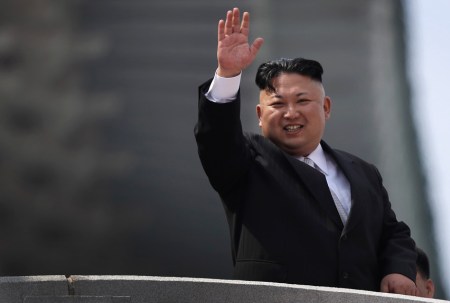
North Korean leader Kim Jong Un waves during a military parade on Saturday, April 15, 2017, in Pyongyang, North Korea (AP Photo/Wong Maye-E)

Because Beijing has such a strong interest in the current regime, we could sweeten the latter offer by abjuring Korean reunification. This would not be Germany, where the communist state was absorbed into the West. We would accept an independent, but Finlandized, North.

During the Cold War, Finland was, by agreement, independent but always pro-Russian in foreign policy. Here we would guarantee that a new North Korea would be independent but always oriented toward China. For example, the new regime would forswear ever joining any hostile alliance.

**************************

WASHINGTON — The crisis with North Korea may appear trumped up. It’s not.

Given that Pyongyang has had nuclear weapons and ballistic missiles for more than a decade, why the panic now? Because North Korea is headed for a nuclear breakout. The regime has openly declared that it is racing to develop an intercontinental ballistic missile that can reach the United States — and thus destroy an American city at a Kim Jong Un push of a button.

The North Koreans are not bluffing. They’ve made significant progress with solid-fuel rockets, which are more quickly deployable and thus more easily hidden and less subject to detection and pre-emption.

At the same time, Pyongyang has been steadily adding to its supply of nuclear weapons. Today it has an estimated 10 to 16. By 2020, it could very well have a hundred. (For context: the British are thought to have about 200.)

Hence the crisis. We simply cannot concede to Kim Jong Un the capacity to annihilate American cities.

Some will argue for deterrence. If it held off the Russians and the Chinese for all these years, why not the North Koreans? First, because deterrence, even with a rational adversary like the old Soviet Union, is never a sure thing. We came pretty close to nuclear war in October 1962.

And second, because North Korea’s regime is bizarre in the extreme, a hermit kingdom run by a weird, utterly ruthless and highly erratic god-king. You can’t count on Caligula. The regime is savage and cult-like; its people, robotic. Karen Elliott House once noted that while Saddam Hussein’s Iraq was a prison, North Korea was an ant colony.

Ant colonies do not have good checks and balances.

If not deterrence, then prevention. But how? The best hope is for China to exercise its influence and induce North Korea to give up its programs.

For years, the Chinese made gestures, but never did anything remotely decisive. They have their reasons. It’s not just that they fear a massive influx of refugees if the Kim regime disintegrates. It’s also that Pyongyang is a perpetual thorn in the side of the Americans, whereas regime collapse brings South Korea (and thus America) right up to the Yalu River.

So why would the Chinese do our bidding now?

For a variety of reasons.

• They don’t mind tension but they don’t want war. And the risk of war is rising. They know that the ICBM threat is totally unacceptable to the Americans. And that the current administration appears particularly committed to enforcing this undeclared red line.

• Chinese interests are being significantly damaged by the erection of regional missile defenses to counteract North Korea’s nukes. South Korea is racing to install a THAAD anti-missile system. Japan may follow. THAAD’s mission is to track and shoot down incoming rockets from North Korea but, like any missile shield, it necessarily reduces the power and penetration of the Chinese nuclear arsenal.

•  For China to do nothing risks the return of the American tactical nukes in South Korea, withdrawn in 1991.

• If the crisis deepens, the possibility arises of South Korea and, most importantly, Japan going nuclear themselves. The latter is the ultimate Chinese nightmare.

These are major cards America can play. Our objective should be clear. At a minimum, a testing freeze. At the maximum, regime change.

Because Beijing has such a strong interest in the current regime, we could sweeten the latter offer by abjuring Korean reunification. This would not be Germany, where the communist state was absorbed into the West. We would accept an independent, but Finlandized, North.

During the Cold War, Finland was, by agreement, independent but always pro-Russian in foreign policy. Here we would guarantee that a new North Korea would be independent but always oriented toward China. For example, the new regime would forswear ever joining any hostile alliance.

There are deals to be made. They may have to be underpinned by demonstrations of American resolve. A pre-emptive attack on North Korea’s nuclear facilities and missile sites would be too dangerous, as it would almost surely precipitate an invasion of South Korea with untold millions of casualties. We might, however, try to shoot down a North Korean missile in mid-flight to demonstrate both our capacity to defend ourselves and the futility of a North Korean missile force that can be neutralized technologically.

The Korea crisis is real and growing. But we are not helpless. We have choices. We have assets. It’s time to deploy them.

CNN: Trump’s North Korea Policy Might Just Be Working

April 19, 2017

CNN: Trump’s North Korea Policy Might Just Be Working, BreitbartJoel B. Pollak, April 19, 2017

AP Photo/Alex Brandon

Former British ambassador to North Korea John Everard writes at CNN.com on Wednesday that President Donald Trump’s assertive strategy towards the rogue nuclear power may have actually worked, despite domestic criticism.

Everard writes:

In my opinion, the most plausible explanation for this is that North Korea blinked. Although it is possible the extensive preparations around its nuclear test site were intended only to wind up the international community, it seems more likely that the North Koreans did indeed plan a nuclear test Saturday but desisted, probably because they assessed the risks of serious retaliation were too great.

The US carrier group it thought was near Korea and China’s threat on April 12 to support UN sanctions, including cutting off North Korea’s oil supply — which would have quickly brought its fragile economy to a halt — probably weighed heavily on Pyongyang as well.

Though domestic critics attacked Trump for stating that the USS Carl Vinson and an “armada” were sailing toward the Korean peninsula, when in fact the ships were far away, Everard says that Trump’s statement was a successful bluff.

The North Korean dictator thought the carrier group really was off the Korean coast, Everard writes. “Very few people outside the US administration knew the carrier group was in fact some 3,500 miles away from the Korean Peninsula.”

He concludes:

Perhaps the North Koreans calculated (rightly, it seems) that either a nuclear test or a test of an intercontinental ballistic missile — a long-range missile of the kind they would need to carry a nuclear warhead to the continental United States — was too dangerous. Instead, launching a medium-range missile would allow them to deny they were buckling under foreign pressure while not triggering a vigorous international reaction. The fact it failed doubtless also softened responses.

If this analysis is right, then the United States has, for now at least, succeeded in its long-term goal of halting the development of North Korea’s nuclear weapons and missiles.

One observer who predicted Trump’s success in the confrontation was Dilbert illustrator and author Scott Adams, who had been stating for weeks that Trump’s unpredictable military moves might scare China into reining in its client state.

CNN is rarely positive in its coverage of the 45th president, making Everard’s article particularly noteworthy.

China’s Korea policy ‘in tatters’ as both North and South defy sanctions

April 17, 2017

China’s Korea policy ‘in tatters’ as both North and South defy sanctions, Washington Post, Simon Denyer, April 17, 2017

(Please see also, President Trump Realigning Geo-Political Alliances, and Few Paying Attention…. — DM)

“Even before the United States upped the tempo, China was in the unusual position of having really very bad relations with both the North and the South — that’s something of an accomplishment,” said Euan Graham, director of the International Security Program at the Lowy Institute in Sydney. “Its peninsula policy was in tatters, and things have only got worse since.”

China is not alone in struggling to construct a successful policy toward North Korea, as the United States can attest. But the failure of its approach has seldom been more starkly outlined, as Pyongyang presses ahead with its nuclear program, the United States sends an aircraft carrier strike group to the region and fears of military conflict mount, analysts say.

“China may marginally increase economic pressure on North Korea by cutting down trade, tourist flows or food aid, but its primary goal is to placate Washington,” said Yanmei Xie, a politics and foreign policy expert at Gavekal Dragonomics. “Beijing has reasons and means to discipline Kim but is more concerned with ensuring the survival of his regime, thus maintaining a buffer against U.S. military presence in the South.”

************************************

More than half a century ago, hundreds of thousands of Chinese troops died in the Korean War, fighting on the side of their Communist allies in the North against the U.S.-backed South. Yet today, China finds itself in the uncomfortable position of falling out with both sides on the Korean Peninsula.

On Monday, South Korea announced that it would press ahead with the “swift deployment” of a U.S. missile defense system, despite vociferous Chinese opposition.

In February, China said it was cutting off coal imports from North Korea in accordance with sanctions imposed by the U.N. Security Council in a bid to persuade the North to abandon its nuclear and missile program. On Sunday, North Korea ignored China’s pleas not to raise regional tensions by conducting another missile test, albeit one that failed.

China has also imposed unofficial and unilateral sanctions against South Korea to persuade it not to deploy the missile defense system, experts say. On Monday, as Vice President Pence warned North Korea not to test U.S. resolve, South Korea’s acting president, Hwang Kyo-ahn, vowed to press ahead with the “swift deployment” of that system, known as Terminal High Altitude Area Defense, or THAAD.

“Even before the United States upped the tempo, China was in the unusual position of having really very bad relations with both the North and the South — that’s something of an accomplishment,” said Euan Graham, director of the International Security Program at the Lowy Institute in Sydney. “Its peninsula policy was in tatters, and things have only got worse since.”

China is not alone in struggling to construct a successful policy toward North Korea, as the United States can attest. But the failure of its approach has seldom been more starkly outlined, as Pyongyang presses ahead with its nuclear program, the United States sends an aircraft carrier strike group to the region and fears of military conflict mount, analysts say.

Both Beijing and Washington share the same goal — a peninsula free of nuclear weapons — but they often appear to be trying to realize those goals in mutually incompatible ways.

Under President Barack Obama, the United States tried to isolate and pressure North Korea economically, an approach that China argues has raised tensions and forced its leader, Kim Jong Un — and his father before him — into a corner.

China had banked on a different approach, believing that building up North Korea’s economy would gradually bring about more moderate politics. That policy, though, has simply given North Korea the resources and the technology to build up its nuclear and missile programs, experts say.

Nor has it brought Beijing the leverage it desires: Kim has never met Chinese President Xi Jinping, and channels of communication between the two governments have never been thinner, experts say.

“China’s hope-based approach has encountered Kim Jong Un’s ‘I’ll have my cake and eat it’ approach,” Graham said. “What’s changed in the political relationship is Kim Jong Un’s total willingness to humiliate China, to slap it in the face, not to give China even the ritual obeisance his father did.”

China believes that the deployment of THAAD, with its sophisticated radar and missile defense capabilities,on its doorstep will allow the United States to spy on it and undermine its national security interests.

It has whipped up nationalist outrage against South Korea over the issue, with the sale of package tours to the country abruptly halted in March and tourist numbers plunging. State-run media have called for boycotts of South Korean businesses and goods, and primary school children have even been encouraged to stage protests. South Korean films were barred from a recent international movie festival in Beijing, and music videos were blocked on streaming services.

Lotte, the South Korean conglomerate that turned over land for THAAD use, has faced huge losses as 87 of its 99 stores in China reportedly have been closed, mostly for ostensibly breaching fire regulations.

But even as Beijing tries to persuade Seoul to cancel the deployment of THAAD, Pyongyang shows utter disregard for China’s interests by launching missile after missile, making the case for the defense system ever stronger.

Now, Beijing has a new headache: brinkmanship not just from Kim but also from President Trump, experts say, with the threat of U.S. military action against North Korea on the table.

There is little doubt this has focused minds in Beijing.

Trump spoke to Xi about North Korea by telephone last week. He later said China is “working with us on the North Korean problem.”

But despite its frustration with Pyongyang, is Beijing really prepared to turn up the heat on its old ally?

There appear to be some within the Communist Party who think it should.

The nationalist Global Times newspaper argued in an editorial on Sunday that China should send a clear message to North Korea: If you conduct a sixth nuclear test, we will cut off the vast majority of your oil imports, through stiffer U.N. sanctions.

Shi Yinhong, a professor of international relations at Renmin University of China, said Beijing is “still hesitant” to take such a radical step, one that would threaten the fuel supplies that keep the North Korean military running.

Indeed, if the United States continues to turn up the heat, with more verbal threats or an even more robust naval presence, China could flip the other way, Shi argues: decide that Washington is the real threat to stability on the peninsula and “shift from suppressing North Korea to opposing the United States.”

Even though coal imports from North Korea appear to have been cut, and Air China canceled some direct flights between Beijing and Pyongyang this week, overall imports and exports between the two countries were up sharply in the first quarter of this year, data released by Chinese customs showed.

In the final analysis, some experts say, the legacy of the Korean War and the survival of the regime China backed at the cost of so much blood remain paramount.

“China may marginally increase economic pressure on North Korea by cutting down trade, tourist flows or food aid, but its primary goal is to placate Washington,” said Yanmei Xie, a politics and foreign policy expert at Gavekal Dragonomics. “Beijing has reasons and means to discipline Kim but is more concerned with ensuring the survival of his regime, thus maintaining a buffer against U.S. military presence in the South.”

Cadence Column: Asia, April 17, 2017

April 17, 2017

Cadence Column: Asia, April 17, 2017,  Pacific Daily Times via China Daily Mail, April 17, 2017

(Excessive optimism? — DM)

Cadence

If the Chinese and Russians wanted to send a message to Washington, they’d send attack vessels like Putin sent late to Syria—at least, he pretended to send a message.

***************************

It’s over. North Korea has been defrocked from among Communist nations. Russia and China aren’t trying to send any kind of message to the US by sending intel-gathering vessels to monitor the Vinson. Spectating usually indicates some kind of support. The “Ruskies” and “Chi-Coms”, as some affectionately call them, kicking back with coke and popcorn in hand isn’t exactly opposition. They are trying to send a message to Communists worldwide, including their own people: Act unruly and you’ll end up like North Korea.

The US can’t do an operation in their back yards without the neighbors keeping a close watch—and Northern Korea is in both Russian and Chinese back yards. If the Chinese and Russians wanted to send a message to Washington, they’d send attack vessels like Putin sent late to Syria—at least, he pretended to send a message.

Countries must appear strong. There is a lot of chest puffing and thumping, even with the soon-to-be-deposed occupation of Northern Korea. The Russians and Chinese will be glad to have the dictator child off of their table of concerns. And, in the process, they want their own people to know whose still boss.

So, it’s over. Soon, we’ll find out just how many Northern Koreans cried for the death of their late “Dear Leader” because they missed him or because they feared what the child dictator would do them if they didn’t. Korea is about to become one country, finally. Kim Jong-Un decided that over the weekend when he threw the temper tantrum that broke every camel’s back in the caravan. Now, the caravan is coming for him.

China’s nuclear get-out clause over defence of North Korea

April 13, 2017

China’s nuclear get-out clause over defence of North Korea, South China Morning PostKristin Huang, April 13, 2017

(Another “hint” from China to North Korea? — DM)

China is not obliged to help defend North Korea from military attack if the reclusive state developed nuclear weapons, according to Chinese diplomatic and military observers.

The assessment comes as senior officials in Washington warn of a strike against the Pyongyang regime.

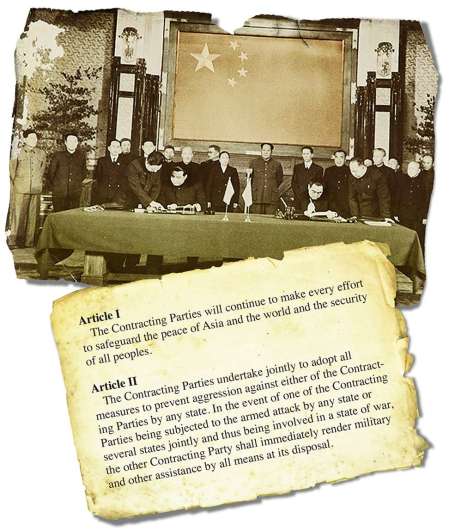
China and North Korea signed a mutual aid and cooperation treaty in 1961 as they sought to mount a united front against Western powers. It specifies that if one of the parties comes under armed attack, the other should render immediate assistance, including military support.

But the treaty also says both nations should safeguard peace and security.

For China, North Korea’s development of nuclear weapons in violation of the United Nations treaty on non-proliferation could amount to a breach of their pact, leaving Beijing with no obligation to lend a hand, observers said.


China could also have a get-out clause if any US military intervention was not deemed an armed attack.

“It’s hard to say how China would assist North Korea militarily in case of war, since North Korea is developing nuclear weapons, an act that might have already breached the treaty between the two nations,” said Li Jie, a retired Chinese naval colonel.

Shanghai-based military analyst Ni Lexiong said China would need to provide military assistance to North Korea if US land forces invaded, but Pyongyang’s violation of the UN non-proliferation treaty was a “strong reason” for Beijing to choose not to help.

Threats of military action against North Korea have grown, with US President Donald Trump saying Washington was prepared to act alone against Pyongyang.

A strike group headed by the aircraft carrier USS Carl Vinson has also been deployed to waters off the Korean peninsula.

Nevertheless, Beijing, North Korea’s economic lifeline, does have some interest in backing up its old ally. China fears the collapse of the regime in Pyongyang could lead to an influx of refugees into China and eliminate the buffer zone keeping US troops from the Chinese border.

But Ni said the possibility of a full-scale war was slim because the US was unlikely to send land forces into North Korea, preferring air strikes or missile launches instead.

“The situation would be much easier for China in this case. China would not have to mobilise its land forces to help North Korea,” he said. “China then only needs to send the North Sea Fleet or military aircraft to step up patrols of the Korean peninsula.”

Zhou Chenming, from the Knowfar Institute for Strategic and Defence Studies think tank, said war over North Korea was unlikely because all the parties involved were looking for ways to defuse tensions.

But if military conflict did erupt, China could help Pyongyang with supplies such as food and weaponry, such as old tanks.

A Chinese State-Run Tabloid Has Warned North Korea Against More Nuclear Tests

April 12, 2017

A Chinese State-Run Tabloid Has Warned North Korea Against More Nuclear Tests, TimeReuters, April 11, 2017

(From the “for what it’s worth” department.  — DM)

The Global Times, whose stance does not equate with Chinese government policy, said that Beijing would likely react strongly to any North Korean test.

(However, The Global Times is run by the Chinese Communist Party. — DM)

The Korean Peninsula has not been so close to a “military clash” since North Korea conducted its first nuclear test in 2006, China’s influential state-run tabloid the Global Times said in an editorial.

“Not only Washington brimming with confidence and arrogance following the missile attacks on Syria, but Trump is also willing to be regarded as a man who honors his promises,” the paper, run by the ruling Communist Party’s official People’s Daily, said. [Emphasis added.]

“The U.S. is making up its mind to stop the North from conducting further nuclear tests. It doesn’t plan to co-exist with a nuclear-armed Pyongyang,” it said.

***********************

(BEIJING)—North Korea should halt any plans for nuclear and missile activities “for its own security”, a Chinese newspaper said on Wednesday, warning that the United States is making clear it doesn’t plan to “co-exist” with a nuclear-armed Pyongyang.

North Korean state media cautioned on Tuesday of a nuclear attack on the United States at any sign of American aggression, as a U.S. Navy strike group steamed toward the western Pacific—a force U.S. President Donald Trump described as an “armada”.

Trump, who has urged China to do more to rein in its impoverished ally and neighbor, said in a tweet that North Korea was “looking for trouble” and the United States would “solve the problem” with or without Beijing’s help.

The Korean Peninsula has not been so close to a “military clash” since North Korea conducted its first nuclear test in 2006, China’s influential state-run tabloid the Global Times said in an editorial.

“Not only Washington brimming with confidence and arrogance following the missile attacks on Syria, but Trump is also willing to be regarded as a man who honors his promises,” the paper, run by the ruling Communist Party’s official People’s Daily, said.

“The U.S. is making up its mind to stop the North from conducting further nuclear tests. It doesn’t plan to co-exist with a nuclear-armed Pyongyang,” it said.

“Pyongyang should avoid making mistakes at this time.”

The Global Times, whose stance does not equate with Chinese government policy, said that Beijing would likely react strongly to any North Korean test.

“If the North makes another provocative move this month, the Chinese society will be willing to see the (U.N. Security Council) adopt severe restrictive measures that have never been seen before, such as restricting oil imports to the North,” the paper said.

Beijing has signed on to U.N. sanctions against North Korea, but it has repeatedly called for a return to dialogue to resolve the tensions.

A military parade is expected in Pyongyang to mark Saturday’s 105th anniversary of the birth of Kim Il-sung, North Korea’s founding father and grandfather of the current ruler. North Korea often marks important anniversaries with tests of its nuclear or missile capabilities.

U.S. officials have previously stressed that stronger sanctions are the most likely U.S. course to press North Korea to abandon its nuclear program, though Washington has said all options—including military ones—are on the table.