Peter Schweizer: Jeff Sessions Ending DOJ Handouts to Activist Groups ‘a Tremendous Victory’, Breitbart, Dan Riehl, June 12, 2017
 Scott Olson/Getty Images
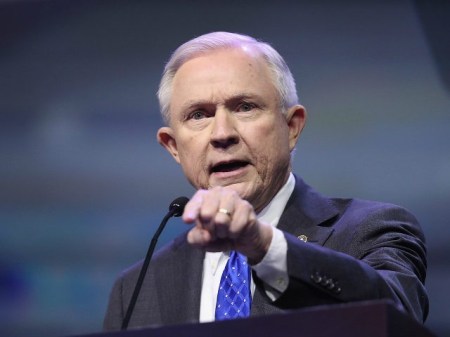
President of the Government Accountability Institute, Peter Schweizer, spoke with Breitbart News Daily SiriusXX host Raheem Kassam on Monday regarding Attorney General Jeff Sessions’ decision to end Department of Justice handouts for leftist groups, which has come to be known as something of a “slush fund.”
As Breitbart News reported:
For decades, through a variety of initiatives, the DOJ has insisted on donations to third parties as part of the settlements it reaches with defendants, especially corporations. In the Obama administration, this practice took on the character of a “slush fund,” which funneled hundreds of millions of dollars from these corporate defendants and put it into the hands of non-government organizations.
Recipients have included left-wing “community organizer” groups such as the National Council of La Raza, or “The Race,” a Latino racial advocacy group that supports mass illegal immigration. Other recipients include the National Urban League, the National Community Reinvestment Coalition, and NeighborWorks America, which is a congressionally chartered mortgage aid group that itself has come under widespread criticism.
“This is a tremendous victory people ought to be very encouraged by,” said Schweizer.
The idea got its start under Eric Holder as far back as the Clinton administration. “The problem is, it got distorted, as so many things do in Washington, DC,” added Schweizer. “And so rather than going to the victims of what a company might have done, they ended up giving it to activist groups. And many of these activist groups, like La Raza, like others, not only didn’t do things to alleviate the activity that had taken place, they actually used the money for things like voter registration.”
“These were politically active groups,” he added.
DOJ Charges California Felon With Dealing Heroin, Illegally Building and Selling Machine Guns, Washington Free Beacon, Stephen Gutowski, May 14, 2017
(Please see also, Bad Hombre Crackdown: Sessions Ramps War on Drug Traffickers. — DM)

WASHINGTON, DC – MAY 12: U.S. Attorney General Jeff Sessions speaks during an event at the Justice Department May 12, 2017 in Washington, DC. Sessions was presented with an award “honoring his support of law enforcement” by the Sergeants Benevolent Association of New York City. (Photo by Win McNamee/Getty Images)
The Department of Justice charged a California man on Thursday with dealing heroin, illegally manufacturing machine guns, and illegally selling those same guns.
“Illegally manufacturing and brokering the sale of guns and drugs on the streets of San Diego poses a tremendous danger to our community,” acting U.S. attorney Alana W. Robinson said in a statement. “Prosecuting firearms offenses is a top priority for the U.S. Attorney’s Office, and we will continue our efforts to disrupt the availability of illegal guns in our city.”
The Department of Justice alleges in a complaint filed in federal court that 39-year-old La Jolla, Calif., resident Paul Joseph Holdy sold a variety of firearms to undercover agents from the Bureau of Alcohol, Tobacco, Firearms, and Explosives as well as the Federal Bureau of Investigation. The agencies say they covertly purchased 19 firearms from Holdy over the course of several months in 2016—included were a number of fully automatic firearms that Holdy had manufactured himself.
Since Holdy was previously convicted of dealing drugs, he was prohibited from possessing any firearms. Additionally, since he did not have a license to manufacture or sell firearms, he was prohibited from building or selling them.
“Firearms traffickers are responsible for the crimes committed with the guns they provide to felons and gang members,” ATF Los Angeles Field Division Special Agent in Charge Eric Harden said in a statement. “Felons cannot skirt the system by manufacturing and selling untraceable firearms from unfinished lower receivers. ATF will use its resources to strategically target and identify these criminals and interrupt the illegal flow of firearms to those who are prohibited from possessing firearms under the law.”
“Illegal firearms and narcotics trafficking cannot be tolerated on our streets,” FBI Special Agent in Charge Eric S. Birnbaum said in a statement. “The FBI will continue to identify, disrupt and dismantle these traffickers in order to keep our communities safe.”
On top of the firearms charges, Holdy was also charged with distribution of heroin. The operation is the result of a partnership between federal, state, and local law enforcement agencies as a part of the Organized Crime Drug Enforcement Task Force. That task force focuses on disrupting and dismantling drug and weapons trafficking rings across the country.
Holdy now faces as many as 30 years in prison and $1.25 million in fines.
Bad Hombre Crackdown: Sessions Ramps War on Drug Traffickers, Breitbart, Ryan Saavedra, May 12, 2017
 AFP
AFP
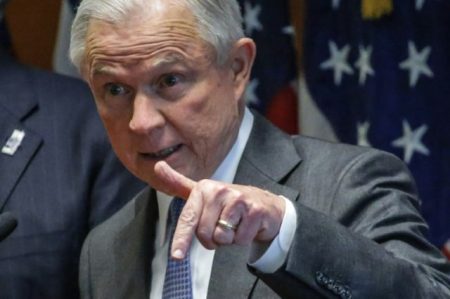
“We are returning to the enforcement of the laws as passed by Congress, plain and simple,” Sessions said. “If you are a drug trafficker, we will not look the other way, we will not be willfully blind to your misconduct.”
Sessions made clear that the criminals he is referring to are not low-level offenders but rather major players in America’s war on drugs.
“These are not low-level drug offenders we, in the federal courts, are focusing on,” Sessions said. “These are drug dealers, and you drug dealers are going to prison.”
Breitbart Texas reported on Thursday that the Department of Homeland Security had concluded a six-week nationwide crackdown on gangs which led to the arrests of over 1,000 confirmed gang members.
****************************
United States Attorney General Jeff Sessions directed federal prosecutors to pursue the most severe penalties for defendants with the most serious and provable crimes.
Sessions instructed federal prosecutors to “charge and pursue the most serious, readily provable offense” in an eight-paragraph memorandum sent to more than 5,000 assistant U.S. attorneys across the country on Thursday.
“The murder rate has surged 10 percent nationwide. The largest increase in murder since 1968 and we know that drugs and crime go hand-in-hand, they just do, the facts prove that so,” Sessions said. “Drug trafficking is an inherently dangerous and violent business. If you want to collect a drug debt, you can’t file a lawsuit in court. You collect it with the barrel of a gun.”
The memo sent by Sessions also rescinded the policies of former attorney general Eric Holder Jr., effectively immediately.
“We are returning to the enforcement of the laws as passed by Congress, plain and simple,” Sessions said. “If you are a drug trafficker, we will not look the other way, we will not be willfully blind to your misconduct.”
Sessions made clear that the criminals he is referring to are not low-level offenders but rather major players in America’s war on drugs.
“These are not low-level drug offenders we, in the federal courts, are focusing on,” Sessions said. “These are drug dealers, and you drug dealers are going to prison.”
Sessions said that under the Trump Administration, the Department of Justice (DOJ) would stand behind law enforcement agencies across the U.S.
“We will do all that we can to keep you safe and promote public support for honorable officers in your dangerous work,” Sessions said.
Sessions encouraged all Americans to find a way to show their gratitude for law enforcement as he pointed out that those working in the field do so to help keep America safe.
“Bring a home cooked meal to your local precinct. Go to a national memorial service or simply shake the hand of a police officer and say thank you for your service,” Sessions said.
The move by Sessions against drug traffickers comes after he announced on April 28 that the DOJ was going to start targeting the notoriously violent MS-13 street gang, Breitbart Texas reported.
Results can already be seen across the country as federal agencies look to rid America’s streets of crime.
Breitbart Texas reported on Thursday that the Department of Homeland Security had concluded a six-week nationwide crackdown on gangs which led to the arrests of over 1,000 confirmed gang members.
New Sheriff in Town: The First 100 Days at the Sessions DOJ, Breitbart, Ian Mason, April 27, 2017
(It’s still a work in progress. He — like President Trump — can’t do everything first, particularly with the “deep state” swamp still in need of drastic draining. — DM)
 Sandy Huffaker/Getty Images
Wednesday saw the first of Attorney General Sessions’ Senate-confirmed subordinates take office: Deputy Attorney General Rod Rosenstein. Over the coming weeks, it is expected that serious progress will be made on nominating and confirming permanent occupants for the dozens of political positions at the Department of Justice, including the over 90 U.S. Attorneys who lead federal criminal prosecutions. The key victories of the first 100 days were accomplished by the Attorney General without any of them in place. As his team assembles around him, Attorney General Sessions looks to be better able to direct the legal policy of the United States government to restore his vision of law and order.
**********************
Under the leadership of Attorney General Jeff Sessions, the first 100 days at the Department of Justice have seen perhaps the most straightforward and earnest efforts to bring the promises of the Trump movement to fruition.
Stepping into leadership at a DOJ managed for eight years by Eric Holder and Loretta Lynch, Sessions has had an uphill battle to implement the key tenets of law and order that so many Americans have long craved and which President Donald Trump promised as a candidate: an end of the lawless hypocrisy on the southern border and in the internal enforcement of our immigration laws, especially in state a jurisdictions that openly flaunt federal law and proclaim themselves “sanctuaries;” a firm commitment to get a handle on rising violent crime, especially in our most dangerous inner cities; and steadfast support of our law enforcement officers at a time when they face danger and disparagement from inside the government and without.
Attorney General Sessions was confirmed by the Senate on February 9, 2017, three weeks into the new administration. One of the very first national politicians to endorse candidate Trump, he was the fifth cabinet member to take his seat, but not before a smooth yet contentious confirmation process yielded one of the most awkwardly worded and forced political slogans of recent memory.
“Nevertheless, she persisted,” the much-touted line goes, a reference to Senate Majority Leader Mitch McConnell’s (R-KY) explanation of his use of Senate rules to prevent Sen. Elizabeth Warren (D-MA) reading a 30-year old letter from Coretta Scott King to imply racist motives to then Senator Sessions. The use was later criticized by Ms. King’s niece.
The fireworks on the Senate floor were quickly followed up in the White House. On his first day as Attorney General, Sessions stood by President Trump’s side as he signed no fewer than four executive orders pertaining to the Justice Department.
Without doubt, cracking down on illegal aliens and the resultant lawlessness on the border and in our immigration system has been the greatest focus of Sessions’ attentions in his tenure at DOJ. Merely the signal of will from the new administration has already brought extraordinary results. March of 2017 saw the lowest number of illegals caught on the border in 17 years, a 72 percent reduction in apprehensions from the last month of the Obama administration.
Rhetoric was repeatedly backed up with action on the Attorney General’s part. In early March, the DOJ shifted 50 immigration judges to detention center along the border and in illegal alien heavy cities. The were set to work in twelve-hour shifts to help clear the massive backlog of deportation cases. This proved to be merely a prelude to much more substantial reform.
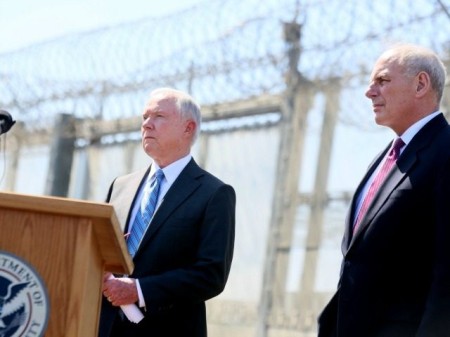
On the morning of April 11, 2017, the Attorney General toured the southern border with officers of U.S Customs and Border Protection. Addressing them and the nation, he proclaimed, “For those that continue to seek improper and illegal entry into this country, be forewarned: This is a new era. This is the Trump era.”
“The catch and release practices of old are over,” Sessions continued, announced that 125 additional immigration judges would be hired on expedited basis. They would be needed because from this point on all adults apprehended at the border were to be detained by federal authorities.
A new set of guidelines was sent to every federal prosecutor in the country. Those who illegally enter the United States a second time will now face felony prosecution as a matter of course, as well those who illegal enter after having been deported, and transporting or harboring three or more illegal aliens. Charges of aggravated identity theft are to be levied on those caught with fraudulent documentation.
These measures are designed to work in tandem with a similar ramping up at the Department of Homeland Security, where 10,000 additional ICE officers have been authorized and are in the process of being hired. Attorney General Sessions made a point of making joint appearances with DHS Secretary John Kelley, presenting a united front to bring order to the border. The two cabinet officials noted increased arrests, more deportations of criminals, and other operations contributing to the apparent decrease in illegal border crossings.
While President Trump has, so far, not seen it fit to reverse Obama’s Deferred Action on Childhood Arrivals executive order, granting amnesty to those who came illegal as children and register with the federal government, the Attorney General has made it clear that the law remains the law. Asked by Fox News in April about the deportation of certain so-called DREAMer (after the never enacted DREAM act), Sessions was unequivocal, “The policy is that if people are here unlawfully, they’re subject to being deported. Our priority is clear. Our priority is to end the lawlessness at the border.”
From the very beginning of his tenure, Attorney General Sessions has tried to bring jurisdictions who refuse to cooperate with federal immigration enforcement back to legal normality, even if it means cutting their federal funds to convince them to do so. Sessions has done this in the face of steadfast refusal to cooperate by some of nation’s most powerful local leaders. For example, Chicago, under the leadership of Mayor Rahm Emmanuel, went so far as to issue a new type of identification available to illegal alien without the city keeping records in response to fears the administration might be able to force the “sanctuary” to give up information on immigration status. Sessions made a point of calling out a California prosecutor who appears to, as a matter of policy, be reducing charges to avoid triggering “violent felon” deportation requirements.
The most troubling resistance, however, came this final week of the first 100 days, as a federal court in San Francisco blocked enforcement of President Trump’s executive order commanding Sessions to cut off federal funds from recalcitrant jurisdictions. At the moment, as the administration has released no comprehensive plan as to what funds are subject to suspension, it is unclear what effect this temporary order will have. It will, however, prevent the use of that executive order’s authority while a lawsuit from a number of California sanctuary jurisdictions makes its way through the courts.
Sessions has not taken this tactic to continue flaunting federal immigration law lightly. In a statement Wednesday, the Attorney General was very clear as to how he saw the lawsuit:
At the heart of this immigration debate is disagreement over whether illegally entering this country is a crime. Our duly enacted laws answer that question.
Nevertheless, actions that have always been understood to be squarely within the powers of the President, regardless of the Administration, have now been enjoined. The Department of Justice cannot accept such a result, and as the President has made clear, we will continue to litigate this case to vindicate the rule of law.
Separate from the wider pledge to cut the flow of federal funds to sanctuary jurisdictions, Sessions has used his independent authority to bring pressure to bear. After weeks of threatening action, the Department of Justice sent letters to nine of the states and cities who most vigorously stifle immigration enforcement, demanding they show compliance by June 30 or forfeit their DOJ Bryne Grants for law enforcement. As these grants already have requirements to follow federal law attached to them, these letters may be unaffected by the ongoing court fracas over President Trump’s executive order.
The mayhem of our inner cities in the waning years of the Obama administration was no less troubling than the chaos on the border. On the day Sessions took office, an executive order established a task force for tackling the violent crime increase seen in certain cities. Sessions has spoken on numerous occasions on his support for a return to “broken windows” policing and taking local law enforcement’s side in their effort to wrestle their crime rates back down to the historic lows seen only a few years ago.
Some of the violence is fueled by what the justice department calls “transnational criminal organizations,” brutal gangs like MS-13 and wide-reaching networks like the Mexican drug cartels. At a meeting of the Attorney General’s Organized Crime Council, Sessions made clear his department would have “zero tolerence” for gang violence as it brings an executive order targeting these organizations for deportation and dismantling into reality.
On several occasions, Sessions has highlighted his continued support for the type of rigorous policing that came under intense fire in the last administration.
To many Americans, the Holder-Lynch DOJ’s failure to keep crime in check and the border under control was compounded by the perceived failure to adequately support law enforcement officers and their in this trying time. Black Lives Matter and other left-wing groups brought anti-police rhetoric to the forefront of the public discourse and politicized violence against the police made headlines throughout 2014, 2015 and 2016. The Justice Department responded by launching investigations into police brutality, bias, and misconduct, making it anything but clear that American law enforcement had their unequivocal support.
Spearheaded by Assistant Attorney General Vanita Gupta’s Civil Rights Division, the Obama administration responded to riots in Ferguson, Missouri, and Baltimore, Maryland by launching federal investigations into those cities’, and others like murder-capital Chicago’s, police departments. The results were predictable. A “Ferguson Effect,” where officers were reluctant to make the routine stops necessary to keep crime under control for fear of being sanctioned for misconduct contributed to a shocking rise in violent crime in the very communities supposedly protected by federal oversight of police. Initially dismissed as a right-wing conspiracy theory, the Ferguson Effect has since been supported by a survey of police officers and by a National Institute of Justice study funded by the Obama DOJ.
When Attorney General Sessions took the reigns at DOJ, there was an immediate shift in tone. “Please know that you have the full support of our Department,” Sessisons told a meeting of police chiefs in April. He went on to call out the former administration’s treatment of police:
In recent years, as you know, law enforcement as a whole has been unfairly maligned and blamed for the crimes and unacceptable deeds of a few bad actors. Amid this intense criticism, morale has gone down, while the number of officers killed in the line of duty has gone up.
Attorney General Sessions has done what is in his power to try and reverse the damage done to Law Enforcement relations. He ordered a complete review of all Obama-era investigations into local law enforcement. He has even sought to scale back the consent decree reached to install federal monitoring of Baltimore’s Police Department in the waning days of the Obama administration. When the federal judge in the case refused to reopen the issue, Sessions issued a public statement criticizing the whole endeavor, saying, “There are clear departures from many proven principles of good policing that we fear will result in more crime.”
Wednesday saw the first of Attorney General Sessions’ Senate-confirmed subordinates take office: Deputy Attorney General Rod Rosenstein. Over the coming weeks, it is expected that serious progress will be made on nominating and confirming permanent occupants for the dozens of political positions at the Department of Justice, including the over 90 U.S. Attorneys who lead federal criminal prosecutions. The key victories of the first 100 days were accomplished by the Attorney General without any of them in place. As his team assembles around him, Attorney General Sessions looks to be better able to direct the legal policy of the United States government to restore his vision of law and order.
How Trump Can Help the Cops, Front Page Magazine, Heather Mac Donald, April 26, 2017
Reprinted from City Journal.
Donald Trump vigorously defended law enforcement during his presidential campaign. He pledged to restore order to the nation’s cities—where violent crime is surging—and to reinvigorate the rule of law. His appointment of conservative Republican senator Jeff Sessions as attorney general was a strong signal that Trump’s words were more than campaign rhetoric. Now that the Trump administration and the Sessions-led Justice Department are up and running, where should they focus their efforts?
The most immediate goal of the Trump administration should be to change the elite-driven narrative about the criminal-justice system. That narrative, which holds that policing is lethally racist, has dominated public discourse since the fatal shooting of Michael Brown in Ferguson, Missouri, in August 2014. In response, officers are backing off of proactive policing, and violent crime is rising fast: 2015 saw the largest one-year spike in homicides nationwide in nearly 50 years. That violent-crime increase has continued unabated through 2016 and into the early months of 2017. A Trump administration official—perhaps Attorney General Sessions, or the president himself—should publicly address the question of what we expect from police officers: Do we want them to be proactive and to try to stop crime before it happens? Or do we want them to be purely reactive, responding to crime only after someone has been victimized? The administration should explain that data-driven, proactive policing made possible the country’s 20-year, 50 percent violent-crime decline that began in the mid-1990s.
In February, Sessions made a good start in turning around the false narrative about policing, addressing the National Association of Attorneys General. Sessions warned that the nation’s violent-crime decline is now at risk, while acknowledging that the crime increase is not happening in every neighborhood. Yet we are diminished as a nation, he said, when citizens “fear for their life when they leave their home.” (To be blunt, the violent-crime increase has hit almost exclusively in black neighborhoods. Nine hundred additional black males were murdered in 2015 compared with 2014, bringing total black homicide deaths that year to more than 7,000. It is a marker of the perversity of elite rhetoric about race that both Trump and Sessions have been fiercely attacked as racist for pledging to save black lives.)
Sessions noted that officers have become reluctant to get out of their cars to conduct discretionary stops and other “up-close” preventive policing. The administration should go further: it should convey the charged, hostile atmosphere in which officers in many urban areas now operate, thanks to the hatred spread by the Black Lives Matter movement. Gun murders of officers increased more than 50 percent in 2016, led by the targeted assassinations of cops.
A frontal assault on the dominant narrative about a racist criminal-justice system will require laying out the stark racial disparities in criminal offending and victimization. The public has been kept in the dark for decades about how vast those disparities are: blacks commit homicide at eight times the rate of whites and Hispanics combined, for example, and die of homicide at six times the rate of whites and Hispanics combined. Lifting that veil of ignorance is necessary to explain why officers operate more actively in minority neighborhoods—in order to save lives. The public must also understand that it is law-abiding members of high-crime communities themselves who beg the police to maintain order, and that such public-order policing was central to the now-jeopardized 20-year crime decline.
The federal government will be vigilant against abusive policing, the administration should say, but it will not deem police departments and police officers biased for proactively fighting crime.
The federal government’s practice of slapping years-long consent decrees on police departments calls out for reform. There is zero chance that civil rights attorneys in the federal government know more than police departments do about how to fight crime constitutionally and successfully. Yet the Obama administration opened 25 “pattern-or-practice” civil rights investigations, based on the false notions that police bias is widespread and that federal lawyers are qualified to recommend effective police practices. The Department of Justice is currently enforcing 14 consent decrees with local departments, which grew out of such investigations. At a minimum, the Trump administration should publish data on how much the Obama-era investigations and consent decrees have cost those departments.
At the end of March 2017, Sessions announced a review of existing and pending consent decrees. The immediate target of this review was a consent decree for the Baltimore Police Department, hastily signed in the waning days of the Obama administration and at that point still awaiting final approval from a federal judge. Sessions’s reevaluation was fully justified. As is typical, the Obama-era DOJ report that preceded the Baltimore decree failed to put numbers behind its charge that the Baltimore PD engaged in a “pattern or practice” of unconstitutional policing. The Obama report blasts the Baltimore cops for “clearing the corners” of miscreants and loiterers, but the police engage in such corner-clearing at the behest of the community. Since the report came out in summer 2016, Baltimore neighborhoods have been overrun by drug dealers, who now believe that they can operate with impunity. Residents have begged the department to return to corner-clearing and other public-order enforcement.
The proposed Baltimore consent decree discourages all such self-initiated police activities. It requires officers to contact a supervisor before making an arrest for minor offenses like disorderly conduct. It prohibits officers from stopping and questioning trespassers and loiterers, unless the officer has received a call for service regarding those individuals. The spurious philosophy beneath these rules is that policing should focus on “serious offenses,” not “minor infractions.” But the best way to prevent serious offenses is to maintain public order in high-crime areas. Proponents argue that the deemphasis on low-level enforcement will save money; in fact, it will only lead to more high-level crime.
Violent street crime in Baltimore has remained at alarming levels in 2017; shootings were up 78 percent through February 25, compared with the same period in 2016; homicides were up 38 percent through early March. These increases come on top of the highest per-capita homicide rate in the city’s history in 2015 and close to that record rate in 2016. Complying with the consent decree will cost financially struggling Baltimore millions of dollars—money that could be better spent hiring new officers and giving them rigorous tactical training. Officers will be pulled from the streets to compile reports for the overpaid federal monitor, covering matters including—as reported in the Power Line blog—whether beat cops respect an individual’s chosen “gender identity” in addressing him (or “zim”). In March 2017, seven plainclothes Baltimore officers were indicted for extortion and fraud. The consent decree is irrelevant to this egregious failure of supervision, focusing as it does on the usual policing-is-racist narrative. Five of the seven indicted officers were black.
The Sessions Justice Department requested a 90-day pause before District Court Judge James Bredar made the Baltimore decree irrevocable. This request triggered strenuous protest, not just from activists and Democratic politicians but also, bizarrely, from Baltimore police commissioner Kevin Davis himself. Davis in essence was declaring his inability to manage his own police department without federal oversight. Judge Bredar rejected the DOJ request for a 90-day extension and approved the decree on April 7, consigning Baltimore and Maryland taxpayers to a depleted and demoralized police force and to tens, if not hundreds, of millions of dollars of unnecessary costs and fees.
The next target of the Sessions consent decree review is an as-yet unfinalized consent decree in Chicago. Since no agreement between the Justice Department and Chicago officials has been signed, the Justice Department should drop negotiations and pull out. The Obama-era report that triggered the pending consent decree suffers from the same flaws as the Baltimore report: it provides no quantified evidence for its claim that the Chicago Police Department engages in systemic civil rights abuses. The mayhem in Chicago in February and March 2017 alone included the slaying of a two-year-old boy and two other children in separate drive-by shootings over four days, and the spread of rape, robberies, carjackings, and kidnappings into downtown and other previously safe neighborhoods. Quelling that violence will not be made easier by diverting police resources into the care and feeding of a federal monitor.
The 2012 police consent decree in New Orleans, for example, is projected to cost $55 million over five years; the actual cost will be much higher. A recent news story trumpeted the fact that sexual-assault complaints rose 83 percent in 2015 (allegedly suggesting greater “gender” sensitivity in the New Orleans Police Department). What should be of greater concern is the fact that New Orleans is also in the midst of an ongoing violent-crime spike. Shootings and homicides more than doubled in January 2017 over January 2016, notwithstanding that 2015 and 2016 had already seen a significant rise in murder and shootings.
Sessions’s announced review of pending consent decrees brought forth the same claims of impotence on the part of Chicago officials as it did in Baltimore. The attorney general should ignore these professions of dependency on the federal government and do the right thing for the law-abiding residents of Chicago’s gang-terrorized neighborhoods by tearing up the proposed decree.
The Department of Justice’s Civil Rights Division should formulate and publish the criteria that it will use to open pattern-or-practice civil rights investigations of police departments. It should quantify the constitutional violations that it uncovers during pattern-or-practice investigations and explain how it concludes that these infractions rise to the level of a “pattern or practice” of civil rights abuses.
The federal government should analyze police actions against a benchmark of crime rates, not population data. If 55 percent of police stops in a jurisdiction have black subjects, for example, the relevant starting point for analysis is the percentage of violent crime committed by blacks, not the black percentage of the resident population.
The specious population benchmark for finding police discrimination is typical of the disparate-impact analysis that drove most criminal-justice policy under the Obama administration. Such analysis should be extirpated in its entirety. There is not a single colorblind law-enforcement practice that does not have a disparate impact on blacks and Hispanics, given their higher rates of crime. The only way to avoid a disparate impact in law enforcement is to stop enforcing the law.
Before the election, the FBI announced a worthy initiative to collect and publish data on all officer uses of force. Such reporting must be accompanied, however, by information on local crime rates, since police use of force will occur most frequently where cops encounter armed and resisting suspects.
Crime-fighting remains overwhelmingly a local matter. But federal agents—from the FBI, the Drug Enforcement Administration, the Bureau of Alcohol, Tobacco, Firearms, and Explosives, and the U.S. Marshals Service—can provide vital assistance. Federal law enforcement reoriented itself toward counterterrorism and cybercrime following the 9/11 Islamist terror attacks. With violence skyrocketing in many urban areas, it is time for a rebalancing. Embattled police departments are calling for more federal agents to work on joint gun and drug task forces. Trump’s proposed budget for the Justice Department has recognized that demand by allocating an additional $175 million to address violent crime.
U.S. gun and drug prosecutions fell significantly during the Obama years, discouraged by the administration’s belief that mandatory-minimum federal sentences, especially for drug trafficking, have resulted in the “mass incarceration” of minorities. In fact, drug enforcement plays no role in disproportionate black incarceration rates. If all drug prisoners were removed from the nation’s prisons, the share of black prisoners would drop from 37.4 percent to 37.2 percent. Libertarians might welcome the five-year, 18 percent drop in federal drug prosecutions, but neighborhoods riven by drug violence do not. In Baltimore, when the local police stopped making drug arrests following the anti-cop riots of April 2015, shootings spiked. Attorney General Sessions must encourage U.S. attorneys in high-crime areas to increase their gun and drug cases, including RICO prosecutions. While modest changes in the federal sentencing guidelines for drug trafficking are acceptable, they should not be undertaken in the name of “racial justice.”
All federal law-enforcement agencies should adopt a CompStat system for information-sharing and analysis. CompStat, first developed in the New York Police Department under Mayor Rudolph Giuliani, holds commanders ruthlessly accountable for measurable results. A White House allegedly informed by business acumen should welcome such a proven system for bottom-line accountability.
Obama’s first attorney general, Eric Holder, called on local U.S. attorneys to involve themselves in prisoner reentry and rehabilitation activities. The Trump administration should determine if that initiative is producing enough crime reduction to justify the diversion of scarce prosecutorial resources; arguably, reentry activities are most efficiently carried out by U.S. probation officers. Federal prisons, on the other hand, can serve as a model for prison work policies and prisoner education. The Bureau of Prisons should partner with private business for job-skills development, as recommended in the Sentencing Reform and Corrections Act of 2015.
Sanctuary cities, counties, and states must be severely penalized. These scofflaw jurisdictions, numbering about 300, refuse to cooperate with Immigration and Customs Enforcement (ICE) efforts to deport convicted illegal-alien criminals. When ICE requests that a jail in a sanctuary jurisdiction briefly hold a criminal who has finished serving his sentence so that ICE can pick him up for deportation, the jail will deliberately release him before ICE can arrive, unless his crime was particularly heinous. Over just one week in late January 2017, ICE found 206 criminal aliens who had been released back to the streets in defiance of a detention request. Their convictions included aggravated assault with a weapon, robbery, rape, aggravated assault against a family member, domestic violence, life-threatening arson against a residence, burglaries of homes and businesses, battery, carrying a prohibited weapon, resisting an officer, driving under the influence, forgery, and indecent exposure. Pending charges against those released aliens included homicide, aggravated assault against an officer with a weapon, and indecent exposure to a minor.
Such disobedience of lawful federal requests undermines the constitutional system. It is also a betrayal of a fundamental truth that big-city police chiefs purport to believe: that all violations of public order, including so-called low-level offenses, threaten community cohesion and safety. There is no public benefit to sending an illegal-alien criminal back into the community if grounds exist for removing him. Congress should impose liability on local law-enforcement officials if someone is victimized by an illegal-alien criminal released in defiance of ICE.
Passage of the Mandatory Minimums for Illegal Reentry Act of 2015, which establishes a compulsory five-year sentence for illegal reentry, would encourage U.S. attorneys to prosecute illegal aliens who have reentered the country following deportation. Trump’s proposed 2018 budget rightly funds 75 additional immigration-judge teams and 20 additional attorneys and support staff for immigration litigation in order to speed up removal proceedings.
Local police departments are shaking the cup for more federal funding, but the Trump administration should resist. Federal grants are not new money; they are merely the same taxpayers’ dollars that localities rely on, minus the huge administrative costs of being routed through Washington. Though many departments desperately need more officers and more tactical training, the better way to provide those resources is to lower federal spending mandates and the federal tax burden so that localities can pay for their own policing needs. Chicago mayor Rahm Emanuel is taking the lead in demanding more federal money for social programs and summer jobs. But if government welfare programs were the solution to crime, we would have had crime-free inner cities decades ago.
Only initiatives that are truly national in scope should be federally funded. Research on what works in crime-fighting is a proper federal function, since local police departments lack the money to conduct their own studies. Topics to be explored include: the effectiveness of public-order and hot-spot policing; the relationship between criminal history and recidivism; and the success rate of electronic monitoring. The federal Task Force on Crime Reduction and Public Safety, announced in February, will explore how to improve data collection in order to fight crime more effectively; a crash course in CompStat data analysis would help detect unmet data needs.
The Obama DOJ spent a lot of time talking about police “legitimacy”; by contrast, the Trump DOJ should advocate for more hands-on, scenario-based tactical training that helps officers avoid the need to use deadly force. Officers should be taught how to cope with stress. When cops use foul language, threats, and unjustified force, they are usually overreacting to stress. The current fad for de-escalation training is appropriate, so long as the proposed principles do not jeopardize officer safety.
From dash-cam videos to body cameras on officers, technology plays an increasingly vital role in policing and in public perceptions of policing. Several areas need to be addressed. The cost of storing video from police body cameras has become a huge problem. The federal government could help determine if a federal cloud for storage or a state consortium is the best solution. Washington should encourage departments to adopt lawful surveillance technology such as aerial cameras and family genetic matching to target criminals surgically.
National legislation is needed on encryption. Law-enforcement agencies now fear “going dark” during the surveillance of criminals and terrorists, thanks to encryption. The feds could also help with technology to improve communications (interoperability) between the nation’s 18,000 police departments. Anti-cop activists and anarchists are breaking into law-enforcement communications. Police WiFi was hacked during the November 2014 anti-cop riots in Ferguson, Missouri; the previous month, a radio operator tried to interfere with police movements and air-support operations in the area. Masked Black Bloc anarchists and Black Lives Matter activists will join forces in the Trump era to attack law and order, as happened in the Berkeley, California, riot in early February 2017. Federal and local law enforcement need to up their game in countering such lawlessness; the wearing of masks to facilitate crime must be severely penalized.
The Obama Justice Department ordered more than 28,000 federal law-enforcement officers and prosecutors into “implicit-bias” training—a form of sensitivity reeducation aimed at teaching police how to combat their own (alleged) subliminal prejudices. Attorney General Sessions should cancel this initiative and lift the pressure on local police departments to put their own officers through this wasteful exercise. The claim that policing, especially police shootings, is riven with “implicit bias” is untrue—in 2016 alone, four academic studies showed that if there is a bias in police shootings, it works in favor of blacks and against whites. The Office of Community Oriented Policing (COPS) has partnered with the Office of Violence Against Women to combat “gender bias.” This is another waste of money and should be ended. There is no significant gender bias in American society, and it is not a criminal-justice issue.
The previous Justice Department’s concern with phantom police bias extended to personnel practices. An October 2016 report called for law-enforcement agencies to boost their minority hiring. The report recommended that departments weaken or eliminate their requirements of a clean criminal record in order to make more minorities eligible. This report and the message behind it should be withdrawn. There is no evidence that minority officers are “fairer” in their policing. The Justice Department itself found in 2015 that black and Hispanic officers in Philadelphia were more likely than white officers to shoot an unarmed black suspect based on the misperception that he was armed. Lowering hiring standards, particularly criminal-background standards, is a sure recipe for corruption and incompetence on a police force.
Obama’s Task Force on 21st Century Policing recommended that police departments mandatorily report to the DOJ their race and gender composition. This recommendation should be axed. And any mandated reporting on police activity that includes the race of suspects stopped or arrested should be accompanied by data on racial crime rates in the police agency’s juridiction. Ideally, the word “diversity” would be excised from all federal communications when it refers to race, sex, sexual orientation, or gender identity. Those traits have no bearing on federal programs or on qualifications for federal employment.
Trump is under pressure from conservatives to fire FBI director James Comey for his actions regarding presidential candidate Hillary Clinton’s e-mail server, his refusal to corroborate Trump’s wiretap allegations against Obama, and the FBI’s investigation of ties between Trump associates and Russia. Trump should resist the pressure to fire him. Comey was virtually the only voice in the Obama administration to call attention to the urban crime increase. He also correctly identified its cause because he understands the power of policing. He will be a valuable asset in quelling the crime spike.
Finally, while police officers have an indefeasible obligation to treat everyone they meet with courtesy and respect and within the confines of the law, community members have a reciprocal obligation to obey police commands and not resist arrest. The Trump administration could start a national campaign: “Comply now, complain later.” Such a campaign would publicize the fact that the vast majority of questionable police shootings over the last several years, as well as the justified police shootings, were triggered by the noncompliance of the victims.
Jeff Sessions: MS-13 Could Be Designated a Terrorist Organization, Breitbart, Ian Mason, April 19, 2017
 AP Photo/Alex Brandon
Attorney General Jeff Sessions continued his campaign against the vicious MS-13 gang on Fox News’s Tucker Tuesday evening, telling host Tucker Carlson that the group may qualify as a terrorist organization.
“The government of El Salvador has designated MS-13 a terrorist organization. Would it be helpful for our government to do the same?” Carlson asked. “I think so, perhaps. It could qualify for that,” was Sessions’s response.
Designating MS-13 a “foreign terrorist organization” would make providing any material support for the group, here or abroad, a felony, and compel U.S. financial institutions to freeze any assets they reasonably believe belong to the group. The determination is made by the State Department and not AG Sessions’s Justice Department, but Sessions’s willingness to support such a designation speaks to how seriously he takes the threat from the gang.
“This is one of the most violent gangs in the history of our country,” Sessions said of MS-13. He cited the group’s use of machetes and willingness to kill and prostitute children, as they have done across the United States.
The Attorney General laid out a plan to attack MS-13, whose 10,000+ estimated members in the United States operate across 40 states, according to a DOJ fact-sheet on the group. Tough use of immigration laws will be central to Sessions’s strategy for breaking the brutal gang, many of whose members are illegal aliens from Central America. The group originally sprouted up among Salvadorans in Los Angeles in 1980s after thousands of them fled there from political atrocities in their war-torn homeland.
“So many of these people are illegally here,” Sessions said, lashing out at the lax immigration enforcement of prior administrations that, in his view, have contributed to the blossoming of MS-13. “With a good lawful border, many of them of would not be here. They sent some of the most violent people.”
Sessions mocked the perverse use of Obama administration policies on “unaccompanied minor” illegal aliens by MS-13 leaders to get their people exactly where they were needed in America. “They were directed how to enter. If they came and claimed themselves as, you know, a minor, the Obama administration let ’em come into the country, and took them to their destination city, and turned them over to some ‘relative,’” he told Tucker.
Sessions sent a hopeful message about efforts to combat MS-13, calling the destruction of the gang “hard, but not impossible.” “As we have cases and we work them hard, pursue convictions, and we deport people who are here unlawfully, we can devastate this gang,” he said.
Sessions Gives Federal Prosecutors Marching Orders on Border Security, PJ Media, Hans A. Von Spakovsky, April 13, 2017
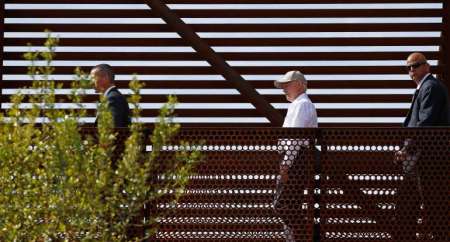 Attorney General Jeff Sessions, center, tours the U.S.-Mexico border with border officials, Tuesday, April 11, 2017, in Nogales, Ariz. Sessions toured the U.S.-Mexico border and unveiled what he described as a new get-tough approach to immigration prosecutions under President Donald Trump. (AP Photo/Ross D. Franklin)
During his trip to the southern border, Attorney General Jeff Sessions made it clear that he will carry out the mandate he was given by President Donald Trump: to vigorously enforce our immigration laws, and go after the human smugglers and traffickers who work for the Mexican cartels that have caused many of our border security problems.
In his April 11 speech to Customs and Border Protection agents in Nogales, Arizona, Sessions bluntly stated his intent to go after the “transnational gangs like MS-13 and international cartels” that are flooding “our country with drugs” and “leave death and violence in their wake.” According to Sessions, it is “criminal aliens and the coyotes and the document-forgers” who want to “overthrow our system of lawful immigration”:
[They] turn cities and suburbs into war zones, that rape and kill innocent citizens and who profit by smuggling poison and other human beings across our borders. … Depravity and violence are their calling cards, including brutal machete attacks and beheadings.
[It is on the border,] on this sliver of land, where we first take our stand against this filth.
These are strong words, indeed — words that certainly had never been spoken by the two attorneys general who served in the prior administration.
Sessions also announced that he was sending a memorandum to all federal prosecutors directing them to make prosecution of certain immigration offenses a higher priority. As Sessions said — in what seems common sense to most Americans — “consistent and vigorous enforcement … will disrupt” these organizations and “deter unlawful conduct.”
Among the enforcement priorities listed by Sessions were the following:
Sessions directed each of the 94 offices of U.S. Attorneys to appoint a “Border Security Coordinator” by April 18. The coordinators will oversee the immigration enforcement program of each office, coordinate with the Department of Homeland Security and other federal agencies, and report the “prosecution statistics related to these offenses.” This latter requirement is obviously an attempt to force transparency on the offices and to provide a measuring stick to gauge how well the attorneys are actually carrying out the attorney general’s directive.
This is particularly important, since resistance from some federal prosecutors is likely.
A Daily Beast article about Sessions’ memorandum quoted an anonymous “veteran federal prosecutor” denouncing the new policy as “totally horrifying” and adding, “We’re all terrified about it, and we don’t know what to do.”
The fact that a lawyer in the career ranks of the Justice Department doesn’twant to enforce federal immigration law is itself “horrifying,” and a sad reflection on the Department’s hiring practices.
How can he or she not “know what to do”?
The choice is crystal clear: Either comply with his or her sworn oath (to uphold the law) and follow this lawful directive or resign.
In addition to taking criminal aliens, smugglers, and those who aid and abet them off the street, increased prosecutions will also have a deterrent effect. For anyone who doubts that, General Sessions cited some stunning numbers:
[From] January to February of this year, illegal crossings dropped by 40 percent, which was unprecedented.
Then in March:
A 72 percent drop compared to the month before the president was inaugurated. That’s the lowest monthly figure for at least 17 years(emphasis added).
As Sessions said, “this is no accident.” It results from:
[A president who] understands the threat, who is not afraid to publicly identify the threat and stand up to it, and who makes clear to law enforcement that the leadership of their country finally has their back.
In his speech, General Sessions also announced plans to hire 50 more immigration judges this year to handle the large backlog of cases. Another 75 judges will be added next year with the help of a new, streamlined hiring process.
This comes on top of the administration’s previously announced plans to hire 5,000 more Border Patrol agents and 10,000 more Immigration and Customs Enforcement agents — not to mention building a secure wall along the Mexican border.
At the end of his speech, General Sessions poignantly referred to Americans who have been killed by illegal aliens with lengthy criminal records. He took an oath “to protect this country from enemies, foreign and domestic” and he intends to enforce “the duly enacted laws of the United States.”
Sessions also honored the victims of prior policy:
[How] can we look the parents and loved ones of Kate Steinle, Grant Ronnebeck and so many others in the eye and say we are doing everything possible to prevent such tragedies from every occurring again?
Report: House Investigation of Susan Rice Scandal Expanding, PJ Media, Debra Heine, April 12, 2017
(Please see also, A Shoe Drops: Obama Administration Spied on Carter Page [Updated] — DM)
 (AP Photo/Carolyn Kaster, File)
Fox News reported Tuesday night that members of the House Intelligence Committee have expanded their investigation into the Susan Rice surveillance controversy.
Appearing on The O’Reilly Factor, investigative reporter Adam Housley said the following:
They’re looking into allegations where Americans including politicians have possibly been unmasked and had their information collected into the files, similar to what they did to the Trump team.
Housley also said that both the House and Senate investigations are being stonewalled:
They say the FBI is being very difficult. We’re told [investigators] just want to know about the unmasking. How frequent was this? Who was doing it? Why were they being unmasked?
Housley added:
[A Committee member says the FBI is] going to have to turn everything over or we’re not going to authorize the congressionally approved 702 program which allows them to do this in the first place. This investigation is full-blown.
Section 702 of the Foreign Intelligence Surveillance Act, or FISA, is up for reauthorization in 2017. The program surveils non-U.S. persons believed to be located outside the United States, incidentally sweeping up the communications of Americans as well, in order to acquire foreign intelligence.
O’Reilly asked Malia Zimmerman, an investigative reporter working with Housley, if the FBI was investigating the case. Zimmerman answered:
There’s a big question about the FBI’s role in this and there’s concern in the House about generally how the FBI is handling this case.
She added that FBI Director James Comey has yet to come back to the Hill to answer the 100 questions the House Intelligence Committee wants answered:
The FBI claims to be “preparing the information,” but it’s been four weeks, Bill.
O’Reilly suggested getting Attorney General Jeff Sessions involved, “because he’s Comey’s boss.”
Housley said they were making progress on the story, but because of the sensitive and classified nature of the information, it’s been difficult work.
Zimmerman added that some of the whistleblowers who have been talking to them may come forward and provide testimony to the House Intelligence Committee:
That would really start to expand this investigation even further.
BREAKING: Sessions Announces Illegal Aliens Who Illegally Re-Enter The U.S. Will Be Charged With a Felony, Town Hall, Katie Pavlich, April 11, 2017

Speaking from the U.S.-Mexico border in Nogales, Arizona Tuesday, Attorney General Jeff Sessions announced major changes to Justice Department protocol when it comes to charging and prosecuting illegal aliens.
“For those that continue to seek improper and illegal entry into this country, be forewarned: This is a new era. This is the Trump era. The lawlessness, the abdication of the duty to enforce our immigration laws and the catch and release practices of old are over,” Sessions said.
Here are the details (bolding is mine):
Starting today, federal prosecutors are now required to consider for prosecution all of the following offenses:
- The transportation or harboring of aliens. As you know too well, this is a booming business down here. No more. We are going to shut down and jail those who have been profiting off this lawlessness — people smuggling gang members across the border, helping convicted criminals re-enter this country and preying on those who don’t know how dangerous the journey can be.
- Further, where an alien has unlawfully entered the country, which is a misdemeanor, that alien will now be charged with a felony if they unlawfully enter or attempt enter a second time and certain aggravating circumstances are present.
- Also, aliens that illegally re-enter the country after prior removal will be referred for felony prosecution — and a priority will be given to such offenses, especially where indicators of gang affiliation, a risk to public safety or criminal history are present.
- Fourth: where possible, prosecutors are directed to charge criminal aliens with document fraud and aggravated identity theft — the latter carrying a two-year mandatory minimum sentence.
Further, Sessions said prosecuting those who assault federal law enforcement officers will be a priority.
“If someone dares to assault one of our folks in the line of duty, they will do federal time for it,” Sessions said.
The Attorney General also emphasized the administration’s focus on dismantling violent cartels and dangerous gangs inside America cities.
“When we talk about MS-13 and the cartels, what do we mean? We mean criminal organizations that turn cities and suburbs into warzones, that rape and kill innocent citizens and who profit by smuggling poison and other human beings across our borders. Depravity and violence are their calling cards, including brutal machete attacks and beheadings,” Sessions said. “With the President’s Executive Orders on Border Security, Transnational Criminal Organizations and Public Safety as our guideposts, we will execute a strategy that once again secures the border; apprehends and prosecutes those criminal aliens that threaten our public safety; takes the fight to gangs like MS-13 and Los Zetas; and makes dismantlement and destruction of the cartels a top priority.”




 anneinpt
 artaxes
 danmillerinpanama
 davidking1530
 Peter Hofman
 Joseph Wouk
 Peter
Peter Louisiana Steve
 WarSclerotic
Recent Comments