Archive for the ‘Air strikes’ category

Obama gives ISIS ally veto power over US air strikes on ISIS

August 3, 2015

Obama gives ISIS ally veto power over US air strikes on ISIS, Front Page Magazine, Daniel Greenfield, August 3, 2015

turkey-2erdoganwhitehouse

The war against the JayVee team that has captured large chunks of Syria, Iraq and Libya is going really well. Secretary of State John Kerry and White House Minister of Information Mohammed Saeed al-Sahaf assure us that the un-Islamic terrorist group whose name must not be mentioned will shortly be crushed.

Meanwhile Obama keeps trying to negotiate with the Taliban, the other group of misogynistic mass-murdering Islamists he had vowed to defeat back in his first term.

The administration is celebrating a coup in finally getting Turkey to get on board and allow the US to use an air force base for air strikes on ISIS. But as Commander Dyer points out, there’s a slight problem.

1.  The Obama administration refuses to define a territorial or operational objective.

2.  U.S. forces aren’t sure whom they’ll be allowed to shoot at.

Well it’s not like we need to know what we’re fighting for or how we’re going to fight. The important thing is that Obama got a crazy Islamist dictator who built himself a billion dollar palace while terrorizing his people to agree to let the US use an air force base.

As long as he gets to decide who we bomb.

The US Air Force could use the Incirlik air force base in Turkey but had to allow Turkish oversight of the targets it would strike in Syria and Iraq from Incirlik.

That is a slight tiny problem because the Turkish regime loves terrorists almost as much as Iran and has a history of secret ties to ISIS.

According to the Guardian on 25 July, a U.S.-led raid on an ISIS compound in May 2015 unearthed a treasure trove of documentation on this connection.  Turkish middlemen have been funding ISIS for months, to the tune of millions of dollars, by buying oil from the guerrillas – implicitly with the knowledge and support of the Turkish government.

The Jerusalem Post reported one Islamic State member said Turkey, a member of NATO, provided funds for the terrorist group.

“Turkey paved the way for us. Had Turkey not shown such understanding for us, the Islamic State would not be in its current place. It [Turkey] showed us affection. Large [numbers] of our mujahedeen received medical treatment in Turkey,” said the man, who was not identified.

The topic of Turkey’s involvement with ISIS remains controversial and has led to a conflict between Turkish law enforcement, which tried to expose government weapons shipments, and the Erdogan regime.

Even Joe Biden said it not long ago, before being forced to apologize.

So Obama has given an ally of ISIS oversight of US air strikes against ISIS. And it gets even more schizophrenic because the US is now involved with the PKK, a Kurdish Marxist liberation group, which Turkey is bombing.

So yes, the war will be won any day. Meanwhile Pakistan will be hosting peace talks with the Taliban. You know, the country which was pretending to be our ally while harboring Osama bin Laden.

Don’t worry. I’m sure the Caliph of ISIS probably isn’t living in a mansion in downtown Istanbul. Yet.

“This caliphate will take over the entire world and behead every last person that rebels against Allah”

August 1, 2015

“This caliphate will take over the entire world and behead every last person that rebels against Allah,”  Front Page Magazine, Daniel Greenfield, August 1, 2015

(But of course, as all good little Obamabots know, the Islamic State it not Islamic. Please see also, Despite Bombing Campaign, Islamic State No Weaker Than a Year Ago. — DM)

isis_map


The Un-Islamic JayVee team that Obama is trying to fight has a big plan. Behead all non-Muslims. Rule the world.

The undated document, titled “A Brief History of the Islamic State Caliphate (ISC), The Caliphate According to the Prophet,” seeks to unite dozens of factions of the Pakistani and Afghan Taliban into a single army of terror.  It includes a never-before-seen history of the Islamic State, details chilling future battle plans, urges al-Qaeda to join the group and says the Islamic State’s leader should be recognized as the sole ruler of the world’s 1 billion Muslims under a religious empire called a “caliphate.”

“Accept the fact that this caliphate will survive and prosper until it takes over the entire world and beheads every last person that rebels against Allah,” it proclaims. “This is the bitter truth, swallow it.”

Unlike al-Qaeda, which has targeted terror attacks on the United States and other western nations, the document said Islamic State leaders believe that’s the wrong strategic goal. “Instead of wasting energy in a direct confrontation with the U.S., we should focus on an armed uprising in the Arab world for the establishment of the caliphate,” the document said.

First the Muslim world. Then the world. It’s a straightforward strategy, one that Osama bin Laden flirted with but never truly committed to. Though he celebrated the Arab Spring, ISIS would reap its rewards.

Retired Defense Intelligence Agency Director Lt. Gen. Michael Flynn, who also reviewed the document, said it “represents the Islamic State’s campaign plan and is something, as an intelligence officer, I would not only want to capture, but fully exploit. It lays out their intent, their goals and objectives, a red flag to which we must pay attention.”

The failure to target the radical Islamic ideas behind the group has given its fighters the opportunity to spread, Flynn said. “If I were in their shoes, I would say,’We are winning, we are achieving our objectives,’” Flynn said. “They have demonstrated an incredible level of resiliency and they will not be defeated by military means alone.”

We have yet to try defeating them by military means.

Shoshana Bryen: The Kurds: A Guide for U.S. Policymakers

June 7, 2015

Shoshana Bryen: The Kurds: A Guide for U.S. Policymakerssecurefreedom via You Tube, June 5, 2015

Shoshana Bryen, Senior Director, Jewish Policy Center; Former Senior Director for Security Policy, Jewish Institute for National Security Affairs (JINSA):


IDF Rehearsing for Nightmare Scenario: 4,000 Killed in Days

June 7, 2015

IDF Rehearsing for Nightmare Scenario: 4,000 Killed in Days, Israel National News, Gil Ronen, June 7, 2015

Security forces are currently rehearsing and preparing for a scenario in which Israel’s enemies launch a “carpet” missile attack that Iron Dome will be unable to counter, due to the sheer number of missiles involved, Arutz Sheva has learned from knowledgeable sources that wish to remain anonymous.

In this scenario, up to 4,000 Israelis will be killed in the first days of the attack, which could happen as early as this summer.

“Iran is seeking to cover Israel with intense fire,” Prime Minister Binyamin Netanyahu warned in a special briefing for journalists at the week’s end.

“In Lebanon, the Iranians are inserting the most advanced weapons in the world, and strengthening Hezbollah, so that it can hit any spot in Israel,” Netanyahu was quoted as saying in the daily Makor Rishon. “They are trying to build a second front in the Golan, and of course, in Gaza.”

‘Earth-shaking shock’ 

Former prime minister and defense minister Ehud Barak also sounded dire warnings last week, regarding Hezbollah’s ability to deal a heavy blow to Israel, and Israel’s unpreparedness for this.

“Our rival is serious, and we have no room for smugness on any front,” he said. “We must not be smug and take our superiority as something that is self-evident and supposedly God-given. Superiority is the result of serious work. We have not really dealt with 100,000 rockets, and we have not started to deal with the matter of their accuracy. When the rockets are accurate, it is not more of the same thing. It is something completely different.”

“The country has no choice but to reach conclusions,” Barak warned. “One cannot deal with this challenge by deploying in all of the places, from which [anti-missile] missiles can be fired. These things are very expensive: Iron Dome and Magic Wand, Arrow and Super-Arrow are expensive projects.

“One cannot exaggerate the importance of safeguarding security,” he added, “and one cannot exaggerate the earth-shaking shock that can take place when it turns out that we did not prepare and we did not understand the urgency and practicality of challenges of this sort, and the need to translate clear thought to conclusions, and we will find ourselves [in a situation where] citizens suddenly discover that one cannot walk slowly and lackadaisically to the bomb shelters, knowing that nothing can happen, as we did in during Operation Protective Edge. These things must be done now, we must not wait.”

Arab sources report Israel air strikes against Syrian-Hizballah missile bases, Hizballah arms convoys. DEBKAfile: Hizballah secret airstrip possible target

April 25, 2015

Arab sources report Israel air strikes against Syrian-Hizballah missile bases, Hizballah arms convoys. DEBKAfile: Hizballah secret airstrip possible target, DEBKAfile, April 25, 2015

Hizbullah_has_constructed_an_airstrip_in_the_northern_Bekaa_Valley_24.4.15Hizballah’s first drone airstrip in Beqaa Valley

Unofficial sources in Syria and Lebanon, cited by the Arab TV channels Al Jazeera and Al Arabiya, reported Saturday, April 25, that the Israeli Air Force struck Hizballah and Syrian military targets in the Qalamoun mountains on the Syrian-Lebanese border from Wednesday, April 22, to Friday night April 24. There is no official word on these reports from Israel or Syria.

In the Wednesday attack, one person was said to have been killed.

The picture taking shape from these reports shows the targets to have been the 155th, 65th and 92nd Brigades of the Syrian army and Hizballah, two Hizballah arms convoys and Syrian long-range missile bases or batteries.

DEBKAfile’s military sources add that it is hardly credible that Israeli air raids spread over three days went unnoticed by the Syrian and Lebanese media. The Arab TV reports if confirmed may therefore be exaggerated in scope.

Friday, our own sources reported that Syrian and Hizballah forces under Iranian Revolutionary Guards officers were fighting to flush out the last rebel pockets on the strategic Qalamoun mountains, to clear the highway to Lebanon for unhindered military movements – most importantly, the weapons and personnel flowing regularly across the border between the two allies.

In past reports, DEBKAfile disclosed that Hizballah had transferred the bulk of its personnel and a large store of missiles from northern Lebanon to a protected enclave in Qalamoun under its control. The Iranian-backed Lebanese militia calculated that this base would be safer from Israeli attack than in Lebanon. And, in the event of war, Israel would be obliged to extend its front to Syria. According to Western intelligence sources, long-range missiles are part of the store Hizballah relocated to the Syrian mountains, whence they can be aimed at Israel.

The putative Israeli air strikes this week would therefore have aimed at thwarting Hizballah’s scheme to set up another war base in the Syrian-Lebanese mountains area.

Another likely target would be Hizballah’s first air strip for drones established in the northern Lebanese Beqaa Valley south of Hermel.

Jane’s, a British publication specializing in military affairs, this week ran satellite images showing the airstrip to be 670 m long and 20 m wide, too short for most transport aircraft, excepting the Iranian Revolutionary Guards short take-off An-74T-200 transports, which carry arms for Hizballah – although landing with a load on this mountain strip would be considered dangerous. The runway was apparently built to accommodate drones, such as the Ababil-3 and Shahed-129 types which Iran has delivered to Hizballah.

IDF Strikes in Gaza Following Rocket Attack

April 24, 2015

IDF Strikes in Gaza Following Rocket Attack, Israel National News,  Elad Benari and Kobi Finkler, April 24, 2015

img517530Israeli airstrike in Gaza  Reuters

The IDF on Thursday night, shortly before midnight, launched an airstrike which targeted a “terrorist infrastructure” in northern Gaza, the IDF Spokesperson’s Unit said in a statement.

According to the statement, the airstrike was in retaliation for an earlier rocket attack by Gaza terrorists on southern Israel.

In addition, said the IDF, the entry of worshipers from Gaza into Israel will be prevented on Friday.

“The IDF will not permit any attempt to harm the security of the citizens of Israel,” the statement said.

The IDF confirmed earlier that at least one terrorist rocket had been fired from Gaza at southern Israel.

There were no reports of physical injuries or damage. The remains of one rocket were located in an open area in the Sha’ar Hanegev region.

The last time a Color Red siren was heard in the Gaza Belt region was in late December – four months ago. In response, IAF jets attacked Hamastraining grounds in Khan Yunis, in southern Gaza.

Fleet of Iranian ships heading to Yemen turns around after being tracked by US warships

April 23, 2015

Fleet of Iranian ships heading to Yemen turns around after being tracked by US warships, Fox News, April 23, 2015

(But see Iranian Warships Arrive in Yemen Port. ?????????????? — DM)

A nine-ship Iranian convoy believed to be laden with weapons bound for rebels in Yemen turned around Thursday after being followed by U.S. warships stationed in the area to prevent arms shipments, multiple sources in the Pentagon told Fox News.

The sources said the nine-ship convoy is south of Salalah, Oman, and now headed northeast in the Arabian Sea in the direction of home. The ships, which include seven freighters and two frigates, had sailed southwest along the coast of Yemen heading in the direction of Aden and the entrance to the Red Sea. They appeared to drop anchor in the north Arabian Sea, after the USS Theodore Roosevelt, the USS Normandy and a half-dozen other American ships arrived in the Arabian Sea on Monday, and U.S. officials said that they could intercept the convoy.

The USS Theodore Roosevelt, a 100,000-ton nuclear-powered aircraft carrier known as the “Big Stick” and her escort, the USS Normandy, a guided missile cruiser, have been shadowing the convoy for the past few days, the sources said.

Fighter jets taking off from the carrier have been relaying the convoy’s location to the U.S. Navy’s higher command since the start of the week.

The Iranian Navy ships are characterized as “smaller than destroyers,” a Pentagon official with knowledge of the convoy said Tuesday. Asked what type of weapons the freighters are carrying, one Pentagon official said, “they are bigger than small arms.”

The reversal was welcomed by Pentagon officials, but they expressed caution saying, “this isn’t over yet,” and insisted Roosevelt will maintain observation on the convoy.

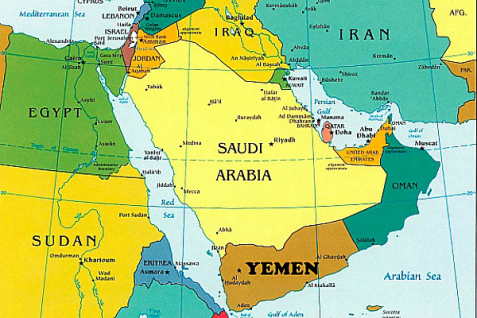
Iran backs the Houthi rebels, who chased the Yemeni president from Sanaa and are fighting for control of the Gulf nation. Warships from Saudi Arabia and Egypt, who back Yemeni President Abd Rabbuh Mansur Hadi, are positioned to the southwest of the convoy, forming a blockade of the Gulf of Aden and the port city of Aden.

Western governments and Sunni Arab countries say the Houthis get their arms from Iran. Tehran and the rebels deny that, although Iran has provided political and humanitarian support to the Shiite group.

The U.S. also has been providing logistical and intelligence support to the Saudi-led coalition launching airstrikes against the Houthis. That air campaign is now in its fourth week, and the U.S. also has begun refueling coalition aircraft involved in the conflict.

The campaign meant to halt the rebel power grab and help return to office Hadi, a close U.S. ally who fled Yemen.

The defiant Shiite rebels pressed their offensive in the country’s south on Thursday, apparently ignoring an overture from Saudi Arabia earlier this week, while the kingdom’s warplanes continued to target their positions, officials said.

The rebels’ prized goal — the port city of Aden — remained an elusive one, in part thanks to the Saudi-led airstrikes.

Meanwhile, Pakistan’s top leaders, including Prime Minister Nawaz Sharif and army chief Gen. Raheel Sharif, arrived Thursday in Saudi Arabia to push for negotiations in the Yemen conflict. The two are to meet with King Salman to discuss the crisis, according to Pakisitan’s Foreign Office spokeswoman Tasnim Aslam.

Both predominantly Sunni majority countries, Saudi Arabia and Pakistan are close allies, and Islamabad has supported the Saudi-led coalition, though it declined to send troops, warplanes and warships to join it.

The kingdom and Gulf Arab allies launched the airstrikes March 26, trying to crush the Houthis and allied military units loyal to ousted President Ali Abdullah Saleh.

The Saudis believe the rebels are tools for Iran to take control of Yemen.

Loud explosions shook the cities of Taiz and Ibb in western Yemen on Thursday, as well as Aden when coalition warplanes bombed the rebels and their allies, witnesses said.

Residents also said the Houthis and Saleh’s forces were attacking the city of Dhale, one of the southern gateways to Aden, with random shelling.

All Yemeni officials and witnesses spoke to The Associated Press on condition of anonymity because they were not authorized to talk to the media or feared for their safety amid the fighting.

Iranian Warships Arrive in Yemen Port

April 23, 2015

Iranian Warships Arrive in Yemen Port, The Jewish PressHana Levi Julian, April 23, 2015

YemenKSA.jpgSaudi Arabia airstrikes were aimed at Iranian-backed Houthi rebels who seized positions in neighboring Yemen. Iran is believed to be arming the rebels. Photo Credit: KSA

Iranian warships arrived Thursday in the southern Yemen port of Aden despite the presence of several U.S. warships in the area as well. It is believed the Iranian vessels are carrying weapons to re-arm the Shiite Houthi rebels who have seized control over the port city and the nation’s capital, Sa’ana.

Saudi Arabian Ambassador to the United States, Adel al-Jubeir, said Wednesday that his nation’s air force had achieved its objectives and has concluded its bombing campaign.

“We destroyed the air force, we destroyed their ballistic missiles as far as we know; we destroyed their command and control; we destroyed much, if not most of their heavy equipment and we made it very difficult for them to move from a strategic perspective,” al-Jubeir said. He added that Saudi forces had “eliminated the threat they posed to the Kingdom of Saudi Arabia” but . said that in the long run, there is “no military solution” to the conflict.

According to the World Health Organization, 1,080 people have been killed in the past month in Yemen, and 4,352 others have been wounded.

Coalition warplanes picked up where Saudi Arabian air force pilots left off and continued on Thursday to pound Houthi rebels in southern Yemen. The international forces targeted rebel positions in Aden and the central city of Taiz, according to Voice of America.

A severe humanitarian crisis has been created in the war-torn region, according to VOA, but the Shi’ite rebels still remain. Yemen President Abd Rabbu Mansour Hadi has fled for his life to Saudi Arabia.

Although Iran claimed that it welcomes an end to “killing innocent and defenseless civilians” and seeks a political resolution to the conflict, its warships laden with arms for the rebels– as usual – tell a different story.

U.S. Warships On Watch – Leading From Behind – Lt Col Ralph Peters – Willis Report

April 22, 2015

U.S. Warships On Watch – Leading From Behind – Lt Col Ralph Peters – Willis Report, Fox News via You Tube, April 21, 2015

(It’s from yesterday and the situation remains fluid. Still, it’s worth watching. — DM)


US Sec. Defense on Iran nuclear facilities: Bunker buster bombs ‘ready to go’

April 11, 2015

US Sec. Defense on Iran nuclear facilities: Bunker buster bombs ‘ready to go’ Jerusalem Post, April 11, 2015

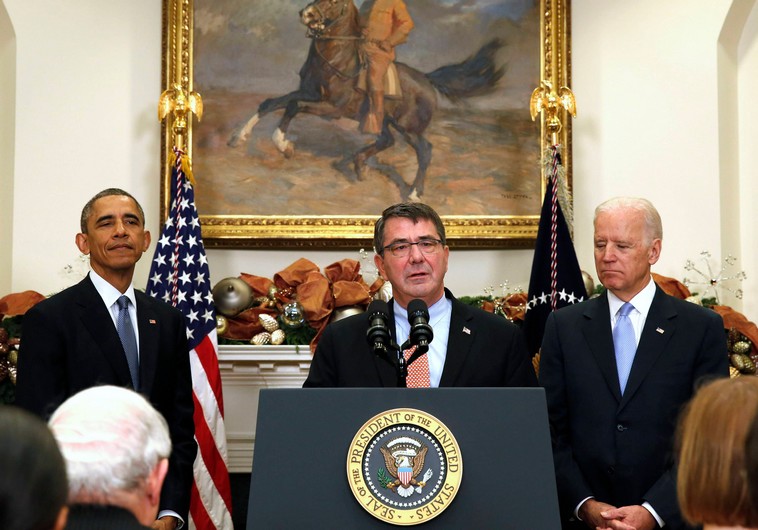
US SecdefAshton Carter (C), US President Barack Obama (L) and US Vice President Joseph Biden (R).. (photo credit:REUTERS)

US Secretary of Defense Ashton Carter addressed the possibility of a military option against Iran, saying that bunker busting bombs, meant to penetrate Iran’s underground facilities, are “ready to go.”

Speaking to CNN in an interview aired Saturday morning, Carter said that the deal between Iran and the P5+1, the basics of which were recently laid out in during negotiations in Switzerland, will hinge not on “trust but rather on “verification.”

“We have the capability to shut down, set back and destroy the Iranian nuclear program and I believe the Iranians know that and understand that,” Carter said, indicating the US’s willingness to utilize high-powered bombs if Tehran does not abide by the deal reached in the Swiss resort town where the various delegations were hosted during the eight day marathon negotiations.

The reference to the Massive Ordinance Penetrator, or MOPS, whose reach extends 200 feet below ground, is the first that any American figure has made concerning substantive military planning against the Islamic Republic’s fortified subterranean facilities.

One such facility is Fordow, near the city of Qom, where Iran maintains a facility dedicated to producing 20% enriched medium-grade uranium. Tehran insists that this would only be used for civilian purposes, a claim that has failed to assuage fears that it could then be further enriched to 90%, the necessary amount needed to produce weaponized material.

While he voiced a more hawkish tone than the White House, Carter echoed Washington’s preference for a diplomatic solution, explaining that negotiations would actually be a more long-lasting method of ensuring a nuclear-bomb free Iran since “military action is reversible overtime.”

Asked about another key factor affecting US interests int the Middle East, namely the White Houses’ willingness to deploy ground troops against the Islamic State group in Iraq and Syria, Carter suggested that the administration has not yet reached that conclusion, but that he “would not hesitate to give that advice.”