Author Archive

Iran: We Can Produce Enriched Uranium in Two Days if U.S. Pulls Out of Nuclear Deal

March 6, 2018

By Adelle Nazarian 6 Mar 2018 Breitbart

Source Link: Iran: We Can Produce Enriched Uranium in Two Days if U.S. Pulls Out of Nuclear Deal

{Two days is probably the amount of time needed to move all that hidden enriched uranium out of hiding. – LS}

Iran claimed Monday that it could produce higher enriched uranium within a 48-hour period if the United States exits the 2015 nuclear deal, otherwise known as the Joint Comprehensive Plan of Action (JCPOA).

“If America pulls out of the deal … Iran could resume its 20 percent uranium enrichment in less than 48 hours,” Behrouz Kamalvandi, spokesman for the Atomic Energy Organisation of Iran, told al-Alam TV, according to Reuters.

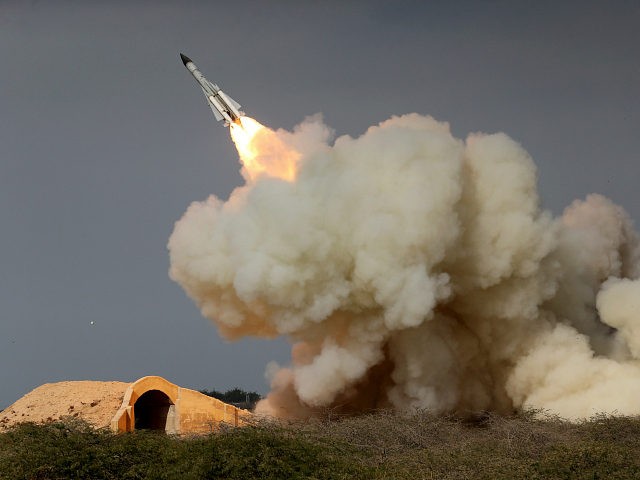
Iran has fired nearly two dozen ballistic missiles, at least 16 of them nuclear-capable missiles, since signing the controversial 2015 nuclear deal.

While President Donald Trump and his administration have indicated the United States’s intention to see the deal discarded, Germany, Britain, France, Russia, and China appear to be committed to keeping the deal intact.

Iran has continuously insisted that its ballistic missile program is purely for defensive purposes. The regime has also denied that it is supplying arms and missile technology to Houthi rebels in Yemen and, despite evidence showing otherwise, that the ballistic missiles that were fired into Saudi Arabia from Yemen were not theirs.

In December, Iran claimed that United States Ambassador to the United Nations Nikki Haley “fabricated” her announcement that the charred remains of a short-range ballistic missile discovered in Yemen, which was prominently displayed behind her during her speech, originated in Iran.

That same month, an independent panel to the U.N. Security Council declared, “Design characteristics and dimensions of the components inspected by the panel are consistent with those reported for the Iranian designed and manufactured Qiam-1 missile.”

Last week, ahead of his trip to Iran this week, French Foreign Minister Jean-Yves Le Drian’s said at a news conference with Russian Foreign Minister Sergey Lavrov that Iran’s ballistic missiles program “worries us enormously.” He reportedly added, “Having such tools is not uniquely defensive, given the distance they can reach.”

In October, Iran said it has no need to increase the range of its ballistic missiles because they were already capable of reaching U.S. forces stationed in the region.

The Increasingly Mysterious U.S. -vs- Russia Battle at Deir Ezzor in Syria…

March 5, 2018

Posted on March 3, 2018 by sundance The Conservative Treehous

Source Link: The Increasingly Mysterious U.S. -vs- Russia Battle at Deir Ezzor in Syria

{Saving face by way of nuclear threats. – LS}

There has been some non-broadcast media discussion about a battle that took place in Syria on February 7th, 2018.  According to the generally accepted overview, U.S. and coalition forces appear to have killed scores of Russian mercenaries, some reports put the number as high as 200.

Officially Russia has denied their troops were engaged in the failed attack against U.S. and coalition forces; however, actions by Russia since the battle seem to convey a more confirming message.

Bloomberg reported around 100 Russian contracted mercenary soldiers, hired by Syria’s Bashir Assad, were killed by a coalition force of U.S. and Kurdish forces in what would easily be the deadliest clash between Russians and Americans since the cold war.

More than 200 contract soldiers, mostly Russians fighting on behalf of Syrian leader Bashar al-Assad, died in a failed attack on a base held by U.S. and mainly Kurdish forces in the oil-rich Deir Ezzor region, two of the Russians said. The U.S. official put the death toll in the fighting at about 100, with 200 to 300 injured, but was unable to say how many were Russians. (link)

The contracted mercenaries are likely from a Russian company Wagner, similar to the U.S. company Blackwater.  Because they are not officially Russian soldiers there’s a great deal of built in plausible deniability.   As Bloomberg also noted: ““This is a big scandal and a reason for an acute international crisis,” said Vladimir Frolov, a former Russian diplomat and lawmaker who’s now an independent political analyst. “But Russia will pretend nothing happened.””

The official response from U.S. Central Command released immediately afterward: Feb. 8, 2018 – Release # 20180208-01 – FOR IMMEDIATE RELEASE:

SOUTHWEST ASIA – Syrian pro-regime forces initiated an unprovoked attack against well-established Syrian Democratic Forces headquarters Feb. 7.

Coalition service members in an advise, assist, and accompany capacity were co-located with SDF partners during the attack eight kilometers east of the agreed-upon Euphrates River de-confliction line.

In defense of Coalition and partner forces, the Coalition conducted strikes against attacking forces to repel the act of aggression against partners engaged in the Global Coalition’s defeat-Daesh mission.

The Coalition remains committed to focusing on the defeat-Daesh mission in the Middle Euphrates River Valley and asserts its non-negotiable right to act in self-defense. (link)

Video encapsulating the event (prompted, just hit play):

The bottom line is Bashir Assad, Russia and Iran are working together in Syria to keep Assad in power.  A military force within of that nexus, mostly paid Russians, attacked a U.S. protected compound with tanks, artillery, mortars and rockets.

The U.S. responded with overwhelming air power (drones, B-52 bombers, F-15 fighter jets, Apache helicopters and AC-130 gun ships), raining down precision-guided munitions upon the enemy assault battalion (300 – 500), while disabling their communications capability, for approximately three hours.   When the dust settled around 200 Russians were dead and hundreds wounded.

That was a jaw-droppingly sneaky and aggressive action by the technically ‘unofficial’Russians; and an even more stunning response by the official U.S. military [Trump ROE].

The aggressive pro-Assad group (“unofficially Russian military”) was officially stomped into the sand.  Therein we discover the reason for the entire episode to be kept on the down-low by the Russian government.

The Russian Government cannot be public or protest the response because technically the Russian government must pretend they had nothing to do with it.  Simultaneously, the U.S. government cannot be public or protest the Russian attack because technically they too must pretend the Russian government had nothing ‘officially’ to do with it.

However, to the intellectually honest international audience:  the Russians just attacked the Americans, and the Americans opened a can of whoop-ass on the Russians in response.

Oh dear.

And notice how the limited public disclosure response was from U.S. CentCom.?  The U.S. Central Command is located at McDill Air-Force Base in Tampa, Florida.

Did you see the latest video release from Russia?

The Putin nuclear video has nothing to do with Mar-a-Lago you knucklehead, the video is connected to the “Dead Russian Mercenaries story”, and a less-than-subtle jab back at U.S. CentCom.


Very rare picture taken inside a can of whoop-ass.

The US is Accelerating Development of Its Own ‘Invincible’ Hypersonic Weapons

March 2, 2018

By Patrick Tucker Technology Editor 3-02-2018 Defense One

Source Link: The US is Accelerating Development of Its Own ‘Invincible’ Hypersonic Weapons

{American ingenuity will prevail. – LS}

Russia isn’t the only country looking to build invincible hypersonic weapons. Here’s the latest on the U.S. efforts to send missiles and even aircraft five times faster than sound.

Last spring, representatives from the Defense Advanced Research Projects Agency, or DARPA, came to the office of then-Deputy Secretary of Defense Bob Work and laid out some hard truths about U.S. development of hypersonic weapons — the ones meant to travel more than five times faster than sound. The message from the military scientists: U.S. hypersonics aren’t keeping up with Russia and China.

Early on Thursday, national-security professionals across Washington, D.C., awoke to news that Russian President Vladimir Putin was claiming to have created an air-defense-beating, “invincible” hypersonic missile — though offering no particular proof. New DARPA director Steven Walker declined to comment on Putin’s assertion but told defense reporters that his teams are working as they can to test a hypersonic missile before 2020 — and that they need more help.

“Most of our programs at DARPA [related to hypersonic research] are testing at one facility,” Walker said: NASA’s Langley Research Center in Virginia, where research and testing is happening around the clock.

He says he needs more testing infrastructure.

“If you look at some of our peer competitors, China being one, the number of facilities that they’ve built to do hypersonics… surpasses the number we have in this country. It’s quickly surpassing it by 2 or 3 times. It is very clear that China has made this one of their national priorities. We need to do the same,” he said.

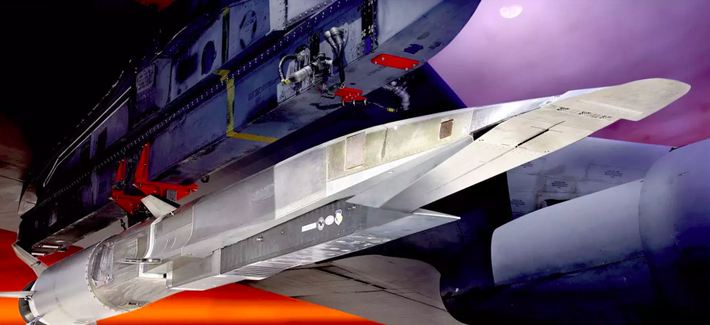
DARPA and the U.S. Air Force are working on two hypersonic weapon concepts. One is the Tactical Boost Glide weapon. A rocket accelerates the craft to very high speeds and altitudes, then glides back to earth. The other is the hypersonic air-breathing weapon concept, or HAWC, whose scramjet engine takes in air at supersonic speeds, compresses it, and pushes it through a nozzle out the back.

The military is requesting a lot more money for hypersonic research following some technological breakthroughs within the last few years. The trend began in 2010 with the achievement of 200 seconds of supersonic combustion in the air, on the X-51 Waverider experimental aircraft.

Current efforts, Walker said, are keenly focused not just on achieving new research breakthroughs, but on putting those into weapons and figuring out how much those weapons will cost.

“Things are moving,” he said. “This is becoming not just [a science and technology] thing. The services are interested in moving forward with real capabilities.”

The military will increase spending for testing and for secondary (or “follow-on”) programs as part of its FY 19 budget request, which includes some $14.3 million for the Tactical Boost Glide effort.

Walker announced on Thursday that the fruits of the research will also further the development of long-range precision weapons for the Army. The military is requesting $53 million for that, part of a program called Operational Fires. And it’s requesting another $50 million to demonstrate a ground-launched hypersonic system that incorporates tech from the Tactical Boost Glide program.

There’s growing support and interest from the leadership as well, said Walker, who reported that Michael Griffin, the new undersecretary of defense for research and engineering and a former NASA administrator, was making hypersonics one of his “top priorities.”

The Air Force program for the boost-glide system is focused on “an operational prototype in the 2022 period,” Walker said. There’s also work on a $140 million program to create a hypersonic craft capable of multiple flights, using tech that has come out of the HAWC.

“We have a program we are working with NASA … called the advanced full range engine. It’s basically developing the combined cycle propulsion system you would need for a reusable platform. We’re making good progress on that. We expect to test the engine in [2019] or [2020] on the ground” at a NASA facility that boasts a 100-square-foot wind tunnel. “Whether we actually go to a flight demo, that’s not part of the program right now,” he said.

The goal is to get a conventional turbine engine that can get up to Mach 2 and then transition seamlessly to a scramjet engine to transition to higher speeds. “You can actually take off like an airplane, fly up to Mach 6, do your mission, and come back down,” said Walker.

In hypersonics, optimism and disappointment are in a constant push and pull, just like the physical forces that act on airplanes flying faster than sound. It’s nearly impossible to predict how a bunch of interconnected metal and electronica are going to behave moving at those speeds. The laws of physics still apply, but at that point, you start getting into the laws’ very fine print.

Why Designing Hypersonic Aircraft Is So Hard

“The tricky thing about hypersonics is that equilibrium flows become non-equilibrium,” said Walker, referring to the effects of air pressure on the physical structure of solid objects at high speeds.

“Lots of friction [and] separation, potentially in the flows [of air, energy and physical materials]” happen in such a way that very good calculations about the material effects become “more guesses than actual reality,” he said.

Different mathematical tools and techniques can make that guesswork easier, such as the Reynolds-Averaged Navier Stokes, or RAND, formula, which allows you to predict what will happen as air moves across object surfaces.

Nicholas Bisek, a research aerospace engineer at the hypersonic sciences branch of the Air Force Research Lab’s Aerospace Systems Directorate, says that Navier Stokes is one of many different mathematical models you can use to figure out solid material interaction at high speeds. But when you apply those formulas to something as big as an aircraft, you have to do it again and again, chewing over the problem millimeter by millimeter to better calculate the effects of air, pressure, and other phenomenon at the most minute level.

“We have to move away from even RAND to particle-based methods that allow us to model individual particles as opposed to fluid treated as a continuum,” he says.

The Air Force is looking toward supercomputers to help with those tiny but numerically herculean math problems. In February, it awarded some $57 million to Hewlett Packard Enterprise, or HPE.

It’s a bit like doing a jigsaw puzzle with highly complex equations. Getting everything to fit together is beyond what humans can do with Sharpies and blackboards, according to Kevin Newmeyer, chief of staff for the high-performance computing modernization program for defense at HPE. “Instead of modeling a single aircraft, you have to model the surface and air in blocks as small as centimeters, millimeters. You join these calculations together in a cascading set of calculations,” he said.

But even here, at the cutting edge of big data and big computing, you still get a very small and very brief window into how air and solid surface are interacting. “One of these calculations may take days or even up to a couple of weeks to model,” Newmeyer said. That model will run 15 to 20 seconds, “if it goes that long.”

Supercomputers are useful; but physical testing facilities are essential, said Walker.

“Another complicating factor in hypersonics is you can only simulate so much on the ground. It’s hard to get the velocity, the temperature, the Mach number all correct as the vehicle would experience [them] in the air. We do component testing on the ground. We’ll do this engine testing on the ground. With hypersonics, you really have to fly,”

Fly they will. In 2019, he says, expect “lots of tests.”

When the Government Fails In Its Primary Duty, The People Will Defend Themselves

March 2, 2018

Written by John Guandolo, President/Founder of Understanding the Threat (UTT)

Source Link: When the Government Fails In Its Primary Duty, The People Will Defend Themselves

{Well written. A must-read for everyone.   – LS}

100% of Islamic Law (sharia) mandates warfare against non-muslims, and obliges stoning, crucifixion and beheading for certain crimes.  Islam’s prophet – a “beautiful pattern of conduct” for all muslims for all times – himself tortured, killed, took sex slaves, waged war on non-muslims, lied, and commanded war until the earth was under Islamic rule.  Yet, the President’s National Security Advisor, Herbert McMaster tells the public the actions of Al Qaeda and the Islamic State have nothing to do with Islam.

Presidents Clinton, Bush, and Obama all told the American people Islam is not a threat, but a peaceful religion.

They were wrong.  What they said is factually untrue and can never be true.

President Clinton’s Islamic Advisor, who also created the Muslim Chaplain Program for the Department of Defense and, as a “Goodwill Ambassador” for the State Department participated in the Middle East peace process on behalf of the United States, was actually a financier for Al Qaeda (Abdurahman Alamoudi), who is now in federal prison.

The U.S. government modeled the “Countering Violent Extremism” program after the British program of the same name which was handed to the Brits by the Muslim Brotherhood in the UK.  The FBI and DHS dragged that trojan horse into the U.S. national security apparatus, and put senior Muslim Brotherhood operatives in advisory roles across the government to implement it.

Numerous members of Congress and other government officials publicly support known leaders of the U.S. Muslim Brotherhood, including the Council on American Islamic Relations (CAIR), which the U.S. Department of Justice identifies as a “Member of the U.S. Muslim Brotherhood’s Palestine Committee” which is Hamas in the United States.

Members of Congress to include nearly all Democrats, as well as John McCain, Scott Brown, Marco Rubio, John Boehner, Paul Ryan and others have consistently failed to identify the threat from the Islamic Movement, and have attacked those who speak truth about it, like former Congresswoman Michele Bachmann.

U.S. military generals and admirals created rules of engagement, policies on training, and wartime strategies all based on a counter-factual understanding of the enemy.  This is why the military’s “win the hearts and minds” crap got thousands of our men and women killed on the battlefield, frustrated our war-fighters, and got some of them put in jail for killing Al Qaeda jihadis outside the bounds of those same rules of engagement.

The FBI investigated:  the Boston Marathon bombers; the Orlando and San Bernadino jihadis; Abdulhakim Mujahid Muhammad, who killed Private Andy Long at a recruiting depot in Little Rock, Arkansas; the Ft Lauderdale jihadi; and so many others.  Yet in all of these cases, the FBI took no action to deter these attacks or kill/capture the men and women who perpetrated them before the attacks.

Why?  Because the U.S. federal government has catastrophically failed in its most basic duty:  to wield the sword and defend this nation and the the inalienable rights given to the American people by God.

We are at war and our government is certainly not acting like it.  They treat it like it is a crime spree.

In my time doing counter-jihad work, I have been physically threatened numerous times.  It is the nature of the business.  Just ask Geert Wilders, Robert Spencer, Pam Geller, and anyone else who speaks truth about Islam.

Ask Theo van Gogh.  Oh wait, you can’t.

I have contacted my old employer, the FBI, many times and filed reports about threats to me from jihadis.  There has been zero follow up by the FBI.

2016 was the first time the FBI followed up on real threats against me.

The FBI’s Oklahoma office opened investigations on two specific threats against me in the fall of 2016.  One of the threats just happened to come immediately after I testified in the Oklahoma State House that  two muslim leaders sitting in the hearing room are jihadis.

They are:  Dr. Imam Imad Enchassi, the Imam of the Muslim Brotherhood’s Islamic Society of Greater Oklahoma City; and Adam Soltani, the leader of Hamas in Oklahoma doing business as the Council on American Islamic Relations (CAIR).

The FBI classified the case, so when they did not prosecute, state and local prosecutors could not use information because it was classified.  By the time the case was declassified, the subject of the investigation fled the country.  See an article here about this incident.

Here is the point:  The United States government has demonstrated since 9/11/01 it is not capable of protecting its citizens, primarily because it refuses to identify Islam/sharia as the doctrinal driver of the jihadis, organizations, and nation states waging war against the West.

Apparently, our leaders are also incapable of reading 1400 years of Islamic history or reading what America’s founders wrote about Islam and the threat it poses to Western civilization.

American leaders are still discussing nuanced strategies, outreach, and interfaith dialogue, while nations have been and are being overthrown, hundreds of thousands of Christians lay dead overseas, and Europe is being overrun by Islamic jihadis (sharia adherent muslims).

America’s leaders play the violin while Rome burns.

The U.S. Department of Justice and the Attorney General of the United States have shown no sign of taking any productive action.  No domestic plan has been formulated to strategically deal with this real threat.

The answer resides, as it always does, in the hands of the American citizens.

Citizens must work to ensure local police/sheriffs get smart on the threat and take action.  Citizens must positively support police in developing aggressive investigative strategies to identify jihadis and their organizations at the local level and shut them down.  Citizens must organize to meet this enemy along every line of operation the enemy has created to stop their forward progress.

This can be done.  It is why Understanding the Threat does what we do, and we are the only ones doing it.

Local media, businesses, and leaders who protect these terrorists/jihadis and minimize the threat, must pay for their actions.  There are local and state laws on the books for individuals (like reporters) aiding and abetting seditious actors and terrorists.  Businesses should be boycotted and shut down if they support jihadi organizations.  Local elected officials should be jailed for propagandizing for, defending, or providing material support to individuals and organizations working to overthrow the state and federal Constitutions.

Many states have RICO statutes which cover many of these violations of the law.  Mostly, Americans must stop being so tolerant of those who support enemies of this nation, and begin taking affirmative actions.

Speak truth boldly IN love and WITHOUT fear.

Get involved in your local school district, local politics, and with your local police and sheriff’s office.  Force them to learn this information and act on it to protect the community, or get new people in positions of authority who will.

Take the fight to the enemy.  Do not wait in a defensive posture.  Put freedom on the offensive where it belongs.

It is late August 1939 in Warsaw, Poland.  As the darkness grows, will you sit and wait or will you do your best to thin the enemy’s ranks here in the U.S. before the larger war begins?

{One more thing to consider……. – LS}

Satellite image said to show new Iranian military base in Syria

February 28, 2018


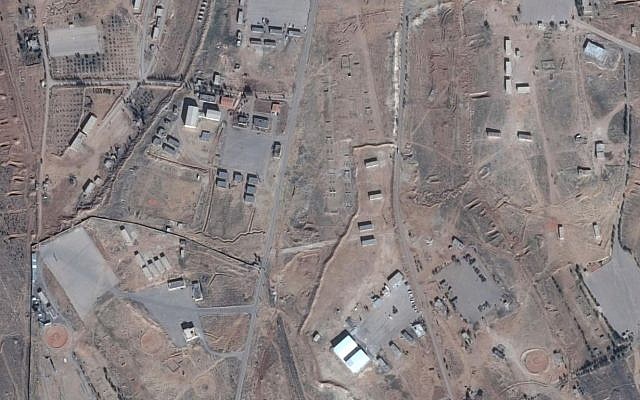
A picture of the alleged Iranian base in Syria. The white hangars can be seen at the bottom center. (Google Maps) {Google? – LS}

Source Link: Satellite image said to show new Iranian military base in Syria

By Times of Israel Staff February 28, 2018

{This won’t end well. – LS}

Hangars seen in picture, reportedly housing missiles, similar to building at site identified as Revolutionary Guards base and allegedly struck by Israel last year.

Satellite images of an area near Damascus appear to show an Iranian military base which could house missiles capable of hitting Israel, according to a report early Wednesday.

A picture of the reported base, in an area known as Jabal al-Sharqi some eight kilometers (5 miles) northwest of the Syrian capital, shows two recently constructed buildings which are similar to those seen at another base in Syria thought to have been used as a base for Iranian Revolutionary Guards Corps troops, according to Fox News, citing information from Israel-based geospatial analysis outfit ImageSat.

On Wednesday morning, Defense Minister Avigdor Liberman downplayed the report, telling Israel Radio there was “nothing new here.”

“Don’t take every report in the media, even from a respected outlet like Fox, as an absolute thing,” the defense minister said.

“We have the full picture of what’s going,” he added.

The buildings were identified in the report as possible hangars housing short- and medium-range missiles.

Their shape and size, 30 meters by 20 meters, is identical to a building at a site also identified as an Iranian base, reportedly targeted by an Israeli strike in December.

However, an ImageSat report on that site, at al-Kiswah some 13 kilometers (8 miles) south of the Syrian capital of Damascus, identified that building in November, before it was struck, not as a missile silo but rather as a probable mosque or dining room.

A BBC report on the same base also indicated analysts did not believe it was designed for storing missiles or other large arms, but rather for housing soldiers and vehicles.

On Wednesday, though, ImageSat revised its understanding of the al-Kiswah building targeted in December, identifying it too as a possible missile silo. No reason was provided for the altered assessment.

An earthen berm is also visible around the Jabal al-Sharqi site, indicating a likely military use.

Israel has been warning for years that Iran is seeking to entrench itself militarily in Syria, including establishing missile bases. According to Israeli political and military assessments, Tehran, which has shored up Syrian President Bashar Assad in the Syrian civil war, has been working to create air and naval bases in Syria, from which it can arm the Lebanon-based terror organization Hezbollah and other Shiite groups, as well as carry out attacks of its own against the Jewish state.

Prime Minister Benjamin Netanyahu warned on February 18 that Israel could strike the Islamic Republic directly and cautioned Tehran not to “test Israel’s resolve.”

“Israel will not allow Iran’s regime to put a noose of terror around our neck,” he added. “We will act without hesitation to defend ourselves. And we will act if necessary not just against Iran’s proxies that are attacking us, but against Iran itself.”

A report earlier this month alleged that Iran is operating 10 military bases in Syria and is training militias loyal to Assad’s regime for a possible battle with Israel, with two key facilities located near the Golan Heights border.

On Tuesday, the head of US Central Command Joseph Votel warned Iran was increasing the quality and quantity of missiles it was supplying to groups in Syria and Lebanon.

“Iran is generating instability across the region, and the Iranian Threat Network continues to increase in strength, enhancing its capacity to threaten US and partner nation interests,” he said.

Returning from a trip to Israel Tuesday, South Carolina Senator Lindsey Graham told reporters that Iran was “testing” US President Donald Trump in Syria and in Lebanon, where Israeli officials fear Iran is helping the terror group Hezbollah build precision-guided rockets for us against the Jewish State.

“They are testing Trump,” Graham said, according to Bloomberg News. “They are testing the international community.”

Graham also predicted there would soon be war in southern Lebanon, over the missiles.

“They’ve told us in no uncertain terms that if this threat continues — they keep making rockets that can hit the airport and do a lot of damage to the state of Israel — they are going to have to go in,” Graham said.

The Tragedy of Syria: All Red Lines Have Been Crossed

February 28, 2018

by Julie Lenarz | 02.27.18 12:23 pm via The Tower

Source Link:
The Tragedy of Syria: All Red Lines Have Been Crossed

{The butcher is still hard at work. – LS}

What’s happening in Ghouta is a war crime. A blood orgy orchestrated by Bashar al-Assad, a modern-day Caligula figure, and his criminal patrons in Iran and Russia.

More than 500 men, women and children have been killed since last week in the eastern enclave, where activists over the weekend reported a suspected poison gas attack.

According to 60 Minutes this past Sunday night, the Assad regime has used internationally banned chemical agents nearly 200 times throughout the civil war. The Organization for the Prohibition of Chemical Weapons (OPCW), the world’s leading chemical weapons watchdog, opened an investigation on Sunday into attacks in Ghouta to determine whether banned munitions had been used.

The unspeakable suffering we are witnessing in Ghouta is the result of a conscious strategy of besiegement, systematic blocking of humanitarian aid, and the illegal destruction of civilian infrastructure – hospitals, schools and kindergartens have all been bombed into the ground.

If this story sounds familiar, that is because we have heard it all before. We have seen it in the ruins of Aleppo, on the killing fields of Cambodia, the poisoned ghost towns in Iraqi Kurdistan, the sieges of Sarajevo and Srebrenica, and the desert death camps of Darfur.

“Never again,” the shell-shocked international community pledged — again, and again – and again — in the wake of these atrocities. And yet the same horrors are now being inflicted on the people of Ghouta and we are reacting with much the same impotence.

The United Nations Security Council (UNSC), corrupted by the malign agendas of Russia and China with no regard for human suffering, has long been reduced to issuing empty mantras ranging from being “concerned” to “very concerned” and, lately, “gravely concerned.”

But their condemnation of crimes committed against innocent civilians does not feed the children on the streets of Ghouta. It does not keep warm the families that must now sleep in the rubble of their homes, or help pull the injured from under the ruins of the city.

Look closely, if you spent the last decade pontificating about US imperialism in the Middle East, sharing uncritically the absurd spectacle of conspiracy theories brought to you by Russia Today, Iranian Press TV and other state controlled outlets with hostile agendas.

Syria is a place where more people died than in Iraq, Afghanistan and Libya combined – it’s a lawless Wild Wild West of international affairs where the Assads, Khameneins, Putins and Erdogans of this world kill at their pleasure.

The UNSC called for the 30-day truce in all of Syria on Saturday to allow aid deliveries and medical evacuations in the war-torn regions. But Iran and the Syrian regime continued attacks on Damascus suburbs held by “terrorists” the Iranian military chief of staff said on Sunday.

Everyone is now a terrorist. Every hospital bombed a secret weapons storage. Every school destroyed a recruitment center. Every use of poisonous gas a false flag operation by the rebels.

The industrial-scale killing machinery in Syria is the unhappy consequence of American isolationism and non-intervention, with the result that, eight years down the line, the murderous dictator is neither dead nor imprisoned, but still gassing his own people.

The Assad regime has recaptured large swathes of Syrian territory. The mullahs have turned the country into a permanent Iranian military base. And Russia is dictating the way things are going.

America isn’t perfect. Far from it. But it’s still an unrivaled beacon of light in the darkness of international relations that do not offer a more just and moral superpower to fill its place.

Eight years into the civil war, Syria has turned into the greatest humanitarian catastrophe of our time. It is too late for the people of Ghouta. They will follow the restless souls of Rwanda, Bosnia, and Kurdistan in a long line of victims abandoned by the international community. All red lines have been crossed. 


Iran Is Trying to Avoid a Clash but May Surprise Israel

February 27, 2018


Iran’s military chief Mohammad Bagheri, right, on a visit to Turkey. Reuters / Stringer

Ephraim Kam Feb 27, 2018 2:46 PM Haaretz

Source Link: Iran Is Trying to Avoid a Clash but May Surprise Israel

{Running out of proxies? – LS}

Tehran will find it hard to remain silent for long if Israel strikes Iranian targets; at some stage it might shock us with the timing, weapons or method

The latest confrontation between Israel and Iran on the northern front was predictable. We can assume that neither side wanted the clash, but with Tehran having sent substantial Iranian and Shi’ite combat forces to Syria  while arming Hezbollah with advanced weapons, and with Israel determined to check the danger, a clash was almost inevitable.

On top of that is the consensus among Israel’s leaders that Iran presents the most serious threat to Israel. This perception is based on a number of elements: Hezbollah and its huge missile system, Iran’s large and improved missile system, and Tehran’s policy of encircling Israel with radical Shi’ites, marked by the anti-Israel front in Syria and Lebanon.

Clearly if Iran goes nuclear some day this threat will increase to an unprecedented level. But the balance of powers is more complex. The main tool used by the Israel Defense Forces in Syria is the air force, and Iran has no answer to it; its own air force is based on planes 30 to 40 years old and clearly can’t cope with its Israeli rival.

In addition, Iran has to operate forces hundreds of kilometers from its borders without any real defense when they’re subject to Israeli attacks and provocations by Sunni groups in Syria. Weapons convoys to Hezbollah and arms plants in Syria are exposed to attacks.

The United States also poses a threat to Iran. The Trump administration has defined Iran as a threat of the highest order to the United States and its allies due to its use of terror, intervention in other countries, construction of a large missile system, and above all its attempt to produce nuclear weapons.

Although Russia – currently the most influential player in Syria – stands alongside Iran and recognizes Iran’s right to maintain forces in Syria, there are differences of opinion, conflicts of interest and suspicions between Tehran and Moscow. As a result, Iran fears that if an overall agreement in Syria is achieved, Russia won’t insist on leaving Bashar Assad’s regime in place if it receives a promise that it can continue to use its air base and naval base there.

If the Assad regime is ousted in the context of an agreement, Iran’s influence in Syria will suffer a serious blow. Iran thus hasn’t yet responded with fire to attacks against weapons convoys and factories in Syria.

Even when Iran challenged Israel in the most recent clash, it did so with a drone, not by opening fire. Since early 2015, Hezbollah has also refrained from responding to what could be perceived as Israeli provocations. This reluctance to respond apparently stems from a recognition of Israel’s significant military advantage in the north.

The Iranians are also likely to fear that a confrontation with Israel would give Israel a chance to attack the nuclear weapons sites in Iran. Moreover, Iran apparently doesn’t seek a confrontation because its top priority is to stabilize the Assad regime and exploit its standing in Syria to strengthen its influence in Iraq and Lebanon. An entanglement with Israel could block these goals.

Iran’s supreme regional goal is to entrench itself in Syria and its neighbors for the long term. It has already paid a high price for this in blood and money, and there’s no reason to assume that it will give this up. Israel, meanwhile, must prevent Iran from leaving its forces and the Shi’ite militias in Syria – including Hezbollah – for the long term. This basic conflict could lead to a confrontation again – and there’s no evidence yet of a responsible adult among the great powers to ease the conflict of interests.

The bottom line is that Iran is trying to avoid a confrontation with Israel, but will find it hard to remain silent for long if Israel strikes Iranian targets. Thus we must take into account that at some stage Iran will take a military action to deter Israel. Iran will want to surprise Israel – with the timing, weapons or method. For that purpose it will prefer to activate Hezbollah and other Shi’ite militias so as not to get involved itself.

Iran may instruct Hezbollah to use its missile system, despite the risks involved both to it and its emissaries. Iran would probably try to exploit an opportunity when Israel is preoccupied with another crisis – the main candidate is a conflict with Hamas in Gaza. And of course there’s also the possibility of a mistake in judgment that would get Iran embroiled in a conflict with Israel.


Palestinians accidentally burn down own factory in protest against IDF soldiers

February 27, 2018

By TOI STAFF 26 February 2018, 12:22 pm The Times of Israel 

Source Link: Palestinians accidentally burn down own factory in protest against IDF soldiers

{You just can’t make this stuff up, folks. – LS}

Israeli firefighters assist PA authorities in putting out blaze in village of Beita after rogue burning tire changes course

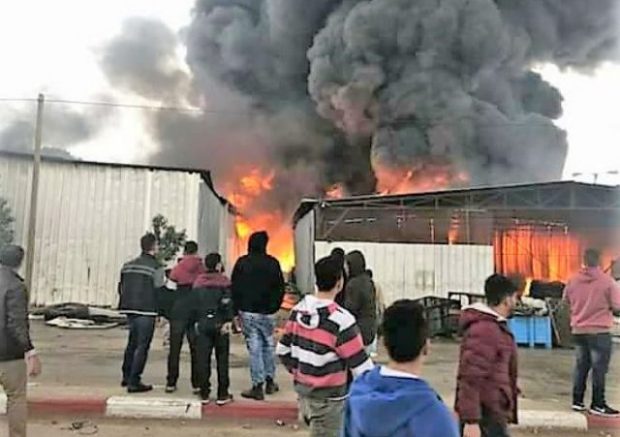
Palestinian protesters in the West Bank inadvertently burned down a local factory this week while confronting IDF soldiers near the West Bank city of Nablus.

According to Hadashot news, protesters in the Nablus-area village of Beita on Sunday were clashing with IDF soldiers, and rolled burning tires in their direction.

But one flaming tire had other plans and changed direction, rolling directly into a nearby plastics factory.

The building went up in flames and the factory was completely destroyed.

The report said Israeli firefighters arrived at the scene to help Palestinian Authority responders put out the fire.

The Nablus area has seen low-level clashes between Israeli security forces and Palestinian protesters after an illegally built Jewish settlement outpost in the area sparked tensions.

The makeshift homes in the outpost called Evyatar were dismantled by the army last week.

‘A Total F***-up’: Russian Mercenaries in Syria Lament U.S. Strike That Killed Dozens

February 26, 2018


Russian forces have been sent to Syria to support President Bashar al-Assad’s regime. The Kremlin has denied that any of those killed on February 7-8 were Russian service members DOMINIQUE DERDA/AFP/Getty Images  

Source Link: ‘A Total F***-up’: Russian Mercenaries in Syria Lament U.S. Strike That Killed Dozens

{Always use overwhelming force. – LS}

Polygraph.info transcribed and translated the conversations recorded.

In the first audio clip, a man says “one squadron fucking lost 200 people …right away, another one lost 10 people… and I don’t know about the third squadron but it got torn up pretty badly, too… So three squadrons took a beating.”

The man explains that American forces used artillery and helicopter gunships to repel the assault. “They were all shelling the holy fuck out of it and our guys didn’t have anything besides the assault rifles… nothing at all, I’m not even talking about shoulder-fired SAMs or anything like that… they tore us to pieces, put us through hell,” he says.

The speaker is also critical of the Russian government’s response to the incident, saying, “They beat our asses like we were little pieces of shit… but our fucking government will go in reverse now and nobody will respond or anything and nobody will punish anyone for this.”

“My guys just called me, they are sitting there drinking, many are MIA, it’s a total fuck-up, another humiliation… nobody gives a fuck about us.”

In a second clip, a man explains that the battle quickly descended into a massacre as the Russians lost all armored support. “Out of all vehicles only one tank survived and one BRDM (Armored Reconnaissance Vehicle) after the attack, all other BRDMs and tanks were destroyed in the first minutes of the fight, right away.”

In the third clip, a man can be heard explaining the Russian convoy was a few hundred meters away from target when the American forces raised their flag and hit the Russians with a heavy artillery barrage, wiping out the first column instantly. “We got our fucking asses beat rough, the Yankees made their point,” he said. “What were they hoping for, that the Yankees are just going to fuck off?… It’s bullshit, some people can’t even be fucking ID’ed , too many people there.”

In another of the clips, a man claims “there are about 215 fucking killed” on the Russian side.

It has been reported that up to 300 Russians may have died in the strikes. The Kremlin initially denied all reports of Russians being involved in the incident. However, in recent days, Russia’s foreign ministry has acknowledged that “several dozen” Russians were killed or wounded.

A foreign ministry report said, “Russian service members did not take part in any capacity and Russian military equipment was not used.” It said those involved were “Russian citizens” who were in Syria “of their own free will and for different reasons.”

Iran’s cyber warfare against its people must not stand

February 23, 2018


Iran’s cyber warfare against its people must not stand
© Getty

By Raymond Tanter and Ivan Sascha Sheehan, opinion contributor — 02/23/18 08:30 AM
The Hill

Source Link: Iran’s cyber warfare against its people must not stand

{Fighting the Mullahs one byte at a time. – LS}

New cyber revelations from the People’s Mujahedeen of Iran (MEK), the Iranian opposition movement, about the scope of mass surveillance by the Iranian regime are significant. Why? They show the desperation of the Iranian regime in confronting the uprising that began nationwide last December and has continued to this day.

Anti-government protesters chanted slogans indicative of a revolution: “Death to the dictator,” “Death to (Supreme Leader) Khamenei”, “Death to (Hassan) Rouhani,” “Don’t be afraid, we are all together,” “Forget about Syria, think about us,” “Not Gaza, nor Lebanon, my life for Iran,” and “Reformer, Hardline, the Game Is Now Over.”

The fact that protests expanded to over 140 cities, by some estimates, constitutes an existential threat to the regime and an opportunity to use the people’s resentment as leverage against it. The Obama administration squandered valuable opportunities in the past — most notably during the 2009 anti-government protests in Iran.

Only when the Iranian regime employed cyber technology was it able to slow down the spread of the protests and wage large numbers of arrests.

Protesters’ Use of Cyber Technology

The latest popular uprising in Iran sent shock waves inside the regime and around the world. Many specialists now view the uprisings as a landmark event. Protesters made use of game-changing cyber technology through mobile devices and social messaging platforms. Technology played a significant role in organizing, exchanging information between different locales, and getting their message out to the rest of the world.

Indeed, protesters’ use of cyber proved to be the regime’s Achilles heel: It could not, despite a show of force, stop the expansion of demonstrations. The protests expanded even as the regime desperately cut off access to the Internet and blocked key mobile apps, such as Telegram, at considerable cost and international embarrassment. A new wave of domestic cyber warfare, led by the Islamic Revolutionary Guard Corps (IRGC), in collaboration with the Ministry of Intelligence and Security (MOIS), accelerated significantly after the eruption of the nationwide protests.

The MEK established that the regime has focused on mass surveillance through malicious codes embedded in IRGC mobile apps. The goal was to monitor and disrupt the communication between protesters and dissidents.

The opposition movement argues that Iran’s domestic cyber warfare shifts focus from access control to “stateful endpoint” surveillance: In other words, with the recent uprising, the Iranian regime is now complementing its network shadowing with “stateful endpoint,” (mobile device) monitoring of content, context, and contacts to counter the expansion of the uprising and avert more protests. Café Bazaar, modeled after Google Play, is supervised by the IRGC and is its platform of choice to promote and distribute spyware enabled mobile apps.

Iran’s universities, according to the opposition group, are “a recruiting ground for IRGC cyber warfare personnel,” with recruits hired through front companies that “often engage in ‘research’ activities with a few of the IRGC’s ‘handpicked professors.’”

Tehran also apparently used foreign assistance to advance its cyber warfare. On Sep. 4, 2012, state-run Fars News Agency reported that the “signing of an agreement between Iran and North Korea to confront cyber-attacks has raised concerns in the west.”

The Way Forward

Access to free, safe and secure Internet is now a new battleground pitting the people against the regime. Data show nearly 48 million Iranians have smartphones and about 50 percent have access to the Internet. As the call for freedom and regime change grows louder in Iran, it is crucial to understand how the international community could stand on the side of the pro-democracy movement by implementing effective measures to curb and confront the regime’s cyberspace repression of the Iranian people. That outcome requires designation of all entities and individuals in Iran engaged in cyber warfare, including enforcing Executive Order 13606.

This order of President Obama’s from April 22, 2012, prohibits any entity to facilitate the Iranian regime in its “computer and network disruption, monitoring, and tracking” and “or otherwise provided, directly or indirectly, goods, services, or technology” that can be used to “enable serious human rights abuses by or on behalf of the Government of Iran.”

Successful cyber warfare against the Iranian regime requires a comprehensive and decisive policy to include the full implementation of the current sanctions against the IRGC and its front companies, as well as measures necessary to evict the IRGC from the regional countries, especially Syria. Finally, the resistance should be offered cyber technology from the West.