Author Archive

Saudi crown prince: If Iran develops nuclear bomb, so will Saudi

March 15, 2018

CBS News March 15, 2018, 4:32 AM

Source Link: Saudi crown prince: If Iran develops nuclear bomb, so will Saudi

{Everyone had to see this coming. – LS}

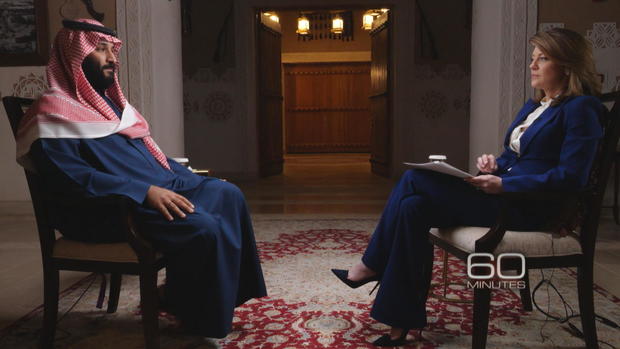
The next leader of Saudi Arabia says his country would quickly obtain a nuclear bomb if arch rival Iran successfully develops its own nuclear weapon. Crown Prince Mohammed bin Salman made the statement about a possible nuclear arms race in the Middle East to “CBS This Morning” co-host Norah O’Donnell, in an interview set to air on this Sunday’s “60 Minutes.”

The interview is the first with a Saudi leader for a U.S. television network since 2005. O’Donnell, a contributing correspondent for “60 Minutes,” asked the 32-year-old crown prince about the political, economic and social reforms unfolding in his kingdom.

The heir to the throne has ushered in significant changes for women in the conservative Sunni Muslim kingdom, including granting them the right to drive for the first time. The crown prince discussed foreign policy, including his views on Saudi Arabia’s longtime foe, Shiite Muslim-ruled Iran.

Below is a preview of O’Donnell’s conversation with the crown prince, and above is a clip in which Mohammed explains why, in his view, Iran’s supreme leader is behaving like Adolf Hitler during the rise of Nazi Germany.

NORAH O’DONNELL: You’ve been rivals for centuries. At its heart, what is this rift about? Is it a battle for Islam?

MOHAMMED BIN SALMAN: Iran is not a rival to Saudi Arabia. Its army is not among the top five armies in the Muslim world. The Saudi economy is larger than the Iranian economy. Iran is far from being equal to Saudi Arabia.

O’DONNELL: But I’ve seen that you called the Ayatollah Khamenei, “the new Hitler” of the Middle East.

MOHAMMED BIN SALMAN: Absolutely.

O’DONNELL: Why?

MOHAMMED BIN SALMAN: Because he wants to expand. He wants to create his own project in the Middle East very much like Hitler who wanted to expand at the time. Many countries around the world and in Europe did not realize how dangerous Hitler was until what happened, happened. I don’t want to see the same events happening in the Middle East.

O’DONNELL: Does Saudi Arabia need nuclear weapons to counter Iran?

MOHAMMED BIN SALMAN: Saudi Arabia does not want to acquire any nuclear bomb, but without a doubt if Iran developed a nuclear bomb, we will follow suit as soon as possible.


Let Assad win? A response to Max Boot

March 15, 2018

Michael Rubin March 14, 2018 2:04 pm | AEIdeas

Source Link: Let Assad win? A response to Max Boot

{Genocide is not an acceptable path to harmony. – LS}

Max Boot, a senior fellow at the Council on Foreign Relations, is a best-selling author and a prolific military historian. Earlier this month, he began a stint as a Washington Post columnist, and the appointment couldn’t have happened to a nicer guy. But his March 8 column on Syria, entitled “To Save Syrians, Let Assad Win,” was a doozy. Boot argued:

The way to save lives, I’ve sadly concluded, is to let [Syrian President Bashar] Assad win as quickly as possible. Aleppo was a charnel house in 2016. But now that it has fallen to Assad’s forces, pictures are circulating of civilians strolling through its rebuilt public park. It’s terrible that they have to live under Assad, but at least they’re alive. Tyranny is preferable to endless and useless war.

Boot could not be more wrong. More than a half million Syrians are not strolling in public parks but are buried under them because of Assad’s ethnic and sectarian cleansing. Assad’s misrule and deliberate targeting of civilians have convinced many times that number to flee.

So, with tongue-in-cheek and to illustrate in the spirit of collegial debate why such logic is wrong, let’s apply Boot’s logic through history:

1940: “To Save Brits, Let Hitler Win”

The “Battle of Britain” was waged over the skies of Great Britain for three and a half months in the summer and autumn of 1940. Nazi Germany’s Luftwaffe repeatedly bombed London and other population centers to try to beat the British into submission. The destruction caused by the Nazi bombing was astounding. More than 40,000 civilians died, and another 50,000 were wounded. To support Great Britain would be to engage in Great Power rivalry. If only Winston Churchill had had the good sense to surrender, maybe the British could get back to gardening and strolling in public parks. Tyranny would be a small price to pay.

1953: “To Save Korea, Let Kim Il-sung Win”

The Korean War killed 2.5 million civilians and is a prime example of Great Power conflict in the Cold War. More than 300,000 Americans fought for Korea’s independence against communist aggression, and almost twice as many South Koreans fought; many never came home. And while China, North Korea, and the United States signed an armistice in 1953, the war technically continues. Indeed, with North Korea now a nuclear power with an increasingly sophisticated missile arsenal, is the price of freedom from tyranny worth it? Are 51 million South Koreans really worth the hassle? And even if North Korean civilians suffer in concentration camps for the crime of not crying adequately at the funerals of Dear Leader Kim Jong-un’s late father and grandfather, Pyongyang has some new skyscrapers and a really neat synchronized cheerleader routine so, there’s that.

1975: “To Save Cambodians, Let Pol Pot Win”

Pol Pot may have been a racist, murderous authoritarian, but as he sought to return Cambodia to its agricultural roots, shouldn’t the United States have been supportive? Sure, the Khmer Rouge might have wanted to shoot anyone who spoke a foreign language or who wore eyeglasses, but wouldn’t it be better just to let them consolidate control and build pyramids out of human skulls so that loyal acolytes of Pol Pot might get on with their lives in peace and tyranny?

2018: “To Save Afghanistan, Let the Taliban Win”

Afghanistan throughout its history, like Syria today, has long been the epicenter of Great Power competition and, for nearly 40 years, has also experienced almost constant internecine struggle. Why bother? The Taliban might execute women in stadiums, deny girls education, profit off opium, and rape young Hazara boys but, when they ran Afghanistan between 1996 and 2001, they also maintained an illusion of stability. When I visited the Taliban’s “emirate” in March 2000, they also had parks. Wouldn’t the ability of bearded Pushtun men to stroll in parks in peace be worth the lack of freedom? We blew that opportunity in 2001, but couldn’t we try to give the Taliban their peace now? Who cares if, imbued with the narrative that they had defeated two superpowers, they would become Islamic State version 2.0.

There are other examples, but let’s be serious: Boot’s policy prescription would signal to any dictator that if only he employed enough brutality against his population, no matter what the regional impact, he could have his cake and eat it too. True, the Syrian opposition is a mixed bag, but let’s not create a self-fulfilling prophecy in which we urge abandonment of anti-Assad Syrians and then complain that they don’t have enough support to win.

Boot is right that Syria is a proxy war and has become a center of Great Power conflict. That’s unfortunate for Syrians, but US engagement overseas isn’t just for positioning — it’s for a vision of the world that doesn’t excuse chemical weapons use, ethnic cleansing, or sectarian incitement. Russia, Iran, and perhaps even Turkey approach Syria through a different lens, and the cost of their victory would reverberate far beyond Syria.

Syria is tough to resolve; there is no magic formula. But allowing Assad to win? That might be the worst of all possible scenarios. Assad won’t bring stability — it was on his watch that a local protest amplified into civil war — and the Hamza Ali Al-Khateeb case illustrates why ordinary Syrians will never acquiesce to life, even under Assad tyranny. Nor would Assad — and his Russian and Iranian protectors — be content with simple stability. Boot is a fine historian but, when it comes to Syria, his prescription promises a future worse than the past.


U.S. Monitoring Possible North Korean Military Base in Syria

March 14, 2018

By: Adam Kredo March 14, 2018 12:20 pm Free Beacon

Source Link: U.S. Monitoring Possible North Korean Military Base in Syria

{Kim must need a place for his nukes since he says he wants to denuclearize the Korean peninsula. – LS}

The United States is monitoring information indicating that North Korea may be running a large underground military base in Syria that could be used for advanced weaponry and nuclear-related work, according to regional reports and U.S. officials tracking the situation.

Regional reports have begun to surface indicating North Korea has neared completion of the construction of an underground military base located near Qardaha in Syria, the hometown of embattled Syrian President Bashar al-Assad.

“According to … satellite images and a military source the underground facility has been under construction for seven years, started by the beginning if the Syrian revolution in March 2011,” Zaman Al Wasl, a Syrian news outlet, reported earlier this month. “The high level of secrecy and tight guard in the North Korean base raise speculations whether it’s a nuclear facility or overseas depot for North Korean weapons.”

U.S. officials told the Washington Free Beacon they are monitoring these reports and efforts by North Korea to help Assad rebuild Syria’s chemical weapons factories.

“We are aware of reports regarding possible DPRK [Democratic People’s Republic of Korea] assistance to Syria to rebuild its chemical weapons capabilities,” a State Department official, speaking on background, told the Free Beacon. “We take these allegations very seriously and we are working assiduously to prevent the Assad regime from obtaining material and equipment to support its chemical weapons program.”

The Trump administration has been engaged in efforts to counter North Korea’s proliferation in Syria, particularly its efforts to supply Assad with chemical weapons.

“The United States has long expressed its deep concerns about both the assistance the DPRK provides to Syria’s weapons programs and Syria’s ongoing possession and use of chemical weapons—both activities in defiance of multiple United Nations Security Council resolutions,” the State Department official said.

The underground North Korean military base could be hiding more than just chemical weapons, according to regional reports indicating that the sheer size of the base, which is mostly situated within a mountain, raises concerns of nuclear work.

Purported satellite images of the base circulating on the internet indicate that only a small portion of the facility is visible from above ground.

“Long tunnels have been built during the last seven years in a deep valley in Qardaha under the supervision of North Korean experts,” the Zaman Al Wasl outlet reported.

The United Nations recently cited North Korea for its increased efforts to meddle in Syria and provide the Assad regime with new caches of chemical weapons.

This has fueled U.S. concerns about the hermit nation at a time when the Trump administration is pursuing diplomatic talks regarding North Korea’s nuclear weapons program.

Evidence that North Korea is working to bolster the Assad regime is likely to fuel further international tensions as Iran and Russia undertake similar efforts. The newest underground facility may facilitate further Iranian and North Korean military collaboration.

The Trump administration is continuing efforts to crackdown on this military collaboration and is urging allies to apply similar pressure.

“North Korea is a significant threat to international security and the Assad regime’s ongoing use of chemical weapons is a similar affront to international law,” the State Department official said. “We work with all our partners to uphold U.N. Security Council Resolutions and prevent North Korea and Syria from further threatening international peace and stability.”

Armed Men Raid Iranian Embassy in London

March 9, 2018

Fars News Agency Fri Mar 09, 2018 10:17

Source Link: Armed Men Raid Iranian Embassy in London

{The plot thickens. – LS}

TEHRAN (FNA)- Several Britain-based Shiite extremists affiliated to Sadeq Shirazi sect attacked the Iranian embassy premises in London minutes ago, while menacing the staffers with cold weapons.

Early reports said the raiders are four men who have opened their way into the embassy premises, while threatening people on the scene with machetes and baseball bats. The London Police have reportedly deployed around the embassy but took no action in the first couple of hours after the attack.

The slogans chanted by the raiders indicate that they are members of Sadeq Shirazi Shiite extremist sect, supported by London.

Iran’s Ambassador to Britain Hamid Baeedinejad confirmed the reports on the embassy attack minutes ago.

“A few followers of Shirazi have attacked the Islamic Republic of Iran’s Embassy in London and broke the flag mast,” the ambassador tweeted minutes ago, and added that the raiders are “chanting slogans against Iranian officials”.

He further confirmed that the raiders were carrying “sticks and machetes”, and said Police are deployed on the scene.

The Shirazi sect that has been labeled as “British Shiism” by the Iranian Supreme Leader operates mainly from London. The sect also runs a satellite network called ‘Fadak’ from London and promotes Shiite extremism against Sunni Islam. The sect is also known to be the religious opposition of the Islamic Republic.

Meantime, Iranian Foreign Ministry Spokesman Bahram Qassemi told FNA that “we are investigating into the case and will keep in contact with the Iranian embassy in London and the British embassy in Tehran”.

“The British government is duty-bound to seriously and decisively fulfill its responsibility to protect the Islamic Republic of Iran’s diplomats and diplomatic centers and immediately arrest and prosecute those who have trespassed the diplomatic sanctuary,” the spokesman reiterated.

U.S. Will Pay $5 Million for Information on Taliban Suicide Bombing Trainer

March 9, 2018

OAN Newsroom UPDATED 9:20 AM PT — Fri. March 9, 2018 One America News Network

Source Link: U.S. Will Pay $5 Million for Information on Taliban Suicide Bombing Trainer

{Wanted: Dead or Alive. Well, just info on his location for now. – LS}

The United States places a bounty of $5 million for information regarding a top Taliban chief.

The bounty placed on Thursday is meant to aid in finding Mullah Fazlullah, who is the leader of the Pakistani arm of the Taliban.

Fazlullah is known for training suicide bombers, and was the target of a U.S. drone strike that killed over 20 militants on Wednesday. However, the operation failed to kill him.

Fazlullah and his Taliban militants are part of ongoing frustration from the U.S. and Kabul toward Pakistan’s efforts to combat insurgents.

The U.S. has been critical of Pakistan’s security efforts.

This comes while a Pakistani delegation meets with officials in Washington to increase cooperation.

Trump-Kim summit plan draws positive reactions from key players

March 9, 2018


By Matt Richardson, Brooke Singman | Fox News March 9, 2018

Source Link: Trump-Kim summit plan draws positive reactions from key players

{You have to ask yourself, what would the impact be on Iran in the event the Norks denuclearize? Personally, I believe it would pull the rug out from under them, especially when you consider the Norks took on the role of research and development years ago.

Something else to consider is this…Somehow, this seems to connect with Xi’s lifetime appointment as President. Coincidence? I don’t think so. Remember when Obama said to the Ruskies that I’ll have more flexibility after the elections? Well. Xi will no longer be subjected to those pesky ‘elections’. Just a thought, nothing more, nothing less. – LS}

The decision to meet with Kim Jong Un in the coming weeks was one that President Donald Trump made “himself,” U.S. Secretary of State Rex Tillerson said Friday, attributing the move to a “dramatic” change in posture by the North Korean leader.

“President Trump has said for some time that he was open to talks and he would willingly meet with Kim when conditions were right,” Tillserson said during a visit to the African nation of Djibouti. “And I think in the president’s judgment that time has arrived now.”

According to Tillerson, the U.S. has seen a shift in Kim from “not just willingness but really his desire for talks.”

Kim Jong Un talked about denuclearization with the South Korean Representatives, not just a freeze. Also, no missile testing by North Korea during this period of time. Great progress being made but sanctions will remain until an agreement is reached. Meeting being planned!
— Donald J. Trump (@realDonaldTrump) March 9, 2018

The news that Trump had accepted the North Korean leader’s invitation to meet was greeted positively Friday by officials in China, Russia and South Korea — three major players in efforts to resolve the ongoing dispute between the U.S. and North Korea over the Hermit Kingdom’s nuclear ambitions.

China’s foreign ministry said it hopes all parties to the dispute will “show their political courage” in restarting negotiations, and pledges its support in working toward that goal.

Russian Foreign Minister Sergey Lavrov was quoted by Russian state news agency Tass on Friday saying — during a visit to the Ethiopian capital Addis Ababa — that Russia considers the move by Trump and Kim to be “a step in the right direction.”

South Korean Foreign Minister Kang Kyung-wha said, during a visit to Hanoi, Vietnam, that her government was consulting with the U.S. on the planned summit — and hopes that if it does take place, “it’s a meaningful meeting with good outcome.”

News of the planned meeting between Trump and Kim, which the White House confirmed Thursday night, was a dramatic development after months of saber-rattling between the two world leaders.

Kim extended the invitation and the president agreed that the two would meet by May, South Korean National Security Adviser Chung Eui-yong announced at the White House.

“Kim Jong Un talked about denuclearization with the South Korean Representatives, not just a freeze,” Trump tweeted. “Also, no missile testing by North Korea during this period of time. Great progress being made but sanctions will remain until an agreement is reached. Meeting being planned!”

Trump, according to White House press secretary Sarah Sanders, “will accept the invitation to meet with Kim Jong Un at a place and time to be determined.” But, Sanders added, “in the meantime, all sanctions and maximum pressure must remain.”

Earlier Thursday, Chung announced that Trump would meet with Kim to “continue the goal of denuclearization.”

Kim “expressed his eagerness to meet President Trump as soon as possible,” Chung said. “President Trump appreciated the briefing and said he would meet Kim Jong Un by May to achieve permanent denuclearization.”

Kim, according to Chung, understands that joint military exercises between South Korea and the U.S. would continue. The North Korean leader, according to recent talks with Chung, also claimed to be “commited to denuclearization.”

“He (Kim) pledged that North Korea will refrain from any further nuclear missile tests,” Chung said, adding that Trump’s “leadership” and “maximum pressure” brought us “to this juncture.”

Chung said that “along with President Trump,” he is “optimistic of continuing a diplomatic process.” But he added that “the pressure will continue until North Korea matches its words with concrete actions.”

News of the willingness of Kim to meet with Trump follows recent high-profile talks between North Korea and South Korea.

Earlier Thursday, Trump announced that South Korea would be making a “major statement” about North Korea. Chung met at the White House earlier in the day with U.S. National Security Adviser H.R. McMaster.

Chung and other South Korean officials briefed the White House Thursday on a potential diplomatic opening with North Korea after a year of escalating tensions. Chung told reporters Tuesday that he had received a message from North Korea intended for the United States, but did not disclose what it was.

Trump and Kim have had a contentious relationship during the last year as both men dramatically increased the rhetoric against the other amid the backdrop of increased nuclear and missile testing by the North Korean regime.

In August Trump warned Kim that, if pressed, the U.S. would unleash “fire, fury and frankly power, the likes of which this world has never seen before.” At the time, the president argued that Kim had “been very threatening beyond a normal state,” adding that the regime “best not make any more threats to the United States.”

However, threats and counter-threats continued into 2018.

“The U.S. should know that the button for nuclear weapons is on my table,” Kim said during a Jan. 1 speech, according to a translation. “The entire area of the U.S. mainland is within our nuclear strike range,” he continued, adding that “the United States can never start a war against me and our country.”

The next day Trump hit back against Kim by claiming that the U.S. nuclear arsenal was more powerful. “North Korean Leader Kim Jong Un just stated that the ‘Nuclear Button is on his desk at all times,'” Trump tweeted. “Will someone from his depleted and food starved regime please inform him that I too have a Nuclear Button, but it is a much bigger & more powerful one than his, and my Button works!”

The last round of significant talks involving the U.S. and North Korea concluded in 2009. The so-called six-party talks, which involved the U.S., North Korea, South Korea, Japan, Russia and China, ended when North Korea walked out.
The Odd Couple: Why Iran is Backing the Taliban

March 8, 2018

Stratfor Worldview March 8, 2018

Source Link: The Odd Couple: Why Iran is Backing the Taliban

{The friend of my enemy is my enemy. – LS}

In the conflict in Afghanistan, there are few stranger bedfellows than Iran and the Taliban. The former is the spiritual hub of Shiite Islam, while the latter is a vociferously anti-Shiite Sunni fundamentalist movement. Changing circumstances, however, have brought the onetime foes into a kind of partnership. Whatever its ideological differences with the insurgent outfit, Tehran has every reason to maintain its tactical partnership with the Taliban — while also keeping its ties to the Afghan government.

Kabul’s New Coast

As a regional heavyweight, Iran has long been involved in Afghan affairs. The Islamic republic, for instance, has recruited fighters from Afghanistan’s Shiite Hazara community and from its own 3 million-strong Afghan refugee population to fill out the Fatemiyoun Brigade it has fighting alongside government forces in Syria. Tehran and Kabul also have pursued extensive economic cooperation, especially on the Chabahar port on Iran’s Arabian Sea coast. In May 2016, Iranian President Hassan Rouhani signed an agreement with Afghan President Ashraf Ghani and Indian Prime Minister Narendra Modi to develop the port, a $31 billion project.

For Iran, Chabahar is critical to diversifying the country’s port access beyond Bandar Abbas, which currently processes 85 percent of its seaborne traffic. For landlocked Afghanistan, the venture represents an opportunity to break its reliance on Pakistani ports. India, meanwhile, wants to use Chabahar to ease its economic inroads into Central Asia by bypassing archrival Pakistan. Rouhani, flanked by Afghan and Indian officials, formally inaugurated the first phase of the project — which has languished in developmental limbo for many years — in December 2017, two months after the first Indian shipment arrived there.

The Enemy of My Enemy

But even as Iran’s leaders work with their counterparts in Kabul over Chabahar, Tehran is also reportedly offering clandestine support to the Afghan government’s most potent enemy, the Taliban. The main reason for Iran’s backing is the rise of the Islamic State’s Khorasan chapter in Afghanistan. Unlike the Taliban, whose chief aim is to reconquer Kabul, the Khorasan group is part of a transnational jihadist movement that threatens Iran, too. (An Islamic State cell, in fact, carried out the coordinated attacks in the country’s capital that killed 17 people in June 2017.) The Islamic State has been active in Afghanistan since 2015. And while it maintains a presence in 30 of Afghanistan’s 399 districts, mainly in the country’s eastern Nangarhar province, the group has yet to seize control of any territory. The Taliban have clashed with the newcomers in the past few months in Nangarhar and northern Jowzjan province.

In addition, the Taliban are currently staging around two attacks a week in three districts of Farah province, along the border with Iran, according to a recent BBC study. Although direct evidence of Iranian support for the attacks hasn’t surfaced, previous cross-border attacks in Farah suggest that Tehran may be backing the latest offensives there. In October 2016, for example, the Afghan military fought off a three-week Taliban siege in the province, during which they killed four alleged Iranian commandos who were battling alongside the group. Iran reportedly also provides the insurgents arms, including AK-47 assault rifles, mortars and rocket-propelled grenades.

The Taliban, in turn, have demonstrated an interest in cultivating deeper ties with the Islamic republic as well. In 2016, the group’s leader at the time, Mullah Akhtar Mansoor, visited Iran allegedly in an effort to diversify his group’s sources of support. Mansoor was killed in a U.S. drone strike after he crossed into Pakistan’s Balochistan province in May of that year. But five months later, the Taliban appointed an envoy to Iran in a further sign of its increasing engagement with Tehran.

Iran Hedges Its Bets

Supporting the Taliban offers Iran a way to counter the Islamic State’s expansion to its east, and Tehran will feel justified in backing the insurgents so long as the transnational jihadist group has a presence in Afghanistan. Beyond counterterrorism, though, Iran wants to maintain contact with the Taliban to be in their good graces if they eventually assume a role in the Afghan government. Even the United States, which has been battling the Taliban for more than a decade and a half, has admitted that a power-sharing deal in Afghanistan likely would involve the Taliban. In that case, Iran will be well-placed to expand its reach in the South Asian country, having kept its ties with both the Taliban and the government’s NATO-backed components.

Iran isn’t the only regional power following this strategy. Countries such as Pakistan and Russia also have intervened in the war-torn state to safeguard their interests. While Islamabad continues to support the Taliban’s leaders, Moscow reportedly has sent fuel shipments by way of Uzbekistan’s Hairatan border crossing for the group to resell. (Russia’s alleged support for the group is a remarkable policy reversal given that the Taliban are the descendants of the mujahideen who fought the Soviets in their 1979 invasion.)

Though there’s no love lost between Iran and the Taliban, the circumstances of the day oblige Tehran to act pragmatically to ward off the Islamic State. The jihadist group’s activity in the country, moreover, provides Iran with a useful pretext to maintain a presence in its long-unstable eastern neighbor. As Iran and other foreign powers use the Taliban to their own ends, the group will keep up its violent insurgency, making it hard for the United States to withdraw from Afghanistan after more than 16 years of war.

Turkey Threatens Exxon Mobil & The US 6th Fleet Off Cyprus

March 8, 2018

by Tyler Durden Thu, 03/08/2018 – 06:10 Zero Hedge

Source Link: Turkey Threatens Exxon Mobil & The US 6th Fleet Off Cyprus

{With friends like this, who needs enemies? – LS}

Turkish Prime Minister Binali Yıldırım threatened not only hydrocarbon survey ships of oil giant Exxon Mobile but also the US 6th Fleet is participating in a naval exercise in the area 7-18 March 2018.

As KeepTalkingGreece.com reports, Yildirim said:

“The Republic of Cyprus would not be allowed to get away with selling the energy resources surrounding the island,” Yildirim said on Wednesday. With reference to the turkey-occupied North part of Cyprus, he added “the natural riches surrounding the island of Cyprus is the common wealth of all the people who live on the island.”

And he threatened that:

“This and other provocative activities that create faits accomplis will be responded to in an appropriate fashion.”

It was a clear message even to the US Fleet as some media have linked its presence off  Cyprus to the Exxon survey, saying the Fleet was going to protect the Exxon Mobile survey vessels.

Last month, Turkish war ships threatened to sink drilling ship commissioned by Italy’s ENI and ultimately managed to block the process as the Italian diplomacy did not dare to put the lives of their fellowmen at risk.

A day earlier, President Recep Tayyip Erdogan, reacting to U.S. Sixth Fleet heading to East Mediterranean, said , “while European states’ boats abandoning refugees to death, we try to rescue every innocent’s life. You can only make it there with your Sixth Fleet, aircraft carrier.”

Yildirim underlined that any underground riches surrounding the island should only be extracted with the permission of both the island’s administrations.

“Any work in which one of these interlocutors is not part of the deal will be evaluated by us as a threat to the sovereign rights of North Cyprus,” he said.

Turkey has been illegally occupying 40% of Cyprus since 1974. It is only Turkey that recognizes “North Cyprus” as ‘state’, while the rest of the world considers as an “illegal” …something with no sovereign rights at all.

Meanwhile, in Cyprus…

One wonders just how far Turkey is willing to push Washington…


Iran’s Khamenei says won’t negotiate with West over regional presence

March 8, 2018

by reuters Thursday Mar 8, 2018 6:59am via The Foreign Desk

Source Link: Iran’s Khamenei says won’t negotiate with West over regional presence

{Nothing surprising here. Just a reminder of what we’re dealing with. – LS}

LONDON (Reuters) – Iran will not negotiate with the West over its presence in the Middle East, Supreme Leader Ayatollah Ali Khamenei said, days after the visiting French foreign minister sought to discuss Tehran’s role in regional conflicts.

Jean-Yves Le Drian traveled to Tehran on Monday with a brief to reaffirm Europe’s support for a nuclear deal that opened Iran’s economy while echoing U.S. concern about Tehran’s missile program and its influence in the region.

“European countries come (to Tehran) and say we want to negotiate with Iran over its presence in the region. It is none of your business. It is our region. Why are you here?” Khamenei was quoted as saying by his official website.

Khamenei said Iran would only negotiate on that issue with other states in the region.

“We will negotiate with America, when we wanted to be present in America,” he added.

U.S. President Donald Trump has threatened to pull out of the nuclear deal unless three European signatories help “fix” the accord by forcing Iran to limit its sway in the Middle East and rein in its missile program.

French President Emmanuel Macron has criticized the program and raised the possibility of new sanctions.

Tehran supports Syria’s President Bashar al-Assad in the government’s war against rebel forces, including groups backed by the West, and is an ally of Israel’s enemy Hezbollah in Lebanon.

Palestinians increase payments to terrorists to $403 million

March 7, 2018

By Lahav Harkov March 6, 2018 The Jerusalem Post

Source Link: Palestinians increase payments to terrorists to $403 million

{The price of murder just went up. – LS}

The Palestinian Authority increased its payments to terrorists and their families by nearly $56 million, Knesset Foreign Affairs and Defense Committee chairman Avi Dichter (Likud) said overnight Monday, when a bill to discourage the practice passed a first reading.

Dichter pointed out that PA President Mahmoud Abbas authorized the 2018 PA budget on Sunday, and that there is a PA law that says 7% of each budget must go to paying terrorists, or to their families, if they’re killed in the act.

The increase “means that the PA will employ more terrorists as PA workers,” Dichter said. “Except that the terrorists who work for the PA have a special quality – they are employed both as dead and living terrorists.

“Murderers like the ones who killed the Fogel family” – two Palestinians killed five out of eight members of the family in Itamar, including a three-month-old, in 2011 – “are heroes to the PA. This is not a whim. It’s in the PA’s constitution,” Dichter added.

The PA paid terrorists and their families more than $347m. in 2017. Terrorists who have been sentenced to three to five years in Israeli prisons receive the average income of a Palestinian, about $580 per month. The families of those who committed more severe crimes and were involved in killing Israelis receive five times that each month for the rest of their lives.

Terrorists receive more from the PA if they are married, for each child they have, if they live in Jerusalem or if they’re an Israeli citizen.

The bill that passed a first reading on Monday, proposed by Yesh Atid MK Elazar Stern and Dichter, would require the government to deduct the amount the PA paid to terrorists and their families from the taxes and tariffs Israel collects for the PA. The proposal was inspired by the Taylor Force Act, a US bill named after an American victim of Palestinian terrorism, which would cut all US aid to the PA until the terrorist payments are stopped.

Stern said when he presented the bill to the Knesset that “there is no opposition or coalition” on the matter.

“In the current situation, there is an incentive for terrorism, which only pushes away peace,” Stern said. “This bill is not only meant to promote the security of citizens and residents of the State of Israel, but to promote peace.”

According to Stern, “Palestinians have said when they were interrogated that they continued terrorism in order to go to jail and get more money.

“We can pay back money, but we can’t bring back human lives taken by terrorism,” he added.

Likud MK Amir Ohana wondered: “How did this absurd situation continue until now, with the State of Israel transferring money to the PA, which engages in glorification and pays families of terrorists. This bill is part of the fight against terrorism, and the economic arena is also a place for this fight.”

Joint List MK Yousef Jabareen said the bill is “colonialist legislation at its best… The bill is collective punishment for the Palestinian population… This is how the occupation is perpetuated.”

According to Jabareen, the payments to terrorists and their families are similar to National Insurance payments: “Their goal is to help the families so they don’t starve.”

MK Aida Touma-Sliman, also of the Joint List, called the bill theft.

“The proposal says to ‘deduct,’ but really it means to steal,” she said. “This is the condescending attitude which suits occupiers who think they can continue lashing out at another nation and not admit that the occupation is the source of all injustice.”

MK Mossi Raz of Meretz argued that the bill would be a violation of the Oslo Accords, in which Israel agreed to collect the tax money for the PA.

The bill passed 52-10. There is a second version of the legislation, drafted by the Defense Ministry, which the Foreign Affairs and Defense Committee is holding up, because it opposes an article in the proposal that would grant the security cabinet the option of not deducting the funds.