French FM warns Trump’s ‘maximum pressure’ tactics only increased risk posed by Tehran; comments come after Iranian announcement of advancing research on uranium metal production
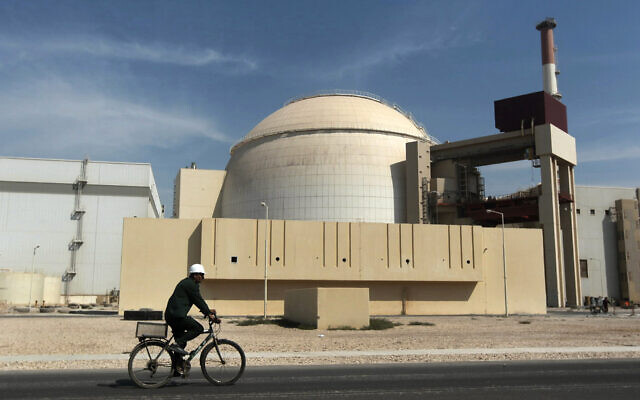
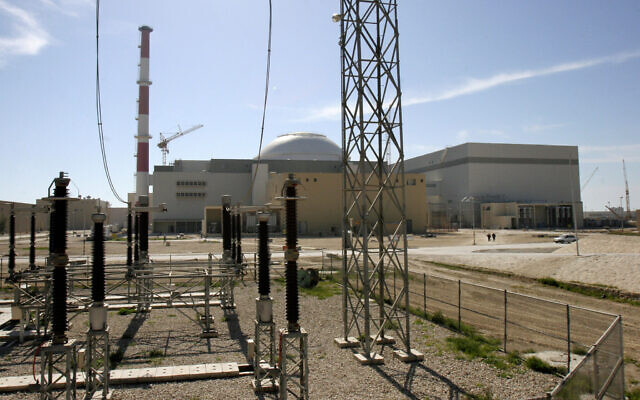
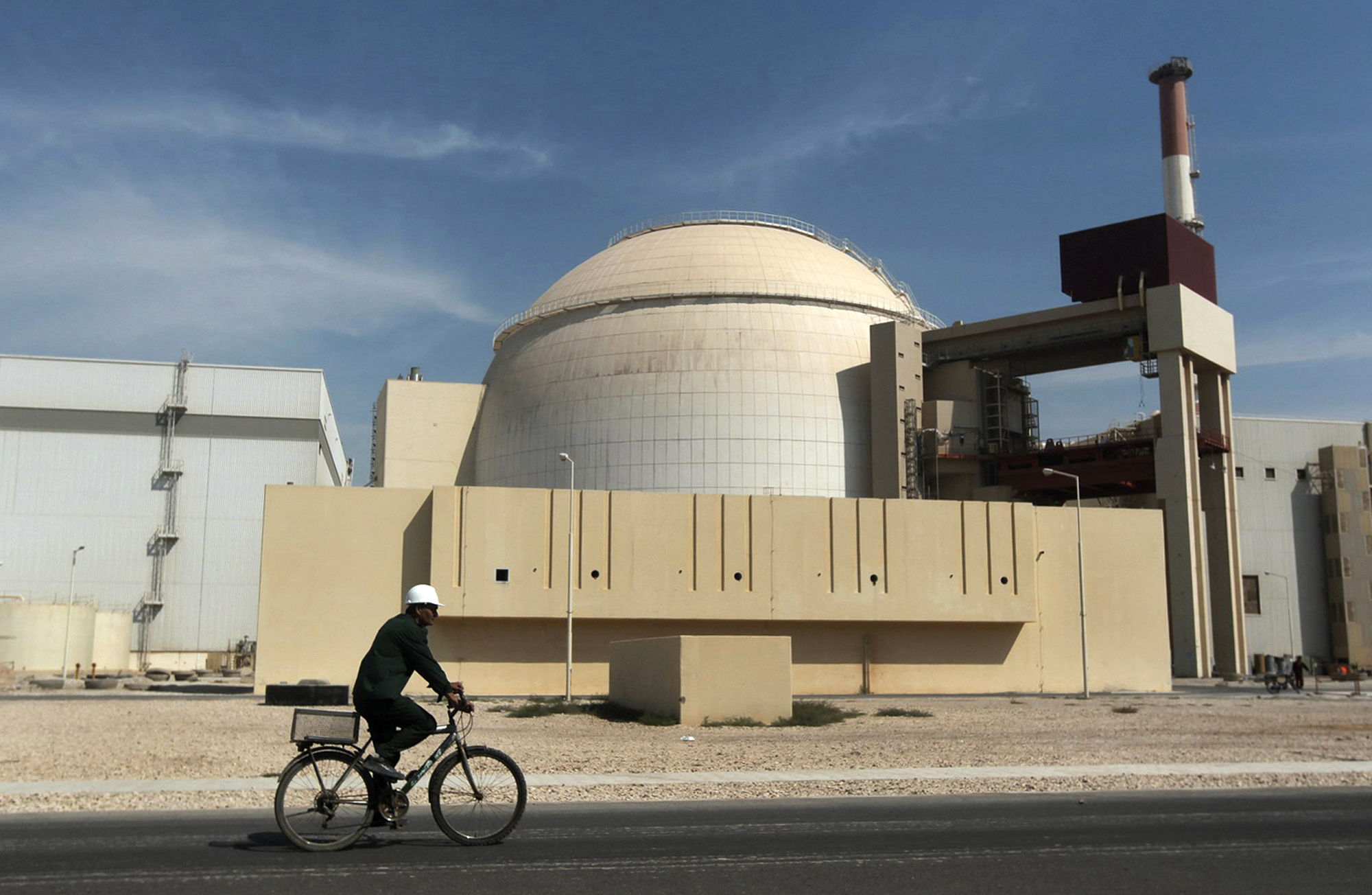
The Bushehr nuclear power plant outside the southern city of Bushehr, Iran. (AP Photo/Mehr News Agency, Majid Asgaripour, File)
France’s Foreign Minister Jean Yves Le Drian on Saturday said that Iran was aiming to acquire nuclear weapons capacity with its breaches of the 2015 nuclear agreement, and only a full return to that deal could prevent Tehran from achieving its goal.
Speaking to the Journal du Dimanche newspaper, Le Drain accused the outgoing United States leadership of exacerbating the crisis with Iran and pushing Tehran to advance its nuclear program.
“The Trump administration chose what it called the maximum pressure campaign on Iran. The result was that this strategy only increased the risk and the threat,” Le Drian said.
“This has to stop because Iran and – I say this clearly – is in the process of acquiring nuclear [weapons] capacity,” he warned.
Le Drian said it was urgent to “tell the Iranians that this is enough” and to try to bring both Iran and the United States back into the accord.
French Foreign Minister Jean-Yves Le Drian, and his Lebanese counterpart Nassif Hitti, hold a news conference following their meeting at the Lebanese foreign ministry in Beirut, Lebanon, July. 23, 2020. (AP Photo/Bilal Hussein)
The landmark 2015 deal between Iran and the United States, China, Russia, Britain, France, and Germany to curb Tehran’s nuclear ambitions has been largely in tatters since US President Donald Trump withdrew from it in 2018 and reimposed harsh sanctions on the Islamic Republic.
The Iranian government has signaled a readiness to engage with incoming president Joe Biden, who takes office on January 20 and who has expressed willingness to return to diplomacy with Tehran.
“Tough discussions will be needed over ballistic proliferation and Iran’s destabilization of its neighbors in the region,” Le Drian said.
The comments came after Iran told the UN nuclear watchdog last week that it was advancing research on uranium metal production, saying it is aimed at providing advanced fuel for a research reactor in Tehran.File: In this photo released on Wednesday, Nov. 6, 2019, a truck containing a cylinder of uranium hexafluoride gas leaves Ahmadi Roshan uranium enrichment facility in Natanz to the Fordo nuclear facility for the purpose of injecting the gas into Fordo centrifuges (Atomic Energy Organization of Iran via AP)
European powers on Saturday voiced deep concern over the plans, warning that Tehran has “no credible civilian use” for the uranium.
“The production of uranium metal has potentially grave military implications,” said the foreign ministers of Britain, France and Germany, the so-called E3, in a joint statement.
Uranium metal can be used as a component in nuclear weapons. Iran had agreed to a 15-year ban on “producing or acquiring plutonium or uranium metals or their alloys” under the so-called Joint Comprehensive Plan of Action (JCPOA) signed in 2015 with world powers.
“We strongly urge Iran to halt this activity, and return to compliance with its JCPOA commitments without further delay if it is serious about preserving the deal,” said the ministers.
The Iranian breaches of the deal have included exceeding the stockpile limit on enriched uranium, enriching beyond the permitted purity level, and using more advanced centrifuges than permitted.
Iran recently informed the International Atomic Energy Agency of its plans to increase enrichment to 20 percent, a technical step away from weapons-grade levels of 90%.Part of the Arak heavy water nuclear facilities, near the central city of Arak, 150 miles (250 kilometers) southwest of Tehran, Iran, Jan. 15, 2011 (Mehdi Marizad/Fars News Agency via AP, File)
A decision to begin enriching to 20% purity a decade ago nearly triggered an Israeli strike targeting Iran’s nuclear facilities. Tensions abated only slightly with the 2015 deal, which saw Iran limit its enrichment in exchange for the lifting of economic sanctions.
Iran says all of its breaches of the 2015 deal’s limits are reversible, but insists that the US has to come back to the deal and lift sanctions first.
European nations have warned that Iran’s moves risk “compromising the important opportunity for a return to diplomacy with the incoming US administration.”
Last week the head of the UN’s nuclear watchdog said that there were “weeks” left to salvage the nuclear deal.
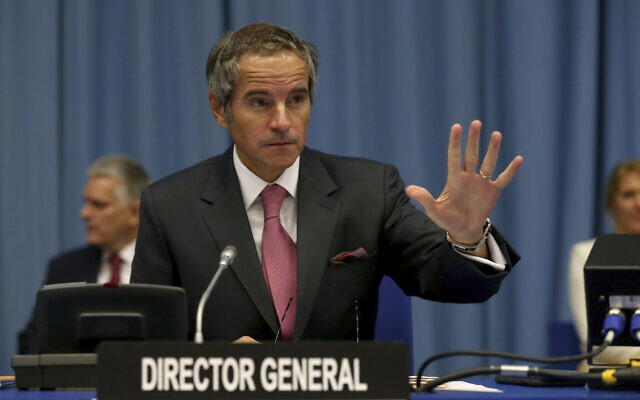
Rafael Grossi, director of the International Atomic Energy Agency, said at the Reuters Next conference that Tehran was advancing “quite rapidly” toward enriching uranium to 20 percent, as it has announced it would, in breach of the accord. He said the IAEA has assessed Iran will be able to produce some 10 kilograms a month.
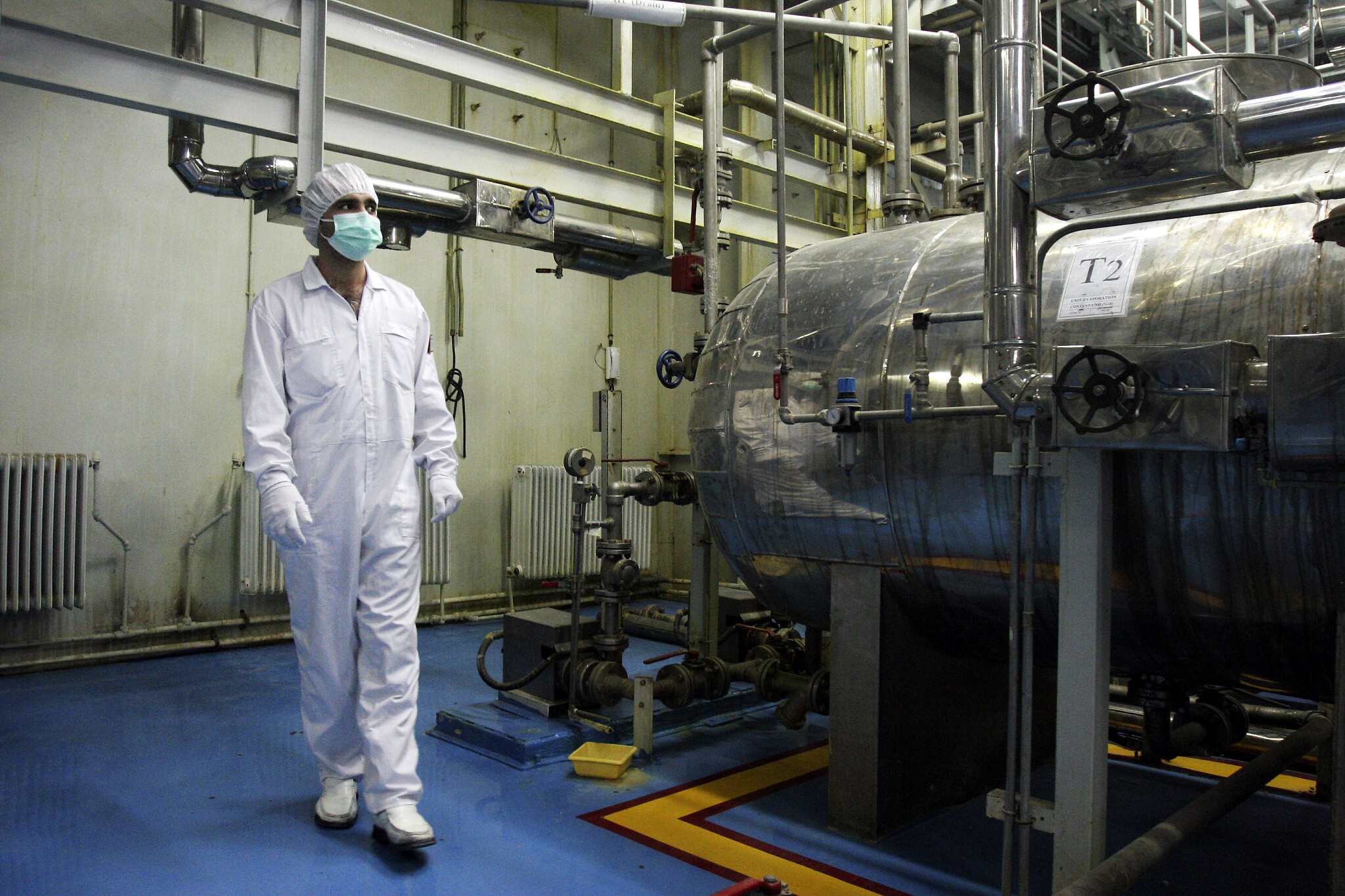
File: An Iranian technician walks through the Uranium Conversion Facility just outside the city of Isfahan 255 miles (410 kilometers) south of the capital Tehran, Iran, Saturday, Feb. 3, 2007 (AP Photo/Vahid Salemi)
BERLIN, Germany — European powers on Saturday voiced deep concern over Iran’s plans to produce uranium metal, warning that Tehran has “no credible civilian use” for the element.
“The production of uranium metal has potentially grave military implications,” said the foreign ministers of Britain, France and Germany, the so-called E3, in a joint statement.
Uranium metal can be used as a component in nuclear weapons. Iran had signed up to a 15-year ban on “producing or acquiring plutonium or uranium metals or their alloys” under the so-called Joint Comprehensive Plan of Action (JCPOA) signed in 2015 with world powers.
“We strongly urge Iran to halt this activity, and return to compliance with its JCPOA commitments without further delay if it is serious about preserving the deal,” said the ministers.
Their call came after Iran told the UN nuclear watchdog on Wednesday that it was advancing research on uranium metal production, saying it is aimed at providing advanced fuel for a research reactor in Tehran.File: In this photo released on Wednesday, Nov. 6, 2019, a truck containing a cylinder of uranium hexafluoride gas leaves Ahmadi Roshan uranium enrichment facility in Natanz to the Fordo nuclear facility for the purpose of injecting the gas into Fordo centrifuges (Atomic Energy Organization of Iran via AP)
In a response to the foreign ministers’ statement, Iran’s atomic energy organization urged the IAEA to avoid creating any “misunderstanding,” adding that it had not yet “presented the design information questionnaire (DIQ) of the uranium metal factory” to the watchdog.
This would be done “after carrying out the necessary preparations and… within the deadline set by law,” the organization said, in reference to a five-month deadline set by the Iranian parliament in December, mandating Tehran to ready the factory.
It said it hoped the IAEA would not cause further “misunderstanding in the future, by refraining from mentioning unnecessary details in its reports.”
The landmark 2015 deal between Iran and the United States, China, Russia, Britain, France, and Germany to curb Tehran’s nuclear ambitions has been largely in tatters since US President Donald Trump withdrew from it in 2018 and reimposed harsh sanctions.
The Iranian government has signaled a readiness to engage with President-elect Joe Biden, who takes office on January 20 and who has expressed willingness to return to diplomacy with Tehran.
The Iranian breaches have included exceeding the stockpile limit on enriched uranium, enriching beyond the permitted purity level, and using more advanced centrifuges than permitted under the deal.
Iran recently informed the International Atomic Energy Agency of its plans to increase enrichment to 20 percent, a technical step away from weapons-grade levels of 90%.A graphic shows the scientific process of uranium enrichment to weapons-grade level (Phil Holm/AP)
A decision to begin enriching to 20% purity a decade ago nearly triggered an Israeli strike targeting Iran’s nuclear facilities. The tensions only abated with the 2015 deal, which saw Iran limit its enrichment in exchange for the lifting of economic sanctions.
Tensions have increased since the assassination in late November of Iranian nuclear physicist Mohsen Fakhrizadeh.
In the aftermath of the attack, which Iran blamed on Israel, hardliners in Tehran pledged a response and Iran’s parliament passed a controversial law calling for expanded nuclear activity and for an end to IAEA inspections.
The law also demanded Iran’s Atomic Energy Organization “operate a facility of metal uranium production” within five months.
Iran says all of its breaches of the 2015 deal’s limits are reversible, but insists that the US has to come back to the deal and lift sanctions first.Part of the Arak heavy water nuclear facilities, near the central city of Arak, 150 miles (250 kilometers) southwest of Tehran, Iran, Jan. 15, 2011 (Mehdi Marizad/Fars News Agency via AP, File)
European nations have warned that Iran’s moves risk “compromising the important opportunity for a return to diplomacy with the incoming US administration.”
Earlier this week the head of the UN’s nuclear watchdog said that there were “weeks” left to salvage the nuclear deal.
Rafael Grossi, director of the International Atomic Energy Agency, said at the Reuters Next conference that Tehran was advancing “quite rapidly” toward enriching uranium to 20 percent, as it has announced it would, in breach of the accord. He said the IAEA has assessed Iran will be able to produce some 10 kilograms a month.
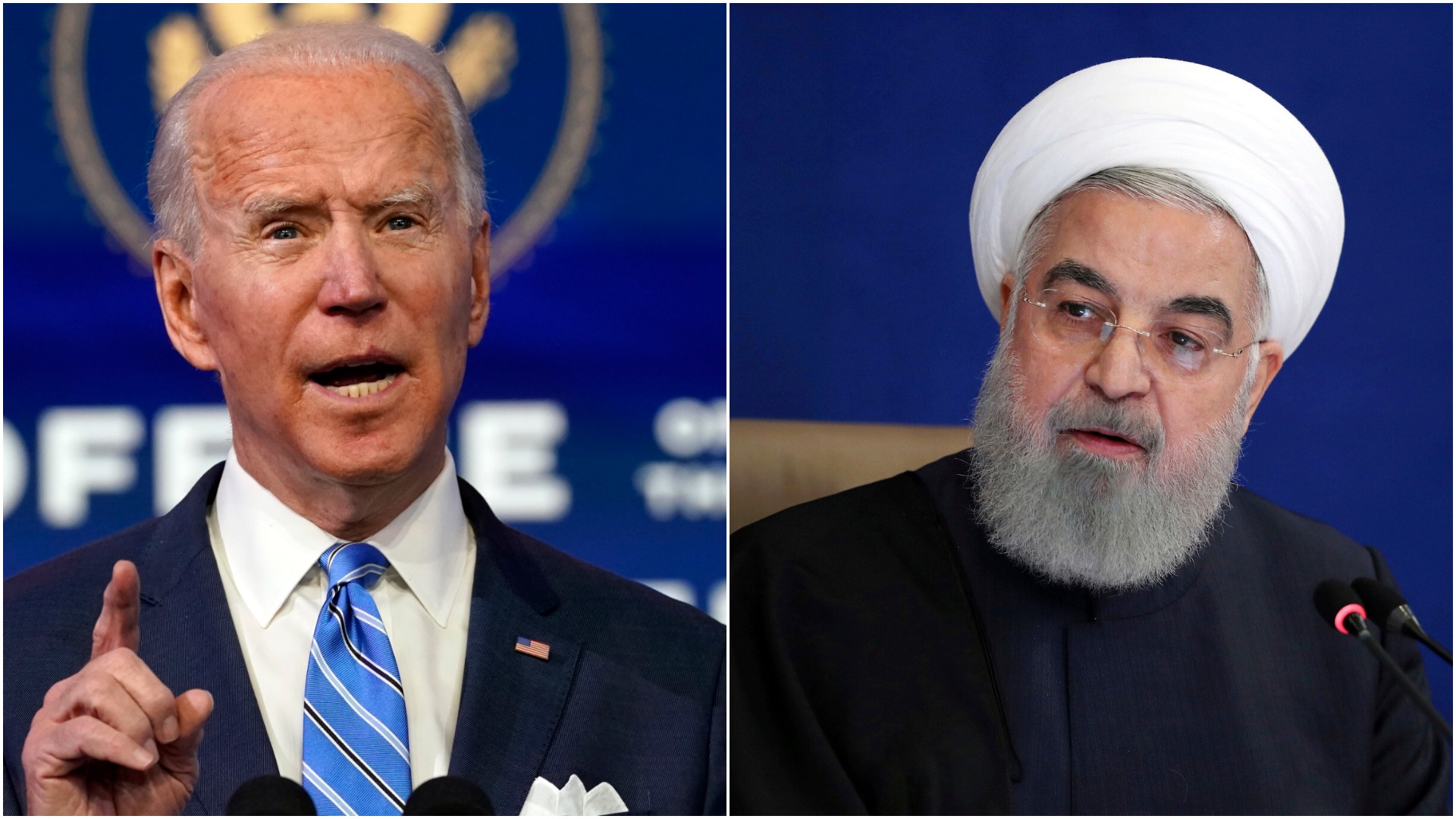
Left: US President-elect Joe Biden on Jan. 14, 2021, in Wilmington, Delaware (AP Photo/Matt Slocum); Right: Iranian President Hassan Rouhani speaks in a meeting in Tehran, Iran, Dec. 9, 2020 (Iranian Presidency Office via AP)
Officials in the incoming Biden administration have already begun holding quiet talks with Iran on a return to the 2015 nuclear deal, and have updated Israel on those conversations, Channel 12 News reported Saturday.
The network gave no sourcing for the report, and no details on what was allegedly discussed.
US President-elect Joe Biden has indicated his desire to return to the accord, while Israel is pushing for any return to the deal to include fresh limitations on Iran’s ballistic missile program and support for terror and destabilization around the world.
On Wednesday, Walla News reported that Israeli Prime Minister Benjamin Netanyahu is assembling a team to strategize for the first talks with the Biden administration on Iran’s nuclear program.
The team will include officials representing national security elements, the Foreign Ministry, the Defense Ministry, the military, the Mossad spy agency, and the Atomic Energy Commission, the report said, citing unnamed sources in the Prime Minister’s Office.
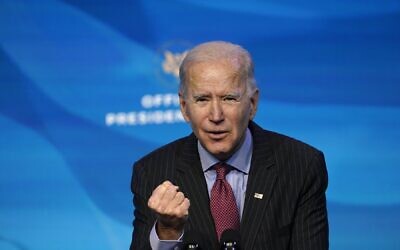
US President-elect Joe Biden speaks at The Queen theater in Wilmington, Del., Friday, Jan. 8, 2021 (AP Photo/Susan Walsh)
Netanyahu is considering appointing a senior official to head the team and to serve as an envoy in talks with the US on the Iranian nuclear program, the report said.
A possible candidate to head the team is Mossad chief Yossi Cohen, the report said.
Channel 12 reported Saturday that Cohen was in Washington this week to meet with officials in the outgoing and incoming administrations.
US President-elect Joe Biden is expected to take a more conciliatory approach to Iran than the Trump administration and has said that if Iran returns to the terms of the 2015 nuclear agreement, he too would rejoin, removing the crushing economic sanctions that have wreaked havoc on the Iranian economy over the past two years.
The US president-elect has indicated that he wants to negotiate more broadly with Tehran if Washington returns to the deal, notably over its missiles and influence across the Middle East. Iran has said it could welcome the return of the Americans to the agreement, but only after they lift sanctions. It has rejected negotiation on other issues.
Former US president Barack Obama, with Biden as his vice president, signed the Iran nuclear deal with world powers in 2015. The Trump administration withdrew from the accord in 2018 and pressured Iran with crippling economic sanctions and other measures.Then-US secretary of state John Kerry talks with Iranian Foreign Minister Mohammad Javad Zarif in Vienna, January 16, 2016 (Kevin Lamarque/Pool via AP, File)
Obama signed the agreement despite fierce protest from Israel, and had a rocky relationship with Jerusalem and Netanyahu, while the premier and Trump have been in lockstep on most Middle East policy issues.
The prospect of the US reengaging with Tehran has drawn warnings and alarm from Netanyahu and his allies.
Last week, speaking alongside US Treasury Secretary Steve Mnuchin in Jerusalem, Netanyahu warned against the US rejoining the nuclear agreement, also known as the Joint Comprehensive Plan of Action (JCPOA).
“If we just go back to the JCPOA, what will happen and may already be happening is that many other countries in the Middle East will rush to arm themselves with nuclear weapons. That is a nightmare and that is folly. It should not happen,” Netanyahu said.
Likud MK Tzachi Hanegbi said Wednesday the incoming US administration must not “appease” Iran, and warned Tehran the Jewish state will not tolerate its military presence in Syria or its development of nuclear weapons.
Likud’s Tzachi Hanegbi attends an event at Kedem in the West Bank on September 5, 2019. (Hillel Maeir/Flash90)
In one of the most forceful statements recently made by an Israeli official, Hanegbi, considered an ally of Netanyahu, threatened that Israel could attack Iran’s nuclear program if the United States rejoined the nuclear deal.
Iran and the Trump administration have engaged in an ongoing exchange in recent months as President Donald Trump’s tenure draws to a close and Iran marked the one-year anniversary of the US assassination of its general Qassem Soleimani.
The back and forth has included threats, military maneuvers, legal action and escalating Iranian violations of the nuclear deal. Israeli and Iranian officials have also exchanged threats in recent weeks.
Channel 12 said Saturday that during his meetings with top Trump administration officials, Mossad chief Cohen was given the impression that there was no plan to attack Iran during the final days of the administration.
US Secretary of State Mike Pompeo publicly accused Iran of harboring al-Qaeda terrorists on Wednesday.Mossad chief Yossi Cohen speaks at a Tel Aviv University cyber conference, on June 24, 2019. (Flash90)
Iran resumed enriching uranium to 20 percent last week, well in excess of the threshold set out in the nuclear deal and a short jump from the level of enrichment needed to produce weapons.
Further complicating the Biden administration’s plans to reengage with Tehran were two high profile assassinations this year in Iran that were attributed to Israel. Top Iranian nuclear scientist Mohsen Fakhrizadeh was gunned down outside Tehran in November in a hit Iranian officials blamed on Israel. In August, Israeli agents killed al-Qaeda’s second-in-command in Tehran at the behest of the US, according to a New York Times report.
A nuclear-powered submarine with hundreds of precision, long-range cruise missiles, operating from the elite Navy SEAL and Harpoon and Tomahawk missiles. Against the backdrop of threats of Iranian retaliata and the shooting on their behalf to Baghdad, the Americans have sent a clear message in recent days
The naval force sent to the Gulf | Photo:indra beaufort/U.S Navy
Tensions after the elimination of the father of Iran’s nuclear program, Mohsen Fahrizadeh, threats by Iran to retaliate for the anniversary of the assassination of General Qassem Suleimani and the firing of pro-Iranian militias at the American embassy in Baghdad, have all prompted the U.S. Navy in recent days to make an unusual announcement.
The Navy said in an unconventional statement that a nuclear-powered submarine and dozens of Tomahawk cruise missiles had been sent to the Strait of Hormuz in the Persian Gulf. The Navy’s statement said the submarine was sent out of “a commitment to allies in the region and a willingness to defend against any threat at any time.” They also mentioned a name that she was accompanied by a pair of guided-missile boats.
The submarine sent to deliver the message to the Iranians is the Georgia. A nuclear-powered submarine that is 170 meters long and weighs over 17,000 tons. By comparison, an Israeli dolphin submarine is less than 2,000 tons.
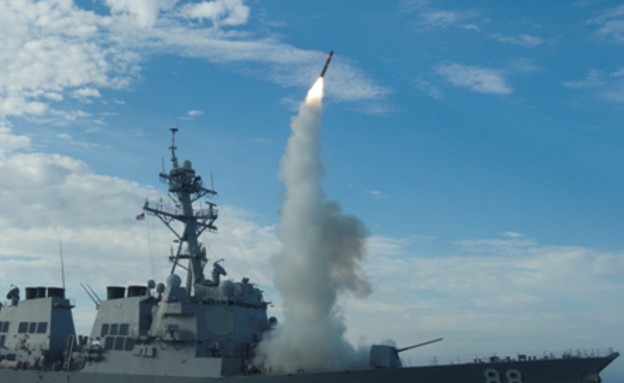
There is no doubt that this is a forceful threat by the Americans to the Iranians. The Georgia can carry up to 154 Tomahawk cruise missiles each carrying a warhead weighing about half a ton to a range ranging from 1,300 to 1,700 kilometers, depending on the model’s underspecies.
It’s an accurate missile that’s very difficult to intercept capable of carrying nuclear warheads. Another important point to note, this submarine can carry 66 operators from the elite Navy SEAL unit for both covert and noisy missions.
The American submarine didn’t go in alone. Along with her, a pair of “Ticonderoga” missile ships also entered. Vessels threaten when each such ship has 120 Mk 41 missile launch compartments. From each one you can launch Tomahawk, Harpoon and more missiles like them there are dozens on board. As it seems the message aimed at the Iranians is sharp and clear.
U.S. battleship launches Tomahawk missile | Photo: U.S. Army
Iran expects the next U.S. administration under President-elect Joe Biden to unconditionally return to the Joint Comprehensive Plan of Action (JCPOA) nuclear deal as originally negotiated by President Barack Obama, Iran’s Ambassador to the U.N. said Friday.
Majid Takht Ravanchi revealed a confident Iran has already received positive signals from the inbound Biden administration.
“We have heard from the Biden team a number of positive remarks regarding the JCPOA and the return of the United States to its obligations based on it,” Iran’s U.N. envoy told the semi-official IRNA news service.
He further said “it’s too early to judge exactly what the next dwellers of the White House will do,” but added Tehran “is not in a rush” and Biden will be given time to align his policies with those of Iran.
“This was a horrible one-sided deal that should have never, ever been made,” Trump said at the time. “It didn’t bring calm, it didn’t bring peace, and it never will.”
Trump’s decision signaled a major blow to the Obama administration’s 2015 signature foreign diplomatic agreement which eased sanctions in return for cuts to Iran’s nuclear program.
The president also denounced the Obama administration for sending billions of dollars to a “regime of great terror” including vast sums of cash, pointing out that money went to further sponsoring terrorism and violence in the Middle East.
Friday’s announcement by Tehran is not the first time it has tried to reheat the JCPOA agreement.
It announced in September, 2019, it would honor the nuclear deal if it could sell its oil on the open market or get “$15 billion over four months,” as Breitbart News reported.
The Iranian navy’s largest warship Makran, a logistics vessel which carries 7 helicopters, and the missile carrier Zereh have been posted to its fleet in the northern Indian Ocean, the Bab-el-Mandeb Strait and the Red Sea, the Tasnim news agency reports. The two new warships were unveiled and delivered during a two-day Iranian exercise in the Gulf of Oman.
“We are once again in the Red Sea region,” said Maj. Gen. Mohammad Hossein Bagher reporting on the ongoing buildup of warships on Wednesday. State TV said the 121,000-metric ton Makran is Iran’s largest military ship at 228 meters (748 feet) long, 42 meters (138 feet) wide and 21.5 meters (70 feet) tall. It is claimed to support combat ships in the fleet, can travel for nearly three years without docking and carry information collection and processing gear. These features are not independently confirmed. Video footage released by the military showed helicopters carrying commandos to the Makran as part of the exercise.
Newsweek this week ran images of advanced Iranian Shahed-136 “suicide drones” deployed to Houthi-controlled northern Yemen. They are estimated to have an effective range of 2,000 to 2,200 km. Israel, Saudi Arabia and US bases are well within range.
Israel military sources say the IDF has identified the peril posed by Iran’s “second circle” of aggression in Yemen and Iraq. The IDF has been conducting war games since December simulating attacks from the south from a variety of hardware, whether by missiles, drones or other remote guidance weapons. Patriot and Iron Dome anti-missile batteries have been moved to its southernmost town, the Red Sea port city and resort of Eilat.
Its backing for the Yemeni Houthi insurgency has won Iran a strategic foothold against Israel and Saudi Arabia, over and above Iraq, Syria and Lebanon. Its naval buildup puts Tehran in position to blockade this vital sea lane.
Iran routinely uses Yemen’s Houthis for cross-border missile and drone attacks on Saudi Arabia. Its current naval buildup will threaten the kingdom’s Red Sea coastline and western oil route as well. Iran’s use of its “second circle” of aggression against American allies in the region is one more item for the incoming Joe Biden presidency to tackle in any renewed nuclear negotiations with the Islamic Republic.
Newspaper says IDF chief has asked for options to derail atomic production, day after Likud minister warned Israel could attack Islamic Republic if US rejoins nuclear deal
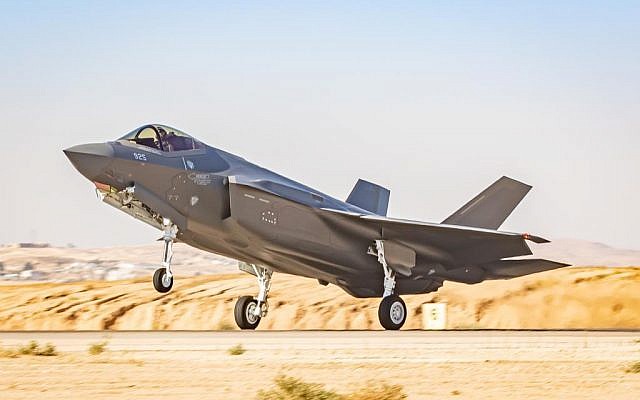
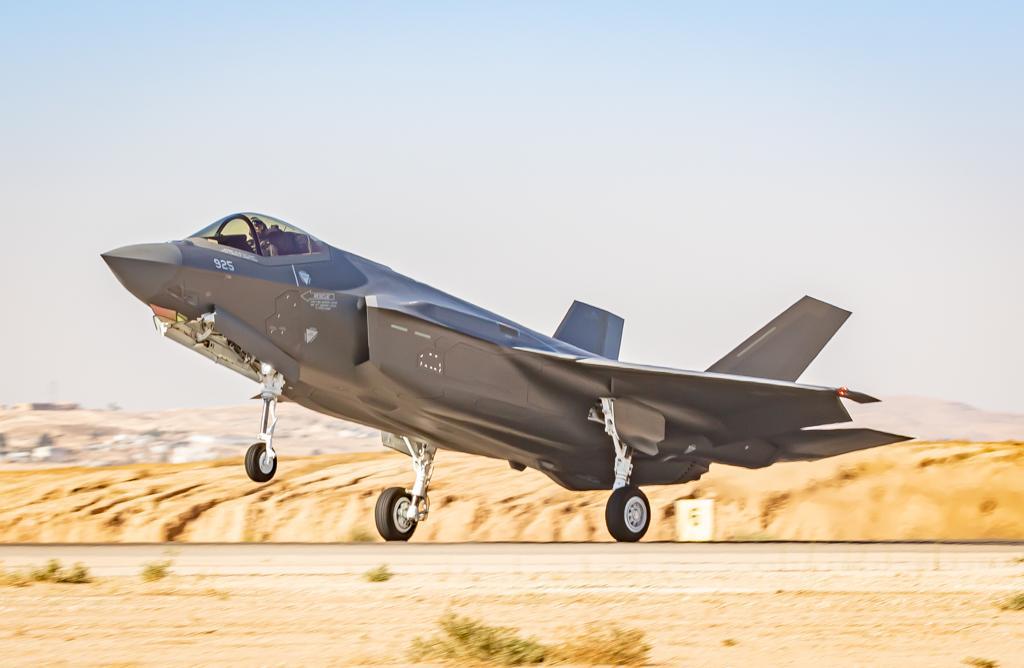
An F-35 fighter jet at the Nevatim Air Base in southern Israel from the United States on July 14, 2019. (Israel Defense Forces)
The Israel Defense Forces is drawing up plans for an attack on Iran’s nuclear program, the Israel Hayom daily reported Thursday in a front-page article.
The newspaper said that IDF Chief of Staff Aviv Kohavi has asked for three alternate proposals to derail Tehran’s program, without elaborating on them. It only indicated one of the proposals is a military strike, noting that such a plan would require a significant budgetary boost for the Israeli military.
Iran resumed enriching uranium to 20 percent last week, well in excess of the threshold set out in its landmark 2015 nuclear deal with world powers and a short technical jump from the 90% level of enrichment needed to produce weapons.
The Israel Hayom report came a day after Likud minister Tzachi Hanegbi, considered an ally of Prime Minister Benjamin Netanyahu, threatened that Israel could attack Iran’s nuclear program if the United States rejoined the nuclear deal, as US President-elect Joe Biden has indicated he plans to do.Prime Minister Benjamin Netanyahu, left, speaks with Tzachi Hanegbi during a Likud Party faction meeting at the Knesset on February 8, 2016. (Yonatan Sindel/Flash90)
“If the United States government rejoins the nuclear deal — and that seems to be the stated policy as of now — the practical result will be that Israel will again be alone against Iran, which by the end of the deal will have received a green light from the world, including the United States, to continue with its nuclear weapons program,” Hanegbi said in an interview with Kan news.
“This of course we will not allow. We’ve already twice done what needed to be done, in 1981 against the Iraqi nuclear program and in 2007 against the Syrian nuclear program,” he said, referring to airstrikes on those two countries’ nuclear reactors.
Former US president Barack Obama, with incoming US President-elect Joe Biden as his vice president, signed the Iranian nuclear deal with world powers in 2015. The Trump administration withdrew from the accord in 2018 and pressured Iran with crippling economic sanctions and other measures.
Obama signed the agreement despite fierce protest from Israel, and had a rocky relationship with Jerusalem and Netanyahu, while the premier and Trump have been in lockstep on most Middle East policy issues.
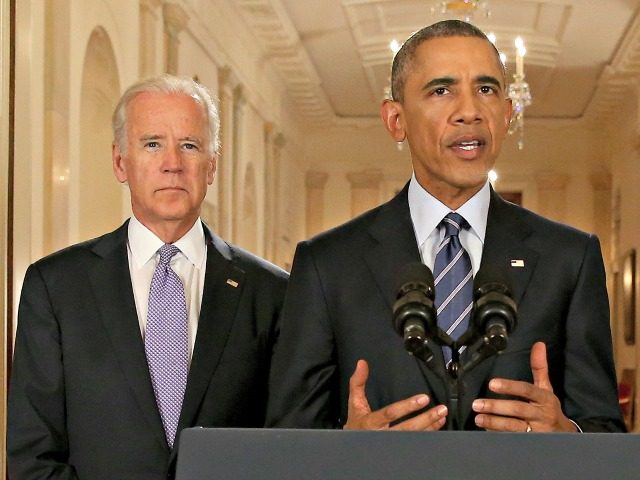
Biden is expected to take a more conciliatory approach to Iran and has said that if Iran returns to the terms of the nuclear agreement, he too would rejoin, removing the crushing economic sanctions that have wreaked havoc on the Iranian economy over the past two years.Then-US President Barack Obama, standing with then-Vice President Joe Biden, delivers remarks in the East Room of the White House in Washington, on July 14, 2015, after a nuclear deal with Iran is reached. (AP Photo/Andrew Harnik, Pool)
The US president-elect has indicated that he wants to negotiate more broadly with Tehran if Washington returns to the deal, notably over its missiles and influence across the Middle East. Iran has said it could welcome the return of the Americans to the agreement, but only after they lift sanctions. It has rejected negotiation on other issues.
Iran and the Trump administration have engaged in an ongoing exchange in recent months as the Trump administration draws to a close and Iran marked the one-year anniversary of the US assassination of its general Qassem Soleimani.
The back and forth has included threats, military maneuvers, legal action and escalating Iranian violations of the nuclear deal.
Further complicating the Biden administration’s plans to reengage with Tehran were two high profile assassinations this year in Iran that were attributed to Israel. Top Iranian nuclear scientist Mohsen Fakhrizadeh was gunned down outside Tehran in November in a hit Iranian officials blamed on Israel. In August, Israeli agents killed al-Qaeda’s second-in-command in Tehran at the behest of the US, according to a New York Times report.
This Sunday, Feb. 26, 2006 file photo, shows a reactor building of the Iran’s Bushehr nuclear power plant (AP Photo/Vahid Salemi, File)
Prime Minister Benjamin Netanyahu is assembling a team to strategize for the first talks with the Biden administration on Iran’s nuclear program, according to a Wednesday report.
The team will include officials representing national security, the Foreign Ministry, Defense Ministry, military, Mossad spy agency and Atomic Energy Commission, Walla news reported, citing unnamed sources in the Prime Minister’s Office.
Netanyahu is considering appointing a senior official to head the team and to serve as an envoy in talks with the US on the Iranian nuclear program, the report said.
A possible candidate to head the team is Mossad chief Yossi Cohen, the report said. Cohen is reportedly in Washington this week but has not met with officials from the Biden team.
Outgoing Israeli envoy to the US Ron Dermer is another candidate, Walla reported.
US President-elect Joe Biden is expected to take a more conciliatory approach to Iran than the Trump administration and has said that if Iran returns to the terms of the 2015 nuclear agreement, he too would rejoin, removing the crushing economic sanctions that have wreaked havoc on the Iranian economy over the past two years.US President-elect Joe Biden speaks during an event at The Queen theater in Wilmington, Del., Friday, Jan. 8, 2021, to announce key administration posts. (AP Photo/Susan Walsh)
The US president-elect has indicated that he wants to negotiate more broadly with Tehran if Washington returns to the deal, notably over its missiles and influence across the Middle East. Iran has said it could welcome the return of the Americans to the agreement, but only after they lift sanctions. It has rejected negotiation on other issues.
Former US president Barack Obama, with Biden as his vice president, signed the Iranian nuclear deal with world powers in 2015. The Trump administration withdrew from the accord in 2018 and pressured Iran with crippling economic sanctions and other measures.
Obama signed the agreement despite fierce protest from Israel, and had a rocky relationship with Jerusalem and Netanyahu, while the premier and Trump have been in lockstep on most Middle East policy issues.
The prospect of the US reengaging with Tehran has drawn warnings and alarm from Netanyahu and his allies.
Last week, speaking alongside US Treasury Secretary Steve Mnuchin in Jerusalem, Netanyahu warned against the US rejoining the nuclear agreement, also known as the Joint Comprehensive Plan of Action (JCPOA).
“If we just go back to the JCPOA, what will happen and may already be happening is that many other countries in the Middle East will rush to arm themselves with nuclear weapons. That is a nightmare and that is folly. It should not happen,” Netanyahu said.
Likud MK Tzachi Hanegbi said Wednesday the incoming US administration must not “appease” Iran, and warned Tehran the Jewish state will not tolerate its military presence in Syria or its development of nuclear weapons.
In one of the most forceful statements recently made by an Israeli official, Hanegbi, considered an ally of Netanyahu, threatened that Israel could attack Iran’s nuclear program if the United States rejoined the nuclear deal.
Iran and the Trump administration have engaged in an ongoing exchange in recent months as President Donald Trump’s tenure draws to a close and Iran marked the one-year anniversary of the US assassination of its general Qassem Soleimani.
The back and forth has included threats, military maneuvers, legal action and escalating Iranian violations of the nuclear deal. Israeli and Iranian officials have also exchanged threats in recent weeks.
US Secretary of State Mike Pompeo publicly accused Iran of harboring al-Qaeda terrorists on Wednesday.
Iran resumed enriching uranium to 20 percent last week, well in excess of the threshold set out in its landmark 2015 nuclear deal with world powers and a short jump from the level of enrichment needed to produce weapons.
Further complicating the Biden administration’s plans to reengage with Tehran were two high profile assassinations this year in Iran that were attributed to Israel. Top Iranian nuclear scientist Mohsen Fakhrizadeh was gunned down outside Tehran in November in a hit Iranian officials blamed on Israel. In August, Israeli agents killed al-Qaeda’s second-in-command in Tehran at the behest of the US, according to a New York Times report.
With the changing of the US administration, the IDF sees Tehran as less likely to retaliate, and is making hay of the opportunity by expanding and intensifying its air campaign
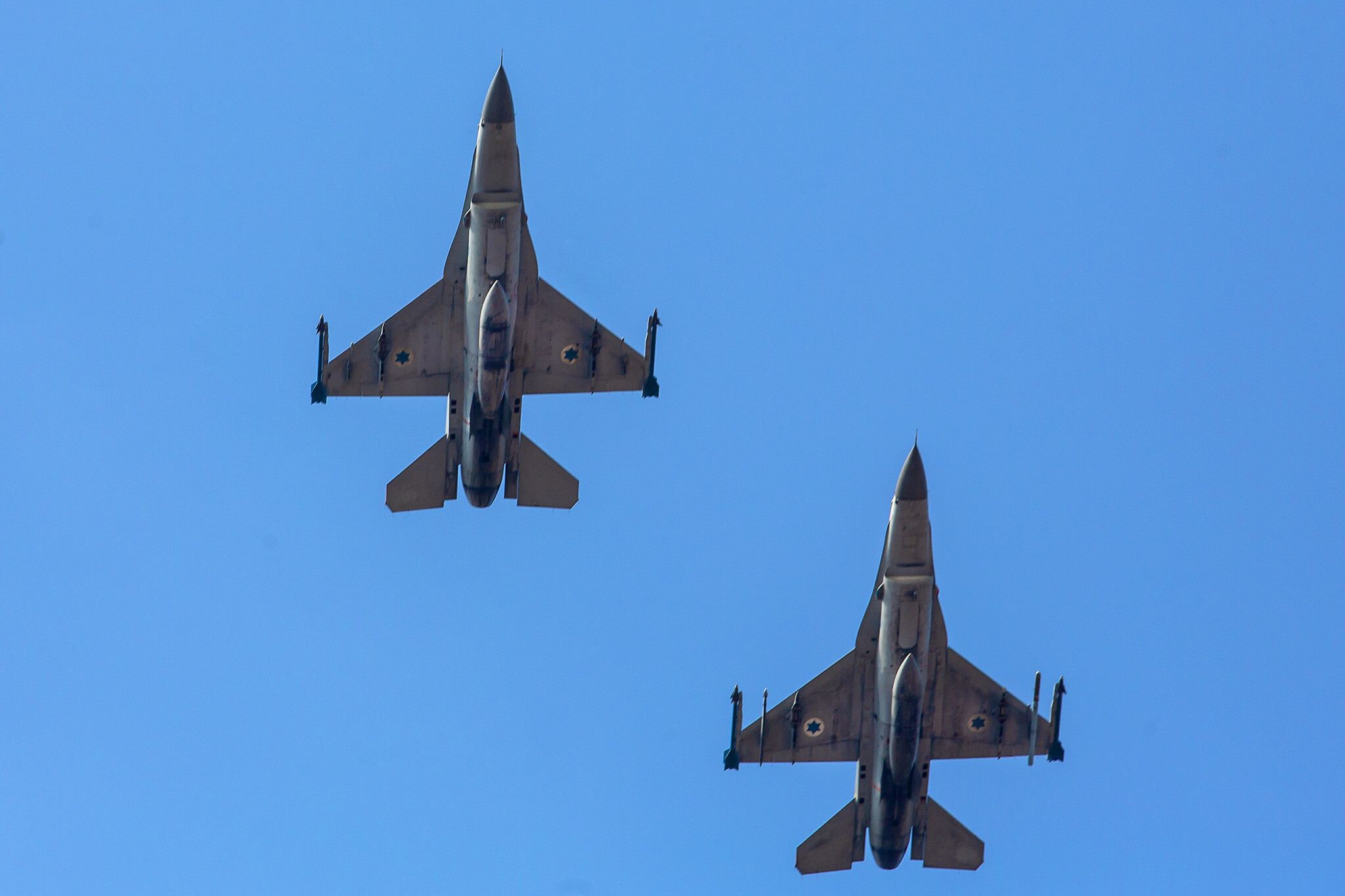
F-16 jets fly above the Herzliya airport on November 15, 2019. (Moshe Shai/Flash90)
Over the past two and a half weeks, Israel has reportedly conducted at least four rounds of airstrikes on Iran-linked sites in Syria, including a major bombardment in the predawn hours of Wednesday morning according to media outlets there, in a major step up from the normal frequency of attacks.
Wednesday’s attack was a major operation, one of the largest reported Israeli airstrikes in years, with over 15 sites bombed in eastern Syria some 500 kilometers (300 miles) from Israel, according to Syrian reports.
The bombing was both more intense than normal — in comparison, the Israel Defense Forces said it struck some 50 targets in all of 2020 — and took place much farther from Israel than most attacks attributed to the Jewish state. The three other rounds of airstrikes in last few weeks took place in areas closer to Damascus and the Syrian Golan.
The IDF had no comment on the late-night strikes, in accordance with its policy to neither confirm nor deny its operations in Syria save for those in retaliation to an attack on Israel from the country.
The significant increase in the frequency and scope of the attacks stems from an assessment by the Israel Defense Forces, shared with The Times of Israel, that Iran is unlikely to retaliate in a major way to these strikes in the short term.
In general over the past year, Iran has not responded to Israeli airstrikes — either not finding a way to do so or being stopped by Israel from doing so — and currently Tehran appears to be preparing to enter into negotiations with US President-elect Joe Biden’s incoming administration, which would be more difficult were it to be actively engaged in fighting with Washington’s key ally in the region. While Iran takes a wait-and-see approach, Israel is taking advantage.Syrian Air defenses respond to alleged Israeli missiles targeting south of the capital Damascus, on July 20, 2020. (AFP)
Even if the frequency of IDF strikes decreases in the coming weeks, it would more likely be due to operational restrictions than the incoming Biden administration trying to curb Israel. The same window of opportunity is expected to remain as long as Tehran holds out hopes of talks with the new president, allowing Israel to continue its efforts in Syria, which are intended to keep Iran from entrenching itself militarily in the country and using it to move weapons that would threaten the Jewish state.
“The Biden administration won’t stop Israel from striking [in Syria],” Amos Yadlin, a former Military Intelligence chief, told the Times of Israel.
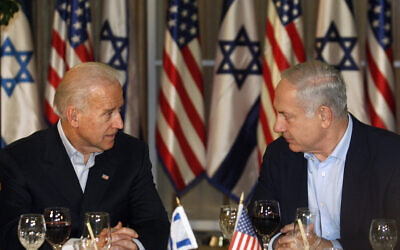
U.S. Vice President Joseph Biden, left, and Israeli Prime Minister Benjamin Netanyahu, right, talk before a dinner at the Prime Minister’s residence in Jerusalem, Tuesday, March 9, 2010. (AP Photo/Baz Ratner, Pool)
According to Israeli officials, the campaign against Iran in Syria has been on the whole successful, stymieing Tehran’s plans for the country and largely keeping the bulk of its forces further from Israel’s borders.
“They wanted to shape [Syria] in the model of Hezbollah, to have masses of soldiers there, with missiles, with the ability to strike Israel, to exhaust Israel,” Minister Tzachi Hanegbi told the Kan broadcaster Wednesday.
“In the past four years… they failed to turn Syria into something like the second Hezbollah. They tried to build there a military force and Israel — time after time — destroyed those attempts and that infrastructure. They haven’t given up, they haven’t quit, but they have failed,” he said.
Last month, IDF Chief of Staff Aviv Kohavi made a similar claim, telling reporters in a year-end briefing that the IDF has noted a marked drop over the previous two years in the number of Iran-backed fighters in Syria, an increase in the number of Iranian military bases being closed in the country, and a significant decrease in the amount of weaponry being transported into and through Syria.
“Iranian entrenchment in Syria is in a clear trend of slowing down as a direct result of IDF activities, though we still have a way to go to reach our goals on this front,” Kohavi said
.
Satellite images showing an alleged Iranian tunnel on a military base near the border crossing in Syria’s Boukamal region, near the Iraqi border, on December 10, 2019. (ImageSat International)
Yet the Islamic Republic has not thrown in the towel and still maintains a significant military presence in the country, even if it is smaller than it desires.
Israeli and Western intelligence officials, as well as Syrian opposition media, have said that these areas are used by Tehran as part of a so-called land corridor to transport weapons from Iran through Iraq into Syria and, in some cases, on to Lebanon, where its most significant proxy, Hezbollah, is based.
Boukamal was also targeted multiple times in 2018 and 2019 in a failed bid to block the construction of the infrastructure likely used to transport missiles into Syria in recent weeks.This file photo released Sept. 3, 2017, by the Syrian official news agency SANA, shows Syrian troops and pro-government gunmen standing next to a sign in Arabic which reads, “Deir el-Zour welcomes you,” in the eastern city of Deir el-Zour, Syria. (SANA via AP)
“The other side, as I understand, is not prepared to surrender because they invested a huge fortune and massive resources in the success of Assad and they want to collect their fee from Assad, which is their ability to operate freely from within Syria, which they saved from falling into the hands of the rebels,” Hanegbi said.
According to Omar Abu Layla, a Europe-based activist who runs DeirEzzor24, a pro-opposition media collective with researchers on the ground in eastern Syria, these warehouses contained a particularly large shipment of missiles that had been brought into the area by the Iran-backed Fatimiyeon militia in recent weeks.
In a highly irregular move, a senior US intelligence official confirmed to the Associated Press that Israel was behind the Wednesday strikes. The official said the intelligence behind the attack was provided by the US. It’s unlikely, though, that Israel would launch such a significant raid based solely on American intelligence, based on its standard operating procedure.
More curiously, the official also claimed the warehouses that were targeted were used to transport components that support Iran’s nuclear program — though not that these materials were themselves targeted in the strikes. This is an eyebrow-raising proposition, given the fact that Deir Ezzor was the site of Syria’s own nuclear reactor before it was destroyed by the Israeli Air Force in 2007.
Institute for National Security Studies Chairman Amos Yadlin attends the Annual International Conference of the Institute for National Security Studies in Tel Aviv January 23, 2017. (Tomer Neuberg/FLASH90)
Yadlin, the current head of the influential Institute for National Security Studies, dismissed this claim as “fake news” and said that these were simply not the supply lines used by Iran for its nuclear program.
Asked if the attribution to a senior US intelligence official didn’t lend some credence to the claim, Yadlin told The Times of Israel: “A former senior Israeli intelligence official is saying this report has no logical [basis].”
Nuclear brinksmanship
Recent months have seen rising tensions between Iran and the US and Israel, amid speculation that outgoing US President Donald Trump would use his final week in office to launch a military strike against Tehran.
The US has deployed B-52 heavy bombers to the Middle East, sent an aircraft carrier to the Persian Gulf and sought to diplomatically challenge Iran by releasing intelligence tying the Islamic Republic to the Al-Qaeda terror group earlier this week. The US has also stepped up its sanctions on Iranian entities.
The head of Iran’s military nuclear program, Mohsen Fakhrizadeh, was also killed in November in an attack that was widely attributed to Israel.
This combination of photos shows US Secretary of State Mike Pompeo (L) and Mossad chief Yossi Cohen. (Saul Loeb/Pool via AP and Miriam Alster/Flash90)
In a somewhat subtler move, Mossad chief Yossi Cohen traveled to Washington, DC, this week, meeting with US Secretary of State Mike Pompeo in a public space, prompting widespread speculation on what the two discussed.
Iran, in turn, has taken a number of provocative steps on the nuclear front, announcing that it was beginning to enrich uranium to 20 percent, a major breach of the 2015 nuclear deal, which it has been steadily violating since Trump abandoned the agreement in 2018. On Wednesday, Tehran announced it was also advancing research into uranium metal, a key component of nuclear weapons, with limited civilian uses.
In addition, the Iranian military has staged two large exercises, one focusing on drones and the other on the navy.
Iran also seized a South Korean oil tanker that had been sailing through the Persian Gulf, an apparent act of revenge for some $7 billion in Iranian assets that were frozen by Seoul.
Likud’s Tzachi Hanegbi attends an event at Kedem in the West Bank on September 5, 2019. (Hillel Maeir/Flash90)
Despite these growing signs of tensions, Hanegbi said Israel did not anticipate some kind of attack in the coming week.
“The [Israeli] assessment is that nothing dramatic will happen during this week,” he said. “This is the calm before the storm.”
The minister, who is considered a close ally of Prime Minister Benjamin Netanyahu, explained that the “storm” would be what comes as the United States negotiates a new nuclear deal with Tehran, saying that if Israel did not feel such an agreement ensured its security, it would attack Iran’s nuclear program.The exterior of the Arak heavy water production facility in Arak, Iran, 360 kilometers southwest of Tehran, October 27, 2004. (AP Photo)
Biden has publicly stated his intention to rejoin the accord — known formally as the Joint Comprehensive Plan of Action — provided Iran also returns to the terms of the deal and use that agreement as a jumping off point for further negotiations.
Those opposed to the JCPOA, as well as some proponents of it, argue that a simple return to the deal would give up the considerable leverage that Trump’s sanctions regime has achieved. Instead, those people argue, Biden should attempt to negotiate a far stronger deal, one that does not have the expiration dates of the JCPOA, with greater access for international inspectors, and also addressing Iran’s ballistic missile program and malign influence in the region. Supporters of Biden’s plan maintain that a significantly more robust deal is not feasible now, but could be negotiated going forward.
This is the calm before the storm
“If the United States government rejoins the nuclear deal — and that seems to be the stated policy as of now — the practical result will be that Israel will again be alone against Iran, which by the end of the deal will have received a green light from the world, including the United States, to continue with its nuclear weapons program,” Hanegbi said.
“This of course we will not allow. We’ve already twice done what needed to be done, in 1981 against the Iraqi nuclear program and in 2007 against the Syrian nuclear program,” he said, referring to airstrikes on those two countries’ nuclear reactors.
Nuclear watchdog head Grossi says if talks are held when Biden takes office, ‘there will have to be clear understanding on how initial terms of accord will be recomplied with’
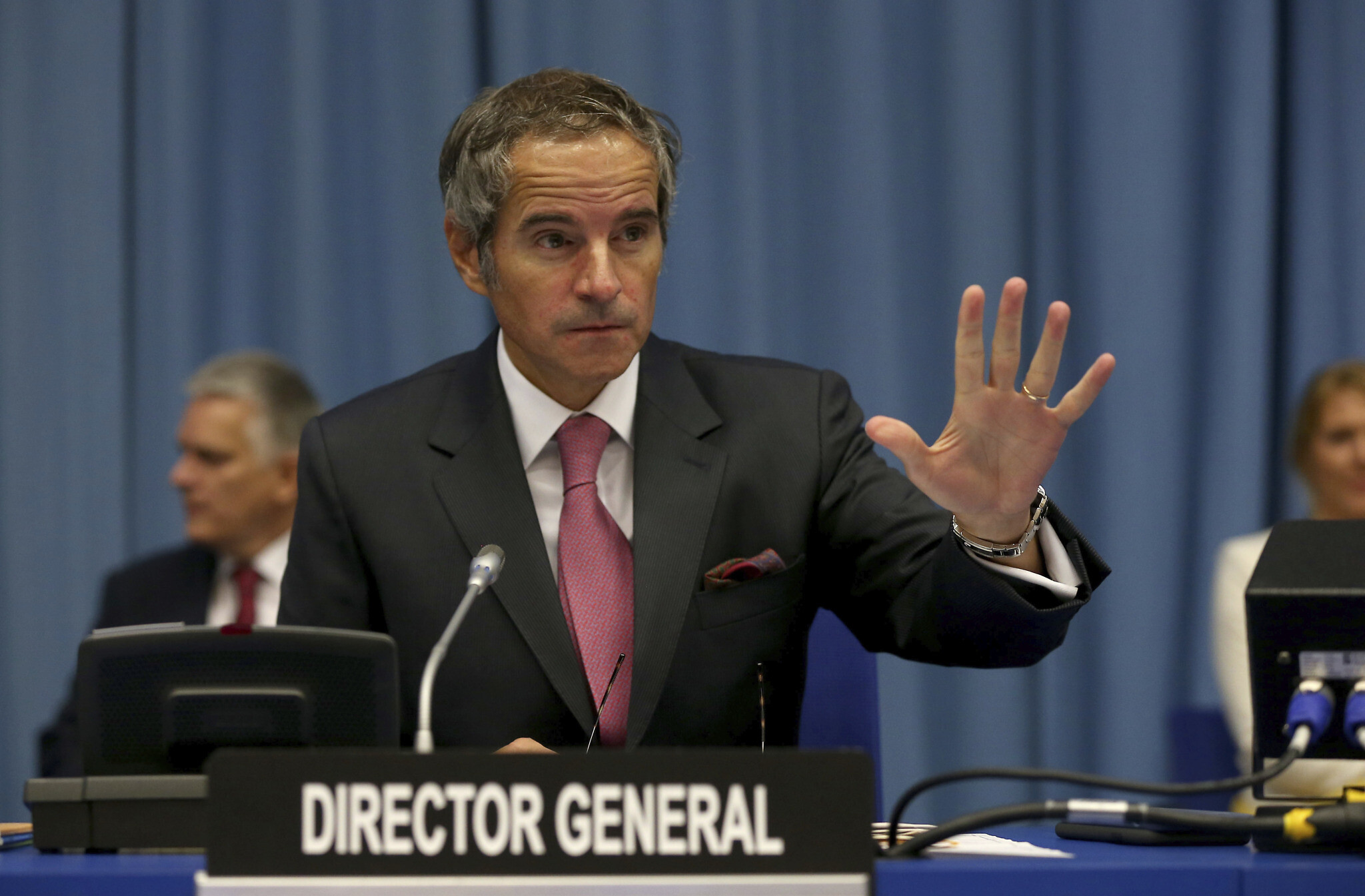
Director General of the International Atomic Energy Agency Rafael Mariano Grossi at the IAEA board of governors meeting at the International Center in Vienna, Austria, September 14, 2020. (Ronald Zak/AP)
The head of the UN’s nuclear watchdog said Monday that there were “weeks” left to salvage the nuclear deal with Iran.
Rafael Grossi, director of the International Atomic Energy Agency, said at the Reuters Next conference that Tehran was advancing “quite rapidly” toward enriching uranium to 20 percent, as it has announced it would, in breach of the accord. He said the IAEA has assessed Iran will be able to produce some 10 kilograms a month.
“It is clear that we don’t have many months ahead of us [to save the deal]. We have rather weeks,” he said.
If talks between the signatories of the accord are launched, “there will have to be a clear understanding on how the initial terms and provisions of the [nuclear deal] are going to be recomplied with,” Grossi said.
The comments came two days after Iranian lawmaker Ahmad Amirabadi Farahani declared that Tehran would expel IAEA inspectors in February unless the US lifts its sanctions on the country.
“If the sanctions against the Islamic Republic of Iran are not lifted by February 21, especially in the fields of finance, banking, and oil, we will definitely expel the International Atomic Energy Agency inspectors from the country,” said Farahani in a television interview, according to an English translation of his remarks by the Mehr news agency.
UN inspections of Iran’s nuclear sites are a key part of a 2015 pact with world powers that saw sanctions lifted from Iran in return for its dismantling the weapons aspects of its nuclear program.
The United States unilaterally withdrew from the agreement in 2018, and the remaining countries that signed it with Iran — Germany, France, Britain, China and Russia — have been trying to keep the accord from collapsing. The Trump administration imposed crippling sanctions on Iran while demanding it renegotiate stricter terms to the deal. Iran has refused and responded by walking back its own commitments to the accord.US Secretary of State Mike Pompeo at Georgia Tech, in Atlanta, December 9, 2020. (John Bazemore/ AP)
US Secretary of State Mike Pompeo responded to Farahani in a statement on Saturday that Iran has an obligation to allow the inspections to continue.
“Nuclear brinksmanship will not strengthen Iran’s position, but instead lead to further isolation and pressure,” Pompeo warned and urged that expulsion of the inspectors “be met by universal condemnation.”
On Sunday, the speaker of Iran’s parliament said that the so-called Joint Comprehensive Plan of Action “is not a sacred agreement; it is merely a deal to remove sanctions under the conditions accepted by the Islamic Republic.”
Last month, Iran began enriching uranium to levels unseen since the 2015 deal. The decision appeared aimed at increasing Tehran’s leverage during US President Donald Trump’s waning days in office.
Iran informed the IAEA of its plans to increase enrichment to 20 percent. Increasing enrichment at its underground Fordo facility puts Tehran a technical step away from weapons-grade levels of 90%.
The purpose of the deal was to prevent Iran from developing a nuclear bomb — something Tehran insists it does not want to do.
US President-elect Joe Biden has said he hopes to return the US to the deal if Iran returns to compliance with it.

 File: In this photo released on Wednesday, Nov. 6, 2019, a truck containing a cylinder of uranium hexafluoride gas leaves Ahmadi Roshan uranium enrichment facility in Natanz to the Fordo nuclear facility for the purpose of injecting the gas into Fordo centrifuges (Atomic Energy Organization of Iran via AP)
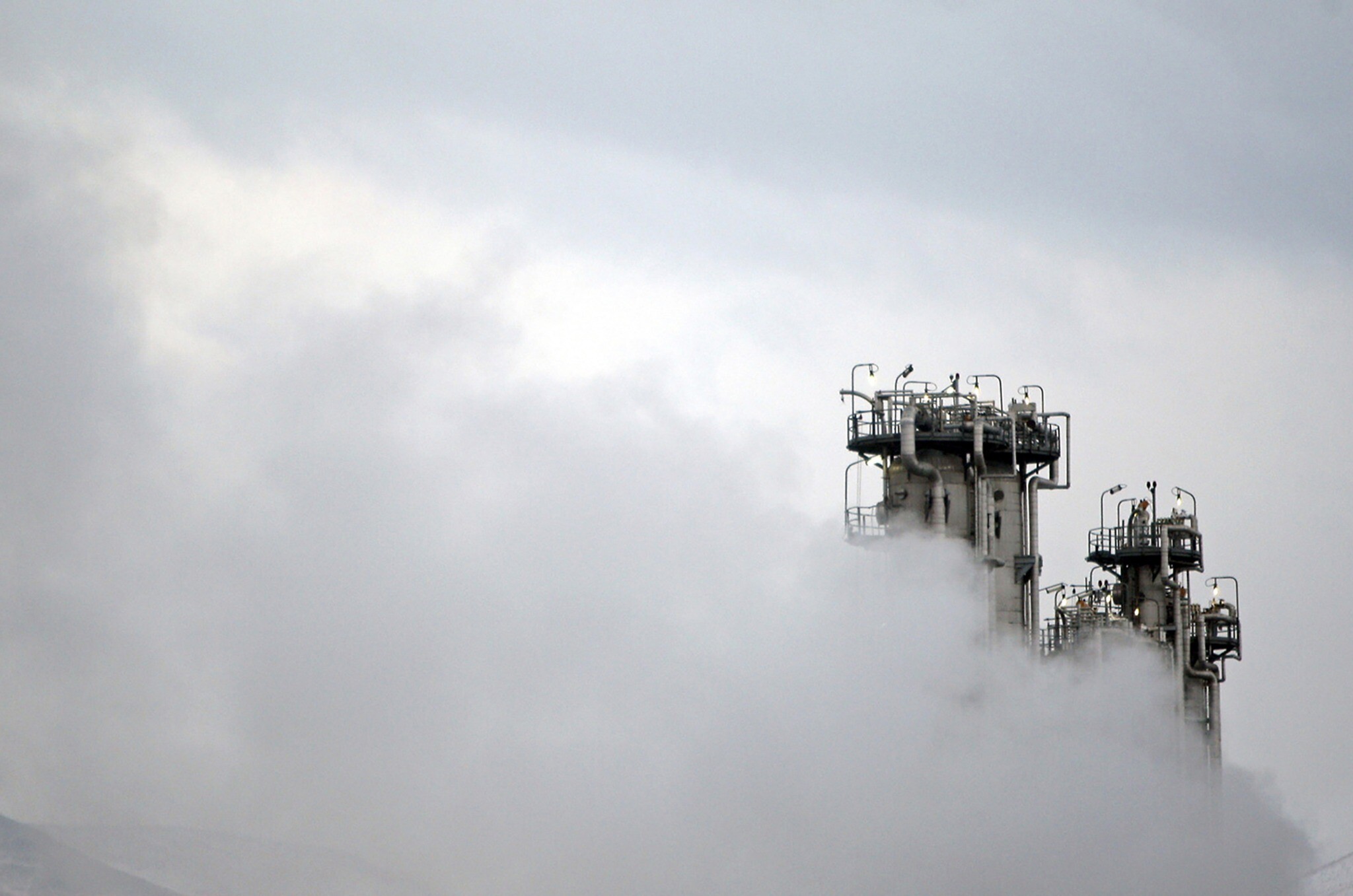 Part of the Arak heavy water nuclear facilities, near the central city of Arak, 150 miles (250 kilometers) southwest of Tehran, Iran, Jan. 15, 2011 (Mehdi Marizad/Fars News Agency via AP, File)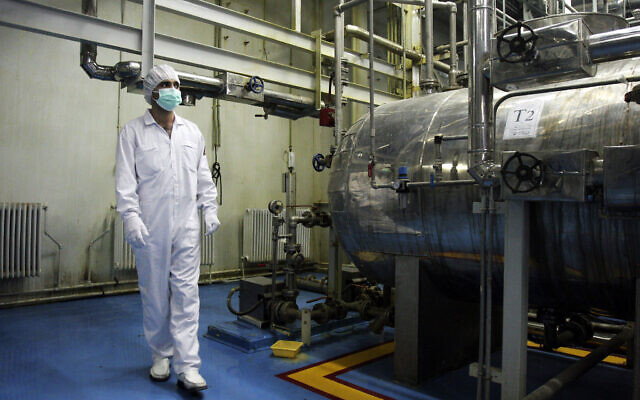
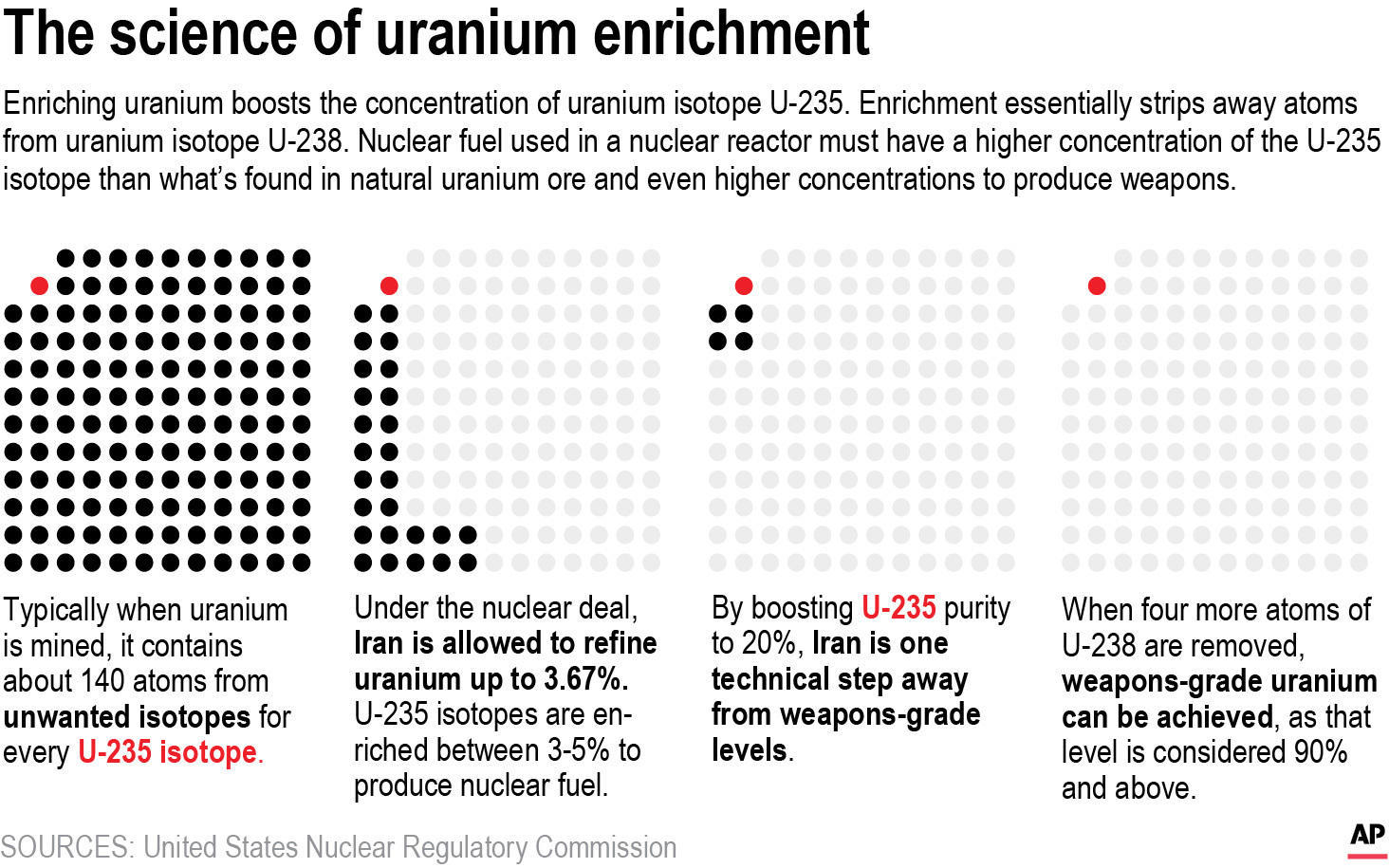 A graphic shows the scientific process of uranium enrichment to weapons-grade level (Phil Holm/AP)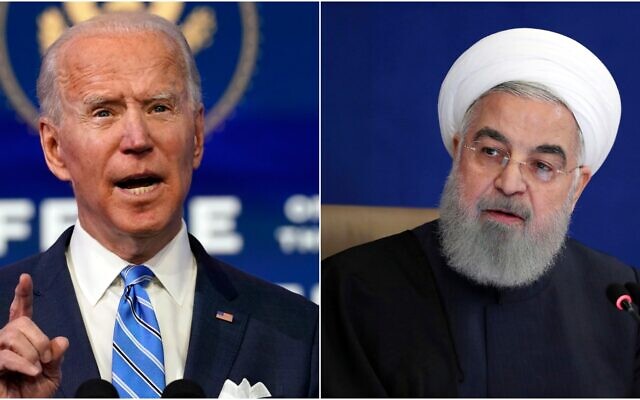
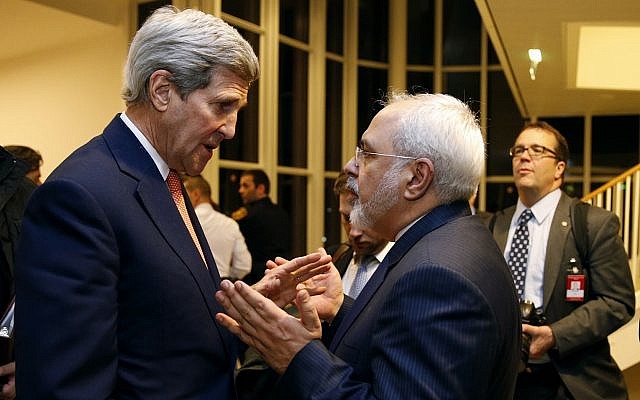 Then-US secretary of state John Kerry talks with Iranian Foreign Minister Mohammad Javad Zarif in Vienna, January 16, 2016 (Kevin Lamarque/Pool via AP, File)
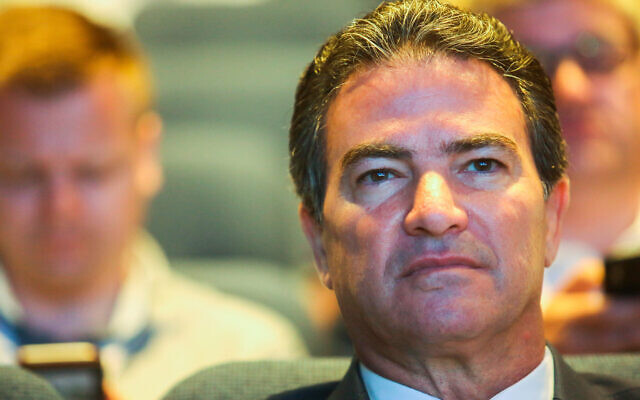 Mossad chief Yossi Cohen speaks at a Tel Aviv University cyber conference, on June 24, 2019. (Flash90)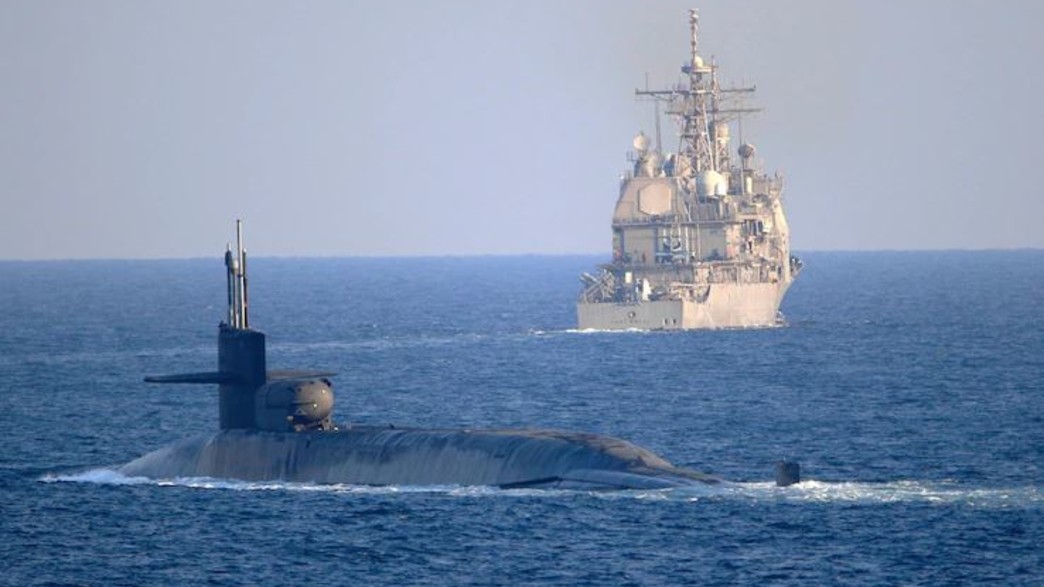

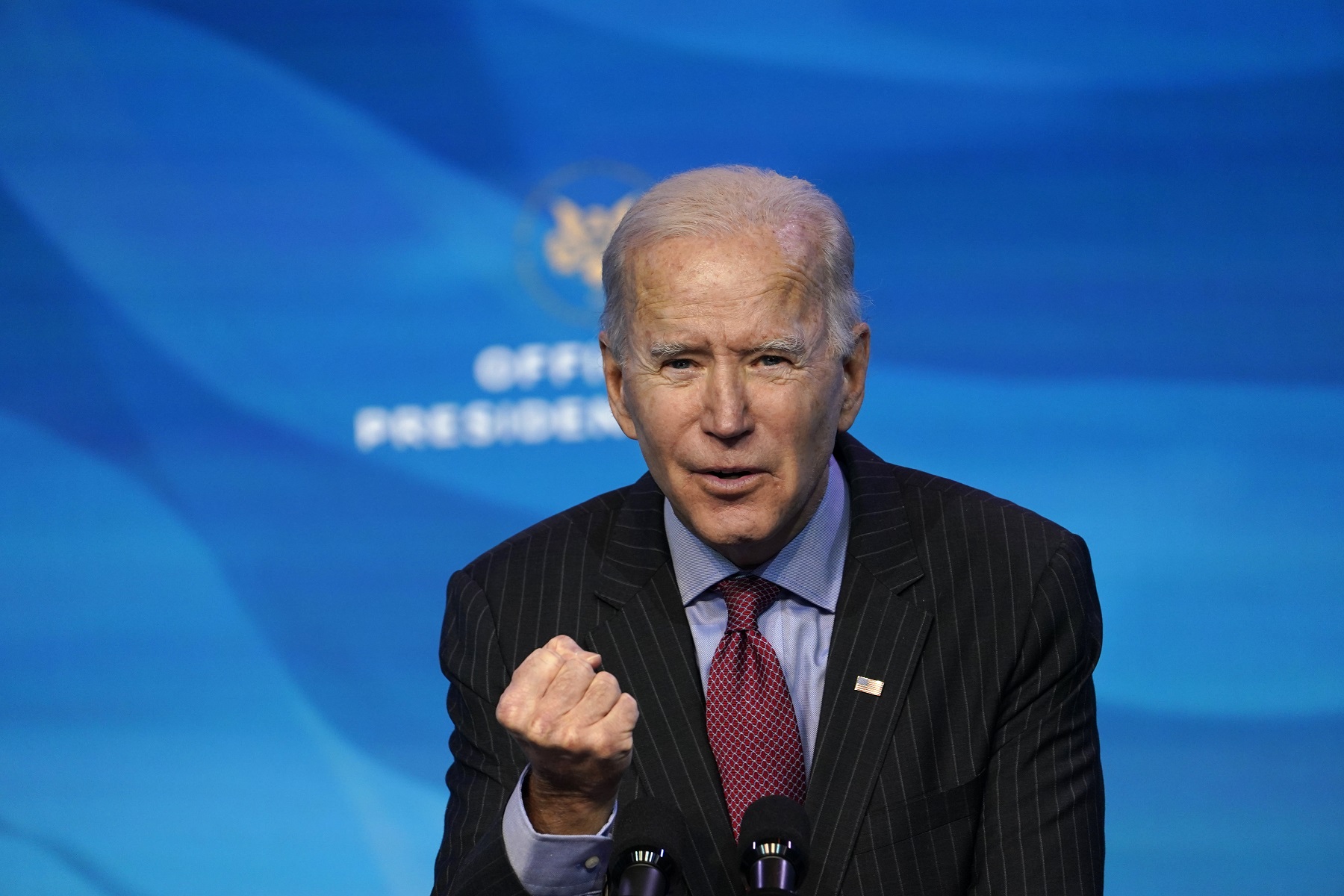 US President-elect Joe Biden speaks during an event at The Queen theater in Wilmington, Del., Friday, Jan. 8, 2021, to announce key administration posts. (AP Photo/Susan Walsh)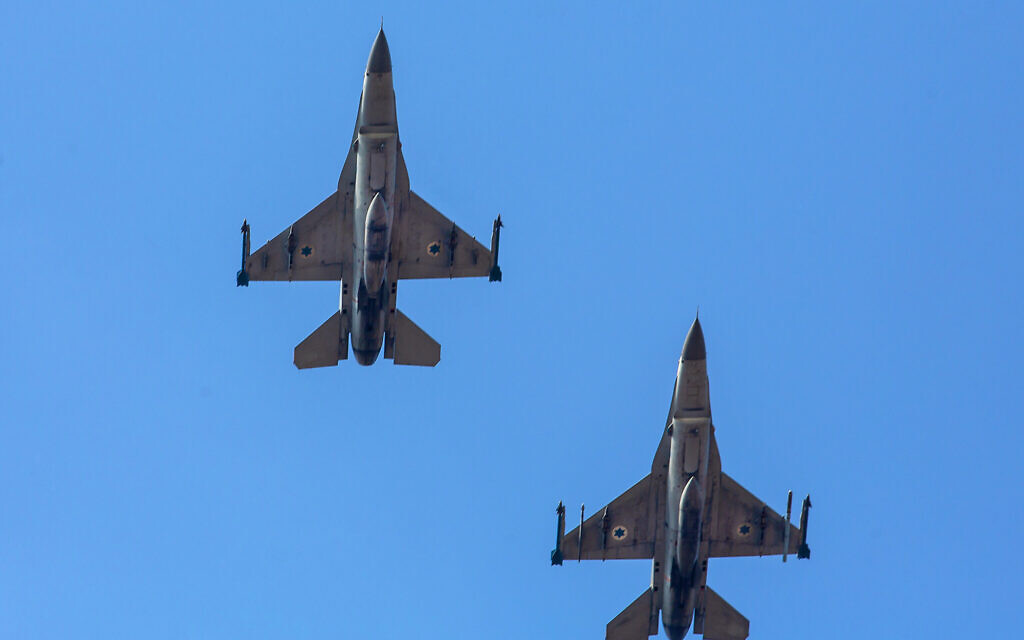


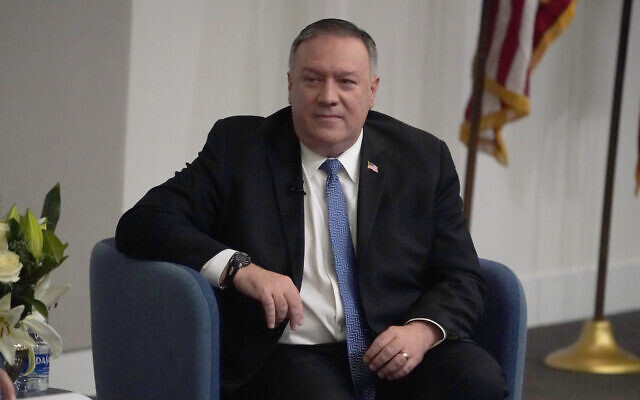 US Secretary of State Mike Pompeo at Georgia Tech, in Atlanta, December 9, 2020. (John Bazemore/ AP)



 anneinpt
 artaxes
 danmillerinpanama
 davidking1530
 Peter Hofman
 Joseph Wouk
 Peter
Peter Louisiana Steve
 WarSclerotic

Recent Comments