Author Archive

France and EU allies say Netanyahu’s claims reinforce Iran nuclear deal

May 1, 2018

Israeli Prime Minister Benjamin Netanyahu’s revelations about Iran’s nuclear weapons program only prove the need for a nuclear deal, according to French and EU leaders.

Maria Burtin
http://www.jerusalemonline.com/news/world-news/around-the-globe/france-continues-to-support-iran-nuclear-deal-35628
Netanyahu, yesterday Photo Credit: Miriam Alster/Flash 90
The French Foreign Ministry responded today to Israeli Prime Minister Benjamin Netanyahu’s presentation of Iran’s nuclear weapons program and stated that Netanyahu only repeated information revealed by Europe back in 2002. The French statement stressed that the presented materials reinforce the importance of maintaining the Iran nuclear deal, formerly known as 2015 Joint Comprehensive Plan of Action.

“At first sight, they (the details) confirm that part of the Iranian nuclear program, as France and its partners stated during the first revelations in the summer of 2002, was not civilian,” said the spokesperson for the ministry, according to a statement obtained by AFP.

In a televised address Monday, Netanyahu presented information gathered from Iran’s nuclear weapons program, claiming that Iran had lied about its efforts to acquire atomic weapons and had developed a nuclear weapons plan that can be activated at any time.

Statements from other European leaders were made before the French ministry’s remarks and said that the revealed information will not change their current position on Iran’s nuclear deal.

“What I have seen from the first reports is that Prime Minister Netanyahu has not put into question Iran’s compliance with the JCPOA [Joint Comprehensive Plan of Action] commitments, meaning post-2015 nuclear commitments,” said European Union foreign affairs chief Federica Mogherini. “The JCPOA, the nuclear agreement, is not based on assumptions of good faith or trust – it is based on concrete commitments, verification mechanisms and a very strict monitoring of facts, done by the IAEA. The IAEA has published 10 reports, certifying that Iran has fully complied with its commitments.”

The British Foreign Office released a statement on Monday evening confirming UK involvement with the plan and its importance.

“We have never been naive about Iran and its nuclear intentions. That is why the IAEA inspection regime agreed as part of the Iran nuclear deal is one of the most extensive and robust in the history of international nuclear accords,” said a spokesperson for the ministry. “It remains a vitally important way of independently verifying that Iran is adhering to the deal and that Iran’s nuclear program is exclusively peaceful.”

Watch: Netanyahu reveals Iranian nuclear files

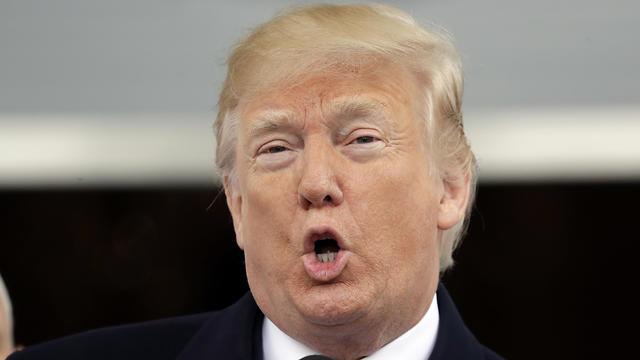
US President Donald Trump responded to Netanyahu’s speech and praised him for “sending the right message on Iran’s nuclear program.”

“In seven years, that deal will have expired and Iran is free to go ahead and create nuclear weapons,” said Trump. “That is just not an acceptable situation.”

Despite his agreement with Netanyahu, Trump refused to address the possible US withdrawal from the nuclear deal this month.  “We’ll see what happens,” Trump said. “I’m not telling you what I’m doing. [A lot] of people think they know. And on or before the 12, we’ll make a decision.”

Mogherini responds to Netanyahu

May 1, 2018

EU High Representative of for Foreign Affairs says she hasn’t seen arguments from Netanyahu that Iran isn’t complying with nuclear deal.

Elad Benari, 01/05/18 00:09
Federica Mogherini

Reuters

Federica Mogherini, the European Union’s High Representative of for Foreign Affairs and Security Policy, on Monday responded to Prime Minister Binyamin Netanyahu’s presentation on Iran.

“What I have seen from the first reports is that Prime Minister Netanyahu has not put into question Iran’s compliance with the JCPOA [Joint Comprehensive Plan of Action] commitments, meaning post-2015 nuclear commitments,” she said, asserting that an agreement was needed due to lack of trust between the sides.

“The JCPOA, the nuclear agreement, is not based on assumptions of good faith or trust – it is based on concrete commitments, verification mechanisms and a very strict monitoring of facts, done by the IAEA. The IAEA has published 10 reports, certifying that Iran has fully complied with its commitments,” continued Mogherini.

“And in any case, if any party and if any country has information of non-compliance, of any kind, it can and should address and channel this information to the proper, legitimate, recognized mechanisms, the IAEA and the Joint Commission [of the JCPOA] for the monitoring of the nuclear deal that I chair and that I convened just a couple of months ago. We have mechanisms in place to address eventual concerns.”

“Again, I have not seen from Prime Minister Netanyahu arguments for the moment on non-compliance, meaning violation by Iran of its nuclear commitments under the [nuclear] deal. And again, the deal was put in place exactly because there was no trust between the parties, otherwise we would not have required a nuclear deal to be put in place,” she concluded.

Netanyahu revealed intelligence from Iran’s secret nuclear files earlier on Monday, noting that “Iran lied big time” when its leaders denied that the Islamic Republic had a program to develop nuclear weapons.

The Prime Minister noted that after it signed the nuclear deal in 2015, Iran intensified its efforts to hide its secret nuclear files. He also pointed out that “in 2017, Iran moved its nuclear weapons files to a highly secret location in Tehran”.

Netanyahu addressed U.S. President Donald Trump’s upcoming decision on whether to remain in the Iran nuclear deal or not and said that he believed that Trump would withdraw from the deal.

“I am sure he will do the right thing, the right thing for the United States, the right thing for Israel, and the right thing for the peace of the world.”

Trump later responded to Netanyahu and said his speech “sends the right message” on Iran’s nuclear program.

The president called the 2015 Iran nuclear deal a “horrible agreement for the United States” and added that Netanyahu’s speech confirmed that he was “100% right” to criticize the 2015 nuclear agreement with Iran.”

However, Trump refused to say whether he would withdraw from the nuclear deal.

The president has set a deadline of May 12 for Europe to fix the flaws of the 2015 Iranian nuclear deal.

U.S. Confirms Authenticity of Secret Iran Nuclear Docs, Officials See Game Over for Deal

April 30, 2018

Trump administration officials praise Netanyahu’s ‘powerful presentation’

Benjamin Netanyahu delivers a speech on Iran's nuclear program

Benjamin Netanyahu delivers a speech on Iran’s nuclear program / Getty Images

BY:

U.S. Confirms Authenticity of Secret Iran Nuclear Docs, Officials See Game Over for Deal

U.S. officials and congressional insiders view the disclosure Monday by Israel of Iran’s ongoing efforts to develop a nuclear weapon as game over for the landmark nuclear deal, telling the Washington Free Beacon that new evidence of Iran’s top secret nuclear workings makes it virtually impossible for President Donald Trump to remain in the agreement.

Senior Trump administration officials confirmed the findings as authentic and praised Israeli Prime Minister Benjamin Netanyahu’s for disclosing thousands of secret documents proving Iran lied about its past work on a nuclear warhead, telling the Free Beacon the revelation was a “powerful presentation” by Israel outlining why the Iran deal must be fixed or killed.

U.S. officials who reviewed the secret documents confirmed their authenticity and said that Israel has shared the information fully with the United States, most likely to help build the case for Trump to abandon the nuclear deal, rather than try to fix what the White House views as a series of insurmountable flaws.

Multiple sources who spoke to the Free Beacon say that Monday’s presentation by Netanyahu resulted from a recent conversation between the prime minister and Trump, who has expressed his opposition to remaining in the deal.

During his presentation, Netanyahu disclosed that Israel had obtained some 100,000 secret documents that provide “conclusive proof” Iran lied to the world about its past nuclear work. The Israeli leader further presented information from these documents purporting to show that Iran continues to build on its nuclear know-how in pursuit of a fully functioning weapon.

While Trump has not made a final decision on whether to scrap the deal, sources close to the president say he is increasingly wary of the deal itself, as well as proposed fixes to the deal currently being discussed by the Europeans.

One senior administration official, speaking only on background, confirmed to the Free Beacon that the United States assessed the secret documents obtained by Israel to be fully authentic.

“All the materials we have reviewed are in our assessment authentic,” the official said, praising Netanyahu for presenting the evidence to the world.

“Prime Minister Netanyahu gave a powerful presentation today of compelling new evidence documenting Iran’s determined pursuit of a nuclear weapon,” the senior official said. “It certainly would have been helpful to have this information when the JCPOA [Joint Comprehensive Plan of Action] was negotiated but the Iranians decided to lock it away in a secret vault for future reference.”

The cache of documents showing that Iran has retained the infrastructure and know-how to produce a nuclear weapon has cast further doubts on U.S. efforts to broker a series of fixes to the landmark agreement.

“Only the regime knows what else they’re hiding, but the revelations today don’t give us much confidence in their protestations that they have never had interest in militarizing their nuclear program,” the official said. “They’re showing us in Syria how they plan to deploy their existing arsenal—we would be foolish to think that behavior is going to change because of a deal that was implemented two years ago that was based on a lie.”

Following Netanyahu’s remarks, Trump emphasized his opposition to the deal.

Those familiar with the president’s thinking said that he has soured on efforts to fix the deal and would prefer to see a wholly new agreement, a demand Iran has rejected in recent days.

Trump “made a clear signal today that he’s not confident in the JCPOA,” said the senior administration official. “The decision is with him and I don’t think he’s made it, but he seemed to indicate he’s more open to a new deal then to try to fix something this broken.”

A senior congressional official who has worked closely with the White House on the Iran issue told the Free Beacon the news has sent shockwaves through Capitol Hill.

“Everything the Obama administration told us about the Iranian nuclear program was a lie,” said the source, who was not authorized to speak on record. “They assured us that we knew everything about Iran’s nuclear weapons program, that it was put on ice, and that the intelligence community had full insight into what was going on.”

“Now we find out the Iranians have warehouses of nuclear weapons designs. People are in shock,” the source said. “Forget the policy implications, which get to the heart of the deal, this shows how the whole sale was built on a lie. Expect to see momentum build in Congress for just scrapping the whole thing.”

The White House National Security Council and the State Department have yet to comment formally on Netanyahu’s disclosures. The Free Beacon will update this report as more information becomes available.

Live: Netanyahu to speak on ‘significant’ development in Iran nuclear deal

April 30, 2018

Nuclear chief: Iran able to enrich uranium higher than pre-deal levels

April 30, 2018

Ali Akbar Salehi says Tehran ‘not bluffing’ over its technical capability, urges Trump to ‘come to his senses’ and remain in nuclear deal

Today, 2:23 pm

https://www.timesofisrael.com/liveblog-april-30-2018/

Head of Iran’s Atomic Energy Organization Ali Akbar Salehi talks at a conference on international cooperation for enhancing nuclear safety, security, safeguards and non-profileration, at the Lincei Academy, in Rome, October 10, 2017. (AP/Gregorio Borgia)

Iran leader: US will be ‘hit multiple times’ if it enters conflict with Iran

April 30, 2018

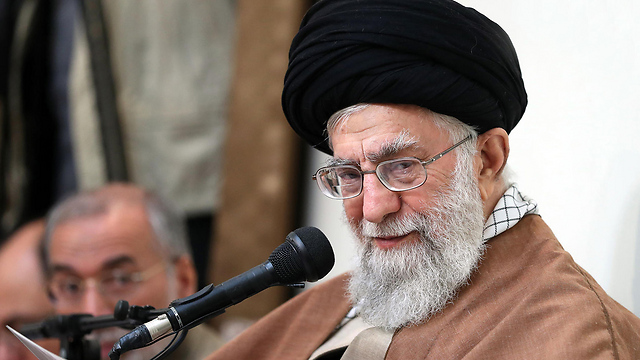
Ayatollah Ali Khamenei calls on US to ‘leave’ Middle East, says any power challenging Islamic republic will be defeated; US ‘provoking region’s inexperienced rulers to create further regional crisis’; in meeting with Iranian lawmaker, Syrian President Assad says region’s maps being redrawn, ‘hostile countries now trying direct aggression after proxies failed.’

Reuters|Published:  04.30.18 , 14:16

If these governments gain more wisdom, they will not confront Iran. If they confront Iran, they will be defeated.”

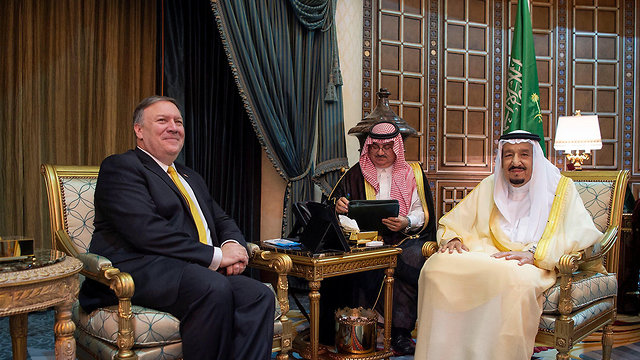
Khamenei’s remarks were aired a day after Pompeo met Saudi King Salman in Riyadh on a flying visit to the region.

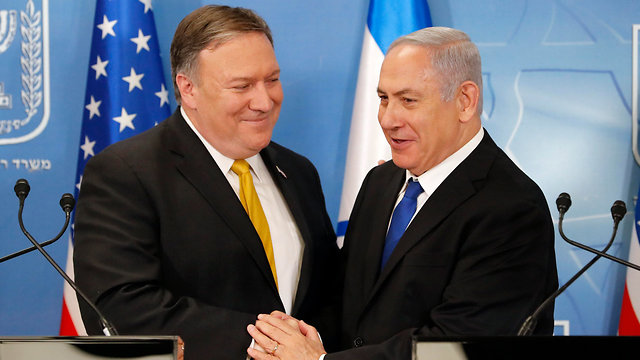
Pompeo said on Sunday during his visit to Israel that the United States was deeply concerned by Iran’s “destabilizing and malign activities” in the Middle East.
Khamenei’s remarks were aired a day after Pompeo met Saudi King Salman in Riyadh on a flying visit to the region.

Pompeo said on Sunday during his visit to Israel that the United States was deeply concerned by Iran’s “destabilizing and malign activities” in the Middle East.

US Sect. of State Pompeo met PM Netanyahu in Israel Sunday (Photo: EPA)

Appearing to address those remarks, Khamenei said Iran had no intention of limiting its influence in the Middle East.

“Americans are the ones who should leave … The Middle East, the west of Asia and the Persian Gulf is our home,” Khamenei said.

Tehran and Riyadh have long been locked in a proxy war, competing for regional supremacy from Iraq to Syria and Lebanon to Yemen. US President Donald Trump has strongly backed Saudi Arabia in its efforts to counter Iran’s influence.

President Assad, Iranian lawmaker assert bilateral bond

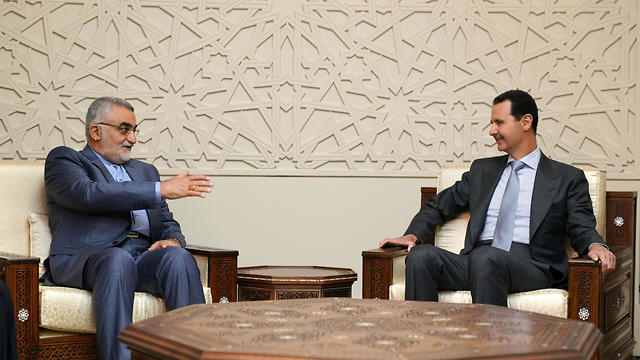
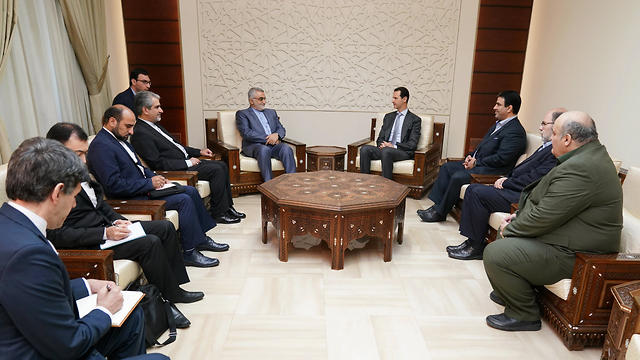
Syrian President Bashar Assad met the chairman of Iranian parliament’s Committee for Foreign Policy and National Security Alaeddin Boroujerdi in Damascus Monday to discuss recent developments in Syria and the two countries’ mutual desire to strengthen their strategic relations.

Committee of Iranian parliament’s Foreign Policy and National Security Boroujerdi (L) met Syrian President Assad in Damascus (Photo: EPA)

President Assad noted to the Iranian lawmaker that the Middle East was “in the process of redrawing international maps,” and that “hostile countries have changed course to direct aggression after the failure of their proxies in the region.”

These aggressive intentions, however, will only increase “Syrians’ determination to eliminate terrorism in all its forms and to uphold their sovereignty,” the beleaguered president claimed.

Boroujerdi, for his part, stressed that while the objective of the United States and its allies in the region was to “defeat Syria,” Iran and its people will remain by Syria’s side and will continue efforts to reach a political settlement to the country’s years’ long civil war.

The Iranian delegation to Syria also included three members of the Shura Council, Qasim Jassmi, Karen Khanlari, Syamk Marzadeq and Secretary of the National Security and Foreign Policy Committee of the Shura Council Fadlullah Baghstan.

Boroujerdi was accompanied by a delegation of Iranian parliamentarians (Photo: EPA)

Sanctions relief

Echoing Assad and Boroujerdi’s remarks, Iranian state TV quoted Iran’s Foreign Ministry spokesman Bahram Qasemi as saying Tehran would keep on backing its friends in the region despite US pressure to curb its influence.


“The cooperation between America and Saudi Arabia will further destabilize the Middle East and will lead to more crisis in the region,” Qasemi said. “Pompeo’s remarks about Iran are baseless and repetitive … As long as the legitimate governments of the regional countries need our help, Iran will remain in those countries.”

In Riyadh, Pompeo reassured Saudi Arabia that the United States would exit Iran’s 2015 multinational nuclear deal, unless European signatories of the accord “fix” it.

Trump has given the European signatories a May 12 deadline to “fix the terrible flaws” of the 2015 nuclear deal, or he will refuse to extend US sanctions relief on Iran.

Under Iran’s settlement with the United States, France, Germany, Britain, Russia and China, Tehran agreed to curb its nuclear program to satisfy the powers that it could not be put to developing atomic bombs. In exchange, Iran received relief from sanctions, most of which were lifted in January 2016.

Khamenei has warned that Tehran would stick to the accord as long as the other signatories respected it, but would “shred” the deal if Washington pulled out.

Britain, France, Germany, Russia, China and the European Union say Washington cannot unilaterally cancel an accord enshrined by a UN resolution. But they have called on Iran to curb its regional influence and ballistic missile program.

President Trump has been a vocal opponent of the nuclear deal (Photo: AP)
 Trump accuses Iran of supporting terrorism and says the 2015 deal does not do enough to block its path to acquiring nuclear weapons. Iran says it does not seek nuclear arms, and blames Washington and its allies for stirring Middle East tension.

Iranian officials on Monday reiterated that Tehran had no intention of suspending its defensive missile capability.

 “By accusing Iran, Americans want to justify their presence in Iran and to sell weapons to the regional countries,” Tasnim news agency quoted deputy head of Iran’s elite Revolutionary Guards Hossein Salami as saying.


Dozens Dead, Mostly Iranians, in Bunker Buster Attack on Syrian Army Base

April 30, 2018

Dozens Dead, Mostly Iranians, in Bunker Buster Attack on Syrian Army Base

Video added by JK

Photo Credit: James Efrem Ringold via Wikimedia

A GBU-24 Paveway III bunker buster missile hits a bunker

The Lebanese newspaper Al Akhbar reported Monday that “pending an official statement confirming the involvement of the Israeli enemy in the nightly aggression on military positions in Syria, Tel Aviv has opened the door once more to unprecedented challenges from the axis of resistance. This time, it plays directly in the face of the central player, Iran.”

Al Akhbar noted that during the explosions, an earthquake measuring 2.6 on the Richter scale was recorded, indicating that the explosions were underground and that the rockets used in the attack were bunker busters. Al Akhbar is convinced that “the nature of the aggression and the targets indicate that Israel is behind it, despite the absence of official recognition as usual.”

Advertisement

But the Syrian newspaper Tashrin, which is affiliated with the Assad regime, reported on Facebook that “aggression against the country in Aleppo and Hama with about 9 ballistic missiles launched by United States and British forces.”

Al Akhbar cited information received from Damascus, indicating that military stores and sites in which the Islamic Revolutionary Guard Corps (IRGC) had been hit with heavy rocket fire at 10:40 PM Sunday.

Sources associated with the Syrian opposition reported that 38 Syrian soldiers were killed in the attack at Hama and 57 wounded. The Syrian Human Rights Organization announced that the bombed bases housed the Syrian army’s 47th Brigade, where Iranian forces were also posted. Also hit: bases of the Assad regime located around the Salhab military airfield west of Hama. According to the Organization, only four of those killed were Syrian soldiers.

In this context, it is borderline amusing to read the combative statement issued on Sunday by IRGC commander Ali Fadavi, who reassured the Fars news agency: “We have reached the deterrence phase. If the enemy wants to adopt a measure, the losses will be more than benefits. Today, they don’t dare to fire even a bullet at us.”

Ah, well, there was that one. Iran’s news outlets, with the exception of Press TV, largely ignored the Sunday night massive attack on Iranian forces in Syria, focusing instead on the gains of Assad’s army against the rebel forces.

Explosions at Syrian Military Base Cause 2.6 Magnitude Earthquake

April 30, 2018

Explosions at Syrian Military Base Cause 2.6 Magnitude Earthquake

The explosion near Hama Sunday night, April 29, 2018.

A 2.6 magnitude earthquake was recorded close to Taqsees, Hama, Syria at 10:40 PM local time (3:40 NY time) Sunday, at the same time Syrian TV reported several explosions in the same area.

 Moments later, videos of an intense set of explosions, reportedly at a Syrian military base at Jabal al-Bukhut 47, some 10 miles south-east of Hama, began to pop on the social networks.

One report cited a hostile strike (Israel) that targeted an ammunition depots in the Hama area which is one of the depots used mostly by Iran’s Islamic Revolutionary Guard Corps.

A SANA report headlined Explosions heard in Hama and Aleppo countryside, authorities working to identify their cause.

Secondary explosions, including missiles flying into the air can be seen on other videos.


Report: US plans to reveal Israeli-Palestinian peace outline after Jerusalem embassy opening

April 29, 2018

The US is reportedly expected to reveal a new outline for the Israeli-Palestinian peace process after the US embassy opening in Jerusalem. The plan will include compensation to the Palestinians, a senior political source told Hadashot.

Maria Burtin
http://www.jerusalemonline.com/news/middle-east/israeli-palestinian-relations/report-us-to-reveal-israeli-palestinian-peace-outline-after-embassy-opening-35592
Netanyahu and Jared Kushner Photo Credit: Amos Ben Gershom/GPO
The new American outline for an Israeli-Palestinian peace deal will be revealed after the American embassy opening in Jerusalem and will include compensation to the Palestinians, a high-ranking source told Hadashot news on Saturday.

The compensation is meant to bring the Palestinians back to the negotiating table, said the source. Meanwhile, US Secretary of State Mike Pompeo is scheduled to arrive in Israel today. Pompeo was confirmed last week by the Senate, and unlike his predecessor, Rex Tillerson, he seems interested in playing an active role in the Israeli-Palestinian peace process.

 On Friday, US President Donald Trump said that he may visit Israel for the Jerusalem embassy opening in May, taking Israeli officials by surprise. Trump’s comment about his possible appearance at the ceremony was surprising since there is no plan for such a visit and Trump is not included in the list of attendees provided by the Americans, Hadashot news reported.

Trump also talked about the low moving costs of the embassy. According to the President, his suggestion to use and remodel a pre-existing building reduced the costs from $1 billion and the duration of the move to only three months.

Palestinians must make peace or shut up, Saudi crown prince said to tell US Jews

April 29, 2018

Israel’s Channel 10 news: In meeting last month in New York, Mohammed bin Salman castigated Abbas and predecessors for spurning opportunities for 40 years

Today, 9:06 pm

https://www.timesofisrael.com/palestinians-must-make-peace-or-shut-up-saudi-crown-prince-said-to-tell-us-jews/

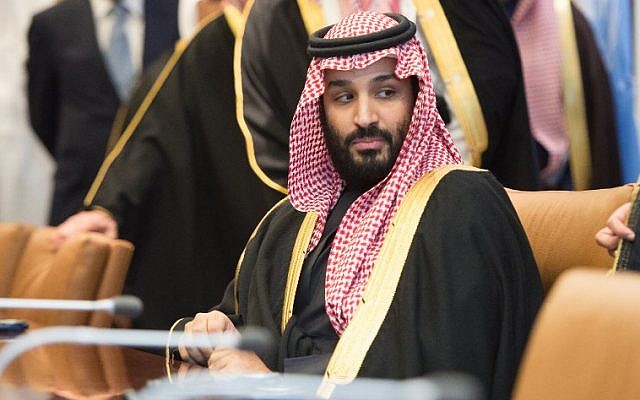
Prince Mohammed bin Salman Al Saud, crown prince of Saudi Arabia, attends a meeting at the United Nations in New York City, March 27, 2018. (Bryan R. Smith/AFP)

At a meeting with Jewish leaders in New York last month, Saudi Crown Prince Mohammed bin Salman castigated the Palestinian leadership for rejecting opportunities for peace with Israel for decades, and said they should either start accepting peace proposals or “shut up.”

Citing what it said were multiple sources, Israel’s Channel 10 News on Sunday night quoted what it said were remarks made by the crown prince at the meeting that left those who were present “staggered” by the ferocity of his criticism of the Palestinians.

At a meeting with Jewish leaders in New York last month, Saudi Crown Prince Mohammed bin Salman castigated the Palestinian leadership for rejecting opportunities for peace with Israel for decades, and said they should either start accepting peace proposals or “shut up.”

Citing what it said were multiple sources, Israel’s Channel 10 News on Sunday night quoted what it said were remarks made by the crown prince at the meeting that left those who were present “staggered” by the ferocity of his criticism of the Palestinians.

“It’s about time that the Palestinians accept the offers, and agree to come to the negotiating table — or they should shut up and stop complaining,” he reportedly went on.

Prince Salman also told the US Jewish leaders that “the Palestinian issue is not at the top of the Saudi government’s agenda” and elaborated, “There are much more urgent and more important issues to deal with — such as Iran,” according to the TV report.

Nonetheless, the crown prince reportedly stressed that there would have to substantive progress toward an Israeli-Palestinian accord before the Saudis and other Arab states would deepen their relationships with Israel. “There needs to be significant progress toward an agreement with the Palestinians before it will be possible to advance negotiations between Saudi Arabia and the Arab world and Israel,” he was quoted saying.

The TV report dated the meeting to March 27, during the prince’s extensive visit to the US. It did not name those present. The Saudi Embassy said that the crown prince was to have met that week with Jewish leaders, including Rabbi Rick Jacobs, president of the Union for Reform Judaism; Rabbi Steven Wernick, head of the United Synagogue of Conservative Judaism; and Allen Fagin, executive vice president of the Orthodox Union. That meeting, however, which also included Christian leaders, took place on March 28.

The TV report was based on a cable to the Foreign Ministry from an Israeli diplomat in the New York consulate, who was briefed on the meeting by those present, and three other sources who were familiar with the content of the meeting. One of those present told the TV channel that the group was staggered by what the prince had to say, and all but fell off their chairs.

A number of news reports, including by The New York Times and Reuters, have claimed in recent months that the Saudi crown prince has pressured Palestinian Authority President Mahmoud Abbas to accept a much-anticipated Trump administration peace proposal.

After he met with Jewish and Christian leaders on March 28, the Saudi Embassy in Washington said the meeting “emphasized the common bond among all people, particularly people of faith, which stresses the importance of tolerance, coexistence, and working together for a better future for all of humanity.”

A statement from the embassy added that “the Kingdom of Saudi Arabia has always, and will continue to champion expanding dialogue, building a better understanding among the faiths, and focusing on the shared humanity of all peoples.”

No specific details of what the faith leaders and crown prince spoke about were released.

In an interview published a few days later,  the crown prince recognized Israel’s right to exist and extolled the prospect of future diplomatic relations between his kingdom and the Jewish state.

In an extensive interview with The Atlantic’s Jeffrey Goldberg, the prince laid out his vision for the future of the Middle East, including the possibility of cooperation with Israel.

Asked whether he believes “the Jewish people have a right to a nation-state in at least part of their ancestral homeland,” he replied: “I believe that each people, anywhere, has a right to live in their peaceful nation. I believe the Palestinians and the Israelis have the right to have their own land.”

However, in keeping with the terms of his kingdom’s regional peace proposal, the Saudi crown prince added that an agreement with the Palestinians was a prerequisite to formal relations. “But we have to have a peace agreement to assure the stability for everyone and to have normal relations,” he said.

Did he have “no religious-based objection to the existence of Israel?” he was further asked. To which the crown prince replied: “We have religious concerns about the fate of the holy mosque in Jerusalem and about the rights of the Palestinian people. This is what we have. We don’t have any objection against any other people.”

Asked about anti-Semitism in Saudi Arabia, he said: “Our country doesn’t have a problem with Jews. Our Prophet Muhammad married a Jewish woman. Not just a friend — he married her. Our prophet, his neighbors were Jewish. You will find a lot of Jews in Saudi Arabia coming from America, coming from Europe. There are no problems between Christian and Muslims and Jews. We have problems like you would find anywhere in the world, among some people. But the normal sort of problems.”

Israel and Saudi Arabia have no official relations and the kingdom does not recognize the Jewish state. Israel has hinted at clandestine ties with Saudi Arabia in recent years, stressing the two countries share an interest in countering Iran. The rumors of covert relations have been denied by Saudi officials. Still, a Saudi general visited Jerusalem in 2016 and met with Israeli lawmakers, and Saudi officials have met with Israeli officials on several occasions in public. Saudi Arabia also allowed Air India to fly to and from Tel Aviv via its airspace, last month.

Discussing whether a shared concern over Iran was bringing Israel and Saudi Arabia together, he said: “Israel is a big economy compared to their size and it’s a growing economy, and of course, there are a lot of interests we share with Israel, and if there is peace, there would be a lot of interest between Israel and the Gulf Cooperation Council countries and countries like Egypt and Jordan.”

Salman also discussed the threat to the Middle East he said was posed by Iran, even saying that Ayatollah Ali Khamenei, the supreme leader of the Islamic Republic, “makes Hitler look good.”

“Hitler didn’t do what the supreme leader is trying to do. Hitler tried to conquer Europe. This is bad,” he explained. “But the supreme leader is trying to conquer the world. He believes he owns the world. They are both evil guys. He is the Hitler of the Middle East. In the 1920s and 1930s, no one saw Hitler as a danger. Only a few people. Until it happened. We don’t want to see what happened in Europe happen in the Middle East. We want to stop this through political moves, economic moves, intelligence moves. We want to avoid war.”

Shortly afterwards, Saudi King Salman reaffirmed his nation’s support for the Palestinians in a conversation with US President Donald Trump.

The king “reaffirmed the kingdom’s steadfast position toward the Palestinian issue and the legitimate rights of the Palestinian people to an independent state with Jerusalem as its capital,” the official Saudi Press Agency said.