The head of the IDF directorate tasked with dealing with the Iran nuclear issue said that the Biden administration largely sees the situation as Israel does, and is so far “keeping its promises.”
Maj. Gen. Tal Kalman, who heads the Strategy and Third-Circle Directorate and has participated in discussions with the Biden White House at the highest levels, told Israel Hayom that “the first stage is to be aligned with [the US] on the intelligence picture.”
“I think that in very high percentages they see the situation as we do,” he said.
Asked about Israel’s concern that many officials who negotiated the 2015 nuclear deal with Iran, which Israeli Prime Minister Benjamin Netanyahu vehemently opposed, have returned to office, Kalman said, “It’s true that in some of the cases these are the same people, but it’s not the same administration.”
“So far, this administration is keeping its promises,” he asserted. “It has come to listen, not rush to a new deal.”
“So, I think there’s a space of a few months to try and influence the administration’s policy,” Kalman said. “Even the Americans are clearly saying they will not allow Iran to achieve nuclear capability. Now, the question is how to act in this situation.”
Israel’s position, he added, is “we’re saying ‘yes’ to a deal that will be longer and stronger” than the 2015 agreement.
Asked whether Israel has the military capability to completely destroy Iran’s nuclear program if necessary, Kalman said, “The answer is yes. When we build these capabilities, we build them to be operational.”
“It’s not that there aren’t many strategic dilemmas, since the day after Iran can go back to the plan, but the ability exists,” he said. “Definitely.”
Regarding a possible strategy of turning the tables on Iran — which has sought to entrench itself on Israel’s borders — by positioning Israeli assets on Iran’s borders, Kalman said, “We need to strengthen that component in the set of actions we’re doing.”
One aspect of this is the Abraham Accords, which have made Gulf states bordering Iran strategic partners of Israel, he added.
“I think the Iranian leader, whose strategy is to base Iran on Israel’s borders, wakes up these days and is very concerned, because he sees potential for Israel to be based around his own borders. It’s a major change,” said Kalman.
The former fighter pilot became a major general in 2020, and took charge over the new, Iran-focused position on the IDF’s General Staff.
December 2008 was the turning point. After a year of incessant rocket fire, the Israeli government decided enough was enough. It was time to go back into the Gaza Strip and do everything possible to take down Hamas.
While a ceasefire had been in effect for six months, sporadic rocket fire – Kassams and mortars – continued to rain down on Israel. Nevertheless, the government had initially preferred quiet. The situation was tenuous but the residents of the South were, for the first time in years, able to leave their homes with some measure of safety. The government wasn’t going to put that at risk so quickly.
In November, though, the calculation changed. The IDF received intelligence that Hamas was digging a terror tunnel across the border into Israel similar to the one that had been used two-and-a-half years earlier to kidnap Gilad Schalit, a soldier in the Armored Corps. Schalit was still being held by Hamas somewhere in Gaza and the IDF decided that the “ticking tunnel” – as it was being called – had to be destroyed.
An elite IDF force from the Paratroopers’ Brigade was sent across the border near the home under which the tunnel was being dug. In a subsequent firefight, a few Palestinian gunmen were killed. At one point, a large bomb went off in the home, bringing down the structure and collapsing the tunnel.
The Hamas response and rocket onslaught was immediate. Dozens of Kassams, Katyushas and mortar shells pounded the South, reaching as far as Ashdod. A rocket attack led to an Israeli Air Force bombing and then more rockets and more airstrikes. By mid-December the truce – tahdiya in Arabic – had completely fallen apart.
Only a handful of people knew that at the same time as Israeli diplomats were trying to salvage the ceasefire with Egyptian assistance, the Shin Bet (Israel Security Agency) and the IAF were busy building a bank of Hamas targets – headquarters, arms caches, command posts, tunnel openings and rocket launchers. Homes, schools, hospitals, mosques – everything was being used by Hamas to hide their weapons and everything was being added to the IDF list.
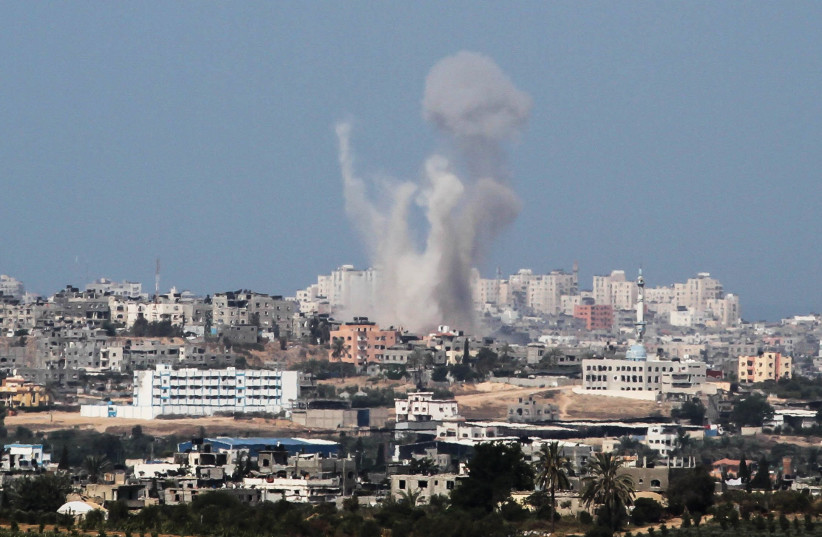
On December 27, at 11:30 a.m., what would become known as “Operation Cast Lead” was launched with the bombing of 50 different targets by dozens of IAF fighter jets and attack helicopters. The planes reported “Alpha Hits,” air force lingo for direct hits on their targets. Some 30 minutes later, a second wave of 60 jets and helicopters struck another 60 targets, including underground rocket launchers – placed inside bunkers and missile silos – that had been fitted with timers.
In all, more than 170 targets were hit by IAF aircraft throughout that first day. Palestinians reported more than 200 Gazans killed and another 800 wounded.
OPERATION CAST LEAD would be remembered as the first large-scale war in Gaza since Israel’s unilateral withdrawal from the Strip three years earlier. It would also go down in history for the United Nations fact-finding mission known as the Goldstone Report that would be established and accuse Israel of war crimes and crimes against humanity.
Ahead of the operation, Israeli intelligence agencies knew they had to adapt. Since the withdrawal from Gaza three years earlier, they no longer had a physical presence on the ground inside the now Hamas-controlled territory. While they could use spies and electronic sensors to identify targets, they would not be able to know – in real time – what was happening inside a specific target.
What the IDF knew was that Hamas was storing its weapons in homes, in apartment buildings and under schools, mosques and hospitals. If a war erupted, Israel had to find a way to attack the targets while, at the same time, reducing civilian casualties and collateral damage.
Recognizing the challenge, the Shin Bet did something new: it created lists of phone numbers belonging to the owners of the homes, office buildings and hospitals throughout the Gaza Strip. It was a Sisyphean effort never undertaken by another military, but Israel knew it didn’t have a choice.
While collecting the phone numbers was difficult, their use was supposed to be simple. The IDF knew that there were basically two categories of targets. The first were terrorists: Palestinians perpetrating an attack or in the midst of planning one. Those people were not going to get called before being attacked. To successfully hit them, Israel needed to retain the element of surprise even if that meant some innocent civilians would unfortunately be caught in the crosshairs.
The second category included the homes, apartment buildings, offices, mosques and other civilian buildings where Hamas and Islamic Jihad had stored their weapons, set up command posts or used as cover to hide a cross-border terror tunnel. These were the targets that would get phone calls in order to give the people inside the opportunity to leave.
“We identified thousands of targets thanks to our agents on the ground,” explained Victor Ben-Ami, a 30-year veteran of the Shin Bet, who was involved in the effort. “We had a list of warehouses, factories and buildings with the understanding that the enemy had a tactic it was using to do everything it could to blend in and hide within civilian infrastructure.”
The intelligence, Ben-Ami recalled, was incredible. “We knew what floor the target we were looking for was located, what color it was, what was there, where the air-conditioning machine was located and more,” he explained.
But because Israel knew that civilians would be inside the buildings, the IDF and Shin Bet created a new operational doctrine. Before attacking, it would take the extra precaution of contacting the building owner or occupant.
The callers had a standard text they read in Arabic that went something like this: “How are you? Is everything okay? This is the Israeli military. We need to bomb your home and we are making every effort to minimize casualties. Please make sure that no one is nearby since in five minutes we will attack.” The line would then go dead.
In every case, an Israeli drone would be hovering above, watching what was happening in the home and nearby. Once it saw people running out of the building, IAF headquarters would give the fighter pilot or attack helicopter the green light to drop their bomb. In some cases, the Palestinians claimed Israeli drones were also used to launch the missiles – although Israel has never officially confirmed that it has attack drones.
Not everyone in the IDF saw eye-to-eye on this new tactic. Col. Pnina Sharvit-Baruch was head of the International Law Department of the Military Advocate General (MAG) Unit as Operation Cast Lead was in the planning stages.
Almost every target was brought to her for approval. In one discussion, one of the other officers around the table suggested skipping the warning stage and attacking the building even at the cost of killing or wounding innocent civilians. The building, the officer explained, had been turned into a military target by Hamas and if people were inside they too were military targets.
The argument was immediately and vehemently shot down by all the participants. “That was the definite fringe minority,” she recalled.
In discussions with combat units, Sharvit-Baruch stressed two reasons why this new tactic was critical for Israel. The first was ethical. Israel, she explained, does not callously attack civilians when they can be spared.
“It is our moral obligation,” she affirmed.
The second reason was of political and diplomatic significance.
“A lot of dead civilians deteriorates the conflict and creates diplomatic international pressure and continues the conflict,” she said. “It harms our interests.”
Ben-Ami agreed.
“Whether we like it or not, this is who we are and how we do things,” he explained. “There is no plan that doesn’t take civilians into consideration. This is who we are.”
FOR THE most part the tactic worked. A building would be brought by the Shin Bet to the Southern Command’s Attack Center where it would be added to the list of targets. There, on the second floor of a plain-looking gray structure in the Beersheba-based headquarters, the IDF soldiers and Shin Bet analysts would discuss what to do and how to attack.
The IDF officers would allocate the necessary attack platform and ensure it was available. Once the mission was approved, an Arabic-speaking intelligence officer would call the owner. The drone would show that the people inside the building had left, the soldiers in the IDF command center would count the number of people who had left, ensuring the number matched up with the intelligence they had received, and they would then give the IAF the green light to attack.
The type of bomb used was adapted based on the target. If it was a private home with an arms cache hidden in the basement, the bomb needed to be capable of penetrating the roof and other floors and only detonate once it hit the basement. If the target was on the second floor, it needed to be a bomb that could be launched into a window and just destroy the second floor but nothing else. Success was often measured by the number of secondary explosions, caused by the amount of explosives hidden under the home.
For the first 40 strikes, everything worked smoothly. Some officers privately wondered among themselves why the Palestinians didn’t go to the roof and try to prevent the bombing.
“We knew that if they did that we would have to call off the strike,” one of the military planners at the time recalled.
Calls were made and empty buildings were struck. But then one day, the officer’s fears came true. One of the Palestinians, whose two-story home was a known Hamas weapons storage center, told the Israeli intelligence officer that he would not leave. Word was circulating around Gaza about the new tactic and people knew that exiting the building would mean not having a home to return to.
The family climbed to the roof, knowing a drone was above, and started making indecent gestures at the Israeli aircraft.
A disagreement broke out in the command center. Some of the officers thought Israel needed to go ahead with the attack.
“If we don’t attack we will lose deterrence,” argued one of the officers, a veteran combat soldier from the IDF’s Nahal Infantry Brigade.
Others pushed back. The Jewish state, they said, couldn’t strike a building while knowing there were still civilians inside. The commander of the Southern Command was updated and the issue eventually made its way up to the chief of staff. Both agreed the strike could not go forward. It was called off.
The next day, another Palestinian refused to leave his home and the surveillance drone showed he had also climbed up to the roof. The commanders in the Attack Center watched the live feed with curiosity. In truth they didn’t know what to do.
On the one hand, they were dealing with a legitimate military target. Yes, it had been a house or an apartment building. But once it was being used for military purposes it had morphed into a military target according to the laws of war. The question now was about “proportionality” – a rule prohibiting attacks that may cause loss of life in excess of the military gain from the attack. This was a legal question that required constant consultations with Sharvit-Baruch and her team of lawyers.
Zvika Fogel, a retired brigadier-general, was in the war room that day. A reservist, Fogel had served as deputy commander of the Southern Command in the early 2000s. When Cast Lead broke out, Fogel was called up to run the Attack Center. Every target had to be signed off by him, whether a home, mosque or terrorist on a motorbike fleeing a just-used rocket launcher.
This war hit close to home for Fogel. On January 5, an IDF Merkava tank shot a shell at a building in the Jabalya refugee camp in northern Gaza. The tank crew had mistakenly identified movement in the structure for Hamas terrorists when they were actually Israeli infantry soldiers from the Golani Brigade. Three troops were killed; 24 more were wounded.
Fogel oversaw the evacuation of the wounded. It would be remembered as one of the more complicated evacuations in IDF history. Once the tank had fired its shell, Hamas terrorists opened fire in the direction of the tank and the building and the whole street became a war zone, making it difficult to get the wounded out of the building.
The IDF launched artillery shells to create a smokescreen and provide cover for the troops to get out of the densely populated area and into the open where helicopters were trying to land to fly the wounded across the border to Israeli hospitals.
As he was overseeing the complex operation, Fogel had no clue that one of the wounded was his own son Dor who had been inside the building when the tank shell struck. Thankfully, he sustained only light injuries.
AFTER THE first time one of the telephoned Palestinians refused to leave his home, Fogel gathered his men in the Attack Center for a consultation on what to do. The home was a legitimate target and had been authorized by Sharvit-Baruch’s team. On the other hand, Fogel knew that attacking would incur too many civilian casualties and whatever tactical gain Israel might achieve from the bombing, it would be for naught.
One of the officers recalled the “Neighbor Procedure,” a controversial tactic employed by infantry units during operations in the West Bank in the beginning of the Second Intifada.
The procedure, which was eventually banned by the High Court of Justice, involved Israeli soldiers sending a neighbor or relative of a wanted Palestinian terror suspect to knock on their door before going in themselves. The idea was that the terror suspect wouldn’t open fire if they knew their cousin or neighbor was standing outside.
While that couldn’t be applied in the same way in Gaza – IDF troops were not always going to be on the ground – the officers started throwing around different ways to achieve the same goal: minimize casualties, on the Israeli side and Palestinian side as well.
“The Neighbor Procedure was an effort used to minimize harm to our soldiers and we thought how could we take it and do something else that could reduce harm to Palestinian civilians,” Fogel recounted.
Fogel was highly motivated to find a solution. In 1996, he was commander of an artillery brigade operating in Lebanon during Operation Grapes of Wrath, started with the objective of stopping Hezbollah rocket fire into northern Israel.
Israel was determined to fight and push Hezbollah far from the border. But seven days into the operation, artillery shells fired by another unit to provide cover for an elite commando team operating in Lebanon accidentally hit a UN compound where Lebanese civilians had sought refuge. Over 100 civilians were reported killed.
While Fogel had not been involved in the assault, what happened next taught him a lesson. Later that day, in New York, the UN Security Council passed Resolution 1052, calling for an immediate ceasefire. Israel, which started the operation with a legitimate cause – to defend its own people – came under harsh international criticism. Within days, the operation was over.
Now, 12 years later, Fogel was again fighting in an operation that had been launched to defend Israeli citizens and again was facing a similar problem like in Grapes of Wrath. Civilian casualties would undermine Israel’s legitimacy to act. The world would condemn the country and the government would ultimately succumb to the pressure and stop the IDF.
A couple of days later, when another Palestinian refused to evacuate his house, one of the officers on Fogel’s team came up with an innovative idea. He suggested sending an F-15 or F-16 to dip low over the home in Gaza, to break the sound barrier and try to scare the people inside.
Another officer had a different idea. The house was next to an empty field.
“Why don’t we have a helicopter fire some warning shots into the empty field right next to the house,” the officer suggested.
The Southern Command officers liked the idea and tried it out. It worked and the residents fled the building. The problem was that the IDF would not always have empty lots next to structures it wanted to attack. It needed to come up with a better method.
“It was kind of like what we would do with a terror suspect who refused to leave his home in the West Bank,” the former Nahal Brigade officer who was stationed in the Attack Center explained. “We would first fire a standard 5.56 mm machine gun bullet at the door. If that didn’t work, we would fire a heavier cannon and if that didn’t work, we would throw a grenade.”
After a few more times, the IDF had refined the tactic. It selected a missile developed by Israel Aerospace Industries known for being small, accurate and capable of being configured to carry a limited amount of explosives.
After calling and encountering a refusal to leave the home, the air force will first fire one of these missiles on the roof. It will usually be fired into a corner, far from where people might be standing. In some cases, the missiles can be configured to burst in mid-air, minimizing even more the chances of casualties.
Once the Palestinians experience the “roof knocking,” in almost all cases they flee the building. After the Israeli drones verify the people have left, the Air Force then drops an even heavier bomb, destroying the structure.
While the IDF doesn’t say much about the weapons it uses, pictures of unexploded ordnance circulated online by Gaza residents show a missile with “Mikholit” written on it on Hebrew next to a stamp of Israel Aerospace Industries’ MBT Missile Division. Mikholit in Hebrew is a small paintbrush, like the kind an artist would use for precise painting.
The missile looks exactly like one developed by IAI called “Sledgehammer” which the company says has a range of 20 km., can carry 15-kg. warheads and weighs just 30 kg. It is this missile that Palestinians claim is fired at them from Israeli drones.
DEVELOPMENT OF the roof-knocking tactic was similar to the way the air force adapted to the use of civilian targets in the 1970s in Lebanon. These were the days before Hezbollah when the IDF was fighting against the PLO, which was regularly shelling northern Israel from Lebanon.
At the time, the term “collateral damage” was not as prevalent as it is today. The IAF had just come out of the Yom Kippur War badly beaten – over 100 aircraft were lost – and needed to adapt to a new urban battlefield in Lebanon while rebuilding its morale and deterrence.
“In the war, we were sent to hit runways where there isn’t collateral damage to worry about,” explained retired Brig.-Gen. Uzi Rosen, a former head of the IAF’s Operations Division. “You would take 10 bombs and statistically one would land where it needed to. You didn’t care if they didn’t hit exactly because the target was a runway. Same when you attacked a Syrian battalion on the Golan Heights.”
During the war, Rosen flew in the IAF’s 107th Squadron and on one flight his F-4 Phantom was hit by an Egyptian missile. Despite losing an engine, Rosen succeeded in landing back in Israel. In total, the squadron lost five planes during the war but not a single pilot. Its pilots succeeded in downing 14 enemy aircraft.
After the war, as fighting intensified in Lebanon, Israel found itself facing a new type of enemy – PLO fighters hiding with their Katyusha rockets inside apartment buildings. It presented the IDF with a new tough dilemma.
On the one hand, not attacking meant that within a day or two those same rockets would rain down on Kiryat Shmona. On the other hand, Israel really didn’t have precision-guided munitions yet in its arsenal. Civilians were always around the apartment buildings and attacking would mean extensive collateral damage.
One officer under Rosen came up with the idea to take regular bombs, remove the explosives and fill them instead with cement. This way, the bombs wouldn’t explode but would just cause damage. In other cases, the IAF took 250-kg. bombs and removed half the explosives to minimize the radius blast.
“We were in distress,” Rosen recalled.
The cement bombs were used on hundreds of targets, sometimes successfully and sometimes not as much. But it was all the IAF had until the 1980s, when laser-guided munitions as well as the Maverick – a bomb that used an electro-optical television guidance system – came into service.
Every bomb had its advantages. Laser-guided munitions required a pilot to either be directly over the target or to have troops on the ground “lighting” it up. Electro-optical bombs needed the ability to see the targets as well and sometimes have the navigator – also referred to as the “weapon systems operator” – drive the missile with a joystick all the way to the target.
“It was always a battle between the operational need to destroy a target and the collateral damage challenge,” Rosen remembered. “But it was exactly this need that started leading the defense industries and the army to develop our own precision capabilities.”
Israel’s technological leap came in the mid-1980s with the rollout of the Popeye, developed by Rafael Advanced Defense Systems. What made the Popeye unique was that it came with a smokeless rocket engine – meaning it did not leave a trail – it could be launched from a plane around 100 km. away from a target and could then be driven – via datalink – all the way there by an IAF navigator. Its control could even be handed off to another plane as needed.
Another missile that has become popular in the IAF is the Spike. Also developed by Rafael, Spike’s origins were also in the Yom Kippur War during which the IDF got hammered by Syrian and Egyptian tanks. While Israel ultimately held on to its territory both in the Golan and the Sinai Peninsula, it needed a new weapon to have the upper hand in the event of another conflict.
The Spike – called “Tamuz” in the army – was a secret until just a few years ago. It was operated by two elite units and was fired from armored personnel carriers. The goal was to use the missiles to surprise and stop future tank invasions. IDF bunkers were stocked with the missiles, which came in different sizes and models, and were appreciated for their high degree of accuracy and lethality.
But with warfare changing – tank battles are no longer really a threat to Israel – the IDF needed to find a new use for the Spike and it did, in the air force always on the lookout for new precision-guided munitions.
ALL OF this was done on the fly and in the midst of battle. During the three weeks of Operation Cast Lead, the IDF would go on to drop more than 2.5 million leaflets warning civilians to leave their homes and made more than 165,000 phone calls warning civilians to distance themselves from military targets. The roof-knocking tactic was used dozens of times.
It didn’t go unnoticed. In a report published by the United Nations, Israel’s use of roof-knocking was harshly criticized, with investigators concluding that the “technique is not effective as a warning and constitutes a form of attack against the civilians inhabiting the building.”
One case that drew international condemnation was in July 2018 when two Palestinian teenagers were accidentally killed in a roof-knocking operation on an empty building in Gaza. In a reconstruction of the incident, B’Tselem found that the IAF had fired four warning shots at the building and that the first one had killed the boys as they sat on the roof taking a selfie with their legs dangling over the edge.
The attack, B’Tselem said at the time, showed how roof knocking was not just a warning but was a real attack and therefore needed to conform to international rules of law.
Israel has rejected this assumption.
“Even if warning shots are considered an ‘attack,’ it is incorrect to view them as an attack ‘against civilians’ because they are not fired at civilians, since the objective of their use is to avoid harm to civilians,” explained Sharvit-Baruch, the IDF legal expert.
Despite the criticism, Israel has continued in the years since Cast Lead to use roof-knocking in its Gaza operations, out of a combination of tactical and strategic interests.
Tactically, commanders recognize the need to minimize collateral damage and civilian casualties. Strategically, Israel’s political and military leaders know that when there are fewer casualties, there is less of a chance of a wider escalation with Hamas. Both are clear Israeli interests.
With the International Criminal Court in The Hague now investigating Israel’s 2014 war in Gaza, Israel will once again have to defend its tactics and explain what precautions it takes to minimize civilian casualties, an effort in which roof knocking plays a critical role.
When looking back on the day in 2009 when the IDF came up with roof knocking, it illustrated a determination to adhere to a level of morality not often seen in the midst of battle.
Israel could have taken the easy way out and attacked without phone calls or warning strikes. But it didn’t. The IDF officers and soldiers in the command center adapted to an evolving situation without having a thoroughly thought-out or carefully crafted doctrine for what to do, nor special technology that would guarantee success.
But, they had their objective – to adhere to Jewish values of going the extra mile to protect civilian life – and they acted accordingly. That is the story of roof knocking.
In June 1981, as Israel was about to begin the holiday of Shavuot, Prime Minister Menachem Begin informed the media he had just ordered one of the most audacious operations in modern military history: the destruction, by Israel’s Air Force, of the Osirak nuclear reactor outside Baghdad. The mission had seemed impossible, as it required flying a total of 2,000 miles—and Israel did not have the ability to refuel. It was assumed that not all the pilots would make it back alive. When all returned safely, Begin ebulliently announced it to the world, insisting that only if Israel publicly claimed responsibility would the attack serve as a future deterrent to Israel’s enemies.
There was only one problem. The notion that a prime minister mere weeks away from an election might have ordered such an attack was so unthinkable that the media refused to believe it. In his biography of Begin, Avi Shilon describes how his subject waited in vain for the Israeli Broadcast Agency to bring the news to the public:
The news editors at the IBA did not believe what they had heard. Uri Porat, the new communications adviser to the prime minister, phoned to find out what was holding up the announcement, but since his voice was unfamiliar to the news editors, they were convinced that it was a hoax. Finally, journalist Immanuel Halperin, Begin’s nephew, decided to call his uncle, and thus in an intimate conversation between Begin family members, the announcement that would cause a furor throughout the world came to light. But it was broadcast, of all places, in a news flash on Radio 3—the IBA’s pop music station—at 3:30 p.m., and Begin had to wait yet another half hour to hear it in an official IBA newscast.
Only in Israel: an earth-shattering event announced on a pop station and ignored elsewhere until confirmed by an impeccable source in the leader’s mishpocha.
The year 2021 marks the 40th anniversary of the “Begin Doctrine,” according to which no enemy of Israel will be allowed to acquire nuclear weapons, and that Israel will act, on its own if necessary, to ensure this remained the case.
Four decades along, it is easy to forget how unexpected the attack was and how outraged much of the world was by it. In Israel, Begin’s electoral opponent, Shimon Peres, had sent him a letter pleading to hold off, but he only convinced the prime minister to act. Shilon describes how Begin told a cabinet member, “For all I know, a month from now, Shimon Peres will be sitting in this room. From his letter it’s clear to you that he certainly wouldn’t carry out this operation, and I’m not willing to leave the stage knowing that I left this problem hovering over our children.”
The international media largely denounced the attack as state-sponsored terror, and even world leaders sympathetic to Israel came down hard. Margaret Thatcher spoke of “a grave breach to international law,” and the Reagan administration ordered Jeane Kirkpatrick (to her dismay) to support an anti-Israel resolution at the UN.
The controversy and surprise show just how this operation, which kept a nuclear weapon out of the hands of Saddam Hussein, was a testament to the unique worldview of one man. Menachem Begin was a modern Zionist, but unlike some of Israel’s other founders, he always felt the personal presence of those murdered in the Holocaust, especially of his father and mother. Again and again, Begin made clear, in the months before the attack, that the fate of his family was very much on his mind. “This morning,” he told the cabinet during an Osirak planning meeting, “when I saw Jewish children playing outside, I decided: ‘No, never again.’” In a meeting with American Jews in May 1981, Begin was asked what he thought the lesson of the Holocaust was. He replied:
First, if an enemy of our people says he seeks to destroy us, believe him. Don’t doubt him for a moment. Don’t make light of it. Do all in your power to deny him the means of carrying out his satanic intent. Second, when a Jew anywhere is threatened, or under attack, do all in your power to come to his aid. Never pause to wonder what the world will think or say. The world will never pity slaughtered Jews. The world may not necessarily like the fighting Jew, but the world will have to take account of him.
These Americans had no idea what Begin was planning when he said these words. He was indeed the fighting Jew, and the world certainly did not like him. Time magazine helpfully informed its readership that the name Begin “rhymes with Fagin,” and American Jewry in 1981 was told repeatedly that they must choose “between Reagan and Begin.” But Begin did not “pause to wonder what the world would say,” and the world did indeed “have to take account of him.”
At the same time, the “fighting Jew” who acted to neutralize the Iraqi threat also was a Jew of profound faith. Yehudah Avner, Begin’s speechwriter, reported that as the planes took off, Begin said to himself “Hashemyishmoraleihem,” may God protect them. And when he was informed that the strike was successful, he instinctively exclaimed two words that Jews have said every day for centuries, but that no other Israeli prime minster would have instinctively uttered: BarukhHashem, thank God. A month later he met with the American Jewish leader Max Fisher and reflected further on the religious meaning of the moment: “Am I a believer—do I believe in ElokeiYisrael, the God of Israel? The answer is a categorical yes. How else to account for our success in accomplishing the virtually impossible? Every conceivable type of enemy weaponry was arraigned against our pilots….Yet not a single one touched us. Only by the grace of God could we have succeeded in that mission.”
Was the assault on Osirak a strategic achievement, or was it a miracle? For the prime minister, it was both. On Yom Kippur 1973, Israel had been caught napping; on Shavuot 1981, Begin announced to the world that Israel would not be caught asleep at the wheel again. And he believed that if Israel avoided somnolence, then its people would also have the right to pray to the God Who, according to the Psalms, is the protector of Israel that neither slumbers nor sleeps. No other Israeli leader so seamlessly merged the Zionist present and the Diasporic past, simultaneously making manifest Jewish independence and humble faith.
Since 1981, Israel has acted several times to prevent its enemies from acquiring nuclear weapons, and it is much stronger—both militarily and diplomatically—than it was in Begin’s day. This is a wonderful thing. But what is missed is the man—a leader who joined strong action with communion to the past, a Jew who could order an ingenious operation and then pray to God for its success.
When Peres accused Begin of ordering the operation for electoral reasons, Begin had a ready reply. “Jews!” he bellowed to the crowd at a rally. “You have known me for 40 years!” He had more to say, but that was enough. Forty years after he said those words, the legacy of Begin’s operation lives on, and many operations like it have followed. But as we remember the “fighting Jew,” we must wonder whether we will ever see a man like him again.
Israel is willing to take action to prevent Iran obtaining nuclear weapons, Israeli Defense Minister Benny Gantz said this week. His statement framed part of a full-court press of Israel warning of Iran’s regional threats as Tehran continues to enrich uranium. Prime Minister Benjamin Netanyahu has long warned of Iran’s pursuit of nuclear weapons, but the transition to a new administration in Washington has been exploited by Iran to increase its enrichment and threats. A senior Israeli defense official laid out to me this week how seriously Israel views the threat. Tehran should listen.
Israel has acted in the past to prevent Iraq and Syria from obtaining nuclear capabilities. Netanyahu warned in a 2012 speech to the United Nations that a red line must be drawn on Iran’s nuclear enrichment program. Now Iran’s Ayatollah Khamenei says Iran could increase the levels of enrichment to 60 percent. This is a nuclear numbers game that Iran uses like a game of chicken with the U.S., hoping the Biden administration will blink and jump right back into an Iran Deal 2.0.
For Israel, it’s essential that the U.S. understand Jerusalem’s views. Israel doesn’t want a nuclear arms race in the region. Iran is an existential threat and no matter who wins Israel’s elections next month, Israel will not accept a threat that violates its declared red lines. At the same time, Israel wants the U.S. and its Western allies to know that they can count on Israel to confront Iran’s proxies and various entrenchments throughout the region. In January 2019, former Israel Defense Forces Chief of General Staff Gadi Eizenkot revealed that Israel had carried out more than 1,000 airstrikes on Iranian targets in Syria. Since then, Israel has continued what it calls the “campaign between the wars” to stop Iran’s entrenchment in Syria and transfer of weapons to Hezbollah in Lebanon.
There is no substitute for U.S. power and influence in the Middle East, the senior Israeli defense official told Newsweek this week. This unshakable bond with the U.S. is essential, as is bipartisan support for Israel in Congress. Part of this support for Israel also anchors the Jewish state in the region via new U.S.-brokered peace deals with the United Arab Emirates and Bahrain, and it is linked to U.S. support for other important partners, such as Egypt, Saudi Arabia and Jordan. While the Biden administration has been critical of Egyptian and Saudi human rights abuses, as Secretary of State Antony Blinken recently indicated in a call with his Egyptian counterpart, Israel hopes this criticism will go hand-in-hand with continued U.S. support.
The threats are too grave for the U.S. and European allies, such as France and Germany, to take their eyes off the threat. Iran’s nuclear program is connected to its broader destabilizing policies, from fueling the Houthi rebels in Yemen and arming them with ballistic missile and drone technology, to moving rockets to Iraq that threaten U.S. troops and Israel. Iran today is one of the leading countries in the world for ballistic missile technology.
The strategic paradigm for Israel today is multilayered. It wants to increase its ability to deter Iran, for instance, through acquisition of more F-35s and other aircraft from the U.S., along with its own development of new air defense capabilities. It also wants Iran to end its long-running entrenchment in Syria. An American commitment to Syria, or even a U.S. deal with Russia on Syria, might reduce Iran’s freedom of maneuver there. Any new Iranian nuclear deal must prevent future enrichment and not merely enable Iran to continue enrichment after a certain time period, as the 2015 deal did. Iran was supposed to keep stockpiles of enrichment at 3.67 percent. Instead, it has installed advanced centrifuges at Natanz and Fordow.
Iran thinks that it can use this nuclear blackmail to get the U.S. and the West to do what it wants. But Israel is messaging to Washington and others how seriously it takes the Iranian threat. Iran is becoming reckless, with recent rocket attacks on U.S. troops in Iraq, and is encouraging attacks on Saudi Arabia. In Lebanon, Hezbollah even fired a missile at an Israeli drone this month.
In mid-February, days after Hezbollah fired the missile at an Israeli drone, and the day before Netanyahu and President Joe Biden first spoke by phone, Israel launched a surprise air force drill in which it simulated striking up to 3,000 targets a day. A week later, Netanyahu and Gantz warned Iran that Israel was serious about preventing a nuclear Iran. Tehran should listen.
Israel is pursuing four more peace deals with countries in the region and elsewhere, Prime Minister Benjamin Netanyahu said on Tuesday.
“I brought four peace agreements, and there are another four on the way,” Netanyahu said. “I talked about one of them yesterday.” He added that one such regional leader spoke with him by phone Monday night. The prime minister did not dispel rumors of other peace agreements in the works with nations such as Niger, Mauritania, and Indonesia.
The longtime Israeli leader also touted the four other agreements he forged last year with Muslim-majority countries in the Middle East and Africa—Bahrain, United Arab Emirates, Morocco, and Sudan—which thawed decades of cold relations.
Israel is inching toward normalizing relations with Saudi Arabia, a key partner in the coalition against Iran due to its size, wealth, and military force. Netanyahu met with Saudi Arabian crown prince Mohammed bin Salman in November. Under the Trump administration, senior officials hinted at prospects of budding relations between Riyadh and Jerusalem in the wake of the historic Abraham Accords signed in August 2020.
Normalization with gulf countries has already borne significant fruit for Israel. Tourism and trade continues to grow apace between Israel and the UAE, with some even remarking that they feel safer wearing traditional Jewish clothing in Dubai than in France now.
The Trump administration furthered such agreements between Israel and regional partners as a senior broker by strongly backing Israel and pressuring Iran. The realignment in the Middle East was appraised by former secretary of state Henry Kissinger as “brilliant.” He emphasized that the Biden administration must build on the progress made in peaceful regional ties by continuing Trump-era policies in the region.
It is unclear, however, the extent to which the Biden administration will pursue additional peace. Both President Biden and Secretary of State Antony Blinken assure Iran that they have interest in pursuing renewed nuclear talks, and several senior level appointments throughout the administration’s foreign policy regime marked themselves as leading critics of the Trump administration’s policies toward Iran and Israel.
But Israeli officials tell Insider the statement from the environmental minister directly blaming Iran released Wednesday was premature as the military and intelligence services have yet to make a final determination on both Iranian culpability and the appropriate level of response to what would be the most brazen act of environmental terrorism in recent history.
“That statement should have never been made,” a former Israeli intelligence official, who still consults for the government and therefore cannot be named, told Insider. “The IDF and Mossad are responsible for investigating attacks on the Israeli homeland, determining the responsibility and suggesting a course of action to respond. That process is underway and it is not the portfolio of the environmental minister to start wars with Iran.”
For the past two weeks, tons of crude oil have washed ashore on Israel and Lebanon’s beaches destroying wildlife and causing ecological damage that could take years to restore, according to environmental experts. But after the minister directly accused Iran of a complex operation to drop the oil offshore, the issue took on a new dimension as fears in Washington ands Europe rose over the possibility of an Israeli response.
When pressed on whether Israeli military and intelligence services suspect an Iranian operation as described by the minister – who said a Libya-flagged ship sailed from Iran to Israel and dumped the oil offshore before stopping in Syria and returning to Iran – the former official conceded that was the case.
“Well yes, it does look that way but there’s a process for gathering all the intelligence and evidence and synthesizing into useful information that can help decision-making,” said the official. “It’s being treated as a direct attack on Israel by a foreign enemy, the most potentially serious since 2006 [attack by Hezbollah to kidnap two Israeli soldiers]. The [prime minister’s office] was already undergoing determination about the attack by Iran on [the ship]. Strike options were already being considered on that alone.”
With that attack firmly blamed on Iran, there is growing concern that Israeli intelligence will make the same determination as the environmental ministry – that the oil spill is an Iranian operation. Israel could use the double provocations as a reason to strike Iran just as Europe and the United States hope to re-start nuclear talks with Iran in exchange for a reopening of economic trade and more peaceful relations.
“Iran is very good at managing escalation, but if both incidents were their work this represents a gamble because both operations have made the Israelis substantially angrier than normal provocations,” said a European diplomat in the region, who refused to be named because of extreme sensitivity.
“Iran must know that Israel is looking for a good reason to escalate things themselves because of fears that Biden will ignore them in cutting a new deal on the nuclear program,” said the diplomat. “And while I normally welcome nations not rushing to conclusions, I suspect I’d prefer if [Israel Prime Minister Binyamin Netanyahu] would go on television shouting and waving pictures of dead sea turtles. Until he gives that performance there’s a concern it means the planners are working on a substantial response, which would be a problem for those of use who want a nuclear deal.”
“Everyone knows Bibi wants to slow down any resumption of talks on the nukes and is looking for an excuse to force some action that can’t be undone,” said the official. “But obviously there are hardliners in Tehran who agree and keep offering him excuses. It’s hard to preach patience when Iran is acting in this aggressive manner.”
But hope it does. Biden and Kerry would be really pissed.
Ha ha ha.
The Algemeiner 25 February 2021.
Jerusalem is currently in talks with the kingdoms of Saudi Arabia, Bahrain, and the United Arab Emirates on establishing a four-nation defense alliance, according to an exclusive i24News report.
While Jerusalem does not have official diplomatic relations with Riyadh, foreign media report that the two countries have long-standing clandestine ties.
The reported defense alliance talks likely come in response to the “growing Iranian threat” in the region, specifically regarding its budding nuclear program along with its expanding influence in the Middle East with countries like Syria and Iraq.
In 1962, President John F. Kennedy observed that “The great enemy of the truth is very often not the lie, but the myth—persistent, persuasive and unrealistic.” When it comes to Iran’s nuclear weapons program there is no shortage of either lies or myths. And regrettably, in the West, there is no shortage of those who are willing to disseminate them.
Among the most persistent myths is that of the so-called Iranian nuclear fatwa.
In recent reports, mainstream news outlets like AP have claimed that a “fatwa, or religious edict” by Iran’s “Supreme Leader Ayatollah Ali Khamenei states that nuclear weapons are forbidden.” A Washington Postdispatch uncritically quoted Mahmoud Alavi, the regime’s intelligence minister, who asserted: “Our nuclear program is peaceful, and the fatwa by the Supreme Leader has forbidden nuclear weapons.” However, Alavi, warned, “if they push Iran in that direction, then it wouldn’t be Iran’s fault but those who pushed it.”
Iran’s spy chief is doing more than threatening the United States and those who seek to prevent the regime’s development of illegal nuclear weapons. Alavi is also engaged in a longstanding, and recently renewed, disinformation campaign.
As the Middle East Media Research Institute (MEMRI) noted in an April 6, 2015 report: “such a fatwa has never been issued, and to his day no one has been able to show it.” Indeed, in a November 27, 2013 column, the Washington Post’s own Fact Checker warned, “U.S. officials should be careful about saying the fatwa prohibits the development of nuclear weapons, as that is not especially clear anymore.”
What is clear, however, is that Tehran has long used claims of a nuclear fatwa as part of its propaganda campaign.
Indeed, the regime has been doing so for years.
In May 2012, shortly before he became president, Hassan Rouhani asserted that the fatwa was issued in 2004 in a November 5 Friday sermon at Tehran University. That sermon, he claimed, was a fatwa against nuclear weapons.
Western press and policymakers alike bought into Rouhani’s fabrication. In September 24, 2013, remarks before the UN General Assembly, then-President Barack Obama said, “The Supreme Leader has developed a fatwa against the development of nuclear weapons.” Both Hillary Clinton and John Kerry also echoed Obama’s remarks.
But as MEMRI noted in its translation of that 2004 sermon, Iran’s Supreme Leader did not say that possessing, storing, or using nuclear weapons was “prohibited (haram).” Rather, he just said that it was “problematic.”
No written evidence of an actual fatwa has been brought forth, only conflicting claims. Indeed, the fatwa has been variously dated as having been issued in the 1990s or in 2003, 2004, 2005, 2007, or 2012—all during moments in which there was intense international focus about Iran’s nuclear program.
In April 2010, Khamenei wrote a letter to the Tehran International Conference on Disarmament and Non-Proliferation referring to nuclear weapons as prohibited. But this is not a fatwa. A 2014 analysis by Bahman Aghai Diba, an Iranian international law expert, noted that the “regime’s failure to publish the actual text of the fatwa, coupled with its reliance on a letter by Khamenei to a conference in Tehran, constitute a breach of Shi’ite custom, according to which a published fatwa consists of a question posed to a senior ayatollah together with his reply.”
Since 2004, Iran has published hundreds of newly issued fatwas online. They run the gamut from political to religious and cultural issues, addressing subjects as varied as dancing to taking medicine that contains alcohol. No fatwa against nuclear weapons has surfaced.
And if a fatwa were to surface, it is worth noting that it would only be as good as the regime’s word. As Shiite theologian Mehdi Khalaji and Michael Eisenstadt of the Washington Institute for Near East Policy noted, religious edicts in the Islamic Republic are “grounded not in Islamic law but rather in the regime’s doctrine of expediency, as interpreted by the Supreme Leader . . . if the Islamic Republic’s leaders believe that developing, stockpiling, or using nuclear weapons is in its interests, then religious considerations will not constrain these actions.”
Although there isn’t any evidence of an Iranian nuclear fatwa, there is growing evidence of Iran’s nuclear activity.
On April 30, 2018, Israel revealed that its intelligence operatives had managed to remove thousands of documents from Tehran, subsequently authenticated by the United States, which showed that Iran had not only lied about its nuclear program, but was engaged in hiding it during negotiations with the United States and others. As the Committee for Accuracy in Middle East Reporting and Analysis highlighted in a Nov. 8, 2018 op-ed, the documents disproved a 2007 National Intelligence Estimate (NIE) which claimed that Iran had ceased work on its program.
That 2007 NIE, like the mythical fatwa, has long been bandied about by those who view the Islamic Republic as a good-faith actor. But facts—not fantasy—suggest otherwise.
Sean Durns is a Senior Research Analyst for CAMERA, the 65,000-member, Boston-based Committee for Accuracy in Middle East Reporting and Analysis.
Israel held out the possibility on Tuesday that it would not engage with US President Joe Biden on strategy regarding the Iranian nuclear program, urging tougher sanctions and a “credible military threat.”
The remarks by Israel’s envoy to Washington came as Prime Minister Benjamin Netanyahu stands for re-election next month.
The new administration has said it wants a US return to a 2015 nuclear deal with Tehran – which former President Donald Trump quit, restoring sanctions – if the Iranians recommit to their own obligations. Washington has also said it wants to confer with allies in the Middle East about such moves.
“We will not be able to be part of such a process if the new administration returns to that deal,” Ambassador Gilad Erdan told Israel’s Army Radio.
Netanyahu aides have privately questioned whether engaging with US counterparts might backfire, for Israel, by falsely signaling its consent for any new deal that it still opposes.
Israel was not a party to the 2015 deal.
“We think that if the United States returns to the same accord that it already withdrew from, all its leverage will be lost,” Erdan said.
“It would appear that only crippling sanctions – keeping the current sanctions and even adding new sanctions – combined with a credible military threat – that Iran fears – might bring Iran to real negotiations with Western countries that might ultimately produce a deal truly capable of preventing it breaking ahead (to nuclear arms).”
The Biden administration has said it wants to strengthen and lengthen constraints on Iran [really? says who?], which denies seeking the bomb.
While Democrats might blame President Donald Trump’s abrogation of the Joint Comprehensive Plan of Action (JCPOA) for recent Iranian nuclear violations, they should not: The 2015 Iran deal reversed decades of non-proliferation precedent which demanded a complete accounting and dismantlement of nuclear infrastructure. Exculpating Iran due to hatred of Trump also ignores that Iran is treaty-bound to uphold its Non-Proliferation Treaty Safeguards Agreement commitments.
To understand just how close the Islamic Republic is to nuclear weapons, consider the three general components of a nuclear weapons capability: enrichment, warhead design, and delivery. Iran has worked on all three. The International Atomic Energy Agency (IAEA) chronicled Iran’s possible military dimensions in a public report almost a decade ago: Iran had worked on warhead design, detonators, weapon modeling, and procurement. While Biden’s team may say that the JCPOA stopped such activity, Iran’s accounting to the IAEA fell short, the regime sought to hide the archive of its work, and the knowledge already developed does not go away.
The JCPOA and its corollary, UN Security Council Resolution 2231, reversed legal precedent to enable Iranian missile work under the guise of a satellite launch program. While some officials debate Iran’s missile capability, they ignore another reality: While the Pentagon might seek precision and perfection, the Islamic Revolutionary Guard Corps may not. A dirty bomb carried by ship obviates the need for an intercontinental ballistic missile or, for that matter, the perfect warhead.
The JCPOA focused its efforts on Iran’s enrichment program, although it undercut its effectiveness both with expiring provisions and by allowing Iran to maintain an industrial-scale enrichment program greater than that of Pakistan at a time that Pakistan built nuclear weapons. In short, Iran already has the knowledge to build and launch a warhead. All it needs is more enriched uranium.
Even as Iran approaches nuclear weapons capability, Biden continues to be blind to Iran’s own strategy. His national security team mistakenly believes that differences between hardliners and reformers are of belief rather than tactics. They see sincerity rather than a game of good-cop, bad-cop. The reality is that both factions support the theocracy’s revolutionary precepts and collude to disenfranchise tens of millions of Iranians who seek to live in a normal country.
Tehran is confident that they can outplay American diplomacy for other reasons: They are simply following the path already laid by Pyongyang. Consider the 1994 Agreed Framework signed both to keep North Korea within the confines of the Nuclear Nonproliferation Treaty and to stop its development of nuclear weapons. As Iran does now, North Korea maintained a pretense of abiding by its agreement even as it sought to cheat along the margins. Even as it became clear the Agreed Framework was not constraining North Korean ambitions, officials—including Biden himself—bent over backwards to deny its flaws and exculpate North Korean cheating. After the North Korean foreign ministry announced in 1998 that it would no longer abide by the Agreement, for example, the Clinton administration offered Pyongyang $100 million in new aid.
Today, Democrats similarly debate new incentives to bring Tehran back into the fold. As defiance becomes lucrative, it only grows. North Korea subsequently demanded $300 million to allow inspection of an underground nuclear site near Kumchang-ni and $1 billion to stop missile exports. American proponents of diplomacy meanwhile argued that increasingly violent North Korean rhetoric was simply a prelude to its offer of a grand bargain. The reality: North Korean authorities never abandoned their nuclear drive, but saw diplomacy as a way to delay accountability and enrich the regime. Today, North Korea’s nuclear arsenal increasingly threatens the United States and its allies, while its leaders live a luxurious lifestyle funded in part by billions of dollars of wasted American taxpayer money.
Let’s face it: Biden’s team may say they want to re-engage Tehran, but in reality, their diplomacy will simply be a fig leaf to enable Iran, like North Korea before it, to establish a nuclear fait accompli.






 anneinpt
 artaxes
 danmillerinpanama
 davidking1530
 Peter Hofman
 Joseph Wouk
 Peter
Peter Louisiana Steve
 WarSclerotic
Recent Comments