Author Archive

Kushner said pushing to close UNRWA, end refugee status for Palestinian millions

August 8, 2018

I am starting to really like Kushner.

My personal style (and preference) would be more direct and hardened, but he is operating in the world of diplomacy.

He has a smart head on his young shoulders.

Good luck to him as he continues the fight in the background, moving around in the shadows…

Kushner said pushing to close UNRWA, end refugee status for Palestinian millions

https://www.timesofisrael.com/kushner-said-pushing-to-end-refugee-status-for-millions-of-palestinians/

Report quotes Palestinian official saying US peace envoys asked Jordan to move toward halting UNRWA’s operations there as part of wider apparent efforts to shutter agency
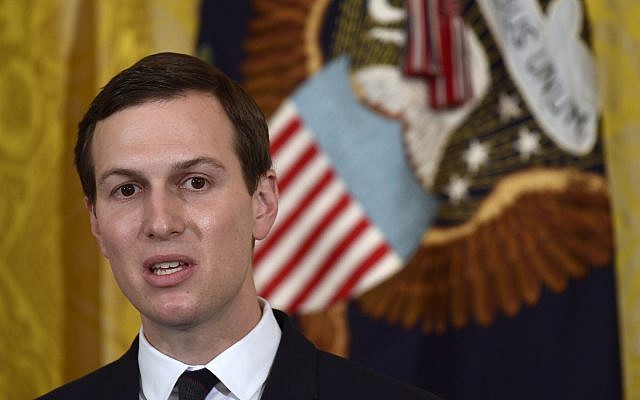
Senior White House adviser Jared Kushner in the East Room of the White House in Washington, May 18, 2018. (Susan Walsh/AP)

Jared Kushner, US President Donald Trump’s senior adviser and son-in-law, has been pushing to remove the refugee status of millions of Palestinians as part of an apparent effort to shutter the United Nations agency for Palestinian refugees, a report on Friday said.

Under Trump, the US has frozen hundreds of millions of dollars in aid to the United Nations Relief and Works Agency, or UNRWA, with the US president linking the decision to the Palestinians’ refusal to speak with his administration after he recognized Jerusalem as Israel’s capital.

According to emails published Friday by Foreign Policy magazine, Kushner has been highly critical of UNRWA, with he and other White House officials weighing its closure as part of their peace efforts.

“It is important to have an honest and sincere effort to disrupt UNRWA,” Kushner wrote in an email dated January 11, just days before the US froze $65 million in funding for UNRWA. “This [agency] perpetuates a status quo, is corrupt, inefficient and doesn’t help peace.”

“Our goal can’t be to keep things stable and as they are… Sometimes you have to strategically risk breaking things in order to get there,” he added in the email, according to Foreign Policy.

Uniquely, UNRWA grants refugee status to all descendants of Palestinians who left or fled Israel with the establishment of the state in 1948, swelling the number to an estimated five million at present, when the number of actual refugees from that conflict is estimated to be in the low tens of thousands. In peace talks, the Palestinian leadership has always demanded a “right of return” to Israel for these millions — an influx that, if accepted by Israel, would spell the end of the Israel as a majority Jewish state.

Israel argues that the Palestinian demand is an UNRWA-facilitated effort to destroy Israel by demographic means. The Palestinians also seek an independent state in the West Bank, Gaza Strip and East Jerusalem. Months of ongoing violent protests fueled by Hamas at the Gaza border with Israel were initiated under the banner of a “March of the Return,” and encouraged by Hamas leaders with the declared ultimate goal of erasing the border and destroying Israel.

Israel argues that an independent Palestinian state, if agreed upon in negotiations, would absorb Palestinian refugees and their descendants, just as Israel absorbed Jewish refugees from Middle Eastern and north African countries over the decades.

In an email from later in January, an adviser to Jason Greenblatt — Trump’s Middle East peace envoy — suggested UNRWA’s closure as part of the US peace push.

“UNRWA should come up with a plan to unwind itself and become part of the UNHCR [UN High Commissioner for Refugees] by the time its charter comes up again in 2019,” wrote Victoria Coates.

Coates described the proposition as one of the “spitball ideas that I’ve had that are also informed by some thoughts I’ve picked up from Jared, Jason and Nikki,” referring to Haley, the US ambassador to the UN.

Other proposals raised were moving UNRWA to a monthly operating budget and coming up with “a plan to remove all anti-Semitism from educational materials.” [Ha ha ha, good luck with that! There would be no education materials left…]

The report also quoted Palestinian officials saying Kushner and Greenblatt in June asked Jordan to remove the refugee status of some 2 million Palestinians in order to end UNRWA’s operations in the country.

“[Kushner said] the resettlement has to take place in the host countries and these governments can do the job that UNRWA was doing,” said Palestinian Liberation Organization official Hanan Ashrawi, according to Foreign Policy.

“They want to take a really irresponsible, dangerous decision and the whole region will suffer,” she added, claiming the White House wanted Gulf states to pick up the tab for whatever this would cost Jordan.

Shortly after the reported request, top Palestinian peace negotiator Saeb Erekat accused Kushner and Greenblatt of seeking the “termination” of the UN’s Palestinian refugee agency.

“They want to terminate the role of UNRWA by proposing direct aid to the countries hosting the Palestinian refugees and sideline the UN agency,” Erekat said at the time. “On top of this, they are planning financial aid to the Gaza Strip worth one billion dollars for projects, also separate from UNRWA and under the title of solving a humanitarian crisis.”

He added: “All this is actually aimed at liquidating the issue of the Palestinian refugees.”

The White House would not directly comment on the Foreign Policy report, though an official told the magazine that the US position on UNRWA “has been under frequent evaluation and internal discussion. The administration will announce its policy in due course.”

Israel, which has also sometimes accused UNRWA of employing Palestinians who support terrorism, says UNRWA’s definition of Palestinian refugees helps to perpetuate the Palestinian narrative of Israeli illegitimacy. It notes that UNRWA’s policy of granting refugee status to the descendants of Palestinian refugees, even when they are born in other countries and have citizenship there, does not apply to the refugees cared for by the UN’s main refugee agency, UNHCR, which cares for all other refugees worldwide. The population of Palestinian refugees thus grows each year, even as other refugee populations in the world shrink with each passing generation.

A spokesman for the Israel Embassy in Washington, Elad Strohmayer, told Foreign Policy: “We believe that UNRWA needs to pass from the world as it is an organization that advocates politically against Israel and perpetuates the Palestinian refugee problem.”

The Foreign Policy report came as US officials say the Trump administration is staffing up a Middle East policy team at the White House in anticipation of unveiling its long awaited but largely mysterious Israeli-Palestinian peace plan.

The National Security Council last week began approaching other agencies seeking volunteers to join the team, which will work for peace pointmen Kushner and Greenblatt, according to the officials.

The creation of a White House team is the first evidence in months that a plan is advancing. Although Trump officials have long promised the most comprehensive package ever put forward toward resolving the conflict, the emerging plan has not been described with even a small amount of detail by Kushner, Greenblatt or any other official.
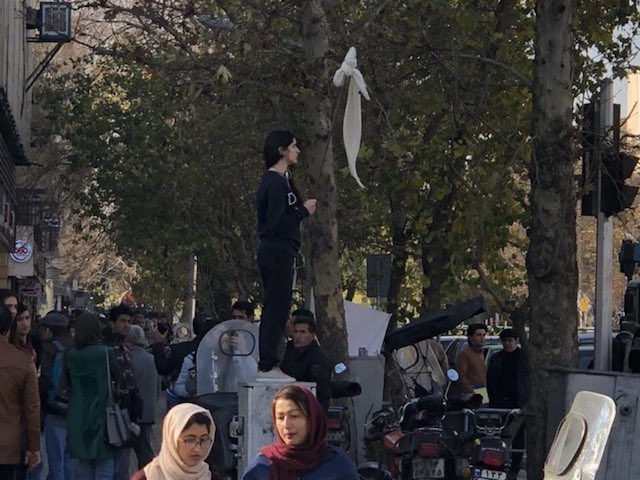
Iranian Woman Who Protested Islamic Headscarf Gets 20-Year Sentence

August 2, 2018

Story is about 3 weeks old now, but it is such a sad thing to happen.

Colour me surprised, but I haven’t heard anything from (leftist) western feminists about this.

Funny that.

Iranian Woman Who Protested Islamic Headscarf Gets 20-Year Sentence

https://www.breitbart.com/jerusalem/2018/07/10/iranian-woman-who-protested-islamic-headscarf-gets-20-year-sentence/

Hijab

(AP) DUBAI, United Arab Emirates — An Iranian woman who removed her obligatory Islamic headscarf out of protest in December says she has been sentenced to 20 years in prison.

Shaparsk Shajarizadeh posted on her personal website that she had been jailed for “opposing the compulsory hijab” and “waving a white flag of peace in the street.”

There was no immediate comment from Iranian officials.

Police in Iran arrested 29 people in February for removing their headscarves as part of a campaign known as “White Wednesdays.” Nasrin Sotoudeh, a prominent human rights lawyer who represented Shajarizadeh and other women, was arrested last month.

Shajarizadeh, 42, was released on bail in late April. Her current whereabouts were unknown.

In Iran, women showing their hair in public face penalties ranging from a $25 fine to prison time.

Iran Sues U.S. to Stop Imposition of Trump’s New Sanctions

August 2, 2018

Ha ha ha…. Good luck with that.

Feeling the heat are we?

Iran Sues U.S. to Stop Imposition of Trump’s New Sanctions

Iran Sues U.S. to Stop Imposition of Trump’s New Sanctions

Iranian President Hassan Rouhani and Mohammad Javad Zarif, Iran's foreign secretary

U.S. officials are fighting against a recently filed lawsuit by Iran in the International Court of Justice, or ICJ, that seeks to block the imposition of harsh new sanctions on Iran by the Trump administration, according to multiple U.S. officials who spoke to the Washington Free Beacon.

Iranian officials launched a formal complaint with the ICJ, a legal body established by the United Nations to adjudicate disagreements between member nations, against the United States earlier this month, alleging the reimposition of harsh new sanctions on Iran by the Trump administration violates international treaties created as a result of the landmark nuclear agreement.

Iran’s lawsuit is reportedly gaining traction at the ICJ, which sent an official letter to Secretary of State Mike Pompeo earlier this week urging him and the Trump administration to hold off on new sanctions amid an economic collapse in Iran that has ignited popular protests across the country.

Iranian officials lauded the latest development at the ICJ and lashed out at the Trump administration in public comments in which they formally rejected the U.S. president’s offers for a direct meeting. The war of words follows a tense few weeks between Trump and Iranian officials, which have sparked fears of a new regional war.

Trump administration officials working on the ICJ lawsuit told the Free Beacon Monday afternoon that Iran’s claims are baseless. Senior U.S. officials are now working to ensure the lawsuit is tossed from the court.

“We are aware of the application filed on July 16, 2018 by Iran in the International Court of Justice instituting proceedings against the United States,” a State Department official disclosed to the Free Beacon on Monday. “While I cannot comment on the specifics, Iran’s application is baseless, and we intend to vigorously defend the United States before the ICJ.”

Alaeddin Boroujerdi, chair the Iranian Parliament’s National Security and Foreign Policy Commission, celebrated the ICJ’s letter to Pompeo urging the United States to halt any new economic sanctions, calling the letter a “highly logical” step by the ICJ.

“The U.S.’s reinstatement of sanctions is against the international standards, because this country was obliged to lift all sanctions against Iran under the U.N. Security Council resolution,” Boroujerdi was quoted as saying on Monday in Iran’s state-controlled press. “Such unlawful act can be sued.”

“The Foreign Ministry’s move to file a lawsuit against the U.S. at the International Court of Justice was very logical, which was confirmed by the ICJ and a date has been set for its proceeding,” the Iranian official added. “I believe that we can succeed if we act from the position of power in advocating the rights of the [Iranian] nation. … If the U.S. is found guilty in the lawsuit, the least achievement for Iran is a political win.”

Iran alleges in the court filings the United States has violated signed international treaties dating back as far as 1955.

A second U.S. official who works on Iran issues told the Free Beacon the Trump administration will not fall victim to Iran’s threats of war and international protestations against new sanctions. The Free Beacon reported last month that Iranian officials have been working closely with their European counterparts to skirt new U.S. sanctions and keep trade open.

“There’s no way that Iran gets to pursue its ‘Death to America’ agenda but we’re not allowed to respond. That isn’t how international law works,” said the official, who was not authorized to speak on record about the situation. “The Iranians would be better off changing their illegal behavior, including their calls for the destruction of Israel which is a U.N. member state, and engaging President Trump on his offer of a better deal than pursuing these nonsense lawsuits.”

Iranian military leaders, responding to a series of tweets by Trump warning Iran against threatening the Unite States, have vowed to deliver harsh reprisals against U.S. interests in the region should the American administration take action.

“Not a night goes by when we don’t think about you in our sleep. Let me tell you, Mr. Trump the gambler… Let me tell you, … know that we are near you, in places that don’t come to your mind,” Qasem Soleimani, the commander of the Iranian Revolutionary Guards Corps Quds Force said in recent remarks. “We are near you in places that you can’t even imagine. We are a nation of martyrdom. We are the nation of Imam Hussein. Ask around. We have endured many hardships.”

Report: Paris turns into Mossad’s playground

August 2, 2018

Well, the Mossad could turn wherever-it-wants into it’s playground…

Report: Paris turns into Mossad’s playground

https://www.ynetnews.com/articles/0,7340,L-5317287,00.html

Al-Mabhouh's assassination in Dubai (Photo: Reuters)

According to Le Monde, the Israeli spy agency set up an operations room in the French capital for Hamas official Mahmoud al-Mabhouh’s assassination in Dubai, among other missions; ‘French hands are tied, our ability to respond to their actions is limited,’ complains French intelligence official.

Paris has become a center of operations for Israel’s Mossad intelligence agency, according to an article published this week in French newspaper Le Monde.

The article, titled “The Mossad’s shadow hovers over Paris,” cites senior French intelligence officials, one of whom claimed that “The city is the Mossad’s playground. The Chinese and the Russians may be our enemies, but let us not forget the Israelis and the Americans are also conducting themselves with great aggression.”

“Our ability to respond to their actions is limited because they rush to use the ‘diplomatic card’ and complain to the French prime minister and president’s offices,” the French intelligence official vented.

“France’s hands are tied” since it depends on Israel “in many sensitive issues,” he said. The French, he added, were “also limited in our ability to prevent some elements in the Jewish community in France from aiding them (the Mossad) with planning and logistics.”

One operation the French intelligence officials say was led from Paris was the assassination of Hamas senior official Mahmoud al-Mabhouh in Dubai. Israel has neither confirmed nor denied it was behind al-Mabhouh’s assassination.

According to Le Monde, the Mossad set up a makeshift operations room equipped with computers and secure phones at a hotel room in the French capital’s Bercy neighborhood—not far from the French Finance Ministry and other government buildings.

While only two of the 11 foreign agents who allegedly took part in the daring assassination—”Kevin” and “Gail”—reportedly arrived in Dubai on an Air France flight from Paris, foreign media has so far believed the operation was led from Austria or another European location. Le Monde, however, reports Israel’s control and command center was in the heart of Paris.

The January 2010 assassination caused international outrage and a diplomatic crisis with Britain over the use of European passports.

France also complained to then-Mossad director Meir Dagan about the use of forged French passports.

According to Le Monde, the French were concerned Hamas would suspect France took part in the assassination.

Paris sent two senior agents to meet with Dagan in Jerusalem. “We’ll stay friends, but there’ll be a price to pay for this,” they told him. The price is believed to have been a halt to the exchange of information between Israeli and French intelligence.

“It was a way to send a message that this was an intolerable line crossing,” said the head of the French police’s investigations department.

Speaking to Yedioth Ahronoth, the Le Monde article’s writer, journalist Jacques Follorou, said French intelligence officials were outraged by the alleged use of French passports, seeing it as a “provocation.”

In addition to Al-Mabhouh’s assassination, the article examines many other operations that Le Monde claims the Mossad and other Israeli elements conducted from French soil, including: a joint Israeli-French attempt to recruit a Syrian agent who tried to buy chemical weapons, an Israeli company’s attempt to wiretap Council of Europe meetings in Brussels, and operations of the company Black Cube, which had offices in Paris’s Place Vendôme.

The Mossad, according to the Le Monde report, also tried to recruit French intelligence agents as double agents during a joint operation in 2010. As a result of that alleged incident, Le Monde claims the Mossad station head in Paris and another employee in the Israeli Embassy had to leave France.

The reason the Mossad—like many other foreign intelligence agencies including the CIA—has turned Paris into its center of operations is because it hosts many international conference and frequent visits of African leaders. Furthermore, the city is home to many foreigners.

Another reason, according to a source in French intelligence, is that “France dedicates most of its espionage activities to the fight against terrorism, therefore it doesn’t have enough manpower for counter-espionage.”

While the Mossad, according to Le Monde, continues operating in Paris with relative freedom, a source in the French Foreign Ministry admitted that “the Israelis are a little bit more cautious than before.” They no longer carry out assassinations on French soil and don’t use the help of the French Jewish community as often.

Iran says notion of Mossad raiding Tehran warehouse ‘laughably absurd’

July 25, 2018

Following from this post:

How the Mossad stole Iran’s nuclear secrets

we now have Iran’s response….

… which could be characterized as *fingers in ears* “la la la la la la la can’t hear you, don’t believe you, la la la la”

Iran says notion of Mossad raiding Tehran warehouse ‘laughably absurd’

https://www.timesofisrael.com/iran-says-notion-of-mossad-raiding-tehran-warehouse-laughably-absurd/

After US reporters view documents from captured archive on nuclear weapons program, Islamic Republic insists Jerusalem’s claims are ‘outlandish’

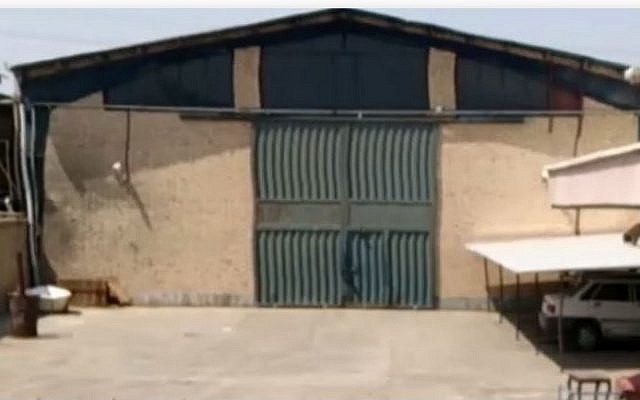
A warehouse in Shorabad, south Tehran, where Mossad agents discovered and extracted tens of thousands of secret files pertaining to Iran's nuclear weapons program (Prime Minister's Office)

Iran has denied that Israel stole thousands of secret documents from a Tehran warehouse relating to the Islamic Republic’s clandestine nuclear weapons program as “laughably absurd.”

Israel said the trove of documents seized by the Mossad in a daring January raid shows Iran had for years worked on developing nuclear weapons while lying to the international community, and that it has put plans in place to pursue such weapons in the future.

“Iran has always been clear that creating indiscriminate weapons of mass destruction is against what we stand for as a country, and the notion that Iran would abandon any kind of sensitive information in some random warehouse in Tehran is laughably absurd,” a spokesman for Tehran’s UN mission said.

“It’s almost as if they are trying to see what outlandish claims they can get a Western audience to believe.”

On Sunday the New York Times reported that the archive shows Iran’s weapons program “was almost certainly larger, more sophisticated and better organized” than was suspected, after US reporters were shown selected documents from the haul.

Three US reporters were given limited access to the trove last week, and were briefed by Israeli officials. Israel, which unveiled the documents in April, has been mining the trove of 100,000 documents for new information, and has also shared the material with the IAEA and with US and European intelligence agencies.

The thrust of last week’s briefing for the US press was to highlight how far the nuclear program had progressed — Iran “was on the cusp of mastering key bombmaking technologies when the research was ordered halted” in 2003, the Washington Post said — and to underline Israel’s insistence that the archive demonstrates that the Iranian regime has not abandoned its effort to obtain a nuclear weapons arsenal, but has merely mothballed parts of it.

Safes inside a warehouse in Shorabad, south Tehran, where Mossad agents discovered and extracted tens of thousands of secret files pertaining to Iran’s nuclear weapons program (Prime Minister’s Office)

“These documents are old, but they have a bearing on the future,” a senior Israeli official was quoted by the Post as saying. “It’s not a history lesson. They have capabilities they can use in the future.”

Iran halted much of the nuclear weapons program in 2003, but internal memos in the archive “show senior scientists making extensive plans to continue several projects in secret, hidden within existing military research programs,” said the Washington Post.

“In a few years, when some of the [deal’s] restrictions expire, Iran will be in a position to resume work on a nuclear device that Israel sees as a threat to its existence,” the Israeli official told the Post.

The Tehran warehouse from which the documents were purloined “was put into use only after the 2015 accord was reached with the United States, European powers, Russia, and China,” the Times reported. Israeli officials contend that the fact that the Iranians “systematically went about collecting thousands of pages spread around the country documenting how to build a weapon, how to fit it on a missile and how to detonate it” demonstrates that they fully intend to return to the effort of nuclear weapons building when the opportunity arises.

Photographs from the Iranian nuclear weapons archive, showcased by Israeli officials, of a metal chamber that Israeli officials said was housed at the Parchin military site and was built to conduct experiments as part of the Iranians’ rogue nuclear weapons program (Israeli government)

The Times noted that one of the reasons Mossad decided to steal the documents rather than photograph or copy them and leave undetected was “to counter Iranian claims that the material was forged and offer it up for examination by international groups.”

Iran indeed maintains the entire document trove is fraudulent.


Syrian pilot killed, body possibly seized by ISIS

July 25, 2018

First article says pilot was killed, second article adds that ISIS now has the body.

Report: Syrian pilot killed after being shot down by Israel

Syrian official says pilot of aircraft shot down over Israel was killed. Syria denies plane entered Israeli airspace.

https://www.israelnationalnews.com/News/News.aspx/249456

Patriot Missile Battery

The pilot of the Syrian aircraft which was shot down after it entered Israeli airspace Tuesday was killed, according to a report by a Russian media outlet.

Pilot Amran Mara’e was killed, a Syrian official told Sputnik, a news outlet supported by the Russian government.

According to the official, Mara’e was flying a mission against ISIS targets in southern Syria when he was shot down.

The IDF stated that the aircraft was shot down by two Patriot missiles after it had flown two two kilometers (1.24 miles) into Israeli airspace. The Syrian government denied that the aircraft had entered Israeli airspace and claimed that it was shot down over Syrian territory.

The fate of a second pilot is unclear.

According to the IDF, there has been an uptick in the Syrian infighting since Tuesday morning, together with additional activity by the Syrian air force.

“The IDF is on high alert and very prepared, and will continue acting against violations of the 1974 Separation of Forces agreement,” an IDF statement read.

Islamic State said to capture body of downed Syrian pilot

Plane shot down by Israel after crossing border said to have crashed in small pocket of land held by terror group in southwest Syria

An official based in Syria and allied with government forces said Tuesday that Islamic State fighters seized the body of a Syrian pilot whose jet was shot down by Israel.

The pilot was identified as Col. Amran Mara’e. He was killed when his plane was shot down, a Syrian military source told Sputnik, a Russian government-backed news outlet.

The fate of the other pilot remains unknown, said the official, who is with the so-called “Axis of Resistance” that is led by Iran and includes Iran, Syria, Hezbollah, and other groups fighting alongside Assad’s forces. He spoke on condition of anonymity because he was not authorized to talk to reporters.

more here

https://www.timesofisrael.com/islamic-state-said-to-capture-body-of-downed-syrian-pilot/

Mass protests sweep Iraq, target pro-Iran militias and parties

July 19, 2018

One middle-eastern country that has fallen off the radar a bit is Iraq.

And it certainly isn’t an oasis of peace at the moment.

Looks like the people are revolting against the Iranian incursion.

The Iranians really can’t seem to get a break anywhere, what a shame…

https://www.jpost.com/Middle-East/Mass-protests-sweep-Iraq-target-pro-Iran-militias-and-parties-562597

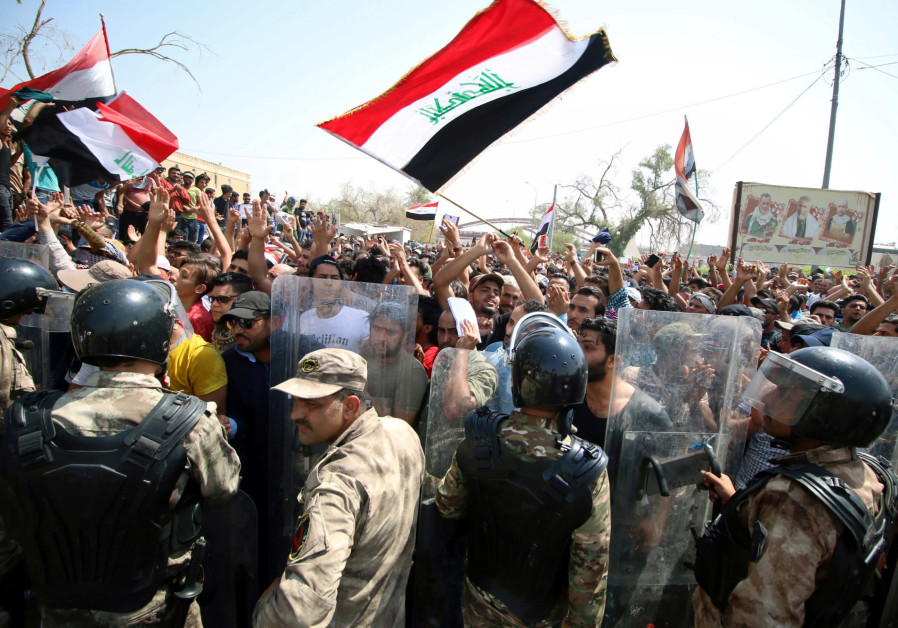
Najaf airport has been sacked. The border with Kuwait has been occupied by protesters and roads to major oil fields blocked in southern Iraq. The base of a Kata’ib Hezbollah pro-Iranian militia was set on fire.

Mass protests sweep Iraq, target pro-Iran militias and parties

In response Baghdad has cut off access to Internet and social media apps, and sent elite counter-terrorism units, as well as the army, to quell the spreading protests.

A year after the Iraqi security forces liberated Mosul from Islamic State, the country was supposed to be getting back on its feet. In February, Middle Eastern powers, including Saudi Arabia and Turkey, promised to help Iraq meet the $80 billion it wanted in reconstruction credit lines and aid. The US and western powers sought to support Baghdad as well. The US is plowing $250 million into Foreign Military Financing in Iraq, $850m. into “train and equip” funds, and $150m. toward stabilization and development programs.

However, the funds have not trickled down to average people throughout Iraq.

In May, voters in Iraq turned out for Muqtada al-Sadr’s Sairoon party, in a populist vote that helped the opposition Shi’ite cleric come in first. In second place was an alliance of Shi’ite militia-backed parties, many of them close to Iran. In third place was Iraq’s prime minister and his “victory” party which sought to capitalize on perceptions he had helped defeat Islamic State.

Since the election, however, a government has not been formed and ISIS attacks have increased throughout many central provinces in Iraq. To tackle the ISIS threat, Baghdad sent half a dozen major military units fanning out into Salahuddin, Diyala, Kirkuk and Nineveh provinces on July 7, in an operation dubbed “Revenge of Martyrs.” Three days later, protesters in the southern city of Basra began assembling on roads leading to major oil fields. The police shot at the protesters, wounding and killing several.

They set up tents; public strikes spread to the neighboring provinces of Dhi Qar, Wasit, Maysan and Babil. Reports spread online saying that dozens of security forces and protesters were killed in southern Iraq near the Iranian border at Amara. Oil workers were evacuated by helicopter. In the holy city of Najaf on July 13, protesters stormed the airport and locals claimed they ransacked planes belonging to Iran. Many Shi’ite pilgrims come from Iran to Iraq, and although many of the protesters were also Shi’ite, they were complaining that Iran’s influence in Iraq was overbearing.

On Friday, protesters also targeted militia and party offices of Kata’ib Hezbollah in Najaf as well as of Dawa, Badr and Asa’ib Ahl al-Haq, all of which are closely connected to Iran and the Islamic Revolutionary Guard Corps. According to Iraq expert Haydar Al-Khoei, the protesters chanted “the Iranian Dawa party, the Safavids,” a reference to the Persian Empire and an attempt to portray modern day Iranian-backed parties in Iraq as a form of Iranian takeover of the country.

There is boiling anger in Iraq at economic stagnation and blame is being cast on the parties that are connected to Iran. Like the protesters in Iran who have been angry at Tehran wasting money on foreign wars in Syria, Iraqis have accused their government of wasting time and resources on foreign connections while abandoning the people.

For instance, the arrival of foreign mediators, including IRGC leader Qasem Soleimani from Iran as well as Hezbollah members from Lebanon – to discuss the new governing coalition – have been seen as foreign meddling.

Baghdad has responded to the unrest by sacking police officials and dispatching the security forces, including the elite coalition trained Counter-Terrorism Service, to maintain order. Sending the elite units to deal with rioters is seen as Baghdad’s way of sending a non-partisan unit, rather than militia-aligned ones, to tackle with the problem. The CTS personnel are supposed to be perceived as neutrals and heroes of the war on ISIS. However, it is a heavy-handed tactic that could backfire. The CTS and other forces were in the middle of fighting ISIS north of Baghdad; redeploying them will take the pressure off the extremists.

BAGHDAD ALSO sought to cut off the Internet and social media apps to stop the spread of the protests. This is the same tactic that Tehran has used against protests in Iran.

Across Iraq there is outrage at the government actions. “Iraqi government asks the protesters to be reasonable after they have stripped them of the simplest rights: Electricity, water, Internet, job opportunities – and 60% of Iraq’s oil is being exported from the poorest cities in the country,” Ali Al-Baroodi, a photographer in Mosul, tweeted on Sunday. There is talk that the protesters will make a new “Arab Spring” in Iraq.

Iraq is now in a state of emergency, with the government considering what will come next. Shifting forces from the north to the south and attempts to re-route electricity from Nineveh to Basra to placate demands are the few things left in Baghdad’s arsenal.

Protesters have sacked government offices, and have succeeded in closing the border with Kuwait and shutting down air travel at an airport. Pro-Iranian media speaks of “infiltrators,” claiming the protests are being stoked from abroad, including social media in Kuwait. But powerful indigenous voices, such as Grand Ayatollah Ali al-Sistani have supported the demonstrators.

Notably silent on the unrest are Western officials, with the US and UK embassies not tweeting since July 10. No expressions of concern for the cutting of Internet or shooting of protesters. Demonstrators may see that as quiet support for Baghdad’s heavy-handed tactics. Lacking support from the West and blaming Iran for their economic problems, Iraqis face another potential round of violence in a country that has seen decades of war and conflict.


Up to 22 killed, including 9 Iranians, in Syria strike blamed on Israel – report

July 17, 2018

https://www.timesofisrael.com/up-to-22-killed-including-9-iranians-in-syria-strike-blamed-on-israel-report/

Earlier, the Syrian Observatory for Human Rights put the death toll at 9, said raid targeted an Iranian Revolutionary Guard center

Syrian rebel forces claimed that 22 people, including nine Iranians, were killed in an overnight strike in northern Syria blamed on Israel, the Qatar-based al-Jazeera network reported Monday.

An Israeli F-16 during an exercise on November 25, 2013. (Ofer Zidon/Flash90)

The figure, which could not be confirmed, was much higher than an earlier report of nine deaths provided by a Syrian watchdog group.

The al-Jazeera report did not cite its sources or give any further details.

Syrian state media has accused Israel of carrying out the bombing of a military position in Aleppo province late Sunday, in what would be a rare Israeli attack so far north in the war-ravaged country.

“The Israeli missiles targeted an Iranian Revolutionary Guard center, near the Neyrab military airport,” said Rami Abdel Rahman, the head of the Syrian Observatory for Human Rights, a Britain-based monitor.

He said those killed included at least six Syrians, but could not specify the nationalities of the remaining fighters.

The position is a logistics hub used to provide equipment and food to pro-regime forces fighting at nearby fronts, but it did not store weapons, Abdel Rahman said.

Earlier Monday, the country’s official news agency SANA reported there was only damage to the site, identified as the Al-Nayrab airbase, adjacent to Aleppo’s international airport.

“The Zionist enemy (Israel)… targeted with its missiles one of our military positions north of the Nayrab military airport, but the damage was only material,” SANA said citing a military source.

Al-Nayrab has in the past been linked with Iran’s Islamic Revolutionary Guards Corps militia.

The Observatory, which relies on a network of sources inside the country, said it had recorded a wave of blasts around Nayrab on Sunday night.

It said that a suspected Israeli missile strike had targeted “positions held by Syria’s regime and its allies at the Nayrab airport” and its surroundings.

The base was reportedly previously struck by Israel on April 29 as part of a large raid that also targeted weapons depots near Hama.

There was no immediate comment from Israel, which rarely confirms such attacks.

Suspected Israeli airstrikes have hit Syrian army positions near Damascus and in the central provinces of Homs and Hama in the past. However, they rarely occur as far north as Aleppo.

The raid came hours before a high-stakes summit between Russian President Vladimir Putin and US President Donald Trump, where Syria and Iran are expected to be on the agenda.

Israel has been pushing Russia to remove Iranian-aligned militia fighters from Syria, and has vowed to stop them from getting a foothold anywhere in the country. Russia has reportedly only agreed to removing them from the Golan border region.

Prime Minister Benjamin Netanyahu, who met with Putin in Moscow last week, said Sunday he had discussed the issue with Trump a day earlier.

Netanyahu reportedly told Putin during their Wednesday meeting that Israel would not challenge Assad’s control of Syria, in exchange for freedom to act against Iran.

On July 8, Israel was accused of carrying out an airstrike on the T-4 military base near Homs, also thought to be used by IRGC fighters.

How the Mossad stole Iran’s nuclear secrets

July 16, 2018

Following on from this previous post…

How did the Mossad get the nuclear papers out of Iran?
https://warsclerotic.com/2018/05/31/how-did-the-mossad-get-the-nuclear-papers-out-of-iran/

… is the following article from the New York Times.

How Israel, in Dark of Night, Torched Its Way to Iran’s Nuclear Secrets

//www.nytimes.com/2018/07/15/us/politics/iran-israel-mossad-nuclear.html

TEL AVIV — The Mossad agents moving in on a warehouse in a drab commercial district of Tehran knew exactly how much time they had to disable the alarms, break through two doors, cut through dozens of giant safes and get out of the city with a half-ton of secret materials: six hours and 29 minutes.

The morning shift of Iranian guards would arrive around 7 a.m., a year of surveillance of the warehouse by the Israeli spy agency had revealed, and the agents were under orders to leave before 5 a.m. to have enough time to escape. Once the Iranian custodians arrived, it would be instantly clear that someone had stolen much of the country’s clandestine nuclear archive, documenting years of work on atomic weapons, warhead designs and production plans.

The agents arrived that night, Jan. 31, with torches that burned at least 3,600 degrees, hot enough, as they knew from intelligence collected during the planning of the operation, to cut through the 32 Iranian-made safes. But they left many untouched, going first for the ones containing the black binders, which contained the most critical designs. When time was up, they fled for the border, hauling some 50,000 pages and 163 compact discs of memos, videos and plans.

In late April, Prime Minister Benjamin Netanyahu announced the results of the heist, after giving President Trump a private briefing at the White House. He said it was another reason Mr. Trump should abandon the 2015 nuclear deal, arguing that the documents proved Iranian deception and an intent to resume bomb production. A few days later, Mr. Trump followed through on his longstanding threat to pull out of the accord — a move that continues to strain relations between the United States and European allies.

Last week, at the invitation of the Israeli government, three reporters, including one from The New York Times, were shown key documents from the trove. Many confirmed what inspectors from the International Atomic Energy Agency, in report after report, had suspected: Despite Iranian insistence that its program was for peaceful purposes, the country had worked in the past to systematically assemble everything it needed to produce atomic weapons.

“It’s quite good,” Robert Kelley, a nuclear engineer and former inspector for the agency, said in Vienna, after being shown some of the fruits of the document theft. “The papers show these guys were working on nuclear bombs.”

There is no way to independently confirm the authenticity of the documents, most of which were at least 15 years old, dating from the time when an effort called Project Amad was ordered halted and some of the nuclear work moved deeper under cover. The Israelis handpicked the documents shown to the reporters, meaning that exculpatory material could have been left out. They said some material had been withheld to avoid providing intelligence to others seeking to make weapons.

The Iranians have maintained that the entire trove is fraudulent — another elaborate scheme by the Israelis to get sanctions reimposed on the country. But American and British intelligence officials, after their own review, which included comparing the documents to some they had previously obtained from spies and defectors, said they believed it was genuine.

From what the Israelis showed to the reporters in a secure intelligence facility, a few things are clear.

The Iranian program to build a nuclear weapon was almost certainly larger, more sophisticated and better organized than most suspected in 2003, when Project Amad was declared ended, according to outside nuclear experts consulted by The Times. Iran had foreign help, though Israeli officials held back any documents indicating where it came from. Much was clearly from Pakistan, but officials said other foreign experts were also involved — though they may not have been working for their governments.

The documents detailed the challenges of integrating a nuclear weapon into a warhead for the Shahab-3, an Iranian missile. One document proposed sites for possible underground nuclear tests, and described plans to build an initial batch of five weapons. None were built, possibly because the Iranians feared being caught, or because a campaign by American and Israeli intelligence agencies to sabotage the effort, with cyberattacks and disclosures of key facilities, took its toll.

David Albright, a former inspector who runs the Institute for Science and International Security, said in an interview that the documents contained “great information.”

“Iran conducted many more high-explosive tests related to nuclear weapons development than previously known,” he told Congress last month.

But the archive also shows that after a burst of activity, a political mandate delivered at the end of 2003 slowed the program dramatically, just as American officials had concluded in a 2007 intelligence report.

Israel, which has its own undeclared nuclear program, has long claimed that the Iranian program continued after 2003, and some documents show senior officials in Tehran’s program — including two who were later assassinated, presumably by Israeli agents — debating how to split it into overt and covert elements.

One of the scientists warned that work on neutrons that create the chain reaction for a nuclear explosion must be hidden. “‘Neutrons’ research could not be considered ‘overt’ and needs to be concealed,” his notes read. “We cannot excuse such activities as defensive. Neutron activities are sensitive, and we have no explanation for them.” That caution, the documents show, came from Masoud Ali Mohammadi, an Iranian nuclear physicist at the University of Tehran, who was assassinated in January 2010.

Mr. Netanyahu argues that the trove proves that the 2015 agreement, with its sunset clauses allowing the Iranians to produce nuclear fuel again after 2030, was naïve. The fact that the Iranians went to such lengths to preserve what they had learned, and hid the archive’s contents from international inspectors in an undeclared site despite an agreement to reveal past research, is evidence of their future intent, he has said.

But the same material could also be interpreted as a strong argument for maintaining and extending the nuclear accord as long as possible. The deal deprived the Iranians of the nuclear fuel they would need to turn the designs into reality.

Former members of the Obama administration, who negotiated the deal, say the archive proves what they had suspected all along: that Iran had advanced fuel capability, warhead designs and a plan to build them rapidly. That was why they negotiated the accord, which forced Iran to ship 97 percent of its nuclear fuel out of the country. Tehran would never have agreed to a permanent ban, they said.

The archive captures the program at a moment in time — a moment 15 years ago, before tensions accelerated, before the United States and Israel attacked Iran’s nuclear centrifuges with a cyberweapon, before an additional underground enrichment center was built and discovered.

Today, despite Mr. Trump’s decision to exit the deal with Iran, it remains in place. The Iranians have not yet resumed enrichment or violated its terms, according to international inspectors. But if sanctions resume, and more Western companies leave Iran, it is possible that Iranian leaders will decide to resume nuclear fuel production.

The warehouse the Israelis penetrated was put into use only after the 2015 accord was reached with the United States, European powers, Russia and China. That pact granted broad rights to the International Atomic Energy Agency to visit suspected nuclear sites, including on military bases.

So the Iranians, Israeli officials said in interviews, systematically went about collecting thousands of pages spread around the country documenting how to build a weapon, how to fit it on a missile and how to detonate it. They consolidated them at the warehouse, in a commercial district with no past relationship to the nuclear program, and far from the declared archives of the Ministry of Defense. There were no round-the-clock guards or anything else that would tip off neighbors, or spies, that something unusual was happening there.

What the Iranians did not know was that the Mossad was documenting the collection effort, filming the moves for two years, since the relocation began in February 2016. Last year, the spies began planning a heist that one senior Israeli intelligence official said bore a strong resemblance to George Clooney’s adventures in “Ocean’s 11.”

In most Mossad operations, spies aim to penetrate a facility and photograph or copy material without traces. But in this case, the Mossad chief, Yossi Cohen, ordered that the material be stolen outright. That would drastically shorten the time that the agents — many, if not all, of them Iranians — spent inside the building. But the Israelis wanted to be able to counter Iranian claims that the material was forged and offer it up for examination by international groups.

Clearly, the Israeli spies had inside help. They had learned which of the 32 safes held the most important information. They watched the habits of the workers. They studied the workings of the alarm system, so that it would appear to be working even though it would not alert anyone when the agents arrived around 10:30 p.m.

For all the cinematics of the raid, the immediate aftermath was absent much drama. There was no chase, said Israeli officials, who would not disclose whether the documents left by land, air or sea — though an escape from the coast, just a few hours’ drive from Tehran, appears the least risky.

Fewer than two dozen agents took part in the break-in. Fearing that some of them would be caught, the Israelis removed the materials on several different routes. At exactly 7 a.m., as the Mossad expected, a guard arrived and discovered that the doors and safes were broken. He sounded the alarm, and the Iranian authorities soon began a nationwide campaign to locate the burglars — an effort that, according to an Israeli official, included “tens of thousands of Iranian security and police personnel.”

The effort yielded nothing. And until Mr. Netanyahu’s speech, the Iranians never said a word in public about what had happened.

Among the most fascinating elements of the archive are pictures taken inside what were once key facilities in Iran, before the equipment was dismantled in anticipation of international inspections. One set of photos taken by the Iranians appears to show a giant metal chamber built to conduct high-explosive experiments, in a building at Parchin, a military base near Tehran.

Intelligence agencies had long suspected nuclear activity at the Parchin site, and Iran had refused to allow international inspectors in, saying that as a military base, it was off limits to inspectors and not part of any nuclear experiments.

By the time the head of the International Atomic Energy Agency, Yukiya Amano, was finally permitted to visit the site in 2015, it was empty, though the agency’s report indicated that it looked as if equipment had been removed. The photos indicate that is exactly what happened: They show a large chamber that nuclear experts say is tailor-made for the kind of experimental activity that the international inspectors were looking for.

It was part of a larger, previously known effort: Satellite photographs show that Parchin was so sanitized before the inspectors’ arrival that tons of soil in the area had been removed, to eliminate any traces of nuclear contamination.

The chamber appears to be part of neutron experiments that strongly point to an effort to build nuclear weapons. Nuclear explosions start when fast-moving particles known as neutrons split atoms of nuclear fuel in two, producing chain reactions that release more neutrons and enormous bursts of energy. At the core of an atom bomb, a device known as a neutron initiator — or sometimes a spark plug — creates the initial wave of speeding neutrons.

The Iranian papers repeatedly mention a specific substance used for making neutron initiators: uranium deuteride. Experts say it has no civil or military use other than making nuclear arms, and is known to have been used for that purpose by China and Pakistan. The initiator appears to be one of the key technologies that A.Q. Khan, the Pakistani nuclear expert who ran a black market in atomic goods, sold to Iran, North Korea and other nations.

Hamas’ online terrorism

July 6, 2018

Interesting, have only copied in extracts, each article at each link is not too long however.

Viral social media

Hamas’ online terrorism

https://www.idf.il/en/minisites/hamas/hamas-online-terrorism/

Extract:

The Information Security Department just revealed Hamas’ method of operation on the internet. In response, the IDF has launched Operation Broken Heart. Hamas cyber terrorists operate as stolen identities in order to talk to people, get their personal information, retrieve sensitive security information, and download malicious applications that turn cell phones into weapons. Thanks to IDF soldiers’ vigilance, there was no damage to Israel’s security.


Hamas’s new espionage system exposed

Hamas plot to upload applications to official Google store to make soldiers download spyware uncovered by alert soldiers.

https://www.israelnationalnews.com/News/News.aspx/248373

Extract:

As of January 2018, the Department of Information Security has begun to receive requests from dozens of soldiers who claim to have encountered suspicious individuals on social media who tried to make them download applications from the official Google app store. Following the soldiers’ reports, the Information Security Department opened an investigation. The investigation revealed that the network was an intelligence operation of the Hamas terrorist organization. The applications included a World Cup app as well as two dating apps.