Author Archive

IDF clears troops in “Hannibal Protocol” operation

August 21, 2018

Sanity prevails.

Ironic eyebrow raise at mention of “72 civilians killed”.

A very interesting, and thorough, examination of the Hannibal Protocol (or Doctrine) is here, by Daniel Pipes:

http://www.danielpipes.org/blog/2009/01/hannibal-protocol

“[The Hannibal Protocol is] named after the Carthaginian general who poisoned himself not to be captured by the Romans.”

IDF clears troops in massive deadly bombardment during 2014 Gaza war

https://www.timesofisrael.com/idf-clears-troops-in-massive-deadly-bombardment-during-2014-gaza-war/

Givati Brigade officer Lt. Hadar Goldin, 23, from Kfar Saba, who was killed in Gaza on August 1, 2014

Army’s top lawyer determines that the 72 civilians killed in offensive after capture of soldier were not deliberately targeted and officers worked to prevent deaths of bystanders

The Israeli military’s top lawyer on Wednesday closed the case on one of the bloodiest battles of the 2014 Gaza war, deciding not to file any criminal charges against those involved in a massive shelling of southern Gaza that left 72 civilians dead, the army said.

The Israel Defense Forces also completed the investigation of seven other, lower-profile cases in which soldiers were said to have unnecessarily killed Palestinian civilians, finding that no crimes or misdeeds were committed.

The military’s findings regarding the “Black Friday” offensive, the nickname for the bombardment of the southern Gaza city of Rafah, largely matched those of the IDF Southern Command’s investigation shortly after the war. The IDF released the results of the probes in a 30-page document in Hebrew.

At 9:06 a.m. on August 1, 2014, just over an hour after the start of a humanitarian ceasefire, fighters from the Hamas terror group emerged from a tunnel in the southeastern part of Rafah and attacked a nearby IDF unit, killing two soldiers and capturing Lt. Hadar Goldin, dragging him back into their tunnel.

Six minutes later, troops in the area initiated the so-called Hannibal Protocol, a controversial order giving commanders near unlimited freedom to do anything necessary to prevent the capture of a soldier.

According to IDF figures, in the ensuing offensive, 42 armed Palestinian combatants were killed, along with 72 others, whom the military acknowledged were likely civilians. The high death toll led to the day’s events later being called “Black Friday.”

According to the army’s findings, the Israeli offensive lasted approximately 10 hours, during which time artillery cannons launched some 250 shells, tanks fired approximately 140 shells and Israeli aircraft conducted dozens of strikes against targets in the city, which is home to approximately 150,000 people.

“In media publications, in reports received by the Military Advocate General, and in requests from and documents produced by non-governmental organizations and international groups, it was alleged that the IDF during the battle acted indiscriminately and disproportionally, and mass casualties and mass destruction was caused by the way it acted,” the army said.

“The events of the battle of Rafah have been investigated in a comprehensive and professional manner by the General Staff’s investigatory mechanism. Following a thorough consideration of the findings of the investigation, Military Advocate General Maj. Gen. Sharon Afek decided that there is no cause to open a criminal investigation into the events of the battle,” the military said in a statement.

The IDF said its probe found no indication that the civilian deaths were deliberate, though it recognized that it lacked sufficient evidence about all of the cases. The majority of the people killed were hit by airstrikes aimed at “military targets or combatants from terror groups,” while a smaller number were killed in the blasts from artillery and tank fire.

“However, in the case of 16 civilians, there was not enough information to tie their injuries to specific events,” the army said.

Afek also dismissed claims made by some human rights groups that Israeli soldiers in the battle were acting out of a desire to “avenge” Goldin’s capture.

According to the military, Afek’s investigation determined that commanders in the field acted “to prevent injury to uninvolved civilians.”

“The findings of the investigation indicate clearly that IDF troops were acting to prevent the capture of Lt. Hadar Goldin, may his memory be blessed, and to attack terror groups in the area, using attacks on military targets and combatants,” the IDF said in a statement.

The decision to close the cases was quickly condemned by the left-wing B’Tselem human rights group.

“The military advocate general again proves that it does not matter how many Palestinians are killed and how arbitrary the reasons are for their deaths by the army. He, standing at the head of a white-washing Israeli mechanism, will always find a way to bury the facts,” the group said.

Black Friday

Immediately following the attack by Hamas on August 1, 2014, the IDF believed that Goldin may have still been alive when he was captured. The military later determined that he had been killed in the initial attack by Hamas, in violation of a ceasefire, in which Maj. Benaya Sarel and Staff Sgt. Liel Gidoni were also killed.

Under the Hannibal Protocol, the military launched a large-scale assault in the city, using infantrymen, artillery fire, mortar shells and airstrikes.

“All claims regarding the events of the battle, including the allegation that civilian bystanders were injured, were investigated thoroughly and professionally. The review did not fight any suspicion that justified the opening of a criminal investigation,” the army said.

The military said the probe was conducted by three teams working in parallel to one another. Each team was led by a brigadier general and those involved were not part of the units that were being investigated during Operation Protective Edge, the army said.

“As part of the review, hundreds of documents, videos, radio communications and pieces of intelligence were collected, and a number of operations were conducted in order to analyze them from the viewpoint of the entire battle and specific events,” the IDF said.

This investigation, as well as one conducted by the Southern Command shortly after the war, found a number of professional failings in the conduct of troops in the field. The Hannibal Protocol, for instance, was found to have been misunderstood and was replaced with a new, clearer set of orders in 2017.

500 complaints, six convictions

During and following the war, the military received at least 500 complaints regarding 360 events. The the General Staff’s investigatory mechanism has looked into 220, completing their review of all but a few dozen, the army said.

Of these, 31 cases were determined to warrant a criminal investigation by the Military Police. All but two of them have been resolved.

These criminal proceedings have led to the convictions of six IDF soldiers, all of them for looting or for aiding and abetting looting.

“The IDF is working to complete the investigation for the all these events as quickly as possible,” the army said.

The seven other cases of Palestinian civilians being killed that were closed by the IDF on Wednesday were found to have either been legitimate under the rules of armed conflict or were determined not to have been perpetrated by Israeli forces.

An airstrike on a building that was believed to be housing a senior Hamas official in the Gazan city of Khan Younis on July 29, 2014, in which 35 people were killed, three of them combatants, and 27 were wounded was found to have been conducted based on incorrect information — specifically about the number of people inside the building at the time of the attack — though the military advocate general determined that the decision-making process was in line with international law requirements.

“This is true despite that in retrospect it was determined that there was a gap between the facts that were known after the attack and the information that was at the disposal of the military commander at the time that he made the decision,” the MAG wrote.

“In light of the incident, the IDF internalized a number of operational lessons in a number of different areas,” he said.

In another case, from July 21, 2014, in which the IDF was said to have killed nine Palestinian women in an attack on a building in Gaza City, the MAG found that neither the air force nor IDF Ground Forces conducted a strike in the area at that time.

“Experts assessed that the facts likely indicate that an explosion of a homemade device took place at that location,” the MAG wrote.

The women were therefore found “to have been injured as a result of activities of a group besides the IDF,” he said.

The 50-day Operation Protective Edge killed more than 2,100 Palestinians, most of them civilians, according to Palestinian sources in the Hamas-run Gaza Strip. The IDF says about half of those killed were combatants. Seventy-three Israelis were killed in the fighting, 66 of them soldiers.

Israel launched the Gaza operation first to halt rocket fire by Hamas terrorists and then to destroy a number of attack tunnels that entered Israeli territory. Hamas, an Islamist group dedicated to the destruction of the State of Israel, seized control of Gaza in a violent coup against the Palestinian Authority in 2007.

Jordan-Israel negotiations on Trump peace plan set to bypass PLO

August 17, 2018

Another article from the always interesting David Singer.

He is an Aussie lawyer. His articles can be found on the site link for this article, as well as at his own blog here:  

http://jordanispalestine.blogspot.com/

Here is an extract from his bio from his blog:

An Australian Lawyer, Foundation Member of the International Analyst Network and Convenor of Jordan is Palestine International — an organization founded in 1979 calling for sovereignty of the West Bank and Gaza to be allocated between Israel and Jordan (and possibly Egypt)as the two successor States to the Mandate for Palestine. His articles have been published extensively on the internet…

He wrote some very interesting articles years ago about the demographic “time bomb” that Iran is facing, which I can’t seem to find at the moment. Iran’s fertility rate suddenly dropped from around 6 or 7 to below the replacement rate (at around 1-2) about a generation ago (that is, around the time the “islamic revolution” occurred in Iran). But it didn’t occur because of the islamic revolution (you’d expect the opposite to occur), but because (from memory) the Shah introduced equal opportunity for women in education, and this was introduced just before he was deposed.

Anyway, David Singer wrote a few articles about this, how there is this huge “bulge” in the demographic distribution of Iran, and how this bulge will be moving into retirement age in years ahead, with very few young people to move into the labour force to support them. It is a very interesting issue, apparently the huge drop in the fertility rate from 6-7-ish to 1-2-ish occurring so suddenly (ie in such a short period of time) is some sort of record in terms of demographic changes.

Time will tell…

http://www.onlineopinion.com.au/view.asp?article=19898&page=0

Jordan-Israel negotiations based on President Trump’s long-awaited peace plan seem increasingly likely to happen after retired Jordanian Ambassador, and former editor of the Jordan Times, Walid Sadi flagged Jordan’s legal and sovereignty claims in the West Bank (Judea and Samaria) and East Jerusalem (“disputed territories”).

Sadi – in an op-ed article in the Jordan Times on 12 August – has forcefully argued that Jordan’s decision to cut off all legal and administrative relations with the disputed territories in July 1988 did not amount to Jordan ceding its claims to sovereignty for the following reasons:

First of all, the unity of the West Bank with the East Bank was officially and constitutionally adopted on 24 of April 1950. No one disputes this fact. The Constitution of the country at the time was the 1952 Constitution, which stipulated in no uncertain terms that no part of the Kingdom shall be ceded, period. This provision makes the 1988 decision to cut off all legal and administrative relations between the two banks stopping short of ceding the West Bank to any side whatsoever. Any other interpretation of the 1988 political decision is absolutely untenable constitutionally.

The Jordan Times is published by the Jordan Press Foundation – in which the government-owned Social Security Investment Fund has a majority stake. Wadi’s politically-charged and highly-significant article could only have been published with the knowledge and approval of Jordan’s King Abdullah.

Jordan’s claims are far superior to those of the Palestine Liberation Organisation (PLO), Jordan being the last Arab state to occupy and claim sovereignty (albeit illegally) in the disputed territories from 1948 until their loss to Israel in the 1967 Six Day War.

Indeed the 1964 PLO Charter made no claim to sovereignty in the disputed territories –completely negating any claimed ancient and long-standing rights accruing to its Arab populations which would outweigh the claims by Jordan to these areas – where sovereignty still remains undetermined between Arabs and Jews.

Jordan’s pivotal role in bringing Trump’s peace proposals to a successful conclusion are grounded in the following salient facts:

  • West Bank and East Jerusalem Arabs voted to unify these areas with Transjordan in 1950 and rename the unified entity – “Jordan”
  • West Bank Arabs were citizens of Jordan possessing Jordanian passports between 1950 and 1988.
  • Half the members of the Jordanian Parliament were elected from the West Bank Arab population between 1950 and 1967.
  • Jordan’s population is overwhelmingly comprised of Arabs born east or west of the Jordan River.
  • Jordan itself comprises 78% of the territory of former Palestine
  • Jordan and Israel are the two successor states to the League of Nations Mandate for Palestine already exercising between them mutually-agreed sovereignty in 95% of former Palestine
  • Jordanian custodianship of Islamic holy sites in Jerusalem is guaranteed under the 1994 Israel-Jordan Peace Treaty.

Reunifying into one territorial unit the East Bank with areas of the West Bank allocated to Jordan only requires Israel and Jordan to redraw their already existing internationally-recognised border.

Israeli and Jordanian negotiators – armed only with pencils, sharpeners and erasers – can achieve this new dividing line between their respective states within a relatively short time.

The PLO has made it clear it wants no part in negotiating Trump’s proposals. The PLO and Hamas will be left to cool their heels and contemplate their many squandered opportunities to create an additional state between Israel and Jordan since the Oslo Accords were signed in 1993.

Jordan’s decision to resurrect its long-dormant claims after 30 years of studied silence and subservience to PLO posturing should be welcomed by all who want to see the Jewish-Arab conflict ended.

Trump restricts delivery of F-35s to Turkey, deepening rift with NATO ally

August 16, 2018

Gotta love Trump’s resolve and willingness to act: Turkey imprisons US pastor, Turkey gets thumped with a doubling of tariffs, currency plummets.

Nice.

https://www.timesofisrael.com/trump-restricts-delivery-of-f-35s-to-turkey-deepening-rift-with-nato-ally/

Transfer of fighter jets halted over Ankara’s interest in Russian air defense system amid diplomatic crisis sparked by detained American pastor

US President Donald Trump has restricted the delivery of 100 F-35 fighter jets to Turkey, exacerbating the strain between the two NATO allies over Ankara’s continued detention of an American pastor.

Trump on Monday signed a defense authorization act that prohibits the delivery of F-35 Joint Strike Fighter aircraft to Turkey if it buys Russia’s S-400 air defense system.

The law requires a review of US-Turkey relations, including the US military’s use of Incirlik Air Base, and a risk assessment associated with delivering the stealth fighter jets.

Turkey has been a partner in the international consortium that financed the F-35 since 2002, and plans to purchase 100 of the stealth fighter jets from the US at a reported $1.2 billion.

Ties between the US and Turkey were already fraught over Washington’s support for Syrian Kurdish forces, but have been further strained by the trial of American pastor Andrew Brunson on terror-related charges linked to a failed coup attempt in the country two years ago.

Brunson has been held in Turkey since October 2016, and could face a jail term of 35 years if convicted. Trump has described his detention as a “total disgrace” and urged Ankara to free him immediately.

After Brunson’s appeal was rejected by a Turkish court earlier in August, Trump responded by doubling steel and aluminum tariffs on the country, causing its currency to plummet.

The diplomatic rift was further deepened after Turkey, despite being a NATO ally, entered into an understanding to buy Russia’s advanced S-400 air defense system.

Such a move would defy US sanctions on Moscow, and Turkey’s increasingly cozy relationship with Russian President Vladimir Putin has alarmed both the US and the European Union.

On Friday, Turkish President Recep Tayyip Erdogan wrote in The New York Times that unless Washington can “reverse this trend of unilateralism and disrespect,” Turkey will “start looking for new friends and allies.” [Please do! Shut the door behind you as leave, Turkey.]

The warning came after Erdogan held a phone call with Putin to discuss economic and trade issues, as well as the Syria crisis.

Turkey’s dialogue with Russia has led some to question its reliability as a NATO partner, and even whether it should remain in the alliance.

Key air base

Incirlik, a Turkish air base in southern Turkey, just 70 miles (110 kilometers) from the border with war-torn Syria, has been a frequent pawn during decades of ups and downs in US-Turkey relations.

Incirlik’s location relative to the Middle East makes it a key strategic asset for the US military and for NATO, and the United States until recently flew bombing runs from there as it fought the Islamic State group in Iraq and Syria.

Separately, the facility is thought to hold a stockpile of about 50 American nuclear bombs.

The arrangement works for Turkey too, as the US military provides Turks with intelligence and drone surveillance over the border region, and helps Ankara monitor the outlawed PKK.

Last year, Muharrem Ince, the main opposition candidate in Turkey’s presidential election, threatened to shut Incirlik unless the US extradited Fethullah Gulen, the exiled Muslim preacher Ankara blames for an attempted coup in 2016.

Ince went on to lose the election to Erdogan by a large margin, but Incirlik remains a key issue.

Following the coup attempt, the Turkish base commander at Incirlik was arrested on suspicion of complicity in the plot.

And according to Turkish newspaper Cumhuriyet, pro-Erdogan lawyers have filed a lawsuit calling for the arrest of US troops at Incirlik on similar suspicions.

Both sides stand to lose if US-Turkey military relations go south, but experts say it would hurt Turkey more.

Trump should release secret report on the true number of Palestinian refugees

August 16, 2018

Inshallah, the report gets released in full.

The shenanigans of the State Dept is interesting, but not surprising.

https://www.washingtonexaminer.com/opinion/op-eds/trump-should-release-secret-report-on-the-true-number-of-palestinian-refugees

Israel Palestinian Refugees

The Trump administration is supposedly considering declassifying a State Department report that tallies up the true number of Palestinian refugees.

If Trump does this, the repercussions could go a long way to settling the Arab-Israeli conflict.

The United Nations Relief and Works Agency for Palestinian Refugees, or UNRWA, classifies refugees unlike any other organization in the world, and in a way that contradicts common sense. Whereas the number of refugees from the original 1948 Arab/Israeli war would likely number in the tens of thousands, the UNRWA also counts people generations removed from the conflict, many of whom are citizens of new countries, in addition to everyone living in their internationally recognized homes of Gaza and the West Bank.

This politically motivated definition raises the number of “refugees” to an estimated 5.3 million. And that number is used by Palestinians to claim a “right of return” to Israel for a number greater than half of Israel’s entire population.

Until today, there has been no official acknowledgment of the true number of refugees. Governments and international organizations around the world instead pay lip service to UNRWA’s fiction that the number of refugees has expanded many times over since the 1948 war.

This will change if the Trump administration releases the classified report.

The origin of the report goes back to 2012, when the Middle East Forum’s Washington Project approached then-Sen. Mark Kirk, R-Ill. with the idea that America should adopt a policy that only recognized as refugees those who would fit its own legal definition of a refugee. Kirk proposed sweeping language to appropriations legislation to that effect, but President Barack Obama’s State Department objected that this would be prejudicial to Israeli-Palestinian negotiations. Deputy Secretary of State Thomas Nides wrote that the provision “would be viewed around the world as the United States acting to prejudge and determine the outcome of this sensitive issue.” Largely as a result, Kirk’s original language was not adopted.

But Kirk did manage to get compromise language, requiring the State Department to issue a report on the issue of the true definition, passed as part of the fiscal 2015 appropriations legislation. But then no one heard anything more about the report for over a year. Kirk assumed the State Department had simply ignored the committee’s direction.

But as it turns out, that wasn’t so. The Middle East Forum learned that the report had, in fact, been written. Committee staffers in the House of Representatives were even informed of its existence. But instead of making it public, the clear intent of the legislation, the State Department classified it. Moreover, it failed to inform Kirk’s office, which had the largest stake in the report, or relevant Senate committee staffers that it had been completed.

Upon learning this, Kirk moved in 2016 to pass another provision forcing the State Department either to produce a nonclassified version of the report, or to inform the Committee why it could not do so. State still chose not to declassify the report.

This year, Rep. Doug Lamborn, R-Colo., wrote a letter to President Trump signed by 50 other members of Congress, asking that the report be declassified. Rep. Chris Stewart, R-Utah, viewed the report, and said in a subsequent interview that “there’s no reason in the world it’s classified.”

The Foundation for the Defense of Democracies also called for declassification, as did Sen. Ted Cruz, R-Texas, saying “The American people deserve to see this reported State Department assessment, so Congress and the administration can have a transparent and productive debate about America’s role in the organization.”

In July, the American Center for Law and Justice obtained a version of the report via a Freedom of Information Act request and a subsequent lawsuit. Unfortunately, it was heavily redacted and omits the most crucial information — the true number of refugees. A recent story citing State Department sources pins the total at just 20,000 refugees, nowhere near the 5.3 million that UNRWA claims and the State Department has previously adopted. The public won’t know for sure unless the Trump administration finally releases an unredacted version of the report.

Hopefully, the Trump Administration will release this report. Telling the truth about the number of refugees, rather than the fictional number provided by UNRWA, would be a big step to unraveling expansive “right of return” claims, ending a threat to Israel’s existence.

Cliff Smith is Washington project director for the Middle East Forum.

“A light unto the nations”Jewish ingenuity leading the way

August 12, 2018

Yet another, in the long line of books on Jewish contributions to the world.

http://www.israelhayom.com/2018/08/10/new-book-showcases-israeli-innovation-throughout-the-years/

“Israeli Innovation” covers Israeli inventions ranging from digital printing, the USB flash drive, drip irrigation and the Iron Dome defense system • Minister: Israel is a fountain of creativity and innovation and an inspiration to the entire world.

Israeli Innovation Authority
http://www.matimop.org.il/

From cherry tomatoes to the Arrow ballistic missile defense system, a new book on Israeli innovation allows readers to discover notable Israeli inventions that have had a global impact.

Among the inventions included in “Israeli Innovation,” a book by the Israeli Innovation Authority, are the Iron Dome rocket defense system, the USB flash drive, innovative water desalination technologies, cherry tomatoes, the Arrow ballistic missile defense system, multiple sclerosis medicine Copaxone, the balloon expandable stent, drip irrigation and digital printing, to name a few.

“Thanks to the recognition of the importance of research, development and mainly human capital, we have become a fountain of creativity and innovation and a technological greenhouse that is an inspiration to the entire world and a source of national pride,” said Economy Minister Eli Cohen, whose office oversees the IIA.

“Since its inception, Israel has recognized the importance of research, development and innovation to its existence and the prosperity of the state. Today, too, Israel is first in the world in investment in these fields,” he said.

According to Israeli Innovation Authority Director Aharon Aharon, “Israel is known around the world as the ‘startup nation,’ a nation in which innovation, entrepreneurship and breakthrough technologies bring prosperity and economic growth. Many tourists come to Israel to see the past; investors come to Israel to see the future. Thanks to the entrepreneurs and inventors behind these products, we are known as the ‘innovation nation.'”

“Israeli Innovation” comes in both bilingual Hebrew-English and Chinese editions. A printable edition of the book is now available to the general public on the Israel Innovation Authority’s website.

Aussies strip citizenship from 5 wannabe martyrs

August 12, 2018

Meet your maker, inshallah.

https://www.breitbart.com/jerusalem/2018/08/09/australia-strips-citizenship-from-five-syria-based-islamic-state-terrorists/

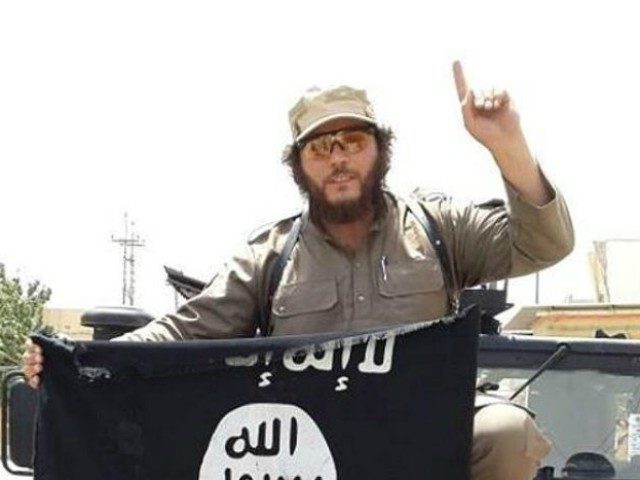
AUSTRALIAN JIHADIST FIGHTER KHALED SHARROUF (TWITTER)

Australia has stripped five Syria-based dual nationals of their citizenship due to their involvement with the Islamic State terrorist group, a government minister said Thursday.

A total of six people have now lost their Australian citizenship since the law was changed in 2015 to enable dual nationals to lose their citizenship rights for actions contrary to their allegiance to Australia, Home Affairs Minister Peter Dutton said.

They join notorious Daesh fighter Khaled Sharrouf (pictured) — who made headlines when he posted a Twitter image of his young son holding a severed head — as the only nationals to be kicked out under tougher anti-terror laws.

[And here is the charming son, holding the pixelated head:

Image result for khaled sharrouf child head

“I can confirm that five more individuals have ceased to be Australian citizens because of their involvement with Daesh offshore,” Mr. Dutton said in a statement.

“Fundamentally, citizenship requires allegiance to this country… these five dual-nationals have been acting against Australia’s interests by engaging with terrorism and have effectively chosen to leave the Australian community.”

The five are all aged in their 20s and 30s. Mr. Dutton provided no further details on their identities but welcomed their exclusion, saying “Australia is a safer place for not having them return.”

Sharrouf, the first Australian national stripped of his passport for Daesh links, was also a Lebanese citizen. He left Australia for Syria in 2013 with his family.

His Australian wife Tara Nettleton, who went with him, has since died and Sharrouf was believed to have been killed in a drone strike in Iraq in 2015.

Under section 35 of the Australian Citizenship Act, a dual national’s Australian citizenship automatically ceases if they act contrary to their allegiance to Australia by engaging in terrorism-related conduct.

This includes those who fight for or who are in the service of a declared terrorist organization overseas. The Islamic State group was declared a terrorist organization for these purposes since May 2016.

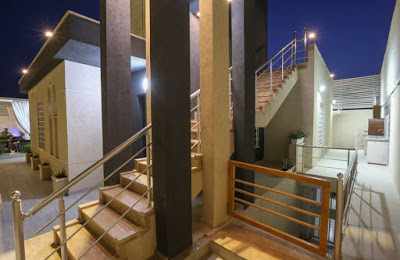
Want a luxury holiday? Go to Gaza!

August 12, 2018

Looks nice to me… but maybe no alcohol…

https://www.facebook.com/whitechalet.co/


Iran has only begun to feel the pain of Trump’s sanctions

August 12, 2018

To the Persian warriors fighting (against the odds) the shiite islamic theocracy: we proudly stand with you and respect your courage and valour.

https://nypost.com/2018/08/06/iran-has-only-begun-to-feel-the-pain-of-trumps-sanctions/

Iran's President Hassan Rouhani

As the Iranian regime reels under the strain of renewed sanctions, the Trump administration is already preparing the next phase.

We see too little of it in our press, but Iranians are increasingly taking to the streets and the clerics’ hold on power is weakening.

And it’s about to get worse for the regime. A new round of US sanctions, announced in advance, kicked in Monday. It restricts currency transfers and bans trade in gold, silver, aluminum, steel and other metals.

Most of the new sanctions have already been factored in, changing the way the world does business in Iran. European politicians, who’ve sanctified President Barack Obama’s nuclear deal, are calling on companies to stay put and do business in Iran, as the seven-party Joint Comprehensive Plan of Action dictates.

But business is business.

After the nuke deal was signed, France’s Renault was eager to position itself for the day all sanctions would be removed, cutting deals to dominate Iran’s car market. Anticipating Monday’s sanctions, however, Renault announced an end to all its Iran businesses in July — even though it sells no cars in America.

Meanwhile, under US pressure, Germany’s central bank last week announced new limits on foreign access to cash, blocking a desperate attempt by cash-strapped Tehran to withdraw 300 million euros ($375 million) from a Hamburg-based Iranian-controlled bank.

European politicians, still bitter over the Trump administration’s decision to pull out of the Iran deal and reimpose sanctions, like to issue defiant press releases. But the American squeeze is working. “We know Iran is increasing activities throughout Europe, and so we must be vigilant,” US Ambassador to Germany Richard Grenell told me Monday.

Buckle up. The next sanctions phase, due in November, will hit Iran’s only viable source of income: oil.

Iran’s oil exports are expected to be halved. Saudis, Russians and Americans will seek to fill the void, making sure Iran, not global consumers, feels the pain.

So you’d think (and the regime had hoped) Iranians would blame America. Instead, striking truck and taxi drivers, workers in faraway dusty towns, environmentalists, women, bazaar salesmen — all blame the regime.

With good reason. Obama’s generous JCPOA-related gifts to the regime, more than $100 billion in cash, never trickled down to the people. The money was spent on regional wars, propping up global terror organizations and lining the pockets of regime bigwigs.

The Iranian people no longer buy the “Great Satan” trope. “Even the bazaaris [who strongly supported the regime] know that impediment to normal life is not international, but domestic,” says Behnam Ben Taleblu, an Iran watcher at the Foundation for Defense of Democracies.

And as protests swell, “many of the enforcers, those who joined the Basij and Revolutionary Guards because it was their only employment option, may also defect and join the uprising,” says the Israeli Farsi broadcaster Menashe Amir. “After all, they’re Iranian too.”

The Western press largely ignores or belittles such tectonic shifts, but the Trump administration doesn’t.

Last month, Secretary of State Mike Pompeo met Iranian-Americans in California, expressing support for the protesters. In a Sunday tweet, he backed “the Iranian people’s right to protest against the regime’s corruption & oppression without fear of reprisal.”

Trump’s strategy — turning to the Iranian people — is a major departure from Obama’s coddling of the clerics. Without declaring it outright, Washington has been encouraging regime change, or at least trying to force an end to the regime’s pursuit of nukes, missiles and Mideast aggression.

Sure, regime change could be chaotic, lengthy and bloody. It could lead to an even more repressive, dictatorial and cruel leadership than the current one. Then again, it may liberate the Iranian people and, more likely, end Tehran’s pursuit of the most dangerous arms and the spread of global violence and terrorism.

“Yes, it’s hard to get worse than the Islamic Republic, but the Mideast is full of surprises,” cautions Ben Taleblu. Yet, he adds, a new regime, “popular and representative, will benefit the Iranian people, the Mideast and the international community.”

The potential risks are dwarfed by ample rewards, so by all means, tighten the screws. On to the next Iran sanctions phase.

Israeli Air Force Gets First-Ever Female Squadron Commander

August 12, 2018

Another proud warrior, standing shoulder to shoulder in the shield wall, at the front line against the forces of hate and evil.

I raise my drink to you, Lieutenant Colonel G.

Israeli Air Force Gets First-Ever Female Squadron Commander

The Israeli Air Force has appointed the first female squadron commander in its 70-year history.

According to Israel’s Channel Two, the commander, who for security reasons is referred to only as “G.,” will be promoted to lieutenant colonel and put charge of the 122nd Squadron, known as “Nachshon.” The squadron is composed of planes specifically geared toward intelligence gathering.

The 34-year-old G. has been active in the Air Force since 2003, and has served in several command positions, including deputy commander of the “Nachshon” Squadron itself.

G. — currently a major — said that she was “happy with the appointment,” which she called “a great privilege alongside a great responsibility.”

“The real work is ahead of me,” she added. “I’m proud to serve in the Air Force.”

Galia Wallach, chairwoman of the Israeli women’s rights organization Naamat, hailed G.’s accomplishment, saying, “We are talking about another goal achieved and we must ensure that it’s not the last. I praise the IDF, the Air Force commander, and especially Lieutenant Colonel G. who won the post through merit and not pity. The IDF sent an important message today to Israeli women — even the skies are not the limit for you.”


Report: US postpones rollout of Mideast ‘deal of the century’

August 8, 2018

http://www.israelhayom.com/2018/08/03/report-us-postpones-rollout-of-mideast-deal-of-the-century/

White House, Arab officials cite congressional elections in November, possible Israeli elections in early 2019 as reasons for delay • Trump administration seeks staff for Middle East policy team under point men Jared Kushner and Jason Greenblatt.

A White House source and senior Arab officials on Thursday said the Trump administration was postponing by several months the rollout of its so-called “deal of the century” to end the Israeli-Palestinian conflict.

The U.S. official said the administration has already decided not to present the peace plan before the congressional mid-term elections on Nov. 6 because certain components of the plan call for Israeli concessions and could harm Republican candidates’ election bids.

The official also said that if Israel goes to elections after the Jewish holidays this September, then the administration would postpone the peace plan even further, as Prime Minister Benjamin Netanyahu would not be able to adopt certain aspects during an election campaign.

Israel’s next election is scheduled for November 2019. But a single party could force early elections by withdrawing from the government coalition. Due to the wide range of views among the coalition parties, Israeli governments rarely complete a full term.

Announcing the peace plan during an Israeli election campaign “would play into the hands of [Habayit Hayehudi Chairman Naftali] Bennett and the administration understands this,” the official said, referring to the politician deemed Netanyahu’s chief rival for the premiership.

“During an election campaign, Netanyahu wouldn’t be able to say ‘yes’ to such ideas. On the other hand, he also can’t say ‘no’ to [President Donald] Trump. It appears, therefore, that the sides would rather play it smart and simply wait until the elections are over, in the U.S. and in Israel,” the official said.

If Israel does not hold elections this year, a window of opportunity for unveiling Trump’s Middle East peace plan would be opened.

Senior Arab officials confirmed to Israel Hayom that the peace plan will likely be delayed by several months, because of assessments in Egypt and Saudi Arabia that Israel will hold elections in early 2019.

The officials said that regardless of the possibility of elections in Israel, the leaders of moderate Arab states, chief among them Saudi Arabia, Egypt and Jordan, sent a joint message to the White House, saying they preferred to wait for the Congressional elections in the U.S. to conclude before the peace plan is presented.

A White House National Security Council official told Israel Hayom, “The release date for the peace plan won’t be determined by political matters in the U.S. or the political situation in Israel, but rather by the date it is completed and when the timing is appropriate.”

Meanwhile, U.S. officials said Thursday that the Trump administration was staffing up the Middle East policy team at the White House in anticipation of unveiling the still largely mysterious peace plan.

Last week, the National Security Council began approaching other agencies seeking volunteers to join the team, which will work under Trump’s Middle East peace point men, Jared Kushner and Jason Greenblatt, the officials said.

The team, which will organize the peace plan’s public presentation and any negotiations that may follow, is to be made up of three units: one concentrating on its political and security details, one on its significant economic focus and one on strategic communications, the officials said.

The establishment of a White House team is the first evidence in months that the plan is advancing. Although Trump officials have long promised the most comprehensive package ever put forward to resolve the conflict, not even a small detail of the emerging plan has been offered by Kushner, Greenblatt or any other official.

The State Department, Pentagon, intelligence agencies and Congress have been asked to detail personnel to the team for six months to a year, according to the officials, who spoke on condition of anonymity.

The agencies declined to comment, but an NSC official said that Kushner, Trump’s son-in-law and senior adviser, and Greenblatt, Trump’s special envoy for international negotiations, “are expanding their team and the resources available as they finalize the details and rollout strategy of the peace initiative.”

White House officials say the plan will focus on pragmatic details, rather than top-line concepts, in a way that will help win public support.

The Palestinian leadership has been openly hostile to any proposal from the Trump administration, saying it has a pro-Israel bias, notably after Trump recognized Jerusalem as Israel’s capital in December and moved the U.S. embassy there from Tel Aviv in May.

Since the Palestinian Authority and its President Mahmoud Abbas broke off contact after the Jerusalem announcement, the U.S. negotiating team has been talking to independent Palestinian experts.

The White House expects that the Palestinian Authority will engage on the plan and has been resisting Congressional demands to fully close the Palestine Liberation Organization office in Washington because Greenblatt and Kushner want to keep that channel open. But officials have offered little evidence to back that up.

Palestinian alienation has continued to grow as millions of dollars in U.S. assistance remains on hold and appears likely to be cut entirely. With just two months left in the current budget year, less than half of the planned $251 million in U.S. aid planned for the Palestinians in 2018 – $92.8 million – has been released, according to the government’s online tracker, http://www.foreignassistance.gov.

The remaining amount is still on hold as is an additional $65 million in frozen U.S. assistance to the U.N. Relief and Works Agency, which provides services to Palestinians in the West Bank, Gaza, Jordan and Lebanon.

In addition, Israel’s response to the plan is far from certain. Although Netanyahu is one of Trump’s top foreign allies, it remains unclear if he will back massive investment in Gaza, which is run by the terrorist Hamas movement.

For the plan to succeed or even survive the starting gate, it will need at least initial buy-in from both Israel and the Palestinians as well as from the Gulf Arab states, which officials say will be asked to substantially bankroll its economic portion. Arab officials have thus far adopted a wait-and-see approach.