Author Archive

Why Iranians are setting their own banks on fire

November 27, 2019

Because they are idiots ruled by numbskulls would be a more succinct reason.

Why Iranians Are Setting Their Own Banks on Fire

Following a hike in gas prices, thousands of Iranians took to the streets in protest on Friday, in some places setting fire to banks and shops. While the regime has shut down the Internet, arrested hundreds, and killed at least a dozen, the demonstrations continue. Ray Takeyh explains what’s behind them, and what they portend:

The Iranian government might gain control of the streets once again, as has happened in the past. But the latest demonstrations reveal an uncomfortable truth for the regime: that the Islamic Republic is increasingly a government without supporters. While the demonstrations have not become as big or sustained as the 2009 “Green Revolution,” in which predominantly middle-class Iranians protested fraud in the presidential election, this current revolt represents a significant uprising by Iran’s working class, which had long been viewed as supportive of the ruling regime.

America today faces a hardline government in Iran that has forfeited much of its legitimacy, which suggests the United States should keep up the sanctions pressure to further weaken the regime’s standing.

The middle classes in Iran have long given up on the theocracy and its contrived political processes. The hardliners’ last pillar of support was thought to be the working class that they relentlessly venerate from their podiums. But the working poor care little about the government’s divine professions and are more interested in the welfare state that is now shrinking. As with the last days of the shah in the late 1970s, the Islamist ruling elite today seem oblivious of all that is crumbling around them. They will persist with involvement in Arab civil wars that the Persians disdain and revamp a nuclear program whose costs are more apparent than its benefits.

While Iran’s most consequential leaders don’t believe sanctions relief is the answer to their economic difficulties, they are wrong. Iran will always remain dependent on the export of oil, and the vagaries of the global economy will inevitably affect its financial vitality. . . . And with economic distress comes an explosive political problem, as the Iranian masses correctly blame their government’s missteps for all their suffering. The challenge for America is to deepen the theocracy’s self-inflicted wounds

Evidence of IAF jamming Syrian air defense systems?

November 27, 2019

Two links here. First one has a 30sec video, and at second link there is a (better) minute long video.

I find it a bit hard to work out what is happening, just looks like dots of light (missiles) going up then coming down… But I am no expert.

Go to the links to see the videos.

And just on the comment at first link about inaction of Russian S-400 missiles, I have read elsewhere that this is because of a deliberate decision by the Russians, as a favour to Israel (in return for something else from Israel, I think maybe Ukraine related? Can’t quite remember exactly).

http://uawire.org/israel-jammed-russian-pantsir-air-defense-systems-during-syria-airstrikes#

There is a logical explanation for the Syrian anti-air defense systems’ failure to repel the Israeli airstrikes earlier this week, and for the complete inaction of the Russian S-400 Triumph missile systems. A key reason is radar jamming by Israel, which has been confirmed by video footage showing Pantsir guided missiles simply self-detonating without hitting their targets. The video has been published by the Russian Telegram channel Gallifreyan Technology.

Israel’s Defense Ministry has not made an official comment on the matter. However, it is noteworthy that the Israeli Air Force used Delilah cruise missiles, which are designed for combat against radar systems and contain radar jamming devices, which lends credibility to the theory.

According to data from several sources, at least eight cruise missiles were fired against targets in the region of the Syrian capital. Of these, only two were shot down, which demonstrated the extremely poor effectiveness of the anti-air defense systems.


http://elderofziyon.blogspot.com/2019/11/amazing-video-of-syrian-anti-missile.html

Here is video of Syrian anti-missile systems being launched against Israeli missiles on targets in Damascus.

You can see that the Syrian missiles often crash into the ground seconds after launch. It appears that Israeli countermeasures include ruining the Syrian missile guidance systems.

IAF does the tetris challenge

November 21, 2019

The Israeli Air Force Takes Part In Tetris Challenge With Fighter Jets, Helicopter And Training Aircraft

Since September 1, 2019, when Zurich police published a photo on social media of two officers lying on the ground, surrounded by the contents of their car, laid out in a geometric pattern and pictured from above, police departments, firefighters, first responders as well as air force squadrons and other military units from all around the world have joined in, photographing their work equipment (and even service members) in this peculiar way.

The Tetris Challenge has since then conquered the Internet making the rounds across all the social networks. The challenge is inspired to the “knolling” a term that dates back to 1987, and it involves organizing objects and tools on the floor at right angles, allowing you to see every item clearly in a photograph. This has often been done ahead of travels, by photographers and journalists, collecting all their stuff in the same place to organize the trip. In the last few weeks, Tetris Challenge has become a way to showcase all the pieces of hardware (and personnel) that make up a service or system.

If you google “Tetris Challenge”, you will find many examples of interesting shots taken from the above. Here you can find an interesting post by our friend Tyler Rogoway at The War Zone.

But, the Challenge, when it deals with military aviation stuff, has probably a brand new winner: the Israeli Air Force.

The IAF has published on Twitter a shot taken by Rotem Rogovsky and Daniel Levatovsky from SKYPRO at Hatzerim Air Base with a Tetris Challenge image that gathers the F-15I Ra’am of the 69 Sq; the F-16I Sufa of the 107 Sq, the M-346 Lavi of the 102 Sq, as well as the G-120A Snunit, the OH-58B Saifan and the T-6A Efroni of the Flight Training Shool. Not only are the aircraft worth a look, but also their accompanying weapons, including the Israeli-developed, SPICE 2000 EO/GPS-guided bombs. Interestingly, even the only airworthy PT-17 (Stearman Model 75) of the Israeli Air Force maintained at the museum in Hatzerim can be seen in the photo.


Off topic: Beaches, bomb shelters and hummus

November 21, 2019

Ex-UFC fighter and now commentator Chael Sonnen was recently in Israel and he loved it.

See his comments here, 6min video.


Carmel: Israel unveils new stealth street-fighting tank

August 14, 2019

Wow, what an awesome vehicle.

Times of Israel also covers this, watch the first video in the article (article not copied into this post but worth a read), and look for the pull-out dividing screens at around the 2min20sec mark. Wow.

Defense Ministry unveils 3 prototypes for Israel’s tanks of the future

https://www.timesofisrael.com/defense-ministry-unveils-3-prototypes-for-israels-tanks-of-the-future/

Carmel: Israel unveils new stealth street-fighting tank

https://nationalinterest.org/blog/buzz/carmel-israel-unveils-new-stealth-street-fighting-tank-72491

Israel has unveiled a new street-fighting tank designed for urban warfare.

The Carmel is a manned but mostly automated vehicle, with Artificial Intelligence controlling many of the tank’s functions. It is the Israel Defense Forces’s response to the lessons of the 2014 Gaza War, where heavy Israeli armored vehicles had difficulty traversing narrow city streets.

The Carmel is a thirty-five ton tracked vehicle with a crew of two. Photos in Israeli media suggest a vehicle that is narrower than a tank, but with a tank-like weapons turret.

“It is almost completely autonomous and highly invisible to enemy radar,” according to the Jerusalem Post. “The platform has breakthrough technologies, including modular transparent armor, next-generation cooperative active protection, an IED alert and neutralization system and a hybrid engine. It is also fitted with tactical drones which can help with surveillance and reconnaissance as well as attack capabilities. The Carmel will also include an entirely new generation of active protection and will allow the two-man crew to operate in closed hatches while still seeing the entire battlefield.

The IDF recently displayed three prototypes during a demonstration in Israel. The Elbit Systems version equips the crew with the IronVision helmet-mounted display, based on helmets developed for F-35 pilots. Rafael’s design features a panoramic console display for 360-degree situational awareness. The Israel Aerospace Industries vehicle uses an Xbox-like joystick.

The IDF emphasized that the Carmel is not a tank. “It’s something totally different than a tank,” said Brigadier General Guy Hasson, chief of the Israeli Armored Corps. “It’s a platform that is totally new.”

What’s interesting is how the Carmel uses—and doesn’t use—AI. Meir Shabtai, an Israel Aerospace Industries robotics manager, told the Post that the Carmel is the “the next generation of combat vehicles” that can autonomously maneuver as well as detect and engage targets at long range.

“The amount of information that a human can understand is limited, so the platform provides the operator only what he needs,” Shabtai said. The vehicle can take the decision to fire at targets and “allow the operator to deal with what he needs to focus on.”

But as Israel’s Ynet News pointed out, the IDF is not choosing to develop a fully robotic tank. “Israel’s plans for its semi-automated armored vehicles shows it intends to keep soldiers at the controls, albeit entirely insulated from the outside thanks to artificial intelligence and smart screens fed by external cameras and sensors,” Ynet noted. IDF officials say that it may be thity years before Israel can deploy a fleet of fully robotic armored vehicles.

But AI or not, the Carmel illustrates the future of armored vehicles. Growing urban sprawl and the rise of “megacities” are making urban combat the norm in warfare. Big, heavy tanks like the M-1 Abrams and T-72 are awkward platforms moving through narrow streets.

The trend is toward developing smaller vehicles armed not with a single big cannon designed to take out tanks, but lighter-caliber weapons. Russia’s Terminator 2 is a T-72 armed with 30-millimeter cannon, grenade launchers and anti-tank missiles. It’s meant to be a combat support tank that assists infantry and regular tanks with firepower, especially in urban areas.


IAEA finds traces of radioactive material at Iran site flagged by Netanyahu

July 12, 2019
Well this took a whole lotta time to come out.

Gotta love Bibi’s sense of humour but.

10 months after PM identified ‘secret atomic warehouse’ in Tehran, UN inspectors reportedly conclude that it was indeed used as a nuclear storage facility

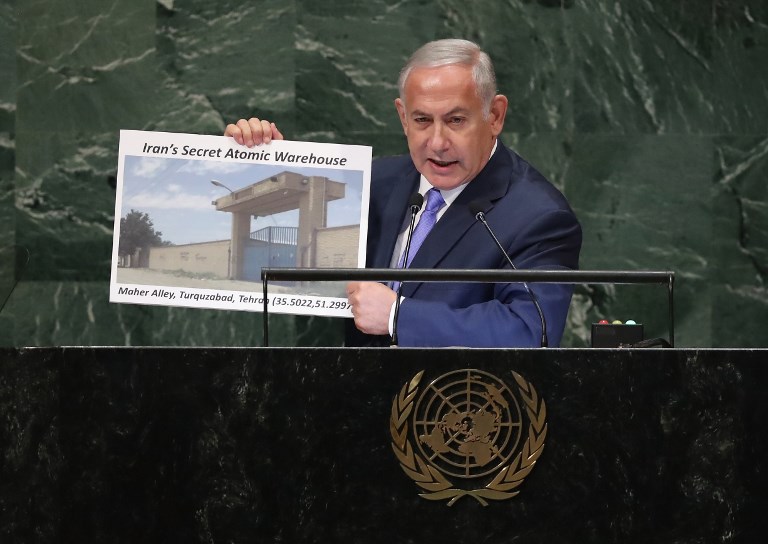
Benjamin Netanyahu addresses the United Nations General Assembly on September 27, 2018 in New York City, and holds up a picture of what he said was a secret Iranian nuclear warehouse. (John Moore/Getty Images/AFP)

Benjamin Netanyahu addresses the United Nations General Assembly on September 27, 2018 in New York City, and holds up a picture of what he said was a secret Iranian nuclear warehouse. (John Moore/Getty Images/AFP)

Inspectors from the UN’s nuclear agency have found traces of radioactive material at a building in Tehran that Prime Minister Benjamin Netanyahu identified last year as a “secret atomic warehouse,” an Israeli television report said on Thursday.

Inspectors from the International Atomic Energy Agency visited the site several times after Netanyahu identified it in an address to the UN General Assembly last September, took soil samples, and have now definitively concluded that there were “traces of radioactive material” there, Channel 13 news reported.

It quoted what it said were four senior Israeli officials involved in the matter, and said the UN agency’s findings had become known to these officials recently.

Iran has denied that the site was a nuclear facility or served any secretive purpose. In an initial response to Netanyahu’s UN speech, Iranian state media claimed the warehouse was actually a recycling facility for scrap metal.

But the IAEA inspectors, who last visited the site in MARCH, have reached a “definitive conclusion” that “there were traces of radioactive material” there, Channel 13 said, and are currently preparing a report on the matter.

The TV report noted that “the storing of radioactive material in a secret facility without informing the IAEA is a breach of the Treaty on the Non-Proliferation of Nuclear Weapons [NPT], to which Iran is a signatory.”

Indicating that Washington is also aware of the IAEA inspectors’ findings, the TV report said that Israel and the US expect the agency to issue a public report on the matter shortly.

Coincidentally or otherwise, Netanyahu spoke on Wednesday by phone with US President Donald Trump about Iran. “The two leaders discussed cooperation between the United States and Israel in advancing shared national security interests, including efforts to prevent Iran’s malign actions in the region,” the White House said.

Speaking at the United Nations last September, Netanyahu called on the IAEA to inspect what he said was the “secret atomic warehouse” in the Iranian capital.

He claimed some 15 kilograms (33 pounds) of radioactive material had been recently removed from the atomic warehouse and squirreled away around Tehran, endangering the capital’s residents. The site may have contained as much as 300 tons of nuclear-related equipment and material in 15 shipping containers, Netanyahu added. He did not specify what nuclear material was contained at the site.

Netanyahu specified that there was a rug-cleaning business nearby: “Like the atomic archive [revealed by the prime minister in April], it’s another innocent-looking compound. Now, for those of you at home using Google Earth, this no-longer-secret atomic warehouse is on Maher Alley, Maher Street. You have the coordinates, you can try to get there. And for those of you who try to get there, it’s 100 meters from the Kalishoi, the rug cleaning operation. By the way, I hear they do a fantastic job cleaning rugs there. But by now they may be radioactive rugs.”

He added: “Now, countries with satellite capabilities may notice some increased activity on Maher Alley in the days and weeks ahead. The people they’ll see scurrying back and forth are Iranian officials desperately trying to finish the job of cleaning up that site. Because, you see, since we raided the atomic archive, they’ve been busy cleaning out the atomic warehouse.

“Just last month, they removed 15 kilograms of radioactive material,” he went on. “You know what they did with it? They had 15 kilograms of radioactive material, they had to get it out of the site, so they took it out and they spread it around Tehran in an effort to hide the evidence. The endangered residents of Tehran may want to know that they can get a Geiger counter on Amazon for only $29.99… They took this radioactive material and spread it around Tehran.

“Now, the Iranian officials cleaning out that site still have a lot of work to do because they’ve had at least, at least 15 ship containers, they’re gigantic, 15 ship containers full of nuclear related equipment and material stored there. Now, since each of those containers can hold 20 tons of material, this means that this site contains as much as 300 tons, 300 tons of nuclear related equipment and material.”

That speech came months after Israel’s disclosure that it had spirited away what it said was a “half-ton” of Iranian nuclear documents from Tehran, with Netanyahu saying both the archive and the warehouse were proof that Iran continues to seek atomic weapons despite the 2015 international agreement to limit its nuclear program. “Iran has not abandoned its goal to develop nuclear weapons…. Rest assured that will not happen. What Iran hides, Israel will find,” Netanyahu told the UN.

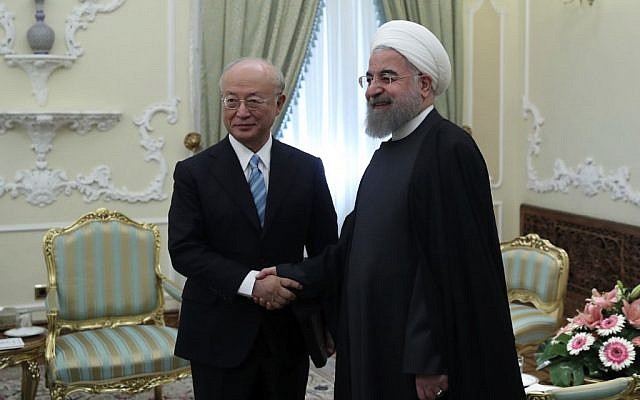
Following Netanyahu’s UN appearance, IAEA head Yukiya Amano said nuclear inspectors had visited “all the sites and locations in Iran which it needed to visit,” while pushing back against the prime minister’s assertion that the organization had failed to act on intelligence provided by Israel on the warehouse.

Diplomats quoted in April, however, said the IAEA visited the site in Tehran’s Turquzabad district multiple times the previous month. They said tests were underway on environmental samples taken from the facility in order to determine if nuclear materials were present there. It was said then that results could be ready by June.

“We have nothing to hide and any access given to the IAEA so far has been in the framework of laws and regulations and nothing beyond that,” an Iranian official said at the time.

Referring to Netanyahu’s statements as “ridiculous,” an Iranian state TV report said the country was committed to nonproliferation and noted Iran’s nuclear program was under surveillance of the IAEA. A state TV website briefly reported the Netanyahu accusation and called it an “illusion.”

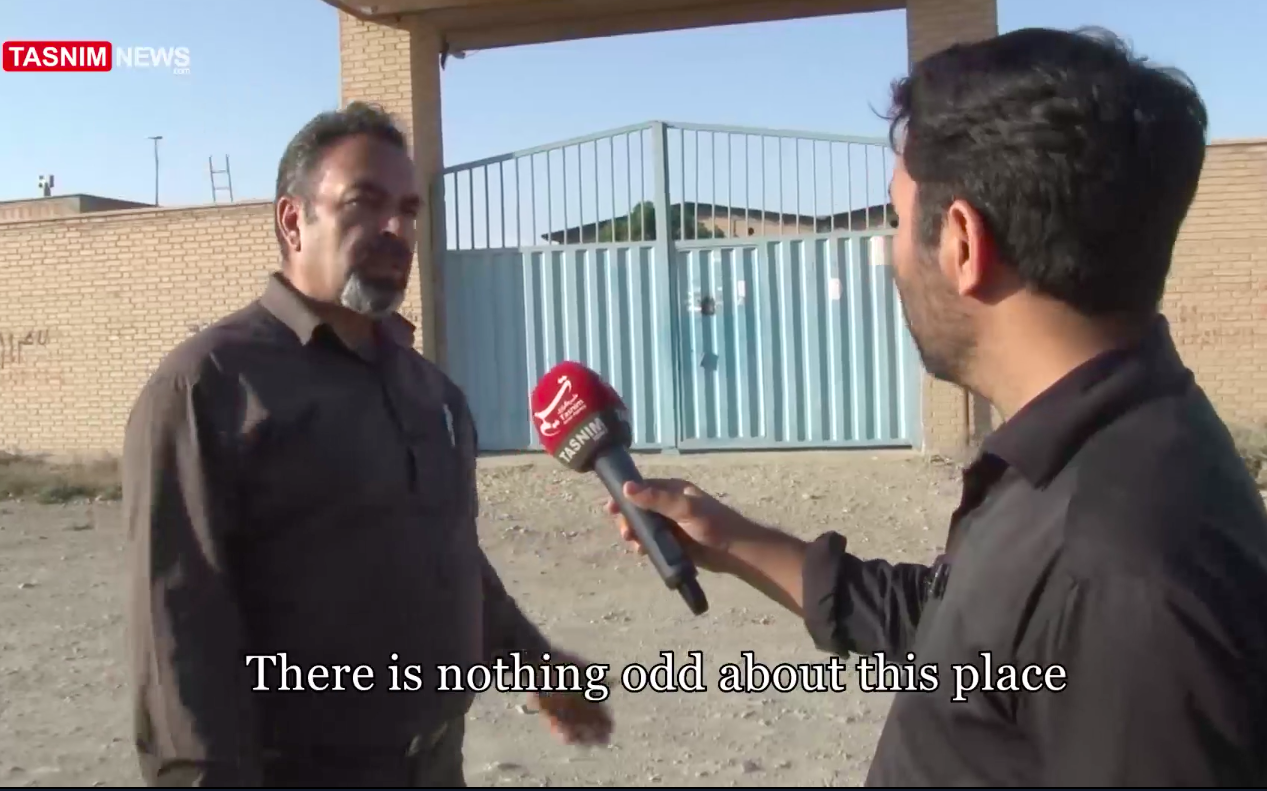
A Tasnim News reporter who visited the warehouse last October was told by a worker from inside the facility that it was not a military site, and that the Israeli leader was “a stupid person” for believing it was a nuclear warehouse. The reporter did not enter the facility, only speaking to the worker via intercom from outside the locked gate.

The owner of the nearby carpet cleaning business told Tasnim “there was nothing out of the ordinary” about the warehouse, and asserted that Netanyahu was fed disinformation to “make him a fool.”

Netanyahu was a vocal opponent of the 2015 nuclear deal with Iran when it was signed under Trump’s predecessor Barack Obama, arguing that it would not stop but only delay Iran’s nuclear weapon program, while removing sanctions critical to curbing Tehran. He praised Trump for withdrawing from the accord in May.

Iran has denied it is seeking atomic weapons, while warning it would walk back its commitment to the nuclear accord if it does not receive economic inducements from its remaining signatories — Britain, France, Germany, Russia and China. In recent days, it has breached the accord’s cap on uranium enrichment levels.

Agencies contributed to this report.

Herman Wouk and Jewish Tradition

May 20, 2019

Coverage in the Aussie media here:

https://www.theherald.com.au/story/6131333/us-author-herman-wouk-dead-at-103/?cs=7594

Interesting article below.

May his memory be a blessing.

https://www.aish.com/jw/s/Herman-Wouk-and-Jewish-Tradition.html?s=mm

Herman Wouk, the Pulitzer Prize winning and bestselling author, has died at the age of 103, just ten days short of his 104th birthday. His long career spanned a tumultuous time in American Jewish history, as many first and second generation Jews assimilated and shed their Jewish identities.

Throughout it all, Wouk was a passionate spokesman for Jewish rituals and lifestyle, introducing many Jews and non-Jews to the beauty of a Jewish life and helping traditional Judaism go mainstream. His book This Is My God was a must-read for searching Jews finding their way back to Jewish observance.

Wouk was born in New York in 1915; his parents Esther and Abraham Wouk were religious Jewish immigrants from Belarus who raised their three children with a deep love of being Jewish. Following college at Columbia University, Wouk worked as a comedy sketch writer, then joined the navy after the attack on Pearl Harbor, serving with distinction. He later said that soldiers from all over the United States changed him, giving him a better understanding of his country and the people in it. Soon, he became a part of the fabric of American culture himself, bringing Jewish experiences into the mainstream American experience.

His novel Marjorie Morningstar was published in 1955 and became a runaway bestseller, selling three million copies in the US alone. It featured Marjorie, a Jewish American woman who tries to become an actress, shedding much of her Judaism and conventional family life along the way. At the end of the novel, after many disappointments, Marjorie realizes what will truly make her happy, settling for a much more sedate lifestyle, marrying a Jewish husband and raising children. The novel was one of the first to describe an attractive, typical character who was also Jewish, and broke new ground in describing Jewish traditions and rituals such as a Passover Seder in a popular book.

When Marjorie Morningstar was made into a movie starring Natalie Wood in 1958, it was the first American film since The Jazz Singer in 1927 to depict Jewish rituals on screen, making Jewish observance acceptable to a new generation of theatre-goers.

Wouk was prolific, writing over two dozen novels, including such wildly popular works as The Caine Mutiny in 1951 and The Winds of War in 1971. He wrote several books about World War II, the Holocaust, and the state of Israel. One of his favorite books, however, was non-fiction: This is My God, first published in 1959. At a time of widespread assimilation, Wouk wanted to explain traditional Judaism to a wider audience. His book described Jewish tradition, including keeping kosher, the Jewish holidays, and milestones such as brit milah and weddings. He wanted, he wrote, to give Jews “permission to believe” in a religion that was often seen as old fashioned and irrelevant. For years, This is My God was a popular bar mitzvah gift and was widely read by both Jews and non-Jews.

In describing a typical American Jews of the time, Wouk wrote “his grandparents were fairly religious, his parents much less so and he is wholly indifferent”. This assimilated American Jew is well educated, has a good job, and is good-hearted and pleasant – but is also intensely ashamed of being a Jew. Wouk’s book was his attempt to change that, to show the beauty and majesty of the Jewish faith, and to encourage readers to see themselves as part of a proud tradition and wider Jewish community.

In the 1988 editions of the book, Wouk noted “if I were to write it afresh now, the book would have a more intensely Jewish tone. In 1959 I was preoccupied with proving that an educated Westerner could live a traditional Jewish existence, not only without any intellectual sacrifices, but much to his enrichment. Today, I take that for granted.”

Within the period of high assimilation rates in the 1950s, 1960s and 1970s, however, Wouk stood out as a proud defender of Jewish tradition and identity. In 1955 he was featured on the cover of Time magazine, and he talked about his return to the traditional Jewish lifestyle with which he grew up. It was an unpopular position at the time but Wouk was adamant that he wouldn’t compromise his Jewishness, even if it seemed unfashionable. “He is a devout Orthodox Jew who had achieved worldly success in worldly-wise Manhattan,” the Time article explained, “while adhering to dietary prohibitions and traditional rituals which many of his fellow Jews find embarrassing.”

Indeed, Wouk lived a glamorous life, with homes in Manhattan, the US Virgin Islands, and Fire Island off the coast of New York. He dressed well and was well-spoken in interviews. The fact that he also maintained Jewish traditions was proof to some that American Jews could be educated and successful and also be religiously observant and proud of their Jewishness. He was married to the same woman, Betty Sarah Brown, for 66 years, until her death in 2011. They had three children, two of whom survive him, as well as three grandchildren and two great grandchildren.

Wouk’s life, like that of American Jews as a whole, was one of evolution. Towards the end of his life Wouk seems to have become even more religiously observant, studying the Talmud every day and helping to establish Jewish study groups near his various homes. In later years, he also taught weekly Talmud classes.

Many of Wouk’s books remain popular. Yet his greatest legacy might be his intense pride in his Jewishness – and his encouragement to other Jews to be proud as well. In 1988, Wouk recalled a meeting he’d had years earlier with David Ben Gurion, the first Prime Minister of Israel.

“Ben Gurion said to me in his office,” Wouk recalled, “the wise, tough old builder of Israel, with the floating white hair of a dreamer and the hard jaw of an army general – ‘You Jews in the United States are different from any Jewish community that has ever existed. You are not strangers or no more strangers than anyone else in your land. America consists of immigrants. You belong like the rest, and you will prosper. But how will you survive as Jews?’

“Without thinking,” Wouk recounted, “I answered, ‘Through the religion’.”

That devotion to Judaism and Jewish tradition maintained Wouk throughout his long life, and continues to inspire us with his works and his example. May Herman Wouk’s memory be a blessing for us all.

Weird ways Israel won its war of independence

March 23, 2019

Some good viewing.

Has the “Arab Spring” reached Gaza?

March 23, 2019

Here’s hoping its popcorn time…

Has the “Arab Spring” Reached Gaza?

Has the “Arab Spring” Reached Gaza?

  • Hamas has failed in its attempts to silence media coverage of the protest demonstrations in Gaza against the rising cost of living and the demonstrations continue.
  • In these demonstrations, which began March 14, 2019, Gaza residents were directing their anger towards the Hamas regime, rather than Israel.
  • The demonstrations are led by an independent youth movement called “We Want to Live!,” which receives widespread public support and support from PLO factions. The “We Want to Live” movement is an independent youth movement that has nothing to do with any political body and was established against the background of the increase in taxes imposed by Hamas on the population and on the unemployment rate among the younger generation, which stands at 69 percent.
  • Hamas security forces carried out dozens of arrests throughout the Gaza Strip, arresting demonstrators who took part in the protests of the “We Want to Live” movement.
    In the Gaza Strip, there is already talk that the “Arab Spring” has reached the Gaza Strip and that Hamas attempts to divert internal and international attention from the demonstrations by firing two M-15 Fajr rockets at Tel Aviv has failed.

Hamas has failed in its attempts to silence media coverage of the protest demonstrations in Gaza against the rising cost of living. Despite Hamas’ efforts, these demonstrations continue.

The demonstrations are led by an independent youth movement called “We Want to Live!” [bidna naish, in Arabic], which receives widespread public support and backing from PLO factions.

By the end of the week of March 17, 2019, Hamas security forces had carried out dozens of arrests throughout the Gaza Strip, detaining demonstrators who took part in the protests of the “We Want to Live” movement. Several journalists covering the demonstrations were also arrested.

The demonstrations began on March 14, 2019, in protest against the rising cost of living in the Gaza Strip. But Gazan residents were directing their anger toward the Hamas regime. Hamas security forces dispersed the demonstrators with gunfire and clubs, especially in the central demonstrations in the Jabalya refugee camp and Deir al-Balah.

The Palestinian Center for Human Rights reported on March 16, 2019, that the demonstrations against the cost of living took place in the Jabalya, Al-Bureij, and Nuseirat refugee camps and the cities of Khan Yunis and Rafah, and that these protests were forcibly dispersed by Hamas security forces.

The director of the Center for Human Rights, Jamil Sarhan, and another lawyer named Bahar al-Turkhamani were beaten by Hamas police.

The anger of the residents of the Gaza Strip is increasing due to the difficult economic situation, taxes, which Hamas has imposed, as well as rising unemployment. Hamas is also suffering from severe financial distress, as the first anniversary of the “March of Return” approaches on March 30, 2019.

Many in the Gaza Strip saw the first year of the Hamas-initiated march as a failure because the campaign failed to break the Israeli blockade on the Gaza Strip as Hamas promised, despite more than 100 fatalities and the thousands of casualties.

The Background to the Current Wave of Protest

According to sources in the Gaza Strip, the “We Want to Live” movement is an independent youth movement that has no ties to any political body and was established against the background of the increase in taxes imposed by Hamas on the population and on the unemployment rate among the younger generation, which stands at 69 percent.

Gazans say that Hamas is increasing taxes to build up the organization’s revenues. Those who are suffering the most in Gaza are the residents who are not affiliated with the organization and do not receive services from Hamas institutions.

According to residents’ testimonies, Hamas imposed taxes on medical treatment in hospitals and on surgeries, even on those people who already paid for medical insurance. The taxes on vehicle licensing were also raised, and a tax of NIS 200 was imposed on all goods weighing more than a ton.

Hamas also increased the tax on goods smuggled from Egypt into the Gaza Strip through the tunnels. A pack of “Royal” cigarettes, which were sold for 4 NIS (New Israeli Shekels), now cost between NIS 26 and NIS 30.

The PLO Factions Support the Protest

Representatives of all the Palestinian factions met on March 16, 2019, in the offices of the Popular Front in Gaza Strip to discuss the latest developments and the violent clampdown on the demonstrations. Hamas and Islamic Jihad organizations boycotted the meeting.

At the end of the meeting, the participants issued a statement in support of the youth movement holding the demonstrations.

The following decisions were announced:

  • Opposition to all forms of suppression of the protests and against any violations of the human rights of demonstrators.
  • Calls upon Hamas to punish anyone who attacked the demonstrators and issue an apology to them, and to withdraw all its security personnel from the streets.
  • Support for the just demands of the demonstrators.
  • Calls upon Hamas to stop all types of taxes on goods and to introduce price controls.
  • Calls upon Egypt to renew the reconciliation process.

Fatah leader Muhammad Dahlan, who has good relations with the Hamas leadership in the Gaza Strip, called on the Hamas leadership to stop all forms of oppression and the use of force against the “cost of living” demonstrators. He also called on Egypt to intervene and secure a Palestinian national agreement.

These developments are in accordance with the Ramallah-based Palestinian Authority and its head, who is encouraging these protests. Two years ago, on the advice of Palestinian Intelligence Chief Majed Faraj, Palestinian Authority Chairman Mahmoud Abbas decided to impose sanctions on the Gaza Strip and worsen the situation there to make the economic situation so dire that Gazan residents would rebel against Hamas.

Senior Fatah official Hussein a-Sheikh said at the end of the week that the Palestinian leadership is in contact with influential Muslim countries to pressure the Hamas movement into stopping the oppressive tactics used against innocent civilians demanding a dignified lifestyle and the abolition of illegal taxes. Palestinian Authority sources reported that Abbas appealed to Egypt and Qatar to exert influence on Hamas to stop suppressing the demonstrators.

Fatah spokesman Osama al-Qawasmeh appeared on official Palestinian television and called on demonstrators to continue their demonstrations: “Our message is to our heroes who are fighting Hamas militias in the Gaza Strip, because the road to Jerusalem begins with a revolution against tyranny. We in the Fatah movement stand with you, and we will always be loyal to you.”

Where Are Things Headed?

In the Gaza Strip, there is already talk that the “Arab Spring” has reached the Gaza Strip and that Hamas attempts to divert internal and international attention from the demonstrations by firing two M-75 Fajr rockets at Tel Aviv had failed.

The phenomenon of the “Arab Spring” began in Tunisia in 2011, after a vegetable vendor named Mohammed Bouazizi set himself on fire in the city of Sidi Said. Now, Gazans are following Bouazizi’s example in the Gaza Strip.

Ahmed Abu Tahn, 32, a resident of the Gaza Strip, set himself on fire on March 16, 2019, to protest the rising cost of living, after being expelled from his home when he could not afford the rent.

The violent repression and arrests of demonstrators by Hamas members are considered a “black stain” on the organization, which is losing its popularity in the Gaza Strip.

Israel’s Bombing of Hamas Targets Won Hamas no Fans
The protests against Hamas began again at the end of the week, even after the bombing of Hamas targets by the Israeli Air Force. According to sources in the Gaza Strip, these protests are supposed to continue, in light of the wave of arrests of demonstrators carried out by Hamas and the public support received by the demonstrators from Palestinian factions affiliated with the PLO.

At the same time, Hamas began to withdraw its supporters from demonstration areas of the “We Want to Live!” movement, so that Gazans would protest against the Palestinian Authority and hold the PA’s leaders to blame for the difficult economic situation.

Of course, Israel will soon again be blamed for the humanitarian crisis in the Gaza Strip.

Attorney Fahmi Shabaneh, a former senior Palestinian intelligence official in the West Bank, told Hamas paper Al-Risala on March 16, 2019, that the PA security forces were encouraging instability in the Gaza Strip, were paying money to transport people to demonstrations, and were taking advantage of the difficult economic situation. “Once an agreement is reached between Israel and Hamas, everything will end,” Shabaneh says.

A day in the life of a Israeli Navy Soldier

March 23, 2019

A video for Joseph…