Author Archive

Israel’s unique methods against the Iranian threat

August 4, 2020

The author makes what really are speculative statements as if they were accepted facts (like bold bit), but anyway…

https://www.jpost.com/opinion/israels-unique-methods-against-the-iranian-threat-637148

The brilliance in Israel’s alleged reactions lay in how they have managed to face Iran on a number of fronts: in Iran, in Syria and in Lebanon.
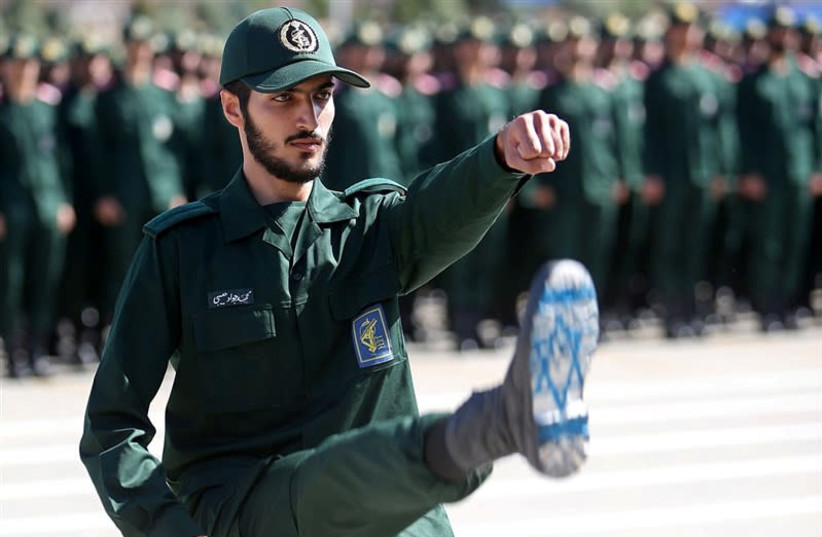
An Iranian Officer of Revolutionary Guards, with Israel flag drawn on his boots, is seen during graduation ceremony, held for the military cadets in a military academy, in Tehran, Iran June 30, 2018 (photo credit: TASNIM NEWS AGENCY/HANDOUT VIA REUTERS)

For the better part of the 21st century, Israel has been trying to circumvent Iran’s regional ambitions in the Middle East to become a nuclear state and spread its military power to neighboring countries. By exploiting the disarray in Syria, Iran routinely sends convoys through Syria to arm its Lebanese proxy, Hezbollah, with precision-guided munitions (PGMs) and other equipment.
Israel has reacted by launching a political and military campaign. Usually it was the political effort that was very public while the intelligence and military activities occurred behind the scenes, however, in the past week or so we have seen a number of mysterious explosions in Iran. It is hard not to see Israeli (and American) fingerprints all over these incidents.
Israel’s intelligence is known to execute audacious missions around the world using creative methods. Look no further than breaking into and smuggling out the secret Iranian nuclear archives in 2019. 
The brilliance in Israel’s alleged reactions lay in how they have managed to face Iran on a number of fronts: in Iran, in Syria and in Lebanon. Each one of them is a unique peril in and of itself, but together they comprise the big Iranian threat. Instead of applying a blanket rule for combating Iran, the Israelis broke down its military campaign into smaller components and used its flexibility and creativity to address each one in a unique form.
Israel’s target in Syria is not a Syrian sovereign one, rather it is an independent Iranian actor functioning in Syria. Israel has conducted numerous airstrikes to avoid shipments of Iranian strategic weapons from entering Lebanon. Many times, the Israel Air Force must hit a moving target while avoiding any collateral damage by inadvertently hitting Syrian state assets.
In Iran, though, Israel’s tactics are different. When facing the nuclear program in Iran, Israel is facing a sovereign country. In Iran, it is Iranian assets that are on the Israeli radar.
At first it was Iranian scientists who were disappearing mysteriously. Now Israel has shifted to exploding non-human assets: nuclear-related sites. In this case, Israel is not exercising any military option or airstrike, it is the clandestine work of the Mossad planting explosives in various locations.
Lastly, and perhaps the most unique challenge, is Hezbollah in Lebanon. Hezbollah is neither a sovereign nor independent actor. It is a semi-governmental organization.
This is why Hezbollah can be a complex and tricky actor to handle. Recognizing this, Israel has not been exhausting its military and intelligence resources against Hezbollah, using a combination of political and financial pressures.
Israel has been applying pressure on many countries to recognize Hezbollah’s political and military arms as a single terrorist organization. By doing so, it would allow financial sanctions on Hezbollah.
At the same time, there is an effort to expose Hezbollah’s revenue stream and dry up those sources of money and disrupt the flow of cash. This requires close cooperation and coordination between legal and financial agencies in a number of countries.
Whether through military, intelligence, political or financial pressure, the extent of the Iranian threat is so great, any options are welcomed. Any opportunity a country has to weaken Iran is an opportunity worth exploring.
The complexity of Iran’s network runs through sovereign, independent and semi-governmental actors. Israel has identified and deployed different methods to tackle the various threats in the Iranian value chain. It is now our time to join Israel in recognizing the full extent of Iran’s threat to the Middle East and the world.
The world must unite in extending the United Nations arms embargo on Iran later this year and not allow Russia or China to exercise their veto powers in the UN Security Council.
The writer is the director of the Project for Israel’s National Security at the Endowment for Middle East Truth (EMET), an unabashedly pro-Israel and pro-American think tank and policy institute in Washington, DC. He formerly served as the international adviser to Yuval Steinitz, a member of Israel’s security cabinet and its energy minister. 
Iran Faked the Satellite Images They Released

August 4, 2020

Ha ha ha, losers.

Iran Faked the Satellite Images They Released

Image

The Islamic Republic of Iran has just added satellite images to its latest portfolio of fake news.

In a message to the United States, Iran’s Islamic Revolutionary Guard Corps (IRGC) released the first images of the NOOR-1 satellite launched into space last April.

Tehran claimed the photos were pictures of an American base in Qatar. As with most good lies, they had a grain of truth.

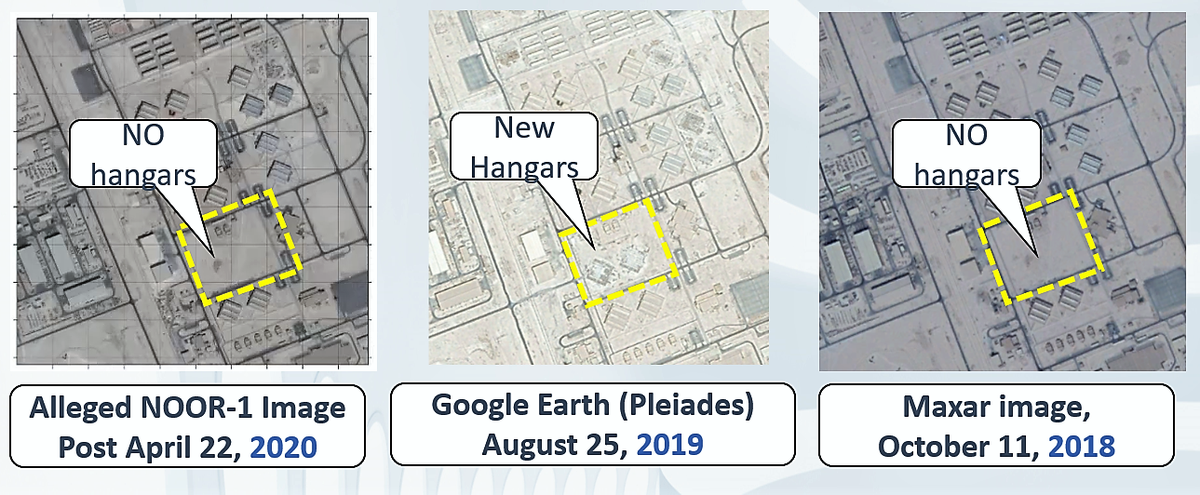
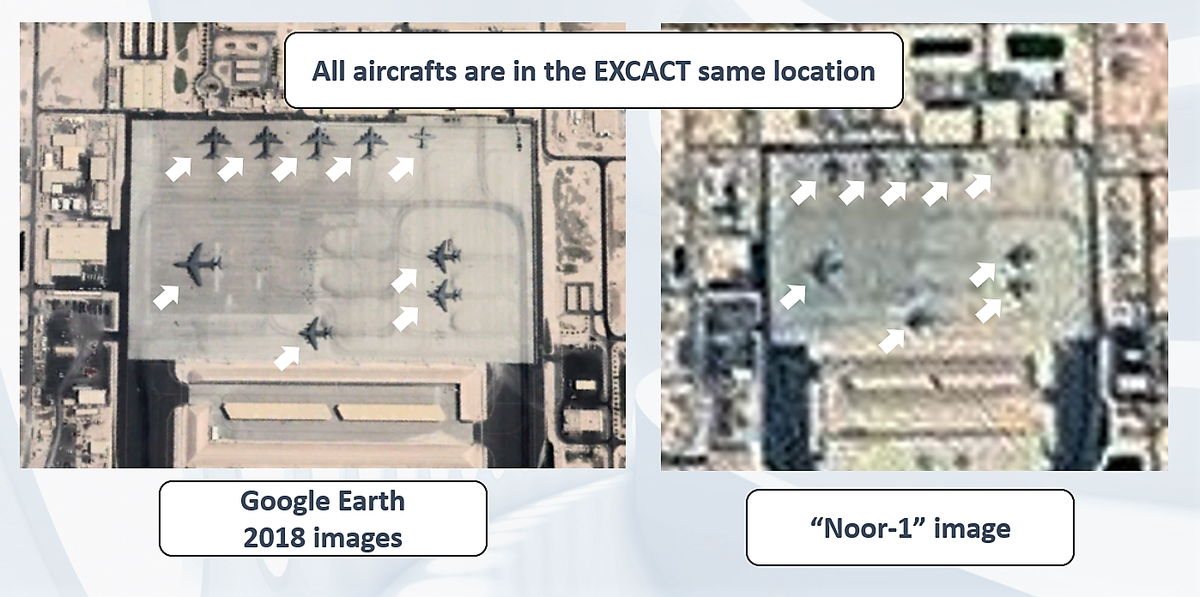
Two of the images were faked: one was from the US Maxar satellite company and another was from Google Earth. Both were from 2018, according to Israeli UAV and space expert Tal Inbar.

So they were satellite images of the US airbase in Qatar, just not an Iranian satellite’s images, as the regime claimed, nor were they recent images either.

In the stolen Maxar image, the recently built hanger bases are missing. In the appropriated Google Earth images, the aircraft are in the exact same place they were two years ago.

Take a look.

Image


Iran fires ballistic missiles from underground for 1st time, during major drill

July 31, 2020

https://www.timesofisrael.com/iran-fires-ballistic-missiles-from-underground-for-1st-time-during-major-drill/

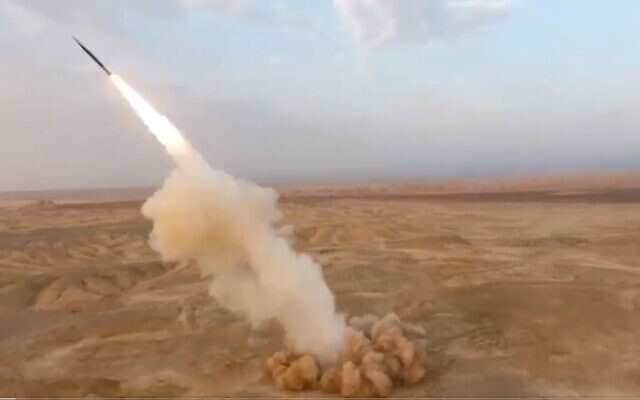
Screenshot from footage of what Iran says was the unprecedented launch of a ballistic missile from underground, July 29, 2020 (Twitter)

TEHRAN, Iran (AP) — Iran’s paramilitary Revolutionary Guard launched underground ballistic missiles for the first time, as part of an exercise involving a mock-up aircraft carrier in the Strait of Hormuz, state television reported Wednesday.

It was the latest barrage in a drill that the previous day saw two American bases temporarily go on alert over the launches.

Drone footage captured by the Guard showed two missiles blasting out from covered positions in what appeared to be a desert plateau in central Iran, with debris flying up in the air in their wake.

The launches took place on Wednesday, said Gen. Amir Ali Hajizadeh, the head of the Guard’s aerospace division. He told state television it was first time the Guard had done this, though the paramilitary force is known to have vast underground bases hiding its ballistic missile arsenal.

Separately, drones targeted the bridge of the fake aircraft carrier, according to the state TV report. The broadcaster did not immediately air footage of the launches or the drone attack, nor did it identify the missiles used in the drill.

However, the drill clearly meant to send a message to the United States.

A semiofficial news agency close to the Guard published a graphic overnight that photoshopped the image of an American carrier into the shape of a casket with a set of crosshairs on it, with a caption quoting Supreme Leader Ayatollah Ali Khamenei pledging to seek revenge for the US drone strike that killed a top Iranian general in January.

The drill — and the American response to it — underlined the lingering threat of military conflict between Iran and the US after a series of escalating incidents last year led to the January drone strike. Tehran responded to that strike by firing ballistic missiles that wounded dozens of American forces in Iraq.

While the coronavirus pandemic has engulfed both Iran and the US for months, there has been a growing confrontation as America argues to extend a years-long UN weapons embargo on Tehran that is due to expire in October. A recent incident over Syria involving an American jet fighter approaching an Iranian passenger plane has also renewed tensions.

Iranian commandos fast-roped down from a helicopter onto the replica in the footage aired Tuesday from the exercise called “Great Prophet 14.”

Anti-aircraft guns opened fire on a target drone near the port city of Bandar Abbas.

State television footage also showed a variety of missiles being fired from fast boats, trucks, mobile launchers and a helicopter, some targeting the fake carrier. A commander said the Guard, a force answerable only to Khamenei, planned to fire “long-range ballistic missiles” as well during the drill that continued Wednesday.

Ballistic missile fire detected from the drill resulted in American troops being put on alert at Al-Dhafra Air Base in Abu Dhabi in the United Arab Emirates and Al-Udeid Air Base, the forward headquarters of the US military’s Central Command in Qatar, the military said. Troops sought cover during that time.

“The incident lasted for a matter of minutes and an all clear was declared after the threat … had passed,” said US Army Maj. Beth Riordan, a Central Command spokeswoman.

Both bases are hundreds of kilometers away from where Iran put the replica aircraft carrier.

Al-Dhafra also is temporarily home to five French-built Rafale fighter jets on their way to India for that country’s air force.

Other footage from the exercise aired by Iran’s state television showed fast boats encircling the mock-up carrier, kicking up white waves in their wake.

While Iran’s naval forces are dwarfed by the US Navy, its commanders practice so-called “swarm” tactics aimed at overwhelming the US carriers that pass through the strait on their way in and out of the Persian Gulf.

It wasn’t immediately clear if all the footage was from Tuesday, as one overhead surveillance image that appeared to be shot by a drone bore Monday’s date. The exercise had been expected as satellite photos released Monday showed the fake carrier being moved into place by a tugboat.

A black-and-white satellite photo taken Tuesday by Colorado-based firm Maxar Technologies showed damage to the replica’s bow and several of its fake jet fighters.

Explosion in Iran’s Kermanshah province, no casualties reported – Mizan

July 31, 2020

Looks like a serious blaze

https://www.jpost.com/breaking-news/explosion-heard-in-western-iran-report-636581

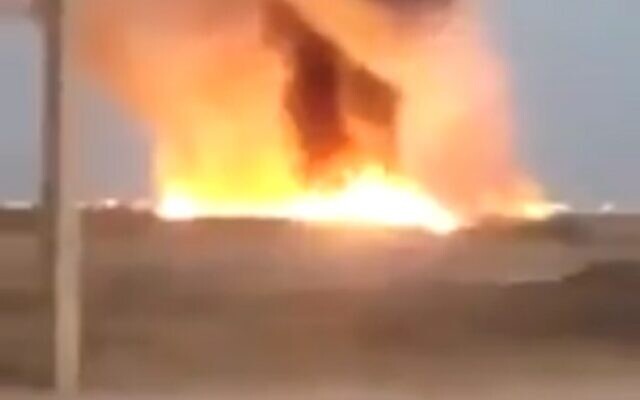
An explosion has set a fuel tank on fire in Iran’s western province of Kermanshah on Tuesday, Iran’s Mizan news agency reported, in the latest in a series of fires and explosions, some of which have hit sensitive sites.

“An explosion in a fuel tank occurred in Dolat Abad industrial area parking area,” Mizan said, but there were no reports of casualties.
Iran’s Student News Agency ISNA said six fuel tanks were exploded that caused a major fire in the area. A video of the incident published by Mizan showed plumes of dense black smoke billowing into the air.
“Some 100 firefighters are trying to contain the fire in the area. There were no casualties but some people were injured,” the deputy head of Kermanshah’s fire department, Keyvan Maleki, told ISNA, adding that authorities were investigating the cause of the explosion.

There have been several explosions and fires around Iranian military, nuclear and industrial facilities since late June.

Was there another ‘mysterious’ explosion on Iran’s Qeshm Island?

July 28, 2020

https://www.jpost.com/middle-east/was-there-another-mysterious-explosion-on-irans-qeshm-island-636371

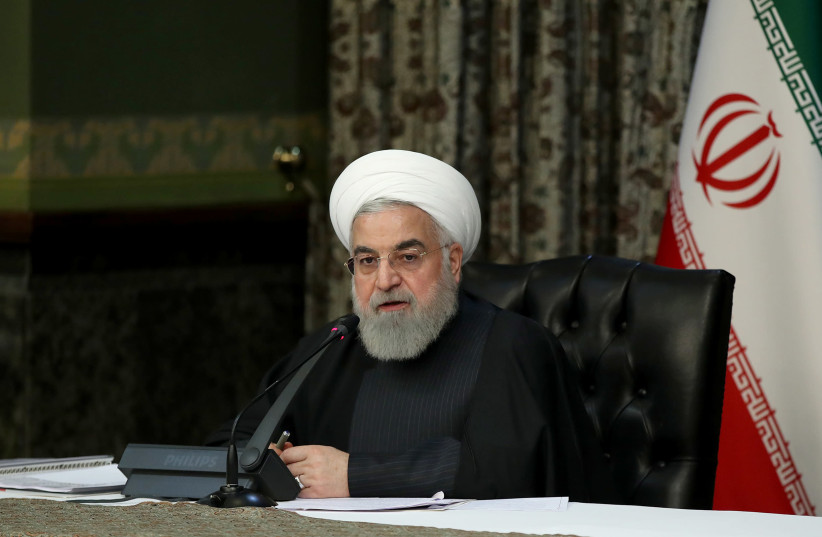
Iranian President Hassan Rouhani speaks during the cabinet meeting in Tehran, Iran, March 4, 2020 (photo credit: OFFICIAL PRESIDENT WEBSITE/HANDOUT VIA REUTERS)

Residents of Qeshm Island in southern Iran reported the sound of an explosion just after 10 p.m. on Saturday. It caused concern because the electricity went off. Officials claimed there was an earthquake, but many did not believe them.

Rumors pointed to other possibilities. Qeshm is known for fishing and tourism. It is a long island off the important Port of Bandar Abbas. Illicit oil trading takes place off some of the islands between Iran and the Gulf.

The tanker Gulf Sky, at the center of an international case involving Islamic Revolutionary Guard Corps front companies, was anchored off the island in mid-July after allegedly being hijacked from near the UAE. It is also of strategic value because the IRGC has a naval base on the island.

In this context, some social-media accounts and local Arabic and Persian media outlets claimed there had been a mysterious explosion. This would be in line with another dozen such explosions that have impacted Iran since late June.

One destroyed a surface-to-surface missile facility at Khojir; another harmed centrifuges at the Natanz nuclear-enrichment facility. This has left many Iranians on edge over concerns they may be targeted by cyberattacks or other acts the government is not admitting to.

There are other controversies related to Qeshm. Fishermen want more support, and some believe the island will form part of a free-trade zone nexus, along with Kish Island, and that China will have a growing role there. “Iran is not for sale,” say some nationalist and populist social-media accounts, challenging China’s alleged upcoming role.

Fishermen held a meeting on Friday about facing issues in transporting their catch. Could an explosion be some sort of sabotage? People say it could be human error or an IRGC secret maneuver.

The fishermen said they were told not to go out fishing on Saturday and link this to the supposed explosion. There are questions over whether it might be linked to ammunition storage on the island.

In the absence of any real evidence that something happened at Qeshm Island, the incident will likely come and go without further details. What it does show is how Iran has been jarred by all the recent explosions – and how locals are quick to report any rumors of what they think is another incident.


Off topic: Arab live TV fights

July 26, 2020

17 minutes of pure gold.

Plenty of shoe-usage and shoe references.

“My shoe and my urine are more dignified than you”, ha ha ha.

The shiite prank caller to the sunni cooking show is amusing.

5 Iran-backed fighters said killed in alleged Israeli strikes on Syria sites

July 24, 2020

“Mowing the lawn” resumes in Syria, may it long continue…

https://www.timesofisrael.com/5-iran-backed-fighters-said-killed-in-alleged-israeli-strikes-on-syria-sites/

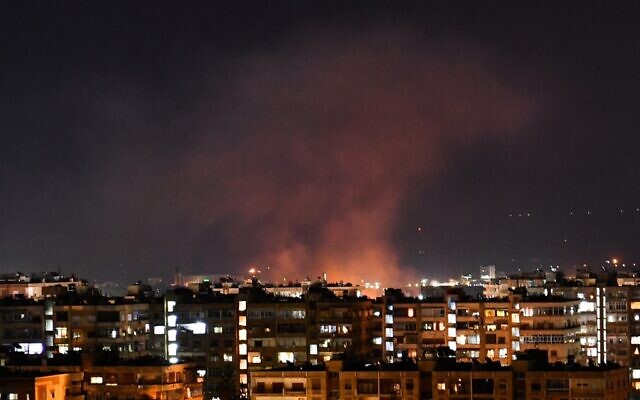
Smoke billows following an alleged Israeli airstrike targeting south of Damascus, Syria, on July 20, 2020 (AFP)

Five Iran-backed fighters were killed in an Israeli missile strike south of the Syrian capital, a Britain-based monitoring group said Tuesday.

The missile attack on Monday night hit weapons depots and military positions belonging to Syrian regime forces and Iran-backed militia fighters south of Damascus, according to the Syrian Observatory for Human Rights.

The attack wounded at least seven Syrian troops, according to the official SANA news agency, which said the missiles were launched by warplanes from the Golan Heights.

The five killed were all non-Syrian paramilitary fighters, according to the Observatory.

It added that 11 combatants were wounded in total — four non-Syrian fighters and seven Syrian troops, of whom two were in critical condition.

The group said the aerial bombardments caused several explosions around the town of Kiswah, south of the Syrian capital, an area that has long been associated with Iran’s Islamic Revolutionary Guard Corps.

The attack reportedly came in two waves. The Reuters news service reported that the assault hit targets in the towns of Jabal al Mane, Muqaylabiya and Zakiya, causing “huge blasts” and allegedly killing Iranian personnel.

A military source quoted by Syria’s official SANA news agency claimed that most of the missiles were shot down. Such claims of interceptions by Syrian state media are generally dismissed by defense analysts as false, empty boasts.

Reuters quoted a Syrian analyst with sources on the ground named Zaid al Reys as saying that the target of the attack was a “major ammunition depot.”

Israel has launched hundreds of strikes in Syria since the start of the civil war in 2011. It has targeted government troops, allied Iranian forces and fighters from the Lebanese Shiite terror group Hezbollah.

It rarely confirms details of its operations in Syria, but says Iran’s presence in support of President Bashar Assad and Hezbollah is a threat and that it will continue its strikes.

Monday’s attack came a week and a half after Iran and Syria signed an agreement that would see Tehran upgrade the Syrian military’s air defenses, apparently in response to ongoing Israeli strikes in the country.

It was the first in Syria to be attributed to Israel since June, when the Observatory said nine fighters were killed in airstrikes targeting positions of Iran-backed militias near the Iraqi border. Those strikes came hours after a similar raid killed six other Tehran-backed fighters.


Hezbollah: IDF Stole Our Drone – We Were Shooting a Music Video

July 22, 2020

The “WTF?” news article for the day.

Hezbollah: IDF Stole Our Drone – We Were Shooting a Music Video

A Hezbollah spokesman on Sunday claimed the IDF had taken control of a drone that was part of a music video of a Lebanese orchestra that was recorded near the border with Israel.

The IDF reported on Sunday that one of its units identified and downed a drone that had apparently penetrated from Lebanese territory into Israeli airspace, which apparently happens up north every few months (IDF Downs Lebanese Drone).

So this is what Hezbollah had to say about the same event (courtesy of Google Translate):

“The enemy’s army hijacked a photo drone belonging to a singing squad that was carrying out a hymn for Nasrallah near the borders with occupied Palestine, before it controlled it electronically and withdrew it 3 kilometers inside the occupied territories. One of the photos taken by the drone while it was being towed showed it flying inside the occupied territories.”

We think the IDF should offer to return the drone, but only directly to Hassan Nasrallah, the terror group’s leader, the one from the hymn, who has been hiding from the IDF in a bunker in south Beirut since 2006. Come out, come out and claim your drone, dear sheikh.

In latest in series of blasts, explosion reported at Iranian oil pipeline

July 20, 2020

Ooops!

https://www.timesofisrael.com/in-latest-in-series-of-blasts-explosion-reported-at-iranian-oil-pipeline/

Footage from a reported blast in an oil pipeline in southern Iran, on July 18, 2020 (video screenshot)

An explosion was reported in an oil pipeline in Iran Saturday, the latest in a mysterious series of blasts and blazes that have occurred throughout the country.

Several of the recent disasters have struck sensitive Iranian sites, leading to speculation that they could be part of a sabotage campaign engineered by Israel or another Tehran foe.

The latest incident occurred in a pipeline in the Ahvaz region in the south of the country, according to reports in local and social media.

Video shared on social media showed a large fire at the scene. There were no reports of casualties in the incident, and it was not immediately clear what the cause was.

The last odd incident came on Wednesday, when seven traditional wooden vessels caught fire in a factory in the southern Iranian port city of Bushehr. Others have included gas blasts and explosions in Tehran, as well as in the vicinity of military facilities.

A July 2 explosion damaged Iran’s Natanz nuclear facility. A week before that, a large blast was felt in Tehran, apparently caused by an explosion at the Parchin military complex, which defense analysts believe holds an underground tunnel system and missile production facilities.

A Middle Eastern intelligence official was quoted earlier this month by The New York Times as saying the fire that badly damaged a building used for producing centrifuges at Natanz was sparked by Israel and was caused by a powerful bomb.

But the unidentified official said Israel was not linked to several other recent mysterious fires in Iran over past weeks.

Israeli TV reports, without naming sources, have said the blast destroyed the laboratory in which Iran developed faster centrifuges and set back the Iranian nuclear program by one or two years.

Iran last week called for action against Israel following the damage to the Natanz facility, and appeared to acknowledge the fire there was not an accident.

Sabotage in Iran Is Preferable to a Deal With Iran

July 18, 2020

Israel also engaged in sabotage operations as part of its effort to stop Saddam going nuclear, see here:

https://en.wikipedia.org/wiki/Operation_Opera#Strategy_and_diplomacy

Anthony Cordesman writes that Israel conducted a series of clandestine operations to halt construction or destroy the reactor.[46] In April 1979, Israeli agents in France allegedly planted a bomb that destroyed the reactor’s first set of core structures while they were awaiting shipment to Iraq.[46] In June 1980, Israeli agents are said to have assassinated Yehia El-Mashad, an Egyptian atomic scientist working on the Iraqi nuclear program.[47][48] It has also been claimed that Israel bombed several of the French and Italian companies it suspected of working on the project, and sent threatening letters to top officials and technicians.[46][48][49] Following the bombing in April 1979, France inserted a clause in its agreement with Iraq saying that French personnel would have to supervise the Osirak reactor on-site for a period of ten years.

https://www.bloomberg.com/opinion/articles/2020-07-13/nuclear-sabotage-is-preferable-to-a-nuclear-deal-with-iran

Natanz, Iran, 2007.

Whoever wins the U.S. presidency in November, there is a good chance he will try to negotiate a stronger nuclear deal with Iran in 2021. But events of the last few weeks show that there are better ways to frustrate the regime’s nuclear ambitions.

Both President Donald Trump and his Democratic rival, Joe Biden, favor talking with Iran. “I would rejoin the agreement and use our renewed commitment to diplomacy to work with our allies to strengthen and extend it,” Biden told the New York Times last winter. Trump, meanwhile, was on Twitter last month urging Iran to “make the Big deal.”

The logic of a deal goes like this: Except for war, the only sustainable way to prevent Iran from getting nuclear weapons is to reach an agreement with its leaders. That has been the basic assumption underlying U.S. nuclear policy on Iran for the last 20 years. With the right mix of carrots and sticks, the thinking goes, Iran will negotiate away a potential nuclear weapon.

But a nuclear deal with Iran would have to rely on a partnership with a regime that oppresses its citizens, preys on its neighbors, supports terrorism on three continents and has shown contempt for international law. And the alternative to a deal is not necessarily a costly and dangerous war. The West can delay and foil Iran’s nuclear ambitions by other means.

Since late June, explosions have rocked at least three Iranian military facilities. The latest appears to have targeted an underground research facility for chemical weapons. Earlier this month, a building at Iran’s Natanz centrifuge site burst into flames.

Much remains unknown about this latest spate of explosions. A relatively new group calling itself “Homeland Panthers” has claimed credit for the attack on Natanz. Iranian officials have blamed it on Israel. David Albright, the former nuclear inspector and founder of the Institute for Science and International Security, told me his organization — which has studied satellite imagery of the facility before and after the explosion — cannot rule out that it was an accident. But “it looks more like a deliberate act,” he said.

There are several good reasons to think all of this was an act of Israeli sabotage. To start, the Israelis have done this kind of thing before. In the early 2010s, Israel’s Mossad conducted a series of assassinations of Iranian nuclear scientists. Before that, Israel and the U.S. cooperated on a cyberattack on Natanz that sped up its centrifuges, causing them to break down.

More recently, Israeli spies broke into a Tehran warehouse and stole a technical archive of Iran’s nuclear program, demonstrating that they have “human networks that have penetrated Iran’s security structure,” said David Wurmser, a national security expert who most recently worked as an adviser to the National Security Council.

Whoever is responsible for the attack — and to be clear, the Iranians say they are prepared to retaliate against Israel, though they have yet to do so — the damage at Natanz alone has significantly set back Iran’s nuclear program. The facility there was an assembly center for more advanced and efficient centrifuges, which Iran was allowed to produce under the flawed 2015 deal. “This was a crown jewel of their program,” Albright said.

And the damage may be to more than just the centrifuges — it could also destabilize the Iranian regime itself. “The more Iran’s government looks impotent, and the impression is left the Israelis are everywhere, the more high-level Iranian officials will calibrate their survival by cooperating with Americans or Israelis, which itself creates an intelligence bonanza,” Wurmser said.

The attacks could also undermine the regime’s legitimacy among the Iranian public more generally. Sabotage of this sort shows that Iran’s leaders are not nearly as powerful and all-knowing as they say.

At the very least, the fact that someone was able to explode a “crown jewel” of Iran’s nuclear program should make clear that the civilized world can delay Iran’s nuclear ambitions without conferring legitimacy to the regime.