Author Archive

Trump strikes at the heart of the North Korean regime with speech

November 8, 2017

Trump strikes at the heart of the North Korean regime with speech, Washington PostAnna Fifield, November 8, 2017

(Here’s a North Korean propaganda video from 2010. An attractive North Korean girl explains that life is wonderful in North Korea and far better than in South Korea or America. Some high-level members of the Kim regime, until they say or do something the Dear Leader considers insulting, may even live as well as the video suggests is common throughout the country.

President Trump’s full speech is available here. — DM)


It is hard to exaggerate the reverence with which North Koreans are forced to treat the Kim family. Every home and all public buildings must display portraits of Kim Il Sung and his son, Kim Jong Il, that must be cleaned only with a special cloth. North Koreans must bow at monuments to the leaders and sing songs celebrating their supposedly legendary feats.

There is no escaping the Kims and the narrative that they have created a utopia that is the envy of the world.

************************************

President Trump has said on several occasions that he’s willing to talk to the North Korean leader Kim Jong Un. Well, on Wednesday, Trump did — after a fashion.

The American president directly addressed his 33-year-old nemesis during his speech to South Korea’s National Assembly. This time, Trump didn’t call Kim “Little Rocket Man” or use the kinds of rhetorical flourishes that play so well on Twitter.

But the words that Trump used will have cut deeper because they strike at the very heart of the Kim regime. 

If there is one thing that Kim Jong Un has shown that he cannot tolerate, it’s personal criticism.

“North Korea is not the paradise your grandfather envisioned,” Trump said to Kim, who, if he was in Pyongyang, was just 120 miles away. “It is a hell that no person deserves.”

Kim Il Sung, who is revered like a god in North Korean propaganda, established the country in 1948 as a “socialist paradise” of free housing, health care, and education where people would want for nothing. Kim Jong Un claims his legitimacy to be the leader as the direct descendant of this quasi-deity.

Trump devoted a large part of his address to detailing the human rights abuses that the Kims have committed in North Korea, filling his speech with words like “twisted,” “sinister,” “tyrant,” “fascism” and “cult.”

“I wanted to stand up from my seat and shout ‘yahoo!’” said Lee Hyeon-seo, an escapee from North Korea who was sitting in the assembly hall Wednesday during Trump’s address. “We just don’t hear people talking about North Korea in this way in South Korea, so I was very emotional during the speech. I was very impressed.”

Trump noted the slave-like conditions that North Korean workers endure, the malnutrition among children, the suppression of religion, and the forced-labor prison camps where North Koreans endure “torture, starvation, rape, and murder on a constant basis.”

Other advocates for North Koreans expressed hope that Trump’s remarks would remind the outside world that the country is not just home to a dictator with nuclear weapons, but 25 million people who suffer under him.

“President Trump spoke about human rights in North Korea more than any other previous U.S. president,” Jeong Kwang-il, who was held as a political prisoner in North Korea and now runs the “No Chain for North Korea” human rights group in Seoul. “I’m hopeful that American policy toward North Korea will focus more on improving human rights there.”

The president did not mince his words about the way the Kim regime has managed to retain its grip on the populace.

“North Korea is a country ruled as a cult. At the center of this military cult is a deranged belief in the leader’s destiny to rule as parent protector over a conquered Korean Peninsula and an enslaved Korean people,” he said.

The success of South Korea discredited “the dark fantasy at the heart of the Kim regime,” Trump said.

It is hard to exaggerate the reverence with which North Koreans are forced to treat the Kim family. Every home and all public buildings must display portraits of Kim Il Sung and his son, Kim Jong Il, that must be cleaned only with a special cloth. North Koreans must bow at monuments to the leaders and sing songs celebrating their supposedly legendary feats.

There is no escaping the Kims and the narrative that they have created a utopia that is the envy of the world.

So to suggest that the regime is founded on a “fantasy” and that the country is something other than a socialist paradise amounts to heresy in North Korea.

“This speech made the ‘axis of evil’ speech look friendly,” said John Delury, a professor of international relations at Yonsei University in Seoul, referring to President George W. Bush’s 2002 State of the Union speech, in which he included North Korea as a country seeking weapons of mass destruction.

“That sent a signal to Pyongyang that the Americans are not open to changing their relationship with North Korea and that the president was deeply hostile and ideologically hostile to them.”

But others saw an opening from Trump, with his suggestion there was a way out of the current quagmire. “Despite every crime you have committed against God and man … we will offer a path to a much better future,” Trump said, saying that this would require total denuclearization.

The president publicly offered a “diplomacy exit ramp” to the Kim regime, Victor Cha, tipped to be Trump’s nominee for ambassador to South Korea, wrote on Twitter.

At a press conference with South Korean president Moon Jae-in the previous day, Trump urged North Korea “to come to the table” and “do the right thing, not only for North Korea but for humanity all over the world.”

At recent meetings near Geneva and in Moscow, Pyongyang’s representatives have signaled an interest in talks with the United States — as long as those talks are not about denuclearization, a non-starter for Washington.

The regime in Pyongyang is likely to react angrily to Trump’s speech.

After Trump threatened at the U.N. General Assembly in September to “totally destroy” North Korea and mocked Kim as “Rocket Man,” Kim took the unprecedented step of releasing a statement in his own name, calling Trump a “mentally deranged U.S. dotard” who would “pay dearly” for his threats.

At the same time, North Korea’s foreign minister said the country might detonate a nuclear device over the Pacific.

A U.N. Commission of Inquiry once charged that the blame for North Korea’s human rights abuses went all way to the top of the leadership, leading to calls for Kim Jong Un to be referred to the International Criminal Court for crimes against humanity.

That prompted North Korean officials to respond publicly to questions about human rights conditions in a way they had not before — a clear attempt to defend the dignity of their leader.

“North Korea tends to react sensitively to criticism in human rights,” said Cheong Seong-chang, director of the unification strategy program at the Sejong Institute, a private think tank in South Korea.

He predicted that the response would be especially sharp because of the time that Trump spent talking about North Korea and the detail he went into, plus the president’s repeated calls for the world to isolate the country.

“North Korea is highly likely to take Trump’s address as a declaration of war and call for a holy war of its own against the U.S.,” Cheong said.

Yoonjung Seo in Seoul contributed reporting.


Trump’s Latest Education Nominee Steps into the Maelstrom

November 8, 2017

Trump’s Latest Education Nominee Steps into the Maelstrom, American ThinkerRichard L. Cravatts, November 8, 2017

No sooner had President Trump nominated Kenneth Marcus, president of the Louis D. Brandeis Center for Human Rights under the Law, to be assistant secretary for civil rights at the U.S. Department of Education than extremist anti-Israel groups mounted an aggressive campaign to derail the appointment.

This is a remarkable affront to a civil rights lawyer who has spent his career fighting for the rights of women, the disabled, and members of many minority groups: black Americans, Hispanics, and Asians, as well as Sikhs, Arabs, and Muslim Americans.  Marcus’s prior tenure at the federal Office for Civil Rights was widely lauded for effective leadership and support for the rights of all students.  For this reason, most civil rights groups have thus far refrained from subjecting Marcus to the vituperation other recent Trump nominees have faced.

Some anti-Israel groups, however, have broken ranks, attacking the administration’s Jewish civil rights nominee with reckless and malicious falsehoods.  One of these groups, Palestine Legal, whose mission is to bolster the anti-Israel movement by challenging efforts to protect Jewish students from anti-Semitism, immediately issued a letter smearing Mr. Marcus as an “anti-Palestinian crusader” and opposing his nomination in terms of the so-called Livingstone Formulation.  Under that formulation, as identified by British sociologist David Hirsch, anti-Semites accuse Jews of fabricating anti-Semitism claims in order to silence decent people concerned about Israel’s supposed human rights violations.  In this way, Palestine Legal’s director, Dima Khalidi, levels the spurious charge that “Marcus is the architect of a strategy to abuse civil rights law to suppress campus criticism of Israel.”  In other words, she contends that Marcus’s campaign to ameliorate campus anti-Semitism is not based on a virtuous desire to end bigotry, but is a disingenuous attempt at “shielding Israel from scrutiny,” consistent with the Livingstone Formulation.  Part of that notion is “the counteraccusation that the raisers of the issue of antisemitism do so with dishonest intent, in order to de-legitimize criticism of Israel. The allegation is that the accuser chooses to ‘play the antisemitism card’ rather than to relate seriously to, or to refute, the criticisms of Israel.”

Those who refuse to acknowledge that their speech or behavior may, in fact, be anti-Semitic normally resist such designations, but the allegation of Palestine Legal against Mr. Marcus is particularly odious because it seeks to impugn his integrity as someone fighting anti-Semitism, suggesting instead that his true motive, carefully hidden from view and masked as benign activism, is actually to serve the interests of Israel by trying to delegitimize and libel Israel’s campus critics.  Moreover, Palestine Legal claims, in order to shield Israel from scrutiny, to insulate its policies and state behavior from critique, Mr. Marcus pretends to be interested in anti-Semitism but is actually creating a smokescreen to shield Israel “at the expense of civil and constitutional rights.”

In addition to the Livingstone Formulation, these groups are also going after Marcus with the classic charge that Jews are attempting to gain control of government power for nefarious purposes.  “Marcus has no business enforcing civil rights laws when he has explicitly used such laws to chill the speech activities and violate the civil rights of Arab, Muslim, Jewish, and other students who advocate for Palestinian rights,” Khalidi charged.  It is not coincidental that a group dedicated to undermining efforts to fight anti-Semitism is aware of the efforts of Mr. Marcus and his colleagues as they attempted to identify the causes and corrosive impact of campus anti-Semitic speech and behavior.

For at least the last decade, the primary source of anti-Zionist, anti-Israel, and anti-Semitic activism on campuses has been anti-Israel individuals and groups, including the Muslim Student Association and the radical Students for Justice in Palestine, among others.  So even as Ms. Khalidi would have one believe that Mr. Marcus launched a campaign to silence pro-Palestinian activists merely as a tactical ploy to insulate Israel from critique and condemnation, the anti-Israel activism she so ardently defends has regularly spawned instances in which agitation against Israel has included speech and behavior that have been considered, and, in fact, often were, anti-Semitic.

Of great concern to those who have observed the invidious byproduct of this radicalism is the frequent appearance of anti-Israel sentiment that often rises to the level of anti-Semitism, when virulent criticism of Israel bleeds into a darker, more sinister level of hatred – enough to make Jewish students, whether or not they support or care about Israel at all, uncomfortable, unsafe, or hated on their own campuses.

That is precisely the type of “hostile environment,” created by generating hostility toward Jewish students over their perceived or actual support of Israel, that may violate Title VI of the Civil Rights Act of 1964, one of the legal tools Mr. Marcus has used and may well continue to use in his new role to ensure that universities take steps to ameliorate situations in which such prejudice-laced campus climates are allowed to develop.

Jewish Voice for Peace (JVP), another anti-Israel group that also, not insignificantly, supports the BDS movement, published an open letter denouncing the choice of Mr. Marcus for the OCR appointment as well, repeating the spurious charge that the use of Title VI statutes, and such guidelines as the U.S. State Department Working Definition of Anti-Semitism, would have the perverse side-effect of suppressing the free speech of “pro-Palestinian” activists.

And despite Palestine Legal’s fear that the conflation of “criticism of Israel with anti-Semitism    …  has really serious consequences for those who advocate for Palestinian human rights and are being condemned and censored and punished as a result of the enormous pressure being placed on universities by the likes of Marcus and dozens of other Israel advocacy groups,” the fact that “pro-Palestinian” activists support a minority group does not justify their misbehavior and extremism, even for what they clearly believe to be a noble cause.

Pro-Palestinian advocacy on campus – the very activism Palestine Legal is so intent on preserving – has been shown to correlate directly with an uptick in anti-Semitic speech and behavior.  For example, in two studies it conducted of anti-Semitism on U.S. campuses, the AMCHA Initiative, an organization that investigates and documents anti-Semitism at U.S. universities, found that “[s]chools with instances of student-produced anti-Zionist expression, including BDS promotion, are 7 times more likely to have incidents that targeted Jewish students for harm than schools with no evidence of students’ anti-Zionist expression and the more such anti-Zionist expression, the higher the likelihood of incidents involving anti-Jewish hostility.”  This “anti-Zionist expression” and “BDS promotion” are the central aspects of Palestinian activism.

That is the issue here, and why it is necessary and important that, in the effort to promote the Palestinian cause and help the Palestinians to achieve statehood, another group – Jewish students on American campuses – do not become victims themselves in a struggle for another group’s self-determination.

Richard L. Cravatts, Ph.D., president emeritus of Scholars for Peace in the Middle East and the author of Dispatches from the Campus War against Israel and Jews, is also a member of the board of directors of the Brandeis Center for Human Rights under the Law and the AMCHA Initiative.

Permanent Investigation: How the Media Uses the Anti-Netanyahu Playbook Against Trump

November 7, 2017

Permanent Investigation: How the Media Uses the Anti-Netanyahu Playbook Against Trump, FrontPageMagazine, Daniel Greenfield, November 7, 2017

Taking out Flynn left Trump with few options except McMaster. And that allowed the swamp to reclaim the National Security Council and protect the eavesdropping operation against Trump. The likely Flynn charges have little to do with the reason he was forced to resign or any accusations against Trump.

But that doesn’t matter. The real goal was to remove Flynn. The details don’t matter.

Thinning out a target’s inner circle makes it harder for him to find competent and loyal replacements. And that makes it all too easy for the swamp to plant its own people in his inner circle. And even if the staffers and allies stay loyal, the investigations make it harder for them to get anything done.

In free countries, the left operates on two tracks: the democratic and the undemocratic. When it loses democratically, it redoubles its undemocratic efforts to retain power. Scandals and investigations are the tools of an undemocratic establishment. But they can’t overthrow the will of the people.

When conservative leaders stay strong, the scandals and investigations blow away like the wind

****************************

The latest news from Israel’s left-wing media outlets is that Ratan Tata, an Indian billionaire, testified to the Israeli police about Prime Minister Netanyahu. The story turned out to be fake news. And that’s true of most of their anti-Netanyahu hit pieces along with the police investigations that accompany them.

But that doesn’t matter.

Americans are just now being introduced to the permanent investigation and its scandal rolodex. Israelis have been living with this Deep State assault against their democracy for much longer. Over eight long years, leftists in the judicial system and the media have manufactured a non-stop campaign of scandals and investigations against Netanyahu. The investigations and the scandals fall apart, but it doesn’t matter because there are usually several being rotated in and out from the scandal rolodex.

The scandals and investigations fall into two categories that should be familiar to Trump supporters.

Category one scandals link some random billionaire to Netanyahu through a chain of connections. The random billionaire in this case is Indian. Then there’s an Australian billionaire in Mexico, German shipbuilders and whatever part of the globe the media-judicial alliance throws a dart at next.

The fake news media in this country is following the same game plan. The latest media hit pieces target Wilbur Ross, Trump’s Secretary of Commerce, in much the same way. Indeed the Russia scandal developed out of media hit pieces that used Trump’s international network of businesses to build up very similar conspiracy theories about foreign interests and influences.

These types of scandals constantly imply corruption without ever actually proving it. But by generating a whole lot of them, they create the sense that Netanyahu or Trump must have done something wrong.

Though no one can say what, because no one can keep track of all the fake scandals.

Category two scandals are character attacks. “He’s a bad person.” Typical examples are Trump’s condolence call controversy and accusations that Netanyahu’s wife is mean to employees.

These types of scandals are straightforward gossip. But lefties have tried to transform them into legal cases. Just about anyone who has ever worked for the Netanyahu family can walk out of the door and have a standing offer to file a lawsuit and do a tour of the media alleging horrible treatment. And the left is trying to advance similar lawsuits against President Trump.

There are lessons to be learned for Trump and Trump supporters from Netanyahu’s experiences.

First, permanent investigations don’t resolve. Trying to wait them out doesn’t work. They never go away until the left wins. An investigation that doesn’t pan out gets swapped out for another one. There are three investigations targeting Netanyahu. If none of them get results, there will be three others.

Everyone knows that.

Second, the purpose of a permanent investigation isn’t to get results. The left would love it if their investigations finally brought down Trump or Netanyahu, but they know that’s a long shot.

The permanent investigation’s real goals are to inflict electoral and policy damage: tying down a targeted politician in scandals so that the public loses confidence in him and preventing him from focusing on his policies. What the left wants is to win elections and stop conservative policies.

The scandals and investigations are political sabotage. And should be treated that way. They’re not about Trump or Netanyahu. They’re about protecting illegal immigration and Islamic terrorists.

Third, the investigations isolate their target by harassing staffers, friends, donors and political allies.

The investigations are a political operation. And so their targets are political. The purpose of the attack is to take out loyal staffers and force allies to keep their distance out of fear that they’ll be next.

Taking out Flynn left Trump with few options except McMaster. And that allowed the swamp to reclaim the National Security Council and protect the eavesdropping operation against Trump. The likely Flynn charges have little to do with the reason he was forced to resign or any accusations against Trump.

But that doesn’t matter. The real goal was to remove Flynn. The details don’t matter.

Thinning out a target’s inner circle makes it harder for him to find competent and loyal replacements. And that makes it all too easy for the swamp to plant its own people in his inner circle. And even if the staffers and allies stay loyal, the investigations make it harder for them to get anything done.

And that too is the point.

This may seem like a grim picture of what the next term or two will look like. But it’s not all grim.

Netanyahu made it through eight years by not letting the scandals drag him down. Even when the attacks against him and his family were as vicious, nasty and personal as the left could get.

He even turned the constant scandals and investigations into a hilarious campaign ad.

Prime Minister Netanyahu has accepted them as a fact of life in a political system where the left’s anti-Israel extremism has made it toxic to voters even while it still controls much of the establishment.

The permanent scandal has been met with permanent scandal fatigue by the public. Israelis have been living through years of hysterical headlines about Netanyahu’s ice cream eating (CNN did its own version of a Trump ice cream scandal with “Trump gets 2 scoops of ice cream, everyone else gets 1”), his wife’s bottle deposits, their children’s misbehavior, their nannies and his bed.

Hardly anyone outside the media bubble cares. Netanyahu’s reputation has been damaged with the media’s low information voters, but he’s still Israel’s longest serving consecutive prime minister.

The Israeli lefty media reacted to its narrative failures the same way that its American counterparts did.

After Trump’s win, the media launched a crusade against “fake news” enlisting Google and Facebook to censor results based on the opinions of the media’s “fact check” operations. Their Israeli counterparts were even more brazen. After a previous Netanyahu victory, they rolled out the “Law for the Advancement and Protection of Written Journalism in Israel”.

The law “advanced and protected” written journalism by banning the distribution of successful free newspapers. The real purpose of the law was to ban the pro-Netanyahu paper, Israel Hayom.

But the media’s censorship crusade didn’t accomplish anything.

The media has an exaggerated sense of its own power and of the gullibility of the public. The two fallacies are interrelated. When people don’t listen to it, the media assumes that since they’re too stupid to have their own ideas, they must be getting all their ideas from some other source. Stamp out this other source, online or offline, and the people will go back to believing what they’re told.

It doesn’t work so well when the media has a worldview and interests that are at odds with the people.

Netanyahu is still around because he represents the public better than the establishment does. The same is true of Trump. And the establishment can’t look in the mirror long enough to understand that.

In free countries, the left operates on two tracks: the democratic and the undemocratic. When it loses democratically, it redoubles its undemocratic efforts to retain power. Scandals and investigations are the tools of an undemocratic establishment. But they can’t overthrow the will of the people.

When conservative leaders stay strong, the scandals and investigations blow away like the wind.

Guns. CNN and Sutherland Springs

November 7, 2017

Guns. CNN and Sutherland Springs, Bill Whittle Channel via YouTube, November 6, 2017

(“If it bleeds it leads.” — DM)

American Islamists’ Silence on Tariq Ramadan Rape Allegations Speaks Volumes

November 7, 2017

American Islamists’ Silence on Tariq Ramadan Rape Allegations Speaks Volumes, Investigative Project on Terrorism, November 7, 2017

(Please see also, Tariq Ramadan’s Fans Insist He’s Not A Rapist: It’s The Women’s Fault. And the Jews’ and Girl Forced to Walk Naked to ‘Restore Honor’ [Pakistan]

Armed men forced a girl to parade naked through her village in Pakistan to “restore the honor” of their family.

The girl was targeted after her brother had an affair with the wife of one of the men. She was taken in broad daylight by a group of men, who cut off her clothes with scissors and forced walk through the streets of in the village of Chaudhuan, according to local residents.

— DM

It’s never fun when one of your favorite celebrities gets accused of wrongdoing. The home team quarterback faces a DUI, or a politician gets caught with his hand in the cookie jar. You can choose to face reality that the hero may not warrant your devotion, or try to pretend you never saw it.

When it comes to Tariq Ramadan, heir to modern Islamist thought and one of the world’s most recognizable Muslim scholars, American Islamists seem intent on looking the other way.

At least four women have accused the Oxford University professor of sexual assault or harassment – making him one of the latest high-profile men to be accused of past misconduct after Hollywood mogul Harvey Weinstein’s fall last month. Oxford announced Tuesday that Ramadan is taking a leave of absence “by mutual agreement.”

Compared to Weinstein and others, there are few voices taking up the cause for Ramadan’s accusers. Some of it may be cultural: Ramadan often has urged Muslims to treat controversial religious issues such as stoning adulterers and female genital mutilation as an “internal discussion.” But there’s also the fact that Ramadan has been quite helpful to American Islamists over the years.

He addressed the two largest gatherings of Muslim Americans last year, speaking to conventions organized by the Islamic Society of North America (ISNA) and a joint Muslim American Society-Islamic Circle of North America (MAS-ICNA) gathering. That September, he spoke at California’s Zaytuna College with its founder Hatem Bazian.

The subject? “Resistance: Combatting Oppression, Inspiring Action.”

Rape is a form of oppression.

Ramadan was the keynote speaker for the Council on American-Islamic Relations (CAIR) Chicago chapter fundraising banquet. He served the same role for CAIR National’s 2010 fundraising banquet.

Last month, he spoke at a conference organized by Georgetown University’s Saudi-endowed Center for Muslim-Christian Understanding.

Center Director Jonathan Brown, Georgetown’s Prince Alwaleed bin Talal Chair of Islamic Civilization in the School of Foreign Service, also spoke at the conference. Brown generated attention earlier this year with a lecture that argued it isn’t “morally evil to own somebody” and that sexual consent is a bit of a myth because no individual is genuinely autonomous.

In the wake of the Ramadan allegations, Brown linked without comment to a Huffington Post op-ed on his Facebook page emphasizing that a person is innocent until proven guilty.

Beyond that, leaders from Georgetown, CAIR, ISNA, ICNA or MAS have had little to say about the possibility Ramadan may be a sexual predator. Some were less reticent when it came to judging people in similar cases.

For example, Zainab Chaudry, CAIR’s Maryland outreach director, praised Netflix’s decision to end its popular series “House of Cards” after star Kevin Spacey was accused of assaulting a teenage boy 30 years ago.

“Hopefully the first step in justice for the survivor(s),” she wrote Monday. She has not expressed concern for the women who say Ramadan assaulted them.

As the Weinstein scandal unfolded, CAIR-Chicago Executive Director Ahmed Rehab took to Facebook to call out the powerful producer as “Another bloated old predator creep – to add to the list alongside Roger Ailles [sic] and Bill O’Reilly – fawned over by society and rewarded with wealth and fame, even as he luxuriated in sociopathic predatory behavior for decades with no accountability.

“Well, it is time for liberals and those on the left to quit the double standard. The same outrage rightly shown to the fallen icons of the right better be shown to this trash human.”

He urged people to “Pay close attention to what happens to Weinstein if anything, and how the mainstream media and Hollywood deal with this.”

Five days later, Rehab noted that three women accused Weinstein of rape – one accuser fewer than Tariq Ramadan has today – and blasted the “hundreds of enablers, including the biggest stars…” A news outlet called 26 actors and directors to ask about Weinstein. “None responded,” Rehab wrote.

Rehab has made no direct comment about Ramadan. On Oct. 28, however, he reposted Ramadan’s statement announcing his plans to sue one accuser for slander. In an exchange with a commenter, Rehab predicted “the truth will eventually prevail in such a way that will be indisputable.” While he generally believes a woman accuser, “the specifics of any case take precedence for me over the generally speaking.”

Weinstein threatened to sue the New York Times after it published a story detailing the number of women he paid to stay quiet about abuse allegations.

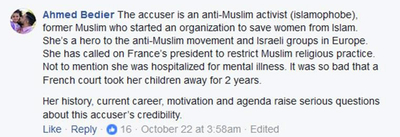
At least in the initial claim against Ramadan, those who sided with him were quick to argue that his accuser disagrees with them politically, so she must be making it up. Henda Ayari is described as a former Salafi Muslim who left the faith and became a secular activist.

Ahmed Bedier, a former CAIR chapter director who still helps the organization raise money, called Ayari a mentally ill Islamophobe and “a hero to the anti-Muslim movement and Israeli groups in Europe.”

In a New York Times profile, Ayari does acknowledge losing custody of her children for two years following a nervous breakdown. But Bedier failed to provide the context: it was brought on by the stress of fleeing from an abusive Salafi home that was described by a social services worker as a prison. She wore the jilbab and niqab – full body coverings – with the story describing her husband’s view that it was “the female garb that most pleased Allah.” She rarely was allowed out of the home.

In a related exchange that same day, Bedier said he would normally give the accuser the benefit of the doubt. But in this case, blaming her is okay because “the accuser is an anti-Muslim activist accusing the leading Muslim figure in Europe.”

He does appear to have weighed in on subsequent accusers.

As we showed Monday, Ramadan’s European fans reacted similarly, attacking the accuser and buying into conspiracy theories.

After trying to discredit the alleged victim, Ramadan may be targeting one of the messengers. His lawyers say they may sue French journalist Caroline Fourest for “witness tampering,” she wrote Friday, adding that she met alleged victims as far back as 2009.

A self-described Muslim feminist has stayed mum about the prospect a leading Muslim voice, and the grandson of Muslim Brotherhood founder Hassan al-Banna, could be a rapist. Linda Sarsour is a leader of the Women’s March movement.

As the number of Weinstein accusers increased, the March’s Twitter feed expressed appreciation and admiration for their courage. “You are not alone,” it said.

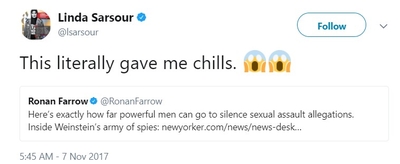
Tuesday morning, after the New Yorker published Ronan Farrow’s follow-up detailing Weinstein’s use of private investigators, including one company comprised of ex-Israeli security officials, to try to thwart investigations into his sexual predations, Sarsour wrote that the story “literally gave me chills.”

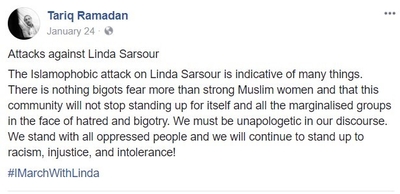
Neither the March nor Sarsour has expressed similar solidarity with Ramadan’s accusers. He defended Sarsour in January, when she faced criticism from liberals who were uncomfortable with her leadership for the Women’s March. “There is nothing bigots fear more than strong Muslim women,” he wrote, “and that this community will not stop standing up for itself and all the marginalized in the face of hatred and bigotry.”

What about sexual assault?

Tariq Ramadan remains innocent until proven guilty. But public judgment changed dramatically with other men as more accusers emerged and a pattern of behavior became clear. A former French official has acknowledged that Ramadan long has had a reputation for womanizing, and that it sometimes included violence. At least four women say that they can attest to that.

At some point, attacking the victims or imagining it will all go away no longer works.

The U.S. Is Saudi Arabia Now

November 7, 2017

The U.S. Is Saudi Arabia Now, PJ MediaRoger L Simon, November 6, 2017

But back to Saudi Arabia. They’re the bad ones here, not us.  They behave in a manner that civilized people must condemn.  We know this because Donald Trump approves of what King Salman is doing, cleaning house of characters like Bin Talal,  and Trump, as we know, is not an honorable man.

How do we know?  Because he has disgraced our country in Japan.  He is uncouth and does not even know how to feed koi. How bad is that! He could have killed the poor….Oh, wait…. 

***************************

Saudi Arabia is evidently undergoing some pretty extreme housecleaning, approaching its own “Night of the Long Knives.”  It’s hard to know what to make of it (though those of us who remember Alwaleed Bin Talal’s  fatuous offer of ten million dollars just after 9/11, properly refused by Rudy Giuliani, have our own opinions of the now-arrested prince.)

Things over there seem pretty primitive and chaotic, almost tribal, replete with the image of billionaire princes forced to sleep on bare mattresses in the ballroom of the local Ritz Carlton. The Saudis have their own way of doing things.

Or do they?

These days things in Washington resemble Riyadh more than we care to admit. And unlike the Saudis, we don’t have Iran’s clients flying missiles into our airports. What’s our excuse?

Not much really — just hatred and the lust for power.  We’re tribal too — and then some.  Indeed, we may be worse.  How else to explain what’s going on inside our major political institutions — from Congress to our political parties to the Department of Justice to, needless to say, the FBI?  The skullduggery has been endless.

The latest is the reaction to Donna Brazile’s disclosure that the Democratic Party primary process was, essentially, fixed in favor of Mrs. Clinton.  The former DNC head is most likely correct because the mortified (and defensive) responses to her revelations are packed with lies.  That Ms. Brazile was concerned for her own safety because of the unsolved Seth Rich murder is also worth noting, speaking of long knives. Meanwhile, the mainstream media barely mentions that anything has occurred.  (The Saudis are more transparent.)

And then there are the matters that can be lumped together as G-Men in Non-Action, i. e. the FBI.  The latest revelation here is that James Comey, chief law enforcement officer in the land at the time, at first wrote a document accusing Hillary Clinton of  having been “grossly negligent” in her email scandal and then crossed it out… or somebody crossed it out for him…  to replace it with, for some reason or other, “extremely careless.” Could it be that “grossly negligent” in the handling of national security material is a crime and she was running for president?  Nah.  James Comey is a man to be trusted.

And so are Robert Mueller and Rod Rosenstein.  That we have just learned they were in charge during the approval of the Uranium One deal, that there was money laundering, bribes and all sorts of double-dealing by the Russian company involved (that they knew about) before twenty percent of U.S. uranium was put under Russian control, should not disturb us. Because of this knowledge, they are all the more qualified to conduct the Russia investigation. After all, Brutus, as Marc Antony assured us, is an honorable man. And so is Bill Clinton.  He had to speak a full two hours for that $500,000 after the deal was made.  So are they all honorable men.

That there are renewed questions about the Fusion GPS Trump dossier, that it may have been used to instigate the entire Russia investigation although filled with unsubstantiated, actually ludicrous, allegations, also should not give us pause.  After all, Bret Stephens believes it and he is an honorable man. He writes for The New York Times.

But back to Saudi Arabia. They’re the bad ones here, not us.  They behave in a manner that civilized people must condemn.  We know this because Donald Trump approves of what King Salman is doing, cleaning house of characters like Bin Talal,  and Trump, as we know, is not an honorable man.

How do we know?  Because he has disgraced our country in Japan.  He is uncouth and does not even know how to feed koi. How bad is that! He could have killed the poor….Oh, wait…. 

Trump’s Biggest Challenge in Seoul

November 7, 2017

Trump’s Biggest Challenge in Seoul, American Thinker,  Daren Jonescu, November 7, 2017

There is no equivalency here. North Korea’s hostilities are their essence, not a product of outside provocation, real or imagined. Anything they do will be on their own heads, as will any destruction that gets unleashed upon them due to their actions. Theirs is a regime that has no moral legitimacy, and hence, while no one is obliged to do anything about that, neither does anyone owe their rule, their aspirations, or their tender feelings any respect.

The only moral considerations that have any weight in this issue are related to whether annihilating Kim’s national death camp — inherently justifiable — is worth the risk it may bring to the lives of other nations’ citizens.

***************************************

Donald Trump is in South Korea today.  All focus, of course, is on whether Trump and recently-elected Korean president Moon Jae-in will present a unified position against North Korean aggression. Or let me restate that in words that make sense within the current zeitgeist: “a unified position on how to avoid an escalation of tensions with North Korea.”

In our worldwide progressive paradigm, suggesting that the problem to be solved here is the threat posed by a tyrannical rogue state’s immoral behavior is considered inflammatory. Rather, we are all supposed to pretend that North Korea is “a sovereign state” with “legitimate concerns about being threatened by the U.S. military presence in Asia,” and that its outrageous provocations, unprovoked violence, and frequent promises to annihilate its democratic enemies are merely “understandable responses to its increased global isolation.”

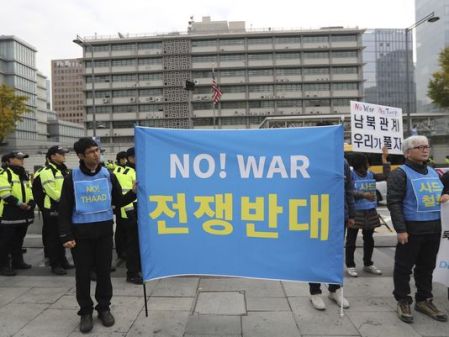
Demonstrators reacting to Trump’s visit

(Even many conservatives of the libertarian bent are wont to ask, “How would you feel if your neighbors were all discussing how to end your regime?” — as though rationalizing a killing machine’s sensitivities were anything but a moral absurdity.)

As for President Moon, a progressive appeaser in the mold of his old ally and boss, Roh Moo-hyun (of North-South “Sunshine Policy” fame), he may be a tough sell on taking a stronger stand against North Korea. He would likely accept the inevitable if necessary, however, especially since Japan has already signed onto America’s “all options on the table” position, and since China has remained largely aloof from the situation so far.

But President Moon probably will have to be dragged to a harder stance by events — a bizarre thing to have to say about the president of a nation that is technically at war with a communist madhouse dictatorship that tore his own country in half, has starved and enslaved millions of his countrymen, and has carried out repeated acts of murderous aggression against the South in recent years, in addition to its constant threats of all-out attack. Talk about Stockholm Syndrome.

But the depth of the moral problem facing this world — in which most governments, media voices, and academics are progressive in their underlying principles and perspective — may be seen in the sheer silliness with which people speak of what might cause an “escalation of hostilities” with North Korea.  Here is a perfect example, from Professor Koo Kab-woo at the University of North Korean Studies in Seoul. (Imagine the political perspective likely to prevail at a university with such a name.)

Addressing the concern that Trump might say or do something careless or bombastic during his South Korean trip, Professor Koo says, “If Trump says anything that can provoke North Korea, it could send military tensions soaring again.”

Right. North Korea is calm and trying to restore a peaceful coexistence. But what if Trump goes and blows it with a stupid remark?

You see, the tensions, whatever might have caused them (who can say?), have settled recently, but if they rise again due to Trump’s rhetoric during his visit to Seoul, then the resulting danger will be on America’s head for having “provoked” it.

This is a classic moral equivalency argument (and an excellent preview of exactly how China will respond if an armed conflict begins on the Korean peninsula): “Both sides need to calm down. If Nation A (the world’s oldest republic and traditional leader of the free world) causes things to escalate again by speaking too harshly, then Nation B (a bloody tyranny starving its own broken people and threatening the world with nuclear war) cannot be held solely responsible for the resulting rise in tensions.”

This is the same argument used for decades to frame the Cold War as a battle between “two noble experiments,” rather than between good and evil. It is the same argument used to equate the pro-Palestinian efforts by much of the Middle East (along with the UN and Europe and most of academia and the North American left) to wipe Israel off the map, to Israeli efforts to push back in defense of a nation the size of New Jersey.

Moral equivalency in international relations — “both sides are to blame,” or “both sides have understandable concerns” — is the last refuge of the morally bankrupt. In this case, expressing peevishness that somehow Donald Trump’s words might provoke North Korean hostilities is a convenient way of implying that North Korea is not inherently, essentially hostile to begin with, but rather that any hostility they display is merely a response to outside instigation. Thus, a tyranny is falsely portrayed as an equal participant in difficult diplomacy, rather than a victim of its own obsession with power and destruction. This in turn creates an aura of legitimacy around one of the most illegitimate regimes of modern times.

I myself have been critical of Trump’s often careless rhetoric on North Korea, but my concern has always been that by speaking too cavalierly, Trump risks tipping his administration’s hand unnecessarily, or painting himself into a strategic corner with Obama-like “red lines.” My concerns, in other words, are related to American interests, not North Korea’s “feelings.” Under no circumstances would I ever suggest Trump’s words or actions were to blame for North Korea’s behavior.

Similarly, appeasers like Moon Jae-in, who has used moral equivalency arguments against his own nation and yet has somehow been elected president under the guise of a “champion of the people” — reminiscent of Barack Obama in that regard, both in policy and in manner — exacerbate a national tragedy by emboldening a dictatorship. But by no means would I suggest such appeasers are to blame for the murderous aspirations of Kim Jong-un’s illegitimate regime.

North Korea is a brutal dictatorship with fantasies of eventually uniting the Korean peninsula under their communist bloodlust regime. They, and they alone, are to blame for their aggression; their aggression is not a response to anything, but rather their regime’s raison d’être.

Progressives constantly use moral equivalency arguments and moral relativism to obscure the crimes committed in the name of their death cult ideology. They have thereby obliterated an extremely proper and reasonable category of political discourse: illegitimate power.

In this age, any tyranny that survives long enough to become stable in its authority, or that exists as a protectorate of a bigger tyranny, is regarded as “sovereign,” in the sense of unassailable. The UN exists largely to reinforce and defend the “right” of unjust regimes to exist unchallenged, or to set strict limits on the conditions in which such regimes may be confronted by the so-called “international community.”

North Korea, under its current and permanent government, is not a sovereign nation. It is an illegitimate tyrannical regime, a state governed by men without even a pretense of concern for the well-being of their trampled population, which exists not at all as citizens, but rather as slaves, without any modicum or memory of self-determination or self-ownership.

To legitimize that regime by worrying about whether Donald Trump might say something to “raise tensions” is to miss the point. Tensions are permanent and unavoidable when a tyranny feels its power threatened. But tyrannies deserve to feel their power threatened, and in fact they always will. As Plato taught us long ago, the tyrannical man is the most frightened man in the world, for he lives in the knowledge that his power is not deserved, and that everyone hates him for it. He cannot sleep at night, because he cannot even trust his own guards, or his own brother.

But today, we are told not to speak too loudly, lest we disturb the tyrant’s sleep and make him angry, as if we would be to blame if our would-be killer’s anger were roused. Thus, progressives defend one of their own — an extreme and ridiculous one to be sure, but one of them nonetheless — with moral equivalency arguments.

There is no equivalency here. North Korea’s hostilities are their essence, not a product of outside provocation, real or imagined. Anything they do will be on their own heads, as will any destruction that gets unleashed upon them due to their actions. Theirs is a regime that has no moral legitimacy, and hence, while no one is obliged to do anything about that, neither does anyone owe their rule, their aspirations, or their tender feelings any respect.

The only moral considerations that have any weight in this issue are related to whether annihilating Kim’s national death camp — inherently justifiable — is worth the risk it may bring to the lives of other nations’ citizens.

Daren Jonescu lives in South Korea where he writes about politics, philosophy, education, and the decline of civilization at http://darenjonescu.com/.

What You Need To Know About Saudi Arabia’s Mass Arrests

November 7, 2017

What You Need To Know About Saudi Arabia’s Mass Arrests, The Federalist, November 7, 2017

There are two ways to interpret the purge over the weekend and the series of moves against Saudi Arabia’s conservative religious establishment. The first is that Mohammad is a true reformer, who wants to prepare his country to survive well into the twenty-first century. To be able to pursue the reforms necessary for that survival, he’s removing anyone he thinks would or could oppose his rule and all its attendant reforms.

The other possibility is that he fears being overthrown and sees the religious leadership in his country as the most serious threat to his power and planned reforms, which he believes will keep young Saudis happy.

**************************

Let’s talk about some real palace intrigue. On Saturday, the kingdom of Saudi Arabia arrested more than ten princes, four ministers, and dozens of former ministers, including several clerics. That list included the noted billionaire and investor Prince Alwaleed bin Talal, one of the richest men in the world. The move shocked the globe and sent speculations flying.

So what’s going on in the House of Saud? This is the latest step in the consolidation of power of the 32-year-old Crown Prince Mohammad bin Salman. The young crown prince is powerful and highly influential mostly because he has the ear of his father, King Salman. No doubt, the crown prince was instrumental in the king’s announcement, just hours before the arrests, of a new anti-corruption committee, which, according to The New York Times, “has the right to investigate, arrest, ban from travel, or freeze the assets of anyone it deems corrupt.”

Not surprisingly, Mohammad was appointed as the chair of this new committee. Because of how intertwined the enormous Saudi royal family is with the government in Riyadh, the lines between private and public money are fuzzy, making corruption charges easy to conjure.

In addition to the high-profile arrests, the Saudi government closed the airport in Riyadh that is used for private planes — preventing any rich family members or allegedly threatening figures from leaving the country — and Salman announced he is taking the place of the minister in charge of the Saudi national guard, putting all three of the Saudi armed forces under the de facto control of the crown prince, who is also the minister of defense.

Latest in a Series of Saudi Leadership Upheavals

Although the Saturday night arrests were the largest and most surprising moves to consolidate power, they aren’t the first, nor are they out of character for the young king-to-be. Mohammad is a relative newcomer to the line of succession. He only became the crown prince in June, taking the place of the former crown prince, Mohammed bin Nayef, Salman’s nephew, who has since been under house arrest.

This change represented a major upheaval of the Saudi system of succession and upset many in the Saudi royal family. Since the founding of the kingdom in 1932 by King Abdulaziz bin Abdul Rahman, also known as Ibn Saud, the throne has gone from brother to brother among Ibn Saud’s children (he had 45 sons). When Mohammed bin Nayef was named crown prince in 2015, he was the first prince to become next in line to the throne who was not one of Ibn Saud’s sons. However, it kept with the spirit of the tradition in that he is the son of the current king’s brother. By redirecting the line of succession to his own son, Salman upended more than 60 years of royal tradition.

It’s unclear, at this point, how the royals will react to this soft coup, or if there’s really anything they can do about it. The crown prince is trying to consolidate power and eliminate any potential threats to his succession to the throne, and it’s working. It’s almost like a silent coup.

Mohammad’s Vision for Saudi Arabia

All of this intrigue raises questions about the new crown prince and what, exactly, he wants. Mohammad made his name as a reformer in the short two years since he rose to the national scene, most notably as the author of a 2016 plan to transform Saudi Arabia and reduce the country’s dependency on oil. The plan, called “Vision 2030,” focuses on modernizing the economy, promoting tourism and education, and supporting non-oil industry trade in the wake of plummeting oil prices.

His vision for Saudi Arabia also appears to be one in which religious fundamentalism takes a back seat. Mohammad was behind the September decision to change Saudi Arabia’s long-standing, ridiculous ban on women driving, a central component to restricting and monitoring the movement of women and keeping them out of the work force. Women will also be allowed to enter sports stadiums beginning next year. In addition, the crown prince approved public concerts this year, which had been banned, and there are rumors of the return of movie theaters to Saudi Arabia (they’ve been gone since the 1980s).

Lifting the driving ban, along with the other cultural reforms, are changes that Saudi clerics, who adhere to an ultra-strict interpretation of Islam called Wahhabism, strongly oppose. But Mohammad has said in no uncertain terms that he will move forward with his plan to bring moderation to Saudi Arabia, with or without the clerics.

In October, at a conference in Riyadh, he described his vision for the future of Saudi Arabia, one where religious extremism has no place. He promised to rid the country of “extremist ideologies” and return to “a more moderate Islam.” He went on to say, “Seventy percent of the Saudi population is under the age of 30. In all honesty, we will not spend 30 years of our lives dealing with extremist ideologies. We will destroy them today and immediately.”

At that same conference, the crown prince referenced 1979, the year of the Iranian Revolution and when Sunni fundamentalists took control of the Grand Mosque in Saudi Arabia’s Mecca. 1979 was, in the crown’s view, when Saudi Arabia took a sharp turn toward religious fundamentalism. He told the conference attendees, “All we’re doing is going back to what we were: a moderate Islam that is open to all religions and to the world and to all traditions and people.”

It was smart for him to allude to Iran, his country’s nemesis in the region, to link modernization with anti-Iran sentiments — something it would be difficult for Saudi clerics to counter given the ongoing tensions between the two countries, including the proxy war in Yemen. On Monday, tensions with Iran ratcheted up further when Saudi Arabia accused Lebanon of declaring war against it in the wake of the resignation Saturday of Prime Minister Saad al-Hariri, a Saudi-allied Lebanese politician. Saudi officials blamed the resignation on Hezbollah, the Iran-backed Shiite group that the United States considers a terrorist organization but is nonetheless represented in the Lebanese parliament.

A Bid for Young People’s Support

But for all the regional geopolitical problems facing Saudi Arabia, domestic troubles are just as pressing. Mohammed’s confrontation with the religious establishment first revved up in 2016, when he spurred the reforms of the country’s religious police, including banning them from making arrests. Some saw this as merely a symbolic move (the religious police have, in the past, been chastened only to make a comeback). But even if that’s true, symbolically pushing back against the powerful clerical class is a bold step and an indication that the young prince means to radically change the country, and perhaps more importantly for him, ensure that he ascends to the royal throne and stays there.

Saudi clerics seem to be getting the message that they’re going to have to go along to get along. After Saturday’s purge, which included the arrests of dozens of clerics, the Council of Senior Scholars, Saudi Arabia’s main religious body, expressed approval for the arrests and support for fighting corruption.

The audience for all these reforms, as evidenced by the crown prince’s October speech, are Saudi Arabia’s youth. Mohammed is trying to woo the young people who make up the majority of the country. Perhaps he’s doing this because he knows that if Saudi Arabia stays culturally entrenched in fundamentalist Islamic ideology, it’s destined to fall prey to the instability endemic to the region. There will, eventually, be a revolt, especially if the oil economy falters and the government is no longer able to keep the population well-fed and well-paid.

There are two ways to interpret the purge over the weekend and the series of moves against Saudi Arabia’s conservative religious establishment. The first is that Mohammad is a true reformer, who wants to prepare his country to survive well into the twenty-first century. To be able to pursue the reforms necessary for that survival, he’s removing anyone he thinks would or could oppose his rule and all its attendant reforms.

The other possibility is that he fears being overthrown and sees the religious leadership in his country as the most serious threat to his power and planned reforms, which he believes will keep young Saudis happy.

What Trump koi fish controversy? Watch what really happened

November 7, 2017

What Trump koi fish controversy? Watch what really happened, Fox News via YouTube, November 6, 2017

(“Journalists” will be “journalists.” — DM)

Western Powers Must Protect Kurds, Urges Iraqi Jew Who Was Escorted to Freedom by Masoud Barzani

November 6, 2017

Western Powers Must Protect Kurds, Urges Iraqi Jew Who Was Escorted to Freedom by Masoud Barzani, AlgemeinerBen Cohen, November 6, 2017

(Israel has been the only nation to support Kurdish independence. Please see also, Hypocrisy: A state for the Palestinians but not for the Kurds or Catalonia. America, which has armed and relied upon Kurdish fighters in opposing the Islamic State and other Islamic terror groups in Iraq and elsewhere, has not. America’s failure to do so is among the very few matters on which I disagree with President Trump’s foreign policy. –DM)

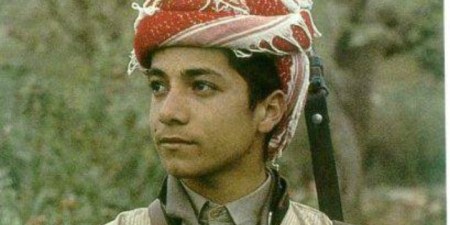
A young Masoud Barzani fighting with the Kurdish peshmerga. Photo: File.

For the last forty-seven years, Jamil “Jimmy” Ezra has marked a special, deeply private anniversary on September 1 with a ray of hope in his heart. For it was on that day in 1970 that Ezra – accompanied by his brother and sister – drove in a jeep to the Iraqi border with Iran with Kurdish leader Masoud Barzani and his assistant at the wheel.

Ezra and his siblings were among more than 2,000 Iraqi Jews who were helped by Kurdish Peshmerga to escape from the Ba’athist regime during the 1970s. These were dark days in Iraq, where the remnant of a Jewish community that had only recently numbered 150,000 was convulsed with fear following the public hanging in Baghdad in 1969 of 14 people, nine of them Jews, on trumped-up charges of spying for Israel. Ezra remembers the time with the same deep emotion that grounds his present fears about what the future now holds for his Kurdish rescuers.

“My heart breaks for the 30 million Kurds, divided between Iraq and Turkey, Syria and Iran, and abused and suffering,” Ezra told The Algemeiner on Monday.

Ezra will be speaking about his experiences with Masoud Barzani – son of the legendary Mullah Mustafa Barzani and, until last week, the president of the Kurdistan Regional Government (KRG) – at downtown Manhattan’s prestigious Center for Jewish History on Tuesday night, during a special two-part series on the Kurds sponsored by the American Sephardi Federation. It is a story that began when Ezra was a boy of 17 in Baghdad, living with his aunt and uncle, and still grieving from the sudden death of his father from a heart attack on the very same day in July 1968 that Saddam Hussein and his Ba’athist comrades seized power.

“One day in 1970, my brother Farid was walking in the street when he was stopped for an ID check,” Ezra recalled. “He had a permit exempting him from serving in the army, and on every page it was written in red, yahudi, yahudi, yahudi (Jew).”

Farid was arrested and imprisoned on a spying charge. His voice breaking, Ezra recalled how his brother was beaten and tortured by his jailers until he suffered a nervous breakdown. Farid was then transferred to a prison for the criminally insane.

“In the hot summer, the prisoners would all run outside to drink the unfiltered river water that was brought in by a truck in the morning — they would fight over the dirty water,” Ezra said. “My aunt would send me with food and clean water for my brother, and he would beg me to take him away.”

At this point, Ezra said, he and his sister Gilda decided that it was time to leave Iraq. He ventured north to Iraqi Kurdistan, then enjoying a measure of autonomy under an agreement with Baghdad that was soon reneged upon by Saddam Hussein. Arriving in the Kurdish town of Haj Omran on the Iranian border, he came across an Iraqi Jewish family he knew who were taken across the border into Iran that same night. Ezra, meanwhile, was given a mattress in a room where he bedded down with ten Kurds. “I told them about how the Jews were suffering,” he said.  “They promised to take me to Mustafa Barzani the following day.”

The next morning, Barzani’s aides hatched a plan that involved Ezra and another Jewish family returning to Baghdad to collect their relatives, after which they would travel to a meeting point back in northern Iraq. “That was on Monday; on the Thursday, back in Baghdad, I woke up my brother Farid, who was suffering badly from his trauma in prison, and I told him, ‘Come on, you and me and Gilda are going on a short vacation,’” he said.

Had they been stopped and discovered at one of the many security checkpoints along the way, certain imprisonment in a Ba’athist jail would have awaited — and, indeed, the family was pulled over by a soldier. “Luckily, the guy was an idiot,” Ezra remembered. “He couldn’t understand why my brother had an exemption permit from the army, so our driver kept explaining, ‘He’s not well, he’s well.’ Eventually, the soldier said, ‘Ok, ok, you can go.’”

Arriving at the meeting point agreed with Barzani’s advisers, Ezra remembered that a high-level Kurdish intelligence official “came out and started briefing us.”

To maintain secrecy around Kurdish assistance to escaping Iraqi Jews, the official instructed Ezra and those with him to personally approach Masoud Barzani, who would be sitting in a cafe at an agreed time, and pretend they had a brother imprisoned by Kurdish forces. “We had to act,” Ezra said. “We had to beg and plead in front of Masoud.”

Following this ruse, the Ezra siblings got into a jeep alongside  Masoud. At the border with Iran, Masoud got out and bade his farewells. “We had a gift for Masoud and his adviser,” Ezra said. “It was a Parker 21 pen, that was a big deal back then. We wanted them to take it, but they refused and refused. They said, ‘We are doing this because we care and we want to help you.’”

“They never took any money, any gifts, unlike the smugglers who would rob the Iraqi Jews they were supposed to be helping,” Ezra continued.

After crossing into Iran on September 1, the Ezras survived a long and arduous journey to Tehran, where they stayed at the aptly-named Hotel Sinai — then full of escaped Iraqi Jews in transit with the Jewish Agency’s assistance. “On October 2, we arrived in America,” Ezra said. “We came to New York.” Many other Iraqi Jews who escaped around the same time went to Israel, as well as the UK, Canada and other countries.

Ezra’s thoughts over the last month have been dominated by the fate of the Kurds, whose 93 percent vote in favor of independence in the September 25 referendum resulted in an Iranian-backed onslaught involving Iraqi government forces and the Shia Hashd al-Shaabi paramilitary group. More than 50 percent of the territory liberated from ISIS by the Kurds has been lost, including the historic city of Kirkuk, while Kurdish political leaders have been painted into a corner as they try to maintain as much autonomy from Baghdad as feasible.

“I follow the news of the Kurds, I pray for them,” Ezra said. “I know their history, how they were divided between four countries after World War One. America has betrayed them, Britain and France have betrayed them. Israel tried to help, but they were limited by the Americans dictating to them how much they could do.”

Ezra wants American Jews to urge their legislators to protect the Kurds, a long-standing American ally. “What happened to the Jews could still happen to them,” Ezra said, casting an eye on Saddam Hussein’s infamous attempts to obliterate the Kurds with chemical weapons attacks in the late 1980s.

“Measures need to be taken to prevent that,” he said. “This should be an emergency for the UN Security Council. The issue of the Kurds has to be kept alive every day of the year.”