Author Archive

Days of Media Rage about Jerusalem

December 7, 2017

Days of Media Rage about Jerusalem, Washington Free Beacon, December 6, 2017

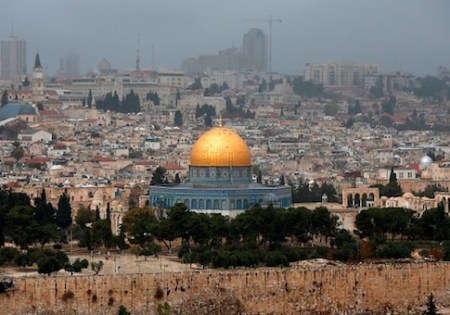
A picture taken from the Mount of Olives shows the Old City of Jerusalem with the Dome of the Rock mosque in the centre / Getty Images

I lived in Jerusalem, Israel, for two happy years, and much of my work ever since has involved U.S.-Israel relations. I should know better, yet still I am surprised at the rending of garments and apocalyptic predictions pouring forth from western pundits over something that will not change a single stone in the holy city, or a single person’s access to its holy sites, or a single border—and that overwhelming majorities of Congress and virtually every president and presidential candidate has endorsed for decades. Chalk it up in part to the hysteria that has characterized our political debates in the past two years, and also in part to the enormous influence that former Obama administration officials have in setting media narratives and frames for covering issues on which the current president repudiates the approach of the previous one. So here are some notes of calm, in no particular order:

  1. One of the first arguments critics make against recognizing Jerusalem is that it would so anger the Palestinians that the peace process would never recover. But the Palestinians have rejected every offer of statehood, and have not been willing to engage in real talks with Israel since the Bush administration. They’re already unwilling to negotiate, and were especially unwilling during the Obama years, when the president was openly acting as their advocate. If they are so incensed that the United States is finally acknowledging the plain fact that Jerusalem is the capital of Israel that they will never talk again, it tells us that a negotiated agreement was never possible in the first place. Despite the likelihood of protests and perhaps some violence in the next few days, U.S. recognition of Jerusalem will actually promote peace in the long run because it will help disabuse the Arab world of its fantasy of Israeli impermanence. It will also show Palestinians for the very first time that their rejectionism has costs, and will not permanently paralyze U.S. policy toward Israel. The cause of peace is weakened so long as the Arab self-delusion about Israel’s impermanence is encouraged by U.S. policy.
  2. Another argument common among Middle East pseudo-sophisticates is that recognizing Jerusalem would drive a wedge between Israel and the Arab states, right at the moment when the threat from Iran is bringing them together. This sounds plausible, but the opposite is probably true. The Arab states’ recent rapprochement with Israel is not ideological—it is expedient, because the Arabs are comparatively weak and are seeking protection from a stronger power. Israel’s embrace of U.S. recognition doesn’t change this reality. Indeed, by confidently demonstrating its willingness to assume risk, and by showing its closeness to America, Israel’s attractiveness to the Arab states who need its help against Iran only increases. Arab regimes will howl in public, but in private they will understand that only a strong, determined country can protect them. And that understanding will draw them closer to Israel.
  3. The most craven argument against recognition is that it will spark Arab violence. This argument is being aggressively promoted by former Obama administration officials and their media allies, and by Palestinian and Jordanian officials, who barely attempt to conceal their mau-mauing of western countries with threats of rioting and terrorism. The United States’ response to this tactic should be to tell them to pound sand. The United States cannot allow Middle Eastern rent-a-mobs to exercise a veto over our foreign policy, especially not on an issue in which the threat of violence originates in the rank anti-Semitism of Islamists who deny Jewish history in Israel and Jewish political rights in the region. If the King of Jordan wants to send crowds of his subjects into the streets to riot, that is his problem. What has been pathetic and depressing to witness is the astounding number of western reporters and pundits who are happy to retail a messaging campaign that is barely distinguishable from blackmail.

Just got this in my in box from Ayman Odeh, leading Arab Israeli member of parliament: “Trump is a pyromaniac who could set the entire region on fire with his madness.

Apparently defying his national security advisers and the counsel of all our allies but one, @POTUS recklessly and needlessly lights a fuse that could further inflame the Middle East.http://www.nytimes.com/2017/12/05/world/middleeast/american-embassy-israel-trump-move.html 

    1. Speaking of westerners who are happy to promote Islamist blackmail: The hypocrisy of their sudden concern for violence in the Middle East can only be described as shameless. The very same people—the Obama administration officials and their media and think tank friends—who made endless excuses for doing nothing about the mass slaughter in Syria or Iran’s takeover of Iraq/fueling of war in Yemen, and who cheered the nuclear deal with Iran, which filled the coffers of the leading state sponsor of terror with billions and put it on a glide path to nuclear weapons—these very same people are now so concerned about peace and stability in the Middle East that they need fainting couches over a speech that recognizes Jerusalem is the capital of Israel. How stupid do they think we are?

A final thought: what to make of the hysterics from the peace-process guild, that class of Washington analysts, diplomats, and former officials who have made careers of attempting to broker Israeli-Palestinian peace? Their supercilious denunciations of Trump’s announcement mask an undercurrent of fear – fear for the loss of their own status. They understand, I think, that for them, recognizing Jerusalem represents much more than a discrete policy change. It raises fundamental questions about a cherished multi-decade American diplomatic project, one that has been a pillar of Democratic foreign policy since the early 1990s.

Through three administrations, the script has remained the same: America brokers talks in which the parties reach compromises on the issues of Jerusalem, borders, refugees, settlements, and security, at which point an agreement is signed and everyone involved receives the Nobel Peace Prize and recognition in history as consequential statesmen. Needless to say, this script hasn’t worked. There is not a single issue on which the two sides have ever come close to reaching an agreement.

But for the peace process guild, that’s not a problem. The important thing is to keep trying, to remain guardians of the issue, and to treat alternative approaches with so much contempt and ridicule that they are never given serious consideration.

In recognizing Jerusalem, Trump is showing that this tired script need not be followed—and that this tired guild need not be obeyed. The peace process community correctly recognizes that Trump’s announcement is not just a policy change, but an attack on their authority. And so they are desperate for it to fail, and one senses based on their breathless tweeting over the past few days that many in this community would experience enormous schadenfreude should the coming days be marked by rioting and terror. Any other outcome makes them look like fearmongers, and delegitimizes the other counsel they dispense.

If a president can show that adherence to the traditional confines of the peace process is unnecessary on Jerusalem, why can’t he do it on other issues? Trump’s announcement is not significant in terms of changing facts on the ground, because Jerusalem has always been Israel’s capital. But it may be very significant for the peace process and the network of experts, think tanks, journalists, politicians, diplomats, and ex-officials who have so much vanity and prestige invested in protecting a failed understanding of the region.
Inside Judicial Watch: The Politicized DOJ — Mueller, Comey, Strzok, Yates, & More!

December 7, 2017

Inside Judicial Watch: The Politicized DOJ — Mueller, Comey, Strzok, Yates, & More! Judicial Watch via YouTube, December 5, 2017


Netanyahu Thanks Trump for ‘Historic Decision’ to Recognize Jerusalem as Israel’s Capital

December 6, 2017

Netanyahu Thanks Trump for ‘Historic Decision’ to Recognize Jerusalem as Israel’s Capital, Washington Free Beacon, December 6, 2017


Israeli Prime Minister Benjamin Netanyahu on Wednesday thanked President Donald Trump for his “historic decision” to recognize Jerusalem as Israel’s capital, saying it will advance peace in the Middle East.

“President Trump, thank you for today’s historic decision to recognize Jerusalem as Israel’s capital,” Netanyahu said in a video statement. “The Jewish people and the Jewish state will be forever grateful.”

Netanyahu noted that Jerusalem “has been the capital of the Jewish people for 3,000 years” and the capital of Israel for nearly 70 years, describing how the city has been the focus of the Jewish people’s “hopes, dreams, and prayers” for three millennia.

Netanyahu’s comments came shortly after Trump officially recognized Jerusalem as the capital of Israel, calling the move an “overdue step” for peace efforts between the Jewish state and the Palestinians. Trump also said that he is directing the State Department to make preparations to move the U.S. embassy in Israel from Tel Aviv to Jerusalem.

Several world leaders, particularly from Europe and the Middle East, have criticized Trump’s decision and said that it will lead to violence. Palestinian factions have called for “three days of rage” over the announcement.

“The president’s decision is an important step towards peace, for there is no peace that doesn’t include Jerusalem as the capital of the State of Israel,” said Netanyahu, who called on all countries to join the U.S. in recognizing Jerusalem as Israel’s capital and to move their embassies to the city.

Netanyahu reiterated his commitment to advancing peace with the Palestinians and all of Israel’s neighbors, adding that the Israeli government will continue to work with the Trump administration “to make that dream of peace come true.”

The prime minister also addressed specific concerns over Trump’s remarks, making clear that “there will be no change whatsoever to the status quo at the holy sites” in Jerusalem.

“Israel will always ensure freedom of worship for Jews, Christians, and Muslims alike,” Netanyahu said.

The Israeli leader called Trump’s announcement “courageous” and said it will advance peace.

“We’re profoundly grateful for the president for his courageous and just decision to recognize Jerusalem as the capital of Israel and to prepare for the opening of the U.S. embassy here,” Netanyahu said. “This decision reflects the president’s commitment to an ancient but enduring truth, to fulfilling his promises and to advancing peace.”

President Trump Gives a Statement on Jerusalem

December 6, 2017

President Trump Gives a Statement on Jerusalem, The White House via YouTube, December 6, 2017

A Two State Solution for Europe?

December 6, 2017

A Two State Solution for Europe? Gatestone InstituteJudith Bergman, December 6, 2017

(A two state “solution” for Europe would be good self-revenge for demanding that Israel submit to it. —  DM)

Moliner’s solution?

“… Establish a dual system of law in France… one territory, one government, but two peoples: the French with the usual laws and Muslims with Qur’anic status (but only for those who choose it)… The latter will have the right to vote… but they will apply Sharia in everyday life, to regulate matrimonial laws (which will legalize polygamy) and inheritance… They will no longer apply to French judges for disputes between Muslims… conflicts between Christians and believers will remain the responsibility of ordinary courts…”

Moliner’s proposal represents a total surrender to political Islam and is of course outrageous, especially considering that Muslims only comprise a little more than five percent of the French population. What he suggests, however, merely formalizes the status quo that already exists — and not only in France — even if it abandons reform-minded Muslims and eventually, with their collapsing demography, the non-Muslims there.

*********************************

A poll conducted this summer found that 29% of French Muslims found Sharia to be more important to them than French laws. It also found that 67% of Muslims want their children to study Arabic, and 56% think it should be taught in public schools.

A 2016 UK poll showed that 43% of British Muslims “believed that parts of the Islamic legal system should replace British law while only 22 per cent opposed the idea”. Another poll from 2016 found that 23% of all Muslims supported the introduction of sharia law in some areas of Britain, 39% agreed that “wives should always obey their husbands,” and 52% of all British Muslims believe that homosexuality should be illegal.

French President Emmanuel Macron blamed France, not Islam, for the increased radicalization, which he said should lead France to “question itself.” According to Macron, then, the parallel Islamic societies of France, have nothing to do with Islam. They are the fault of the French republic. Did the French republic impose sharia and the subjugation of women in the suburbs, described by one female survivor as “hell”? Was the French republic behind the recent distribution of leaflets stipulating “if you meet a Jew, kill him”?

A French intellectual, Christian Moliner, recently suggested that France should establish a Muslim state-within-a-state that adheres to sharia law, inside the borders of France, to avoid a civil war. Warning against refusing to deal with the problems of Islamism in Europe because of political correctness, he stated:

“Out of the fear of appearing Islamophobic, to satisfy this bustling fringe of Muslims, governments are ready to accept the spread of radical practices throughout the country…. [some] territories are outside the control of the Republic. The police can come only in force and for limited durations… We can never convert the 30% of Muslims who demand the introduction of sharia law to the merits of our democracy and secularism. We are now allowing segregation to take place that does not say its name.”

Moliner’s solution?

“… Establish a dual system of law in France… one territory, one government, but two peoples: the French with the usual laws and Muslims with Qur’anic status (but only for those who choose it)… The latter will have the right to vote… but they will apply Sharia in everyday life, to regulate matrimonial laws (which will legalize polygamy) and inheritance… They will no longer apply to French judges for disputes between Muslims… conflicts between Christians and believers will remain the responsibility of ordinary courts…”

Moliner’s proposal represents a total surrender to political Islam and is of course outrageous, especially considering that Muslims only comprise a little more than five percent of the French population. What he suggests, however, merely formalizes the status quo that already exists — and not only in France — even if it abandons reform-minded Muslims and eventually, with their collapsing demography, the non-Muslims there.

In France, the no-go zones with their Islamization and Islamic law, sharia, and most noticeably the subjugation of women, has already spread from the suburbs (banlieues) to the cities themselves. As Gatestone’s Yves Mamou described:

“… no-go zones are no longer relegated to the suburbs, where migrants and Muslims have usually been concentrated. No-go zones, through mass migration, have been emerging in the heart of Paris, Bordeaux, Toulouse, Marseille, Grenoble, Avignon — districts ‘privatized’ here and there by a mix of drug traffickers, Salafist zealots and Islamic youth gangs. The main victims are women. They are — both Muslim and non-Muslim — sexually harassed; some are sexually assaulted”.

Last year, French TV aired a documentary about women disappearing from public view in certain areas, where parallel Islamic societies had taken hold. The program named Sevran in the district of Seine-Saint Denis — a suburb of Paris described by French political scientist Gilles Kepel as “the capital of French Islam”. There are 1.4 million people living in the district of Seine-Saint-Denis. More than 600,000 of them are Muslims. The French postal service recently said that it will no longer supply its Chronopost delivery service to Seine-Saint-Denis — the danger to their delivery drivers is too high. Last year, 51 of its delivery drivers were reportedly attacked while doing their rounds.

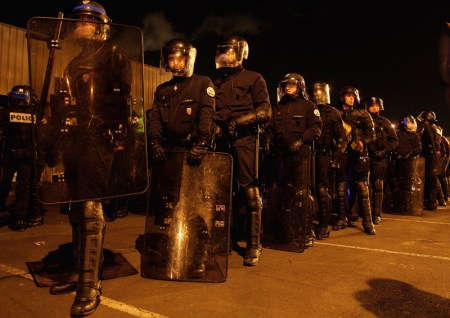
Riot police muster in the northern Paris suburb of Villiers-le-Bel, France. (Photo by Pascal Le Segretain/Getty Images)

In France, a poll conducted by Institut Montaigne this summer found that 29% of French Muslims found sharia to be more important to them than French laws. It also found that 67% of Muslims want their children to study Arabic and 56% think it should be taught in public schools.

A 2016 UK poll, apparently the largest poll ever done on the subject in the UK, showed that 43% of British Muslims “believed that parts of the Islamic legal system should replace British law while only 22 per cent opposed the idea”. A different poll, also from 2016, found that nearly a quarter (23%) of all Muslims supported the introduction of sharia law in some areas of Britain, and 39% agreed that “wives should always obey their husbands”, compared with 5% of the country as a whole. Nearly a third (31%) thought it was acceptable for a British Muslim man to have more than one wife, compared with 8% of the wider population. According to the same poll, 52% of all British Muslims believe that homosexuality should be illegal.

According to a 2014 study of Moroccan and Turkish Muslims in Germany, France, the Netherlands, Belgium, Austria and Sweden, an average of almost 60% of the Muslims polled agreed that Muslims should return to the roots of Islam; 75% thought there is only one interpretation of the Koran possible and 65 % said that Sharia is more important to them than the laws of the country in which they lived. The specific numbers for Germany were that 47% of Muslims believe Sharia is more important than German law. In Sweden, 52% of Muslims believe that Sharia is more important than Swedish law.

As the polls show, there already are “two peoples” in France and large parts of Europe, who wish to live according to completely different standards, as Moliner suggests. Politicians persist in ignoring these facts or downplaying them. So why be shocked at the suggestion of a “two-state solution” for France? How do these politicians, who do not even acknowledge the problems, propose to tackle the fact that large percentages of their population would rather live under sharia law? They do not propose anything. They pretend that this information does not exist.

French President Emmanuel Macron, is an example of such immunity to facts: “Radicalization has taken hold because the French Republic has resigned,” Macron said recently about the Islamization of the French suburbs. Macron blamed France, not Islam, for the increased radicalization, which he said should lead France to “question itself”. Macron noted that, “We allowed, in too many cities, too many districts, representatives of a distortion of a religion, which are full of hate and disenfranchisement to provide solutions that the Republic no longer gives.”

According to Macron, then, the parallel Islamic societies of France, have nothing to do with Islam. They are the fault of the French republic. Did the French republic impose Sharia and the subjugation of women in the suburbs, described by one female survivor as “hell”? Was the French republic behind the recent distribution of leaflets stipulating “if you meet a Jew, kill him”? Did the French republic force the mother of Mohammed Merah, the man who killed a little Jewish girl at school by shooting her in the head, while screaming “Allahu Akbar”, to say that “the prophet permits the killing of Jewish children”?

France, as well as the rest of Europe, is — wittingly or unwittingly — heading towards the “two-state solution” outlined by Moliner, whether it wants it or not. That fact, however, does not appear particularly to bother the political establishment.

Judith Bergman is a columnist, lawyer and political analyst.

Jerusalem 101: Why President Trump’s New Policy Is Such a Big Deal

December 6, 2017

Jerusalem 101: Why President Trump’s New Policy Is Such a Big Deal, BreitbartJoel B. Pollak, December 6, 2017

AP Photo/Evan Vucci

President Trump’s decision also represents a guarantee of Israeli sovereignty in at least part of Jerusalem. As such, it represents the fulfillment of thousands of years of Jewish prayer, and over a century of Zionist efforts to establish and protect a Jewish state in the ancient homeland of the Jewish people.

It is no exaggeration to say that for Jews, recognition of Jerusalem as Israel’s capital is an event of almost Biblical significance. And we are witnesses to it.

********************************

President Donald Trump is announcing Wednesday that the U.S. officially recognizes Jerusalem as the capital of Israel, and that the State Department will begin the process of moving the embassy to Jerusalem from Tel Aviv.

It might be unclear at first why that policy change is so important. Jerusalem is, after all, the de facto capital of Israel. The Israeli parliament (Knesset) is there, as are the prime minister’s office, the president’s residence, the Supreme Court, and all of the executive agencies. Israelis consider Jerusalem their capital whether or not the U.S. recognizes it as such. As a practical matter, the change is symbolic. But as such, it is still extremely important.

To understand why, it is important to understand the history of the city. The Old Testament describes in 2 Samuel 5 how King David conquered the city and made it his capital, over 3000 years ago. It later describes in 1 Kings 8 how David’s son, King Solomon, built the Holy Temple and installed the Ark of the Covenant there. Since then, Jews have always faced Jerusalem in their daily prayers. It is the center of the Jewish faith and the core of Jewish history.

The Bible also tells the story of how the Jews were exiled from Jerusalem by the Babylonians, and later returned to rebuild the Temple. Another exile happened after 70 A.D., when the Romans destroyed the Second Temple and the city itself. Still, many Jews remained, and Jews worldwide prayed for 2,000 years for a return to “Zion.” Jews have been the largest ethnic group in Jerusalem for nearly 200 years, and a majority since the mid-nineteenth century.

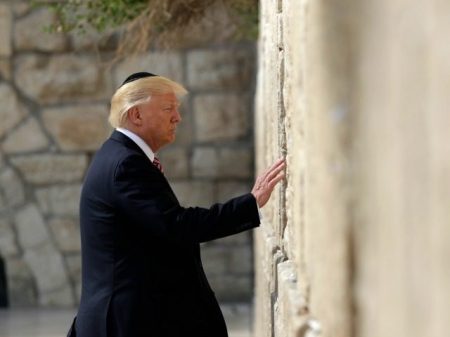
Jerusalem is also holy to Christians and to Muslims, though it is less central to either. And under Israeli sovereignty, all religions have enjoyed the freedom to worship at their respective holy sites. The Temple Mount — or Haram ash-Sharif, to Muslims — has only been closed when there are imminent security threats, as radicals have sometimes used that holy site to attack Jews worshipping at the Western Wall — the last remnant of the Temple — below.

Jews began returning to the region in large numbers in the late nineteenth century as part of the Zionist movement, which aimed to re-establish Israel as a modern state, and as a refuge for the persecuted Jews of Europe. In 1917, the British government backed the establishment of a Jewish “national home” in what was then called Palestine (though the Arabs of the region did not call themselves Palestinians), in lands under British control since World War One.

The Jewish community of Jerusalem had, by then, expanded beyond the Old City and developed neighborhoods to the west. In 1947, the United Nations voted to approve the partition of Palestine west of the Jordan River into two states — one Jewish, one Arab. Jerusalem was to be an international city, not under the control of either side. The Jews accepted the plan and declared independence in 1948; the Arabs rejected the plan and declared war instead.

During that war, Arab forces fought to sever the connection between the Jewish community in Jerusalem and the Jewish communities further west. There was only one road to Jerusalem, and it was constantly under attack. In the Old City, Jewish fighters were eventually overrun by Jordanian troops — which, trained by Britain, were the Arab world’s best. Jordan occupied the Old City and flattened the Jewish quarter, ethnically cleansing its inhabitants.

From 1948 to 1967, Jerusalem was divided into two parts. On the western side, Israel established its capital amidst a modern city. On the eastern side, Jordan governed the Old City and the surrounding Arab neighborhoods of the West Bank. There was never any discussion of establishing a Palestinian state in the West Bank or a Palestinian capital in Jerusalem. Jews were denied access to the holy sites of the Old City, especially the Western Wall.

In the Six Day War of 1967, Israel — under direct threat of destruction by the surrounding Arab states — won a surprise victory and took control of the Sinai peninsula, the West Bank, and the Golan Heights. Israeli troops also conquered all of Jerusalem, reuniting it and liberating the Old City. But the Arab states still refused to negotiate with Israel, and most countries declined to place their embassies there for fear of antagonizing the Palestinians.

In the 1990s, when formal negotiations began between Israel and the Palestinians, Jerusalem was one of the most difficult issues — more difficult than the questions of borders and Palestinian refugees. Though Congress passed the Jerusalem Embassy Act in 1995, it gave the president the power to sign a waiver every six months delaying the embassy move. The idea was to preserve the status quo in Jerusalem so as not to jeopardize ongoing peace talks.

But as administration officials explained to reporters on Tuesday, after more than two decades, it was clear that recognition of Jerusalem as Israel’s capital was not a real obstacle to peace. It was clear to all that the western part of Jerusalem, at least, would be under Israeli sovereignty in any conceivable peace agreement. The idea that all of the city would be up for negotiation was little more than a concession to the most extreme Palestinian demands.

As such, recognizing Jerusalem as Israel’s capital and moving the U.S. embassy there is just a recognition of reality. But it is also a courageous decision, showing that the U.S. will stand with our allies regardless of terrorist threats.

President Trump’s decision also represents a guarantee of Israeli sovereignty in at least part of Jerusalem. As such, it represents the fulfillment of thousands of years of Jewish prayer, and over a century of Zionist efforts to establish and protect a Jewish state in the ancient homeland of the Jewish people.

It is no exaggeration to say that for Jews, recognition of Jerusalem as Israel’s capital is an event of almost Biblical significance. And we are witnesses to it.

Jerusalem: Trump and Congress Challenge the Palestinians to Grow Up

December 6, 2017

Jerusalem: Trump and Congress Challenge the Palestinians to Grow Up, PJ MediaRoger L Simon, December 5, 2017

(There have been numerous conflicting guesses about what President Trump will say this afternoon. We will have to wait to find out. — DM)

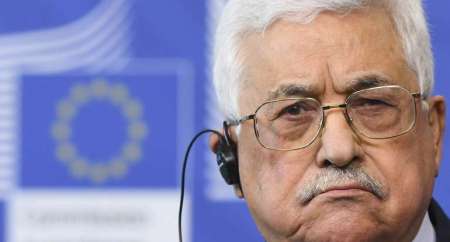
Mahmoud Abbas visit to Brussels, Belgium – 27 Mar 2017Mahmoud Abbas visit to Brussels, Belgium – 27 Mar 2017

The irony is that anyone who actually cares about the Palestinians as people should welcome what America is doing now.  It is perhaps the last best chance for the Palestinians to grow up, break free of their endless pattern of self destruction, and give up looking for excuses for another pointless intifada.  Unfortunately, too many of those players enjoy the status quo, profit from it, or resist change in general, like the self-righteous European leadership.

**********************************

The president’s decision to move the U.S. embassy in Israel from Tel Aviv to Jerusalem to be announced Wednesday is already sending the usual suspects into a tizzy.  The famous Arab Street, we are told, will be erupting.  The despicable fascist that runs Turkey has warned of imminent disaster.  And the president of France is doing what the French usually do vis-a-vis the Jews — well, not quite that bad.

But the real question is how the Palestinians themselves will react once the dust has settled. Will they continue decades of self-destructive violent protests that have led many of us to believe they never had an interest in a two-state solution in the first place, that it was all posturing for handouts? Or will they grow up and realize the time has come to negotiate to a conclusion and accept the responsibility of their own state and the adult compromises that would naturally entail?

By finally moving U.S. policy at least two degrees off years of unimaginative stagnation, Trump has forced the Palestinians to face some measure of reality.  But he is not alone. They are also being challenged forcefully by Congress.  From the Algemeiner:

The Taylor Force Act passed the US House of Representatives by unanimous consent on Tuesday, confronting the Palestinian Authority with the prospect of a massive cut in US aid for as long as it maintains its policy of paying monthly salaries and other benefits to the families of slain or convicted Palestinian terrorists.

Named in memory of Taylor Force – the former American army officer stabbed to death during a knifing spree by a Palestinian assailant in Tel Aviv in March 2016 – the legislation prevents the transfer of funds “that directly benefit the Palestinian Authority” for a six-year period beginning in 2018 unless the PA verifiably ends its so-called “martyr payments” policy. The Taylor Force Act also requires the PA to repeal any laws enabling or favoring the payments policy, as well investigate terrorist acts for the purpose of “bringing the perpetrators to justice.”

Though the embassy move may be more superficially dramatic in a part of the world rarely governed by logic, the congressional action might just be more persuasive to a Palestinian leadership that has been living off global largesse since the Oslo Accords of 1993.  There’s nothing like taking the money out of the hands of kleptocrats. (The U.S. is the PA’s biggest donor to the tune of approximately $700 million per annum, directly or via the UN. The PA, in its turn, paid out $355 million to terrorist — or, as they say, “martyr” — families in 2017.)  At the very least, two branches of the American government seem to be working together for once.

Of course, their attempt  may produce nothing.  Those Hamas and PA billionaires may have enough stashed away to continue their sadistic games, seducing their own impoverished people with dreams of martyrdom over nothing, but for once the dial has been moved.

It will be interesting to see what happens.  The global chess game has changed.  Saudi Arabia, as we all know, is terrified of the Iranians and has found itself a covert ally of Israel against the mullahs.  The Palestinians are aware of that and not happy about it.  They are in a box.  Trump and Congress have chosen an auspicious time to make a move.  Various players will undoubtedly yell and scream in public and say something totally different in private.  That is the way of the Middle East (and America, unfortunately, these days).

The irony is that anyone who actually cares about the Palestinians as people should welcome what America is doing now.  It is perhaps the last best chance for the Palestinians to grow up, break free of their endless pattern of self destruction, and give up looking for excuses for another pointless intifada.  Unfortunately, too many of those players enjoy the status quo, profit from it, or resist change in general, like the self-righteous European leadership.

Robert Mueller’s mighty tuna shrinks to a goldfish

December 5, 2017

Robert Mueller’s mighty tuna shrinks to a goldfish, Washington Times, December 4, 2017

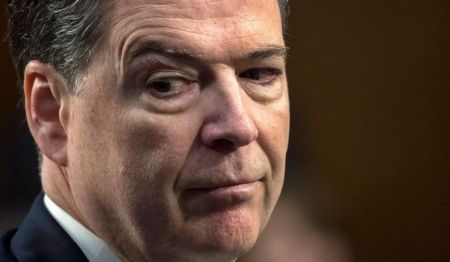
James Comey. (Associated Press) ** FILE

ANALYSIS/OPINION:

Robert Mueller has the heart of a Las Vegas hooker and the guile of a New Orleans stripper. Not to push the metaphor too far, he’s skilled at showing a little skin in a cloud of satin and lace, but never quite comes across with what the customer is paying for.

Mr. Mueller, held up by his fellow Blackstones as a model of lawyerly rectitude, teased everyone last week that after testing his prowess to the limit, he had hooked a mighty tuna. His hallelujah chorus in the media celebrated the hundred-pound monster, but overnight it melted into a two-inch goldfish.

The special prosecutor might yet get the last laugh. He may yet land the promised tuna if there’s actually one out there in the briny deep. So far he’s coming up with nothing but net. The Associated Press, which has never been accused of giving Republicans a break, called the arrest “lots of smoke, but no smoking gun.” The “lots of smoke” looked as the new week began as merely a thin tuft of smoke, or more likely a wisp of fog.

The president’s sharpest detractors, agreed CNBC News, among the most fervent of those detractors, have so far been unable to find evidence that the Trump campaign coordinated with, or was even aware of, Russian efforts to swing the 2016 presidential election against Hillary Clinton.

The Democrats figure that since the tuna turned out to be a goldfish, it’s time to resurrect something dead from the recent past. Sen. Dianne Feinstein, whose Senate seat has been getting a little warm, resurrected a notion discarded earlier that Mr. Trump obstructed justice by firing James Comey as director of the FBI. Mr. Comey is best buds with Robert Mueller, who has never given up trying to rehabilitate Mr. Comey from goat to grandee. Only last week Mr. Comey himself took a turn as Bible scholar, attempting to apply a verse from the Book of Amos (5:24) — “But let judgment run down as waters, and righteousness as a mighty stream” — to Mr. Mueller’s search for a crime. A Bible verse in the hands of a novice can be like a child with a gun.

Alan Dershowitz thinks the idea that the president, by sacking Mr. Comey, obstructed justice is nonsense. Mr. Dershowitz, the distinguished law professor at Harvard, warned Mrs. Feinstein and Democrats who are trying to build a case that the president obstructed justice that they’re wasting their time.

“You cannot charge a president with obstruction of justice for exercising his constitutional power to fire Comey and his constitutional authority to tell the Justice Department who to investigate, who not to investigate. That’s what Thomas Jefferson did, that’s what Lincoln did, that’s what Roosevelt did. We have precedents that clearly establish that.”

The president’s tweets are making trouble for him again. Some Democrats, eager for something, anything, to hang their hats on, argue that Mr. Trump’s tweet on Sunday “suggested” that the president knew former National Security Adviser Michael Flynn lied to the FBI, and that implies obstruction of justice. Or it might only be that these Democrats inferred that that’s what the president did. They should study the difference. A desperate Democrat might infer a lot of fake stuff. To pursue a president for obstruction would ultimately require that “clearly illegal acts” would have to have been committed.

This is what some of Mr. Trump’s pursuers would call mere technicalities in the law. Destroying Donald Trump is of such transcendent purpose, the goal of every right-thinking American, that anything goes. Ask any never-Trumper. What does the Constitution have to do with it, anyway? Six and seven decades of drinking the poison that the Constitution is only “a living document,” subject to reinterpretation to fit any theory of the law, has done great damage.

The Flynn episode might be the needed tutorial in constitutional law. Lawyer and layman alike can learn something useful. Alan Dershowitz thinks Mr. Trump’s lawyers should learn something, too. Legally speaking, he says, Mr. Flynn was “up for sale,” and his “credibility is worthless” since he has been credibly accused of perjury.

“I think the administration is not aggressive enough with [Mr.] Mueller,” Mr. Dershowitz told Laura Ingraham of Fox News last week. “They should be in court challenging what he has been doing. He is going far beyond any possible scope of his investigation.”

The president’s lawyers could be challenging subpoenas, and who are called as witnesses. An investigation, whether called for or not, should be done with a semblance of fairness or it will invite a generation of vipers to do their evil work. If Donald Trump is half as bad as the Democrats say he is, Robert Mueller does not need a railroad to get to where he’s trying to go.

• Wesley Pruden is editor in chief emeritus of The Times.

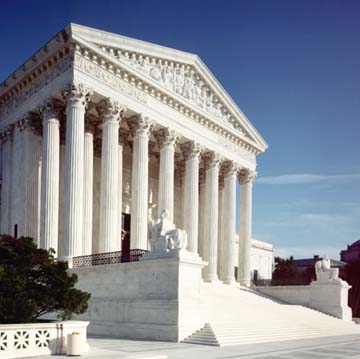
Supreme Court Reinstates The Trump Travel Ban In Full Depending Appeal

December 5, 2017

Supreme Court Reinstates The Trump Travel Ban In Full Depending Appeal, Jonathan Turley’s Blog, Jonathan Turley, December 5, 2017

I do not see how these orders cannot be taken as a strong indication of the view of the majority on the Supreme Court in favor of the authority claimed by the Administration.  Moreover, the orders contain a notable line that indicates that the Court wants this litigation brought to an end: “In light of its decision to consider the case on an expedited basis, we expect that the Court of Appeals will render its decision with appropriate dispatch.”  If the injunction decision is any indication, the Court may be thinking of dispatching more than the schedule in this long-running litigation.

******************************

Yesterday, the Trump Administration secured two clear victories after the United States Supreme Court issued two orders lifting the lower court injunctions imposed on the travel ban.  I have written repeatedly on the travel ban (here and here and here and here and here and here and here and here) and my view that the case law supported the Trump Administration.  I thought that the appeal that reached the Supreme Court on the second round seemed likely to succeed while the third round was even stronger for the Administration.  The Administration had already secured an order with the Ninth Circuit reversing the trial courts in critical respects.  Now the Supreme Court restored the travel ban in its entirety pending appeal.  The orders issued shortly before appellate arguments on the merits this week is a further indication that the Administration is likely to prevail on the merits.  Indeed, while the orders do not dictate an outcome, they send a strong message to the lower courts on the skepticism of the Court.

When the Supreme Court lifted a significant part of the injunctions imposed by lower courts, there was a surprising footnote in the short order that I discussed at the time.  The Court indicated that the Trump Administration had not asked for an expedited hearing before October.  That set the travel ban up for what I described as “planned obsolescence” to expire shortly before the scheduled oral argument.

Buried in the order was the following line after the Court set the oral hearing for the start of the October session:  “The Government has not requested that we expedite consideration of the merits to a greater extent.”  So the Administration asked for expedition but did not push for a July argument, which would not be unprecedented. Instead, the Court set oral argument for the start of the October session.  Why?  If this is a matter of national security danger, one would expect at least a request for a July argument.

As discussed at the time, the answer would seem to be that the Administration was planning to issue a new travel order after the expiration (it would be smarter to wait for the passage of the 90 days to avoid arguments that the new order in any way worked in tandem with the prior order).  The new order would then be based on new information, new priorities, and likely cover additional countries. That would make it even more difficult to challenge.  The degree of reliance of lower courts on Trump’s campaign statements and tweets were always questionable.  Replaying “Golden Trump Oldies” on a new ban is unlikely to garner as much of a judicial audience.

After the Supreme Court order lifting the injunction, the expired ban barred citizens of Iran, Libya, Somalia, Sudan, Syria and Yemen who could not show a “credible claim of a bona fide relationship with a person or entity in the United States” from entering the U.S. As I discuss, the new order could add additional countries to the list and identify other vetting concerns and procedures.  It did.

The new order issued Sept. 24 contains a new list of countries that dropped some of the original countries while adding new non-Muslim countries. For the record, I have long criticized the earlier orders against the travel orders as relying too heavily on campaign statements and too little on existing case law. I believe that the administration would have largely prevailed on the second order if the litigation were not mooted. The new opinions in Hawaii and Maryland offered basically the same narrative while ignoring the new factual foundation.

There is no question that President Trump continues to make the defense of these orders more difficult with his controversial tweets, including the recent retweeting of controversial videos from an extremist group in England. However, the materiality of these statements has become more and more forced with each new generation of agency findings. Agencies studied the vetting procedures for months and reached a consensus on the changes that they deemed necessary for border protection. Such factual findings are normally accorded deference by courts, which are bound not to substitute their judgment for policy or political choices.

Judge Chuang notably found that the administration may have met the “low bar” of establishing that entry from these countries would be “detrimental to the interests of the United States.” However, he insisted that the administration did not “explain why the broad travel ban is necessary in a way…unrelated to religious animus.” It is not clear how the administration is supposed to prove that, particularly after shouldering the burden on the detrimental impact to the nation’s security. The administration cited “inadequate identity management protocols, information sharing practices, and risk factors,” including need technological improvements.

The new orders allow, for the first time, the travel bans to go into full affect. They notably do not include the prior limitation imposed by the Court in June when the Court lifted most but not all of the injunctions.  At that time, three justices indicated that they wanted to lift the injunctions without limitations but the rest of the Court decided to preserve the injunction for those with established connections to the United States.  On this occasion, only Ruth Bader Ginsburg and Sonia Sotomayor dissented to allowing the travel ban to be enforced in its entirety.

While the orders relate to the injunctions and not the merits, the Court clearly rejected the lower court finding under the preliminary injunction standard that the challengers had shown a “likelihood of success on the merits” of the case. The Court could also have rejected the showing that the plaintiff is likely to suffer irreparable harm in the absence of preliminary relief, that the balance of equities weighs in the plaintiff’s favor, or that a preliminary injunction is in the public interest.

I do not see how these orders cannot be taken as a strong indication of the view of the majority on the Supreme Court in favor of the authority claimed by the Administration.  Moreover, the orders contain a notable line that indicates that the Court wants this litigation brought to an end: “In light of its decision to consider the case on an expedited basis, we expect that the Court of Appeals will render its decision with appropriate dispatch.”  If the injunction decision is any indication, the Court may be thinking of dispatching more than the schedule in this long-running litigation.

Here are the orders: International Refugee Assistance order and the Hawaii order.

Trump Tells Abbas & Abdullah: The US Embassy is Moving to Jerusalem

December 5, 2017

Trump Tells Abbas & Abdullah: The US Embassy is Moving to Jerusalem, The Jewish Press, December 5, 2017

(Please see also Report: US Quietly Taking Major Steps Toward Moving Israeli Embassy. As to the timing, it may take time to get the new embassy ready.– DM)

Mazal Tov to President Trump from a Jerusalem, Israel builder

On Monday night, President Trump did not sign the waiver for the Jerusalem Embassy Act, which he is required to sign every 6 months if he wants to delay the move.

**************************

President Donald J. Trump spoke with Palestinian Authority President Mahmoud Abbas and the King of Jordan Abdullah II on Tuesday and informed them that he intends to move the US Embassy from Tel Aviv to Jerusalem.

Both the PA and the Kingdom of Jordan released statements stating that this is what Trump told them.

No indication was given for a timeline as to when this will happen.

The Palestinian Authority had already called for three days of rage starting on Wednesday, before they received the phone call.

There is some expectations that on Wednesday, Trump may also officially recognize Jerusalem as Israel’s capital.

On Monday night, President Trump did not sign the waiver for the Jerusalem Embassy Act, which he is required to sign every 6 months if he wants to delay the move.