Author Archive

Qassem Soleimani sends minion on odyssey from Iraq to the Lebanese-Israeli border

December 12, 2017

Qassem Soleimani sends minion on odyssey from Iraq to the Lebanese-Israeli border, DEBKAfile, December 12, 2017

It took Soleimani’s Iraqi minion and his heavily armed convoy a couple of days to cover 300km from Iraq to Beirut. This is exactly the distance Iranian and Hizballah forces cover on their way from Iraq to the Mediterranean. The tour that wound up Khazali’s trip took place on the south Lebanese road parallel to Israel’s northern border. That road is just 65km long. At several points on his itinerary from Iraq, he must have been sighted. It is hard to understand why no American force in Syria and no eyes along the Israeli-Lebanese border missed sighting his armored convoy and failed to take him out – and so cut short Tehran’s deadly, well-advanced conspiracy to unleash thousands of ferocious Iraqi Shiite militiamen against Israel.

*********************************

By reaching the Lebanese-Israeli border on Dec. 2, Iraqi Shiite militia chief Qais al-Khazali embodied the consummation of Iran’s open land bridge to the Mediterranean.

The mission that Iranian Revolutionary Guards Al Qods chief, Gen. Qassem Soleini entrusted to  Khazali and his militia, Asaib Ahl al-Haq (the League of Believers), embodies Iran’s success in gaining its great ambition of an overland corridor under its control through Iraq up to the Mediterranean coast. In line with that mission, the militia chief was guided along the Lebanese-Israeli border on Dec. 2, for a sight at close hand Israel’s border towns from Admit in the west to Metullah in the east. He needed this information in order to mark out the military positions he would assign to his Khalazi network at Tehran’s behest.

This event most of all highlighted American and Israeli inertia in letting Iran consummate its prime strategic goal of opening up new fronts against Israel from Lebanon and the Syrian Golan. They are to be manned not just by Hizballah, but by many thousands of battle-hardened Iraqi militiamen devoted to Tehran, as the Khazali odyssey has revealed.

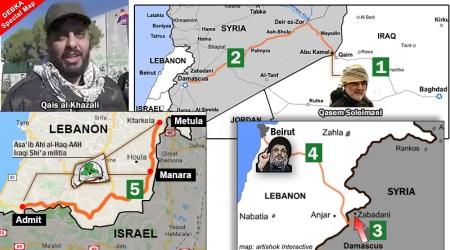
DEBKAfile’s military and intelligence sources tracked his itinerary from the crossing into Syria from Iraq on Thursday, Nov. 30. His first stop was at Soleimani’s headquarters east of Abu Kamal. There, he conferred with the Al Qods chief and his operational staff, as well as with officers of his own militia who were fighting in Syria. They discussed ways and means of transferring 15,000 militiamen from Iraq to Lebanon via Syria for taking up deployment in southern Lebanon along the Israeli border.

On Dec. 1, when these matters were settled, Khazali set out for Damascus, escorted now by Hizballah in a heavily-armored convoy. There, he reported to the new headquarters set up by his militia in partnership with the Iraqi Kata’ib Hezbollah, the backbone of the Iraqi Popular Mobilization Forces (PMU). It is commanded by Soleimani’s deputy, Abu Mahdi al-Muhandis. Our sources report that this headquarters was recently established in Damascus to coordinate the Syrian- based Shiite militias, including those imported from Pakistan and Afghanistan, for a concerted campaign against Israel.

Khazali’s convoy then drove west, crossed the Syrian border into Lebanon and drove on to Beirut for a meeting with Hizballah’s leader Hassan Nasrallah. The two terror chiefs ironed out all the details pertaining to the disposition of the Assaib Ahl al-Haq militia in southern Lebanon across from northern Israel’s Galilee. Our military sources report that that the militia chief was then taken on his tour by Hizballah for surveillance of Israeli military formations on the other side of the border, so as to arrange the positioning of his forces accordingly when they arrived in Lebanon.

The tour began at the Hizballah position facing Israel’s Admit, continued to Houla, west of which Hizballah has planted a position opposite Israel’s Manara ridge and the IDF post located there. His next stop was Kafr Kela, just one and a half kilometers from the northernmost Israeli town of Metula. From a nearby Hizballah position, he was able to view the Golan and Hermon slopes. The voice of a Hizballah officer could be heard on a video clip released in Iraq on the militia chief’s tour. He was saying: “This is Golan. It is nearly 10 kilometers from here.” Khazali then proceeded on foot with his escorts to the Fatima Gate on the Lebanese-Israeli border outside Metula.

It took Soleimani’s Iraqi minion and his heavily armed convoy a couple of days to cover 300km from Iraq to Beirut. This is exactly the distance Iranian and Hizballah forces cover on their way from Iraq to the Mediterranean. The tour that wound up Khazali’s trip took place on the south Lebanese road parallel to Israel’s northern border. That road is just 65km long. At several points on his itinerary from Iraq, he must have been sighted. It is hard to understand why no American force in Syria and no eyes along the Israeli-Lebanese border missed sighting his armored convoy and failed to take him out – and so cut short Tehran’s deadly, well-advanced conspiracy to unleash thousands of ferocious Iraqi Shiite militiamen against Israel.

Congress ignores Trump’s deadline on Iran nuclear deal

December 12, 2017

Congress ignores Trump’s deadline on Iran nuclear deal, Washington Times December 11, 2017

President Trump said on Oct. 13 that Iran is not living up to the “spirit” of the nuclear deal that it signed in 2015. (Associated Press/File)

Congress is about to miss what was widely seen as a deadline to deal with President Trump’s demands for a harder line on the Iran nuclear deal, failing to agree on new sanctions against Tehran and punting the future of the deal back to Mr. Trump.

A Republican legislative push to establish new “triggers” that could reimpose harsh sanctions on Iran lifted under the Obama-era deal has gone nowhere ahead of Tuesday — the end of a 60-day unofficial deadline set by the administration for Capitol Hill to weigh in on the situation after Mr. Trump declared he could no longer certify that the accord was in the U.S. national interest.

Congressional aides say lawmakers still have time to propose something before Mr. Trump is mandated to decide again whether to weigh in on the deal, but White House aides say the president is rankled by the lack of progress on Capitol Hill and likely will pull the United States out of the deal entirely when it comes up for review on Jan. 13.

In October, Mr. Trump called on Congress and American allies party to the 2015 accord — including Britain, France and Germany — to propose ways to address what he called the deal’s “serious flaws,” including its failure to reimpose sanctions should Iran continue to carry out ballistic missile tests in violation of existing U.N. Security Council resolutions. Russia and China also signed the accord and, to date, none of the other signatories has followed the U.S. lead in trying to overhaul the agreement.

U.N. monitors have also repeatedly said Tehran is honoring the letter of the 2015 agreement in curtailing its suspect nuclear programs.

“Come January, the president may be extremely frustrated that neither Congress nor the Europeans have responded to his request for ways to fix the deal,” Mark Dubowitz, an analyst on Iran sanctions and CEO of the Foundation for Defense of Democracies, said in an interview. “It’s entirely possible at that time that the president will walk away from the deal.”

According to a law enacted by Congress in 2015, the president must certify every 90 days that Iran is honoring the deal and that it is in the U.S. national interest. Mr. Trump, in the early days of his administration, twice formally certified Iran’s compliance, but he clearly chafed at seeming to endorse an agreement that he harshly criticized on the campaign trail last year.

He made clear his unhappiness when announcing his Iran deal decision two months ago.

“In the event we are not able to reach a solution working with Congress and our allies, then the agreement will be terminated,” Mr. Trump said on Oct. 13. The deal “is under continuous review, and our participation can be canceled by me, as president, at any time.”

Some of the president’s top aides, including Defense Secretary James Mattis, have advocated staying in the deal out of concern about the negative effects an American pullout could have on Middle East security and on U.S. allies that remain committed to the deal.

The Obama administration strongly backed the agreement, which gave major sanctions relief to Iran in exchange for limits to its nuclear programs. For decades before the accord, the Islamic republic was suspected of developing nuclear weapons in violation of U.N. resolutions.

Legislative fix

Critics say the restrictions on Tehran will expire over the coming decade and that Iran has not moderated its policies in other areas the way President Obama and other supporters of the deal had hoped.

Mr. Trump moved in October to decertify the deal but stopped short of fully pulling Washington out of the agreement. Instead, he called on lawmakers to come up with legislative fixes “to strengthen enforcement, prevent Iran from developing an … intercontinental ballistic missile and make all restrictions on Iran’s nuclear activity permanent under U.S. law.”

Several senior administration officials told reporters on background ahead of Mr. Trump’s announcement in October that the White House was giving Congress 60 days to deliver on such legislation, but congressional aides argued Monday that the president never put a hard deadline on the request.

Aides to Senate Foreign Relations Committee Chairman Bob Corker, Tennessee Republican, say he is negotiating with key lawmakers such as Sen. Benjamin L. Cardin of Maryland, the panel’s ranking Democrat, and Sen. Tom Cotton, the Arkansas Republican who is one of the most prominent critics of the deal on Capitol Hill, to meet Mr. Trump’s demands for legislative action.

“Sen. Corker remains engaged in productive discussions with Sen. Cardin, Sen. Cotton and the administration about the appropriate path forward,” Micah Johnson, a spokeswoman for Mr. Corker, said Monday.

If the legislation comes to the fore and passes before Jan. 13 — an unlikely scenario given the limited number of congressional working days until then — there are concerns about how U.S. allies in Europe who signed the nuclear accord would react.

Analysts say any legislation calling for a reimposition of sanctions on Iran could trigger a demand from Iran for a renegotiation of the entire nuclear accord. There is little appetite for reopening the accord in Europe, where concerns are high that it would lead to an all-out collapse of the existing deal.

European Union Foreign Policy chief Federica Mogherini has firmly rejected the idea of trying to renegotiate the agreement in hopes of getting new concessions from Iran. After a closed-door briefing to lawmakers on Capitol Hill last month, Mrs. Mogherini told reporters flat out that “renegotiation [of the nuclear deal] is not an option.”

She also stressed that European nations “wish to see the United States continue in the implementation of the deal.”

There are also concerns about the impact a Trump administration pullout from the Iranian accord may have on U.S. efforts to engage in a negotiated solution to another nuclear-related crisis — that with North Korea.

Donald Trump’s undermining of the Iran nuclear deal only shrinks U.S. options for dealing with North Korea,” said Andray Abrahamian, a visiting fellow with the Jeju Peace Research Institute, a South Korea-based think tank.

“The U.S. president’s decertification of Tehran’s compliance will be well noted in Pyongyang, giving North Korean leader Kim Jong-un a credible excuse for refusing to negotiate with Washington,” Mr. Abrahamian wrote in a recent commentary published by Reuters.

Decrying False Genocide, Palestinian Advocates Call for Genocide

December 11, 2017

Decrying False Genocide, Palestinian Advocates Call for Genocide, Investigative Project on Terrorism, December 11, 2017

No one expected universal praise for the new U.S. policy toward Jerusalem. What too many Palestinian advocates are doing here, however, is dropping any veneer of moderation or hopes for peace. They will only accept peace when an existing nation and its people are wiped.

There’s a word for that.

****************************

Angered by President Trump’s declaration that Jerusalem is Israel’s capital, Palestinian advocates took to the streets throughout the country during the weekend to express their anger and frustration.

But the message often was telling. Few echoed media analysts’ concerns that the move might hurt future peace efforts. Instead, there were taunts of what Mohamed’s army has waiting for Jews and calls for new violence.

“We don’t want 2 states! We want 48!” was among the chants Friday night at a Times Square rally. The “48” refers to Israel’s 1948 independence, and the message calls for a return to a world before there was a Jewish state.

Other chants at the rally, sponsored by a group of organizations including American Muslims for PalestineStudents for Justice in Palestine and Al-Awda/the Palestine Right to Return Coalition, similarly called for Israel’s elimination or for a massacre of Jews:

“From the river to the sea, Palestine will be free!”

Khaybar O Jews, Muhammad’s army will return.”

A Palestine “from the river to the sea” erases Israel from the map. “Khaybar” is a taunt invoking a 7th century massacre of Jews by Mohammed’s army. It is considered a “battle cry” before attacks on Jews or Israelis.

Palestinians are quick to accuse Israel of genocide – the systematic destruction of a culture and its people – a sign at Friday’s rally said, “Israel= racism + genocide.”

Yet that’s exactly what they pray would happen to Israel. We reported Friday on a Texas-imam’s prayer that “Allah destroy the Zionists and their allies.” The prayer generated an “Amen, amen” comment from Said Abbasy, a New York-based supporter of the “moderate” Muslim Brotherhood.

Abbasy appeared pleased by the attention, confirming the sentiment in Arabic on Facebook and justifying it because “the world Zionists are my enemies, because you are all killers and enemies of humanity.”

Imagine what would happen if a mainstream pro-Israel advocate voiced a reciprocal sentiment. Imagine a pro-Israel rally featuring similar rhetoric – taunting Palestinians over a massacre or advocating the elimination of Palestinians as a people. Imagine a rally which demanded more violence. The international shock and outrage would dominate news coverage and debate for days or longer.

But in Times Square Friday night, Mohammad Qatanani did just that. Qatanani, the imam at Paterson, N.J.’s Islamic Center of Passaic County, has spent a decade battling the government’s efforts to deport him over his failure to disclose Hamas ties, told the crowd that all peace efforts should be cut off.

(Video at the link. — DM)

“Our message to the Palestinian authority, you have to stop all kinds of peace process, no peace process and negotiation with the occupation in Palestine. Oslo has to be stopped and to be finished. We have to start a new intifada.” He then led the crowd in chanting, “intifada, intifada!”

Previous intifadas featured deadly terrorist attacks, including suicide bombingsshootings and deadly knife attacks.

We have chronicled the effect blind hatred for Israel has on Palestinian advocates. It leads them to treat terrorist murderers and their enablers as heroes. It causes otherwise rational people to see no moral distinction between Israel and ISIS.

No one expected universal praise for the new U.S. policy toward Jerusalem. What too many Palestinian advocates are doing here, however, is dropping any veneer of moderation or hopes for peace. They will only accept peace when an existing nation and its people are wiped.

There’s a word for that.

Putin lands in Syria on announced visit to create false impression war is over

December 11, 2017

Putin lands in Syria on announced visit to create false impression war is over, DEBKAfile, December 11, 2017

The fact remains that US and Kurdish forces control parts of northern Syria; Islamist extremists groups led by the Al Qaeda-affiliated Hayat Tahrir al-Sham rule much of Syria’s largest province of Idlib, and motley Syrian rebel groups hold onto areas around Damascus. Southern Syria is pretty much the same sort of patchwork quilt. The Syrian war is therefore very far from over.

*************************

The Russian President Vladimir Putin’s airplane made a surprise landing Monday. Dec. 11, at the Russian Hmeimim air base in Latakia and announced he had ordered Russian troops to start withdrawing from Syria.

Putin arrived with defense minister Col. Gen. Sergey Shoigu. Straight after his welcome by a guard of honor composed of Russian units serving in the Syrian war, Putin took the microphone for this announcement: “I order the defense minister and chief of the general staff to start the withdrawal of Russian troops to their permanent bases.” He went on to say: “In the space of two years, the Russian and Syrian militaries have defeated the most battle-hardened grouping of international terrorists.” He then issued a warning to the various terrorist elements still operating in Syria, “Russia will strike them as they have been seen before.”

Putin then sat down with Syrian President Bashar Assad who came to the base to see him. Later Monday, the Russian president has scheduled trips to Egypt and Turkey.

DEBKAfile adds: Putin staged his surprise visit to Syria and comments in order to generate the impression that the Syrian war was over – which he has been trying to do for some weeks – that it had ended in victory for the “Russia and Syrian militaries” and that the time had come for a political resolution.

He omitted mention of the Iranian and pro-Iranian Shiite militias, including Hizballah, their partners in combat on the ground, in which very few Russian troops took part. The main Russian contribution to Assad’s war was and is air support for those ground troops, who filled the depleted ranks of the Syrian army. In ordering the withdrawal of Russian units from Syria, Putin did not specify whether the air units were also being withdrawn. But his warning to “terrorists” still fighting in Syria indicated that in reality the war is far from over. Assad’s heavily reduced army lacks manpower for holding onto areas recently liberated from Syrian rebel forces and he is hard put just to defend his capital, Damascus. The Shiite militias fighting under Iranian Revolutionary Guards commanders can’t do without massive Russian air and intelligence support

The Russian president also skipped reference to the US coalition fighting ISIS in Syria, including the Kurdish YPG militia which liberated Raqqa, pretending the “victory” was just down to the Russian and Syrian armies. But his presentation of the situation is bound to boomerang. The fact remains that US and Kurdish forces control parts of northern Syria; Islamist extremists groups led by the Al Qaeda-affiliated Hayat Tahrir al-Sham rule much of Syria’s largest province of Idlib, and motley Syrian rebel groups hold onto areas around Damascus. Southern Syria is pretty much the same sort of patchwork quilt. The Syrian war is therefore very far from over.

Bangladeshi Muslim Suicide Bomber Blows up in New York

December 11, 2017

Bangladeshi Muslim Suicide Bomber Blows up in New York. The Point (Front Page Magazine), Daniel Greenfield, December 11, 2017

(Three cheers for the bomber. It’s just a shame that he failed and didn’t take some of his co-religionists with him. — DM)


(Video at the link — DM)

The Port Authority bomber is Akayed Ullah, a 27-year-old from Bangladesh. He came to the US 7 years ago.

Ullah means Allah. If there were any ambiguity.

After 9/11, New York City successfully shut down Islamic terrorism. Under Mayor Bill de Blasio, deals were made with CAIR and Linda Sarsour. The terrorists were protected. And this is the result.

Akayed Ullah, a 27-year-old Bangladeshi native, detonated part of his “low tech” explosive at 7:30 a.m. and was injured in an underground subway passage just 200 feet from the bus terminal at West 42nd St. and Eighth Ave., officials said. Three commuters suffered minor injuries, officials said.

After the explosion, Port Authority cops moved in and struggled with Ullah, who had wires attached to his body, sources said.

He tried to set off the rest of his bomb, but only part of it went off. Two PAPD officers grabbed him and successfully removed the explosives without further incident.

The Port Authority may be obscure to most non-New Yorkers, but PAPD was on the scene in 9/11. And a number of PAPD officers lost their lives. Muslim terrorists are increasingly targeting bus and train stations. And so PAPD will be on the front lines.

The Port Authority is massive. And crowded. He picked a good target. If he had better technical skills, this story would be much more horrific. And the next Muslim terrorist might be more adept. And then we would be reading about 20-30 dead.

He was taken to Bellevue Hospital with burns to the hands and the abdomen and also lacerations and is expected to survive, sources said.

And will now become a permanent taxpayer burden for Americans and a civil rights cause for Muslims. I look forward to all the claims of entrapment and mental illness. So far the media hasn’t begun blaming Trump, but I give it a few hours.

Former NYPD Commissioner Bill Bratton, speaking on MSNBC’s “Morning Joe,” said preliminary information suggests Ullah “supposedly was setting the device off in the name of ISIS, so definitely a terrorist attack, definitely intended.”

The man has been in the country for about seven years, Bratton said. The device was affixed to his body with velcro and zip ties.

He came under Obama.

So much for vetting. You can’t vet what a Muslim migrant will do in 7 years. But you can reduce Bangladeshi migration to America. And let’s forget the “technical labor” nonsense. Our friend the Bangladeshi suicide bomber was tech labor. Don’t pin green cards to future suicide bombers.

I wrote about Brooklyn’s Little Bangladesh back in 2014.

Little Bangladesh has been cut off from Brooklyn and attached to a country thousands of miles away. Immigrants step off a plane from Bangladesh at JFK airport, get into a taxi driven by a Bangladeshi playing Bengali pop tapes and step out into a small slice of Bangladesh on McDonald Avenue.

And when the infidels of Brooklyn wander into their territory, they are glared at as the foreign intruders that they are.

In Chinatown, Buddhist temples and protestant churches sit side by side and in Latino neighborhoods, Adventist storefront churches and massive Catholic edifices co-exist; along with them can be found synagogues, Hindu and Zoroastrian temples and the whole dizzying array of religious diversity of a port city defined by its swells and tides of immigrants.

Bangladesh is more than 90 percent Muslim. Hindus are being attacked in the streets of its cities by Islamist mobs because Islam does not co-exist. The other religions of the city do not demand that everyone join them or acknowledge their supremacy and pay them protection money for the right to exist.

Islam does.

The number of Bangladeshis in New York has increased by 20 percent in only four years to an estimated 74,000. And those numbers don’t take into account the unofficial Mohammeds living in basements while nursing their murderous grudges.

Jamaica, Queens is becoming the center of the Bangladeshi presence in New York. Another Mohammed, Quazi Mohammad Rezwanul Ahsan Nafis, lived here in a low rise development of indistinguishable buildings crammed together and studded with satellite dishes so the dwellers could watch the television programs of their home countries, and plotted the mass murder of Americans.

“We will not stop until we attain victory or martyrdom,” he said in a video recorded before his planned attack.  His modest goal, in his own words, was to “destroy America” and quoted “Sheikh Osama” to justify the killing of American women and children.

“I just want something big. Something very big,” Mohammed said, “make one step ahead, for the Muslims . . . that will make us one step closer to run the whole world.”

At this hour no one in Little Korea, Little Italy, Little Brazil, Brighton Beach or Koreatown is plotting to destroy America so that his religion can rule the world. That is what sets the Little Bangladeshes, Little Pakistans, Little Mogadishus and Little Egypts apart from every other immigrant group whose dreams for the future are not overshadowed by the iron dream of Islam.

We need to wake up.

President Trump: The Courage to Act

December 11, 2017

President Trump: The Courage to Act, Gatestone InstituteDouglas Murray, December 11, 2017

The reaction around the world in recent days has been a reminder of the one central truth of the whole conflict. Those who cannot accept that Jerusalem is the capital of the State of Israel tend to be exactly the same as those who cannot accept the State of Israel.

Trump comes out of the whole situation well — taking on a promise that his three predecessors made, but on which only he had the courage to act. Those who have most forcibly criticised him, on the other hand, have shown something weak, as well as ugly, about themselves.

President Trump’s announcement on the status of Jerusalem last week was both historic and commendable. Historic because it is the first time that an American president has not just acknowledged that the Israeli capital is Jerusalem but decided to act on that acknowledgement. Commendable for breaking a deceitful trend and accepting what will remain the reality on the ground in every imaginable future scenario. As many people have pointed out in recent days, there is not one prospective peace deal between the Israelis and the Palestinians in which Tel Aviv becomes the capital of the Jewish state.

Yet, the Palestinian leadership, much of the mainstream media, academia and the global diplomatic community take another view. They believe that the American president should have continued with the fairy tale and should never have said “That the United States recognises Jerusalem as the capital of the State of Israel and that the United States Embassy to Israel will be relocated to Jerusalem as soon as practicable.” They claim that this is not a simple recognition of reality and not simply the American President granting the State of Israel the same right every other nation on the planet has — which is to have their capital where they like. Such forces claim that this is a “provocative” move. Amply demonstrating the illogic of this position, the first thing the Turkish Sultan Recep Tayyip Erdogan did after the American president made his announcement was to threaten a suspension of Turkish relations with Israel.

The reaction around the world in recent days has been a reminder of the one central truth of the whole conflict. Those who cannot accept that Jerusalem is the capital of the State of Israel tend to be exactly the same as those who cannot accept the State of Israel. Consider the expert whom the BBC’s flagship current affairs programme Newsnight chose to bring on to receive soft-ball questions on this issue. Dr. Ghada Karmi, from the Institute of Arab and Islamic Studies at the University of Exeter, a notorious opponent of Israel, was inevitably given the sort of respectful interview style that Newsnight presenters generally reserve for when they are interviewing Madonna or some other mega-star they cannot believe their luck at having gotten to speak with.

Here is what Ghada Karm had to say — with no meaningful challenge from the programme’s presenter, Emily Maitlis.

Ghada Karmi: We know that Donald Trump is not a free agent. He is surrounded by pro-Israel advisors, pro-Israel officials.

Emily Maitlis (BBC): To be fair the American stance towards Israel has not differed particularly from one President to another.

Karmi: No, because it’s always been dictated by Israeli interests.

Maitlis (BBC): So what are you saying – that he cannot broker peace or America cannot broker peace in the region.

Karmi: No – of course not. He can’t. He’s compromised. He is surrounded by pro-Israel propagandists, people who want Israel’s interests above any other and he cannot operate as a free agent even if he had the wit to do it…. Why it is so dangerous is because you know one of the first things that might happen — and watch for this — is that Israel will be emboldened to take over the Islamic holy places. It’s had its eye on the Aqsa mosque for a long time.

To the surprise of absolutely nobody, when Maitlis then turned to interview the Israeli ambassador to the UK, she adopted a different tone.

Ambassador Mark Regev was not given these sorts of soft-ball questions. If he had claimed that the Palestinians were planning to bulldoze the Western Wall, it seems unlikely he would have been allowed to say it uncontested. He was in fact treated throughout as though he were simply some well-known variety of idiot or liar, who had no concept of the “offence” (a favourite threat term) that this move by the American President would cause Palestinians.

Ghada Karmi was not challenged on the claim that the Israelis were about to take over any and all Islamic holy places (to do what?), but Ambassador Regev’s suggestion that the State of Israel already has its Parliament, Supreme Court and every wing of government in Jerusalem, and that Jerusalem might just be Israel’s capital, was treated as though it were the most inflammatory nonsense the BBC had ever heard.

Most disappointing was the response of the British Prime Minister, Theresa May. Goaded on by the deeply anti-Israel (not to mention anti-Semitism-harbouring) Labour party leader Jeremy Corbyn, May, for the second time in a fortnight, chose to berate the President of Britain’s closest ally. Captured by the logic of the UK’s Foreign Office, May announced:

“We disagree with the US decision to move its embassy to Jerusalem and recognise Jerusalem as the Israeli capital before a final status agreement.

“We believe it is unhelpful in terms of prospects for peace in the region. The British Embassy to Israel is based in Tel Aviv and we have no plans to move it.

“Our position on the status of Jerusalem is clear and long-standing: it should be determined in a negotiated settlement between the Israelis and the Palestinians, and Jerusalem should ultimately be the shared capital of the Israeli and Palestinian states.

“In line with relevant Security Council Resolutions, we regard East Jerusalem as part of the Occupied Palestinian Territories.”

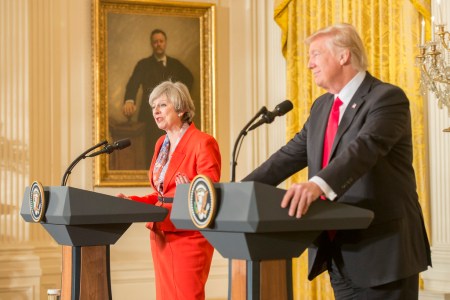
Following President Trump’s historic and commendable announcement on the status of Jerusalem last week, Britain’s Prime Minister Theresa May chose to berate Trump. Pictured: PM May, on January 27, 2017 addresses the media in Washington, DC alongside President Trump. (Image source: 10 Downing St./Flickr)

There is something which the entire world ought to recognise about the British government’s attitude towards “occupied territory”, which is that the august entity in Whitehall still believes that land in northern Israel should be returned to Syria’s Bashar al-Assad. Even now, the greatest minds of the Foreign Office in London advocate that Assad has not had enough territory to immiserate and destroy in recent years. Who knows, perhaps President Assad could have killed more than a half a million people in his country’s civil war if he could only have got an extra sliver of land?

Perhaps May feels the pressure of the Foreign Office status quo. Or perhaps she feels the pressure of Jeremy Corbyn’s band of anti-Semites at her back. Or — who knows — perhaps she worries about the millions of British Muslims from South Asia who can occasionally be whipped up into believing that the prime responsibility of Muslims worldwide is to rage about Middle Eastern politics — only of course if Jews are involved (otherwise they remain placid). Certainly that appeared to be on the national broadcaster’s mind, with the BBC choosing to go straight to the Muslim-dominated city of Bradford to ask South Asian Muslims there what they thought about Jerusalem.

There have been reactions around the world to US President’s historic announcement. Trump comes out of the whole situation well — taking on a promise that his three predecessors made, but on which only he had the courage to act. Those who have most forcibly criticised him, on the other hand, have shown something weak, as well as ugly, about themselves: When the facts on the ground were staring them in the face, they chose instead to bow to domestic fantasies of their own creation.

Douglas Murray, British author, commentator and public affairs analyst, is based in London, England. His latest book, an international best-seller, is “The Strange Death of Europe: Immigration, Identity, Islam.”


UN Security Council Bashes Trump’s Jerusalem Decision

December 11, 2017

UN Security Council Bashes Trump’s Jerusalem Decision, FrontPage MagazineJoseph Klein, December 11, 2017

(Please see also, Defiant Haley chides fuming Security Council members: ‘Change is hard. — DM)
Whichever provisions of Resolution 2334 are legally binding on Israel and all other UN member states, President Trump’s December 6th decision does not have any bearing on the sensitive issue of Israeli settlements or on Israel’s claims to sovereignty over “East Jerusalem.” Thus, invoking this infamous anti-Israeli resolution in the context of President Trump’s decision is a red herring.

“Over many years,” Ambassador Haley said in her remarks to the Security Council, the United Nations has been one of the world’s “foremost centers of hostility towards Israel.”  The Security Council became a kangaroo court on Friday, turning a perverted version of “international law” against the Trump administration for its just defense of the Jewish state of Israel and Israel’s right to choose its own capital as every other member state has the right to do.
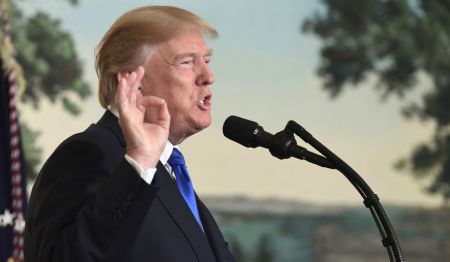
********************************

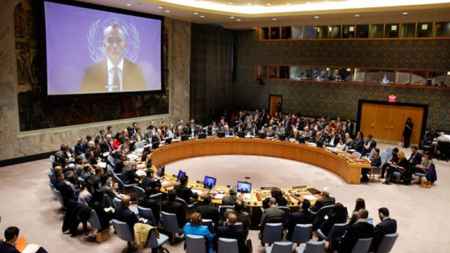
On December 6th, President Trump announced his decision to officially recognize Jerusalem as the capital of Israel and to instruct the State Department to begin the process of relocating the U.S. Embassy from Tel Aviv to Jerusalem. Two days later, at a special meeting of the United Nations Security Council, the other 14 members of the Council, including U.S. allies such as France, the United Kingdom and Italy, ganged up on the United States to condemn President Trump’s decision. Allies and adversaries of the U.S., one after the other, claimed that President Trump’s decision had defied international consensus on how to achieve a viable two-state solution, violated international law and risked destabilizing the region as well as imperiling the peace process. Bolivia’s ambassador was the most strident, demanding that the Security Council take action against President Trump’s decision if it wanted to avoid becoming “an occupied territory.

To add insult to injury, the UN ambassadors from five member states of the European Union – the United Kingdom, France, Italy, Sweden and Germany – further criticized President Trump’s decision in a joint statement they read following the adjournment of the Security Council meeting. They claimed the decision “is not in line with Security Council resolutions and is unhelpful in terms of prospects for peace in the region.”

U.S. Ambassador to the UN, Nikki Haley, stood her ground in her remarks to the Security Council. She chastised those “countries that lack any credibility when it comes to treating both Israelis and Palestinians fairly.” All President Trump had done, she explained, was to formally acknowledge the reality that for nearly 70 years “the city of Jerusalem has been the capital of the State of Israel, despite many attempts by others to deny that reality. Jerusalem is the home of Israel’s parliament, president, prime minister, Supreme Court, and many of its ministries. It is simple common sense that foreign embassies be located there.”

President Trump’s change in American policy to reflect this reality does not mean that the United States has taken a position on the specific boundaries or borders within Jerusalem as a whole. “The specific dimensions of sovereignty over Jerusalem are still to be decided by the Israelis and the Palestinians in negotiations,” Ambassador Haley said.

Notably, President Trump’s announcement specifically called for maintaining the status quo at the holy sites in the Old City of Jerusalem. There is not even the slightest hint that the U.S. would be moving its embassy to the Old City or to any part of “East Jerusalem.” However, the critics of President Trump’s decision refuse to allow for the possibility of a U.S. embassy located anywhere at all in the entire city of Jerusalem – even in what is now referred to as “West Jerusalem,” which is an undisputed section of Jerusalem.

“Israel, like all nations, has the right to determine its capital city,” Ambassador Haley said. “In virtually every country in the world, U.S. embassies are located in the host country’s capital city. Israel should be no different.”

The principal objections to President Trump’s decision are that it sets back the chances for a peaceful resolution of the Israeli-Palestinian conflict based on the two-state solution, it is apt to destabilize and trigger violence in the region and beyond, and it violates international law.

The first two objections can be given short shrift. For seventy years, there has been no peace because the Palestinians have consistently pursued an absolutist policy rejecting the idea of a Jewish state living side by side with an Arab state. The Palestinians and their Arab state neighbors rejected the partition recommended in UN General Assembly Resolution 181 in 1947. The Palestinians did not declare an independent state of their own when they had the chance. They embarked instead on a campaign of violence. Hamas, Palestinian President Abbas’s coalition partner, still calls for Israel’s destruction. Abbas, who has incited sectarian violence and rewards terrorists, spurned a peace offer from Israel in 2008 that would have resulted in Israel’s withdrawal from virtually all of the West Bank and the relinquishment of Israeli control of Jerusalem’s Old City in favor of placing it under international control. Abbas has refused to this day to agree to direct unconditional negotiations with Israel, a position which long preceded President Trump’s decision.

As for the violence that critics of President Trump’s decision seek to lay at his feet, violence has indeed erupted, not only in the Middle East but elsewhere including Europe. However, President Trump’s decision is being used as a pretext for such behavior that Palestinians and Islamists throughout the world have displayed time and again. We have seen excuses for violence ranging from cartoons and an obscure anti-Muslim video to the installation of metal detectors at the Temple Mount (despite the presence of metal detectors at mosques in other countries). Foreign policy and national security decisions cannot be held hostage to mob rule. Giving in to threats of a violent reaction will only encourage the increased use of such threats to thwart other controversial decisions.

Turning to the objection to President Trump’s decision based on “international law,” the critics have claimed that his declaration recognizing Jerusalem as Israel’s capital and decision to move the U.S. embassy from Tel Aviv to Jerusalem violate a whole host of UN General Assembly and Security Council resolutions. Sovereignty over Jerusalem, they have argued, is a “final status” issue to be negotiated between the parties themselves. They have argued this position while also holding on to the characterization of “East Jerusalem” as part of the “Occupied Palestinian Territories” in the various UN resolutions they cite. In short, the Israel bashers have no problem exploiting UN resolutions to pre-determine the final status of “East Jerusalem,” which contains the holy sites of Judaism, Christianity and Islam, as belonging to the Palestinians.

Moreover, the UN resolutions that the critics of President Trump’s decision rely upon to support their objections on “legal” grounds do little to help their case. As a matter of international law, there is nothing in the United Nations Charter that grants the General Assembly any power that would render its resolutions, declarations, or recommendations legally binding or enforceable. In any case, the Palestinians and their Arab state neighbors, including Jordan, which illegally seized and annexed the Old City of Jerusalem in 1948, completely rejected the original UN two-state partition resolution, Resolution 181. Their attempt to invoke that resolution or subsequent General Assembly resolutions now to rationalize their position on international law grounds is specious at best.

President Trump’s critics also point for support of their position to UN Security Council resolutions stating that East Jerusalem is part of the “Occupied Palestinian Territories,” declaring Israel’s settlements in East Jerusalem to be illegal, concluding that Israel’s assertion of sovereignty over a unified Jerusalem is null and void, and calling upon member states to withdraw their embassies from the Holy City of Jerusalem.  These resolutions were not explicitly adopted in the exercise of the Security Council’s Chapter VII enforcement powers, which is significant in determining whether they are legally binding unless they are expressly framed as “decisions” of the Council or, at the very least, use such words as “demand” in the applicable provisions. Words and phrases such as “calls upon,” “urges,” “reaffirms,” “underlines,” and “stresses” are deemed insufficient by legal experts in the field to reflect an intention on the part of the Security Council to create a legally binding obligation on any of the member states of the UN.

Many of the ambassadors speaking at Friday’s Security Council meeting invoked Security Council Resolution 478 as a principal basis for declaring President Trump’s decision to be in violation of international law. However, Resolution 478 used the word “decides” only in the context of refusing to recognize Israel’s “Basic Law” declaring Israeli sovereignty over the “Holy City of Jerusalem” and “such other actions by Israel that, as a result of this law, seek to alter the character and status of Jerusalem.” Resolution 478 then “calls upon” (not demands) the member states “to accept this decision,” which means it is up to each member state to agree or not. Moreover, Resolution 478 only “calls upon” the member states “that have established diplomatic missions at Jerusalem to withdraw such missions from the Holy City.” Again, this does not constitute a legally binding obligation. Moreover, it would not appear to apply explicitly to the western sector of Jerusalem, outside of the Old City where the holy sites of Judaism, Christianity and Islam are located.

President Trump’s decision in no way is inconsistent with Resolution 478. To the contrary, as discussed above, President Trump specifically called for maintaining the status quo at the holy sites in Jerusalem and left it to Israel and the Palestinians to negotiate the final status of the boundary lines within Jerusalem as a whole. President Trump’s announcement of the intent to relocate the U.S. embassy to Jerusalem, particularly if relocated outside of the boundaries of the Old City as it most certainly will be, would not be enjoined by Resolution 478’s express provisions, which are not legally binding in any event. Moreover, it is way too premature to consider the legality of such a move since it is likely to take three years or more to occur.

The critics also have referred to Security Council Resolution 2334, passed at the end of last year after the Obama administration decided to abstain rather than exercise its veto power. Resolution 2334 principally addresses Israeli settlements in the occupied territories, which, as in previous resolutions, are said to include “East Jerusalem.” It states that “the establishment by Israel of settlements in the Palestinian territory occupied since 1967, including East Jerusalem, has no legal validity and constitutes a flagrant violation under international law.” Although most of the resolution’s operative paragraphs use non-binding words and phrases such as “calls upon,” the resolution does once refer to the Security Council’s “demand that Israel immediately and completely cease all settlement activities in the occupied Palestinian territory, including East Jerusalem, and that it fully respect all of its legal obligations in this regard.” (Emphasis added)

Whichever provisions of Resolution 2334 are legally binding on Israel and all other UN member states, President Trump’s December 6th decision does not have any bearing on the sensitive issue of Israeli settlements or on Israel’s claims to sovereignty over “East Jerusalem.” Thus, invoking this infamous anti-Israeli resolution in the context of President Trump’s decision is a red herring.

“Over many years,” Ambassador Haley said in her remarks to the Security Council, the United Nations has been one of the world’s “foremost centers of hostility towards Israel.”  The Security Council became a kangaroo court on Friday, turning a perverted version of “international law” against the Trump administration for its just defense of the Jewish state of Israel and Israel’s right to choose its own capital as every other member state has the right to do.

US must include “sovereignty” in Jerusalem Embassy Relocation Act.

December 11, 2017

US must include “sovereignty” in Jerusalem Embassy Relocation Act., Israel National News, David Bedein, December 10, 2017

(Please see also, U.S. Still Won’t List Jerusalem as Israel’s Capital on Official Docs, Passports, Maps. — DM)

The time is opportune to amend the US Embassy Relocation Act, so as to clarify the permanent legal status of Israel in Jerusalem to be in tune with what President Trump said when declaring Jerusalem the official capital of Israel.

The real challenge will be whether the U.S. will do so.

Such a policy change remains much more significant than the move of the U.S. embassy.

**********************************

President Trump did Israel a favor when he delayed the US embassy move to Jerusalem.  

Current wording of the US Embassy Relocation Act would move the embassy to Jerusalem, yet deprive Israel of sovereignty in Jerusalem. 

The U.S. Embassy Relocation Act does not officially recognize Jerusalem as part of Israel. The wording of Jerusalem Embassy and Recognition Act in 1995, as passed into law, reads as follows:

(1) Jerusalem should remain an undivided city in which the rights of every ethnic and religious group are protected.

(2) Jerusalem should be recognized as the capital of Israel.

As a journalist, I cover ed events in the US capitol when Congress passed the “US Embassy Jerusalem and Recognition Act” in October 1995

There was speculation at the time that the US would abandon its policy from 1948 that all of Jerusalem must be a “corpus separatum”– an international zone apart from Israel.

Yet the final wording of the US Embassy Jerusalem and Recognition Act removed references to Jerusalem as part of Israel and gave no assurance that Jerusalem would remain the exclusive capital of Israel.

Instead, the US Embassy Relocation Act reinforced two archaic rules of US policy which date from 1948: Not to recognize Jerusalem as part of Israel, and to define Jerusalem as an “international zone”.

The assassination of the UN envoy to Jerusalem in September 1948 suspended negotiations over the status of Jerusalem. However, nothing canceled these US policies.

The implications of the Jerusalem Embassy and Recognition Act are not lost on American citizens whose children were born in Jerusalem and whose children’s U.S. passports said “Jerusalem”, with no country listed, as their place of birth. For that reason, American citizens in Jerusalem initiated a class action lawsuit which reached the U.S. Supreme Court last year, with a demand to stamp Jerusalem, Israel on their passports.

The family of Ben Blutstein, an American student murdered by a terror bomb in July 2002 while having lunch in the Frank Sinatra cafeteria at the Hebrew University, still cannot get the US State Department to allow his US death certificate to read “Jerusalem, Israel.”

Spokespeople of the US State Department made it clear that under current law, even if the US embassy moves to Jerusalem, US birth and death certificates will still be stamped ” Jerusalem”, with no country.

If the US embassy moves to Jerusalem under current law, that would establish a “de jure” precedent that the embassy could move – yet with no Israel sovereignty in Jerusalem.

If the US still does not recognize Jerusalem as part of Israel, the next time Israel objects to an Arab education curriculum in Jerusalem, and the next time Israel objects to a given policy at the  Temple Mount , the US can repeat the mantra  that “Jerusalem does not belong to you.”

Why, then, the vocal Arab resentment and the overwhelming Jewish enthusiasm over the Jerusalem Embassy and Recognition Act?
​​
It is doubtful whether either side has read the wording of the legislation.

The time is opportune to amend the US Embassy Relocation Act, so as to clarify the permanent legal status of Israel in Jerusalem to be in tune with what President Trump said when declaring Jerusalem the official capital of Israel..

The real challenge will be whether the U.S. will do so.

Such a policy change remains much more significant than the move of the U.S. embassy.

5 Thoughts On The Furor Over The White House’s Hanukkah Party

December 11, 2017

5 Thoughts On The Furor Over The White House’s Hanukkah Party, The Federalist, December 11, 2017

(Please see also, Trump Attacked for Not Inviting Anti-Israel Activists to Hanukkah Party. — DM)

The media is so addicted to outrage that they’ve now set Hanukkah ablaze. The Jewish Festival of Lights, which begins the evening of December 12 this year, was celebrated last Thursday night at the White House. Because it was Donald Trump’s first Hanukkah party, we’re supposed to be inflamed by the White House’s supposed hostility to American Jewry.

Beyond the timing of the event, the media was offended that only 300 guests attended, not including many of their political allies on the Hill and elsewhere (e.g., J Street). They also didn’t like the decor. As a Jew watching all of this from home, I had some thoughts on the Hanukkah hullabaloo.

1. Define ‘Hanukkah Decorations’

Hanukkah has been elevated to Christmas-like importance so American Jewish children don’t feel left out in December. But Hanukkah isn’t Christmas. So I was confused by the pool reporter noting “there are no visible Hanukkah decorations or menorah in the East Room, but there are four large Christmas trees.” Yes, you could say there’s irony in celebrating a holiday about resisting assimilation while surrounded by Christmas trees.

However, what Hanukkah decorations was the pooler expecting? I honestly don’t know, because celebrating the Festival of Lights is about lighting candles (which Newsweek reports the Kushner children did), singing “Maoz Tzur” (which Elite Daily reports attendees did) and eating fried foods like potato pancakes (which The New York Times reports were on-hand).

2. The Guest List Isn’t Scandalous

Multiple articles trumpeted how shocking it is that congressional Jewish Democrats weren’t invited. But can we really be surprised? First, it’s not scandalous. Just because President Obama did things a certain way doesn’t mean everyone will, or should. As Tevi Troy, former Jewish liaison under President George W. Bush (who started the annual Hanukkah party tradition), told McClatchy, members of Congress typically weren’t invited to the White House Hanukkah party during Bush’s tenure.

Second, Jewish Democrats have been incredibly outspoken about #Resistance this past year, as is their right. But was the president supposed to invite Hillary ally Debbie Wasserman Schultz and others so they could turn their “regrets” into some sort of public performance art? Tennessee’s Rep. Steve Cohen tweeted: “Congressional Democrats Left Out of White House Hanukkah Party Honored not to have been invited and will work to see I’m not invited next year and the next and the next but in ’21!” Florida’s Rep. Lois Frankel remarked, “‘Let me just say this, not to be a hypocrite, I wouldn’t be going to any party at the White House with him.’” Exactly.

I’m all in favor of finding more common ground in politics, but that’s not where things are right now. If I were hosting the party, I’d say it wasn’t worth the drama, and I’d advise the president to work on building bridges one-on-one behind the scenes instead.

3. Descriptors Should Have Meaning

If you insist on referring to J Street as “pro-Israel,” as The New York Times does, describing them as “a progressive pro-Israel group that strongly backed Mr. Obama and the nuclear deal he forged with Iran — which was detested by many conservative Jews,” I reserve the right to take all your observations and analysis with a large grain of salt. J Street is progressive, yes, but pro-Israel no.

4. Get the Terminology Right

If you’re writing about a Jewish holiday event, please get the terminology right. Newsweek reports, “During the celebration, Trump’s Jewish grandchildren, the children of Ivanka Trump and her husband, Kushner, lit a menorah.” Numerous other outlets used the same incorrect terminology. A menorah is a candelabra with space for seven candles. It’s what was used in the Temple in Jerusalem in the Hanukkah story. To commemorate the miracle of one day’s oil lasting for eight nights, Jews now light a hanukkiah, or a candelabra with space for nine candles.

5. Thursday Night Was Historic

You wouldn’t know it from tweets, like this from CBS’ Mark Knoller, which focused on the party’s timing — and yes, it was random, just like President Obama’s not-on-Hanukkah party in 2011 — but Thursday night’s event was also historic. The president’s Jewish grandchildren were on hand to light candles. When was the last time that ever happened? Never.

So even if the president’s not “your guy,” it’s okay to feel pride while watching as Jewish traditions are passed “from generation to generation.” How do you like them apples, Antiochus?

And to all who will be celebrating this week, Chag Chanukah Sameach!

Melissa Langsam Braunstein, a former U.S. Department of State speechwriter, is an independent writer in Washington DC and a senior contributor to The Federalist. Her work has appeared in The New York Times, National Review Online, and RealClearPolitics, among others. She has appeared on EWTN and WMAL. Melissa shares all of her writing on her website and tweets as @slowhoneybee.

After Anti-Israel Rally, Swedish Synagogue was Firebombed

December 10, 2017

After Anti-Israel Rally, Swedish Synagogue was Firebombed, The Point (FrontPage Magazine), Daniel Greenfield, December 10, 2017

If only it wasn’t for Trump, I’m sure he would be dancing the hora and discussing how much he loves Jewish and not smashing Jewish store windows. We should never hold anti-Semites responsible for anti-Semitic violence. Instead we must blame Jews and their supporters for causing it by refusing to die. Just ask J Street, JVP, If Not Now and the rest of the gang.

***************************************

Don’t worry, firebombing a synagogue is anti-Zionist. Not anti-Semitic. Just ask the National Socialists. Or the plain old Socialists. Or the Islamofascists.

Pro-Palestinian Arab demonstrators on Saturday night threw a firebomb at a synagogue in Gothenburg, Sweden, local media reported.

According to the report, about 20 Muslim protesters who were demonstrating against U.S. President Donald Trump’s decision to recognize Jerusalem as the capital of Israel are responsible for the attack.

The attack took place as Jewish students were holding a party inside the synagogue. A firefighter who was called to the scene told a Swedish news site that a fire had broken out between parked vehicles in a car park outside the synagogue.

Dvir Maoz, a representative of the World Bnei Akiva movement in Gothenburg, who witnessed the incident, said, “It happened at 10:18 p.m. Sweden time. There was a youth party inside at the time. Before the party I sat in the lobby with one of the security guards, we talked a little bit and as we were talking, I saw fire, so I told the security guards that a firebomb had been thrown at the building. They called the police. The youths were scared. This was the first time they had experienced any form of terrorism so close to them.”

“The police came, they cleaned the place, and they checked to make sure that everything is in order. The parents came and took the children home. There were a few children who were very stressed. One of them told me that he was feeling very unsafe. Another told me casually that because he has a very Jewish name, it causes Arabs in his school to curse him, harass him and spit on him. It’s very hard for him,” continued Maoz.

“I live ten minutes away. Relatively close. At the same time, I cannot say that we feel an increase in anti-Semitism every day,” he concluded.

Clearly, it’s Trump’s fault.

On Thursday, a man wearing a Palestine Liberation Organization (PLO) flag smashed the windows of the kosher HaCarmel restaurant, which is located in a heavily-Jewish part of Amsterdam.

The suspect smashed the window and kicked down the restaurant’s doors before police officers who were on the scene arrested him.

If only it wasn’t for Trump, I’m sure he would be dancing the hora and discussing how much he loves Jewish and not smashing Jewish store windows. We should never hold anti-Semites responsible for anti-Semitic violence. Instead we must blame Jews and their supporters for causing it by refusing to die. Just ask J Street, JVP, If Not Now and the rest of the gang.