Author Archive

POLLAK: Eight Reasons This Year’s Hanukkah Is the Best in a Long Time

December 13, 2017

POLLAK: Eight Reasons This Year’s Hanukkah Is the Best in a Long Time, BreitbartJoel B. Pollak, December 12, 2017

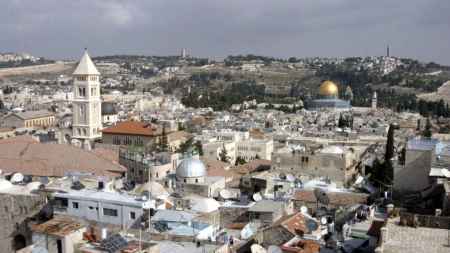
Jack Guez / Getty

This year’s Jewish holiday of Hanukkah — which starts at sundown on Tuesday, Dec. 12 and continues for eight days and nights through sundown on Wednesday, Dec. 20 — may be the best in recent memory.

The holiday commemorates the successful revolt by the Jews of ancient Israel against the Seleucid Greeks in the second century B.C., and the re-dedication of the Holy Temple in Jerusalem, where holy oil that should have lasted for one day miraculously burned for eight.

Jews observe the holiday by lighting an eight-branch candelabra, often called a menorah, adding one candle each night. (In recent years, the Chabad organization has popularized public menorah-lightings.) In addition, people exchange gifts; play with a top called a dreidel; and eat fried delicacies, such as potato pancakes (latkes) or jelly doughnuts (sufganiot). Here is why this year’s Hanukkah (or Chanukah) is among the best ever.

1. Jerusalem. President Donald Trump’s decision to recognize Jerusalem as Israel’s capital made clear that Israeli sovereignty in the city, the center of the Jewish faith, is permanent. Of course, Israel had made Jerusalem its capital through hard work and military sacrifice. But like the original Hanukkah, the symbolic part of the victory is just as important. It was a decision that took great courage, and will ultimately make peace easier, not harder, to achieve.

2. Obama is out of office. Last year, just before Hanukkah, a lame-duck President Barack Obama stabbed Israel in the back at the United Nations Security Council by abstaining from, rather than vetoing, a resolution that declared Israel’s presence in the Old City of Jerusalem — where Jews have lived for millennia — a “a flagrant violation under international law and a major obstacle to … a just, lasting and comprehensive peace.” Good riddance.

3. John Kerry is gone, too. After Obama’s “parting shot” at Israel, outgoing Secretary of State John Kerry added insult to injury by delivering an address at the State Department in which he attacked the Israeli government and blamed Israel for the impasse in negotiations with Palestinians. The speech was staged in the middle of Hanukkah. It was largely ignored by Israelis but showed the depth of anti-Israel feeling at the top of the Obama administration.

4. New ties with the Arab world. In the past year, with President Trump in office, parts of the Arab world have been reaching out to Israel to build relations as the threat of a potentially nuclear-armed Iran looms over the region. In May, Air Force One completed the first-known flight directly from Saudi Arabia to Israel, a hopeful sign that the Muslim world might finally be reconciling itself to the existence of a small Jewish democracy in the Middle East.

5. Cool Jews. Jews continue to do interesting and important things in the world. There has never been a more Jewish First Family, with Jared Kushner and Ivanka Trump proudly observing their faith and raising their children in a Jewish home. There is Alex Bregman, the Houston Astros player who became the first Jew to hit a walk-off hit in the World Series. We have our bad apples, like every group, but there is more to be proud of than ever.

6. Best White House Hanukkah party. Invitations to the party were notoriously difficult to find — but you can watch the proceedings on C-SPAN. What was particularly special was the fact that the ceremony stuck to the religious rules. Rabbi Meir Soloveitchik did not allow the recitations of the actual Hanukkah blessings, which would have been premature. Instead, he found a dignified substitute: the blessing upon meeting a head of state.

7. Introspection. Josh Block, a thoughtful liberal Democrat, has just published one of the most important essays on Jewish communal life in the last several years. He warns that the recent preoccupation with “social justice” by many Jewish institutions is undermining the community’s foundations by ignoring the continuity of Jewish life. It is a conservative critique that has finally entered the Jewish mainstream, meaning there is hope to turn things around.

8. Optimism. You might not know it, from the way the media tie themselves in knots over everything Trump does (or tweets), but the world is doing rather well. The U.S. economy is booming, and the global economy is looking good. The so-called “Islamic State” has been smashed. Technology is racing ahead, from blockchain to electric trucks. There are still big challenges — and new will to tackle them. That’s “good for the Jews,” and for everyone.

On Jerusalem, a response divorced from reality

December 13, 2017

On Jerusalem, a response divorced from reality, Times of IsraelTzachi Hanegbi, December 13, 2017

Much of the world has lambasted President Trump’s recognition that Jerusalem is the capital of Israel. Recognizing reality is in the interest of peace. Continual denial of reality, and resorting to violence anytime somebody says something you’d prefer they hadn’t is a recipe for perpetual conflict.

There remains only one viable path forward to achieving peace. President Abbas claims he is a man of peace. Saying you are a man of peace is easy, actually being one requires courage. If he is serious, he can prove it now by taking two actions that are entirely within his power: 1. End his constant incitement to violence against Jews in Israel and around the world; and 2. Accept Prime Minister Netanyahu’s repeated offers to negotiate anytime, anywhere without preconditions.

The time for empty slogans, and outright rejection of reality has long since passed. If President Abbas truly wants peace and a better future for his people, the time for action is now.

*****************************

Last week, President Donald Trump made an historic announcement. It was consistent with his powers as the President of the United States and in line with the Jerusalem Embassy Act passed overwhelmingly by the United States Congress 22 years ago.

Based on the reactions in the press, by European leaders and across the Muslim world, you would think he had made a broad pronouncement granting Israel dominion over the entire Middle East and declaring the Palestinians devoid of any rights. He did no such thing.

President Trump made a brave decision to keep his word and recognize the simple and indisputable reality that Jerusalem is the capital of the State of Israel. I have served in the Knesset, Israel’s Parliament, since 1988. I go to work every day in Jerusalem. Across the street from the Knesset is the rime Minister’s office and just up the road is the Supreme Court. When foreign heads of state meet with the Prime Minister they do so in Jerusalem, and when Anwar Sadat came to make peace he delivered his historic address in Jerusalem.

President Trump made clear he was taking no position on the final borders or status of Jerusalem or any other issue of contention between Israel and the Palestinians. He stated that he is determined to reach a peaceful resolution to the conflict in a manner acceptable to both Israel and the Palestinians. In his words, “[w]e are not taking a position on any final status issues, including the specific boundaries of the Israeli sovereignty in Jerusalem or the resolution of contested borders. Those questions are up to the parties involved… We want an agreement that is a great deal for the Israelis and a great deal for the Palestinians”.

In response, President Abbas is boycotting Vice President Pence during his visit to Israel and has said the United States has forever abrogated its role as an honest broker. He has called for “days of rage” and endless protests and riots. President Erdogan of Turkey has threatened to cut diplomatic ties with Israel over a purely American decision. In Sweden, a synagogue was firebombed.

There are protests from London to Malaysia. How is it that such a measured announcement, designed to reflect reality, and painstakingly crafted to make clear that the President was not prejudicing the rights of the Palestinians, resulted in such an unhinged response around the world? The President said that the parties themselves should make the decisions that will determine their own future and wants a “great deal for the Palestinians”. Why does being told they have agency over their own future offend the Palestinians or their supporters?

The answer, unfortunately, is that the response has very little to do with what the President actually said and the real world impact of his announcement. The response makes clear that those protesting are not concerned that recognizing Jerusalem as the capital of Israel makes peace harder to attain. They are angry because it may make it easier.

For those who reject the rights of the Jewish people to a state within any borders, any pronouncement that could bring reconciliation to the truth is a threat. Anyone recognizing the fact that the Jewish people have a three thousand year connection to Jerusalem is a threat to those making the absurd claim that Jews are invaders and colonists in our own land.

Those chanting “Khaybar, Khaybar ya yahud” and burning Israeli and American flags are not interested in promoting co-existence. They have no interest in building a better life for the Palestinians, and certainly not for Israelis.

President Trump recognizes the meaning of Jerusalem to the Jewish people. He appreciates that central to our return home was our return to the only capital we have ever known or wanted anywhere in the world. That makes his statement anathema to anti-Semites and anti-Zionists around the world. Make no mistake, most of those protesting are doing so because of their hatred of Jews and Israel, not out of love for the Palestinians or concern for a brighter future.

David Ben Gurion famously said “No city in the world, not even Athens or Rome, ever played as great a role in the life of a nation for so long a time, as Jerusalem has done in the life of the Jewish people”. This statement is still true today.

The truth will never be an impediment to peace. Deluding oneself into believing that a Temple never stood where it once stood, or that the Israeli government does not stand where it now stands is the true impediment to peace.

Much of the world has lambasted President Trump’s recognition that Jerusalem is the capital of Israel. Recognizing reality is in the interest of peace. Continual denial of reality, and resorting to violence anytime somebody says something you’d prefer they hadn’t is a recipe for perpetual conflict.

There remains only one viable path forward to achieving peace. President Abbas claims he is a man of peace. Saying you are a man of peace is easy, actually being one requires courage. If he is serious, he can prove it now by taking two actions that are entirely within his power: 1. End his constant incitement to violence against Jews in Israel and around the world; and 2. Accept Prime Minister Netanyahu’s repeated offers to negotiate anytime, anywhere without preconditions.

The time for empty slogans, and outright rejection of reality has long since passed. If President Abbas truly wants peace and a better future for his people, the time for action is now.

Tzachi Hanegbi is Minister for Regional Cooperation

Europe would not last a week if it had to face what Israel does

December 13, 2017

Europe would not last a week if it had to face what Israel does, Israel National News, Giulio Meotti, December 13, 2017

[T]he attacks, the wars, the threats, the tension and the death drawings that the world prepares for the small Jewish state with whose disappearance it is obsessed. And I thought, looking and looking at those images, that no European country, not one, would survive a week of this instead of Israel.

The very existence of Israel goes against all the rules. It is a classical example of nonsense. Because Israel is a miracle, the conscience of the world, the Western frontier located on the Eastern front. 

It is a symbol of our civilization as it was in its highest moments. 

*************************

I was watching the videos from Ramallah and elsewhere of the Palestinian riots against the blessed American decision to recognize Jerusalem as the capital of Israel. All those Israeli policemen and soldiers engaged in dispelling the riots and violence without inflicting losses but managing to contain the damage.

They are not shaheeds, they care about human life, their own and the ones of the people they must confront in the streets.

These young Israelis doing such a tragic job are the same age as I am, at night they return to their wives and children, mothers and fathers. They are not shaheeds, they care about human life, their own and the ones of the people they must confront in the streets. They are the face of a state dealing with this drama for the last 70 years.

Then I thought of all the blackmail, the attacks, the wars, the threats, the tension and the death drawings that the world prepares for the small Jewish state with whose disappearance it is obsessed. And I thought, looking and looking at those images, that no European country, not one, would survive a week of this instead of Israel.

Most of commentators today worry about the “consequences” of the just and historical American recognition of Jerusalem as the capital of Israel. But if the fear of violence had dictated its actions, Israel would not have been born in 1948 and the Jews after Auschwitz would have been found in a deli of Brooklyn rather than on the beaches of Tel Aviv.

In its 70 years of existence, Israel has lost 23,447 soldiers and 2,495 civilians, it survived 12 wars and thousands of missiles, while coexisting with the specter of a chemical and nuclear war.

The very existence of Israel goes against all the rules. It is a classical example of nonsense. Because Israel is a miracle, the conscience of the world, the Western frontier located on the Eastern front.

It is a symbol of our civilization as it was in its highest moments.


I react to the latest attack in NYC near Times Square this morning 12.11.2017

December 12, 2017

I react to the latest attack in NYC near Times Square this morning 12.11.2017, Islamic Forum For Democracy via YouTube

“Eurosion”: Muslim Majority in Thirty Years?

December 12, 2017

“Eurosion”: Muslim Majority in Thirty Years? Gatestone Institute, Giulio Meotti, December 12, 2017

Even if all current 28 EU members, plus Norway and Switzerland, closed their borders to migrants, the Islamic population will continue to exponentiate…. Today, it is an increase of six million in seven years. And tomorrow?

What will happen in major European cities, where the Muslim communities are currently based? Will London, Marseille, Stockholm, Brussels, Amsterdam, Antwerp and Birmingham all have Muslim majorities?

Under the “medium” and “high” projections in Pew’s scenarios, how can Europe preserve all its most precious gifts — freedom of expression, separation of church and state, freedom of conscience, rule of law and equality between men and women?

One of the most debated arguments about Muslims in Europe is the “Eurabia” claim: that high birth rates and immigration will make Muslims the majority on the continent within a few decades. For years, most of the media and analysts dismissed the claim as alarmist and racist. “Dispelling the myth of Eurabia“, sniffed a major Newsweek cover.

Not many had the courage to sound an alarm. The great Arabist scholar, Bernard Lewis, sent out a warning more than a decade ago that Europe would turn Muslim by the end of this century, and dissolve into “part of the Arab West, the Maghreb”. The late scholar Fouad Ajami also cautioned that “Europe is host to a war between order and its enemies, fueled by demography”; and the Italian writer Oriana Fallaci imagined a continent with “the minarets in place of the bell-towers, with the burka in place of the mini-skirt”. Mark Steyn explained that “the future belongs to Islam” with an “enfeebled” West in a “semi Islamified Europe”.

Ten years later, since Europe opened its borders to a massive wave of migrants from North Africa and the Middle East, the demographers reviewed their assessments.

New projections by the Washington-based Pew Research Center should be on the table of every European official and politician. The projections foretell that if the current wave of immigrants persists, in thirty years Europe’s Muslim population will triple. If high migration continues, the Muslim share of Germany’s population, could grow from 6.1% in 2016 to 19.7% by 2050. Even if all current 28 EU members, plus Norway and Switzerland, closed their borders to migrants, the Islamic population will continue to exponentiate. According to Pew’s data, Muslims made up 4.9% of Europe’s population in 2016, with 25.8 million people across 30 countries, up from 19.5 million people in 2010. Today it is an increase of six million in seven years. And tomorrow?

Pew’s researchers looked at three scenarios: “zero migration” between 2016 and 2050; “medium migration”, in which the flow of refugees stops but people continue to migrate for other reasons; and “high migration”, in which the flow of migrants between 2014 and 2016 continues with the same religious composition.

In the medium migration scenario – considered by Pew “the most likely” – Sweden would have the biggest share of the new population at 20.5%. The UK’s share would rise from 6.3% in 2016 to 16.7%. There will be similar percentages everywhere, from Belgium (15%) to France (17.4%). If high migration continues until 2050, Sweden’s Muslim share will grow to 30.6%, Finland’s to 15%, Norway’s to 17%, France’s to 18%, Belgium’s to 18.2% and Austria’s to 19.9%.

Pew’s dramatic scenarios do not tell the whole story, however. What will happen in major European cities, where the Muslim communities are currently based? Will London, Marseille, Stockholm, Brussels, Amsterdam, Berlin and Birmingham all have Muslim majorities?

What will happen in major European cities, where the Muslim communities are currently based? Will London, Marseille, Stockholm, Brussels, Amsterdam, Berlin and Birmingham all have Muslim majorities? (Photo by Alexander Hassenstein/Getty Images)

The French demographer Jean-Claude Chesnais in his book “Le Crépuscule de l’Occident” predicted an opulent but sterile continent, one in which population is characterized by death, not birth. According to the national statistics agency Istat, fewer than 474,000 births were registered in Italy last year, down 12,000 from the year before, with an even bigger drop from the 577,000 born in 2008. Italy has “lost” 100.000 births in ten years. The loss has been called “the great Eurosion“. The old continent is “frailing”.

Moreover, the fastest-breeding demographic group in Europe is also the most resistant to the pieties of a secularized liberal European democracy, which is seen as a sign of moral abdication from the true “path” or “way”.

Under the “medium” and “high” projections in Pew’s scenarios, how can Europe preserve all its most precious gifts: freedom of expression, separation of church and state, freedom of conscience, rule of law and equality between men and women?

According to the French author Eric Zemmour:

“If tomorrow there were 20, 30 million French Muslims determined to veil their wives and to apply the laws of Sharia, we could only preserve the minimal rules of secularism by dictatorship. That’s what Atatürk, Bourguiba or even Nasser understood in their day”.

Will Europe retreat into a non-democratic regime to preserve its own freedoms or will it lose these freedoms under the rise of this large Islamic communities? Considering what Europe witnessed in the last couple of years under terrorism and multiculturalism, what will happen in the next thirty years?

Jean-Claude Chesnais rightly called this shift a “crépuscule”, a twilight. We are living through the self-extinction of the European societies of the Enlightenment. It has shaped the humanitarian age we live in – but may not any more.

Giulio Meotti, Cultural Editor for Il Foglio, is an Italian journalist and author.

Ibrahim Munir, the Man Who Keeps the Muslim Brotherhood Alive

December 12, 2017

Ibrahim Munir, the Man Who Keeps the Muslim Brotherhood Alive, Investigative Project on Terrorism, Hany Ghoraba, December 12, 2017
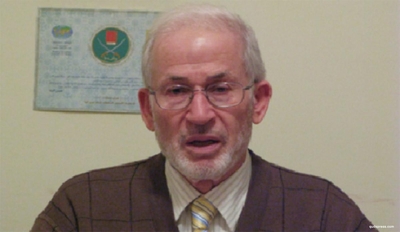
Undoubtedly, without Britain’s hosting and granting of political asylum and citizenship to its leaders throughout the past six decades, the Brotherhood would have lost access to international media outlets and financial means, and might have disbanded by now. Munir and his colleagues managed to keep the ship afloat through its international base, aided by Islamic charities such as the Takaful Trust and now-defunct Human Relief International. These fronts financed multiple media outlets including a TV network originating from Turkey after June 2013 which became the launching pad for Brotherhood propaganda and incitement of violence in Egypt.

Moreover, the Brotherhood convinced the British authorities repeatedly of its so-called peaceful nature. They managed through trickery, taqqiya, and shrewd diplomacy to play off British politicians’ naiveté’ to keep their UK operations intact.

*****************************

Among the lesser known, yet most influential leaders of the Muslim Brotherhood organization is the Egyptian-born British national Ahmed Ibrahim Munir Mustafa. Known simply as Ibrahim Munir, he is the global Brotherhood’s secretary general and interim supreme guide.

The Brotherhood faces a great succession dilemma with many of its Egyptian leadership jailed and facing trials. A controversial old Islamic jurisprudence fatwa states that captured men or prisoners of wars cannot lead their nation or groups. Accordingly, incumbent Supreme Guide Mohamed Badie cannot lead the group while he is in an Egyptian prison.

Several names were mentioned as a possible new supreme guide, among them Mahmoud Ezzat, a leading Brotherhood member since the 1960s, who is believed to be in hiding in Gaza and is wanted by Egyptian authorities for allegedly orchestrating the violence taking place in Egypt. But Ezzat announced in 2016 that he did not want the title and recommended Ibrahim Munir.

But group members and leaders in Egypt question the 80-year-old Munir’s leadership abilities as they fight against the Egyptian state and wish to substitute him with a wartime general guide. Younger members who followed the late Brotherhood leader Mohamed Kamal indicated their desire for a more vicious supreme guide. While the Muslim Brotherhood leadership tried to keep the news of the succession war a secret, the divisions and resignations have rocked the group and shattered any image of unity.

The double messages

Among his Brotherhood duties, Ibrahim Munir supervises the content of IkwhanWeb, the group’s English-language website, and its weekly journal Risalat al-Ikhwan. English-language statements tend to be much more sanitized and tolerant than what the Brotherhood tells its Arabic-speaking audience.

Munir followed the taqqiya principal – a precautionary concealment or denial of religious belief and practice in the face of persecution – in all his English language communications with the media and United Kingdom politicians. The Brotherhood is a Sunni movement with a Salafist tradition, while taqqiya remains a practice found in the Shiite denomination of Islam.

For example, Munir told a British Parliament committee that sharia laws tolerate apostates, but that statement contradicts the beliefs and teachings of Brotherhood founder Hassan al-Banna. It also avoided answering questions about the Brotherhood’s positions toward minorities such as homosexuals.

An example of the Brotherhood’s dual messaging came in September 2012 when a group of Islamists led by the Muslim Brotherhood stormed the American Embassy to protest what was dubbed as an anti-Islamic movie. In Arabic, they called upon all “Egyptians to rise to defend the Prophet” in a million-man march directed towards U.S. Embassy in Cairo. Munir’s London-based IkhwanWeb, on the other hand, tweeted a statement from deputy head Khairat Al Shater: “relieved none of @USembassycairo staff were harmed,” while expressing hopes that Egyptian-American relations could weather the storm. However, the U.S. Embassy in Cairo twitter account mocked the tweet in English: “Thanks, by the way, have you checked your own Arabic feeds? I hope you know we read those too.”
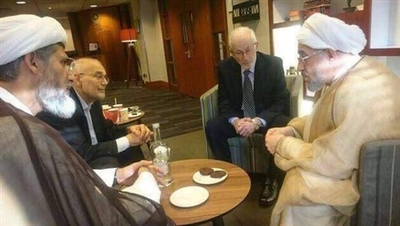
Ibrahim Munir meets in London last July with Ayatollah Khamenei’s personal representative Mohsen Araki.

Despite their following different religious denominations the Muslim Brotherhood and Iran have had relations for decades, as many Brotherhood leaders frequently visit Iran as guests of the regime. The first meeting between Brotherhood founder Hassan al-Banna and Ayatollah Khomeini, the supreme leader of the Islamic revolution took placein 1945 – more than three decades before the 1979 Islamic revolution. Moreover, the only time an Iranian president visited Egypt after the revolution came during Mohamed Morsi’s ill-fated one-year reign in 2013 when Mahmoud Ahmedinejad traveled to Egypt. Munir, along with other Brotherhood officials, have maintained strong ties with Iranian leaders. During a July conference on Islamophobia, Munir was among Brotherhood members to meet in London with Ayatollah Ali Khamenei’s personal representative, Mohsen Araki.

Ties to terrorism:

During the 1960s, Munir was part of a terrorist group led by Brotherhood ideologue Sayyid Qutb. Munir was sentenced to 10 years in a maximum security prison as a result. He remains loyal to Qutb, who advocated violent jihad and the toppling of what he considered “apostate” regimes. In a lengthy essay last year, Munir called Qutb a “humanitarian teacher.”

As with many Islamists in the past five decades, Munir applied for political asylum in the United Kingdom, citing political persecution in Egypt. From his safe haven in London, he established, along with defector former member Kamal Al Hilbawy, the Muslim Brotherhood’s international base in 1982. The organization established a network that extended across the globe using London as a political and financial center.

From his office in London’s Cricklewood Broadway neighborhood, Munir established a web of connections using his diplomatic skills and contacts in the British government. He was instrumental in keeping the Muslim Brotherhood from being banned in the United Kingdom in 2014 after then-Prime Minister David Cameron ordered an investigation into the Brotherhood’s activities in Britain and Egypt. The investigation was prompted by terrorist attacks in Egypt that were orchestrated by the Muslim Brotherhood after the June 2013 ouster of President Mohamed Morsi.

Munir issued an indirect threat to the British government that terrorism will increase if the ban goes in effect. “This would make a lot of people in Muslim communities think that ‘peaceful’ Muslim Brotherhood values . . . didn’t work and now they are designated a terrorist group, which would make the doors open for all options,” he said. Asked if that might include violence, he replied, “Any possibility.”

Munir helped saved the Muslim Brotherhood from a terrorist designation by lobbying Britain’s Foreign Affairs Select Committee, headed by British MP Crispin Blunt, to release a counter report criticizing Jenkins’, neglecting the clear condemnation of the group’s activities in UK found in Sir John Jenkins’s 2014 report.

“Their public narrative – notably in the West – emphasised engagement not violence. But there have been significant differences between Muslim Brotherhood communications in English and Arabic,” the report said.

“Aspects of Muslim Brotherhood ideology and tactics, in this country and overseas, are contrary to our values and have been contrary to our national interests and our national security,” it added.

Munir defended Hamas terrorism as self-defense during an unaired June interview with NBC. “I don’t just support Hamas,” he said, “I support the Palestinian cause, that conflict was created by the West and they have to resolve it or the conflict will continue indefinitely; if Hamas violates the UN articles and Geneva Accords we will condemn them but the West should tell us how else can the Palestinians acquire their rights.”

Undoubtedly, without Britain’s hosting and granting of political asylum and citizenship to its leaders throughout the past six decades, the Brotherhood would have lost access to international media outlets and financial means, and might have disbanded by now. Munir and his colleagues managed to keep the ship afloat through its international base, aided by Islamic charities such as the Takaful Trust and now-defunct Human Relief International. These fronts financed multiple media outlets including a TV network originating from Turkey after June 2013 which became the launching pad for Brotherhood propaganda and incitement of violence in Egypt.

Moreover, the Brotherhood convinced the British authorities repeatedly of its so-called peaceful nature. They managed through trickery, taqqiya, and shrewd diplomacy to play off British politicians’ naiveté’ to keep their UK operations intact.

Ibrahim Munir may not be a household name but he remains the Brotherhood’s gatekeeper and its savior in dire situations. His good-cop attitude with the British media and political circles, along with shrewd financial and media skills, has managed to protect the group from attempts to ban it.

Hany Ghoraba is an Egyptian writer, political and counter-terrorism analyst at Al Ahram Weekly, author of Egypt’s Arab Spring: The Long and Winding Road to Democracy and a regular contributor to the BBC.

How Israel is bringing an end to Hamas’ tunnels

December 12, 2017

How Israel is bringing an end to Hamas’ tunnels, Al-Monitor

In the same week that Hamas is celebrating the 30th anniversary of its founding and Israel is marking the 30th anniversary of the start of the first intifada (1987), Hamas finds itself facing a multifaceted crisis. It has ceded government control of Gaza to the Palestinian Authority, it continues to be isolated internationally and Israel’s missile defense system has successfully neutralized 89% of the threat posed by rockets to the Israeli homefront, based on Defense Ministry figures from Protective Edge. Now the tunnels are slipping out of its hands as well. Hamas will have to reinvent itself if it wants to remain relevant. Given its current conditions and the means at its disposal, it will be especially difficult to do.

**********************************

There were no loud explosions, and no plumes of black smoke rose along Israel’s border with the Gaza Strip. The latest Hamas tunnel was discovered weeks ago using advanced technology developed by Israel. The Israel Defense Forces (IDF) kept news of the tunnel secret until completing preparations to neutralize it with innovative methods.

It is worth remembering that the last time the IDF destroyed a tunnel dug by the Palestinian Islamic Jihad movement it failed to realize that members of the terrorist group were inside it at the time. Despite efforts to extricate survivors, the demolition of the tunnel resulted in the deaths of 12 Islamic Jihad and Hamas fighters and almost led to a major conflagration. This time, the tunnel was neutralized in absolute silence.

Hamas appears to have had no idea that its strategic tunnel had been located or that it had been targeted by the IDF for weeks. Following the operation, Defense Minister Avigdor Liberman said Dec. 10, “Thanks to the joint efforts of the IDF, the Ministry of Defense and the defense industries, we have reached new technological capacities in the struggle against terrorism and the terror tunnels. I hope that over the next few months, the threat posed by the tunnels to Israelis living in localities surrounding the Gaza Strip will be a thing of the past.”

Liberman’s comments prompted a series of public statements by top Israeli officials that after investing unlimited resources and the extensive efforts of the country’s finest minds, Israel has managed to remove the threat of the tunnels, which have kept the people of the south up at night for the past few years. The truth is much more complicated, though there is no doubt that Israel is getting closer to achieving this capacity.

“It’s not like we have some machine that locates tunnels and destroys them,” a senior defense official told Al-Monitor on condition of anonymity. “This is a system based on the integration of three parallel approaches: shielding, intelligence and technology.”

As of now, this approach is effectively keeping Israel’s border with the Gaza Strip sealed. Israel estimates that in the near future it will be able to eradicate the existing tunnels entirely and make it impossible to dig new ones.

The Hamas tunnel destroyed this week was especially long, stretching several hundred meters into Israel. Israeli officials say that it was intended to allow Hamas to strike behind IDF lines in the next round of violence, just as the group attempted to do during Operation Protective Edge. Now Hamas has been denied that ability.

The movement developed its underground strategy to gain an advantage over the IDF, but that advantage is decreasing rapidly. This development is forcing Hamas to confront a strategic dilemma. Should it accept the existing situation and search for new ways to attack Israel, or should it act quickly to take advantage of whatever tunnels it may have left before it is too late to use them?

This danger is one reason the IDF did not make a big deal of the tunnel’s neutralization on Dec. 10. Apart from some warnings by the chief of the Southern Command, Eyal Zamir, to Hamas and Islamic Jihad that the tunnels would become a death trap for their fighters, the IDF has remained quiet. “There’s no need to celebrate,” one senior military official told Al-Monitor on condition of anonymity. “These are sensitive times, especially after President [Donald] Trump’s declaration concerning Jerusalem. There is no reason to help anyone who wants to bring about the deterioration [of the security situation].”

Israel’s approach to this operation was based on three components. The first, shielding, consists of a vast underground cement barrier being built along the border that should eventually encompass the entire Gaza Strip. The wall extends several dozen meters underground, and experts say that there is no way to dig tunnels beneath it. The wall is outfitted with sensors and other technologies to detect other tunnels and identify new excavation efforts.

The second component, intelligence, involves using all means at the disposal of Israel’s defense establishment — HUMINT (human intelligence), SIGINT (electronic signal intelligence) and others — to learn where and when militants are excavating tunnels. The IDF has told Al-Monitor that Israel has put together a very good picture of what is happening on the ground.

The third component, technology, includes the major innovation that enabled Israel to locate the two tunnels in the past two months. It was an integrated effort by all of Israel’s defense industries. The Defense Ministry’s Administration for the Development of Weapons and Technological Infrastructure set up a lab near the Gaza Strip for the country’s finest minds to tackle the problem.

“Each meter that we check takes a lot of time and serious investments,” a senior Israeli military official told Al-Monitor on condition of anonymity, “but we are getting results.”

Despite remarks by a number of Israeli leaders this week, the country’s ability to identify and destroy the tunnels and to seal its border with the Gaza Strip has yet to be perfected. “We are making progress. Our capacity will improve, and we will reach a stage in which we can announce that there are zero tunnels and that the threat has been neutralized,” one senior Israeli security official said on condition of anonymity. “But we’re not there yet.”

In the same week that Hamas is celebrating the 30th anniversary of its founding and Israel is marking the 30th anniversary of the start of the first intifada (1987), Hamas finds itself facing a multifaceted crisis. It has ceded government control of Gaza to the Palestinian Authority, it continues to be isolated internationally and Israel’s missile defense system has successfully neutralized 89% of the threat posed by rockets to the Israeli homefront, based on Defense Ministry figures from Protective Edge. Now the tunnels are slipping out of its hands as well. Hamas will have to reinvent itself if it wants to remain relevant. Given its current conditions and the means at its disposal, it will be especially difficult to do.


Germany’s Batty Plan to Deter Migrants

December 12, 2017

Germany’s Batty Plan to Deter Migrants, Gatestone InstituteStefan Frank, December 12, 2017

(Reversing course is difficult if you are driving at full speed ahead. — DM

As to the government’s new efforts to scare away migrants by painting a somber picture of the situation of migrants in Germany, Broder says: “It’s as if a drug dealer were advising his customers not to buy from him.”

**********************

Every German knows that hardly any asylum seekers whose applications are rejected are forced to leave Germany. But if their application is rejected and they do decide to return to their home country, they are rewarded with an allowance of between €1000 ($1,200) and €3000 ($3,600).

This information campaign, however, must have been carefully hidden from the German public — no major newspaper reported it at the time.

“The only authentic and honest thing about this movie were the closing credits….” — Henryk Broder, columnist, Die Welt.

The German foreign ministry has launched a website to discourage would-be migrants from making their journey to Germany: “Rumours about Germany: Facts for Migrants”. It aims — In English, French and Arabic — to debunk “some of the most common false promises made by traffickers”, such as:

  • “Every refugee receives a welcome payment of 2,000 euros”,
  • “Germany grants a house to every refugee” or,
  • “The ship for the crossing is very big, it even has a pool and a cinema.”

The new website comes in the wake of “AWARE MIGRANTS”, a similar projectj jointly developed by the Italian Ministry of the Interior and the International Office for Migration(IOM) in July 2016. Whereas the goal of “AWARE MIGRANTS” was to raise awareness about the dangerous journey across the African desert and the Mediterranean, “Rumours about Germany” focuses mostly on the economic aspects of asylum seekers’ lives in Germany — which the website paints as one of hardships and dismal prospects:

“Those entering Germany illegally will not be able to get a job. Also note that the German government does not provide refugees with jobs. … Contrary to rumours and misinformation deliberately spread by human traffickers, Germany does not provide a welcome payment. Nobody will be given his own house. In fact, finding a place to live has become more and more difficult in Germany, especially in the big cities. Also note that you cannot choose freely where to live while you seek asylum and may have to stay in remote places where no one understands your language.”

“With the website http://www.rumoursaboutgermany.info,” the foreign ministry explained in a press release, “the foreign ministry continues an information campaign of the same name which it started abroad in the fall 2015”.

This information campaign, however, must have been carefully hidden from the German public – no major newspaper reported it at the time. To find information about it, one has to go to the foreign ministry’s website and find a press releasefrom January 2016 in which the ministry describes its anti-migration campaign in Afghanistan:

“During the first phase at the end of 2015, large billboards were placed in in Kabul, Masar-e Scharif and Herat on locations with a particularly high volume of traffic. They contain questions in the local languages Dari and Pashtu: ‘Leaving Afghanistan? Are you sure?’ and ‘Leaving Afghanistan? Have you thought this through?'”

Obviously, the billboard advertisement did not have the effect the German government was looking for — probably why it had to launch the new website. The foreign ministry’s press release quotes Andreas Kindl, the ministry’s “Agent for Strategic Communication”, as saying:

“The website is optimized for smartphones and speaks in simple, clear language to people who are thinking about coming to Germany, who are on their way or who already are here.”

Kindl, a graduate in Islamic Studies was, until September 2017, Germany’s ambassador to Yemen. The German government might think that the job requires a certain kind of cultural expertise, but there is a problem: even if a would-be migrant happens to go to the “Rumours about Germany” website — which seems unlikely — why would he be convinced by claims such as this:

“Many asylum seekers do not qualify for protection and their applications are rejected — they are not allowed to stay and have to leave Germany. Then they return [home] with no money and have to start from scratch.”

Every German knows that hardly any asylum seekers whose applications are rejected are forced to leave Germany. If their application is rejected and they decide to return to their home country, they are rewarded with an with an allowance of between €1000 ($1,200) and €3000 ($3,600). Thus, contrary to what “Rumours about Germany” claims, making the journey to Germany still appears as a win-win proposition.

To the German reader, the whole campaign and its central messages must seem disturbing. Since 2015, when Chancellor Angela Merkel opened Germany’s borders to more than a million migrants from Africa, Asia and the Middle East, the German public has been kept under the impression that every single migrant entering Germany was a refugee who had fled a war zone such as Syria or Iraq. To keep up this fiction, politicians and journalists never speak of migrants, immigrants or illegal aliens, but only of “refugees” (Flüchtlinge) or “protection seekers” (Schutzsuchende).

As soon as someone without legitimate papers sets foot on German soil, he becomes, by definition, a “protection seeker”. According to the German statistics agency (Statistisches Bundesamt), for instance, there are 1.6 million asylum seekers currently in Germany. So far, so good. But the foreign ministry’s new campaign now raises a puzzling question: How can the idea that every newly-arriving migrant is an asylum seeker be made consistent with the new finding, according to which many are actually seeking jobs, housing or money?

Moreover, critics were quick to point out another contradiction. In 2014, the government’s own Agency for Migration and Refugees (Bundesamt für Migration und Flüchtlinge, BAMF) produced a 17-minute-long promotional video supposedly describing the arrival of a fictional refugee from Iraq: how he files an asylum request and is admitted to an refugee shelter. In the entire film, there was no mention of any obstacles or unpleasant situations. Instead, the fictional refugee encounters smiling officials who have seemingly have been waiting just for him — their only client — to show up. One of them even speaks Arabic. Also, the refugee shelter in the film is not an overcrowded hot-spot of violent crime, but a cozy place with just two other residents who happen to be friendly and smiling: “One of them also speaks my language. Arsalan has already been here for a few weeks and offers me his help.”

A promotional video produced in 2014 by the German government shows the arrival of a fictional refugee from Iraq, with no mention of any obstacles or unpleasant situations; just smiling officials who have seemingly have been waiting just for him. (Image source: Bundesamt für Migration und Flüchtlinge)

Henryk Broder, a columnist with the daily Die Welt and publisher of the popular blog Achse des Guten (“Axis of Good”) commented on the promotional film:

The only authentic and honest thing about this movie were the closing credits [with the disclaimer]: “The asylum-seekers shown in this film are actors with a fictional escape story.”

As to the government’s new efforts to scare away migrants by painting a somber picture of the situation of migrants in Germany, Broder says: “It’s as if a drug dealer were advising his customers not to buy from him.”

Stefan Frank is a journalist and author based in Germany.

Deep State Resisters at State Dept. Defy Jerusalem Directive

December 12, 2017

Deep State Resisters at State Dept. Defy Jerusalem Directive, FrontPage MagazineAri Lieberman, December 12, 2017

(Please see also, US must include “sovereignty” in Jerusalem Embassy Relocation Act and U.S. Still Won’t List Jerusalem as Israel’s Capital on Official Docs, Passports, Maps. — DM)

It appears that the State Department, staffed with a cadre of career civil servants and employees of the diplomatic corps, is conducting its own foreign policy, one that deviates from the goals of the White House and undermines its objectives. This group is perhaps more fanatical in its opposition to the president’s historic declaration than some Arab leaders.

While the State Department can obstruct, impede and delay, it is ultimately Trump who has the final say. He must demand progress reports from the State Department to ensure that those entrusted with the embassy move are taking the necessary steps to relocate the embassy from Tel Aviv to Jerusalem in expeditious fashion. As for the passport issue, Trump can easily remedy this area of discord by issuing a clear and unambiguous directive to his secretary of state to permit U.S. citizens born in Jerusalem to list Israel as their birthplace on official documents.

*********************************************

Following President Trump’s historic declaration recognizing Jerusalem as the capital of Israel, West Bank and Gazan Arabs took to the streets in rage. They burned U.S. and Israeli flags. They cursed America, Israel and the Yahuds (Jews). Their imams cited verses from the Koran and the Hadiths about the usurpers and interlopers and the “descendants of apes and pigs.” In other words, it was business as usual for the Palestinians. Nothing had changed.

At the State Department too, it was business as usual. In a transparent effort to placate the Arab bloc, Secretary of State Rex Tillerson said the process of moving the embassy from Tel Aviv to Jerusalem would take several years. Tillerson is said to have counseled Trump against recognition.  

Then, at a Washington DC press briefing on December 7, Acting Assistant Secretary of State for Near Eastern Affairs David Satterfield was evasive when asked by AP journalist Matt Lee, “what country is Jerusalem in.” Satterfield acknowledged that Jerusalem was the capital of Israel but paradoxically could not say definitively that Jerusalem was located in Israel. Satterfield went on to note that consistent with current State Department policy, U.S. citizens born in Jerusalem would not be able to state their place of birth as “Israel” on their passports. The only options currently available to U.S citizens born in Jerusalem are to note either “Jerusalem” as their place of birth or if born prior to 1948, “Palestine.”

This then is the absurdity that the White House must contend with. It appears that the State Department, staffed with a cadre of career civil servants and employees of the diplomatic corps, is conducting its own foreign policy, one that deviates from the goals of the White House and undermines its objectives. This group is perhaps more fanatical in its opposition to the president’s historic declaration than some Arab leaders.

Their resistance is motivated by a myriad of reasons. Some simply hate Trump and this offers an opportunity to engage in obstructionism. Some are deeply anti-Semitic and their sympathies lie squarely in the Arab camp. Others view change and bold action as a threat and prefer the status quo. Whatever their motivations, they are working in concert to delay and obstruct the president’s bold new policy initiatives aimed at supporting a loyal ally and acknowledging reality while at the same time breaking the deadlock and reviving an anemic peace process based on a foundation of truth.

This isn’t the first time that the White House was confronted with such obstructionism from the State Department. In 1948, Secretary of State George C. Marshall vehemently opposed U.S. recognition of the nascent state of Israel and attempted to subvert President Harry Truman’s desire to extend diplomatic recognition. He told Truman that if Truman extended recognition, he would not be able to vote for him in the next presidential election. A statement like that represents a direct challenge to the president and is tantamount to a threat to resign. Ultimately, Truman took the morally correct path, disregarded Marshall’s protestations and extended de-facto recognition (de-jure recognition was extended in 1949) while Marshall continued to serve as Secretary of State.

The State Department’s current position as enumerated by Satterfield is also inconsistent with the will of Congress. In 2002, Congress passed the Foreign Relations Authorization Act. Section 214(d) of the FRAA states in relevant part “For purposes of the registration of birth, certification of nationality, or issuance of a passport of a United States citizen born in the city of Jerusalem, the Secretary shall, upon the request of the citizen or the citizen’s legal guardian, record the place of birth as Israel.”

In 2015, a divided Supreme Court struck down the law stating that Congress had overstepped its bounds when it passed the bill. Justice Kennedy, who issued the majority decision in Zivotofsky v. Kerry, stated that the power to recognize foreign nations rests with the executive branch of government and the ability to determine what a passport says is part of this power.

The Supreme Court’s ruling put the matter to rest temporarily but Trump’s recognition of Jerusalem as Israel’s capital revives the issue. The State Department will be hard pressed to defend its position in light of the new political reality.

While the State Department can obstruct, impede and delay, it is ultimately Trump who has the final say. He must demand progress reports from the State Department to ensure that those entrusted with the embassy move are taking the necessary steps to relocate the embassy from Tel Aviv to Jerusalem in expeditious fashion. As for the passport issue, Trump can easily remedy this area of discord by issuing a clear and unambiguous directive to his secretary of state to permit U.S. citizens born in Jerusalem to list Israel as their birthplace on official documents.

Cotton: Trump Should Cooperate Militarily With Taiwan in Spite of Chinese Invasion Threat

December 12, 2017

Cotton: Trump Should Cooperate Militarily With Taiwan in Spite of Chinese Invasion Threat, Washington Free Beacon , December 12, 2017

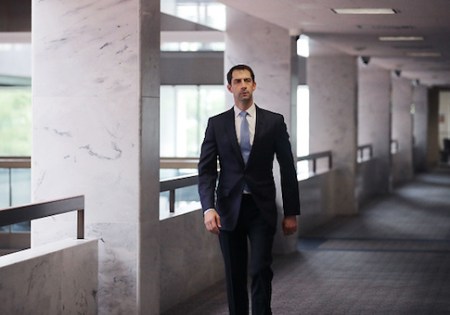
Sen. Tom Cotton / Getty Images

Sen. Tom Cotton (R., Ark.) on Monday said he takes Chinese threats to invade Taiwan seriously, stating that he urged both President Donald Trump and Congress to cooperate militarily with Taipei.

Cotton’s statement came in response to a senior Chinese diplomat’s remark that China would employ its “Anti-Secession Law,” which gives it the ability to use force on the island to prevent secession, if the U.S. sent navy ships there.

“The day that a U.S. Navy vessel arrives in Kaohsiung is the day that our People’s Liberation Army unifies Taiwan with military force,” Chinese media at the weekend quoted Li as saying, referring to Taiwan’s main port, according to Reuters.

“I take Beijing’s threats to use military force against Taiwan seriously,” Cotton said. “That’s why I urge both the president and Congress to accelerate the sale of defensive weapons to Taiwan, as well as to bring Taiwan into joint military exercises with the United States. We can’t afford to take Beijing’s saber-rattling lightly.”

Taiwan’s status as a self-ruled island is disputed by China, which feels it can still use force to keep it under control, Reuters reported:

China considers Taiwan to be a wayward province and has never renounced the use of force to bring it under its control. The United States has no formal ties with Taiwan but is bound by law to help it defend itself and is its main source of arms.

Beijing regularly calls Taiwan the most sensitive and important issue between it and the United States. In September, the U.S. Congress passed the National Defense Authorization Act for the 2018 fiscal year, which authorises mutual visits by navy vessels between Taiwan and the United States.