Author Archive

How to Defund the U.N.

December 27, 2017

How to Defund the U.N., Gatestone InstituteJohn R. Bolton, December 27, 2017

(Back in June of 1950, when North Korea with Stalin’s help and encouragement invaded South Korea, The UN General Secretary telephoned President Truman to say that he regarded the North Korean invasion an assault on the UN. Fortunately, Russia was boycotting the UN to protest its refusal to seat China. Various UN members provided troops to support the UN Command. It was a very different UN back then, the likes of which we are unlikely ever to see again. — DM)

Turtle Bay has been impervious to reform largely because most U.N. budgets are financed through effectively mandatory contributions. Under this system, calculated by a “capacity to pay” formula, each U.N. member is assigned a fixed percentage of each agency’s budget to contribute. The highest assessment is 22%, paid by the U.S. This far exceeds other major economies, whose contribution levels are based on prevailing exchange rates rather than purchasing power parity. China’s assessment is just under 8%.

Why does the U.S. tolerate this? It is either consistently outvoted when setting the budgets that determine contributions or has joined the “consensus” to avoid the appearance of losing. Yet dodging embarrassing votes means acquiescing to increasingly high expenditures.

The U.S. should reject this international taxation regime and move instead to voluntary contributions. This means paying only for what the country wants — and expecting to get what it pays for. Agencies failing to deliver will see their budgets cut, modestly or substantially. Perhaps America will depart some organizations entirely. This is a performance incentive the current assessment-taxation system simply does not provide.

**********************************

As an assistant secretary of state in the George H.W. Bush administration, I worked vigorously to repeal a hateful United Nations General Assembly resolution equating Zionism with racism. Foreign diplomats frequently told me the effort was unnecessary. My Soviet counterpart, for example, said Resolution 3379 was only a piece of paper gathering dust on a shelf. Why stir up old controversies years after its 1975 adoption?

We ignored the foreign objections and persisted because that abominable resolution cast a stain of illegitimacy and anti-Semitism on the U.N. It paid off. On Dec. 16, 1991, the General Assembly rescinded the offensive language.

Now, a quarter-century later, the U.N. has come close to repeating Resolution 3379’s original sin. Last week the U.N. showed its true colors with a 128-9 vote condemning President Trump’s recognition of Jerusalem as Israel’s capital.

This seemingly lopsided outcome obscured a significant victory and major opportunity for the president. Thirty-five countries abstained, and 21 didn’t vote at all. Days earlier the Security Council had endorsed similar language, 14-1, defeated only by the U.S. veto. The margin narrowed significantly once Mr. Trump threatened to penalize countries that voted against the U.S. This demonstrated once again that America is heard much more clearly at the U.N. when it puts its money where its mouth is. (In related news, Guatemala announced Sunday it will move its embassy to Jerusalem, a good example for others.)

While imposing financial repercussions on individual governments is entirely legitimate, the White House should also reconsider how Washington funds the U.N. more broadly. Should the U.S. forthrightly withdraw from some U.N. bodies (as we have from UNESCO and as Israel announced its intention to do on Friday)? Should others be partially or totally defunded? What should the government do with surplus money if it does withhold funds?

Despite decades of U.N. “reform” efforts, little or nothing in its culture or effectiveness has changed. Instead, despite providing the body with a disproportionate share of its funding, the U.S. is subjected to autos-da-fé on a regular basis. The only consolation, at least to date, is that this global virtue-signaling has not yet included burning the U.S. ambassador at the stake.

Turtle Bay has been impervious to reform largely because most U.N. budgets are financed through effectively mandatory contributions. Under this system, calculated by a “capacity to pay” formula, each U.N. member is assigned a fixed percentage of each agency’s budget to contribute. The highest assessment is 22%, paid by the U.S. This far exceeds other major economies, whose contribution levels are based on prevailing exchange rates rather than purchasing power parity. China’s assessment is just under 8%.

Why does the U.S. tolerate this? It is either consistently outvoted when setting the budgets that determine contributions or has joined the “consensus” to avoid the appearance of losing. Yet dodging embarrassing votes means acquiescing to increasingly high expenditures.

The U.S. should reject this international taxation regime and move instead to voluntary contributions. This means paying only for what the country wants — and expecting to get what it pays for. Agencies failing to deliver will see their budgets cut, modestly or substantially. Perhaps America will depart some organizations entirely. This is a performance incentive the current assessment-taxation system simply does not provide.

Start with the U.N. Human Rights Council. Though notorious for its anti-Israel bias, the organization has never hesitated to abuse America. How many know that earlier this year the U.N. dispatched a special rapporteur to investigate poverty in the U.S.? American taxpayers effectively paid a progressive professor to lecture them about how evil their country is.

The U.N.’s five regional economic and social councils, which have no concrete accomplishments, don’t deserve American funding either. If nations believe these regional organizations are worthwhile — a distinctly dubious proposition — they are entirely free to fund them. Why America is assessed to support them is incomprehensible.

Next come vast swaths of U.N. bureaucracy. Most of these budgets could be slashed with little or no real-world impact. Start with the Office for Disarmament Affairs. The U.N. Development Program is another example. Significant savings could be realized by reducing other U.N. offices that are little more than self-licking ice cream cones, including many dealing with “Palestinian” questions. The U.N. Relief and Works Agency for Palestine Refugees (UNRWA) could be consolidated into the U.N. High Commissioner for Refugees.

Many U.N. specialized and technical agencies do important work, adhere to their mandates and abjure international politics. A few examples: the International Atomic Energy Agency, the Food and Agriculture Organization and the World Health Organization. They shouldn’t be shuttered, but they also deserve closer scrutiny.

Some will argue incorrectly that unilaterally moving to voluntary contributions violates the U.N. Charter. In construing treaties, like contracts, parties are absolved from performance when others violate their commitments. Defenders of the assessed-contribution model would doubtless not enjoy estimating how often the charter has been violated since 1945.

If the U.S. moved first, Japan and some European Union countries might well follow America’s lead. Elites love the U.N., but they would have a tough time explaining to voters why they are not insisting their contributions be used effectively, as America has. Apart from risking the loss of a meaningless General Assembly vote — the Security Council vote and veto being written into the Charter itself — the U.S. has nothing substantial to lose.

Thus could Mr. Trump revolutionize the U.N. system. The swamp in Turtle Bay might be drained much more quickly than the one in Washington.

Pictured: John Bolton, then U.S. Ambassador to the United Nations, addresses the UN Security Council on October 14, 2006 in New York City. (Photo by Stephen Chernin/Getty Images)

John R. Bolton, former U.S. Ambassador to the United Nations, is Chairman of Gatestone Institute, a senior fellow at the American Enterprise Institute, and author of “Surrender Is Not an Option: Defending America at the United Nations and Abroad”.

This article first appeared in The Wall Street Journal and is reprinted here with the kind permission of the author.
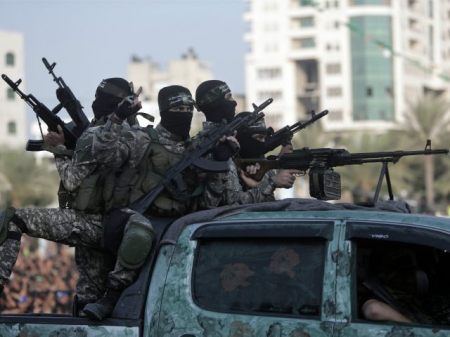
Hamas: Iran Has Pledged ‘All Capabilities’ To Help Us Fight Israel

December 27, 2017

Hamas: Iran Has Pledged ‘All Capabilities’ To Help Us Fight Israel, Breitbart, December 26, 2017

AP Photo/ Khalil Hamra

The director of Israel’s Shin Bet security agency on Sunday told a select group of Israeli ministers and lawmakers that the Gaza-based group is being careful to avoid a full conflagration with Israel along the Gaza border, but was actively trying to sow chaos in the West Bank.

The security service’s chief Nadav Argaman said Hamas was preparing for a takeover of the West Bank, and added that the group’s efforts are dangerous especially in light of the political weakness of Palestinian Authority President Mahmoud Abbas.

******************************************

TEL AVIV — A top Hamas official said Monday that a senior Iranian official gave him his word that all of Iran’s military might would be available to help the Gaza-based group fight Israel and take over Jerusalem, according to a report in the Times of Israel.

“All our of capabilities and potential are at your disposal in the battle for the defense of Jerusalem,” Yahya Sinwar quoted the commander of Iran’s Islamic Revolutionary Guards Corps’ elite Quds Force Qassem Soleimani as telling him over the phone.

Sinwar’s comments were carried by pro-Iranian Lebanese news outlet al-Mayadeen.

Soleimani, according to the report, told Sinwar that “Iran, the Revolutionary Guards and Quds Force stand with all they have with our people in order to defend Jerusalem so that Jerusalem will endure as the capital of the state of Palestine.”

Since U.S. President Donald Trump recognized Jerusalem as Israel’s capital, Hamas has been trying to inflame the Palestinian street and issued calls for “days of rage” and a third intifada.

There have been riots near the Old City of Jerusalem after Friday morning prayers, but Israeli security forces have so far succeeded in quelling them with few casualties.

The director of Israel’s Shin Bet security agency on Sunday told a select group of Israeli ministers and lawmakers that the Gaza-based group is being careful to avoid a full conflagration with Israel along the Gaza border, but was actively trying to sow chaos in the West Bank.

The security service’s chief Nadav Argaman said Hamas was preparing for a takeover of the West Bank, and added that the group’s efforts are dangerous especially in light of the political weakness of Palestinian Authority President Mahmoud Abbas.

No friend of Israel

December 27, 2017

No friend of Israel, Israel Hayom, Eldad Beck, December 27, 2017

(Might the substantial and increasing Islamisation of “multicultural” Germany be a factor in German hostility to Israel? — DM)

The time has come to reveal the true face of Germany, a country that wages a relentless struggle against Israel in both EU and U.N. institutions at the same time that it claims Israel’s existence and security are integral to its national interests. Germany is Europe’s single largest donor to the Palestinian Authority, but it has never once thought to demand the Palestinians do something for peace in return for all the money it provides, like put an end to the violence and the anti-Semitic incitement. While this should be obvious given Germany’s history, it seems it is not so crystal clear to Berlin. Germany prefers to put pressure on Israel only, by funding radical organizations that slander the Jewish state around the world.

*************************************

Around two weeks ago, and mere days after U.S. President Donald Trump’s recognition of Jerusalem as Israel’s capital, one of the most popular tourist attractions in Berlin was opened at the Jewish Museum. Spanning over 1,000 square feet, the “Welcome to Jerusalem” exhibit is huge and includes hundreds of displays and exhibits.

One would have expected this type of exhibit at such an important Jewish museum to emphasize Jerusalem’s unique character as the holiest city in Judaism and also possibly focus a bit on the historical narrative of Zionism and the State of Israel. Such an exhibit could also have presented, in a balanced manner of course, the different religions that coexist in the city in spite of the ongoing conflict. But regrettably, the exhibit does nothing of the sort, but rather serves to strengthen the theory of Muslim-Arab-Palestinian ownership of the city, mainly through a biased presentation of the Arab-Israeli conflict.

A historical documentary about the conflict, one of the exhibit’s highlights, portrays Jews as domineering invaders. It notes the massacres and terrorist acts committed by Jewish paramilitary organizations while completely ignoring those same acts when they were carried out by Arab organizations at the behest of Jerusalem Mufti Haj Amin al-Husseini; completely ignores the Arab revolt of the 1930s and Husseini’s collaboration with the Nazis; presents a fairly long segment from an interview with late Palestinian leader Yasser Arafat from the early years of his leadership, in which the then-PLO chief explains that the Palestinians have no choice but to take up arms; and repeats the theory according to which the 1995 assassination of Prime Minister Yitzhak Rabin is what led to the disintegration of the peace process, as well as the proven lie that then-Opposition Leader Ariel Sharon’s 2000 visit to the Temple Mount sparked the Second Intifada. In short, according to the Jewish Museum in Berlin, the Jews are bad while the Arabs are victims.

Could one have really expected a different approach from a Jewish museum that, as part of its permanent exhibits, presents Israel as part of the “Diaspora” of German Jewry along with images of left-wing German Jews protesting against Israel? One of the curators of the Jerusalem exhibit is Cilly Kugelmann, a former vice director of the Jewish Museum whose post-Zionist views helped turn the museum into a center of activity for those who negate Israel’s existence. It is important to note that the Jewish Museum does not have ties with the local Jewish community and is financed by public funds, meaning the German establishment could influence the content on display and use the museum to relay a message. In fact, that is exactly what it is doing: The Jewish Museum serves the German establishment in its conscious struggle against Israel under the guise of a supposedly Jewish body.

Trump’s recognition of Jerusalem as Israel’s capital served to reveal Germany’s hypocrisy as far as concerns its ties with the Jewish state: Last week, Germany voted in favor of a U.N. resolution submitted by Turkey and Yemen that called U.S. recognition of Jerusalem as Israel’s capital “null and void.” Germany, along with the other great nations of the European Union, betrayed its alliance with the United States and Israel in order to align with the world’s most unsavory regimes in negating the Jewish state’s right to determine that its capital is in Jerusalem, the most sacred city to Jews.

The time has come to reveal the true face of Germany, a country that wages a relentless struggle against Israel in both EU and U.N. institutions at the same time that it claims Israel’s existence and security are integral to its national interests. Germany is Europe’s single largest donor to the Palestinian Authority, but it has never once thought to demand the Palestinians do something for peace in return for all the money it provides, like put an end to the violence and the anti-Semitic incitement. While this should be obvious given Germany’s history, it seems it is not so crystal clear to Berlin. Germany prefers to put pressure on Israel only, by funding radical organizations that slander the Jewish state around the world.

Unfortunately, Germany is no friend of Israel. That is at least as long as its current policies remain in place.

North Korean Soldier Had ‘Anthrax Antibodies,’ Raising Concerns Over Pyongyang’s Biological Weapons Plans

December 27, 2017

North Korean Soldier Had ‘Anthrax Antibodies,’ Raising Concerns Over Pyongyang’s Biological Weapons Plans, Newsweek,  , December 27, 2017

According to 2015 documents from the South Korean Defense Ministry, North Korea possesses 13 types of bacteria and viruses that cause disease, known as pathogens. These include anthrax, botulism, cholera, Korean hemorrhagic fever, plague, smallpox, typhoid fever, yellow fever, dysentery, brucellosis, staph, typhus fever, and alimentary toxic aleukia.

Seoul estimated Pyongyang could “cultivate and weaponize [the pathogens] within 10 days,” and would prioritize anthrax, because it is highly deadly, and smallpox, because it is highly contagious—and its soldiers are thought to be vaccinated against it.

******************************************

Anthrax antibodies were found in the blood of a North Korean soldier who defected to the South, intelligence sources told Seoul’s media, increasing concerns about the country’s biological weapons production.

The unidentified intelligence official who spoke to South Korea’s Channel A network did not specify which soldier it was referring to; at least four North Korean soldiers have defected in the past seven months. “Anthrax antibodies have been found in the North Korean defector who has escaped this year,” the official was quoted as saying in the news report, which aired Tuesday.

North Korea is thought to be vaccinating top officials against anthrax, while the defectors held lower ranks. Seoul’s intelligence agency is investigating what kind of vaccines stockpiles has the country developed, the report said.

Senior defense analyst Shin Jong Woo of the Korea Defense Security Forum (KODEF) told Channel A the vaccine is likely to have been given to soldiers who handle the bacteria for military purposes, as unconfirmed reports last week indicated Pyongyang was looking to load anthrax on its intercontinental ballistic missiles (ICBMs).

Anthrax can infect human beings through either ingestion, inhalation or skin exposure and it affects the normal functioning of the body’s immune system cells. While ingestion or skin exposure to anthrax can sometimes be treated, inhalation is highly fatal, with a mortality rate of at least 80 percent, according to the FDA.

South Korean military biochemical warfare soldiers take part in an anti-terror drill in Seoul on May 3, 2011. A North Korean defector was found to have anthrax antibodies in his blood, an intelligence source told South Korean media. JUNG YEON-JE/AFP/GETTY IMAGES

Despite concerns about North Korea’s biological weapons production, Seoul’s soldiers are not vaccinated against deadly bacteria, unlike U.S. troops deployed on the peninsula, for whom smallpox and anthrax vaccinations have been compulsory for more than a decade. The two countries regularly hold military training exercises to practice their response to possible biological or chemical attacks.

On Monday, Seoul confirmed it had imported 350 doses of anthrax vaccines this year, which are meant to be stocked for treatment rather than vaccination.

“We purchased the vaccines, not to prevent but to treat the disease, in case of biological terror attacks,” presidential spokesperson Park Soo-hyun said, as quoted in the Korea Herald . He added that the Korea Centers for Disease Control and Prevention have acquired anthrax vaccines for 1,000 patients for the same purpose.

While North Korea has never publicly acknowledged the development of biological weapons, its leader Kim Jong Un visited Pyongyang’s Biological Technology Research Institute in June 2015.

According to Melissa Hanham, research associate at the James Martin Center for Nonproliferation Studies, the facility was not being used as a biological weapons facility at the time—but it could serve that purpose, as she wrote in analysis published on 38 North, a website dedicated to monitoring North Korea.

According to 2015 documents from the South Korean Defense Ministry, North Korea possesses 13 types of bacteria and viruses that cause disease, known as pathogens. These include anthrax, botulism, cholera, Korean hemorrhagic fever, plague, smallpox, typhoid fever, yellow fever, dysentery, brucellosis, staph, typhus fever, and alimentary toxic aleukia.

Seoul estimated Pyongyang could “cultivate and weaponize [the pathogens] within 10 days,” and would prioritize anthrax, because it is highly deadly, and smallpox, because it is highly contagious—and its soldiers are thought to be vaccinated against it.

Rethinking “Radicalization”: Dutch Researcher Discusses What Makes a Homegrown Terrorist

December 26, 2017

Rethinking “Radicalization”: Dutch Researcher Discusses What Makes a Homegrown Terrorist, Investigative Project on Terrorism, Abigail R. Esman, December 26, 2017

(Terrorism is obviously bad and we need to do our best to prevent it. However, my principal concern is about political Islam, aka Islamism. Islamists often do not need to engage in terrorism; they can rely instead on whatever democratic processes are available to Islamise nations. Look at Canada, for example. “Islamophobia” laws restrict free speech about Islam and its anti-democracy, pro-theocracy tendencies. In America, CAIR fights “Islamophobia” as well as organizations which want Muslims to respect American law. Here’s video on America and Sharia law.

(– DM)

On Nov. 2, 2004, Dutch filmmaker and writer Theo van Gogh left his home and set off to work, riding his bicycle as he did most days through the quiet streets of Amsterdam.

Minutes later, 26-year-old Mohammed Bouyeri, a Dutch-Moroccan Muslim angered by van Gogh’s writings and films about radical Islam, fired eight shots at the filmmaker. As Van Gogh stumbled, Bouyeri shot again, then stabbed him with a butcher knife, piercing straight through his chest. Then he sliced across Theo van Gogh’s throat in a failed effort to decapitate him before stabbing him one final time. It was, as many later said, the country’s 9/11, the arrival of Islamist terrorism to the tranquil tulip fields and calm canals of the Netherlands.

Mohammed Bouyeri acted alone, but he was a leading member of what later became known as the Hofstadgroep (Hofstad Group), a loosely-knit circle of Dutch Muslim youth from Amsterdam and The Hague with extremist ideas and half-hatched plans to execute terrorist attacks around the country. In the days following Van Gogh’s death, police raided a home in The Hague, arresting seven Hofstadgroep members after a standoff lasting several hours.

Their trials, and the trials of other members, have shaped much of the Dutch understanding of Islamist terrorism both for citizens and law enforcement. Above all, the cases showed definitively that European Muslims could be radicalized, and that even Muslims raised in the West had become a threat.

In fact, as Bart Schuurman, a research Fellow at the International Centre for Counterterrorism in The Hague, argues in his upcoming book, Becoming A European Homegrown Terrorist, the Hofstadgroep case ultimately came to define homegrown jihadism in Europe. Thanks, too, to the work of Dutch journalists Janny Groen and Annieke Kranenberg, studies into the women in and around the Hofstadgroep have provided important insights into the radicalization of Muslim women in the West, and their role in homegrown jihad.

For his research, Schuurman spoke with Hofstadgroep members and studied the police interviews with the Hofstadgroep to better understand their actions and thought processes.

On the eve of the publication of his new book, Schuurman talked to the Investigative Project on Terrorism (IPT) about his findings, what they say about the making of a homegrown terrorist, and how his research can help bring new insights to the fight against Islamist terror.

Abigail R. Esman: The Hofstadgroep was limited to the Netherlands, and the group preceded (by over a decade) the rise of ISIS and even social media. How is knowledge about that group still useful for a more global and more contemporary analysis of home-grown terrorism?

Bart Schuurman: The Hofstadgroep is indeed an older case as it was active between 2002 and 2005. As such, it was part of what could be called the first wave of European homegrown jihadism. I argue that insights we can derive from how and why people became involved in the Hofstadgroep are still relevant now for several reasons. First of all, like the current foreign fighter phenomenon, the Hofstadgroep’s extremist inner-circle also initially tried to join jihadist insurgencies overseas. Only when this failed, did some of them begin to consider and plan terrorist attacks in the Netherlands. Secondly, the Hofstadgroep was not a phenomenon unique to the Netherlands, but one example of the broader phenomenon of European homegrown jihadism that is still with us today. While much has changed in terms of context, such as a shift in focus from Afghanistan to Syria, many of the underlying dynamics driving involvement in this type of terrorism remain unaltered. I think that the field of terrorism studies sometimes has the unwarranted tendency to see every development in the terrorist threat as heralding a fundamentally ‘new’ situation to which our previous explanations and theories are of little to no utility. I’d argue it’s exactly the opposite; especially because it’s relatively easier to access high-quality data on older cases, they are a great resource for informing the ongoing debate on what can motivate (and prevent!) people from becoming involved in terrorism.

ARE: Are there any other groups like the Hofstadgroep today, either in the Netherlands or elsewhere?

BS: In ideological terms, the Hofstadgroep could be broadly characterized as driven by an extremist Salafi-Jihadist worldview and focused on waging a ‘defensive’ jihad against what they saw as Western geopolitical aggression and the threat posed by heresy and apostasy. I think it’s safe to say that such views have continued to be embraced by Islamist extremists in the Netherlands and Europe more broadly, although it is difficult to assess the scale on which this has occurred. But it is crucial to distinguish between holding radical or extremist views and becoming involved in any capacity in terrorist violence. The vast majority of radicals never cross this threshold. What I think we see today in Europe is that relatively small numbers of (would-be) jihadist terrorists continue to pose a serious threat and that they are embedded in a broader ‘radical milieu’ from which they draw support. While this threat is a very real one, I think it is important to keep in mind that these individuals and groups are not representative of the Muslim community as a whole. A key observation that we sometimes miss, is that Muslims are in fact the number one victims of groups like [ISIS] and al-Qaeda when we look at the violence in countries like Syria and Iraq.

ARE: What did you learn about the personalities of those likely to join such groups, or to act as lone wolves? (Is there also a similarity between those who join groups and lone wolf attackers?)

BS: Most researchers would agree that there is no such thing as a terrorist profile, at least not one of any practical utility. Most terrorists are relatively young and most are male; beyond that considerably diversity has been observed in terms of socioeconomic background, family obligations etcetera. None of which means that personality factors cannot play a role at all. In fact, things like past involvement in violence or previous socialization to extremist beliefs can be important parts of the explanation for why someone became involved in terrorism. Perhaps the most important thing that I took away from my Hofstadgroep study in terms of the influence of personality factors, is that extremism and terrorism cannot simply be explained as stemming from psychopathology or deprivation. On the whole, group-based terrorists are not driven (primarily) by mental health problems or lack of opportunities to pursue alternative career paths in society. The uncomfortable truth is that, for many of these individuals, involvement in terrorism is a more or less conscious decision. An interesting finding about lone actors is that many of them did not ‘go it alone’ for tactical considerations, but because they failed to join or form a terrorist cell of their own. This may tie into the higher prevalence of mental health problems among lone actor extremists, which can make them appear untrustworthy or simply disagreeable and therefore prevent them from being truly accepted by other extremists.

ARE: Is there a difference between those who join local groups and the lone wolf types who are influenced by ISIS and Al Qaeda? That is to say, do they see the larger terror groups in the same way Hofstadgroep members saw their own group?

BS: Again, while some lone actors (Unabomber, Breivik) make a conscious decision to operate alone, many would have liked to join others but failed to do so. But both lone actors and participants in groups like Hofstad are generally heavily-influenced by the larger radical milieu of which they are a part; taking inspiration from videos, writings, speeches etc. of leading figures and groups.

ARE: You distinguish between radicalization and fanaticism in your work. Can you explain what these are?

BS: I have been critical of the concept of radicalization for a long time. Although it has become a household term since 2004, it doesn’t really explain how and why people become involved in extremism and terrorism. Radicalization suffers from lack of a clear definition and it is inherently subjective. A century ago, those in favor of extending voting rights to women were often labeled radicals by their opponents. Few would (hopefully!) dare make that same argument now. Not only do our views of what is ‘radical’ change over time, but by associating radicalization so closely with terrorism, we have lumped together activists who, although we may disagree with them, are essentially advocating change while remaining within the limits of the liberal democratic order, with individuals and groups committed to the use of extreme violence to get what they want. If that isn’t problematic enough, most interpretations of radicalization continue to overstate the degree to which beliefs influence behavior. Saying someone was ‘radicalized’ prior to committing a terrorist act doesn’t really help us understand that act; there are millions of people with radical or extremist views and the vast majority of them never become involved in terrorism in any way, shape or form. So while extremist beliefs are usually an important component of the overall picture of why people commit terrorism, they are insufficient by themselves to function as an explanation. For that reason, I think we should stop talking about radicalization and instead study the pathways to lead to involvement in terrorism, as this implicitly draws attention to the multitude of factors that constitute such processes. Fanaticism struck me as a more useful concept because, as it was developed by British psychologist Max Taylor, it recognizes that not all ‘fanatics’ will act on their beliefs but stipulates conditions under which they are more likely to do so. “Fanaticism” is thus able to overcome, at least to some degree, “radicalization’s” greatest shortcoming; namely, why the vast majority of radicals never become terrorists.

ARE: Why are fanatics more likely to become violent?

BS: It is more a question of when, rather than why. Fanaticism (or radicalism, if you will) is more likely to actually lead to violence when 1) the beliefs adhered to are distinctly militant; 2) when the fanatic/radical also holds to millenarian views, such as that the apocalypse is nigh and can be hastened by the individual believer; and 3) (to me most importantly) when the radical/fanatic is not exposed to contrarian views that can challenge his/her extremist convictions or inject some grey into a black/white world-view.

ARE: You also indicate that the Hofstadgroep members were less concerned with creating change than with making a statement about their own Islamic identity. In a way, it seems you are saying it was more about themselves than about the world. That’s an interesting perspective for me, because it parallels my own ideas about terrorists being narcissists, and I wonder if this isn’t in fact true of other terrorists and terror groups – not just Islamist. Is this a view or an approach to terrorism we have overlooked? Maybe we’ve been missing the real picture. Or is it some of both?

BS: I am always a bit careful using terms like narcissism because people can then be quick to pathologize such statements. But there is definitely something interesting going on in terms of identity. A key question for me is always; why would anyone join a terrorist group? The most likely outcomes are death or a life in prison. Now, while jihadists (at least profess to) want to die for their beliefs, terrorism has a much longer and broader history than Islamist extremism alone. There have been many secular terrorist groups who were not keen to go to an afterlife. So, what does terrorism offer that can make some people takes these risks? A large part of the answer lies, I believe, in the attractions of group membership. Things like status within a particular community, the notion of being part of something grandiose and important, the feeling of living an important and exciting life, the comradeship formed under fire, these are key factors binding people to terrorist groups, whether we’re talking about [ISIS], the IRA or the Italian Red Brigades. I think it would be great to delve more deeply into such factors in future research.

ARE: Finally: How can your research help counterterrorism analysts and law enforcement going forward?

BS: I hope that my work will be able make a contribution to the work of counterterrorism policymakers and practitioners in two ways. First of all, by providing a unique primary-sources based account of how and why involvement in a key example of European homegrown jihadist group occurred, I hope to contribute to their subject-matter expertise. More importantly, I hope that my findings will challenge counterterrorism professionals to keep critically re-examining the assumptions about such processes that they use to guide their own work.

O! Jerusalem

December 26, 2017

O! Jerusalem, Israel National News, Rabbi Berel Wein, December 26, 2017

The city of Jerusalem itself is thriving as perhaps never before in its long and turbulent history. The population is at an all-time high and every neighborhood in the city is experiencing new construction and refurbishment. The light rail system has proven to be a success and the good old green Egged buses are still plying their routes more or less in an orderly fashion and on a scheduled timeline. 

The city has enjoyed an economic upturn and its government has improved many of the services, quietly and without boastful fanfare. The Arab citizens of Jerusalem – they are a little more than 30% of the population here – enjoy a standard of living and opportunity unmatched anywhere else in the Middle East.

Yet, this means nothing regarding the attitude of much of the world as far as Israel and Jerusalem is concerned

******************************

The Jewish people and the world generally were witness this past week to yet another fulfillment of a biblical prophecy. The prophet said that a day will come when all of the nations – or at least a sizable portion of them – will attack Jerusalem and attempt to dislodge the Jewish people from their capital city and its holy environs. 128 nations voted for a UN General Assembly resolution denying the right of Israel and the Jewish people to claim Jerusalem as its capital. 

Among the nations that voted for this resolution were the usual culprits – dictators, slaveholders, warmongers and many others of this ilk. And naturally the hypocritical democracies of Europe never have been able to overcome their anti-Jewish bias, developed over centuries of persecution and discrimination against Jews also supported this nefarious resolution.

There were countries, led by the United States of America, who voted against the resolution and spoke up about its bias and impracticality. In the long view of history those nations who defended Jewish rights eventually were blessed for their wisdom and kindness. The United States of America is the world’s leading democracy and with all of its warts and faults remains a shining beacon of fairness and opportunity for individuals all over the world. 

Supporting Israel’s claim to Jerusalem is just simply choosing right over wrong and realistic history over illusory plans and policies. The United States committed its error in supporting an anti-Israel resolution last year under the Obama administration. And it made good on its policy of long-standing to protect Israel from these continued efforts by the United Nations to undermine its sovereignty and territorial integrity.

There is no use arguing this matter logically or even realistically. It matters little to the world that Jerusalem, for the first time in many centuries, is free for worship to all faiths and peoples. It also matters little that Israel has all of its government offices located in Jerusalem and that Israel as a sovereign nation has long chosen Jerusalem to be its capital. None of this matters because it is not so much that the world wants Jerusalem – after all it was a wasteland and backwater location for many centuries whether under Christian or Moslem rule – it is simply that the world does not want the Jews to have Jerusalem.

There is absolutely no logical explanation for this position but there it is anyway. The terrible virus of anti-Semitism affects all attitudes and positions regarding the state of Israel and certainly regarding Jerusalem. I certainly agree that there are religious difficulties for both the Christian and Moslem worlds regarding the status of Jerusalem as being a Jewish city and the capital of the state of Israel. However just as portions of the Christian clergy and Moslem nations have learned to live with the reality of the existence of the state of Israel – itself a religious difficulty to the theology of these faiths – so too I am confident that they will be able to adjust to the fact that Jerusalem is the capital of the Jewish state. Reality eventually affects beliefs and previously held opinions, even those that were once represented as being sacred and immutable.

The city of Jerusalem itself is thriving as perhaps never before in its long and turbulent history. The population is at an all-time high and every neighborhood in the city is experiencing new construction and refurbishment. The light rail system has proven to be a success and the good old green Egged buses are still plying their routes more or less in an orderly fashion and on a scheduled timeline.

The city has enjoyed an economic upturn and its government has improved many of the services, quietly and without boastful fanfare. The Arab citizens of Jerusalem – they are a little more than 30% of the population here – enjoy a standard of living and opportunity unmatched anywhere else in the Middle East.

Yet, this means nothing regarding the attitude of much of the world as far as Israel and Jerusalem is concerned.

The United Nations resolution, shameful as it is, is nevertheless nonbinding and non-enforceable. It is another one of the paper propaganda victories that the Palestinian Authority revels in, which brings them no closer to a state of their own, which by now most of us suspect they really don’t want anyway.

Jerusalem was supposed to be a bargaining chip to extract greater concessions from Israel on any final agreement. Somehow that chip may now be lost and no longer in play.

Not-so-beautiful Dreamers: The reality behind the media airbrushing

December 26, 2017

Not-so-beautiful Dreamers: The reality behind the media airbrushing, Washington Times, Hans A. von Spakovsky, December 25, 2017

Media reports portray Dreamers as college-educated immigrants who were just a few years old when their parents brought them into the country illegally. (Associated Press/File)

ANALYSIS/OPINION:

The Obama administration did not check the background of each DACA beneficiary, despite a requirement that they have no felony convictions and pose no threat to national security. Only a few randomly selected DACA applicants were ever actually vetted.

This may explain why, by August this year, more than 2,100 DACA beneficiaries had had their eligibility pulled because of criminal convictions and gang affiliation. Even if a random background investigation produced substantial evidence that an illegal alien might have committed multiple crimes, the alien would still be eligible for DACA if he wasn’t convicted.

History shows that providing amnesty will attract even more illegal immigration and won’t solve our enforcement problems. Congress shouldn’t even consider such relief unless and until we have a sustained period of concentrated enforcement that stems illegal entry and reduces the illegal alien population in the U.S.

Congress should instead concentrate on providing the resources needed to enforce our immigration laws and secure our border.

******************************

When members of Congress battled over the budget, some threatened to block funding unless Congress provided amnesty to illegal alien Dreamers who benefited from President Obama’s Deferred Action for Childhood Arrivals program (DACA), which President Trump announced he is ending.

Conscientious members of Congress should not give in to this threat. Amnesty will encourage even more illegal immigration — just as the 1986 Immigration Reform and Control Act did.

That bill provided citizenship to 2.7 million illegal aliens. Yet by 1995, another 5.7 million illegal aliens were residing in the U.S. Many of them crossed the border to join their newly legalized friends and family. Others, no doubt, believed that since the U.S. provided amnesty once, it would do so again.

However Congress decides to deal with Dreamers, it should be based on the real demographics of the DACA populace, not the glamorized image typically presented by the media.

Watching television reports concerning Dreamers, one would think that the DACA program applied only to college-educated immigrants who were just a few years old when their parents brought them into the country illegally. We are led to believe that most are so fully Americanized that they would now have trouble speaking their native language and are all but ignorant of their birth countries’ cultural norms. Thus, we are supposed to believe, returning them to their native lands would be a cruel hardship.

In fact, many DACA beneficiaries came here as teenagers. All were eligible for the program as long as they entered the U.S. before their 16th birthday. By that time, there is no doubt that they spoke the language of their native countries fluently and knew their culture intimately.

DACA had no requirement of English fluency, as evidenced by the application form that had a space to list the translator used to complete the form. The Center for Immigration Studies estimates that “perhaps 24 percent of the DACA-eligible population fall into the functionally illiterate category and another 46 percent have only ‘basic’ English ability.”

Unfortunately, many Dreamers are poorly educated. Only 49 percent of DACA beneficiaries have a high school education, even though a majority are now adults. And while military service could also qualify an illegal alien for DACA, out of the current 690,000 DACA beneficiaries, only 900 are serving in the military.

The Obama administration did not check the background of each DACA beneficiary, despite a requirement that they have no felony convictions and pose no threat to national security. Only a few randomly selected DACA applicants were ever actually vetted.

This may explain why, by August this year, more than 2,100 DACA beneficiaries had had their eligibility pulled because of criminal convictions and gang affiliation. Even if a random background investigation produced substantial evidence that an illegal alien might have committed multiple crimes, the alien would still be eligible for DACA if he wasn’t convicted.

Thus, it seems that a significant percentage of DACA beneficiaries have serious limitations in their education, work experience and English fluency. What’s the likelihood that they’ll be able to function in American society without being substantial burdens to U.S. taxpayers?

Without changing the sponsorship rules, any congressional amnesty bill providing citizenship could significantly increase the number of illegal aliens who will benefit beyond the immediate DACA beneficiaries. Giving lawful status to Dreamers will allow them and their families to profit from illegal conduct.

History shows that providing amnesty will attract even more illegal immigration and won’t solve our enforcement problems. Congress shouldn’t even consider such relief unless and until we have a sustained period of concentrated enforcement that stems illegal entry and reduces the illegal alien population in the U.S.

Congress should instead concentrate on providing the resources needed to enforce our immigration laws and secure our border.

⦁ Hans A. von Spakovsky is a senior legal fellow at The Heritage Foundation and a former Justice Department lawyer. He is a co-author of “Who’s Counting? How Fraudsters and Bureaucrats Put Your Vote at Risk” and “Obama’s Enforcer: Eric Holder’s Justice Department.”

Palestinians: Where Have They Gone?

December 26, 2017

Palestinians: Where Have They Gone? Gatestone Institute, Shoshana Bryen, December 26, 2017

(Please see also, The night the UNRWA stole Xmas. — DM)

American funding for UNRWA is problematic itself because the organization is inextricably intertwined with Hamas in Gaza and Hezbollah in Lebanon. This may be the right time to review the number of Palestinian “refugees” in the world and the world’s obligation to them.

Ten years ago, in a forum on Capitol Hill, then-Rep. Mark Kirk called for an international audit of UNRWA. Kirk admitted he was unsuccessful, despite such accounting anomalies as a $13 million entry for “un-earmarked expenses” in an audit conducted by UNRWA’s own board.

Palestinians are the only “refugee” group that hands the status down through generations, which is why they are governed by UNRWA; all other refugees are under the care of the UN High Commissioner for Refugees, which has a mandate to settle refugees so they can become citizens of new countries.

Palestinian refugees are a slippery population — but when 285,535 of them go missing from a small country such as Lebanon, it should raise eyebrows.

UNRWA in Lebanon reports on its website that 449,957 refugees live under its protection in 12 camps, but a survey by Lebanon’s Central Administration of Statistics, together with the Palestinian Central Bureau of Statistics, could only find 174,535. The Lebanese government said the others “left.” Okay, maybe they did — Lebanon constrained them viciously, so it would make some sense. What does NOT make sense, then, is the UN giving UNRWA a budget based on nearly half a million people when, in fact, there are far fewer than a quarter of a million. Who is paying and who is getting the money?

We are and they are.

The UNRWA website shows a budget of $2.41 billion combined for FY 2016 and 2017. The U.S. provides more than $300 million to UNRWA annually, about one-quarter of the total. In August 2017, UNRWA claimed a deficit of $126 million. A former State Department official said the budget shortfalls are chronic but that “the funds seemed eventually arrive” after pressing others for more money — some of that additional money is from the U.S.

American funding for UNRWA is problematic itself because the organization is inextricably intertwined with Hamas in Gaza and Hezbollah in Lebanon; see herehere and here. And specifically for Lebanon, the connection goes as far back as 2007. But stay with the “floating” population problem for a moment.

A July 2015 street celebration in Lebanon’s Ain al-Hilweh camp, which is administered by UNRWA. (Image source: Geneva Call/Flickr)

The huge discrepancy in Lebanon suggests that UNRWA may have trouble counting refugees in the West Bank, Jordan, Gaza, and Syria as well. (We’ll give them a pass on Syria for now.) The problem is not new, but that Palestinian agencies were running the census may help the United States overcome its own long-term obstinacy when it comes to counting and paying.

Ten years ago, a forum on Capitol Hill, then-Rep. Mark Kirk called for an international audit of UNRWA. Kirk admitted he was unsuccessful in generating demand among his colleagues despite such accounting anomalies as a $13 million entry for “un-earmarked expenses” in an audit conducted by UNRWA’s own board. An amendment to the 2006 Foreign Assistance Act had called for $2 million in additional funds for UNRWA, specifically for an investigation of finances, but the amendment was withdrawn at the request of the State Department.

As a Senator, Kirk offered an amendment calling for the State Department to provide two numbers to Congress: the number of Palestinians physically displaced from their homes in what became Israel in 1948, and the number of their descendants administered by the UNRWA. The State Department denounced the amendment, saying:

“This proposed amendment would be viewed around the world as the United States acting to prejudge and determine the outcome of this sensitive issue.”

Far from prejudging the outcome, a review of the number of Palestinian “refugees” in the world and the world’s obligation to them would provide an honest basis from which to make policy.

In 1950, the UN defined Palestinian “refugees” as people displaced from territory that had become Israel after having lived there for two years or more — this is distinct from every other population of refugees that must be displaced from their long-term homes. Furthermore, Palestinians are the only “refugee” group that hands the status down through generations, until there is a resolution of the status of the original group — which is why they are governed by UNRWA; all other refugees are under the care of the UN High Commissioner for Refugees (UNHCR), which has a mandate to settle refugees so they can become citizens of new countries. UNRWA, naturally, produces the only population of refugees that grows geometrically over time rather than declining as the original refugees die and their children are no longer stateless. (See Vietnamese refugee resettlement for an example of how this works for others.)

The original population of refugees was estimated at 711,000 in 1950. Today, there appear to be 30-50,000 original refugees remaining, and UNRWA claims to care for 4,950,000 of their descendants. But 285,000 of them appear to have disappeared from Lebanon.

It has long been understood that there is an undercount of deaths in UNRWA refugee camps — to admit a death means UNRWA loses that member in the accounting for the international community. It also wreaks havoc with Palestinian insistence that there are 6 million refugees (not UNRWA’s 5 million) and that a million people are not registered, but should still have a “right of return” to homes their parents, grandparents or great-grandparents claim to have had inside the borders of Israel.

The numbers game also exists with people who do not live in refugee camps. The Palestinian Authority counts as residents 400,000 Palestinians who have lived abroad for over a year, and according to Deputy Palestinian Interior Minister Hassan Illwi, more than 100,000 babies born abroad are registered as West Bank residents — both in contravention of population-counting norms. Jerusalem Palestinians are double-counted – once as Palestinian Authority residents and once as Israeli Palestinians. The PA, furthermore, claims zero net out-migration; Israeli government statistics differ.

How many Palestinians would there be in these territories if a proper census was taken? How many “refugees” would disappear from UNRWA rolls as they did in Lebanon? How might that affect the budget?

Can we please find out?

Shoshana Bryen is Senior Director of the Jewish Policy Center.

Panic at the Washington Post

December 26, 2017

Panic at the Washington Post, Power LinePaul Mirengoff, December 25, 2017

The Washington Post is worried. The lead headline in today’s paper edition reads: “Mueller criticism grows to a clamor — FBI Conspiracy Claim Takes Hold — Driven by activists, GOP lawmakers, Trump tweets.”

Turnabout is fair play. Last year around this time, an honest newspaper could easily have written: “Trump criticism grows to a clamor — Russia Collusion Takes Hold — Driven by activists, Democratic lawmakers, leaks.”

A year ago, an honest newspaper could not have written that the Trump collusion criticism was driven by the FBI. The facts supporting such a headline were not known. Now we have good reason to suspect that the FBI was, in fact, advancing the collusion claim.

The FBI reportedly offered money to Christoper Steele to continue his work on the anti-Trump dossier (in testimony before Congress Rod Rosenstein refused to say whether the FBI paid or offered to pay for the dossier). The FBI may well have used information in the dossier to secure approval of surveillance efforts from the FISA court.

The FBI also helped push the dossier into the public’s consciousness. Its general counsel, James Baker, reportedly told reporter David Corn about the dossier, thus enabling Corn to write about it just before the election. And FBI director Comey briefed president-elect Trump on the dossier, which led to publication of its contents by BuzzFeed.

We also know about the quest of Peter Strzok, a high-level FBI man, for an “insurance policy” against a Trump presidency.

But let’s return to the Washington Post’s story about growing criticism of Mueller. The three distressed Post writers are less than fully open when it comes to informing readers what — other than activists, GOP lawmakers, and Trump tweets — is causing criticism of Mueller to grow to a clamor.

They acknowledge that it has something to do with Strzok’s role as Mueller’s former top investigator. However, they do their best to make Strzok seem innocuous.

The story introduces him by noting that he called Trump an “idiot” and predicted that Hillary Clinton would win the election in a landslide — statements that don’t distinguish him from tens of thousands of government employees and millions of other Americans. They also quote a former colleague of Strzok who says:

To think Pete could not do his job objectively shows no understanding of the organization. We have Democrats, we have Republicans, we have conservatives and liberals. . . . Having personal views doesn’t prevent us from independently following the facts.

The problem with peddling this happy narrative is that it ignores Strzok’s anti-Trump zeal, his obvious desire to impress his mistress, and his damning statement about the need for an “insurance policy” against Trump becoming president. The Post, in fact, never mentions that statement.

The Post also manages to ignore the hyper-partisan nature of Mueller’s staff, even excluding Strzok, whom he reassigned. There is a passing reference to Andrew Weissmann’s gushing note to Sally Yates praising her for her resistance to Trump, but no discussion of the ideologically one-sided composition of Team Mueller — a marked contrast to Ken Starr’s balanced staff.

Even with that diverse staff, Starr was successfully portrayed as spearheading a “vast right-wing conspiracy.” It’s not surprising that as more and more evidence emerges of bias within Mueller’s team, criticism mounts and takes hold.

Mueller himself is a Republican. But he is also a friend of James Comey, another fact the Post ignores. The steady stream of evidence of Comey’s anti-Trump animus and manipulative conduct has contributed to declining faith in Mueller.

And then, there’s the fact that Mueller appears to have come up empty so far on “collusion” by Trump. A prosecutor investigating a president is bound to lose credibility if, after an extended period of time, he neither produces evidence against the president nor exonerates him of the set of crimes that supposedly underlie the investigation.

A prosecutor who cannot credibly be accused of bias — either personal or within his team — buys himself time and patience from the public. Mueller is not that prosecutor.

In sum, the Post’s account of how Mueller lost the “near-universal support” he enjoyed earlier is shallow.

The Post’s story is significant, nonetheless. Clearly, the Post is concerned that, as it states, the growing criticism of Mueller “threatens to shadow his investigation’s eventual findings.”

It does, indeed. A recent Harvard poll found that 54 percent of voters believe that “as the former head of the FBI and a friend of James Comey,” Mueller has a conflict of interest in the proceedings. Meanwhile, only 35 percent believe that evidence of collusion between Trump and Russia has been found.

I’m sure Mueller believes his own press-clippings, but the public no longer does. The press, it seems, is beginning to realize this.

Germany Needs An Extra 2,000 Judges and Prosecutors to Process Fivefold Increase in Terror Cases

December 25, 2017

Germany Needs An Extra 2,000 Judges and Prosecutors to Process Fivefold Increase in Terror Cases, BreitbartJack Montromery, December 24, 2017

Sean Gallup/Getty Images

Germany also faces more longstanding issues with immigration: between 43 and 48 per cent of the country’s substantial ethnic Turkish population — which has been growing steadily since the introduction of a special ‘guest worker’ programme in the 1960s and now numbers in the millions — is ‘economically inactive’, with German media reporting the “vast majority … declare that — at least for the moment — they are not interested in a job.”

***********************************

Germany’s judicial system is groaning under the strain of an explosion in terror cases since Chancellor Angela Merkel opened the door to unlimited numbers of migrants in 2015.

The German Attorney-General opened a shocking 1,200 terror cases in 2017, of which around 1,000 were related to radical Islamic terrorism, Tagesschau reports.

This represents a fivefold increase on 2016, when the figure stood at around 250 — with roughly 200 cases being related to radical Islam.

Sven Rebehn, the head of the German association of judges, has warned that the system is struggling to cope with the sheer volume of its expanded caseload, with burden particularly heavy in the migrant hotspots of Berlin, Dusseldorf, Frankfurt, and Hamburg

The judicial federation has calculated that around 2,000 additional judges and prosecutors are needed if the country hopes to tackle the growing terror threat and clear the backlog, or else face real difficulty in the near future.

Migrants have not only increased the workload of the courts in the field of terrorism — for example, 91 per cent of a 48 per cent surge in Bavarian rape cases was attributed to migrants in September 2017.

But the costs of expanding the judicial system’s capacity to absorb the surge in terror cases is not the only expense to fall on Germany as a consequence of mass migration.

The cost of the country’s more recent arrivals was predicted to reach close to 100 billion euros by 2020 last year — with the figure likely to have increased since then.

Germany also faces more longstanding issues with immigration: between 43 and 48 per cent of the country’s substantial ethnic Turkish population — which has been growing steadily since the introduction of a special ‘guest worker’ programme in the 1960s and now numbers in the millions — is ‘economically inactive’, with German media reporting the “vast majority … declare that — at least for the moment — they are not interested in a job.”