Archive for January 2020

Iraq attack LIVE: Iran launches missiles at US forces in Iraq over Soleimani death

January 8, 2020

Whoa boy, here we go. Gloves are off.

Videos at the link.

https://www.theage.com.au/world/middle-east/iraq-attack-live-iran-launches-missiles-at-us-forces-in-iraq-over-soleimani-death-20200108-p53pra.html

Summary

  • Iran has targeted US forces in Iraq with “dozens” of missiles
  • At least two military bases containing US troops have been targeted
  • Iran’s attacks are in retaliation for the US killing of Iranian general Qassem Soleimani
  • Pentagon is conducting “initial battle damage assessments”
  • Iran state TV says the attack was called “Operation Martyr Soleimani”

Australia ‘closely monitoring’ events

Prime Minister Scott Morrison says the government is “closely monitoring” what’s unfolding, and whether action needs to be taken to keep Australians safe.

He has just released a statement:

The Prime Minister, Chief of the Defence Force and Ministers for Defence and Foreign Affairs are in frequent contact.

The Prime Minister has directed the Chief of the Defence Force (CDF) to take whatever actions are necessary to protect and defend our ADF and diplomatic personnel and keep Australians safe.

The Prime Minister has contacted the Leader of the Opposition to brief him on the current situation.

The National Security Committee of the Cabinet has been meeting to review this situation and take decisions as necessary since Saturday, is already scheduled to meet again for this purpose on Thursday and will be convened sooner should further information be confirmed requiring such a response, and will be done so in consultation with the CDF.

Iran’s targets

Two attacks have been confirmed: one on the Ain Asad airbase, the second at Erbil in Northern Iraq.

What prompted these attacks?

The Iranian attack comes in response to the US killing of Iran’s top general Qassem Soleimani. If you don’t know much about him, this piece will give you a sense idea of the outrage caused by his assassination.

And this piece will tell you more about who Soleimani is and why the US wanted him dead.

Major General Qassem Soleimani, pictured in September 2016.
Major General Qassem Soleimani, pictured in September 2016.CREDIT:AP

Iran state TV airs footage of attacks

By Patrick Elligett

Iran’s FARS news agency broadcast footage of missiles being launched from inside Iran. At least two military bases housing US forces in Iraq have been targeted.

Video shows apparent Iran missile attack on Iraq base

Footage posted by FarsNews Agency, regarded as the ‘semi-official’ news agency of the Government of Iran, claims to show a missile attack on Ain Assad air base in Iraq’s western Anbar province.

Operation Moses – How Israel Rescued the Jews of Ethiopia 

January 7, 2020

https://www.youtube.com/watch?v=UM_2CFkLTEQ

BBC Documentary

Operation Moses (Hebrew: מִבְצָע מֹשֶׁה, Mivtza Moshe) refers to the covert evacuation of Ethiopian Jews (known as the “Beta Israel” community or “Falashas”)[1] from Sudan during a civil war that caused a famine in 1984. Originally called Gur Aryeh Yehuda (“Cub of the Lion of Judah”) by Israelis, the United Jewish Appeal changed the name to “Operation Moses.”[2]

History
The operation, named after the biblical figure Moses, was a cooperative effort between the Israel Defense Forces, the Central Intelligence Agency, the United States embassy in Khartoum, mercenaries, and Sudanese state security forces.[3] Years after the operation completed, it was revealed that Sudanese Muslims and secret police of Sudan also played a role in facilitating the mass migration of Ethiopian Jews out of Sudan.[4] Operation Moses was the brainchild of then Associate U.S. Coordinator for Refugee Affairs, Richard Krieger. After receiving accounts of the persecution of Ethiopian Jews in the refugee camps, Krieger came up with the idea of an airlift and met with Mossad and Sudanese representatives to facilitate the Operation.[5][6]

After a secret Israeli cabinet meeting in November 1984, the decision was made to go forward with Operation Moses.[7] Beginning November 21, 1984, it involved the air transport by Trans European Airways of some 8,000 Ethiopian Jews from Sudan via Brussels to Israel, ending January 5, 1985.

Over those seven weeks, over 30 flights brought about 200 Ethiopian Jews at a time to Israel.[8] Trans European Airways had flown out of Sudan previously with Muslims making the pilgrimage to Mecca, so using TEA was a logical solution for this semi-covert operation because it would not provoke questions from the airport authorities.[9] Before this operation, there were approximately as few as 250 Ethiopian immigrants in Israel.[10] Thousands of Beta Israel had fled Ethiopia on foot for refugee camps in Sudan, a journey which usually took anywhere from two weeks to a month.[11] It is estimated as many as 4,000 died during the trek, due to violence and illness along the way. Sudan secretly allowed Israel to evacuate the refugees. Two days after the airlifts began, Jewish journalists wrote about “the mass rescue of thousands of Ethiopian Jews.”[12]

Operation Moses ended on Friday, January 5, 1985, after Israeli Prime Minister Shimon Peres held a press conference confirming the airlift while asking people not to talk about it. Sudan killed the airlift moments after Peres stopped speaking, ending it prematurely as the news began to reach their Arab allies.[13] Once the story broke in the media, Arab countries pressured Sudan to stop the airlift. Although thousands made it successfully to Israel, many children died in the camps or during the flight to Israel, and it was reported that their parents brought their bodies down from the aircraft with them.[14] Some 1,000 Ethiopian Jews were left behind, approximately 500 of whom were evacuated later in the U.S.-led Operation Joshua.[15] More than 1,000 so-called “orphans of circumstance” existed in Israel, children separated from their families still in Africa, until five years later Operation Solomon took 14,324 more Jews to Israel in 1991.[16] Operation Solomon in 1991 cost Israel $26 million to pay off the dictator-led government, while Operation Moses had been the least expensive of all rescue operations undertaken by Israel to aid Jews in other countries.[17]

Operation Dove Wing 2010; 2015-2020
On 14 November 2010, the Israeli cabinet approved a plan to allow an additional 8,000 Falash Mura to immigrate to Israel.[18][1]

On November 16, 2015, the Israeli cabinet unanimously voted in favor of allowing the last group of Falash Mura to immigrate over the next five years, but their acceptance will be conditional on a successful Jewish conversion process, according to the Interior Ministry.[19] In April 2016, they announced that a total of 10,300 people would be included in the latest round of Aliyah, over the following 5 years.[20][21]

As Iran prepares to bury Soleimani, crowds shout ‘Death to Israel’

January 7, 2020

Source: As Iran prepares to bury Soleimani, crowds shout ‘Death to Israel’ | The Times of Israel

Revolutionary Guard leader Salami threatens to ‘set ablaze’ US-backed places as burial ceremony gets underway in slain general’s hometown of Kerman

Iranian mourners gather for the burial of slain top general Qasem Soleimani in his hometown Kerman on January 7, 2020 (Atta KENARE / AFP)

TEHRAN, Iran (AP) — The leader of Iran’s Revolutionary Guard threatened on Tuesday to “set ablaze” places supported by the United States over the killing of a top Iranian general in a US airstrike last week, sparking cries from the crowd of supporters of “Death to Israel!”

Hossein Salami made the pledge before a crowd of thousands gathered in a central square in Kerman, the hometown of the slain Gen. Qassem Soleimani. His vow mirrored the demands of top Iranian officials — from Supreme Leader Ayatollah Ali Khamenei to others — as well as supporters across the Islamic Republic, demanding retaliation against America for a slaying that’s drastically raised tensions across the Middle East.

Mourners in Kerman dressed in black carried posters bearing the image of Soleimani, a man whose slaying prompted Iran’s supreme leader to weep over his casket on Monday as a crowd said by police to be in the millions filled Tehran streets. Although there was no independent estimate, aerial footage and Associated Press journalists suggested a turnout of at least 1 million, and the throngs were visible on satellite images of Tehran taken Monday.

The outpouring of grief was an unprecedented honor for a man viewed by Iranians as a national hero for his work leading the Guard’s expeditionary Quds Force. The US blames him for the killing of American troops in Iraq and accused him of plotting new attacks just before his death Friday in a drone strike near Baghdad’s airport. Soleimani also led forces in Syria backing President Bashar Assad in a long war, and he also served as the point man for Iranian proxies in countries like Iraq, Lebanon and Yemen.

His slaying already has pushed Tehran to abandon the remaining limits of its 2015 nuclear deal with world powers as his successor and others vow to take revenge. In Baghdad, the parliament has called for the expulsion of all American troops from Iraqi soil, something analysts fear could allow Islamic State militants to mount a comeback.

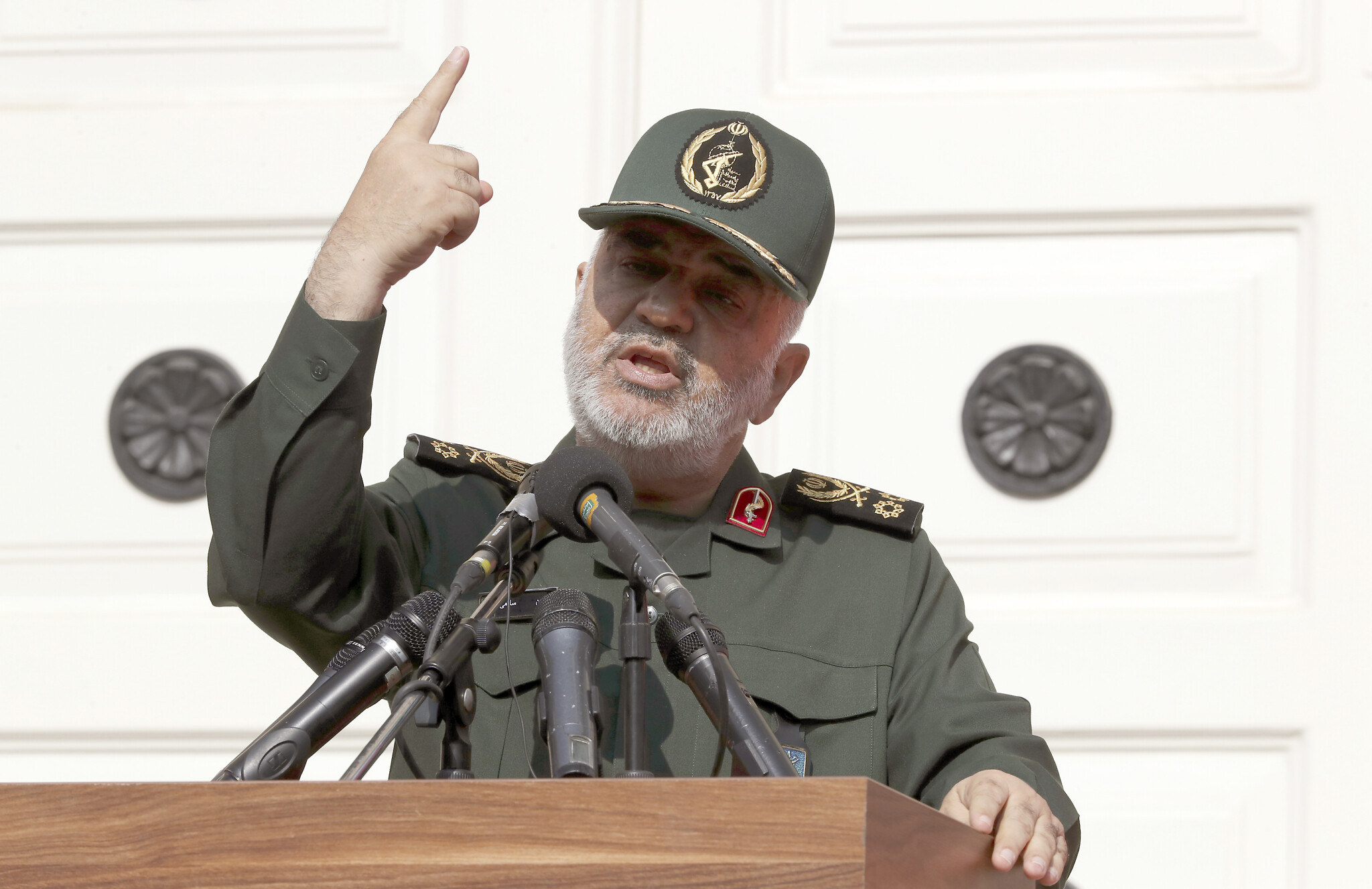
Chief of Iran’s Islamic Revolutionary Guard Corps Gen. Hossein Salami speaks in a ceremony to unveil new anti-US murals painted on the walls of former US embassy in Tehran, Iran, November 2, 2019. (Vahid Salemi/AP)

Soleimani’s remains and those of the others killed in the airstrike were brought to a central square in Kerman, a desert city surrounded by mountains that dates back to the days of the Silk Road where he will be buried later on Tuesday.

Salami praised Soleimani’s exploits and said as a martyr, he represented an even greater threat to Iran’s enemies.

“We will take revenge. We will set ablaze where they like,” Salami said, drawing the cries of “Death to Israel!”

Israel is a longtime regional foe of Iran.

According to a report on Tuesday by the semi-official Tasnim news agency, Iran has worked up 13 sets of plans for revenge for Soleimani’s killing. The report quoted Ali Shamkhani, the secretary of Iran’s Supreme National Security Council, as saying that even the weakest among them would be a “historic nightmare” for the US. He declined to give any details,

“If the US troops do not leave our region voluntarily and upright, we will do something to carry their bodies horizontally out,” Shamkhani said.

Iran’s parliament, meanwhile, passed an urgent bill declaring the US military’s command at the Pentagon in Washington and those acting on its behalf “terrorists,” subject to Iranian sanctions. The measure appears to mirror a decision by President Donald Trump in April to declare the Revolutionary Guard a “terrorist organization.”

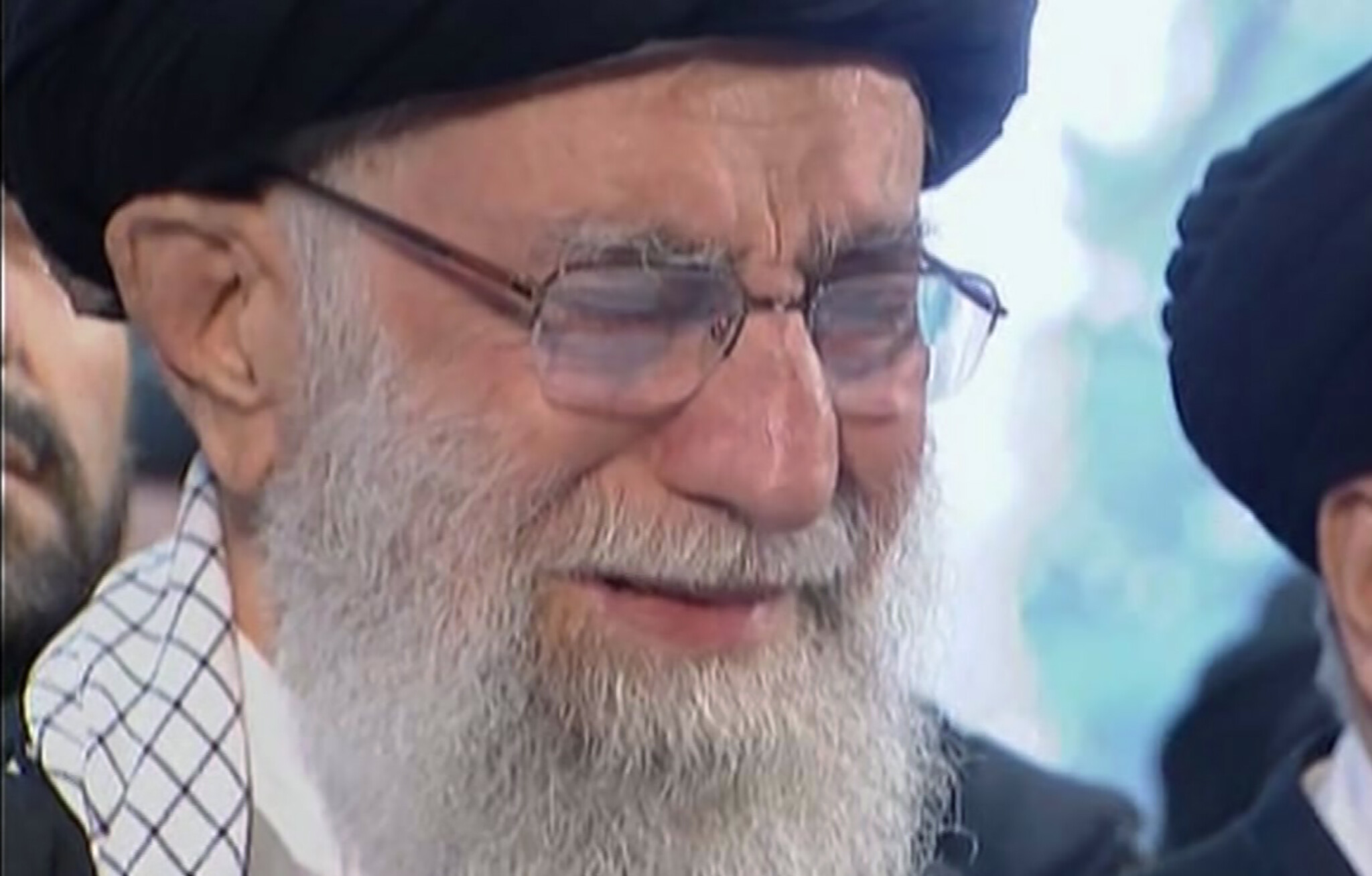
Screen capture from video shows Iranian Supreme Leader Ayatollah Ali Khamenei openly weeping as he leads a prayer over the coffin of Gen. Qassem Soleimani, who was killed in Iraq in a US drone strike, during a funeral ceremony at the Tehran University campus, in Tehran, Iran, January 6, 2020. (Iran Press TV via AP)

The US Defense Department used the Guard’s designation as a terror organization in the US to support the strike that killed Soleimani. The decision by Iran’s parliament, done by a special procedure to speed the bill to law, comes as officials across the country threaten to retaliate for Soleimani’s killing.

Also Tuesday, Iranian Foreign Minister Mohammad Javad Zarif said the US had declined to issue him a visa to travel to New York for upocoming meetings at the United Nations. The US as the host of the UN headquarters is supposed to allow foreign officials to attend such meetings.

“They fear that someone comes to the US and reveals realities,” Zarif said and added: “The world is not limited to New York and you can talk to the American people from Tehran and we will do that.”

The US State Department did not immediately respond to a request for comment.


Death to America… but not their cars

January 7, 2020

This made me chuckle.

http://elderofziyon.blogspot.com/2020/01/mourners-shout-death-to-america-as.html

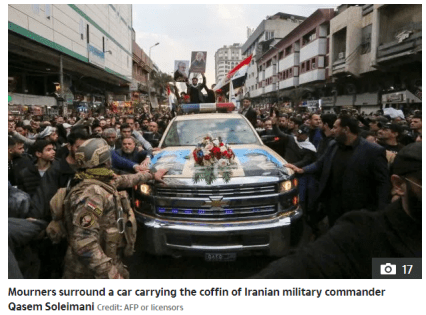
Qassem Soleimani’s funeral procession in Baghdad saw thousands of mourners shouting “Death to America!”

His coffin was in a Chevrolet, perhaps the most American car there is.

Social media in Arabic enjoyed this irony a great deal.

Johnson says Britain will not lament death of Soleimani

January 6, 2020

Source: Johnson says Britain will not lament death of Soleimani | The Times of Israel

British PM says he has spoken to Trump, calls slain Iranian general ‘a threat to all our interests’; London imam urges crowd to aspire to be like Soleimani

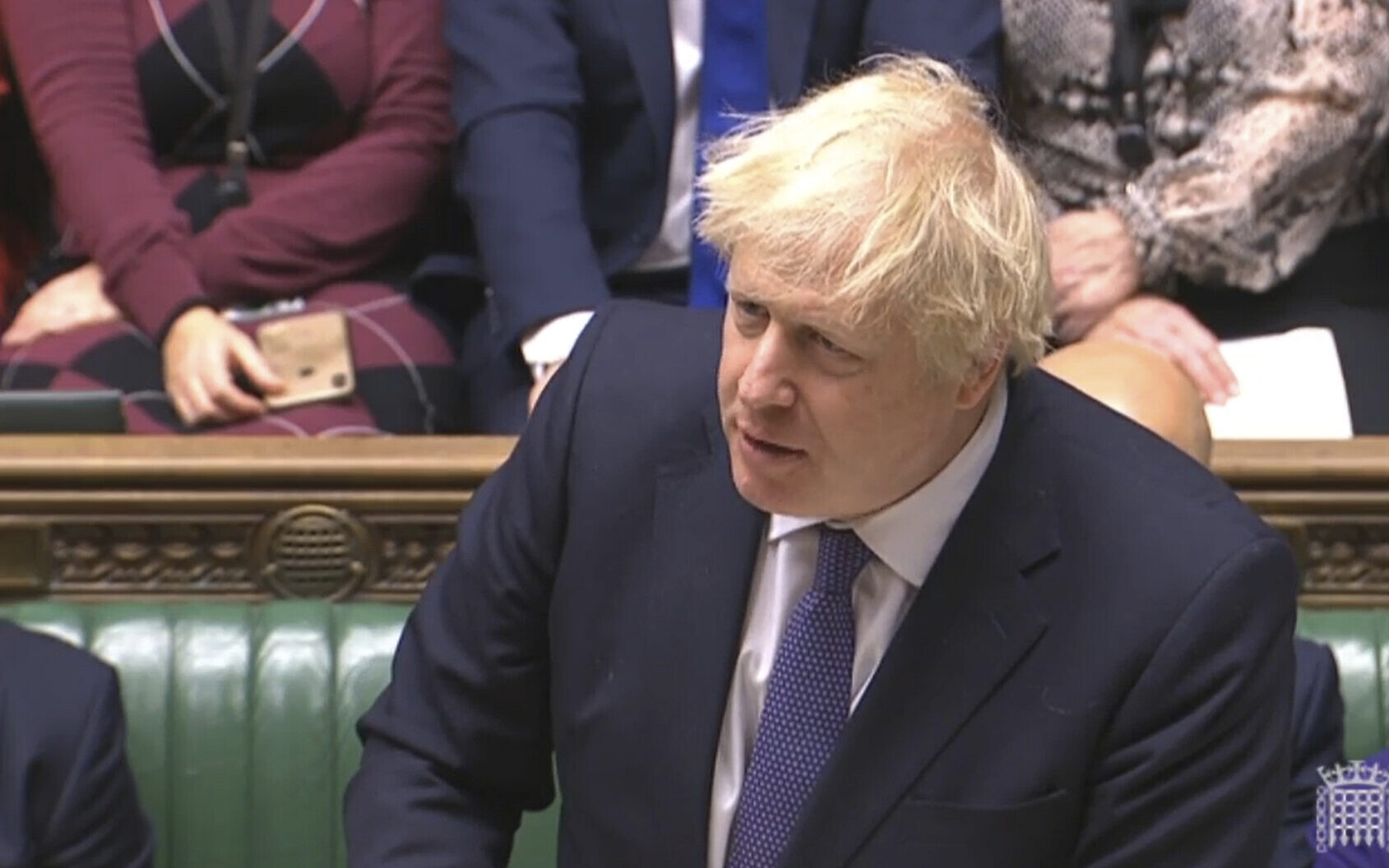
British Prime Minister Boris Johnson speaks during the Brexit debate on The European Union (Withdrawal Agreement) Bill in the House of Commons in London, Friday Dec. 20, 2019 (House of Commons via AP)

British Prime Minister Boris Johnson speaks during the Brexit debate on The European Union (Withdrawal Agreement) Bill in the House of Commons in London, Friday Dec. 20, 2019 (House of Commons via AP)

LONDON — Britain will not lament the death of Iranian general Qassem Soleimani, UK Prime Minister Boris Johnson said Sunday, though he warned that reprisals would lead to greater violence.

The United States killed top military leader Soleimani outside Baghdad airport in a drone strike on Friday.

In his first intervention on the escalation of tensions in the Middle East, Johnson said he had spoken Sunday with US President Donald Trump, French President Emmanuel Macron and German Chancellor Angela Merkel.

He said he would speak to other leaders in the coming days.

“General Qassem Soleimani posed a threat to all our interests and was responsible for a pattern of disruptive, destabilizing behavior in the region,” Johnson said in a statement.

“Given the leading role he has played in actions that have led to the deaths of thousands of innocent civilians and Western personnel, we will not lament his death.

“It is clear however that all calls for retaliation or reprisals will simply lead to more violence in the region and they are in no one’s interest.”

Iranian lawmakers chant anti-American and anti-Israeli slogans to protest against the US killing of Iranian general Qassem Soleimani, at the start of an open session of parliament in Tehran, Iran, Jan. 5, 2020. (Mohammad Hassanzadeh/Tasnim News Agency via AP)

Johnson said that following ministerial meetings and further international calls, MPs would be updated on the situation on Tuesday.

Meanwhile London has urged Baghdad to allow international coalition soldiers to stay in Iraq, where the parliament on Sunday pressed the government to oust foreign troops.

The cabinet would have to approve any such decision.

British troops are part of an international coalition of forces stationed in Iraq — invited by the government in Baghdad in 2014 — to help fight against the Islamic State (IS) jihadist group.

A British government spokesman said: “The coalition is in Iraq to help protect Iraqis and others from the threat from Daesh (IS), at the request of the Iraqi government.

“We urge the Iraqi government to ensure the coalition is able to continue our vital work countering this shared threat.”

Some 5,200 US soldiers are stationed across Iraqi bases to support local troops preventing an IS resurgence.

Meanwhile several dozen British Muslims took part in a memorial ceremony for Soleimani, with an imam urging participants to “aspire to be like” the slain Iranian, the Daily Mail reported.

In a video of the sermon in the Islamic Center of England in London, the cleric tells the crowd that: “I would like to give you all my condolences but I would also like to congratulate you”

“We are lucky enough to live in a time where we can see, touch and feel a man like Qassem Soleimani and we hope and we pray and we work hard to make sure that there will be many many more Qassem Soleimanis,” he said.  “We aspire to become like him, we are jealous and we want the same thing for ourselves and our loved ones.”


Iran: We’re not bound by nuke deal, won’t limit enrichment, after Soleimani hit 

January 6, 2020

Source: Iran: We’re not bound by nuke deal, won’t limit enrichment, after Soleimani hit | The Times of Israel

Tehran says it will not observe curbs on uranium enrichment, stockpiles, research and development, but cooperation with UN watchdog will continue

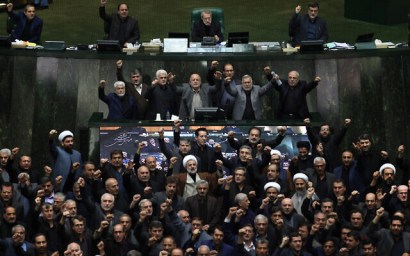
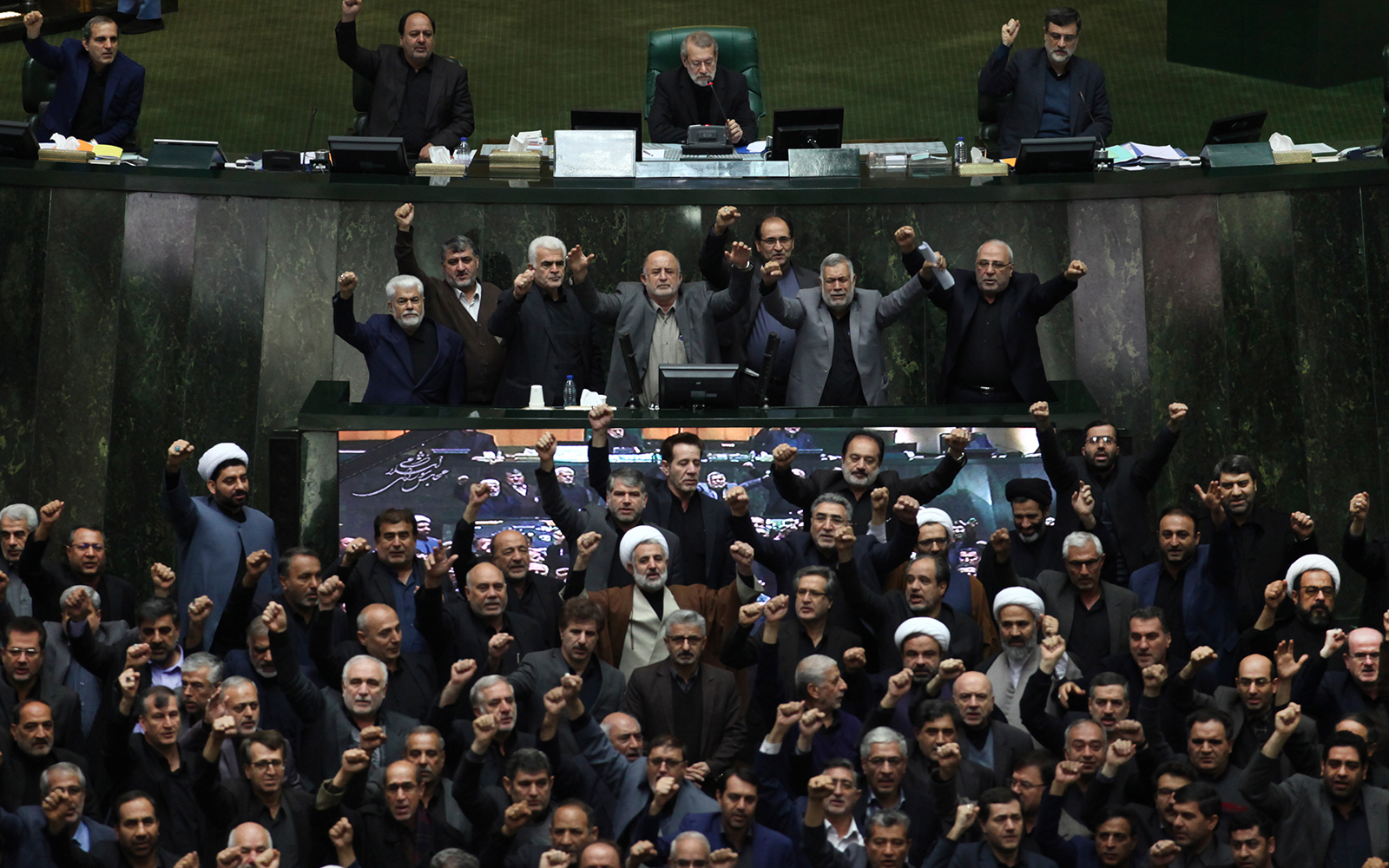
Iranian lawmakers chant anti-American and anti-Israeli slogans to protest against the US killing of Iranian general Qassem Soleimani, at the start of an open session of parliament in Tehran, Iran, Jan. 5, 2020. (Mohammad Hassanzadeh/Tasnim News Agency via AP)

Iranian lawmakers chant anti-American and anti-Israeli slogans to protest against the US killing of Iranian general Qassem Soleimani, at the start of an open session of parliament in Tehran, Iran, Jan. 5, 2020. (Mohammad Hassanzadeh/Tasnim News Agency via AP)

TEHRAN, Iran (AP) — Iran said Sunday it would no longer abide by any of the limits of the unraveling 2015 nuclear deal with world powers after a US airstrike killed a top Iranian general in Baghdad, apparently ending an accord that blocked Tehran from having enough material to build an atomic weapon.

The announcement came Sunday night after another Iranian official said Tehran would consider taking even harsher steps over the US killing of Gen. Qassem Soleimani on Friday.

The Iranian parliament on Sunday opened with lawmakers chanting in unison “Death to America” while raising clenched fists.

Hundreds of thousands of people flooded the streets Sunday in Iran to walk alongside a casket carrying the remains of Soleimani, the former leader of its Quds Force that organizes Tehran’s proxy forces in the wider Mideast.

The leader of one such proxy, Lebanon’s Hezbollah terror group, said Soleimani’s killing made US military bases, warships and service members spread across the region fair targets for attacks.

A former Revolutionary Guard leader suggested the city of Haifa and “centers” like Tel Aviv could be targeted.

Iran’s state TV cited a statement by President Hassan Rouhani’s administration saying the country will not observe limitations on its enrichment, the amount of stockpiled enriched uranium as well as research and development in its nuclear activities. “The Islamic Republic of Iran no longer faces any limitations in operations,” a state TV broadcaster said.

Iran insisted that it remains open to negotiations with European partners over its nuclear program. And it did not back off from earlier promises that it wouldn’t seek a nuclear weapon. However, the announcement represents the clearest nuclear proliferation threat yet made by Iran since President Donald Trump unilaterally withdrew from the accord in 2018 and reimposed sanctions. It further raises regional tensions, as Iran’s longtime foe Israel has promised never to allow Iran to produce an atomic bomb.

Iran did not elaborate on what levels it would immediately reach in its program. Tehran has already broken some of the deal’s limits as part of a step-by-step pressure campaign to get sanctions relief. It has increased its production, begun enriching uranium to 5% and restarted enrichment at an underground facility.

While it does not possess uranium enriched to weapons-grade levels of 90%, any push forward narrows the estimated one-year “breakout time” needed for it to have enough material to build a nuclear weapon if it chose to do so.

The International Atomic Energy Agency, the United Nations watchdog observing Iran’s program, did not immediately respond to a request for comment. However, Iran said that its cooperation with the IAEA “will continue as before.”

Meanwhile, Iraq’s parliament voted in favor of a resolution calling for an end of the foreign military presence in their nation, an effort aimed at expelling the 5,000 US troops stationed there for the fight against the Islamic State terror group.
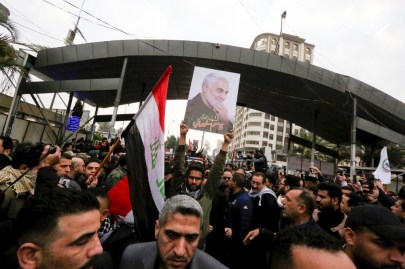
Mourners wave the national flag and the Hashed al-Shaabi flag as they carry the portrait Iranian military commander Qasem Soleimani during a funeral procession in Kadhimiya, a Shiite pilgrimage district of Baghdad, on January 4, 2020. (SABAH ARAR / AFP)

Soleimani’s killing has escalated the crisis between Tehran and Washington after months of trading attacks and threats that have put the wider Middle East on edge. The conflict is rooted in Donald Trump pulling out of Iran’s atomic accord and imposing sanctions that have crippled Iran’s economy.

Iran has promised “harsh revenge” for the US attack, which shocked Iranians across all political lines. Many saw Soleimani as a pillar of the Islamic Republic at a moment when it is beset by US sanctions and recent anti-government protests.

Retaliation for Soleimani could potentially come through the proxy forces which he oversaw. Soleimani’s longtime deputy Esmail Ghaani already has taken over as the Quds Force’s commander.

The US Embassy in Saudi Arabia separately warned Americans “of the heightened risk of missile and drone attacks.”

Late Saturday, a series of rockets launched in Baghdad fell inside or near the Green Zone, which houses government offices and foreign embassies, including the US Embassy.

Trump wrote on Twitter afterward that the US had already “targeted 52 Iranian sites (representing the 52 American hostages taken by Iran many years ago), some at a very high level & important to Iran & the Iranian culture.”

Trump did not identify the targets but added that they would be “HIT VERY FAST AND VERY HARD.”

The 1954 Hague Convention, of which the US is a party, bars any military from “direct hostilities against cultural property.” However, such sites can be targeted if they have been re-purposed and turned into a legitimate “military objective,” according to the International Committee of the Red Cross.

Iran, home to 24 UNESCO World Heritage sites, has in the past reportedly guarded the sprawling tomb complex of the Islamic Republic’s founder, Ayatollah Ruhollah Khomeini, with surface-to-air missiles.

After thousands in Baghdad on Saturday mourned Soleimani and others killed in the strike, authorities flew the general’s body to the southwestern Iranian city of Ahvaz. An honor guard stood by early Sunday as mourners carried the flag-draped coffins of Soleimani and other Guard members off the tarmac.
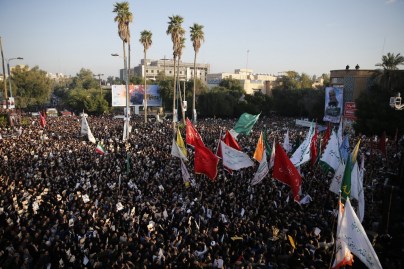
Iranians march on January 5, 2020 in the streets of the northwestern city of Ahvaz to pay homage to top general Qasem Soleimani, who was killed in a US strike in Baghdad. (HOSSEIN MERSADI/Fars news/AFP)

The caskets then moved slowly through streets choked with mourners wearing black, beating their chests and carrying posters with Soleimani’s portrait. Demonstrators also carried red Shiite flags, which traditionally both symbolize the spilled blood of someone unjustly killed and call for their deaths to be avenged.

Officials brought Soleimani’s body to Ahvaz, a city that was a focus of fighting during the bloody, 1980-88 war between Iraq and Iran in which the general slowly grew to prominence. After that war, Soleimani joined the Guard’s newly formed Quds, or Jersualem, Force, an expeditionary force that works with Iranian proxy forces in countries like Iraq, Lebanon and Yemen.

Authorities then took Soleimani’s body to the city of Mashhad later Sunday. State TV estimated that a million mourners came out to the Imam Reza shrine to pay their respects, although that number could not be independently verified. Soleimani’s remains will go to Tehran and Qom on Monday for public mourning processions, followed by his hometown of Kerman for burial Tuesday.

This marks the first time Iran honored a single man with a multi-city ceremony. Not even Khomeini received such a processional with his death in 1989. Soleimani on Monday will lie in state at Tehran’s famed Musalla mosque as the revolutionary leader did before him.

Soleimani was the architect of Iran’s regional policy of mobilizing militias across Iraq, Syria and Lebanon, including in the war against the Islamic State group. He was also blamed for attacks on US troops and American allies going back decades.

Although it’s unclear how or when Iran may respond, any retaliation was likely to come after three days of mourning declared in both Iran and Iraq.

Mohsen Rezaei, a former leader of the Guard, told a crowd of mourners in Tehran that the city of Haifa and other “centers” like Tel Aviv could be targeted as part of a response. Rezaei earlier alleged without offering evidence that Israel leaked information to the US about Soleimani’s whereabouts, which allowed them to carry out the drone strike.

“Rest assured we will level to the ground Haifa and Israeli centers so that Israel will be wiped out,” he said. “The issue is very serious for the Iranian nation. You hit us and you should get hit. You attacked us and it is the Iranian nation’s right.”
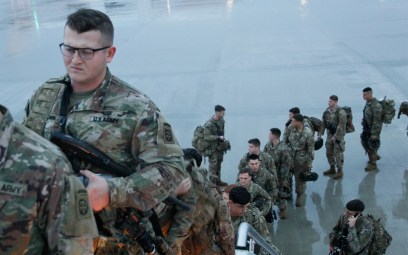
US paratroopers prepare equipment and load aircraft for deployment to the Middle East from Fort Bragg, North Carolina, January 4, 2020. (US Army/Spc. Hubert Delany III)

Iranian officials planned to meet Sunday night to discuss taking a fifth step away from its 2015 nuclear deal with world powers, one that could be even greater than planned, Foreign Ministry spokesman Abbas Mousavi told journalists.

“In the world of politics, all developments are interconnected,” Mousavi said.

Iran previously has broken limits of its enrichment, its stockpiles and its centrifuges, as well as restarted enrichment at an underground facility.

Iranian parliament speaker Ali Larijani compared Soleimani’s killing to the 1953 CIA-backed coup that cemented the shah’s power and to the US Navy’s shootdown of an Iranian passenger plane in 1988 that killed 290 people. He also described American officials as following “the law of the jungle.”

Rain fell at the shrine in Mashhad late Sunday as an imam delivered a sermon over the coffins of Soleimani and others stood. The crowd surged and shouted as he preached. Mourners threw clothing up to officials accompanying the remains to have the fabric be brushed against the caskets in a belief it would carry God’s blessings to them.
 

Trump threatens sanctions on Baghdad after lawmakers call on US troops to leave 

January 6, 2020

Source: Trump threatens sanctions on Baghdad after lawmakers call on US troops to leave – The Jerusalem post

Before Trump’s comments to reporters, a State Department spokeswoman said the US was waiting for clarification of the legal nature and impact of the resolution passed by the Iraqi parliament.

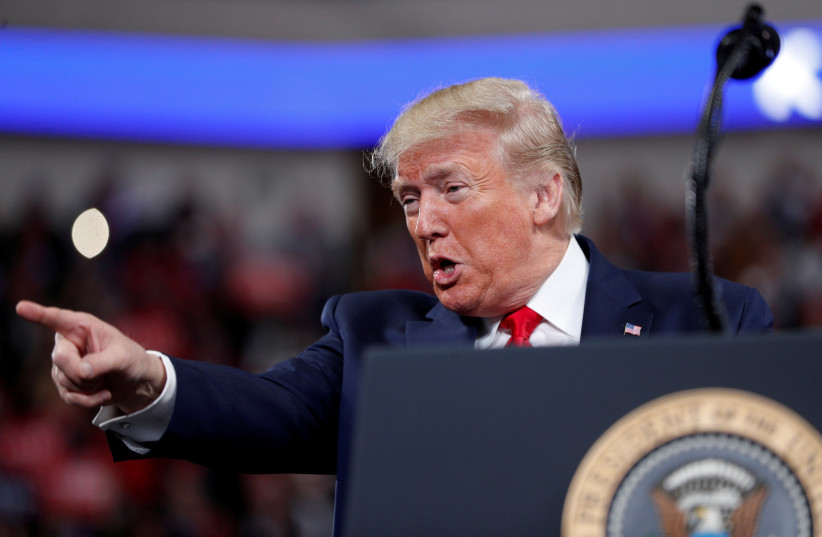
U.S. President Donald Trump delivers remarks during a campaign rally at the Giant Center in Hershey, Pennsylvania, U.S., December 10, 2019 (photo credit: REUTERS//TOM BRENNER)
U.S. President Donald Trump delivers remarks during a campaign rally at the Giant Center in Hershey, Pennsylvania, U.S., December 10, 2019
(photo credit: REUTERS//TOM BRENNER)
ABOARD AIR FORCE ONE – US President Donald Trump threatened sanctions against Baghdad on Sunday after Iraq‘s parliament called on US troops to leave the country, and the president said if troops did leave, Baghdad would have to pay Washington for the cost of the air base there.

“We have a very extraordinarily expensive air base that’s there. It cost billions of dollars to build, long before my time. We’re not leaving unless they pay us back for it,” Trump told reporters on Air Force One.Trump said that if Iraq asked US forces to leave and it was not done on a friendly basis, “we will charge them sanctions like they’ve never seen before ever. It’ll make Iranian sanctions look somewhat tame.”

Before Trump’s comments to reporters, a State Department spokeswoman said the United States was waiting for clarification of the legal nature and impact of the resolution, and strongly urged Iraqi leaders to reconsider the importance of the two nations’ ongoing economic and security relationship.

Some 5,000 U.S. troops remain in Iraq, most in an advisory role.

Abdul Mahdi said that despite the “internal and external difficulties” the country might face, canceling its request for help from U.S.-led coalition military forces “remains best for Iraq on principle and practically.”

He said he had been scheduled to meet Soleimani the day he was killed, and that the general had been due to deliver an Iranian response to a message from Saudi Arabia that Abdul Mahdi had earlier passed to Tehran. Sunni Muslim Saudi Arabia and Shi’ite Iran had been about to “reach a breakthrough over the situation in Iraq and the region,” Abdul Mahdi said.

Despite decades of U.S.-Iran enmity, Iranian-backed militia and U.S. troops fought side by side during Iraq’s 2014-17 war against Islamic State, their common enemy. Iraqi militia leader Abu Mahdi al-Muhandis was also killed in Friday’s strike.

Sunday’s parliamentary resolution was passed by overwhelmingly Shi’ite lawmakers, as the special session was boycotted by most Sunni Muslim and Kurdish lawmakers.

One Sunni member of parliament told Reuters both groups feared that kicking out U.S.-led forces would leave Iraq vulnerable to insurgents, undermine security and heighten the power of Iranian-backed Shi’ite militias.

During the evening Trump also spoke with UK Prime Minister Boris Johnson, discussing the current situation in Iraq and Iran, the White House said in a statement.

The release offered few details of the specifics of the call, noting only that the two leaders “reaffirmed the close alliance between the two countries.”


Iran announces it is suspending all commitments to the 2015 nuclear deal

January 6, 2020

Mourners carry the coffins of Iran's top general Qassem Soleimani and Abu Mahdi al-Muhandis, deputy commander of Iran-backed militias in Iraq, during their funeral in the shrine of Imam Hussein in Karbala, Iraq on January 4.

Mourners carry the coffins of Iran’s top general Qassem Soleimani and Abu Mahdi al-Muhandis, deputy commander of Iran-backed militias in Iraq, during their funeral in the shrine of Imam Hussein in Karbala, Iraq on January 4

https://www.theage.com.au/world/middle-east/iran-announces-it-is-suspending-all-commitments-to-the-2015-nuclear-deal-20200106-p53p3m.html

Istanbul: Iran said on Sunday that it is suspending all commitments under the 2015 nuclear deal it had struck with world powers and will abandon restrictions on uranium enrichment and other activities unless United States sanctions are lifted.

The government announced the move in a statement carried by state news agencies.

“Iran’s nuclear program will now be based solely on its technical needs,” the statement said. The move includes breaching the accord’s caps on everything from enrichment capacity to activating centrifuges to its stockpile of nuclear fuel.

Iran announced it would abandon limitations on enriching uranium, taking a further step back from commitments to a 2015 nuclear deal with six major powers.

“If the sanctions are lifted … the Islamic Republic is ready to return to its obligations,” the statement said. It added that Iran will continue to cooperate with the International Atomic Energy Agency, the United Nations’ nuclear watchdog.

The announcement came as the region continued to grapple with the fallout of a US drone strike that killed Major-General Qasem Soleimani, commander of Iran’s elite Quds Force, as he traveled in a convoy near the Baghdad airport Friday. The strike also killed a key Iraq militia leader, Abu Mahdi al-Muhandis.

Iranian state television cited a statement by President Hassan Rouhani’s administration saying the country would not observe the deal’s restrictions on fuel enrichment, on the size of its enriched uranium stockpile and on its research and development activities.

“The Islamic Republic of Iran no longer faces any limitations in operations,” a state TV broadcaster said.

The leaders of Germany, France and Britain called for Iran to abide by the terms of the 2015 nuclear deal.

US President Donald Trump withdrew the his country from the deal in 2018 and stepped up economic sanctions on Tehran, even as other world powers stuck by the agreement.

In a joint statement, German Chancellor Angela Merkel, French President Emmanuel Macron and British Prime Minister Boris Johnson urged Iran to refrain from conducting or supporting further “violent acts”.

The three European leaders specifically urged Iran to “withdraw all measures” not in line with the 2015 nuclear agreement that was intended to stop Tehran from pursuing its atomic weapons program.

They also called on all actors involved to show “utmost restraint and responsibility” and pledged to continue to seek to reduce tensions and ensure stability in the Middle East.

Iraq’s caretaker prime minister urged parliament on Sunday to take “urgent measures” to force the withdrawal of foreign forces following the strike. In an address to the legislature, Adel Abdul Mahdi recommended that the government establish a timetable for the departure of foreign troops, including the members of the US-led coalition fighting the Islamic State militant group, “for the sake of our national sovereignty.”

“What happened was a political assassination,” Abdul Mahdi said.

Lawmakers responded by passing a nonbinding resolution calling on the government to end the foreign troop presence in Iraq. But Abdul Mahdi, who resigned in November and has been serving in a caretaker role, is not legally authorized to sign the bill into law.

As a result, the vote Sunday did not immediately imperil the US presence in Iraq, but it highlights the headwinds the Trump administration faces after the strike, which was seen in Iraq as a violation of sovereignty and as a dangerous escalation by governments across the Middle East.

In a sign of the spiraling consequences, the US-led coalition said it had paused its training mission in Iraq because of “repeated rocket attacks over the last two months” by the Iran-backed Kataib Hezbollah militia. It would now focus on protecting its bases from attack, the coalition said in a statement.

“This has limited our capacity to conduct training with partners and to support their operations” against the Islamic State, it said. “We have therefore paused these activities.”

Iran, meanwhile, said Sunday that it would limit its response to the drone attack to US military targets.

“The response for sure will be military and against military sites,” Hossein Dehghan, the military adviser to Iran’s supreme leader, said in an interview with CNN. “The only thing that can end this period of war is for the Americans to receive a blow that is equal to the blow they have inflicted.”

Deghan’s remarks came as President Donald Trump threatened Saturday on Twitter to strike “52 Iranian sites … some at a very high level & important to Iran and the Iranian culture” should Tehran retaliate against Americans or US interests in the region. Iran has 24 locations on the UN list of cultural world heritage sites.

If Trump were to carry out his threats, Dehghan said, “no American military staff, no American political center, no American military base, no American vessel will be safe.”

US allies widely share concerns about the consequences of Soleimani’s death. NATO will convene an emergency meeting of its ambassadors on Monday to discuss the situation in Iraq. NATO suspended its training programs in the country, and several member nations have scrambled to protect their troops and citizens here.

In Saudi Arabia, the US Embassy released a security alert Sunday advising Americans of “the heightened risk of missile and drone attacks” against both civilian and military targets.

The US blamed Iran for a brazen drone and cruise missile attack on Saudi state oil facilities in September, a strike that knocked half of the nation’s oil production offline.

While Saudi officials have long urged the US to take stronger action against what they say is Iran’s unchecked expansionism in the region, they have also expressed discomfort at the rising tensions between Washington and Tehran.

Abdul Mahdi suggested Sunday that Iran and the Saudis had been engaged in dialogue to tamp down their feud, with Iraq playing the role of mediator. Abdul Mahdi said he had been expecting to meet with Soleimani on the day he was killed. “He came to deliver me a message from Iran, responding to the message we delivered from Saudi Arabia to Iran,” the prime minister said, without providing details.

In Iran, Soleimani’s body was flown in a flag-draped coffin to the southwestern city of Ahvaz, following a funeral procession in Baghdad and Iraq’s twin Shiite shrine cities, Karbala and Najaf. It was later carried to the northeastern city of Mashhad, home to the shrine of Imam Reza, a revered figure in Shiite Islam. Iran is ruled by a Shiite theocracy.

Footage broadcast on Iranian state television showed tens of thousands of black-clad mourners waving flags and chanting religious slogans. Iran’s state-run Islamic Republic News Agency described the scene as “glorious.”

“All schools and businesses are closed today – he was popular here and even more popular now,” said Farnaz, 33, a computer engineer and resident of Ahvaz, referring to Soleimani. Like other Iranians contacted Sunday, she spoke on the condition that her full name not be used so she could talk freely about his death.

“People here … saw Soleimani as an important and charismatic commander who was protecting their security,” she said.

Still, Ahvaz and other cities in oil-rich Khuzestan province, home to a large ethnic Arab minority, have a history of anti-government unrest. On Sunday, an unverified video posted online showed masked youths setting fire to a billboard commemorating Soleimani.

The slain commander’s procession will continue Monday to the holy city of Qom and the capital, Tehran, where Ayatollah Ali Khamenei, Iran’s supreme leader, will lead prayers at the ceremony. Soleimani will be buried in his hometown, Kerman, on Tuesday.

The Washington Post, AP

Did The U.S. Use New Joint Air-To-Ground Missile To Kill Iran’s General Soleimani?

January 6, 2020

https://www.forbes.com/sites/sebastienroblin/2020/01/04/did-the-pentagon-use-new-joint-air-to-ground-missiles-in-killing-of-general-soleimani/#792e582a4bb6

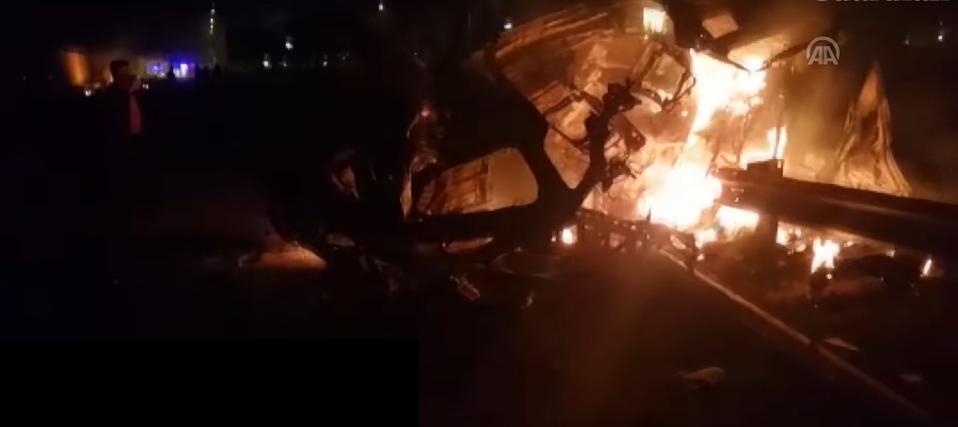
Flaming wreckage of convoy carrying Iranian Gen. Qasem Solemaini after U.S. drone strike.

The killing via drone strike of Iranian Quds Force commander Gen. Qasem Soleimani and Abu Mahdi al-Muhandis, deputy commander of Iraq’s Popular Mobilization Front (PMF) militias, just outside Baghdad International Airport on Jan. 3 may have immense consequences for the Middle East, including the non-trivial potential of triggering an escalation dynamic leading to war.

The technical means by which the deadly U.S. air strikes on a PMF convoy was effected is of decidedly secondary importance, but the attack nonetheless may have left behind evidence that the Pentagon employed a deadly new weapon.

Mohamed Saleh Alftayeh, a military analyst specializing in the Middle East, drew my attention to a photo posted on an Iraqi Facebook group appearing to show fragments recovered at the airport from one of the missiles used in the attack.

The origin, a Facebook group Tactical Cell, describes itself as an “independent investigative military cell, concerned with the Iraqi and regional military situation, and which is managed by independent military officers and activists.” According to Alftayeh, the group mostly posts content associated with PMF militias.

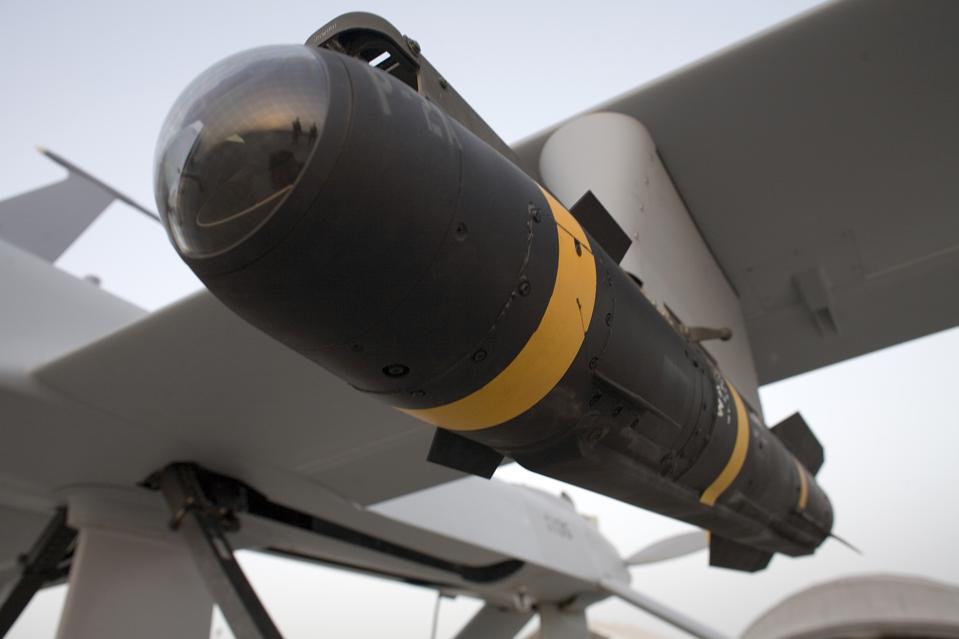
The photo shows print on the fragment that notes the missile weighs 52 kilograms (114.6 pounds) and requires two persons to lift.

Some analysts have identified the munition as an AGM-114 Hellfire missile, a deadly supersonic anti-tank weapon now used extensively by the U.S. military to attack diverse point targets. In addition to the latest laser-guided AGM-114R ‘Romeo’ type, there’s also a mysterious Hellfire variant that uses pop-out sword blades to kill targets with minimal collateral damage.

https://twitter.com/N_Waters89/status/1126477020827877378

But there’s a problem: Hellfire variants have listed weights between 45 to 50 kilograms. And given that the targeted car was reduced to a blazing wreck, we can rule out the use of the blade-armed Hellfire.

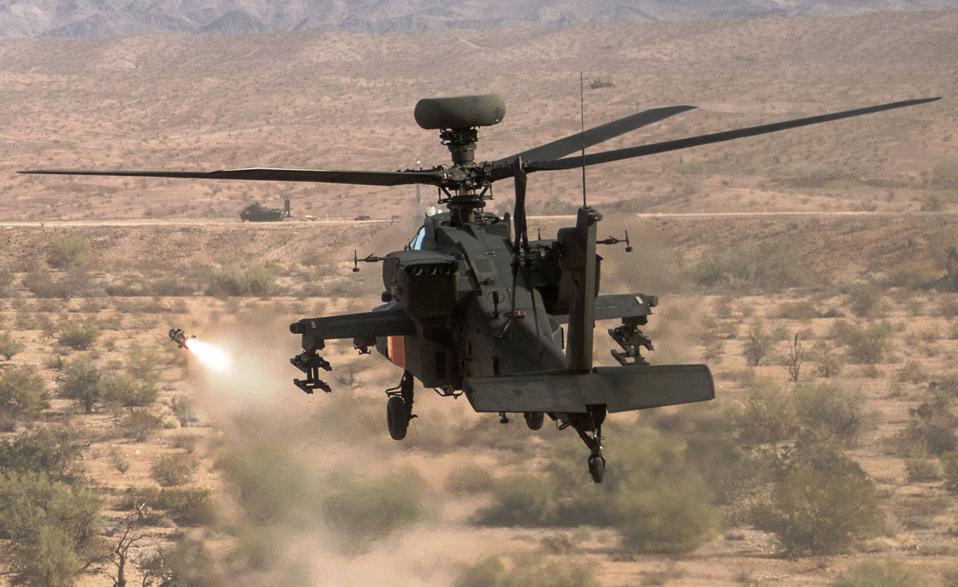
In fact, a weapon intended to replace the Hellfire, called the AGM-179 Joint-Air-to-Ground Missile (JAGM) does weigh 52 kilos (115 pounds), and is designed to be fired from the same helicopters and drones. It essentially plugs an advanced guidance-cone into the body of a standard AGM-114R missile (the motor, flight control system and its multi-purpose warhead).

JAGM was funded jointly by the Army and Marine Corps (and originally the Navy) to replace several kinds of air-launched precision missiles including long-range optically-guided TOW anti-tank guided missile and both radar-guided AGM-114L and laser-guided AGM-114R variants of the Hellfire missile.

The JAGM is designed to be more flexible and resistant to anti-missile countermeasures by incorporating two seekers. A semi-active laser guidance seeker automatically adjusts the missile’s course to home in on a target painted by a laser targeter.

Additionally, a millimeter-wave radar seeker allows the missile to be used as a fire-and-forget weapon capable of homing in on moving vehicles. The firer can even switch the missile mid-flight from laser to radar-guided mode, if they need to perform evasive maneuvers instead of continuing to track their target with the laser designator.

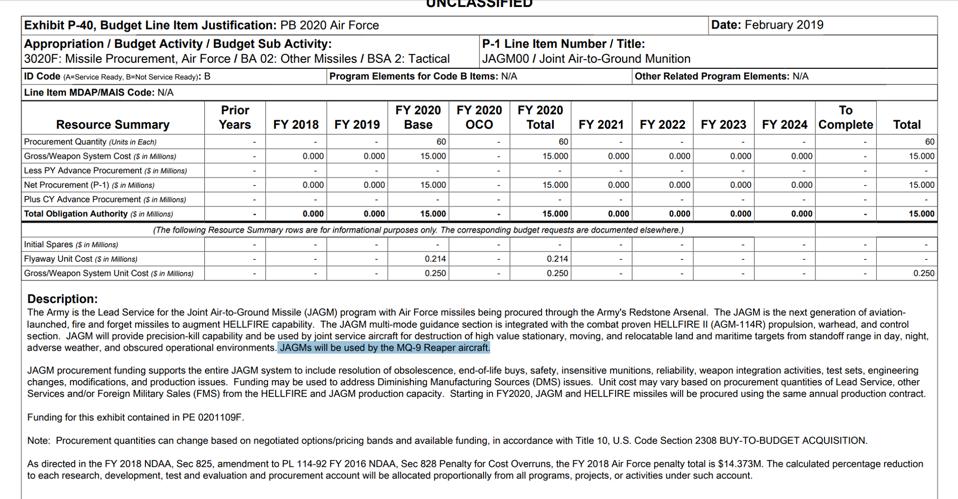
While weapons with multi-mode seekers cost more—a budget document suggests a cost of $238,000 per unit, over twice the price of most late-model AGM-114s—they are praised by pilots because they allow more flexible planning as only one type of missile can engage different targets under varying circumstances.

The JAGM’s fuse can also be programmed to airburst against personnel targets on open ground, or delay detonation for greater effectiveness versus bunkers. The missile has a maximum range of 5 miles and reportedly remains effective against targets obscured by smoke, fog or dust.

Ultimately the Army plans to procure over 20,000 JAGMs, and in mid-December 2019 the service asked Lockheed to double its production rate from 50 to 100 per month. The missile might eventually be integrated on Navy MH-60R Seahawk helicopters and Marine KC-130 Harvest Hawk tanker/gunships.

Eventually, an “Increment 2”JAGM model adding a third, infrared-type seeker and extending range to 7.5 miles may also be in the offing, and the program had in the past proposed a 13-mile range model for use by the Marine Corps’ Harrier and F-35B Lightning jump jets.

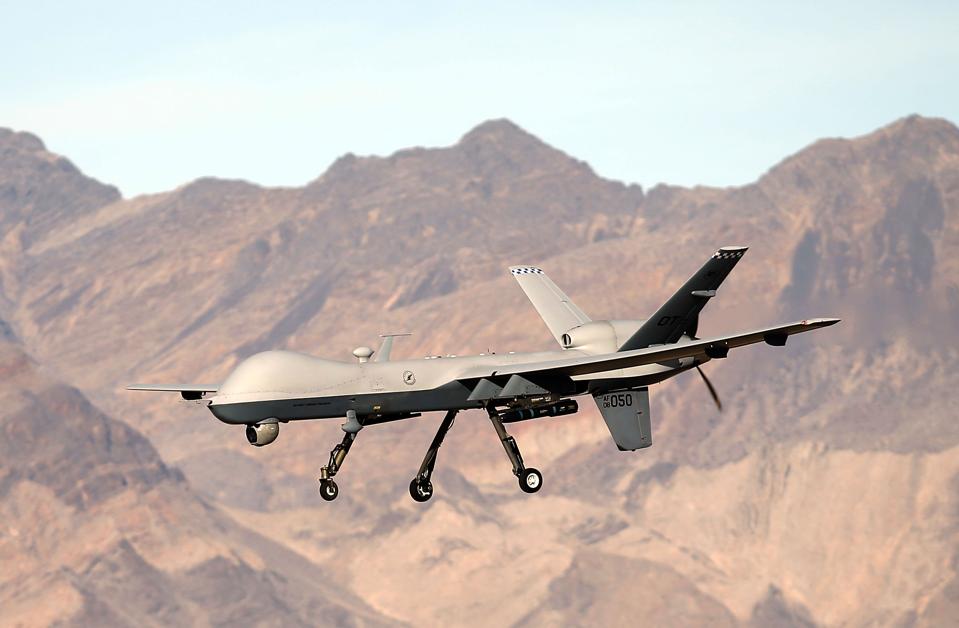
However, this week’s strike was reportedly executed by an MQ-9 Reaper drone, which (in the U.S. military) is only operated by the U.S. Air Force—not a participant in the JAGM program.

However, the defense budget documents show that the Air Force requested 60 JAGMs from the Army specifically to arm its MQ-9 Reaper drones.

An article by retired Air Force General James Poss also states the service has plans to deploy JAGM on the Reaper, as its fire-and-forget capability is seen as ideal for engaging the Iranian Revolutionary Guard Corp Navy’s unconventional swarming motor boat tacticsOther sources have indicated integration with MQ-9 is planned for.

Admittedly, there remains no confirmation in open sources such integration has been carried out. However, it’s possible the JAGM’s similarity to the Hellfire allowed integration to be expedited without much fanfare.

An annual report by the Pentagon’s Department Of Testing and Evaluation notes that it performed flight tests satisfactorily, and that the weapon “maintains the lethality of the legacy [AGM-114R] HELLFIRE Romeo against target-representative light and heavy armored ground combat vehicles, trucks, and boats. The Army is working on adjusting the fuse delay timing to improve JAGM lethality against bunkers, adobe walls, and personnel in the open to either meet or exceed legacy lethality against these targets.”

Earlier identified vulnerabilities to hacking had apparently been addressed, though at the time of the report’s writing, cockpit instrumentation for interfacing with JAGM was deemed excessively slow and not yet suitable for operational use.

Ultimately, the fragments photographed in Iraq don’t by themselves confirm whether a JAGM missile was used or some other 52-kilo class armament.

Regardless, it seems clear given the large scale of JAGM production underway that this costlier and more capable munition will soon begin increasing the effectiveness of U.S. military drones and helicopters, while reducing their vulnerability to enemy fire.

However, the ability to kill a person more efficiently is by no means the same as the ability to judge whether doing so is a wise decision—by far the larger question haunting many observers of the rising tensions in the Middle East.


Ex-chief of Iran’s Revolutionary Guards says Haifa, Tel Aviv are targets 

January 6, 2020

Source: Ex-chief of Iran’s Revolutionary Guards says Haifa, Tel Aviv are targets | The Times of Israel

As tensions continue to skyrocket, top politician Mohsen Rezaei alleges Israel leaked information on Soleimani’s whereabouts to US forces

Iranian former chief of the Revolutionary Guards Mohsen Rezai takes part in a demonstration against American ‘crimes’ in the capital Tehran, January 3, 2020. (Atta Kenare/AFP)

A former leader of Iran’s Revolutionary Guards said Sunday that the cities of Tel Aviv and Haifa could be targeted to avenge the general killed by a US drone strike in Baghdad.

Mohsen Rezaei made the threat in Tehran at a ceremony in honor of slain commander Qassem Soleimani and on Twitter.

“Iran’s revenge against America for the assassination of Soleimani will be severe… Haifa and Israeli military centers will be included in the retaliation,” he said, according to a translation by Reuters.

Rezaei, the secretary of Iran’s powerful Expediency Council, is considered a top politician and an adviser to Supreme Leader Ayatollah Ali Khamenei.

He previously alleged Israel somehow leaked information about Soleimani’s whereabouts to US forces, who killed him Friday in a drone strike.

محسن رضایی@ir_rezaee

اگر بعد از پاسخ نظامی ما دست به اقدامی بزند تلاویو و حیفا را با خاک یکسان خواهیم کرد.

On Friday Rezaei vowed vengeance against the US.

“Martyr Lieutenant General Qassem Suleimani joined his martyred brothers, but we will take vigorous revenge on America,” he wrote on Twitter.

His threats followed a Sunday statement by senior Iranian military adviser Hossein Dehghan, who said that his country would respond to the killing of Soleimani with force and target army installations.

Dehghan, the military adviser to Supreme Leader Ayatollah Khamenei, told CNN that Iran was not seeking war with the United States.

“The response for sure will be military and against military sites,” Dehghan said, even as he insisted Tehran is not looking to open a broad conflict.

“Let me tell you one thing: Our leadership has officially announced that we have never been seeking war and we will not be seeking war,” he said.

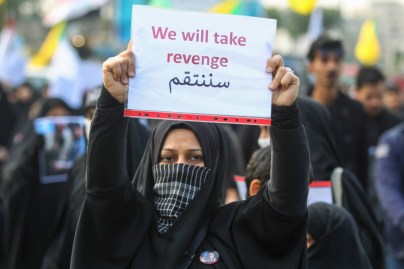
An Iraqi woman holds a placard during the funeral of Iranian military commander Qasem Soleimani, Iraqi paramilitary chief Abu Mahdi al-Muhandis and eight others in Baghdad’s district of al-Jadriya on January 4, 2020. (AHMAD AL-RUBAYE / AFP)

“It was America that has started the war,” he continued. “Therefore, they should accept appropriate reactions to their actions. The only thing that can end this period of war is for the Americans to receive a blow that is equal to the blow they have inflicted. Afterward they should not seek a new cycle.”

US President Donald Trump tweeted Saturday that the US has already “targeted 52 Iranian” sites it is ready to hit immediately if Iran attacks Americans, and noted that some are of cultural importance to the Iranians.

Dehghan told CNN that if the US hits cultural sites, it would be considered a declaration of war and the Iranian response would be harsh.

As the rhetoric between the countries escalated Sunday, US Secretary of State Mike Pompeo warned Iran against attacking US assets in the Middle East.

“We think there is a real likelihood Iran will make a mistake and make a decision to go after some of our forces, military forces in Iraq or soldiers in northeast Syria,” Pompeo said in an interview with Fox news.

The US has about 60,000 troops in the region, including around 5,200 in Iraq. Washington ordered thousands more soldiers to the Middle East on Friday after Soleimani’s killing.

“We’re preparing for all kinds of various responses,” including cyber attacks, Pompeo said.

Iran’s Information and Telecommunications Minister Mohammad Javad Azari-Jahromi called Trump “a terrorist in a suit.”

Protesters demonstrate over the US airstrike in Iraq that killed Iranian Revolutionary Guard Gen. Qassem Soleimani in Tehran, Iran, January 4, 2020. (Ebrahim Noroozi/AP)

“Like ISIS, Like Hitler, Like Genghis! They all hate cultures,” he tweeted, according to a report from Reuters. “Trump is a terrorist in a suit. He will learn history very soon that NOBODY can defeat ‘the Great Iranian Nation & Culture.’”

The US, meanwhile, warned American citizens in Saudi Arabia “of the heightened risk of missile and drone attacks.” A security alert message sent Sunday by the US mission there said that in the past “regional actors hostile to Saudi Arabia have conducted missile and drone attacks against both civilian and military targets inside the kingdom.”

It warned that US citizens living and working near military bases, oil and gas facilities and other critical civilian infrastructure are at heightened risk of attack, particularly in the Eastern Province where the oil giant Aramco is headquartered and areas near the border with Yemen.

Josep Borrell, EU foreign policy chief, spoke with the Iranian foreign minister by phone and asked him to deescalate the situation.