Archive for June 2019

Bolton lands in Israel ahead of unprecedented security summit 

June 23, 2019

Source: Bolton lands in Israel ahead of unprecedented security summit | The Times of Israel

US national security adviser to meet with Netanyahu, discuss Iran with Russian and Israeli counterparts

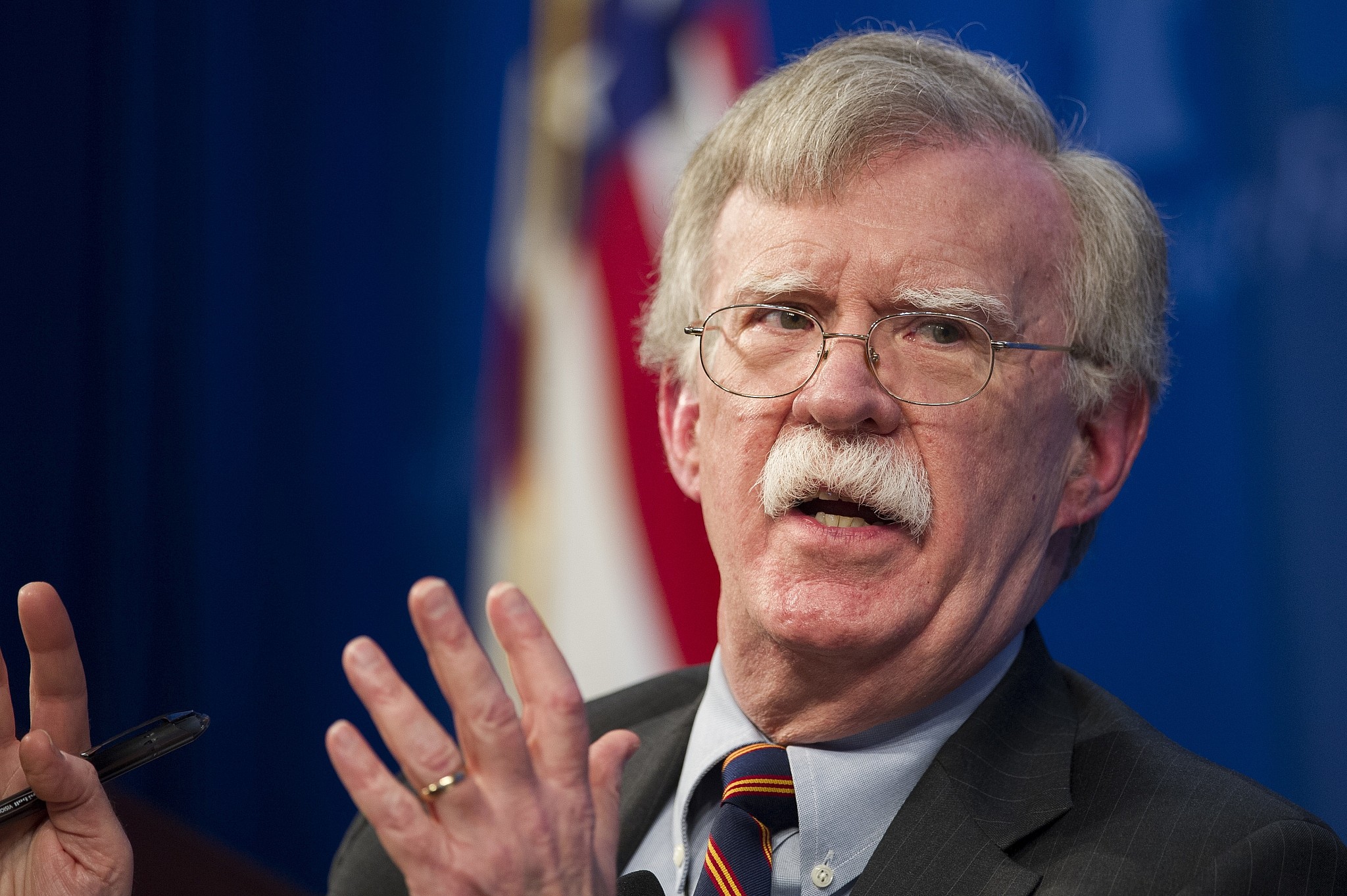
US National Security Adviser John Bolton unveils the Trump administration's Africa Strategy at the Heritage Foundation in Washington, December 13, 2018. (Cliff Owen/AP)

US National Security Adviser John Bolton unveils the Trump administration’s Africa Strategy at the Heritage Foundation in Washington, December 13, 2018. (Cliff Owen/AP)

US National Security Adviser John Bolton landed in Israel on Saturday ahead of an unprecedented trilateral meeting in Jerusalem of top security officials from the United States, Israel and Russia.

Bolton will discuss regional issues with his counterparts, Meir Ben-Shabbat and Nikolai Patrushev. Iran’s efforts to entrench itself militarily in Syria and the escalating tensions between Tehran and Washington are expected to top the agenda.

Moscow has said it will look out for Iran’s interests at the meeting.

“Iran is in Syria at the invitation of the legitimate government and is actively involved in fighting terrorism. Therefore, of course, we will have to take into account the interests of Iran,” Patrushev said.

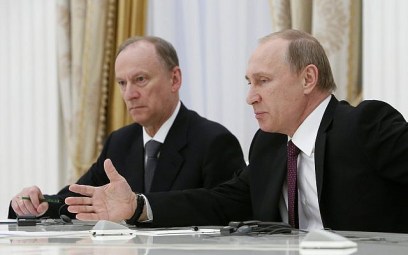
Russian President Vladimir Putin, right, flanked by Security Council Secretary Nikolai Patrushev, meets with the BRICS countries’ senior officials in charge of security matters, at the Kremlin in Moscow, Russia, on May 26, 2015. (Sergei Karpukhin/Pool Photo via AP)

Bolton landed Saturday afternoon and is expected to meet with Prime Minister Benjamin Netanyahu on Sunday morning, the Ynet news site reported.

On Tuesday, Netanyahu hailed the “historic and unprecedented” summit as an important step toward guaranteeing “stability in the Middle East during turbulent times.”

“What is important about this trilateral meeting of the two superpowers in the State of Israel is that it greatly attests to the current international standing of Israel among the nations,” he added.

Earlier this month, a senior US official said Washington would use the meeting to tell Moscow that Iran should withdraw from Syria, and ask for Russia’s suggestions on how to counter Tehran’s influence in the region. The unnamed official said that the US supported Israel’s actions against Iranian entrenchment in Syria.

“We would hope to make the point in conjunction with the Israelis that we don’t see any positive role for the Iranians — and that would extend beyond Syria, to Lebanon, to Iraq, to Yemen — other places where they’re active,” the official said, according to a Reuters report.

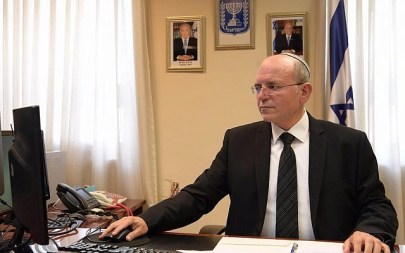
National Security Adviser Meir Ben-Shabbat. (Amos Ben Gerschom/GPO)

He added that Washington was sure that the summit, with Israel hosting both Russia and the US in Jerusalem, would irk Iranian leadership, and said that the fact that Russia was participating was a positive sign.

“The fact that the Russians see value in these conversations, that they’re willing to do it publicly, I think is in and of itself quite significant,” the official said.

According to a report by the Kan public broadcaster, Israel and the US will offer Russia incentives for an effort to curb Iranian influence in Syria, which could include legitimizing the continued leadership of Syrian President Bashar Assad. It was unclear what Washington and Jerusalem would offer Moscow in return.

Moscow is a close ally of Tehran and Damascus, while Jerusalem and Washington are the Islamic Republic’s archenemies.


Iranian hackers step up cyber efforts, impersonate email from president’s office

June 23, 2019

Source: Iranian hackers step up cyber efforts, impersonate email from president’s office | The Times of Israel

Cybersecurity firms see surge in attempts to gain access to American government agencies, oil and gas sectors

Illustrative: Stuart Davis, a director at one of FireEye's subsidiaries speaks to journalists about the techniques of Iranian hacking, Wednesday, Sept. 20, 2017, in Dubai, United Arab Emirates. (AP Photo/Kamran Jebreili)

Illustrative: Stuart Davis, a director at one of FireEye’s subsidiaries speaks to journalists about the techniques of Iranian hacking, Wednesday, Sept. 20, 2017, in Dubai, United Arab Emirates. (AP Photo/Kamran Jebreili)

WASHINGTON (AP) — Iran has increased its offensive cyberattacks against the US government and critical infrastructure as tensions have grown between the two nations, cybersecurity firms say.

In recent weeks, hackers believed to be working for the Iranian government have targeted US government agencies, as well as sectors of the economy, including oil and gas, sending waves of spear-phishing emails, according to representatives of cybersecurity companies CrowdStrike and FireEye, which regularly track such activity.

It was not known if any of the hackers managed to gain access to the targeted networks with the emails, which typically mimic legitimate emails but contain malicious software.

The cyber offensive is the latest chapter in the US and Iran’s ongoing cyber operations targeting the other, with this recent sharp increase in attacks occurring after the Trump administration imposed sanctions on the Iranian petrochemical sector this month.

Tensions have escalated since the US withdrew from the 2015 nuclear deal with Iran last year and began a policy of “maximum pressure.” Iran has since been hit by multiple rounds of sanctions. Tensions spiked this past week after Iran shot down an unmanned US drone — an incident that nearly led to a US military strike against Iran on Thursday evening.

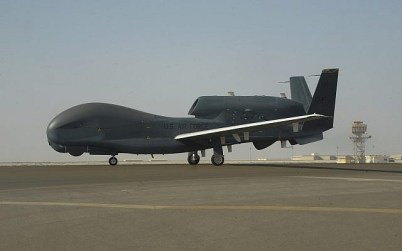
In this February 13, 2018, photo released by the US Air Force, an RQ-4 Global Hawk is seen on the tarmac of Al-Dhafra Air Base near Abu Dhabi, United Arab Emirates. (Airman 1st Class D. Blake Browning/US Air Force via AP)

“Both sides are desperate to know what the other side is thinking,” said John Hultquist, director of intelligence analysis at FireEye. “You can absolutely expect the regime to be leveraging every tool they have available to reduce the uncertainty about what’s going to happen next, about what the US’s next move will be.”

CrowdStrike shared images of the spear-phishing emails with The AP.

One such email that was confirmed by FireEye appeared to come from the Executive Office of the President and seemed to be trying to recruit people for an economic adviser position. Another email was more generic and appeared to include details on updating Microsoft Outlook’s global address book.

The Iranian actor involved in the cyberattack, dubbed “Refined Kitten” by CrowdStrike, has for years targeted the US energy and defense sectors, as well as allies such as Saudi Arabia and the United Arab Emirates, said Adam Meyers, vice president of intelligence at CrowdStrike.

The National Security Agency would not address discuss Iranian cyber actions specifically but said in a statement to The Associated Press on Friday that “there have been serious issues with malicious Iranian cyber actions in the past.”

“In these times of heightened tensions, it is appropriate for everyone to be alert to signs of Iranian aggression in cyberspace and ensure appropriate defenses are in place,” the NSA said.

Iran has long targeted the US oil and gas sectors and other critical infrastructure, but those efforts dropped significantly after the nuclear agreement was signed. After President Donald Trump withdrew the US from the deal in May 2018, cyber experts said they have seen an increase in Iranian hacking efforts.

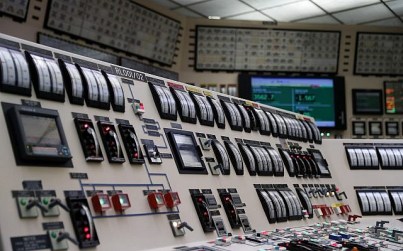
Illustrative: A control room simulator used for training is seen at the Callaway Energy Center, Missouri’s only nuclear power plant, Thursday, Oct. 19, 2017, in Reform, Mo. (AP Photo/Jeff Roberson)

“This is not a remote war (anymore),” said Sergio Caltagirone, vice president of threat intelligence at Dragos, Inc. “This is one where Iranians could quote unquote bring the war home to the United States.”

Caltagirone said as nations increase their abilities to engage offensively in cyberspace, the ability of the United States to pick a fight internationally and have that fight stay out of the United States physically is increasingly reduced.

The US has had a contentious cyber history with Iran.

In 2010, the so-called Stuxnet virus disrupted the operation of thousands of centrifuges at a uranium enrichment facility in Iran. Iran accused the US and Israel of trying to undermine its nuclear program through covert operations.

Iran has also shown a willingness to conduct destructive campaigns. Iranian hackers in 2012 launched an attack against state-owned oil company Saudi Aramco, releasing a virus that erased data on 30,000 computers and left an image of a burning American flag on screens.

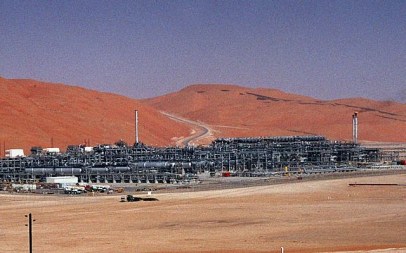
Illustrative photo from 2004 of an industrial plant that strips natural gas from freshly pumped crude oil at Saudi Aramco’s Shaybah oil field at Shaybah in Saudi Arabia’s Rub al-Khali desert. (AP Photo/Bruce Stanley, File)

In 2016, the US indicted Iranian hackers for a series of punishing cyberattacks on US banks and a small dam outside of New York City.

US Cyber Command refused to comment on the latest Iranian activity. “As a matter of policy and for operational security, we do not discuss cyberspace operations, intelligence or planning,” Pentagon spokeswoman Heather Babb said in a statement. The White House did not respond to a request for comment.

Despite the apparent cyber campaign, experts say the Iranians would not necessarily immediately exploit any access they gain into computer systems and may seek to maintain future capabilities should their relationship with the US further deteriorate.

“It’s important to remember that cyber is not some magic offensive nuke you can fly over and drop one day,” said Oren Falkowitz, a former National Security Agency analyst. It takes years of planning, he said, but as tensions increase, “cyber impact is going to be one of the tools they use and one of the hardest things to defend against.”


Revolutionary Guard officials celebrate Iran’s downing of US drone 

June 23, 2019

Source: Revolutionary Guard officials celebrate Iran’s downing of US drone | The Times of Israel

Sources tell New York Times elite military unit was surprised by success of operation and had only attempted it to see if it was possible

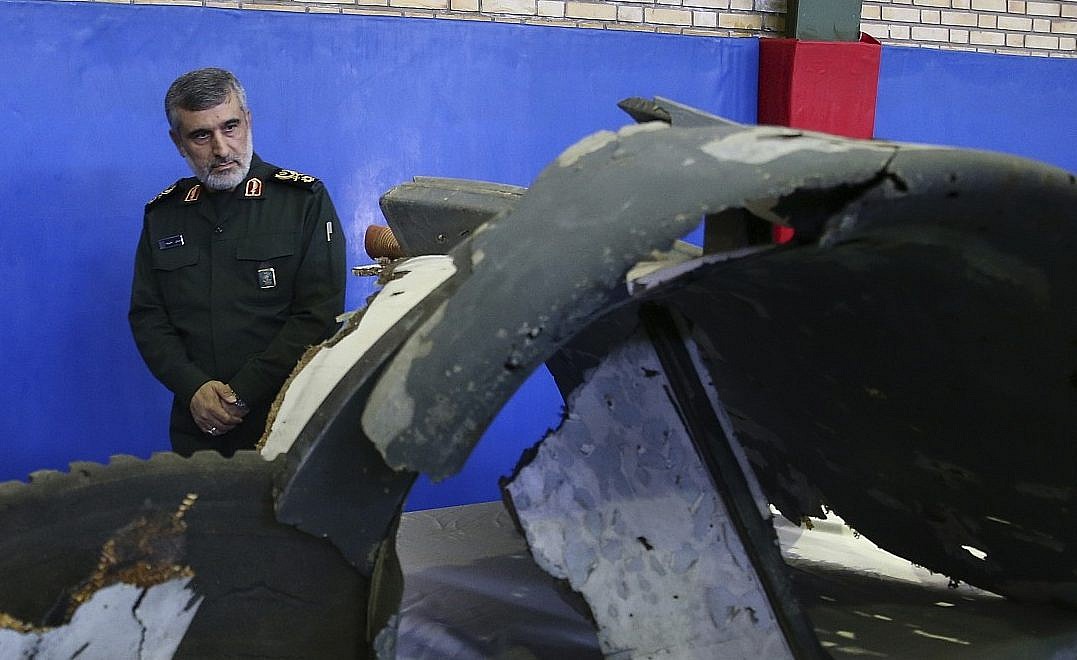
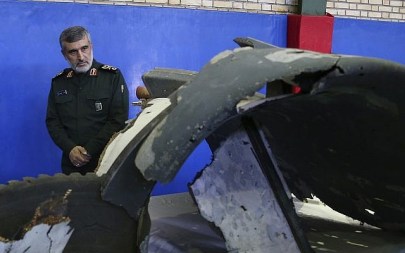
Head of the Revolutionary Guard’s aerospace division Brig. Gen. Amir Ali Hajizadeh looks at debris from what the division describes as the US drone which was shot down on Thursday, in Tehran, Iran, Friday, June 21, 2019 (Meghdad Madadi/Tasnim News Agency/via AP)

Around 30 officials from Iran’s Islamic Revolutionary Guard Corps and their guests gathered Thursday night in a villa in Tehran to celebrate the downing of a US drone.

“A special blessing for the commander who ordered the attack on the American drone and for the fighters who carried it out,” said a preacher, according to a guest who spoke with The New York Times.

According to the report, Revolutionary Guard officials were somewhat surprised they had succeeded in shooting the drone out of the sky and had in fact only attempted the operation to see if it was possible, according to that guest, and four others, including two senior current members of the Guard, and two former members.

According to the sources, the elite military unit, which answers only to Supreme Leader Ayatollah Ali Khamenei, had been maddened by recent statements from the Trump administration calling into question the abilities of the IRGC.

The officials felt further joy when they heard that US President Donald Trump had called off retaliatory strikes 10 minutes before they were to be carried out after being told some 150 people could die.

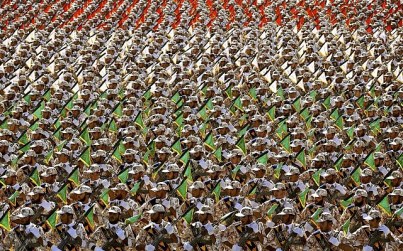
Members of Iran’s Revolutionary Guard march during an annual military parade at the mausoleum of Ayatollah Khomeini, outside Tehran, Iran, on September 22, 2014. (AP Photo/Ebrahim Noroozi)

The aborted attack was the closest the US has come to a direct military strike on Iran in the year since the administration pulled out of the 2015 international agreement intended to curb the Iranian nuclear program and launched a campaign of increasing economic pressure against the Islamic Republic.

“What happened in the past 48 hours was extremely important in showing Iran’s strength and forcing the US to recalculate,” political analyst and former member of the Guards’ political bureau Naser Imani told the Times. “No matter how you look at it, Iran won.”

A top commander in the Guard Corps said Friday Iran could have downed an aircraft carrying American personnel on Thursday, but chose not to do so.

The United States reportedly launched cyber attacks against Iranian missile control systems and a spy network in response to the downing of the drone. The attack crippled computers used to control rocket and missile launches, according to the Washington Post, which cited people familiar with the matter.

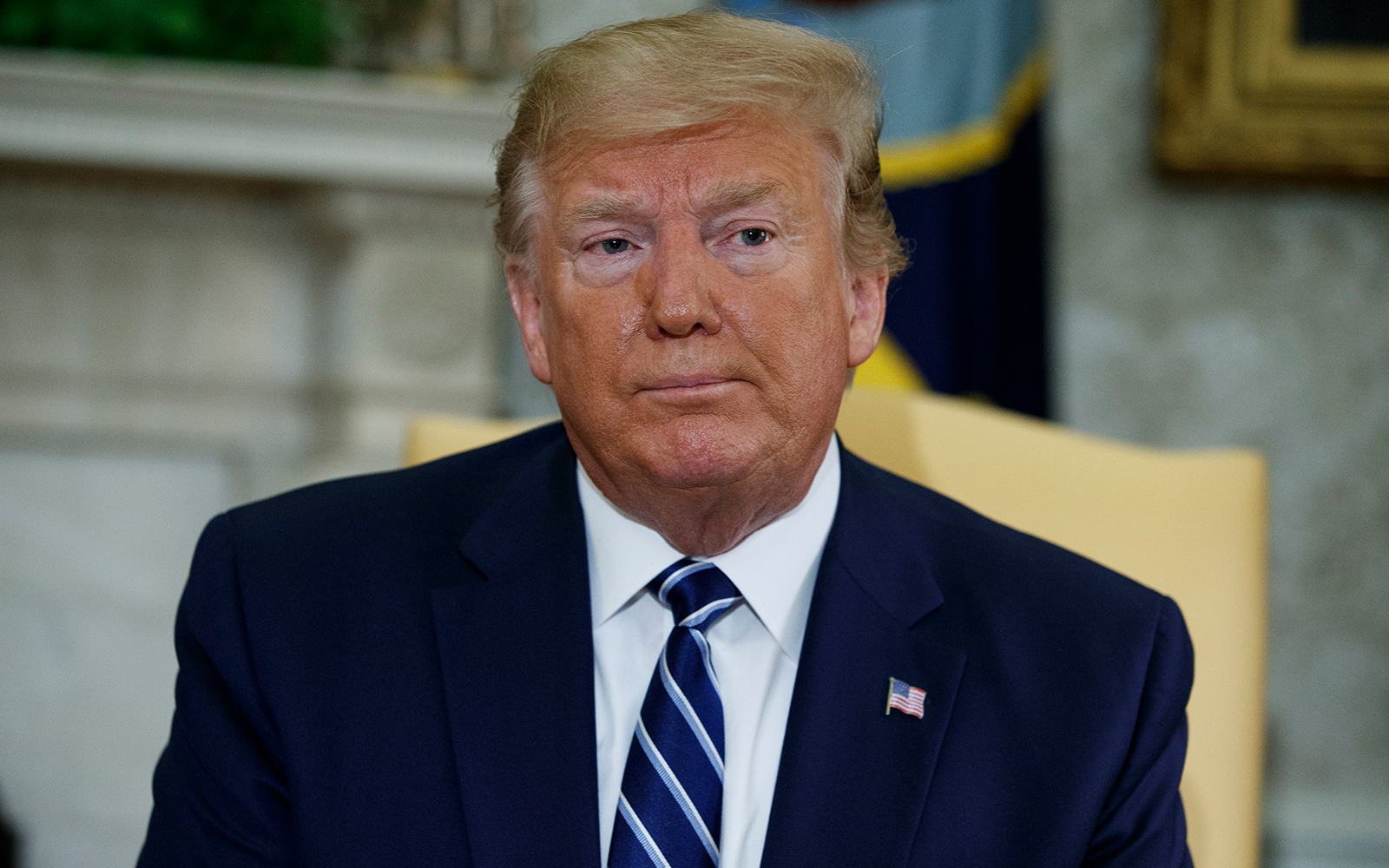
US President Donald Trump listens to a question during a meeting with Canadian Prime Minister Justin Trudeau in the Oval Office of the White House, June 20, 2019. (AP Photo/Evan Vucci)

The downing of the drone — which Washington insists was over international waters but Tehran says was within its airspace — has seen tensions between the two countries spike further after a series of attacks on tankers the US and its staunch ally, Saudi Arabia, as well as reportedly Israel, have blamed on Iran.

Tehran denies having been behind those attacks but has frequently threatened in the past to block the vital sea lanes into and out of the Gulf.

A top Iranian military official on Saturday pledged to “set fire to the interests of America and its allies” if the US attacks.

Tensions between Tehran and Washington have grown sharply since May last year when Trump unilaterally abandoned a landmark 2015 nuclear deal between major powers and Iran, and reimposed sweeping sanctions. The international agreement intended to limit Iran’s nuclear program in exchange for relief from earlier sanctions.

The US has since bolstered its military presence in the Middle East and blacklisted Iran’s Revolutionary Guards as a terrorist organization.


A half-hour away: How Trump opted against Iran strike 

June 23, 2019

Source: A half-hour away: How Trump opted against Iran strike | The Times of Israel

Decision-making process of US president revealed in account based on information from over a dozen legislators, congressional aides, administration officials

US President Donald Trump listens to a question during a meeting with Canadian Prime Minister Justin Trudeau in the Oval Office of the White House, June 20, 2019. (AP Photo/Evan Vucci)

US President Donald Trump listens to a question during a meeting with Canadian Prime Minister Justin Trudeau in the Oval Office of the White House, June 20, 2019. (AP Photo/Evan Vucci)

WASHINGTON (AP) — The planes were ready — their deadly cargo poised for delivery within a half-hour.

US President Donald Trump had been given a series of options Thursday night on how to respond to Iran’s downing of an unmanned American surveillance drone. Senior military advisers zeroed in on a plan to launch strikes on a trio of sites within Iran, and it was up to Trump to give the final go-ahead.

If the planes took off, Trump later recounted to NBC, they would soon be at “a point where you wouldn’t turn back or couldn’t turn back.”

Trump’s decision point came at the culmination of a tense 24 hours inside the West Wing after the drone went down.

How would he make his decision? “My gut,” he told legislators.
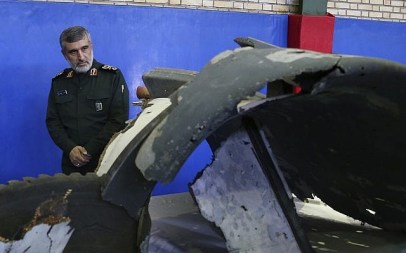
Head of Iranian Revolutionary Guard’s aerospace division Brig. Gen. Amir Ali Hajizadeh looks at debris from what the division says iss the US drone which was shot down on Thursday, in Tehran, Iran, June 21, 2019 (Meghdad Madadi/Tasnim News Agency/via AP)

When the military officers came looking for the president’s final go-ahead, Trump said he had one last question.

“‘I want to know something before you go,’” Trump recounted. “‘How many people will be killed?’”

This account is based on information from more than a dozen legislators, congressional aides, administration officials and others, some of whom spoke on condition of anonymity to discuss internal deliberations.

Hours earlier, a model of a proposed new Air Force One was perched on the coffee table in the Oval Office. Its Trump-designed red, white and blue color scheme glistened under the Oval Office lights.
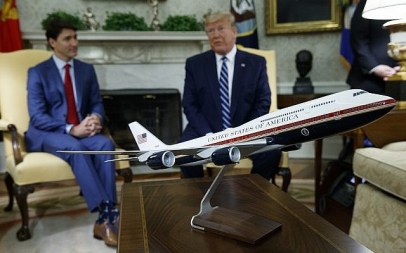
In this June 20, 2019, photo, a model of the new Air Force One design sits on a table during a meeting between President Donald Trump and Canadian Prime Minister Justin Trudeau in the Oval Office of the White House in Washington. (AP Photo/Evan Vucci)

Seated behind the plane were Trump and Canadian Prime Minister Justin Trudeau, whose visit to Washington on Thursday to discuss trade and tariffs was suddenly upstaged by the rising tensions in the Middle East. With reporters peppering Trump with a torrent of questions about how he would respond to Tehran, the president took a moment to extoll the virtues of the new presidential plane. “It’s going to be terrific,” he declared.

But what to do about Iran?

“You’ll find out. You’ll find out,” Trump said. “They made a very big mistake.”

The president, who had just come from a briefing on the incident, seemed to telegraph what he had learned, declaring, “I find it hard to believe it was intentional, if you want to know the truth.”

“I think that it could have been somebody who was loose and stupid that did it,” he said.

Over a year earlier, Trump had defied most of the United States’ allies by pulling out of the Iran nuclear deal and strengthening sanctions on the regime, choking the Iranian economy and pushing Tehran to escalate tensions. Trudeau, who largely looked on in silence while Trump fielded questions, used his brief remarks to highlight the need for close coordination among nations.

“We look forward to discussing with our closest ally — their perspectives on this — and how we can move forward as an international community,” the Canadian prime minister said.
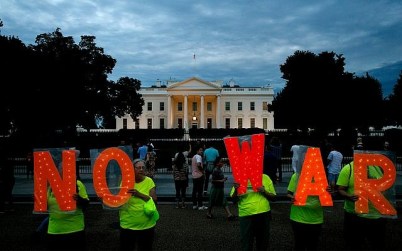
Protesters outside the White House after US President Donald Trump tweeted that “Iran made a very big mistake” by shooting down a US drone over the Strait of Hormuz, June 20, 2019. (AP Photo/Jacquelyn Martin)

Trump, for his part, made no mention of alliances.

Trudeau’s meeting later that afternoon with Senate Majority Leader Mitch McConnell was abruptly cancelled when McConnell was summoned to the White House for a briefing on Iran.

But there was a glaring omission on the invitation list for briefing top congressional leaders and national security committee chairmen.

The heads of the House and Senate foreign relations committees were quickly added once the White House was reminded the panels have jurisdiction over the War Powers Act, according to a congressional aide familiar with the situation.

Once assembled, the lawmakers around the table made their case, one by one. Trump seemed eager to hear their opinions, even those of House Democrats who have launched a slew of investigations into the president.
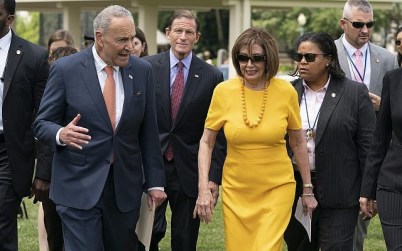
Senate Minority Leader Chuck Schumer, (D-NY, left), and Speaker of the House Nancy Pelosi (D-Calif.) joined at center rear by Sen. Richard Blumenthal (D-Conn.) at the Capitol in Washington, DC, June 20, 2019. (AP/J. Scott Applewhite)

“These conflicts have a way of escalating,” Senate Minority Leader Chuck Schumer told the president. Even if Trump didn’t intend to go to war, Schumer said, he could “bumble” into one.

The legislators saw “a commander in chief who struggled with the issue,” said Republican Sen. Jim Risch of Idaho, the chairman of the Foreign Relations Committee. “It was painful for him.”

Democrats made the case for caution, for partnering with allies, for taking a breath to deescalate, as House Speaker Nancy Pelosi would put it later. Intelligence Committee Chairman Rep. Adam Schiff told the administration it could not continue to rely on the war authorizations approved by Congress after the Sept. 11, 2001 terror attacks.

White House reporters and photographers trained their eyes on a West Wing side door where the legislators would emerge, looking for any clues to what had transpired. When the legislators did turn up, there was a perplexing image: Schumer pumped his arms skyward in a celebratory “raise the roof” gesture while Pelosi cheerfully clapped.

Had the Democrats talked the president out of war? Had some sort of deal been struck?
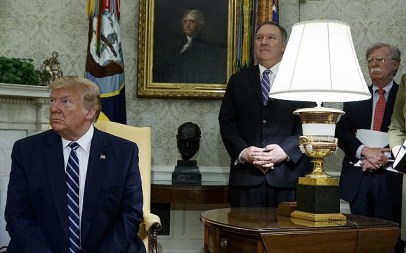
US Secretary of State Mike Pompeo (C) and National security adviser John Bolton (R) look on as President Donald Trump meets with Canadian Prime Minister Justin Trudeau in the Oval Office of the White House, June 20, 2019. (AP Photo/Evan Vucci)

Neither. It turned out Schumer had just relayed the happy news that his elderly mother had been released from the hospital.

“We left with the idea the president was going to consider some options,” Pelosi said.

Televisions across the White House were tuned, as usual, to Fox News. Tucker Carlson’s image flickered on the screen as he made his case earlier in the week against going to war with Iran.

Carlson was making a similar case to Trump in private, according to a White House official and a Republican close to the West Wing.

Trump had been soliciting a wide array of opinions about Iran after a pair of tankers were damaged a week earlier near the Strait of Hormuz, an incident US officials blamed on the Iranians. The president was growing frustrated with his national security adviser John Bolton’s advocacy for a strike, the officials said.
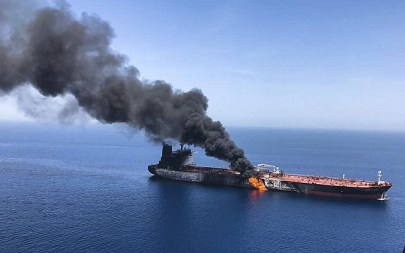
An oil tanker on fire in the Gulf of Oman, June 13, 2019 near the strategic Strait of Hormuz where two ships were reportedly attacked. (AP Photo/ISNA)

The attack on the drone put the military option on the table.

But when Trump asked his question Thursday about how many Iranians could die in the strikes, the answer gave him pause. He was told 150 Iranian lives were at stake.

“I thought about it for a second,” Trump told NBC, “and I said: ‘You know what? They shot down an unmanned drone, plane, whatever you want to call it. And here we are sitting with 150 dead people that would have taken place probably within a half an hour after I said go ahead.’ And I didn’t like it. I didn’t think, I didn’t think it was proportionate.”

The president, long opposed to being drawn into a military conflict in the Middle East and in particular with an unpredictable foe like Iran, played up the drama of the moment. He tweeted Friday morning that the military had been “cocked and loaded” and that the weaponry was only 10 minutes away from being deployed.

As the day went on, a sense of normalcy returned to the White House.

US President Donald Trump and first lady Melania Trump greet attendees of the annual Congressional Picnic on the South Lawn of the White House, June 21, 2019. (AP Photo/Jacquelyn Martin)

On Friday afternoon, lawmakers filtered into the White House south lawn for the annual congressional picnic — just steps away from the windowless, basement Situation Room where security officials had debated what could come next.

Risch’s prediction: “There’s going to be something more proportional, obviously, and I suspect it’s going to be not kinetic action.”
 

US reportedly launched cyber attack on Iran after drone downing 

June 23, 2019

Source: US reportedly launched cyber attack on Iran after drone downing | The Times of Israel

Long-planned operation targeted missile systems and spy network tracking ships in Strait of Hormuz, according to Washington Post

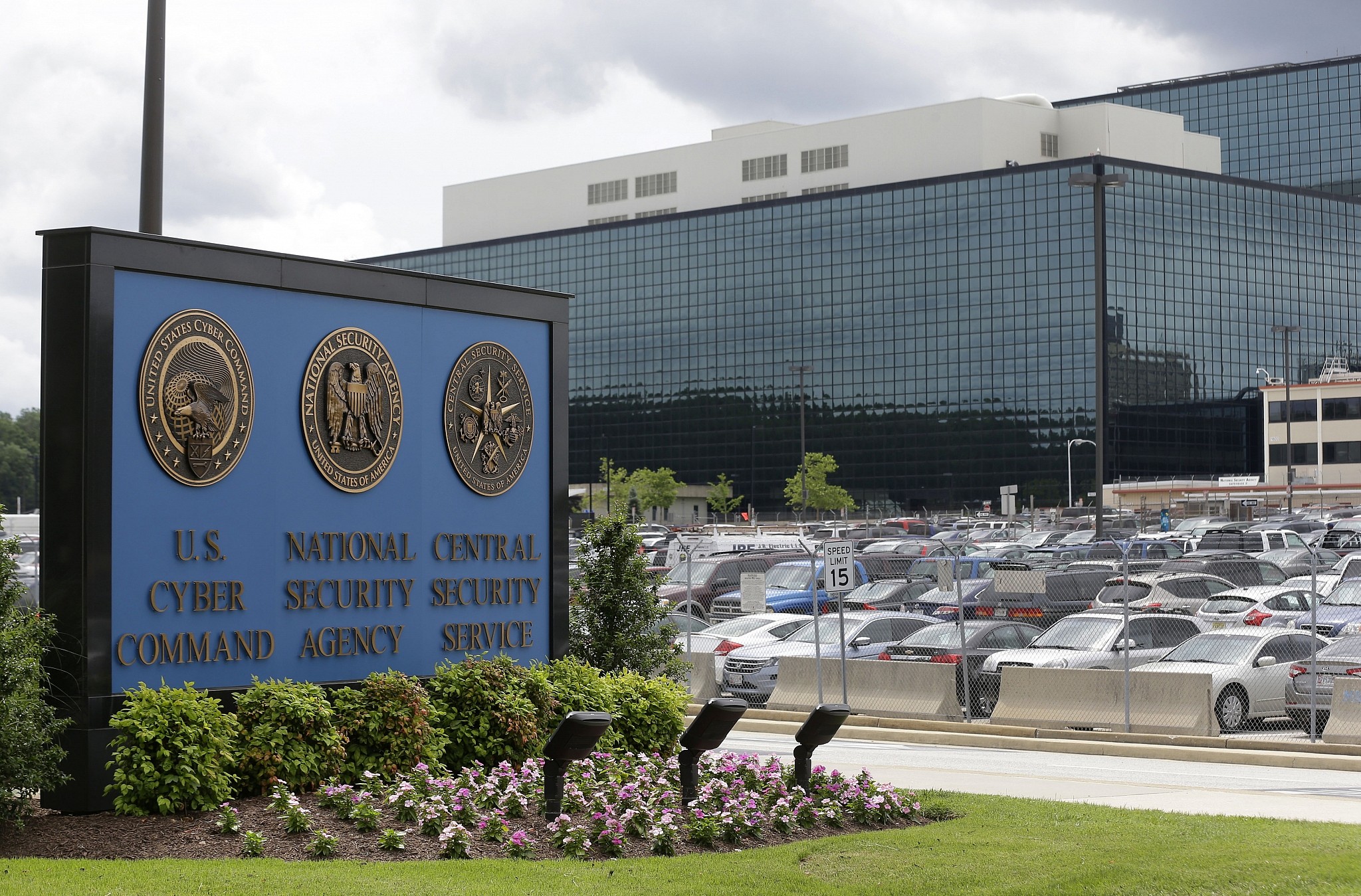
This June 6, 2013 file photo shows the National Security Administration (NSA) campus in Fort Meade, Md at a time when the American Civil Liberties Union, Wikimedia and other groups were suing the National Security Agency over its surveillance practices. (AP Photo/Patrick Semansky, File)

WASHINGTON — The United States launched cyber attacks against Iranian missile control systems and a spy network this week after Tehran downed an American surveillance drone, US media reported on Saturday.

US President Donald Trump ordered a retaliatory military strike against Iran after the drone shootdown but then called it off, saying the response wouldn’t be “proportionate” and instead pledged new sanctions on the country.

But after the drone’s downing, Trump secretly authorized US Cyber Command to carry out a retaliatory cyber attack on Iran, The Washington Post reported.

The attack crippled computers used to control rocket and missile launches, according to the Post, which cited people familiar with the matter.

Yahoo cited two former intelligence officials as saying the US targeted a spying group responsible for tracking ships in the strategic Strait of Hormuz, where Washington has blamed Iran for two recent mine attacks on oil tankers.

The Post said the strikes, which caused no casualties, had been planned for weeks and were first proposed as a response to the tanker attacks.

Head of the Revolutionary Guard’s aerospace division Brig. Gen. Amir Ali Hajizadeh looks at debris from what the division describes as the US drone which was shot down on Thursday, in Tehran, Iran, Friday, June 21, 2019 (Meghdad Madadi/Tasnim News Agency/via AP)

US defense officials refused to confirm the reports.

“As a matter of policy and for operational security, we do not discuss cyberspace operations, intelligence or planning,” Defense Department spokeswoman Heather Babb told AFP.

Tensions are high between the US and Iran once again following Trump’s move more than one year ago to leave a multinational accord curbing Iran’s nuclear ambition.

His administration has instead imposed a robust slate of punitive economic sanctions designed to choke off Iranian oil sales and cripple its economy.

President Donald Trump speaks to reporters on the South Lawn of the White House in Washington, Saturday, June 22, 2019, before boarding Marine One for the trip to Camp David in Maryland. (AP Photo/Susan Walsh)

On Saturday, Trump said the US would put “major” new sanctions on Iran next week.

Tehran said it shot down the US drone on Thursday after it violated Iranian airspace. Washington maintains the plane was over international waters.

Meanwhile, Iran has denied responsibility for the tanker attacks, and a top military official on Saturday pledged to “set fire to the interests of America and its allies” if the US attacks.

These cyber attacks aren’t the first time the US and Iran have dueled online.

Iranian technicians work at the Bushehr nuclear power plant in 2010 (photo credit: AP/IIPA, Ebrahim Norouzi)

Iranian technicians work at the Bushehr nuclear power plant in 2010 (photo credit: AP/IIPA, Ebrahim Norouzi)

The Stuxnet virus, discovered in 2010, is believed to have been engineered by Israel and the US to damage nuclear facilities in Iran.

And Tehran is believed to have stepped up its own cyber capabilities in the face of US efforts to isolate the Islamic Republic.


A new US-Iran hot line: More a channel for miscommunication than dialogue – DEBKAfile

June 23, 2019

Source: A new US-Iran hot line: More a channel for miscommunication than dialogue – DEBKAfile

President Donald Trump gave Tehran prior notice ahead of the US attack on Iranian missile sites that was aborted on Thursday, June 20, saying that it was “imminent,” and adding that he is against war and wants to talk. Iranian officials replied that it was up to supreme leader Ayatollah Ali Khamenei to decide on this issue although he is against any talks. The exchange stopped there.

DEBKAfile’s military and intelligence sources report exclusively that some of the messages the US and Iran exchanged shortly before and after the Iranian surface-to-air missile shot down a Navy missile over the Strait of Hormuz on Thursday did not go through any third party. They were channeled directly through a new hot line established in the last fortnight to create a direct link between the US Fifth Fleet in Manama, Bahrain and the Bushehr-based Revolutionary Guards Navy HQ.

The latest exchange ran into the main stumbling block in this communications process: there is no knowing for sure which messages actually reach the all-powerful supreme leader. Washington channeled a second set through Qatar – not Oman as both US and Iranian officials told reporters.

Hot lines especially in the Middle East are designed for emergency contacts between opposing powers to avert unintentional war conflagrations. They are maintained inter alia by the US and Russia, the US and Israel and Russia and Israel. This mechanism works only when it suits both parties. When one of the sides is intent on concealing its actions from the other, the link goes silent.

This breakdown of communications through the new hot line was behind the complaint heard from Gen. Amir Hajizadeh, chief of Iran’s Revolutionary Guards Aerospace Command: “Iran warned the [US] drone four times, and the drone would have transmitted the warnings to its central stations. Unfortunately, when they failed to reply, and the aircraft made no change to its trajectory… we were obliged to shoot it down.”

The US insists the drone was shot down in an “unprovoked attack” in international airspace over the Strait of Hormuz.
“Their failure to reply” is the outstanding feature of the new hot line. According to our sources, the Trump administration has sent several messages through the Manama-Bushehr link warning Tehran to call off its planned strike on a major Saudi oil target, which is scheduled to occur in days. As far as we can establish, no Iranian reply has been forthcoming up until now.


If there is a war: This is how U.S. and allies stack up to Iran 

June 22, 2019

Source: If there is a war: This is how U.S. and allies stack up to Iran – Middle East – Jerusalem Post

If war breaks out between the US and Iran, and their respective allies, how will Iran and its proxies stack up?

BY SETH J. FRANTZMAN
 JUNE 21, 2019 01:16
If there is a war: This is how U.S. and allies stack up to Iran

Iran showcased its impressive military capabilities on Thursday by downing a sophisticated US drone.

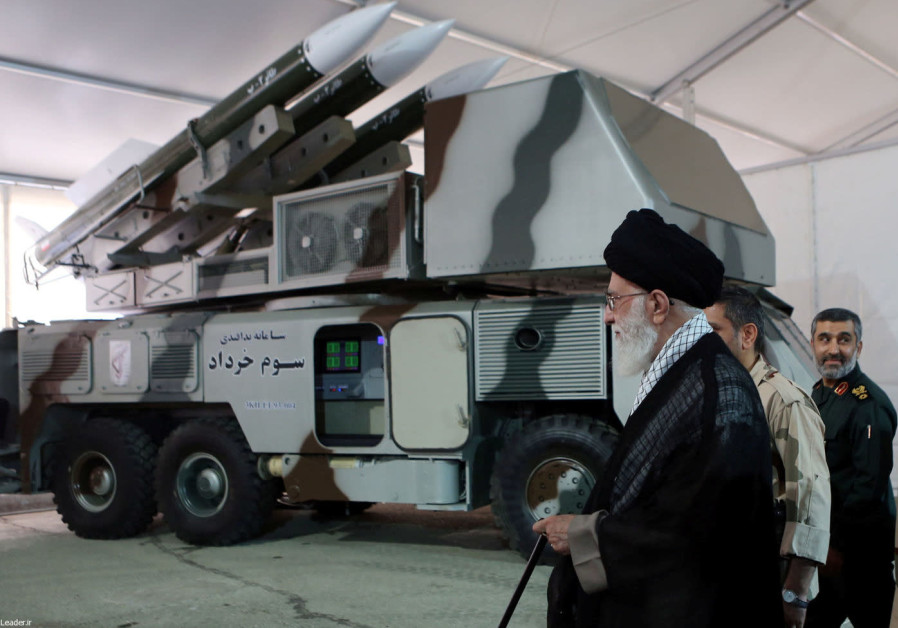
It says it used its “3rd Khordad” system, which is supposed to replicate the S-300’s capabilities. Iran has also been highlighting other defense capabilities recently, including precision ballistic missiles, rockets, drones, submarines, limpet mines and cruise missiles.

Tehran’s defense technology is impressive. Most of its neighbors have not developed their own indigenous weapons systems, nor are they particularly innovative when it comes to using the technologies they do have, which are supplied by the US and Western powers.

This leads to the question, if war breaks out between the US and Iran, and their respective allies, how will Iran and its proxies stack up?

When we look at how Iran and its allies have waged war in the past, it is clear Iran doesn’t wage massive wars.

Iran has a regular army and navy, called Artesh. These armed forces are potentially quite large in a country of 80 million. It has 530,000 men under arms, but according to the Middle East Institute, they are poorly equipped.

Since Iran’s last land war was its 1980-1988 conflict with Iraq, it is “hard to provide an accurate assessment of their real fighting capabilities.” The war with Iraq saw Iran use human wave attacks on a battlefield that sometimes resembled more World War I than a war of maneuver and technology. Even though Saddam Hussein’s army fought the Iranians to a standstill, it was no match for the US military in the 1991 Gulf War and it was easily destroyed.

Iran doesn’t spend much on its army. Around $16 billion in 2017, compared to an Israeli defense budget of up to $19b. Saudi Arabia plows through $76b., and the Americans spend $600b.

This then tells us Iran’s conventional army is no match for the US in a real war. But Iran doesn’t fight large conventional wars. Its strategy is based on its alliance system involving the Islamic Revolutionary Guard Corps (IRGC) and its affiliates, allies and proxies, including Houthi rebels in Yemen, Iraqi paramilitaries, Hezbollah in Lebanon, and Palestinian Islamic Jihad and Hamas in Gaza.

The IRGC has a variety of forces, including its own 100,000 soldiers, as well as a Basij militia of another 600,000 or so, according to the Council on Foreign Relations in the US. The IRGC has its own navy, which is larger than Iran’s regular navy, and its own air force. It also has a cyber force. This puts the IRGC at the forefront of Iran’s technical knowhow. It is the IRGC that set up bases in Syria, and managed relationships with allies.

Iran has transferred precision guidance technology to Hezbollah for its rockets. In March, the IRGC stated that all of Israel is within range of the Lebanese terrorist group’s missiles.

Hezbollah’s massive rocket arsenal of more than 150,000 rockets pose a major threat. These include long-range rockets such as the Zelzal, Fateh 110 and the Fajr, as well as shorter range such as Katyushas. The Fateh 110 has a range of several hundred kilometers.

Hezbollah has an assortment of other weapons; it has deployed anti-ship missiles in the past and has anti-air systems such as the SA-7, which Iran used to fire at a US Reaper drone on June 13.

Iran likes to showcase its missile abilities. In September 2018 it fired seven Fateh 110s at dissidents in Koya in northern Iraq.

They stuck precisely at the room where the dissidents were meeting. It has used its Zulfiqar and Qiam ballistic missiles against ISIS in Syria. It is thought that these missiles can fly 800 km. Iran has also developed a line of Shehab missiles since the 1990s.

It is not clear how well they function, but they allegedly have a range up to 2,000 km. Iran also says it put guided warheads on a missile called the Khoramshahr. It said in February this missile carries a 1,800 kg. warhead.

In February, Iran also showed off a new long range cruise missile, which it claimed has a range of 1,300 km. Called the Hoveizeh, it’s part of a larger Soumar family of cruise missiles. Iran’s Press TV said the Houthi rebels used a cruise missile against Saudi Arabia in the last several days.

There is no end to Iran’s seemingly endless list of new technology. Submarines with cruise missiles were also unveiled in February. Iran also has a new destroyer, and tested armed drones in March. Iran often copies and improves other country’s weapons, and copied a US Sentinel drone it captured. It may have used North Korean expertise on its rockets. Afterwards, Iran transfers technology to its allies. The Houthis offer a battlefield testing ground for its rockets.

But none of these rockets are a game changer in a real war. Israel, for instance, has built a multi-layered defense system to stop missiles. This includes the Iron Dome, David’s Sling and Arrow-3. And Israel and the US have done missile defense drills with the THAAD system for high altitude air defense. Israel also has Patriot batteries, and is more than capable of thwarting a missile threat.

The US Navy, including the USS Abraham Lincoln Carrier Strike Force in the Gulf of Oman, is also equipped with enough firepower to bring the Iranian navy and air force to heel. This would not be a great competition, if the US wanted to do it.

The way Iran fights wars, though, is asymmetrically. It doesn’t want a conventional war. That is why Iran also uses other allies, such as the pro-Iranian Iraqi Shi’ite militias called the PMU. These have 100,000 men under arms and possess missiles, rockets and armored vehicles. They helped defeat ISIS, and some of them have fought the Americans in the past. The US army in Iraq today is there solely to train Iraqi security forces against ISIS, not to fight Iran. In the last week, there have been four rocket and mortar attacks near US forces. Iran knows that in each case, if its allies harass the US, the US will not likely retaliate but will call on the Iraqi army to respond.

In Syria, Iranian-backed militias have tested the US near Tanf and Deir Ezzor in recent years. In each case, the US struck at the harassers. These included mercenaries who attacked a US-backed Syrian Democratic Forces post in February 2018. Any Iranian harassment of US forces in Syria would be met with force. And the US has the forces to deal that blow, including several thousand personnel and air force assets.

The question for the US and its allies when dealing with Iran is that in each case, the US and its allies – including Saudi Arabia and Israel – are capable of fighting, and have already been fighting, Iranian-backed groups. Israel has dealt with thousands of rockets fired from Gaza. Riyadh has dealt with drone attacks and ballistic missiles. Israel has carried out more than 1,000 airstrikes in Syria over five years, according to reports.

If a conflict develops between the US and Iran, the US and her allies are more than a match for every part of the Iranian octopus of militias and proxies. The question is whether each front-line will erupt at once and the complexity of facing off against these asymmetric forces in a major conflict. Ideally, neither Iran nor the US want that conflict, and neither do their allies.


If there is a war: This is how U.S. and allies stack up to Iran

June 22, 2019

Source: If there is a war: This is how U.S. and allies stack up to Iran – Middle East – Jerusalem Post

If war breaks out between the US and Iran, and their respective allies, how will Iran and its proxies stack up?

BY SETH J. FRANTZMAN
 JUNE 21, 2019 01:16
If there is a war: This is how U.S. and allies stack up to Iran

Iran showcased its impressive military capabilities on Thursday by downing a sophisticated US drone.

It says it used its “3rd Khordad” system, which is supposed to replicate the S-300’s capabilities. Iran has also been highlighting other defense capabilities recently, including precision ballistic missiles, rockets, drones, submarines, limpet mines and cruise missiles.

Tehran’s defense technology is impressive. Most of its neighbors have not developed their own indigenous weapons systems, nor are they particularly innovative when it comes to using the technologies they do have, which are supplied by the US and Western powers.

This leads to the question, if war breaks out between the US and Iran, and their respective allies, how will Iran and its proxies stack up?

When we look at how Iran and its allies have waged war in the past, it is clear Iran doesn’t wage massive wars.

Iran has a regular army and navy, called Artesh. These armed forces are potentially quite large in a country of 80 million. It has 530,000 men under arms, but according to the Middle East Institute, they are poorly equipped.

Since Iran’s last land war was its 1980-1988 conflict with Iraq, it is “hard to provide an accurate assessment of their real fighting capabilities.” The war with Iraq saw Iran use human wave attacks on a battlefield that sometimes resembled more World War I than a war of maneuver and technology. Even though Saddam Hussein’s army fought the Iranians to a standstill, it was no match for the US military in the 1991 Gulf War and it was easily destroyed.

Iran doesn’t spend much on its army. Around $16 billion in 2017, compared to an Israeli defense budget of up to $19b. Saudi Arabia plows through $76b., and the Americans spend $600b.

This then tells us Iran’s conventional army is no match for the US in a real war. But Iran doesn’t fight large conventional wars. Its strategy is based on its alliance system involving the Islamic Revolutionary Guard Corps (IRGC) and its affiliates, allies and proxies, including Houthi rebels in Yemen, Iraqi paramilitaries, Hezbollah in Lebanon, and Palestinian Islamic Jihad and Hamas in Gaza.

The IRGC has a variety of forces, including its own 100,000 soldiers, as well as a Basij militia of another 600,000 or so, according to the Council on Foreign Relations in the US. The IRGC has its own navy, which is larger than Iran’s regular navy, and its own air force. It also has a cyber force. This puts the IRGC at the forefront of Iran’s technical knowhow. It is the IRGC that set up bases in Syria, and managed relationships with allies.

Iran has transferred precision guidance technology to Hezbollah for its rockets. In March, the IRGC stated that all of Israel is within range of the Lebanese terrorist group’s missiles.

Hezbollah’s massive rocket arsenal of more than 150,000 rockets pose a major threat. These include long-range rockets such as the Zelzal, Fateh 110 and the Fajr, as well as shorter range such as Katyushas. The Fateh 110 has a range of several hundred kilometers.

Hezbollah has an assortment of other weapons; it has deployed anti-ship missiles in the past and has anti-air systems such as the SA-7, which Iran used to fire at a US Reaper drone on June 13.

Iran likes to showcase its missile abilities. In September 2018 it fired seven Fateh 110s at dissidents in Koya in northern Iraq.

They stuck precisely at the room where the dissidents were meeting. It has used its Zulfiqar and Qiam ballistic missiles against ISIS in Syria. It is thought that these missiles can fly 800 km. Iran has also developed a line of Shehab missiles since the 1990s.

It is not clear how well they function, but they allegedly have a range up to 2,000 km. Iran also says it put guided warheads on a missile called the Khoramshahr. It said in February this missile carries a 1,800 kg. warhead.

In February, Iran also showed off a new long range cruise missile, which it claimed has a range of 1,300 km. Called the Hoveizeh, it’s part of a larger Soumar family of cruise missiles. Iran’s Press TV said the Houthi rebels used a cruise missile against Saudi Arabia in the last several days.

There is no end to Iran’s seemingly endless list of new technology. Submarines with cruise missiles were also unveiled in February. Iran also has a new destroyer, and tested armed drones in March. Iran often copies and improves other country’s weapons, and copied a US Sentinel drone it captured. It may have used North Korean expertise on its rockets. Afterwards, Iran transfers technology to its allies. The Houthis offer a battlefield testing ground for its rockets.

But none of these rockets are a game changer in a real war. Israel, for instance, has built a multi-layered defense system to stop missiles. This includes the Iron Dome, David’s Sling and Arrow-3. And Israel and the US have done missile defense drills with the THAAD system for high altitude air defense. Israel also has Patriot batteries, and is more than capable of thwarting a missile threat.

The US Navy, including the USS Abraham Lincoln Carrier Strike Force in the Gulf of Oman, is also equipped with enough firepower to bring the Iranian navy and air force to heel. This would not be a great competition, if the US wanted to do it.

The way Iran fights wars, though, is asymmetrically. It doesn’t want a conventional war. That is why Iran also uses other allies, such as the pro-Iranian Iraqi Shi’ite militias called the PMU. These have 100,000 men under arms and possess missiles, rockets and armored vehicles. They helped defeat ISIS, and some of them have fought the Americans in the past. The US army in Iraq today is there solely to train Iraqi security forces against ISIS, not to fight Iran. In the last week, there have been four rocket and mortar attacks near US forces. Iran knows that in each case, if its allies harass the US, the US will not likely retaliate but will call on the Iraqi army to respond.

In Syria, Iranian-backed militias have tested the US near Tanf and Deir Ezzor in recent years. In each case, the US struck at the harassers. These included mercenaries who attacked a US-backed Syrian Democratic Forces post in February 2018. Any Iranian harassment of US forces in Syria would be met with force. And the US has the forces to deal that blow, including several thousand personnel and air force assets.

The question for the US and its allies when dealing with Iran is that in each case, the US and its allies – including Saudi Arabia and Israel – are capable of fighting, and have already been fighting, Iranian-backed groups. Israel has dealt with thousands of rockets fired from Gaza. Riyadh has dealt with drone attacks and ballistic missiles. Israel has carried out more than 1,000 airstrikes in Syria over five years, according to reports.

If a conflict develops between the US and Iran, the US and her allies are more than a match for every part of the Iranian octopus of militias and proxies. The question is whether each front-line will erupt at once and the complexity of facing off against these asymmetric forces in a major conflict. Ideally, neither Iran nor the US want that conflict, and neither do their allies.


Trump says doesn’t want war with Iran but there’ll be ‘obliteration’ if there is

June 22, 2019

Source: Trump says doesn’t want war with Iran but there’ll be ‘obliteration’ if there is | The Times of Israel

US president says no preconditions for talks with Tehran but won’t allow them to have nuclear weapons; US military was ‘cocked and loaded’ to retaliate for downing of drone

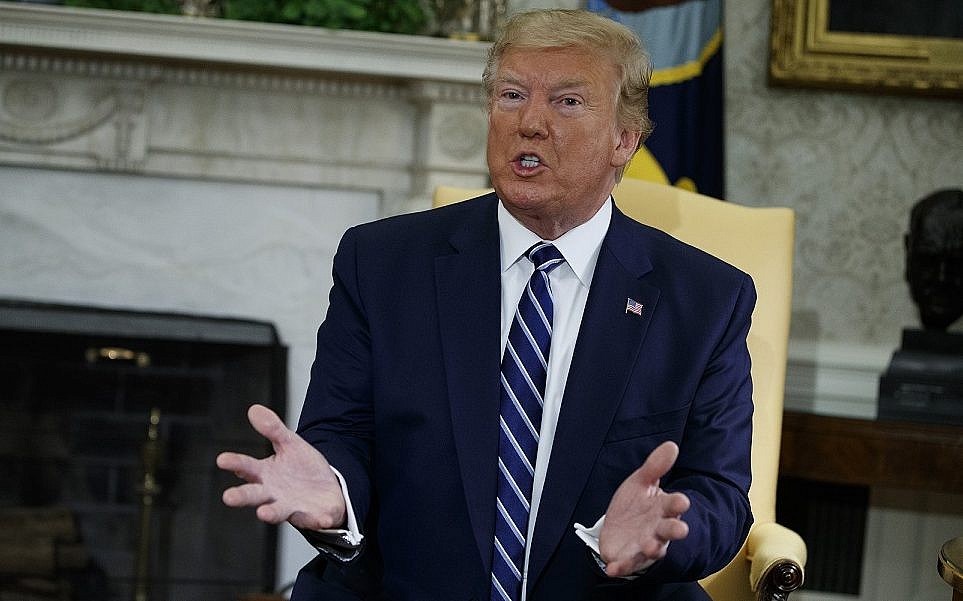
US President Donald Trump speaks during a meeting with Canadian Prime Minister Justin Trudeau at the White House in Washington, DC, on Thursday, June 20, 2019. (AP/Evan Vucci)

US President Donald Trump speaks during a meeting with Canadian Prime Minister Justin Trudeau at the White House in Washington, DC, on Thursday, June 20, 2019. (AP/Evan Vucci)

US President Donald Trump said Friday that he went to war with Iran there would be “obliteration like you’ve never seen before.”

In an interview with NBC, the president then added: “But I’m not looking to do that.”

Trump also said there would be no preconditions for any talks with Tehran.

“You can’t have nuclear weapons,” Trump said. “And if you want to talk about it, good. Otherwise, you can live in a shattered economy for a long time to come.”

Excerpts from the interview were released hours after Trump said the US was “cocked and loaded” to retaliate against Iran, but canceled the strikes 10 minutes before they were to be carried out after being told some 150 people could die.

Trump’s tweeted statement raised important questions, including why he learned about possible deaths only at the last minute.

His stance was the latest example of the president showing some reluctance to escalate tensions with Iran into open military conflict.

He did not rule out a future strike but said in a TV interview that the likelihood of casualties from the Thursday night plan to attack three sites in Iran did not seem like the correct response to shooting down an unmanned drone earlier in the day in the Strait of Hormuz.

“I didn’t think it was proportionate,” he said in the interview.

The aborted attack was the closest the US has come to a direct military strike on Iran in the year since the administration pulled out of the 2015 international agreement intended to curb the Iranian nuclear program and launched a campaign of increasing economic pressure against the Islamic Republic.

Trump told NBC News that he never gave a final order to launch the strikes — planes were not yet in the air but would have been “pretty soon.”

He said military officials came to him about 30 minutes before the strikes were to be launched and asked him for his final approval. Before signing off, he said he asked how many Iranians would be killed and was told approximately 150.

“I thought about it for a second and I said, ‘You know what? They shot down an unmanned drone, plane — whatever you want to call it — and here we are sitting with 150 dead people.’ That would have taken place probably within a half an hour after I said go ahead. And I didn’t like it. I didn’t think it was proportionate.”

Trump tweeted Friday that the US was ready to “retaliate last night on 3 different sights when I asked, how many will die.” He said a general told him 150 people, and he canceled the strikes as “not proportionate to shooting down an unmanned drone.”

Trump tweeted that the US will never allow Iran to have a nuclear weapon. But he said he’s in no hurry to respond to the downing of the US surveillance drone over the Strait of Hormuz.

He said US sanctions are crippling the Iranian economy and that more are being added.

Donald J. Trump

@realDonaldTrump

….Death to America. I terminated deal, which was not even ratified by Congress, and imposed strong sanctions. They are a much weakened nation today than at the beginning of my Presidency, when they were causing major problems throughout the Middle East. Now they are Bust!….

Donald J. Trump

@realDonaldTrump

….On Monday they shot down an unmanned drone flying in International Waters. We were cocked & loaded to retaliate last night on 3 different sights when I asked, how many will die. 150 people, sir, was the answer from a General. 10 minutes before the strike I stopped it, not….

The United States abruptly called off preparations for a military strike against Iran over the downing of a US surveillance drone, a US official said, while Iran claimed Friday it had issued several warnings before shooting down the drone over what it said was Iranian territory.

A US official, who was not authorized to discuss the operation publicly and spoke on condition of anonymity, said the targets would have included radars and missile batteries.

The swift reversal was a reminder of the serious risk of military conflict between US and Iranian forces as the Trump administration combines a “maximum pressure” campaign of economic sanctions with a buildup of American forces in the region. As tensions mounted in recent weeks, there have been growing fears that either side could make a dire miscalculation that led to war .

On Friday, the head of Iran’s Revolutionary Guard’s aerospace division told Iranian state television that Iran had given repeated warnings before launching a missile at the US military surveillance drone.

Gen. Amir Ali Hajizadeh, standing in front of what Iranian authorities described as pieces of the US Navy RQ-4A Global Hawk drone, told state TV that Iranians gave the warnings over radio frequencies that are routinely monitored by drone pilots and the US military. “Unfortunately, they did not answer,” he said.

Head of the Revolutionary Guard’s aerospace division Brig. Gen. Amir Ali Hajizadeh looks at debris from what the division describes as the US drone which was shot down on Thursday, in Tehran, Iran, Friday, June 21, 2019.(Meghdad Madadi/Tasnim News Agency/via AP)

He also said that Iran could have downed a manned a P-8 American plane, but did not.

He added Iran collected the debris from its territorial waters. The US military says that the drone was in international airspace over the Strait of Hormuz when it was shot down.

However, the New York Times quoted a senior administration  official as saying that there was some doubt whether either of the US aircraft did violate Iranian airspace at some point. The official said the doubt was one of the reasons Trump called off the strike, according to the Times, which said that it could under international norms be viewed as an act of war.

The paper also reported that planes were in the air and ships were in position, but no missiles had been fired when word came to stand down.

Trump’s initial comments on the attack were succinct. He declared in a tweet that “Iran made a very big mistake!” But he also suggested that shooting down the drone — which has a wingspan wider than a Boeing 737 — was a foolish error rather than an intentional escalation, suggesting he may have been looking for some way to avoid a crisis.

“I find it hard to believe it was intentional, if you want to know the truth,” Trump said at the White House. “I think that it could have been somebody who was loose and stupid that did it.”

Trump, who has said he wants to avoid war and negotiate with Iran over its nuclear ambitions, cast the shootdown as “a new wrinkle … a new fly in the ointment.” Yet he also said “this country will not stand for it, that I can tell you.”

He said the American drone was unarmed and unmanned and “clearly over international waters.” It would have “made a big, big difference” if someone had been inside, he said.

But fears of open conflict shadowed much of the discourse in Washington. As the day wore on, Trump summoned his top national security advisers and congressional leaders to the White House for an hour-long briefing in the Situation Room. Attendees included Secretary of State Mike Pompeo, national security adviser John Bolton, CIA Director Gina Haspel, Joint Chiefs Chairman Gen. Joseph Dunford, acting Defense Secretary Patrick Shanahan and Army Secretary Mark Esper, whom Trump has said he’ll nominate as Pentagon chief.

In this February 13, 2018, photo released by the US Air Force, an RQ-4 Global Hawk is seen on the tarmac of Al-Dhafra Air Base near Abu Dhabi, United Arab Emirates. (Airman 1st Class D. Blake Browning/US Air Force via AP)

Democratic leaders in particular urged the president to work with US allies and stressed the need for caution to avoid any unintended escalation. Senate Democratic leader Chuck Schumer said he told Trump that conflicts have a way of escalating and “we’re worried that he and the administration may bumble into a war.”

Pompeo and Bolton have advocated hardline policies against Iran, but Rep. Adam Schiff, the chairman of the House intelligence committee, said “the president certainly was listening” when congressional leaders at the meeting urged him to be cautious and not escalate the already tense situation.

Some lawmakers insisted the White House must consult with Congress before taking any actions.


Off Topic:  Why Herman Wouk Will Achieve an Immortality Unlike Any Other Jewish Cultural Figure of His Time 

June 22, 2019

Source: Why Herman Wouk Will Achieve an Immortality Unlike Any Other Jewish Cultural Figure of His Time » Mosaic

American Jewry produced many great literary figures in the 20th century, but only one, notes Meir Soloveichik, remained a devoutly observant Jew for his entire life except for a brief interval in his youth. This was Herman Wouk, who died last month at the age of one-hundred-three. In addition to numerous novels, Wouk also wrote a bold—and best-selling—apologia for Orthodox Judaism, This Is My God. Reflecting on what Wouk himself termed the “mystery” of the Jewish people, Soloveichik writes:

To journalists and literati, [Wouk’s piety] was a paradox. Wouk, Time magazine argued, “seems like an enigmatic character in search of an author. He is a devout Orthodox Jew who has achieved worldly success in worldly-wise Manhattan while adhering to the dietary prohibitions and traditional rituals which many of his fellow Jews find embarrassing.” But it is not a paradox at all. A novelist like Wouk knew a great story when he saw one, and he was surely struck by the fact that those very same American Jews who avidly read his novels seemed to ignore the most interesting plot of all.

Wouk’s own countercultural observance . . . heralded the resurgence of Orthodoxy in America, one that few in the 1950s would have predicted. But Wouk also offers an example of what American Orthodoxy so sorely needs today: those with the ambition and ability to defend, passionately and eloquently, Judaism’s vision to the world. Should they emerge, they may find an audience far surpassing Wouk’s, hungering for truth in an age of rank relativism and cultural decay, waiting for a gifted writer to fulfill once again words uttered by Moses millennia ago: “This is my God and I will beautify Him; the God of my father that I shall glorify.”

For decades, Wouk seemed superhuman, living to be over one-hundred years of age and writing lucidly late into his nineties. In this he appeared to embody the immortality of the people that he so exquisitely described. . . . Now his own remarkable story has come to an end. . . . But it hasn’t, not really.

Individually, every man is mortal; Herman Wouk was a man, and even he would ultimately die. But precisely because of his faith, a faith that seemed paradoxical but which actually made so much sense, Wouk will achieve an immortality unlike any other Jewish cultural figure of his time. He will live, first and foremost, not in his movies, or novels, but in the extraordinary endurance of Orthodoxy in America, and through the eternal people who cling stubbornly, with love, to Herman Wouk’s God.