Archive for June 2019

Hezbollah is now giving orders to Syria’s army – and using it to spy on Israel 

June 24, 2019

Source: Hezbollah is now giving orders to Syria’s army – and using it to spy on Israel | The Times of Israel

In a reality once unthinkable, Assad’s troops along Golan border are heeding commanders of the Iran-backed terror group, and helping it prepare for conflict with the Jewish state
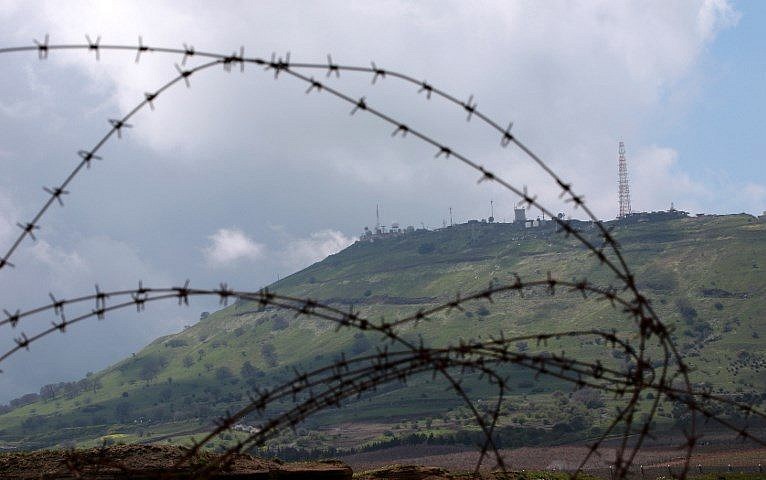
An Israeli military outpost in the Golan Heights is pictured from the Syrian town of Quneitra on March 26, 2019. (Louai Beshara/AFP)

An Israeli military outpost in the Golan Heights is pictured from the Syrian town of Quneitra on March 26, 2019. (Louai Beshara/AFP)

Earlier this month, the Syrian Observatory for Human Rights, a UK-based watchdog group, reported that Israeli fighter jets struck Hezbollah positions on the Syrian side of the Golan Heights. There was no Israeli comment on the claim.

The report said one of the targets was a post on Tel al-Harra, a mountain that is considered a strategic point that overlooks the Golan Heights, while the other was in Quneitra, near the UN-monitored border crossing with Israel, where Arab media reports a Syrian air-defense position and a Hezbollah intelligence center are located.

The Iran-backed Lebanese terror group had been trying to set up a front on the Syrian Golan for years, but had previously been unable to gain a sufficient foothold in the area. However, Syrian President Bashar Assad’s conquest of the border area last summer provided the regime-allied organization with an opportunity to once again attempt to establish the necessary infrastructure with which it could threaten Israel near the border.

The alleged Israeli strikes near the border were a rare occurrence. In the past Israel has targeted villages and towns along the Golan Heights frontier after identifying Iranian and Hezbollah attempts to establish cells and infrastructure in the area.

But the incident also highlighted a reality once unthinkable in Syria: With Hezbollah one of the chief powers setting the tone in the country after years of civil war, Syrian army forces are now in some cases taking their orders from the organization — and helping it spy on Israel.

Hezbollah’s presence in Syrian territory opposite the Israeli border is a natural continuation of the group’s expanding activity in the Middle East (in Yemen, Iraq, Syria, and Lebanon, among others), and the civil war that has been raging in Syria for approximately eight years.

Its increased clout is particularly noticeable in the region of southern Syria that the Syrians call Hauran. In the same area that gave rise to the protests against Assad in March 2011 in the city of Daraa, a situation has now formed in which Syrian soldiers receive “recommendations” — which are in effect orders — from Hezbollah commanders.

A segment of the Syrian army that controls the southern part of the country works closely with many consultants from Hezbollah, which use it for purposes such as intelligence-gathering, and is also helping the Lebanon-based group prepare for an expected future war with Israel (as well as assisting it in dealing with local opposition).
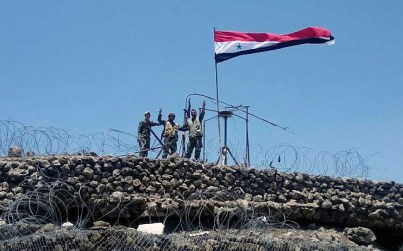
Illustrative: Syrian troops flash the victory sign next to the Syrian flag in Tel al-Haara, the highest hill in the southwestern Daraa province, Syria, July 17, 2018. (SANA via AP)

To put it in the simplest terms, these Syrian troops are now serving Hezbollah’s Shiite army in Lebanon. Bashar’s deceased father, Hafez Assad, would be rolling in his grave: During his time the elder Assad waged war against Hezbollah in Lebanon, and killed hundreds of its members.

How did the tables so turn? The civil war was, without a doubt, the key event, with the Syrian army now dependent on assistance from Hezbollah and Iran in order to survive.

Earlier in the war, when Assad’s regime appeared to be on its last legs, Hezbollah sent numerous advisers to the region whose stated purpose was simply to aid the fighting against the opposition groups in Hauran. A great deal has happened since then, and about a year ago — with Assad buoyed also by Iranian and particularly Russian forces — it became clear that the battle for Syria had been decided: the regime had won. But Hezbollah didn’t stop at that point — it began to establish its forces permanently throughout Syria, particularly in its southern sector.

This process took place with quite a bit of hesitation by Hezbollah’s leaders, especially regarding the financial implications of leaving troops on Syrian soil. In the end, the strategic thinking that troops should be positioned against Israel on the Syrian side of the Golan Heights won out.

This had to be done clandestinely though: Following the understandings that Israel reached with Russia, Iranian and Hezbollah presence is prohibited at a distance of approximately 80 kilometers (50 miles) from the Syrian border with Israel.

And thus a “Southern Headquarters” operated by Hezbollah is currently operating in secret in the territory known as Hauran. It is a military organization in every sense, which operates with several dozen Lebanese and hundreds of Syrians, most of them from Hauran: Thanks to financial difficulties brought on by the war, Hezbollah has had little trouble recruiting quite a few locals to serve its purposes.

The force, led by Lebanese commander Munir Ali Naim Shaiti (better known by the alias Hajj Hashem), is now focusing less and less upon threats at home and much more on the old threat: Israel.

The Southern Headquarters is armed with weapons that include antitank missiles and particularly powerful short-range rockets with a minimum weight of approximately 250 kilograms and effectiveness at a range of approximately four kilometers. Their original purpose was to strike opposition targets, but they are now being repurposed with the aim of destroying Israeli villages on the Golan Heights or the upper Galilee.
Illustrative: A picture taken from the Israeli Golan Heights shows a smoke plume rising during airstrikes backing a Syrian-government-led offensive in the southwestern province of Daraa, July 23, 2018. (JALAA MAREY/AFP)

The purpose of the Southern Headquarters is to collect high-quality intelligence about the Israeli side of the border. The headquarters works under the radar of international forces and does its best to hide its tracks. Seeking to avoid Israeli attacks on its forces, Hezbollah has done its best to camouflage its activity. Its people do not act openly, and it has recruited troops from Syria Army’s 1st Corps to assist its operations.

It is believed the group has set up approximately 20 lookout positions on the Syrian Golan Heights facing Israeli territory. Each such outpost is manned by Syrian soldiers, often accompanied by Hezbollah members but sometimes on their own. These soldiers gather intelligence according to the orders of Hezbollah: training exercises on the Israeli side, the day-to-day security routine, activity in villages and more. The information is sent to several Hezbollah operations rooms in the Syrian Golan Heights, and from there it is relayed to headquarters in Lebanon and/or to the Iranians.

In addition, the Southern Headquarters makes use of technology to attempt to listen in on the Israeli side, via communications networks or other means.

Simultaneously Hezbollah continues to build its offensive capabilities in the Golan Heights. These efforts are led by veteran terrorist Ali Musa Daqduq, also known as Abu Hussein Sajed, a Lebanese man who is wanted in the United States for attacks against American forces in Iraq, including planning an attack in Karbala in 2007 that resulted in the deaths of five US soldiers.

Hezbollah leader Ali Musa Daqduq, suspected of forming a terror cell for the organization in the Syrian Golan Heights. (Israel Defense Forces)

According to the US Treasury Department, Daqduq has served “as commander of a Hezbollah special forces unit and chief of a protective detail for Hezbollah Secretary General Hassan Nasrallah.” Daqduq was arrested in 2007 and imprisoned in Iraq, but was released five years later and sent to Lebanon.

Daqduq leads an operational unit in every sense, whose purpose is to act mainly in situations of large-scale escalation and carry out high-quality terror attacks. In March, the IDF said it had exposed a nascent Hezbollah terror cell led by Daqduq and established in a border village on the Syrian Golan Heights.

While the commanding officers of this unit are Lebanese, most of its troops — which number approximately two hundred — are Syrian, who were recruited from, among other places, Druze communities such as Khadar and Arnah on the Syrian Golan Heights.

The concern now is that the intelligence and operational arms will join forces: If Hezbollah commanders decide to use Daqduq’s troops to carry out an attack on Israel from the Syrian Golan Heights, they will likely do so with intelligence provided by Hajj Hashem’s Southern Headquarters.
 

Iranians say their ‘bones breaking’ under US sanctions

June 24, 2019

Source: Iranians say their ‘bones breaking’ under US sanctions | The Times of Israel

With climbing unemployment and inflation nearing 40%, ordinary Iranians are feeling the pinch of Trump’s foreign policy, but many also blame government corruption

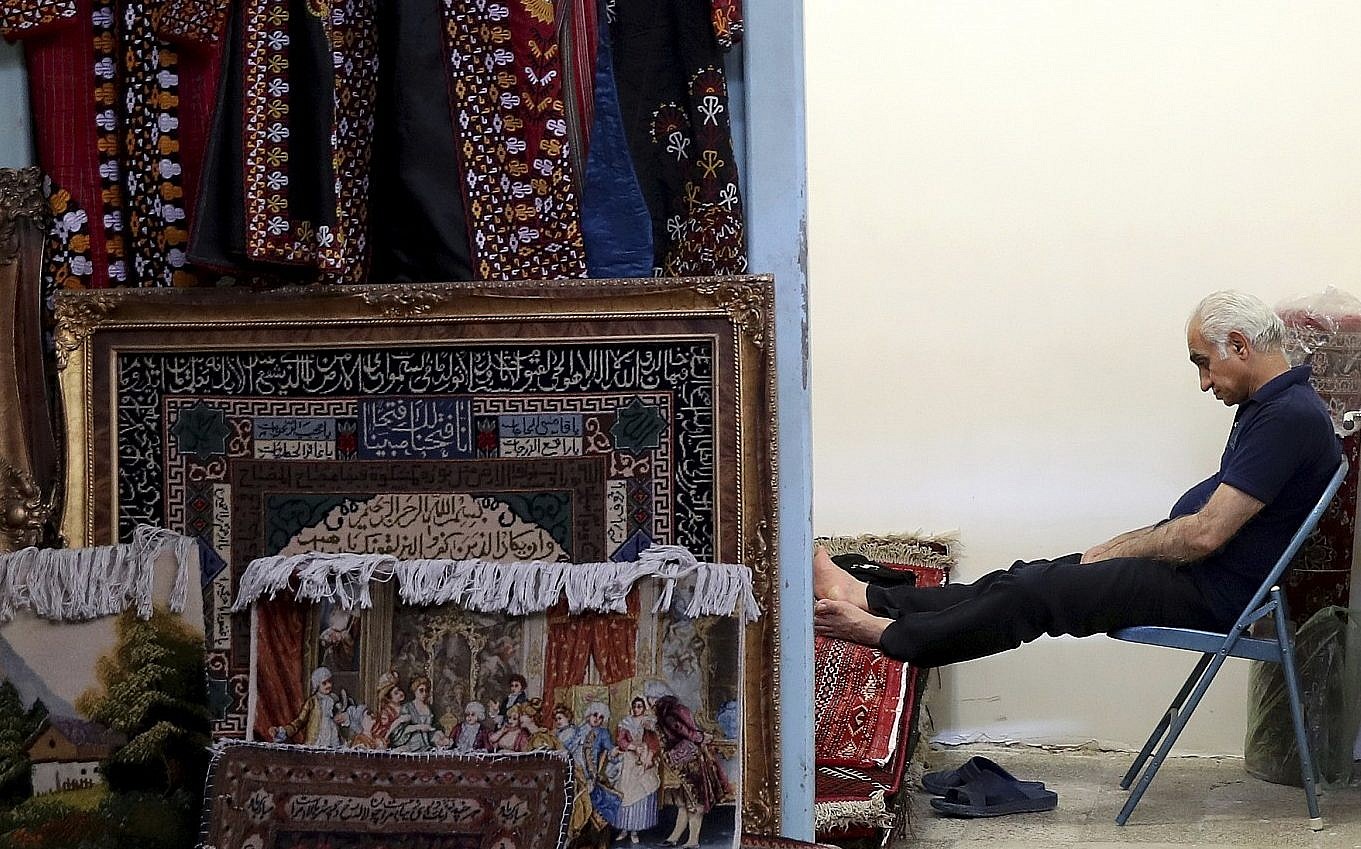
A carpet seller sits at his shop in the old main bazaar in Tehran, Iran, on June 23, 2019. (AP Photo/Ebrahim Noroozi)

A carpet seller sits at his shop in the old main bazaar in Tehran, Iran, on June 23, 2019. (AP Photo/Ebrahim Noroozi)

TEHRAN, Iran (AP) — As the US piles sanction after sanction on Iran, it’s the average person who feels it the most.

From a subway performer’s battered leather hat devoid of tips, to a bride-to-be’s empty purse, the lack of cash from the economic pressure facing Iran’s 80 million people can be seen everywhere.

Many blame US President Donald Trump and his maximalist policy on Iran, which has seen him pull out of Tehran’s 2015 nuclear deal with world powers and levy punishing US sanctions on the country.

In recent weeks, Iran has threatened to break out of the deal unless European powers mitigate what it calls Trump’s “economic warfare.” Iran also appeared ready to push back against the buildup of US forces in the region, after shooting down an American drone it says violated its airspace last week.

In response, US officials have vowed to pile on more sanctions.

But alongside Trump, many Iranians blame their own government, which has careened from one economic disaster to another since its Islamic Revolution 40 years ago.

“The economic war is a reality and people are under extreme pressure,” said Shiva Keshavarz, a 22-year-old accountant soon to be married.

She said government leaders “keep telling us to be strong and endure the pressures, but we can already hear the sound of our bones breaking.”

Motorbike taxi divers carry goods at the old main bazaar in Tehran, Iran on June 23, 2019. (AP Photo/Ebrahim Noroozi)

Walking by any money exchange shop is a dramatic reminder of the hardships most people are facing. At the time of the nuclear deal, Iran’s currency traded at 32,000 rials to $1. Today, the numbers listed in exchange shop windows have skyrocketed — it costs over 130,000 rials for one US dollar.

Inflation is over 37%, according to government statistics. More than 3 million people, or 12% of working-age citizens, are unemployed. That rate doubles for educated youth.

Depreciation and inflation make everything more expensive — from fruits and vegetables to tires and oil, all the way to the big-ticket items, like mobile phones. A simple cell phone is about two months’ salary for the average government worker, while a single iPhone costs a 10 months’ salary.

“When importing mobile phones into the country is blocked, dealers have to smuggle them in with black market dollar rates and sell them for expensive prices,” said Pouria Hassani, a mobile phone salesman in Tehran. “You can’t expect us to buy expensive and sell cheap to customers. We don’t want to make a loss either.”

Hossein Rostami, a 33-year-old motorbike taxi driver and deliveryman, said the price of brake pads alone had jumped fivefold.

“The cause of our problems is the officials’ incompetence,” he told The Associated Press as fellow motorbike drivers called out for passengers in Tehran. “Our country is full of wealth and riches.”

The riches part is true — Iran is home to the world’s fourth-largest proven reserve of crude oil and holds the world’s second-largest proven reserve of natural gas, after Russia.

But under Trump’s maximum-pressure campaign, the US has cut off Iran’s ability to sell crude on the global market, and threatened to sanction any nation that purchases it. Oil covers a third of the $80 billion a year the government spends in Iran, meaning that a fall in oil revenues cuts into its social welfare programs, as well as its military expenditures.

The rest of the country’s budget comes from taxes and non-oil exports, among them oil-based petrochemical products that provide up to 50% of Iran’s $45 billion in non-oil export.

In this photo from August 8, 2018, a man exchanges Iranian Rials for US Dollars at an exchange shop in the Iranian capital Tehran. (AFP Photo/Atta Kenare)

In Tehran’s Laleh park, retired school teacher Zahra Ghasemi criticized the government for blaming “every problem” on US sanctions.

She says she has trouble paying for her basic livelihood. The price of a bottle of milk has doubled, along with that of vegetables and fruit.

“We are dying under these pressures and a lack of solutions from officials,” Ghasemi said.

Years of popular frustration with failed economic policies triggered protests in late 2017, which early the following year spiraled into anti-government demonstrations across dozens of cities and towns.

The current problems take root in Iran’s faltering efforts to privatize its state-planned economy after the devastating war with Iraq in the 1980s, which saw 1 million people killed.

But Oil Minister Bijan Zanganeh said earlier this month that the crunch on oil exports was hitting harder today than during the 1980s war, when Saddam Hussein’s forces targeted Iran’s oil trade.

“Our situation is worse than during the war,” Zanganeh said. “We did not have such an export problem when Saddam was targeting our industrial units. Now, we cannot export oil labeled Iran.”

Still, many Iranians pin the economic crisis on corruption as much as anything else.

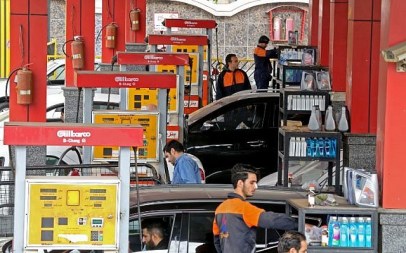
Iranians drivers fill their tanks at a gas station in the capital Tehran on November 5, 2018. (ATTA KENARE / AFP)

“Our problem is the embezzlers and thieves in the government,” said Nasrollah Pazouki, who has sold clothes in Tehran’s Grand Bazaar since before the 1979 Islamic Revolution. “When people come to power, instead of working sincerely and seriously for the people, we hear and read after a few months in newspapers that they have stolen billions and fled.”

He added: “Whose money is that? It’s the people’s money.”

Sanctions do cause some of the problems, said Jafar Mousavi, who runs a dry-goods store in Tehran. But many of the woes are self-inflicted from rampant graft, he said.

“The economic war is not from outside of our borders but within the country,” Mousavi said. “If there was integrity among our government, producers and people, we could have overcome the pressures.”

Yet people come and go each day to work on Tehran’s crowded metro, seemingly earning less each day for the same work. In one train car, Abbas Feayouji and his son Rahmat play mournful-sounding traditional love songs known as “Sultan-e Ghalbha,” or “King of Hearts” in Farsi.

“People pay less than before,” said the elder Feayouji, a 47-year-old father of three, as he took a short break to speak to the AP. “I don’t know why they do, but it shows people have less money than before.”


Trump: US demands for Iran are no nuclear weapons, no terror funding 

June 24, 2019

Source: Trump: US demands for Iran are no nuclear weapons, no terror funding | The Times of Israel

US President Donald Trump on Monday says other countries should protect their own Gulf oil shipments, and defined US aims regarding Iran as “No Nuclear Weapons and No Further Sponsoring of Terror.”

In a pair of tweets, Trump says the US did not even need to be in the Gulf because it had become the world’s largest energy producer.

“So why are we protecting the shipping lanes for other countries (many years) for zero compensation. All of these countries should be protecting their own ships on what has always been a dangerous journey,” he writes.

As for Tehran, he says, “The U.S. request for Iran is very simple – No Nuclear Weapons and No Further Sponsoring of Terror!”

Donald J. Trump

@realDonaldTrump

China gets 91% of its Oil from the Straight, Japan 62%, & many other countries likewise. So why are we protecting the shipping lanes for other countries (many years) for zero compensation. All of these countries should be protecting their own ships on what has always been….

Donald J. Trump

@realDonaldTrump

….a dangerous journey. We don’t even need to be there in that the U.S. has just become (by far) the largest producer of Energy anywhere in the world! The U.S. request for Iran is very simple – No Nuclear Weapons and No Further Sponsoring of Terror!


US covert cyber war on Iran may prompt Russian, Chinese cyber aid for Tehran against America – DEBKAfile

June 24, 2019

Source: US covert cyber war on Iran may prompt Russian, Chinese cyber aid for Tehran against America – DEBKAfile

President Donald Trump is reported widely by US media to have embarked on a covert cyberwar on Iran. Just as, in the absence of proof, Tehran has never owned up to its recent sabotage provocations in the region – although its hand is self-evident, Washington too intends to duck formal attribution for any cyberattacks against the Islamic Republic.

President Trump has not said this out loud, but his turn to clandestine cyber warfare in retaliation for Iranian attacks, in place of direct military strikes, takes the campaign against Tehran out of the hands of the US Central Command and over to the Cyber Command and the CIA, in line with his resolve to avoid full-scale war. Under consideration are operations not just to disable various missile bases and command centers, but also a range of Iranian vehicles of aggression. They include the Revolutionary Guards (IRGC) patrol boats used to damage Gulf oil tankers this month, as well as Iranian proxies across the region, such as Hizballah and Iraqi Shiite militias.  The CIA will deploy covert forces inside Iran for striking essential infrastructure and stirring up unrest.

The first operation of the first cyber war in military history was in fact launched by Washington on Thursday, June 20, just hours after an Iranian surface-to-air missile shot down a US Navy drone over Gulf waters. It targeted the computers of the IRGC missile command centers, as well as the computers and networks of an Iranian intelligence group which US spy agencies hold responsible for managing the strikes on the oil tankers.

President Trump believes that his constantly toughened sanctions supported by this clandestine, unadmitted cyber campaign is the correct and fitting response for Iran’s aggression and upholds his vow not to entangle America in another Middle East war. This strategy does, however, entail some omissions and drawbacks, say DEBKAfile’s military sources:

  1. The US Cyber Command certainly keeps in a bottom drawer a range of plans for attacking specific targets in Iran, but not likely a comprehensive US-Iranian cyber conflict.
  2. Even the US Cyber Command is in the dark about the extent of Iran’s cyber capabilities and its capacity to strike back. Eight years ago, the Iranians astonished Washington when they seized control of the military satellite computers operating the highly sophisticated US RQ-170 Sentinel spy drone and bringing the UAV down. To this day, the US has never confirmed this Iranian coup.
  3. What is Israel’s role in this campaign and is it prepared to face up to a cyber war?
  4. Iran is unlikely to stand alone in the first major cyber war to be launched by the United States in real time, notwithstanding Trump’s efforts at secrecy. Russia and China may decide to leap to Tehran’s aid for seizing a unique opportunity for testing their own offensive cyber weapons in a real confrontation with America.


Trump, the proportionality president, and the Iranian wild card 

June 23, 2019

Source: Trump, the proportionality president, and the Iranian wild card -analysis – Middle East – Jerusalem Post

Anyone who is familiar with military operations by Israel or the US from the inside knows that there is no such thing as one option to kill 150 people at three sites or nothing.

BY YONAH JEREMY BOB
 JUNE 23, 2019 17:41
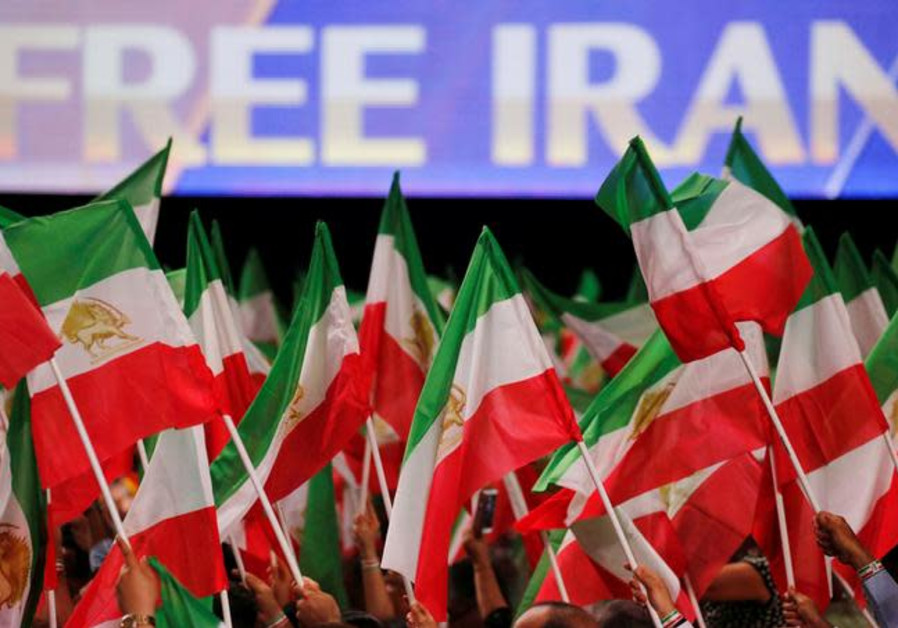
Supporters of Maryam Rajavi, president-elect of the National Council of Resistance of Iran (NCRI)

There was an unusual amount of nuance going on for US President Donald Trump on Friday, as he ordered and then canceled air strikes on Iran in response to its downing of an expensive US drone.

But none of that nuance had to do with proportionality – especially in its legal sense – or the 150 Iranian lives Trump said he was concerned about saving.

First, there is difficulty, from an operational perspective, with his statements about killing 150 people.

Anyone who is familiar from the inside with military operations by Israel or the US knows that there is no such thing as one option to kill 150 people at three sites or nothing.

You can alter what munition is used in a strike to significantly reduce the harm to the target area. One munition might blow up a whole building, another just one floor and another just one unit within a floor.

You can issue warnings to the other side before you strike, as Israel often does when it strikes empty Hamas weapons storehouses.

You can reduce the three targets to one, which reduces the volume of casualties.

Or you can pick a different set of targets with less people around.

His decision also had nothing to do with proportionality under the law of war, which essentially says that the harm to civilians from the use of force cannot be excessive in relation to the military advantage obtained through an attack.

Based on the three Iranian military targets that the US was locked and loaded to strike, it is unlikely that any civilians would have been harmed.

That basically means the law of proportionality would not have even applied.

Members of an army, certainly those performing operational functions such as radar and missile batteries, are legitimate military targets at all times.

Hitting any of those forces involved in shooting down the US drone would be the definition of self-defense – and there is no specific proportionality requirement.

WHAT IS remarkable about Trump’s tossing out proportionality as something that matters to him – and in a context where it does not even apply – is that he has been eminently clear that he is against considering proportionality in pursuing terrorists, especially ISIS.

His big break in 2016 with long-time Republican national security stalwart and former CIA director General Michael Hayden was over Trump’s repeated public statements endorsing the bombing of potentially innocent family members and nearby neighbors of terrorists to get terrorists.

Hayden and others are not necessarily against “collateral damage” to civilians if a specific attack meets proportionality requirements of international law, but they rejected his readiness to endorse unqualified attacks on potential innocents as long as he got terrorists also.

By all accounts, his targeting of ISIS did come with fewer restrictions than under the Obama administration, which has led to more civilian harm.

Trump was also widely slammed in 2016 for endorsing not just torture against terrorist detainees, but for a readiness to use techniques worse than waterboarding. No one was clear on what he meant, with some imagining “the rack” of the Spanish Inquisition.

The point is, if the first time that Trump mentions international law and war is when it does not even apply, one can take the statement with a grain of salt.

In truth, Trump just decided that he did not want to strike Iran at this time over an unmanned drone being shot down because he is highly cautious about wars in the Middle East, and is gambling that his initial buildup to a strike, coupled with his eventual restraint, may get Iran to calm its own escalation in using force.

If he pulls this off, it may be added to a short list of moments where his unconventional leadership style and high-stakes gambling, which goes against conventional wisdom, led to an unexpectedly positive foreign policy result.
Except that Trump is not the only decisive actor.

IRAN IS A wild card and is not a single-minded entity. Trump’s latest restraint did not provide it an easy landing from the US maximum pressure campaign.

The Islamic republic’s moderates or internationalists might be interested in a new nuclear deal even if it meant some new concessions to the US – but even they might not be.

Besides them, Iran’s middle of the spectrum power center, represented by Supreme Leader Ali Khamenei, is willing to make pragmatic moves, like deals, but is highly suspicious of the West – and nothing Trump did on Friday likely changed that.

Then there is a large wing of the Islamic Revolutionary Guard Corps who are a combination of ideological Messianics and ruthless realists who were willing to let massive numbers of their people die in the 1980-1988 Iran-Iraq War. They never wanted the old deal and certainly do not want a new one.

They would be happy to go to war and to show the US that even if it is stronger, it is not willing to bleed as much and for as long as they are.

So Trump’s moment this weekend could be his Obama redline moment, where he loses deterrence globally by being exposed as unwilling to use military options. On the other hand, it could be a brilliant moment, which eventually brings Iran to cut an improved nuclear deal.

Or it could be just another forgotten moment in the ongoing nuclear standoff between the US and Iran, with both sides continuing to play chicken.

Either way, proportionality was not the issue.


Saudi official says ‘Deal of Century’ leads to full Palestinian statehood 

June 23, 2019

Source: Saudi official says ‘Deal of Century’ leads to full Palestinian statehood – Israel News – Jerusalem Post

The official slammed Palestinian leadership as “irresponsible” for not even considering the Deal of the Century, which will bring 60 billion USD to their people.

BY JERUSALEM POST STAFF
 JUNE 22, 2019 22:30
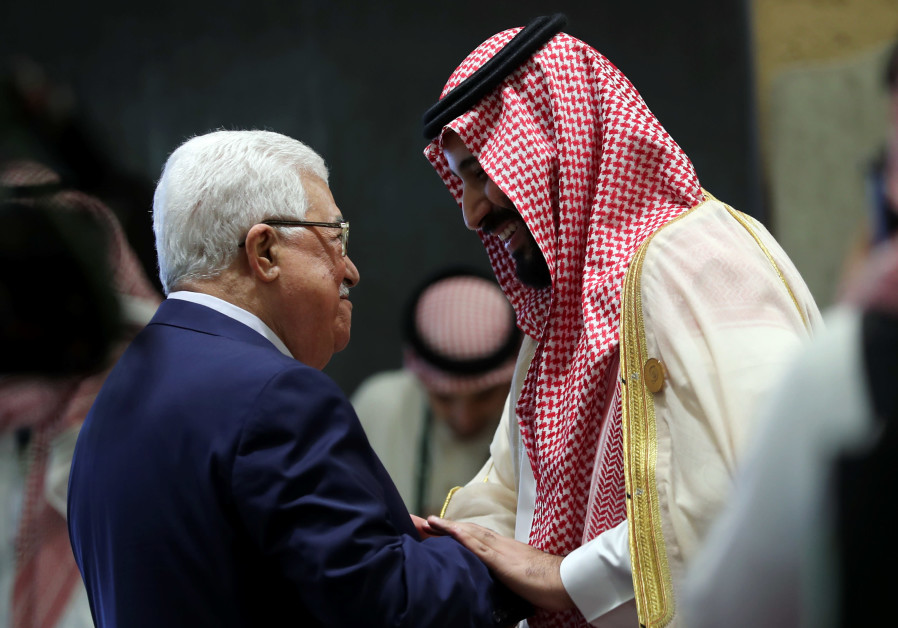
Saudi Arabia's Crown Prince Mohammed bin Salman greets Palestinian President Mahmoud Abbas

“History and Allah brought a real opportunity,” a top-ranking Saudi diplomat told Israelis via an interview in Globes on Friday. “The blood conflict had lasted too long. Us Saudis and all Gulf States plus Egypt and Jordan realize that the age of going to war with Israel is over.”
Pointing to “the advantages of normalizing relations,” he argued that “the whole Arab world could benefit from it,” Globes reported.
The Saudi diplomat told Globes that “Israeli technology is very advanced and the Arab world, including those who hate you, looks at Israel in admiration due to this success and hopes to copy it.”
He further stated that despite the understanding among Saudi people that the age of war with Israel needs to end, the kingdom has a deep commitment to the Palestinians.

“Maybe it is hard for them to part with the character of the ever-suffering victim and they don’t believe they could survive without it,” he said, noting that if they accept the American peace plan they will be given “sums they never dreamed of.” 

The official slammed Palestinian leadership as “irresponsible” for not even considering the “Deal of the Century,” which will bring $50 billion to their people, he said.

Far from arguing the plan is based solely on money, the Saudi diplomat argued that it includes a “clear path leading to complete Palestinian independence” and added that “we are convinced that even the hard issues can be resolved when one has a full stomach and a relaxed life…they still don’t accept this.”
The diplomat argued that one of the reasons for this refusal is the Palestinian perspective that Prime Minister Benjamin Netanyahu may not be able to sell a peace deal to the Israelis and so they can wait until a leader who is more suitable to their needs might appear.
“We think that when it’s time to decide every Israeli leader, Netanyahu as well, will take the path of peace as this is what most Israelis want,” the man said.


Under siege, Iran reverts to its old tricks 

June 23, 2019

Source: Under siege, Iran reverts to its old tricks – www.israelhayom.com

Feeling the pain of economic sanctions, Iran is looking for a way to end the siege. Now that its hopes of rescue by the Europeans have been dashed, Tehran has opted for the familiar path: terrorism.

It is doubtful that officials in Tehran feel like popping open a bottle of champagne following reports the Americans called off a retaliatory military strike against the Shiite country at the last minute. US President Donald Trump’s decision not to respond to the downing of a drone does not appear to be due to fear of a conflict but rather a way to offer another opportunity to avoid one.

Iran, whose economy is beginning to feel the pain of economic sanctions, is looking for a way to end the siege. After having its hopes European countries, together with Russia and China, would save it dashed, Tehran took the familiar route: terrorism. First, in the hope of raising insurance premiums and oil prices, it attacked oil tankers. Later, it aimed to send a clear message to the Americans by way of downing an advanced drone estimated to cost some $120 million.

Follow Israel Hayom on Facebook and Twitter

It seems these moves were less a battle cry and more a cry for help. While Washington, as of Saturday, has chosen not to respond with war, it has also not surrendered on the issue of economic pressure on Iran. Trump has made it clear to Iran that “it’s my way or the highway.” There will be no compromises on the 12 US demands Secretary of State Mike Pompeo has said Iran would need to meet in order for sanctions to be lifted.

Iran does not appear poised to give up at this stage. All the experts agree that Tehran will continue with its favorite policy of walking on the razor’s edge, meaning more attempts to attack, more signaling and more action.

It could be that in the next stage, Iran will move from activity in the Persian Gulf against tankers, Saudi Arabia and the United Arab Emirates to additional targets that include Israel.

From Tehran’s standpoint, there are four ways to strike: attacks from Syria, attacks from Lebanon, attacks from the Gaza Strip and attacks against Israeli and Jewish targets around the world, or a combination of two or more of these scenarios.

The fourth scenario, which would see Iran strike Israeli or Jewish targets around the world, is the least likely at this stage because it is doubtful Iran wants to start trouble with additional countries. The Syria scenario would be relatively convenient from Israel’s perspective, as the Israel Defense Forces has total aerial superiority in the arena after years of intensive activities against Iranian targets in the north.

The second and third scenarios, however, are more complicated. The more likely option of these two would see Iran act from Gaza. The Palestinian Islamic Jihad has already proved its ability to go wild out of nowhere over the last year.

Although unlikely, the most dangerous option is the Lebanese one. Despite Hassan Nasrallah’s threats, Hezbollah would be less than enthusiastic about getting dragged into conflict – the outcome of which no one could predict.

And yet, this complicated state of affairs obligates Israel to ensure it is prepared for such scenarios. The massive IDF exercise this week, which focused on fighting on several fronts, was aimed at sending exactly that message: Israel is ready. It does not intend to initiate a conflict, but if challenged, we will respond.

The situation will be given even clearer public expression at the unprecedented meeting of American, Russian and Israel national security advisers in Jerusalem this week. A solution to the situation in Syria will not be found there, but the very assembly of Americans and Russians in Jerusalem, under Israeli auspices, is a clear sign to Tehran as to just who the good guys and the bad guys are in this story. With the Bahrain conference in the background, Iran will likely opt to take a deep breath and wait a little longer before taking action once again.

Even those with a wealth of foresight are now finding it difficult to predict how this story will end – whether in dialogue or in an exchange of blows that precedes that dialogue or in another way entirely. What is certain is that we are not even close to the beginning of the end of tensions in the Gulf; with things as they look right now, we’re not even at the end of the beginning.


Iran calls the American bluff 

June 23, 2019

Source: Iran calls the American bluff – www.israelhayom.com

Tehran has concluded that opposition in the US to sending more forces to the Middle East, Trump’s desire to withdraw from the region, and his new re-election campaign means it can sting the US without getting stung back.

Iran’s diplomatic approach of hostile messages, which it has implemented in recent weeks, reached new heights last Thursday when an American spy drone was shot down by the Iranian Revolutionary Guard Corps over the Persian Gulf. In Saudi Arabia, meanwhile, facilities were hit by ballistic missiles fired by Houthi rebels in Yemen that are loyal to Iran.

The Iranians say the advanced US surveillance aircraft, which is capable of staying in the air for more than 30 hours and is equipped with sophisticated observation systems, was downed because it had infiltrated Iranian airspace. This claim contradicts the statement issued by the US military that the drone was shot down in international airspace. Regardless, the incident illustrates Iran’s determination to continue provoking the United States despite its stated desire to avoid war.

Iran’s escalation in the Persian Gulf has been gradual. The terrorist attacks on the oil tankers in May and two weeks ago were specifically designed to avoid leaving fingerprints.  In the wake of the drone incident, however, the chief of the IRGC was quick to threaten the US “not to cross the red line.” The missile fired at the obvious American target on Thursday was a direct message to the White House.

Tehran decided to push the envelope in the Persian Gulf for two main reasons. One pertains, of course, to its domestic situation. Iran is seeking to create a new equation whereby the tighter the noose of US-imposed economic sanctions becomes the greater the risk of a conflagration in the Gulf will be. Conversely, if the US decides to loosen the noose, perhaps Iran will be more amenable to talking.

The other reason behind Iran’s escalation in the Gulf stems from the belief in Tehran that the White House is so afraid of conflict and military quagmire in the Gulf that it won’t rush to retaliate – even to more severe provocations. This assessment was strengthened not only by US President Donald Trump’s stated desire to avoid war with Iran but also his tempered response to the oil tanker attacks.

In formulating their assessment, the Iranians are also leaning on the opposition within the US to deploying additional forces to the Persian Gulf, Trump’s fundamental desire to withdraw from the Middle East, his recently launched re-election campaign, and on the fact that his acting defense secretary is stepping down. Ayatollah Ali Khamenei and his advisers believe that under these circumstances, Iran now has a decent chance of stinging the US without getting stung back.

Are the Iranians wrong? The IRGC chief pointed to Tehran’s red lines by downing the American drone, but it isn’t clear he knows what Trump’s red lines are. Is Washington still preparing its response to the drone incident, or will it only respond with military force if a manned plane is hit?

What is clear is that the situation in the Persian Gulf is highly combustible, and both sides are closer to conflict than to dialogue and negotiations over a new nuclear deal.


Iranian brinkmanship creates mounting dilemma for Trump administration 

June 23, 2019

Source: Iranian brinkmanship creates mounting dilemma for Trump administration – www.israelhayom.c

Iran’s downing of an American drone over the Strait of Hormuz seems part of Iran’s calculated strategy in the Persian Gulf. Meanwhile, Israel is preparing for the possibility of being dragged into the fray.

The Iranian destruction of an American intelligence-gathering drone over the Strait of Hormuz on Wednesday represents the continuation of a clear, consistent and calculated Iranian strategy of brinkmanship, which began in May.

Iran said it used a domestically produced surface-to-air missile system to bring down the advanced drone, scoring a valuable propaganda victory against the United States. It appears as if Iran’s Revolutionary Guards Corps and Supreme Leader Ayatollah Ali Khamenei have come to the conclusion that the Trump administration has a fairly high tolerance level to Iranian provocations, and this assessment is forming the basis for a string of Iranian attacks throughout the region.

This policy has seen the IRGC conduct sabotage attacks on international oil tankers docked at a United Arab Emirates’ port, launch mine attacks on oil tankers in the Gulf of Oman, and previously attempt to shoot down an American drone in the Persian Gulf.

The Iranian policy also saw cruise-missile and explosive drone attacks against sensitive Saudi Arabian targets by the Iranian-backed Houthis in Yemen. “Anonymous” rocket attacks on Israel and the US Embassy in Baghdad fit this pattern as well.

Iran is signaling to America and the region that it will not give in to economic pressure and that the sanctions imposed on the Islamic Republic will only serve to destabilize the Middle East.

In doing so, the Iranians have used high-risk brinkmanship to create a serious dilemma for the Trump administration. Washington must choose between containment, which could be interpreted by Iran as a green light for further attacks, or retaliation, which the Iranians appear confident enough to absorb.

Either way, Iran is not complying with Trump’s demands to reopen the 2015 nuclear deal, and its posture is designed to tell the international community that economic sanctions will fail as a means to influence its behavior.

This comes as The New York Times reported Thursday night that President Trump ordered an airstrike on Iran in retaliation for the downing of the drone, only to be pulled back from the launch shortly afterward. The report quoted US officials as saying that the president had initially approved attacks on a handful of Iranian targets, like radar and missile batteries.

Given this, the White House will now have to decide whether to refrain from retaliating for the Iranian escalation – a decision that could cost it in terms of deterrence – or launch a pinpoint retaliation, which could develop into a wider conflict.

Either way, no diplomatic breakthrough is on the horizon, and the situation in the region continues to escalate.

‘Prepared for any scenario’

Israel, which is threatened by Iranian proxies from Lebanon, Syria, and Gaza, and which is engaged in a lengthy, defensive shadow war against Iranian forces in Syria, could with some ease find itself dragged into any Iranian-American flare-up.

In what appears to be a reflection of that fact, the Israeli cabinet reportedly held two sessions recently and ministers have apparently been banned from giving interviews about the meetings, although one senior Israeli official told Ynet that “when there is tension with Iran, we certainly need to be concerned and to be prepared for any scenario.”

Prime Minister Benjamin Netanyahu warned Israel’s enemies on Thursday that the IDF has “very big destructive power.” He spoke at the end of a large-scale IDF war exercise in a statement designed to energize Israel’s deterrent posture.

The IDF’s exercise, held in northern Israel and the Jordan Valley, simulated combat against the Iranian-backed terrorist army of Hezbollah in Lebanon.

At the same time, the Israeli Air Force held its annual exercise, involving hundreds of aircraft from IAF squadrons. These were joined by helicopters and transport planes, which flew through the day and night, simulating war missions.

“The exercise, which simulated multifront warfare, aimed to improve the IAF’s readiness in simultaneously facing combat scenarios on several fronts,” the IDF said.

The Israeli Navy joined in as well, with missile ships, submarines and coastal security vessels practicing scenarios in the northern region.

“This exercise continued to improve the IDF’s readiness for war,” said the commanding officer of the Ground Forces National Training Center, Brig. Gen. Nadav Lotan.

After all, little boosts Israeli deterrence more effectively than such a display of war readiness.

This article is reprinted with permission from JNS.org.


PM Netanyahu Meets with US National Security Adviser John Bolton 

June 23, 2019