Archive for June 2019

In trilateral Jerusalem summit, Russia sides with Iran, against Israel and US

June 25, 2019

Source: In trilateral Jerusalem summit, Russia sides with Iran, against Israel and US | The Times of Israel

Senior Russian official stands by Tehran’s claim that US drone was shot down in Iranian airspace, defends rights of foreign troops to remain in Syria despite Israeli opposition
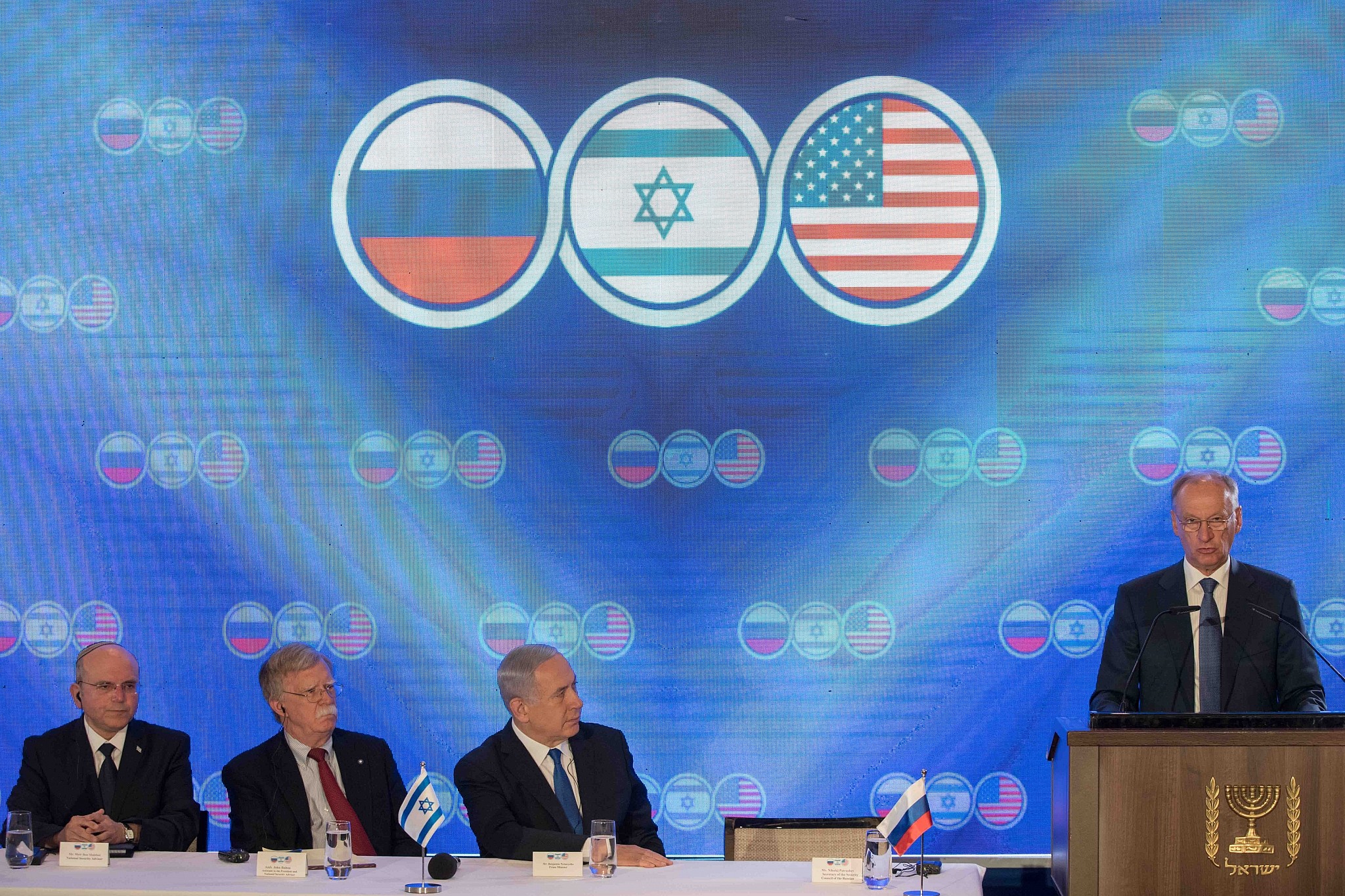
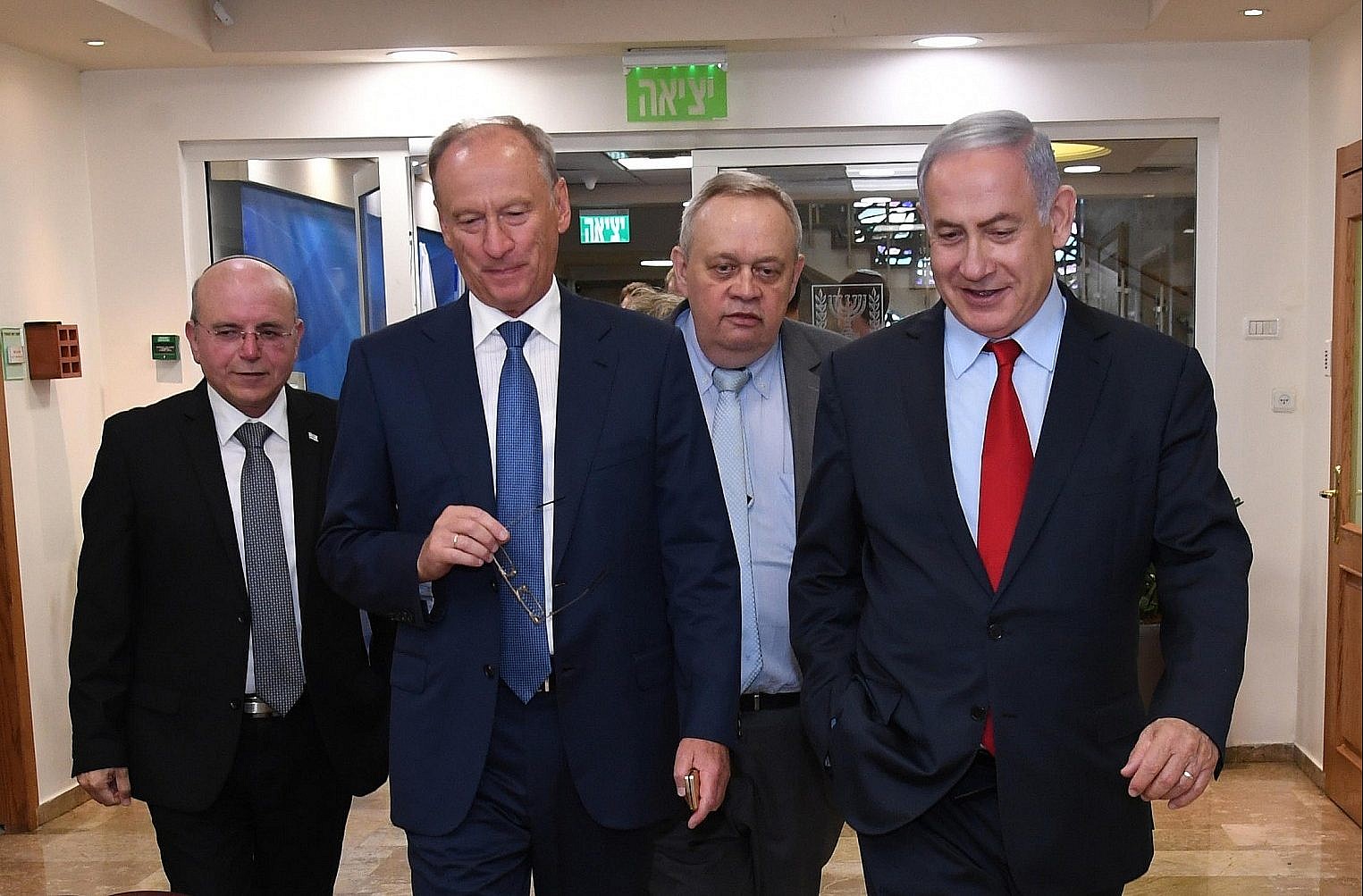
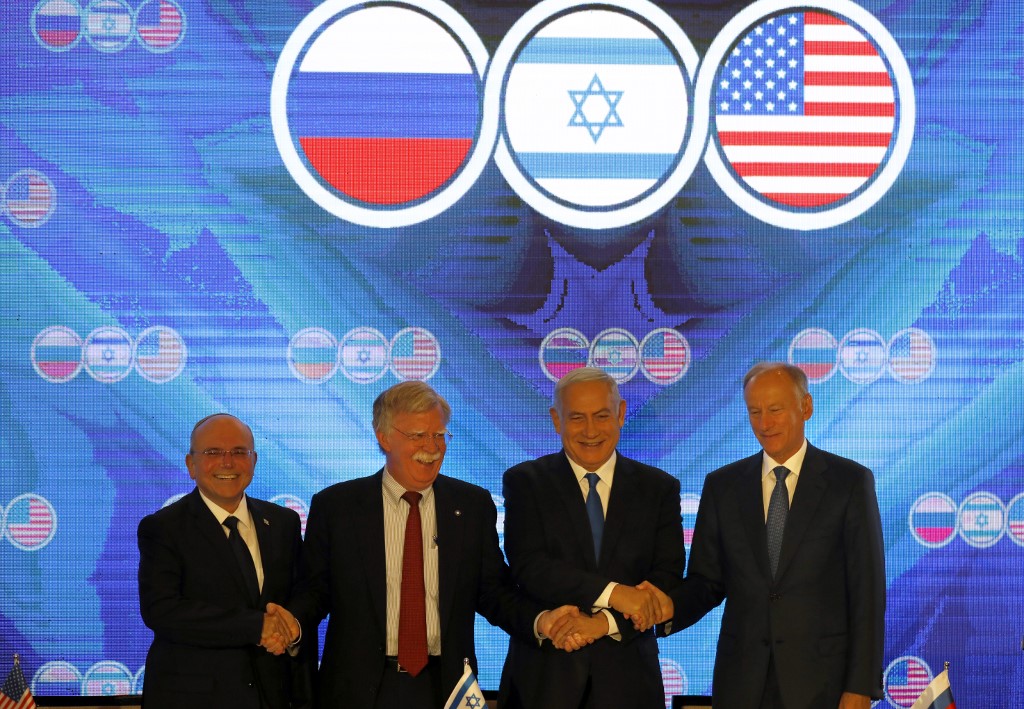
Secretary of the Russian Security Council Nikolai Patrushev speaks at a trilateral summit with Prime Minister Benjamin Netanyahu, center-right, US National Security Adviser John Bolton, center-left, and National Security Adviser Meir Ben-Shabbat at the Orient Hotel in Jerusalem on June 25, 2019. (Noam Revkin Fenton\Flash90)

Russia’s top national security adviser spoke out on behalf of Iran during trilateral meetings with his Israeli and American counterparts in Jerusalem on Tuesday, backing Tehran’s claims against the United States and supporting its ongoing military presence in Syria, which Israel sees as a threat to its security.

The trilateral conference of Israeli, Russian, and US national security advisers is the first event of its kind to be held in Jerusalem and, according to Israel, is aimed specifically at countering Iran, including both its nuclear aspirations and its influence throughout the Middle East.

The meeting comes amid escalating tensions between Washington and Tehran, following US President Donald Trump’s decision to pull out of the Iran nuclear deal last year and put in place a series of crushing economic sanctions. The Islamic Republic has retaliated by stepping up its uranium enrichment to levels beyond those permitted under the 2015 accord, allegedly carrying out a number of attacks on petroleum facilities around the Middle East, and shooting down a sophisticated US drone last week.

Russia, which maintains close ties to both Israel and Iran, is seen as a potential interlocutor between the West and Tehran. But comments made by its representative at the summit, security adviser Nikolai Patrushev, indicated that Moscow was siding with the Islamic Republic.

In press conferences on Tuesday, Patrushev rejected the view held by the US and Israel that Iran represents “the main threat to regional security” and said Israeli airstrikes in Syria against Iranian forces and its proxies were “undesirable.”

Commenting on the downing of a US drone by Iran last week, Patrushev said the Russian Defense Ministry had determined that the aircraft had entered Iranian airspace, as Tehran claims. The US maintains that the drone was flying in international airspace when it was downed.

“We have not seen any proof otherwise,” Patrushev said.
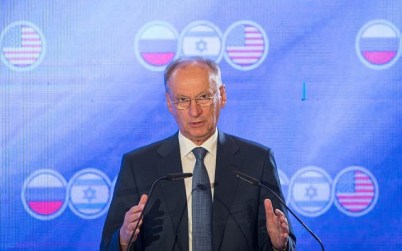
Secretary of the Russian Security Council Nikolai Patrushev speaks at a trilateral summit with Israel and the United States at the Orient Hotel in Jerusalem on June 25, 2019. (Noam Revkin Fenton\Flash90)

Patrushev also lauded Iran’s ongoing presence in Syria — which Israel sees as an unacceptable threat. The Russian official said Iran was “contributing a lot to fighting terrorists on Syrian soil and stabilizing the situation there.”

He said Moscow was aware of Israel’s concerns regarding Iran’s military presence in Syria and was working to address the issue with Tehran.

“We pay special attention to ensuring Israel’s security,” he said, calling it “a special interest of ours because here in Israel live a little less than about two million of our countrymen. Israel supports us in several channels, including at the UN. The prime minister [Netanyahu] has already said that we share the same views on the issue of the struggle against falsifying the history of World War II.”

According to a Central Bureau of Statistics report in 2016, as of five years ago, there were 985,000 immigrants from the former Soviet Union living in Israel.

US National Security Adviser John Bolton, seen as a longtime hawk on Iranian issues, threatened Tuesday that the White House would step up the sanctions and other measures against Iran if it exceeded the uranium enrichment levels of the nuclear deal, saying such a move would be a “very serious mistake” by Tehran.

Tehran had announced on May 8 that it was suspending two of its 2015 pledges and gave Europe, China and Russia a two-month ultimatum to help Iran circumvent US sanctions and sell its oil or it would abandon two more commitments. Bolton spoke a day after the US imposed fresh sanctions against Iran’s Supreme Leader Ayatollah Ali Khamenei.

“They’ll either get the point or as the president said, we will enhance the maximum pressure campaign further,” he said at a press conference, adding that “all options are on the table.”

In his press conference, Bolton disputed Patrushev’s positive view of Iranian troops in Syria, saying he did not believe this was the true stance of Russia and that Moscow also hopes to see Tehran’s forces and proxies leave Syria.

“The Russians have said repeatedly that they would like to see Iranian forces leave,” he said, citing comments made by Russian President Vladimir Putin in a recent meeting in Moscow.

Bolton said that despite this desire, Russia has thus far been unable to achieve this goal but that with the summit in Jerusalem the three countries were working to “find a way to make it happen.”

Israel has long sought Russian backing for its demand that Iranian forces leave Syria upon the conclusion of the country’s civil war.

Earlier this year, the Israeli military said the Iran-backed Hezbollah terror group had established a new base of operations in southern Syria along the border with Israel.

Earlier in the day, Bolton said that Trump, while imposing “significant new sanctions” on Iranian leaders on Monday, “has held the door open to real negotiations to completely and verifiably eliminate Iran’s nuclear weapons program, its pursuit of ballistic missile delivery systems, its support for international terrorism, and its other malign behavior worldwide.
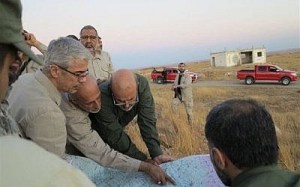
This file photo provided on Friday October 20, 2017 by the government-controlled Syrian Central Military Media shows Iran’s army chief of staff Maj. Gen. Mohammad Bagheri, left, looking at a map with senior officers from the Iranian military as they visit a front line position in the northern province of Aleppo, Syria. (Syrian Central Military Media, via AP)

“All that Iran needs to do is to walk through that open door,” he said.

In his press conference on Tuesday afternoon, Bolton stressed that the White House was not seeking regime change in the Islamic Republic. “That’s not the policy of the United States,” he said, acknowledging that as a private citizen he had called for this in the past.

Iran’s President Hassan Rouhani said that new US sanctions against senior Iranian officials including top diplomat Mohammad Javad Zarif showed Washington was “lying” about offering to negotiate.

Agencies contributed to this report.
 

FULL: John Bolton on Syria, Palestinians and Iran

June 25, 2019


Russia condemns Israeli strikes in Syria, attempts to isolate Iran

June 25, 2019

Source: Russia condemns Israeli strikes in Syria, attempts to isolate Iran

During a three-way meeting between Israeli, American and Russian security advisers – focused primarily on Iran and Syria – Nikolai Patrushev calls attempts to demonize Islamic Republic ‘unacceptable’; Bolton says ‘all options remain on the table’ if Tehran exceeds uranium enrichment limit
Russia’s national security adviser said Israeli air strikes on Syria were “undesirable” and condemned attempts to isolate Iran during a trilateral summit meeting with his Israeli and American counterparts in Jerusalem on Tuesday.
Prime Minister Benjamin Netanyahu at the beginning of the three-way meeting – focused primarily on Iran and Syria – called for the three countries to agree on expelling foreign forces from the war-torn neighboring country. He said Israel will not allow Iran to establish a permanent military presence there.

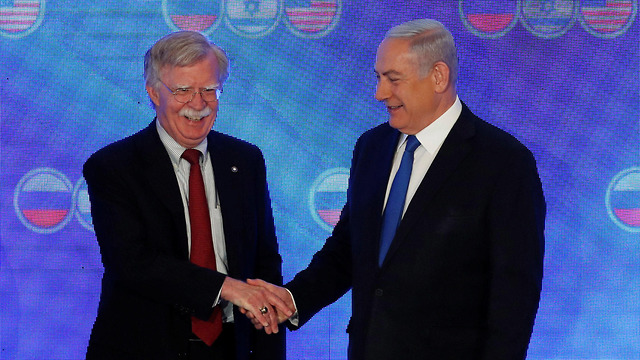
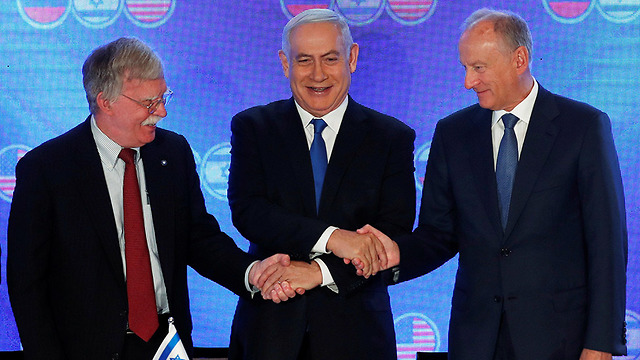
U.S. National Security Adviser John Bolton, Prime Minister Benjamin Netanyahu and Russian Security Council Secretary Nikolai Patrushev  (Photo: Reuters)

U.S. National Security Adviser John Bolton, Prime Minister Benjamin Netanyahu and Russian Security Council Secretary Nikolai Patrushev (Photo: Reuters)

Russian Security Council Secretary Nikolai Patrushev also said the attempts to present Iran as the main threat to the region and equate it to international terrorist groups are “not acceptable,” urging Israel and the United States to show “restraint” toward the Islamic Republic.

Patrushev added that “Iran is contributing a lot to fighting terrorists on the Syrian soil and stabilizing the situation there.” He also called on Israel and the U.S. to encourage a political settlement in Syria.

Russian Security Council Secretary Nikolai Patrushev (Photo: Eli Mendelbaum)

Russian Security Council Secretary Nikolai Patrushev (Photo: Eli Mendelbaum)

U.S. National Security Adviser John Bolton, meanwhile, said Washington’s pressure campaign against Iran would lead it to enter negotiations.

“They’ll either get the point or … we will simply enhance the maximum pressure campaign further,” Bolton told reporters. “It will be, I think, the combination of sanctions and other pressure that does bring Iran to the table.”

Bolton also said that “all options remain on the table” if Iran exceeds uranium enrichment limit under the 2015 deal.

He was responding to a question about whether a military strike was still an option if Iran crosses the 300-kilogram stockpile threshold outlined in the atomic accord. Bolton says it would be “a very serious mistake for Iran to ignore those limits.”

John Bolton and Prime Minister Netanyahu (Photo: Reuters)

John Bolton and Prime Minister Netanyahu (Photo: Reuters)

Iran says it will possess over 300 kilograms of low-enriched uranium by Thursday, in violation of the deal. Europe separately faces a July 7 deadline imposed by Tehran to offer a better deal or Iran will begin enriching its uranium closer to weapons-grade levels.

Bolton, a longtime Iran hawk, says it “should give up their pursuit of deliverable nuclear weapons.”

“The attainment of security and stability in our region is our common goal. It will be unattainable without reining in Iran’s aspirations and actions,” said Israel’s National Security Adviser Meir Ben-Shabbat. “Recent events underscore this conclusion, which must be taken into account in any outline for an agreement.”

Netanyahu kicked-off the summit by thanking both Russian President Vladimir Putin and U.S. President Donald Trump for working with Israel on resolving regional conflicts. “All three of us would like to see a peaceful, stable and secure Syria,” Netanyhau said.

“We also have a common objective to achieve that larger goal, and that is no foreign forces that arrived in Syria after 2011 remain in Syria. We think there are also ways to achieve this common goal, which will create a more stable Middle East,” Netanyahu said. “The departure of all foreign forces from Syria – will be good for Russia, good for the United States, good for Israel, and may I add, good for Syria.”


FULL: Netanyahu and Bolton Address Mideast Security Issues 

June 25, 2019


Iran currently setting up terror cells in Africa to attack U.S., others

June 25, 2019

Source: Iran currently setting up terror cells in Africa to attack U.S., others – Breaking News – Jerusalem Post

According to the Telegraph, “The aim of the new terror cell is to target US and other Western military bases on the continent, as well as embassies and officials.”

BY BENJAMIN WEINTHAL
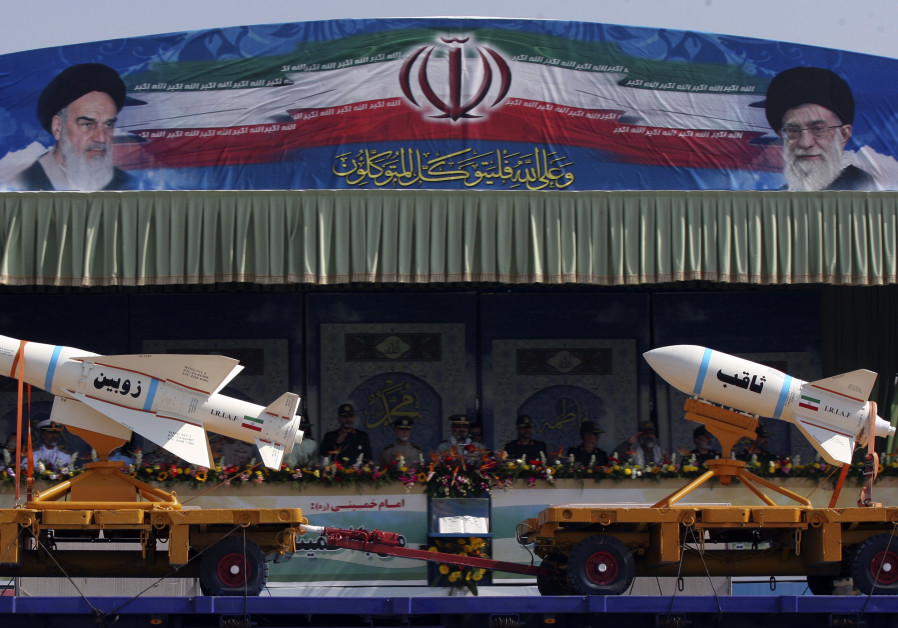
A military vehicle carrying Iranian Zoobin smart bomb (L) and Sagheb missile under pictures of Iran'

The Islamic Republic of Iran is spreading its state-sponsored terrorism to Western African countries to attack the US and Western assets, the British Daily Telegraph reported on Wednesday.

“Iran is setting up a network of terror cells in Africa to attack US and other Western targets in retaliation for Washington’s decision to impose sanctions against Tehran, according to Western security officials,” according to the newspaper.The article by veteran defense and security journalist Con Coughlin said that the “new terror network has been established on the orders of Qassem Suleimani, the head of the Quds Force, the elite section of Iran’s Republican Guard Corps that has responsibility for overseas operations.”

The United States government classifies Iran’s regime as the leading international state-sponsor of terrorism.

According to the Telegraph, “The aim of the new terror cell is to target US and other Western military bases on the continent, as well as embassies and officials. The Iranian cells are said to be active in a number of African countries including Sudan, Chad, Ghana, Niger, Gambia and the Central African Republic.”

“Iran is setting up a new terrorist infrastructure in Africa with the aim of attacking Western targets,” a senior Western security source told The Telegraph, adding, “It is all part of Tehran’s attempts to expand its terrorist operations across the globe.”

The report noted “Intelligence officials say Iran has been working on the new terror network for the past three years since signing the nuclear deal on freezing its uranium enrichment activities with the US and other major world powers in 2015.”

Coughlin wrote that “The operation is being organized by Unit 400, a highly specialized section of the Quds Force which is run by Hamed Abdollahi, a veteran Republican Guard officer who was designated by the US as supporting terrorist activity in 2012.”

The African cell is said to be run by Ali Parhoon, another senior Iranian officer in Unit 400. Details of the terror cell’s existence were uncovered following a series of arrests in Chad in April.

“Investigators found that Iran was behind the recruitment and training of men between the ages of 25-35 with the aim of committing terror attacks against Western targets on the continent,” The Telegraph reported.

“There are estimated to be around 300 militants who have been recruited by the Revolutionary Guard and have undergone rigorous training at Iranian-run training camps in Syria and Iraq.”

According to the article, “The last batch of recruits were trained at an Iranian base in the southern Iraqi city of Najaf. Iran’s attempts to establish a new terror operation in Africa follow revelations in The Telegraph earlier this month that British security officials caught terrorists linked to Iran stockpiling tons of explosives on the outskirts of London.

“The British authorities believe this cell was also set up in 2015 after Iran signed the nuclear deal.

“US diplomatic officials say a warning has been circulated to American diplomatic and military missions in the countries where Iranian militants are said to be operating, as well as missions of other Western countries, including Britain, France and Italy,” The Telegraph reported.

The Jerusalem Post reported last week that one of  main actors in espionage activities in the Federal Republic of Germany is Iran’s clerical regime, according to the intelligence report from the state of Brandenburg, which was reviewed by the Post.

Iran’s regime also has 1,050  Hezbollah operatives in Germany who are loyal to Tehran. German Chancellor Angela Merkel has declined to ban Hezbollah’s political wing in Germany. The United Kingdom outlawed Hezbollah’s so-called political wing in February.  The EU banned Hezbollah’s so-called military wing in 2013.

Iran’s regime has conducted illicit proliferation activities in Germany since the 2015 Iran nuclear deal was reached with Tehran. In exchange for Tehran agreeing to curbs on its nuclear program, the world powers – including Germany – provided considerable economic sanctions relief to Iran.

The Post reported in May that a German state intelligence report from Bavaria said Iran is “making efforts to expand its conventional arsenal of weapons with weapons of mass destruction.”

Iran was termed a “risk country” in the 335-page document outlining serious threats to the security and democracy of the state of Bavaria.

The intelligence report defines weapons of mass destruction as “the spread of atomic, biological [or] chemical weapons of mass destruction.”

The May 2019 intelligence report from the northern German state of Mecklenburg-Vorpommern stated: “The fight against the illegal proliferation of nuclear, biological or chemical weapons of mass destruction and the materials needed for their manufacture, as well as the corresponding delivery systems [e.g. rockets], including the necessary knowledge, in cooperation with other authorities, is also the responsibility of counterintelligence.”

The intelligence report added, “From these points of view, it is essentially the Islamic Republic of Pakistan, the Islamic Republic of Iran, the Democratic People’s Republic of Korea [North Korea] and the Syrian Arab Republic that need to be mentioned. The intelligence services of these countries are involved in unlawful procurement activities in the field of proliferation, using globally oriented, conspiratorial business and commercial structures.”


Iran says ‘idiotic’ new US sanctions have closed path to diplomacy

June 25, 2019

Source: Iran says ‘idiotic’ new US sanctions have closed path to diplomacy | World news | The Guardian

Foreign ministry spokesman accuses Trump administration of destroying peace and security

Iran’s Supreme Leader Ayatollah Ali Khamenei has become the target of new US sanctions
 Iran’s Supreme Leader Ayatollah Ali Khamenei has become the target of new US sanctions Photograph: Caren Firouz/Reuters

Iran says the US decision to impose sanctions on its supreme leader and other top officials is “idiotic” and has permanently closed the path to diplomacy between Tehran and Washington.

Donald Trump imposed new sanctions on Monday against supreme leader Ayatollah Ali Khamenei and top military chiefs, in an unprecedented step designed to increase pressure on Iran after Tehran’s downing of an unmanned American drone. Khamenei is Iran’s utmost authority who has the last say on all state matters.

Washington said it would also impose sanctions this week on Iran’s foreign minister Javad Zarif, who negotiated the 2015 nuclear deal with the US and other major powers and has spearheaded Iranian diplomacy since.

Hassan Rouhani, the country’s president, said the new sanctions were “outrageous and idiotic”. Speaking in a live television address on Tuesday, he added: “You sanction the foreign minister simultaneously with a request for talks?” The White House was “afflicted by mental retardation”, he said.

A foreign ministry spokesman said in a tweet: “Imposing useless sanctions on Iran’s supreme leader and the commander of Iran’s diplomacy is the permanent closure of the path of diplomacy. Trump’s desperate administration is destroying the established international mechanisms for maintaining world peace and security.”

Signing an executive order in the Oval Office on Monday, Trump called the increased sanctions “hard-hitting”, saying they would deny the supreme leader, his office and and those closely affiliated with him access to key financial resources.

“These measures represent a strong and proportionate response to Iran’s increasingly provocative actions,” Trump said. “We do not seek conflict with Iran or any other country. I can only tell you we cannot ever let Iranhave a nuclear weapon.”

Standing alongside Trump, the treasury secretary, Steven Mnuchin, said the measures would freeze billions of dollars in Iranian assets.

But analysts said their impact on an already heavily-sanctioned country would be limited.

“The newly announced Iran sanctions are symbolic,” said Jarrett Blanc, a former senior state department official now at the Carnegie Endowment for International Peace.

Trump said he was willing to pursue dialogue with Tehran without preconditions, a line echoed by his national security adviser John Bolton on Tuesday. “All that Iran needs to do is walk through that open door,” Bolton said at a high-profile trilateral security summit in Jerusalem.

But the sanctions appeared to make such talks even less likely.

The Iranian ambassador to the UN, Majid Takht-Ravanchi, said: “No one in clear mind can have a dialogue with somebody who is threatening you with sanctions as long as that is still there is no way we can have a dialogue.”

The ratcheting up of tensions between the two countries comes in the wake of the Gulf of Oman tanker attacks, when two vessels were damaged by explosions. The Trump administration blamed Iran for the attacks, but Tehran denied responsibility.

Then last week a US drone was shot down by Iran, further escalating the crisis. The US president responded by ordering an attack on Iran, before pulling back and opting for stronger sanctions instead.

Tensions with Iran have been mounting since Trump withdrew theUS from the 2015 nuclear deal last year and began applying pressure onTehranthrough economic sanctions.


Netanyahu tells Russian official: We will do ‘anything’ to prevent nuclear Iran 

June 25, 2019

Source: Netanyahu tells Russian official: We will do ‘anything’ to prevent nuclear Iran | The Times of Israel

At Jerusalem meet ahead of trilateral summit, Moscow’s national security adviser promises to pay ‘special attention to ensuring Israel’s security’

Prime Minister Benjamin Netanyahu, right, meets Russia's national security adviser, Nikolai Patrushev, second from left, in Jerusalem, June 24, 2019. Israel's National Security Adviser Meir Ben-Shabbat is at left. (Haim Tzach/GPO)

Prime Minister Benjamin Netanyahu, right, meets Russia’s national security adviser, Nikolai Patrushev, second from left, in Jerusalem, June 24, 2019. Israel’s National Security Adviser Meir Ben-Shabbat is at left. (Haim Tzach/GPO)

Prime Minister Benjamin Netanyahu told Russian President Vladimir Putin’s top security adviser on Monday that Israel will do “anything it takes” to ensure Iran does not obtain nuclear weapons.

“I’m certain that Russia understands what it means for us when a regime calls for our annihilation, and acts on a daily basis to achieve that aim,” Netanyahu said in a meeting at his Jerusalem office with Russia’s National Security Council Secretary Nikolai Patrushev.

“Israel won’t allow an Iran that calls for our annihilation to entrench itself on our border, and we will do anything it takes to prevent it from obtaining nuclear weapons,” the prime minister said.

The meeting comes ahead of a first-ever trilateral summit Tuesday between the Russian, Israeli and American national security advisers — Patrushev, Meir Ben-Shabbat and John Bolton, respectively.

“The security cooperation between Russia and Israel has already contributed a great deal to the security and stability of our region, and has profoundly changed the regional situation,” Netanyahu said.

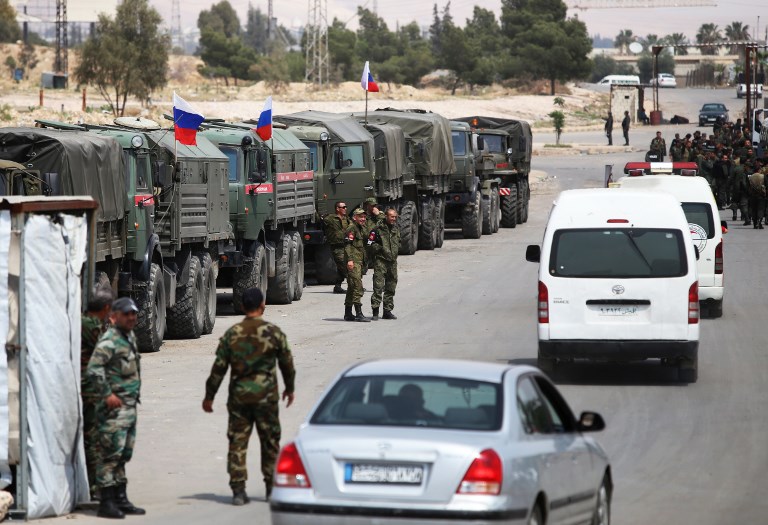
Syrian and Russian soldiers at the entrance of the Wafideen Camp in Syria, on April 12, 2018. (AFP Photo/Youssef Karwashan)

In a statement to reporters, Patrushev said Monday that the following day’s summit would focus on “the regional situation, especially Syria,” and place special emphasis on Israel’s security concerns.

“We pay special attention to ensuring Israel’s security,” he said, calling it “a special interest of ours because here in Israel live a little less than about two million of our countrymen. Israel supports us in several channels, including at the UN. The prime minister [Netanyahu] has already said that we share the same views on the issue of the struggle against falsifying the history of World War II.”

Among the issues that will be discussed with Bolton, Patrushev added, were “several ideas about how to reach peace in your region. And once we reach agreement, we should add other states in the region to this format.”

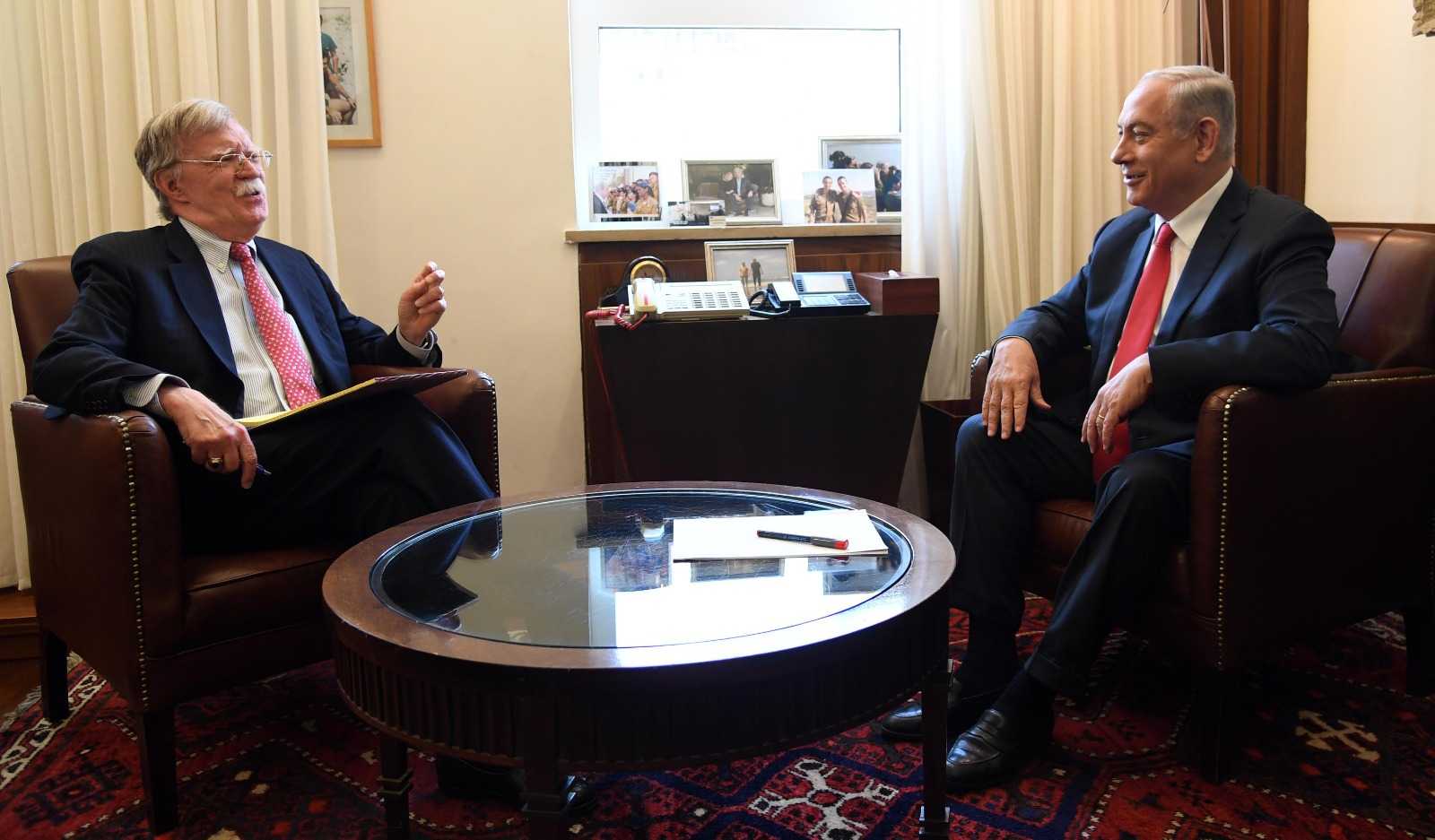
US National Security Adviser John Bolton, left, meets with Prime Minister Benjamin Netanyahu at the Prime Minister’s Office in Jerusalem, June 23, 2019. (Haim Zach/GPO)

Earlier Monday, during a meeting of the cabinet, Netanyahu called the upcoming trilateral gathering “an unprecedented summit between two great powers, the United States and Russia, and Israel — here in Israel.

“The very fact that this summit is happening here is more evidence of the special standing of Israel among the nations of the world at this time,” he said.

Iran’s efforts to entrench itself militarily in Syria and the escalating tensions between Tehran and Washington are expected to top the agenda.

Patrushev has tried to navigate the regional struggle between Israel and Iran without upending Russia’s relationship with either.

Last week, he said Moscow would back Iran’s interests at the trilateral meeting.

“Iran is in Syria at the invitation of the legitimate government and is actively involved in fighting terrorism. Therefore, of course, we will have to take into account the interests of Iran,” Patrushev said.

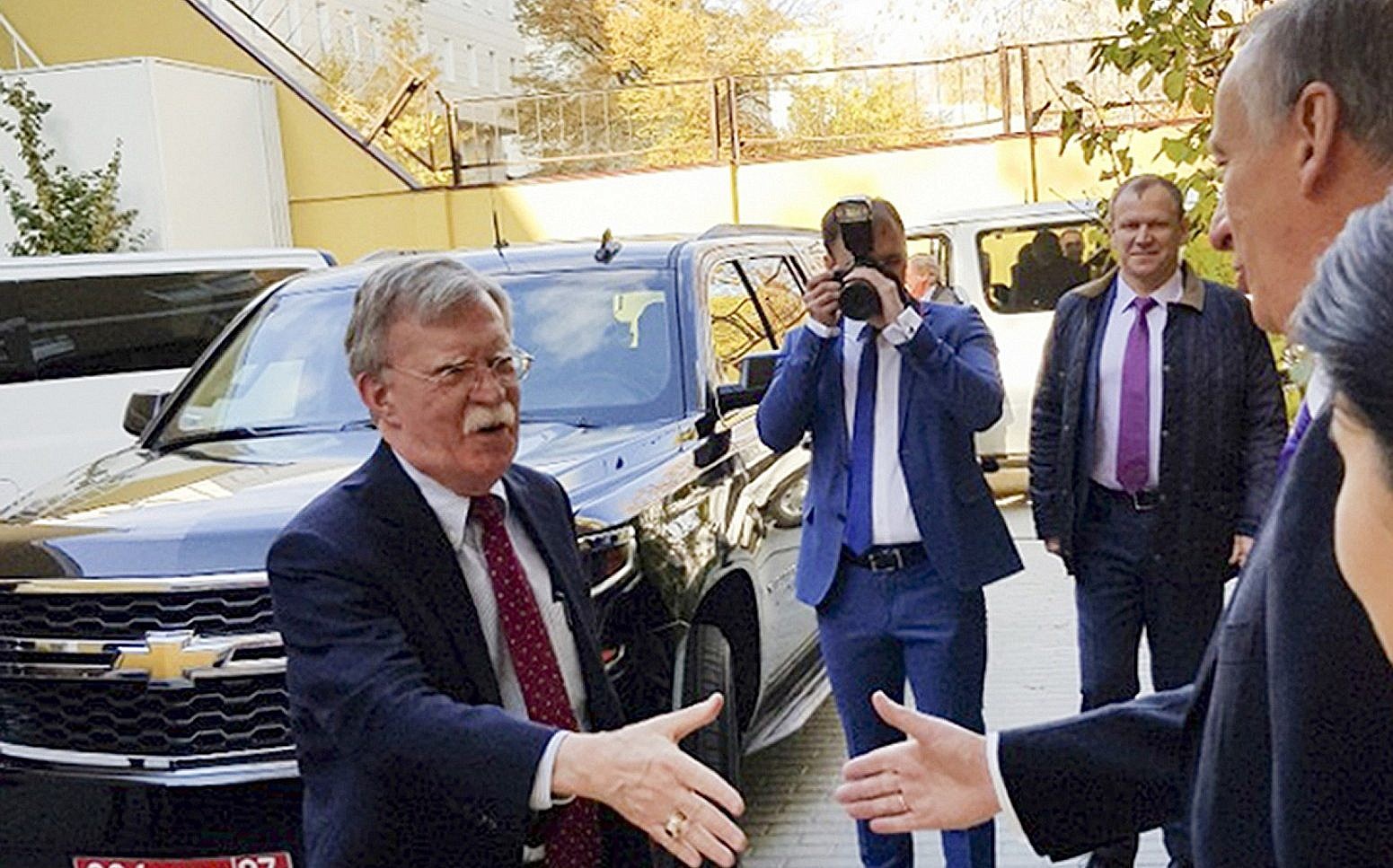
US National Security Adviser John Bolton, left, is greeted by Russian Security Council chairman Nikolai Patrushev in Moscow, Russia, October 22, 2018. (Press Service of the Russian Security Council via AP)

Earlier this month, a senior US official said Washington would use the meeting to tell Moscow that Iran should withdraw from Syria, and ask for Russia’s suggestions on how to counter Tehran’s influence in the region. The unnamed official said that the US supported Israel’s actions against Iranian entrenchment in Syria.

“We would hope to make the point in conjunction with the Israelis that we don’t see any positive role for the Iranians — and that would extend beyond Syria, to Lebanon, to Iraq, to Yemen — other places where they’re active,” the official said, according to a Reuters report.

He added that Washington was sure that the summit, with Israel hosting both Russia and the US in Jerusalem, would irk Iranian leadership, and said that the fact that Russia was participating was a positive sign.

“The fact that the Russians see value in these conversations, that they’re willing to do it publicly, I think is in and of itself quite significant,” the official said.

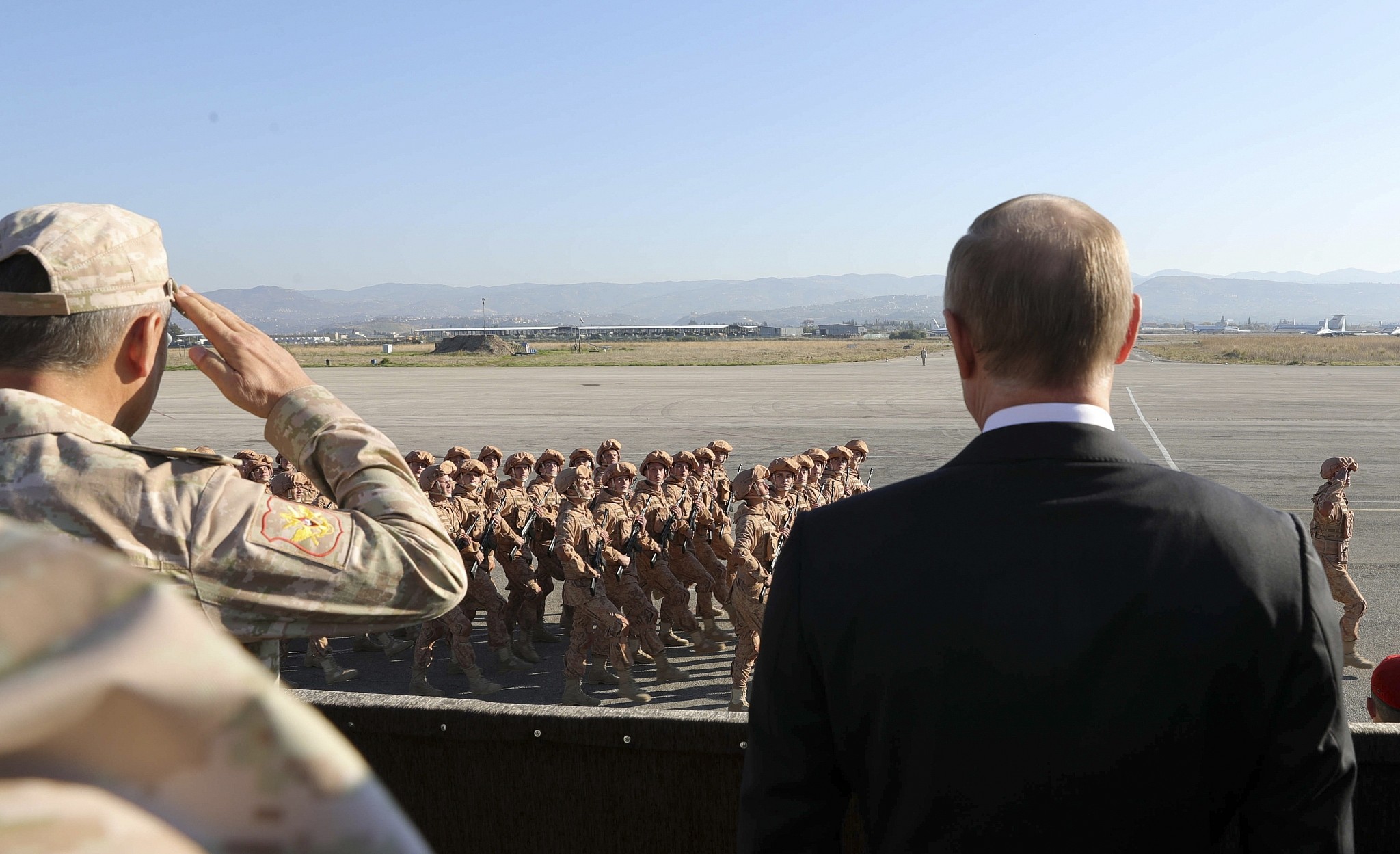
Russian President Vladimir Putin, right, meets troops alongside Syrian President Bashar Assad on a visit to the Hmeimim air base in Syria, December 11, 2017. (Mikhail Klimentyev, Sputnik, Kremlin Pool Photo via AP)

According to a report by the Kan public broadcaster, Israel and the US will offer Russia incentives for an effort to curb Iranian influence in Syria, which could include legitimizing the continued leadership of Syrian President Bashar Assad. It was unclear what Washington and Jerusalem would offer Moscow in return.

Moscow is a close ally of Tehran and Damascus, while Jerusalem and Washington are seen by the Iranian regime as archenemies.


Rouhani says US ‘lying’ about talks offer, suffers from ‘mental retardation’ 

June 25, 2019

Source: Rouhani says US ‘lying’ about talks offer, suffers from ‘mental retardation’ | The Times of Israel

Iranian president denounces sanctions against foreign minister Zarif; military spokesman says Washington ruptured path of diplomacy by also targeting supreme leader Khamenei

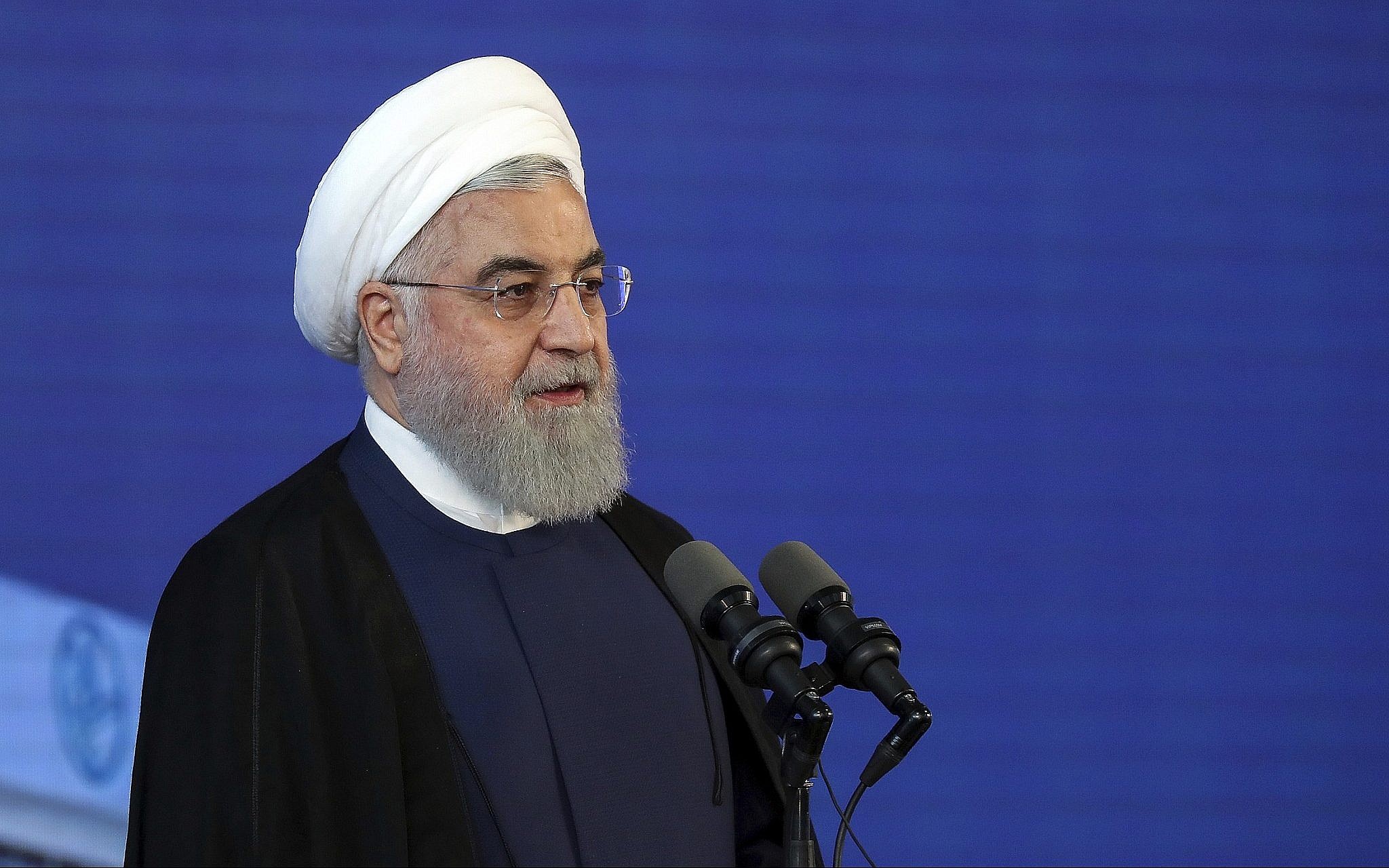
In this photo released by an official website of the office of the Iranian Presidency, Iranian President Hassan Rouhani speaks in a ceremony at Imam Khomeini International Airport some 25 miles (40 kilometers) south of the capital Tehran, Iran, June 18, 2019. (Iranian Presidency Office via AP)

In this photo released by an official website of the office of the Iranian Presidency, Iranian President Hassan Rouhani speaks in a ceremony at Imam Khomeini International Airport some 25 miles (40 kilometers) south of the capital Tehran, Iran, June 18, 2019. (Iranian Presidency Office via AP)

Iran’s President Hassan Rouhani said Tuesday that new US sanctions against senior Iranian officials including top diplomat Mohammad Javad Zarif showed Washington is “lying” about offering to negotiate.

“At the same time as you call for negotiations you seek to sanction the foreign minister? It’s obvious that you’re lying,” Rouhani said in a meeting with ministers broadcast live on TV.

He also said the White House is “afflicted by mental retardation.”

His comments came as US National Security Adviser John Bolton said in Jerusalem that Washington had “held the door open to real negotiations” but that “in response, Iran’s silence has been deafening.”

Iran’s Foreign Ministry said the sanctions on its leaders represent the “permanent closure” of diplomacy with Washington.

“Imposing fruitless sanctions against Iran’s supreme leader and the commander of Iran’s diplomacy is the permanent closure of the path to diplomacy with Trump’s desperate government,” ministry spokesman Abbas Mousavi said in a tweet.

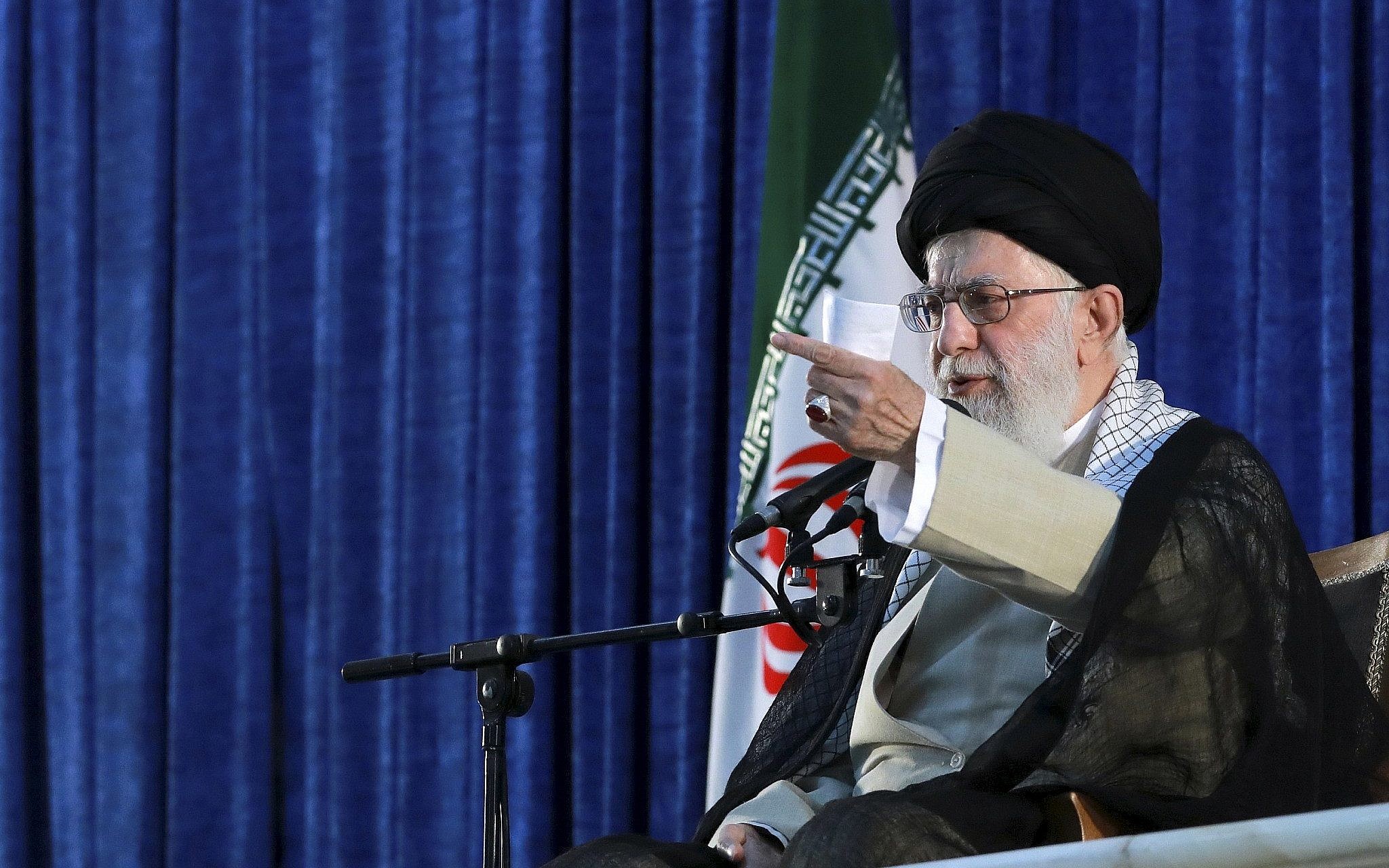
Iranian supreme leader, Ayatollah Ali Khamenei speaks in a ceremony marking the 30th death anniversary of the late revolutionary founder Ayatollah Ruhollah Khomeini, at his mausoleum just outside Tehran, Iran, June 4, 2019. (Office of the Iranian Supreme Leader via AP)

Washington imposed new sanctions against supreme leader Ayatollah Ali Khamenei Monday as well as blacklisting Foreign Minister Zarif, its latest salvo in a tense standoff that has raised fears of a regional conflict.

“Trump’s government is destroying all established international mechanisms for keeping global peace and security,” Mousavi added.

Zarif responded Monday to the sanctions, saying that leaders in Israel, Saudi Arabia and the US “despise diplomacy and thirst for war.”

US President Donald Trump also imposed new sanctions Monday against top Iranian military chiefs, pressuring the country it has threatened with “obliteration” if a war breaks out.

Washington’s move came after Iran shot down a US spy drone last week and Trump authorized a retaliatory strike but canceled it at the last minute.

That follows a series of attacks on ships in sensitive Gulf waters that the US has blamed on Iran — allegations hotly denied by Tehran. The incidents came a year after Trump unilaterally withdrew from a multilateral pact with Iran over its nuclear program.

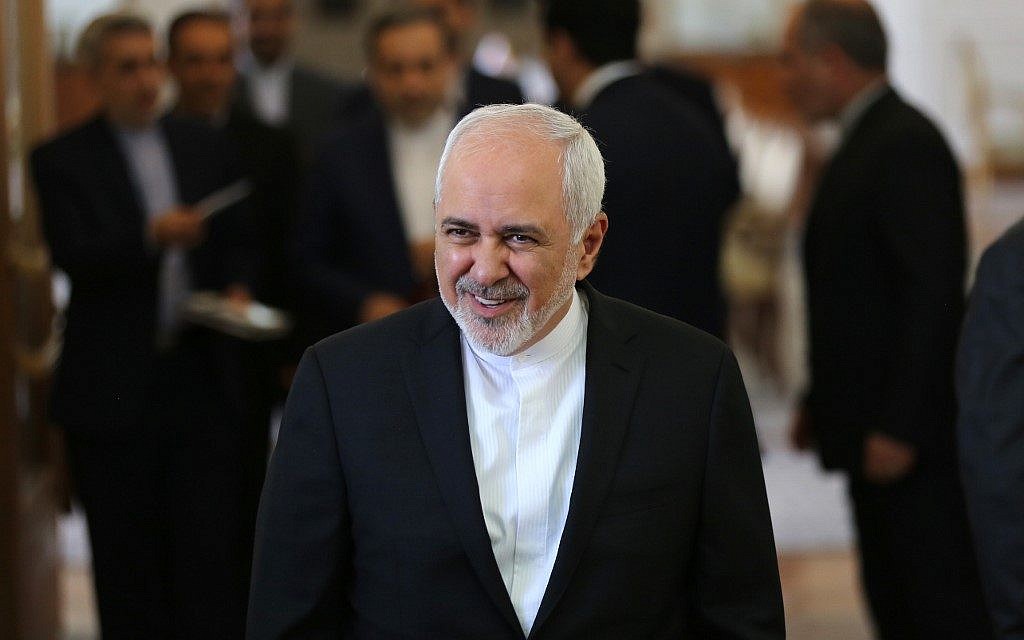
Iranian Foreign Minister Mohammad Javad Zarif arrives to meet his Japanese counterpart in Tehran on June 12, 2019. (Atta Kenare/AFP)

US media have also reported Trump secretly authorized cyberattacks against Iran’s missile defense systems and a spy network, but Tehran says no damage was done.

Trump called the punitive measures “a strong and proportionate response to Iran’s increasingly provocative actions.”

Tehran and Washington broke off diplomatic relations in 1980 over the hostage crisis at the US embassy in Tehran following Iran’s Islamic Revolution.


Bolton slams Iran’s ‘belligerence’ but says ‘door is open’ for negotiations

June 25, 2019

Source: Bolton slams Iran’s ‘belligerence’ but says ‘door is open’ for negotiations | The Times of Israel

At Jerusalem summit with Israeli, Russian counterparts, Trump security adviser says talks possible if Tehran renounces nukes, ballistic missiles, terrorism

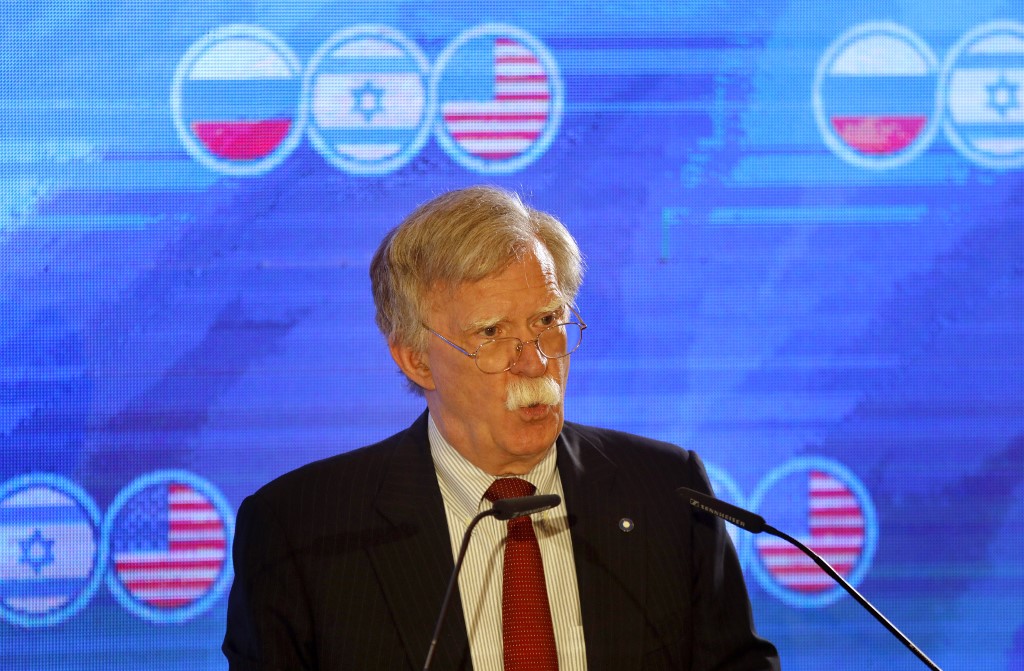
US National Security Adviser John Bolton speaks at a trilateral summit of national security advisers of the US, Israel and Russia, in Jerusalem on June 25, 2019. (Menahem Kahana/AFP)

US National Security Adviser John Bolton speaks at a trilateral summit of national security advisers of the US, Israel and Russia, in Jerusalem on June 25, 2019. (Menahem Kahana/AFP)

US President Donald Trump’s top national security adviser urged Iran on Tuesday to step back from its “malign behavior” and enter into “real negotiations” over its nuclear weapons program, ballistic missile development, and backing for international terror groups.

Speaking at a summit meeting between Israel’s, Russia’s and America’s national security advisers in Jerusalem, John Bolton slammed Iran as the “source of belligerence and aggression” in the Middle East.

He accused Tehran of supporting violence throughout the region — from Hezbollah in Lebanon to the Assad regime in Syria, as well as Shiite militias in Iraq, Yemen’s Houthi rebels, and terror attacks on US forces in Afghanistan — and of threatening Middle Eastern oil supplies.

He also charged that the Islamic Republic was still pursuing nuclear weapons, saying, “There’s simply no evidence that Iran has made the strategic decision to renounce nuclear weapons and open realistic discussions to demonstrate that decision.

“In just a few days,” he noted, “Iran has threatened to exceed the key limits imposed by the inadequate 2015 Iran nuclear deal, exposing once again the fatal deficiencies of that failed agreement.”

He said Trump, while imposing “significant new sanctions” on Iranian leaders on Monday, “has held the door open to real negotiations to completely and verifiably eliminate Iran’s nuclear weapons program, its pursuit of ballistic missile delivery systems, its support for international terrorism, and its other malign behavior worldwide.

“All that Iran needs to do is to walk through that open door,” he said.

Meanwhile on Tuesday, Iran’s President Hassan Rouhani said that new US sanctions against senior Iranian officials including top diplomat Mohammad Javad Zarif showed Washington was “lying” about offering to negotiate.

A ‘historic’ gathering in Jerusalem

Prime Minister Benjamin Netanyahu, speaking to the three countries’ delegations, which met at Jerusalem’s Orient Hotel, said the “historic” gathering signaled the sides’ “common objective” of ensuring the withdrawal of all foreign forces from Syria.

Israel has long sought Russian backing for its demand that Iranian forces leave Syria upon the conclusion of the country’s civil war.

In this photo released by an official website of the office of the Iranian Presidency, Iranian President Hassan Rouhani speaks in a ceremony at Imam Khomeini International Airport some 25 miles (40 kilometers) south of the capital Tehran, Iran, June 18, 2019. (Iranian Presidency Office via AP)

“There’s a wider basis for cooperation between the three of us than many believe…. We have a common objective: that no foreign forces that arrived in Syria after 2011 remain in Syria. We think there are also ways to achieve this common goal. We look forward to discussing concrete ways to achieve this goal,” he said.

Sounding a different tone on Iran, the Russian national security adviser, Nikolia Patrushev, insisted that Tehran was aiding in the battle against Islamist terrorists in Syria. “We work together and listen to each other. We’re aware of Israel’s concerns and hope the threats will be lifted,” he said.

The meeting between the three nations’ national security advisers — Bolton, Patrushev, and Israel’s Meir Ben-Shabbat — was the first-ever such trilateral summit.

Iran’s efforts to entrench itself militarily in Syria and the escalating tensions between Tehran and Washington were expected to top the agenda.

On Monday, Netanyahu told Patrushev that Israel would do “anything it takes” to ensure Iran does not obtain nuclear weapons.

In a statement to reporters Monday, Patrushev said the summit would focus on “the regional situation, especially Syria,” and place special emphasis on Israel’s security concerns.

Prime Minister Benjamin Netanyahu, second right, US National Security Adviser John Bolton, second left, Russian National Security Council Secretary Nikolai Patrushev, right, and Israeli National Security Adviser Meir Ben-Shabbat, left, take part in a trilateral summit in Jerusalem on June 25, 2019. (Menahem Kahana/AFP)

“We pay special attention to ensuring Israel’s security,” he said, calling it “a special interest of ours because here in Israel live a little less than about two million of our countrymen. Israel supports us in several channels, including at the UN. The prime minister [Netanyahu] has already said that we share the same views on the issue of the struggle against falsifying the history of World War II.”

Among the issues that will be discussed with Bolton, Patrushev added, were “several ideas about how to reach peace in your region. And once we reach agreement, we should add other states in the region to this format.”

Earlier Monday, during a meeting of the cabinet, Netanyahu called the trilateral gathering “an unprecedented summit between two great powers, the United States and Russia, and Israel — here in Israel.

“The very fact that this summit is happening here is more evidence of the special standing of Israel among the nations of the world at this time,” he said.

Agencies contributed to this report.


Iran calls US cyber attack unsuccessful, warns it could repeat drone downing

June 24, 2019

Source: Iran calls US cyber attack unsuccessful, warns it could repeat drone downing | The Times of Israel

Meanwhile White House said drafting plans for possible further cyber action: targeting Iranian navy and seeking to foment unrest elsewhere in the nation

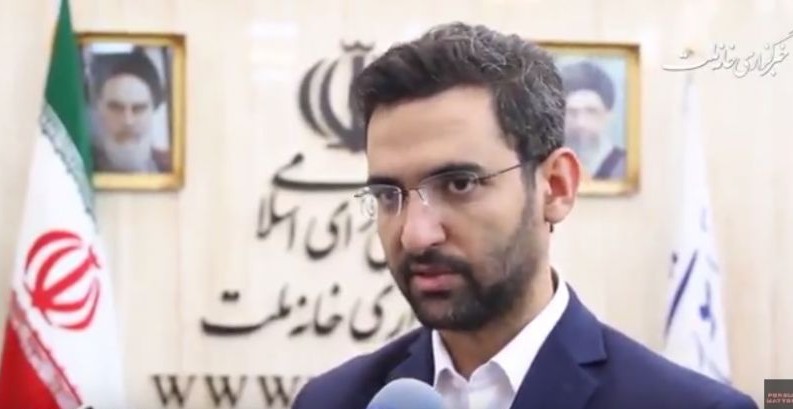
Iran's communications minister Mohammad-Javad Azari Jahromi speaks in a TV interview on August 13, 2017. (screen capture: YouTube)

Iran’s communications minister Mohammad-Javad Azari Jahromi speaks in a TV interview on August 13, 2017. (screen capture: YouTube)

An Iranian minister said Monday that the US was unsuccessful in its cyber attacks against Iran this week after Tehran downed an American surveillance drone.

“They try hard, but have not carried out a successful attack,” said Mohammad Javad Azari Jahromi, Iran’s minister for information and communications technology, according to the Reuters news agency.

“Media asked if the claimed cyber attacks against Iran are true,” he said. “Last year we neutralized 33 million attacks with the [national] firewall.”

On Sunday the New York Times reported US military and intelligence officials are drafting plans for additional cyber attacks against Iranian targets.

Current and former officials told the Times the White House is drafting a wide range of covert operations that include disabling Iranian boats used to conduct shipping attacks in and around the Strait of Hormuz, as well as unspecified efforts to stoke unrest inside the Islamic Republic. The White House may also be exploring ways weaken Iranian proxy groups in the region, the officials said.

A former US military commander told the Times that if the Pentagon or Central Intelligence Agency pursued one of the options, there would not be “crystal-clear attribution” the US was responsible.

Tensions between Washington and Tehran have flared since Iran on Thursday shot down the US drone. Iran said the drone violated its airspace — a claim the US denies — near the strategic Strait of Hormuz.

Iranian Navy chief Rear Admiral Hossein Khanzadi on Monday warned the country could carry out similar actions in the future. “This firm response can be repeated, and the enemy knows it,” he said, according to a report in the Tasnim news agency translated by Reuters.

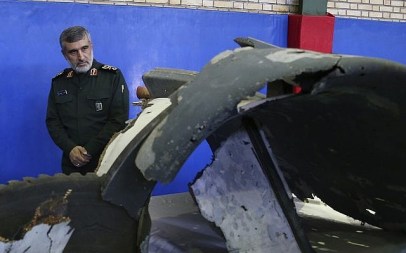
Head of the Revolutionary Guard’s aerospace division Brig. Gen. Amir Ali Hajizadeh looks at debris from what the division describes as the US drone which was shot down by Iran, seen here in Tehran, Iran, June 21, 2019 (Meghdad Madadi/Tasnim News Agency/via AP)

In response to the drone’s destruction, the US was ready to carry out a military strike against Iran but US President Donald Trump said he called it off at the last minute after being told some 150 people could die.

The aborted attack was the closest the US has come to a direct military strike on Iran in the year since the administration pulled out of the 2015 international agreement intended to curb the Iranian nuclear program and launched a campaign of increasing economic pressure against the Islamic Republic.

But after the drone’s downing, Trump secretly authorized US Cyber Command to carry out a retaliatory cyber attack on Iran, The Washington Post reported Saturday.

The attack crippled computers used to control rocket and missile launches, according to the Post, which cited people familiar with the matter.

Yahoo cited two former intelligence officials as saying the US targeted a spying group responsible for tracking ships in the strategic Strait of Hormuz, where Washington has blamed Iran for two recent mine attacks on oil tankers.

An oil tanker is on fire in the sea of Oman, June 13, 2019. (AP Photo/ISNA)

The Post said the cyber strikes, which caused no casualties, had been planned for weeks and were first proposed as a response to the tanker attacks. US defense officials refused to confirm the reports.

Azari Jahromi said the attacks on Iranian computer networks over the weekend were “cyber-terrorism, like Stuxnet,” referring to a virus discovered in 2010 which is believed to have been engineered by Israel and the US to damage nuclear facilities in Iran.

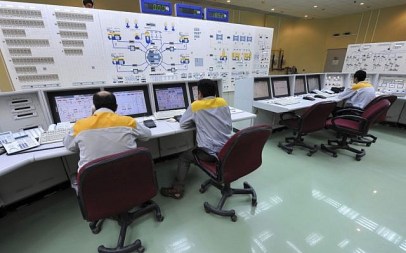
Iranian technicians work at the Bushehr nuclear power plant in 2010 (photo credit: AP/IIPA, Ebrahim Norouzi)

Iranian technicians work at the Bushehr nuclear power plant in 2010 (photo credit: AP/IIPA, Ebrahim Norouzi)

Tehran is believed to have stepped up its own cyber capabilities in the face of US efforts to isolate the Islamic Republic.

Trump last year left a multinational accord curbing Iran’s nuclear ambition. His administration has instead imposed a robust slate of punitive economic sanctions designed to choke off Iranian oil sales and cripple its economy.

On Saturday, Trump said the US would put “major” new sanctions on Iran on Monday.

Meanwhile, Iran has denied responsibility for attacks on tankers in Gulf waters, and a top military official on Saturday pledged to “set fire to the interests of America and its allies” if the US attacks.

Iranian President Hassan Rouhani on Sunday said the international community must react to the “intrusion” of the US drone, and Foreign Minister Mohammad Javad Zarif accused allies and advisers of the US president, including US National Security Adviser John Bolton, Israeli Prime Minister Benjamin Netanyahu, and Saudi Crown Prince Mohammed bin Salman, of being “moments away from trapping Donald Trump into a war.”