Archive for June 2019

Iran threatens ‘crushing response’ to US attack as Japan seeks to lower flames

June 13, 2019

Source: Iran threatens ‘crushing response’ to US attack as Japan seeks to lower flames | The Times of Israel

Shinzo Abe urges Tehran to play constructive role in Mideast, warns of ‘accidental conflict,’ hours after Houthi attack on Saudis
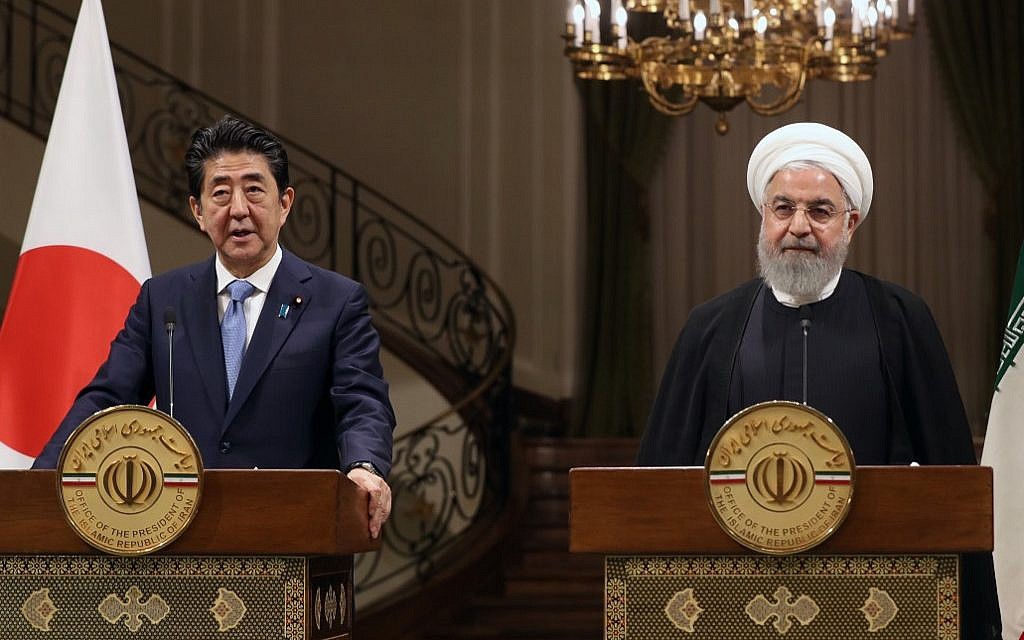
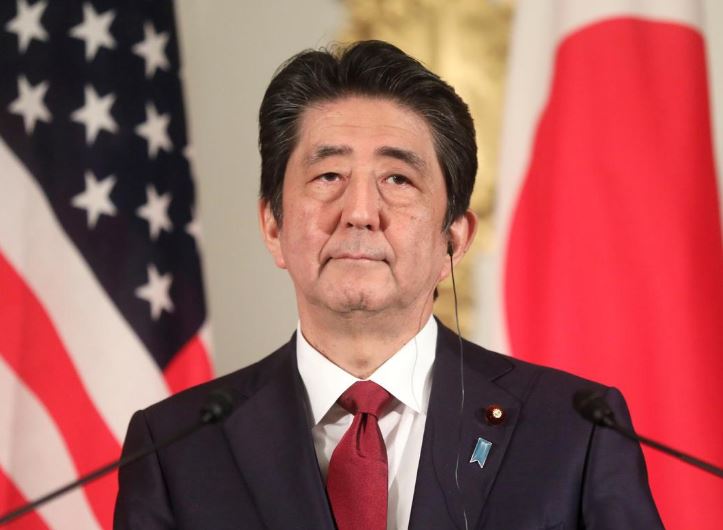
Iranian President Hassan Rouhani (R) Japanese Prime Minister Shinzo Abe give a joint press conference at the Saadabad Palace in Iran's capital Tehran on June 12, 2019. (AFP)

Iranian President Hassan Rouhani (R) Japanese Prime Minister Shinzo Abe give a joint press conference at the Saadabad Palace in Iran’s capital Tehran on June 12, 2019. (AFP)

Iranian President Hassan Rouhani said Wednesday the Islamic Republic does not seek war with the US, but will give “a crushing response” if it is attacked, as Japan’s premier visited Tehran in a bid to ease tensions between the rivals.

Rouhani made the comment as he stood alongside Japanese Prime Minister Shinzo Abe, who called for “more patience” between Iran and the US.

“There is possibility of an accidental conflict and a military conflict should be prevented at all costs,” Abe said.

He said he and the Iranian president had “bluntly discussed” the crisis.

“It is essential that Iran plays a constructive role in building solid peace and stability in the Middle East,” Abe told the joint news conference in Tehran with the Iranian leader, hours after Yemen’s Iranian-backed Houthi rebels attacked a Saudi airport, wounding 26 people.

Abe’s trip to Tehran represents the highest-level effort yet to de-escalate tensions between the US and Iran as the country appears poised to break the 2015 nuclear deal it struck with world powers that America earlier abandoned.
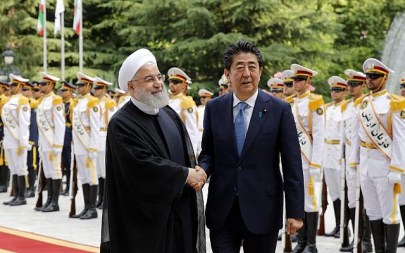
Iranian President Hassan Rouhani (L) shakes hands with Japanese Prime Minister Shinzo Abe during a welcoming ceremony at the Saadabad Palace in Iran’s capital Tehran on June 12, 2019. (AFP)

Iran is threatening to resume enriching uranium closer to weapons-grade level on July 7 if European allies fail to offer it new terms. While US President Donald Trump says he wants to talk to Tehran, the US has piled on sanctions that have seen Iran’s rial currency plummet along with its crucial oil exports.

The US also has sent an aircraft carrier and B-52 bombers to the region, along with hundreds more troops to back up the tens of thousands already deployed across the Middle East. The US blames Iran for a mysterious attack on oil tankers off the coast of the United Arab Emirates, while Iranian-backed rebels in Yemen continue to launch coordinated drone attacks on Saudi Arabia.

Rouhani said an end to the “economic war” would result in “a very positive development in the region and the world.”

Abe’s plane landed at Tehran’s Mehrabad International Airport on Wednesday afternoon where he was greeted by Iranian Foreign Minister Mohammad Javad Zarif. He immediately met Iranian President Hassan Rouhani and will see Iran’s Supreme Leader Ayatollah Ali Khameini on Thursday.
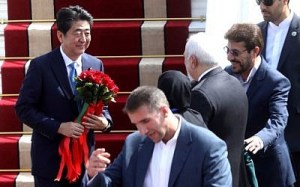
Japan’s Prime Minister Shinzo Abe (L) is greeted by Iran’s Foreign Minister Mohammad Javad Zarif (3rd R) at Tehran’s Mehrabad airport on June 12, 2019. (Ali Taghavi/ISNA/AFP)

Iran’s semi-official news agency reported that dozens of hard-line students gathered outside of the airport to protest Abe’s efforts to calm tensions.

Protesters said “the efforts by Japan’s prime minister for mediating between Iran and the US is useless, and if this is the goal of the trip, it will have no achievement,” the Fars news agency reported.

Students held placards, written in Farsi and Japanese, mocking Abe as “Japan’s representative or America’s ambassador.”

A hard-line newspaper also criticized Abe’s visit by printing an image showing the mushroom cloud of a nuclear blast on its front page: “How Can You Trust A War Criminal, Mr. Abe?” This appeared to refer to America dropping atomic bombs on Hiroshima and Nagasaki at the end of World War II.

In this July 2, 2012 file photo, an Iranian Revolutionary Guard speedboat maneuvers in the Persian Gulf while an oil tanker is seen in background. (AP Photo/Vahid Salemi, File)

Abe landed just hours after the attack in Abha. The Yemeni rebels, known as Houthis, said they launched a cruise missile at the Saudi airport while the kingdom said 26 people were hurt.

Though there were no fatalities, it was the largest number of civilians to be injured in Saudi Arabia as a result of an attack by the rebels since the start of the Saudi-led war in Yemen more than four years ago.

The rebels’ Al-Masirah satellite news channel said the missile hit its intended target, halting air traffic at the airport in the town of Abha in the kingdom’s southwest, some 165 kilometers (100 miles) from the Saudi-Yemen border.

The war in Yemen, the Arab world’s poorest country, has killed tens of thousands of civilians, with most of the deaths blamed on Saudi-led coalition airstrikes, and has pushed Yemen to the brink of famine.
 

Balloon-borne bomb from Gaza explodes over Israeli town

June 13, 2019

Source: Balloon-borne bomb from Gaza explodes over Israeli town | The Times of Israel

No injuries or damage as explosive detonates in air; 6 blazes sparked Wednesday by incendiary devices from Strip

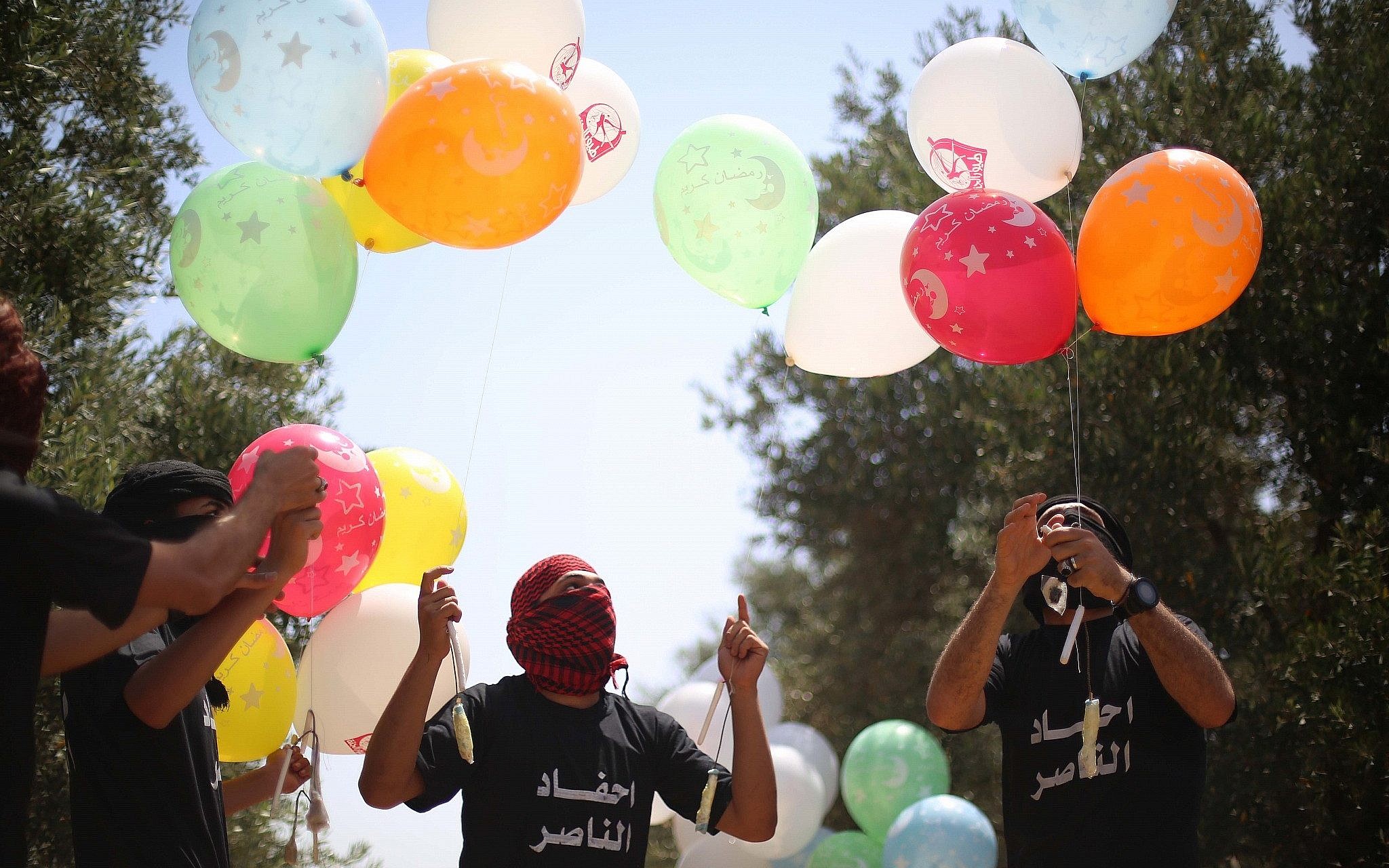
Illustrative: Palestinians prepare balloon-borne incendiary devices to launch at Israel, at the Bureij refugee camp in the Gaza Strip on May 31, 2019. (Hassan Jedi/Flash90)

A balloon-borne explosive device launched from the Gaza Strip detonated over a community in southern Israel Wednesday, as tensions along the border rose.

The explosion caused neither injury nor damage, but came as Gazans have stepped up launches of balloon-borne incendiary devices into Israel, with many of them being blamed for wildfires.

“An explosive balloon detonated near a community in the Eshkol region. Residents reported a loud blast heard in the community,” a local government spokesperson said.

It was the first such explosive attack from the Gaza Strip since Israel and terror groups in the coastal enclave reached an unofficial ceasefire agreement following two days of intense fighting in early May.

As part of an Egyptian-brokered agreement to end the flareup, Gaza’s Hamas rulers were reportedly obliged to halt the launching of incendiary balloons at Israeli communities, among other measures to rein in violence along the border.

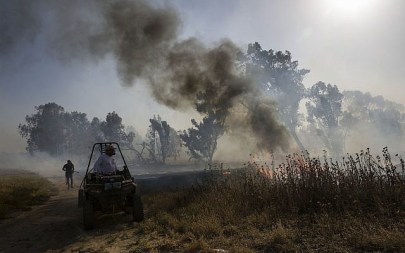
Illustrative: Firefighters work to extinguish a blaze in the Eshkol region of southern Israel that was sparked by a balloon-borne incendiary device from the Gaza Strip on May 22, 2019. (Eli Cohen/Fire and Rescue Services)

Though violence has ebbed since the ceasefire was reached, arson attacks from the Strip have continued intermittently, with the local fire department reporting six fires were started Wednesday in southern Israel as a result of incendiary and explosive devices flown from Gaza.

On Tuesday, seven fires in southern Israel were sparked by balloon-borne incendiary devices from Gaza, prompting Israel to announce in response that it will further scale back the Gaza fishing zone from 10 nautical miles to six.

For the past several months, Israel has been extending and reducing the permitted fishing zone around Gaza as fewer or more incendiary balloons have been sent over the border.

Also Wednesday, a rocket fired from Gaza during last month’s fighting was believed to have caused an explosion in a cemetery east of the southern port city of Ashdod.

The rocket apparently landed at the site, in the town of Be’er Tuvia, but did not explode on impact.

No one was hurt in the incident.


IAF strikes underground Hamas targets after Palestinians fire rocket into Israel 

June 13, 2019

Source: IAF strikes underground Hamas targets after Palestinians fire rocket into Israel | The Times of Israel

No injuries or damage as Iron Dome intercepts projectile over southern Israel; rocket attack follows day of balloon attacks from Gaza

A picture taken on May 5, 2019 from the Israel-Gaza border shows a barrage of rockets being fired from the Hamas-run Palestinian enclave. (Jack Guez/AFP)

Illustrative. A picture taken on May 5, 2019 from the Israel-Gaza border shows a barrage of rockets being fired from the Hamas-run Palestinian enclave. (Jack Guez/AFP)

Israeli aircraft hit Hamas underground facilities in the Gaza Strip early Thursday after a rocket fired at southern Israel was shot down in the first such attack since Israel and terror groups in the coastal enclave fought a vicious two-day battle last month.

The IDF said fighter jets bombed “underground terror infrastructure on a base belonging to the Hamas terror group in the southern Gaza Strip.”

It said the strikes came in response to the rocket that was fired at Israel earlier in the night, noting that Israel holds Hamas responsible for all violence emanating from the Strip.

Earlier in the night the Israeli military said it shot down a rocket from Gaza heading toward southern Israel shortly after midnight Wednesday.

The incoming projectile triggered sirens in the community of Nirim in the Eshkol region, east of Gaza, at approximately 12:15 a.m. on Thursday. Residents of the area reported hearing sounds of explosions.

“One launch was detected from the Gaza Strip toward Israeli territory. It was intercepted by Iron Dome soldiers,” the army said in a statement, referring to the air defense system.

Residents said the rocket caused no injuries or damage.

“There were no impacts inside a community. Searches are being conducted in the area,” an Eshkol spokesperson said in a statement.

The attack came hours after Israel announced it was imposing a full naval closure of the Gaza Strip, not allowing local fisherman access to the sea, in response to the wave of arson and explosive attacks from the coastal enclave throughout the day.

At least six fires in southern Israel were blamed on incendiary balloons launched from the Strip, and another balloon with a bomb attached to it exploded over an Israeli town. There were no reports of injuries. The arson attacks caused significant damage to area farmland.

Illustrative: Israeli firefighter battles a fire started by an incendiary device launched from Gaza Strip, near the Israel and Gaza border fence, May 15, 2019. (AP/Tsafrir Abayov)

“Due to the continued fires and flying of incendiary balloons from the Gaza Strip, it was decided this evening to impose a naval closure on the Strip until further notice,” the Defense Ministry’s liaison to the Palestinians said in a statement.

The arson attacks appear to be a violation of an unofficial ceasefire reached in early May between Israel and Gaza’s Hamas rulers that ended two days of intense fighting between the Israeli military and Palestinian terror groups.

According to Israel’s Channel 12 news, the agreement includes a Hamas obligation to halt violent incidents along the border fence, maintaining a buffer zone 300 meters from the border; an end to the launching of incendiary balloons at Israeli communities and nighttime clashes between Gazans and security forces; and a stop to flotillas trying to break through the maritime border between Gaza and Israel.

In return, Israel expanded the fishing zone and agreed to enable United Nations cash-for-work programs, allow medicine and other civil aid to enter the Strip, and open negotiations on matters relating to electricity, crossings, healthcare, and funds.

The balloon-borne bomb Wednesday was the first armed attack from the Strip since that round of fighting ended on May 5.

Also Wednesday, an unexploded rocket exploded in a cemetery in a town outside Ashdod. There were no reports of injuries.

Times of Israel staff contributed to this report.


The Details of the Alleged Israeli Strike Attempt on Syria

June 12, 2019

Israeli missile attack claimed by Syria hit Iranian-held Tel Al Harrah radar overlooking Golan – DEBKAfile

June 12, 2019

Source: Israeli missile attack claimed by Syria hit Iranian-held Tel Al Harrah radar overlooking Golan – DEBKAfile

The Israel missile strike that Syrian military sources claimed took place early Wednesday, June 12, struck Iranian radars situated at Tel Al-Harrah, a hill overlooking the Golan, Galilee and the Sea of Galilee, DEBKAfile reports. Hizballah also maintains an observation post in the same Quneitra region some 15km from the Israeli border.

The Syrians claimed to have thwarted an Israeli electronic attack for interfering with its radars which it thwarted by shooting the missiles down.

DEBKAfile’s sources report that Tel Al-Harrah is the southernmost point in Syria at which Russian forces have permitted Iran to maintain a military presence in the vicinity of the Israeli border. In other parts of the border region, especially the Daraa district, Russian “military police” prevented Iran and its proxies from establishing military posts, allowing only temporary positions holding no more than 15-20 Iranian or Hizballah military personnel. Neither are allowed to enter the southern Syrian towns of Daraa and Quneitra. Moscow and Tehran are at loggerheads on this issue.

According to our military sources, the IDF’s Tel Al-Harrah strike was mounted to prepare the way for a high-powered meeting planned to take place in Jerusalem later this month of the American, Russian and Israeli national security advisers – John Bolton, Nikolai Patrushev and Meir Ben-Shabbat – for an airing of the situation in Syria and Iran’s military presence there.


Syria accuses Israel of firing missiles at a border town in its south

June 12, 2019

Source: Syria accuses Israel of firing missiles at a border town in its south | The Times of Israel

State media says some incoming projectiles intercepted; no reports of injuries and no comment from IDF; reported strike comes days after rockets fired at Israel

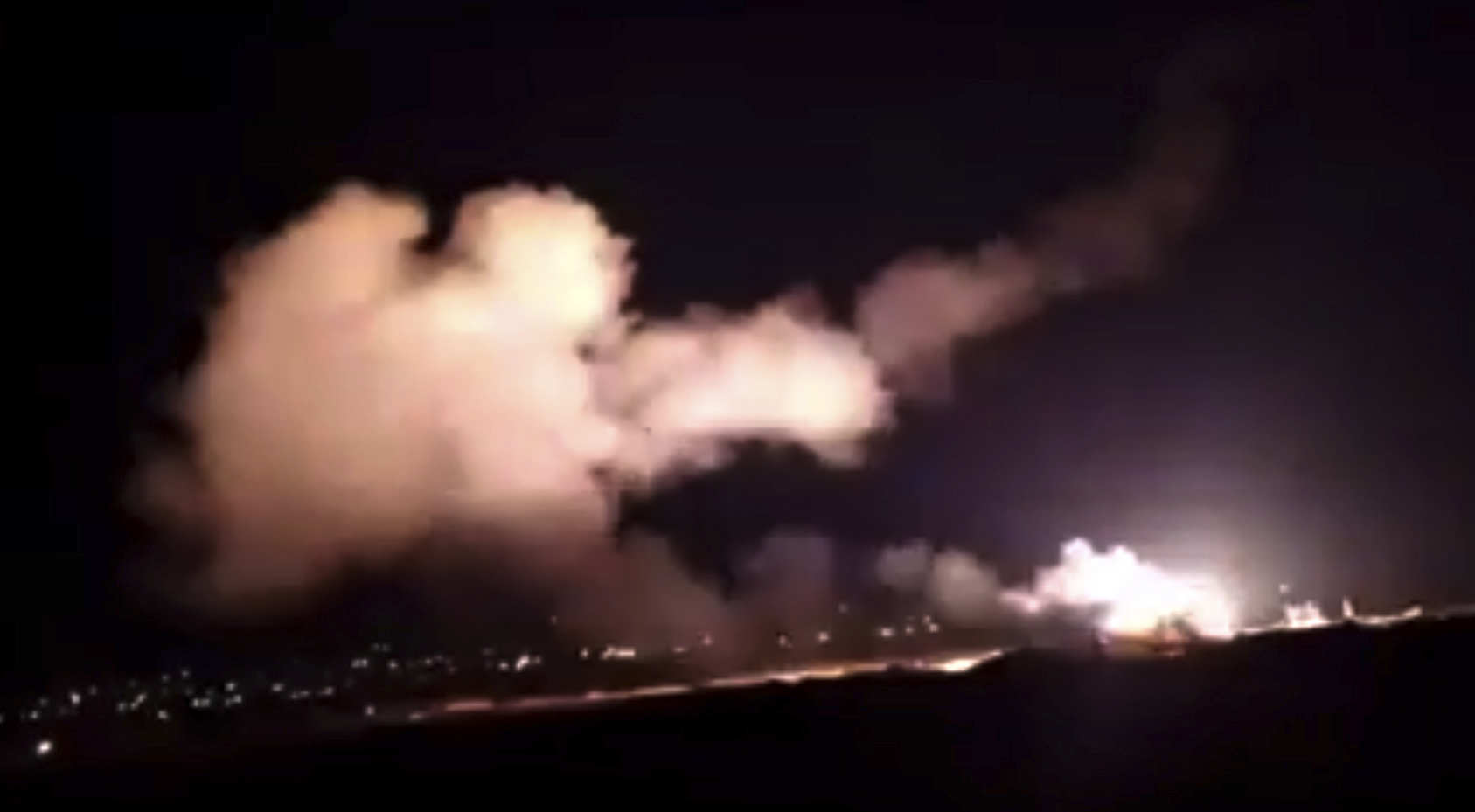
Illustrative: This frame grab from a video provided by the Syrian official news agency SANA shows missiles flying into the sky near Damascus, Syria, Tuesday, December 25, 2018. (SANA via AP)

Syrian state media reported early Wednesday that Israel had fired several missiles toward the town of al-Harra just across the Golan Heights border and claimed air defenses intercepted several of the projectiles.

There were no immediate reports of injuries and no Israeli response to the claims.

The report also claimed that Israel was jamming Syrian air defense radars in the area.

While Israel has carried out hundreds of strikes in Syria, they have usually targeted bases linked with Iran. In the rare occasions that Israel has targeted villages and towns along the Golan Heights border, it has been after identifying Iranian and Hezbollah attempts to set up cells in the area.

On Saturday, two rockets were fired from Syria toward Israel’s Mount Hermon in the Golan Heights. There were no reports of injuries or damage.

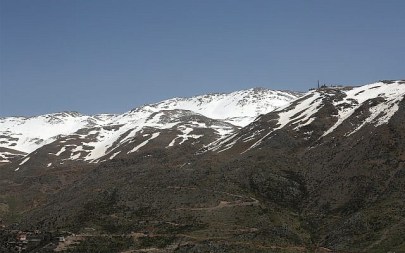
An Israeli military position, right, is seen on the top of Mount Hermon in the Golan Heights, where the borders between Israel, Syria and Lebanon meet. April 9, 2019. (AP Photo/Hussein Malla)

The launches came less than a week after a limited clash between Israel and Syria.

Toward the start of the Syrian civil war, the Israeli military established a number of “red lines” that if violated would result in a retaliatory strike, including any attacks — intentional or otherwise — against Israel.

They also included Iranian efforts to establish a permanent military presence in Syria and attempts to transfer advanced munitions to the Lebanon-based Hezbollah terrorist group.

In recent years, Israel has acknowledged conducting hundreds of airstrikes in Syria in response to these “red line” violations.


Syria accuses Israel of firing missiles at a border town in its south

June 12, 2019

Source: Syria accuses Israel of firing missiles at a border town in its south | The Times of Israel

State media says some incoming projectiles intercepted; no reports of injuries and no comment from IDF; reported strike comes days after rockets fired at Israel

Illustrative: This frame grab from a video provided by the Syrian official news agency SANA shows missiles flying into the sky near Damascus, Syria, Tuesday, December 25, 2018. (SANA via AP)

Syrian state media reported early Wednesday that Israel had fired several missiles toward the town of al-Harra just across the Golan Heights border and claimed air defenses intercepted several of the projectiles.

There were no immediate reports of injuries and no Israeli response to the claims.

The report also claimed that Israel was jamming Syrian air defense radars in the area.

While Israel has carried out hundreds of strikes in Syria, they have usually targeted bases linked with Iran. In the rare occasions that Israel has targeted villages and towns along the Golan Heights border, it has been after identifying Iranian and Hezbollah attempts to set up cells in the area.

On Saturday, two rockets were fired from Syria toward Israel’s Mount Hermon in the Golan Heights. There were no reports of injuries or damage.

An Israeli military position, right, is seen on the top of Mount Hermon in the Golan Heights, where the borders between Israel, Syria and Lebanon meet. April 9, 2019. (AP Photo/Hussein Malla)

The launches came less than a week after a limited clash between Israel and Syria.

Toward the start of the Syrian civil war, the Israeli military established a number of “red lines” that if violated would result in a retaliatory strike, including any attacks — intentional or otherwise — against Israel.

They also included Iranian efforts to establish a permanent military presence in Syria and attempts to transfer advanced munitions to the Lebanon-based Hezbollah terrorist group.

In recent years, Israel has acknowledged conducting hundreds of airstrikes in Syria in response to these “red line” violations.


Japanese PM to meet Iran’s Khamenei, Rouhani

June 11, 2019

Source: Japanese PM to meet Iran’s Khamenei, Rouhani – www.israelhayom.com

Prime Minister Shinzo Abe will meet with Islamic republic’s supreme leader and its president as part of first visit by an incumbent Japanese premier to Iran in 41 years. Tokyo and Tehran have friendly ties and are set to mark the 90th anniversary of diplomatic relations this year.

Japanese Prime Minister Shinzo Abe is set to meet with Iranian Supreme Leader Ayatollah Ali Khamenei and President Hassan Rouhani this week, in a visit aimed at easing regional tensions.

Abe’s trip, scheduled to take place from Wednesday to Friday, is the first by an incumbent Japanese premier to Iran in 41 years, although Tokyo and Tehran have friendly ties and are set to mark the 90th anniversary of diplomatic relations this year.

“Amid rising tensions in the Middle East, we plan to encourage Iran, a regional power, to move toward easing tensions at the top leaders’ meetings,” said Japan’s Chief Cabinet Secretary Yoshihide Suga, who announced the trip on Tuesday.

Abe had spoken to U.S. President Donald Trump by telephone to discuss Iran, Suga told a news conference.

On a four-day visit to Japan last month, Trump welcomed Abe’s help in dealing with Iran after public broadcaster NHK had said Japan’s leader was considering a trip to Tehran.

Abe is in a unique position, thanks to his close ties to Trump, cultivated since the U.S. leader took office, and Tokyo’s friendly relations with Iran, diplomatic experts said.

“Abe is trying to play the role of messenger and ease the tension,” said Toshihiro Nakayama, a Japan Fellow at the Wilson Center in Washington. “It is a bold move. I think it comes from confidence with his personal relations with Trump.”

Japan is keen for stability in the Middle East because it imports the bulk of its oil from the region, although it stopped buying Iranian oil this year because of U.S. sanctions.

Some experts played down prospects for the trip. “The object of the visit is not to mediate,” said former Japanese diplomat Kunihiko Miyake. “It’s basically bilateral issues, and if there is any additional business to do, we will do it carefully.”

The most Abe can probably achieve is to persuade Iran and the United States to resume direct talks, the experts said, adding that both sides may be seeking a way to avoid a confrontation while still saving face.

In his meeting with Maas, Iranian President Hassan Rouhani blamed the U.S. for the soaring tensions and called on the European signatories to the deal to “resist the economic war on Iran imposed by America.”


Fear and loathing in the United Kingdom

June 11, 2019

Source: Fear and loathing in the United Kingdom – www.israelhayom.com

The British, it seems, will do everything in their power to avoid making the Iranians angry. Yes, the same Iranians who ordered Hezbollah to build bombs in London.

In the summer of 2015, then-U.S. President Barack Obama and his European allies basked in the warm, intoxicating glow of the nuclear deal with Iran. The sense of achievement was so overwhelming that the mere thought that Iran could continue manufacturing long-range ballistic missiles and sowing terror across the region never crossed anyone’s mind.

In this vein, and in order to avoid tarnishing the festive atmosphere or heaven forbid nip the nuclear deal in the bud, the British chose to conceal the incriminating information from the media about the bomb-making factories Hezbollah had built on Iran’s behalf in the northwest of London. This evidence was hidden not only from the media but from members of parliament, some of whom, it isn’t a secret, wouldn’t have approved the deal.

London is just one of the global terrorist hubs Iran sought to establish at the height of negotiations over its nuclear program. The incriminating evidence provided by Israeli intelligence – and the arrests that followed – were reported on in the United States, Thailand, and Cyprus, but the story was buried in the United Kingdom. And in their desire to avoid making the Iranians angry, it also took the British more than three years, until February 2019, to publicly state that there is no difference between Hezbollah’s military and political wings and to add the Lebanon-based group to its list of terrorist organizations.

What’s sad about this story is that over these past four years the Europeans have not changed their approach to Tehran very much. Iran is straining under the economic sanctions imposed by the United States. The Iranian economy is crumbling. Its oil exports have plummeted from over one million barrels per day to less than 400,000. One U.S. dollar is now worth around 50,000 rials, while inflation has skyrocketed to above 40%.

But instead of exploiting the situation to pressure Iran, Germany’s foreign minister rushed to Tehran on Monday to urge the Iranians not to withdraw from the nuclear deal and to promise they would soon be able to use the mechanism crafted by the EU to bypass the American sanctions.

Iran’s foreign minister reminded his German counterpart that Tehran’s ultimatum for “solving the problem” created by the White House would expire in less than one month. In the meantime, the International Atomic Energy Agency confirmed on Monday that Iran has started accelerating its uranium enrichment, although still to within the parameters of the nuclear deal.

At their joint press conference, the two foreign ministers failed to address the new ballistic missile unveiled by the Iranians this week or the Islamic republic’s ballistic missile program, which continues to operate unabated. Nor any mention of Hezbollah, whose fighters, under Iranian orders, continue helping the Syrian army drop oil drums on the civilian population in Idlib; the rebels in Yemen, who are raining missiles on Saudi Arabia; or the pro-Iranian Shiite militias in Iraq, who are preparing to attack American forces stationed there if and when a conflict erupts between Iran and the U.S.

The British in particular and the Europeans in general didn’t need the information from Israel to understand that Hezbollah is the tip of Iran’s terrorist spear, not just in the Middle East but across the globe. Anyone who wants to stop the Iranians must also handle their messenger.


Netanyahu: Iran’s Zarif lying, Tehran is the one threatening destruction 

June 11, 2019

Source: Netanyahu: Iran’s Zarif lying, Tehran is the one threatening destruction | The Times of Israel

PM says Islamic Republic ‘accelerating its nuclear program,’ warns Israel won’t allow it to develop atomic weapons, hours after Iran’s FM castigated Israel

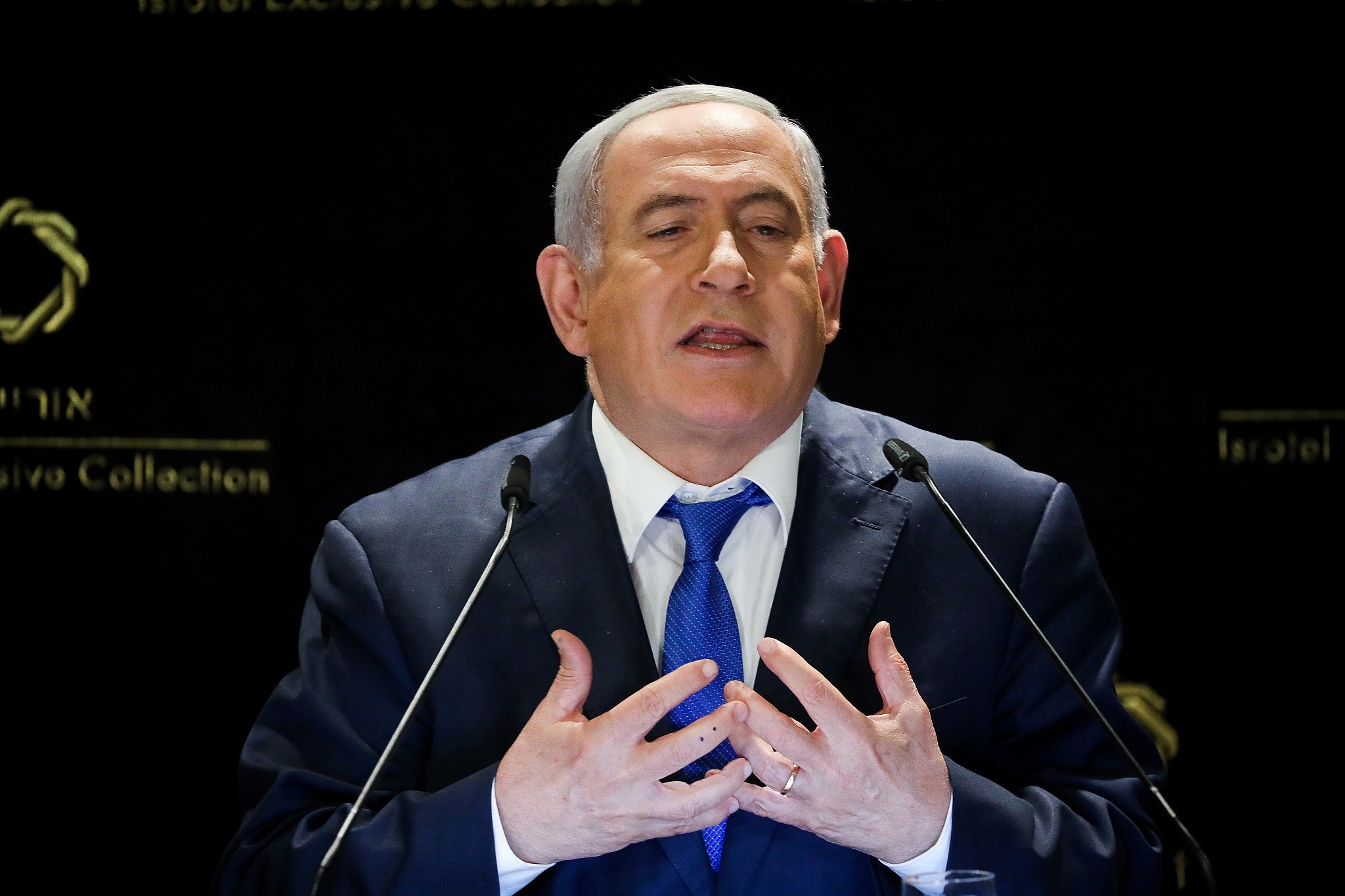
Prime Minister Benjamin Netanyahu delivers a statement to the media at the Orient Hotel in Jerusalem, on May 30, 2019. (Noam Revkin Fenton/Flash90)

Prime Minister Benjamin Netanyahu delivers a statement to the media at the Orient Hotel in Jerusalem, on May 30, 2019. (Noam Revkin Fenton/Flash90)

Prime Minister Benjamin Netanyahu fired back at Iran on Monday after its foreign minister, Mohammad Javad Zarif, claimed the Israeli leader had threatened to destroy his country and warned that the Islamic Republic would respond to such threats.

“Zarif is once again lying,” Netanyahu said in a statement. “Iran is the one openly threatening destruction. The regime’s officials threaten the destruction of Israel on a daily basis.”

He said Iran was “attempting to establish itself militarily in Syria, and just today it was publicized that it is accelerating its nuclear program.

“I’ll say it again: We won’t allow Iran to develop nuclear weapons that will endanger us and the entire world,” he said.

At a press conference in Tehran alongside visiting German Foreign Minister Heiko Maas, Zarif had said “Netanyahu stands next to the Dimona [reactor], a nuclear weapons site, and says Iran should be destroyed…Of course, no one can act against our people without receiving a decisive response.”

Israel has long maintained an official position of ambiguity with regards to its nuclear capabilities.

According to Iran’s Tasnim news agency, which provided an English translation of his remarks, Zarif was referring to comments Netanyahu made in August 2018 during a visit to Israel’s secretive nuclear site in Dimona.

At the time Netanyahu warned that those who seek to destroy Israel put themselves in danger of suffering the same fate instead.

The Iranian regime routinely threatens and anticipates the destruction of Israel, and funds and arms anti-Israel terrorist groups in Gaza, the West Bank and Lebanon. Iran’s supreme leader, Ayatollah Ali Khamenei, frequently refers to Israel as a cancer that must be eradicated, and has set out detailed plans for its elimination.

Israel has repeatedly warned that Iran is seeking a nuclear arsenal in order to destroy it, and Netanyahu has led international opposition to the 2015 P5+1 nuclear deal with Iran.

“Iran has never waged a war against any country and will not do so in future,” Zarif said Monday, but warned that “if any country starts a war on Iran, it would definitely not be the one that ends it.”

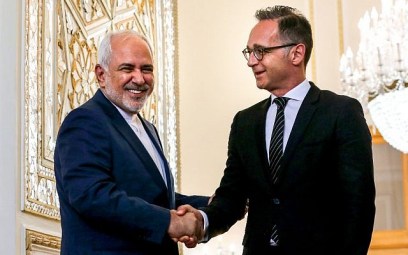
Iran’s Foreign Minister Mohammad Javad Zarif (L) receives his German counterpart Heiko Maas in the capital Tehran on June 10, 2019. (ATTA KENARE / AFP)

Though Zarif made a point to shake Maas’s hands in front of the cameras, his comments marked a sharp departure for the US-educated diplomat who helped secure the nuclear deal. They came after Maas spoke in support of Israel.

“Israel’s right to exist is part of Germany’s founding principle and is completely non-negotiable,” Maas said. “It is a result of our history and it’s irrevocable and doesn’t just change because I am currently in Tehran.”

Zarif then grew visibly angry, offering a list of Mideast problems ranging from al-Qaeda to the bombing of Yemeni civilians he blamed on the US and its allies, including Saudi Arabia.

“If one seeks to talk about instability in this region, those are the other parties who should be held responsible,” Zarif said.

He also offered a series of threats over the ongoing tensions gripping the Persian Gulf. The crisis, he said, stems from US President Donald Trump’s decision over a year ago to withdraw America from Iran’s 2015 nuclear deal with world powers.

Iran announced May 8 that it no longer considered itself bound to keep to the limits of stocks of heavy water and enriched uranium that it agreed to as part of the 2015 Joint Comprehensive Plan of Action (JCPOA). Tehran’s move came a year after Trump pulled out of the deal. Washington has also reinforced economic sanctions against the Islamic republic.

International Atomic Energy Agency Director General Yukiya Amano at a press conference during the Board of Governors Meeting at IAEA headquarters in Vienna, Austria, June 10, 2019. (Dean Calma / IAEA)

Meanwhile, in a report Monday, the UN’s nuclear watchdog did not explicitly say Iran was implementing its nuclear-related commitments, for the first time since the signing of the 2015 Iran nuclear deal, and said that its rate of uranium enrichment was increasing.

Speaking to journalists after his speech opening the agency’s quarterly board of governors meeting, Amano said the accord was “under tension” and confirmed that Iran’s “production rate (of uranium) is increasing,” although he could not give an exact figure.