Archive for June 29, 2019

Senate fails to limit Trump war powers amid Iran tensions

June 29, 2019

Source: Senate fails to limit Trump war powers amid Iran tensions | The Times of Israel

Bill that would require congressional approval for military strikes doesn’t pass vote, but lawmakers hope effort sends message of alarm to White House
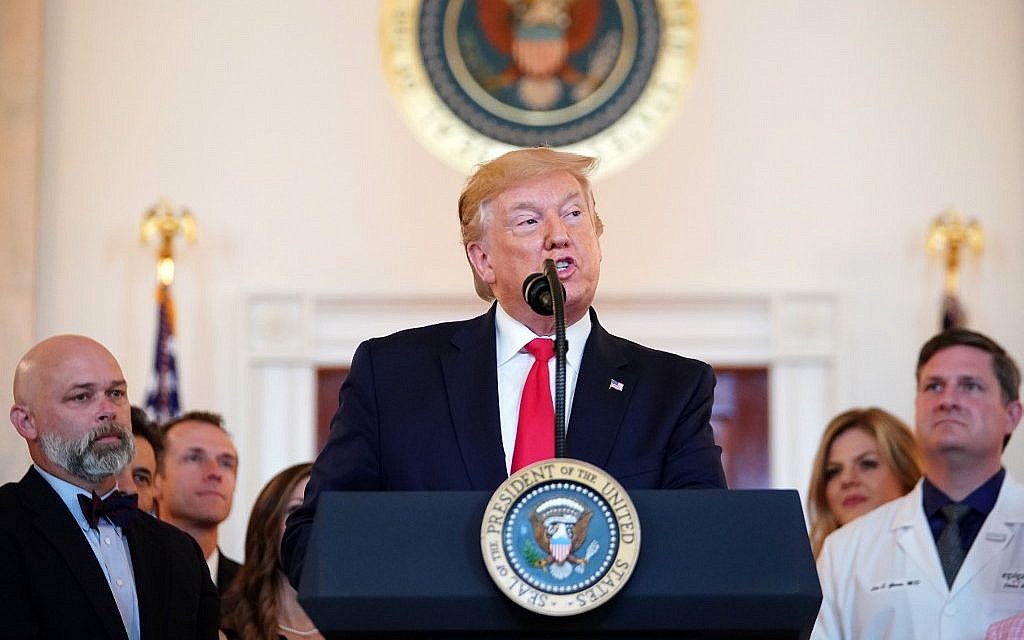
US President Donald Trump speaks before signing an executive order in the Grand Foyer of the White House on June 24, 2019. (Mandel Ngan/AFP)

US President Donald Trump speaks before signing an executive order in the Grand Foyer of the White House on June 24, 2019. (Mandel Ngan/AFP)

WASHINGTON (AP) — Political unease over the White House’s tough talk against Iran is reviving questions about US President Donald Trump’s ability to order military strikes without approval from Congress.

The Senate fell short Friday, in a 50-40 vote, on an amendment to a sweeping Defense bill that would require congressional support before Trump acts. It didn’t reach the 60-vote threshold needed for passage. But lawmakers said the majority showing sent a strong message that Trump cannot continue relying on the nearly two-decade-old war authorizations Congress approved in the aftermath of the September 11, 2001, attacks. The House is expected to take up the issue next month.

“A congressional vote is a pretty good signal of what our constituents are telling us — that another war in the Middle East would be a disaster right now, we don’t want the president to just do it on a whim,” said Democratic Senator Tim Kaine of Virginia, a co-author of the measure with Democratic Senator Tom Udall of New Mexico.

“My gut tells me that the White House is realizing this is deeply unpopular with the American public.”

The effort in the Senate signals discomfort with Trump’s approach to foreign policy. Four Republicans joined most Democrats in supporting the amendment, but it faces steep resistance from the White House and the Pentagon wrote a letter opposing it.

Senate Majority Leader Mitch McConnell called it nothing more than another example of “Trump Derangement Syndrome,” which he explained as whatever the president’s for “they seem to be against.”

In this file photo taken on January 25, 2019, US Senate Majority Leader Mitch McConnell talks with reporters at the US Capitol in Washington, DC (WIN MCNAMEE / GETTY IMAGES NORTH AMERICA / AFP)

McConnell said putting restrictions on the White House would “hamstring” the president’s ability to respond militarily at a time of escalating tension between the US and Iran.

“They have gratuitously chosen to make him the enemy,” McConnell said. “Rather than work with the president to deter our actual enemy, they have chosen to make him the enemy.”

Trump’s approach to the standoff with Iran and his assertion earlier this week that he doesn’t need congressional approval to engage militarily has only sparked fresh questions and hardened views in Congress.

Trump tweeted last week that the US came within minutes of striking Iran in response to its shooting down of an unmanned US drone until he told the military to stand down. He said he was concerned over an Iranian casualty count estimated at 150.

“We’ve been keeping Congress abreast of what we’re doing… and I think it’s something they appreciate,” Trump told The Hill website. “I do like keeping them abreast, but I don’t have to do it legally.”

As the popular defense bill was making its way through the Senate, Democrats vowed to hold back their support unless McConnell agreed to debate the war powers. The defense bill was roundly approved Thursday on a vote of 86-8.

Top Senate Democrat Chuck Schumer of New York assembled his caucus earlier this week. In a series of closed-door meetings he argued that Congress had ceded too much authority to presidents of both parties, according to a person granted anonymity to discuss the private sessions. Schumer said the amendment would prohibit funds to be used for hostilities with Iran without the OK of Congress.

Schumer also said that the American people are worried that the US and Iran are on a dangerous collision course and that even though Trump campaigned on not wanting to get the US embroiled in wars he “may bumble us into one.”

“It is high time that Congress re-establishes itself as this nation’s decider of war and peace,” Schumer said on the Senate floor.
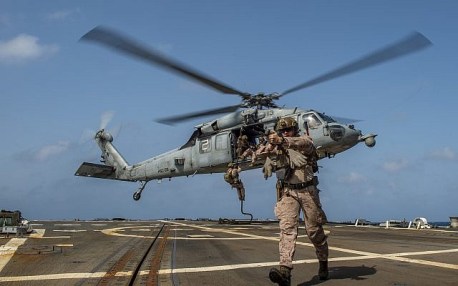
US Marines training on the flight deck of the guided-missile destroyer USS Bainbridge, May 18, 2019, deployed in the Gulf of Arabia ‘to respond to contingencies and to defend US forces and interests in the region.’ (MCS Jason Waite/US Navy)

To counter the Democrats’ effort, Republican Senator Mitt Romney of Utah pushed forward an alternative to Udall’s amendment that reaffirmed the US can defend itself and respond to any attacks. But Romney said his version is not an authorization to use force against Iran.

“I fully concur with my Senate colleagues who desire to reassert out constitutional role,” Romney said on the Senate floor. But he warned that the Udall amendment goes too far. “The president should not have his hands tied.”

The debate over whether the legislative or executive branch has sole power over war-making depends on how one interprets the Constitution, experts said.

In recent years, the US military has been deployed under old war authorizations passed in 2001 and 2002 for conflicts in Iraq and Afghanistan. Some lawmakers have pushed to pass new war powers acts, but none have materialized, though the House last week voted to sunset those authorizations.

In ticking off a list of Iranian acts of “unprovoked aggression,” Secretary of State Mike Pompeo recently asserted that a late May car bombing of a US convoy in Kabul, Afghanistan, was among a series of threats or attacks by Iran and its proxies against American and allies interests. At the time, the Taliban claimed credit for the attack, with no public word of Iranian involvement.

Pompeo’s inclusion of the Afghanistan attack in his list of six Iranian incidents raised eyebrows in Congress. Pompeo and other administration officials have suggested that they would be legally justified in taking military action against Iran under the 2001 authorization.

That law gave President George W. Bush authority to retaliate against al-Qaida and the Taliban for the September 11, 2001, terrorist attacks. It has subsequently been used to allow military force against extremists elsewhere, from the Philippines to Syria.

The Senate amendment addressed the question about how much Congress can restrict the president, said Scott R. Anderson, a legal expert at Brookings Institution.

“If they actually pass it, it would be very substantive because it would be putting limits on the president that have never been there before,” Anderson said.

Even though the measure failed to reach the 60 votes needed, the House will likely try to attach its own limits on military action in Iran with its defense bill next month.
 

US cyber attack on Iran exploited flaw in heavily-guarded network, experts say

June 29, 2019

Source: US cyber attack on Iran exploited flaw in heavily-guarded network, experts say | The Times of Israel

Assault that crippled Revolutionary Guard missile system result of massive investment in cyber warfare by American military, likely took extensive preparation

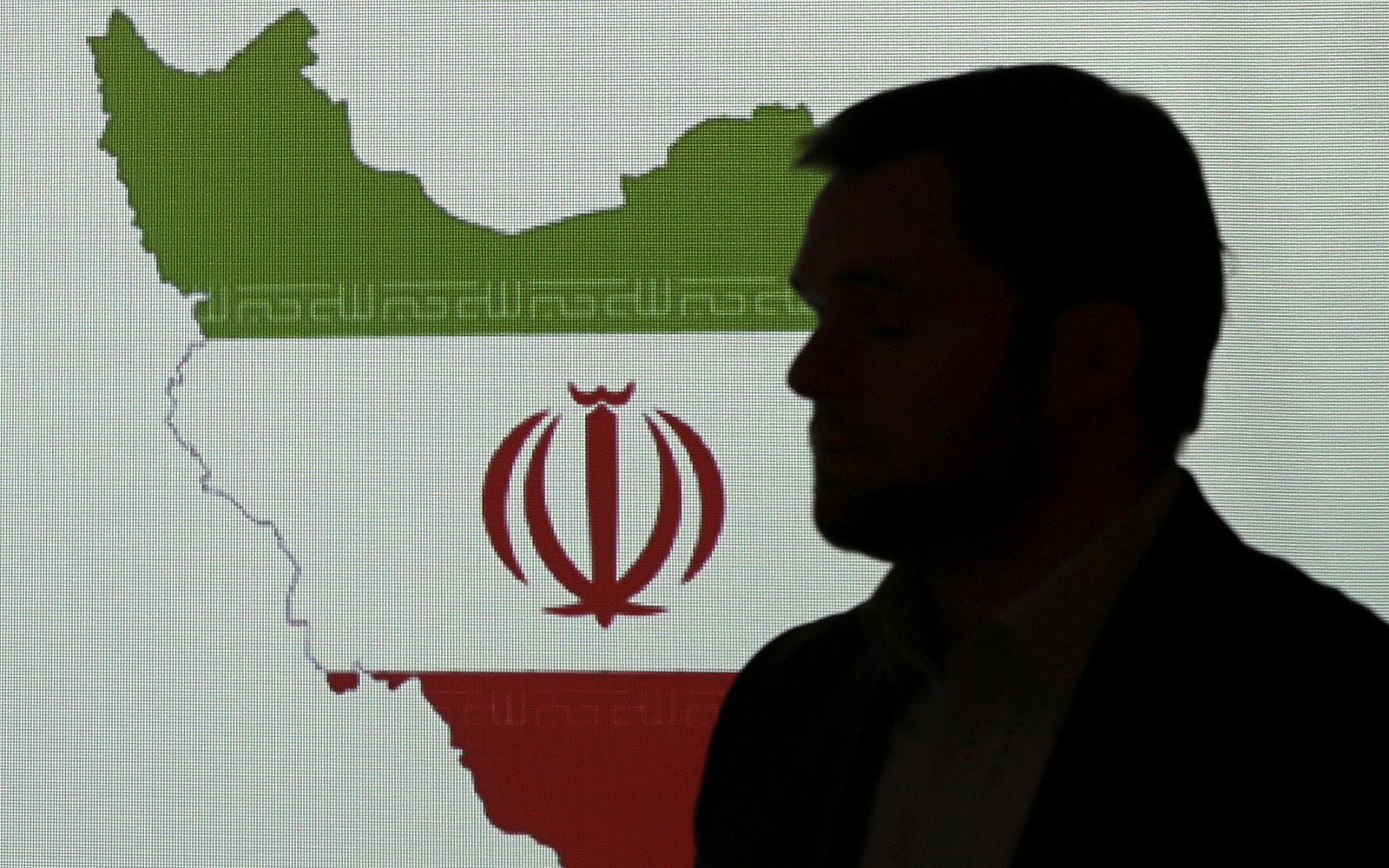
Illustrative: A cybersecurity expert stands in front of a map of Iran as he speaks to journalists about the techniques of Iranian hacking, September 20, 2017, in Dubai, United Arab Emirates. (AP Photo/Kamran Jebreili)

AFP — A cyber attack on Iranian missile systems claimed by the US last week would have had to exploit a flaw in the heavily-guarded network, experts said.

Citing US official sources, American media last week reported that the Army Cyber Command had crippled the Iranian Revolutionary Guard’s air defense units that shot down a sophisticated drone on June 20.

Military computing security is usually “hardened” to defend against attack but highly-skilled computer scientists in cyber units of modern armies are always working to find a way in.

“The simplest way would be for a special forces member to plug in a USB [carrying a virus] to the right place,” Loic Guezo of the French Information Security Club told AFP.

This is almost certainly how the well-known US-Israeli Stuxnet virus was introduced in 2010, into the computers of Iran’s nuclear complex, according to experts.

Iran at the time accused the US and Israel of using the virus to target its centrifuges used for uranium enrichment.

The Revolutionary Guards are believed to have since bolstered precautionary measures in a bid to isolate their military computer networks from the internet.

However, according to a military expert who requested anonymity, an “anti-aircraft defense system requires radars, control and command centers and ground-to-air missile sites to be inter-connected.”

Those components are connected by intranet networks that “at one time or another” must be connected to the internet.

“In the past, there was no way to connect to a weapon system,” said Guezo.

Today, however, he said most computer operating systems are commercial and vulnerable to attacks even if “everything is done to make them impenetrable.”

“Nothing is impenetrable,” said Guezo.

This photo released by the official website of the Iranian Defense Ministry on Sunday, June 9, 2019, shows the Khordad 15, a new surface-to-air missile battery at an undisclosed location in Iran. The system uses locally made missiles that resemble the HAWK missiles that the US once sold to the shah and later delivered to the Islamic Republic in the 1980s Iran-Contra scandal. (Iranian Defense Ministry via AP)

Modern cyber crime units, especially American and Israeli, have massive resources at their disposal and recruit high-level experts.

The Cyber Command became a fully-fledged combat unit within the US army in May with a budget running into billions of dollars.

In Israel, the renowned electronic warfare Unit 8200 attracts the country’s best talent.

When cyber attackers “have identified an entry point,” they “intrude the network with messages carrying hyper-aggressive malware which will at least partially cripple the air defense network,” said an anonymous military specialist.

In March 2017, researcher Remy Hemez of the French Institute for International Relations (IFRI) told of how the Israeli army had used a program called SUTER in 2007 to temporarily blind Syrian air defense radars.

Operation Orchard, according to Hemez, showed how cyber weapons can successfully be used in battle.

Israeli fighter jets had penetrated deep into Syrian air space to destroy a suspected nuclear facility after having disabled Syrian air defenses.

Last week’s US claim of an attack on Iranian missile launching systems would have required months or even years of preparation, said Guezo.

“You have to study the architecture of the equipment and then create attack plans,” Guezo said.


US deploys stealth fighters to Qatar airbase amid Iran tensions

June 29, 2019

Source: US deploys stealth fighters to Qatar airbase amid Iran tensions | The Times of Israel

Following downing of drone and tanker attacks, Air Force says F-22s have been sent to Persian Gulf ‘to defend American forces and interests’

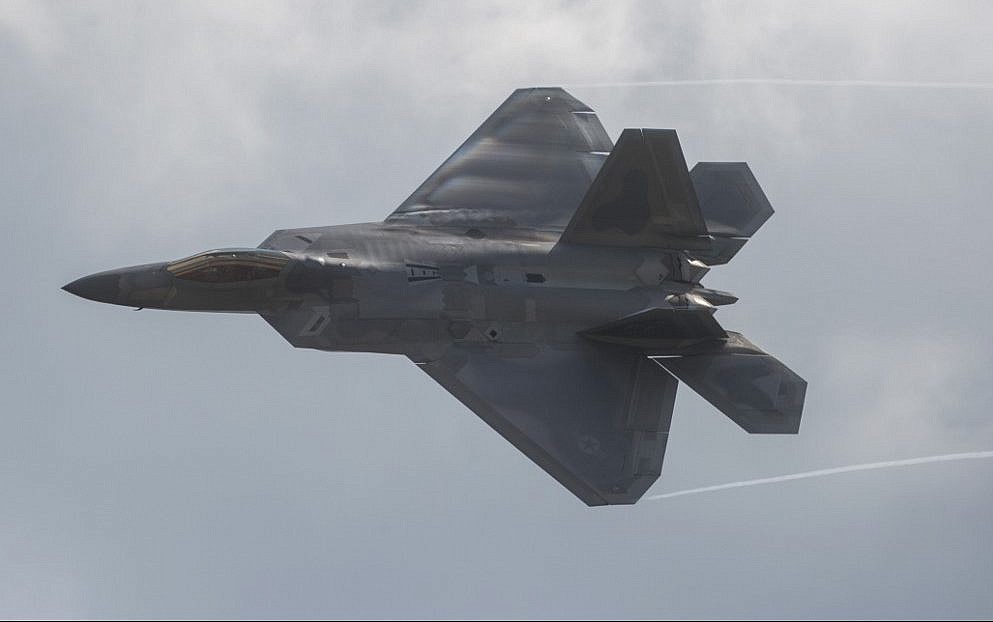
In this photo from September 16, 2017, an F-22 Raptor does a fly-by during the airshow at Joint Andrews Air Base in Maryland. (Andrew Caballero-Reynolds/AFP)

In this photo from September 16, 2017, an F-22 Raptor does a fly-by during the airshow at Joint Andrews Air Base in Maryland. (Andrew Caballero-Reynolds/AFP)

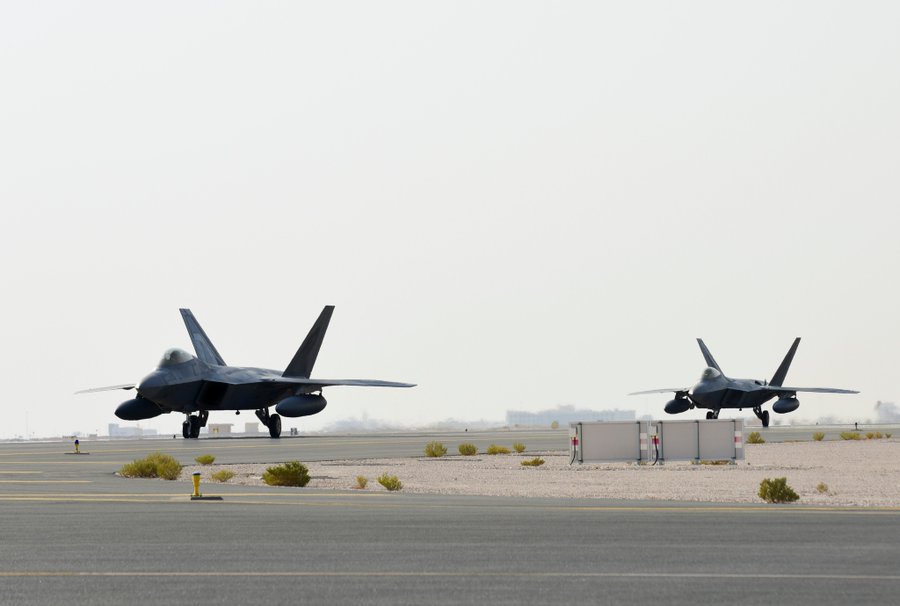
WASHINGTON — The US has deployed F-22 stealth fighters to Qatar for the first time, its military said Friday, adding to a buildup of US forces in the Gulf amid tensions with Iran.

The Air Force F-22 Raptor stealth fighters have been deployed “to defend American forces and interests,” the US Air Forces Central Military Command said in a statement that did not specify how many of the hi-tech planes had been sent.

A photo handout showed five of the jets flying above the Al Udeid Air Base in Qatar.

Tehran and Washington have been locked in an escalating standoff since US President Donald Trump unilaterally withdrew from a multi-party 2015 nuclear deal with Iran and reimposed sanctions on the Islamic Republic.

US AFCENT

@USAFCENT

F-22s to for the first time in order to defend American forces and interests in the @CENTCOM area of responsibility. http://bit.ly/31X7au7  @DeptofDefense @usairforce @grandslamwing

Tensions spiked last week when Iran shot down a US drone over sensitive Gulf waters following a series of tanker attacks that Washington blamed on Tehran, which has denied involvement.

Since then the arch-foes have been locked in a war of words, which escalated this week when Trump announced new sanctions against Iran’s Supreme Leader Ayatollah Ali Khamenei and Foreign Minister Mohammad Javad Zarif.

Iran has threatened to abandon some of its commitments under the nuclear deal unless the remaining partners — Britain, China, France, Germany and Russia — help it circumvent US sanctions and especially sell its oil.

In May, the US Air Force deployed several nuclear-capable B-52 Stratofortress bombers to the Gulf in response to what the Defense Department described as a possible plan by Iran to attack American forces in the region, as well as an aircraft carrier task force.


Israel will always defend itself by itself against any threat – TV7 Israel News 28.06.19

June 29, 2019