Archive for June 23, 2019

US reportedly launched cyber attack on Iran after drone downing 

June 23, 2019

Source: US reportedly launched cyber attack on Iran after drone downing | The Times of Israel

Long-planned operation targeted missile systems and spy network tracking ships in Strait of Hormuz, according to Washington Post
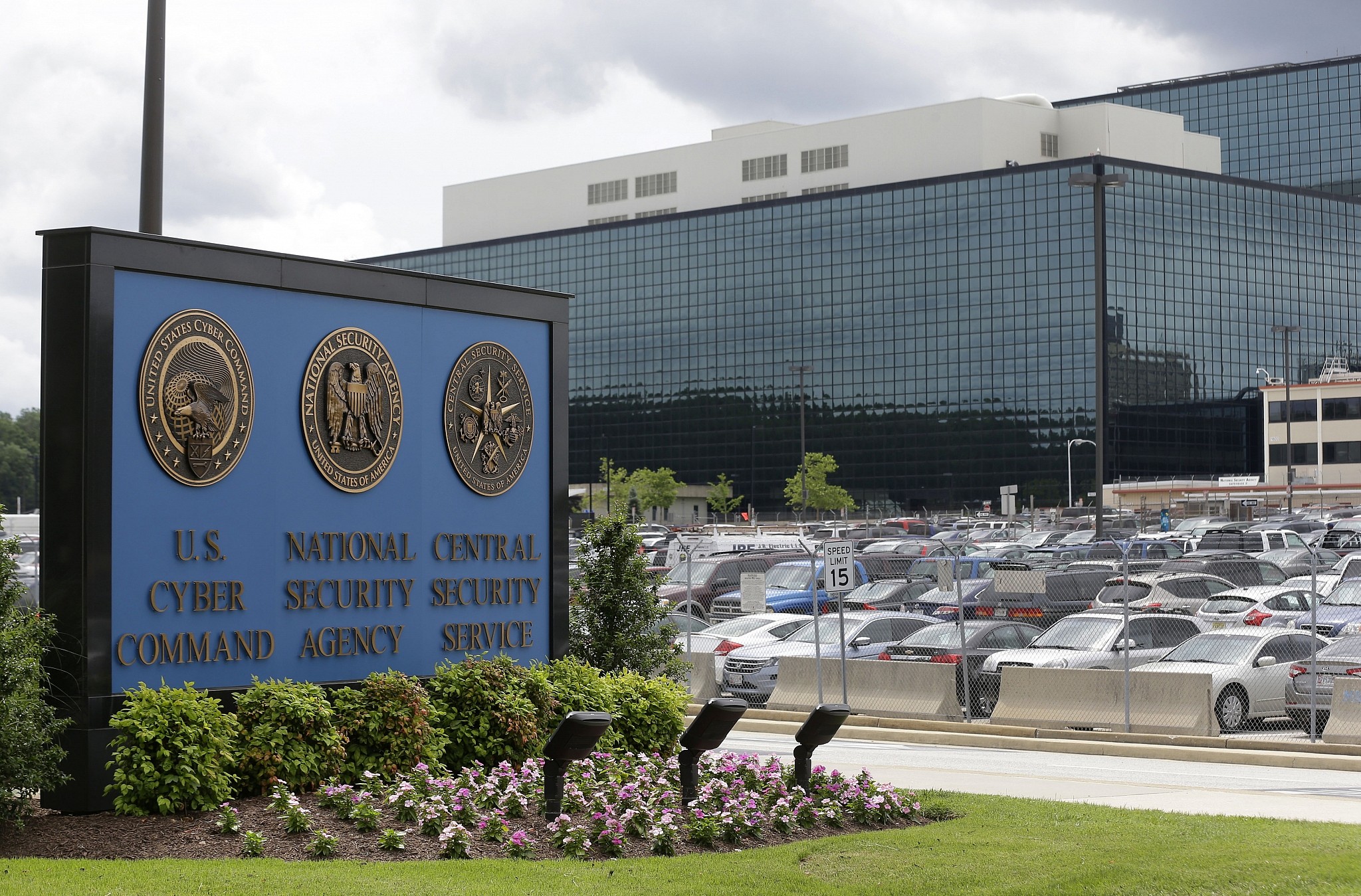
This June 6, 2013 file photo shows the National Security Administration (NSA) campus in Fort Meade, Md at a time when the American Civil Liberties Union, Wikimedia and other groups were suing the National Security Agency over its surveillance practices. (AP Photo/Patrick Semansky, File)

WASHINGTON — The United States launched cyber attacks against Iranian missile control systems and a spy network this week after Tehran downed an American surveillance drone, US media reported on Saturday.

US President Donald Trump ordered a retaliatory military strike against Iran after the drone shootdown but then called it off, saying the response wouldn’t be “proportionate” and instead pledged new sanctions on the country.

But after the drone’s downing, Trump secretly authorized US Cyber Command to carry out a retaliatory cyber attack on Iran, The Washington Post reported.

The attack crippled computers used to control rocket and missile launches, according to the Post, which cited people familiar with the matter.

Yahoo cited two former intelligence officials as saying the US targeted a spying group responsible for tracking ships in the strategic Strait of Hormuz, where Washington has blamed Iran for two recent mine attacks on oil tankers.

The Post said the strikes, which caused no casualties, had been planned for weeks and were first proposed as a response to the tanker attacks.
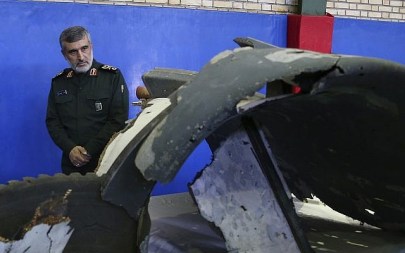
Head of the Revolutionary Guard’s aerospace division Brig. Gen. Amir Ali Hajizadeh looks at debris from what the division describes as the US drone which was shot down on Thursday, in Tehran, Iran, Friday, June 21, 2019 (Meghdad Madadi/Tasnim News Agency/via AP)

US defense officials refused to confirm the reports.

“As a matter of policy and for operational security, we do not discuss cyberspace operations, intelligence or planning,” Defense Department spokeswoman Heather Babb told AFP.

Tensions are high between the US and Iran once again following Trump’s move more than one year ago to leave a multinational accord curbing Iran’s nuclear ambition.

His administration has instead imposed a robust slate of punitive economic sanctions designed to choke off Iranian oil sales and cripple its economy.

President Donald Trump speaks to reporters on the South Lawn of the White House in Washington, Saturday, June 22, 2019, before boarding Marine One for the trip to Camp David in Maryland. (AP Photo/Susan Walsh)

On Saturday, Trump said the US would put “major” new sanctions on Iran next week.

Tehran said it shot down the US drone on Thursday after it violated Iranian airspace. Washington maintains the plane was over international waters.

Meanwhile, Iran has denied responsibility for the tanker attacks, and a top military official on Saturday pledged to “set fire to the interests of America and its allies” if the US attacks.

These cyber attacks aren’t the first time the US and Iran have dueled online.

Iranian technicians work at the Bushehr nuclear power plant in 2010 (photo credit: AP/IIPA, Ebrahim Norouzi)

Iranian technicians work at the Bushehr nuclear power plant in 2010 (photo credit: AP/IIPA, Ebrahim Norouzi)

The Stuxnet virus, discovered in 2010, is believed to have been engineered by Israel and the US to damage nuclear facilities in Iran.

And Tehran is believed to have stepped up its own cyber capabilities in the face of US efforts to isolate the Islamic Republic.


 

A new US-Iran hot line: More a channel for miscommunication than dialogue – DEBKAfile

June 23, 2019

Source: A new US-Iran hot line: More a channel for miscommunication than dialogue – DEBKAfile

President Donald Trump gave Tehran prior notice ahead of the US attack on Iranian missile sites that was aborted on Thursday, June 20, saying that it was “imminent,” and adding that he is against war and wants to talk. Iranian officials replied that it was up to supreme leader Ayatollah Ali Khamenei to decide on this issue although he is against any talks. The exchange stopped there.

DEBKAfile’s military and intelligence sources report exclusively that some of the messages the US and Iran exchanged shortly before and after the Iranian surface-to-air missile shot down a Navy missile over the Strait of Hormuz on Thursday did not go through any third party. They were channeled directly through a new hot line established in the last fortnight to create a direct link between the US Fifth Fleet in Manama, Bahrain and the Bushehr-based Revolutionary Guards Navy HQ.

The latest exchange ran into the main stumbling block in this communications process: there is no knowing for sure which messages actually reach the all-powerful supreme leader. Washington channeled a second set through Qatar – not Oman as both US and Iranian officials told reporters.

Hot lines especially in the Middle East are designed for emergency contacts between opposing powers to avert unintentional war conflagrations. They are maintained inter alia by the US and Russia, the US and Israel and Russia and Israel. This mechanism works only when it suits both parties. When one of the sides is intent on concealing its actions from the other, the link goes silent.

This breakdown of communications through the new hot line was behind the complaint heard from Gen. Amir Hajizadeh, chief of Iran’s Revolutionary Guards Aerospace Command: “Iran warned the [US] drone four times, and the drone would have transmitted the warnings to its central stations. Unfortunately, when they failed to reply, and the aircraft made no change to its trajectory… we were obliged to shoot it down.”

The US insists the drone was shot down in an “unprovoked attack” in international airspace over the Strait of Hormuz.
“Their failure to reply” is the outstanding feature of the new hot line. According to our sources, the Trump administration has sent several messages through the Manama-Bushehr link warning Tehran to call off its planned strike on a major Saudi oil target, which is scheduled to occur in days. As far as we can establish, no Iranian reply has been forthcoming up until now.

