Archive for June 16, 2019

Iran under diplomatic fire over provocations in Persian Gulf

June 16, 2019

Source: Iran under diplomatic fire over provocations in Persian Gulf – www.israelhayom.com

American allies in the Middle East and beyond point finger at Tehran after US shows evidence that it was behind attacks on two oil tankers in the Gulf of Oman on Thursday. Iran decries “Iranophobic campaign” waged by the United States.

In the face of heavy diplomatic pressure following US accusations that Tehran was behind attacks on two oil tankers in the Gulf of Oman on Thursday, the Islamic republic said on Friday that blaming it for attacks on the shipping vessels was alarming.

“We are in charge of maintaining security of the Strait and we rescued the crew of those attacked tankers in the shortest possible time … US Secretary of State [Mike] Pompeo’s accusations towards Iran is alarming,” Iranian Foreign Ministry spokesman Abbas Mousavi said.

The US military released a video late on Thursday that it said showed troops from Iran’s Islamic Revolutionary Guard Corps removing an unexploded mine from the side of one of the targeted vessels, the Japanese-owned oil tanker Kokuka Courageous.

The US military’s Central Command also released photographs showing the apparent mine, which attaches to the side of a ship magnetically, before it was removed later in the day.

Iran has denied being involved in the attack, calling it an “unfounded claim” in the United States’ “Iranophobic campaign.”

Meanwhile, the UK said it was working on the basis that Iran is responsible for the attacks, and warned Iran that these actions were “deeply unwise,” Foreign Secretary Jeremy Hunt said.

“This is deeply worrying and comes at a time of already huge tension. I have been in contact with Pompeo and, while we will be making our own assessment soberly and carefully, our starting point is obviously to believe our US allies,” Hunt said in a statement.

“We are taking this extremely seriously and my message to Iran is that if they have been involved it is a deeply unwise escalation which poses a real danger to the prospects of peace and stability in the region,” he added.

Saudi Arabia also agreed with the American assessment that Iran was behind the suspected attacks, Saudi Minister of State for Foreign Affairs Adel al-Jubeir said.

“We have no reason to disagree with the [US] secretary of state. We agree with him,” Jubeir told CNN. “Iran has a history of doing this.”

Saudi Arabia also said early Friday that its military intercepted five drones launched by Iran-backed Yemen’s Houthi rebels targeting the kingdom, including the Abha regional airport. The kingdom said a similar attack Wednesday on the Abha airport wounded 26 people.

The United Arab Emirates’ Minister of State for Foreign Affairs Anwar Gargash called the alleged attacks in the Gulf of Oman a “major and dangerous escalation” that requires the international community to scramble to protect regional stability and security.

“Wisdom and collective responsibility are needed to prevent more escalation,” Gargash said in a Twitter post.

Egypt also condemned any acts that undermine the safety of waterways in the Gulf region, its foreign ministry said, adding that Cairo was “following with concern” the news of the attack.

Qatar called for an international investigation into the suspected attacks.

A foreign ministry statement carried on state news agency QNA condemned what it called acts of destruction “regardless of who is behind them” and warned against tampering with the security of the Gulf and broader region.

It urged all parties to show restraint and stop escalations.

The United Nations warned that the world cannot afford “a major confrontation in the Gulf.”

UN Secretary-General Antonio Guterres told the Security Council: “I strongly condemn any attack against civilians. Facts must be established and responsibilities clarified.”


UK plans to deploy marines to Persian Gulf: report 

June 16, 2019

Source: UK plans to deploy marines to Persian Gulf: report – POLITICO

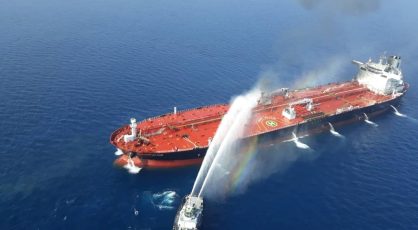
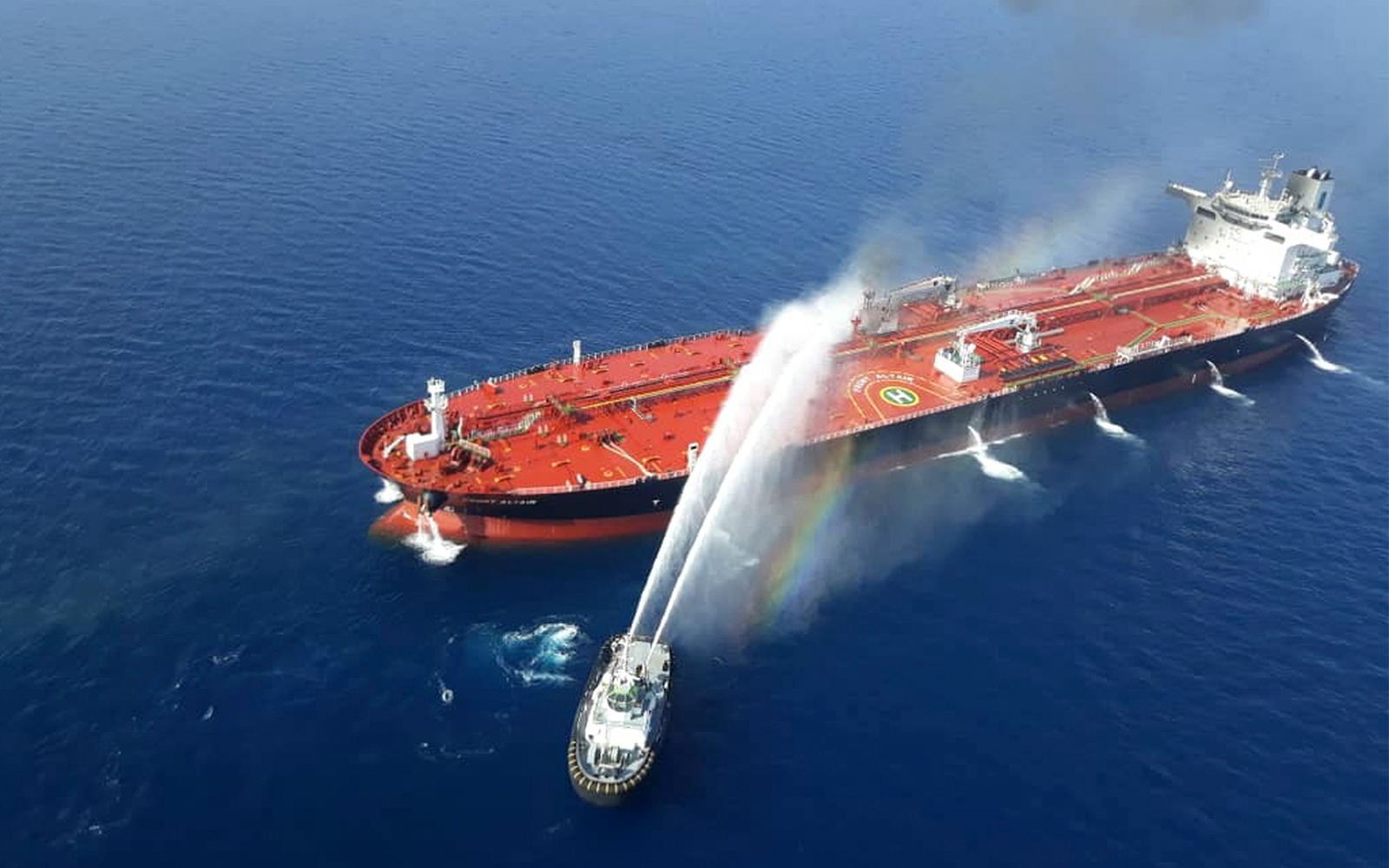
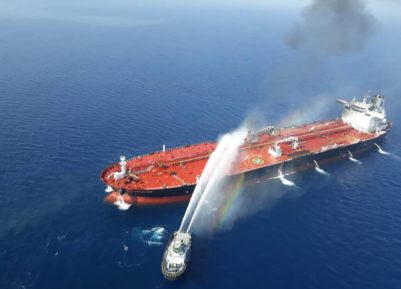
A boat tries to control the flames from a tanker attacked in the Gulf of Oman last week | AFP via Getty Images

The move comes amid rising tensions with Iran.

By

Updated 

LONDON — The United Kingdom will send elite forces to the Gulf of Oman to protect its warships amid rising tensions with Iran, according to The Sunday Times.

The planned deployment follows Thursday’s attacks on two oil tankers, which the U.S. has blamed on Iran. British Foreign Secretary Jeremy Hunt on Friday said the U.K. would make its own assessment, but believed the U.S. claim that Tehran was behind the incident.

One hundred Royal Marines are expected to be deployed “within weeks” to join naval ships operating from the U.K.’s new naval base in Bahrain, The Sunday Times reported, citing unnamed military sources.

The Marines will police the strait from helicopters and smaller boats, in a “force protection” mission that has been planned for several weeks due to rising tensions with Iran, according to the newspaper.

Yet the British defense ministry sought to downplay the move, telling The Sunday Times: “This is a pre-planned training deployment and is in no way related to the ongoing situation in the Gulf of Oman.”

Iran has denied any involvement in the oil tanker attacks, but the U.S. claims it has video evidence proving Iranian forces were responsible.

Tensions between Iran and the West have soared after Washington withdrew from the nuclear deal last year and reimposed sanctions on the country. In May, the U.S. cancelled waivers that had allowed a small group of countries to continue buying Iranian oil despite the reimposition of U.S. sanctions.

In December, Iranian President Hassan Rouhani had warned that “if one day [the U.S.] want to prevent the export of Iran’s oil, then no oil will be exported from the Persian Gulf.”

Large explosion in military zone of Damascus — Syrian state TV 

June 16, 2019

Source: Large explosion in military zone of Damascus — Syrian state TV | The Times of Israel

Syrian state media gives no further details on cause; Hebrew-language media reports blast was at ammunition store

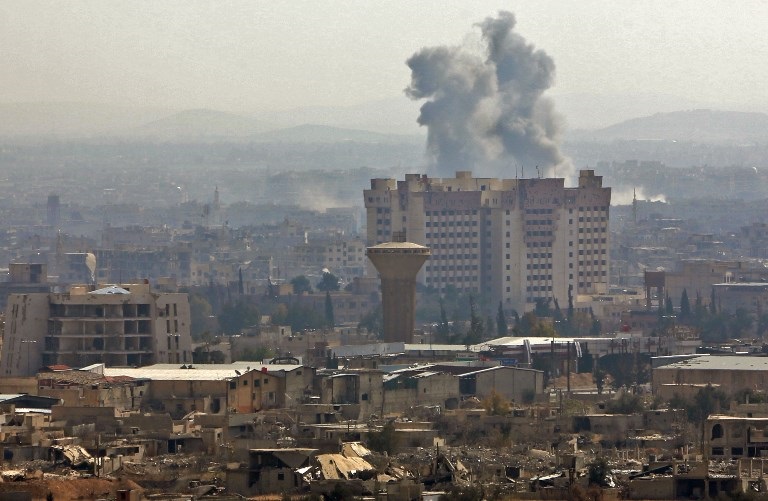
A picture taken from a government-controlled area on the outskirts of Harasta on the northeastern suburbs of Damascus on February 21, 2018, shows smoke rising from areas targeted by Syrian army shelling in the towns of Arbin and Harasta. (AFP PHOTO)

Illustrative: A picture taken from a government-controlled area on the outskirts of Harasta on the northeastern suburbs of Damascus on February 21, 2018, shows smoke rising from areas targeted by Syrian army shelling in the towns of Arbin and Harasta. (AFP PHOTO)

An explosion rocked a military area of Damascus early Saturday evening, Syrian state television reported, giving no further details on the blast.

“The blast heard in Damascus is a result of an explosion in a military zone in Mashrou Dummar”, a western suburb, state news agency SANA said.

The explosion was said to have been at an ammunition store in an area of the city housing military facilities, Hebrew-language media reported.

It was not immediately known what caused the blasts.

The explosion wounded eight pro-government fighters, according to the Britain-based Syrian Observatory for Human Rights war monitor.

In the predawn hours of Wednesday morning, Syrian state media reported that Israel fired several missiles toward a mountain near the Golan border. According to Syrian and Lebanese reports, the target of the strikes was infrastructure set up by the Iran-backed Hezbollah terror group and its allies in recent months.

According to Syria’s official SANA news outlet, the strike targeted sites around Tel al-Harra, an area that Hezbollah has previously identified as being of “great strategic importance” because of the visibility it offers of the surrounding area. There were no reports of injuries.

SANA also reported Israel had jammed Syrian air defense radars in the area, in what it called an act of electronic warfare.

Israel has not officially commented on the alleged strike.

Earlier this month, two rockets were fired from Syria toward Israel’s Mount Hermon in the Golan Heights. There were no reports of injuries or damage.

Israel has carried out hundreds of strikes in Syria in recent years, usually targeting bases linked with Iran.

Toward the start of the Syrian civil war, the Israeli military established a number of “red lines” that if violated would result in a retaliatory strike, including any attacks — intentional or otherwise — against Israel.

They also included Iranian efforts to establish a permanent military presence in Syria and attempts to transfer advanced munitions to the Lebanon-based Hezbollah terrorist group.

In recent years, Israel has acknowledged conducting hundreds of airstrikes in Syria in response to these “red line” violations.


Trump blames Iran for tanker attacks but calls for talks

June 16, 2019

Source: Trump blames Iran for tanker attacks but calls for talks – www.israelhayom.com

Iran: US waging “Iranophobic campaign” of economic warfare. With 20% of world’s oil passes through Strait of Hormuz, acting US defense secretary cites need for contingency plans should situation deteriorate.

US President Donald Trump has blamed Iran for attacks on oil tankers near the strategic Strait of Hormuz, but he also held out hope that implicit US threats to use force will yield talks with the Shiite republic as the Pentagon considers beefing up defenses in the Persian Gulf area.

A day after explosions blew holes in two oil tankers just outside Iran’s territorial waters, rattling international oil markets, the administration seemed caught between pressure to punish Iran and reassure Washington’s Gulf Arab allies without drawing the US closer to war.

“Iran did it,” Trump said Friday on Fox News Channel’s “Fox & Friends.” He didn’t offer evidence, but the US military released video it said showed Iran’s Revolutionary Guard removing an unexploded mine from one of the oil tankers targeted near the Strait of Hormuz, suggesting Tehran wanted to cover its tracks.

By pointing the finger at Iran, Trump was keeping a public spotlight on an adversary he accuses of terrorism but also has invited to negotiate. The approach is similar to his diplomacy with North Korea, which has quieted talk of war but not yet achieved his goal of nuclear disarmament. Iran has shown little sign of backing down, creating uncertainty about how far the Trump administration can go with its campaign of increasing pressure through sanctions.

Iran denied any involvement in the attacks and accused Washington of waging an “Iranophobic campaign” of economic warfare.

A US Navy team on Friday was aboard one of the tankers, the Japanese-owned Kokuka Courageous, collecting forensic evidence, according to a US official who spoke on condition of anonymity to discuss the sensitive operation.

Apparently alluding to the US video, Trump said Iran’s culpability had been “exposed.” He did not say what he intended to do about it but suggested “very tough” US sanctions, including efforts to strangle Iranian oil revenues, would have the desired effect.

“They’ve been told in very strong terms we want to get them back to the table,” Trump said. Just a day earlier, however, the president tweeted that it was “too soon to even think about making a deal” with Iran’s leaders: “They are not ready, and neither are we!”

Trump last year withdrew the United States from an international agreement to limit Iran’s nuclear program that was signed in 2015 under his predecessor, Barack Obama. He has since reinstated economic sanctions aimed at compelling the Iranians to return to the negotiating table. Just last month, the US ended waivers that allowed some countries to continue buying Iranian oil, a move that is starving Iran of oil income and that coincided with what US officials called a surge in intelligence pointing to Iranian preparations for attacks against US forces and interests in the Gulf region.

In response to those intelligence warnings, the US on May 5 announced it was accelerating the deployment of the USS Abraham Lincoln aircraft carrier battle group to the Gulf region. It also sent four nuclear-capable B-52 bombers to Qatar and has beefed up its defenses in the region by deploying more Patriot air defense systems.

Officials said that Pentagon deliberations about possibly sending more military resources to the region, including more Patriot missile batteries, could be accelerated by Thursday’s dramatic attack on the oil tankers.

At the Pentagon, acting Defense Secretary Patrick Shanahan said Iran is not just a US problem. He said the US goal is to “build international consensus to this international problem,” and to ensure that US military commanders in the region get the resources and support they need.

In remarks to reporters later, Shanahan noted the commercial and strategic importance of the Strait of Hormuz, through which about 20% of the world’s oil passes through.

“So, we obviously need to make contingency plans should the situation deteriorate,” he said.

Other administration officials said the US is re-evaluating its presence in the region and will discuss the matter with allies before making decisions. The officials, who briefed reporters on condition of anonymity, said Thursday the US was looking at all options to ensure that maritime traffic in the region is safe and international commerce, particularly through the Strait of Hormuz, is not disrupted. One option, they said, is for US and allied ships to accompany vessels through the strait, noting that this tactic has been used in the past. They said there is no timeline for any decisions.

Rep. Elissa Slotkin, D-Michigan, said that providing naval escorts through the Strait of Hormuz is an option, but, “I don’t think it’s a sustainable option because of the amount of traffic.” She said tanker warfare in the Persian Gulf has historically been a problem, and she wouldn’t be opposed to the US having a more visible presence in the region.

Slotkin, a former senior policy adviser at the Pentagon, said she is concerned that the Trump administration does not have a clear strategy on Iran. She said it’s difficult to deter Iran without provoking additional violence, adding, “I don’t believe this administration is capable of walking such a deft, fine line.”

In ticking off a list of Iranian acts of “unprovoked aggression,” including Thursday’s oil tanker attacks, Secretary of State Mike Pompeo added a surprise accusation. He asserted on Thursday that a late May car bombing of a US convoy in Kabul, Afghanistan, was among a series of threats or attacks by Iran and its proxies against American and allies’ interests. At the time, the Taliban claimed credit for the attack, with no public word of Iranian involvement.

Pompeo’s inclusion of the Afghanistan attack in his list of six Iranian incidents has raised eyebrows in Congress, where he and other US officials have suggested that the administration would be legally justified in taking military action against Iran under the 2001 Authorization of Military Force, or AUMF. In that law, Congress gave then-President George W. Bush authority to retaliate against al-Qaida and the Taliban for the Sept. 11, 2001, terrorist attacks. It has subsequently been used to allow military force against extremists elsewhere, from the Philippines to Syria.

As the world awaited Washington’s next move, analysts said it was difficult to sort out the conflicting claims.

“There are few actors in the world that have less credibility than Donald Trump and the Iranian regime, so even US allies at the moment are confused about what happened,” said Karim Sadjadpour, an Iran expert at the Carnegie Endowment for International Peace. He said the “tremendous mistrust” of both Trump and Iran has made “the biggest priority for most countries to simply avoid conflict or further escalation.”

At the same time, Iranian Ayatollah Ali Khamenei is in a difficult position, Sadjadpour said. “If he didn’t respond to Trump’s provocations, he would risk looking like a paper tiger and projecting weakness. But if he responds overly aggressive to Trump he potentially destabilizes his own rule and his own regime. That’s why we’ve seen Iran calibrate its escalation.”


Spotlight on Iran (June 2 -16, 2019) – The Meir Amit Intelligence and Terrorism Information Center

June 16, 2019

Source: Spotlight on Iran (June 2 -16, 2019) – The Meir Amit Intelligence and Terrorism Information Center

June 2 -16, 2019Editor: Dr. Raz Zimmttwitter
Overview
  • On June 13, two oil tankers were attacked in the Gulf of Oman. One of the tankers, owned by a Norwegian company, was en route from the United Arab Emirates (UAE) to Taiwan, while the other, owned by a Japanese firm, was on its way from Saudi Arabia to Singapore. The US blamed Iran for the attack. In a video, published by the U.S. Navy, a force of the Iranian Revolutionary Guards Corps (IRGC) can be seen removing a limpet mine that failed to explode from the side of one of the targeted tankers. Iran rejected the accusations and blamed foreign actors for the attack, which was carried out during a visit of the Japanese prime minister to Tehran.
  • The deputy commander of the IRGC called Iranian presence in Syria “the realization of a divide duty” and declared that the Islamic Revolution is not confined in one geographic region. He added that the presence of Iranian fighters in Syria is an expression of the commitment to the values of the Islamic Revolution.
  • Against the backdrop of reports on growing discord between Iran and Russia in Syria, a Lebanese newspaper published a report alleging a reduction in the presence of pro-Iranian militias in Damascus due to Russian pressure. The newspaper reported, based on senior military sources in Syria, that the number of Shi’ite militiamen in Damascus decreased by more than 70% over the past year. On the other hand, the newspaper reported about growing presence of foreign pilgrims visiting Shi’ite holy sites around Damascus. Meanwhile, an Iranian news website reported that an Iranian delegation of preachers and Qur’an reciters was dispatched during the month of Ramadan to Syria. The dispatch of the delegation is indication for Iranian efforts to broaden the religious and cultural activities under its guidance in Syria.
  • The Lebanese businessman, Nizar Zakka, who also holds American residency, was released from prison in Iran and returned to Lebanon. Iranian officials reported that his release followed an official request by the Lebanese president and through the mediation of Hezbollah Secretary General, Hassan Nasrallah.
  • During a visit to the Khuzestan Province in southwestern Iran, the senior military adviser of the Supreme Leader of Iran called to connect Iran, Iraq and Syria through railways that would create a corridor connecting the countries of central Asia to the Mediterranean Sea and provide Iran with significant financial benefits. He remarked that Iraq and Syria strategically complement Iran, and that the alliance between the three countries can serve as an economic, political and security axis against Israel and the United States.
  • During the Quds Day speeches in the Gaza Strip, senior Hamas and Palestinian Islamic Jihad Officials thanked Iran for its support for the Palestinians. The Supreme Leader of Iran, Khamenei, used the occasion of a meeting between ambassadors of Muslim-majority countries to mark Eid al-Fitr to reiterate Iran’s support for the Palestinians and call for continued Palestinian “resistance” against Israel.
Attack on Tankers in the Gulf of Oman
  • On June 13, two oil tankers were attacked in the Gulf of Oman. The motor tanker “Front Altair,” sailing under the flag of the Marshall Islands, belongs to the Norwegian Frontline firm. The ship carried refined crude oil on the way from the UAE to Taiwan and was targeted while sailing in international waters between Oman and Iran. The motor tanker “Kokuka Courageous” sailed under Panama’s flag and belongs to a Japanese firm. The tanker carried methanol and was en route from Saudi Arabia to Singapore. One of the crew members was very lightly injured. Due to the damage to the tankers, the crewmembers of both tankers had to evacuate.
  • The U.S. Secretary of State, Mike Pompeo, blamed Iran for the attack. As proof for this allegation, Pompeo pointed to intelligence collected by the U.S., the type of weapon used, the level of expertise required to carry out the operation, similar Iranian attacks on ships in the region, and that fact that none of the proxy groups operating in the region have the resources and skills required to carry out such complex operations. He asserted that Iranian attacks are part of an overarching Iranian campaign intended to increase tensions in the region and that Iran is working to sabotage the flow of oil through the Straits of Hormuz.
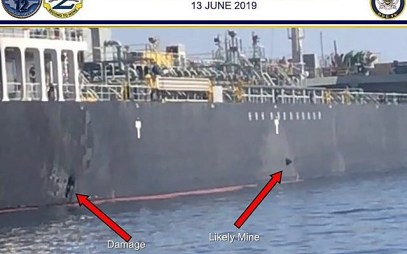
  • A few hours after the attack, the U.S. Navy published a video showing an IRGC force removing a limpet mine from the side of one of the targeted tankers, which had failed to detonate. The spokesman of the U.S. Navy stated that the video shows a force on an IRGC patrol boat approaching the Kokuka Courageous ship and removing the mine. The Japanese operator of the ship stated, on the other hand, that he and the crewmen saw “flying objects” around the time of the attack, which could have been bullets. He rejected the possibility that the ship had been targeted with mines or torpedo missiles, since the damage done to the vessel was about the water line.
  • Iran denied the American allegations and blamed foreign actors for the attack, which was executed in the midst of a visit by Japan’s prime minister to Tehran. Last month (May 14), four commercial vessels (two Saudi, one Norwegian, and one Emirati) were targeted near the Emirate of Fujairah in the Hormuz Straits. An international investigative team ruled last week that the attack had been carried out by a state actor, which used divers on speedboats to plant naval mines against the ships. The investigators, however, did not specifically name Iran as the culprit.
Iranian Involvement in Syria and Lebanon
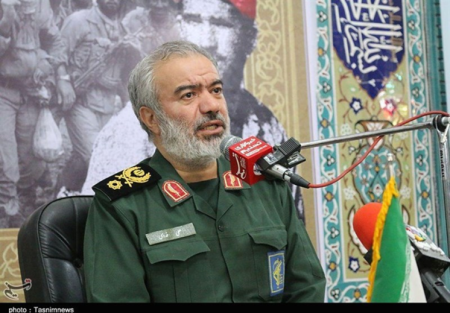
  • Ali Fadavi, the Deputy Commander of the IRGC, called the Iranian presence in Syria a “realization of divide duty.” At a ceremony memorializing Iranian fighters killed in the Iran-Iraq War, Fadavi stated that the Islamic Revolution is not limited to one geographic area and that one of the most beautiful expression of holding steadfast to the Revolution is the presence of Iranian young men thousands of kilometers away from Iran’s borders and the victory they have achieved. Fadavi asserted that even the enemies of the Islamic Revolution are admitting the victory of the Iranian young men in Syria. The United States, the countries of Europe and the “reactionary” Arab states that opposed the current government in Syria and strove to topple it have failed to do so because Iran did not allow it to happen, boasted Fadavi (Tasnim, June 2).
  • The Lebanese paper al-Modon reported (June 2) that the presence of pro-Iranian militias in Damascus has decreased due to Russian pressure. According to this report, at the end of the military campaign around Damascus, the Russians began exerting pressure on the Iranians to leave the city and halt efforts to spread Shi’ite Islam in the area. Following this, Shi’ite pro-Iranian militias began withdrawing from dozens of military positions and hotels where they were staying in Damascus. The newspaper cited senior military sources who claimed that the number of Shi’ite militiamen in Damascus decreased by more than 70% over the past year. In addition, the number of posters hanging in public of Hezbollah Secretary General, Hassan Nasrallah, and the Supreme Leader of Iran, Ali Khamenei, has also decreased. However, the Iranians still maintain several dozens of headquarters and offices in certain areas of Damascus out of which Iranian and Iraqi commanders continue operating. In addition, there has been a marked rise in the number of pilgrims visiting Shi’ite holy sites around Damascus. In parallel to the decrease in Iranian military presence there has also been a rise in the military presence of Russians in the streets and markets of Damascus.
  • A delegation of Iranian preachers and Qur’an reciters were dispatched during the month of Ramadan to Syria. The preachers took part in religious ceremonies in Damascus, Hama, Aleppo, Palmyra, al-Mayadin, Albu Kamal, Deir Ezzor, Nubul and Homs. The Iranian news agency Quran reported that Iran intends to expand its religious activities in Syria and establish centers for the study of the Qur’an across the country (iqna.ir, June 9).
  • On June 11, Iran released from prison the Lebanese businessman Nizar Zakka who was convicted of spying on behalf of the United States. Zakka, a resident of the United States who was detained in Iran since 2015 was accompanied on his way back to Lebanon by the Director of Lebanese General Security, Ibrahim Abbas. The Spokesman of the Iranian Judiciary, Gholam-Hossein Esmaili, stated that Zakka was released following an official request of the Lebanese President, Michel Aoun, conveyed to Iranian authorities. He added that the pardon request was approved by the judiciary following consultation of the Iranian Supreme National Security Council and with Hezbollah, taking into account that Zakka served over a third of his sentence and displayed good behavior (Fars, June 11). The Spokesman of the Iranian Supreme National Security Council, Keivan Khosravi, also stated that Zakka’s release was made possible following the request of the Lebanese president and the mediation of Hezbollah Secretary General, Hassan Nasrallah. He noted that the request of the president of Lebanon was approved due to his support for the “Resistance Front” in Lebanon (Tasnim, June 11).
Iranian Involvement in Iraq
  • On June 10, Iranian Minister of Foreign Affairs, Mohammed Javad Zarif met with Falih Fayyad, the Iraqi National Security Adviser and head of the Popular Mobilization Units (al-Hashd al-Shaabi, the umbrella organization of Iraqi militias). The two discussed relations between the two countries, ways to expand them and latest developments in the region (ISNA, June 11).
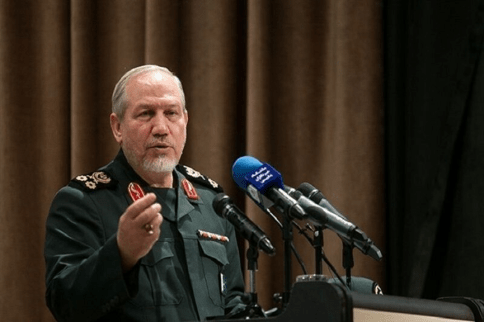
  • During his visit to the Khuzestan Province in southwestern Iran, Yahya Rahim Safavi, the Senior Military Adviser of the Supreme Leader of Iran and former IRGC Commander, stated that Iraq and Syria strategically complement Iran and that the three countries should be connected by railway. He remarked that if it was possible to connect the railways from western Iran to Baghdad through the Kohsravi border crossing in Kermanshah or Khoramshahr in Khuzestan reaching Basra in southern Iraq, such railways would create a land bridge that would connect the countries of western Asia to the Mediterranean through Iran, Iraq and Syria. Iran could, according to Safavi, make billions of dollars from the passage of goods through this corridor. Safavi added that the alliance between Iran, Iraq and Syria could serve as an economic, political, security and defensive axis against the “Zionist regime” and the United States (IRNA, June 12).
  • The Iranian news website, Mashregh News, affiliated with the IRGC, reported (June 11) about U.S. attempts to stymie Iranian effort to create a ground line of supply from Tehran to the Mediterranean. The website reported that recently, the U.S. suddenly halted the training U.S. were providing in the Ain al-Assad military base to fighters among the Sunni tribes of al-Anbar Province to prepare them to fight ISIS. The website alleged that the decision to halt the training is part of an American effort to destabilize security in the region to expand American military influence and thwart Iranian efforts to utilize the ground line of supply through Iran and Syria to the Mediterranean. The website also mentioned that he Americans, concerned about the activation of the land corridor by Iran, have also moved forces and military equipment from Jordan to military bases used by the Americans in al-Anbar, to ensure they are present closer to the sphere of operation of the Popular Mobilization Unit militias around the al-Qa’im border crossing between Syria and Iraq.
Iranian Involvement in the Palestinian Arena
  • During the International Quds Day speeches in the Gaza Strip, senior Hamas and Palestinian Islamic Jihad Officials expressed their gratitude toward Iran for its support for the Palestinians. A senior Hamas leader, Ismail Radwan, gave a speech at the al-Awda (Return) Camp in eastern Gaza City and thanked Iran and the “Resistance Axis” for their support for the “Resistance” (Facebook page of Ismail Radwan, May 31).
  • On the occasion of Quds Day, Yahya al-Sinwar, the Head of the Political Bureau of Hamas, delivered a speech (May 30) in Gaza. The Hamas leader declared that during the 2012 conflict the Palestinian organization struck Tel Aviv for the first time with Fajr rockets provided to them by Iran. He boasted that during the 2014 conflict, the organizations struck Tel Aviv with 370 rockets, including Fajr rockets provided by Iran, and rockets manufactured locally, thanks to financial assistance from Iran (al-Mayadin, May 30).
  • In a speech delivered in Gaza by Ziad Nakhla, the Secretary General of Palestinian Islamic Jihad, on the occasion of Quds Day, he declared that Iran is the only country supporting the Palestinians against the “aggression” of Israel, adding that Iranian support manifests in weaponry and knowledge Iran has transferred to the “Resistance.” He declared that the Palestinian Islamic Jihad is committed to Palestine, to Jerusalem and to the line of Khomeini, the leader of the Islamic Revolution. Al-Nakhla praised Qasem Soleimani, the Commander of the Qods Force of the IRGC, for his support and added that Soleimani personally knows most of the leaders of the “Resistance.” According to al-Nakhla, Iran continues to support the “Resistance” and thanks to this, the Resistance will continue to exist (al-Manar, May 30).
  • In an event marking International Quds Day in Gaza, the event host announced that Iran had decided to provide financial assistance to the families of the fallen whose stipends were cut by the Palestinian Authority. According to him, the total sum of assistance will be $651,000, intended for families of 1,540 fallen, whose stipends from the Palestinian Authority were halted by Ramallah. The family of a Palestinian killed while single will receive a payment of $200, while the family of a married fallen Palestinian will receive $600. According to the announcer, the stipends will also cover 242 individuals injured during the “Marches of Return.” He vowed that Iran will continue to take care of the injured of the “Marches of Return” in the Gaza Strip (Safa, May 30; the website of the radio station Sawt al-Quds, May 30).
  • The Supreme Leader of Iran, Ali Khamenei, expressed once again his confidence in the imminent victory of the Palestinian people in the struggle against Israel. In a meeting with the ambassadors of Muslim countries on the occasion of Eid al-Fitr (June 5), Khamenei stated that the point of view of the Islamic Republic, unlike that of some old Arab leaders who believed that the Jews should be thrown into the sea, is that the Palestinian struggle must continue in the military, political and cultural arenas until the “occupiers” will succumb to the will of the Palestinian people. The Iranian leader lambasted Muslim countries that strive to reach a compromise with Israel and called on the countries of Islam to unify against “the criminal presence of the occupying enemy in Palestine” instead of fighting one another (Fars, June 5).


Iran is playing with fire

June 16, 2019

Source: Iran is playing with fire – www.israelhayom.com

Iran is hoping to pressure the US into easing sanctions via terrorist attacks. The US will have to deal with the ayatollah regime a serious blow, not only to deter it but to prevent future escalation

The terrorist attacked perpetrated by the Iranian Revolutionary Guard Corps, the most recent being directed against oil tankers in the Persian Gulf, are more proof of the pressure that Tehran is feeling from the harsh U.S. sanctions. Washington is slowly strangling the Iranian economy, and the ayatollahs are finding it difficult to find a way out of noose they feel tightening around their necks. The Europeans, as they usually do, are expressing understanding of Tehran’s difficulties but not doing anything to help it. Whereas Russia and China, the ayatollah regime’s most important allies, are not known for handing out bonbons – and even if they wanted to help Iran, their economic ability to do so is limited.

The Iranians thought they could hold on until the 2020 US elections, in the hope that if a new government were voted in, pressure from Washington on Tehran would ease up. But the Iranian economy has collapsed faster than officials in Tehran thought it would, and the economic distress has led to increased civil protests within Iran. The budget hardships also forced Iran to slash the generous aid it provided to its various satellites throughout the Middle East, including Hezbollah and the regime of Syrian President Bashar Assad.

Iranian President Hassan Rouhani and his close associates, who supposedly belong to the moderate camp, have tried in vain to find a diplomatic solution through the friends of Iran in Europe, and even seek the help of Russia and China. It quickly became clear that both Rouhani and his foreign minister, Javad Zarif, are the tail of the dog and it’s the Revolutionary Guards who decide on policy in Iran. The Guards want to maintain their power and promote terrorism throughout the Middle East, even if Iranian citizens are the ones who have to pay the price.

Therefore, the Iranians have decided to turn up the flames, hoping that the Americans will agree to ease the sanctions as a way of avoiding any escalation that would hurt US allies in the Persian Gulf. On the other hand, leaders in Tehran are hoping that Europe and possibly even some Gulf states will cave in the face of terrorism and urge Washington to give up its policy or take action themselves to placate Iran.

Iran is a paper tiger. While it is capable of making its neighbors’ lives miserable and spreading terrorism throughout the region, when it is confronted directly and red lines are drawn – and when other nations are poised to strike – Iran falls back. That is what happened in Syria, for example, where Israel managed to check Iranian attempts to entrench itself in a position to face off against Israel. Besides which, Iran does not have the capabilities to withstand American power if the latter were ever turned on Tehran with full forces.

Tehran is hoping that it can keep walking a tightrope and believes that through threats and terrorism, it will achieve its goals and avoid total economic collapse. It appears that the Iranians are taking heart from the lukewarm response from the international community and especially the US’s conduct, which they perceive as weak and hesitant. In the end, the Middle East is like the Wild West – anyone who wants to shoot, should shoot, or else the threat will carry no weight.

It cannot be denied that the US is sending mixed signals. On one hand, it is applying harsh sanctions against Iran, but on the other, it is making it clear that it intends to pull out of the Middle East and not get bogged down in the muck of regional disputes. Washington is pointing an accusing finger at Iran as the party responsible for the attack on the oil tankers and is even threatening to respond if Iran dares to attack American interests. However, the Americans are also expressing a willingness to enter into dialogue with Tehran. Even more importantly, they are not responding to Iranian terrorist attacks in the region.

Other than Israel, none of the countries in the region – particularly the Gulf states – have the ability to confront Iran on their own. So Washington will be forced to deal Iran a severe blow – not only to deter it but to prevent escalation and war. It would be better if that blow came sooner rather than later.


Corbyn: UK gov’t heightening Gulf tensions by blaming Iran for tanker attacks

June 16, 2019

Source: Corbyn: UK gov’t heightening Gulf tensions by blaming Iran for tanker attacks | The Times of Israel

Labour leader says Britain should work to lower the flames in the region, ‘not fuel a military escalation that began with US withdrawal’ from the nuclear deal

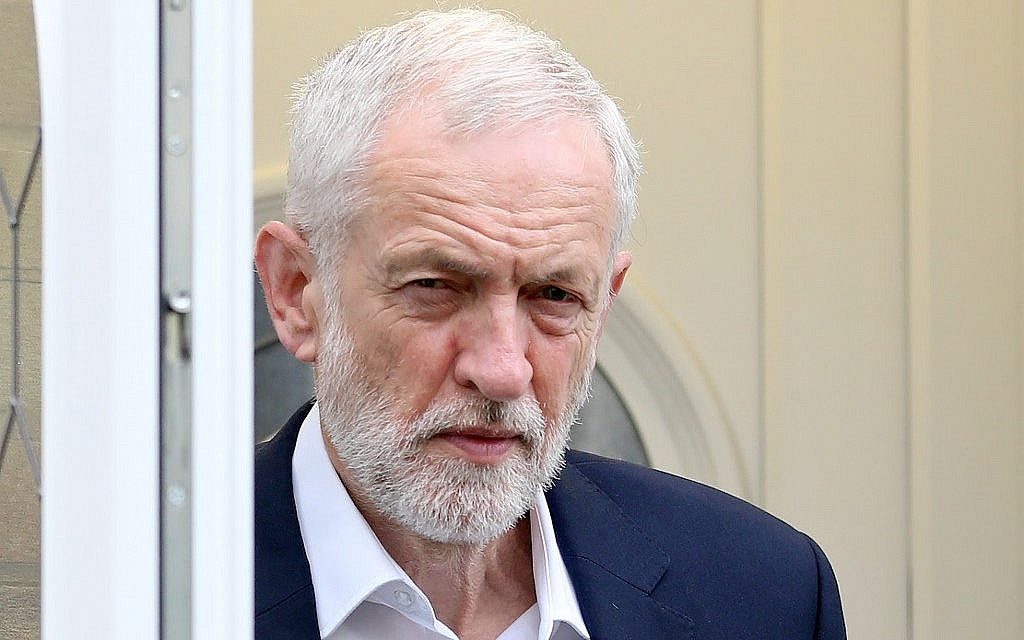
UK Labour Party leader Jeremy Corbyn leaves his house in north London on June 12, 2019. (Isabel Infantes/AFP)

UK Labour Party leader Jeremy Corbyn leaves his house in north London on June 12, 2019. (Isabel Infantes/AFP)

UK Labour Party leader Jeremy Corbyn accused the British government of heightening the possibility of a military conflict in the Persian Gulf, after the country’s foreign minister said Iran was culpable for this week’s attack on a pair of oil tankers.

“Britain should act to ease tensions in the Gulf, not fuel a military escalation that began with US withdrawal from the Iran nuclear agreement,” Corbyn tweeted Friday.

“Without credible evidence about the tanker attacks, the government’s rhetoric will only increase the threat of war,” he added.

The comments by Corbyn, a far-left lawmaker who previously has appeared on a television network connected to the state-owned Iranian broadcasting company, came after British Foreign Secretary Jeremy Hunt said that an independent assessment had concluded that Iran was “almost certainly” responsible for the latest Gulf tanker attacks.

Britain’s Foreign Secretary Jeremy Hunt leaves 10 Downing Street in London on June 11, 2019. (Isabel Infantes/AFP)

“Our own assessment leads us to conclude that responsibility for the attacks almost certainly lies with Iran. These latest attacks build on a pattern of destabilizing Iranian behavior and pose a serious danger to the region,” Hunt said in a statement.

The Foreign Office statement pinned the blame for Thursday’s attack on the Islamic Revolutionary Guard — a vast and powerful branch of the Iranian military.

“No other state or non-state actor could plausibly have been responsible,” the Foreign Office statement said.

Hunt called on Iran to “cease all forms of destabilizing activity” and said Britain was working with other countries to try to find a diplomatic solution to the escalating standoff between Tehran and Washington.

The US military on Friday released a video it said shows Iran’s Revolutionary Guards removing an unexploded limpet mine from one of the oil tankers targeted near the Strait of Hormuz, suggesting the Islamic republic sought to remove evidence of its involvement from the scene.

Iran denies being involved, accusing the US instead of waging an “Iranophobic campaign” against it.

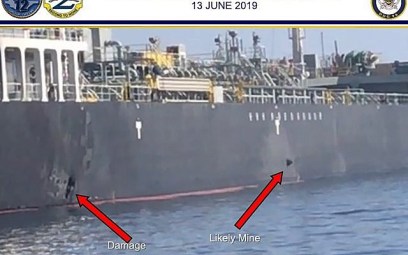
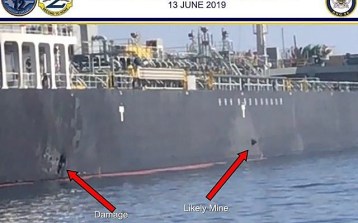
This June 13, 2019, image released by the US military’s Central Command, shows damage and a suspected mine on the Kokuka Courageous in the Gulf of Oman near the coast of Iran. (U.S. Central Command via AP)

While Iran has denied being involved in the attack, Tehran previously used mines against oil tankers in 1987 and 1988 in the “Tanker War,” when the US Navy escorted ships through the region.

The black-and-white footage, as well as still photographs released by the US military’s Central Command on Friday, appeared to show the limpet mine on the Kokuka Courageous.

The suspected attacks occurred at dawn Thursday about 40 kilometers (25 miles) off the southern coast of Iran. The Front Altair, loaded with the flammable hydrocarbon mixture naphtha from the United Arab Emirates, radioed for help as it caught fire. A short time later, the Kokuka Courageous, loaded with methanol from Saudi Arabia and Qatar, also called for help.

The US Navy sent a destroyer, the USS Bainbridge, to assist, said Cmdr. Joshua Frey, a 5th Fleet spokesman. He described the ships as being hit in a “reported attack,” without elaborating.

Thursday’s attack resembled that of an attack in May targeting four oil tankers off the nearby Emirati port of Fujairah. US officials similarly accused Iran of targeting the ships with limpet mines, which are magnetic and attach to the hulls of a ship. The mines disable, but don’t sink, a vessel.


Israel said to blame Iran’s Revolutionary Guard for attacks on oil tankers

June 16, 2019

Source: Israel said to blame Iran’s Revolutionary Guard for attacks on oil tankers | The Times of IsraelTV rep

ort says Israeli intelligence shares US, UK assessment, claims mines and a torpedo were used in Thursday’s strikes in Gulf of Oman

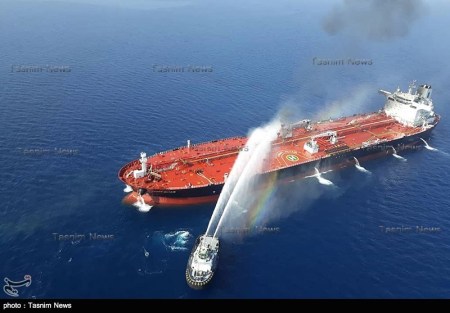
An Iranian navy boat sprays water to extinguish a fire on an oil tanker in the sea of Oman, Thursday, June 13, 2019. (AP Photo/Tasnim News Agency)

An Iranian navy boat sprays water to extinguish a fire on an oil tanker in the sea of Oman, Thursday, June 13, 2019. (AP Photo/Tasnim News Agency)

Israeli intelligence has concluded that Iran carried out Thursday’s attacks on two oil tankers in the Gulf of Oman, Israeli television reported on Saturday night.

Quoting a senior Israeli official involved in Iran-related issues, Channel 13 news reported that Iran’s Islamic Revolutionary Guard Corps carried out the attacks. They used mines and a torpedo, the report said.

US President Donald Trump on Friday called Iran “a nation of terror,” saying the attacks on tankers in the Gulf of Oman had “Iran written all over it.”

The Israeli conclusion mirrors that of the US and the UK.

The US military on Friday released a video it said shows Iran’s Revolutionary Guard removing an unexploded limpet mine from one of the oil tankers targeted near the Strait of Hormuz, suggesting the Islamic republic sought to remove evidence of its involvement from the scene.

Also Friday, Britain said it had concluded that Iran was “almost certainly” responsible for the latest Gulf tanker attacks.
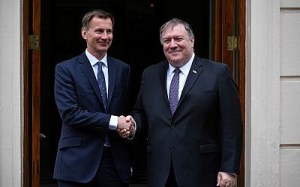
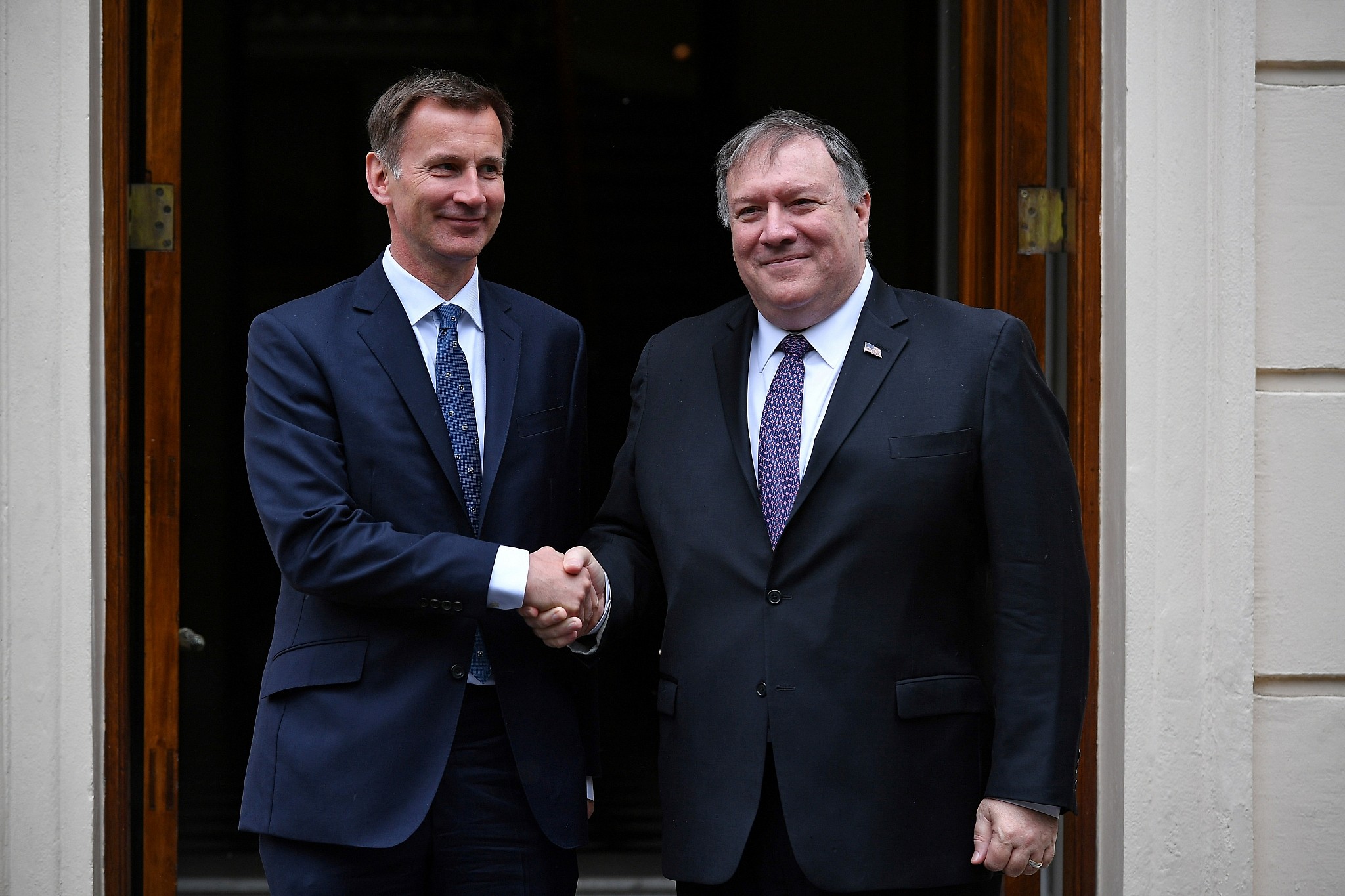
US Secretary of State Mike Pompeo, right, is greeted by Britain’s Foreign Secretary Jeremy Hunt in central London, May 8, 2019. (Mandel Ngan/Pool via AP)

“Our own assessment leads us to conclude that responsibility for the attacks almost certainly lies with Iran. These latest attacks build on a pattern of destabilizing Iranian behavior and pose a serious danger to the region,” British Foreign Secretary Jeremy Hunt said Friday

Iran denies being involved, accusing the US instead of waging an “Iranophobic campaign” against it. Tehran’s foreign minister Mohammad Javad Zarif on Friday fired back at Washington, accusing the US, Israel and Saudi Arabia of a plot to “sabotage diplomacy,” and appeared to insinuate that those countries were behind the assaults.

US President Donald Trump said Friday of the attacks, “Iran did do it.” He cited the video purporting to show an Iranian boat removing what the US says is an unexploded mine from one of the vessels.

“You know they did it because you saw the boat,” Trump said. “I guess one of the mines didn’t explode and it’s probably got essentially Iran written all over it.”

“You saw the boat at night, successfully trying to take the mine off — and that was exposed,” he said.

Also on Friday, an US official told CNN that Iranian forces in the Gulf of Oman fired a missile at a US drone hours before the alleged attack. The drone had spotted Iranian boats approaching the tankers before the sabotage occurred. The surface-to-air missile launched at the drone missed its target and fell into the sea, the official said.
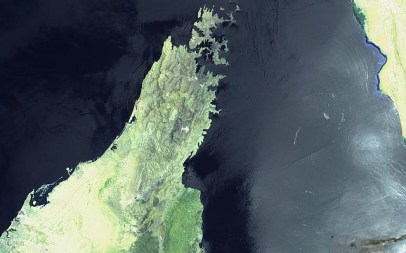
This June 13, 2019 false-color image from the European Commission’s Sentinel-2 satellite that was processed by Sinergise’s Sentinel Hub website shows the Norwegian-owned MT Front Altair, bottom right, ablaze with smoke rising from it in the Gulf of Oman after what the U.S. described as a limpet mine attack by Iran. Iran has denied being involved in the incident. The land mass to the left is the United Arab Emirates and Oman on the Arabian Peninsula. The land mass in the upper right hand corner is Iran. (European Commission via AP)

The ships’ operators offered no immediate explanation on who or what caused the damage against the Norwegian-owned MT Front Altair and the Japanese-owned Kokuka Courageous. Each was loaded with petroleum products, and the Front Altair burned for hours, sending up a column of thick, black smoke.

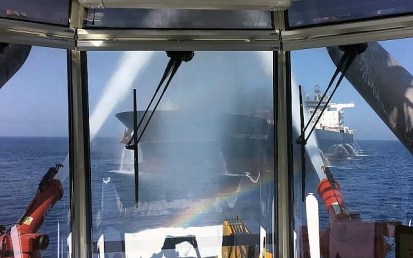
In this photo dated Thursday June 13, 2019, made available by the Norwegian shipowner Frontline, showing the crude oil tanker Front Altair seen through glass observation window as water cannon operate during the firefighting of the fire onboard the Norwegian ship in the Gulf of Oman. The US Navy rushed to assist the stricken vessels in the Gulf of Oman, off the coast of Iran, as two oil tankers came under suspected attack amid heightened tension between Iran and the US. (Frontline via AP)

Frontline, the owner of the MT Front Altair said Friday that the blaze has been extinguished and did not cause any pollution. The company added that its 23 crew members are still in Iran at Bandar Abbas, though they’ll be repatriated soon.

Frontline CEO Robert Hvide Macleod separately said the company still doesn’t know the cause of the explosion and the fire, “but we can exclude that a fault with the ship that has caused this.”

While Iran has denied being involved in the attack, Tehran previously used mines against oil tankers in 1987 and 1988 in the “Tanker War,” when the US Navy escorted ships through the region.

The black-and-white footage, as well as still photographs released by the US military’s Central Command on Friday, appeared to show the limpet mine on the Kokuka Courageous.
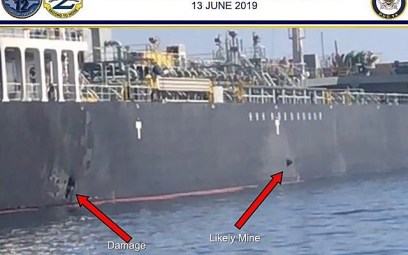
This June 13, 2019, image released by the US military’s Central Command, shows damage and a suspected mine on the Kokuka Courageous in the Gulf of Oman near the coast of Iran. (U.S. Central Command via AP)

A Revolutionary Guard patrol boat pulled alongside the ship and removed the mine, Central Command spokesman Capt. Bill Urban said.

“The US and the international community stand ready to defend our interests, including the freedom of navigation,” Urban said. “The United States has no interest in engaging in a new conflict in the Middle East. However, we will defend our interests.”

Iran earlier denied involvement via a statement from its mission to the United Nations.

“The US economic war and terrorism against the Iranian people as well as its massive military presence in the region have been and continue to be the main sources of insecurity and instability in the wider Persian Gulf region and the most significant threat to its peace and security,” the statement said.

Meanwhile in Tokyo, the owner of the Kokuka Courageous said its sailors saw “flying objects” before the attack, suggesting it wasn’t damaged by mines. Company president Yutaka Katada offered no evidence for his claim, which contradicts the US military account.

Katada also said crew members saw an Iranian naval ship nearby, but did not specify whether this was before or after the attacks.

The suspected attacks occurred at dawn Thursday about 40 kilometers (25 miles) off the southern coast of Iran. The Front Altair, loaded with the flammable hydrocarbon mixture naphtha from the United Arab Emirates, radioed for help as it caught fire. A short time later, the Kokuka Courageous, loaded with methanol from Saudi Arabia and Qatar, also called for help.

The US Navy sent a destroyer, the USS Bainbridge, to assist, said Cmdr. Joshua Frey, a 5th Fleet spokesman. He described the ships as being hit in a “reported attack,” without elaborating.

Thursday’s attack resembled that of an attack in May targeting four oil tankers off the nearby Emirati port of Fujairah. US officials similarly accused Iran of targeting the ships with limpet mines, which are magnetic and attach to the hulls of a ship. The mines disable, but don’t sink, a vessel.

US Secretary of State Mike Pompeo told journalists on Thursday that the US assessment of Iran’s involvement was based in part on intelligence, as well as the expertise needed for the operation. It was also based on recent incidents in the region, which the US also blamed on Iran, including the use of limpet mines in the Fujairah attack, he said. He also tied Iran to a drone attack by Yemen’s Iranian-backed Houthi rebels on a crucial Saudi oil pipeline around the same time.

“Taken as a whole, these unprovoked attacks present a clear threat to international peace and security, a blatant assault on the freedom of navigation and an unacceptable campaign of escalating tension by Iran,” Pompeo said. He didn’t elaborate and took no questions.

Tensions have escalated in the Mideast as Iran appears poised to break the 2015 nuclear deal with world powers, an accord that President Donald Trump repudiated last year. In the deal, Tehran agreed to limit its enrichment of uranium in exchange for the lifting of crippling sanctions. Now, Iran is threatening to resume enriching uranium closer to weapons-grade levels if European nations don’t offer it new terms to the deal by July 7.

Already, Iran says it quadrupled its production of low-enriched uranium. Meanwhile, US sanctions have cut off opportunities for Iran to trade its excess uranium and heavy water abroad, putting Tehran on course to violate terms of the nuclear deal regardless.
 

Iranian forces fired missile at US drone before tanker sabotage — report

June 16, 2019

Source: Iranian forces fired missile at US drone before tanker sabotage — report | The Times of Israel

Unmanned aircraft spotted Iran boats approaching ships hours before they were hit in alleged attack, American official tells CNN

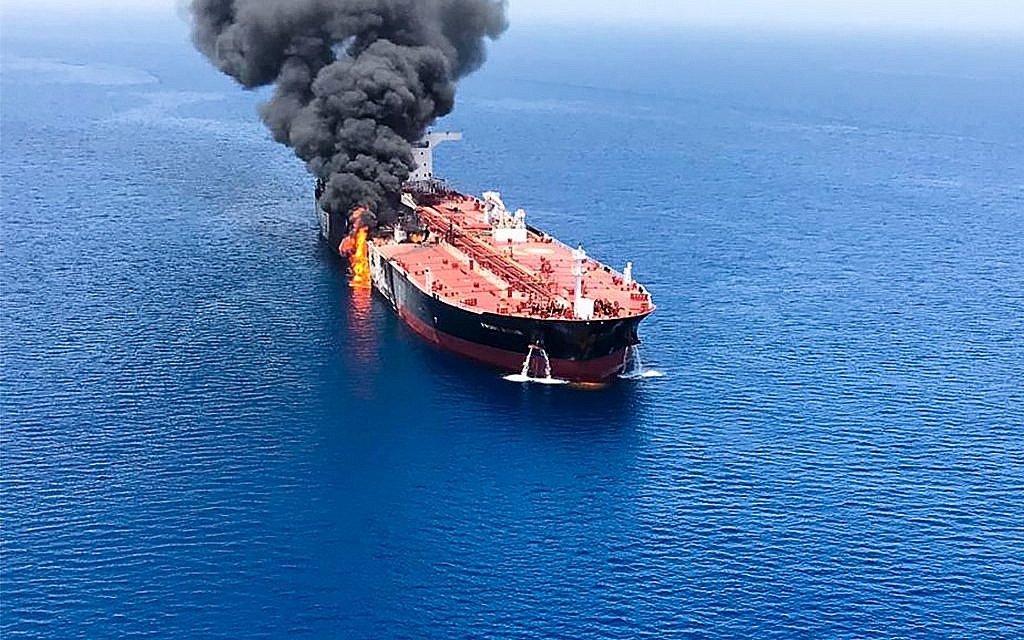
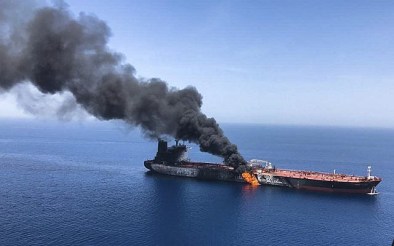
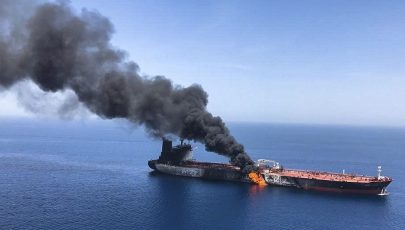
A picture obtained by AFP from Iranian News Agency ISNA on June 13, 2019, reportedly shows fire and smoke billowing from a tanker said to have been attacked in the waters of the Gulf of Oman. (ISNA/AFP)

A picture obtained by AFP from Iranian News Agency ISNA on June 13, 2019, reportedly shows fire and smoke billowing from a tanker said to have been attacked in the waters of the Gulf of Oman. (ISNA/AFP)

Iranian forces in the Gulf of Oman on Thursday fired a missile at a US drone, hours before an alleged attack by Iran against two tankers in the area.

The surface-to-air missile was fired from a boat and missed its target, a US official told CNN on Friday.

The MQ-9 drone had spotted the Iranian forces approaching the tankers, the official said. He did not say if the aircraft had seen the actual attacks take place.

The unnamed official added that an American reaper drone had been downed in the Red Sea in the days before the attack, likely by Houthi rebels equipped with an Iranian missile.

Tensions between Washington and Tehran have skyrocketed following the incident.

On Friday, US President Donald Trump blamed Iran for the sabotage,calling the country “a nation of terror” and saying the attack had “Iran written all over it.”

Calling into “Fox & Friends,” Trump said of the Thursday attacks, “Iran did do it.” He cited video purporting to show an Iranian boat removing what the US says is an unexploded mine from one of the vessels.

“You know they did it because you saw the boat,” Trump said. “I guess one of the mines didn’t explode and it’s probably got essentially Iran written all over it.”

Trump cited no new potential US responses, saying the US has been “very tough on sanctions.” He said, “They’ve been told in very strong terms we want to get them back to the table.”

Trump also warned Iran not to close off the strategic Strait of Hormuz, saying if it is closed it won’t be closed for long.

“They’re not going to be closing it. It’s not going to be closed, it’s not going to be closed for long and they know it. They’ve been told in very strong terms,” Trump said.

The US military on Friday released a video it said shows Iran’s Revolutionary Guard removing an unexploded limpet mine from one of the oil tankers, suggesting the Islamic Republic sought to remove evidence of its involvement from the scene.

The black-and-white footage, as well as still photographs released by the US military’s Central Command on Friday, appeared to show the limpet mine on the Japanese-owned Kokuka Courageous.

The ships’ operators offered no immediate explanation on who or what caused the damage against the Norwegian-owned MT Front Altair and the Kokuka Courageous. Each was loaded with petroleum products, and the Front Altair burned for hours, sending up a column of thick, black smoke.

The suspected attacks occurred at dawn Thursday about 40 kilometers (25 miles) off the southern coast of Iran. The Front Altair, loaded with the flammable hydrocarbon mixture naphtha from the United Arab Emirates, radioed for help as it caught fire. A short time later, the Kokuka Courageous, loaded with methanol from Saudi Arabia and Qatar, also called for help. The US Navy rushed to assist the stricken vessels.

While Iran has denied being involved in the attack, Tehran previously used mines against oil tankers in 1987 and 1988 in the “Tanker War,” when the US Navy escorted ships through the region.

In this photo dated Thursday June 13, 2019, made available by the Norwegian shipowner Frontline, showing the crude oil tanker Front Altair seen through glass observation window as water cannon operate during the firefighting of the fire onboard the Norwegian ship in the Gulf of Oman. The U.S. Navy rushed to assist the stricken vessels in the Gulf of Oman, off the coast of Iran, as two oil tankers came under suspected attack amid heightened tension between Iran and the U.S. (Frontline via AP)

Tehran’s foreign minister Mohammad Javad Zarif on Friday fired back at Washington, accusing the US, Israel and Saudi Arabia of a plot to “sabotage diplomacy,” and appeared to insinuate that those countries were behind the assaults.

Iran earlier denied involvement via a statement from its mission to the United Nations.

“The US economic war and terrorism against the Iranian people as well as its massive military presence in the region have been and continue to be the main sources of insecurity and instability in the wider Persian Gulf region and the most significant threat to its peace and security,” the statement said.

Thursday’s attack resembled that of an attack in May targeting four oil tankers off the Emirati port of Fujairah. US officials similarly accused Iran of targeting the ships with limpet mines, which are magnetic and attach to the hulls of a ship. The mines disable, but don’t sink, a vessel.

This June 13, 2019, image released by the US military’s Central Command, shows damage and a suspected mine on the Kokuka Courageous in the Gulf of Oman near the coast of Iran. (U.S. Central Command via AP)

US Secretary of State Mike Pompeo told journalists on Thursday that the US assessment of Iran’s involvement was based in part on intelligence, as well as the expertise needed for the operation. It was also based on recent incidents in the region, which the US also blamed on Iran, including the use of limpet mines in the Fujairah attack, he said. He also tied Iran to a drone attack by Yemen’s Iranian-backed Houthi rebels on a crucial Saudi oil pipeline around the same time.

Tensions have escalated in the Mideast as Iran appears poised to break the 2015 nuclear deal with world powers, an accord that Trump repudiated last year. In the deal, Tehran agreed to limit its enrichment of uranium in exchange for the lifting of crippling sanctions. Now, Iran is threatening to resume enriching uranium closer to weapons-grade levels if European nations don’t offer it new terms to the deal by July 7.

Already, Iran says it quadrupled its production of low-enriched uranium. Meanwhile, US sanctions have cut off opportunities for Iran to trade its excess uranium and heavy water abroad, putting Tehran on course to violate terms of the nuclear deal regardless.
 

Saudi prince blames Iran for tanker attacks, says won’t hesitate on ‘threats’ 

June 16, 2019

Source: Saudi prince blames Iran for tanker attacks, says won’t hesitate on ‘threats’ | The Times of Israel

Mohammed bin Salman warns kingdom does ‘not want a war in the region’ but will not allow harm to its ‘people, sovereignty, interests’

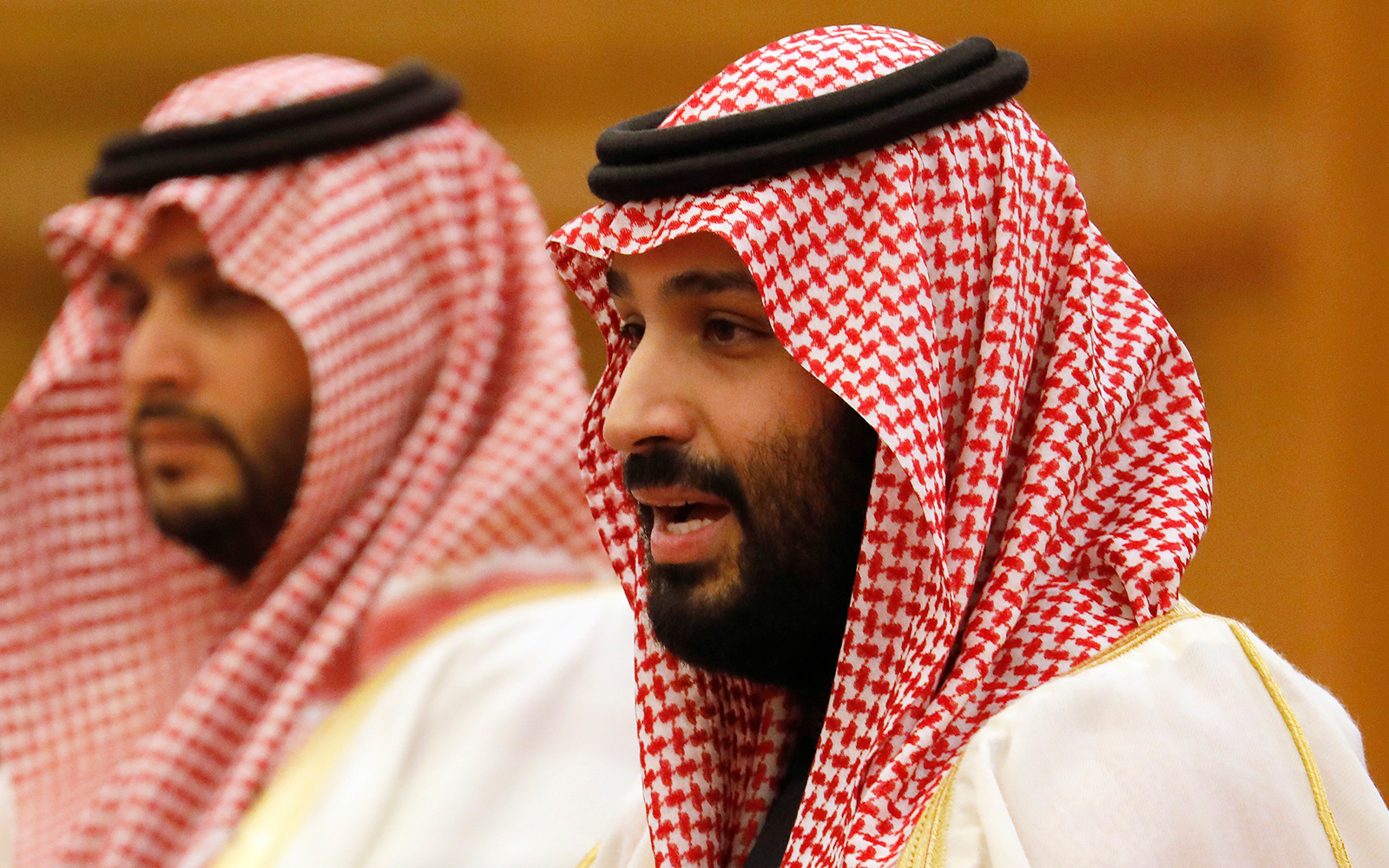
Saudi Crown Prince Mohammad bin Salman, right, speaks during a meeting in Beijing, China, February 22, 2019. (How Hwee Young/Pool Photo via AP, File)

Saudi Crown Prince Mohammed bin Salman on Saturday night accused Iran of carrying out twin attacks on oil tankers in a vital Gulf shipping channel, and said he “won’t hesitate” to tackle threats to the kingdom, in his first comment amid ongoing tensions with rival Iran following attacks on oil tankers in a vital Gulf shipping channel.

“We do not want a war in the region… But we won’t hesitate to deal with any threat to our people, our sovereignty, our territorial integrity and our vital interests,” Prince Mohammed said in excerpts published early Sunday of an interview to pan-Arab daily Asharq al-Awsat.

“The Iranian regime did not respect the presence of the Japanese prime minister as a guest in Tehran and responded to his [diplomatic] efforts by attacking two tankers, one of which was Japanese,” he said.

The prince also accused “Iran and its proxies” over May 12 attacks on four tankers anchored in the Gulf of Oman off the United Arab Emirates port of Fujairah.

The attacks on Thursday on two tankers in the Gulf of Oman sent crude prices soaring amid a tense standoff between Iran and the US.

The Japanese-owned Kokuka Courageous was carrying highly flammable methanol through the Gulf of Oman when it was rocked by explosions, causing a blaze that was quickly extinguished.

US President Donald Trump said the twin attack, which also targeted a tanker owned by Oslo-listed company Frontline, had Iran “written all over it.”

An oil tanker on fire in the Gulf of Oman, June 13, 2019 near the strategic Strait of Hormuz where two ships were reportedly attacked. (AP Photo/ISNA)

The US military on Friday released a video it said shows Iran’s Revolutionary Guard removing an unexploded limpet mine from one of the oil tankers targeted near the Strait of Hormuz, suggesting the Islamic republic sought to remove evidence of its involvement from the scene.

Tehran has vehemently denied any involvement.

Saudi Arabia, a close US ally, is a bitter regional rival of Iran.

Iran has repeatedly warned in the past that it could block the strategic Hormuz Strait in a relatively low-tech, high-impact countermeasure to any attack by the United States.

Doing so would disrupt oil tankers travelling out of the Gulf region to the Indian Ocean and global export routes.

Israeli TV reported Saturday night that Israeli intelligence has concluded Iran carried out Thursday’s attacks. Quoting a senior Israeli official involved in Iran-related issues, Channel 13 news reported that the IRGC carried out the attacks. They used mines and a torpedo, the report said.

The Israeli conclusion mirrors that of the US and the UK.

“Our own assessment leads us to conclude that responsibility for the attacks almost certainly lies with Iran. These latest attacks build on a pattern of destabilizing Iranian behavior and pose a serious danger to the region,” British Foreign Secretary Jeremy Hunt said Friday

Iran denies being involved, accusing the US instead of waging an “Iranophobic campaign” against it. Tehran’s foreign minister Mohammad Javad Zarif on Friday accused the US, Israel and Saudi Arabia of a plot to “sabotage diplomacy,” and appeared to insinuate that those countries were behind the assaults.

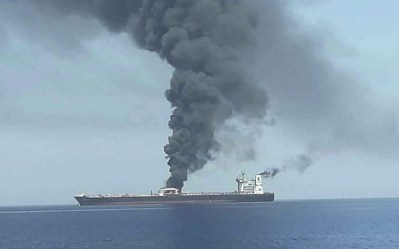
In this photo released by Iran’s state-run IRIB News Agency, an oil tanker is on fire in the sea of Oman, June 13, 2019. (IRIB News Agency via AP)

The ships’ operators offered no immediate explanation on who or what caused the damage against the Norwegian-owned MT Front Altair and the Japanese-owned Kokuka Courageous. Each was loaded with petroleum products, and the Front Altair burned for hours, sending up a column of thick, black smoke.

Tehran previously used mines against oil tankers in 1987 and 1988 in the “Tanker War,” when the US Navy escorted ships through the region.

The US Navy sent a destroyer, the USS Bainbridge, to assist, said Cmdr. Joshua Frey, a 5th Fleet spokesman. He described the ships as being hit in a “reported attack,” without elaborating.

Thursday’s attack resembled that of an attack in May targeting four oil tankers off the nearby Emirati port of Fujairah. US officials similarly accused Iran of targeting the ships with limpet mines, which are magnetic and attach to the hulls of a ship. The mines disable, but don’t sink, a vessel.

This June 13, 2019, image released by the US military’s Central Command, shows damage and a suspected mine on the Kokuka Courageous in the Gulf of Oman near the coast of Iran. (U.S. Central Command via AP)

US Secretary of State Mike Pompeo told journalists on Thursday that the US assessment of Iran’s involvement was based in part on intelligence, as well as the expertise needed for the operation. It was also based on recent incidents in the region, which the US also blamed on Iran, including the use of limpet mines in the Fujairah attack, he said. He also tied Iran to a drone attack by Yemen’s Iranian-backed Houthi rebels on a crucial Saudi oil pipeline around the same time.

“Taken as a whole, these unprovoked attacks present a clear threat to international peace and security, a blatant assault on the freedom of navigation and an unacceptable campaign of escalating tension by Iran,” Pompeo said. He didn’t elaborate and took no questions.

Tensions have escalated in the Mideast as Iran appears poised to break the 2015 nuclear deal with world powers, an accord that President Donald Trump repudiated last year. In the deal, Tehran agreed to limit its enrichment of uranium in exchange for the lifting of crippling sanctions. Now, Iran is threatening to resume enriching uranium closer to weapons-grade levels if European nations don’t offer it new terms to the deal by July 7.

Already, Iran says it quadrupled its production of low-enriched uranium. Meanwhile, US sanctions have cut off opportunities for Iran to trade its excess uranium and heavy water abroad, putting Tehran on course to violate terms of the nuclear deal regardless.
AP contributed to this repor