Archive for June 13, 2019

Iran threatens ‘crushing response’ to US attack as Japan seeks to lower flames

June 13, 2019

Source: Iran threatens ‘crushing response’ to US attack as Japan seeks to lower flames | The Times of Israel

Shinzo Abe urges Tehran to play constructive role in Mideast, warns of ‘accidental conflict,’ hours after Houthi attack on Saudis
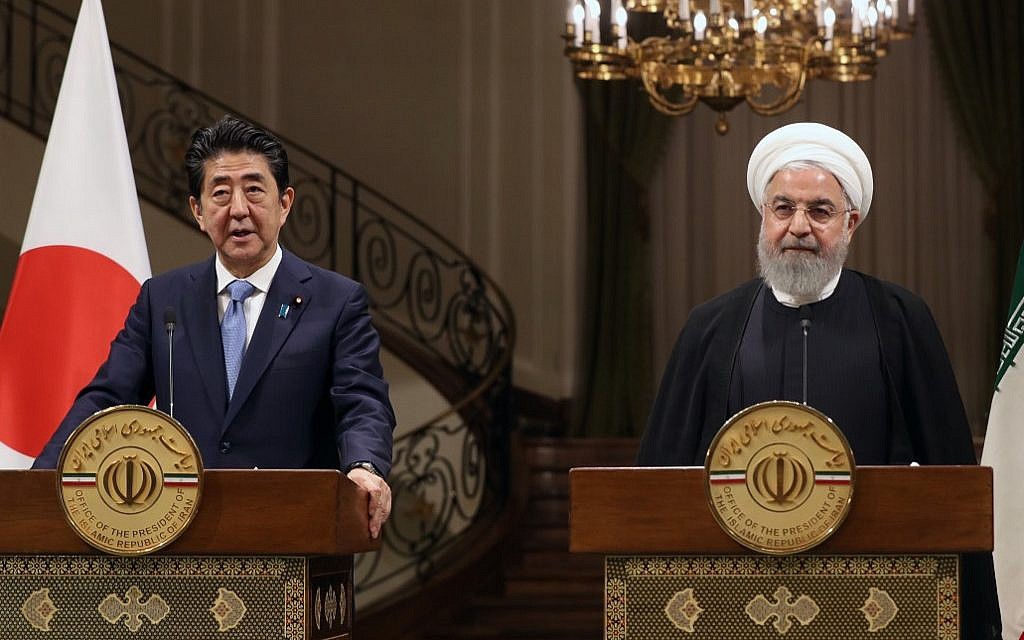
Iranian President Hassan Rouhani (R) Japanese Prime Minister Shinzo Abe give a joint press conference at the Saadabad Palace in Iran's capital Tehran on June 12, 2019. (AFP)

Iranian President Hassan Rouhani (R) Japanese Prime Minister Shinzo Abe give a joint press conference at the Saadabad Palace in Iran’s capital Tehran on June 12, 2019. (AFP)

Iranian President Hassan Rouhani said Wednesday the Islamic Republic does not seek war with the US, but will give “a crushing response” if it is attacked, as Japan’s premier visited Tehran in a bid to ease tensions between the rivals.

Rouhani made the comment as he stood alongside Japanese Prime Minister Shinzo Abe, who called for “more patience” between Iran and the US.

“There is possibility of an accidental conflict and a military conflict should be prevented at all costs,” Abe said.

He said he and the Iranian president had “bluntly discussed” the crisis.

“It is essential that Iran plays a constructive role in building solid peace and stability in the Middle East,” Abe told the joint news conference in Tehran with the Iranian leader, hours after Yemen’s Iranian-backed Houthi rebels attacked a Saudi airport, wounding 26 people.

Abe’s trip to Tehran represents the highest-level effort yet to de-escalate tensions between the US and Iran as the country appears poised to break the 2015 nuclear deal it struck with world powers that America earlier abandoned.
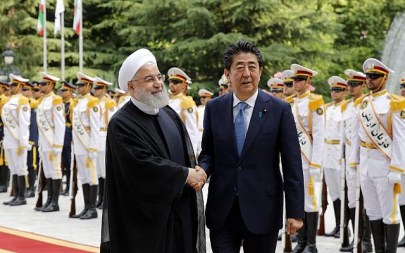
Iranian President Hassan Rouhani (L) shakes hands with Japanese Prime Minister Shinzo Abe during a welcoming ceremony at the Saadabad Palace in Iran’s capital Tehran on June 12, 2019. (AFP)

Iran is threatening to resume enriching uranium closer to weapons-grade level on July 7 if European allies fail to offer it new terms. While US President Donald Trump says he wants to talk to Tehran, the US has piled on sanctions that have seen Iran’s rial currency plummet along with its crucial oil exports.

The US also has sent an aircraft carrier and B-52 bombers to the region, along with hundreds more troops to back up the tens of thousands already deployed across the Middle East. The US blames Iran for a mysterious attack on oil tankers off the coast of the United Arab Emirates, while Iranian-backed rebels in Yemen continue to launch coordinated drone attacks on Saudi Arabia.

Rouhani said an end to the “economic war” would result in “a very positive development in the region and the world.”

Abe’s plane landed at Tehran’s Mehrabad International Airport on Wednesday afternoon where he was greeted by Iranian Foreign Minister Mohammad Javad Zarif. He immediately met Iranian President Hassan Rouhani and will see Iran’s Supreme Leader Ayatollah Ali Khameini on Thursday.
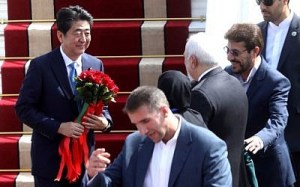
Japan’s Prime Minister Shinzo Abe (L) is greeted by Iran’s Foreign Minister Mohammad Javad Zarif (3rd R) at Tehran’s Mehrabad airport on June 12, 2019. (Ali Taghavi/ISNA/AFP)

Iran’s semi-official news agency reported that dozens of hard-line students gathered outside of the airport to protest Abe’s efforts to calm tensions.

Protesters said “the efforts by Japan’s prime minister for mediating between Iran and the US is useless, and if this is the goal of the trip, it will have no achievement,” the Fars news agency reported.

Students held placards, written in Farsi and Japanese, mocking Abe as “Japan’s representative or America’s ambassador.”

A hard-line newspaper also criticized Abe’s visit by printing an image showing the mushroom cloud of a nuclear blast on its front page: “How Can You Trust A War Criminal, Mr. Abe?” This appeared to refer to America dropping atomic bombs on Hiroshima and Nagasaki at the end of World War II.

In this July 2, 2012 file photo, an Iranian Revolutionary Guard speedboat maneuvers in the Persian Gulf while an oil tanker is seen in background. (AP Photo/Vahid Salemi, File)

Abe landed just hours after the attack in Abha. The Yemeni rebels, known as Houthis, said they launched a cruise missile at the Saudi airport while the kingdom said 26 people were hurt.

Though there were no fatalities, it was the largest number of civilians to be injured in Saudi Arabia as a result of an attack by the rebels since the start of the Saudi-led war in Yemen more than four years ago.

The rebels’ Al-Masirah satellite news channel said the missile hit its intended target, halting air traffic at the airport in the town of Abha in the kingdom’s southwest, some 165 kilometers (100 miles) from the Saudi-Yemen border.

The war in Yemen, the Arab world’s poorest country, has killed tens of thousands of civilians, with most of the deaths blamed on Saudi-led coalition airstrikes, and has pushed Yemen to the brink of famine.
 

Balloon-borne bomb from Gaza explodes over Israeli town

June 13, 2019

Source: Balloon-borne bomb from Gaza explodes over Israeli town | The Times of Israel

No injuries or damage as explosive detonates in air; 6 blazes sparked Wednesday by incendiary devices from Strip

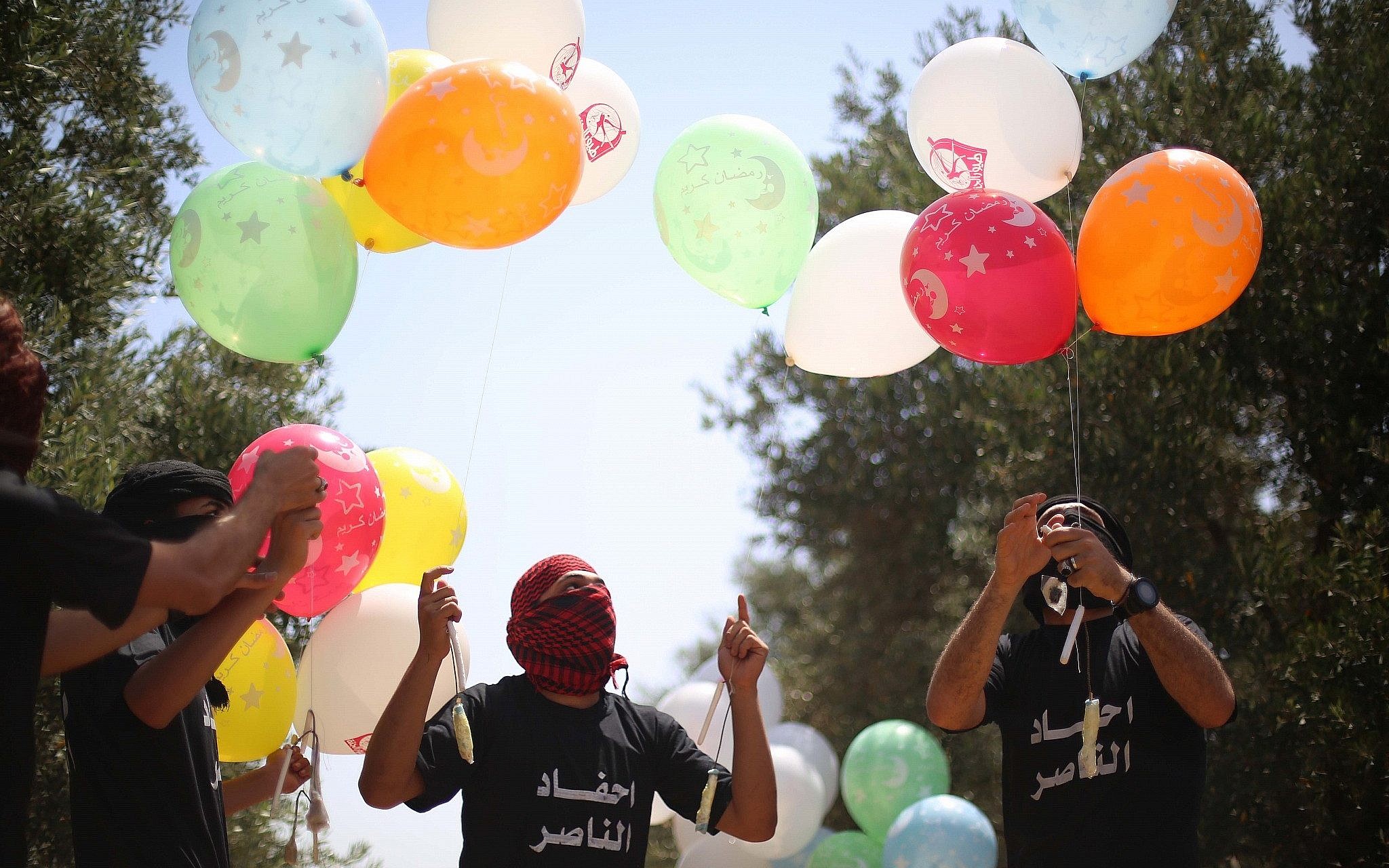
Illustrative: Palestinians prepare balloon-borne incendiary devices to launch at Israel, at the Bureij refugee camp in the Gaza Strip on May 31, 2019. (Hassan Jedi/Flash90)

A balloon-borne explosive device launched from the Gaza Strip detonated over a community in southern Israel Wednesday, as tensions along the border rose.

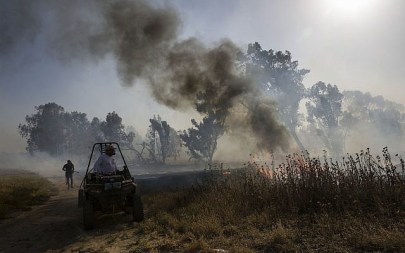
The explosion caused neither injury nor damage, but came as Gazans have stepped up launches of balloon-borne incendiary devices into Israel, with many of them being blamed for wildfires.

“An explosive balloon detonated near a community in the Eshkol region. Residents reported a loud blast heard in the community,” a local government spokesperson said.

It was the first such explosive attack from the Gaza Strip since Israel and terror groups in the coastal enclave reached an unofficial ceasefire agreement following two days of intense fighting in early May.

As part of an Egyptian-brokered agreement to end the flareup, Gaza’s Hamas rulers were reportedly obliged to halt the launching of incendiary balloons at Israeli communities, among other measures to rein in violence along the border.

Illustrative: Firefighters work to extinguish a blaze in the Eshkol region of southern Israel that was sparked by a balloon-borne incendiary device from the Gaza Strip on May 22, 2019. (Eli Cohen/Fire and Rescue Services)

Though violence has ebbed since the ceasefire was reached, arson attacks from the Strip have continued intermittently, with the local fire department reporting six fires were started Wednesday in southern Israel as a result of incendiary and explosive devices flown from Gaza.

On Tuesday, seven fires in southern Israel were sparked by balloon-borne incendiary devices from Gaza, prompting Israel to announce in response that it will further scale back the Gaza fishing zone from 10 nautical miles to six.

For the past several months, Israel has been extending and reducing the permitted fishing zone around Gaza as fewer or more incendiary balloons have been sent over the border.

Also Wednesday, a rocket fired from Gaza during last month’s fighting was believed to have caused an explosion in a cemetery east of the southern port city of Ashdod.

The rocket apparently landed at the site, in the town of Be’er Tuvia, but did not explode on impact.

No one was hurt in the incident.


IAF strikes underground Hamas targets after Palestinians fire rocket into Israel 

June 13, 2019

Source: IAF strikes underground Hamas targets after Palestinians fire rocket into Israel | The Times of Israel

No injuries or damage as Iron Dome intercepts projectile over southern Israel; rocket attack follows day of balloon attacks from Gaza

A picture taken on May 5, 2019 from the Israel-Gaza border shows a barrage of rockets being fired from the Hamas-run Palestinian enclave. (Jack Guez/AFP)

Illustrative. A picture taken on May 5, 2019 from the Israel-Gaza border shows a barrage of rockets being fired from the Hamas-run Palestinian enclave. (Jack Guez/AFP)

Israeli aircraft hit Hamas underground facilities in the Gaza Strip early Thursday after a rocket fired at southern Israel was shot down in the first such attack since Israel and terror groups in the coastal enclave fought a vicious two-day battle last month.

The IDF said fighter jets bombed “underground terror infrastructure on a base belonging to the Hamas terror group in the southern Gaza Strip.”

It said the strikes came in response to the rocket that was fired at Israel earlier in the night, noting that Israel holds Hamas responsible for all violence emanating from the Strip.

Earlier in the night the Israeli military said it shot down a rocket from Gaza heading toward southern Israel shortly after midnight Wednesday.

The incoming projectile triggered sirens in the community of Nirim in the Eshkol region, east of Gaza, at approximately 12:15 a.m. on Thursday. Residents of the area reported hearing sounds of explosions.

“One launch was detected from the Gaza Strip toward Israeli territory. It was intercepted by Iron Dome soldiers,” the army said in a statement, referring to the air defense system.

Residents said the rocket caused no injuries or damage.

“There were no impacts inside a community. Searches are being conducted in the area,” an Eshkol spokesperson said in a statement.

The attack came hours after Israel announced it was imposing a full naval closure of the Gaza Strip, not allowing local fisherman access to the sea, in response to the wave of arson and explosive attacks from the coastal enclave throughout the day.

At least six fires in southern Israel were blamed on incendiary balloons launched from the Strip, and another balloon with a bomb attached to it exploded over an Israeli town. There were no reports of injuries. The arson attacks caused significant damage to area farmland.

Illustrative: Israeli firefighter battles a fire started by an incendiary device launched from Gaza Strip, near the Israel and Gaza border fence, May 15, 2019. (AP/Tsafrir Abayov)

“Due to the continued fires and flying of incendiary balloons from the Gaza Strip, it was decided this evening to impose a naval closure on the Strip until further notice,” the Defense Ministry’s liaison to the Palestinians said in a statement.

The arson attacks appear to be a violation of an unofficial ceasefire reached in early May between Israel and Gaza’s Hamas rulers that ended two days of intense fighting between the Israeli military and Palestinian terror groups.

According to Israel’s Channel 12 news, the agreement includes a Hamas obligation to halt violent incidents along the border fence, maintaining a buffer zone 300 meters from the border; an end to the launching of incendiary balloons at Israeli communities and nighttime clashes between Gazans and security forces; and a stop to flotillas trying to break through the maritime border between Gaza and Israel.

In return, Israel expanded the fishing zone and agreed to enable United Nations cash-for-work programs, allow medicine and other civil aid to enter the Strip, and open negotiations on matters relating to electricity, crossings, healthcare, and funds.

The balloon-borne bomb Wednesday was the first armed attack from the Strip since that round of fighting ended on May 5.

Also Wednesday, an unexploded rocket exploded in a cemetery in a town outside Ashdod. There were no reports of injuries.

Times of Israel staff contributed to this report.