Archive for May 2019

Herman Wouk and the Jew in the public square 

May 27, 2019

Source: Herman Wouk and the Jew in the public square – www.israelhayom.com

At a time when American Jews rose to prominence by shedding their Jewish identity, Herman Wouk was an author with different ideals.

The novelist, who died on May 17, just 10 days short of his 104 birthday, was among the most prolific authors of his era. He wrote best-selling novels like The Caine Mutiny, which won a Pulitzer Prize and was subsequently made into a hit play and movie made immortal by Humphrey Bogart’s portrayal of the doomed and mentally unstable Captain Queeg. Marjorie Morningstar has been loved by generations of American girls and women who identified with the title character. His narrative epics about World War II, The Winds of War and War and Remembrance, were read by millions and made into popular television miniseries in the 1980s that Americans watched with bated breath. Wouk continued writing popular works until the end of his long, productive life, unfazed by the disdain of literary critics and the contempt of cultural elites who put him down for championing the values of middle-class morality, faith and patriotism they deplored.

There is much to say about Wouk the author. But what was just as remarkable, especially in the context of his time, was Wouk the very publicly observant Jew.

Born in the Bronx in 1915 to Russian Jewish immigrant parents and a graduate of Columbia University, Wouk wrote jokes for radio comedian Fred Allen, though left the entertainment world to serve as an officer in the U.S. Navy during World War II. His time fighting in the Pacific not only served as the basis for some of his writing, but also profoundly influenced his outlook on life.

Literary critics may have preferred Jewish writers like Norman Mailer and Philip Roth, who regarded the lifestyle most Americans aspired to as empty and hypocritical. Yet Wouk’s innate conservatism expressed the ethos of postwar America, and the ambitions of the generation of upward-striving second-generation Americans in particular.

In stark contrast to other Jewish writers and prominent American Jews was the way Wouk treated Judaism and Jewish identity.

While Jews were prominent figures in American popular culture throughout the first half of the 20th century, this was due in large measure to their shedding of their Jewish identity or at least keeping it under wraps. The same was true of films, plays and books written for popular audiences. To the extent that Jewish religious observance or traditions were presented to the public, it was shown as exoticism rather than normal.

But Wouk had very different ideals.

In his books, Jews weren’t stereotypes or merely Americans with Jewish surnames and backgrounds, but living, breathing Jews who were engaged in one way or another with their traditions and faith.

His character Barney Greenglass, the navy attorney in The Caine Mutiny, isn’t afraid to speak about being Jewish or to reference the threat of the Holocaust. In Marjorie Morningstar, the heroine’s family is authentically Jewish, celebrating Passover and a child’s bar mitzvah – something that helped introduce Jewish life to the vast mainstream non-Jewish audience that read Wouk’s books. Marjorie’s story arc, in which she drops her Jewish-sounding name and pursues fame as an actress, as well as rejecting the strict sexual mores of her family only to ultimately settle happily for life as a typical Jewish suburban wife and mother, may not sit well with some readers today. But it exemplified faith in the value of tradition, as well as middle-class morality.

But Wouk was more than just a Jewish author unafraid to write about Jews and Judaism. He was also an Orthodox Jew who, even while immersed in the creative process, refused to compromise on the observance of Shabbat and kashrut.

That was remarkable in an era when, if they were celebrities like Wouk, Jews simply didn’t behave that way in public. When he appeared on the cover of Time magazine in 1955, the article noted his Jewish observance as something of a curiosity: “He is a devout Orthodox Jew who had achieved worldly success in worldly-wise Manhattan while adhering to dietary prohibitions and traditional rituals which many of his fellow Jews find embarrassing.”

But Wouk wasn’t merely unashamed to be a practicing Jew. He also sought to educate the public about Judaism. In 1959, he published This Is My God, a primer on Judaism that opened up the world of Jewish study and faith to a vast audience. It was more than a defense of traditional Jewish faith; it presented the religion as an attractive, normative lifestyle, rather than something restricted to those presumed to be living in an unenlightened past. His books also gave us insight into his own life, in which Torah study, observance, celebration of Jewish identity and support of Israel remained a constant throughout his nearly 104 years.

Wouk would go on writing best-selling books with a special emphasis on historical fiction. Those two-volume epics – Winds of War and War and Remembrance – were especially influential in teaching many about the Holocaust.

Those books sparked comparisons to Leo Tolstoy’s War and Peace from some of his admirers. Suffice it to say that neither his prose nor his historical insights justified that analogy, but Wouk thought of himself as a storyteller, not a literary immortal. At his best, his straightforward narrative style remains both entertaining and educational. Our world would be much poorer without his vast body of work.

As an American and a veteran, Herman Wouk was a sterling example of why we call the men and women who lived in his era and had similar experiences “the greatest generation.” But he was also a role model who showed us that it was possible to be a faithful Jew in the American public square. May his memory be a blessing.

This article is reprinted with permission from JNS.org.
 

Exclusive — Pompeo: $8B Arms Sales to Middle East Allies ‘Appropriate and Necessary’

May 25, 2019

By KRISTINA WONG24 May 2019

https://www.breitbart.com/politics/2019/05/24/exclusive-pompeo-8b-arms-sales-to-middle-east-allies-appropriate-and-necessary/

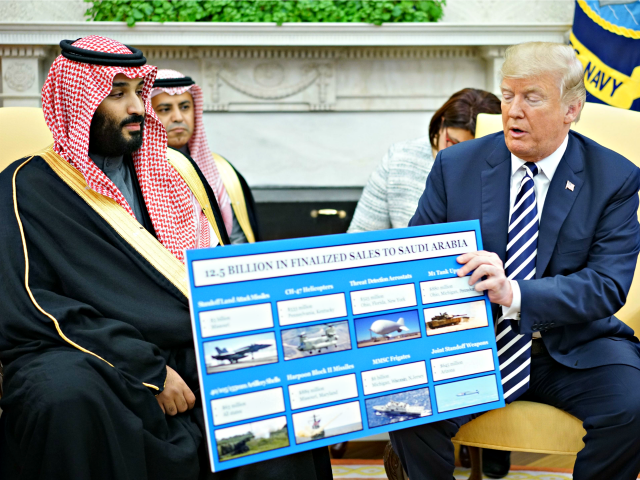
Secretary of State Michael Pompeo said Friday in an exclusive interview with Breitbart News that a newly-announced $8 billion in arms sales to Middle East allies would help protect their and America’s interests against increased Iranian threats in the region.

MANDEL NGAN/AFP/Getty Images

“It is significant that we are not only demonstrating our will to continue to help them support and defend their countries and deter these threats, but the challenge from the Islamic Republic of Iran that we face,” Pompeo said in a phone interview.

“We’ve seen the heightened tensions over the last handful of weeks, so our expectation is that the risks will continue to stay at a heightened level, so it is appropriate and necessary to get these arms sales moving forward,” he said.

The State Department on Friday notified Congress of 22 pending arms sales to the United Arab Emirates, Jordan, and Saudi Arabia worth $8 billion total. The equipment includes aircraft support maintenance; intelligence, surveillance, and reconnaissance (ISR); munitions; and other equipment.

Pompeo said that the first sales will begin to be delivered within the next few weeks, but others could take some months. “It’s about prioritization, delivery schedule, availability,” he said.

“One of the reasons we need to start today…is some of these things do take time,” he added. “You gotta take that first step, or you can’t get to where you hopefully need to be, and that’s what’s today’s declaration is about.”

The arms sales were previously blocked by members of Congress more than a year ago. While most foreign arms sales are approved by Congress, the State Department in this case is drawing upon an authority under Section 36 of the Arms Export Control Act that allows the administration to undertake arms sales in an emergency.

The State Department has determined the increased threat-stream from Iran constitutes an emergency.

On May 3, U.S. Central Command commander Marine Gen. Kenneth McKenzie received intelligence showing there were increased threats from Iran to U.S. forces and assets in the Middle East. On May 5, the Pentagon approved his request to send an aircraft carrier, a bomber squadron, and a Patriot anti-missile battery to the region.

Shortly thereafter, there were attacks on four oil tankers in the Persian Gulf and an attack on a Saudi pipeline that the Pentagon later attributed to Iran. On Sunday, a rocket landed less than a mile from the U.S. Embassy in Iraq that was also attributed to Iranian or Iranian-backed forces in the country. On Friday, the Pentagon announced it was extending the mission of 600 troops that deployed with the battery, and was sending 900 additional troops for a total of 1,500.

The attacks and threats have come as the U.S. has ramped up its economic pressure on Iran, to force it back to the negotiating table over its nuclear program, which the West suspects is a weapons program. In April, the administration designation the Iranian Revolutionary Guard Corps as a terrorist organization, and announced it would end waivers for sanctions on the remaining countries buying oil from Iran.

Pompeo said the attacks were designed to increase the risk to shippers so that crude oil prices will rise and the Islamic Republican of Iran can expand its capacity to inflict terror around the world. “The attempts that you’ve seen over the past week, the attacks on the four commercial tankers, the attacks on the east-west pipeline in Saudi Arabia aim squarely at the heart of Western democratic economies,” he said.

The arms sales would help partners ensure that important sea lanes remain open, and that crude oil is delivered at prices that keep American businesses growing and successful, he said.

“We’ve had some success at disrupting that so far, but we must be ever-vigilant. We need to ensure that we protect our interests, that we do our best to help our allies protect their own commercial vessels, their own territory, and this set of weapons sales is a component of that,” he said.

Pompeo pushed back against criticism from members of Congress that the administration was bypassing them.

“This isn’t going around Congress. The authority that the president used today was granted to us by Congress. It passed the law, it would have been signed by a previous president and provided us specific authority to conduct arms sales in precisely the manner in which we’re doing, so it’s not a bypass of Congress. Indeed we are expressly following the will of Congress in doing this,” he said.

He also addressed criticism over selling arms to Saudi Arabia after the high-profile murder of columnist Jamal Khashoggi in the Saudi embassy in Turkey, calling the murder “horrific” but saying, “this is the right thing to do.”

“Look, we are here supporting the Kingdom of Saudi Arabia, the United Arab Emirates, and Jordan to protect their interests and also it protects ours, American interests. This is the right thing to do. And those are important strategic partners to the United States,” he said.

Pompeo also noted that if the U.S. did not sell Saudi Arabia and other regional allies the weapons, they would buy them from the Russians or the Chinese, who have very different interests from the U.S. He argued that buying the systems from the U.S. also decreases the risks of misuse of these systems. The sales will also create 40,000 jobs in the U.S., he said.

In response to the administration’s pressure campaign, former Obama officials and Democrats have launched their own campaign to save the Iran nuclear deal, which the U.S. pulled out of last year. In a series of op-eds and statements in recent weeks, they have accused the Trump administration of wanting war with Iran.

Pompeo called suggestions the administration wants war with Iran “patently false.”

“I’ve said it, the president’s said it, we do not war with the Islamic Republican of Iran,” he said. However, he said, Iran must stop its dangerous behavior.

“For 40 years, the Iranians have attacked and killed Americans. They’ve made clear their intentions to continue to do so. They continue to chant ‘death to America.’ They continue to talk about wiping Israel from the face of the earth. They’re the most antisemitic country by policy in the world, and so that’s a real threat,” he said.

“We don’t war with them. What we want them to do is to cease their nuclear program, we want them to step away from their proxy campaign attempting to essentially control five capitals in the Middle East,” he continued.

“We want them to cease continuing to develop their missile program that could launch nuclear missile weapons across the world,” he said. “The UN Security Council said the same thing, and UN Security Council [Resolution] 2231. That’s what we’re looking for, and we’re using peaceful means — economic and diplomatic efforts to achieve those ends.”

He blasted the Obama administration’s approach to dealing with Iran, and said President Trump has pursued a different path.

“The Obama administration for the last eight years had appeased Iran and allowed them to grow their terror regime, enhance the capacity of their proxies threatening not only the United States and Israel, but the Gulf States as well,” he said.

“President Trump has taken a very different approach and done our best to deny the Iranians the capacity to conduct their terror campaigns,” he said.

“These arms sales are a piece of our complete effort, of the holistic package of efforts we’re undertaking to deter Iran and to deny them the resources they need to inflict these terror efforts all around the world,” he said.

Greenblatt’s Trojan Horse

May 24, 2019

By David Israel – 19 Iyyar 5779 – May 24, 2019

L-R: Envoy Jason Greenblatt, Ambassador David Friedman, President Donald Trump, Adviser Jared Kushner

Some of my reports about President Donald Trump’s peace envoy to the Middle East, Jason Greenblatt, have been very critical. But despite those reports, I believe Greenblatt is far from being an enemy of the settlement enterprise, or of Israel.

I also happen to believe that Jason Greenblatt represents the first American administration which actually understands the Arabs, and has come up with a viable plan to rein them in for the sake of their own future and Israel’s.

I believe that I understand Greenblatt’s plan and that it could work. I’m merely committed to pointing out the inevitable and sometimes terrifying risks to Israel and to the Jewish settlements in the liberated territories, which is the only thing I truly care about.

I’ll explain.

In a recent lecture at Tel Aviv University about the lessons of Oslo, Yaakov Amidror, a former major-general and National Security Advisor to several Israeli prime ministers, commented on the common Israeli complaint that the PLO never produced their own David Ben-Gurion, and therefore can’t make Ben-Gurion-type decisions, by which they refer to Israel’s political founder’s willingness to settle for less in order to gain more in the future.

According to Amidror, PLO chairman Yasser Arafat was every bit as able to make Ben-Gurion decisions as Ben-Gurion himself had been, but we can’t appreciate it because we don’t understand Arafat’s plans.

In 1992, Arafat was in a much worse position than Ben-Gurion had been in 1947, when he accepted the UN partition plan that awarded Israel less than half the territory of Mandatory Palestine. Ben-Gurion was already there, on the land – Arafat desperately needed to be allowed in.

And so, to Arafat, Amidror argued, embracing the Oslo agreements was his path to the promised land.

Arafat knew that everything he said about doves and olive branches and good neighbors was reversible, but his capturing of Judea, Samaria and Gaza could never be reversed.

Arafat in the Oslo story was the Trojan horse, while the entire Israeli political and military establishment played the role of the naïve Trojans.

The Trump administration entered the Middle East after six US presidents had messed it up – starting with Jimmy Carter, who deposed the Shah and forced Israel to give up a lot of land and resources in exchange for a piece of paper; Reagen’s bizarre military adventure in Lebanon that cost needless American lives; Bush I’s betrayal of his most loyal agent in the region, Saddam Hussein, to appease the Saudis; Clinton’s continued subduing of Hussein while ignoring the latter’s value in deterring Iran; Bush II’s disastrous, multi-trillion dollar invasion which turned Iraq into a loyal Shiite ally of the Iranian mullahs; and Obama’s catastrophic meddling in the Arab Spring fiasco.

Trump is the first US president who reads the Middle East correctly, possibly because he has the annoying habit of ignoring his military advisors. He has certainly improved security in the Middle East by choking the ayatollah’s regime in Iran, and by blocking the Syrian and Turkish territory to the rich Iraqi oil fields.

In the stalemated peace negotiations between the PLO and Israel, Trump, his envoy Greenblatt, and his Ambassador to Jerusalem David Friedman, understood that an even-handed approach would not do, because the problem was not Israel. Israeli leaders have been near-suicidal in their fanatical zealotry for peace in our times with their Arab neighbors. The problem was and still is that even the most generous Israel offer does not meet the most minimalist PLO demands.

Countless times, we’ve heard from Arab intellectuals, military men, politicians and journalists that the problem between us and them is not the Naksa – their name for their 1967 defeat, but the Nakba – the fact that a Jewish state was established in 1948. There is no compromising this – all the territory occupied by Jews in 1948 must be returned, and all the Arabs who fled from the land, along with their next generations for eternity, must come back.

President Trump and Jason Greenblatt are merely the first American officials to pay attention, and to realize we’ve all been dealing with the wrong partner in these tortured peace negotiations.

Which is why, from the start, the Trump administration’s approach has been to humiliate the PLO, trivialize it, cut back its funds, deplete UNRWA, shut down the PLO mission in DC, move the embassy to Jerusalem – showing the world and – much more importantly – the Arabs, that the PLO does not count.

And the PLO has reacted as expected, screaming its head off, running to the EU leadership (which could be replaced this week or next), and to Russia (which maintains a healthy diplomatic relationship with both Trump and Netanyahu).

Now, by boycotting the Bahrain conference, the PLO has written itself out of what could emerge as the most important peace conference of the past 50 years in the region. Unlike previous conferences, this one will not be a stage for politicians to placate the media with hollow proclamations. Instead they’ll be discussing money and the good things money can buy for the Arabs in Judea and Samaria, perhaps Gaza as well: a new infrastructure, power, water, housing, transportation, health, education, business, industry, agriculture.

The PLO insists that before any of these issues are settled, there are more urgent ones: a Palestinian state with Jerusalem as its capital, a total Israeli withdrawal from Judea and Samaria, a return of some 5 million children of refugees to Haifa, Acre, Jaffa, Lod, and Ramla. Issues the PLO knows full well are designed to stick the “peace process” where it is – providing the PLO with a reason to exist.

Should Jason Greenblatt succeed, his deal would launch a speedy emergence of a robust Arab middle class in Judea and Samaria, which would, in the near future, stand up to its oppressors in Ramallah. With sufficient encouragement from the US, Saudi Arabia and the Gulf states, and with Israeli cooperation which is already setting facts on the ground, the PLO would be relegated to the trash heaps of history.

There is no need for a traditional, US-brokered peace deal, because by definition a deal involving the PLO is destined to fail.

I suspect that all the “deal of the century” talk, with its lingering postponements, is so much camouflage. The real Trump-Greenblatt deal is intended to fix the Arabs’ abysmal economic condition, the result of 25 years of a PLO failed state.

I could be wrong—in which case there are several hats in my possession I would choose from and eat.

But I have faith that Jason Greenblatt is not a political hack. He’s a real-estate lawyer and a businessman. He should have the skill-set needed to tell what can and can’t be achieved. He would not talk his biggest client – Donald Trump – into signing his name to a deal that has no future.

Frankly, I hope Jason Greenblatt represents the Ben-Gurion spirit of the Trump administration – which requires a good measure of humility but also an almost inhuman stubbornness.

I actually think Greenblatt is a new Trojan horse, preferring to help reshape Arab society in the territories in an almost clandestine manner, for the sake of a peaceful outcome down the road. He could succeed.

Our job as a Jewish newspaper is to make sure our brothers and sisters in Israel and in the settlements (also in Israel) don’t find themselves under the wrong side of the horse.

ISRAELI NAVY INAUGURATES FIRST SAAR 6 CORVETTE

May 24, 2019

The construction of the four Sa’ar 6 warships was agreed to in a 430 million euro deal between Israel and the German company ThyssenKrupp in 2015.

BY ANNA AHRONHEIM  MAY 24, 2019 13:13 

Sa’ar 6 corvette | The Times of Israel
timesofisrael.com
Israeli Navy inaugurates first Saar 6 corvette. (photo credit: IDF SPOKESPERSON’S UNIT)

The INS Magen, the Navy’s first Sa’ar 6 corvette, was officially named at a ceremony held at the Kiel shipyards in Germany.

The ceremony was headed by Navy Commander Maj.-Gen. Eli Sharvit, Defense Ministry Head of Procurement Avi Dadon, Navy Material Command head Yossi Ashkenazi, project head Brig.-Gen. Erez, as well as the Commander of the INS Magen Lt.-Col Baruch. Commanders and soldiers who took part in the project and shipyard employees also attended the ceremony.The ceremony included the customary breaking a bottle of champagne on the ship’s bow by the navy commander’s wife, Etti Sharvit.

The construction of the four Sa’ar 6 warships was agreed to in a 430 million euro deal between Israel and the German company ThyssenKrupp in 2015.  

The INS Magen is expected to arrive in the spring of 2020.

The new Sa’ar 6 are set to defend Israel’s strategic maritime assets such as the country’s offshore natural gas reserves, as well as maintaining Israel’s sovereignty in the near and far seas, destroying the enemy’s war fleets and significantly contributing to complex and secret missions in the war-between-war campaign.

“The Sa’ar 6 corvettes, including the INS Magen, will significantly increase the strength of Israel’s missile boat flotilla, and they will serve as the ‘tip of the spear’ in protecting strategic Israeli interests,” read a statement by the IDF Spokesperson’s Unit.

The Sa’ar 6 will have a maximum speed of 26 knots and a crew of 70 sailors, a range of 2500 miles, and advanced capabilities able to deal with a wide range of threats. They will be fitted with two Naval Iron Dome short range defense missile launchers with 20 Tamir missile for each launcher and Barak-8 long-range surface-to-air missile naval defense system.

They will also have 16 anti-ship missiles, one 76mm Oto Melara Super Rapid main gun,  two Typhoon 25mm remote weapon stations and two 324mm torpedo launchers for MK54 Lightweight Torpedoes.

“Today, when we give the missile corvette a Hebrew name – the INS Magen – we add another significant brick to our country’s protective wall. Building watercraft is like going on a long, many-year trip,’ Sharvit said at the ceremony. “One step after another we walk a complex path which presents many challenges and requires close cooperation with many others along the way. I would like to thank all our partners in this journey, both in the Navy and outside of it.”

“Just one year ago we stood here at a ceremony marking cutting the first metal, and here, a year later, we are standing in awe of the first of four ships, the INS Magen,” said Avi Dadon, the head of the Defense Ministry’s procurement department. “This unusual achievement is thanks to the hard work of Navy commanders and those in the Defense Ministry. Together with our partners in the German shipyard, you turned a dream into reality. This will dramatically influence the amount of power the Navy has.”

Thyssenkrupp CEO Rolf Wirtz said, “We are very proud to contribute to Israel’s security. The Sa’ar 6 ships are the most advanced and largest in the Israeli Navy. The Israeli industry will put together the final systems, and these ships will greatly aid the country’s economy.”

Iran orders its proxies to ‘prepare for war’ – TV7 Israel News 22.05.19

May 22, 2019


Pentagon: Iran threat ‘on hold’ thanks to US response

May 22, 2019

Source: Pentagon: Iran threat ‘on hold’ thanks to US response | The Times of Israel

‘Our steps were very prudent,’ Acting Defense Secretary Patrick Shanahan says of US deployment of ships, bombers to region amid intelligence warnings of Iranian attack plans

The USS Abraham Lincoln sails south in the Suez canal near Ismailia toward the Persian Gulf, May 9, 2019. (Suez Canal Authority via AP)

WASHINGTON – Pentagon chief Patrick Shanahan said Tuesday that the United States had “put on hold” the Iranian threat to its interests, following a spike in tensions that has seen the US dispatch bomber aircraft to the Gulf.

“I think our steps were very prudent and we’ve put on hold the potential for attacks on Americans,” the acting defense secretary said, as he prepared to brief lawmakers on regional tensions.

“I’d say we’re in a period where the threat remains high and our job is to make sure that there is no miscalculation by the Iranians,” Shanahan added.

His comments come amid a war of words between Washington and Tehran as both sides accuse the other of dangerously ratcheting up tensions.

Then-deputy defense secretary Patrick Shanahan, right, listens as US President Donald Trump speaks during a Cabinet meeting at the White House, in Washington, DC, on April 9, 2018. (AP Photo/Evan Vucci, File)

The Pentagon accelerated the deployment of an aircraft carrier strike group to the Gulf and dispatched B-52 bombers to the region on May 7 after US intelligence reported Iranian “threats” to US and allied forces.

The nature of the threat has remained vague, although it reportedly included sightings of missiles being loaded on Iranian dhows in the Gulf.

Several tankers in the Gulf, including two Saudi vessels, were reportedly sabotaged as well.

Members of Congress, including some Republicans, have expressed skepticism about the intelligence, however, as well as worries about the potential for miscalculation.

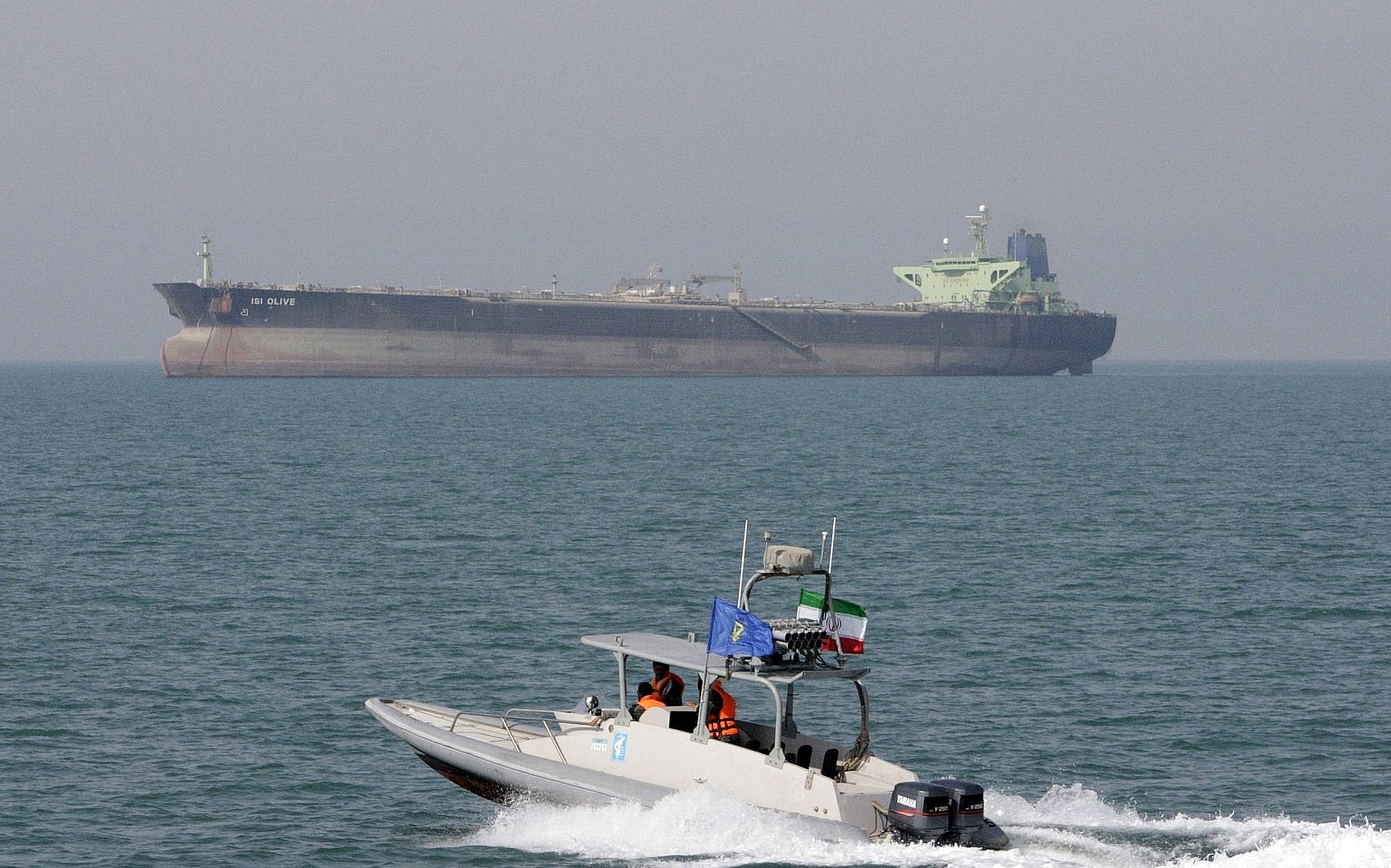
An Iranian Revolutionary Guard speedboat maneuvers in the Persian Gulf while an oil tanker is seen in background, July 2, 2012. (AP Photo/Vahid Salemi, File)

“I really want to underscore the credibility of the intelligence,” Shanahan said, adding that he would be giving lawmakers a more detailed briefing about it.

Asked later what he meant by putting the threat “on hold,” Shanahan told reporters, “There haven’t been any attacks on Americans. I would consider that a hold.”

“That doesn’t mean that the threats that we’ve previously identified have gone away,” he said.

“Our prudent response, I think, has given the Iranians time to recalculate. I think our response was a measure of our will and our resolve that we will protect our people and our interests in the region.”


Iran inches towards restarting nuclear program after attacking Gulf oil infrastructure – DEBKAfile

May 22, 2019

Source: Iran inches towards restarting nuclear program after attacking Gulf oil infrastructure – DEBKAfile

How big a threat is Iran’s decision on Monday, May 20, to increase fourfold production of low-grade enriched uranium and halt the “modernization” of its Arak plant?

Iran has stocked no more than 15-16 kg of low-grade, 3.67pc enriched uranium, according to DEBKAfile’s intelligence sources. This is far below the 300kg cap set by the JCPOA – the nuclear accord Iran signed with six world powers in 2015. It would take Iran’s enrichment plants months to reach that maximum amount, and only then if advanced centrifuges were put to work, in direct violation of that accord.

Therefore, the announcement of a fourfold production boost by an official at the Natanz enrichment site on Monday has little practical relevance at this time for Iran’s nuclear development program.

As for the centrifuges, Iran is allowed to operate 6,000 outdated machines at the Natanz plant in central Iran. Another 19,000 centrifuges, some advanced versions, stand idle, in line with the pact’s provisions. Getting all those machines spinning again after four years of unemployment presents a major technological challenge, for which it is hard to see Iran having the manpower and industrial resources to hand.  Natanz is also handicapped by tours of inspection by the UN’s International Atomic Energy Commission and military surveillance satellites some of them Israeli, watching overhead. Under these conditions, Tehran will find it difficult to take uranium enrichment up to the next 20pc level on the way to weapons grade fuel. However, as recently as last December, Ali Akhbar Salehi, head of Iran’s nuclear energy commission, spoke of 1,044 centrifuges “currently ready” at Fordow (the once-secret underground enrichment facility near the holy city of Qom). “If the establishment wants, we will restart 20pc uranium enrichment there.”

The Fordow centrifuges waiting at Fordow are faster than the machines at Natanz. For now, there is no sign that enrichment there has indeed resumed.

Also covered by the JCPOA was the Arak heavy water reactor, which can produce plutonium. Under the pact, Iran was obliged to convert the plant to civilian use. Tehran never met this obligation. Instead, it performed certain deceptive steps which kept the Arak reactor inactive while still capable of restarting its prohibited functions. This is what was meant by Iran’s Supreme National Council statement on My 8 that “Iran would cease implementation of measures related to the modernization of the Arak Heavy Water Reactor.” Those “modernization” measures were never in fact implemented in full and have left Arak still capable of resuming plutonium production if its functions ae fully restored.

That, too, has not happened thus far. Our military and intelligence sources note, therefore, that, after announcing its partial withdrawal from the nuclear pact, Tehran is moving forward cautiously towards reviving the banned elements of its nuclear program. Preparations are being slowly put in place so that in the event of the confrontation with Washington escalating sharply, those preparations could spring into execution at short notice.


Israel approves armored vehicles for Palestinian Authority

May 21, 2019

Israel approves entry of ten armored vehicles donated by EU on background of crisis between Israel and PA over tax revenues.

Mordechai Sones, 21/05/19 18:26

http://www.israelnationalnews.com/News/News.aspx/263491

Armored vehicleiStock

The Palestinian Authority under Mahmoud Abbas has received armored vehicles from the European Union according to YNet. Israel approved the vehicle’s introduction after years of postponements, on the background of the crisis surrounding offsetting tax money to terrorists’ families.

The armored vehicles were brought into Samaria via Jordan with Israel’s approval.

In recent years the Palestinian Authority has repeatedly demanded that Israel approve entry of armored vehicles, but their request was allegedly rejected time after time.

The last time PA armored vehicles aroused controversy was in 2000 when a paper published by the Ariel Center for Policy Research identified the PA armored threat to Jewish communities in Judea and Samaria, saying “Because the IDF limits yishuv self defense to small arms, the growing armor vehicle capability of the PA would render the assault troops it carries invulnerable to yishuv defenders. The IDF gate guards do not have anything to stop these vehicles. The standard sliding gates for all yishuvim would buckle under the impact of such armored vehicles, and many yishuvim lack even this ‘obstacle’ – such that the only thing separating between the attacker and the yishuv is a moving aluminum arm painted red and white.”

The report went on to say that “The PA armored vehicle force is not capable of challenging the IDF, but would be unstoppable in a first strike on yishuvim. Therefore, it is reasonable to assume that that is their purpose.

“Although it is possible to gain sudden entry into yishuvim by using commandos or even less prepared troops – as the examples of Ariel and Ofra show – armored vehicles provide a rapid capability to do so that ground troops cannot match.”

At that time, the IDF justification for the PA need for armored vehicles according to Oslo was that Arafat needed them to protect his government from Arab extremist elements, while at the same time trying to deny their existence.

The current shipment of armored vehicles arrived at a time of crisis between Jerusalem and Ramallah around the law to offset terrorist salaries and the Palestinian Authority’s stubborn refusal to accept tax revenues from Israel after it offset the Palestinian Authority’s payment to the families of terrorists.

For more than three months, tens of thousands of members of the PA organizations have received half of their salaries because of the crisis surrounding the PA-Israel offsetting law. In the corridors of the security apparatuses, there was harsh criticism of Israel’s policy, as the PA continues security coordination with the Israeli defense establishment while Israel conducts indirect negotiations with Hamas, allowing tens of millions of dollars from Qatar to be disbursed.

YNet conjectures that the approval of the move during this period is intended to soften the criticism and frustration in the Palestinian Authority and to maintain close security coordination.

About three months ago, Palestinian Authority Chairman Mahmoud Abbas announced that Ramallah would waive all the tax revenues it receives every month from Israel – about NIS 500 million – in response to the Israeli decision to offset the salaries of the terrorists.

According to the cabinet decision, Israel offsets the taxes it transfers to the Palestinian Authority on payments linked to terrorism. Prime Minister and Defense Minister Binyamin Netanyahu instructed the security forces to intensify the examination of payments to terrorists and their families and to update the frozen amount accordingly.

In 2000, the IDF repeatedly denied Arab armored vehicles in Judea and Samaria, apparently
intending to convince Jewish residents there that Arab armor would only threaten to concentrate on communities in Gaza. But evidence of attack preparations against yishuvim of Judea and Samaria continued to grow, as reports of PA armor in Ramallah and Shechem began to gain credibility despite IDF denials.

The lunatics run the show

May 21, 2019

Women’s movement: Put ‘Mother and Father’ back on IDF forms

Shovrot Shivyon women’s movement slams surrender to LGBT pressure, says there was ‘no public discussion,’ conservatives are ‘silenced.’

Arutz Sheva Staff, 21/05/19 15:02

http://www.israelnationalnews.com/News/News.aspx/263471

IDF soldiers (illustrative)Hadas Parush, Flash 90

The Shovrot Shivyon (Breaking Equality) women’s movement on Tuesday called on the IDF “to return ‘Father’ and ‘Mother’ to the induction forms and immediately remove the categories of ‘Parent 1’ and ‘Parent 2,’ recently instituted by the IDF.”

The new categories were instituted in response to continuous pressure from LGBT groups and in order to avoid embarrassment during the recruitment process.

According to Shovrot Shivyon, “Identity politics have penetrated the IDF. The minority is forcing its opinion on the majority who believe in the values ​​of the natural family. The IDF Spokesperson stated that the goal was to prevent embarrassment during induction stages. The silent and conservative majority was the one who felt embarrassed by such a form. Progressive values ​​are assimilated by left-extreme groups without any public discussion, with the other side being silenced and modernized.”

“As women and mothers, we call on the army to return to a consensus and avoid political disagreements that shape society at the expense of our children.”

Earlier on Tuesday, an IDF spokesperson explained: “The IDF updates and changes the questionnaires from time to time in accordance with the comments received and the needs that arise during the screening process.”


Iran Accelerates Production of Enriched Uranium as Tensions Rise

May 21, 2019

Source: Iran Accelerates Production of Enriched Uranium as Tensions Rise

Golnar Motevalli
Bloomberg

(Bloomberg) — Iran has accelerated the rate at which it’s enriching low-grade uranium four-fold, weeks after threatening to gradually scale back its commitments under a 2015 deal meant to prevent it from developing a nuclear bomb.

The semi-official Tasnim news agency quoted Behrouz Kamalvandi, an official at Iran’s Atomic Energy Organization, as saying that Iran had increased its output of 3.67% enriched uranium as of Monday, and that the United Nations nuclear watchdog had been informed. The number of active centrifuges has not been raised, it added. Crucially, Iran hasn’t increased the level to which it is enriching beyond the agreed limit.

“This issue does not mean that there is an increase in the purity of the material or that there’s an increase in the number of centrifuge machines or that there’s a change in the type of centrifuges,” Kamalvandi said, according the Tasmin.

Tehran has already announced it stopped complying with a 300-kilogram cap on the storage of enriched uranium and heavy water imposed by the multilateral accord, and said it would abandon limits on uranium enrichment unless Europe throws it an economic lifeline within 60 days, setting an ultimatum for the survival of the landmark agreement.

Tensions in the Gulf have spiked since the U.S. stopped granting waivers to buyers of Iranian oil early this month, tightening sanctions slapped on the Islamic Republic after President Donald Trump pulled the U.S. out of the nuclear deal a year ago.

With an economic crisis looming, Iran announced on May 8 it would gradually withdraw from the agreement unless the remaining parties find a way to ease its pain. That was followed last week by so far unexplained sabotage attacks against four vessels, including two Saudi oil tankers, heading toward the Gulf and a drone attack by Iran-backed Yemeni rebels against Saudi pumping stations, which forced the temporary suspension of an east-west pipeline.

Saudi Prince Says Iran Ordered Pipeline Attack as Tensions Rise

On Wednesday, the U.S. cited growing yet unspecified threats as it ordered the departure of non-emergency staff from Iraq, where Iran provides material and political support to several powerful militias.

By the end of last week, Trump appeared to dial back the tensions, reiterating earlier statements that he’s open to talks with the Iranian government and saying he hopes there isn’t a war. But he’s also signaled that the U.S. will respond to any provocations and asserted that Tehran needs to initiate any talks.

“Iran will call us if and when they are every ready,” Trump wrote on Twitter on Monday. “In the meantime, their economy continues to collapse — very sad for the Iranian people.”

In a meeting with clerics in Iran, President Hassan Rouhani said Monday, “I am a supporter of negotiations and diplomacy, but I do not accept to do it in the current circumstances.”

Though all sides have said they do not want war, heightened concerns have rattled oil markets and become a subject of debate at a meeting of OPEC oil exporters taking place in the Saudi city of Jeddah. Iran says that its nuclear program is for civilian energy and medical uses and that it has never sought nuclear weapons.

The U.S. accelerated the dispatch of an aircraft carrier and moved B-52 bombers to the region in recent weeks, citing unspecified threats from Iran and its proxies.

The Trump administration revoked this month two waivers that enabled Iran to send surplus heavy water to Oman and ship out any enriched uranium above the 300 kg limit in exchange for natural or “yellowcake” uranium. Those measures undermined Iran’s ability to dispose of excess materials, forcing it to choose either between stopping enrichment, as the Trump administration wants, or abandoning its commitment to the storage threshold.