Archive for May 2019

Israel and the Arab world 71 years on 

May 6, 2019

Source: Israel and the Arab world 71 years on – www.israelhayom.com

Once a weak and isolated country in the Middle East, Israel is now a central player and desirable ally in the Arab world.

But against the background of all of this, a dramatic revolution is now underway. Seventy years after its establishment, Israel is a powerful regional player, and more importantly a legitimate and accepted country and even a desired ally in the eyes of the Arab arena. Israel has peaceful ties with some of its neighbors, and has even, in the form of an undeclared ally, established strategic relations, in particular on issues of security but also economic matters with additional Arab countries.

This revolution is the result of the bolstering of Israel’s regional and international standing and of course its military and economic growth at home. But it is also a reflection of the changing face of the Middle East and in particular the sunset of Arab nationalism and the weakening of the Arab states in relation to the strengthening of Iran and Turkey. Iran’s threatening shadow and quite possibly the challenge presented by Turkey have pushed Israel and the Arab states to cooperate. After all, in light of Washington’s retreat from the region, Israel has been left at the forefront of the struggle against Iran. The determination it has shown in the face of Tehran’s efforts to establish itself militarily in Syria have scored Israel points in the eyes of its Arab neighbors, and in particular among Gulf Arab states that feel under threat from the ayatollahs.

These trends have sidelined the Palestinian issue, which was always seen as an obstacle to any attempt to promote Israel-Arab ties. To be honest, this question remains important, and may even constitute a glass ceiling of sorts to efforts to establish peaceful relations between Israel and its neighbors. But the Arab regimes have succeeded in maneuvering between their peoples’ commitment to the fate of the Palestinians and the interests pushing their countries toward improving ties with Israel.

The alliance between Israel and its neighbors is now focused on the Iranian threat, but it could expand to other issues. Israel and the Arabs share many common interests, like the struggle against radical Islam and the advancement of the regional economy. Israel’s security cooperation with Greece and Cyprus and the formal institutionalization of the economic relationship between these countries and Egypt are a testament to the ability to expand the array of relationships and alliances beyond strategic issues and even beyond the Middle Eastern arena.

Israel is also working to advance ties with countries like Azerbaijan in Central Asia and Ethiopia, Kenya and Chad in Africa. But this renewed “alliance of the periphery” is completely different from the alliances Israel established in the late 1950s with Iran and Turkey against then-Egyptian President Gamal Abdel Nasser. This time, Israel is the axis around which the alliance revolves.

These trends are an expression of Israel’s transformation from a marginal and weak player ostracized by the Arab world to a powerful country and desirable ally. This too is one of the markers of Israel’s upcoming 71st Independence Day.


Things have to change

May 6, 2019

Source: Things have to change – www.israelhayom.com

A 10th escalation is too much. It is time for the prime minister to live up to his obligation to the residents of Gaza border communities and the citizens of Israel as a whole.

The citizens of Israel are paying a bitter price for the last 18 years of an absence of a policy on the Gaza Strip and the “containment” approach to the events of the past year.

As deterrence erodes in the face of rocket fire, arson balloons, and terrorism along the border fence, Hamas is raising its head. It is expanding its rocket fire to communities far from the border and lobbing insane barrages at the Israel-Gaza frontier. All this is taking place at a sensitive time for Israel, when the country wants quiet more than anything: Remembrance Day for Fallen Soldiers and Victims of Terrorism, Independence Day, and the Eurovision song competition. Hamas knows it.

If the decision-makers had meted out an unequivocal response a year ago, or a year and a half ago, when the border incidents began, this wouldn’t be our reality now. For a year, we near the border issued repeated warnings: “Today, it’s us – tomorrow, it will be you.” And “you” doesn’t just refer to residents of Ashdod and Kiryat Gat, but to all the citizens who are now getting excited for the Eurovision.

Terrorist attacks against residents of the Gaza border communities began more than a year ago. Since then, an entire region of the country has become the victim of a terrorist organization that is extorting our entire nation. This equation has to change.

This is a region that played a historic role in the founding of the state. A part of the country whose pioneer elderly were the ones that laid down the country’s borders. This past year, they have seen their grandchildren and great-grandchildren exhausted by terrorism. This reality has gone on for 18 years straight and increased over the past year.

Israel cannot allow it to go on. We must change it. We have been patient, we trusted the decision-makers’ considerations and allow them to explore various ways of restoring quiet throughout the area. A 10th escalation is too much. It’s time to act bravely and daringly to bring about a change.

The prime minister received a mandate for another four years in office from us, the citizens of Israel. I am calling on him to honor that mandate and live up to his obligation to us.


The cost problem of Iron Dome, and the solution 

May 6, 2019

Source: The cost problem of Iron Dome, and the solution – www.israelhayom.com

Iron Dome saves lives, but every interceptor fired costs some $80,000. Cheaper laser-based alternatives exist that can eradicate threats from multiple rocket barrages.

In the past 24 hours alone, hundreds of rockets and mortars have been fired from the Gaza Strip at cities and communities in southern and central Israel. Hundreds of Iron Dome interceptor missiles have been launched to down them, and in many cases saved lives. Nevertheless, Iron Dome cannot provide hermetic protection on its own, and the casualties and wounded in this latest round of escalation are proof of that.

The cost of a single Iron Dome interception is about $80,000. The cost of the batteries themselves and their operation is also high. If we need to use the David’s Sling system or Arrow 2 missiles, the average cost of a single interception will jump to about $2 million.

It takes a long time to rebuild the supply of interceptor missiles because it the manufacturing process is relatively slow. On the other hand, the terrorist groups use rockets that are manufactured quickly, at a negligible cost. In effect, our enemies currently have such large stockpiles of firepower that they can handle a long war without resupplying.

Using the expensive Iron Dome missiles to intercept massive quantities of cheap rockets and barrages of mortars is economically inefficient, even though it effectively takes down most of the rockets that pose a danger to human life.

Given all this, an effective solution would be to upgrade our defenses against rockets and missiles with a system based on a laser cannon. We should consider it.

Let’s look at the numbers. The cost of an interception using laser rays is only about $2,000 – some 2% of the cost of an Iron Dome interception, and a fraction of the cost of an interception using David’s Sling or the Arrow 2.

However, do such efficient systems exist? Northrop Grumman offered us the SkyGuard system, which was developed at Israel’s request and with U.S. research and funding, 12 years ago. The system was designed to facilitate affordable and logistically efficient answers to massive onslaughts of rockets and mortars. It could be made operational in two to three years. In effect, it could already be operational if the IDF had made the decision to acquire it.

Eight of these systems, which intercept any threat within 25 seconds, could block everything fired from the Gaza Strip, including mortars and all types of rockets – even long-range ones – immediately after they are launched. If every launching area is covered by three of these systems, each one could take down about seven threats simultaneously, and it would be possible to intercept a barrage of up to 24 rockets at once.

Using this system in conjunction with Iron Dome could eradicate all low-level threats and would eliminate the need for immense financial outlay on attacking Gaza, as well as allow residents of southern Israel to go about their day-to-day lives.

The situation on the northern front, against Hezbollah, is much worse. Defense and security officials think that in the next war with Lebanon, some 2,000 rockets and missiles will be fired at Israel daily, some of which will have precision capabilities. In a scenario like that, we could expect hundreds of direct hits per day of fighting. Therefore, we need to do everything possible to equip ourselves with SkyGuard.

Eli Bar-On is an economist who specializes in analysis of defense systems and performance research.

Eli Meron is a physicist and chemist and a former senior official in the Israeli defense establishment.


This war will receive an encore

May 6, 2019

Source: This war will receive an encore – www.israelhayom.com

Hamas and Islamic Jihad will boast of their achievements against Israel, but Gaza will continue to sink further into the gutter of extremism and backwardness. We can safely assume, therefore, that the latest round of fighting won’t be the last.

Residents of Gaza, who are marking the beginning of the Muslim holy month of Ramadan on Monday, if they were asked, would undoubtedly rather forego the current round of fighting with Israel, initiated by Palestinian Islamic Jihad and which forced Hamas to follow suit. But Islamic Jihad and certainly Hamas, which controls the Gaza Strip, ultimately had to take Ramadan into account as they weighed their costs and benefits moving forward. While they signaled to Israel their ability to disrupt Independence Day celebrations this week, they were also well aware that every victory comes with a price and that in Gaza, the people wouldn’t forgive them for turning Ramadan into a month-long war of destruction and devastation.

This, in theory, was enough to balance out the desire of the armed factions to hurt Israel and win a few points, and perhaps a few more dollars from Qatar, and their need to ensure that the latest round of violence would be limited in scope and quickly come to an end.

Hamas’ logic, however, doesn’t necessarily coincide with Islamic Jihad’s logic. The latter doesn’t bear responsibility for governing Gaza; hence it has been trying for quite some time to ignite a conflagration and position itself as the tone-setter versus Israel. In the future, it could fight Hamas for superiority, not just when it comes to Israel but over control of Gaza.

At present, Hamas is hostage to Islamic Jihad’s whims. It cannot allow itself to be perceived as conciliatory toward Israel and the enforcer of peace and quiet along the border, while its own operatives and members of Islamic Jihad are being killed.

Herein lays Israel’s fundamental problem. It isn’t contending with one Palestinian enemy, but three: Islamic Jihad, Hamas, and finally the Palestinian Authority, which gleefully looked on as its adversaries, Israel and the armed Palestinian faction in Gaza, exchanged blows.

From the south, Egypt watched with concern as the flames grew higher. The Egyptian interest is to ensure that peace and quiet persists, but it doesn’t have the power to impose its will on the Palestinians. From farther afield, meanwhile, Iran and Turkey have poured gas on the flames, although their ability to influence events on the ground is partial and limited.

What’s certain is that the cease-fire agreement secured early Monday morning will also be partial and limited, and won’t be enough to solve Gaza’s root problems. Hamas and Islamic Jihad will boast of their achievements against Israel, but Gaza will continue to sink further into the gutter of extremism and backwardness. We can safely assume, therefore, that the latest round of fighting won’t be the last.


Israeli politicians put hooks in Gaza cease-fire

May 6, 2019

Source: Israeli politicians put hooks in Gaza cease-fire – www.israelhayom.com

Blue and White leader Benny Gantz slams Netanyahu for “loss of deterrence,” saying Hamas “blackmailed” Israel. Likud MK Sa’ar attacks prime minister for making Hamas “stronger.”

Gantz, who was the main challenger to Prime Minister Benjamin Netanyahu during the recent election but ultimately failed to win enough seats to form a coalition, called for using the calm to promote a process that would ensure long-term calm.

Embedded video

i24NEWS English

@i24NEWS_EN

🔴 Apparent ceasefire reached between and puts temporary halt to border flare-up
📰 MORE ►http://i24ne.ws/9Vy230oE6r6 

See i24NEWS English’s other Tweets

“Almost 700 launches into Israeli territory, many wounded and hurt, and four killed, all of them the result of the loss of deterrence, end with another surrender to the blackmail of Hamas and the terrorist organizations,” Gantz said. “All that the government did, once again, is to facilitate next flare-up.”

He said that he expected a “severe” response should there be a return of hostilities or otherwise a meaningful long-term agreement that ensured “a genuine political process that will lead to the return of the bodies of our fallen soldiers and those who are missing and to ensure long-term peace and stability.”

Co-leader Yair Lapid and fellow faction member former IDF chief Moshe “Bogie” Ya’alon also reacted Monday morning to the cease-fire with similar sentiments but with even more scathing criticism of Prime Minister Benjamin Netanyahu.

“Netanyahu used the residents of the south as a bulletproof vest on the way to a complete submission against Hamas,” Lapid wrote on Twitter.

“Netanyahu will not solve the problem in Gaza. He does not have the operational and political courage to do so. The least he has to do is explain to Israeli citizens the situation but even for that he lacks the courage.”

Ya’alon was even more cynical, saying that Netanyahu “buys temporary peace only for his political survival.”

Netanyahu’s fellow Likud parliamentarian Gideon Sa’ar was critical of the temporary truce, claiming that it did not accomplish anything for Israel, given the circumstances.

“The intervals between the flare-ups are getting shorter and the terrorist organizations in Gaza are growing stronger,” he warned.

However, Energy Minister Yuval Steinitz expressed satisfaction with Israel’s military response, saying “the attacks were at the highest level.”

On Sunday he offered a foreboding view of the situation, predicting that “Israel would still be fighting against terrorism from Gaza in thirty years time.”

Left-wing Labor chairman Avi Gabbay claimed that Netanyahu’s government has only strengthened Hamas

“Without a long-term political solution, the next round is only a matter of time,” Gabbay attacked.

This article was originally published by i24NEWS. Read more athttps://www.i24news.tv/en


As ceasefire goes into effect, Netanyahu says Gaza campaign not over

May 6, 2019

Source: As ceasefire goes into effect, Netanyahu says Gaza campaign not over | The Times of Israel

PM says Israel hit terror groups ‘with great force,’ is readying for next round of fighting; Hamas: Conflict ‘will not end until we regain our rights’

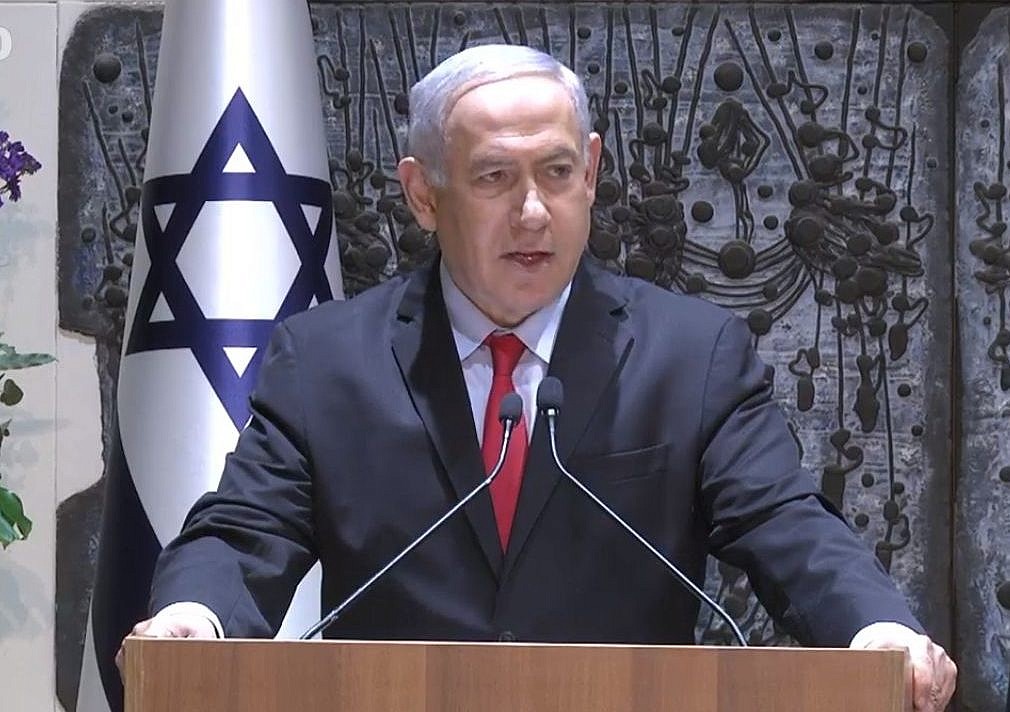
Prime Minister Benjamin Netanyahu receives a mandate to form a government, April 17, 2019. (GPO screenshot)

Prime Minister Benjamin Netanyahu receives a mandate to form a government, April 17, 2019. (GPO screenshot)

Prime Minister Benjamin Netanyahu on Monday commented on reports of an Egyptian-brokered ceasefire deal in Gaza, after two days of fighting in which four Israelis were killed, saying that Israel was readying for further confrontations with terrorist groups in the coastal enclave.

“Over the past two days, we have hit Hamas and Islamic Jihad with great force, attacking over 350 targets and terrorist leaders and activists, and destroying terrorist infrastructure,” Netanyahu said in a statement.

“The campaign is not over and requires patience and judgment. We are preparing to continue,” the prime minister added. “The goal was and remains to ensure the peace and security of the residents of the south. I send condolences to the families and wish a speedy recovery for the wounded.”

A spokesperson for Hamas similarly said, in response to the prime minister’s statement, that although the recent flareup in violence had come to an end, the wider conflict would continue.

“The resistance managed to deter the IDF,” said Sami Abu Zuhri, according to the Kan public broadcaster, referring to the Gaza terror groups. “Our message is that this round is over, but the conflict will not end until we regain our rights.”

The scene of a car hit by a rocket fired from the Gaza Strip near the Israel-Gaza border on May 5, 2019. (Noam Rivkin Fenton/Flash90)

The ceasefire between Israel and the Gaza terror groups went into effect at 4:30 a.m. Monday, according to the Hamas and Islamic Jihad terror groups, ending two days of intense fighting that saw more than 600 rockets fired at Israel and four Israeli civilians killed.

Over two days, in response to the rocket fire, the Israeli military conducted hundreds of strikes from the air and land, including one highly unusual targeted killing of a terrorist operative who the IDF said funneled money from Iran to terror groups in the Strip.

Palestinian medical officials reported 29 dead since Friday, including at least 11 terrorists, The Times of Israel confirmed.

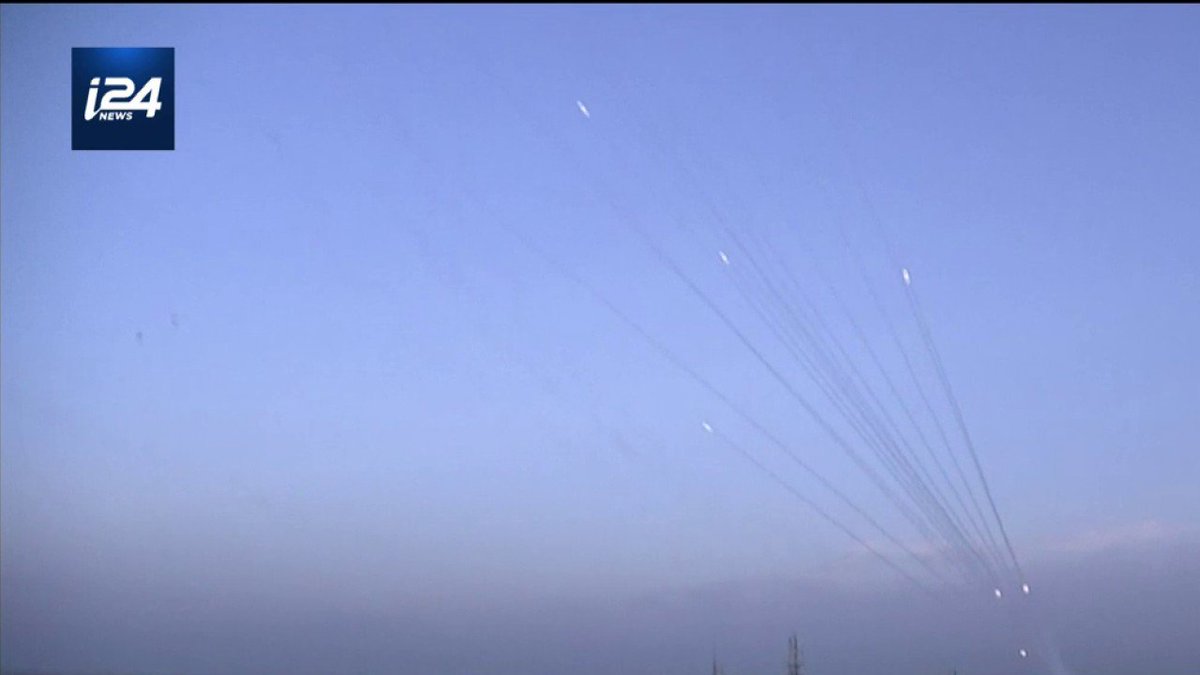
A picture taken in Gaza city on May 5, 2019 shows rockets fired toward Israel from the Gaza Strip. (Mahmud Hams/AFP)

The Israeli government refused to confirm the reported truce, apparently so as to avoid publicly acknowledging its negotiations with terrorist groups. However, the military announced that, as of 7 a.m., it was lifting all security restrictions that had been in place in the south during the fighting, and that schools would be allowed to open, indicating that a ceasefire had indeed been reached.

The ceasefire was criticized Monday morning by opposition parties, as well as by one senior member of the prime minister’s Likud party. MK Gideon Sa’ar, a political rival of the prime minister, said the terms of the agreement hold little to no benefit for Israel and will not prevent future violence.

“The circumstances in which the ceasefire was reached are very lacking for Israel,” Sa’ar posted on Twitter, in a rare implicit criticism of Netanyahu from within his own party.

Blue and White leader Benny Gantz, a former IDF chief of staff, laid the blame for the rocket onslaught from the Gaza Strip over the past two days at the government’s door.

Blue and White party head Benny Gantz at a press conference at party headquarters in Tel Aviv, April 10, 2019 (Flash90)

“Nearly 700 projectiles were launched at Israeli territory, four were killed and many are wounded,” Gantz said in a statement. “All of this is the result of losing our deterrence, and it’s ending with another surrender to blackmail from Hamas and other terrorist groups.”

“All the government has done is, once again, led us to the next confrontation,” he charged.


Gaza ceasefire leaves Israel and Hamas exactly where they were before 

May 6, 2019

Source: Gaza ceasefire leaves Israel and Hamas exactly where they were before | The Times of Israel

The latest flareup and truce were born of Jerusalem’s past capitulation to extortion by the rulers of the Strip

A picture taken in Gaza city on May 5, 2019, shows rockets fired toward Israel from the Gaza Strip. (Mahmud Hams/AFP)

A picture taken in Gaza city on May 5, 2019, shows rockets fired toward Israel from the Gaza Strip. (Mahmud Hams/AFP)

The morning after the latest round of fighting between Israel and Hamas looks exactly like the morning before it began. It’s as if nothing had happened.

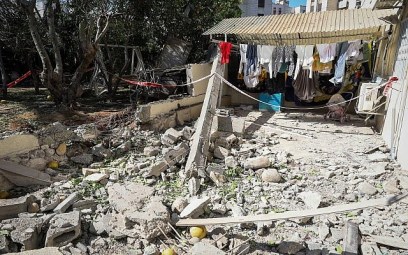
In two days of conflict, more than 700 rockets were fired toward Israel; four Israelis were killed, along with 29 Gazans (at least 11 of them members of the terror groups); and considerable damage was done to Hamas and Islamic Jihad infrastructure in the Strip.

But as usual, Israel and Hamas find themselves in a shaky truce without the situation having changed in the slightest. As they say, the more things change, the more they stay the same.

Neither side has any substantive achievement to boast of, nor have they made a move that has altered the status quo.

A car bursts into flames after it was hit by a rocket fired from the Gaza Strip in the southern Israeli city of Ashdod on May 5, 2019. (Flash90)

Hamas has shown that its military capabilities have improved, with the lethality of the rocket attacks and their ability to overcome the Iron Dome missile defense system on multiple occasions, as well as the minimal harm sustained by members of the terrorist organization.

This attests to constant improvements to the terrorists’ military wing in the run-up to the next campaign.

On the other hand, the Israel Defense Forces improved its list of targets and managed to hit important Hamas military facilities. It also showed its ability to carry out a targeted assassination against a member of the terrorist group who had tried to remain under the intelligence radar, with a missile strike on the car of Hamed Hamdan al-Khodari, who funneled Iranian money to Palestinian terror groups in the Gaza Strip.

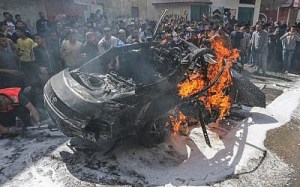
Palestinian emergency personnel try to put out the fire on a car belonging to Hamas terror group senior member Hamed Hamdan al-Khodari after it was hit by an Israeli airstrike in Gaza City on May 5, 2019. (MAHMUD HAMS/AFP)

There are, nonetheless, many causes for concern on the Israeli side.

It is clear that Hamas has learned to defend itself. Most of its senior operatives took cover in the subterranean bunkers and tunnels the terror group has dug underneath the enclave, and escaped the flareup unharmed. Its missile launch and command and control capabilities were impressive.

All of these things should ring warning bells in Israel.

The big problem for Hamas is that on the first morning of the holy month of Ramadan, it cannot present any hope of an economic solution to the people of Gaza — and certainly not of a political one.

This failure on Hamas’s part comes despite the fact that many Gazans expressed willingness for a major military operation, if only to bring about a change in their situation.

While Qatari money may enter Gaza in the coming days, it will not alleviate the overall crisis: Unemployment stands at 51 percent and there is abject poverty.

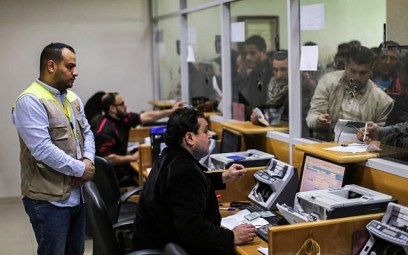
Postal workers aid Palestinians who arrived at the central post office in Gaza City on January 26, 2019, to receive financial aid from the Qatari government given to impoverished families. (Mahmud Hams/AFP)

Hamas does nothing to help the local population. Instead, it imposes more and more taxes, which it uses for military infrastructure (including the aforementioned tunnels and bunkers for senior Hamas officials) rather than improving the overall situation in Gaza.

Gazans are starting to show signs of discontent with Hamas — although not enough to bring them out to the streets as was the case earlier this year. But there is now criticism of the terrorist organization on social networks.

The latest round of fighting was likely also an attempt by Hamas to divert Gazan public anger away from the organization and toward Israel.

Ultimately, both sides are hostages to Israel’s decision six months ago to approve the transfer of Qatari money to pay the salaries of Hamas employees.

That money was interpreted in Gaza in only one way — an Israeli surrender to Hamas’s extortion.

It is clear that whoever on the Israeli side made the deal with Hamas — whether they were from the Mossad or the Prime Minister’s Office — did not understand this.

An apartment building hit by a rocket fired from the Gaza Strip, in Ashkelon, southern Israel, on May 5, 2019. (Noam Rivkin Fenton/Flash90)

What appeared to those on the Israeli side as an opportunity to cut a deal with Hamas was interpreted on the other side as sign of a weakness that could be exploited.

Thus, when the Qatari money was delayed last weekend, not due to any fault of Israel, Hamas immediately triggered a broader conflict than usual, thinking and believing that what had worked six months ago would work again this time.

And it seems that Hamas was right.

While the Qataris didn’t get involved initially, the money is expected to be transferred to Gaza shortly — just in time to ensure a Ramadan kareem.


Netanyahu slammed for continuing to duck a decisive campaign against Gaza terrorists – DEBKAfile

May 6, 2019

Source: Netanyahu slammed for continuing to duck a decisive campaign against Gaza terrorists – DEBKAfile

“After 700 rockets, 4 fatalities and 250 injured, Israel has again capitulated to Palestinian terrorist blackmail,” said opposition Blue-White leader Benny Gantz on Monday, May 6, after the Palestinians announced that a ceasefire went into effect at 4.30 a.m. with Israel’s consent.

For once, Gantz voiced widespread popular sentiment when he warned that this lame curtailment of massive terrorist rocket aggression held the key to recurring violence on an even greater scale. However, this process also represents a recurring pattern of the Netanyahu’s premiership.

The prime minister and defense minister, Binyamin Netanyahu, is widely seen – even in his own Likud – as letting down the general expectation which he himself fostered, for the IDF to be allowed, at long last, to cut short in the long term the violent harassment which Hamas and Islamic Jihad terrorists have meted out on the population for years. It was hoped that this time, Netanyahu would break with his long practice, and finally tough it out for the sake of a better future for the battered population of the South.

That his government allowed the Palestinians to inform the Israeli public of the ceasefire post factum – leaving it to the IDF Home Security Command to simply tell people to go back to their normal routines, without explanation – was an especially bitter pill . On Sunday, after the heaviest Palestinian rocket barrage since the 2014 war hit Israel’s southern towns and villages, killing 4 people and injuring 250, the IDF Home Command ordered schools closed on Monday for a second day and 200,000 children kept at home. On Monday morning, they woke up and were told suddenly that it was back to school and their normal routines.

How were people expected to behave normally? On Monday, as scores of rockets landed on their heads, they heard a senior Likud minister, MK Avi Dichter, declaring that this time, the IDF was fully prepared to repeat in Gaza the Jenin operation that ended the Second Intifada 15 years ago. Dichter may have been naively convinced with the rest of the country that this scenario was finally about to unfold. However, the IDF spokesman also announced the transfer of the 7thArmored Brigade and the Golani Brigade troops to the Gaza border for a buildup of strength “in preparation for an operation that could go on for days.”

Monday morning, that statement was exposed as a deliberate smoke screen for concealing the secretly ongoing, ceasefire negotiations with terrorists while they intensified their rocket blitz.

While the army defers to government policy and directives, its spokesman takes his orders from the chief of staff. Lt. Gen. Aviv Kochavi would be well advised to urgently repair the senior IDF spokesperson’s current strategy of issuing false and misleading statements. An effort must be made to restore credibility to this institution considering is important role in shaping  public morale especially in times of stress.

As for the army’s morale, large-scale combat units were transferred on Sunday to the Gaza sector for the second time in two weeks – the first time in the last week of March and this week again – only to be sent back to their former bases a few hours later after doing nothing.

DEBKAfile’s sources offer the following motivation for Netanyahu’s apparently purposeless exercises around the Gaza Strip and failure to go all the way against massive terrorist aggression: He appears to be putting his trust in the eventual rise of an independent Palestinian state – even under Hamas rule – that will finally force the break-up of Mahmoud Abbas’ crumbling Palestinian Authority. This goal is in line with the US Middle East peace plan on whose final draft President Donald Trump’s advisers, Jared Kushner and Jason Greenblatt, are putting the final touches before publication.  This goal would also fit the plans of Egypt’s president Abdel-Fatteh El-Sisi.


Iran Accuses U.S. Of ‘Not Being Genuine’ Over Carrier Strike Group Deployment

May 6, 2019

Source: Iran Accuses U.S. Of ‘Not Being Genuine’ Over Carrier Strike Group Deployment

On Sunday night, the U.S. National Security Adviser announced that “the United States is deploying the USS Abraham Lincoln Carrier Strike Group and a bomber task force to the U.S. Central Command region send a clear and unmistakable message to the Iranian regime that any attack on United States interests or on those of our allies will be met with unrelenting force.”

The move came a week after an Iranian news agency had published drone footage that it claimed showed “U.S. warships being closely monitored in the Persian Gulf waters, south of Iran.”

John Bolton said the move came in response to “a number of troubling and ‘escalatory’ indications and warnings,” albeit “the United States is not seeking war with the Iranian regime, but we are fully prepared to respond to any attack, whether by proxy, the Islamic Revolutionary Guard Corps or regular Iranian forces.”

According to ABC News, a U.S. official told them that “the deployments were in response to ‘clear indications’ Iranian and Iranian proxy forces were preparing for a possible attack, and that the decision to send forces was made on Sunday.”

But Iran, responding through its state media platform Press TV, said that “the deployment seems to be a ‘regularly scheduled’ one by the U.S. Navy, and Bolton has just tried to talk it up. Back on April 8, the USS Abraham Lincoln Carrier Strike Group (ABECSG) Public Affairs announced that the Strike Group has departed a naval station in Virginia on April 1 for a regularly scheduled deployment. Therefore, what Bolton describes as a ‘response’ to Iran’s warning does not seem to be genuine, as the ABECSG started its mission long before Iran’s warning.”

The carrier group would likely have transited through the Middle East on its return to the U.S. and Mike Pompeo, U.S. Secretary of State, conceded to reporters that the deployment was “something we’ve been working on for a little while.” Although he added that “it is absolutely the case that we have seen ‘escalatory’ actions from the Iranians, and it is equally the case that we will hold the Iranians accountable for attacks on American interests. If these actions take place, if they do by some third-party proxy, a militia group, Hezbollah, we will hold the Iranian leadership directly accountable for that.”

Iran has been heavily vocal in its criticism of Israel over the country’s retaliation against the rocket strikes into the country from Gaza. Iran’s Farsnews agency reported that “Foreign Ministry spokesman Abbas Mousavi said Iran strongly condemned the Zionist regime’s savage attack,” adding that “due to unlimited American support for this regime and the embarrassing silence of some Islamic governments, there is no end to Zionist crimes in the occupied Palestinian territories.”

The U.S. has denied any link between the carrier deployment and the situation in Gaza, where the U.S. has publicly supported Israel’s actions. “The United States strongly condemns the ongoing barrage of rocket attacks by Hamas and Palestinian Islamic Jihad from Gaza upon innocent civilians and their communities across Israel,” said State Department spokesperson Morgan Ortagus. “We call on those responsible for the violence to cease this aggression immediately. We stand with Israel and fully support its right to self-defense against these abhorrent attacks.”

“Notably,” wrote Haaretz, “the statement did not call for restraint, a feature of such statements in previous administrations.”

Press reports early on Monday, citing Palestinian sources, suggested that “a ceasefire agreement has been reached to end a recent surge of violence in the Gaza Strip and southern Israel that has led to the deaths of at least 24 Palestinians and four Israelis.” There was no confirmation from Israel side at the time of writing.

On Saturday, Iran’s Foreign Minister Mohammad Javad Zarif told Al Jazeera that “we have been very clear that we have no interest in escalation. We have been clear that the Persian Gulf and the Strait of Hormuz are our lifeline. We depend on them for our livelihood, and we want them safe, secure, and free for navigation of all countries, including Iran. As we have stated before, Iran won’t permit the US to threaten the Persian Gulf.”

Earlier in the week, following the passing of a law in Iran designating all U.S. forces operating in the Middle East as terrorists and the U.S. government itself as a sponsor of terrorism, Zarif had said that “[Iranian and U.S.] forces, which have been reciprocally designated as terrorist groups, may engage in clashes in the Persian Gulf or any other region, [and] there is no doubt that the U.S. will be held accountable for such a situation.”

The ramping up of U.S. military presence in the region will be seen as inevitable. As I wrote on Wednesday, “the actual risk is that the whole situation is doomed to result in military skirmishes that will gradually escalate towards a scale of conflict that nobody with a healthy view of geopolitics and reality should want to see.”

The ending of waivers over oil sanctions is set to have a devastating impact on Iran’s already beleaguered economy, whatever rhetoric comes out of Teheran. “I believe President Trump’s intention to put a policy of maximum pressure on Iran in order to bring Iran to its knees is doomed to failure,” Zarif said in a U.S. television interview last weekend.

Since then the veiled threats have come thick and fast from Iran. Now, with a U.S. military deployment in its vicinity, the potential for the Iranian regime to provoke action as the world’s media watches on is about to get very real. This is Washington’s first major move in the Middle East since Teheran designated U.S. military forces in the region as terrorists – with it, the two countries are soon set to be within easy striking distance of one other.

Find me on Twitter or Linkedin or email zakd@me.com.


US deploying carrier, bombers to Middle East to deter Iran 

May 6, 2019

Source: US deploying carrier, bombers to Middle East to deter Iran – www.israelhayom.com

Move comes in response to “clear indications” that Iranian and Iranian proxy forces are preparing to possibly attack U.S. forces in the region. U.S. will retaliate with “unrelenting force” to any attack on U.S. interests or those of its allies, warns National Security Adviser John Bolton. U.S. Secretary of State Mike Pompeo: Deployment “separate” from events in Israel.

The defense official, who spoke on condition of anonymity to discuss sensitive information, said the Pentagon approved the deployments and that U.S. forces at sea and on land were thought to be the potential targets. The official declined to be more specific.

With tensions already high between Washington and Tehran, another U.S. official said the deployment was ordered “as a deterrence to what has been seen as potential preparations by Iranian forces and its proxies that may indicate possible attacks on U.S. forces in the region.” However, the official, speaking on condition of anonymity, said the United States was not expecting any imminent Iranian attack.

National Security Adviser John Bolton said the carrier deployment was also to show that the U.S. will retaliate with “unrelenting force” to any attack on U.S. interests or those of its allies, adding that the move was in response to “a number of troubling and escalatory indications and warnings.”

Speaking to reporters while flying to Europe, U.S. Secretary of State Mike Pompeo said the actions undertaken by the U.S. had been in the works for a little while.

“It is absolutely the case that we have seen escalatory actions from the Iranians and it is equally the case that we will hold the Iranians accountable for attacks on American interests,” Pompeo said. “If these actions take place, if they do by some third-party proxy, a militia group, Hezbollah, we will hold the Iranian leadership directly accountable for that.”

Asked about “escalatory actions,” Pompeo replied, “I don’t want to talk about what underlays it, but make no mistake, we have good reason to want to communicate clearly about how the Iranians should understand how we will respond to actions they may take.”

Asked if the Iranian action were related to the deadly events in Gaza and Israel, Pompeo said, “It is separate from that.”

Bolton – who has spearheaded an increasingly hawkish U.S. policy on Iran – said the decision, which could exacerbate problems between the two countries, was meant to send a “clear and unmistakable message” of U.S. resolve to Tehran.

Though he cited no specific Iranian activities that have raised new concerns, Iran has recently warned it would block the Strait of Hormuz if it was barred from using the strategic waterway. About a fifth of the oil consumed globally passes through the strait.

“The United States is not seeking war with the Iranian regime, but we are fully prepared to respond to any attack, whether by proxy, the Islamic Revolutionary Guard Corps or regular Iranian forces,” Bolton said in a statement.

It marked the latest in a series of moves by U.S. President Donald Trump’s administration aimed at ratcheting up pressure on Iran in recent months.

Washington has said it will stop waivers for countries buying Iranian oil, in an attempt to reduce Iran’s oil exports to zero. It has also blacklisted Iran’s Revolutionary Guard Corps, taking the unprecedented step of designating it as a foreign terrorist organization, which Iran has cast as an American provocation.

The Trump administration’s efforts to impose political and economic isolation on Tehran began last year when it unilaterally withdrew from the nuclear deal it and other world powers negotiated with Iran in 2015.

“The United States is deploying the USS Abraham Lincoln Carrier Strike Group and a bomber task force to the U.S. Central Command region to send a clear and unmistakable message to the Iranian regime that any attack on United States interests or on those of our allies will be met with unrelenting force,” Bolton said.

Bolton did not provide any further details.

A U.S. Navy statement issued early last month said the aircraft carrier and its accompanying convoy of ships had steamed out of Norfolk, Virginia, on April 1 “for a regularly scheduled deployment,” but it did not give any destination at the time.