Source: War with Iran forthcoming? Most experts say they don’t think so – Middle East – Jerusalem Post
War between the US and Iran is probably not in the cards, even as the US ups pressure on Iran via sanctions and a military build-up in the region.
Source: War with Iran forthcoming? Most experts say they don’t think so – Middle East – Jerusalem Post
War between the US and Iran is probably not in the cards, even as the US ups pressure on Iran via sanctions and a military build-up in the region.
Source: Iran’s dilemma – www.israelhayom.com
In Tehran, regime officials are worried that the pressure applied by the U.S. administration is meant to expedite regime change, not just curb Iran’s nuclear and hegemonic ambitions in the region.
Tehran announced that if Europe fails to act to temper the economic fallout from American sanctions, it will gradually withdraw from the nuclear deal. Its leaders, meanwhile, are threatening to target the U.S. and its allies. In response, the Europeans have stressed that despite their commitment to the nuclear deal, if Iran stops fulfilling its obligations they will have to renew sanctions. Russia and China are standing with Iran, as expected, while inside Iran tensions continue to foment over the country’s economic distress. Western nuclear experts are still publishing analyses of Iran’s nuclear archives. These reports highlight the progress Iran’s military nuclear program has made since 2003, and illustrate the degree to which the International Atomic Energy Agency was irresponsible in regard to the nuclear deal. (The agency itself continues to remain silent in the face of these reports.)
The Iranian regime’s ultimate objective is to ensure its own survival, and saving the nuclear deal gives it the ability to manufacture unhindered a large nuclear arsenal within 11 years. In Tehran, officials are worried that the pressure applied by the U.S. administration is meant to expedite regime change, not just curb Iran’s nuclear and hegemonic ambitions in the region.
Iranian leaders are presently at odds over the best way to contend with the American pressure. They could introduce austerity measures and also wage “economic jihad” (in the words of the Iranians) by attempting to extort from Europe, through threats, compensation for the financial losses they are expected to incur as a result of the sanctions. They are also seeking to deter the U.S. by threatening them and their allies with the use of military force, under the assumption that President Donald Trump and segments of his administration don’t want an escalation. It’s still unclear whether Iran’s most recent declarations reflect a concrete decision in this regard; it’s possible these threats toward the West are merely a trial balloon, and that the Iranians believe they can avoid having to back them up. These threats put the regime on a course that will only exacerbate its anguish: Europe will be compelled to move toward shedding the nuclear deal and there will be a greater probability of an escalation.
In all likelihood, the Iranians would rather wait until the next U.S. presidential election before making their decision, in the hope that Trump is replaced by a Democratic candidate who will restore the nuclear deal. However, it appears Ayatollah Ali Khamenei believes an immediate response to the sanctions is needed to maintain the regime’s reputation as all-powerful in the eyes of Iranians; and that the country’s dire economic situation can threaten the regime’s stability. Still, it’s more reasonable to assume that Tehran, at this stage, will seek to avoid a direct military clash with the United States by recognizing the limits of its own might and vulnerability in the face of American military capabilities.
It seems these insights are at the core of current U.S. policy. The Americans want to knock the Iranians off balance and force them to make a move before the next U.S. election. The Iranian regime’s dilemma: Adhere to the nuclear deal or trash it outright and jeopardize its survival, or succumb to the pressure and agree to renegotiate the deal. At this stage, the regime is rejecting the possibility of surrender, although their failure to boost the economy, together with festering popular unrest, could ultimately induce it to choose this course.
Israel needs to support the U.S. in its efforts to prevent Iran from acquiring nuclear weapons. It must be prepared for the possibility that an escalation in the Persian Gulf will lead to a clash with Iran’s regional proxies, chief among them Hezbollah, Palestinian Islamic Jihad and Hamas.
Source: US-Iran conflict could break out ‘by accident,’ Britain warns – www.israelhayom.com
U.K. Foreign Secretary Jeremy Hunt says “unintended” escalation could snowball after U.S. announces deployment of aircraft carrier to Persian Gulf.

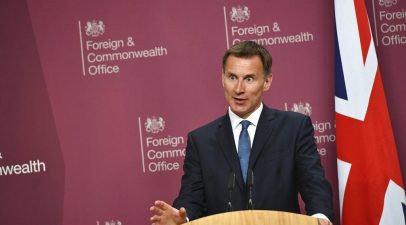
Britain’s Foreign Secretary Jeremy Hunt speaks during a joint press conference with U.S. Secretary of State Mike Pompeo, last week | Photo: Mandel Ngan/Pool via AP
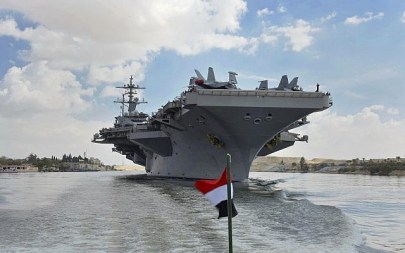
The warning came after the United States announced the deployment of the USS Abraham Lincoln aircraft carrier strike group to the Persian Gulf to counter an alleged but still-unspecified threat from Iran, the latest in a long line of such deployments to the strategic region.
“We are very worried about the risk of a conflict happening by accident, with an escalation that is unintended really on either side but ends with some kind of conflict,” British Foreign Secretary Jeremy Hunt told reporters in Brussels.
“What we need is a period of calm to make sure that everyone understands what the other side is thinking,” Hunt said. He added that he would “be sharing those concerns” Monday with European partners and visiting U.S. Secretary of State Mike Pompeo.
The United States pulled out of the 2015 nuclear accord a year ago, saying it does nothing to stop Iran developing missiles or destabilizing the Middle East. The Europeans insist the agreement was never meant to address those issues but has been effective in curbing Iran’s nuclear ambitions.
Tensions mounted last week when Iranian President Hassan Rouhani said that signatories to the deal now have 60 days to come up with a plan to shield his country from the sanctions imposed by U.S. President Donald Trump.
Hunt said that “if Iran becomes a nuclear power its neighbors are likely to want to become nuclear powers. This is already the most unstable region in the world. This would be a massive step in the wrong direction.”
The meeting between Hunt, his counterparts from France and Germany, and EU foreign policy chief Federica Mogherini comes as the Europeans struggle to keep financial supply lines open to Iran to offset the impact of U.S. sanctions on the Islamic republic’s shattered economy.
“We in Europe agree that this treaty is necessary for our security,” German Foreign Minister Heiko Maas said. “Nobody wants Iran to get possession of an atomic bomb and that’s been achieved so far.”
Mogherini said the talks will focus on “how to continue to best support the full implementation of the nuclear deal.”
As the U.S. sanctions bite, domestic pressure is increasing on Rouhani to demonstrate that Iran can still benefit from an agreement based on providing it with economic opportunities in exchange for limiting nuclear development.
Maas said the Europeans “are working on the assumption that Iran won’t withdraw step by step from this treaty, but rather meet all of its commitments.”
Even so, the EU cannot keep Iran’s economy afloat alone.
The Europeans have set up a complicated barter-type system to skirt direct financial transactions with Iran and so evade possible U.S. sanctions. The workaround, dubbed INSTEX, is not yet operational as Iran has not completed its part of the scheme.
They have also introduced a “blocking statute” protecting European companies from the effects of U.S. sanctions, but many international corporations do more business in the United States than in Iran and have already severed ties there rather than risk running afoul of Washington.
“We have already initiated concrete steps in recent months, especially as concerns the payment channel and INSTEX. Now, this instrument needs to be further operationalized and used in order to continue implementing” the nuclear agreement, Maas said.
Source: Arab League condemns attacks on Saudi tankers – www.israelhayom.com
After Saudi Arabia announces “significant damage” to two of its oil tankers off the coast of the UAE, the U.S. issues a new warning to sailors and Iran calls for “further clarification” of the incident.

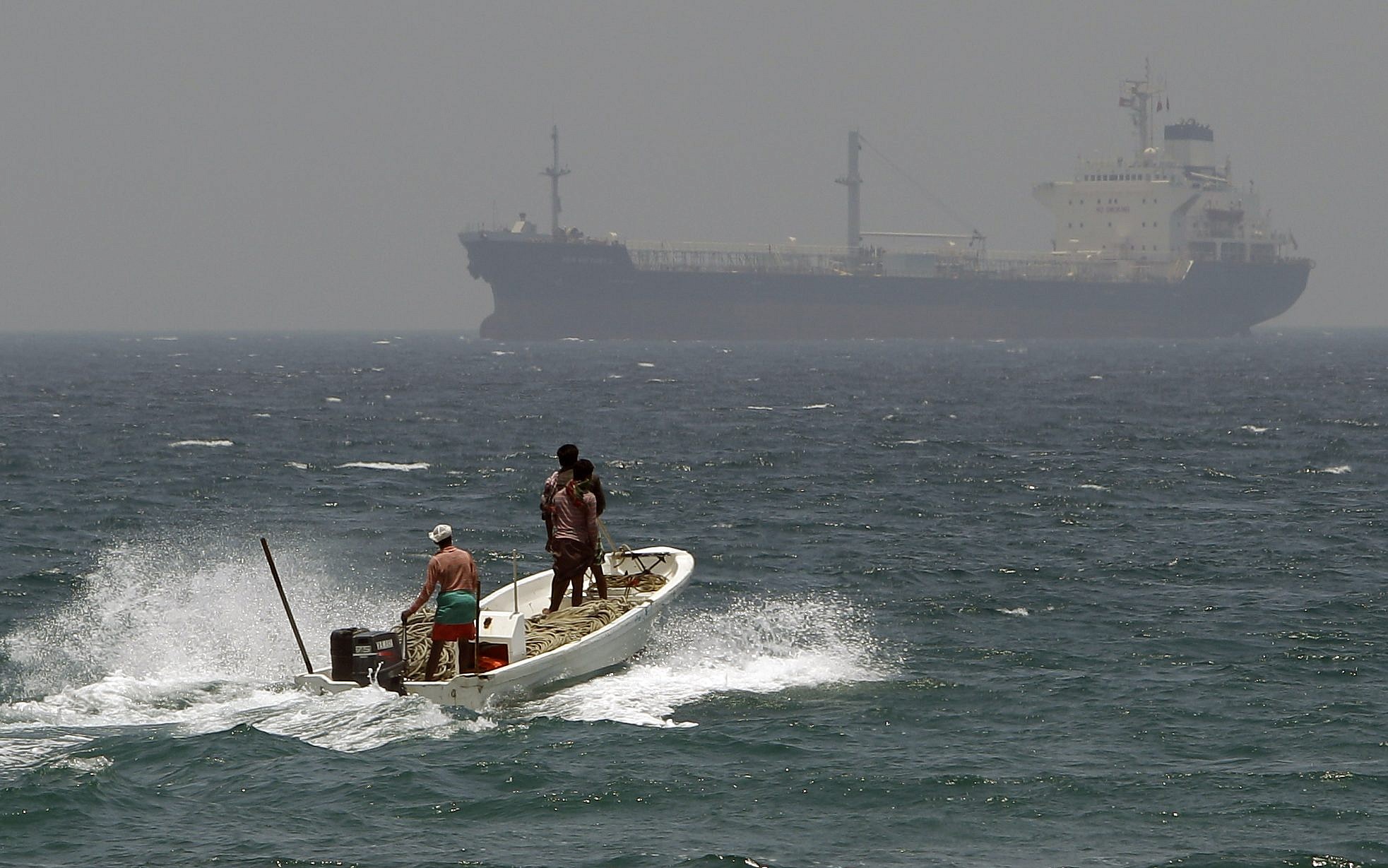
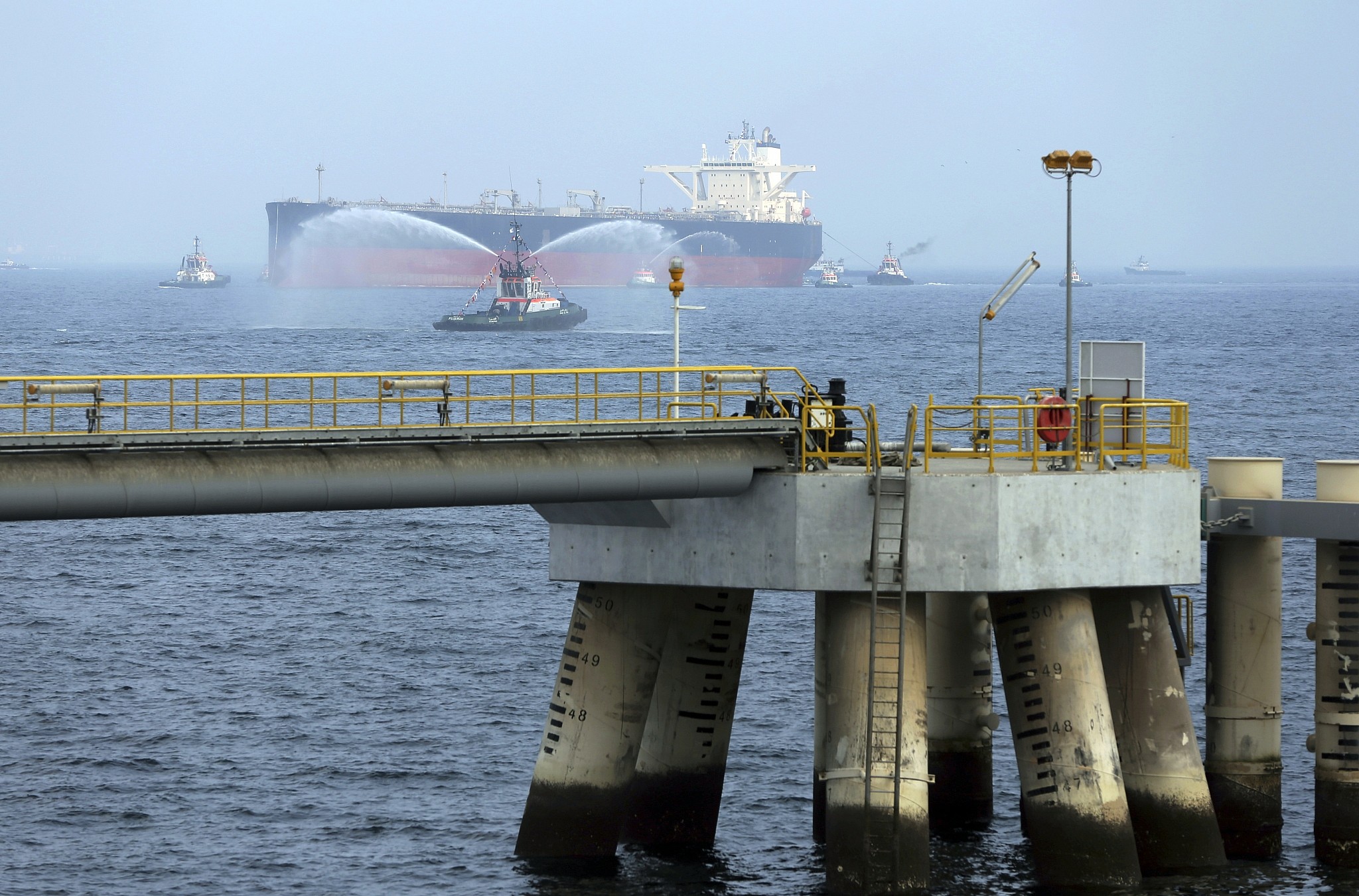
An oil tanker during the launch of the new $650 million oil facility in Fujairah, United Arab Emirates | Photo: AP Photo/Kamran Jebreili
On Monday, Saudi Arabia revealed that two of its oil tankers were sabotaged off the coast of the United Arab Emirates in attacks that caused “significant damage” to the vessels, one of them as it was en route to pick up Saudi oil to transport to the United States.
Ahmed Aboul-Gheit said in a statement on Monday that these acts are a “serious violation of the freedom and integrity of trade and maritime transport routes.”
He says the Arab League stands by the UAE and Saudi Arabia “in all measures taken to safeguard their security and interests.”
The announcement by Saudi Energy Minister Khalid al-Falih came as the U.S. issued a new warning to sailors and the UAE’s regional allies condemned the reported sabotage on Sunday of four ships off the coast of the port city of Fujairah.
The statement came just hours after Iranian and Lebanese media outlets aired false reports of explosions at the city’s port. Emirati officials have declined to elaborate on the nature of the sabotage or say who might have been responsible.
The U.S. has warned ships that “Iran or its proxies” could be targeting maritime traffic in the region. The U.S. is deploying an aircraft carrier and B-52 bombers to the Persian Gulf to counter alleged threats from Tehran.
Shortly after the Saudi announcement, Iran’s Foreign Ministry called for further clarification as to what exactly happened with the Saudi tankers. The ministry’s spokesman, Abbas Mousavi, was quoted by the official Islamic Republic News Agency as saying that there should be more information about the incident.
Mousavi also warned against any “conspiracy orchestrated by ill-wishers” and “adventurism by foreigners” that would seek to undermine the maritime region’s stability and security.
Tensions have risen in the year since President Donald Trump withdrew the U.S. from the 2015 nuclear deal between Iran and world powers, restoring American sanctions that have pushed Iran’s economy into crisis. Last week, Iran warned that it would begin enriching uranium at higher levels in 60 days if world powers failed to negotiate new terms for the deal.
In his statement, al-Falih said the attacks on the two tankers happened at 6 a.m. Sunday.
“One of the two vessels was on its way to be loaded with Saudi crude oil from the port of Ras Tanura, to be delivered to Saudi Aramco’s customers in the United States,” al-Falih said. “Fortunately, the attack didn’t lead to any casualties or an oil spill; however, it caused significant damage to the structures of the two vessels.”
Saudi Arabia did not identify the vessels involved, nor did it say whom it suspected of carrying out the alleged sabotage.
A statement on Sunday from the UAE’s Foreign Ministry put the ships near the country’s territorial waters in the Gulf of Oman, east of the port of Fujairah. It said it was investigating “in cooperation with local and international bodies.” It said there were “no injuries or fatalities on board the vessels” and “no spillage of harmful chemicals or fuel.”
The U.S. Navy’s 5th Fleet, which oversees the region, did not immediately offer comment. Emirati officials declined to answer questions from the Associated Press, saying their investigation is ongoing.
Fujairah’s port is about 140 kilometers (87 miles) south of the Strait of Hormuz, the narrow mouth of the Persian Gulf through which a third of all oil at sea is traded. The facility handles oil for bunkering and shipping, as well as general and bulk cargo. It is seen as strategically located, serving shipping routes in the Persian Gulf, the Indian subcontinent and Africa.
Source: Pompeo skips Moscow to meet with European officials on Iran – www.israelhayom.com
Decision comes a day after Saudi tankers were sabotaged near the Strait of Hormuz and a week after the secretary of state changed his travel schedule at the last minute due to intelligence suggesting Iran or its proxies were planning an attack against American targets in the Middle East.

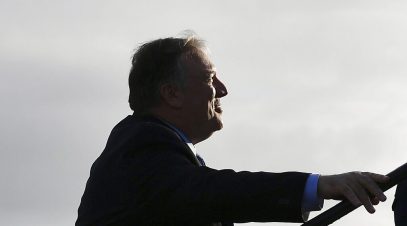
Secretary of State Mike Pompeo boards a plane before departing from London Stansted Airport, north of London | Photo: AP/Mandel Ngan
A State Department official said Pompeo, who departed Sunday night, was still expected to meet Tuesday in Sochi with Russian President Vladimir Putin and Foreign Minister Sergey Lavrov. The official wasn’t authorized to discuss the itinerary by name and requested anonymity.
The visit to Sochi will be Pompeo’s first to Russia as secretary of state.
Twice last week Pompeo changed his travel schedule at the last minute after U.S. officials picked up intelligence suggesting Iran or its proxies were planning an attack against American targets in the Middle East.
In the wake of that development, Pompeo flew to Iraq to meet with U.S. troops and President Donald Trump warned Iran that he was sending more troops to the region, including an aircraft carrier.
Source: UAE reports rare ‘acts of sabotage’ against 4 boats off its coast | The Times of Israel
Dubai doesn’t assign blame and says there are no injuries, denies report that incident included explosion; tensions in region elevated amid latest US-Iran spat
DUBAI — The United Arab Emirates said Sunday that four of its commercial ships “were subjected to sabotage operations,” after false reports circulated in Lebanese and Iranian media outlets saying there had been explosions at one of the nation’s seaports.
The statement carried by the state-run WAM news agency did not say who the UAE suspected of carrying out the sabotage in Gulf waters off its coast, or identify the ships involved.
The statement said there had been “no injuries or fatalities on board the vessels,” and “no spillage of harmful chemicals or fuel.”
Earlier Sunday, pro-Iran Lebanese media and Iranian media falsely reported that there had been explosions at oil tankers at the port of Fujairah. The Associated Press found the reports to be unfounded, after speaking to Emirati officials and local witnesses.
Tensions in the region were climbing over the weekend, which began with the US announcing on Friday that it would move a Patriot missile battery to the Middle East to counter threats from Iran.
The Pentagon provided no details, but a defense official said the move came after intelligence showed that the Iranians have loaded military equipment and missiles onto small boats. The official, who was not authorized to discuss the information publicly, spoke anonymously.
It was not clear whether the boats with missiles represented a new military capability that could be used against US forces, or were only being moved to shore locations.
The US removed Patriot missile batteries from Bahrain, Kuwait, and Jordan late last year. It was not clear if the batteries would be returned to those countries. The Patriot air defense system is meant to intercept both incoming aircraft and long-range ballistic missiles.
Also on Friday, the US Maritime Administration warned that Iran could try to attack American commercial vessels, including oil tankers, Reuters reported.
US officials announced Sunday that they would rush an aircraft carrier strike group and nuclear-capable bombers to the region.
On Thursday, US President Donald Trump said he sought talks with Iran.
“What I would like to see with Iran, I would like to see them call me,” Trump told reporters at the White House. “We don’t want them to have nuclear weapons — not much to ask.”
“We have information that you don’t want to know about,” Trump said. “They were very threatening and we have to have great security for this country and many other places.”
Asked about the possibility of military conflict with Iran, the president said: “I guess you could say that always, right? I don’t want to say no, but hopefully that won’t happen. We have one of the most powerful ships in the world that is loaded up and we don’t want to do anything.”
US Secretary of State Mike Pompeo on Thursday threatened a “swift and decisive” US response to any attack by Iran.
Iran last Wednesday said it would suspend some commitments under a 2015 nuclear accord rejected by Trump, frustrated that renewed US sanctions have prevented the country from enjoying the economic fruits of compliance with the deal.
The moves by the US have frightened some European allies, as well as Trump’s Democratic rivals, who fear the administration is pushing for war, based on overhyped intelligence.
TOI staff and Agencies contributed to this report
US Maritime Administration urges shippers to exercise caution after earlier warning that Iran could target commercial sea traffic
DUBAI, United Arab Emirates (AP) — Saudi Arabia said Monday two of its oil tankers were sabotaged off the coast of the United Arab Emirates in attacks that caused “significant damage” to the vessels, one of them as it was en route to pick up Saudi oil to take to the US.
Energy Minister Khalid al-Falih’s comments came as the US issued a new warning to sailors and the UAE’s regional allies condemned the reported sabotage Sunday of four ships off the coast of the port city of Fujairah. The announcement came just hours after Iranian and Lebanese media outlets aired false reports of explosions at the city’s port.
Emirati officials have declined to elaborate on the nature of the sabotage or say who might have been responsible. However, the reports come as the US has warned ships that “Iran or its proxies” could be targeting maritime traffic in the region, and as America is deploying an aircraft carrier and B-52 bombers to the Persian Gulf to counter alleged threats from Tehran.
Tensions have risen in the year since US President Donald Trump withdrew the United States from the 2015 nuclear deal between Iran and world powers, restoring American sanctions that have pushed Iran’s economy into crisis. Last week, Iran warned it would begin enriching uranium at higher levels in 60 days if world powers failed to negotiate new terms for the deal.
In his statement, al-Falih said the attacks on the two tankers happened at 6 a.m. Sunday.
“One of the two vessels was on its way to be loaded with Saudi crude oil from the port of Ras Tanura, to be delivered to Saudi Aramco’s customers in the United States,” al-Falih said. “Fortunately, the attack didn’t lead to any casualties or oil spill; however, it caused significant damage to the structures of the two vessels.”
Saudi Arabia did not identify the vessels involved, nor did it say whom it suspected of carrying out the alleged sabotage.
Underlining the regional risk, the general-secretary of the six-nation Gulf Cooperation Council described the alleged sabotage as a “serious escalation” in an overnight statement.
“Such irresponsible acts will increase tension and conflicts in the region and expose its peoples to great danger,” Abdullatif bin Rashid al-Zayani said.
A statement Sunday from the UAE’s Foreign Ministry put the ships near the country’s territorial waters in the Gulf of Oman, east of the port of Fujairah. It said it was investigating “in cooperation with local and international bodies.” It said there were “no injuries or fatalities on board the vessels” and “no spillage of harmful chemicals or fuel.”
The US Navy’s 5th Fleet, which oversees the region, did not immediately offer comment. Emirati officials declined to answer questions from The Associated Press, saying their investigation is ongoing.
Earlier Sunday, Lebanon’s pro-Iran satellite channel Al-Mayadeen, quoting “Gulf sources,” falsely reported that a series of explosions had struck Fujairah’s port. State and semi-official media in Iran picked up the report from Al-Mayadeen, which later published the names of vessels it claimed were involved.
The AP, after speaking to Emirati officials and local witnesses, found the report about explosions at the port to be unsubstantiated.
Fujairah’s port is about 140 kilometers (85 miles) south of the Strait of Hormuz, the narrow mouth of the Persian Gulf through which a third of all oil at sea is traded. The facility handles oil for bunkering and shipping, as well as general and bulk cargo. It is seen as strategically located, serving shipping routes in the Persian Gulf, the Indian subcontinent and Africa.
Sunday’s incident comes after the US Maritime Administration, a division of the US Transportation Department, warned Thursday that Iran could target commercial sea traffic.
“Since early May, there is an increased possibility that Iran and/or its regional proxies could take action against US and partner interests, including oil production infrastructure, after recently threatening to close the Strait of Hormuz,” the warning read. “Iran or its proxies could respond by targeting commercial vessels, including oil tankers, or US military vessels in the Red Sea, Bab-el-Mandeb Strait or the Persian Gulf.”
Early Sunday, the agency issued a new warning to sailors about the alleged sabotage, while stressing “the incident has not been confirmed.” It urged shippers to exercise caution in the area for the next week.
Publicly available satellite images of the area taken Sunday showed no smoke or fire.
It remains unclear if the previous warning from the US Maritime Administration is the same perceived threat that prompted the White House to order the USS Abraham Lincoln aircraft carrier strike group and B-52 bombers to the region on May 4.
Source: An alliance for the ages – www.israelhayom.com
From the historical recognition of Jerusalem and the Golan Heights, inaugurating the new embassy in the capital a year ago, withdrawing from the Iran nuclear deal and many other measures, U.S. President Donald Trump and his administration are firmly on Israel’s side with no sign of slowing down.

U.S. President Donald Trump with Prime Minister Benjamin Netanyahu at the Israel Museum in Jerusalem, May 23, 2017 | Photo: AP
On May 8, 2018, mere days before the U.S. officially inaugurated its new embassy in Jerusalem, the Trump administration withdrew from the Iran nuclear deal. Since then, the U.S. has continued imposing harsh economic sanctions on the regime in Tehran, decimated its economy, forced large corporations to cut business ties with it, rebuffed intensive European efforts to save the Iranian economy, compelled China and India to partake in sanctions, and just last week deployed the U.S. Navy’s largest aircraft carrier to the Persian Gulf. And while Trump and officials in his administration have stressed that these measures were implemented to uphold American interests, and not necessarily on behalf of Israel, in their view, Israel’s and America’s security are one and the same – and this is the crux of the matter.
Not only has the administration completely backed all Israeli military activity in Syria, Gaza and Judea and Samaria, but officials have also made clear that in their view anti-Zionism, Jew-hatred and calls for boycotting Israel all stem from the same phenomenon.
In the words of U.S. Ambassador to Israel David Friedman: “There are places in Manhattan, where I worked for 35 years, where you could attend a cocktail party and if you said, ‘I hate Jews,’ you would be politely escorted to the door. But if you said ‘isn’t it a shame that after the Jews survived the Holocaust they turned into Nazis themselves against the Palestinians,’ you might be ordered another drink and invited to hold court on your interesting point of view. Unlike other nations, unlike other peoples, there is no political correctness when it comes to Israel and the Jewish people.” The Trump administration refuses to accept this double-standard.
On April 12, for the first time, the U.S. Embassy announced visa exemptions for Israeli investors, while on March 26, President Trump made history by recognizing Israel’s sovereignty over the Golan. Consequently, the administration and Congress are now including the Golan in joint trade and cooperation initiatives.
On March 4, the U.S. Central Command declared it was deploying the Terminal High Altitude Area Defense (THAAD) anti-ballistic missile defense system in Israel – the most advanced such system in the American arsenal. A day earlier, the U.S. State Department said it was shutting down the independent “Palestinian consulate” on Agron Street in Jerusalem and making it a regular department of the embassy located in the city’s Arnona neighborhood.
On February 21, for the second time, Friedman attended and spoke at the Israeli-Palestinian International Economic Forum sponsored by the Judea and Samaria Chamber of Commerce and Industry – yet another step signaling U.S. recognition of the permanence of Israel’s presence in there.
A week prior, on February 13-14, the U.S. convened, in large part on Israel’s behalf, the 2019 Warsaw Conference, in an effort to highlight and curb Iran’s activities in the region. At the conference, Prime Minister Benjamin Netanyahu sat alongside Arab leaders.
U.S. Vice President Mike Pence spoke at the conference and declared: “Tonight I believe we are beginning a new era, with Prime Minister Netanyahu from the State of Israel, with leaders from Bahrain, Saudi Arabia, and the UAE, all breaking bread together, and later in this conference sharing honest perspectives on the challenges facing the area.”
On September 1, 2018, the Trump administration announced the complete cessation of American financial support for the U.N. Relief and Works Agency for Palestine Refugees, which perpetuates and exaggerates the Palestinian refugee issue. Ten days later, the administration shuttered the PLO’s offices in Washington and on June 20, 2018, the U.S. withdrew from the so-called U.N. “Human Rights Council.” The move was spearheaded by then-U.S. Ambassador to the U.N. Nikki Haley, who did so simply to object to the body’s discrimination against Israel.
Source: The drums of war in the Persian Gulf – www.israelhayom.com
We need to understand that the shockwaves from a clash between the U.S. and Iran, if it indeed occurs, will reach us. If attacked, Tehran will unleash it proxies, chief among them Palestinian Islamic Jihad in Gaza and Hezbollah in Lebanon, against Israel.

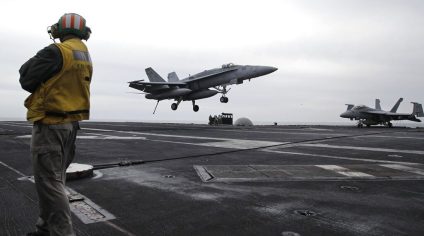
In this Feb. 13, 2012 file photo, a U.S. fighter jet lands on the USS Abraham Lincoln aircraft carrier during exercises in the Persian Gulf | Photo: AP
The escalation began with a verbal exchange. On the one-year anniversary of the United States’ withdrawal from the nuclear deal, Iranian President Hassan Rouhani told global powers that his country would cease fulfilling its obligations as part of the deal. At this stage, this mostly means Iran will stop shipping abroad its surplus of enriched uranium and heavy water, as it prepares to enrich uranium at a greater pace.
In response, the White House said it would impose additional sanctions on Iran – not just on its oil production, banks and foreign trade, but on its metals industry. This sector is Iran’s top job provider and hurting it could leave many Iranians unemployed, which in turn would increase internal strife.
But the main factor behind increased tensions in the Persian Gulf over the past two days was the Pentagon’s decision to deploy the “Abraham Lincoln” aircraft carrier and four B-52H bombers to Qatar. The backdrop, as conveyed by the Pentagon, were fears that Iran was planning to attack American forces stationed in Iraq, perhaps via Shiite militias that it controls.
It’s hard to misread these developments. After a year of harsh sanctions, the ayatollah regime in Iran is exceedingly frustrated. This frustration stems from the country’s drastic economic downturn, but also from the fact that European countries – who are co-signed to the nuclear deal – have not kept their promises to compensate European companies that continued doing business with Tehran despite the sanctions imposed by Washington.
There’s no question the Trump administration is also disappointed. Although the sanctions are having an effect, they still haven’t forced Iran to wave the white flag and agree to fundamentally amend the nuclear deal to include shelving its ballistic missile project and ceasing its subversive activities via its proxies across the region.
Moreover, if we can assess the situation according to the behavior of Palestinian Islamic Jihad in Gaza and the latest round of violence with Israel, Iran has only amplified its subversive efforts. This terrorist organization, which is completely subordinate to and entirely funded by Tehran, ignited the latest skirmish by sniping at IDF officers on the border and it is the one presently spearheading, at the behest of Iran, the most aggressive line against Israel.
How will developments in the Persian Gulf unfold in the weeks ahead? It’s too soon to make a determination. The Iranians’ move to cancel “some” of their obligations stipulated by the nuclear deal is not irreversible and was the least they could permit themselves without being accused of violating it. The main objective behind their move is to incentivize the Europeans to fulfill their promises, and Rouhani even declared a 60-day extension for global powers to reconsider – before Iran accelerates its uranium enrichment.
The Trump administration, for its part, stressed that its military reinforcements are only intended to deter Iran from attacking American forces in the region, adding that the purpose for increasing sanctions is to bring Iran back to the negotiating table.
The problem, of course, is that it’s entirely uncertain any of this will actually transpire in the near future. We don’t know if the Europeans will surrender to Iranian extortion, and it’s almost assured that the White House will not halt sanctions before the Iranians agree to recalibrate their course of action.
This dynamic is a sure-fire recipe for heightened tensions in the Persian Gulf and opens the door for a military escalation. The ayatollah regime, if it feels it must, could renew uranium enrichment and risk a limited military confrontation with the U.S., over the prospect of regime collapse due to domestic revolt amid the country’s increasingly dire economic situation.
We need to understand that the shockwaves from such a clash, if it indeed occurs, will reach us. During the Gulf War, Saddam Hussein launched Scud missiles at Israel. Iran, if it is attacked, will unleash it proxies, chief among them Palestinian Islamic Jihad in Gaza and Hezbollah in Lebanon, against Israel.
Source: Minister: Iran may attack Israel if US standoff escalates – www.israelhayom.com
Energy Minister Yuval Steinitz says “things are heating up” in the Persian Gulf. Statement comes as U.S. bolsters military presence in the region, with Iran warning it might renew high-level uranium enrichment.

The USS Mitscher and other vessels in a strike group sail behind the USS John C. Stennis aircraft carrier on Friday, Dec. 21, 2018 | Photo: AP
An Israeli cabinet minister warned on Sunday of possible direct or proxy Iranian attacks on Israel should the standoff between Tehran and Washington escalate.
Energy Minister Yuval Steinitz said that, in the Gulf, “things are heating up.”
The United States has increased economic and military pressure on Iran, with President Donald Trump on Thursday urging its leaders to talk to him about giving up their nuclear program and saying he could not rule out an armed confrontation.
“If there’s some sort of conflagration between Iran and the United States, between Iran and its neighbors, I’m not ruling out that they will activate Hezbollah and the Palestinian Islamic Jihad from Gaza, or even that they will try to fire missiles from Iran on Israel,” Steinitz, a member of Diplomatic-Security Cabinet, said.
Hezbollah and Islamic Jihad are Iranian-sponsored guerrilla terrorist groups on Israel’s borders, the former active in Syria as well as Lebanon and the latter in the Palestinian cities.
The Israeli military declined to comment when asked if it was making any preparations for possible threats linked to the Iran-U.S. standoff.
Israel has traded blows with Iranian forces in Syria, as well as with Hezbollah in Lebanon and Palestinian terrorists. But it has not fought an open war with Iran, a country on the other side of the Middle East.
Recent Comments