Tehran accused Riyadh Friday of “sowing division” in the region to Israel’s advantage after the kingdom hosted summits of Gulf and Arab leaders to rally support against the Islamic republic.
Saudi Arabia has “continued to sow division between Islamic countries and in the region, which is the wish of the Zionist regime,” foreign ministry spokesman Seyed Abbas Mousavi said.
“We see the attempts by Saudi Arabia to rally neighboring and Arab countries against Iran as the continuation of futile attempts by America and the Zionist regime,” he added.
The statement came as Iranians began anti-Israel rallies across the country to mark Quds, or Jerusalem Day, which will see demonstrations across the Mideast. The annual protests — also being held in Iraq, Lebanon and elsewhere — are held on the last Friday of the Muslim holy fasting month of Ramadan.
Saudi Arabia’s King Salman on Friday ratcheted up the rhetoric against arch-nemesis Iran, calling on Arab states to confront its “criminal” actions after attacks on oil installations sparked fears of a regional conflagration.
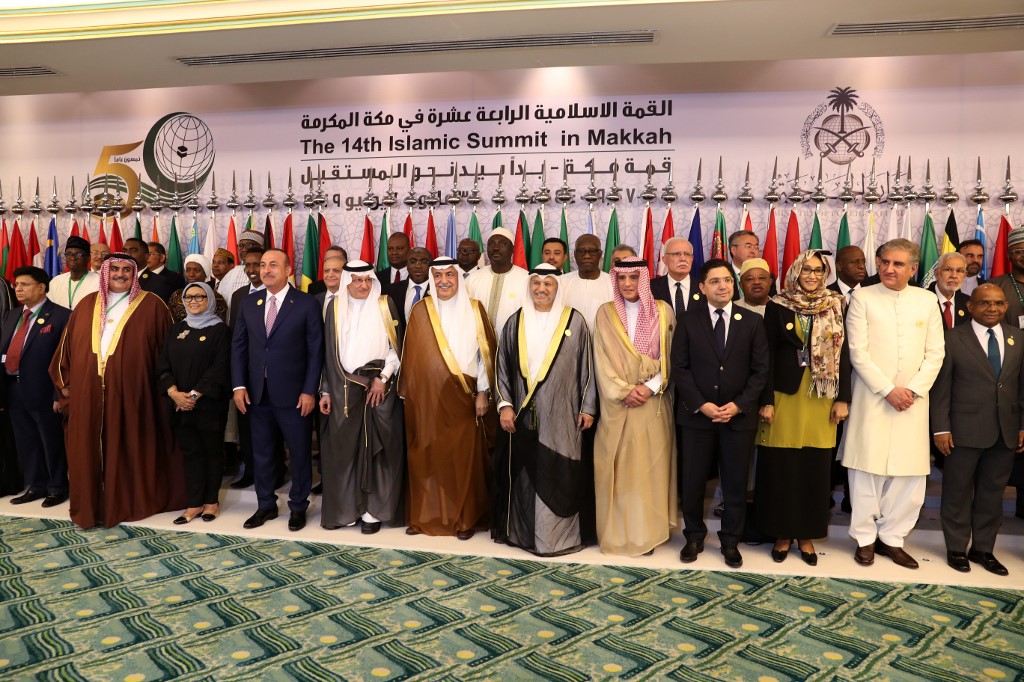
The king’s remarks came at the start of two back-to-back emergency summits in the holy city of Mecca, which drew near-unanimous support for the Sunni kingdom from Gulf and Arab states — with the exception of Iraq.
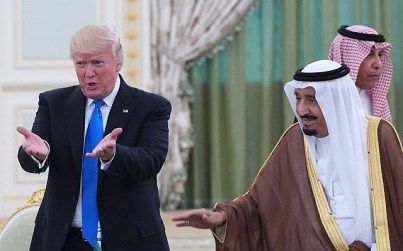
In this file photo taken on May 20, 2017, US President Donald Trump (L) and Saudi Arabia’s King Salman bin Abdulaziz al-Saud take part in a signing ceremony at the Saudi Royal Court in Riyadh. (MANDEL NGAN / AFP)
The summits came a day after hawkish US National Security Advisor John Bolton said Iran was almost certainly behind this month’s sabotage of four ships, including two Saudi oil tankers, off the UAE coast. Tehran rejected the charge.
Saudi Arabia, a staunch US ally, also faces stepped-up drone attacks from Iran-aligned Houthi rebels, one of which resulted in the temporary shutdown of a major oil pipeline.
“The absence of a firm and dissuasive response to Iran’s acts of sabotage in the region has encouraged it to continue and strengthen them in the way we see today,” the Saudi king said.
“Its recent criminal acts… require that all of us work seriously to preserve the security and achievements of GCC (Gulf Cooperation Council),” the king added, referring to the attacks on Gulf oil installations.
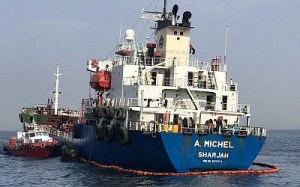
The Emirati-flagged oil tanker A. Michel, May 13, 2019, one of four ships damaged in what Gulf officials called a “sabotage” attack off the coast of the United Arab Emirates. (UAE National Media Council via AP)
The monarch also called on the international community to use “all means” necessary to contain the Shiite power.
Saudi Arabia hosted the summits — which will be followed by a third meeting on Saturday of heads of state from Islamic nations — apparently to mobilize efforts to isolate Iran’s regime amid fears of a military confrontation.
But Iraq, caught in the middle of its two allies, the US and Iran, opposed a final statement released by Arab countries, which condemned Tehran’s behavior in the region.
Iraq, which has offered to mediate between Washington and Tehran, recently warned of a risk of war amid escalating tensions.
On the eve of the summits, Riyadh blasted what it called Iranian “interference” across the region and demanded “firmness” over attacks on Gulf oil tankers and pipelines.

Saudi Minister of State for Foreign Affairs Adel al-Jubeir (C) gestures during a meeting of Islamic and Arab Foreign Ministers in Jeddah on May 30, 2019, ahead of the Gulf, Arab, and Islamic summit to be held in Mecca on 30 and 31 May 2019. (BANDAR ALDANDANI / AFP)
Tensions in the region spiked after the four ships were damaged in a mysterious sabotage attack off the coast of the emirate of Fujairah on May 12.
The vessels were attacked using “naval mines almost certainly from Iran”, Bolton told a news conference in Abu Dhabi on Wednesday.
Iran rejected the accusation, calling it “laughable.”
US experts are part of a five-nation team investigating the ship attacks.
Stepping up the war of words on Thursday, US Secretary of State Mike Pompeo said that Iran was trying to raise global energy prices through the attacks on oil installations.
The US has beefed up its military presence in the region, with the deployment of an aircraft carrier, B-52 bombers and 1,500 additional troops.
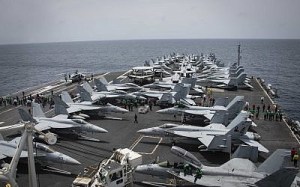
The flight deck of the Nimitz-class aircraft carrier USS Abraham Lincoln in the Arabian Sea, on May 19, 2019. (Mass Communication Specialist 3rd Class Garrett LaBarge/US Navy via AP)
Bolton however said the extra US forces were sent to the Middle East as a “deterrent” and that Washington’s response would be prudent.
“We definitely desire a change in the (Iranian) regime’s behavior,” Brian Hook, US Special Representative for Iran, said Thursday.
Regional tensions have grown since US President Donald Trump’s administration reimposed sanctions against Iran after Washington unilaterally pulled out of a multilateral 2015 nuclear accord signed with the Islamic republic.
But Trump appeared to soften his hawkish tone towards Tehran, saying during a visit to Japan on Monday that his government does not seek “regime change.”




 anneinpt
 artaxes
 danmillerinpanama
 davidking1530
 Peter Hofman
 Joseph Wouk
 Peter
Peter Louisiana Steve
 WarSclerotic
Recent Comments