Source: Report links vast online disinformation campaign to Iran – www.israelhayom.com
In a report published Tuesday, Citizen Lab reveals a years-old, multilingual campaign aimed at seeding anti-Saudi, anti-Israel and anti-American stories across the internet. Campaign tried to replicate legitimate news sites, giving them almost identical URLs.

Ali AlAhmed poses for a photograph in his office in Washington | Photo: AP Photo/Alex Brandon,
The Associated Press was on the verge of publishing a story about how AlAhmed, who is based in the Washington area, had been targeted by hackers posing as a female journalist. Now, just two days before the article was set to go live, another young woman had sidled up to him over the internet, trying to entice him to read an article and share it online.
“They will never stop,” AlAhmed wrote in a Nov. 6 message to the AP. “They think a hot girl can lure me.”
The AP flagged the exchange to Canadian internet watchdog Citizen Lab, which was already helping AlAhmed deal with the hackers. Citizen Lab quickly determined that the Twitter account, purportedly belonging to an Egyptian writer named Mona A.Rahman , was part of a separate operation. In fact, she wasn’t even trying to hack AlAhmed — she was trying to enlist him in an ambitious global disinformation effort linked to Tehran.
In a report published Tuesday, Citizen Lab said A.Rahman was but a small piece of a years-old, multilingual campaign aimed at seeding anti-Saudi, anti-Israel and anti-American stories across the internet. Citizen Lab, which is based at the University of Toronto’s Munk School, said it believes “with moderate confidence” that the operation is aligned with Iran. The campaign is another indication of how online disinformation is being tested by countries well beyond Russia, whose interference into the 2016 U.S. presidential election was laid out in vivid detail in special prosecutor Robert Mueller’s report.
“What this shows is that more and more parties are entering the disinformation game,” said John Scott-Railton, a Citizen Lab researcher, “and they’re constantly learning.”
In London, Iranian Embassy press secretary Mohammad Mohammadi denied that his government had anything to do with digital disinformation, saying that Iran was “the biggest victim” of such campaigns and had called for international regulations to curb them. He referred further questions to Iran’s Communications Ministry, whose deputy minister did not immediately return a message Tuesday.
Scott-Railton and his colleagues ended up identifying 135 fake articles that were published as part of the campaign, which they dubbed “Endless Mayfly” because, like the short-lived insect, the bogus stories tended to disappear soon after they began to spread.
The article A.Rahman was trying to get AlAhmed to share — a claim that Israel’s then-defense minister, Avigdor Lieberman, had been fired for being a Russian spy — was typical: The article had startling news, it was hosted on a fake version of a Harvard University website and had a host of spelling and grammatical mistakes. Articles shared by other fake personas followed a similar pattern. They made inflammatory claims about Israel, Saudi Arabia, and the United States presented on lookalike versions of respected news sites.
“Ivanka Trump says it is unbelievable that women cannot drive in Saudi Arabia,” said one article posted to a site dressed up to look Foreign Policy magazine. “Saudi Arabia funds the US Mexico border Wall,” said another, hosted on a site imitating The Atlantic.
The campaign seems to have been largely ineffectual — Scott-Railton noted that “most of their stories got almost no organic buzz” — but a couple did break through.
In March 2017 a fake Belgian newspaper article claiming that then-French presidential candidate Emmanuel Macron’s campaign was being one-third funded by Saudi money was widely shared in French ultra-nationalist circles, including by Marion Marechal, the granddaughter of French far-right leader Jean-Marie Le Pen. A few months later another site mimicking a Swiss publication tricked the Reuters news agency and other outlets into publishing a false report that Saudi Arabia had written a letter to FIFA, soccer’s governing body, demanding that archrival Qatar be barred from hosting the 2012 World Cup. The report was later withdrawn.
Citizen Lab said it first got wind of the suspected Iranian disinformation campaign when a British web developer debunked one of the fake articles on Reddit two years ago. The developer pointed out that the story — which suggested that British Prime Minister Theresa May was “dancing to the tune” of Saudi Arabia — had been published on a website using the URL “indepnedent,” imitating the legitimate British news site, The Independent, and was linked to a network of other suspicious sites, including “bloomberq,” a clone of the news agency Bloomberg. A third site, “daylisabah,” was a fake version of the Turkish publication Daily Sabah.
“Did we just get an insight into a fake news operation?” the developer asked at the time.
Citizen Lab confirmed his hunch, later connecting the sites to an incident in which another Twitter user, Bina Melamed, tried to persuade Israeli journalists to share the same fake Harvard article that AlAhmed received.
When one of the reporters privately confronted Melamed about why she was pushing nonsense, the answer was unusually straightforward.
“I like challenging and controversial stories,” Melamed said. “Sometimes they are fake and sometimes they are not.”
Outside experts who reviewed Citizen Lab’s report gave a qualified verdict. Both FireEye and ClearSky Cyber Security, U.S. and Israeli companies respectively, said they recognized elements of the digital infrastructure flagged by Citizen Lab from their own reporting, but ClearSky researcher Ohad Zaidenberg said he wanted to see more evidence before attributing the social media personas to Iran.
Speaking generally, he said the apparent clumsiness of the online disinformation should not be a reason to dismiss it.
“It gets better each day,” he said.
Most of the personas mentioned in Citizen Lab’s report — such as A.Rahman and Melamed — have been suspended. Messages left with a handful of surviving accounts — sent via Twitter and Reddit — elicited no response. Emails sent to half a dozen addresses used to register several bogus websites — including bloomberq, daylisabah, foriegnpolicy, theatlatnic and indepnedent — either weren’t returned or bounced back as undeliverable.
AlAhmed said he was intrigued to hear that A.Rahman had been tied to the Iranian government. Despite knowing from the start that the whole thing was a charade, AlAhmed struck a wistful note in a recent interview about his interactions with the attractive-looking A.Rahman. At one point, she had written to him inviting him to stay at an apartment she claimed to have in London.
“A small part of me thought, ‘I hope this is real,’” AlAhmed said.
He quickly made clear that he was kidding.
“I told my wife,” he said.
Amid increasing speculation of new Iranian aggression, Ayatollah Ali Khamenei suggests neither side wants war. Leader insists country will not renegotiate nuclear deal from 2015.
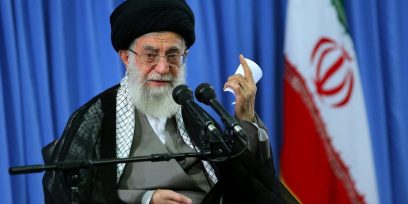
Iranian Supreme Leader Ayatollah Ali Khamenei speaks during a ceremony in Tehran, Iran, 17 August 2015. | Archives: EPA
Iran’s state TV quoted Khamenei on Tuesday as calling negotiations with the U.S. “poison” and saying: “This is not a military confrontation, because no war is going to happen.”
Khamenei, who has final say on all state matters, said: “Neither we, nor they are seeking war, they know that it is not to their benefit.”
The Ayatollah’s comments come as tensions have escalated between Washington and Tehran. The Trump administration has sent the aircraft carrier USS Abraham Lincoln and a bomber squadron to the region in response to unspecified threats by Iran against American interests.
Meanwhile, President Donald Trump dismissed a report that the U.S. is planning for a military conflict with Iran.
Trump was responding to Tuesday’s report in The New York Times that the White House was reviewing military plans against Iran that could result in sending 120,000 U.S. troops to the Middle East if Iran attacked American forces or stepped up work on nuclear weapons.
Trump called the report “fake news” and added that he would “absolutely” be willing to send troops, but hopefully won’t have to plan for that.
He stressed that if the U.S. was going to get into a military conflict with Iran, “we’d send a hell of a lot more” troops.
Trump spoke to reporters at the White House before traveling to Louisiana.
Source: All fingerprints lead back to Tehran – www.israelhayom.com
The Iranians, who normally use proxies to do their bidding, warned that if they can’t export oil from the Gulf, no one can. This message to Washington and Riyadh wasn’t hard to decifer.

UAE Navy boats next to a Saudi tanker off the Port of Fujairah, UAE, Monday | Photo: Reuters/Satish Kumar
Iranian-backed Houthi rebels in Yemen boasted of their successful attack on the pipelines and promised there would be more to follow; no group has claimed responsibility for bombing the ships. Iran was quick to denounce the attacks, saying they should be investigated.
Iran, however, is the primary suspect in both cases, and the fingerprints at each crime scene all lead back to Tehran. Without massive Iranian support, the rebels in Yemen could not have flown armed unmanned drones hundreds of kilometers to precisely target an oil pipeline in Saudi Arabia. They could not have sabotaged four tankers, without leaving behind evidence, without training and guidance from Iranian experts.
The suspicion of Iranian involvement is bolstered by the fact that both attacks, on the pipeline and the tankers, were aimed at Saudi targets directly linked to its ability to produce and deliver oil. In recent weeks, even before Iran and the United States intensified their recent bout of saber-rattling, the Iranians warned that if they were prohibited from exporting oil from the Gulf due to sanctions, “no one will be able to export oil from the region.” This message, to Washington and Riyadh, wasn’t hard to understand.
Furthermore, the Iranians seem to have made an effort to make sure the damage from the two attacks was minimal. A type of warning signal, or incendiary message to the U.S. and its allies, to say: It’s true that we, the Iranians, don’t want war, but look what we can do if you act against us. This is also why, in both cases and similar to many others in the past, the Iranians opted to perpetrate the attacks via loyal proxies, to prevent a situation in which Tehran could be held directly responsible.
The Iranian public is very concerned about a military clash with the U.S., hence the country’s supreme leader, Ayatollah Ali Khamenei, hastily declared he doesn’t believe a war will erupt. In the same breath, however, he also said he would never agree to renegotiate the nuclear deal. Meanwhile, Iran’s transition from words to deeds is, in and of itself, an escalation and further enflames tensions in the Gulf. Had the attack on the Saudi tankers or oil fields been more destructive, it could have instantly ignited a conflagration.
Source: The Golan is next after Iran hit 3 Gulf oil targets, say Rev Guards associates – DEBKAfile

Two staffers on Iranian Revolutionary Guards publications reported on Tuesday, May 14 that the Israeli Golan is Tehran’s next target after its attacks on UAE and Saudi oil infrastructure.
Hamed Rahim-Pour, international editor of the Khorasan daily and Amin Arabshahi, a senior reporter for the IRGC’s Tasnim news agency, wrote this on Tuesday: “All our options are on the table; the [Saudi] port of Yanbu [on the Red Sea] and also the [UAE] port of Fujairah [in the Bay of Oman] were attacked. [These] two ports are meant [to supply oil] to replace Iranian oil! They received such a blow that they didn’t see where it came from.”
The two journalists went on to say: “The scope of the {US} war against Iran should not be defined only by gigantic US aircraft carriers, or {its] strategic bombers stationed in Qatar or the F-35 fighter planes. The range and scope of the possible war against Iran may be defined by quiet infiltrations of Fujairah, Yanbu and Golan, and dozens of other points in the region.
DEBKAfile’s military and intelligence sources disclose that last week’s missile attack on Saudi Arabia’s main western oil terminal of Yanbu, which went unreported by the US or the Saudis, was in fact the opening shot of a series carried over this week to two more Iranian attacks on oil infrastructure – the sabotage of four oil tankers outside Fujairah port and the explosive drone attack on two Saudi pumping stations on its east-west pipeline. Washington and Riyadh have avoided explicitly naming Iran as the culprit or even linking the three episodes. Two IRGC mouthpieces have now admitted who was responsible and furthermore revealed the order of the “blows” on Tehran’s agenda. Israel should therefore be prepared for the Golan to be next in line.
US military sources revealed on Monday that pro-Iranian Shiite militias have been armed with three types of rockets for attacking the Golan and US military bases in eastern Syria and western Iraq: Short range Fatteh-110, Zelzals 2 and 3 and the Zulfikar, which have a longer range of 700km.
Source: U.S. orders non-emergency embassy staff to leave Iraq – Middle East – Jerusalem Post
CENTCOM raised threat level in Iraq and Syria with troops on high alert against possible “imminent” attack by Iran.

As tension continue to rise between Iran and the United States, the US State Department ordered the departure of “non-emergency US government employees” from Iraq on Wednesday.
The statement urged those affected “depart by commercial transportation as soon as possible.”
“US Central Command, in coordination with Operation Inherent Resolve, has increased the force posture level for all service members assigned to OIR in Iraq and Syria,” the statement says. “As a result, OIR is now at a high level of alert as we continue to closely monitor credible and possibly imminent threats to US forces in Iraq.”
In an unusual rebuke, the statement countered claims made earlier in the day by a top British general serving as the deputy commander of the coalition against the Islamic State group that Iranian-backed militias posed no immediate threat to coalition troops in the region.
“There’s been no increased threat from Iranian-backed forces in Iraq and Syria,” British Army Maj. Gen. Christopher Ghika, a deputy commander with the Operation Inherent Resolve coalition, said Tuesday during a video briefing from Iraq.
The statement by CENTCOM added Ghika’s comments “run counter to the identified credible threats” of Iranian-backed forces in the region.
Tensions have skyrocketed between Iran and the US in the past week following intelligence reports that Tehran and its proxies might be preparing to attack American troops or its allies in the Middle East.
The Pentagon approved the deployment of a B-52 bomber task force, one Patriot missile defense battery, an amphibious transport dock and an aircraft carrier strike group to CENTCOM’s region.
But Iranian officials have downplayed America’s recent military movements.
On Tuesday Iran’s Ayatollah Seyed Ali Khamenei said that any confrontation between the US and Iran would not be “a military one,” and that “there was not going to be any war.”
“The Iranian nation’s definite option will be resistance in the face of the US, and in this confrontation, the US would be forced into a retreat,” Khamenei was quoted by Iran’s Tasnim news agency as saying. “Neither we nor they, who know war will not be in their interest, are after war.”
Khamenei also said Washington that gives priority to Israel’s interests over the benefits of all others, saying that “the control of many affairs rests in the hands of the Zionist society.”
The newly appointed head of Iran’s Revolutionary Guard Corps Maj.-Gen. Hossein Salami was quoted by ISNA as telling parliament on Sunday that Washington was engaged in a “psychological war” and that the “comings and goings of their military” are a normal matter.
Both Israel and the US have warned that Iran and their proxy militias are the biggest threats to peace in the region and hope to weaken Iran’s growing influence across the Middle East and Persian Gulf.
Considered as the head of a snake, Israel has warned repeatedly that it would not allow for an Iranian presence in Syria and has admitted to hundreds of airstrikes to prevent the transfer of weapons such as ammunition to surface-to-air missile kits to Hezbollah in Lebanon the entrenchment of its forces on the Golan.
It is believed that Iran will attempt to entrench itself in Iraq, a mainly Shia Muslim country, as it did in Syria where they have managed to establish, shape and consolidate a solid parallel security structure in the country.
While there have been no reports of strikes in Iraq attributed to Israel, the Jewish State is reported to be behind an airstrike on the Syrian-Iraqi border last year near the town of Al-Bukamal which killed 22 members of a Shiite militia.
Iraqi troops have been working with the Hashd al-Shaabi (also known as Popular Mobilization Forces) militia fighters in the fight against IS militants in the country. The PMF, militias who were incorporated into Iraq’s security apparatus in 2016 to fight against the Islamic State group along with Iraqi and Kurdish forces, are directly financed and equipped by Iran.
In September Reuters reported that Iran had transferred ballistic missiles to Shiite proxies in Iraq over the course of several months and that it is developing the capacity to build more there. The missiles that were said to have been transferred include the Fateh-110, Zolfaqar, and Zelzal types, which have ranges of 200-700 km allowing them to be able to threaten both Saudi Arabia and Israel.
Source: Rouhani adviser to Trump: ‘Looks like you are going to get war’ with Iran | The Times of Israel
In escalating sabre-rattling, Tehran’s ambassador to Britain also lashes Washington’s ‘theatrical maneuvers,’ but warns ‘Don’t test us’
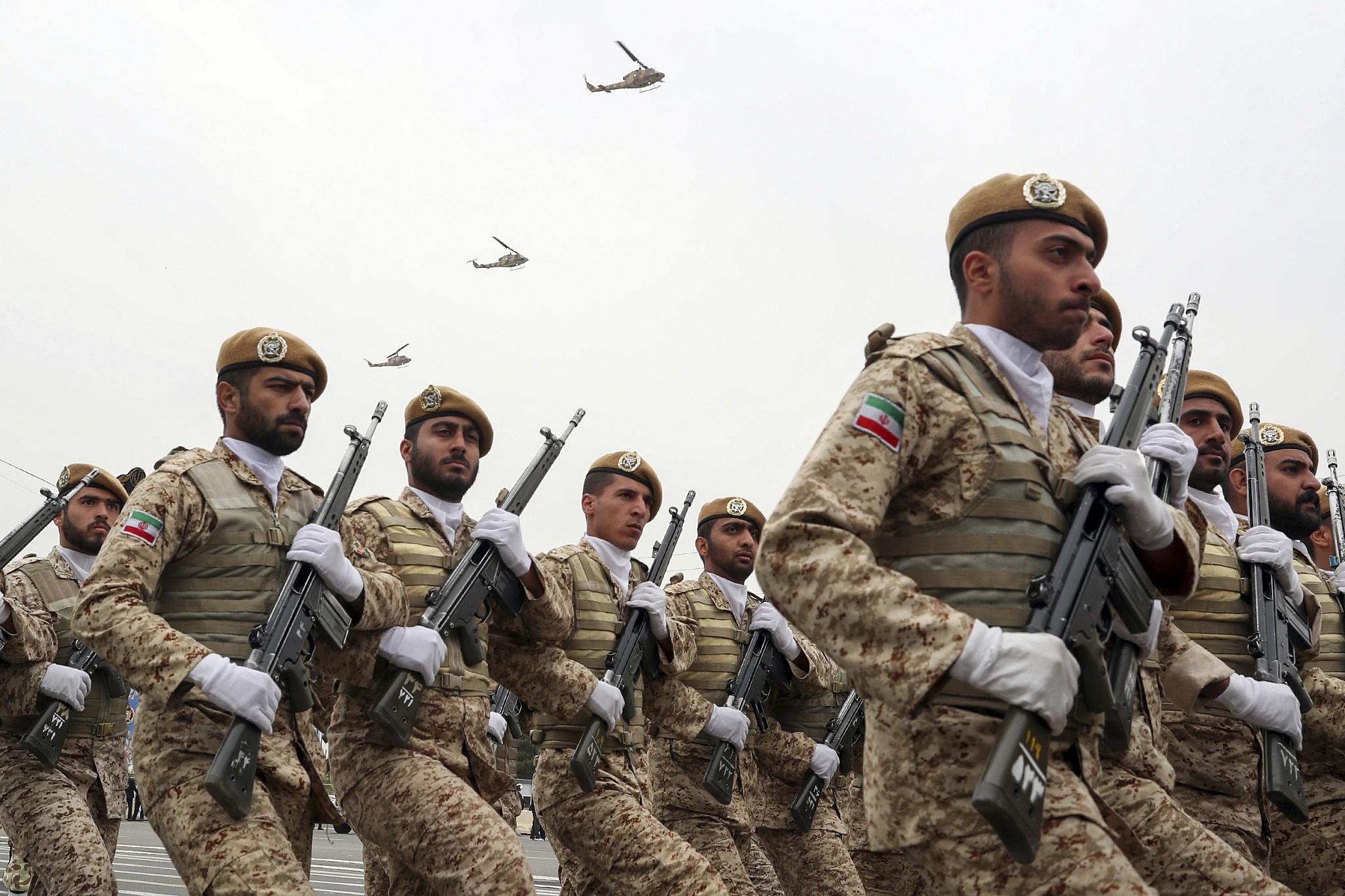
A close adviser to Iranian President Hassan Rouhani warned US President Donald Trump on Tuesday that it “looks like you are going to get a war” with Iran, as the US deployed additional warships to the region amid rising tensions.
In an English-language tweet tagging Trump, Hesameddin Ashena said, “You wanted a better deal with Iran. Looks like you are going to get a war instead.”
He added, in an apparent reference to mustachioed US National Security Adviser John Bolton, “That’s what happens when you listen to the mustache.”
“Good luck in 2020!” he added sarcastically.
 Hesameddin Ashena@hesamodin1
@realDonaldTrump : You wanted a better deal with Iran. Looks like you are going to get a war instead. That’s what happens when you listen to the mustache. Good luck in 2020!
On Tuesday, in a rare television interview, Tehran’s envoy to the United Kingdom, Hamid Baeidinejad, dismissed the US deployments as “theatrical maneuvers by the US administration,” and warned the US not to “try to test the determination of Iran.”
In an interview with Sky News, Baeidinejad said, “While we have renounced any escalation in the region, I would assure you that Iranian armed forces are fully ready for any eventuality in the region, so they should not try to test the determination of Iran to confront any escalation in the region.”
The comments come amid rising tensions in the region that saw the deployment earlier this month of an American aircraft carrier strike group to the Persian Gulf. On Sunday, four ships, including two Saudi oil tankers, were reportedly attacked off the United Arab Emirates coast in an attack US officials reportedly suspect was carried out at Iran’s behest.
Iran has called for an investigation into what it called an “alarming” incident, while a senior member of Iran’s parliament blamed Israel on Tuesday for the attacks on the ships, for which no one has yet claimed responsibility.

The attacks “appeared to be Israeli mischief,” Behrouz Nemati said after a closed-door session of parliament, quoted by state news agency IRNA.
Also Tuesday, drone attacks by Iran-aligned rebels in Yemen shut down one of Saudi Arabia’s main oil pipelines, further ratcheting up Gulf tensions after the mysterious sabotage of the tankers.
The assaults came days after an Israeli television report said Israel had warned the US that Iran was considering targeting Saudi oil production facilities.
Tensions have risen since Trump withdrew the US from the 2015 nuclear deal between Iran and world powers, and restored US sanctions that have pushed Iran’s economy into crisis. Last week, Iran warned it would begin enriching uranium at higher levels in 60 days if world powers failed to negotiate new terms for the deal.

European powers have vowed to fight to save the nuclear deal and the European Union has urged Iran to respect the international agreement, saying it aims to continue trading with the country despite US sanctions.
An American military team’s initial assessment is that Iranian or Iranian-backed proxies used explosives Sunday to blow large holes in four ships anchored off the coast of the United Arab Emirates, a US official said.
The incident came after the White House ordered the USS Abraham Lincoln aircraft carrier strike group and B-52 bombers to the region on May 4, and has reportedly been reviewing a plan to send as many as 120,000 US troops to the Middle East if Iran accelerates its uranium enrichment or attacks American targets. Trump has denied the claim of planning to send troops to counter Iran.
Source: Allies split with US over Iranian threat as war worries mount | The Times of Israel
British general tells reporters that coalition forces have not detected any issues with Iran-backed forced in Iraq and Syria, drawing rare rebuke from US military and exposing rift
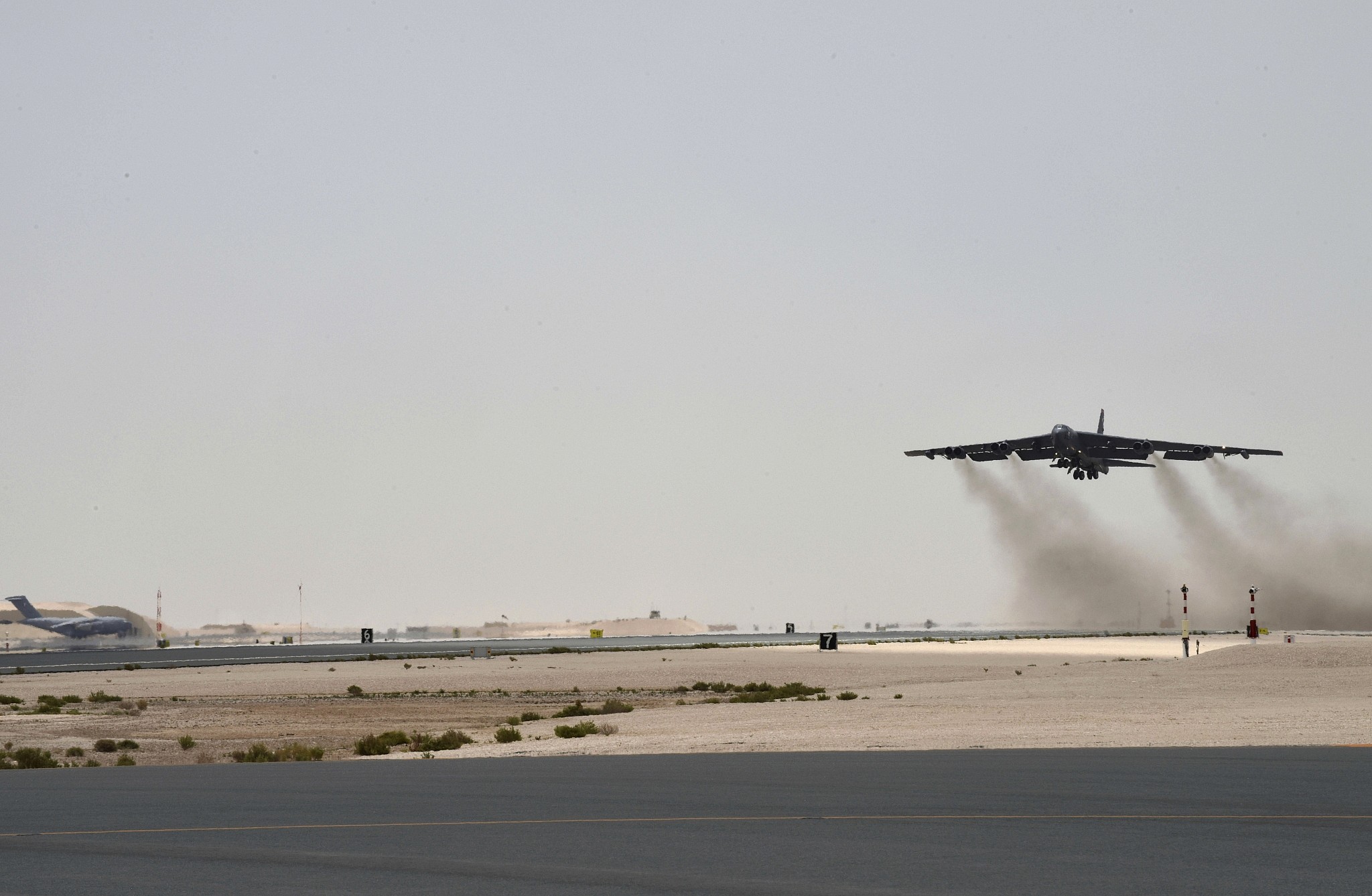
WASHINGTON — International worries that the Trump administration is sliding toward war with Iran flared into the open Tuesday amid skepticism about its claims that the Islamic Republic poses a growing threat to the US and its allies in the Persian Gulf and beyond .
The US military rebutted doubts expressed by a British general about such a threat. US President Donald Trump denied a report that the administration has updated plans to send more than 100,000 troops to counter Iran if necessary. But Trump then stirred the controversy further by saying: “Would I do that? Absolutely.”
The general’s remarks exposed international skepticism over the American military build-up in the Middle East, a legacy of the 2003 invasion of Iraq that was predicated on false intelligence. US officials have not publicly provided any evidence to back up claims of an increased Iranian threat amid other signs of allied unease.
As tensions in the region started to surge, British Foreign Secretary Jeremy Hunt said his nation was worried about the risk of accidental conflict “with an escalation that is unintended really on either side.” Then on Tuesday, Spain temporarily pulled one of its frigates from the US-led combat fleet heading toward the Strait of Hormuz. That was followed by the unusual public challenge to the Trump administration by the general.
“No, there’s been no increased threat from Iranian-backed forces in Iraq and Syria,” said Maj. Gen. Chris Ghika, a British senior officer in the US-backed coalition fighting the Islamic State group. Ghika, speaking in a video conference from coalition headquarters in Baghdad, told reporters at the Pentagon that the coalition monitors the presence of Iranian-backed forces “along with a whole range of others because that’s the environment we’re in.”
But he added, “There are a substantial number of militia groups in Iraq and Syria, and we don’t see any increased threat from any of them at this stage.”

Ghika denied he was contradicting his US partners.
“I don’t think we’re out of step with the White House at all,” Ghika said.
But late in the day, in a rare public rebuttal of an allied military officer, US Central Command said Ghika’s remarks “run counter to the identified credible threats” from Iranian-backed forces in the Mideast. In a written statement, Central Command said the coalition in Baghdad has increased the alert level for all service members in Iraq and Syria.
“As a result, (the coalition) is now at a high level of alert as we continue to closely monitor credible and possibly imminent threats to U.S. forces in Iraq,” the statement said.
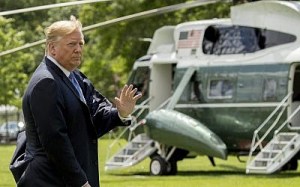
At the White House, Trump, who has repeatedly argued for avoiding long-term conflicts in the Mideast, discounted a New York Times report that the US has updated plans that could send up to 120,000 troops to counter Iran if it attacked American forces.
“Would I do that? Absolutely,” he told reporters. “But we have not planned for that. Hopefully we’re not going to have to plan for that. If we did that, we’d send a hell of a lot more troops than that.”
Reinforcing Trump’s denial, Secretary of State Mike Pompeo said at a joint news conference in Sochi with Russian Foreign Minister Sergei Lavrov, “We fundamentally do not seek war with Iran.”
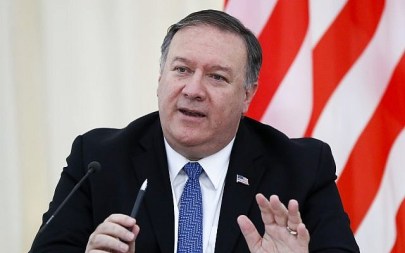
A Trump administration official said a recent small meeting of national security officials was not focused on a military response to Iran, but instead concentrated on a range of other policy options, including diplomacy and economic sanctions. The official spoke on condition of anonymity to discuss internal deliberations.
Lavrov said Pompeo told him that a potential deployment of 120,000 US troops to the Mideast was only a “rumor.” Lavrov said the international community needs to focus on diplomacy with Iran, including on the potentially explosive issue of Iran’s nuclear program, which is constrained by a US-brokered deal in 2015 that Trump has abandoned.
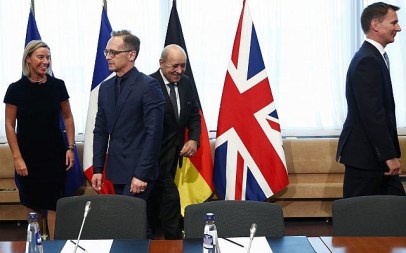
US Iran envoy Brian Hook told reporters traveling with Pompeo in Brussels that the secretary of state shared intelligence on Iran with allies since “Europe shares our concerns about stability in the Gulf and the Middle East.” What the Europeans do not share, however, is Washington’s more aggressive approach to Iran.
“We are very worried about the risk of a conflict happening by accident, with an escalation that is unintended really on either side but ends with some kind of conflict,” British Foreign Secretary Jeremy Hunt told reporters in Brussels.
“What we need is a period of calm to make sure that everyone understands what the other side is thinking,” Hunt said.
Last week, US officials said they had detected signs of Iranian preparations for potential attacks on US forces and interests in the Mideast, but Washington has not spelled out that threat.
Israeli officials have expressed worries that Iranian backed militias could attack Israel to provide cover for other Iranian actions or as retaliation for a confrontation between the US and Iran.
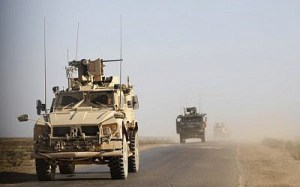
On Sunday, a senior Iranian lawmaker hinted that Iran could hit Israel if the US attacked Tehran’s interests.
The US has about 5,000 troops in Iraq and about 2,000 in Syria as part of the coalition campaign to defeat the Islamic State group there. It also has long had a variety of air and naval forces stationed in Bahrain, Qatar and elsewhere in the Gulf, partly to support military operations against IS and partly as a counter to Iranian influence.
Gen. Ghika’s comments came amid dramatically heightened tensions in the Middle East. The US in recent days has ordered the USS Abraham Lincoln aircraft carrier strike group to the Gulf region, plus four B-52 bombers. It also is moving a Patriot air-defense missile battery to an undisclosed country in the area. As of Tuesday, the Lincoln and its strike group had passed through the Bab-el-Mandeb Strait in the Red Sea, but officials would not disclose their exact location.

Tensions rose another notch with reports Sunday that four commercial vessels anchored off the United Arab Emirates had been damaged by sabotage.
A US military team was sent to the UAE to investigate, and one US official said the initial assessment is that each ship has a 5- to 10-foot hole in it, near or just below the water line.
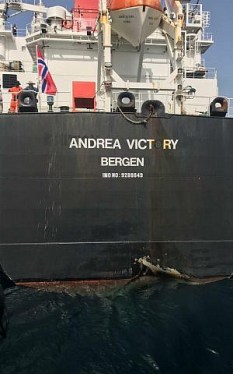
The official, who was not authorized to publicly discuss details of the investigation, said the early interpretation is that the holes were caused by explosive charges.
The official on Tuesday acknowledged seeing some photographs of the damage to the ships, but those images have not been made public.
The official also said that the team is continuing to conduct forensic testing on the ship damage and that US leaders are still awaiting the final report.
The team’s initial assessment is that the damage was done by Iranian or Iranian-backed proxies, but they are still going through the evidence and have not yet reached a final conclusion, the official said.
Times of Israel staff and AFP contributed to this report.
Source: Iran drops commitment to cap uranium enrichment, as nuclear deal unravels | The Times of Israel
Official from country’s atomic agency says move part of 60-day ultimatum laid down by President Rouhani for negotiating new terms
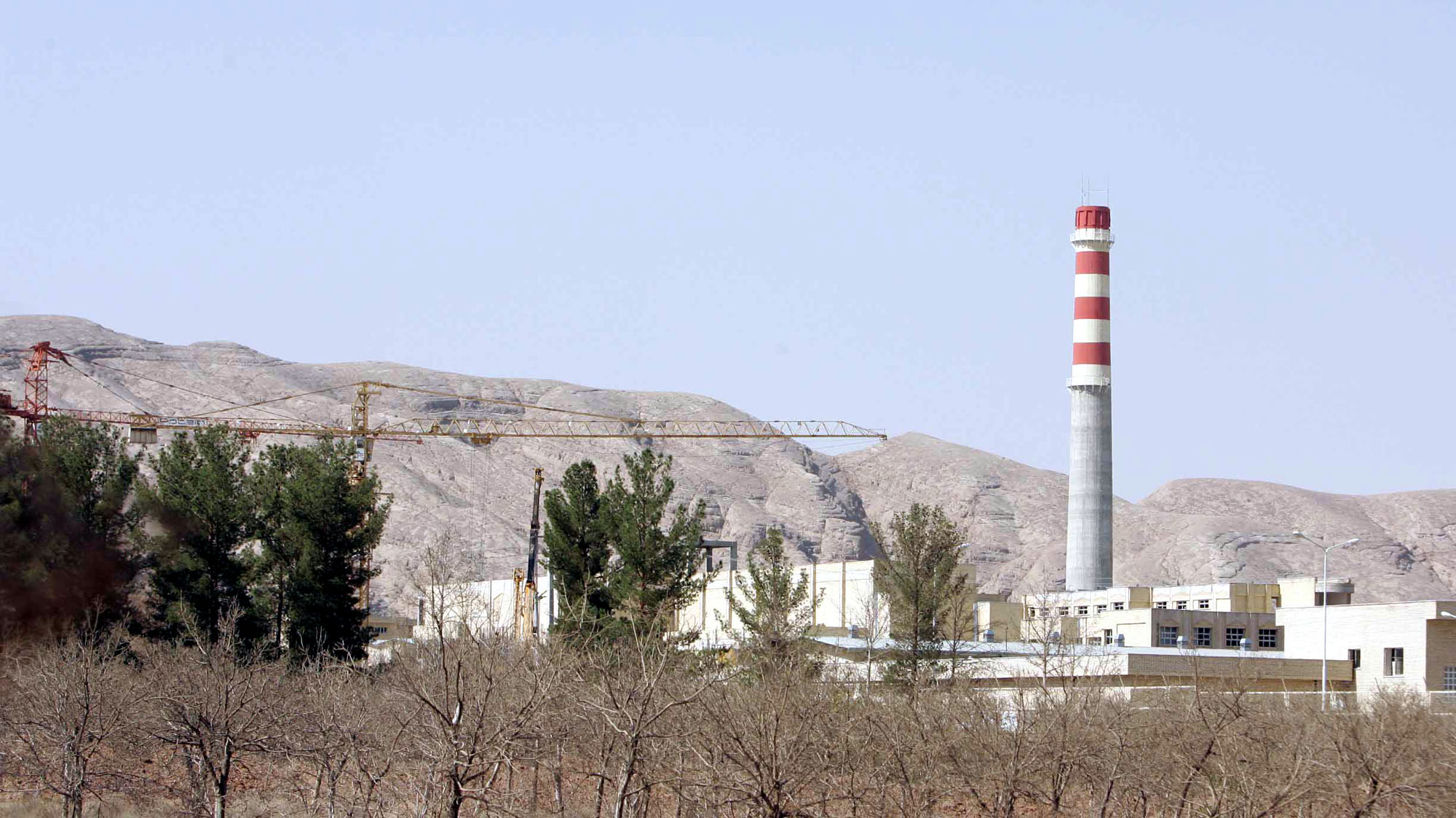
Iran has formally dropped the limitations on uranium enrichment and production of heavy water that were laid down in its landmark 2015 nuclear deal with world powers, an official from the Atomic Energy Organization of Iran announced on Wednesday.
The official said the move — which comes after the US backed out of the deal and reimposed many sanctions on Tehran — was in accordance with instructions from Iran’s Supreme National Security Council and was part of a recent 60-day Iranian ultimatum for renegotiating the pact, the regime-affiliated Iranian Students News Agency reported.
More details of the development were to be provided later in the day, promised the official, who asked to remain anonymous.
Under the terms of the nuclear deal, Iran can keep a stockpile of no more than 300 kilograms (660 pounds) of low-enriched uranium. That’s compared to the 10,000 kilograms (22,046 pounds) of higher-enriched uranium it once had. It is also capped at storing 300 tons of heavy water, which it sells to Oman for use as a coolant in nuclear reactors.
The announcement came two days after Iranian atomic agency spokesman Behrouz Kamalvandi said that his country was beginning to set in motion actions ordered last week by President Hassan Rouhani, who had warned Iran will breach enriched uranium and heavy water limits as a response to sanctions applied by Washington after last year pulling out of the deal.
Kamalvandi cited articles 26 and 36 of the deal, which discuss Iran’s right to suspend some of its commitments to the agreement if sanctions are brought back.
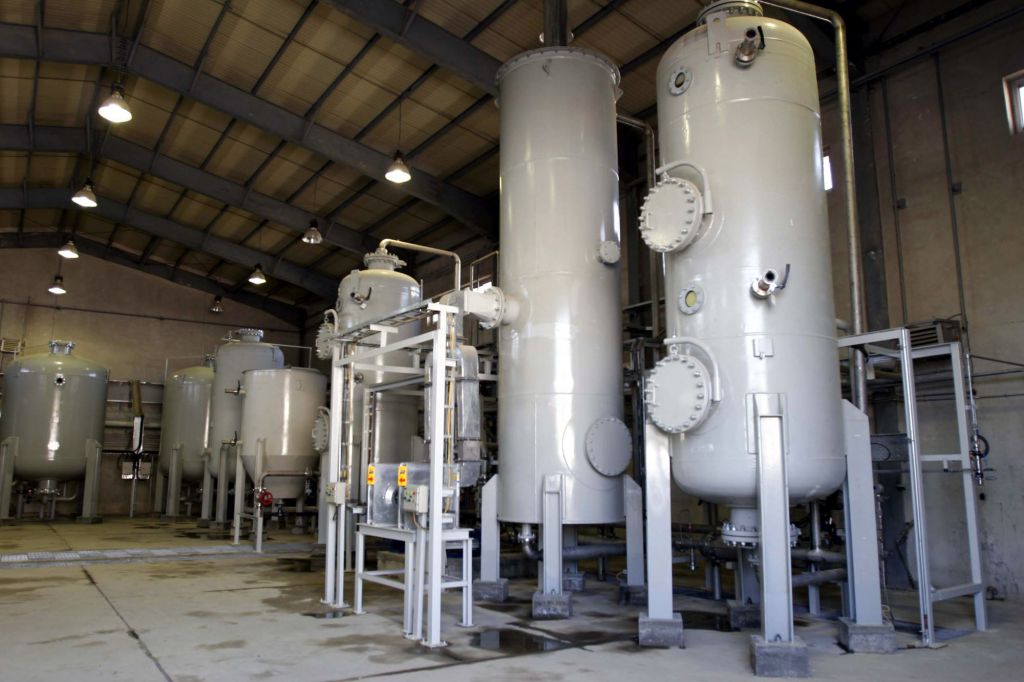
The United Nations’ nuclear watchdog, the International Atomic Energy Agency, says Iran has previously complied with the terms of the nuclear deal, which saw it limit its enrichment of uranium in exchange for the lifting of economic sanctions. But renewed American sanctions have wreaked havoc on Iran’s already-anemic economy, while promised help from European partners in the deal haven’t alleviated the pain.
Rouhani said in a televised address last Wednesday, a year after the US withdrew from the accord, that signatories to the deal have 60 days to come up with a plan to shield his country — already laboring under economic hardship — from new sanctions imposed by US President Donald Trump. If negotiations fail, Iran will restart uranium enrichment to levels banned under the agreement, he warned.
Iran had stopped its sale of excess uranium and heavy water as a first step, Rouhani said, something required under the deal. A week earlier the US ended deals allowing Iran to exchange its enriched uranium for unrefined yellowcake uranium with Russia, and to sell its heavy water, which is used as a coolant in nuclear reactors, to Oman.
Currently, the accord limits Iran to enriching uranium to 3.67%, which can fuel a commercial nuclear power plant. Weapons-grade uranium needs to be enriched to around 90%. However, once a country enriches uranium to around 20%, scientists say the time needed to reach 90% is halved. Iran has previously enriched to 20%.
European powers have since rejected the “ultimatums” from Tehran, but vowed to fight to save the deal itself. The European Union has urged Iran to respect the international agreement, saying it aims to continue trading with the country despite US sanctions.
Following Rouhani’s announcement last week, Kamalvandi, the Iranian atomic agency spokesman, said that his country’s intention was to strengthen the deal and “bring it back on track.”
The Trump administration pulled America out of the deal in May 2018, saying it does nothing to stop Iran from developing missiles or destabilizing the Middle East. The Europeans insist that the pact is an important pillar of regional and global security and was never meant to address those other issues.
Sparking fears of war, already high tensions skyrocketed last week as US National Security Adviser John Bolton said that the United States was sending an aircraft carrier strike group and a bomber task force to the Middle East in a “clear and unmistakable” message to Iran.
Source: Second attack on Gulf oil: Drones drop explosives on two Saudi oil pumping stations – DEBKAfile

Earlier, a television station owned by Yemen’s Iranian-backed Houthi insurgents claimed drone attacks on Saudi installations, without identifying the targets or time of the attacks.
The UAE has identified the four vessels sabotaged on Sunday as a very large crude carrier (VLCC) tanker Amjad and crude tanker Al Marzoqah, both owned by the Saudi shipping firm Bahri. The other two were the UAE-flagged fuel bunker barge A. Michel and the Norwegian-registered oil products tanker MT Andrew Victory. An unnamed US official said Tuesday that an initial assessment suggested that Iran was behind this attack, but there was no evidence of this as yet.
DEBKAfile adds: The second attack on essential Gulf oil infrastructure on the heels of the first took place in the absence of an international response to the sabotage of four oil tankers outside Fujairah port on Sunday. US officials even tried to play the event down. While the first attack, which was more of a warning than seriously damaging, was carried out by Iran’s elite Al Qods special forces, the second was claimed by Yemeni Houthis. Last December, these Yemeni insurgents used an explosive drone supplied by Iran to bomb a government parade and kill a large number of pro-Saudi officers and men. Then, military experts warned that this new Iranian device, after proving its worth as a precise weapon in Yemen, was ready for use against other Iranian targets, including US forces in the region and Israel.
Both targets, the new Fujairah pipeline project and the Saudi East-West pipeline, were designed to bypass the Strait of Hormuz which is controlled by Iran. Tehran’s two attacks this week were both in response to US sanctions on its oil experts and a demonstration of its many resources for causing damage to the Gulf’s entire energy industry and disrupting all its export routes to international markets.




 anneinpt
 artaxes
 danmillerinpanama
 davidking1530
 Peter Hofman
 Joseph Wouk
 Peter
Peter Louisiana Steve
 WarSclerotic
Recent Comments