Archive for May 7, 2019

Europe could reimpose sanctions if Iran violates nuclear deal — French official 

May 7, 2019

Source: Europe could reimpose sanctions if Iran violates nuclear deal — French official | The Times of Israel

A French presidential official is warning the European Union could reimpose sanctions on Iran if it violates parts of the 2015 nuclear deal limiting its nuclear program.

“We do not want Tehran to announce tomorrow actions that would violate the nuclear agreement, because in this case we Europeans would be obliged to reimpose sanctions as per the terms of the agreement,” the unnamed official tells Reuters. “We don’t want that and we hope that the Iranians will not make this decision.”

The comments come as Iranian state-media reports that the country would unveil new measures Wednesday meant to counter American sanctions that were reimposed on Iran as part of US President Donald Trump’s decision to pull out of the nuclear deal last year.


FULL: Netanyahu Speaks Ahead of Israeli Memorial Day – YouTube

May 7, 2019


Iranian plot on U.S. possibly thwarted due to Israeli intelligence

May 7, 2019

Source: Iranian plot on U.S. possibly thwarted due to Israeli intelligence– repor – Middle East – Jerusalem Post

The information was handed to the US before National Security advisor John Bolton publicly said Iran will face “unrelenting force” if it attempts to harm the US.

BY HAGAY HACOHEN
 MAY 7, 2019 08:45
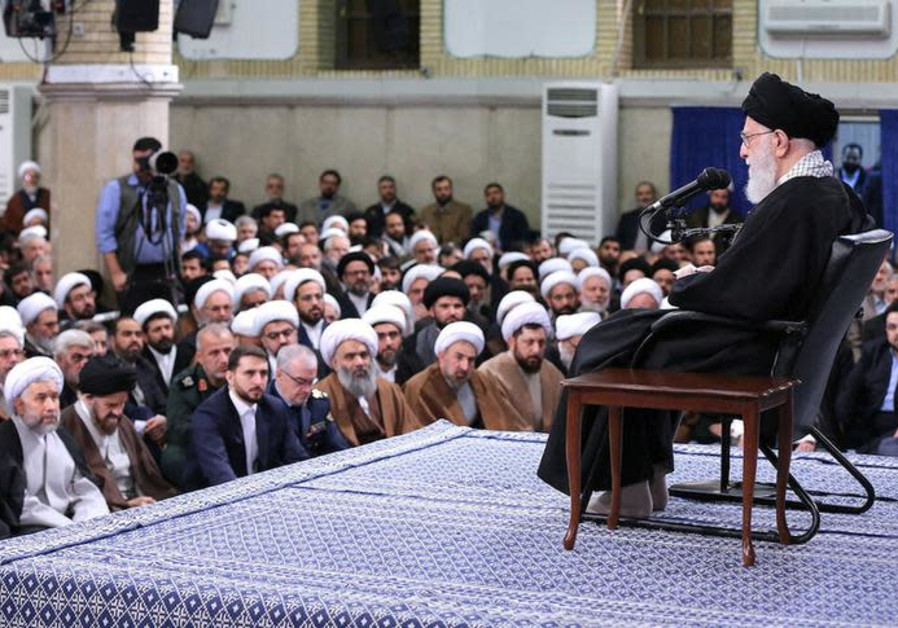
Iran's Supreme Leader Ayatollah Ali Khamenei meets with people of Qom, in Teheran, Iran.

The United States received information from Israel concerning an alleged Iranian plot to attack American interests in the Gulf, Axios reported on Monday.

National Security advisor John Bolton publicly warned on Sunday that Iran will face “unrelenting force” if it attempts to harm the US, in an unusual statement.

In the same statement the US announced that it would deploy the aircraft carrier USS Lincoln to the region.

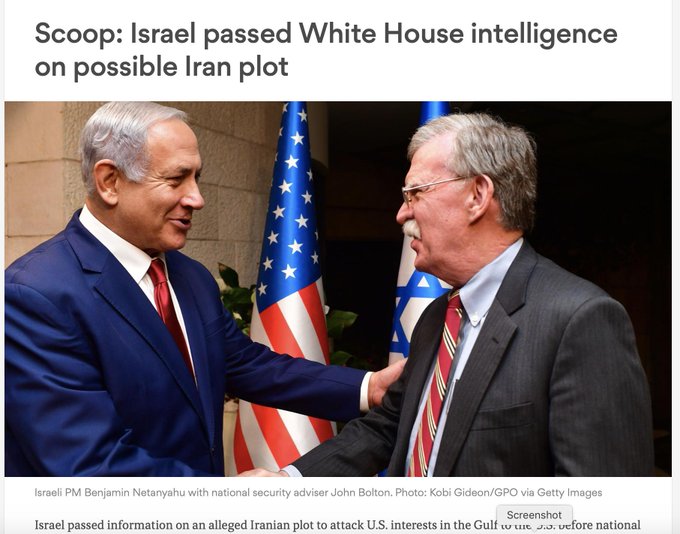
According to the report, intelligence provided by Israel’s Mossad agency was at least part of  the reason for the warning and the move to deploy the aircraft carrier. The information was allegedly passed to a U.S. team headed by Bolton two weeks ago by an Israeli delegation led by national security adviser Meir Ben Shabbat.

It wasn’t clear what Iran’s plans would have been, but it might have attempted to hit a US target in the Gulf, or one of its allies in the region such as Saudi Arabia or UAE.

Saying that “Iranian temperature is rising” due to US sanctions, an unnamed Israeli official said Iran is looking into attacking US interests in the Gulf.


Iran: U.S. sending carrier, bombers to mideast is ‘psychological warfare’ 

May 7, 2019

Source: Iran: U.S. sending carrier, bombers to mideast is ‘psychological warfare’ – Middle East – Jerusalem Post

Adviser John Bolton said on Sunday the United States was deploying the Abraham Lincoln carrier strike group and a bomber task force to the Middle East.

BY HAGAY HACOHEN, OMRI NAHMIAS, JERUSALEM POST STAFF
 MAY 7, 2019 16:26
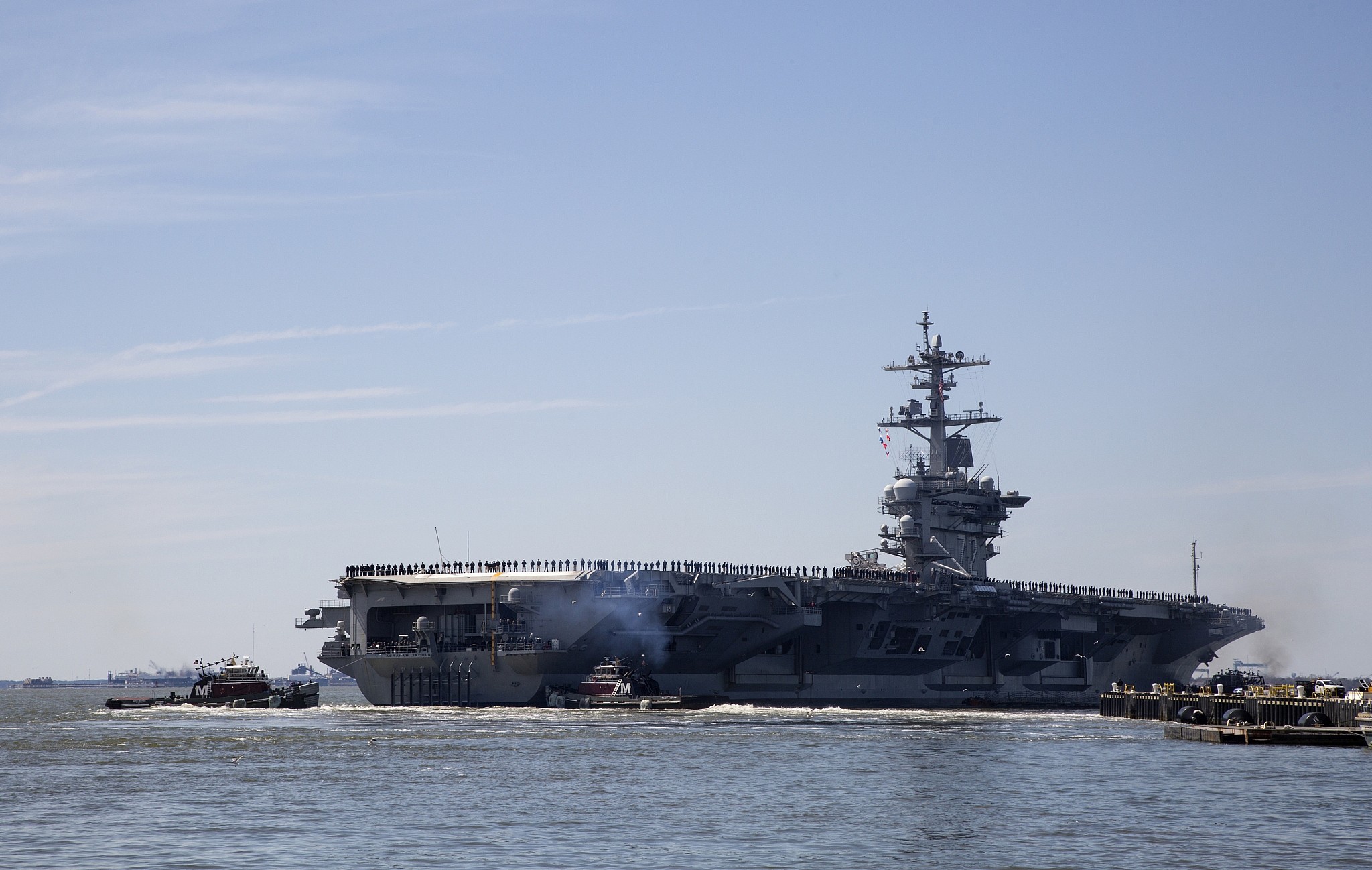
The Nimitz-class aircraft carrier USS Abraham Lincoln (CVN 72) transits the Strait of Gibraltar

On Tuesday, the semi-official Tasnim news agency reported that Keyvan Khosravi, spokesman for the Supreme National Security Council, had said that “Bolton’s statement is a clumsy use of a burnt-out happening for psychological warfare.” Khosravi also said the carrier had arrived in the Mediterranean weeks ago, according to Tasnim.

US National Security advisor John Bolton announced on Sunday that the US is deploying the USS Abraham Lincoln Carrier Strike Group and a bomber task force to the Middle East to send a message to Iran.

The goal behind the move is “to send a clear and unmistakable message to the Iranian regime that any attack on United States interests or on those of our allies will be met with unrelenting force,” according to Bolton.

Axios reported on Monday that the move was made due to information that the US received from Israel concerning an alleged Iranian plot to attack American interests in the Gulf.

“The #B_Team is at it again: From announcements of naval movements (that actually occurred last month) to dire warnings about so-called ‘Iranian threats’,” Iranian FM Mohammad Javad Zarif tweeted on Tuesday in response to the Bolton’s announcement that the US was sending a carrier strike group and bombers to the Middle East.

View image on TwitterView image on TwitterView image on TwitterView image on Twitter

Javad Zarif

@JZarif

The is at it again: From announcements of naval movements (that actually occurred last month) to dire warnings about so-called “Iranian threats”.
If US and clients don’t feel safe, it’s because they’re despised by the people of the region— blaming Iran won’t reverse that.

“If US and clients don’t feel safe, it’s because they’re despised by the people of the region— blaming Iran won’t reverse that,” Zarif added.

Iran’s state-run Press TV reported earlier that “the deployment seems to be a ‘regularly scheduled’ one by the US Navy, and Bolton has just tried to talk it up.”

A military adviser to Supreme Leader Ayatollah Ali Khamenei said the United States was “neither willing nor capable” with respect to an attack on Iran, according to the semi-official news agency ISNA.

Brigadier General Hossein Dehgan said Washington would have a hard time convincing world opinion and regional countries to accept an all-out war against Iran, and to mobilise resources for such a conflict.

Last week, President Donald Trump’s administration said it would end waivers for countries buying Iranian oil in an attempt to reduce Iran’s crude exports to zero following Washington’s withdrawal from world powers’ 2015 nuclear deal with Tehran.

The administration also blacklisted Iran’s elite Revolutionary Guard Corps.

US-Iranian tensions escalated further after Washington acted on Friday to force Tehran to stop producing low-enriched uranium and expanding its only nuclear power plant. Washington’s step intensified a campaign aimed at halting Tehran’s ballistic missile programme and curbing its regional power.

Iran will revive part of its halted nuclear programme in response to the US withdrawal from the nuclear accord but does not plan to pull out of the agreement itself, state media reported on Monday.

Reuters contributed to this report.


Gaza official: Israel agreed to implement ceasefire concessions within a week 

May 7, 2019

Source: Gaza official: Israel agreed to implement ceasefire concessions within a week | The Times of Israel

Senior politician says Israel will allow some restricted goods into Strip and undertake other measures in return for end to all ‘resistance’ except for ‘peaceful’ border protests. 

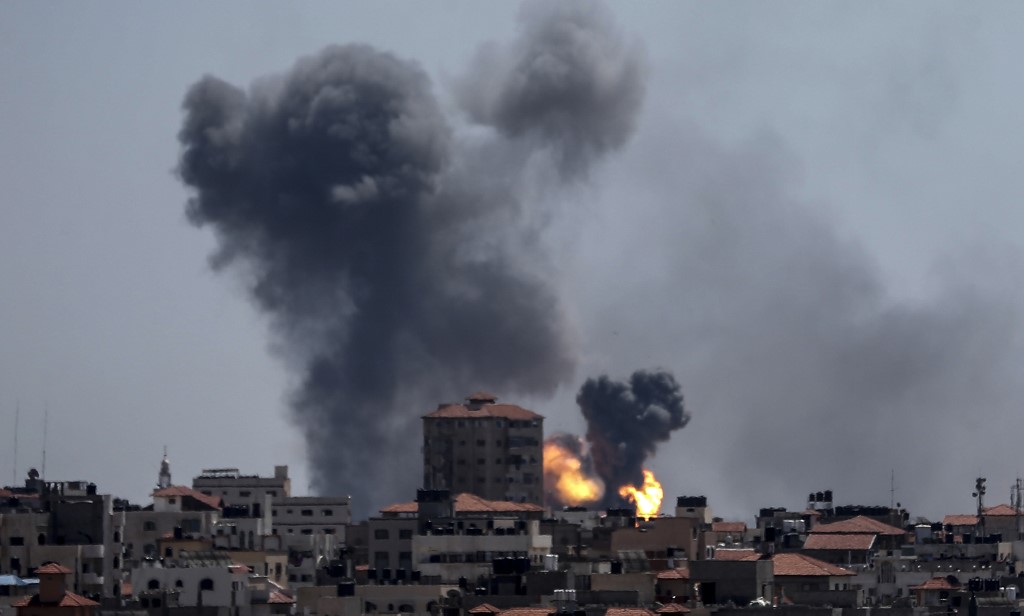
A picture taken from the Gaza Strip on May 4, 2019, shows smoke billowing following an airstrike by Israel in response to rockets fired by Palestinian terrorists. (MAHMUD HAMS / AFP)

Israel has agreed to implement a series of measures within a week, including lifting restrictions on the import of many goods into the Gaza Strip, as part of a ceasefire agreement with terror groups in the coastal enclave, a senior Palestinian official in the territory said Tuesday.

After two days of intense fighting over the weekend in which terror groups launched over 650 rockets at southern Israel and the Israel Defense Forces carried out more than 300 retaliatory strikes throughout Gaza, Hamas and Palestinian Islamic Jihad announced that Egypt and other international parties had successfully brokered a truce deal.

A number of Arabic news sites have published varying reports detailing the terms of the deal.

The senior Gaza-based official, who spoke on condition of anonymity, told The Times of Israel that the agreement “basically focuses on Israel implementing what it previously agreed to carry out, but now Israel has pledged for the first time to do so within one week.”

In return, he said Gaza’s rulers are to put an end to all “resistance” against Israel, except for “peaceful” border protests.

He added that “all options would be on the table” if the Jewish state does not abide by the deal.

The Prime Minister’s Office, the Foreign Ministry and the Coordinator of Government Activities in the Territories — the Defense Ministry body responsible for liaising with the Palestinians — declined to comment on the official’s description of the ceasefire deal.

As a rule, Israeli officials do not acknowledge the existence of talks with the Palestinian factions in the Gaza Strip, which it considers terror groups.

Prime Minister Benjamin Netanyahu suggested on Monday that Israel has only temporarily halted its fire at Hamas and Islamic Jihad.

“Over the past two days, we have hit Hamas and Islamic Jihad with great force, attacking over 350 targets and terrorist leaders and activists, and destroying terrorist infrastructure,” he said in a statement. “The campaign is not over and requires patience and judgment. We are preparing to continue. The goal was and remains to ensure the peace and security of the residents of the south.”

Trucks loaded with goods and merchandise make deliveries to the Gaza Strip after the Kerem Shalom crossing was opened on August 15, 2018. (Flash90)

The Gaza-based official, who is a senior politician, said Israel agreed to “lift restrictions on importing 30% of so-called dual-use goods into Gaza and allow for increased exports from [the Strip].”

For the past several years, Israel has heavily restricted the entry into Gaza of products that it labels “dual-use,” meaning that they can be utilized for both civilian and military purposes. Palestinians in Gaza have been required to receive special permits to import goods that Israel categorizes as dual-use.

Jerusalem has long held that its restrictions on the movement of goods aim to prevent Hamas and other terror groups sworn to the destruction of the Jewish state from obtaining weapons and the materials to produce them.

The Gaza official also said Israel consented to allow the transfer of Qatari funds into the coastal enclave geared toward small grants for impoverished families, salaries of Hamas-appointed civil servants, and United Nations-supervised cash-for-work projects.

“These are all matters that Israel agreed to two months ago, but evaded implementing,” he said, adding that the Jewish state also approved the continued entry of Qatari-bought fuel into the Strip.

Over the past several months, Israel has at times permitted Qatar to distribute funds to poor families as well as Hamas-appointed government employees. It has also allowed for Qatari-purchased fuel to enter Gaza since October 2018 to power the Strip’s sole power plant.

Alluding to the cash-for-work program, the Gaza official said that it aims to help “new university graduates find employment.”

The UN agreed with Qatar in January to take $20 million from Doha to create temporary employment opportunities in Gaza.

Jamie McGoldrick, the deputy UN special coordinator to the Middle East peace process, said on Monday in a call that he estimates the $20 million will establish some 10,000 temporary jobs. He noted that additional funding announced by Qatar on Tuesday for Gaza will likely provide 20,000 extra temporary positions.

He said some of the jobs would last for six months, while others would be for nine months.

Qatar announced earlier Tuesday that it would send $480 million to the West Bank and Gaza to “aid the brotherly Palestinian people in obtaining its basic needs.”

The unemployment rate in Gaza stands at 52 percent, according to the Palestinian Authority Central Bureau of Statistics.

Postal workers aid Palestinians who arrived at the central post office in Gaza City on January 26, 2019, to receive financial aid from the Qatari government given to impoverished families. (Mahmud Hams/AFP)

The Gaza official added that Israel also agreed to expand the fishing zone off of Gaza’s coast.

“Israel consented to widening the fishing zone to six nautical miles in the north, nine near Gaza City, 12 in the center and 15 in the south,” he said. “This is the same arrangement that was implemented at the start of April.”

Israel expanded the fishing zone to 15 nautical miles in some areas off Gaza’s coast in early April, but subsequently reduced and then canceled the move in response to rocket fire.

There are 3,700 fishermen in Gaza, the vast majority of whom live below the poverty line, a 2018 report by the B’Tselem human rights group said.

The official also said that Israel committed to “halting all aggression against Palestinians in Gaza including fishermen and farmers near the border.”

Israel has called on Palestinians in Gaza to stay away from the border with Israel, warning that approaching it puts their lives at risk.

For over the past year, the IDF has opened fire on many Palestinians in the coastal enclave participating in weekly border protests, including a large number who lobbed firebombs and rocks at soldiers in addition to carrying out other acts of violence.
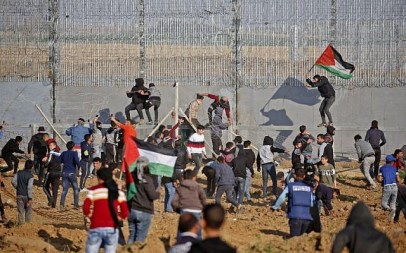
Palestinians wave Palestinian flags as they try to climb the security fence on the border between Israel and the Gaza Strip, east of Gaza City, on March 22, 2019. (Said Khatib/AFP)

The official added that in return for Israel implementing all the aforementioned measures within a week, Palestinians in Gaza will halt “all resistance against Israel except for the weekly protests along the border in their peaceful form.” This formulation would appear to include a halt to the launching of incendiary balloons and kites across the border into Israel.

Asked what would happen if Israel did not implement the measures within a week and whether terror groups would start firing rockets at Israel during the Eurovision Song Contest, he said “all options would be on the table.”

“We would need to meet and decide our response, but I can assure you that we will not allow Israel to evade abiding by its commitments,” he said.

The Eurovision Song Contest is slated to take place in Tel Aviv on May 14-18.
 

The next round will probably be worse 

May 7, 2019

Source: The next round will probably be worse – www.israelhayom.com

The defense and security establishment believes that deterrence has been restored, but not fully, and that if no political understandings are reached, it is only a matter of time until the next escalation.

The prevailing assessment in the defense and security establishment is that while Israel has restored deterrence against terrorist groups in the Gaza Strip for the short-term, in the absence of any advancement toward a long-term peace deal, the calm that was restored on Monday will not hold for more than a few weeks.

Although no Israeli officials are saying so, Memorial Day for Fallen Soldiers and Victims of Terrorism and Independence Day – as well as next week’s Eurovision pop song extravaganza – were main considerations in Israel’s decision to hold back, and the defense establishment was working under instructions not to cross any retaliatory lines that might worsen the escalation.

In the past few weeks, the Gaza Brigade has been operating under warnings that the Islamic Jihad might execute a potential large-scale terrorist attack near the border fence. Defense officials think that this rogue group wanted to take advantage of the days leading up to Eurovision and ruin the international event.

The incident that set off the recent few days of intense conflict took place on Friday, when Islamic Jihad sniper fire wounded an IDF officer and a female soldier. In response, Chief of Staff Lt. Gen. Aviv Kochavi decided to dial up the Israeli response and attack a manned Hamas outpost that was not on the border itself. This prompted the organization to respond in an “eye for an eye” manner.

It appears that Hamas wanted a response that was more limited in scope, such as a sniper attack or firing an anti-tank missile, but the Islamic Jihad – which does not always obey Hamas – starting firing on Israel without coordinating with Hamas. Following the Israeli response to the rocket fire, in which the IDF attacked Hamas as well as the Islamic Jihad, Hamas decided to fire its own rockets – heavy barrages for every major Israeli retaliatory strike.

That is how some 690 rockets and mortars wound up being launched at Israel in under 48 hours. Actually, the number is higher, because not all the rockets that were fired made it over the border fence. Most of them landed in unpopulated areas, and some 240 were intercepted by Israel’s air defenses. The soldiers who operate those systems displayed impressive capabilities, but a few dozen still landed in populated areas, killing four Israelis, wounding many others, and causing considerable damage.

This time, the terrorist organizations were using more firepower and rockets that had a range of up to 40 kilometers, as well as the new Badr model, which carries a heavy load of explosives. These rockets are not high quality, and the ones that made it over the border were intercepted by Israel’s air defense troops. Hamas and the Islamic Jihad were warned not to fire at the greater Tel Aviv area to avoid an especially harsh Israeli response that could drag both sides into a full-scale conflict.

Israeli officials think that Hamas wanted an immediate cease-fire so it can get back to working on an agreement that will improve the economic and humanitarian situation in Gaza, but the defense establishment wanted to go far enough so Islamic Jihad wouldn’t want to escalate things with Israel, either.

Of the 350 or so retaliatory strikes the IDF carried out in Gaza, more aggressively than in the past, a few dozens were aimed at Islamic Jihad targets. In effect, the 29 casualties in Gaza included 10 Islamic Jihad operatives. The defense establishment says that the purpose was to “bend” the terrorist group, but not break it.

This time, Israel used tools it has not taken out of its belt for a while, including the first targeted killing in years. Actually, there were two – one was a money changer who played a major role in bringing Iranian funds to Gaza terrorist organizations, and the second was a Hamas drone operator.

No one in Israel is promising that the latest round brought calm that will last more than a few weeks, but the reigning belief is that the risk of Islamic Jihad firing on Tel Aviv during the Eurovision has dropped, if not disappeared. The IDF thinks that it must maintain and increase deterrence when it comes to the rogue group.

Israel is also refusing to disclose the details of the cease-fire agreement with Hamas, but apparently, it did not include any new benefits. As of 4:30 a.m. Monday, both sides stopped firing.

Either way, if no political understandings are reached, it’s only a question of time when we’ll see the next round of escalation, and it won’t be very long before it happens. Battles like this start again from where they left off, so it’s likely that the next escalation will be even more violent.


Iran set to restart some nuclear activity in response to US withdrawal from deal

May 7, 2019

Source: Iran set to restart some nuclear activity in response to US withdrawal from deal – www.israelhayom.com

State-run IRIB news reports that European Union leaders have unofficially been informed of Islamic republic’s decision to reduce some of its “minor and general” commitments made as part of 2015 nuclear agreement.

Citing a source close to an official commission which oversees the nuclear deal, IRIB reported that President Hassan Rouhani would announce that Iran would reduce some of its “minor and general” commitments under the deal on May 8 – exactly one year after U.S. President Donald Trump announced the U.S. pullout.

Trump subsequently reimposed tough sanctions on Iran, including on its lifeblood oil exports with the stated intent of reducing them to zero and starving Iran’s economy.

“The Islamic Republic of Iran in reaction to the exit of America from the nuclear deal and the bad promises of European countries in carrying out their obligations will restart a part of the nuclear activities which were stopped under the framework of the nuclear deal,” the source said, according to IRIB.

Similarly, the semiofficial Iranian Students’ News Agency reported that Iran on Wednesday will announce “reciprocal actions” to the U.S. withdrawal from the nuclear deal, quoting “knowledgeable sources.”

Some European Union leaders had been unofficially told of Iran’s decision, the report said.

The United States acted on Friday to force Iran to stop producing low-enriched uranium and expanding its only nuclear power plant.

Trump, who was not in office when the nuclear deal was negotiated, said it was flawed in Iran’s favor for doing nothing to curb its ballistic missile program or its support of proxy forces in several Middle East wars.

Iran has said its development of ballistic missiles has nothing to do with its nuclear activity and is wholly defensive in nature, and that its support for allies around the Middle East is not Washington’s business.

Under the 2015 deal, Iran restricted the capacity of its uranium enrichment program – widely seen as a route to developing a nuclear weapon – in exchange for a lifting of most international sanctions. U.N. nuclear inspectors have repeatedly verified Iranian compliance with the accord.

Iran has denied ever pursuing a nuclear weapons program.

The other signatories to the deal – European powers Germany, France and Britain, as well as Russia and China – remain committed to it. The EU has been looking into ways of preserving its economic benefits that Iran says must stay or it could abandon the deal.

The Trump administration is now deploying a carrier strike group and bombers to the Middle East in response to troubling “indications and warnings” from Iran and to show the United States will retaliate with “unrelenting force” to any attack, U.S. national security adviser John Bolton said on Sunday.

Bolton – who has spearheaded an increasingly hawkish U.S. policy on Iran – said the decision, which could exacerbate tensions between the two countries, was meant to send a “clear and unmistakable message” of U.S. resolve to Tehran.

U.S. Secretary of State Mike Pompeo also issued a warning to the Islamic republic on Sunday.

“It is absolutely the case that we have seen escalatory actions from the Iranians and it is equally the case that we will hold the Iranians accountable for attacks on American interests,” Pompeo told reporters aboard a flight en route to an Arctic Council meeting in Finland.

If these actions take place, if they do by some third-party proxy, a militia group, Hezbollah, we will hold the Iranian leadership directly accountable for that.”


“Unrelenting Force”: Trump Sends Carrier Strike Group, Bombers to Deter Iran Threat 

May 7, 2019


Report: Mossad intel of looming Iranian attack led US to send in carrier force 

May 7, 2019

Source: Report: Mossad intel of looming Iranian attack led US to send in carrier force | The Times of Israel

Deploying USS Abraham Lincoln to vicinity of Iran, US National Security Adviser John Bolton says it came after ‘a number of troubling and escalatory indications and warnings’

The USS Abraham Lincoln deploys from Naval Station Norfolk, in the vicinity of Norfolk, Virginia, on April 1, 2019. (Kaitlin McKeown/ The Virginian-Pilot via AP)

The USS Abraham Lincoln deploys from Naval Station Norfolk, in the vicinity of Norfolk, Virginia, on April 1, 2019. (Kaitlin McKeown/ The Virginian-Pilot via AP)

Israel’s Mossad intelligence agency reportedly tipped off the United States on an impending Iranian attack on American interests in the Gulf, prompting Washington to deploy an aircraft carrier strike group to the region late Sunday, in a sharp escalation of US President Donald Trump’s pressure campaign.

John Bolton, Trump’s national security adviser who advocated attacking Iran before taking up the post, announced late Sunday that the USS Abraham Lincoln Carrier Strike Group would sail to unspecified waters in the vicinity of Iran.

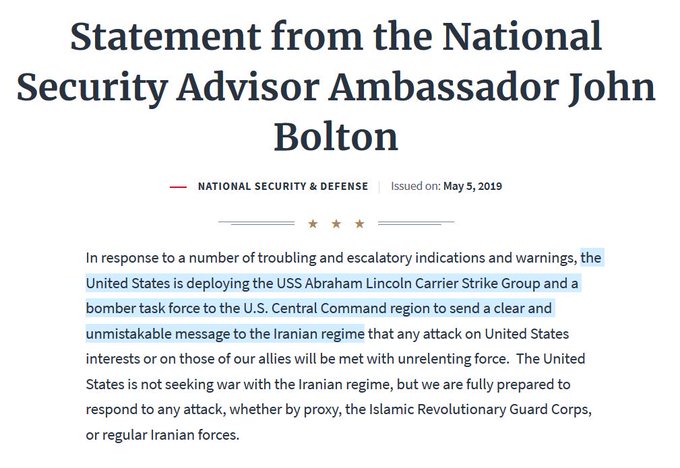
The deployment is aimed at sending “a clear and unmistakable message to the Iranian regime that any attack on United States interests or on those of our allies will be met with unrelenting force,” Bolton said.

“The United States is not seeking war with the Iranian regime, but we are fully prepared to respond to any attack, whether by proxy, the Islamic Revolutionary Guard Corps, or regular Iranian forces.”

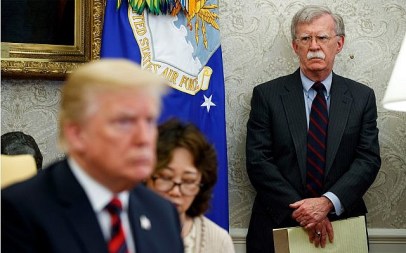
US President Donald Trump, left, meets with South Korean President Moon Jae-In in the Oval Office of the White House in Washington, as national security adviser John Bolton, right, watches. May 22, 2018. (AP Photo/Evan Vucci, File)

According to Israel’s Channel 13, Israeli officials conveyed information gathered largely by the Mossad on an Iranian plan to attack either a US or US-allied target, details of which were not provided to the network.

The threat was initially raised two weeks ago in the White House, officials told Channel 13, when an Israeli delegation led by National Security Council head Meir Ben-Shabbat huddled with their American counterparts.

“It is still unclear to us what the Iranians are trying to do and how they are planning to do it, but it is clear to us that the Iranian temperature is on the rise as a result of the growing US pressure campaign against them, and they are considering retaliating against US interests in the Gulf,” an official was quoted as saying.

The USS Abraham Lincoln has previously been deployed to the Gulf, including during the 2003 invasion of Iraq, and was the scene of then-president George W. Bush’s later notorious victory speech in front of a banner that read “Mission Accomplished.”

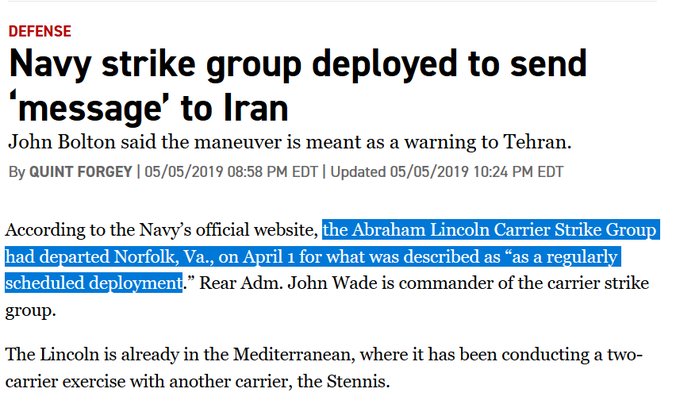
The Pentagon had already announced with little fanfare last month that the USS Abraham Lincoln and the rest of its strike group had headed on a “regularly scheduled deployment” out of its base in Norfolk, Virginia.

But Bolton gave the deployment a new urgency as he said that it was in response to “a number of troubling and escalatory indications and warnings” by Iran.

Iranian navy personnel celebrate after successfully launching a Ghader missile from the Jask port area on the shores of the Gulf of Oman during a drill near the Strait of Hormuz, January 1, 2013. (AP/Jamejam Online, Azin Haghighi)

US Secretary of State Mike Pompeo told reporters he could not elaborate on what those indications were, but said they were separate from a violent flare-up between Israel and Hamas, the Iranian-backed Islamist terror group that runs the Gaza Strip.

Mark Dubowitz, chief executive of the Foundation for Defense of Democracies, which advocates a hard line on Iran, said he had heard of a “spike” in intelligence in recent days about planned attacks.

He believed Iran had given the green-light to the missiles out of Gaza by Hamas and allied movement Islamic Jihad.

A picture taken on May 5, 2019 from the Israel-Gaza border shows a barrage of rockets being fired from the Hamas-run Palestinian enclave. (Jack GUEZ / AFP)

The strikes sought “to tie down Israeli forces and create a crisis to distract the US and Israel from IRGC plans elsewhere,” he said, referring to Iran’s elite Revolutionary Guards.

Other observers were much more skeptical, believing that Bolton had seized on a routine deployment as a way to pile pressure on Iran.

The statement came almost a year to the date after Trump pulled the United States out of a multinational accord under which Tehran drastically scaled back its sensitive nuclear work.

“I think this is manufactured by Bolton to try to justify the administration’s very harsh policy toward Iran, despite the fact that Iran has been complying with the nuclear deal,” said Barbara Slavin, the director of the Future of Iran Initiative at the Atlantic Council think tank.

“Given Bolton’s record,” she said, “I wouldn’t put it past him to try to manufacture a crisis here.”

UN inspectors say that Iran has been in compliance with the nuclear deal, which is still backed by European powers as well as Trump’s Democratic rivals seeking to unseat him next year.

But Iranians have voiced frustration that they have not seen a promised economic boon, with Trump instead slapping sweeping sanctions on the country.

In recent weeks, the Trump administration has hit even harder, moving to ban all countries from buying Iran’s oil, its top export, and declaring the Revolutionary Guards to be a terrorist group — the first such designation of a unit of a foreign government.

Iranian President Hassan Rouhani may announce “retaliatory measures” on Wednesday on the anniversary of the US pullout, the semi-official ISNA news agency said on Monday.


US-Iran tensions rise ahead of anniversary of deal pullout 

May 7, 2019

Source: US-Iran tensions rise ahead of anniversary of deal pullout | The Times of Israel

Iranian President Rouhani said to be planning a speech Wednesday to discuss the next steps Tehran will take in confronting Washington

The USS Abraham Lincoln deploys from Naval Station Norfolk, in the vicinity of Norfolk, Virginia, on April 1, 2019. (Kaitlin McKeown/ The Virginian-Pilot via AP)

The USS Abraham Lincoln deploys from Naval Station Norfolk, in the vicinity of Norfolk, Virginia, on April 1, 2019. (Kaitlin McKeown/ The Virginian-Pilot via AP)

DUBAI, United Arab Emirates (AP) — A sudden White House announcement that a US aircraft carrier and a bomber wing would be deployed in the Persian Gulf to counter Iran comes just days ahead of the anniversary of US President Donald Trump’s decision to withdraw America from Tehran’s nuclear deal.

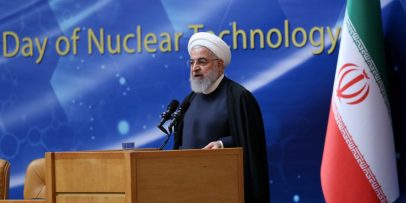
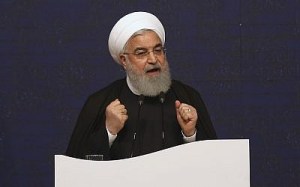
Iranian President Hassan Rouhani is said to be planning a speech Wednesday on the anniversary to discuss the next steps Tehran will take in confronting the US. Officials in the Islamic Republic previously warned that Iran might increase its uranium enrichment, potentially pulling away from a deal it has sought to salvage for months.

The military has almost always had an aircraft carrier in the Persian Gulf as part of its sprawling military presence in the strategic region, but had begun to scale back its presence as the air campaign against the Islamic State group in Iraq and Syria wound down.

Sunday night’s statement from national security adviser John Bolton said the USS Abraham Lincoln, other ships in the carrier’s strike group and a bomber wing would deploy to the Mideast. Bolton blamed “a number of troubling and escalatory indications and warnings,” without elaborating.

Iranian President Hassan Rouhani speaks during the inauguration ceremony of four projects at the South Pars gas field on the northern coast of the Persian Gulf, in Asaluyeh, Iran, March 17, 2019. (AP/Vahid Salemi)

“The United States is not seeking war with the Iranian regime, but we are fully prepared to respond to any attack, whether by proxy, the Islamic Revolutionary Guard Corps, or regular Iranian forces,” Bolton said.

In Iran, the semi-official ISNA news agency on Monday quoted an anonymous official as saying that Rouhani planned a broadcast address Wednesday and may discuss the “counteractions” Tehran will take over America’s withdrawal from the nuclear deal. It said Iranian officials have informed their European counterparts — with whom Iran has been trying to salvage the agreement — of the planned speech.

“Partial and total reduction of some of Iran’s commitments and resumption of some nuclear activities which were ceased following (the deal) are the first step,” ISNA said. Iranian state television and the semi-official Fars news agency similarly suggested an Iranian response loomed.

A spokesman for Iran’s Supreme National Security Council, Keivan Khosravi, also dismissed Bolton’s comments as “psychological warfare.”

The United Nations’ nuclear watchdog says Iran has continued to comply with the terms of the 2015 nuclear deal, which saw it limit its enrichment of uranium in exchange for the lifting of economic sanctions. But American sanctions have wreaked havoc on Iran’s already-anemic economy, while promised help from European partners in the deal haven’t alleviated the pain.

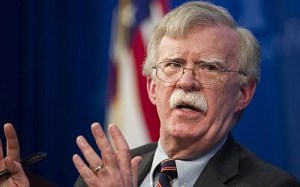
US National Security Advisor John Bolton unveils the Trump Administration’s Africa Strategy at the Heritage Foundation in Washington, December 13, 2018. (Cliff Owen/AP)

The US last week stopped issuing waivers for countries importing Iranian crude oil, a crucial source of cash for Iran’s government.

It’s unclear what specific threat American officials perceive coming from Iran. A US official, who spoke to The Associated Press on condition of anonymity to discuss intelligence matters, said American troops at land and sea could be targeted.

The USS Abraham Lincoln had been in the Mediterranean Sea conducting operations alongside the USS John C. Stennis, another aircraft carrier that has twice been in the Persian Gulf in recent months.

However, American military officials have stopped the near-continuous presence of aircraft carriers in the Persian Gulf, a pattern set following the 1991 Gulf War. American air bases spanning the region can scramble fighter jets and drones, lessening the necessity of an aircraft carrier as U.S. officials also worry about China and Russia.

Already in the Persian Gulf is a group of US Navy warships led by the USS Kearsarge, an amphibious assault ship carrying troops from the 22nd Marine Expeditionary Unit. The Kearsarge also carries AV-8B Harrier fighter jets, MH-60 helicopters and MV-22 Osprey airplanes.

The USS Kearsarge in the Gulf of Aqaba, June 4, 2013. (Jose E. Ponce/US Navy, released by C5F PAO)

Across the wider 5th Fleet, there were 17 warships deployed, according to the most-recent count by the US Naval Institute, which tracks deployments around the world.

The Bahrain-based 5th Fleet declined to comment on the White House announcement when reached by the AP on Monday.

It also remains unclear what bomber wing would be deployed to the region. Typically, the al-Udeid Air Base in Qatar, home to the forward headquarters of the US military’s Central Command, hosts such bomber deployments.

In late March, the Air Force acknowledged a rare gap in bomber cover in the Mideast after a squadron of B-1 Lancers left al-Udeid to return to Texas. B-52 bombers also had been deployed to the area to keep up attacks on the Islamic State group, the first time the aging aircraft had deployed to the region in 25 years.

Officials at al-Udeid, which also hosts the F-35 fighter jet, declined to answer questions from the AP.

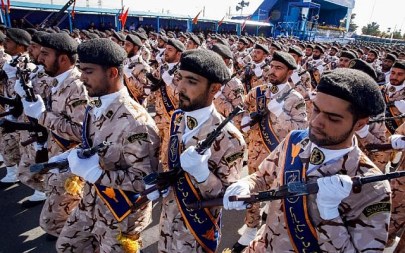
Members of Iran’s Islamic Revolutionary Guard Corps (IRGC) march during the annual military parade, marking the anniversary of the outbreak of the devastating 1980-1988 war with Saddam Hussein’s Iraq, in the capital Tehran, on September 22, 2018. (AFP/STR)

The Trump administration, which abruptly announced in December that it was pulling out of Syria, still maintains 2,000 US troops in the northern part of the war-torn country. Officials suggest they serve as a check on Iranian ambitions and help ensure that Islamic State fighters do not regroup. No significant US forces have so far withdrawn from Syria.

Trump has also said he has no plans to withdraw the 5,200 troops stationed in Iraq as part of a security agreement to advise, assist and support the country’s troops in the fight against IS. Earlier this year, Trump angered Iraqi politicians and Iranian-backed factions by saying troops should stay there to keep an eye on neighboring Iran.