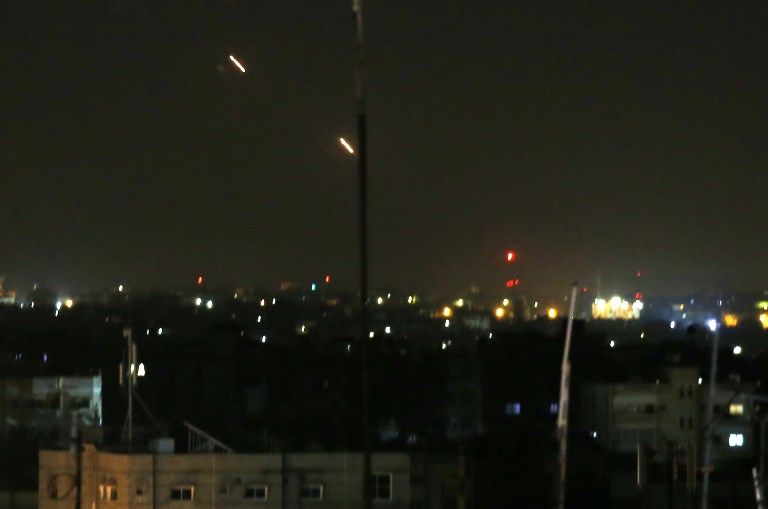
Palestinian terrorists in the Gaza Strip launched at least two rockets into Israel early Thursday, the IDF said. Witnesses said the projectiles fell in an open area and no injuries were reported.
The rocket fire came hours after Israeli aircraft bombed a Hamas base in the northern Gaza Strip in retaliation for a wave of fire balloons that were launched into Israel from the Strip.
After warning sirens sounded in the Sha’ar Hanegev region, the IDF said it had identified at least two launches into Israel. A spokesperson for the Sha’ar Hanegev Regional council said the rockets apparently landed in open fields and caused no injuries.
Earlier, the IDF said it had struck a Hamas camp in the wake of a spike of fire balloon attacks from Gaza.
“Earlier today, explosive and arson balloons were launched from the Gaza Strip,” the army said. “In response, overnight, an IDF fighter jet and an IDF aircraft struck a number of terror targets in a Hamas military compound in the northern Gaza Strip.”
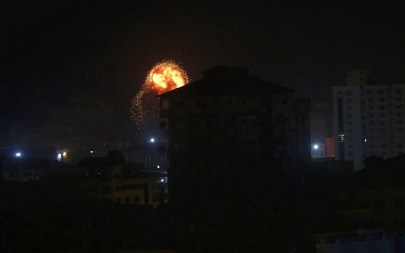
Illustrative: An explosion caused by Israeli airstrikes is seen over Gaza City, early Friday, Friday, March 15, 2019. Israeli warplanes attacked terrorist targets in the southern Gaza Strip early Friday in response to a rocket attack on the Israeli city of Tel Aviv. (AP Photo/Adel Hana)
There were no immediate reports of injuries.
The IAF strike came after a large brushfire broke out in the Eshkol region of southern Israel on Wednesday night, with suspicions that it was caused by a balloon-borne incendiary device from the nearby Gaza Strip, officials said.
The blaze began in a field between the Eshkol National Park and Kibbutz Urim, spreading throughout the grasslands and into a wooded area, according to Fire and Rescue Department Eli Cohen.
The IDF said it held Hamas responsible for all violence emanating from the Strip.
The fire came amid heightened tensions between Israel and terror groups in the Strip, after a rocket was launched from the coastal enclave, landing several kilometers off shore on Monday night.
Throughout the day, Palestinians launched dozens of incendiary devices, carried by balloons, into southern Israel from the Gaza Strip. However, it was not immediately clear if the Eshkol fire was sparked by one of these objects.

A fire rages in the Eshkol region of southern Israel on May 1, 2019. (Tzvika Korbeshi/Eshkol Regional Council)
“At this point, the cause of the fire is not known. We will only know after a check by fire investigators,” a spokesperson for the Eshkol region said.
Three teams of firefighters were working to put out the fire. In addition to the Fire and Rescue Department, firefighters from the Jewish National Fund and from the Parks Service were involved in the effort, the fire department spokesman said.
“The teams are working together to get control over the fire and prevent it from spreading,” Cohen said.

A fire rages in the Eshkol region of southern Israel on May 1, 2019. (Tzvika Korbeshi/Eshkol Regional Council)
Due to the blaze’s location, the firefighters were not able to bring their trucks into the area, requiring them to use smaller, hand-held equipment to battle the flames, the fire department spokesman said.
On Tuesday, a fire broke out near Kibbutz Nahal Oz in the Sha’ar Hanegev region. That blaze was caused by a balloon-borne incendiary device launched into Israel from Gaza. In recent weeks, such arson attacks have tapered off under the ceasefire brokered by Egypt last month.
That fire was quickly extinguished by a team of volunteers, the fire department said.
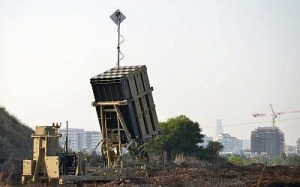
An Iron Dome Missile Battery near Tel Aviv on July 15, 2018 (Ben Dori/Flash90)
Also Tuesday, the Israeli military deployed Iron Dome missile defense batteries throughout the country, following a rocket attack from Gaza the previous night and ahead of what is expected to be a sensitive next few weeks.
The military expects the coming weeks to be particularly tense, as they will see the start of the Muslim holy month of Ramadan, the international Eurovision song competition in Tel Aviv, Israel’s Memorial and Independence days, and the first anniversary of the opening of the contentious US Embassy in Jerusalem.
Following Monday’s rocket launch, Israel scaled back the permitted Gaza fishing zone from 15 nautical miles to six until further notice. The fishing zone had previously been extended to 15 miles — a level that the coastal enclave has not seen in over a decade — as one of the first concessions by Jerusalem under an unofficial ceasefire agreement with terror groups in the Gaza Strip.
On Tuesday morning, the IDF said the Islamic Jihad intentionally fired the rocket from the northern Gaza Strip toward coastal Israel the day before in an effort to derail ongoing efforts to maintain the ceasefire.
While there has not been a complete cessation of violence along the Gaza border since the ceasefire went into effect last month, the situation there has been relatively calm.
Terror groups in the Strip have threatened to bring back regular border riots if Israel does not abide by its side of the deal.
Times of Israel staff contributed to this report.







 anneinpt
 artaxes
 danmillerinpanama
 davidking1530
 Peter Hofman
 Joseph Wouk
 Peter
Peter Louisiana Steve
 WarSclerotic
Recent Comments