Archive for April 2019

When Will Iran’s Regime Finally Cave In?

April 8, 2019

Islamic Revolution Guards Will Attack US if Trump Designates Them as Terrorists

April 8, 2019

Islamic Revolution Guards Will Attack US if Trump Designates Them as Terrorists

http://en.hawzahnews.com/detail/News/353622-Photo Credit: Fars

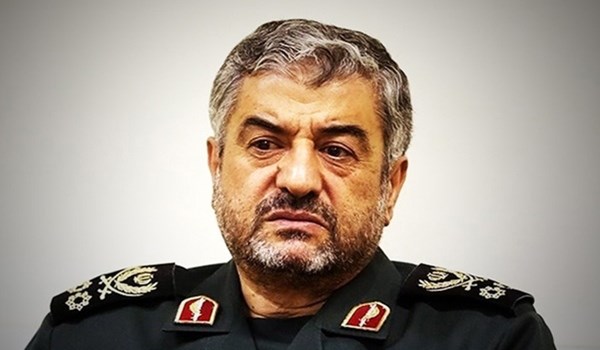
Major General Mohammad Ali Jafari, Commander of the Islamic Revolution Guards Corps (IRGC), on Sunday warned that the US designates the IRGC as a terrorist organization “the US Army and American security forces stationed in the Middle-East will lose their current status of ease and serenity,” Fars reported.

“If they make a stupid move as such and endanger out national security, a reciprocal move will be placed on our agenda and then put into operation based on the policies of the Establishment of the Islamic Republic of Iran,” Ali Jafari reiterated.

Ali Jafari spoke following a report by the Wall Street Journal that US officials plan to designate the IRGC as a foreign terrorist organization. According to the WSJ, the announcement could be made as early as Monday, and would be the first branding of a sovereign country’s military as a terrorist group.

A belligerent Jafari said back in 2017 that “the Americans fear the consequences of war with Iran and know that if such a war starts, they will lose and therefore, they are after hitting a blow to the Islamic Republic through soft war and economic pressure.”

Iranian Foreign Minister Mohammad Javad Zarif has tweeted his own warning to President Trump: “Netanyahu Firsters who have long agitated for FTO (Foreign Terrorist Organization) designation of the IRGC fully understand its consequences for US forces in the region. In fact, they seek to drag the US into a quagmire on his behalf.”

Netanyahu to i24NEWS: ‘I hope we won’t have to say no’ to Trump’s peace plan

April 8, 2019

i24NEWS

Netanyahu says ‘coming from a friend’ he expects Trump’s plan will take Israel’s interests into consideration

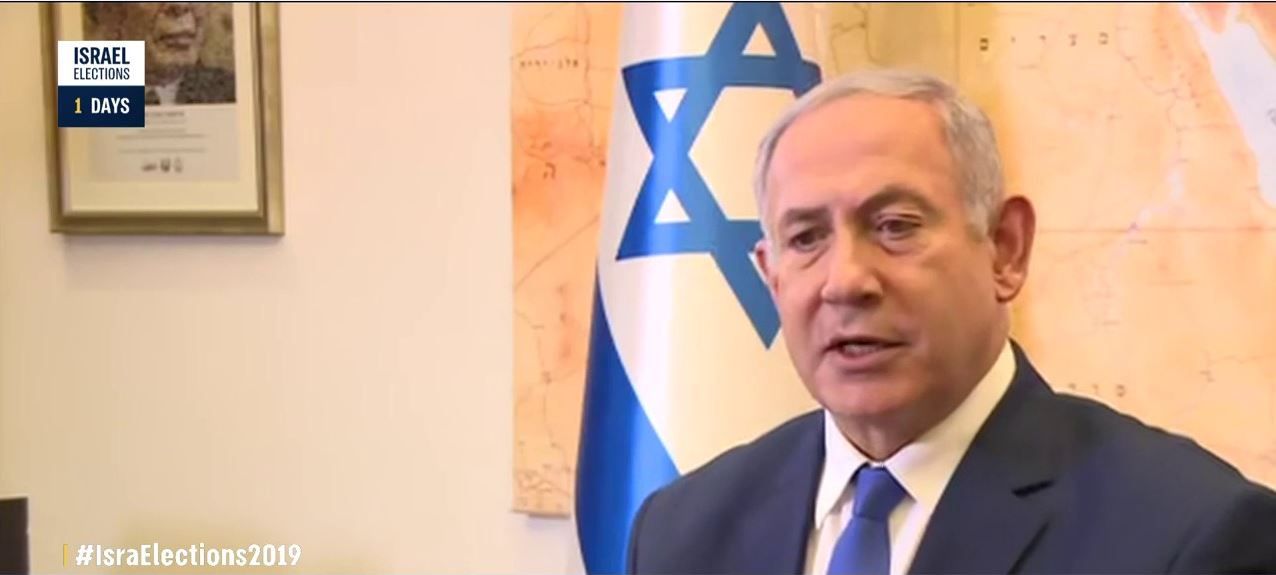
Israeli Prime Minister Benjamin Netanyahu told i24NEWS on Monday that he believes President Donald Trump’s long-awaited peace plan — expected to be published imminently following Israel’s national elections on Tuesday — will “include everything we want,” but raised the possibility of rejecting the offer if it doesn’t.

In an exclusive and broad-ranging interview for i24NEWS-Israel Hayom’s joint election special less than 48-hours before Israelis begin casting ballots, Prime Minister Benjamin Netanyahu said that “coming from a friend” he expects the plan will take into consideration Israel’s interests, including maintaining security presence in the West Bank and a united Jerusalem.

“We have to give president Trump a chance, I don’t know what will ultimately be presented but I believe they respect what I have suggested,” Netanyahu said. “My guess is that coming from a friend, they will consider most of what I just said.”

Trump has previously stated that both sides would have to make concessions in any final settlement and that the Israeli government would “pay a higher price” in return for his recognition of Jerusalem and his relocation of the US embassy there.

“I hope we don’t have to say no,” Netanyahu said of the plan.

During the interview, Netanyahu repeated his vow not to uproot a single Israeli settler from the West Bank, saying doing so would be tantamount to “ethnic cleansing”.

The premier, who is in the midst of a hard-fought battle for re-election, reiterated his vow to extend Israel’s sovereignty to settlements in the West Bank if he wins another term, but clarified that he has no intentions of annexing all of the West Bank.

“I did not say I would annex the West Bank, I said I would apply Israeli law to Jewish communities in Judea & Samaria,” Netanyahu affirmed, using a biblical term to refer to the territory of the West Bank.

“I said time and time again, I will not remove a single Israeli forcibly, I am against ethnic cleansing,” he added.

Over the course of more than ten years in power, Netanyahu has repeatedly rejected relinquishing Israeli military control over territory west of the Jordan River. Israel maintains full security and administrative control over the West Bank’s “Area C”, which comprises some 60% of the territory.

Many of Netanyahu’s right-wing political rivals openly call for the annexation of Area C, where most major Israeli settlement blocs are concentrated, while others call for the application of Israeli sovereignty over the entire West Bank where some 430,000 Israeli settlers live among 2.6 million Palestinians.

Netanyahu’s pledge to extend sovereignty over settlements were criticized domestically as a ploy to appeal to right-wing voters, and internationally as a threat to the two-state solution.

– ‘The main lesson from Gaza is not to repeat it’ –

Defending his policy in the Gaza Strip — which has come under stark criticism by his political rivals who seek to erode his reputation as “Mr Security” — Netanyahu said that the trio of generals heading up the centrist Blue & White party — Benny Gantz, Moshe Ya’alon, Gabi Ashkenazi – have not suggested any novel security policies.

“They (the ex-IDF chiefs) have not realized that the main lesson of Gaza is not to repeat it in Judea & Samaria,” Netanyahu said.

“I do not wish recreate a Hama-stan that is twenty times the size,” he said, referring to the 2005 Israeli disengagement from the coastal enclave that, following a rift with Fatah led to Hamas’ seizure of power.

“There was a possibility of conquering Gaza…it is not something that I can rule out completely,” Netanyahu tells i24NEWS

Netanyahu’s former coalition was thrown into chaos in November when Avigdor Liberman, who served as defense minister, quit the post and pulled his party from the government over sharp disagreement with the premier’s policy in the Strip, including an agreement to allow millions of dollars of Qatari funding into the enclave in exchange for relative calm on the border.

But Netanyahu appeared to champion his ability to respond to periodic flare-ups in a “measured way”, noting that “not a single Israeli was killed” in the four and a half years since Israel’s last war with Hamas.

“There was a possibility of conquering Gaza, but it would draw a lot of blood from our people but it is not something that I can rule out completely,” he told i24NEWS. However, he explained that he was would continue to act “responsibly” even if it would cost him politically.

As violence has continued to spill into Israel in the form of weekly riots and the launch of rockets and incendiary devices across the border, Netanyahu’s rivals have accused the long-serving premier of not acting strongly enough to quell the tensions and of abandoning Israeli citizens living in proximity to Gaza.

“Israel has to defend itself against any enemy, I don’t need international guarantees”

When pressed on whether he would negotiate with Hamas, he clarified that communication with the Islamist organization was “not about a peace deal” and said he would, via proxies, focus on returning Israeli citizens, slain soldiers and MIA’s.

As the date for unveiling long-awaited and widely-anticipated US peace plan draws near, Netanyahu threw his weight behind his American ally and said Israel should give US President Donald Trump a chance at making peace adding that he believes Washington will take Israel’s interests into consideration.

Watch the full i24NEWS interview with Israeli Prime Minister Benjamin Netanyahu here!

Iran threatens to respond in kind if US labels Revolutionary Guard terrorists

April 7, 2019

Source: Iran threatens to respond in kind if US labels Revolutionary Guard terrorists | The Times of Israel

Majority of MPs in Tehran warn Washington against reported plans to apply label to entirety of special military force

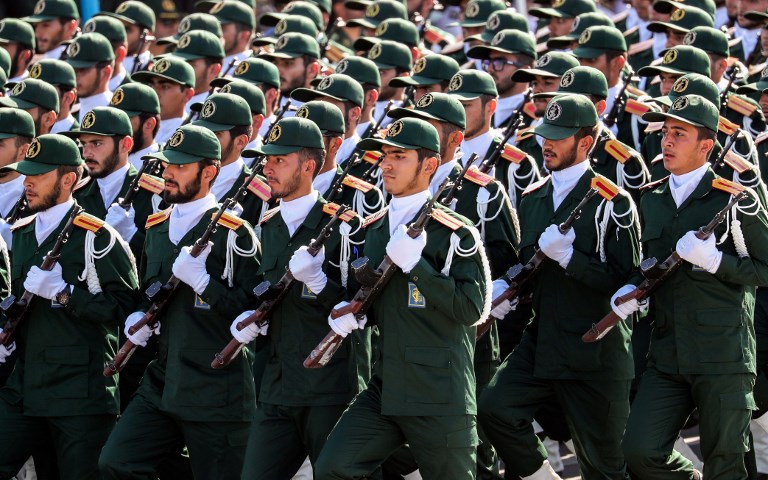
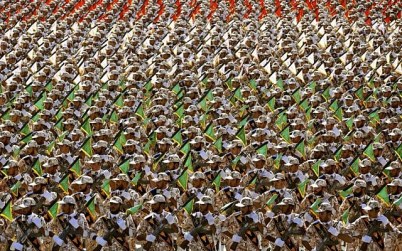
Members of Iran’s Revolutionary Guard Corps (IRGC) march during the annual military parade marking the anniversary of the outbreak of the devastating 1980-1988 war with Saddam Hussein’s Iraq, in the capital Tehran on September 22, 2018. (AFP/STR)

Iranian lawmakers warned on Sunday they would respond in kind if the United States designated their country’s Islamic Revolutionary Guard Corps a terror group.

On Friday, the Wall Street Journal reported such a move by Washington could come as early as Monday and would be the first time the US has designated a state entity as a terrorist organization.

Responding to the report, a vast majority of lawmakers in Iran’s parliament issued a statement threatening to designate elements of the US military a terror group, state-run news agency IRNA reported.

“We will answer any action taken against this force with a reciprocal action,” Reuters quoted the statement, signed by 255 out of the parliament’s 290 members, as saying. “So the leaders of America, who themselves are the creators and supporters of terrorists in the (Middle East) region, will regret this inappropriate and idiotic action.”

According to IRNA, the lawmakers also called the IRGC one of Iran’s greatest achievements since the 1979 Islamic Revolution.

The US has accused the IRGC of supporting terror groups and militias throughout the Middle East that threaten allies such as Israel.

Members of Iran’s Revolutionary Guard Corps are seen at an annual military parade in front of the mausoleum of the late Ayatollah Khomeini just outside Tehran on September 22, 2014. (AP/Ebrahim Noroozi/File)

The Wall Street Journal, quoting unnamed officials, said US President Donald Trump’s administration would announce the long-mulled decision as soon as Monday and that concerned defense officials were bracing for the impact. Reuters said three US officials confirmed the plan.

It would be the first time the US has designated another nation’s army as a terror organization.

Iran warned that it could respond in kind, listing the US military as a terror group.

“If the Revolutionary Guards are placed on America’s list of terrorist groups, we will put that country’s military on the terror blacklist next to Daesh [Islamic State],” Heshmatollah Falahatpisheh, the head of the Iranian parliament’s national security committee, tweeted on Saturday.

The Islamic Revolutionary Guards Corps was formed after the 1979 Islamic Revolution with a mission to defend the clerical regime, in contrast to more traditional military units that protect borders. It exists in parallel to Iran’s regular military. The Revolutionary Guards have amassed enormous power within Iran, becoming owners of significant industries and other economic interests on behalf of the regime.

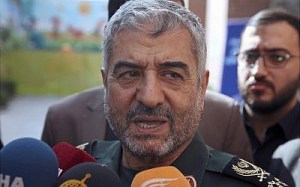
In this file photo from October 31, 2017, the head of Iran’s Islamic Revolutionary Guard Corps Mohammad Ali Jafari speaks to journalists after his speech at a conference called ‘A World Without Terror,’ in Tehran, Iran. (AP Photo/Vahid Salemi, File)

The Guards’ prized foreign operations unit is the Quds Force, named for the Arabic word for Jerusalem, which supports forces allied with Iran around the region, including the regime of Syrian President Bashar Assad and Lebanon’s Hezbollah terror group.

The Trump administration has already imposed sweeping sanctions on Iran after withdrawing last year from an international agreement under which Tehran scaled back its nuclear program in exchange for sanctions relief.

A foreign terrorist designation would make it harder for businesses and institutions to interact with the IRGC and its assets, as many such interactions would carry punishments under US law.

The Pentagon and CIA reportedly have reservations about the planned move by the Trump administration, with officials saying it could increase risks for US troops in the region without doing much more to damage the Iranian economy than existing sanctions and restrictions are already doing.

Reuters noted that in 2017 IRGC chief Mohammad Ali Jafari said such action by Washington would lead the Guards to “consider the American army to be like Islamic State all around the world.”

Republican Senator Ben Sasse spoke in support of the move, saying, “A formal designation and its consequences may be new, but these IRGC butchers have been terrorists for a long time.”


Israels 1982 War in Lebanon 

April 7, 2019

From the TV series “Modern Warfare.”

( The first War I fought in on a Dabur class patrol boat off Sidon, Tyre and Beirut. – JW )

The 1982 Lebanon War, dubbed Operation Peace for Galilee (Hebrew: מבצע שלום הגליל, or מבצע של”ג‎ Mivtsa Shlom HaGalil or Mivtsa Sheleg) by the Israeli government, later known in Israel as the Lebanon War or the First Lebanon War (Hebrew: מלחמת לבנון הראשונה‎, Milhemet Levanon Harishona), and known in Lebanon as “the invasion” (Arabic: الاجتياح‎, Al-ijtiyāḥ), began on 6 June 1982, when the Israel Defense Forces (IDF) invaded southern Lebanon, after repeated attacks and counter-attacks between the Palestine Liberation Organization (PLO) operating in southern Lebanon and the IDF that had caused civilian casualties on both sides of the border.[16][17][18] The military operation was launched after gunmen from Abu Nidal’s organization attempted to assassinate Shlomo Argov, Israel’s ambassador to the United Kingdom. Israeli Prime Minister Menachem Begin blamed Abu Nidal’s enemy, the PLO, for the incident,[19][20] and treated the incident as a casus belli for the invasion.[21][22][i]

After attacking the PLO – as well as Syrian, leftist, and Muslim Lebanese forces – the Israeli military, in cooperation with the Maronite allies and the self-proclaimed Free Lebanon State, occupied southern Lebanon, eventually surrounding the PLO and elements of the Syrian Army. Surrounded in West Beirut and subjected to heavy bombardment, the PLO forces and their allies negotiated passage from Lebanon with the aid of United States Special Envoy Philip Habib and the protection of international peacekeepers. The PLO, under the chairmanship of Yasser Arafat, had relocated its headquarters to Tripoli in June 1982.

Trump’s blacklisting of Iran’s Guards bodes tougher US oil sanctions, more IDF air strikes in W. Iraq as well as Syria – DEBKAfile

April 7, 2019

Source: Trump’s blacklisting of Iran’s Guards bodes tougher US oil sanctions, more IDF air strikes in W. Iraq as well as Syria – DEBKAfile

President Donald Trump’s planned designation of Iran’s Revolutionary Guards Corps (IRGC) as a terrorist organization on Monday, April 8 , will add to US steps for maximizing the economic pressure on Iran in the coming two months.

It is the first time a government military entity has been branded terrorist. The US can expect Iran to retaliate at once by proclaiming the American army a global terrorist organization on a par with the Islamic State and calling on allied regimes to follow Tehran’s example, such as, for instance, Nicolas Maduro in Venezuela.

Closer to home, Syrian President Bashar Assad, Hizballah’s leader Hassan Nasrallah and the pro-Iranian militia conglomerate in Iraq, may well act in solidarity with Iran, in which case, violent clashes may erupt between the proxies Iran has scattered across the Middle East and US forces. Conscious of the threat, on Friday, April 5, American army units in the region were placed on the alert for Iranian-orchestrated reprisals.

DEBKAfile’s military analysts suggests that Trump’s latest move against the IRGC may take practical form in various ways:

  1. Does it mean that that US forces are henceforth licensed to attack IRGC forces in their different regional sectors of operation? Or was it a general directive to open the door for such attacks in the future?
  2. More realistically, blacklisting the IRGC as a terrorist organization is likely to bear more significantly on the Corps economic power, rather than its military functions. The Guards are not only Iran’s most powerful security organization, with control over its missiles and nuclear programs; they also rule essential sections of the economy, with responsibility for the country’s oil exports and import of energy products. The IRGC, moreover, manages the mechanisms set up with foreign governments, such as China, Russia, Turkey, Iraq and some western Europeans, to bypass or blunt the existing US sanctions against Iran. Therefore, Trump’s next action against the IRGC is likely to be the tightening of oil sanctions, which is expected to be announced on May 8, to mark the first anniversary of his decision to take the US out of the 2015 nuclear accord with Iran. Those sanctions will be made more painful by Washington recalling the waivers granted to a number of nations, such as India, China and Iraq, allowing them to purchase certain quantities of Iranian oil while it was under embargo. Three weeks ago, Secretary of State Mike Pompeo told an energy conference in Houston that the purpose of the administration’s sanctions against Iran was to “drive Iran’s oil exports down to zero.”
  3. Israel will be empowered to step up its aerial assaults on Iranian forces in Syria and extend them to western Iraq, where pro-Iranian Iraqi Shiite militias have piled up under IRGC command.


Hamas: In next war, Israel has to evacuate Ashdod, Ashkelon and Tel Aviv

April 6, 2019

Yahya Sinwar said that despite the recent ceasefire understandings with Israel, the Palestinians will continue to protest near the border with Israel.

By Khaled Abu Toameh
April 6, 2019 17:30
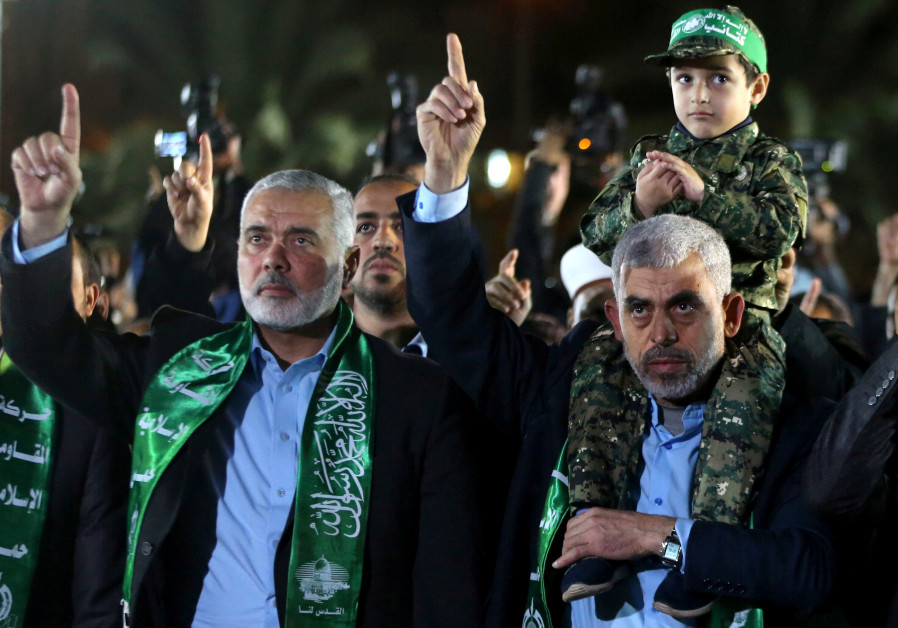
The son of senior Hamas militant Mazen Fuqaha sits on the shoulders of Hamas Gaza Chief Yahya Al-Sinwar as Hamas leader Ismail Haniyeh (L) gestures during a memorial service for Fuqaha, in Gaza City March 27, 2017.. (photo credit: REUTERS)

In the next war between Hamas and Israel, the Israelis will have to evacuate not only their “settlements” near the border with the Gaza Strip, but also Ashdod, Ashkelon, the Negev and Tel Aviv, Yahya Sinwar, the leader of Hamas in the Gaza Strip, threatened on Saturday.

He said that despite the recent ceasefire understandings with Israel, the Palestinians will continue to protest near the border with Israel.

Sinwar, who was speaking to representatives of Palestinian factions and civil society organizations in the Hamas-ruled coastal enclave, said that his movement will continue to be ready for war with Israel to “defend the Palestinian people.” Hamas, he said, will be a “shield and sword” for the Palestinians.

Sinwar said that if a war is “imposed” on the Gaza Strip, Israel will “suffer.” He added: “I pledge that the occupation will evacuate its settlements not only in the ‘Gaza Envelope,’ but also in Ashdod, the Negev, Ashkelon and even Tel Aviv. Remember this pledge. The fingers of the resistance in the Gaza Strip are on the trigger. We are today ten times stronger than we were in 2014 (a reference to the war in the Gaza Strip –Operation Protective Shield).”

Regarding the ceasefire understandings with Israel, Sinwar said that Hamas did not pay any “political price.” The understandings, he said, “have no prices or political dimensions.”

He further said that the understandings were not connected to any prisoner swap between Hamas and Israel or the issue of the weapons of Palestinian terror groups in the Gaza Strip.

“The understandings are not an alternative to Palestinian unity and partnership,” the Hamas leader explained. “There is no talk about the Palestinian right to resistance in all its forms, especially in the West Bank. Also, there is not talk about halting the March of Return.”

The March of Return is the name Palestinians use to describe the weekly protests near the border with Israel. The protests began in March 2018.

Sinwar praised Egypt for its role in “easing restrictions” imposed on the Gaza Strip.

“We have strengthened our relations with Egypt,” he said. “The Egyptians have thankfully played a big role in the easing of the restrictions.”

Hamas claims that the Egyptian-sponsored ceasefire understandings include the expansion of the fishing zone, reopening border crossings between the Gaza Strip and Israel, the delivery of additional Qatari funds, launching various humanitarian and economic projects in the coastal enclave and solving the power shortage.

The Hamas leader boasted that his movement has been successful in thwarting attempts to instigate unrest in the Gaza Strip. He was referring to recent anti-Hamas protests that erupted in various parts of the Gaza Strip to protest economic hardship. Hamas security forces used brutal force to squash the protests, arresting, beating and shooting scores of Palestinians.

“During the last year, Hamas, together with our people, has scored a number of achievements,” Sinwar said. “The most prominent achievement has been the foiling of all attempts to destabilize civil peace in the Gaza Strip.”

Hamas leaders have accused their rivals in Fatah and the Palestinian Authority of being behind the protests. They claim that the protests were part of a “conspiracy” to end the Hamas-rule in the Gaza Strip. Fatah and PA officials have dismissed the charges.

Sinwar also praised the ongoing protests near the border with Israel and said they have placed the issue of the Gaza Strip blockade on the world’s agenda.

Off Topic –  Good news for Netanyahu: Last pre-election poll puts Likud, Blue and White even 

April 6, 2019

Source: Good news for Netanyahu: Last pre-election poll puts Likud, Blue and White even | The Times of Israel

( Crossing my fingers.  I believe he has proven to be the best PM in Israel’s history. – JW )

Right-wing, ultra-Orthodox bloc forecast to win majority in all final surveys, leaving Netanyahu well-placed to retain power, though several show Gantz’s party ahead of Likud

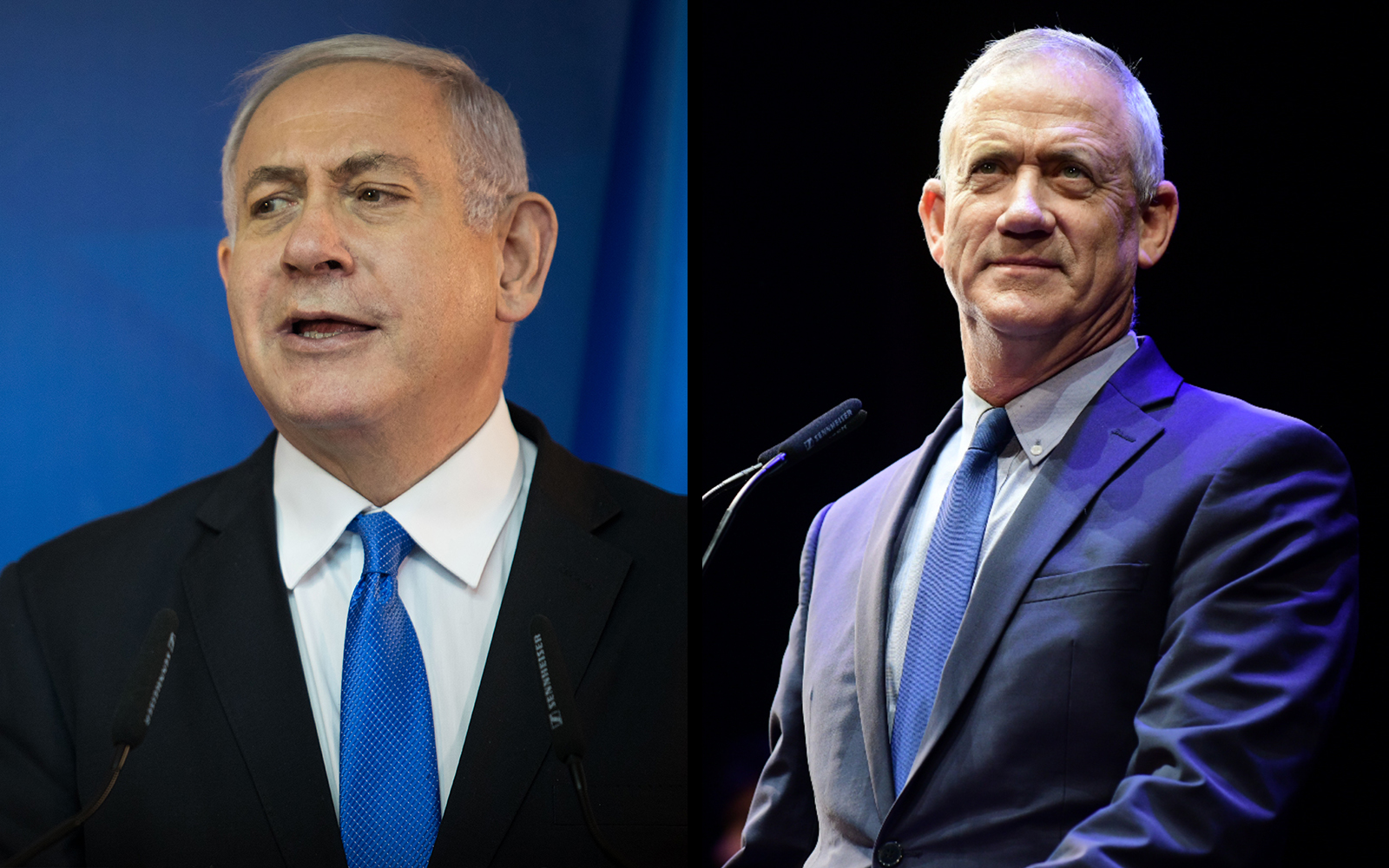
Prime Minister Benjamin Netanyahu, left, and Benny Gantz, right. (Hadas Parush/Tomer Neuberg/Flash90)

Prime Minister Benjamin Netanyahu’s Likud party and challenger Benny Gantz’s Blue and White were neck-and-neck in a poll released Friday evening, setting up a frantic end to election campaigns as parties worked to shore up their support before Israelis vote on April 9.

Overall, right-wing and religious parties received 66 seats in the poll, versus 54 for the center-left and Arab parties, mirroring the results of all major surveys released in recent days and again suggesting that Netanyahu will have an easier route to building a governing majority.

The survey, aired by Channel 13 news, was the last of the campaign for the 21st Knesset, with Israeli election law barring the publication of further polls after Friday.

Likud and Blue and White were dead even with 28 seats in the poll, after a survey released earlier in the week by the network gave the former a one-seat lead.

Following the two parties in the poll was the opposition Labor Party with 11 seats, similar to the total it received in other surveys this week.

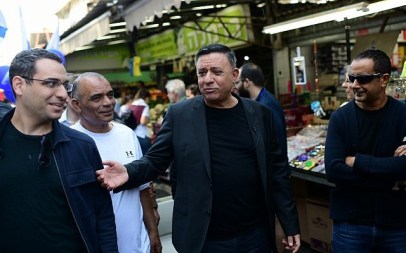
Labor Party leader Avi Gabbay tours the Carmel Market in Tel Aviv, on April 3, 2019, ahead of general elections for the Knesset. (Tomer Neuberg/Flash90)

After Labor was the Union of Right-Wing Parties, an alliance of the national-religious Jewish Home and National Union factions with the extremist Otzma Yehudit, with seven seats.

Hadash-Ta’al, a merger of two parties from the outgoing Knesset’s Joint (Arab) List, had six seats in the poll, as did maverick former Likud lawmaker Moshe Feiglin’s Zehut, the nationalist New Right and the ultra-Orthodox United Torah Judaism.

The ultra-Orthodox Shas party and left-wing Meretz each received five seats, while Finance Minister Moshe Kahlon’s center-right Kulanu, hawkish former defense minister Avigdor Liberman’s Yisrael Beytenu and the Ra’am-Balad alliance of Arab factions each received four seats.

Asked their preference for prime minister, 46 percent of poll respondents said Netanyahu, 37% said Gantz and 17% said they did not know.

The poll was conducted for the network by pollster Camil Fuchs and included 858 respondents. The margin of error was 3.4%.

While Channel 13 had Likud and Blue and White polling even, and a pair of other polls had one or the other leading by a single seat, three separate surveys gave Gantz’s party a 4-5 seat advantage.

Prime Minister Benjamin Netanyahu speaks to supporters from his Likud party at his official residence in Jerusalem on April 5, warning them that Likud could lose the elections, 2019. (Screen capture: Twitter)

In light of those results, Netanyahu issued an appeal Friday to right-wing voters to back Likud, warning it “is in danger” of losing its hold on power.

Encouraging voters from fellow right-wing parties to throw their support behind Likud could prove to be a risky strategy for Netanyahu, as a subsequent failure by one or more of them to clear the minimum electoral threshold could deprive the premier of a majority needed to form a ruling coalition.

Blue and White no. 2 Yair Lapid said in an interview with The Times of Israel on Thursday that if the party receives at least four seats more than Likud, it will get the first shot at putting together a government after Tuesday’s vote, a sentiment that has been echoed by Netanyahu.


What Is Behind the Opposition to Peace with Israel?

April 6, 2019

Al Akhbar: Trump Wants Jordan to Take In 1 Million ‘Palestinians’

April 5, 2019

Al Akhbar: Trump Wants Jordan to Take In 1 Million ‘Palestinians’

PA Chairman Mahmoud Abbas and Jordan’s King Abdullah II review an honor guard in Ramallah, August 7, 2017.Photo Credit: Flash90

The Lebanese newspaper Al-Akhbar on Friday reported new details about President Donald Trump’s promised “deal of the century.”

According to the newspaper, $45 billion will be invested in projects in the Kingdom of Jordan in return for its agreement to accept a million “Palestinians.” But King Abdullah has made it clear that he thought the plan was dangerous.

According to the report, Egyptian President Abd al-Fatah al-Sisi is expected to be updated on the final details of the plan during his visit to Washington next week. This would be before the official announcement and its implementation, which are planned for after Tuesday’s elections in Israel.

Al-Akhbar also reported that Egypt and Jordan lowered their opposition to the deal, about which King Abdullah had already been briefed in his recent visit to Washington.

The king said that the plan was dangerous and not simple to implement, in particular the part relating to the land swaps in Tzofar, a moshav in the Arava desert, and Naharayim, where Jordan conquered in 1948 the Island of Peace and a hydroelectric power-plant that belonged to Israel. According to the Trump proposal, Jordan would receive from Saudi Arabia an area equal in size to these territories which Israel would reacquire.

In addition, Jordan has been asked to take in a million “Palestinian” refugees in several stages, in return for $45 billion in investments. Jordan’s entire GDP is only $40 billion. Saudi Arabia and other Gulf states will finance these investments.

According to Al-Akhbar, King Abdullah has told Egyptian officials based on the maps he had seen in Washington, that the American plan envisions a confederation of the Palestinian Authority, Jordan and the Israeli Civil Administration in the liberated territories.

The plan also expects Egypt to permit “Palestinians” to move freely through the Rafah crossing, to work legally in industrial zones in Egypt, and to pursue a track to Egyptian citizenship. Egypt would be compensated with projects in the northern Sinai to the tune of $65 billion.

Lebanon will also be included in the new deal, by awarding Lebanese citizenship to the “Palestinian” refugees on its soil, and not seek their return to Israel.