Archive for December 31, 2018

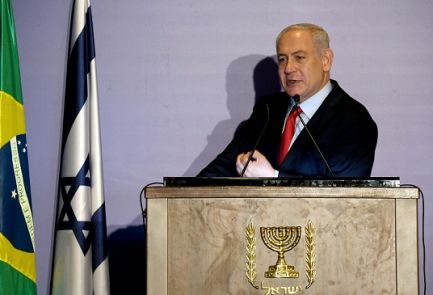
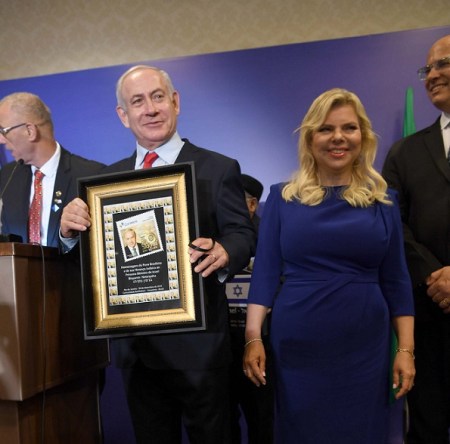
Brazil Embassy move ‘question of when, not if,’ PM says

December 31, 2018

Source: Brazil Embassy move ‘question of when, not if,’ PM says – Israel Hayom


Tectonic shifts in attitudes toward Israel 

December 31, 2018

Source: Tectonic shifts in attitudes toward Israel – Israel Hayom

Daniel Pipes

As Arabs and Muslims warm to Israel, the Left grows colder. These shifts imply one great imperative for the Jewish state.

On the first shift: Prime Minister Benjamin Netanyahurecently pointed out “a great change” in the Arab world which has a growing connection to Israeli companies because it needs Israeli “technology and innovation … water, electricity, medical care, and high-tech.” Explaining this normalization as a result of Arab states “looking for links with the strong,” Netanyahu was too considerate of American liberals’ feelings to add another factor: Former U.S. President Barack Obama’s policy of appeasing Tehran jolted the Arab states to get serious about the real threats facing them.

It is striking that full-scale Arab state warfare against Israel lasted a mere 25 years (1948-1973) and ended 45 long years ago; and that Turkey and Iran have since picked up the anti-Zionist torch.

Nor is it just Israeli companies making inroads into Arab countries. Israel’s sport minister broke into tears as “Hatikva,” Israel’s anthem, was played in Abu Dhabi upon the victory of an Israeli athlete. Rumors are swirling about a handshake to come between Saudi Arabia’s Crown Prince Mohammad bin Salman (MbS) and Israel’s prime minister.

That Arab and Muslim enmity has fractured, probably never to be reconstituted, amounts to one tectonic shift in the Arab-Israeli conflict. The second, no less important, involves the global Left’s growing hostility to Israel.

This pattern can be found consistently from South Korea to Thailand to South Africa to Sweden to Brazil. The Durban conference of 2001 initially brought this phenomenon to light. Among many other examples, the Black Lives Matter movement accuses Israel of “apartheid” and “genocide.” A communist labor union in India representing 16 million farmers apparently joined the boycott, divestment, and sanction movement.

Attitudes toward the Jewish state follow an almost linear progression of growing negativity as one goes from right to left. A 2012 Pew Research Center survey of American adults found 75% of conservative Republicans sympathize more with Israel than with the Palestinians, followed by 60% of moderate and liberal Republicans, 47%  of independents, 46% of conservative and moderate Democrats, and 33% of liberal Democrats.

It was not always thus. Joseph Stalin was so instrumental to Israel’s birth in 1947-1949 by providing diplomatic support and armaments that Abba Eban, Israel’s first U.N. ambassador, observed that “we couldn’t have made it, either diplomatically or militarily,” if not for Soviet help. Democrats Harry Truman and John F. Kennedy rank among the most pro-Israel of American presidents, but Republican Dwight Eisenhower was unquestionably the most antagonistic.

MbS vs. Jeremy Corbyn symbolizes these two tectonic shifts, as does Israel now enjoying better relations with Egypt than with Sweden. The president of Chad turns up in Israel but a singer from New Zealand does not. Israel’s athletes compete in the United Arab Emirates but get banned in Spain. Muslims show increasing indifference to the breakdown in Palestinian-Israeli diplomacy, but leftists express growing anger over it.

This last point has great importance: The rage against Israel is not about Ashkenazi-Sephardi relations, tensions on the Temple Mount, a possible attack on Iran’s nuclear infrastructure, or Israel’s own rumored nuclear weapons. Rather, it almost exclusively concerns the status of some 3 million Palestinians in the West Bank and Gaza. Thanks to a mix of Palestinian public relations expertise and continued antisemitism, the welfare of this small and powerless but fanatical population has transmogrified into the premier global issue of human rights, getting endlessly more attention than, say, Ethiopia – and motivates nearly all denunciations of Israel.

Therefore, when the Left, now largely excluded from power, eventually returns to office in countries like Japan, India, Germany, France, the United Kingdom, and the United States, Israel will face a crisis due to the unresolved situations in the West Bank and Gaza.

Accordingly, a resolution of this issue should be an utmost priority for Israelis.

That does not mean touting yet another peace plan doomed to crash on the hard rock of Palestinian intransigence. It does mean, whatever one’s favored plan might be, Palestinian aggression toward Israel must end: No more suicide attacks, kite bombings, and rockets. Only this will soothe leftist rage.

Only an Israel victory and a Palestinian defeat will achieve this. Getting the Palestinians to cry uncle is an urgent priority for Israel and its supporters.

Daniel Pipes (DanielPipes.org, @DanielPipes) is president of the Middle East Forum.‎

The uncertainty to come 

December 31, 2018

Source: The uncertainty to come – Israel Hayom

Yoav Limor

The coming year is likely to be one of uncertainty ‎as Israel tries to walk the extremely fine line ‎between the highly volatile potential on all fronts ‎and the IDF’s clear superiority and ability to ‎generate deterrence.‎

Ostensibly, Israel has to strive to avoid a wide ‎scale conflict in 2019. This should be ‎doable as each foe, in every sector, currently has ‎far more pressing issues to deal with: Syria is reeling from the ‎bloody, seven-year civil war; Hezbollah is knee-deep ‎in financial problems and the internal Lebanese ‎political turmoil; Hamas is trying to improve the ‎dire economic situation in the Gaza Strip, and the ‎Palestinian Authority in the West Bank is focused on ‎trying to make heads or tails of the impending post-President ‎Mahmoud Abbas era. ‎

Add to that Israel’s military power and one can ‎understand why Israel’s enemies are wary of ‎confrontation. Still, logic does not always prevail ‎in the Middle East, and each sector harbors a ‎significant chance of experiencing a rapid ‎escalation, especially as all are under the menacing ‎specter of Iran, which is trying to increase its ‎regional influence.‎

This means that the Israeli challenge will be first, ‎to avoid war; second, to win a war should one erupt; ‎and third – and perhaps most important – to both ‎prevent Iran from entrenching itself militarily in ‎Syria and stop Hezbollah’s armament efforts in ‎Lebanon, especially with respect to the Shiite ‎terrorist group’s precision-missile program.‎

Israel will also have to carefully navigate its ‎policy in Gaza, to ensure the desperation there does ‎not worsen, and equal prudence will be required in ‎the West Bank, where fighting terrorism while ‎minimizing the infringement on the civilian ‎Palestinian population’s routine is crucial to ‎preventing another intifada. ‎

Israel will have to do all of this while contending ‎with complex geostrategic conditions, especially ‎given U.S. President Donald Trump’s decision to pull ‎American troops from Syria and the subsequent ‎increase in Russia’s regional power. ‎

This would require not only diplomatically ‎navigating the complex equation between ‎Washington and Moscow, but also fostering closer ‎ties with the moderate Sunni axis, which, in turn, ‎is likely to increase friction with rogue states, ‎including Turkey. ‎

This fine line between opportunity and risk is one ‎Israel will have to walk alone, and it will have ‎only itself to count on, diplomatically and ‎militarily. ‎

All this will take place against the backdrop of ‎what is expected to be a challenging year for Israel ‎regardless. The election campaign is already proving ‎to be a stormy one and it is unlikely it would refrain ‎from dragging the IDF into it. The new IDF chief of ‎staff, slated to take office in mid-January, will ‎have to maneuver between all the external and ‎internal threats and challenges, including the ‎questions raised about the army’s war readiness, ‎the need to formulate a multiyear budget, ‎to the personnel crisis brewing in the military’s ‎regular and standing ranks.‎

Defense and security issues will continue to ‎dominate the political and public agenda in 2019, on ‎every level. The good news is that chances of war ‎are slim. The bad news is that, given the regional ‎upheaval, no security assessment can be taken for ‎granted.‎

IDF looks back on 2018: 865 strikes, 20 terror tunnels destroyed 

December 31, 2018

Source: IDF looks back on 2018: 865 strikes, 20 terror tunnels destroyed – Israel Hayom


In New Year greeting, Putin says he hopes for more cooperation with Israel 

December 31, 2018

Source: In New Year greeting, Putin says he hopes for more cooperation with Israel | The Times of Israel

Russian president notes experience gained ‘in various spheres,’ says he looks forward to developing ties in a ‘constructive manner’

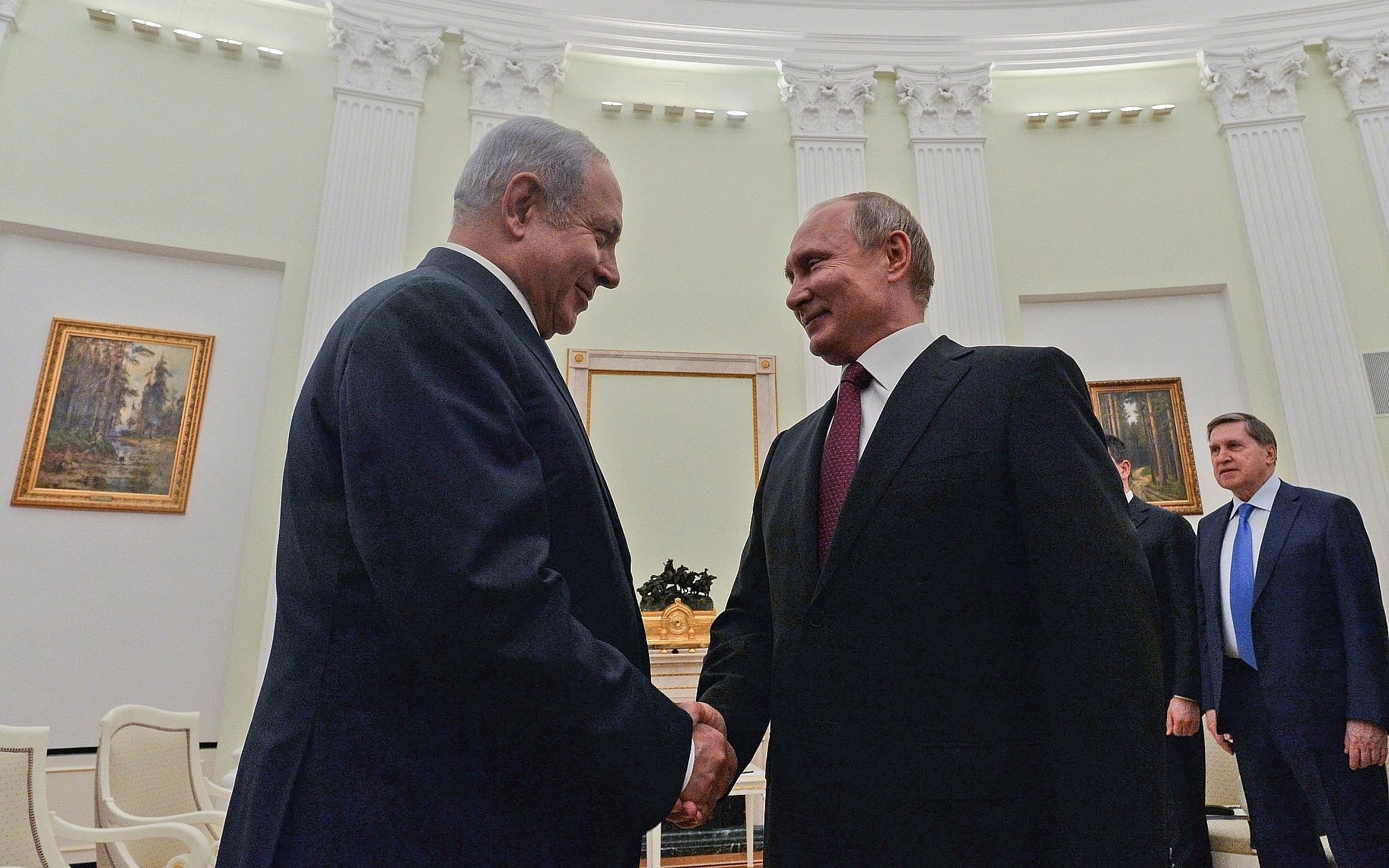
Prime Minister Benjamin Netanyahu meets with Russian President Vladimir Putin in Moscow on July 11, 2018. (Kobi Gideon/GPO/Flash90)

Prime Minister Benjamin Netanyahu meets with Russian President Vladimir Putin in Moscow on July 11, 2018. (Kobi Gideon/GPO/Flash90)

Russian President Vladimir Putin, in a Christmas and New Year greeting to Prime Minister Benjamin Netanyahu, noted the successful cooperation between the two countries in the past and spoke of his hope that the partnership will develop in the future.

“Putin noted that the two countries have gained considerable experience in cooperation in various spheres and expressed hope that in the upcoming year Russian-Israeli relations will be developing in a constructive manner as a partnership for the benefit of the peoples of both states and in the interest of strengthening peace, security and stability in the Middle East,” the Russian Foreign Ministry said in a statement Sunday.

Putin and Netanyahu have met face-to-face several times in recent years, usually in Moscow.

Putin sent seasonal greetings to various “heads of state and government and heads of international organizations,” the ministry said last week.

In a message to US President Donald Trump, Putin “stressed that Russia-US relations are the most important factor behind ensuring strategic stability and international security, and reaffirmed that Russia is open to dialogue with the United States on the most extensive agenda.”

The foreign ministry statement made no mention of seasonal greetings sent to Muslim nations and the Palestinian Authority.

Israel’s ties with Russia have been both strengthened and strained by events in Syria, where Israeli efforts to prevent Iran from gaining a military foothold have at times clashed with Moscow’s campaign to aid the Syrian regime in the civil war.

The two countries have coordinated their military efforts in Syria in recent years, in order to avoid friction and accidental conflict.

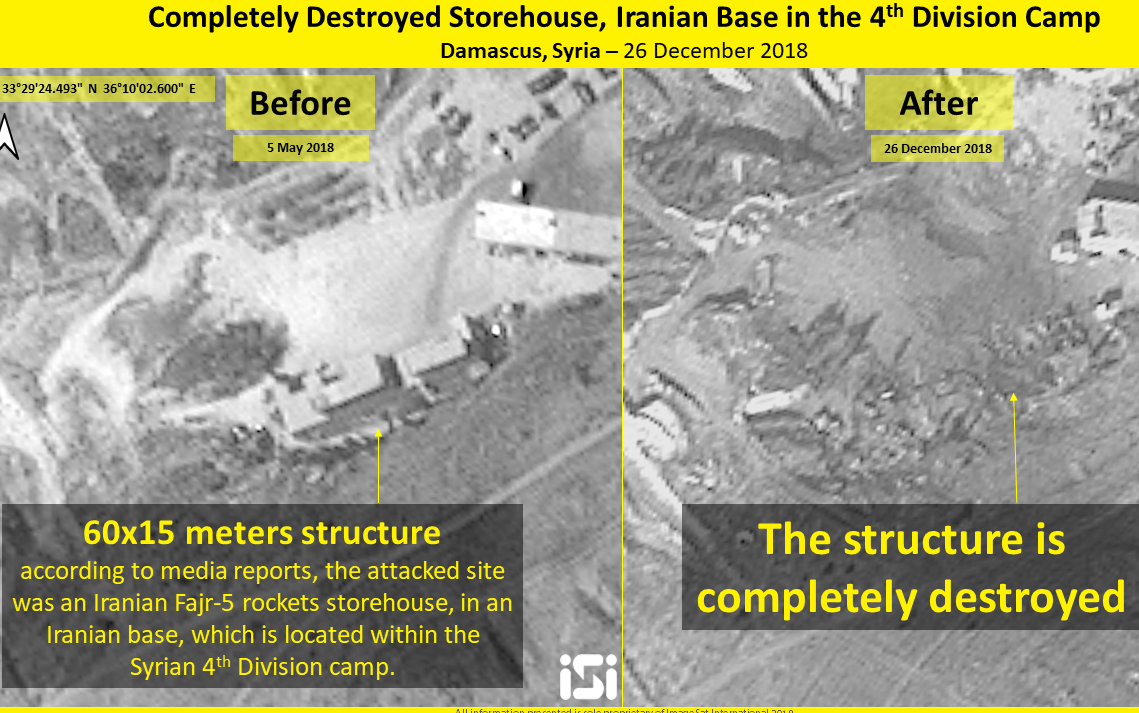
Satellite photos released by Israeli firm ImageSat International on December 27, 2018, show damaged facilities in Syria purportedly used by Iran that were targeted in an airstrike attributed to Israel. (ImageSat International)

Tensions recently reached a peak following the downing of a Russian aircraft by Syrian anti-aircraft fire during an Israeli airstrike, an incident Russia blamed on Israel.

Despite the Russian anger over the downed spy plane, Netanyahu has reiterated several times that Israel will continue to act to prevent Iran’s military entrenchment in Syria and the smuggling of advanced weapons into Lebanon.

Israel in recent years has carried out hundreds of airstrikes in Syria against targets linked to Iran, which alongside its proxies and Russia is fighting on behalf of the regime of Syrian President Bashar Assad. Jerusalem is concerned that Iran will use Syria as a forward base from which to attack the Jewish state.

Last week Russia accused Israel of endangering two civilian flights during airstrikes near an airport in Syria, calling the alleged strikes a “provocative act” and a violation of Syrian sovereignty.

The situation in Syria is set to become even more fragile after Trump announced earlier this month that he will pull all US ground troops out of the country. The US forces were seen as a buffer that also hindered Iranian entrenchment.

Following Trump’s announcement, Netanyahu has said the US pullout will not deter Israel from continuing to attack Iranian military interests in Syria.


Top Republican indicates Trump rethinking plans to withdraw from Syria 

December 31, 2018

Source: Top Republican indicates Trump rethinking plans to withdraw from Syria | The Times of Israel

After meeting president, Lindsey Graham says Trump is now vowing to stay and ‘destroy’ IS before leaving Syria and to make sure ‘Iran doesn’t become the big winner of our leaving’

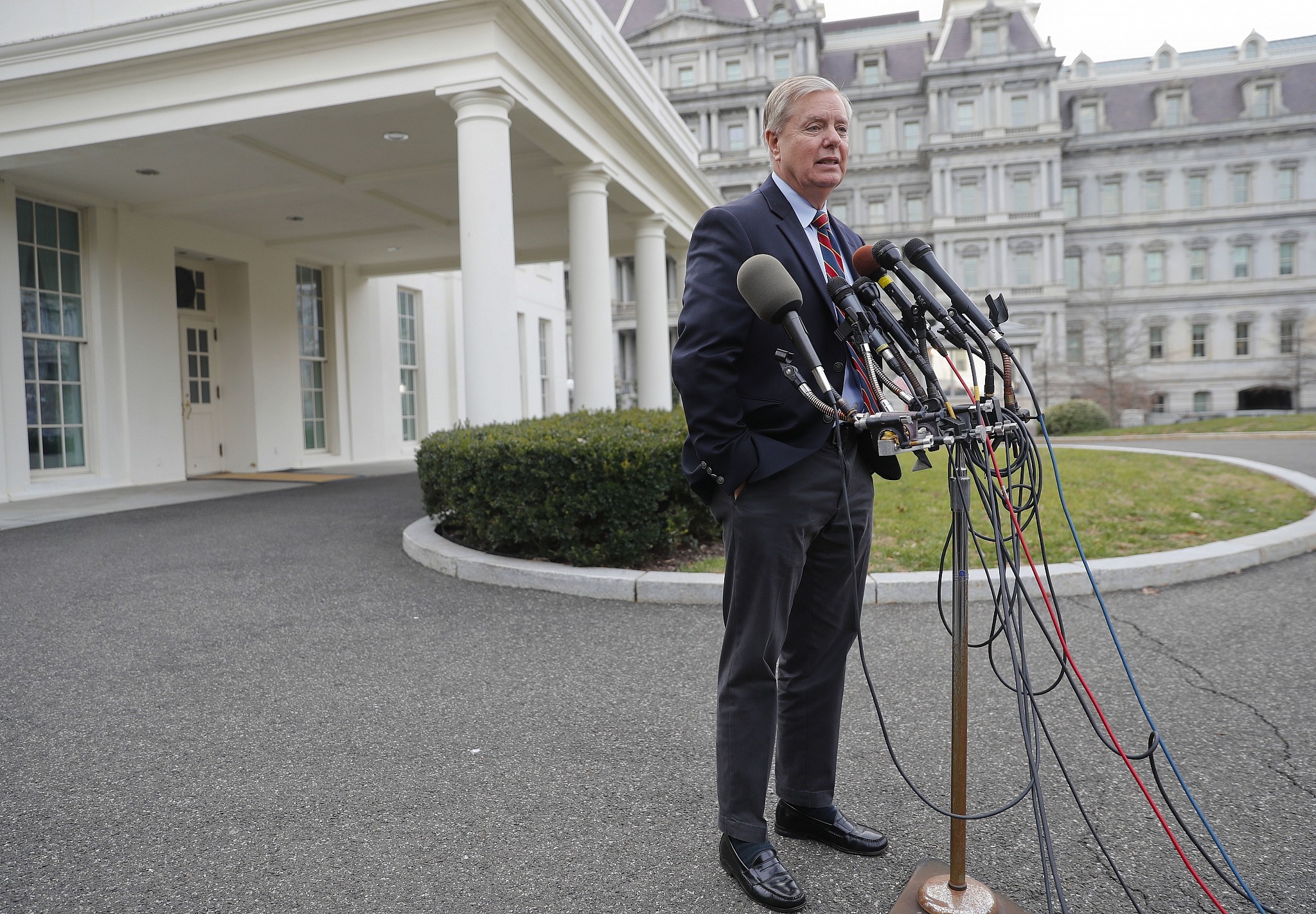
Sen. Lindsey Graham, R-S.C., speaks to members of the media outside the West Wing of the White House in Washington, after his meeting with President Donald Trump, Sunday, Dec. 30, 2018. (AP Photo/Pablo Martinez Monsivais)

Sen. Lindsey Graham, R-S.C., speaks to members of the media outside the West Wing of the White House in Washington, after his meeting with President Donald Trump, Sunday, Dec. 30, 2018. (AP Photo/Pablo Martinez Monsivais)

WASHINGTON (AFP) — A senior Republican senator said Sunday that President Donald Trump had promised to stay in Syria to finish the job of destroying the Islamic State group — just days after announcing he would be withdrawing troops immediately.

“The president understands the need to finish the job,” Graham told reporters outside the White House after what he described as a two-hour lunch meeting.

“He told me some things I didn’t know that made me feel a lot better about where we’re headed in Syria,” the South Carolina lawmaker said.

“I think the president is committed to making sure when we leave Syria that ISIS is completely defeated and we are inside the 10-yard line,” he said, using an alternative name for the Islamic State group.

When Trump tweeted on December 19 that “we have defeated ISIS in Syria,” several military and security experts said he was overstating the case, and warned against a hasty withdrawal.

‘Thinking long and hard’

Graham said Trump was “thinking long and hard about Syria and how to withdraw the forces” after ensuring that ISIS is destroyed, that US-allied Kurdish forces are protected and that “Iran doesn’t become the big winner of our leaving.”

Graham, who as a member of the Armed Services committee has frequently visited US troops in combat zones, was once a frequent critic of Trump but, reversing course, now frequently defends him and seems to have gained privileged access to the president’s ear.

The senator’s remarks after the White House meeting were considerably modulated from his tone earlier in the day, when he told ABC television’s “This Week” that “if we leave (Syria) now, the Kurds will get slaughtered.”

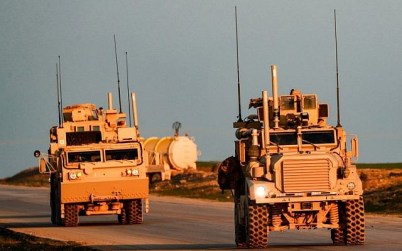
US Marine Corps tactical vehicles are seen driving along a road near the town of Tal Baydar in the countryside of Syria’s northeastern Hasakeh province on December 21, 2018. (Delil Souleiman/AFP)

“I’m going to ask the president to do something that President Obama would never do: reconsider,” he said.

Graham said he knew Trump was “frustrated” by his limited options in Syria.

“The president is reconsidering how we would do this,” Graham said.

“I get it. We’re not the policemen of the world here.”

He added: “I’m going to ask him to sit down with his generals and reconsider how to do this. Slow it down. Make sure we get it right.”

A Trump announcement?

Kellyanne Conway, a close Trump adviser, seemed to hint that the president might be rethinking his withdrawal plans.

“In Iraq he had a closed-door meeting and he said watch what happens… Watch what happens because he’s got plans and I won’t get ahead of his announcement, but he did want me to convey that,” she said on “Fox News Sunday.”

Trump’s abrupt decision on Syria stunned regional players, US politicians of both parties and military leaders, who expressed surprise that such a major decision would be announced after apparently so little advance consultation, against the advice of his national security advisers — and on Twitter.

US Secretary of Defense James Mattis speaks during a change of command ceremony at the US Southern Command headquarters on November 26, 2018, in Doral, Florida. (AP Photo/Brynn Anderson)

US Defense Secretary Jim Mattis resigned following the announcement, which came on the same day that US officials said Trump was also planning a significant drawdown in Afghanistan, with some reports suggesting as many as half of the 14,000 troops could leave.

Graham warned at the time that a reduction now of US forces in war-torn Afghanistan risked “paving the way toward a second 9/11.”

Another prominent critic of the move was retired US army general Stanley McChrystal, the former commander of US and international forces in Afghanistan.

On Sunday, he told ABC that the dual drawdowns could seriously weaken US influence in the region.

“We have a tumultuous regime or region (in Syria) that now has a Russian presence which had been out for about 30 years,” he said.

“Iran has increased influence across the region now. If you pull American influence out, you’re likely to have greater instability.”

Similarly, he said, Trump’s planned drawdown in Afghanistan could seriously undercut American leverage there.

“Just when we were starting to sit down with the Taliban, just as we were starting to begin negotiations, he basically traded away the biggest leverage point we have,” McChrystal added.


IDF sees drop in West Bank terror attacks for 4th consecutive year

December 31, 2018

Source: IDF sees drop in West Bank terror attacks for 4th consecutive year | The Times of Israel

2018 saw a slight decrease in fatalities from 2107 with 16 Israelis killed, but the number of injured rose

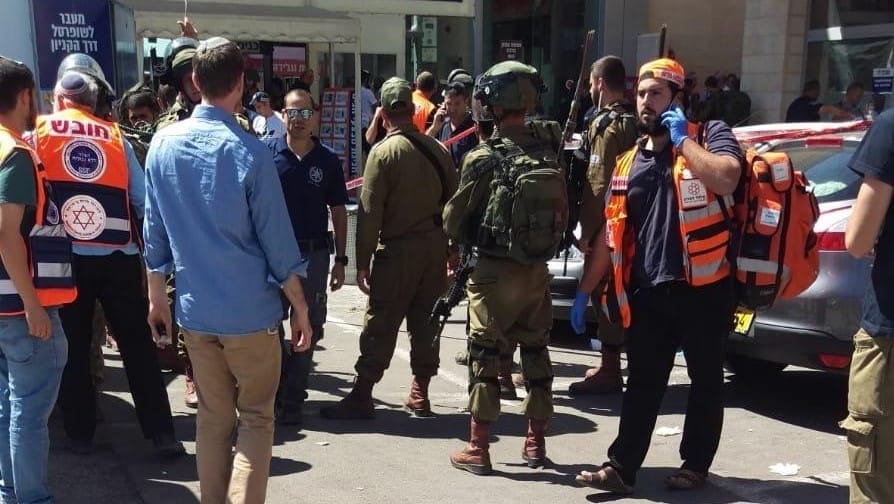
Illustrative: Security forces arrive at the scene after an Israeli man was stabbed in a terrorist attack at a shopping mall next to the Gush Etzion Junction on September 16, 2018. (United Hatzalah)

Palestinian terror attacks from the West Bank dropped for the fourth consecutive year, the IDF said Monday, releasing its summary of 2018.

In 2018, the army documented 87 “terror events,” 10 fewer than the 97 recorded in 2017. This was a steep decline from the 169 in 2016 and 219 terror attacks in 2015.

The IDF also considers attacks on soldiers, not just civilians, to be terror attacks.

Sixteen Israelis were killed in West Bank terror attacks in 2018: nine civilians and seven soldiers — a slight decrease from the 20 killed in 2017, 12 of whom were civilians.

However, the outgoing calendar year did see a slight rise in the number of people injured in terror. One hundred and ninety-nine people were injured in attacks in 2018 — 30 more than in 2017. Still the number marked a significant drop from the total injured in 2016 and 2015, when 263 and 360 people were wounded, respectively.

According to the IDF, the number of shooting attacks was almost the same, with 33 in 2018, compared to 34 in 2017. However, there was a jump in the number of stabbings, with 17 recorded, up from 5 in 2017.

There was a sharp drop in the incidents of stone throwing, with 2,057 recorded, compared to 5,082 in 2017.

The army conducted almost nightly raids in the West Bank, arresting 3,173 terror suspects, confiscating 406 weapons and seizing NIS 2,156,089 ($572,754) in terror funds, the army said.

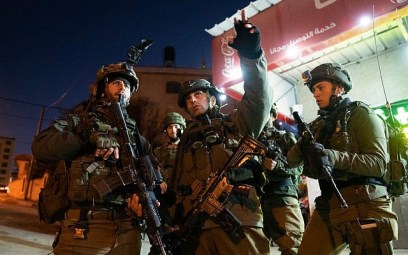
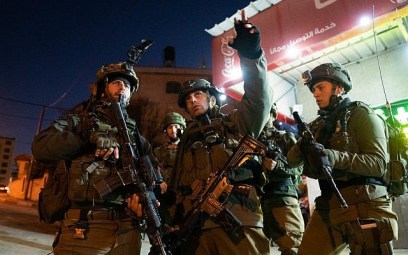
Israeli troops search for the terrorists who committed a shooting attack on a bus stop outside the Ofra settlement in the West Bank, near Ramallah, in which seven Israelis were injured, including a pregnant woman, on December 9, 2018. (Israel Defense Forces)

In the Gaza Strip, the IDF said that it carried out 865 strikes in response to roughly 1,000 launches from Palestinian terror groups directed at Israel. Just 45 of those launches managed to land in built up areas within the Jewish state. Two hundred of them were intercepted by the Iron Dome missile defense system.

The army also said that it had constructed 27 kilometers (178 miles) of an underground barrier designed to prevent terror groups like Hamas digging attack tunnels into Israel. The army said it destroyed 15 tunnels in 2018, including one undersea tunnel.

However, the army provided no details on its efforts to contain the weekly mass protests along the Gaza border.

The surge of violence in Gaza began in March with a series of protests along the border that were dubbed the “March of Return.” The clashes, which Gaza’s Hamas rulers orchestrated, have included rock and Molotov cocktail attacks on troops, as well as attempts to breach the border fence and attack Israeli soldiers.

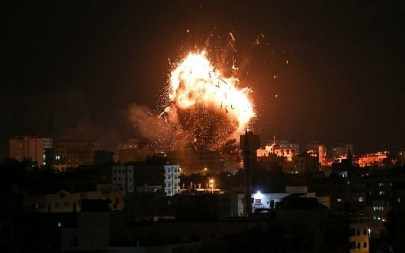
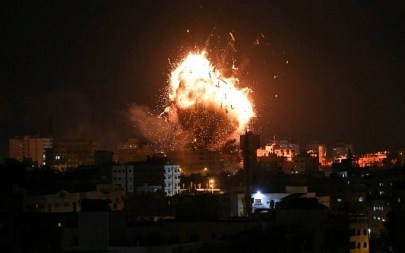
A picture taken on November 12, 2018 shows a ball of fire above the building housing the Hamas-run television station al-Aqsa TV in Gaza City during an Israeli air strike. ( Bashar TALEB / AFP)

Incendiary devices launched from Gaza on kites and balloons also caused hundreds of fires inside Israel and destroyed thousands acres of farm land and nature reserves.

Since the protests began in March, at least 150 Palestinians have been killed and several thousand wounded in the clashes. Hamas, which seeks to destroy Israel, has acknowledged that dozens of those killed were its members. During that time, a Gaza sniper killed an Israeli soldier. Another Israeli soldier was killed in a botched raid inside Gaza.

On Israel’s northern border with Lebanon and Syria, the IDF summed up its activities by saying it built 13 kilometers (8 miles) of walls and another 2.5 kilometers (1.5 miles) in the Golan Heights.

It also noted that IDF opened the Quneitra crossing between Israel and Syria for the first time since 2014.

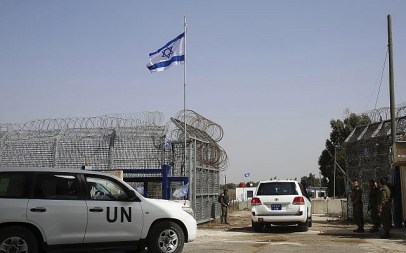
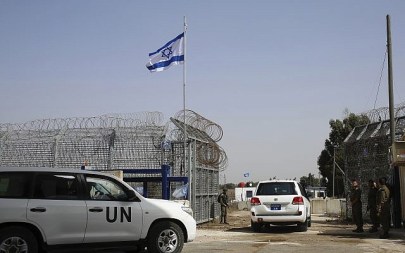
An Israeli soldier opens the border gates as a UN vehicle enters Syria at the Quneitra crossing in the Golan Heights, October 15, 2018. (AP Photo/Ariel Schalit)

The army made no mention of the Hezbollah terror tunnels recently uncovered on the Lebanese border, nor the dozens of airstrikes carried out on Iranian targets in Syria.

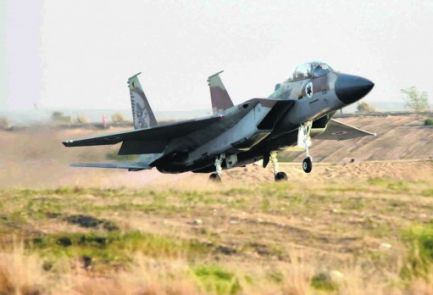
However, it did note that fighter planes flew more than 2,000 sorties, helicopters flew more than 600, and IAF drones flew 32,166 operational hours.

The annual report also included some noncombat statistics, noting that 674 children were born to conscript soldiers and that it had provided vegan meals to some 10,000 soldiers.


IDF sees drop in West Bank terror attacks for 4th consecutive year

December 31, 2018

Source: IDF sees drop in West Bank terror attacks for 4th consecutive year | The Times of Israel

2018 saw a slight decrease in fatalities from 2107 with 16 Israelis killed, but the number of injured rose

Illustrative: Security forces arrive at the scene after an Israeli man was stabbed in a terrorist attack at a shopping mall next to the Gush Etzion Junction on September 16, 2018. (United Hatzalah)

Illustrative: Security forces arrive at the scene after an Israeli man was stabbed in a terrorist attack at a shopping mall next to the Gush Etzion Junction on September 16, 2018. (United Hatzalah)

Palestinian terror attacks from the West Bank dropped for the fourth consecutive year, the IDF said Monday, releasing its summary of 2018.

In 2018, the army documented 87 “terror events,” 10 fewer than the 97 recorded in 2017. This was a steep decline from the 169 in 2016 and 219 terror attacks in 2015.

The IDF also considers attacks on soldiers, not just civilians, to be terror attacks.

Sixteen Israelis were killed in West Bank terror attacks in 2018: nine civilians and seven soldiers — a slight decrease from the 20 killed in 2017, 12 of whom were civilians.

However, the outgoing calendar year did see a slight rise in the number of people injured in terror. One hundred and ninety-nine people were injured in attacks in 2018 — 30 more than in 2017. Still the number marked a significant drop from the total injured in 2016 and 2015, when 263 and 360 people were wounded, respectively.

According to the IDF, the number of shooting attacks was almost the same, with 33 in 2018, compared to 34 in 2017. However, there was a jump in the number of stabbings, with 17 recorded, up from 5 in 2017.

There was a sharp drop in the incidents of stone throwing, with 2,057 recorded, compared to 5,082 in 2017.

The army conducted almost nightly raids in the West Bank, arresting 3,173 terror suspects, confiscating 406 weapons and seizing NIS 2,156,089 ($572,754) in terror funds, the army said.

Israeli troops search for the terrorists who committed a shooting attack on a bus stop outside the Ofra settlement in the West Bank, near Ramallah, in which seven Israelis were injured, including a pregnant woman, on December 9, 2018. (Israel Defense Forces)

In the Gaza Strip, the IDF said that it carried out 865 strikes in response to roughly 1,000 launches from Palestinian terror groups directed at Israel. Just 45 of those launches managed to land in built up areas within the Jewish state. Two hundred of them were intercepted by the Iron Dome missile defense system.

The army also said that it had constructed 27 kilometers (178 miles) of an underground barrier designed to prevent terror groups like Hamas digging attack tunnels into Israel. The army said it destroyed 15 tunnels in 2018, including one undersea tunnel.

However, the army provided no details on its efforts to contain the weekly mass protests along the Gaza border.

The surge of violence in Gaza began in March with a series of protests along the border that were dubbed the “March of Return.” The clashes, which Gaza’s Hamas rulers orchestrated, have included rock and Molotov cocktail attacks on troops, as well as attempts to breach the border fence and attack Israeli soldiers.

A picture taken on November 12, 2018 shows a ball of fire above the building housing the Hamas-run television station al-Aqsa TV in Gaza City during an Israeli air strike. ( Bashar TALEB / AFP)

Incendiary devices launched from Gaza on kites and balloons also caused hundreds of fires inside Israel and destroyed thousands acres of farm land and nature reserves.

Since the protests began in March, at least 150 Palestinians have been killed and several thousand wounded in the clashes. Hamas, which seeks to destroy Israel, has acknowledged that dozens of those killed were its members. During that time, a Gaza sniper killed an Israeli soldier. Another Israeli soldier was killed in a botched raid inside Gaza.

On Israel’s northern border with Lebanon and Syria, the IDF summed up its activities by saying it built 13 kilometers (8 miles) of walls and another 2.5 kilometers (1.5 miles) in the Golan Heights.

It also noted that IDF opened the Quneitra crossing between Israel and Syria for the first time since 2014.

An Israeli soldier opens the border gates as a UN vehicle enters Syria at the Quneitra crossing in the Golan Heights, October 15, 2018. (AP Photo/Ariel Schalit)

The army made no mention of the Hezbollah terror tunnels recently uncovered on the Lebanese border, nor the dozens of airstrikes carried out on Iranian targets in Syria.

However, it did note that fighter planes flew more than 2,000 sorties, helicopters flew more than 600, and IAF drones flew 32,166 operational hours.

The annual report also included some noncombat statistics, noting that 674 children were born to conscript soldiers and that it had provided vegan meals to some 10,000 soldiers.


Trump phases Arab forces into Syria vs Iran ahead of US pullout. Egyptian/UAE officers on the scene – DEBKAfile

December 31, 2018

Source: Trump phases Arab forces into Syria vs Iran ahead of US pullout. Egyptian/UAE officers on the scene – DEBKAfile

When Sen. Lindsay Graham said Monday, Dec. 31: “I think we are slowing things [exit from Syria] down in a smart way,” he confirmed DEBKAfile’s Dec. 22 report: “US troops will leave eastern and northern Syria, but America is not deserting this part of the country and will continue to maintain a presence after the pullout.”

On Monday, the Republican Senator, who sharply criticized President Donald Trump for the troop withdrawal as a “huge Obama-like mistake,” stated: “The president assured me he is going to make sure he gets the job done.”

Our sources can now reveal the nature of that presence and the process afoot for the gradual US withdrawal. In the last few days, Egyptian and UAE military officers visited the contested north Syrian town of Manbij. They toured the town and its outskirts, checked out the locations of US and Kurdish YPG militia positions, and took notes on how to deploy their own troops as replacements. On the diplomatic side, the White House is in continuous conversation with the UAE Crown Prince Sheikh Muhammed Bin Ziyad (MbZ) and Egyptian President Abdel-Fatteh El-Sisi. The deal Trump is offering, is that they take over US positions in Manbij, where the Kurds have sought protection against a Turkish invasion, and American air cover will be assured against Russian, Syrian or Turkish attack.

As DEBKAfile has noted, the Egyptian president, during his four years in power, was the only Arab leader to consistently side with Bashar Assad against the insurgency against his regime. Assad may therefore accept the posting of Egyptian forces in Manbij so long as Syrian officers are attached to their units. The Syrian president would likely also favor a UAE military presence. Not only was the emirate the first Arab nation to reopen its embassy in Damascus after long years of Arab boycott, but unlike most of its Arab League colleagues, the UAE can well afford to contribute funding for the colossal reconstruction task needed for getting the war-devastated country on its feet.

Approval of the Egyptian-UAE forces to Manbij would kick off the stationing of mixed Arab forces in other parts of Syria, including the border with Iraq. If the Trump administration’s plans mature, then countries like Saudi Arabia, Morocco and Algeria would send troops to push the Iranian military presence out of key areas where they have taken hold.

After being briefed on this plan by the president, Sen. Graham made this satisfied comment: “I think we’re in a pause situation where we are re-evaluating what’s the best way to achieve the president’s objective of having people pay more and do more.”