Bolsonaro accepts Netanyahu’s invitation, issued during first meeting in Rio, to visit the Jewish state; no talks on possible embassy move
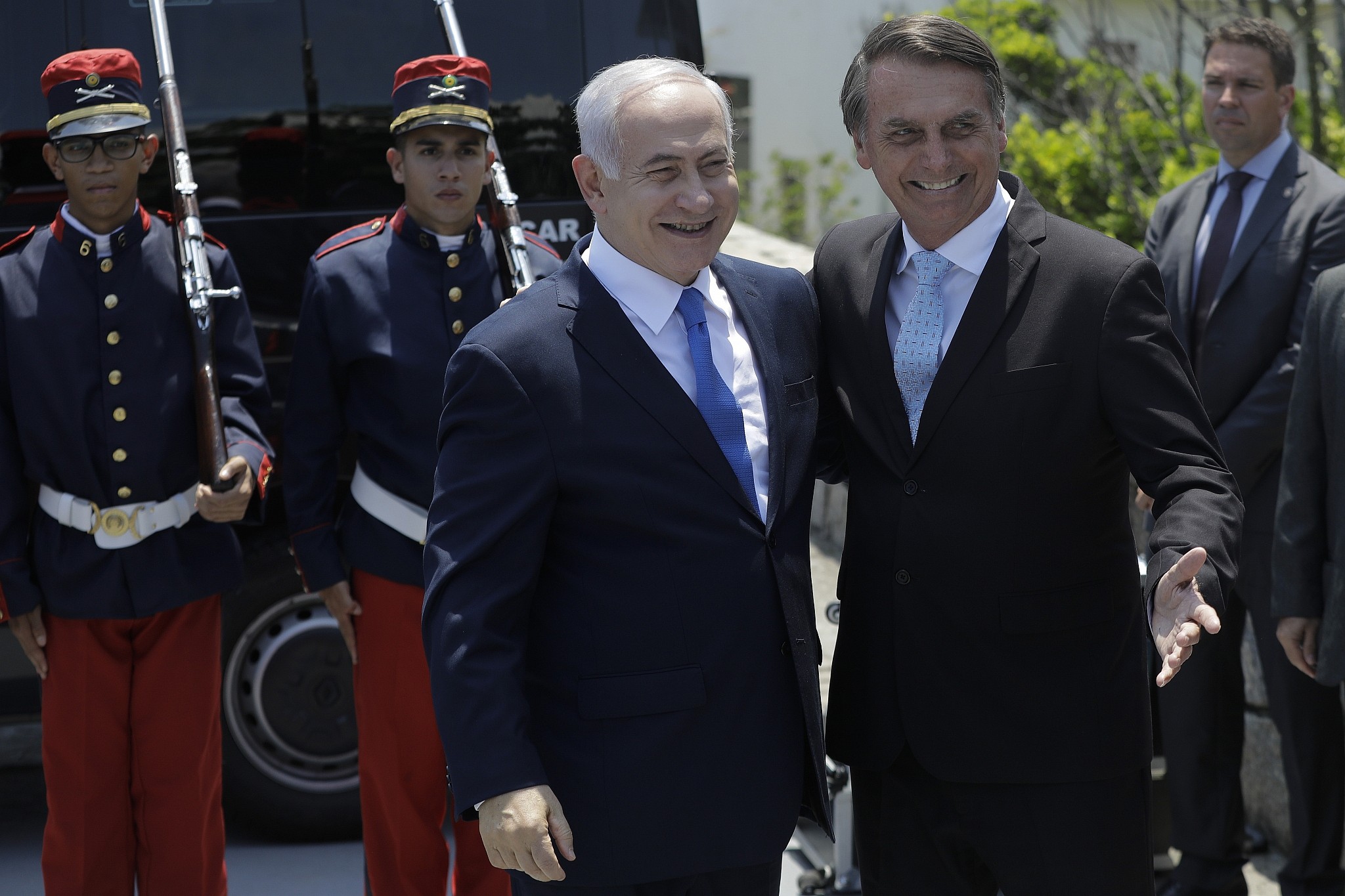
RIO DE JANIERO — Brazilian President-elect Jair Bolsonaro said he expects to visit Israel in March 2019, after accepting an invitation by Prime Minister Benjamin Netanyahu who is currently on a state trip to Brazil, according to a Reuters report cited by the Hebrew-language media.
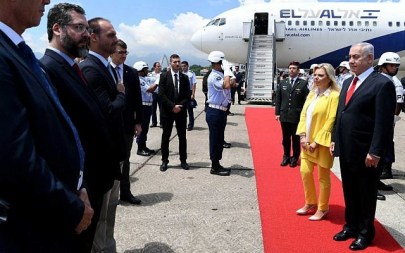
Netanyahu arrived in Brazil on Friday, accompanied by his wife Sarah and son Yair, and the family is set to stay on through Tuesday to join other foreign dignitaries at the inauguration in Brasilia of Bolsonaro, a far-right, security-conscious politician and former army officer elected in October on pledges to crack down on endemic crime and corruption.
Netanyahu’s is the first-ever visit by an Israeli prime minister to Brazil.
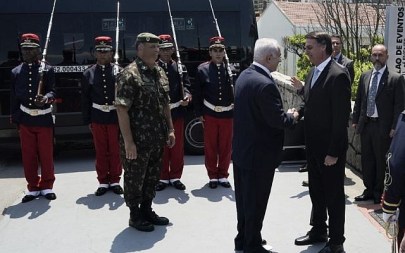
Following a private meeting Friday in a century-old military fort on Rio de Janeiro’s Copacabana beach, the two issued the warm words to the media, hailing a nascent “brotherhood” between their countries that will boost economic, military, and technological cooperation.
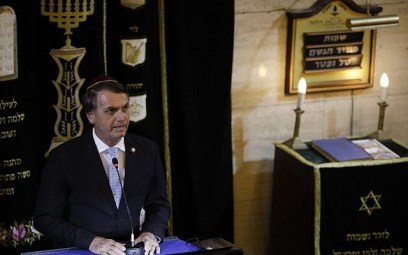
They then visited a local synagogue.
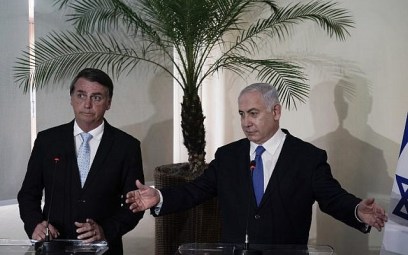
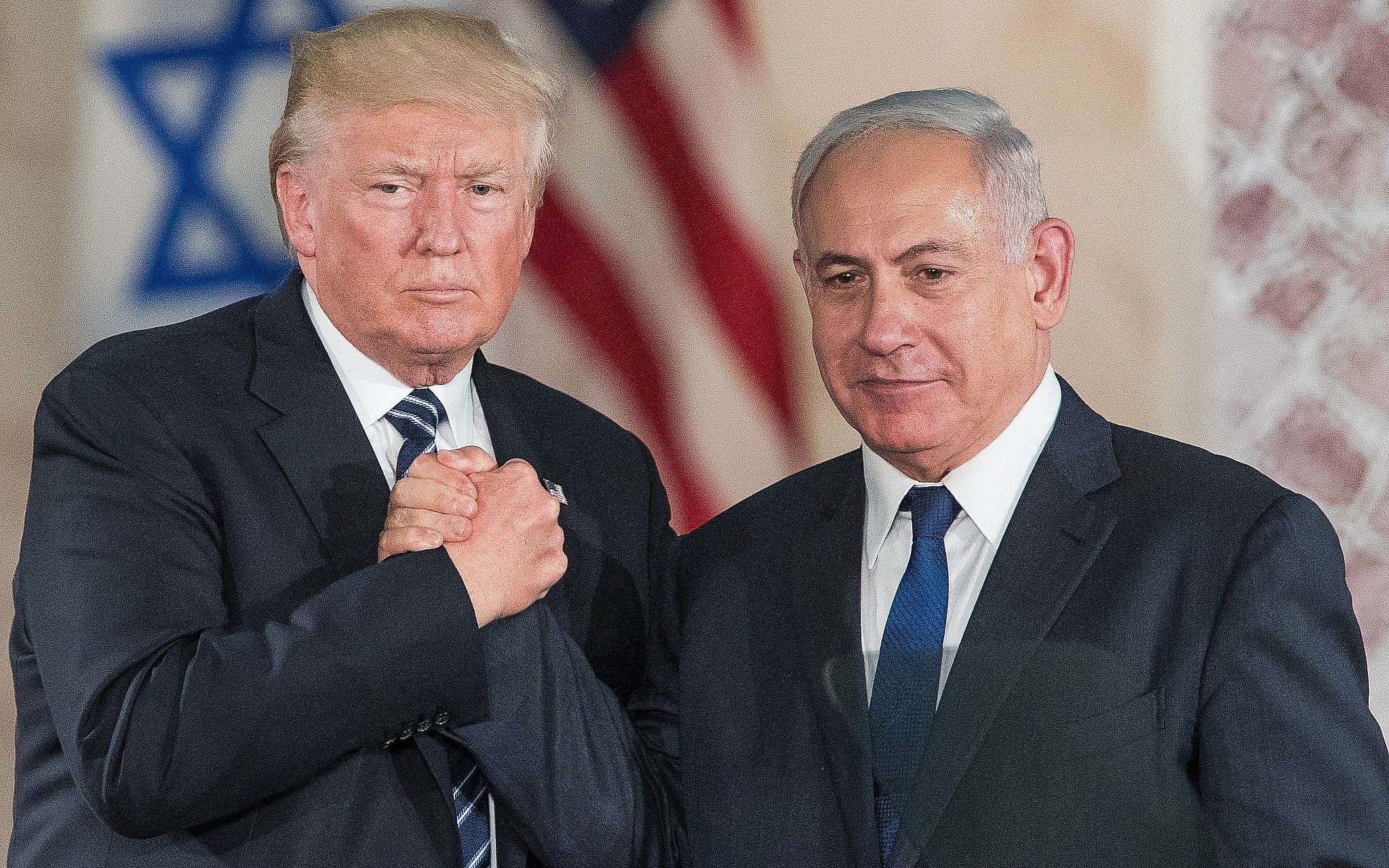
Bolsonaro, sometimes called the “Trump of the tropics” for a similar style to US President Donald Trump and rejection of multilateral diplomacy, emphasized the bond he wants to build with Netanyahu, a firm US ally.
“More than partners, we will be brothers in the future, in economy, technology, all that can bring benefit to our two countries,” Bolsonaro said. He also spoke of cooperation in military and agriculture matters.
Netanyahu, calling his visit “historic,” also spoke of “the brotherhood, the alliance” the two planned as something that “can carry us to great heights.”
“Through our mutual cooperation, enormous benefits will be created for our two peoples,” Netanyahu said. “It’s hard to believe that we had no such contacts before,” he added.
Brazil and Israel have previously had cordial but strained relations.
The leftist Workers Party, which had dominated Brazilian politics for 13 years before Bolsonaro’s election, often showed support for the Palestinian independence movement. But Bolsonaro and Netanyahu have developed an increasingly warm relationship with similar views on security issues.
Netanyahu announced his trip to Brazil following a November 1 tweet from Bolsonaro indicating he intends to move the Brazilian Embassy in Israel from Tel Aviv to Jerusalem, following in Trump’s footsteps. He later walked it back.
There was no mention of Bolsonaro’s post-election declaration on Friday.
Netanyahu had told reporters on his flight to Brazil that “you can be certain I will speak with him about that in our first meeting.” But neither man raised the topic in their comments to media, and no questions were taken.
An embassy move could put at risk lucrative Brazilian poultry and halal meat exports to Arab countries, which fiercely oppose any unilateral moves seen as cementing Israel’s claim to all of Jerusalem as its capital.
The Palestinians view East Jerusalem as the capital of their future state, and most countries in the world back a longstanding consensus that Jerusalem’s status can only be resolved through negotiations and as part of an Israeli-Palestinian peace process.
Nearly 20 percent of Brazil’s $5 billion beef exports go to 17 Arab countries.
Brazil-Israel trade currently amounts to $1.2 billion.
In preparation for his tenure as president, Bolsonaro has sent aides to Israel to study desalination technology and to investigate the potential purchase of drones for use by Brazilian security forces.
Bolsonaro’s ascent to the presidency represents a dramatic, rightward shift in Brazil’s politics.
For decades, the country has been under center-left and center-right rule and resolutely sought to carve out foreign policy independent of the United States. In 2010 the country recognized a Palestinian state, and it nurtured trade and investment relations with China.
But Bolsonaro has spoken with hostility of China’s investments in Brazil, and he and one of his politician sons have reached out to Trump and people in his orbit.
He and his team have also excluded the far-left leaders of Cuba, Venezuela, and Nicaragua from attending the inauguration in Brasilia, although Bolivia’s left-wing President Evo Morales received an invitation.
Other VIPs attending include conservative Chilean President Sebastian Pinera, Hungary’s far-right Prime Minister Viktor Orban, and US Secretary of State Mike Pompeo.
Netanyahu made his Brazil trip despite domestic political turmoil in Israel and a spike in military volatility in neighboring Syria.
Pompeo and Netanyahu are to discuss Syria on the sidelines of Bolsonaro’s swearing-in, an Israeli official and the US State Department said.
US allies including Israel were caught by surprise by Trump’s abrupt announcement last week that he was pulling US troops out of Syria, where Israel’s arch-foe Iran has built up a significant military and political presence.
Israel has made several aerial strikes in Syria against positions held by Iran and its Lebanese militia Hezbollah.
Domestically, Netanyahu is maneuvering to extend his reign in Israel despite a slew of corruption allegations. On Wednesday, Israel’s parliament approved a government decision to call early elections for April 9.
Source: Scrap over Manbij opens door for Russia and Assad’s troops to take control of NE. Syria – DEBKAfile

One of Bashar Assad’s best weeks in years – and one of Tayyip Erdogan’s worst – peaked on Friday, Dec. 28. The US exit from NE Syria announced by President Donald Trump on Dec. 19 left an irresistible void for multiple forces to close in, even before a single American soldier was actually lifted off Syrian soil.
In the wake of that announcement, the UAE cancelled its plans to send troops into northern Syria and instead reopened its embassy in Damascus for the resumption of normal relations, after years of backing the Syrian rebellion against the Assad regime. DEBKAfile’s intelligence sources have learned that Saudi Arabia will shortly follow suit. The two Gulf nations are therefore lining up behind Trump’s new Syrian policy.
Encouraged by the hoisting of the UAE flag over its Damascus embassy, Bashar Assad ordered his army on Friday to advance on the northern flashpoint town of Manbij which had been lost to him for most years of the civil war. A Syrian army vanguard has already reached the town’s outskirts, drawing to a halt at its southern entrance. Kurdish YPG militiamen raised the Syrian flag over the town center, after the Kurdish-led, US-backed Syrian Democratic Forces (SDF) and Syrian Arab Army (SAA) reached deal with the Syrian government to ward off the threatened Turkish invasion of this border town.
DEBKAfile’s military and intelligence sources can reveal that Russian officers are attached to the command of the Syrian units at the gates of Manbij, This is highly significant because, before accepting the Kurdish request, Assad also sought and received the consent of Russian President Vladimir Putin. In no time, Kremlin spokesperson, Dmitry Peskov, went on record to call Assad’s move a “positive step” that could help stabilize the situation. No surprise there, since the Russians now see their way for the first time to crossing the Euphrates River into northeastern Syria. This move would finally bury the Putin-Obama deal which split Syria between the two powers – Russia in the west and the US east of the Euphrates.
The Assad Kurdish deal for the transfer of Manbij to the Syrian government is a stinging setback from Turkish President Erdogan, the second in a month. He was first convinced that he had President Trump’s approval, after the US exit, for his army to move in on Kurdish turf in northeastern Syria, cross the Euphrates and take their capital of Qamishli. Trump did not explicitly dispel this impression. But when a high-ranking US delegation promised to arrive in Ankara and coordinate US-Turkish military moves never turned up, the Turkish leader began to see his plans going up in smoke.
He reacted by announcing on Tuesday, Dec. 25 that he was heading to Moscow to discuss with Putin the crisis over the forthcoming US troop pullout and his plan to move the Turkish army across the Euphrates. But then came a slap from the Kremlin. Peskov said that the Russian president’s schedule for the coming days was full.
Bereft of support from either Trump or Putin, Erdogan announced that a Turkish delegation of his top officials would travel to Moscow on Saturday, Dec. 29. Led by Defense Minister Gen. Hulusi Akar, Director of MIT intelligence Hakan Fidan and Foreign Minister Mevlut Cavusoglu. The day before the delegation left, the Syrian army reached the outskirts of the key border town of Manbij. In a belated show of muscle, Erdogan ordered Turkey’s Syrian rebel allies – mostly Turkoman militias – to “launch their Manbij offensive.” Moscow is not likely to be impressed.
Amid concerns over pullout from Syria, State Department stresses commitment to Israeli security is ‘enduring and unshakable’
The US on Friday gave its full backing to Israeli efforts to counter Iran’s “aggressive adventurism” in the Middle East, just days after Iranian military facilities in Syria were targeted in alleged Israeli strikes.
“The United States fully supports Israel’s right to defend itself against Iranian regional actions that endanger Israeli national security and the safety of the Israeli people,” deputy State Department spokesperson Robert Palladino said in a statement.
“Iranian support of and supply to terrorist groups in Syria and across the region that have the clear intent and capability to strike Israel are unacceptable,” he added.
The airstrikes late Tuesday and early Wednesday, which an unnamed Israeli defense official told The Associated Press targeted several Iranian sites, were the first attributed to Israel since US President Donald Trump’s sudden announcement this month he would pull all American troops from Syria.
That move has sparked concern in Israel, which has accused archenemy Iran of working to establish a military presence in Syria that could threaten the Jewish state and be used to transfer weaponry to the Hezbollah terror group in Lebanon.
“The United States fully supports Israel’s right to defend itself against the Iranian regime’s aggressive adventurism, and we will continue to ensure that Israel has the military capacity to do so decisively,” Palladino said.
“The commitment of the Trump Administration and the American people to ensuring Israel’s security is both enduring and unshakable.”
Also Friday, Trump’s National Security Adviser John Bolton said he will visit Israel and Turkey in January for talks on regional security as the US moves forward with the troop pullout from Syria.
“We will discuss our continued work confronting security challenges facing allies & partners in the region, including the next phase of the fight against ISIS, as the U.S. begins to bring troops home from Syria,” he wrote on Twitter.
Despite domestic and international criticism over the Syria withdrawal, Trump has defended the move and said Wednesday he was not concerned it would endanger Israeli security by emboldening Iran, pointing to extensive US military aid for Israel.
“I told Bibi. And, you know, we give Israel $4.5 billion a year. And they’re doing very well defending themselves, if you take a look,” Trump saidduring a visit to US troops in Iraq, using Prime Minister Benjamin Netanyahu’s nickname.
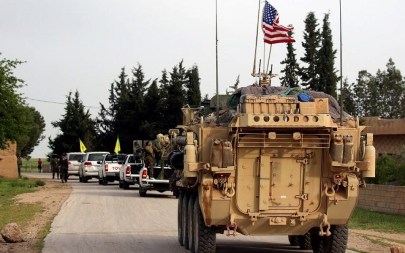
Israel has repeatedly warned in recent years that Iran is seeking to establish a military presence in Syria, where it is fighting alongside Russia and Hezbollah on behalf of Syrian President Bashar Assad.
Israeli officials have said that America’s absence would open the door for Tehran to create a so-called “land bridge” from Iran, through Iraq and Syria, into Lebanon and to the Mediterranean Sea.
“We will study its timetable, how it will be implemented and — of course — its implications for us. In any case we will take care to maintain the security of Israel and to defend ourselves in this area,” Netanyahu said in an English-language statement released by his office immediately following Trump’s announcement on December 19.
While most American troops have been stationed in northeastern Syria, backing Kurdish fighters, a smaller number have maintained a presence along the Iraqi border at al-Tanf, frustrating Iranian efforts to move weapons and technology.
After talks in Rio on first-ever visit by an Israeli PM, Netanyahu and Bolsonaro speak of budding ‘brotherhood,’ ignore Jerusalem issue
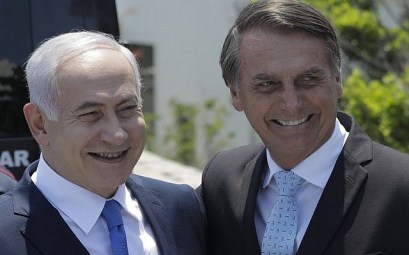
RIO DE JANIERO (AFP) — Prime Minister Benjamin Netanyahu and Brazil’s president-elect Jair Bolsonaro on Friday announced a nascent “brotherhood” between their countries that will boost economic, military, and technological cooperation.
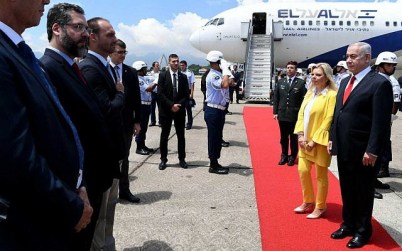
The two issued the warm words to the media after a meeting in a century-old military fort on Rio de Janeiro’s Copacabana beach, at the beginning of the first-ever visit by an Israeli prime minister to Brazil.
Netanyahu said Bolsonaro had accepted an invitation to make his own visit to Israel, without giving a date.
The Israeli leader is to stay on through Tuesday to join other foreign dignitaries at the inauguration in Brasilia of Bolsonaro, a far-right, security-conscious politician and former army officer elected in October on pledges to crack down on endemic crime and corruption.
Bolsonaro, sometimes called the “Trump of the tropics” for a similar style to US President Donald Trump and rejection of multilateral diplomacy, emphasized the bond he wants to build with Netanyahu, a firm US ally.
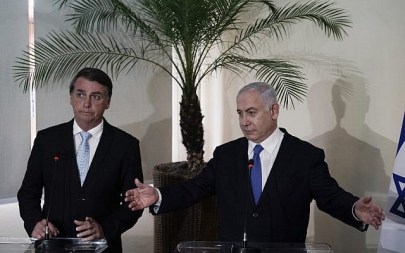
“More than partners, we will be brothers in the future, in economy, technology, all that can bring benefit to our two countries,” Bolsonaro said. He also spoke of cooperation in military and agriculture matters.
Netanyahu, calling his visit “historic,” also spoke of “the brotherhood, the alliance” the two planned as something that “can carry us to great heights.”
“It’s hard to believe that we had no such contacts before,” he said.
Later, the two leaders visited a synagogue in the city.
However there was no mention of Bolsonaro’s post-election declaration — later walked back — that he intended to follow Trump in moving his country’s embassy in Israel to Jerusalem.
Netanyahu had told reporters on his flight to Brazil that “you can be certain I will speak with him about that in our first meeting.” But neither man raised the topic in their comments to media, and no questions were taken.
An embassy move could put at risk lucrative Brazilian poultry and halal meat exports to Arab countries, which fiercely oppose any unilateral moves seen as cementing Israel’s claim to all of Jerusalem as its capital.
The Palestinians view East Jerusalem as the capital of their future state, and most countries in the world back a longstanding consensus that Jerusalem’s status can only be resolved through negotiations and as part of an Israeli-Palestinian peace process.
Nearly 20 percent of Brazil’s $5 billion beef exports go to 17 Arab countries.
Brazil-Israel trade currently amounts to $1.2 billion. Bolsonaro said Tuesday he is looking to import Israeli technology to produce water for Brazil’s parched northeast.
Bolsonaro’s ascent to the presidency represents a dramatic, rightward shift in Brazil’s politics.
For decades, the country has been under center-left and center-right rule and resolutely sought to carve out foreign policy independent of the United States. In 2010 the country recognized a Palestinian state, and it nurtured trade and investment relations with China.
But Bolsonaro has spoken with hostility of China’s investments in Brazil, and he and one of his politician sons have reached out to Trump and people in his orbit.
He and his team have also excluded the far-left leaders of Cuba, Venezuela, and Nicaragua from attending the inauguration in Brasilia, although Bolivia’s leftwing President Evo Morales received an invitation.
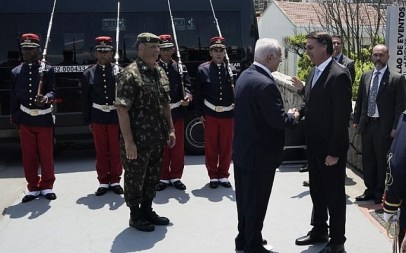
Other VIPs attending include conservative Chilean President Sebastian Pinera, Hungary’s far-right Prime Minister Viktor Orban, and US Secretary of State Mike Pompeo.
Netanyahu made his Brazil trip despite domestic political turmoil in Israel and a spike in military volatility in neighboring Syria.
Pompeo and Netanyahu are to discuss Syria on the sidelines of Bolsonaro’s swearing-in, an Israeli official and the US State Department said.
US allies including Israel were caught by surprise by President Donald Trump’s abrupt announcement last week that he was pulling US troops out of Syria, where Israel’s arch-foe Iran has built up a significant military and political presence.
Israel has made several aerial strikes in Syria against positions held by Iran and its Lebanese militia Hezbollah.
Domestically, Netanyahu is maneuvering to extend his reign in Israel despite a slew of corruption allegations. On Wednesday, Israel’s parliament approved a government decision to call early elections for April 9.
Source: Trump advisor heads to Turkey, Israel after Syria pullout | The Times of Israel
US president last week unexpectedly said he was pulling all 2,000 troops from war-torn country, declaring that America had achieved its objective there
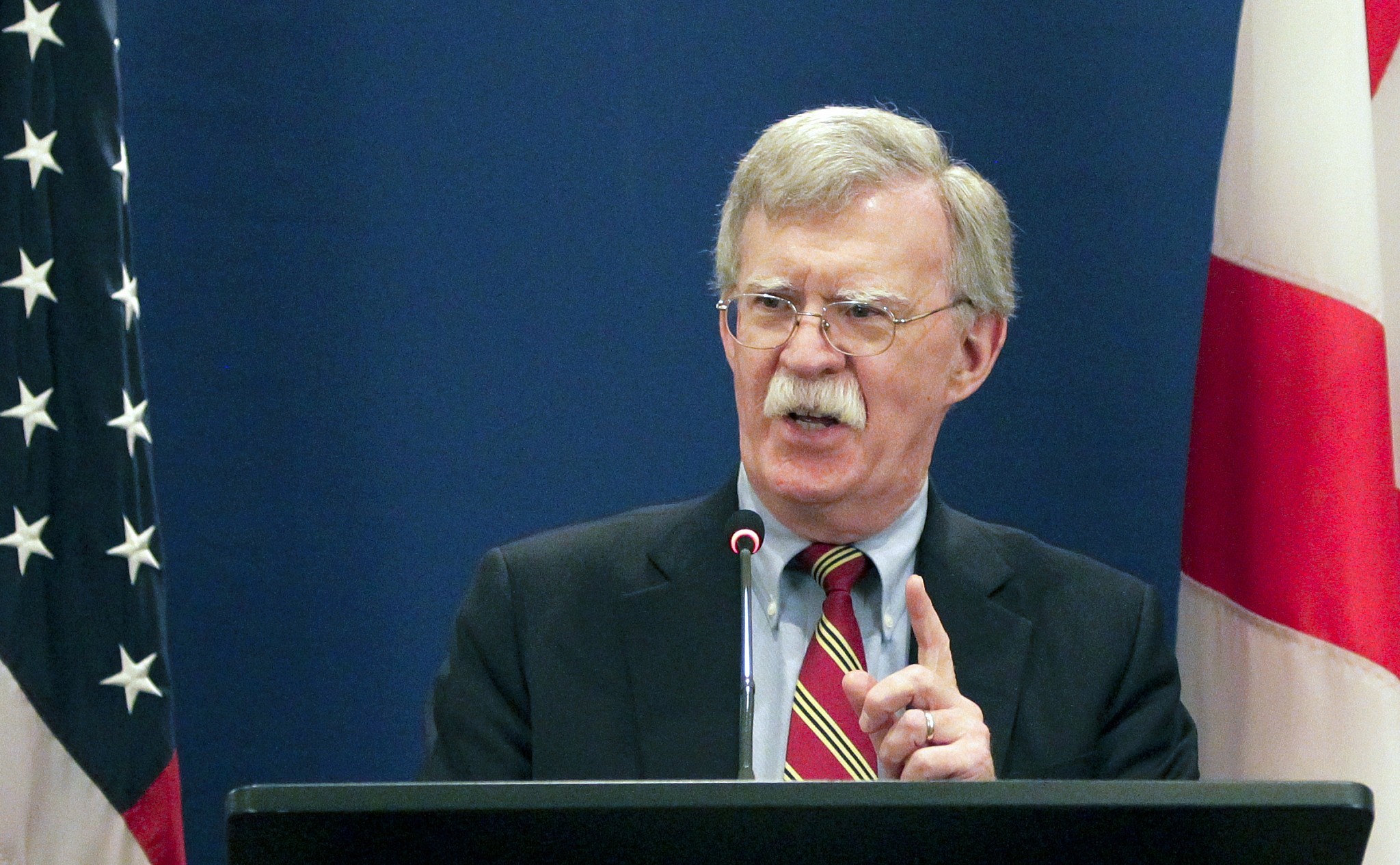
US national security advisor John Bolton said Friday he would visit Turkey and Israel to coordinate on Syria, after President Donald Trump’s decision to withdraw all US forces.
Bolton said he would head in January to both Turkey — which has enthusiastically backed Trump’s sudden move — as well as Israel, a close US ally where the pullout has caused concern.
“We will discuss our continued work confronting security challenges facing allies and partners in the region, including the next phase of the fight against ISIS, as the US begins to bring troops home from Syria,” Bolton tweeted.
Trump last week unexpectedly said he was pulling all 2,000 troops from Syria, declaring that the United States had achieved its objective as the Islamic State extremist movement had been “knocked” out.
Islamic State, also known as ISIS, has lost nearly all of its territory, although thousands of its jihadists are thought to remain in war-battered Syria.
The United States, meanwhile, robustly defended Israel’s right to strike inside Syria after criticism from Russia, which backs President Bashar Assad and will see its clout grow with the US pullout.
Moscow condemned Israel’s alleged Tuesday missile strikes near Damascus, the latest of hundreds of raids Israel says are aimed at Iranian forces and their Hezbollah allies.
“The United States fully supports Israel’s right to defend itself against the Iranian regime’s aggressive adventurism, and we will continue to ensure that Israel has the military capacity to do so decisively,” State Department spokesman Robert Palladino said in a statement.
“The commitment of the Trump administration and the American people to ensuring Israel’s security is both enduring and unshakable,” he said.
Israeli Prime Minister Benjamin Netanyahu has been delighted by Trump’s hard line on Iran and landmark move of the US embassy in Israel to Jerusalem, but the pullout from Syria has caused unease concern in the Jewish state.
Secretary of State Mike Pompeo is set to meet next week in Brazil with Netanyahu in the wake of the Syria pullout decision, which triggered the resignation of Defense Secretary Jim Mattis.
Source: Russia to host Putin-Erdogan-Rouhani summit on Syria | The Times of Israel
Meeting comes following US President Donald Trump’s announcement that he will withdraw 2,000 US soldiers deployed in war-torn country
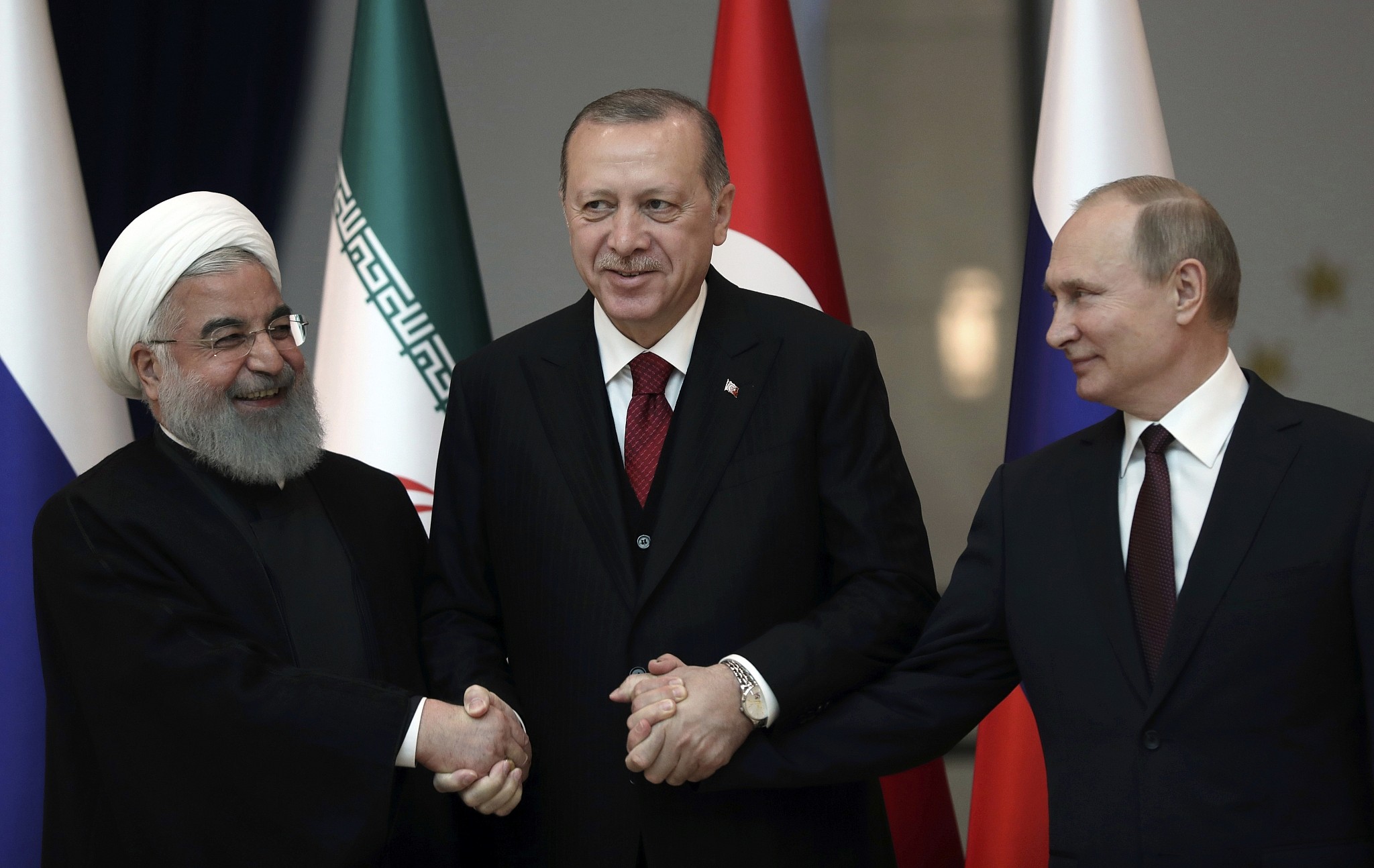
MOSCOW, Russia — Russia said Friday it will host a three-way summit with Turkey and Iran on the Syrian conflict early next year, after Foreign Minister Sergei Lavrov voiced skepticism about an announced withdrawal of US forces.
“It’s our turn to host the summit… around the first week of the year. This will depend on the schedules of the presidents” of the three countries, deputy foreign minister Mikhail Bogdanov was cited as saying by Interfax news agency.
The last meeting between Russia’s Vladimir Putin, Iran’s Hassan Rouhani and Turkey’s Recep Tayyip Erdogan took place in Iran in September.
Lavrov refused to comment Friday on the US announcement, saying he was “waiting for actions to follow words.”
US President Donald Trump has said he will withdraw 2,000 US soldiers deployed in Syria, claiming that the Islamic State jihadists there had been defeated.
“The Americans don’t always do what they promise, far from it,” Lavrov said. “Washington clearly wants to pass on the responsibilities on the ground to its partners in the coalition.”
A Turkish delegation that includes Foreign Minister Mevlut Cavusoglu and Defense Minister Hulusi Akar is due in Moscow on Saturday to discuss the US pullout.
Meanwhile, Kremlin spokesman Dmitry Peskov hailed the entry on Friday by Syrian forces into the key northern city of Manbij for the first time in six years after Kurds opened the gates.
“Of course, this will help in stabilizing the situation. The enlargement of the zone under the control of government forces… is without doubt a positive trend,” he said.
Kurdish forces who were left exposed by Trump’s pledge to withdraw US troops have asked the Syrian regime for help to face a threatened Turkish offensive.
Ankara is opposed to Kurdish control of Syrian territory close to its border, saying it helps Kurdish separatists inside Turkey.
Peskov said the Turkish ministers’ visit to Moscow would serve to “clarify” the situation and “synchronize actions” between the two countries.
A three-way summit in January would be the latest step in the Astana peace process — set up in early 2017 by Russia and Iran, who support President Bashar al-Assad’s regime in Syria, and opposition backer Turkey.
The Astana process was launched after Russia’s military intervention in Syria tipped the balance in the Damascus regime’s favor.
Lavrov said the “ultimate goal” of the Astana process is to “restore peace in Syria, with all ethnic and religious groups at ease and at peace, including the Kurds of course.”
Source: IDF attacks Hamas’ position in response to rocket fire from Gaza | The Times of Israel
Projectile launched from Strip landed in open area within the Jewish state, causing no damages or injures
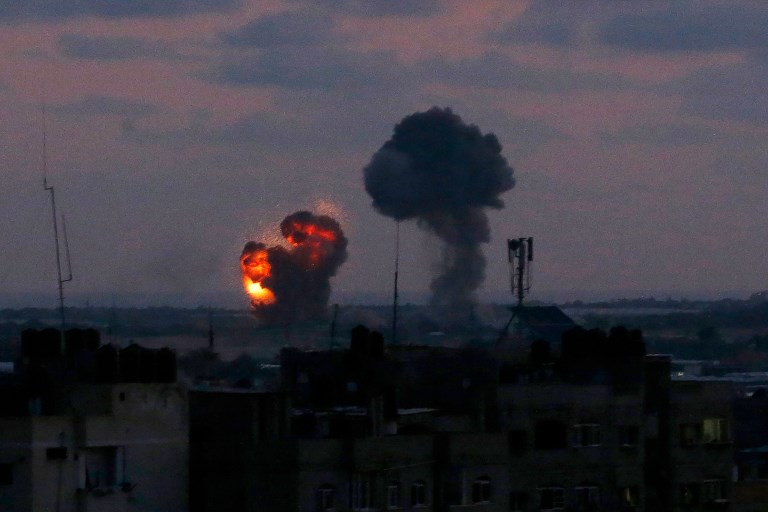
An IDF combat helicopter attacked a Hamas position in the southern Gaza Strip, the Israeli army said Saturday.
According to the IDF, the strike was carried out in response to an earlier rocket launch from the Strip at Israel.
The rocket fired Friday was the first such incident in over one month, the IDF Spokesperson’s Office said.
The Red Alert alarm warning system was not activated as the projectile landed in an open area, the spokesperson added.
No injuries or damage were reported.
Earlier Friday, a Palestinian was reported killed as thousands took part in protests along the border with the Gaza Strip, amid threats by terror factions in the coastal enclave to ramp up violence with Israel.
An Israeli army spokesperson said some 4,000 Palestinians took part in the riots, throwing rocks and explosive devices at soldiers. The explosives did not reach the border fence where troops were deployed.
Israeli forces responded with riot dispersal means, including live fire, the spokesperson said.
Also Friday, a suspected incendiary device landed near a kindergarten in a Gaza-area community, after a lull of several weeks for the airborne arson attempts from the coastal enclave.
Gaza protesters have launched hundreds of incendiary kites and balloons into Israel, sparking fires that have destroyed forests, burned crops, and killed livestock. Over 7,000 acres of land have been burned, causing millions of shekels in damages, according to Israeli officials. Some balloons have carried improvised explosive devices.

Last week, Prime Minister Benjamin Netanyahu said he had issued a warning to the rulers of the Strip, amid a spike in terror attacks in the West Bank. “I conveyed a clear message to Hamas — we won’t accept a situation of a truce in Gaza and terror in Judea and Samaria,” he told a cabinet meeting, using the biblical name for the West Bank.
Friday’s rocket fire came more than six weeks after Hamas and Palestinian terror groups in Gaza engaged in the heaviest battle with Israel since the 2014 war.
After an Israeli special forces operation in Gaza was exposed, and an Israeli soldier and seven Hamas gunmen were killed in the ensuing firefight, some 500 rockets and mortar shells were fired at southern Israel over the course of November 12-13 — more than twice the rate at which they were launched during the 2014 conflict.
The Iron Dome missile defense system intercepted over 100 of them. Most of the rest landed in open fields, but dozens landed inside Israeli cities and towns, killing one person, injuring dozens and causing significant property damage.
In response, the Israeli military said it targeted approximately 160 sites in the Gaza Strip connected to the Hamas and Palestinian Islamic Jihad terror groups, including four facilities that the army designated as “key strategic assets.”
The fighting ended on Tuesday, November 13, after a Hamas-announced ceasefire took effect, though this was not officially confirmed by Israel.
Defense minister Avigdor Liberman resigned in protest at the ceasefire, having pushed for a harsher Israeli response to the Hamas rocket attacks, reducing Netanyahu’s governing coalition to just 61 of the 120 Knesset seats — a move that helped trigger the dissolution of the Knesset on Wednesday, with elections now set for April 9. Education Minister Naftali Bennett threatened to quit and bolt the coalition with his Jewish Home party if he was not appointed to replace Liberman, but he subsequently withdrew his ultimatum.
Since March, Palestinians have been holding weekly protests on the border that Israel has accused Hamas of using as a cover for attacks on troops and attempts to breach the security fence. Israel has demanded an end to the violent demonstrations along the border in any ceasefire agreement.
Hamas, an Islamist terror group that seized control of Gaza in 2007 from the Fatah faction of Palestinian Authority President Mahmoud Abbas, openly seeks to destroy Israel.




 anneinpt
 artaxes
 danmillerinpanama
 davidking1530
 Peter Hofman
 Joseph Wouk
 Peter
Peter Louisiana Steve
 WarSclerotic
Recent Comments