( This is the first time I had a real problem with Trump’s foreign policy. Abandoning the Kurds {the only westernized Moslems in the region} feels like a betrayal of American values. – JW )
US president’s surprise announcement plunges volatile region into profound uncertainty, leaving America’s Kurdish allies in the lurch
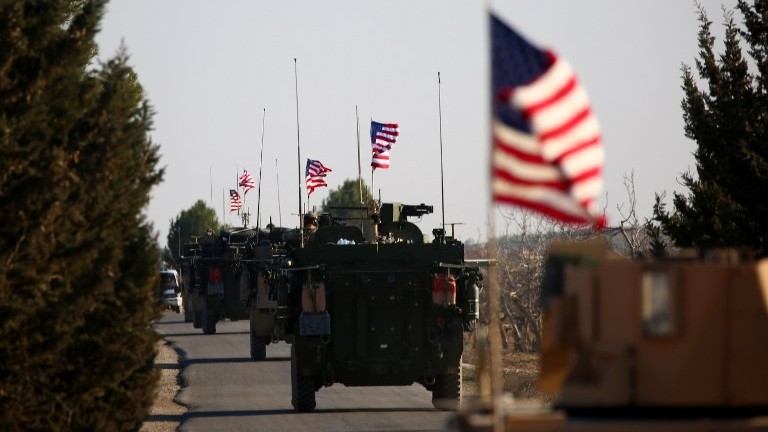
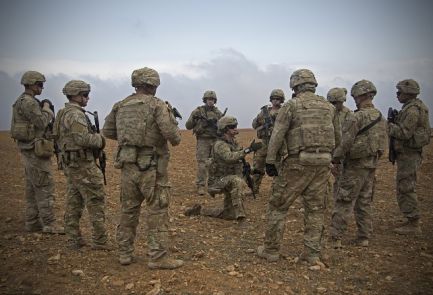
A convoy of US forces armoured vehicles drives near the village of Yalanli, on the western outskirts of the northern Syrian city of Manbij, on March 5, 2017. (AFP Photo/Delil Souleiman)
BEIRUT (AP) — The United States’ Kurdish allies had been gearing up for a new fight for weeks, digging trenches and defense tunnels in northeastern Syria in preparation for an offensive Turkey’s president warned was imminent.
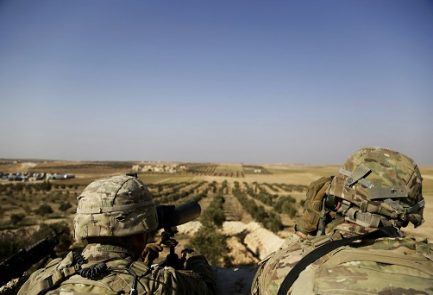
On the ground, US troops were bringing in reinforcements through the border with Iraq, beefing up patrols and observation points to prevent friction between the Turks and their Kurdish partners.
Then, in a surprise announcement, US President Donald Trump declared he was pulling all 2,000 US troops out of Syria, declaring the Islamic State group had been vanquished. The move, conveyed in a tweet Wednesday, plunged the volatile region into profound uncertainty, leaving America’s only allies in Syria in the lurch.
The US forces “were as surprised as we were” by the White House decision, said Mustafa Bali, spokesman for the Kurdish-led Syrian Democratic Forces.
A quick and unplanned withdrawal of American forces opens the door for major turmoil as various groups rush to fill the political and security vacuum, giving leverage to America’s enemies including Russia, Iran and President Bashar Assad’s government. Experts warn the Islamic State group, currently fighting to hang on to its last pockets in Syria, would soon find its way back.
“A full withdrawal sends the wrong signal, one that also will be heard by other counterterrorism partners far from Syria,” said William F. Wechsler, senior adviser for Middle East programs at the Atlantic Council.
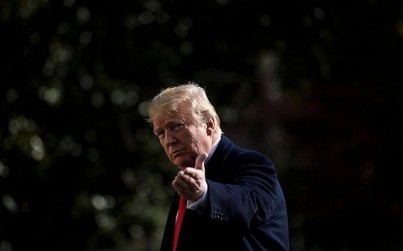
In this photo from November 29, 2018, US President Donald Trump points to the press while walking to Marine One on the South Lawn of the White House. (Brendan Smialowski/AFP)
Not surprisingly, Russian President Vladimir Putin welcomed Trump’s decision, saying Thursday the US forces should not have been in Syria to start with. A key ally of Assad, Russia’s military intervention beginning in 2015 turned the tide of the war in the Syrian leader’s favor.
“I agree with the US president, we have made significant progress in fighting terrorism on that territory and dealt serious blows to IS in Syria,” the Russian leader said.
But Trump, whose announcement contradicted his own experts’ assessments, now faces major pushback and political pressure from the Pentagon and other US officials not to withdraw from Syria.
On Thursday, he defended his decision, saying on Twitter: “Does the USA want to be the Policeman of the Middle East, getting NOTHING but spending precious lives and trillions of dollars protecting others who, in almost all cases, do not appreciate what we are doing? Do we want to be there forever?”
The announcement of a pullout is widely seen as an abandonment of a loyal ally, even though America’s partnership with the Kurds against the Islamic State group in Syria was always seen as a temporary marriage of convenience. With US air support, the Kurds drove IS from much of northern and eastern Syria in a costly four-year campaign.
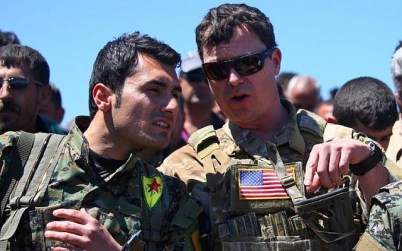
A file photo taken on April 25, 2017, shows a US military officer (R) speaking with a fighter from the Kurdish People’s Protection Units (YPG) at the site of Turkish airstrikes near the northeastern Syrian Kurdish town of Derik, known as al-Malikiyah in Arabic. (Delil Souleiman/AFP)
In a strongly worded statement laced with bitterness, the Kurdish force said that a premature US pullout before IS militants are defeated would have dangerous repercussions, including a resurgence of the extremist group and a destabilizing effect on the entire region.
“The war against terrorism has not ended and (the Islamic State group) has not been defeated,” the statement said, adding that the fight against IS was at a “decisive” stage that requires even more support from the US-led coalition.
“The decision to pull out under these circumstances will lead to a state of instability and create a political and military void in the region and leave its people between the claws of enemy forces,” the statement said.
Kurdish officials and commanders met into the night, discussing their response, local residents said. A war monitor said among the options seriously discussed was releasing thousands of Islamic State militants and their families detained in prisons and camps run by the Kurdish forces. It was not clear whether any decision was made, and Kurdish commanders made no mention of the discussions.
The US announcement came at a particularly tense moment in northern Syria. Turkish President Recep Tayyip Erdogan has repeatedly threatened to launch a new offensive against the Kurds but in recent days had stepped up the rhetoric, threatening an assault could begin “at any moment.”
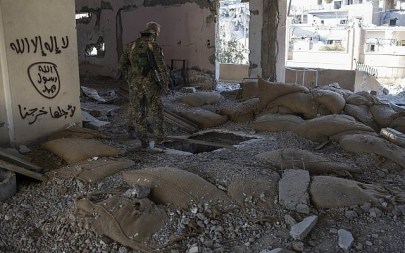
Members of the US-backed Syrian Democratic Forces (SDF) check for bombs at the stadium that was the site of Islamic State fighters’ last stand in the city of Raqqa, Syria, Wednesday, October 18, 2017. (AP/Asmaa Waguih)
Turkey views the People’s Protection Units, or YPG, the main component of the Syrian Democratic Forces, as a terrorist group and an extension of the insurgency within its borders. US support for the group has strained ties between the two NATO allies.
The Syrian government ultimately wants a foothold back into the oil-rich east, and the loss of US support may push Kurdish forces into negotiating with the Damascus government. This shift in turn would open the door for Iranian-backed militias to enter the region.
“For the Syrian government, I think this is music to its ears,” said Maha Yahya, director of Carnegie Middle East Center. She said a US pullout will force Kurdish forces to negotiate with the regime with a bargaining position that has now been considerably weakened.
Prime Minister Benjamin Netanyahu weighed in Thursday, saying Israel will “intensify” its activity in Syria to prevent Iranian entrenchment following the withdrawal of American forces.
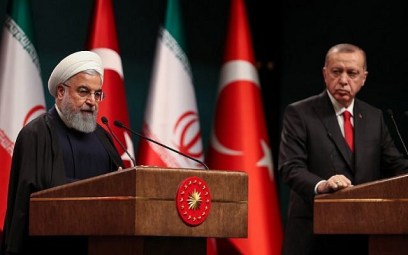
Iran’s President Hassan Rouhani (L) and Turkey’s President Recep Tayyip Erdogan (R) attend a joint press conference at the Turkish presidential complex in Ankara on December 20, 2018. (Adem ALTAN / AFP)
Israel’s main interest in Syria is to prevent its archenemy Iran from establishing a permanent military presence there, and to block sophisticated Iranian arms from reaching Hezbollah forces in Lebanon. Israel has carried out hundreds of airstrikes during the Syrian civil war, mainly against suspect arms shipments allegedly bound for Hezbollah.
Although the US has not actively assisted Israel in this mission, the presence of US forces in Syria has served as a deterrent to Israel’s enemies.
Ebrahim Ebrahim of the Syrian Democratic Council, the political wing of the SDF, called Trump’s decision “treason” and said there is fear among residents in northern Syria that Turkey will invade the region following a US withdrawal, and that government forces and IS militants will attack areas held by the Kurdish forces.
“The American withdrawal will be the trigger that blows up the region,” he added.
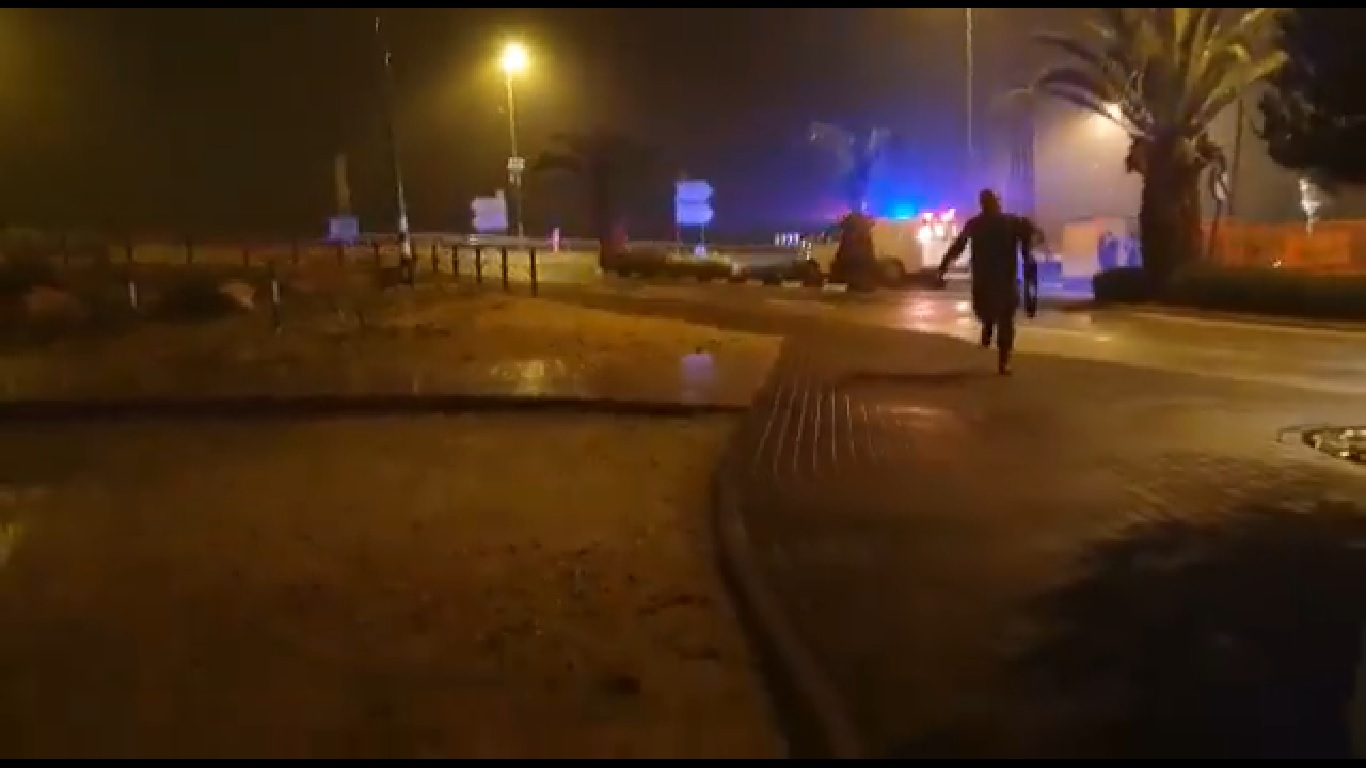
Screen capture from video of a shooting incident at the Ofra junction in the West Bank, December 20, 2018. (Facebook)
IDF soldiers opened fire on a Palestinian car that ran through a West Bank roadblock Thursday evening, killing one of its occupants.
The car broke through the so-called Focus checkpoint, the military said in a statement. IDF soldiers manning the position opened fire on the vehicle, killing one of the people inside and injuring another.
The Palestinian health ministry confirmed one man was killed. Palestinian media named him as Qassem Abassi, 17, from the East Jerusalem neighborhood of Silwan.
The incident came as tensions ran high following two shootings in the area last week that claimed the lives of two Israeli soldiers and a baby, and amid a general uptick in violence in the West Bank.
Less than an hour before the incident, shots were fired at a bus stop near the settlement of Ofra, north of Jerusalem, causing no injuries. Soldiers at the scene fired at the source of the gunfire, which appeared to be the nearby Palestinian village of Ein Yabrud, the military said.
Hadashot TV news reported that there were several people at the bus stop at the time. An eyewitness said that as soon as the shots rang out, the civilians dove to the ground behind the soldiers.
The IDF said it was investigating both incidents and that troops had set up roadblocks in the area.
Beyond the checkpoint is a road used by Palestinians from al-Bireh and Ramallah to its south, and settlers from Beit El to its north, to reach Route 60. The Ofra junction lies farther along the same road.
Thursday’s violence came after two shooting attacks last week along Route 60, one at the Ofra Junction on December 9 and another at the Givat Assaf Junction on December 13.
Two Israeli soldiers were killed and another was critically injured in the Givat Assaf attack. Several Israelis were injured in the attack at the Ofra Junction, including a seven-months pregnant woman, whose baby — delivered in emergency surgery by doctors hours after the attack — died four days later.
An Israeli defense official said Thursday that the Palestinian man suspected of carrying out the terror attack near Givat Assaf is Asem Barghouti, the brother of Salih Barghouti, who was suspected of having carried out the attack near Ofra.
Salih was shot dead on December 12 in a village near Ramallah as he attacked Israeli security forces in an attempt to evade arrest, the Shin Bet security service said.
The attackers from the Givat Assaf shooting are still at large.
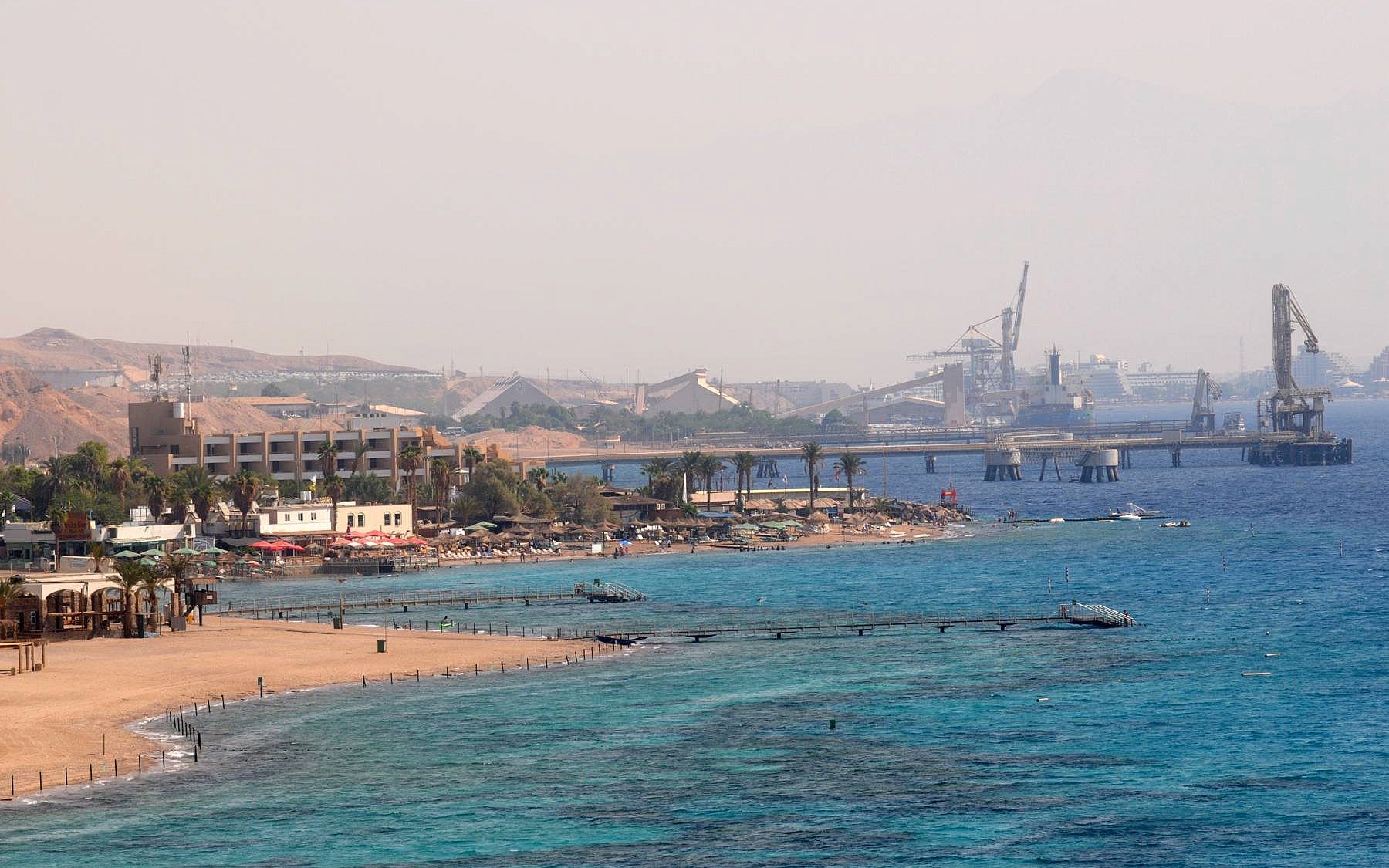
Illustrative image of the port of Eilat (Jorge Novominsky/Flash90)
A Jordanian man who was employed in the southern port city of Eilat was indicted Friday over the assault of two Israeli men several weeks ago, in what prosecutors are saying was a terror attack.
According to the indictment, which was filed at the Beersheba District Court, Taher Halef had been planning to attack Israelis for over a decade. He is accused of several counts of attempted murder, as well as a terrorist conspiracy.
Two Israelis, who were working as divers at the port, were seriously wounded when Halef attacked them with a hammer on November 30, police said at the time. In addition to the injured Israelis, who were brought to the city’s Yoseftal Hospital with head injuries, a second Jordanian worker who tried to restrain the attacker was lightly hurt.
Halef was arrested following the incident, and police said several hours later that an initial probe had raised suspicions that the attack was nationalistically motivated.
The suspect began working in Israel days before the attack after receiving a daily work permit from the Population and Immigration Authority. Friday’s indictment said he had succeeded in passing the screening process despite being flagged as a potential terrorist by the Jordanian manpower agency that first interviewed him.
Israel in 2014 granted permission for 1,500 Jordanians to work in Eilat, the Red Sea resort town located directly across the border from the Jordanian city of Aqaba. The countries signed a peace treaty in 1994, but relations have been tumultuous due to occasional violent incidents and political disagreements.
The indictment said that Halef, who identifies as Palestinian, received help from cousins in Jordan on previous occasions that he sought to carry out attacks.
Allegedly, his first terrorist plot was in 2008, when, after seeing television footage of the first war between Israel and Hamas in the Gaza Strip, Operation Cast Lead, he planned to carry out a shooting attack at the border. The indictment said that Halef’s father foiled his son’s plan by blocking the road while he was already en route to the border, having stolen the father’s gun.
During the summer of 2017, the indictment said, Halef and his cousins resolved to enter Israel through the border fence and carry out a shooting attack. However, after surveying the landscape, they realized their plan was unfeasible.
It was then that he decided to obtain an entry permit to Israel and carry out a stabbing attack in Jerusalem. To that end, he allegedly enlisted the help of his brothers and cousins, who agreed to travel to Israel with him.
While they were initially turned down by an agency in Amman, Halef eventually received a permit to work in Eilat.
On his second day working in Israel, after crossing over from Aqaba, he attacked the two Israeli divers at the port, named in the indictment as Tamir Gross and Yevgeny Kolomitz, as well as the second Jordanian worker, who attempted to stop him.
Allegedly, during the attack, he yelled at the other Jordanian, “We’re Muslims and they’re Jews.”
His lawyer, Khaled Mahajna, insisted Friday that Halef’s assault was criminal in nature rather than a terror attack.
Albanian Foreign Ministry says Iran’s ambassador and another diplomat have been ordered to leave for “damaging national security” • Iranian officials: Albania is an “unintentional victim” in a U.S.-Israeli ploy to destroy Iran’s relations with Europe.
News Agencies and Israel Hayom Staff
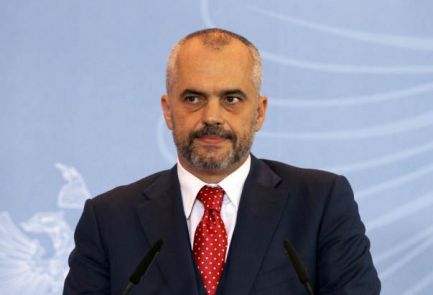
Albanian Prime Minister Edi Rama
|Photo: Reuters
Iran is blaming the United States and Israel for Albania’s expulsion of two Iranian diplomats accused of engaging in criminal activities that threatened the small European country’s security.
Tirana on Thursday expelled Iran’s ambassador and another diplomat for “damaging its national security”, the country’s Foreign Ministry said on Wednesday.
The ministry did not identify the two, and did not say when they were expelled or if they had left the NATO member country, but said it had consulted its alliance partners on the decision.
Iran’s Foreign Ministry spokesman Bahram Qassemi said on Thursday the move was made under pressure from Israel and the United States, which he said were working to destroy relations between Iran and European countries. Albania should not allow others to dictate its relations with Tehran, he said.
“I believe that this is a step aimed at harming Iran’s ties with Europe at such a sensitive time,” the state news agency IRNA quoted Qassemi as saying.
“Obviously this is a measure which has been taken under Israel and America’s pressure. We expect Albania to respect its own independence. … Albania has become an unintentional victim of the United States, Israel and some terrorist groups.”
U.S. National Security Adviser John Bolton, who played a major role in Trump’s decision to reimpose sanctions on Iran, backed Albania’s decision.
“Prime Minister Edi Rama of Albania just expelled the Iranian ambassador, signaling to Iran’s leaders that their support for terrorism will not be tolerated,” Bolton said in a Twitter post.
“We stand with PM Rama and the Albanian people as they stand up to Iran’s reckless behavior in Europe and across the globe,” he said.
Defense Secretary Jim Mattis: U.S. “cannot protect our interests … without maintaining strong alliances and showing respect” to allies • U.S. military leaders scramble to plan Syria troop withdrawal as lawmakers appeal to Trump to reverse abrupt order.
News Agencies and Israel Hayom Staff
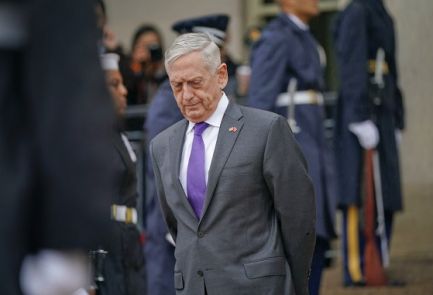
Defense Secretary Jim Mattis
|Photo: AP
U.S. Defense Secretary Jim Mattis resigned Thursday after clashing with President Donald Trump over the abrupt withdrawal of U.S. troops from Syria.
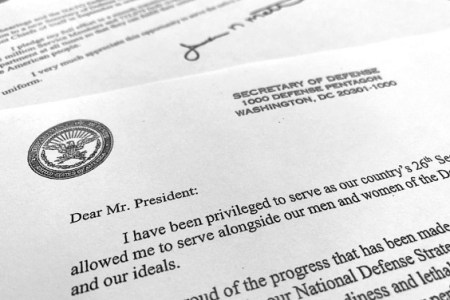
Mattis, perhaps the most respected foreign policy official in Trump’s administration, will leave by the end of February after two tumultuous years struggling to soften and moderate the president’s hard-line and sometimes sharply changing policies. In his resignation letter, Mattis emphasized the importance of “showing respect” to allies and told Trump he was leaving because “you have a right to have a secretary of defense whose views are better aligned with yours.”
“While the U.S. remains the indispensable nation in the free world, we cannot protect our interests or serve that role effectively without maintaining strong alliances and showing respect to those allies,” he wrote.
There was no confrontation between the two men, an anonymous senior official familiar with the incident said, but Syria likely was the last straw for Mattis.
His departure was immediately lamented by foreign policy hands and lawmakers on both sides of the aisle, who viewed the retired Marine general as a sober voice of experience.
“Just read Gen. Mattis resignation letter,” tweeted Florida Sen. Marco Rubio. “It makes it abundantly clear that we are headed toward a series of grave policy errors which will endanger our nation, damage our alliances and empower our adversaries.”
AP
Part of U.S. Defense Secretary Jim Mattis’ resignation letter to President Donald Trump
Mattis did not mention the dispute over Syria in his letter or proposed deep cuts to U.S. forces in Afghanistan, another significant policy dispute. He noted his “core belief” that American strength is “inextricably linked” with the nation’s alliances with other countries, a position seemingly at odds with the “America First” policy of the president.
The defense secretary also said China and Russia want to spread their “authoritarian model” and promote their interests at the expense of America and its allies. “That is why we must use all the tools of American power to provide for the common defense,” he wrote.
The roughly 2,000 U.S. troops in Syria, many of them special forces, were ostensibly helping to combat Islamic State but were also seen as a possible bulwark against Syrian President Bashar Assad, who has retaken much of the country from his foes in the civil war, with military help from Iran and Russia.
The announcement came a day after Trump surprised U.S. allies and members of Congress by announcing the withdrawal of all U.S. troops from Syria, and as he continues to consider cutting in half the American deployment in Afghanistan by this summer.
Four U.S. officials, who spoke on condition of anonymity, said the troop withdrawal is expected to mean an end to the U.S. air campaign against Islamic State in Syria. The U.S.-led air war has been vital to crushing the militants there and in neighboring Iraq, with more than 100,000 bombs and missiles fired at targets in the two countries since 2015.
Still, one U.S. official said a final decision on the air campaign had not been made and did not rule out some kind of support for partners and allies.
The United States told the U.N. Security Council it was committed to the “permanent destruction” of Islamic State in Syria and would keep pushing for the withdrawal of Iranian-backed forces in the country.
“This is scary,” reacted Senate Intelligence Committee Vice Chairman Mark Warner, D-Va., on Twitter. “Secretary Mattis has been an island of stability amidst the chaos of the Trump administration.”
“Jim Mattis did a superb job as secretary of defense. But he cannot be expected to stand behind a president who disrespects our allies and ingratiates himself to our adversaries,” said William Cohen, who served as defense secretary under Bill Clinton and knows Mattis well.
Mattis’ departure has long been rumored, but officials close to him have insisted that the battle-hardened retired marine would hang on, determined to bring military calm and judgment to the administration’s often chaotic national security decisions and to soften some of Trump’s sharper tones with allies.
Opponents of Mattis, however, have seen him as an unwanted check on Trump.
AP
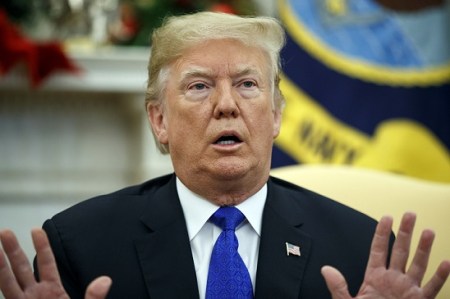
U.S. President Donald Trump
Trump said a replacement would be chosen soon.
The two also were divided on the future of the Afghanistan war, with Trump complaining from the first about its cost and arguing for withdrawal. Mattis and others ultimately persuaded Trump to pour additional resources and troops into the conflict to press toward a resolution.
U.S. officials say there now is active planning in the Pentagon that would pull as many as half the 14,000 U.S. troops out of Afghanistan by summer. They say no final decision has been made.
U.S. military leaders were scrambling Thursday to devise a swift but safe departure of troops from Syria, as outraged lawmakers on both sides of the aisle appealed to President Donald Trump to reverse an abrupt withdrawal order that rattled Washington’s allies and was a key factor in the resignation of Defense Secretary Jim Mattis later in the day. Opponents of the move said the withdrawal would strengthen the hand of Russia and Iran in Syria and enable a resurgence of the Islamic State group.
The terrorists still hold a string of villages and towns along the Euphrates River in eastern Syria, where they have resisted weeks of attacks by the U.S.-supported Syrian Democratic Forces to drive them out. The pocket is home to about 15,000 people, among them 2,000 Islamic State fighters, according to U.S. military estimates.
Mattis and other senior administration officials have argued publicly for months that it would be in the best interests of the United States to remain in Syria long enough to ensure a lasting defeat of the Islamic State terrorists, who have been greatly diminished but not eliminated. Gen. Joseph Dunford, chairman of the Joint Chiefs of Staff, recently said the Pentagon estimates that 35,000 to 40,000 local security forces are needed to ensure stability in northeastern Syria. As of December, Dunford said, only about 20% of those forces have been trained.
Defense officials said U.S. airstrikes would continue until all the approximately 2,000 U.S. troops are out of Syria, but it was unclear whether the air campaign would then end. Officials said it might depend on whether France and other coalition partners keep ground troops in Syria after the Americans leave. A continued presence of allied troops working with local Syrians might compel the U.S. to contribute air cover.
NATO allies France and Germany said Washington’s change of course on Syria risks damaging the fight against Islamic State, the terrorist group that had seized swathes of Iraq and Syria but has now been squeezed to a sliver of Syrian territory.
“Islamic State has not been wiped from the map nor have its roots. The last pockets of this terrorist organization must be defeated militarily once and for all,” French Defense Minister Florence Parly said on Twitter.
France has about 1,100 troops in Iraq and Syria providing logistics, training and heavy artillery support as well as fighter jets. In Syria, it has dozens of special forces, military advisers and some foreign office personnel.
Trump, however, tweeted that he was fulfilling a promise to leave Syria made during his presidential campaign and arguing that the United States was doing the work of other countries and it was “time for others to finally fight.”
The Pentagon, roiled first by the surprise withdrawal order from Trump and then the abrupt resignation of Mattis, offered no information about how the withdrawal will happen or how long it will take, apparently because they don’t know.
Two officials speaking on condition of anonymity to discuss internal planning said Gen. Joseph Votel, head of U.S. Central Command, will submit a comprehensive withdrawal plan to top Pentagon officials in coming days.
One official said military commanders are concerned that the pullout will leave their Syrian Kurdish allies in the lurch.
Trump’s decision to pull troops out of Syria has been sharply criticized for abandoning America’s Kurdish allies, who may well face a Turkish assault once U.S. troops leave, and had been staunchly opposed by the Pentagon.
Turkey, which considers the Kurds a security threat, has said it intends to send its army into Syria to clear them out. Until now, Turkey had to consider the presence of U.S. troops; once they are gone, a bloody clash seems inevitable.
Sen. Lindsey Graham, R-S.C., said on Thursday that Mattis had told him he is worried about the Kurds and this is not the right time to leave.
“I won’t get into conversations between Mattis and the president, but I will tell you what he told me: He thought that the time was not right to leave,” Graham said at a Capitol Hill news conference.
Mattis believes that “the day we leave it’s going to be open season on every Kurd who’s supported us,” according to Graham.
The Kurdish-led Syrian Democratic Forces, who have partnered with U.S. troops for years as the key force against IS militants, said in a strongly worded statement laced with bitterness that the fight against IS was at a “decisive” stage that requires even more support from the U.S.-led coalition, not a precipitate U.S. withdrawal.
The SDF are in the final stages of a campaign to recapture areas seized by the terrorists. But they face the threat of a military incursion by Turkey, which considers the Kurdish YPG fighters who spearhead the force to be a terrorist group, and Syrian forces committed to restoring Assad’s control over the whole country.
“The war against terrorism has not ended and [the Islamic State group] has not been defeated,” the statement said.
While Turkey has not commented directly on Trump’s decision, an end to the U.S.-Kurdish partnership will please Ankara.
Kurdish militants east of the Euphrates in Syria “will be buried in their ditches when the time comes,” state-owned Anadolu news agency reported Defense Minister Hulusi Akar as saying.
Turkey has intervened to sweep YPG and Islamic State fighters from parts of northern Syria that lie west of the Euphrates over the past two years. It has not gone east of the river, partly to avoid direct confrontation with U.S. forces.
Russian President Vladimir Putin said he largely agreed with Trump that the group had been defeated in Syria but added there was a risk it could recover.
He also questioned what Trump’s announcement meant in practical terms, saying there was no sign yet of a withdrawal of U.S. forces, whose presence in Syria Moscow calls illegitimate.
Graham said Mattis also expressed concern about the more than 700 Islamic State fighters being held by the SDF, saying they could be released and end up back on the battlefield.
Graham has himself warned a withdrawal would have “devastating consequences” for the United States.
AP
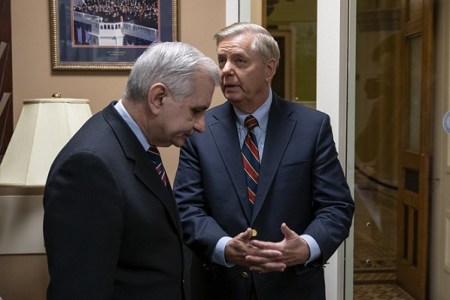
Democratic Senator Jack Reed and Republican Senator Lindsay Graham in Washington, Thursday
From the start of his administration, Trump had made no secret of his desire to pull out of Syria. But the timing of his announcement Wednesday remains a puzzle. His national security adviser, John Bolton, Mattis and other top leaders argued against the pullout but were unable to change Trump’s mind.
Graham and Democratic Senators Bob Menendez of New Jersey and Jack Reed of Rhode Island said they have growing support for a resolution urging the president to change his strategy.
“I can’t explain this decision,” Graham told reporters. “I’m not going to suggest motivations that are anything other than a frustrated president. But I can promise this: that if you follow through with this everything that happened in Iraq is going to happen in Syria. It’s going to be worse, not better. It’s going to make it harder to make the Taliban reconcile.” His Taliban reference was to U.S. efforts to promote peace in Afghanistan.
On Thursday, Trump defended his decision, saying on Twitter: “Getting out of Syria was no surprise. I’ve been campaigning on it for years, and six months ago, when I very publicly wanted to do it, I agreed to stay longer.”
He added: “Does the USA want to be the policeman of the Middle East, getting NOTHING but spending precious lives and trillions of dollars protecting others who, in almost all cases, do not appreciate what we are doing? Do we want to be there forever?”
“So hard to believe that Lindsey Graham would be against saving soldier lives & billions of $$$. Why are we fighting for our enemy, Syria, by staying & killing ISIS for them Russia, Iran & other locals?” he asked.
Secretary of State Mike Pompeo, who is known to have opposed leaving Syria now, defended the Trump decision Thursday.
“The president made an enormous commitment to take down the caliphate, and that has been achieved,” he said. “We now have the battle, it’s a long-time battle, which is the counterterrorism battle, not only against ISIS, but against al-Qaida and others …, all the terrorist groups. President Trump remains just as committed today as he was yesterday and the day before.”
After President Trump announces decision to withdraw all U.S. forces from Syria, top Jordanian official tells Israel Hayom: Israel enjoys proven air supremacy to deter Iranian troops, but Jordan now faces a real threat • Kurdish militia warns of vacuum.
Daniel Siryoti, Associated Press and Israel Hayom Staff and Neta Bar
U.S. soldiers in Manbij, Syria
|Photo: AP
U.S. President Donald Trump’s decision this week to withdraw American troops from Syria sparked disappointment in Amman, with one senior Jordanian official telling Israel Hayom the move is akin to “stabbing an ally in the back and forsaking it.”
Trump announced Wednesday that the U.S. would be pulling all its troops out from Syria, saying they had succeeded in their mission to defeat the Islamic State terrorist group and were no longer needed in the country.
The decision was met with shock by U.S. allies in the international coalition that has been fighting Islamic State in recent years. These allies include France, the United Kingdom, and Jordan, which views the American presence in the region as crucial to ending the Syrian civil war and keeping Iran in check.
The Jordanian official who spoke to Israel Hayom said: “Israel enjoys proven air supremacy to deter Iranian troops, but Jordan is facing a tangible threat in the wake of the American decision. Having U.S. troops leave southwestern Syria, an area that borders Jordan, will have destabilizing repercussions.”
The U.S.’s Kurdish allies were also outraged by Trump’s announcement. The Kurdish-led Syrian Democratic Forces, which partnered with U.S. troops for years as the key force against Islamic State militants, said in a strongly worded statement Thursday that the fight against the jihadi group was at a “decisive” stage that required even more support from the U.S.-led coalition.
“The war against terrorism has not ended and [Islamic State] has not been defeated,” the statement said. “The decision to pull back will directly undermine the efforts of the final battle of defeating the terrorists … and it will lead to political-military vacuum.”
One senior SDF official said they might be forced to release some 3,200 captured Islamic State fighters, which could give a boost to the terrorist group.
Turkey has repeatedly warned that it might launch an offensive in northeastern Syria against the SDF-controlled enclave there, saying the militia is aligned with Kurdish separatists in Turkey. In the wake of Trump’s decision, Turkey may show less restraint and move ahead with such an offensive.
The Syrian Observatory for Human Rights said the SDF might boost its presence along the border with Turkey to prepare for a possible invasion.
European Court of Auditors finds EU lacks sufficient information on how funds it gives NGOs are used • Strategic Affairs Minister Erdan asks EU to examine whether funds transferred to NGOs in Israeli-Palestinian arena are used for their intended purposes.
Ariel Kahana
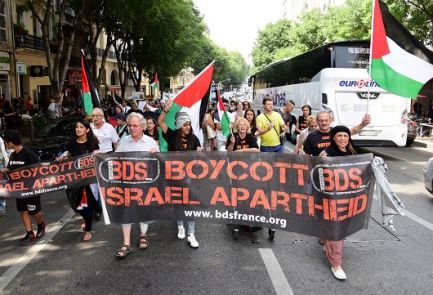
Protesters march in support of the boycott, divestment and sanctions movement in Marseille in 2015
|Photo: Citizenside
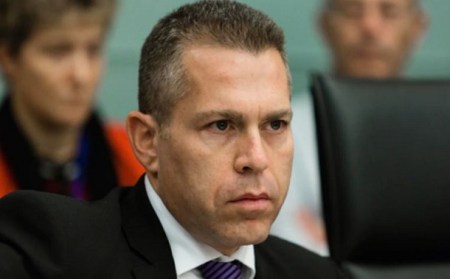
Strategic Affairs Minister Gilad Erdan has asked the European Union to investigate whether its funds are being transferred to organizations that promote boycotts of Israel.
On Wednesday, the European Court of Auditors published a detailed report on the funding the EU transfers to nongovernmental organizations. The report finds that the bloc’s system of determining whether organizations meet the criteria for NGOs is unreliable, and that the European Council, which is responsible for defining the EU’s overall political direction and priorities, does not have sufficiently detailed information about how the funds are being used.
Israel has for years criticized the EU’s extensive support for NGOs that act against Israeli government policies. Israeli officials believe the new report confirms these concerns.
Erdan, who oversees Israel’s efforts to combat the boycott, divestment and sanctions movement, contacted European Commission President Jean-Claude Juncker on Thursday with a request to ensure that the EU immediately halts funding to organizations that support boycotts of Israel.
Channel 12
Strategic Affairs Minister Gilad Erdan
Erdan wrote to Juncker that he was not surprised by the court’s findings, and that he had contacted EU foreign policy chief Federica Mogherini on the matter over six months ago.
Erdan said the EU should “swiftly implement the report’s recommendations for improving transparency and oversight as far as the funding of organizations active in the Israeli-Palestinian arena.”
He also called for the bloc to examine “whether funds transferred to organizations active in the Israeli-Palestinian arena were not used for their intended purposes.”
The EU’s mission in Israel issued a statement saying the report “did not specifically address Israeli or Palestinian organizations. The European Commission is one of the most transparent bodies in the world. The EU provides funding to nongovernmental organizations in the most transparent manner. The EU will continue to support civil society organizations.”
In May, the Strategic Affairs Ministry published a report showing that in 2016 the EU had provided a total of €5 million ($5.9 million) in direct funding to groups that supported boycotts of Israel, including some that maintained links to terrorist groups.
Millions of additional euros had also reached the NGOs through indirect funding, the ministry said.
Knesset subcommittee’s finding that IDF combat readiness has improved since 2014 fails to address “gross failures” impeding Ground Forces’ preparedness, says ombudsman Yitzhak Brik • Panel “squandered a unique opportunity” to lead change, he says.
Lilach Shoval
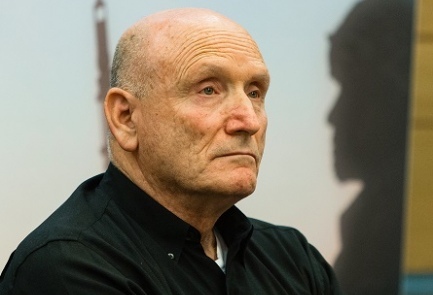
Military Ombudsman Maj. Gen. (res.) Yitzhak Brik
|Photo: Dudi Vaaknin
Military Ombudsman Maj. Gen. (res.) Yitzhak Brik on Thursday criticized the findings of a Knesset subcommittee that dismissed a report in which he cautioned that the IDF Ground Forces are not ready for war.
The report prompted an investigation by Subcommittee for War Readiness, under the Knesset Foreign Affairs and Defense Committee, whose members met with GOC Army Headquarters Maj. Gen. Yaakov Barak and with several brigade and division commanders.
On Wednesday, subcommittee chairman Col. (ret.) MK Omer Bar-Lev (Zionist Union) said the panel had found that, contrary to Brik’s report, the military’s war readiness has improved significantly since Operation Protective Edge in 2014.
”The IDF has improved its readiness and is, in fact, ready for war despite several weak points, most of which have been identified and have or are being addressed,” Bar-Lev said.
However, the following day, Brik said the subcommittee’s findings were “categorically inconsistent with the gross failures that impede the Ground Forces’ war readiness, as illustrated in my report and in a report by the defense establishment’s comptroller.”
He said his report had listed 15 serious issues that undermine the military’s wartime readiness, and the subcommittee failed to address them.
“The members of the subcommittee squandered a unique opportunity to lead a courageous move that would extract the Ground Forces from the crisis they face,” Brik said.
He also referred to what he described as “grave reports” from Defense Establishment Comptroller Eitan Dahan about the army’s lack of readiness.
“Anyone who reads them is simply shocked by the army’s incompetence, lack of discipline, lack of integration and lack of checks and balances, as well as by its failure to implement orders meant to rectify these issues,” Brike said.
“We must act to correct these flaws before we are too late to preserve the IDF and its strength, in the interests of Israel’s security.”
Secret talks reach understandings with Russia that will enable Israel to retain freedom to attack Iranian and Hezbollah targets in Syria • Egypt, Israeli cabinet reportedly not informed of U.S. President Trump’s surprise decision to withdraw from Syria.
Daniel Siryoti, Yoni Hersch, Ariel Kahana, Eldad Beck, Erez Linn and Israel Hayom Staff
U.S. troops in northern Syria look toward the border with Turkey, an Iranian ally
|Photo: AP
The Russian forces currently in Syria will take action to restrain Hezbollah and Iranian activity there, according to understandings reached by Israel, the United States, Jordan and Saudi Arabia with Russian President Vladimir Putin, a Jordanian official confirmed to Israel Hayom.
According to the terms of the understanding, Russia will continue to give Israel the freedom to strike Hezbollah and Iranian targets and weaponry that threaten the “balance of power” in Syria. According to the Jordanian official, it was these understandings between Trump and Putin that paved the way for the U.S. decision to pull its forces from Syria.
Other high-ranking Jordanian officials have confirmed that Jordan, Israel, and Saudi Arabia are working together to contain the threat posed by Iran and Hezbollah’s presence in Syria. Several of them emphasized that U.S. officials had made it clear that U.S. intelligence agencies would increase cooperation with Israel, Jordan and Saudi Arabia, particularly on sharing intelligence, in a joint attempt to counter Iran’s attempt to create a contiguous Shiite corridor from Tehran to Beirut.
Senior Egyptian intelligence officials say that, unlike Jordan, Israel, Saudi Arabia and Turkey, Egypt was not advised ahead of time that the U.S. was pulling out of Syria.
On Thursday, in a meeting with Greek Prime Minister Alexis Tsiras and Cypriot President Nicos Anastasiades in Beersheba, Prime Minister Benjamin Netanyahu decried the “Iranian web of aggression in the Middle East, which also terrorizes Europe and the entire world.”
“Israel launched a campaign to expose and neutralize cross-border terror tunnels on our northern border with Lebanon. These tunnels were built by Hezbollah with direct support and funding from Iran. … Israel will continue to act in Syria to prevent Iran’s effort to militarily entrench itself against us. We are not going to reduce our efforts; we’re going to increase our efforts,” Netanyahu said.
Behind closed doors, Israeli officials were critical of Trump’s decision. One senior minister called it a “horrifying moral and a bad diplomatic step.”
“The move does not serve Israel’s interests, harms the Kurds, strengthens [Turkish President Recep Tayyip] Erdogan, and will give Iran additional routes through which to send weapons to Syria,” the minister said.
Cabinet ministers and diplomatic officials have also confirmed to Israel Hayom that while Netanyahu said earlier this week that Trump had advised him on Monday that he was pulling U.S. troops out of Syria, and that U.S. Secretary of State Mike Pompeo had discussed the matter with him on Tuesday, the information was never shared with Israel’s National Security Council or the cabinet.
One minister told Israel Hayom that he thought Netanyahu might have been worried that cabinet officials would vocally criticize the American move. Netanyahu’s office declined to comment.
With funding and direction from Iran, Hamas has raised its flag in the Palestinian Authority capital of Ramallah, where it hopes to kill two birds with one stone: Attack Israel and topple PA President Mahmoud Abbas. Ramallah reverts to a terrorist agenda.
Nadav Shragai
Palestinian security forces cracked down on violent Hamas protests near Ramallah this week
|Photo: AP
Ramallah has suddenly reverted to a terrorist agenda. Hamas has raised its flag in the capital of the Palestinian Authority.
There, in that city of spacious homes, which in recent years has attracted banks and business centers and international organizations and embassies, and where accelerated development has resulted in hundreds of high-rise buildings springing up, Hamas is sticking it to PA President Mahmoud Abbas.
Ramallah and the villages around it, which function as the political and economic center of the PA, strongly identified with the Palestinian elite and wanted cooperation with Israel. This week, they became the site of a hunt for the terrorists who carried out the shooting attacks in Ofra and Givat Asaf. The raids, the encirclement, the capture of homes and the shots fired at protesters – all in the beating heart of the PA, which this week resumed full security coordination with Israel – are the last thing the ailing Abbas needs.
In the middle of all this, between the Jewish settlements Halamish, Nachliel and Atarot, lies the village of Kaubar, a hamlet that raises murderers. Kaubar illustrates how shaky Abbas’ stature has become in the region where his own capital lies.
In October 2011, the village hosted a great celebration in honor of four local residents being released from prison in Israel as part of the Hamas-engineered prisoner exchange deal for captive soldier Gilad Schalit. The prisoners included cousins Nael and Fahri Barghouti, who had served over 30 years in prison. In 1978, they stabbed bus driver Moti Yakuel to death as he was driving Palestinian workers home to Kaubar and other local villages. The cousins were welcomed by Omar Barghouti, Nael’s brother, who was also convicted for the murder but had been released as part of the 1985 Jibril Agreement, in which Israel freed over 1,150 security prisoners for three Israelis captured in the First Lebanon War.
Nael has since been imprisoned again in Israel for supposedly violating his parole. His wife, Aman, also has a rap sheet. She served time in prison for planning a terrorist attack on Jaffa Road in Jerusalem, although it was never carried out. Two of Fahri’s sons also served time in Israeli prisons. Eight years ago, the road that leads to Kaubar was stenciled with stars of David, so that cars could drive over them on their way into the village.
Local pride
Kaubar found itself in the headlines once again this week after it turned out that Salah Barghouti, 29, was the terrorist who had opened fired at a hitchhiking post outside the Ofra settlement in Samaria two weeks ago, wounding seven Israelis, including Shira and Amichai Ish-Ran, whose son Amiad Yisrael was delivered prematurely in an emergency cesarian section and died a few days later.
Salah Barghouti was shot to death in a gunfight with Israeli forces. He is the son of Omar Barghouti, one of the top Hamas officials in the West Bank (not to be confused with Omar Barghouti, the Qatar-born Palestinian activist behind the international BDS movement) and the nephew of Nael Barghouti. Another of Salah’s uncles, Jasser Barghouti, also from Kaubar, was given nine life sentences for killing Israeli soldiers. He was released in exchange for Schalit, and he is suspected of having used his familiarity with the people of Kaubar to direct – from the Gaza Strip – the cell responsible for the Ofra and Givat Asaf attacks.
Palestinian leader and murderer Marwan Barghouti, who is currently serving five life sentences in Israel, is also a native of Kaubar, as is Omar al-Abed, who murdered Yossi, Chaya, and Elad Salomon at the Salomon family’s home in Halamish last summer. So is Muhammad Tarek, who murdered Yotam Ovadia in the Adam settlement last summer.
“The village of Kaubar is shaping its own glory,” the PA daily Al Hayat Al-Jadida crowed a year ago after the slaughter of the Salomon family. “During the Palestinian people’s intifada, Kaubar has produced 15 shahids [martyrs], along with dozens of wounded and hundreds of prisoners.”
Kaubar, home to some 4,500 residents, is located in Area B, which is under Israeli security control but Palestinian civil control. The village fields lie next to Area C, which is under full Israeli control. Kaubar has a few schools and four mosques, one of which was built with a donation from the Walsall Kobar Friendship Association. Walsall is a city of 200,000 that lies northwest of Birmingham, England. In 2007, Walsall and Kaubar became twin cities. Kaubar’s sister city doesn’t seem particularly bothered by the long list of killers generated by its evil twin.
Indeed, many in Kaubar see Israel’s very existence as a disaster, and Hamas – whose goal is to destroy Israel – is the strongest political-religious entity in the village. Hamas’ strength makes Abbas’ weakness all that much clearer. This week, Abbas was so worried about the threat to his rule that he rushed to work more closely with Israel on security, ties that had relaxed. The IDF carried out operations near the Mukata in Ramallah as well as near Abbas’ home to find the car from which the shots in the Ofra attack were fired. Not far from there, the Shin Bet security agency confiscated security footage from cameras at the Palestinian news agency Wafa, and the Palestinian security services did nothing to intervene. Abbas knows very well that Hamas is fighting him as well as Israel. He would be as happy as Israel about every armed Hamas terrorist that is captured. Only this week, his security forces used violent measures to break up demonstrations by Hamas supporters in Hebron and Nablus.
The PA’s concern about Iranian involvement is another factor prompting Abbas and his people to resume cooperation with Israel on security matters. Iran is overseeing the policy of splitting Hamas between Gaza – where for now it is sticking to a policy of “understandings” with Israel – and the West Bank, where Hamas is trying to light up the territory through sleeper cells it has established throughout Judea and Samaria.
Writing in Haaretz this week, Amos Harel referred to “the two banks of Hamas,” hitting the nail on the head. Hamas indeed differentiates between Gaza, where is wants to recover and shore up its rule, and the West Bank, where it wants to create chaos and kill two birds with one stone: attack Israel and topple Abbas.
Hamas leader in Gaza Ismail Haniyeh, who this week spoke before tens of thousands of Gazans in honor of Hamas’ 31st anniversary, made the organization’s priorities very clear: “The renewed intifada in the West Bank will be the cemetery of Trump’s ‘deal of the century’ … the new awakening in the West Bank is a response to all the occupation’s attempts at humiliation in the West Bank and Jerusalem .. I say to the Zionists: Operatives of Hamas and Fatah and the other groups in the West Bank do not need to be remote-controlled from the Gaza Strip to carry out attacks.” Haniyeh characterized the resurgence of terrorism in Judea and Samaria as “the most important area, which will decide the conflict with the Zionist enemy.”
This past year, the Shin Bet has exposed numerous attempts by Hamas abroad to direct attacks by cells in the West Bank. These include a plot in Nablus to carry out attacks in Jerusalem and Tel Aviv and another plot out of the east Jerusalem neighborhood of Zur Bahar, where two cell members visited Turkey and were supplied with thousands of dollars to use for attacks in western Samaria. Leaders of the Hamas infrastructure in Hebron maintained contact with Hamas in Turkey and sent female operatives there to collect money and instructions.
Don’t let the numbers fool you
In the face of this concerted effort by Hamas, Israel’s security forces are maintaining a “pincer” policy that opposes collective punishment of the Palestinian population, which it sees as doing more harm than good. The IDF and the Shin Bet see cooperation with the PA on matters of security as an asset, not a burden. The Shin Bet also opposes the idea of deporting families of terrorists, believing that it would encourage terrorism instead of deterring it. The Shin Bet was furious over claims made this week that is was lackadaisical in its use of human intelligence sources and overly dependent on cooperation with the PA, and denied the allegations.
In conjunction with the Shin Bet, the IDF is taking advantage of its pursuit of the Ofra and Givat Asaf terrorists to clear as many Hamas operatives as possible out of the area and reduce the potential for more attacks. Over 150 suspects have been arrested thus far. In at least one instance, an imminent attack was thwarted. Soldiers from the Golani Brigade arrested two Palestinians who were driving not far from Kiryat Arba. They had three automatic weapons in the car, including a loaded M-16 rifle and an Uzi.
The thwarted attacks and preventative tactics come on the heels of a year of wide-scale activity by the IDF and the Shin Bet to counter Hamas’ attempts to unleash terrorism in Judea and Samaria. Only recently, head of the Shin Bet Nadav Argaman informed the Knesset Foreign Affairs and Defense Committee that 201 Hamas cells had been arrested over the course of 2018 and 480 major terrorist attacks prevented – including dozens of planned abductions. A total of 590 individual terrorist operatives were arrested. Argaman described a state of “false calm,” and pointed to somewhat confusing statistics that would appear to indicate that terrorist attacks in Judea and Samaria are down compared to the past few years.
The reason for the confusion is simple. Yes, there have in fact been fewer major attacks: 54 as of Dec. 16 this year, compared to 82 by the same date in 2017 and 142 by the same date in 2016. But if we look at the breakdown of the 54 attacks in 2018, we discover that almost half (26) were carried out between September and December, compared to only 12 in the same period last year.
The incitement continues
Even as the PA cooperates more closely with Israel on security, it continues to allow incitement against Israel, possibly to create balance and reassure the Palestinian public that it is not cooperating with the “occupation.” The Fatah movement, of which Abbas is the official leader, held prayers this week for the souls of the killers of Ziv Hajbi and Kim Levongrond-Yehezkel, who were shot to death in the attack at the Barkan Industrial Park in October, and the infant Amiad Yisrael. Fatah described the killers as “pure-hearted” and prayed that they might win “immortality and glory.”
This terminology is familiar from similar attacks in the past, but there is one difference worthy of note, and it pertains to Hitler and the Holocaust. The nonprofit monitoring group Palestinian Media Watch published a video this week of a sermon that ran on Palestinian state TV. The preacher in the video explains that Hitler was one of a series of people throughout history sent by Allah to punish the Jews for their “bad behavior” and teach them a lesson. The sermon was given in a tent in the illegal tent city Khan al-Amar, which Israel has delayed plans to demolish.
This is not the first time that Hitler has had a guest role in Palestinian texts. A few years ago, a PA-funded monthly children’s magazine ran an essay by a teenage girl that portrayed Hitler as a positive figure, “because he killed Jews to make the world better.”
Last April, political commentator Hani Abu Zeid said on Palestinian TV that Israelis “cried over the made-up Holocaust in the time of Hitler” and that “the numbers weren’t that big. It’s a lie they [Jews] spread throughout the world. A lot of Israelis had ties to Hitler to open the gates to Palestine so they could bring in settlers.”
In the more distant past, Palestinian TV aired a children’s program that taught its young viewers that Israel had burned Palestinians in ovens. In an exhibit in Gaza, children set up dolls in a model oven embellished with a Star of David and a swastika. Another Palestinian “historian” claimed on TV that “Dachau never existed, nor did Auschwitz” and at the same time said that the two camps had been “purification sites.”
We may have accepted Palestinian incitement as routine, but when they bring in Hitler and the Holocaust, that is hard to hear. And the lack of an Israeli response is even more jarring.




 anneinpt
 artaxes
 danmillerinpanama
 davidking1530
 Peter Hofman
 Joseph Wouk
 Peter
Peter Louisiana Steve
 WarSclerotic
Recent Comments