Archive for December 17, 2018

Netanyahu says Israeli agents ‘periodically visit’ Iran to monitor nuke program

December 17, 2018

Source: Netanyahu says Israeli agents ‘periodically visit’ Iran to monitor nuke program | The Times of Israel

PM tells diplomats: Intelligence operatives working to thwart Tehran’s nuclear ambitions ‘all over the world,’ and visit Islamic republic to ‘catch up’
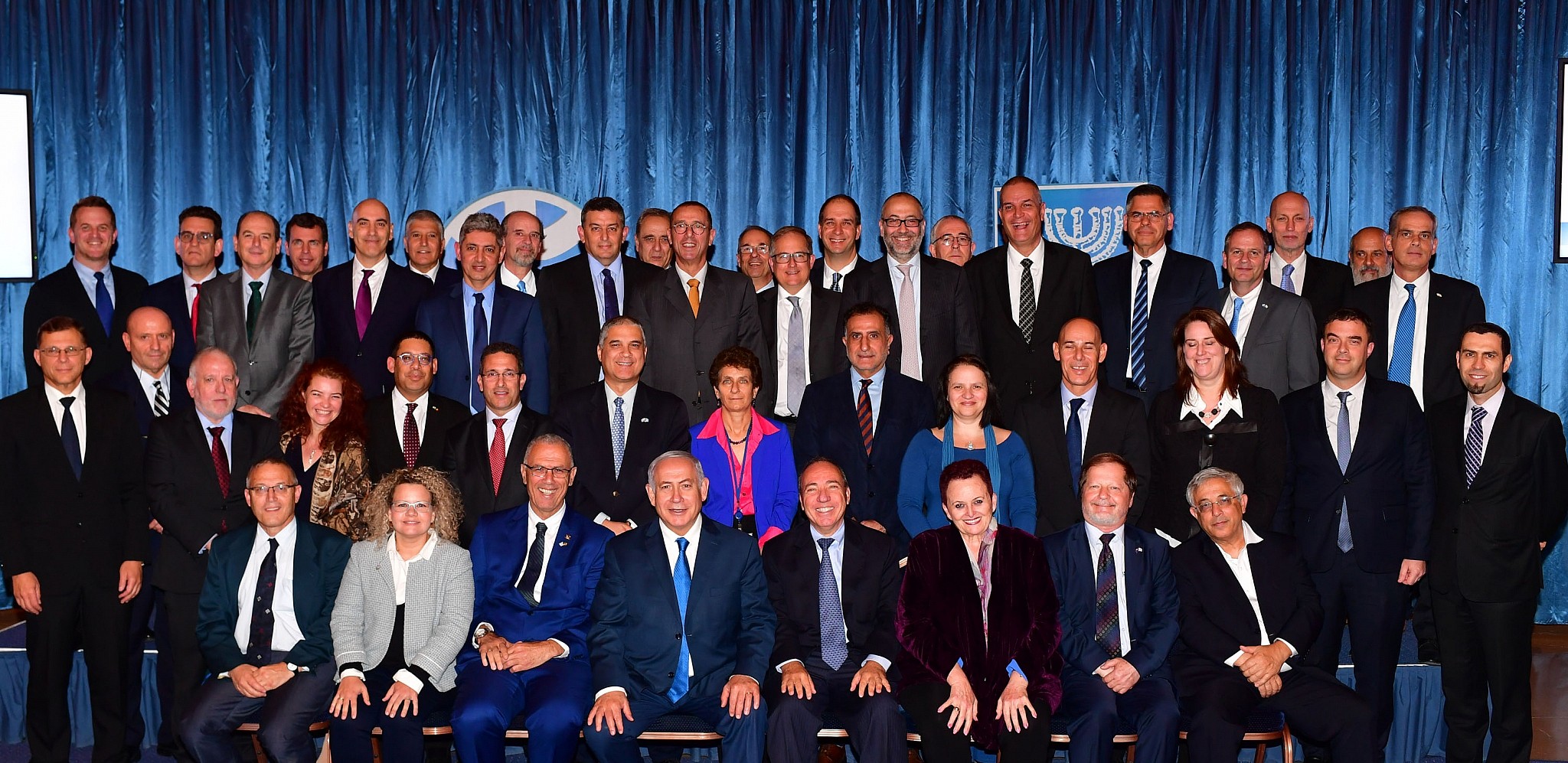
Prime Minister Benjamin Netanyahu with foreign diplomats, December 16, 2016 (Kobi Gideon / GPO)

Prime Minister Benjamin Netanyahu with foreign diplomats, December 16, 2016 (Kobi Gideon / GPO)

Prime Minister Benjamin Netanyahu told a group of diplomats on Sunday that Israeli agents continue to operate inside Iran as part of Israel’s efforts to thwart the nuclear ambitions of the Islamic republic.

“We are fighting all over the world in regards to Iran’s nuclear program,” he said at the Ministry of Foreign Affairs headquarters in Jerusalem.

“We also visit there periodically… to ‘catch up,’” Netanyahu added without giving specific details.

Netanyahu was a vocal opponent of the US-led nuclear deal between Iran and Western powers in 2015 that lifted painful economic sanctions against Iran in exchange for curbs on its nuclear program.

The Israeli leader has repeatedly argued that the Obama-era deal will not prevent Iran from acquiring nuclear weapons, after its restrictions expire in the next decade or so. US President Donald Trump, with whom Netanyahu is closely allied, withdrew from the accord in May and reimposed sanctions.
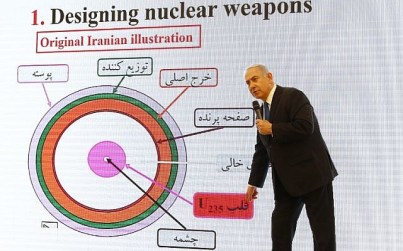
Prime Minister Benjamin Netanyahu gives a speech on files obtained by Israel, which he says prove Iran lied about its nuclear program, at the Defense Ministry in Tel Aviv, on April 30, 2018. (AFP Photo/Jack Guez)

Israel has admitted to covert operations inside Iran to thwart its nuclear program and undermine the agreement.

In April, Israel announced it had smuggled out of Iran more than 100,000 documents from a Tehran archive detailing the country’s nuclear program.

Netanyahu said at the time that the cache proved the Iranian leaders covered up their nuclear weapons program before signing the nuclear agreement. Iran has not acknowledged the alleged seizure.

In September, Netanyahu in his address at the UN General Assembly revealed what he said was a “secret atomic warehouse” outside Tehran, which contained nuclear materials that Iran was not allowed to posses without declaring them to the International Atomic Energy Agency (IAEA).

Both the archive and warehouse, he said in his UN speech, were proof that Iran had not given up its nuclear program.

He accused the IAEA of failing to investigate the cache of documents smuggled out of Iran by Israeli agents, and said he revealed the existence of the Tehran warehouse in an effort to goad the UN’s nuclear watchdog into taking action.

Photographs from the Iranian nuclear weapons archive, showcased by Israeli officials, of a metal chamber that Israeli officials said was housed at the Parchin military site and was built to conduct experiments as part of the Iranians’ rogue nuclear weapons program (Israeli government)

Last month, the Axios news site reported that the Trump administration promised Netanyahu that it would lean on the IAEA to examine the Israeli findings.

US Special Envoy Brian Hook told Israeli officials during a visit in November that the UN agency was “dragging its feet” in its investigation, and vowed that US officials would “work aggressively to make sure the IAEA seriously addresses all information provided by Israel, the US, and other countries regarding the Iranian nuclear program.”

Arab Ties

Netanyahu also addressed Israel’s burgeoning ties with the Arab world that have been largely driven by common fears over Iran.

“I won’t suspend efforts to reach peace with the Arab world until the Palestinians make peace with us. I won’t do it,” he says, describing a process of “normalization” with the region.

“We are going to the [Arab world] and are not subject to the whims of the Palestinians,” he says, repeating hopes that ties with the Arab world will open up new opportunities to reach a deal with the Palestinians.

The Arabs had in the past conditioned any normalization on Israel first reaching a peace deal with the Palestinians.

Netanyahu visited Oman last month and there has been increasing speculation of a breakthrough with Saudi Arabia, amid ongoing behind the scenes cooperation.
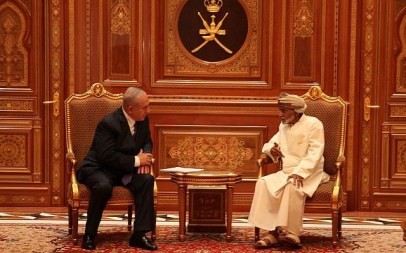
Prime Minister Benjamin Netanyahu (L) talks with Sultan Qaboos bin Said in Oman on October 26, 2018 (Courtesy)

He also said Israeli bilateral trade with Turkey is on the rise, despite diplomatic tensions between the two former allies.
 

Erekat on final meeting with Kushner: He shouted, warned ‘Don’t threaten me’ 

December 17, 2018

Source: Erekat on final meeting with Kushner: He shouted, warned ‘Don’t threaten me’ | The Times of Israel

PA official describes angry conversation as Trump’s special adviser informed him US would recognize Jerusalem, move embassy

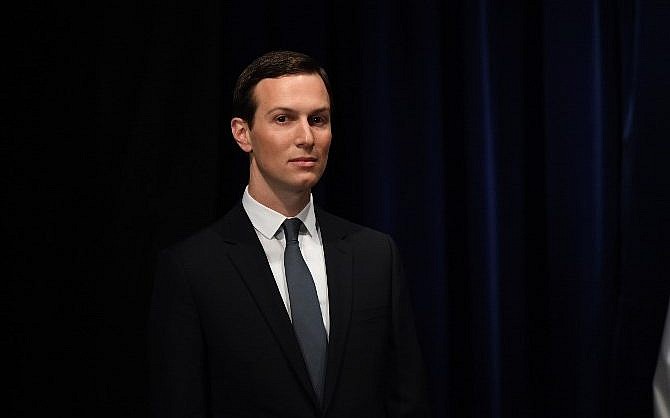
Senior Adviser to the President of the United States Jared Kushner, is pictured before being decorated with the Mexican Order of the Aztec Eagle by Mexico's President Enrique Pena Nieto in Buenos Aires, on November 30, 2018, in the sidelines of the G20 Leaders' Summit. (SAUL LOEB / AFP)

Senior Adviser to the President of the United States Jared Kushner, is pictured before being decorated with the Mexican Order of the Aztec Eagle by Mexico’s President Enrique Pena Nieto in Buenos Aires, on November 30, 2018, in the sidelines of the G20 Leaders’ Summit. (SAUL LOEB / AFP)

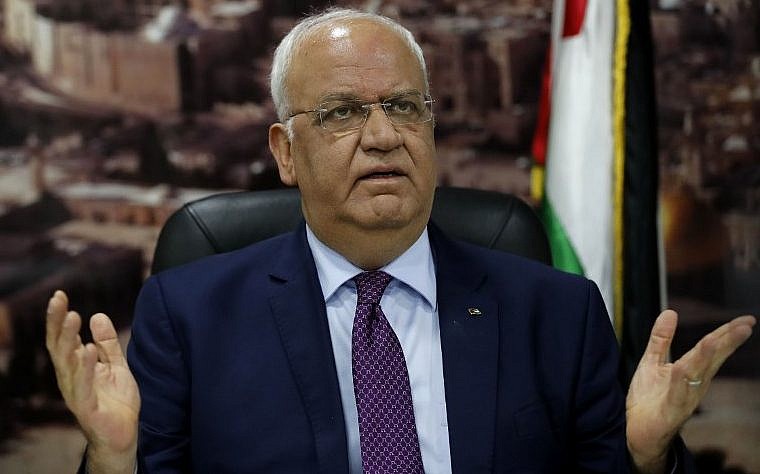
Top Palestinian Authority official Saeb Erekat has described his combative last meeting with US President Donald Trump’s son-in-law and adviser Jared Kushner, before Washington announced it was recognizing Jerusalem as Israel’s capital in December of last year.

On November 30, 2017, less than a week before Trump announced he was recognizing Jerusalem and relocating the US embassy there — a move that led the PA to sever its ties with the administration — Kushner met with Erekat at the White House, Erekat told the Doha Forum on international policy in Qatar on Sunday, in comments provided by Buzzfeed.

Erekat said that during the meeting he reminded Kushner that Trump was due to sign a presidential waiver delaying the move of the embassy from Tel Aviv to Jerusalem, which had been decided on by the US Congress in 1995.

Kushner, he said, then told him: “We’re not going to sign.”

“I said, ‘what do you mean we’re not going to sign? The president promised us in the White House that he would not take any step that may preempt or pre-judge Jerusalem, not before negotiations,’” Erekat recalled.

Saeb Erekat speaks to journalists in the West Bank city of Ramallah, on September 1, 2018. (AFP/Ahmad Gharabli)

Kushner, who is married to Trump’s daughter Ivanka, responded, “It’s our business and we will conduct our policies according to our interests,” Erekat said.

Erekat then declared that if the embassy move went ahead, the US would have “disqualified” itself from any role in the peace process.

Kushner responded: “Don’t threaten me,” to which Erekat retorted: “Read my lips. You will have disqualified yourself from any role in the peace process.”

“You don’t know the changes that are happening around you in the Arab world,” Kushner reportedly said.

“The best thing for me is to be a student, so teach me,” Erekat answered. Kushner allegedly shouted back: “Don’t be sarcastic!”

Erekat told the forum he then tried to explain his point of view and warn of the potential dire consequences to moving the embassy.

“Do you think Arab countries will open embassies in Tel Aviv and accept Jerusalem, with the Al-Aqsa Mosque, as Israel’s capital?” he recounted telling Kushner. “To them Jerusalem is a red line — all of them! Saudis, Qataris, Egyptians, Jordanians, Bahrainis. So what are you talking about?”

Kushner wouldn’t explain. “This is our business, our policies,” he reportedly said.

“If you do this, you will bring Israelis and Palestinians to brink of disaster,” Erekat said he warned Kushner.

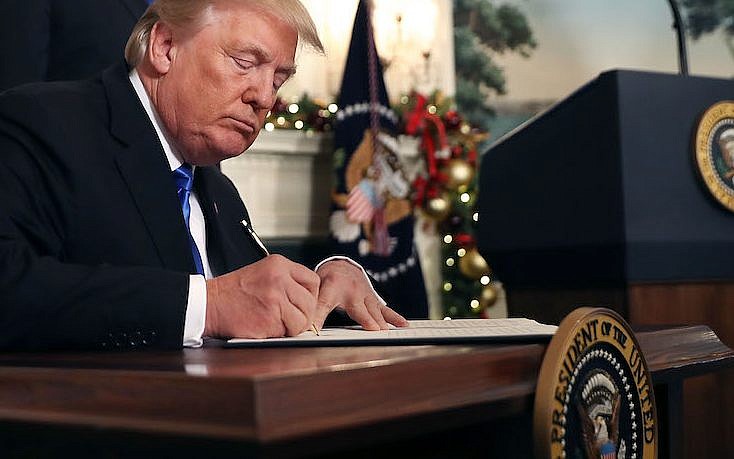
US President Donald Trump signing a proclamation that the US government will formally recognize Jerusalem as the capital of Israel, at the White House in Washington, DC, December 6, 2017. (Chip Somodevilla/Getty Images via JTA)

On December 7, 2017, Trump announced that he was recognizing Jerusalem as Israel’s capital and that he had instructed the State Department to begin preparation to relocate the US embassy there. The Palestinian Authority has boycotted Washington ever since and on May 14 the new embassy opened in the Arnona neighborhood of Jerusalem.

In a twist of bureaucratic red tape, hours after his December declaration, Trump did in fact sign the waiver and then signed it again in June 2018.

Trump’s move was necessitated by the fact that the ambassador’s official residence has not yet been relocated to the capital.

The US decision led relations with the PA to spiral downwards. In light of Ramallah’s severing of ties, Washington has cut all aid to the Palestinians this year with the exception of some $42 million it gives them for ongoing security cooperation efforts. It also closed the Palestine Liberation Organization’s mission in Washington DC.

The Trump administration’s plan for Israeli-Palestinian peace is expected to be rolled out in the coming months. Although the Trump administration has been long touting its peace plan, details of it have been scant, and the Palestinians have vowed not to cooperate with US efforts.


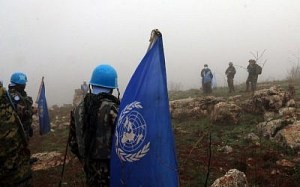
With guns out, Israeli, Lebanese soldiers squabble at border 

December 17, 2018

Source: With guns out, Israeli, Lebanese soldiers squabble at border | The Times of Israel

In morning incident, Lebanon disputes Israel’s placement of concertina wire along Blue Line separating the two countries; UN troops on site keep peace

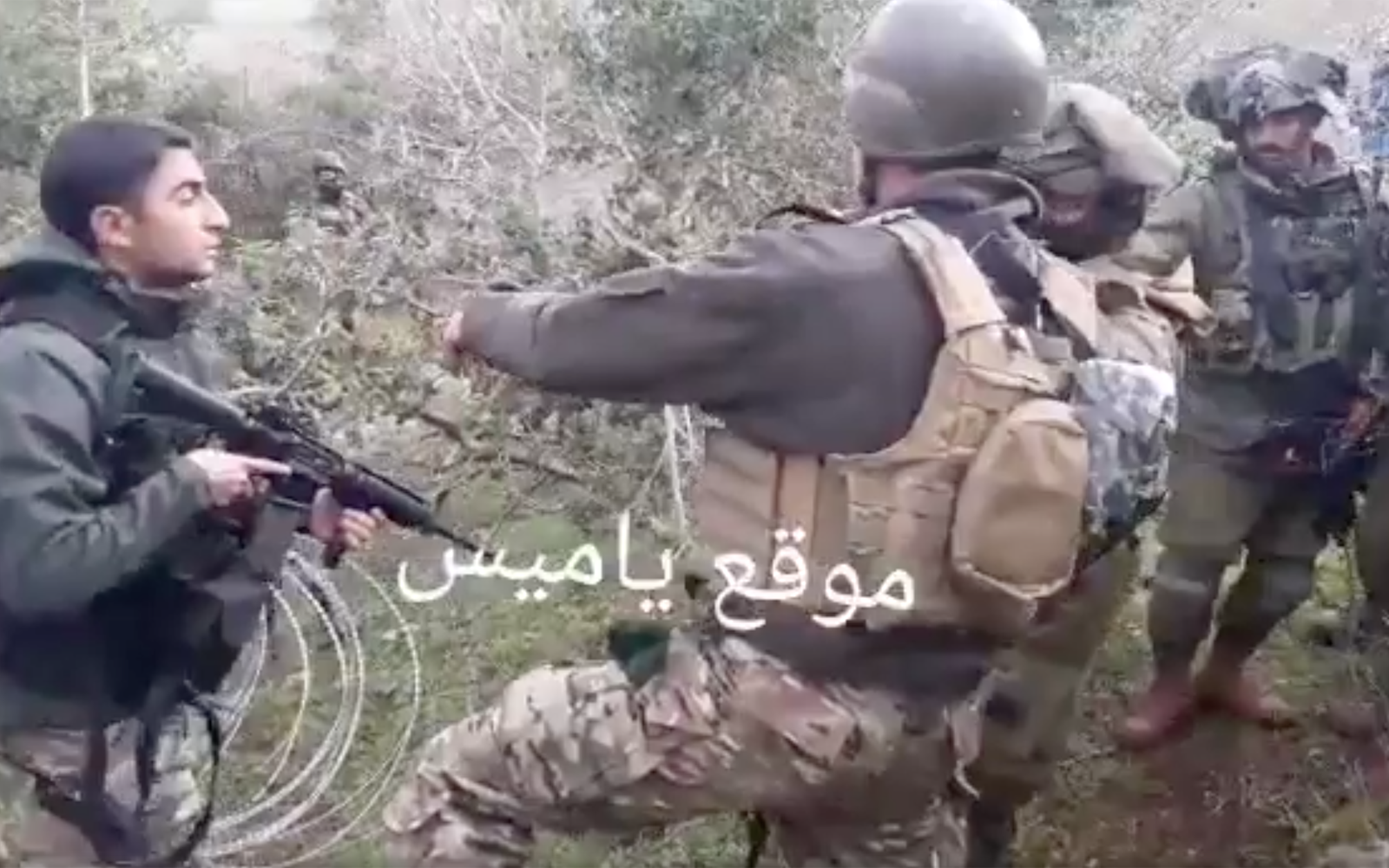
Israeli, Lebanese troops argue after Israel places concertina wire near border between two countries on December 17, 2018. (Screen capture/Twitter)

Israeli, Lebanese troops argue after Israel places concertina wire near border between two countries on December 17, 2018. (Screen capture/Twitter)

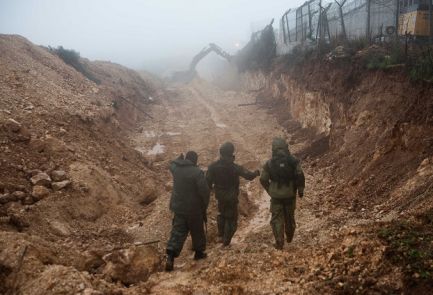
Rifles drawn, Israeli and Lebanese troops verbally sparred over Israel’s placement of concertina wire along the border line separating the two countries Monday morning, as part of an ongoing IDF effort to find and destroy cross-border attack tunnels.

United Nations peacekeepers were at the scene, working to prevent conflict between the two sides.

On December 4, the Israel Defense Forces launched Operation Northern Shield, an effort to find attack tunnels dug into Israeli from southern Lebanon by the Hezbollah terror group. So far, the Israeli military has said it’s uncovered four such tunnels but knows of the existence of several more.

The operation has raised prospects of a possible fresh conflict on the volatile border, though Lebanon has downplayed chances of war so long as Israeli troops do not cross the border. UN peacekeepers have also stepped up patrols to ensure the frontier remains calm.

Embedded video

علي شعيب 🇱🇧@ali_shoeib1

هكذا منع الجيش اللبناني جنود العدو من وضع أسلاك شائكة على الخط الأزرق في ميس الجبل بغياب فريق جغرافي لبناني

The IDF said Monday it placed rolls of concertina wire on the Israeli side of the Blue Line, the armistice line that acts as a de facto border between the two countries. The army said it had coordinated its activities with the UN Interim Force in Lebanon, known by its acronym UNIFIL.

The Lebanese military, however, objected to the concertina wire’s placement and approached the area in an apparent effort to remove it.

Video from the scene showed Lebanese soldiers arguing with unarmed UNIFIL officials and Israeli troops about the exact location of the border.

“You told us it was behind the tree,” one of the Lebanese soldiers is heard saying.

The IDF said the altercation never escalated to violence. Both sides eventually left the area.

UNIFIL did not immediately respond for comment.

This weekend, the Israeli military uncovered a fourth cross-border attack tunnel that it says the Hezbollah terror group dug into Israel from southern Lebanon.

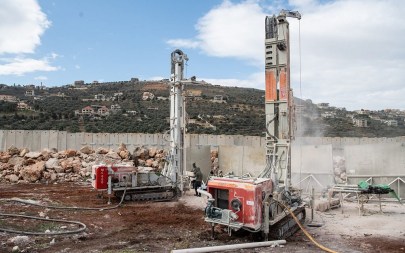
The Israeli military drills into the soil south of the Lebanese border in an effort to locate and destroy Hezbollah attack tunnels that it says entered Israeli territory, on December 5, 2018. (Israel Defense Forces)

The IDF refused to specify where the tunnel was found, but said the “relevant local governments” were notified of its location. “The tunnel is under IDF control and does not present a threat,” the army said in a statement.

The IDF filled the tunnel with explosives — as it did with the three other tunnels it exposed in recent weeks — in order to ensure that it could not be used to carry out an attack.

“Whoever enters it from the Lebanese side forfeits his life,” the army said in a statement.

The military said it believes the tunnels were meant to be used by the Iran-backed terror group as a surprise component of an opening salvo in a future war, to allow dozens or hundreds of terrorists into Israel, alongside a mass infiltration of operatives above-ground and the launching of rockets, missiles, and mortar shells at northern Israel.

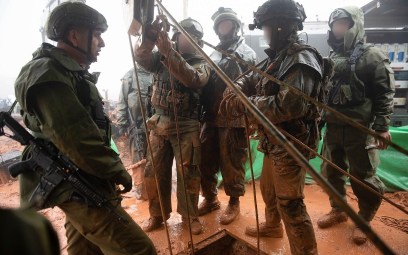
Israeli troops search for a Hezbollah border-crossing attack tunnel from southern Lebanon, along the northern border, on December 8, 2018. (Israel Defense Forces)

The specific number of tunnels that Israel believes were dug from Lebanon, as well as other information about the operation, cannot be published by order of the military censor.

According to the IDF, Operation Northern Shield is taking place close to Lebanese territory, sometimes on the north side of the border wall, albeit still inside Israeli territory.

An IDF incursion into Lebanon could spark a major confrontation with Hezbollah, which bills itself as a defender of Lebanon against Israeli aggression.

A picture taken from the southern Lebanese village of Meiss al-Jabal on December 9, 2018, shows Israeli and United Nations Interim Forces in Lebanon (UNIFIL) soldiers gathered on the Israeli side of the border between the two countries (Ali DIA / AFP)

Israeli officials have indicated that the IDF may operate within Lebanese territory, if necessary, to destroy the tunnels. Lebanese President Michel Aoun, a Hezbollah ally, said Tuesday that the United States assured him that Israel has “no aggressive intentions” with its Operation Northern Shield.

The first and second tunnels were found outside the town of Metulla, near the Lebanese border. The military has refused to reveal the locations of the subsequent tunnels it found, and the military has censored much of the information surrounding the operation, citing national security.

Israel maintains that the tunnels represent a “serious violation of Resolution 1701 and the State of Israel’s sovereignty.”

UN Resolution 1701 ended the 2006 Second Lebanon War and required all armed groups besides the Lebanese military to remain north of the country’s Litani River.


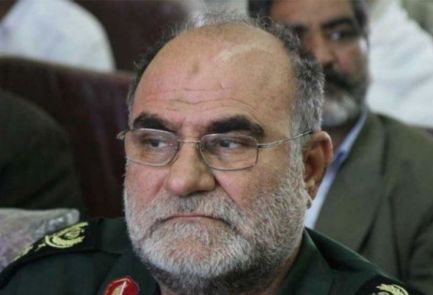
Report: Iranian general fatally shoots himself in gun cleaning accident

December 17, 2018

Source: Report: Iranian general fatally shoots himself in gun cleaning accident – Israel Hayom


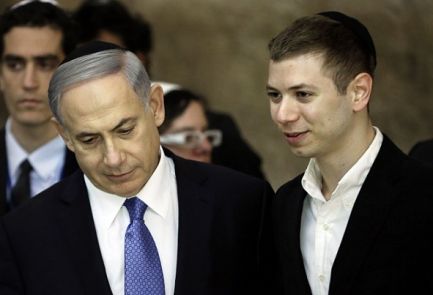
Off Topic: PM’s son Yair Netanyahu temporarily banned from Facebook

December 17, 2018

Source: PM’s son Yair Netanyahu temporarily banned from Facebook – Israel Hayom


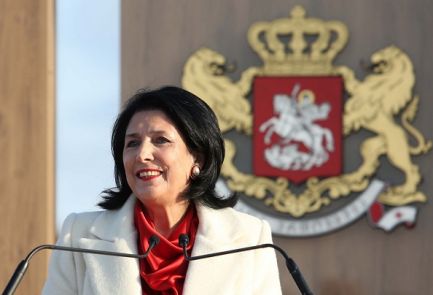
Georgia mulls relocating its embassy in Israel to Jerusalem 

December 17, 2018

Source: Georgia mulls relocating its embassy in Israel to Jerusalem – Israel Hayom


Hamas boasts finding high-tech ‘trove’ after botched IDF op 

December 17, 2018

Source: Hamas boasts finding high-tech ‘trove’ after botched IDF op – Israel Hayom


Did Iran order the recent attacks in Israel? 

December 17, 2018

Source: Did Iran order the recent attacks in Israel? – Israel Hayom

Rachel Avraham

After the State of Israel buried two IDF soldiers and a newborn baby who was murdered before even being granted the right to live, the Israeli military is preparing for more violence.

The question remains, who stands behind the recent escalation? According to a recent report in Yedioth Ahronoth, Hamas, an Iranian proxy, stands behind the recent spike of violence in Judea and Samaria. And according to Palestinian dissident Mudar Zahran, Iran used the Gazan terror groups to lash out at Israel because the Islamic republic needs a diversion from its present predicament due to the increased U.S. sanctions. The question remains, why does Iran seek to target Israel now when Israel just permitted Qatar to transfer $15 million to Hamas?

Iran has suffered immensely from the recent U.S.-imposed sanctions. According to the International Monetary Fund, in the wake of the latest U.S. sanctions, GDP growth in Iran will be -1.5% for 2018. In addition, the IMF projects that the sanctions will cause 40% inflation and a 1.3% increase in unemployment this year. Although eight countries were exempted from Iran’s sanctions on humanitarian grounds, these exemptions are only temporary and would be subject to an immediate reduction of 40% to 50% of Iran’s oil purchase. While all of these statistics are unlikely to hinder Iran from continuing to support both Hamas and Islamic Jihad, Al Arabiya noted that Iran is still hurting, prompting the regime to engage in increasingly repressive measures against their own people and to take further action against Israel.

According to Iranian political theorist Dr. Reza Parchizadeh, “The Iranian regime always exploits Israel’s security weaknesses as a bargaining chip with the U.S. That is why it needs a foothold close to Israel. Whenever the Iranian regime is under pressure from the U.S., it tightens the screws on Israel so the U.S. relents. In the months leading up to the new round of sanctions, Iran was openly threatening Israel with retaliation and annihilation. Abbas Araghchi, the political deputy of the Iranian Foreign Ministry, threatened European countries with terrorism and security problems if they would not try harder to ease the U.S. sanctions. The same thing is with Israel. As soon as the [Iranian] regime is under pressure, it incites Hamas and Islamic Jihad to open fire on Israel. It has probably kept Hezbollah for the next phase of the escalation.”

Mendi Safadi, who heads the Safadi Center for International Diplomacy, Research, Public Relations and Human Rights, added, “After Iran took control of Yemen, Lebanon, Iraq and Syria, it is working to take over Gaza and the Palestinian Authority. It is pouring in a lot of money in order to keep the flames on fire in Gaza and in order to spread it to the PA.” The Gazan terror groups have ample reason to pay attention to instructions given to them by the Iranian regime. According to a Palestinian source, the Iranians are very influential with most of the terror groups in Gaza especially when their paychecks come in.

According to Dr. Mordechai Kedar, a senior lecturer at Bar-Ilan University, “The Iranians paid for the Gaza protests and the arson attacks which they did in our fields, groves and forests. They were behind the kite and balloon terror. They also paid for the Qassam rockets. They sponsored the development of rockets that could surpass the capabilities of Iron Dome.” A press release put out by the Meir Amit Intelligence and Terror Information Center found that when a Gazan anti-tank Kornet missile hit a bus with soldiers inside of it, severely injuring one, the technology was provided by Iran. Yedioth Ahronoth has reported that Iran transfers $100 million per year to Hamas and Islamic Jihad. Both terror groups use the Iranian money to prepare for war against Israel instead of helping their own civilian populations.

According to a Palestinian source, Hamas ultimately agreed to a cease-fire only because it was threatened by Egypt: “It wouldn’t be the Israelis who would wipe Gaza out.” Given this, Hamas is not entirely committed to the cease-fire. Therefore, according to Safadi, even after Hamas agreed to a cease-fire in Gaza, it continues to incite young people and to seek an escalation of violence in Judea and Samaria so that it can justify the funds that it receives from its Iranian masters. Iran wants Israel to suffer particularly to avenge for the suffering that the U.S. has inflicted on the Iranian regime: “Hamas is not acting on its own but is directed by external elements that dictate the agenda.”

By escalating the violence in Judea and Samaria, Iran seeks to sabotage any potential U.S. peace plan before it has a chance to get off the ground. Therefore, Zahran claims that the recent violence that Israel has experienced has everything to do with changes that are happening in the region and the motivation behind it is to provoke Israel into declaring a total war – a trap that, so far, Israel has not fallen for. Given this, Israel can expect more violence in the immediate future.

Rachel Avraham is the president of the Dona Gracia Mendes Nasi Center for Human Rights and a political analyst at the Safadi Center for International Diplomacy, Research and Public Relations.

Punishing a Saudi prince 

December 17, 2018

Source: Punishing a Saudi prince – Israel Hayom

Clifford D. May

Consult a map of the Middle East. Locate the Strait of Hormuz, a narrow sea passage separating the Arabian Peninsula from Iran, and connecting the Gulf – whether you call it the Persian Gulf or the Arabian Gulf is a thorny question – to the open oceans beyond.

The Strait of Hormuz is among the world’s most strategic waterways, essential to the health of the global economy. More than a third of seaborne oil shipments and 20 percent of the oil traded internationally pass through it.

The U.S. Navy – specifically the Bahrain-based Fifth Fleet – keeps this sea lane open, frustrating Iran’s rulers who claim it as their private lap pool. They menace American vessels there – though less frequently since Donald Trump replaced Barack Obama in the White House.

Look at the map again. Locate Bab el-Mandeb, another strategic strait. It separates Yemen and the Arabian Peninsula from Africa and guards the entrance to the Red Sea at the northern end of which is the Suez Canal, also a vital chokepoint. Iran’s rulers covet Bab el-Mandeb as well.

Their maritime goals support their hegemonic ambitions. The last thing American leaders should do is help them. Yet a bipartisan majority of senators is working on a resolution that would do exactly that by withdrawing U.S. military assistance to the Saudi-led coalition fighting Iranian-backed Houthi rebels in Yemen.

How did this come about? On October 2, Jamal Khashoggi, a Saudi dissident who for two years had been contributing opinion columns to The Washington Post, was murdered in the Saudi consulate in Istanbul.

The Saudi government has charged 11 individuals in connection with the killing. The Trump administration has sanctioned 17 persons thought to be implicated.

Many members of Congress regard that as woefully insufficient. They believe, as does the CIA, that Crown Prince Mohammed bin Salman, Saudi Arabia’s de facto ruler, ordered the hit – or at least that the buck stops on his desk, or throne or yacht or wherever.

Fair enough but let me state what ought to be obvious: To punish Saudi royals by rewarding Iranian ayatollahs makes no sense.

It is not in the U.S. national interest for the Houthis to prevail in Yemen, thereby allowing Iran’s rulers to expand their empire, threaten Saudi Arabia’s southern underbelly (from which the Houthis already fire missiles at Riyadh), and station forces adjacent to Bab el-Mandeb.

Consider what’s happened in this region over the last few years: Lebanon, for all intents and purposes, is ruled by Hezbollah, Tehran’s proxy.  Iranian military forces and mercenary militias have propped up Syrian dictator Bashar Assad. Iranian influence in Baghdad has increased since Obama withdrew American troops in 2011. The clerical regime works closely with Hamas and Palestinian Islamic Jihad in Gaza.

Anyone with a lick of sense understands why preventing the Islamic State group from establishing a Middle Eastern caliphate is in the American national interest.  How many licks does it take to grasp that it’s no less imperative to prevent the Islamic republic from achieving the same objective (though the preferable Shia term would be imamate)?

The royal families who rule the United Arab Emirates and Bahrain harbor no illusions about the threat Tehran poses to them. That has been made abundantly clear in conversations I’ve had over recent days with senior officials in both countries, including top officers in the UAE military whose troops are fighting in Yemen.

Commanders with the U.S. Fifth Fleet also made plain why it’s essential to contain – if not roll back – the imperialist and avowedly jihadist Islamic Republic of Iran.

The conflict in Yemen has been devastating for the civilian population. A negotiated solution would be welcome. But the Houthis chant, “Death to America, death to Israel, a curse upon the Jews, victory to Islam,” and according to an Associated Press investigation practice “extreme torture” – including hanging victims “from chains by their wrists or genitals for weeks at a time.”

We may safely conclude that these are not exactly let’s-make-a-deal kind of guys. Can anyone seriously believe that they will be more amenable to compromise if the military pressure on them is eased?

House members, before deciding whether to support whatever resolution the Senate passes, would be well-advised to spend a few minutes studying a map of the Middle East and thinking about what it will mean if the region falls under the boot heel of an oil-rich, jihadist theocracy that intends to become nuclear-armed. (Obama’s deal with Tehran was meant only to delay, not prevent that eventuality.)

There are other ways to punish the Saudis. Or perhaps a better idea: Use this crisis instead to press the Saudis for serious reforms.

Final point: Despots kill dissidents. Always have. Always will.

More than 10 critics of Russian President Vladimir Putin have died in suspicious circumstances. There has been a string of recent Iranian terrorist plots in Europe. And let’s not forget the foiled 2011 Iranian plot to assassinate the Saudi ambassador in a Georgetown restaurant. Meanwhile, both Iran’s rulers and Putin share culpability with Assad for the slaughter of half a million men, women and children in Syria.

In these and many other instances, the so-called international community responded fecklessly. It would not be surprising if the 33-year-old crown prince – who though wealthy and powerful is by no means worldly – had expected the killing of Khashoggi to be treated with similar indifference.

Clifford D. May is president of the Foundation for Defense of Democracies and a columnist for The ‎Washington Times.


Russia warns Lebanon against violations of ‎Israeli territory 

December 17, 2018

Source: Russia warns Lebanon against violations of ‎Israeli territory – Israel Hayom